Table of Contents
- Storm on the Garonne: Setting the Stage for 848
- Aquitaine Before the Fire: A Fragile Carolingian Frontier
- Men from the North: Who Were the Vikings of the Garonne?
- Watching the River: Bordeaux on the Eve of Disaster
- Dragon Ships at Dawn: The Viking Fleet Approaches
- The Assault Begins: Breaking the Defenses of Bordeaux
- Fire in the Streets: The Sack and Plunder of the City
- Churches in Flames: Monasteries, Relics, and Sacred Loot
- Captives, Ransom, and Slavery: The Human Cost of 848
- Kings, Counts, and Quarrels: Political Chaos in Aquitaine
- Echoes in the Chronicles: How Medieval Writers Remembered 848
- Aftermath on the Garonne: A City Half-Empty
- Long Shadows: How 848 Shaped Viking Strategy in France
- Memory, Myth, and Identity: Bordeaux’s Viking Ghosts
- Conclusion
- FAQs
- External Resource
- Internal Link
Article Summary: In the year 848, a Viking fleet forced its way up the Garonne and struck the flourishing city of Bordeaux, unleashing a wave of destruction that would echo through Aquitaine’s history. This article reconstructs the viking raid bordeaux 848 as both a military event and a human catastrophe, exploring the political fractures that left the city vulnerable and the mindset of the Norse raiders who saw in it an irresistible prize. We follow the approach of the longships, the crushing of local defenses, and the burning of churches and houses, while tracing the trauma endured by captives, clergy, and townspeople. The narrative then widens to examine how this single raid exposed the weakness of Carolingian power and reshaped strategies on both sides of the conflict. Drawing on medieval chronicles and modern historical analysis, it shows how the memory of the viking raid bordeaux 848 became woven into regional identity, part fear, part legend. By the end, Bordeaux’s ordeal emerges not as an isolated misfortune but as a turning point in the Viking age along the Atlantic seaboard. Throughout, the article keeps returning to the viking raid bordeaux 848 as a lens for understanding the collision between northern seafarers and a fractured Frankish world. It is a story of fire, river mist, and political ruin, but also of survival and the slow rebuilding of a wounded city.
Storm on the Garonne: Setting the Stage for 848
The year 848 did not arrive in Aquitaine as a single, isolated disaster; it came at the end of a long tightening of the noose. Along the Atlantic seaboard, rumors had been growing for more than a generation: tales of swift ships, of men in strange helmets, of coastal churches stripped bare in a single tide. By the time the viking raid bordeaux 848 descended upon the Garonne, the word “Norman”—a catch‑all term in Frankish sources for men of the North—already carried the chill of prophecy. In monasteries from Brittany to the Loire, monks inserted hurried lines into their chronicles: “The Northmen came…” Those brief sentences were the tip of an enormous, unseen iceberg of fear.
Bordeaux, however, was not a helpless fishing village. It was a city with a Roman memory: stone walls, a structured episcopal hierarchy, busy river quays lined with warehouses and wine amphorae. Merchants came from the hinterland of Aquitaine, loading barrels of the region’s wine for export and receiving in return salt, cloth, and precious goods from across the Frankish world. The city’s prosperity was tied to the river—the same river that, in 848, would carry its ruin. It’s astonishing, isn’t it? The very artery of life could so quickly become a corridor of death.
On clear evenings, citizens of Bordeaux might have stood atop fragments of the old Roman fortifications, looking down at the slow curve of the Garonne. They saw fishing boats, barges laden with grain, perhaps a royal envoy’s vessel heading toward the interior. Few, perhaps, could imagine that a different silhouette—sleeker, more predatory—would soon appear: long, shallow‑draft ships, their high stems like carved beasts, their prows cutting upriver against the current at an unnerving speed. Yet if anyone had been reading the signs closely, the danger was already there, written in the wider geography of power, war, and royal weakness.
The Carolingian empire, once unified under Charlemagne, had splintered after his death into rival kingdoms, cousins and brothers quarreling over inherited dominions. In the southwest, Aquitaine was both a prize and a problem: rich, semi‑independent, and restless under distant northern rulers. The royal court in the north struggled to enforce authority in this borderland of tongues and loyalties, where Gascon lords negotiated, resisted, or ignored royal orders as it suited them. A distracted, divided kingdom is exactly what Viking leaders looked for—a place where rivers were wide, goods were plentiful, and defense was someone else’s problem.
To understand the viking raid bordeaux 848, then, we must imagine not a sudden bolt from the blue but a long build‑up of storms offshore, political and military. The longships that would one day nose into the estuary were the final visible edge of a much larger front: demographic pressures in Scandinavia, the lure of silver and Christian gold, the tested routes of previous raids along the Loire and the Seine. The Garonne was, in many ways, the next logical step. But for the people of Bordeaux, it would feel like the end of the world.
Aquitaine Before the Fire: A Fragile Carolingian Frontier
In the mid‑ninth century, Aquitaine stood at the intersection of cultures and ambitions. Legally, it belonged to the kings of the Franks, heirs of Charlemagne, but its heart beat to an older rhythm—Roman, Visigothic, and local. Dukes and counts managed territories that were at once royal offices and hereditary fiefdoms. A web of small churches and monasteries dotted the countryside, binding villages to saints and patrons as much as to kings. Into this intricate environment came the stresses of civil war and external attack.
Louis the Pious, Charlemagne’s son, had tried to keep Aquitaine within the imperial fold by designating his son Pippin as sub‑king there in the early ninth century. Pippin ruled from this southwestern base, giving Aquitaine a semi‑autonomous status. When Pippin died and Louis’s other sons began tearing at the empire’s fabric, Aquitaine’s political situation soured. Competing claimants, shifting loyalties, and intermittent rebellions meant that by the 840s, the region’s rulers were more focused on who wore which crown than on who defended which frontier.
The Treaty of Verdun in 843 divided the Carolingian world into three kingdoms. Although this treaty is often treated as a neat solution in textbooks, on the ground it created new uncertainties. Borders overlapped with older, messier loyalties; local magnates weighed which ruler would most respect their rights and privileges. The city of Bordeaux, sitting near the edge of the Atlantic and the Garonne’s inland route, depended on coordinated defense between royal authority, the local count, and the bishop. But coordination requires clarity, and clarity was in short supply.
Complicating this picture were the Gascons, the people inhabiting the lands south of the Garonne and toward the Pyrenees. Their dukes and lords held a reputation in Frankish sources for independence, even unruliness. Some Gascon nobles cooperated with Frankish kings; others resisted or played a longer game, waiting to see which way the wind blew. The Viking raiders—by now seasoned observers of Frankish politics—would have understood that this region was fractured. If not in every detail, then at least in the crucial sense: there would be no single, unified army rushing to Bordeaux’s aid.
Economically, Aquitaine was flourishing. Its wines were known far beyond regional borders; its agricultural wealth filled warehouses and storehouses like those along Bordeaux’s riverfront. To raiders who had already tested the plunder of monasteries in the north, the prospect of tapping into this southern wealth was tempting. Monasteries like Saint‑Sever and La Réole guarded not only relics but also charters and inventories—records of land, herds, and accumulated gifts. Even if the Vikings never read these documents, their scouts and informants would have picked up on the visible signs of surplus.
Yet behind the celebrations of vintage and trade fairs, a slower anxiety crept along the riverbanks. Stories arrived from the Loire of Viking encampments, of raiders overwintering on islands, of towns buying peace with heavy tribute. The word “Danes” no longer meant a rare, distant menace but a recurring presence in the political calculations of counts and bishops. Some may have argued for stronger walls; others for alliances; still others for trust in God and the patron saints. In many ways, the debates failed to catch up with the speed of events. When the viking raid bordeaux 848 finally surged up the Garonne, Aquitaine was rich, divided, and unprepared—a combination that would prove deadly.
Men from the North: Who Were the Vikings of the Garonne?
The attackers who would storm Bordeaux in 848 were not faceless barbarians from a dark lagoon of myth. They were, in all likelihood, a composite force of Norse warbands, perhaps primarily Danish but possibly mixed with Norwegians and men from the isles and coasts they had already visited. By the mid‑ninth century, Viking activity had evolved from quick smash‑and‑grab raids into more organized campaigns. Fleets coordinated timings, divided spoils, and returned repeatedly to rich river systems. The Garonne was a fresh theatre for seasoned players.
Their longships remain some of the most iconic artifacts of the era: clinker‑built hulls, overlapping planks riveted together for flexibility and strength; shallow drafts that allowed them to slip into estuaries and upriver channels where heavier Frankish craft could not follow. A typical warship might carry 30 to 60 men, each one both rower and fighter, shield and sword hanging by his bench. A fleet of a dozen vessels could disgorge several hundred warriors—a number more than sufficient to overwhelm a poorly defended port city whose garrison might be little more than a small mounted retinue and local militia.
Leadership within a Viking fleet was a mixture of charisma, experience, and opportunity. We do not know the name of the chieftain who commanded the viking raid bordeaux 848; the sources are frustratingly silent. They speak of “Northmen” or “pagans,” interested more in the calamity they wrought than in their internal politics. Yet we can tentatively reconstruct their mindset. These leaders had seen, or heard in detail, how previous raiders had extracted tribute from Frankish kings along the Seine, or how they had burned monasteries like Nantes and plundered inland along the Loire. They knew that Carolingian weakness opened doors.
Such men were not merely pirates. Many came from societies in Scandinavia undergoing demographic and political change: competing chieftains, limited arable land, the lure of overseas wealth and honor. Raiding, trading, and exploring formed a continuum rather than clear categories. A Viking crew that sacked a church one season might sell its captured goods and slaves in a more peaceful port the next. Silver, weapons, fine cloth, and especially people—captives who could be ransomed or sold—were vital storage units of value.
Their religious outlook clashed sharply with the Christian world of Aquitaine. To the Vikings, churches and monasteries were simply wealthy storehouses, their relics and sacred vessels indistinguishable from other forms of treasure. Gold chalices, silver reliquaries, embroidered altar cloths—these gleamed in the half‑light of sanctuaries as invitingly as the ornaments in any royal hall. The horror felt by Christian chroniclers at such desecration was not necessarily shared by the raiders. Sacrilege, from the Viking point of view, was a foreign accusation.
It would be easy to paint these men purely as savage destroyers, but the reality was more complicated. They navigated complex waterways; they negotiated (sometimes) with local rulers; they weighed the risks of pushing deeper inland against the potential rewards. The decision to send a fleet into the Garonne and toward Bordeaux was a calculated one. They would have scouted the estuary, probed nearby coasts, and gauged the absence of strong, coordinated Frankish response. The viking raid bordeaux 848 was the product not of blind fury but of cold logic sharpened by a warrior culture and an appetite for risk.
Watching the River: Bordeaux on the Eve of Disaster
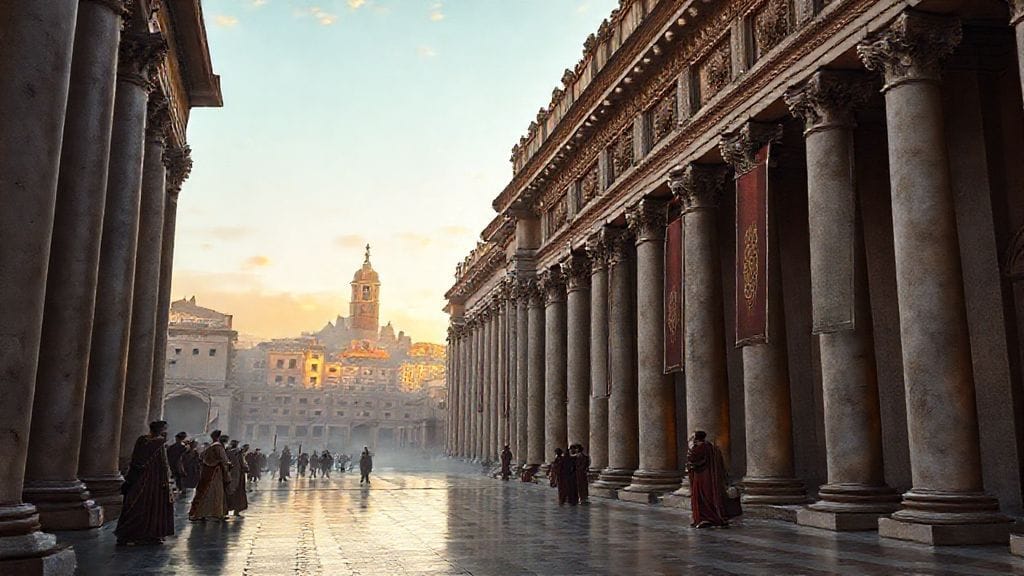
Bordeaux in the 840s was a city of layers. Roman walls, though in some places crumbled, still traced a defensive ring around the core. Within, narrow streets threaded between houses of stone and timber, while outside the walls suburbs stretched toward the riverbanks, where the real economic heartbeat of the city pulsed. The bishop’s quarter and key churches dominated the skyline, their towers and roofs rising above clusters of workshops and homes.
On the eve of the raid, the city’s leaders faced a tangle of worries. The local count had obligations not only to defend the city but also to engage in the region’s wider political struggles. Forces might be drawn away to support or oppose a rival in nearby territories. The bishop, too, had to balance care for his flock with the need to secure his own estates and those of the Church. In an age where secular and ecclesiastical power intertwined, disagreements over priorities could easily sap the effectiveness of any joint defense.
Still, the threat of Viking attack was not unknown. Coastal and riverine communities across the Frankish world had begun to erect watch posts, improve fortifications, or erect emergency refuges. It is likely that Bordeaux had some form of river watch, men assigned to look down the Garonne’s curve for unexpected sails. They might have seen ordinary trading vessels most days, their crews familiar and their cargos routine. Somewhere in the city, perhaps, someone had spoken already of Viking sails seen further north, on the Loire or the Charente, and warned that the Garonne might be next.
But warnings are not the same as preparations. We must imagine the tension between daily life and distant fear. Wine merchants were more immediately concerned with making the most of a good harvest; artisans cared about securing payment for their wares; the poor struggled with rents and dues. The possibility that several hundred armed foreigners could, in a single day, change everything—burn homes, seize people, shatter relics—was too vast, too unreal, to fully inhabit their minds. Human beings, then as now, often lived with danger through a combination of denial and hope.
The clergy, especially monks in nearby monasteries, may have been more acutely aware. Latin letters from this era often contain lines of dread about pagans, a sense that divine wrath for sins might be manifested in these northern scourges. In one chronicle from the region of the Loire, the writer laments that “the churches of God are exposed to wolves, and our sins cry out for correction.” That sentiment almost certainly echoed in Aquitaine. The viking raid bordeaux 848 would later be interpreted not only as a military failure but as a moral lesson: a punishment permitted by God to chastise a wayward people.
Yet for all this, the city did not cease to be itself. Children ran along the quays; barges creaked; bells rang the hours of the divine office. The smell of tar, wine, and river mud mingled in the air. If a sailor from the north, perhaps already in the pay of the Vikings as an informant, had walked among the crowds, he might have seen a complacent prize. Warehouses stacked with trade goods; churches glittering with liturgical ornaments; a citizenry whose primary defense was the assumption that tomorrow would be like today. But this was only the beginning of what the river was about to bring.
Dragon Ships at Dawn: The Viking Fleet Approaches
Sometime in 848—chronicles do not give us the exact day, leaving us only season and sequence—a line of longships appeared at the Garonne’s mouth. We must imagine them first as rumors on the coastal horizon: fishermen glimpsing low silhouettes that were not familiar, then rowing hard to shore with breathless tales of “Norman” sails. Word could have traveled upriver faster than the current, carried by riders and small boats, warning that the dreaded ships of the North were entering Aquitaine’s arterial waterway.
The Vikings, for their part, would not have rushed blindly. Their entry into the estuary was likely timed with care, using tides and winds to speed their advance. They might have paused briefly at key points—small settlements, river islands—to gauge resistance and, perhaps, extract quick plunder or provisions. Each bend rounded without serious opposition confirmed what their leaders hoped: that no strong defensive network waited ahead.
As they rowed or sailed inland, the landscape around the Garonne shifted from the open, salty estuary to more sheltered banks lined with fields and villages. The crews, seasoned from years of coastal raiding, would have noted the signs of wealth: the size of farmhouses, the number of livestock, the presence of stone churches even in modest communities. They were moving into a land where Christianity had sunk deep roots and accumulated centuries of gifts and tithes. In the Viking mental ledger, that meant treasure.
The approach to Bordeaux itself would have stirred a mix of anticipation and calculation. Far ahead, perhaps veiled in morning mist, loomed the first outlying structures of the city’s riverfront. Watch posts, if they existed, might have sounded alarms with horn or bell. Boats tied along the quays rocked in the churning wake of the approaching fleet. For the city’s people, the sudden appearance of tall masts and carved prows on the river would have broken the ordinary frame of the day like a shouted curse in a church.
Contemporary annals compress all of this into a line or two. One ninth‑century chronicle, speaking of similar attacks along the Loire, states simply: “The Northmen advanced by ship and devastated…” Such stark phrases, however, conceal the multitude of human reactions: panic, hurried confessions, mothers grabbing children, merchants hiding coin, priests clutching relics. As the viking raid bordeaux 848 fleet closed the distance, Bordeaux’s reality narrowed to one question: could they be stopped?
In all likelihood, there was some attempt to resist at the riverside—local warriors called to arms, perhaps a small mounted force riding to the quays to block a landing. But rivers are fickle frontiers. The Vikings could choose where to beach, swing from one bank to another, or even bypass initial defenders to strike weaker points. Their longships, running up onto the muddy shore, created instant bridges from water to land, warriors leaping down with shields locked and spears ready. The raiders’ arrival at Bordeaux was not just a frightening sight; it was a tactical advantage made visible in wood and steel.
The Assault Begins: Breaking the Defenses of Bordeaux
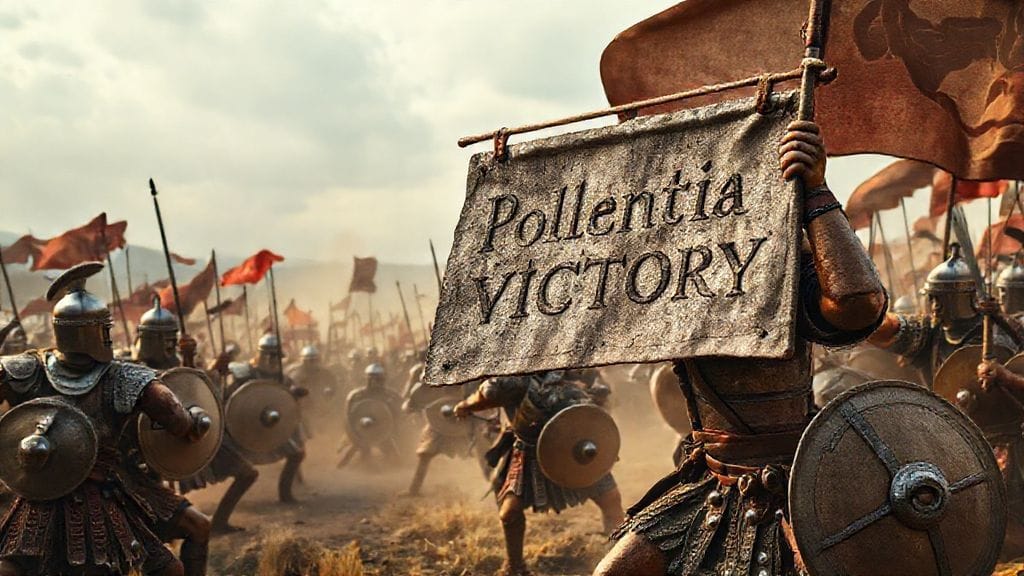
When the first longships reached Bordeaux’s immediate vicinity, the transition from approach to assault unfolded with brutal speed. The city’s defenders, limited in number and likely spread thin, confronted an enemy practiced in shock tactics. A sudden volley of arrows might have gone up from the ships, aimed at any visible concentrations of armed men ashore. Then came the real storm: warriors forming a rough shield wall as they advanced from the landing site toward the city’s gates and riverfront streets.
Bordeaux’s Roman walls, where intact, were a formidable barrier on paper. Stone ramparts, towers, and gates designed to check earlier barbarian incursions were still impressive centuries later. But defenses are only as strong as their maintenance, garrison, and will to use them. Chronic neglect in the troubled 840s could have left sections in disrepair. Meanwhile, the city’s growth beyond the walls in riverfront suburbs created unprotected zones of housing and commerce—soft tissue outside a hardened shell.
The Vikings, experienced with such hybrid urban landscapes from raids on towns along the Seine and Loire, would have probed for weakness. A lightly defended gate could be forced with axes; a section of lower wall, if undermanned, could be scaled with ladders or even climbed where rubble accumulated. Fire, too, was a weapon. Torches flung onto wooden gates or houses close to the walls forced defenders to choose between fighting and firefighting. The assault on Bordeaux was, above all, an exercise in stretching a small defending force beyond its limits.
Inside the city, chaos multiplied. Command and control in a ninth‑century town did not resemble the ordered chains of modern warfare. The count or his representative might try to rally men in the main square; the bishop could order processions, ring bells, and carry relics to inspire divine protection. But terrified townspeople did not necessarily think of coordinated defense. Many would have rushed to hide goods, flee with families, or seek refuge in churches, assuming—fatally—that sacred space would be respected by pagan raiders.
Somewhere along the line of contact, defenders broke. A gate was thrown open, a segment of wall yielded, or an undefended suburb was overrun and used as a foothold. Once the Vikings gained access to the interior spaces of Bordeaux, the logic of sack took over. Organized battle gave way to house‑to‑house plunder and fire. The viking raid bordeaux 848 was no longer simply a military operation; it had become, in the eyes of Bordeaux’s inhabitants, an apocalypse in the streets.
It’s worth noting how swift such transitions could be. Medieval urban defenses, when undermanned, often collapsed in hours rather than days. There was no long siege, no measured starvation of the city. Instead, Bordeaux faced a compressed catastrophe: from first sight of sails to the fall of its defenses might have passed a single, unbearable day.
Fire in the Streets: The Sack and Plunder of the City
Once Bordeaux’s defenses gave way, the Vikings fanned out like fire along dry tinder. Their priorities were clear: seize portable wealth, neutralize remaining resistance, and instill a terror so profound that organized opposition would crumble. In practice, that meant bursting through doors, overturning chests, and striking down any who resisted—soldier, merchant, or peasant. What for the raiders was business, for the inhabitants was the shattering of an entire world.
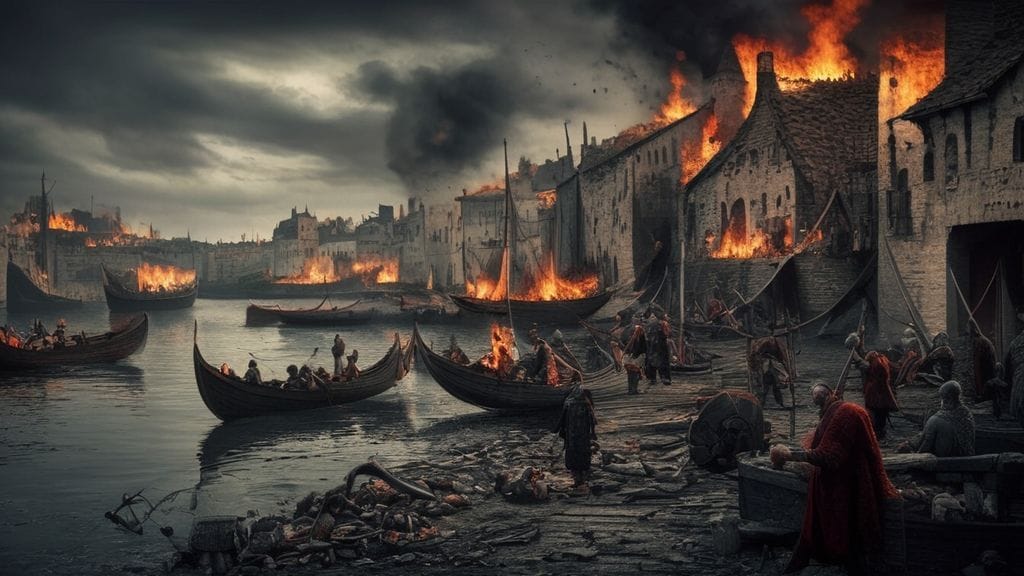
Flames joined steel as instruments of conquest. Wooden structures caught easily from torches or cooking fires overturned in the melee. Thatch roofs became blazing torches, sending smoke roiling into the sky above the city. The smell of burning pitch, timber, and thatch mixed with the metallic tang of blood. Chroniclers often mention fire in a ritualized way—“they burned the city”—but for those present, each building was a singular loss: a family’s home, a warehouse of hard‑earned goods, a shop that represented years of craft.
Amid the violence, acts of desperate courage flickered. A group of townsmen might have tried to form a defensive knot in a narrow street, leveraging their knowledge of the alleys to ambush small Viking detachments. A noblewoman, trapped as her household fell, could have confronted a raider with curses or pleas, clinging to children as bargaining chips for mercy. We hear nothing of their names in the surviving texts, but human resilience is as reliable a constant as human fear. The sack of Bordeaux would have been lit not only by fire but by these brief, often doomed, resistances.
Loot piled up quickly. Raiders grabbed silver cups, bronze cauldrons, richly woven cloths, jewelry, coins, and anything else that could be carried back to the river. Larger objects that could not be easily transported might be smashed in place to deny any future benefit to the Franks. Weapons taken from fallen defenders were valuable prizes, as were horses—though mounted pursuit was less useful once the raiders reached their ships. Above all, however, people themselves became plunder.
Men, women, and children were dragged from hiding places, roped together or guarded individually. For the raiders, captives represented liquid wealth: they could be ransomed back to local elites for silver or carried away to be sold in distant markets. A wine merchant with a reputation, a cleric from a wealthy family, or a noble youth might fetch considerably more than a peasant girl or dockhand, though in the brutal arithmetic of the slave trade, every body held a price. The viking raid bordeaux 848 thus fed into a wider network of human trafficking that stretched from the British Isles to Muslim Spain and even further into the Mediterranean.
As day turned toward night, the city’s skyline must have glowed with more than the usual lamplight. Columns of smoke twisted upward, visible for miles along the Garonne’s valley. Travelers approaching from the countryside would have seen that something terrible was happening, perhaps turning back in fear, perhaps hurrying toward the city in a futile attempt to aid loved ones. By the time darkness fell, Bordeaux was no longer the city it had been that morning. Its identity as a stable, semi‑Roman, Christian urban center had been violently rewritten by northern hands.
Churches in Flames: Monasteries, Relics, and Sacred Loot
Of all the spaces in Bordeaux, the churches and monasteries suffered perhaps the most symbolic blow. To Christian inhabitants, these were holy enclosures, the heart of community and memory. To Viking raiders, they were treasure houses protected only by unarmed men in robes. The collision of these perspectives produced scenes that later chroniclers would describe with special horror.
We have no detailed inventory of Bordeaux’s ecclesiastical riches in 848, but we can infer from comparable cities. The cathedral would have held a silver or gilded altar, reliquaries containing the bones of saints, processional crosses, ornate gospel books bound in decorated covers, liturgical vestments embroidered with gold thread, chalices, patens, and candelabra—objects donated over generations by pious kings, nobles, and merchants. Nearby monasteries and churches maintained their own, smaller treasuries. Each item represented not only artistic and spiritual value but the concentrated surplus of decades.
During the viking raid bordeaux 848, these sanctuaries likely became both refuges and targets. Terrified citizens crowded into naves, clutching relics or icons, believing that sacred walls and the intercession of saints would shield them from harm. Priests and monks organized prayers, processions, and perhaps last‑minute attempts to hide precious objects in crypts or burial grounds. The noise of battle outside—shouts, clash of arms, crackle of flames—must have penetrated the stone, turning liturgical chants into desperate pleas.
When Vikings reached these buildings, the encounter was brutal. Doors were forced; if necessary, roofs could be set alight to smoke out those inside. Some raiders, indifferent or even amused by Christian symbols, might have seized crosses and images only to strip them of metal and gems. Books, whose value required knowledge of Latin and a Christian framework, were often torn for their covers or simply thrown aside. In one famous description of a similar attack, a chronicler laments that “holy books were scattered in the mud and trampled by the feet of swine.” We can imagine well that Bordeaux’s scribes, if they survived, witnessed comparable desecrations.
Relics—the bones and remains of saints—occupied a complex position. For Christians, they were beyond price, mediators of miracles and protectors of the city. For the raiders, they may have been treated as curiosities or talismans, their containers far more important than their contents. Some Vikings did, over time, come to value Christian relics for their supposed magical power, but in 848 the likely response was more pragmatic: strip the gold and silver reliquaries, discard the old bones. The spiritual universe of the Franks experienced a kind of unmaking here, as matter was violently wrenched from meaning.
At least one chronicler from the region, writing in the later ninth century, comments that “the pagans spared neither altar nor virgin, neither priest nor child.” His words, though generalized, convey the sense that no degree of sanctity guaranteed safety. The viking raid bordeaux 848 shattered the assumption that churches, as houses of God, were off‑limits. In the centuries to come, reformers would look back on such episodes as proof that Christendom needed stronger walls, better discipline, and more unified kings—anything to prevent a repeat of that day when the altar stones of Bordeaux were stained with blood.
Captives, Ransom, and Slavery: The Human Cost of 848
Behind every burned building stood lives displaced, behind every looted treasury a chain of human suffering. The sack’s most enduring wound was not only the material loss but the tearing apart of families and communities. As the fires died and the Vikings organized their plunder, the captives taken in Bordeaux confronted an uncertain and terrifying fate.
Some were held for ransom. This was a grim but familiar practice in the medieval world; not only pagans but Christian lords ransomed enemies and sometimes their own subjects. The raiders would identify those of apparent status—judged by clothing, speech, and testimony—and send word, if possible, to their kin or patrons. Negotiations might involve intermediaries: clergy allowed to move between the Viking camp and the town’s survivors, or even nearby monasteries. Silver, livestock, and other valuables would be demanded in exchange for the release of the captured.
But ransom was far from universal. Many captives were herded together, bound and guarded as living cargo to be taken back downriver. Among them were likely artisans, young men and women, and children—all valuable labor or commodities in markets further afield. Some might end up in the slave markets of the Frankish north, others in the Danelaw in England, still others sold on to traders with links to Muslim Spain or beyond. The Viking world was hooked into wider exchange networks, and Bordeaux’s tragedy rippled across seas and cultures.
The psychological trauma for those left behind is almost beyond reconstruction. Parents who managed to hide one child but lost another, spouses divided, friends missing without trace—these were the daily absences that reshaped Bordeaux’s demographic and emotional landscape. A city can rebuild walls and churches in a generation; it cannot so easily patch the holes ripped into its social fabric. The viking raid bordeaux 848 did not simply lessen Bordeaux’s population; it altered its very composition and memory.
In sermons and letters after such attacks elsewhere, bishops urged their congregations to perform acts of penance and charity, including the ransoming of captives. It is reasonable to assume similar exhortations in Aquitaine. The Church condemned slavery in the abstract but operated within a society where enslavement through war and raiding was a recognized, if lamented, reality. Thus, Christian responses emphasized the duty to redeem captives when possible. Each successful ransom, however, told a double story: joy for one family, and the silent, unresolved fate of those who never returned.
We should remember, too, that not all Vikings remained pagans or permanent outsiders. Over subsequent decades, some northern warriors accepted baptism, entered Frankish service, or settled as semi‑legitimate lords in territories they once raided. It is possible—though unprovable—that a child taken from Bordeaux in 848 could have ended life integrated into a distant community, bearing in memory only hazy flashes of the burning city and the river. In that way, the human cost of the raid flowed outwards in countless individual stories, many of them ending far from the Garonne’s banks.
Kings, Counts, and Quarrels: Political Chaos in Aquitaine
If the human experience of the raid centered on fear and loss, the political consequences unfolded in accusations and calculations. The viking raid bordeaux 848 was a verdict on Carolingian governance as much as an episode of foreign aggression. For kings and counts, the burning of a major city raised uncomfortable questions: Who had failed? Who would pay? And who might use this disaster to strengthen their own claim to authority?
The Frankish kingdoms at this time were ruled by the sons and grandsons of Louis the Pious, who had already shown themselves willing to wage war upon one another. Aquitaine, with its mix of Frankish and local elites, was contested ground. Some nobles leaned toward West Francia under Charles the Bald; others entertained the claims of rival Carolingian branches. The Viking threat theoretically demanded unity, but in practice, it became one more token on the chessboard of power. A king could denounce his rival’s weakness by pointing to Viking incursions in that rival’s territory.
Within Aquitaine itself, counts and bishops had to demonstrate that they were doing something—anything—to prevent a repetition of Bordeaux’s fate. That might mean hastily repairing walls, organizing militias, or building fortified refuges (later known as castra) to shelter rural populations. It also meant writing letters to the royal court, seeking funds, troops, or at least royal sanction for defensive measures. Royal capitularies from this era sometimes refer to the need for river defenses and coordinated watches, though implementation varied wildly.
Blame tended to fall on local officials. A negligent count, an inattentive bishop, a cowardly garrison—such figures made convenient scapegoats. But the deeper problem was structural: an empire designed around the mobility and prestige of mounted warriors was not well organized to respond to swift, amphibious raids on long river systems. The Vikings had, in effect, discovered a pressure point in Carolingian political anatomy. The sacking of Bordeaux dramatized that vulnerability in the most public way possible.
Some historians have argued that the viking raid bordeaux 848 tipped the balance in local disputes, empowering certain families who could claim credit for recovery efforts or later victories against the Northmen. A count who organized a successful ambush of a small Viking band in the years after the sack might trumpet that achievement as proof of his fitness to rule. Alliances could be made on promises of security just as much as on promises of wealth. In that sense, Viking raids did not only destroy; they reshaped elite networks, pushing them toward new configurations of power.
At the royal level, Charles the Bald and others were forced to acknowledge that occasional punitive expeditions or tribute payments were insufficient. The recurring shocks of raids like that on Bordeaux contributed, over decades, to the emergence of more localized forms of defense. Castles, fortified bridges, and regional alliances gained importance. The Carolingian dream of a unified, centrally directed Christian empire dimmed, replaced by a more fragmented, feudal mosaic. Fire along the Garonne was one flicker in that larger shift.
Echoes in the Chronicles: How Medieval Writers Remembered 848
The events at Bordeaux in 848 would be unknown to us without the fragile testimony of medieval writers. Their words, preserved in manuscripts that survived fire, neglect, and later wars, offer brief glimpses into what the raid meant to contemporaries. Yet these glimpses are partial and shaped by their authors’ purposes: moral exhortation, political commentary, or simple annalistic record.
In the monastic annals of the region—documents like the Annales Bertiniani or the Chronicon Aquitanicum—the viking raid bordeaux 848 sometimes appears in stark, formulaic language. A typical entry might read: “In this year the Northmen sailed up the Garonne and sacked Bordeaux, burning churches and taking many captives.” Such phrases pack calamity into a single sentence. For the monks compiling these texts, the horror lay in the pattern: year after year, line after line, similar entries accumulating like blows.
Yet even in these compressed notes, we hear echoes of deeper interpretation. Chroniclers consistently frame Viking attacks as divine chastisements. One writer, speaking of raids further north but in language easily transferable to Bordeaux, lamented: “Because of our sins, God has allowed the furious Northmen to rage against us.” This was not rhetoric alone; it expressed a worldview in which history was a dialogue between human behavior and divine response. The sack of Bordeaux became, in this reading, both a fact and a sermon.
Later historians, writing in the tenth and eleventh centuries, sometimes elaborated on earlier entries, adding color and commentary. They might describe the Vikings as “cruel wolves” or “sons of perdition,” exaggerating numbers or atrocities to heighten the sense of catastrophe. While these expansions must be read critically, they show how the memory of 848 did not fade quickly. Instead, it was woven into a broader narrative of Christian suffering and eventual deliverance.
Modern scholars have debated the reliability of these accounts. Some argue that monastic writers, focused on their own losses, exaggerated Viking cruelty and ignored examples of negotiation or pragmatism. Others point out that archaeological evidence—burn layers, hoards buried in haste, abandoned settlements—corroborates much of the chroniclers’ bleak picture. In the case of Bordeaux, the written record, though sparse, aligns with what we know of Viking strategy and Carolingian weakness along major rivers.
One modern historian, Janet L. Nelson, has noted (in another context) that our view of the Viking age “is filtered through the ink of victims and survivors.” That observation applies keenly here. The viking raid bordeaux 848 reaches us not through a Viking saga boasting of exploits on the Garonne, but through Christian pens lamenting ruin. This asymmetry shapes the emotional tone of our narrative: we know far more of the fear and sorrow than of the raiders’ internal conversations. The chronicles, in a sense, are Bordeaux’s side of the story—partial, pained, and priceless.
Aftermath on the Garonne: A City Half-Empty
When the Viking ships finally pushed off from Bordeaux’s quays, their hulls heavy with loot and captives, the city they left behind was a wounded shell. Smoke still curled from smoldering ruins; charred beams lay across streets; some walls and towers stood blackened but intact, eerie witnesses to the day’s violence. The silence that follows such an invasion is not true quiet but a stunned absence—the missing sounds of markets, laughter, and ordinary quarrels.
Survivors emerged slowly from hiding places: cellars, thickets outside the walls, church crypts, even cesspits. They stepped into a transformed urban landscape. A familiar street might lead now to a heap of ash where a neighbor’s home had stood; the church where one had been baptized might be a gutted stone shell. The dead, too many to bury at once, lay in houses and public spaces. Priests and layfolk together faced the grim labor of collecting bodies, performing hurried rites where possible, or, in sheer necessity, consigning corpses to mass graves outside the walls.
Economically, the blow was severe but not fatal. A city with Bordeaux’s deep roots rarely dies from a single raid. Merchants who survived would slowly resume trade, perhaps more cautiously, perhaps at reduced scale. Some wealthier families, fearing a repeat attack, may have resettled inland, taking capital and connections with them. Others, seeing opportunity in a half‑empty city, might have moved in from surrounding areas, purchasing damaged properties at low prices. Urban continuity in the early Middle Ages was a dance between disaster and resilience.
The Church, too, began a process of repair. Bishops appealed for aid—financial or in kind—from other dioceses and from royal or ducal patrons. Relics, if lost, might be replaced by acquiring new ones from elsewhere; if miraculously preserved, their survival could be celebrated as a sign of divine favor. Rebuilding churches offered a visible way to restore confidence, though resources were stretched. In charters from later decades, we occasionally see references to lands “laid waste by the Northmen” being granted anew to ecclesiastical institutions, a kind of spiritual and economic re‑investment.
Psychologically, however, Bordeaux would never be quite the same. The viking raid bordeaux 848 entered communal memory as a dividing line: before the Northmen came, and after. Stories passed down from grandparents to grandchildren remembered not only fear but specific losses—“this quarter once held the house of my ancestor, burned by pagans,” or “our family’s relic was taken that year.” Such narratives helped explain misfortune and forged a shared identity as survivors.
At the same time, life insisted on its own return. Children were born who knew the raid only as a story. Shops reopened; new bell towers rose where old ones had fallen. The river, indifferent to human tragedy, continued its slow, muddy course, bearing barges and fishers just as before. Yet behind the everyday business of the Garonne, a new wariness lingered. Each unfamiliar sail on the horizon now carried, somewhere in the back of the mind, the shadow of dragon‑prowed ships.
Long Shadows: How 848 Shaped Viking Strategy in France
The sack of Bordeaux in 848 did not happen in isolation; it fit into a broader evolution of Viking activity in Francia. Earlier in the century, raids had been largely seasonal, hit‑and‑run affairs along coasts and lower rivers. By mid‑century, they had grown bolder, pushing inland, wintering in encampments, and, eventually, extracting formal tribute from kings. The successful attack on a significant southern city like Bordeaux sent a clear message to Viking leaders: the Garonne and the wider southwest were open fields for future exploitation.
After 848, there is evidence of continued Viking pressure in Aquitaine and neighboring regions. Fleets returned to the Garonne and nearby rivers in later years, sometimes establishing bases from which they could launch repeated forays into the countryside. Such patterns mirrored what was happening in the north along the Seine, where Viking encampments at places like Jeufosse allowed them to threaten Paris and Rouen repeatedly. The viability of this strategy depended on two things: navigable rivers and divided Frankish responses. Bordeaux demonstrated that both conditions could be met in the southwest.
For the Vikings themselves, experiences like the viking raid bordeaux 848 fed into a pool of collective knowledge. Word spread among different bands about which regions were rich, which defensive measures were growing stronger, and which rulers paid well for peace. Leaders planning new expeditions might factor in stories of Bordeaux’s wealth or of subsequent Frankish attempts to fortify the Garonne. Over time, a kind of informal strategic map emerged, charting where quick hits were best and where longer‑term operations—like occupying an island or a river peninsula—were worthwhile.
Frankish responses, in turn, adapted gradually. One particularly important development was the fortification of river crossings and bridges. A fortified bridge could serve as a barrier across a river, preventing Viking ships from passing further upstream without a fight. Charles the Bald, ruling West Francia, invested in such projects along the Seine and Loire. It is likely, though documentation is sparse, that similar efforts were considered or attempted along the Garonne, especially after the humiliation of 848.
Another shift lay in treaties and settlements. Kings began to experiment with granting land to Viking leaders in exchange for their conversion and their service as defenders against other raiders. This policy, more famously associated with the creation of Normandy in the early tenth century, had its roots in the ninth‑century crises triggered by raids like those on Bordeaux. The logic was harsh but pragmatic: if you cannot expel the wolves, perhaps you can collar some of them and set them to guard your flocks from others.
In this way, the long shadow of 848 extended beyond Aquitaine. It formed part of a series of shocks that pushed the Carolingian world toward new political forms and military arrangements. The Vikings, initially external predators, became—at least in some cases—internal actors, landholders, and eventually Christian lords. But those later developments should not obscure the rawness of the original blow. The viking raid bordeaux 848 remained, in memory, the moment when the Garonne first ran red beneath dragon ships.
Memory, Myth, and Identity: Bordeaux’s Viking Ghosts
Centuries after the smoke cleared and the last of the raiders had vanished from the Garonne, the story of Bordeaux’s sack continued to haunt the city’s sense of self. Medieval communities often used past catastrophes as moral exempla—stories to be retold in sermons, chronicles, and local traditions. In Bordeaux, 848 became one of those dark reference points, alongside later sieges and plagues, against which residents measured both their vulnerability and their resilience.
Local saints’ cults played an important role in processing this trauma. If certain relics were believed to have miraculously survived the flames, their preservation could be woven into miracle stories: the saint who guarded his own church from total destruction, or whose image remained untouched while everything around it burned. Such tales reaffirmed divine protection even in the midst of disaster. Conversely, the loss of a revered relic might be used by preachers as evidence of communal sin, a call to deeper piety and reform. In either case, the viking raid bordeaux 848 was not just history; it was a theological lesson.
Over time, details blurred and shifted. Oral retellings embellished the appearance of the raiders—their helmets sprouting horns in the imagination long before nineteenth‑century opera popularized that image. Numbers of ships and warriors grew in proportion to the tellers’ desire to emphasize Bordeaux’s ordeal. Specific tragedies—a child thrown into the river, a cloister burned with its nuns inside—could harden into fixed motifs, whether or not they had occurred exactly as remembered. Memory, like the river, reshaped its own banks.
In the early modern and modern periods, historians and antiquarians in Bordeaux revisited the medieval sources. Some sought to minimize the scale of the Viking impact, arguing that the city’s continuity proved its fundamental strength. Others, influenced by Romanticism, highlighted the dramatic clash of pagan Northmen and Christian Franks, turning 848 into a stage for broader narratives about civilization and barbarism. These interpretations reveal as much about their authors’ times as about the ninth century, but they show that the raid continued to exert imaginative force.
Today, Bordeaux is known globally for its wine, architecture, and riverside charm. Tourists stroll along quays where, more than a millennium ago, panicked citizens fled burning streets toward the uncertain refuge of the water. Archaeology, local archives, and comparative studies have allowed historians to re‑contextualize the raid, seeing it not as a random eruption of savagery but as part of the Viking age’s broader dynamics. Yet for those who pause to think about it, there is still something chilling in the thought that this elegant city once echoed with the shouts of raiders and the crackle of flames.
In the end, the ghosts of 848 are less about helmets and axes than about the fragile line between security and catastrophe. Bordeaux’s experience reminds us that thriving communities, deeply rooted in their landscapes and traditions, can find their world overturned in a single day by forces from beyond their imagined horizons. And it shows how, even after such a blow, memory can be molded into identity, turning past vulnerability into present vigilance.
Conclusion
The Viking raid and sack of Bordeaux in 848 stands at the intersection of personal tragedy and continental transformation. On one level, it was a brutal, localized event: ships appearing on the Garonne, walls breached, churches looted, homes burned, and people carried off in chains. On another level, it was a symptom of deeper currents—the fragmentation of Carolingian authority, the rising audacity of Viking operations, and the inadequacy of existing defensive arrangements along Europe’s great rivers. Through the lens of the viking raid bordeaux 848, we glimpse both the fragility of a medieval city and the adaptability of the societies that endured such blows.
Reconstructing this episode from sparse chronicles and broader patterns requires acts of careful imagination. We listen to the terse lines of monastic annals, weigh them against what we know of Viking ships and Frankish politics, and try to recover the human texture behind phrases like “they burned the city.” In doing so, we discover not only scenes of horror but also of resilience: survivors emerging from hiding, rebuilding walls and churches, reweaving commerce and community life along the Garonne. The river that carried the raiders also carried, in time, the goods and people that restored Bordeaux’s fortunes.
Politically, the raid accelerated shifts already underway. Frankish rulers, stung by humiliations like the sack of Bordeaux, were forced to innovate, experimenting with fortified bridges, local militias, and even land grants to converted Viking leaders. These responses contributed to the gradual emergence of a more feudal landscape, in which regional powers counted as much as, or more than, distant kings. Strategically, the success of the attack confirmed for Viking leaders that France’s southwestern rivers were exploitable routes, shaping later campaigns and settlements.
Culturally and psychologically, 848 left marks that outlasted the charred beams and rebuilt churches. The memory of the raid entered sermons, chronicles, and local lore, becoming a perennial reminder of divine judgment, human frailty, and the need for vigilance. Over centuries, the stark facts blurred into legend, but the core experience—of a prosperous, confident city suddenly made vulnerable—retained its potency. To remember the viking raid bordeaux 848 today is to acknowledge both the terror of that day and the long arc of recovery that followed.
Ultimately, the story of Bordeaux and the Vikings is not only about ships and swords but about the capacity of communities to absorb shock, reinterpret it, and move forward. The longships are gone; the dragon prows decay in the imagination. Yet the city they once assailed still stands, its quays alive with a different kind of traffic, its churches ringing different bells. Between the past and present runs the same river, a silent witness to both destruction and endurance.
FAQs
- What exactly happened during the Viking raid on Bordeaux in 848?
In 848, a Viking fleet sailed up the Garonne River, attacked Bordeaux, broke through its weakened defenses, and systematically sacked the city. They looted homes, warehouses, and especially churches, burned large parts of the urban area, and carried away many inhabitants as captives for ransom or sale into slavery. Contemporary chroniclers summarize it briefly, but the event was a profound military, social, and spiritual shock for Aquitaine. - Why was Bordeaux particularly vulnerable to a Viking attack?
Bordeaux lay on a major navigable river that connected the Atlantic coast to the wealthy interior of Aquitaine, making it accessible to shallow‑draft Viking ships. Politically, the region was weakened by Carolingian civil wars and divided loyalties among local nobles, which hindered coordinated defense. Its prosperity—wine trade, ecclesiastical treasuries, and urban stores—made it an attractive target once Viking leaders realized how lightly guarded the Garonne corridor was. - Do we know who led the Viking fleet that attacked Bordeaux?
No medieval source names the specific Viking chieftain or leaders responsible for the viking raid bordeaux 848. Frankish and Aquitanian chronicles refer only to “Northmen” or “pagans,” reflecting their focus on the calamity rather than on the internal politics of the raiders. Modern historians can infer the raiders’ origins (likely Danish or mixed Scandinavian groups) and strategy, but their personal identities remain unknown. - How reliable are the medieval accounts of the raid?
The main accounts are brief entries in Latin annals and chronicles, written by clerics, often at some distance in time and place. They are generally reliable in recording that a major sack occurred, but they compress detail, emphasize ecclesiastical losses, and interpret events as divine punishment. Modern scholars cross‑check these texts with broader patterns of Viking activity and, where available, archaeological evidence to build a more nuanced reconstruction of what happened in 848. - What were the long‑term consequences of the raid for Bordeaux and Aquitaine?
In the short term, the raid caused major loss of life, property, and religious treasures, and it disrupted trade and urban life. Over the longer term, it contributed to political changes, pushing kings and local lords to strengthen river defenses, fortify key points, and reconsider how to respond to Viking threats. For Bordeaux itself, the attack left a deep mark in collective memory but did not end the city’s history; it gradually recovered, though with a heightened sense of vulnerability and a lasting awareness of its exposed position on the Garonne. - Did any good come out of the Viking attacks on regions like Aquitaine?
For contemporaries, the raids were overwhelmingly negative—bringing death, slavery, and destruction. Indirectly, however, they spurred changes that reshaped medieval Europe: better local defenses, more fortified towns and bridges, and new political arrangements, including the integration of some Viking leaders into Frankish society as Christian lords. These developments contributed to the transition from the Carolingian empire to a more localized, feudal order in which regional powers played a larger role.
External Resource
Internal Link
Other Resources
- Encyclopaedia Britannica – general search for the exact subject
- Google Scholar – academic search for the exact subject
- Internet Archive – digital library search for the exact subject