Table of Contents
- Whispers of the North: Setting the Stage for the Raid on Dorestad
- A River of Wealth: Why Dorestad Drew Viking Eyes
- Frisia on the Frontier: Power Struggles Before 853
- Men from the Sea: Viking Society, Beliefs, and Motives
- Across the Grey Waves: The Longships Approach Dorestad
- Dawn over the Rhine: The Opening Moves of the Viking Raid on Dorestad
- Fire, Steel, and Panic: Inside the Sack of a Merchant City
- Merchants, Monks, and Fisherfolk: Human Stories from the Ruins
- Kings, Counts, and Compromises: Frankish Responses to the Raids
- From Market Hub to Haunted Name: The Decline of Dorestad
- Faith under Siege: Churches, Relics, and the Christian Imagination
- Archaeology of a Ravaged Port: What the Earth Still Remembers
- Between Myth and Chronicle: How Medieval Writers Saw the Vikings
- A Wider Storm: Dorestad within the Age of North Sea Raiding
- Legacy of Fear and Exchange: Cultural Echoes of the 853 Raid
- Conclusion
- FAQs
- External Resource
- Internal Link
Article Summary: This article unfolds the story of the viking raid on dorestad in 853 as both a brutal episode of violence and a turning point in European history. It first evokes the bustling river emporium of Dorestad, a rich Carolingian trading hub whose prosperity made it both indispensable and vulnerable. Against this backdrop, we follow the Vikings—seasoned raiders and traders from Scandinavia—into the Rhine estuary, watching the clash between their ambitions and Frankish weakness. Through narrative scenes and historical analysis, the article reconstructs the attack itself, the terror among townsfolk, and the political maneuvers that followed. It then explores how the viking raid on dorestad fit into a broader cycle of Scandinavian assaults that reshaped the North Sea world. Drawing on chronicles, archaeology, and modern scholarship, it shows how Dorestad’s decline symbolized the fracturing of Carolingian power. In the end, the viking raid on dorestad emerges as more than a single event: it becomes a lens on trade, warfare, and cultural encounter in the ninth century. Along the way, readers encounter individual lives—merchants, monks, and warriors—caught in the tide of history that the viking raid on dorestad helped accelerate.
Whispers of the North: Setting the Stage for the Raid on Dorestad
On a mist-laden morning sometime in the middle of the ninth century, the people of Dorestad would have woken to the familiar sounds of their world: the creak of moored ships along the riverbank, the calls of traders haggling in a tangle of tongues, the low murmur of prayers from a riverside church. Dorestad, perched near the fork of the lower Rhine in what is now the Netherlands, seemed to stand at the safe heart of a Christian empire. Yet by 853, that sense of security was an illusion—thin as the morning fog on the water.
Rumors had been drifting downriver for decades. Fishermen spoke of sleek, fast ships glimpsed on the horizon, their prows carved into dragons or serpents. Pilgrims told of monasteries burnt in coastal Francia, of monks fleeing with relics sewn into their robes. Royal messengers brought news of tribute paid to strange northern men who wielded axes with terrifying ease and sailed as comfortably as other people walked. Now and then, a vessel moored in Dorestad carried scars: charred planks repaired in haste, crew members with hollow eyes who had seen a village disappear in flames along the coast. Whispers passed from tavern to tavern—“the men from the north are coming closer.”
In this anxious atmosphere, the viking raid on dorestad in 853 did not fall from a clear sky. It was the culmination of long-building tensions: the slow weakening of Carolingian unity after the death of Charlemagne, the shifting sands of power in Frisia, and the relentless economic magnetism of one of northern Europe’s great marketplaces. To understand why the longships finally turned decisively toward this town, one must first walk its muddy streets and stand under its bustling cranes, listening to the clatter of commerce that made it both proud and perilous.
By the time the dragon-prowed ships nosed into the Rhine estuary in 853, Dorestad was living a double life. On the surface, it was a symbol of prosperity and order, a carefully managed gateway between the North Sea and the vast interior of the Frankish realm. Beneath the surface, however, it was a city on edge—guarded by thin walls and thin promises, its wealth gleaming like a beacon to those willing to risk blood for silver. The viking raid on dorestad would expose that contradiction with fire and steel, leaving scars far deeper than those etched into timber and stone.
A River of Wealth: Why Dorestad Drew Viking Eyes
Dorestad’s fate was bound to water. Situated where the Rhine split and braided on its way to the sea, it controlled the artery through which the riches of the continent pulsed. In the early ninth century, merchants here exchanged Frisian wool, Frankish wine, salt, furs, pottery, glassware, and even exotic goods that had traveled staggering distances: beads from the east, perhaps silk that had once brushed the shoulders of a Byzantine noble, or spices passed hand-to-hand along dusty caravan routes. The clang of metalworkers and the smell of tanning leather filled the air. It was a place where languages collided—Old Frisian, Frankish dialects, Latin of the Church, and Norse from northern traders who arrived peaceably long before they arrived as raiders.
Administratively, Dorestad was an emporium, a royal trading center recognized and taxed by Carolingian rulers who understood its value. Charlemagne and his successors had granted rights and privileges to the town, and royal officials collected tolls from passing boats. Every ship that came up the Rhine to deliver wine to the northern coasts, every vessel laden with English wool or Scandinavian furs headed inland, would likely brush past Dorestad’s wharves. The city’s prosperity was not an accident; it was engineered, guarded—at least in theory—by counts and royal envoys.
But wealth, once piled high, has its own gravity. For the Vikings, who were as much traders as raiders, a place like Dorestad was irresistible. Even before the viking raid on dorestad in 853, Scandinavians had known this port well. Archaeological finds suggest that northern goods had long flowed into its markets, and some Norse merchants may even have had semi-permanent footholds there. These men knew the layout of the town; they knew where the silver changed hands, where the warehouses were stacked full before the winter shipping season, where the churches stored their gilded chalices and reliquaries.
To the Viking mind, the town would have presented itself in stark, practical terms: a dense concentration of portable wealth, positioned at a point reachable by sea-going longships and yet still within striking distance of inland territories. It was not simply a target of opportunity; it was a node in a much larger web of trade and tribute. When political fractures in the Frankish realm began to pull protective forces away from such cities, it was almost inevitable that the eyes of Scandinavian war leaders would turn from coastal monasteries to riverine emporia like Dorestad. The raid in 853 was one violent chapter in a longer economic drama, written in silver, smoke, and blood.
Frisia on the Frontier: Power Struggles Before 853
Long before the first longship prow slid silently toward Dorestad, Frisia was a land of contested borders and layered loyalties. The Frisians, a maritime people who inhabited the low-lying coastal plains and islands along the North Sea, had long been both rivals and partners to the Frankish rulers to their south. In the eighth century, the Franks—under Charles Martel and then Charlemagne—had waged hard campaigns to bring Frisia under their sway, integrating it into the Carolingian empire. Christian missionaries followed, raising churches and baptizing local elites, while royal administrators imposed new laws and collected taxes.
But submission did not erase geography or old habits. Frisia remained a frontier zone, open to the sea, to trade, and to incursions. The powerful Frankish empire tried to fix new boundaries and identities in a landscape that resisted easy control. Countships were created, markets like Dorestad were endowed with special status, and monasteries were planted as outposts of both faith and power. Still, the very marshes and estuaries that made Frisia a haven for trade also made it vulnerable to seaborne attackers. It was a doorway that could not easily be locked.
By 843, the Treaty of Verdun had divided Charlemagne’s empire among his grandsons, fracturing the unity that had once allowed for coordinated defense. Frisia, including Dorestad, fell within the zone ruled by Lothar I, later Lothar II for the Middle Kingdom, an awkward stretch of territory that ran from the North Sea down through Italy. Administering such a long, thin realm was a nightmare. Local counts, bishops, and magnates gained leverage as kings turned their attention to distant rivalries and internal conflicts. As royal attention frayed, so did the defenses of coastal and riverine regions like Frisia.
In this context, the viking raid on dorestad in 853 should be seen not as a sudden shock but as a symptom of deeper structural weaknesses. Treaties among Frankish rulers often included clauses about handling the “Northmen,” promising coordinated responses or mutual attempts to secure coasts. But treaties on parchment were one thing; mustering troops to the marshy edge of the empire at the right moment was another. Local communities were often left to fend for themselves, hastily throwing up wooden palisades or trying to buy peace when ships appeared on the horizon. The Vikings, astute observers of political fissures, understood that Frisia and regions like it were soft targets—a frontier where empire thinned out and where a handful of determined warriors could do outsized damage.
By 853, Frisia had likely seen more than one Viking ship pass along its coasts or probe its rivers. Some may have come to trade, others to plunder, and still others to secure winter bases. Local leaders had, at times, negotiated with Viking bands, offering silver or land in exchange for promises of protection or at least restraint. Those deals, however, were fragile, depending on personalities, honor, and shifting interests. When the viking raid on dorestad erupted into full violence, it was not only the wealth of a town that was at stake; it was the credibility of an entire order that had promised its people safety in return for loyalty and tribute.
Men from the Sea: Viking Society, Beliefs, and Motives
To the inhabitants of Dorestad, the men who arrived in longships in 853 must have seemed like creatures from another world. Yet the Vikings of this period were not mindless marauders; they were products of a complex, stratified society in Scandinavia with its own laws, honor codes, and sacred traditions. Understanding who they were and what they valued helps explain why the viking raid on dorestad took the form it did, and why so many such raids swept across Europe in the ninth century.
Most Scandinavian communities were organized around chieftains and local assemblies known as things, where freemen could debate issues and settle disputes. Loyalty was often personal, tied to war leaders who offered their followers a share in booty and glory. The economy was mixed—farming, animal husbandry, seasonal fishing—but it could be precarious, especially in harsher climates. For ambitious men seeking wealth and status beyond what their native fields could offer, the sea presented both a highway and an escape. Raiding was not the only answer; many Vikings traded extensively, forming peaceful ties from Ireland to the Baltic. But warfare and trade were not neatly separated. A crew that sailed to Dorestad one year to sell furs might return in another season with twice as many men and a very different purpose.
Religion also played a role. The pre-Christian Norse pantheon celebrated gods like Odin, associated with wisdom and war, and Thor, the thunder-wielding protector. Tales of Valhalla promised that those who died bravely in battle would feast eternally. Such beliefs did not make Viking warriors suicidal, but they framed death in combat as honorable and meaningful. Facing Christian crosses rising from Dorestad’s churches, the raiders would have seen not only a different faith but also symbols of wealth: bells to melt for metal, chalices to sell or rework, reliquaries rich with gold. Their worldview was one in which sacred and profane, commerce and warfare, often overlapped.
Finally, political pressures inside Scandinavia pushed some leaders outward. Competition among chieftains, shifting alliances, and the beginnings of more centralized kingship in places like Denmark and Norway encouraged ambitious men to seek fortunes abroad. A successful raid could fund a leader’s household, equip more warriors, and purchase alliances at home. The viking raid on dorestad can thus be seen as part of the internal political economy of Scandinavia: a distant Frankish town became the stage upon which a Norse war leader proved his worth, rewarded his followers, and wrote his name in the sagas—if not in ink, then in the haunted memories of those who survived.
Across the Grey Waves: The Longships Approach Dorestad
Imagine the view from the dunes and low spits of land at the North Sea’s edge, sometime in 853. The horizon thickens, a darker line against the pale sky. Gradually, shapes emerge: long, narrow hulls gliding across the choppy water, their striped sails swelling with the wind. To coastal watchers, the sight of such ships would have been enough to send messengers racing upriver. Each sail was a question: trade or terror? But as the vessels slipped into the estuary and turned toward the arteries that led to Dorestad, the question would become tragically easy to answer.
Viking longships were technological marvels of their day—shallow-drafted, fast, and flexible. They could cross open sea but also creep up rivers, landing on sandy banks far from established ports. Their oars allowed for silent, controlled approaches; their construction let them be dragged over short stretches of land if necessary. For a town like Dorestad, whose lifeblood was its river access, the very path of wealth from sea to wharf became a path of invasion. No chain stretched across the water, no permanent stone fortress loomed above the riverbend. Defenses, where they existed, were likely modest wooden works and local militia, brave but scarcely a match for seasoned raiders.
It is unlikely that the viking raid on dorestad was an entirely improvised affair. The attackers probably had intelligence: knowledge of river depths, tides, and local politics, perhaps gleaned by informants or by prior visits under the guise of trade. Some historians suggest that Viking leaders occasionally struck deals with discontented local elites, who preferred a quick plunder to a rival count’s slow strangulation of their autonomy. Whether or not such collusion played a role in 853, the raiders were too effective to have been blind. They would have timed their approach to coincide with favorable tides and, possibly, with moments when they believed Dorestad’s defenses were weakest.
As the ships drew closer, their crews would have read the water and sky with instinctive ease. A seasoned helmsman could feel the river’s pull through the steering oar, sense the depth beneath the keel. Scouts perched at the prow scanned for sandbanks, rival ships, or any sign that the town had mustered resistance. Behind them, warriors adjusted shields and helmets, checked sword edges, and murmured to the gods or to one another. The planning, the grim anticipation, the whispered promises of silver and fame—all of it surged with them upriver. Step by measured step, stroke by oar stroke, the assault on Dorestad moved from intention to inevitability.
Dawn over the Rhine: The Opening Moves of the Viking Raid on Dorestad
The morning of the attack likely began like any other in Dorestad—carts rattling over wooden planks, smoke curling from hearths, bells summoning the faithful to early prayers. Then the alarm would have sounded. Perhaps it was a watchman on a river tower who first saw the unfamiliar sails rounding a bend, or a fisherman who dropped his nets in terror at the sight of too many ships, too heavily manned, to be ordinary traders. The cry spread quickly: “Northmen! The Northmen are on the river!”
Panic and preparation raced side by side. Town defenders grabbed spears and shields from racks, while someone ran to rouse the local count or military commander, if he was even present. Merchants hurried to secure chests of coin or to hide their most portable valuables. Religious houses might have rushed relics toward inner chambers or hastily walled-up niches, praying that saints who had crossed seas in life or in legend might now protect their resting-places. But the river gave little time. Viking longships could close distance quickly, propelled by both current and coordinated muscle.
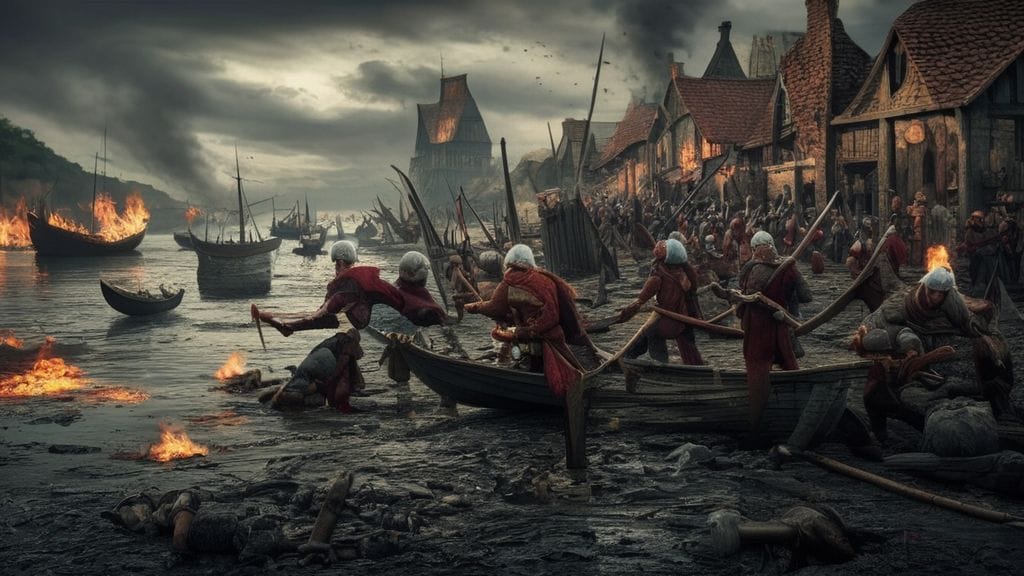
When the ships finally loomed into full view, their approach announced the raiders’ intentions more clearly than any banner. Shields lined the rails like a row of staring eyes. Helmets and spearpoints glinted above them. A few of the warriors may have worn mail, but many depended on speed and ferocity rather than heavy armor. At a shouted command, the oars dug in one final time, driving the hulls toward Dorestad’s wharves. Some ships may have beached on nearby banks, their crews splashing through the shallows with raised weapons. Others tied up long enough for men to leap ashore before pushing off again, ready to reposition or to pursue any who tried to flee by water.
The viking raid on dorestad began in those first chaotic moments when order unraveled. Clashes erupted along the riverfront as town defenders tried to form shield walls in narrow spaces, their feet slipping on wet timbers. For a few heartbeats, the outcome might have seemed in doubt. A determined local garrison, given good leadership and enough numbers, could sometimes repel a raiding party. But Dorestad’s very nature—as a trade town rather than a fortress—worked against it. Too many people, too little training, and too many vulnerable buildings packed close together created an environment where a small, disciplined force of raiders could rapidly turn skirmishes into routs.
Once a Viking force broke through along one stretch of the waterfront, the battle ceased to be a battle in the usual sense. It became a hunt. Warriors fanned out into streets and alleys, some heading for the nearest churches and storehouses, others driving defenders back from improvised barricades. Smoke, shouts, and the sharp ring of steel on steel mingled with the high, raw cries of those who had never before seen war stride into their lives. The raid in 853, like so many across this age, began with tactics and ended in terror.
Fire, Steel, and Panic: Inside the Sack of a Merchant City
Once inside the town’s fragile defenses, the Vikings set about their work with brutal efficiency. Their objective was not conquest in the modern sense; they did not intend to govern Dorestad or plant their own institutions in its streets. Their aim was wealth—portable, valuable, and, if possible, quickly won. Silver coins, jewelry, weapons, high-quality cloaks, carved reliquaries, and even people—all were prizes in the violent economics of raiding.
Merchants’ houses near the waterfront were the first to feel the blow. Doors were battered down, chests pried open, and those who resisted were cut down without ceremony. In some cases, a merchant who had once driven a hard bargain over wool or wine might now find himself on his knees, hands raised as a warrior rifled his belongings. Some raiders were likely systematic, focusing on known warehouses where goods from across the realm were stored before onward shipment. Others followed the sound of weeping or the glimmer of gilded crosses, drawn toward churches and chapels like moths to flame.
Churches in Dorestad, as in many towns of the Carolingian world, were both spiritual and economic centers. They held not only sacred relics but also donations, tithes, sometimes even communal grain or wine reserves. To the Vikings, who understood sacredness in very different terms, a reliquary’s shimmering gold casing outweighed any tale of the martyr or saint within. Liturgical vessels, book covers adorned with gems, candlesticks, and altar frontals could all be broken up, stripped down, and carried away. One monastic chronicler, writing of similar attacks, would later say that the Northmen “defiled the holy places, seized the treasures of the churches, and trampled underfoot the bodies of the saints.” Though we lack a detailed eyewitness account of the viking raid on dorestad itself, it almost certainly followed this grim pattern.
Fire trailed the raiders as they moved. Whether as a deliberate tactic to flush people from hiding and sow confusion, or as the result of torches and overturned lamps in the chaos, buildings caught and burned. In a town built largely of wood, flame spread quickly. Rafters cracked and collapsed, sending showers of sparks into narrow streets. Smoke thickened the air, mixing with the metallic tang of blood. Some structures may have been spared, perhaps because raiders intended to use them temporarily or because haste moved them on before they finished their destruction. But others would have been reduced to blackened skeletons, their former functions—shop, home, warehouse—already blurred by the levelled ash.
Captives, too, were a central part of the spoils. Men, women, and children could be dragged to the river, hands bound, to be carried off and sold as slaves in markets as far away as Ireland, the Frankish coasts, or even Muslim Spain. Enslaved people were a vital component of the Viking economic world; the bodies taken from Dorestad were not collateral damage but living currency. The trauma of families torn apart in those hours is hard to exaggerate. For survivors, the memory of the viking raid on dorestad would be inscribed not only in burnt beams and toppled walls but in the silence left behind when loved ones did not return.
Merchants, Monks, and Fisherfolk: Human Stories from the Ruins
Behind every statistic of plunder or casualty lies a life, or rather thousands of lives, abruptly diverted by violence. While our sources offer only fragments, they invite us to imagine the human dimension of the viking raid on dorestad in 853. Through these imagined yet historically grounded stories, we glimpse the textures of a world turned upside down.
Consider a Frisian merchant, perhaps named Odo, who had built his fortune over years of careful calculation. He traded in salt and wool, kept accounts in wax tablets, and prided himself on his connections from Cologne to the English ports. When the alarm rang, he and his household may have tried to move their most precious goods—a chest of coins, some fine cloaks, a jar of imported oil—into a hidden cellar. But there are only so many hands in a household, and only so much one can carry when footsteps pound closer in the street. As raiders forced his door, Odo had to choose: stand and defend his property with a kitchen knife, or flee through a back exit with his family. If he escaped with his life, everything that had structured his days was gone: credit, merchandise, home. In an instant, the web of trust and transaction that bound Dorestad to distant markets snapped.
Elsewhere in town, a small community of clerics and monks might have gathered around a church or chapel dedicated to a saint whose relics had been brought from far off. They had likely heard of Viking attacks on other ecclesiastical sites: the burning of monasteries along the coasts of Francia and the British Isles, the murder or dispersal of brotherhoods who had once believed their walls and prayers would suffice. Knowing this, the clergy in Dorestad might have hidden manuscripts in hastily dug pits or beneath floorboards, trying to preserve the Word even as the walls shuddered with blows. A young scribe, hands stained with ink, could have found himself suddenly clutching not a quill but a rough-hewn staff, trying to defend his brethren—or kneeling to plead for mercy from men who did not speak his tongue.
On the river’s edge, a fisherman named Hrold, whose days were usually measured by tides and nets, may have found himself in the strange role of guide or witness. From his boat, he saw the longships first and shouted the alarm, but he also saw, later, how some terrified townsfolk tried to escape by water, pushing off in overloaded craft that swayed dangerously. Some made it, rowing upriver toward uncertain shelter; others, pursued by Viking boats, were intercepted, their cries echoing over the water. For Hrold, the river that had always promised sustenance—fish, trade, passage—now became the setting for scenes of chase and capture that would haunt him long after the fires in Dorestad’s streets had died down.
These individual narratives may be hypothetical, but they are built from patterns attested across many raided communities. Chronicles describe families slain at altars, merchants ruined overnight, peasants fleeing into marshes or woods. Archaeology uncovers hurriedly buried hoards of coins and jewelry—silent testimonies to people who believed they might come back later to reclaim what they had hidden, and never did. In every such hoard near the Rhine delta, one can sense a moment of decision during the viking raid on dorestad or its sister attacks: a hand digging, a heart pounding, the desperate hope that this, at least, might be saved.
Kings, Counts, and Compromises: Frankish Responses to the Raids
While Dorestad burned, news of the catastrophe traveled swiftly along the communication lines of the Carolingian world. Messengers on horseback, boatmen bearing tales upriver, passing pilgrims or merchants—all carried variations of the same mournful message: the empire’s northern gateway had once again been struck by men from the sea. For Frankish kings and their officials, the viking raid on dorestad in 853 was not only a local tragedy; it was a political embarrassment, a reminder that their promises of protection rang hollow in crucial regions.
The royal court, perhaps gathered far to the south or east, had limited tools at its disposal. It could order punitive expeditions, but catching Viking fleets was notoriously difficult. The raiders knew how to vanish into river mouths, offshore islands, or distant bases long before a Frankish army could organize and march. Leaders could also order the strengthening of defenses—raising fortifications, building watchtowers, organizing local levies—but such projects required money and, crucially, cooperation among local elites who sometimes resented the burdens imposed from above.
Another response, increasingly common by the mid-ninth century, was negotiation. Frankish rulers, faced with repeated incursions, sometimes chose to pay the Vikings off. They offered tribute, land, and official trading rights in exchange for promises of peace or even military service against rival Frankish factions. These deals were deeply controversial; some contemporaries saw them as necessary pragmatism, others as disgraceful capitulation. After all, paying one group of raiders did not guarantee that another would not appear the following season, eager to test the defenses or the treasury.
In the case of Dorestad, there are indications that Frankish rulers may have used a mix of these strategies across the years, with varying success. The port’s importance meant that no king could ignore its fate, yet its repeated vulnerability highlighted the limits of royal power in far-flung frontiers. As one modern historian has observed of this era, “Carolingian kingship was as much about managing crises as it was about preventing them.” The viking raid on dorestad fits this pattern: a flare-up of violence that forced rulers to reassess their priorities, shift resources, and sometimes cede ground—politically or literally—in order to preserve what they could.
Local counts and bishops, too, had to navigate the post-raid landscape. Some may have pushed for stronger defenses or demanded that the king station more troops in Frisia. Others might have quietly negotiated their own arrangements with Viking leaders, hoping to redirect attacks elsewhere. These pragmatic accommodations could serve immediate community interests but undermine broader imperial cohesion. Each raid, therefore, did more than damage a town; it eroded the shared sense that the Carolingian order was inevitable, stable, and ordained. With each such blow, the empire’s carefully woven tapestry loosened another thread.
From Market Hub to Haunted Name: The Decline of Dorestad
Even before 853, Dorestad’s fortunes had begun to waver. Shifts in river channels, competition from other ports, and the gradual reorientation of trade networks all nibbled at its primacy. But the repeated assaults it suffered from Viking bands—of which the 853 raid is a focal example—accelerated its decline dramatically. A trading town thrives on confidence: faith that goods can be moved, that contracts will be honored, that ships will arrive and depart in relative safety. The viking raid on dorestad shattered that faith.
Merchants are, by necessity, pragmatic. Once it became clear that Dorestad could no longer guarantee even a reasonable level of protection, many traders likely began favoring alternative routes. Some may have shifted their operations upriver, closer to fortified centers under stronger royal or episcopal control. Others turned to rival emporia along the North Sea, places less exposed or more recently fortified. As commerce bled away, so too did the tax revenues that had once justified royal investments in the port. The logic of decline became self-reinforcing: fewer traders meant fewer resources for defense; weaker defenses made future raids more likely, or at least ensured that the reputation of danger clung stubbornly to the town.
By the later ninth century, Dorestad’s name appears less frequently in the sources, and when it does surface, it is often as a reminder of past greatness, not present power. Archaeological work on the site, near modern Wijk bij Duurstede, suggests a contraction of settlement and activity. Where once bustling quays had stood, now there were quieter, more localized communities. The ghost of the old emporium lingered in earthworks and abandoned foundations, but the beating commercial heart had moved elsewhere.
This transformation was not solely the work of Viking axes. Environmental changes, silting of waterways, internal Carolingian conflicts, and the rise of other centers all played roles. Yet it is difficult to imagine Dorestad’s steep fall without the repeated shocks of raiding. The town was both a victim and a symbol: a place where the vulnerabilities of the Carolingian system—its overextended borders, its reliance on riverine trade, its fragmenting authority—were laid bare. Long after the fires of 853 had cooled, the memory of the viking raid on dorestad lingered as a shorthand for northern ferocity and imperial fragility.
In this sense, Dorestad’s decline has a strangely modern resonance. Cities rise and fall on currents of trade and security; when those currents shift or are violently interrupted, urban fortunes can change within a generation. Dorestad’s wharves, once crowded with goods bound for the far corners of the realm, became archaeological strata. Its story, however, continued as a cautionary tale in chronicles and, centuries later, in the careful trenches of archaeologists peeling back layers of soil to reveal the scars of a lost port.
Faith under Siege: Churches, Relics, and the Christian Imagination
For the Christian communities of Frisia and the wider Carolingian realm, the viking raid on dorestad was not just an assault on property or royal prestige; it was a blow to the sacred order they believed framed their world. Churches and monasteries had long been portrayed as islands of peace, protected by God and, ideally, by Christian rulers. When those sanctuaries burned under Viking torches, theology and lived reality collided in painful ways.
Clerical writers struggled to understand these disasters. Some framed the raids as divine punishment for sin, calling on kings and peoples to repent. Others emphasized the cruelty and “pagan” nature of the attackers, casting them as instruments of the devil in a cosmic struggle. In this rhetoric, the sack of Dorestad’s churches would have stood alongside other well-known outrages—like the infamous raids on Lindisfarne in 793 or on Paris in 845—as signs of an age in which the forces of darkness seemed to be pressing hard against Christendom’s frontiers.
The physical damage to religious life in Dorestad was equally significant. Destroyed altars, shattered relic shrines, burned manuscripts—each loss rippled outward. Pilgrimage routes might be disrupted, local cults temporarily extinguished, liturgical practices interrupted. In some cases, communities relocated, carrying their saints’ relics with them to safer grounds, thereby seeding new centers of devotion elsewhere. The cult of Saint Willibrord, for example—an early missionary to Frisia associated with nearby Echternach—was shaped not only by his life but by the turbulent context in which his legacy had to be preserved amid threats like the viking raid on dorestad and its cousins.
Yet faith did not simply crumble under the hammer blows of raiders. In a poignant irony, Viking violence sometimes strengthened Christian identity. Martyrologies commemorated those who died defending churches; sermons urged believers to cling more tightly to God in the face of foreign assault. The memory of devastation became a resource for later storytellers, who could point back and say, “Our ancestors endured this; with God’s help, so can we.” The very act of chronicling the raids—of setting down in ink the horrors witnessed—was itself a form of resistance, a refusal to let fear and fire erase meaning.
Over time, a more complex picture emerged as well. Some Viking leaders converted to Christianity, often in the course of making treaties or settling permanently in regions they had once raided. Churches rebuilt and, in some cases, profited from new patterns of patronage and trade that connected Christian and newly Christianized Scandinavian elites. The stark opposition—Christian victim versus pagan raider—gave way to a more entangled world. Still, when chroniclers wanted to evoke the vulnerability of their own societies, the memory of Viking ships on rivers like the Rhine, converging on places like Dorestad, remained a powerful image.
Archaeology of a Ravaged Port: What the Earth Still Remembers
Centuries after the last longship vanished from the Rhine delta, the remains of Dorestad lay mostly forgotten beneath fields and modest settlements. It was only with the rise of modern archaeology that the town’s bones began to surface again. Excavations near modern Wijk bij Duurstede have revealed an intricate pattern of streets, warehouses, workshops, and riverfront installations—mute witnesses to the life that once pulsed through this emporium.
Archaeologists have uncovered rows of wooden buildings aligned along what were once busy quays, as well as evidence of large timber-framed halls that may have served administrative or commercial functions. Thousands of artifacts—ceramics, glass, metalwork, coins—attest to Dorestad’s role as a hub of exchange. Frankish, Frisian, and foreign goods mingle in these layers, telling a story of connectivity that spans regions and cultures. Among these finds, there are also hints of disruption: burnt layers, collapsed structures, and sudden abandonment in certain zones, all of which align with the historical accounts of Viking raids.
One of the more evocative classes of finds is the hoarded treasure: small caches of coins, jewelry, or cut silver buried in haste and never reclaimed. Each hoard represents a moment of acute fear—someone deciding that the best chance of preserving their wealth was to entrust it to the earth. The fact that modern excavators find these treasures uncollected suggests that their owners did not survive, or never found the opportunity to return. In a very real sense, these hoards are the fingerprints of the viking raid on dorestad and similar assaults, pressed into the soil.
Scholars piecing together these material traces with written sources must navigate gaps and uncertainties. Medieval chroniclers mention Dorestad’s importance and its suffering under Viking attacks, but they do not offer detailed street-level maps. Archaeology, conversely, maps buildings and deposits meticulously but cannot fix exact dates to every layer without careful scientific testing and interpretive caution. Yet together, these two lines of evidence reinforce one another. When a layer of destruction lines up with a period in which we know from texts that raids intensified, a plausible narrative emerges: here, the city burned; there, it was rebuilt, only to decline later.
In this way, the earth itself becomes an archive, preserving an alternative memory of the viking raid on dorestad. Where words are silent or biased, charred beams and scattered coins speak. They confirm that the raid was not just an invention of fearful monks but a real, transformative event that left its mark in timber and clay. As archaeologist Richard Hodges once suggested in another context, the archaeology of early medieval emporia allows us to “listen to the silent majority”—the artisans, dockworkers, and small traders whose experiences rarely entered written records. Through their lost possessions and altered urban landscape, we trace the contours of a community reshaped by contact with Scandinavian raiders.
Between Myth and Chronicle: How Medieval Writers Saw the Vikings
Our knowledge of the viking raid on dorestad, like many events of the ninth century, comes largely from the pens of clerics—monks and bishops who wrote annals, letters, and saints’ lives. These men were not neutral reporters; they viewed the world through lenses colored by theology, local politics, and personal experience. To them, Vikings were first and foremost “pagans,” “heathens,” or “Northmen,” agents of chaos looming at the edges of a Christian order.
In texts such as the Annals of St-Bertin and the Annals of Fulda, raids are plotted along the chronological spine of years: “In this year, the Northmen devastated…”. These terse entries sometimes expand into vivid accounts of particular attacks, especially those that threatened royal centers or famous monasteries. The sack of Paris in 845 or the siege in 885–886 drew detailed attention; Dorestad, though clearly important, appears more intermittently, often as part of a pattern of assaults along the Frisian coast. One entry, for example, notes how “the Northmen ravaged the Frisian shores and Dorestad, taking much booty.” In such lines, the town’s suffering is both acknowledged and subsumed into a tide of generalized destruction.
These chronicles must be read critically. They emphasize sin and punishment, sometimes attributing military failures to moral failings rather than tactical misjudgments or logistical constraints. Their authors rarely attempt to understand Viking motives beyond greed and irreligion. Yet even in their condemnation, they preserve invaluable details: names of leaders, rough dates, and the cumulative impression that Viking raids were more than isolated incidents—they were a structural part of ninth-century life. The repeated mention of Dorestad underscores its status as a key target whose fate mattered to contemporaries.
Over time, memories of the Vikings would be reshaped again in saga literature, written down in Iceland centuries after the events. There, Scandinavian warriors and chieftains appear as complex figures—sometimes ruthless, sometimes honorable, often larger than life. While the Icelandic sagas do not dwell extensively on the viking raid on dorestad specifically, they help modern readers grasp the ethos of raiding culture from the inside. Glory, vengeance, loyalty, and cunning intertwine, suggesting that what Christian chroniclers saw as senseless savagery was, in part, governed by a recognizable code.
Modern historians negotiating between these sources and the archaeological record have sought a more balanced view. As historian Janet L. Nelson has noted in her studies of the Carolingian world, Viking activity cannot be reduced to mere piracy; it must be understood within a wider context of trade, diplomacy, and internal Frankish strife. Thus, when we read about the viking raid on dorestad, we are reading not only about an episode of pillage but about a knot in the tangled fabric of early medieval politics and economy. The challenge is to honor the real suffering recorded by contemporaries while also recognizing the agency and complexity of the “Northmen” they so feared.
A Wider Storm: Dorestad within the Age of North Sea Raiding
Dorestad’s story is but one wave in a much larger storm that swept across the North Sea and its surrounding lands between the late eighth and early tenth centuries. The viking raid on dorestad in 853 fits into a broader pattern of Scandinavian activity that remade the political and cultural map of Europe. From the British Isles to the Frankish coasts, from the Baltic to the Iberian Peninsula, Viking ships tested defenses, extracted tribute, founded settlements, and reshaped trade routes.
In the British Isles, famous raids like the attack on Lindisfarne in 793 and the subsequent assaults on Iona and other monastic islands marked the beginning of what later chroniclers would call the “Viking Age.” By the middle of the ninth century, Viking armies were no longer content with hit-and-run raids; they wintered in England, carved out the Danelaw, and established power bases from which to negotiate with or coerce local rulers. In Ireland, they founded coastal longphuirt (ship-forts) that evolved into trading towns—Dublin being the most prominent—that mirrored in some ways the functions of emporia like Dorestad.
Along the Frankish coasts and river systems, raids penetrated ever deeper. The Seine, Loire, Garonne, and other major rivers became highways for fleets that struck at cities like Rouen, Nantes, and Bordeaux. The siege of Paris in 845 under Ragnar—semi-legendary in later accounts—and the even more protracted attack in 885–886 highlighted the vulnerability of major urban centers. Dorestad, though smaller than Paris, occupied a similar strategic position along the Rhine. Its repeated targeting shows that Vikings understood well the importance of riverine gateways.
Further east, in the Baltic and the lands of the Slavs and Finnic peoples, Vikings (often referred to as Varangians in these contexts) engaged in complex trade and raiding patterns that connected northern Europe to the Byzantine Empire and the Islamic world via river routes. Silver from the Abbasid Caliphate flowed northward along these paths, some of it eventually reaching the North Sea circuits in which Dorestad had once been central. The viking raid on dorestad, therefore, must be seen against this vast backdrop of movement, as one of many points where global flows of silver, slaves, and goods intersected with local catastrophe.
This wider perspective has important implications. It suggests that the raiders who struck Dorestad were not isolated marauders but participants in a sophisticated maritime culture with knowledge of distant lands, market values, and political opportunities. It also underscores the ways in which local communities like Dorestad were enmeshed in larger systems of exchange and conflict. When longships appeared on the Rhine, they brought with them not only armed men but also the echoes of distant wars, alliances, and economic shifts that stretched from the fjords of Norway to the caliphal mints of Baghdad.
Legacy of Fear and Exchange: Cultural Echoes of the 853 Raid
When the smoke of the viking raid on dorestad finally cleared in 853, the town’s people were left not only with ruins but with memories that would shape their descendants’ understanding of the world. Fear is a powerful legacy. Children growing up in Frisia in the succeeding decades would have heard stories of the day the Northmen came—tales told and retold around hearths, embroidered with new details but anchored in real loss. These narratives taught lessons about vigilance, about the fragility of prosperity, and about the unpredictable whims of distant kings.
Yet the legacy of the Viking presence in the North Sea world was not only one of fear. Paradoxically, violence opened pathways for new forms of cultural exchange. Some Vikings settled in regions they had once raided, integrating with local communities. Intermarriage, mutual adoption of technology, and shared participation in trade slowly blurred sharp ethnic and religious lines. Scandinavian words entered local languages; Frankish and Frisian customs left their mark in Scandinavian realms. Christianity spread northward, while certain artistic motifs and navigational knowledge spread south.
For historians, the viking raid on dorestad stands as an emblem of this dual legacy. On the one hand, it symbolizes the destructive capacity of mobile, maritime warfare in a world whose political structures struggled to adapt. On the other hand, it reminds us that such destruction did not simply erase connections; it rerouted them. Trade continued, sometimes in altered forms; political orders reconfigured; religious frontiers shifted. The Carolingian empire would fragment, but new polities and identities emerged in the crucible of these crises.
In modern memory, Dorestad has reemerged from relative obscurity thanks to archaeological discoveries and renewed interest in the Viking Age. Museums in the Netherlands display artifacts from the site—coins, tools, fragments of imported goods—that allow visitors to imagine the town’s bustling life and violent end. Scholars cite Dorestad as a key case study in discussions of early medieval trade, state formation, and the impacts of raiding. What was once a burned port on a forgotten branch of the Rhine has become, once again, a place that matters in the stories we tell about Europe’s past.
It’s astonishing, isn’t it, how a single raid in 853 continues to reverberate across more than a millennium? The people of Dorestad could not have imagined that their suffering would one day be analyzed in scholarly monographs or reconstructed in museum exhibits. They knew only the immediate sting of loss and the long work of rebuilding—or of leaving. But by tracing their experience, we gain insight into the forces that shaped our world: the tensions between center and periphery, land and sea, continuity and upheaval. The longships that appeared on their horizon were harbingers of a new age, one in which old certainties burned as easily as timbered roofs.
Conclusion
The viking raid on dorestad in 853 was more than a brutal episode on a distant riverbank; it was a moment in which several great currents of early medieval history collided. Dorestad stood at the crossroads of trade, politics, and faith—a rich Carolingian emporium whose prosperity depended on open waterways and a functioning imperial order. The Vikings who targeted it brought with them a different set of logics: those of mobile warfare, opportunistic diplomacy, and an economic system that intertwined raiding and trading across vast distances.
In the fires that consumed Dorestad’s warehouses and churches, we glimpse the vulnerabilities of the Carolingian world. Fractured royal authority, overextended frontiers, and uneven defenses left crucial nodes like Dorestad exposed. The raid of 853 did not, by itself, end the town’s importance, but it accelerated a process of decline already underway, encouraging merchants and rulers alike to seek safer or more advantageous harbors. The once-bustling emporium faded, leaving traces in soil and text rather than in living memory.
Yet the story is not merely one of loss. The raid, and others like it, forced European societies to adapt. Fortified bridges, new military obligations, evolving diplomatic strategies, and shifting trade routes all sprang in part from the challenge posed by Viking fleets. Over time, the very people who had been cast as destroyers became rulers and neighbors in regions of England, Ireland, and the Continent. Dorestad’s suffering thus forms part of the crucible in which a new medieval order was forged, one less centralized than Charlemagne’s dream but more attuned to the realities of a connected, contested North Sea world.
Remembering the viking raid on dorestad today invites us to hold together multiple perspectives: the terror of townsfolk watching longships approach; the calculation of Viking leaders weighing risks and rewards; the frustration of Frankish rulers struggling to defend a sprawling realm; and the patient work of archaeologists and historians sifting through what remains. Out of this mosaic emerges a richer understanding of the ninth century—not as a dark age of meaningless violence, but as a dynamic period in which war, trade, and faith intertwined to reshape the map of Europe. The smoke that rose over Dorestad in 853 has long since dispersed, but its shadow still falls across the stories we tell about beginnings and endings, about power and its limits, along the banks of the Rhine.
FAQs
- What and where was Dorestad?
Dorestad was a major early medieval trading town (emporium) located near the lower Rhine in present-day Netherlands, close to modern Wijk bij Duurstede. It served as a crucial hub linking North Sea routes with the inland river systems of the Frankish empire, handling goods from England, Scandinavia, the Frankish heartlands, and beyond. - When did the viking raid on dorestad take place?
The most notable viking raid on dorestad discussed here occurred in the year 853, during a period of intensified Scandinavian activity along the Frisian and Frankish coasts. The town suffered multiple attacks across the ninth century, but 853 stands out as a symbolic and documented moment in its decline. - Why did the Vikings target Dorestad?
The Vikings targeted Dorestad because it was rich, accessible, and strategically located. As a royal emporium, it concentrated large amounts of portable wealth—coins, goods, and valuable church treasures—within reach of longships that could sail up the Rhine. Political fragmentation in the Carolingian realm made its defenses comparatively weak, increasing its appeal as a target. - How do we know about the raid if sources are limited?
Knowledge of the viking raid on dorestad comes from a combination of written and archaeological evidence. Medieval chronicles and annals, written by clerics, mention attacks on Dorestad and nearby Frisian regions. Archaeological excavations have revealed destruction layers, hoards, and patterns of abandonment consistent with raiding, which, when correlated with textual references, create a coherent historical picture. - What were the consequences of the raid for Dorestad?
The raid contributed to a rapid decline in Dorestad’s fortunes. Repeated attacks undermined merchant confidence, redirected trade to safer or rising centers, and eroded the town’s tax base and strategic value for Frankish rulers. Environmental changes and shifting trade routes also played roles, but Viking pressure made it far more difficult for Dorestad to recover and retain its former status. - Did the raid change Viking–Frankish relations?
The viking raid on dorestad was part of a broader cycle of interaction that included warfare, tribute payments, and negotiated settlements. Frankish rulers responded with a mixture of military campaigns, defensive reforms, and diplomatic agreements that sometimes involved paying Viking groups or granting them land. Over time, some Vikings entered Frankish service or settled permanently, complicating the earlier pattern of simple hostility. - Were the Vikings only raiders, or also traders?
They were both. Despite their fearsome reputation as raiders, Vikings were also active traders who participated in extensive commercial networks from the North Atlantic to the Black Sea. The same ships that brought warriors to Dorestad had likely carried furs, slaves, and other goods to markets across Europe. Raiding and trading were complementary strategies in a flexible maritime economy. - What happened to Dorestad after the ninth century?
By the late ninth and early tenth centuries, Dorestad had largely lost its prominence. Trade shifted to other locations along the Rhine and in the Low Countries, while the town contracted and partially faded from written records. Today, its remains lie near Wijk bij Duurstede, where archaeological work has reconstructed aspects of its layout and life. - Can we visit the site of Dorestad today?
While the medieval town itself no longer stands, visitors can explore the modern town of Wijk bij Duurstede, where local museums and interpretive materials present the history of Dorestad and its Viking encounters. Exhibits typically include artifacts recovered from excavations, offering tangible connections to the events described in chronicles. - Why does the viking raid on dorestad matter for understanding medieval Europe?
The raid offers a window into the vulnerabilities of the Carolingian empire, the dynamics of early medieval trade, and the impact of Viking maritime power. Studying Dorestad helps historians understand how local events on a single riverfront were tied to larger processes—state formation, economic change, and religious confrontation—that shaped the course of European history in the early Middle Ages.
External Resource
Internal Link
Other Resources
- Encyclopaedia Britannica – general search for the exact subject
- Google Scholar – academic search for the exact subject
- Internet Archive – digital library search for the exact subject

