Table of Contents
- The Visigothic Court: A Kingdom in Transition
- From Foederati to Sovereigns: The New Order in Gaul
- The Strategic Importance of Toulouse: A Jewel in the Visigothic Crown
- Political Upheavals in Early 5th Century Gaul
- King Wallia’s Ambitions and the Foothold in Aquitaine
- The Visigothic Arrival in Toulouse: Setting the Stage for Supremacy
- Diplomacy and Warfare: Navigating Roman and Barbarian Interests
- The Role of Roman Senators and Gaulish Nobility in the Visigothic Transition
- Administration of Toulouse: From Military Encampment to Royal Court
- Toulouse as a Hub of Visigothic Power and Culture
- The Visigothic Army: Composition, Strategy, and Impact
- Religion and Identity: The Arian Challenge in Catholic Gaul
- Economic Transformation Under Visigothic Rule
- Relations with Neighboring Powers: Franks, Burgundians, and Romans
- The Legal Innovations of the Visigothic Court
- Social Consequences: Local Populations and Visigothic Governance
- The Challenge of Integration: Barbarian and Roman Coexistence
- Toulouse Supremacy Consolidated: The Aftermath of 419
- The Legacy of the Visigothic Court in Southern Gaul
- Conclusion: The Dawn of a New Political Landscape in Late Antique Gaul
- Frequently Asked Questions
- External Resource
- Internal Link
The Visigothic Court: A Kingdom in Transition
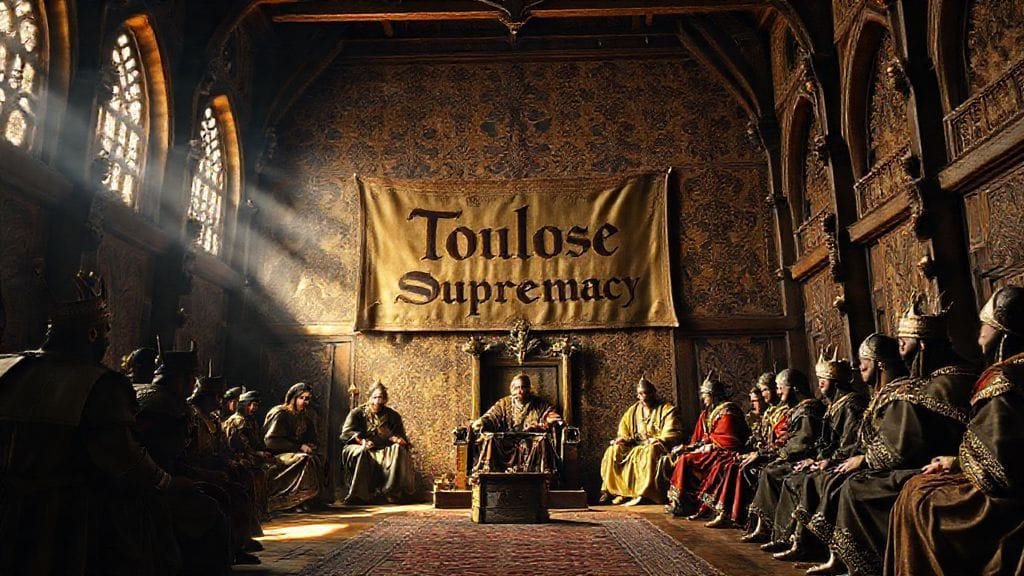
In the damp chill of a spring morning in 418 AD, the city of Toulouse received a new ruler. The Visigothic court, once a nomadic warband famed for sacking Rome decades earlier, was now setting its weary but resolute feet in a land as challenging as it was promising—Gaul. The scene was both somber and filled with the whispers of ambition: banners fluttered against a gray sky, warriors and Romans alike eyed one another with mingled suspicion and curiosity, while King Wallia and his council prepared to establish a seat of power that would change the destiny of the region.
It was more than a mere relocation; it was the opening chapter of a profound shift in political prowess. Toulouse, a vibrant but fractured city of ancient Roman heritage, was about to become the heart of a new kind of supremacy—a kingdom built on uneasy alliances, brutal warfare, and a vision that challenged the declining authority of the Western Roman Empire. The air was fraught with tension, hope, and the first inkling of what would become an indelible mark on the history of Gaul.
From Foederati to Sovereigns: The New Order in Gaul
To understand the momentous significance of the Visigothic court’s move towards Toulouse, it is essential to return to the tumultuous decades that preceded this event. The Visigoths, a branch of the Gothic peoples, had long vacillated between friend and foe of the Romans. Initially settling as foederati—federated allies tasked with policing borders—they were driven by changing fortunes and pressures from other barbarian groups, particularly the Huns.
The early 5th century found Rome stretched thin. Gaul was a volatile patchwork of Roman officials clinging to authority while simultaneously facing incursions and internal dissension. Into this vacuum stepped the Visigoths, led by deft politicians and seasoned warriors who saw survival not in annihilation, but in integration and power-sharing. Their new role was no longer that of mercenaries; it was that of kings and governors.
The Strategic Importance of Toulouse: A Jewel in the Visigothic Crown
Toulouse was no random choice. Nestled on the banks of the Garonne River, it held immense strategic value as a gateway to southwestern Gaul and beyond. Its walls still retained the imprint of Roman engineering, guarding commerce centers and routes essential for both military and economic control.
Moreover, Toulouse offered fertile lands with rich supplies, an urban population increasingly accustomed to a diminished but still tangible Roman culture, and proximity to other influential tribes like the Franks and Burgundians. To the Visigothic leadership, Toulouse was the perfect fulcrum from which to extend their influence—political, cultural, and military—across Gaul and into Hispania.
Political Upheavals in Early 5th Century Gaul
The gradual collapse of centralized Roman power created a feverish political nexus throughout Gaul. Governors and local aristocrats jostled for control while external pressures mounted. The Roman administration, though still nominally sovereign, increasingly invited barbarian groups as allies to assist in controlling restless populations and defending territories.
But these alliances were fraught with instability. The Visigoths’ earlier incursions and their sack of Rome in 410 under King Alaric the Elder had sown mistrust. Yet the pragmatic Romans under Emperor Honorius recognized that empowering the Visigoths with lands such as Toulouse might be the only way to maintain order in Gaul.
Tensions between Roman leaders, local Gallic aristocracy, and barbarian newcomers like the Visigoths defined the political chessboard on which power was contested.
King Wallia’s Ambitions and the Foothold in Aquitaine
Wallia, ascending to the Visigothic throne in 415, soon distinguished himself as a shrewd leader willing to negotiate with Rome. After a period of conflict with other tribes and Romans, he struck a decisive agreement in 418 that granted Visigothic sovereignty over territories in Aquitaine, with Toulouse as the administrative capital.
Wallia’s tactical foresight underscored a new vision: to forge a stable kingdom embedded within Roman structures rather than an outside threat. Under his guidance, the Visigoths increasingly adopted Roman administrative practices, blended Gothic martial traditions with Roman diplomacy, and forged a nascent sense of legitimacy that would underpin future success.
The Visigothic Arrival in Toulouse: Setting the Stage for Supremacy
The transfer of the Visigothic court to Toulouse was not merely a physical relocation but a symbolic assertion of power. The city, still scarred by years of warfare and political flux, was now the theatre of a grand institutional transformation.
As Visigothic leaders established residence in Toulouse’s palace quarters, the military hierarchy solidified its control over the city, and the local Roman population cautiously adjusted to new rulers whose laws and customs mixed Gothic habits with residual Roman influence. Streets echoed with soldiers’ boots alongside merchants’ carts; Latin mingled with Gothic dialects.
It was an uneasy but electrifying mosaic—where fragments of empire met the tides of barbarian kingship.
Diplomacy and Warfare: Navigating Roman and Barbarian Interests
Throughout this period, diplomacy was as much a weapon as the sword. Wallia and his successors had to deftly balance the demands of Rome—which still regarded itself as the rightful imperial authority—with the ambitions of their Visigothic constituencies.
At times, this meant military confrontations with other barbarian groups like the Vandals or Alans who dominated parts of Gaul and Hispania. At others, it involved negotiations that required painful compromises, marriages, and the integration of diverse populations under a common political framework. This delicate balance was key to the survival and eventual supremacy of the Visigothic state centered in Toulouse.
The Role of Roman Senators and Gaulish Nobility in the Visigothic Transition
A fascinating dynamic arose as many members of the Roman senatorial class chose accommodation with the Visigothic rulers rather than resistance. These aristocrats brought administrative expertise, wealth, and local knowledge essential for maintaining city life.
By partnering with the Visigoths, the Gaulish nobility hoped to preserve their privileges and avoid the total upheaval that might have occurred under a purely barbarian conquest. Their collaboration, although pragmatic, infused Visigothic governance with Roman cultural norms, laws, and even religious practices that smoothed the transition.
This hybrid elite class became a cornerstone of Visigothic administration.
Administration of Toulouse: From Military Encampment to Royal Court
Transforming Toulouse from a military camp into a royal court required extensive institutional reorganization. The Visigoths implemented a system blending Gothic traditions of personal loyalty to the king with Roman models of provincial governance.
Officials were appointed to oversee taxation, justice, and city infrastructure, while a permanent standing force maintained security against internal dissent and external threats. The court itself grew more elaborate, embracing diplomacy, patronage, and ceremonial display to signal stability and power.
Under Wallia and his successors, Toulouse gradually emerged as a beacon of order amid wider chaos.
Toulouse as a Hub of Visigothic Power and Culture
The Visigothic court was not only a seat of political authority; it became a cultural crucible. Within Toulouse, Gothic artistry mingled with Roman architectural legacies and Christian iconography—albeit marked by the distinctive Arian creed of the Visigothic elite, setting them apart from the predominantly Catholic Roman Gauls.
Workshops produced manuscripts, jewelry, and weaponry that reflected both traditions. Bardic storytellers recounted heroic tales blending elements from both cultures. Toulouse embodied the fusion and tension of two worlds locking arms and fingers into something unmistakably new.
The Visigothic Army: Composition, Strategy, and Impact
Fundamental to Visigothic supremacy was their formidable military. The army consisted of seasoned Gothic warriors bound by oaths of loyalty, supplemented by allied barbarian contingents and even Roman auxiliaries.
Their strategies combined heavy infantry formations with cavalry maneuvers adapted to the varied terrain of Gaul. The military campaigns conducted from Toulouse secured border territories and subdued rebellious regions, earning respect and fearful reputation.
This martial prowess assured the Visigothic court’s grip on power and provided a deterrent to rivals.
Religion and Identity: The Arian Challenge in Catholic Gaul
Religious difference was a shadow that loomed large over Visigothic rule. The Visigoths adhered to Arian Christianity, a belief that deviated from the Nicene orthodoxy embraced by most Gauls and Roman clergy.
This religious gap complicated efforts at integration and sometimes fomented local resistance or prejudice. Yet it also underscored the complex identity of the Visigothic kingdom as a separate, distinct power within the collapsing Western Roman world.
Over time, religious tensions would ease, especially under later rulers, but in 418–419, the Arian faith marked the Visigoths as both rulers and outsiders.
Economic Transformation Under Visigothic Rule
Economically, the Visigothic takeover led to both disruption and innovation. Control of Toulouse allowed the Visigoths to harness important trade routes and agricultural production, but their military demands also strained resources.
Taxation systems were restructured, land ownership reallocated, and commerce regulated to sustain the new regime. Nonetheless, market activity persisted, and crafts thrived within the city walls, suggesting a pragmatic approach to economic continuity amidst political change.
This economic adaptation was crucial to the survival and growth of the Visigothic kingdom.
Relations with Neighboring Powers: Franks, Burgundians, and Romans
Toulouse was ensnared in a complex web of relations. Neighboring barbarian groups such as the Franks to the north and Burgundians to the east were simultaneously rivals and uneasy partners at various points.
The remnants of Roman authority, limited as they were, attempted to negotiate alliances or resist encroachment. The Visigothic court therefore had to master a fluid diplomacy, punctuated by warfare and treaties, to maintain and expand its dominance.
These interactions shaped the geopolitical map of Gaul and laid foundations for future kingdoms.
The Legal Innovations of the Visigothic Court
One of the most enduring legacies of the Toulouse court was the codification and evolution of laws. Rooted in Gothic tribal customs but influenced by Roman jurisprudence, the Visigothic legal system sought to govern a diverse population.
This included regulations on property rights, criminal law, and family law that balanced traditional tribal codes with needs of urban administration. The laws reflected the hybrid identity of the kingdom and became a model for later medieval codes.
They represent the early medieval synthesis of Roman and Germanic legal traditions.
Social Consequences: Local Populations and Visigothic Governance
Beneath the royal court and military campaigns lay the lives of common people—Romans, Gauls, and Goths—whose daily existence was reshaped by the new order. Many locals initially distrusted the “barbarian” rulers, but over time, shared governance, trade, and intermarriage blurred ethnic lines.
New social hierarchies arose, but local customs and aristocratic privileges largely endured. The presence of the Visigothic court altered patterns of urban life, taxation, and religious practice, forging a novel social fabric.
The Challenge of Integration: Barbarian and Roman Coexistence
Integration was neither seamless nor immediate. Deep-seated cultural differences, memories of past conflicts, and competing loyalties complicated Visigothic rule in Toulouse and beyond.
Yet the pragmatic need to cohabit led to accommodations—language, marriage, religion, and law became vectors for unity as well as division. The Visigoths’ ability to adopt Roman strategies of governance while asserting their distinct identity enabled their survival through this complex social terrain.
Toulouse Supremacy Consolidated: The Aftermath of 419
By 419, the Visigothic court’s foothold in Toulouse had solidified into clear supremacy in southwestern Gaul. The city was both a bastion of Gothic power and a symbol of their transformation from nomadic warlords to settled kings.
This supremacy set the stage for the later expansion of Visigothic influence into Hispania and deeper into Gaul, challenging other emerging barbarian kingdoms. Toulouse was no longer a contested outpost but the heart of a kingdom whose pulse beat fiercely despite the twilight of the Roman world.
The Legacy of the Visigothic Court in Southern Gaul
The presence of the Visigothic court in Toulouse left an indelible imprint on the political, cultural, and social landscape of southern Gaul. It was the crucible in which medieval kingdoms were forged, influencing language, law, religion, and identity for centuries to come.
Though eventually absorbed into later Frankish domains, the Visigothic legacy remained a foundational chapter in the history of medieval Europe. Their journey from migrants and mercenaries to sovereigns epitomizes the transformation of Late Antiquity.
Conclusion: The Dawn of a New Political Landscape in Late Antique Gaul
The Visigothic court’s move towards Toulouse in 418–419 was far more than a royal migration; it was a turning point in the slow unraveling and reinvention of Roman Gaul. Against a backdrop of empire’s decline, shifting allegiances, and persistent warfare, the Visigoths carved out a new kingdom, blending Gothic vigor with Roman sophistication.
This was a kingdom born of pragmatism and ambition, whose story invites us to reflect on resilience, identity, and the mutable nature of power. Toulouse, once a Roman provincial city, became a beacon of barbarian kingship and medieval possibility—a symbol of history’s ceaseless flow and human adaptability.
Frequently Asked Questions
1. Why did the Visigothic court choose Toulouse as their seat of power?
Toulouse was strategically located on the Garonne River with a strong Roman heritage, allowing the Visigoths to control key trade routes and dominate southwestern Gaul. Its established urban infrastructure and fertile surroundings made it ideal for establishing a stable kingdom.
2. What was the relationship between the Visigoths and the Roman authorities during this period?
The Visigoths were initially foederati—federated allies of Rome—but over time became de facto sovereigns in their territories after treaties granting them land. This relationship was pragmatic and tense, with Rome tacitly acknowledging Visigothic rule while seeking to maintain nominal authority.
3. How did Visigothic rule affect the local Roman and Gaulish populations?
Many local elites adapted by cooperating with the new rulers. While initial distrust existed, over time an intricate coexistence developed involving shared governance, cultural exchange, and social integration, despite differences in language, religion, and law.
4. What role did religion play in Visigothic Toulouse?
The Visigoths were Arians, a Christian sect differing from the Nicene Christianity practiced by most Gauls and Romans. This religious difference caused some tension but also marked the kingdom’s distinct identity. Over time, religious reconciliation would progress under later rulers.
5. How did the Visigothic legal system develop during their rule in Toulouse?
It combined Gothic tribal laws with Roman legal traditions to regulate property, family, and criminal matters across a diverse population, representing an early medieval synthesis influential for subsequent legal codes.
6. What military strategies did the Visigoths employ to maintain their supremacy?
Their army blended heavily armored infantry with cavalry tactics, using knowledge of local terrain to strategic advantage. They balanced aggressive campaigns with diplomatic negotiation to secure borders and suppress rivals.
7. How did the Visigothic court influence the cultural landscape of southern Gaul?
Through patronage of arts, adaptation of Roman architecture, and blending of Gothic and Roman customs, the court fostered a unique cultural milieu that shaped the identity of the region for centuries.
8. What was the long-term significance of the Visigothic move to Toulouse for medieval Europe?
This event marked the emergence of barbarian kingdoms as successors to Rome’s western provinces, laying political, legal, and cultural foundations foundational to medieval European development.

