Table of Contents
- The Dawn of a Decisive Clash: Setting the Stage at Pollentia
- Rome’s Waning Power and the Visigothic Surge
- Alaric’s Rise: From Foederati to Foe of the Empire
- The Road to Pollentia: Marching into Italy
- The Battle Commences: Dawn of April 6, 402
- Tactical Maneuvers and Battlefield Drama
- The Role of Stilicho: Rome’s Last Hope
- Visigothic Strategies and the Assault on Roman Lines
- Civilians and Soldiers: The Human Face of Conflict
- The Tide Turns: Contesting the Outcome
- Aftermath of Pollentia: Romans and Visigoths Reassess
- Political Reverberations Across the Western Empire
- Cultural and Social Impacts in Italy and Beyond
- The Legacy of Pollentia in Visigothic and Roman Memory
- Pollentia’s Place in the Decline of the Western Roman Empire
- Modern Historiographical Debates and Interpretations
- Echoes of Pollentia in Medieval European Identity
- Conclusion: Lessons from a Clash of Worlds
- FAQs: The Battle of Pollentia Explained
- External Resource: Further Reading on Pollentia
- Internal Link: Explore More on History Sphere
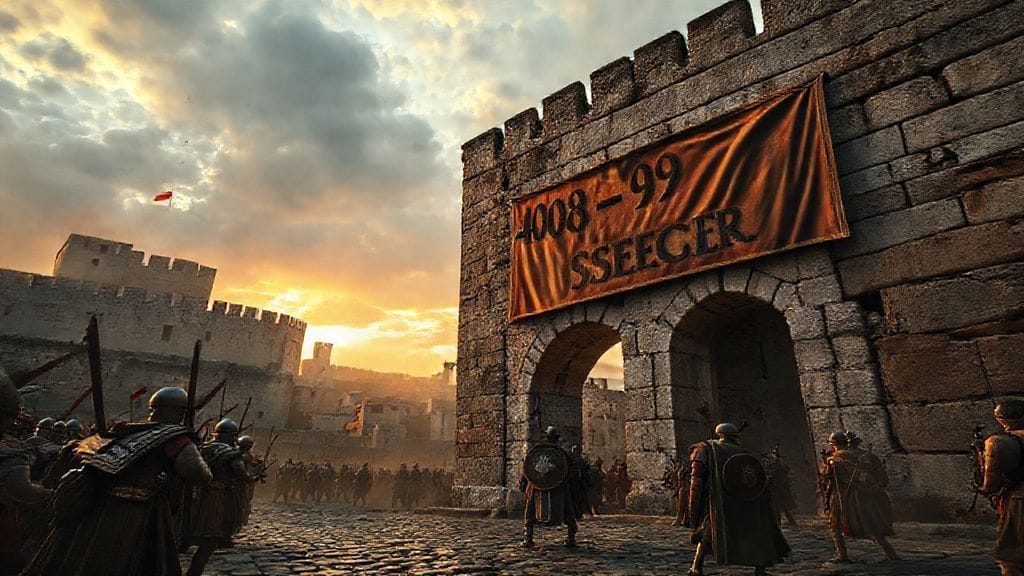
The first light of April 6, 402, dawned over the tranquil plains near Pollentia, a small Roman settlement nestled in the fertile lands of northern Italy’s Po Valley. Yet beneath that calm sky, the air bristled with tension, anticipation, and the haunting knowledge that this day would etch itself into the chronicles of history. Two titans of a fading age—Visigoths under Alaric I and the Roman legions led by the formidable general Stilicho—were about to clash in a battle that would foreshadow the twilight of ancient Rome.
As banners fluttered and warriors steeled themselves for combat, this confrontation was much more than a military engagement. It was a crucible where the destinies of empires and “barbarians” intertwined, where loyalty and betrayal, desperation and ambition, would play out on a stage far more complex than swords and shields. The Battle of Pollentia was not only a contest of armies but a struggle for survival in a world unraveling at its seams.
Rome’s Waning Power and the Visigothic Surge
To grasp the monumental significance of Pollentia, one must first understand the Roman Empire in 402 AD—a colossus riddled with cracks. The Western Roman Empire, once the invincible heart of Mediterranean civilization, faced internal decay, economic strain, and relentless pressures from all fronts. Germanic tribes, long labeled as “barbarians,” had more than mere raiding in mind; many sought new homes, alliances, and sometimes the destruction of a world they found oppressive.
Among them, the Visigoths had risen from a vassal people displaced by the Huns’ westward migration. Their king, Alaric I, was a charismatic and shrewd leader, a man who combined warrior instinct with political savvy. He was no mere marauder: Alaric sought to secure a place for his people within the Roman order, yet found himself repeatedly at odds with Roman authority. The years leading to Pollentia were marked by uneasy truces, broken promises, and mounting grudges.
Meanwhile, the Roman general Stilicho—half-Vandal by birth but loyal to the Empire—carried the enormous burden of defending a splintering realm. Tasked with repelling the Visigothic threat, Stilicho marshaled an army in northern Italy, preparing to face a foe that was as enigmatic as it was dangerous.
The Road to Pollentia: Marching into Italy
Alaric’s march on Rome in 401 had already shaken the Empire’s nerves. Though the Visigoths did not capture the city itself, their presence plunged Italy into fear and instability. By early 402, Alaric had entrenched his forces around Pollentia (modern-day Pollenzo), commanding control over vital routes and threatening the heartland of Roman power.
Stilicho responded with calculated resolve, assembling an army that would meet the Visigoths on their own ground. The battlefront near Pollentia was not chosen by chance—it was a strategic bottleneck, where the fate of northern Italy hung precariously. The two armies faced each other under ominous clouds as spring began, a silent testament to the clash between the old world and the new.
The Battle Commences: Dawn of April 6, 402
The alarm bells echoed as first light kissed the fields near Pollentia. Stilicho’s forces advanced in disciplined ranks; meanwhile, Alaric readied his warriors, who were fierce, battle-hardened and hungry for a decisive victory. Weapons glimmered, horses snorted, and banners snapped in the morning breeze.
Historical accounts, though fragmentary and sometimes contradictory, tell of a brutal contest of wills. The Visigoths launched fierce assaults against Roman positions. Stilicho’s legions, renowned for their discipline but fewer in number than earlier Roman armies, skillfully countered. The battle swayed back and forth amid dust clouds and clashing steel.
Tactical Maneuvers and Battlefield Drama
Stilicho’s tactical brilliance, honed through years of warfare, comes alive in the records: his ability to deploy forces rapidly and adapt mid-battle repeatedly frustrated Alaric’s attempts for a swift victory. At one critical moment, Roman cavalry executed a daring charge that disrupted the Gothic lines, yet Alaric’s personal leadership rallied his men beyond the brink of collapse.
The fighting was savage—shields splintered, flesh was pierced by arrows and spears, cries of agony mingled with roars of triumph. This was not a mere skirmish but a fierce, desperate siege of survival for both sides. The very earth seemed to tremble beneath the weight of empires colliding.
The Role of Stilicho: Rome’s Last Hope
Flavius Stilicho stands as a towering figure of this chapter in Roman history. Despite facing distrust from Rome’s political elite and the burden of an empire in decline, he embodied the last vestiges of Roman military tradition. His skills not only in battlefield command but also in diplomacy and propaganda kept the Roman heart beating amid chaos.
His leadership during Pollentia revealed both his strengths and vulnerabilities; the battle was as much a psychological war as a physical contest. Stilicho’s goal was to check the Visigoths’ advance without compromising Italy’s defenses, a tightrope walk that demanded both courage and caution.
Visigothic Strategies and the Assault on Roman Lines
Alaric’s tactics reflected his understanding of Roman military discipline. The Visigoths employed guerrilla-like assaults mixed with organized phalanx charges, leveraging their knowledge of the terrain. Their resilience was matched by a will forged through decades of displacement and conflict.
Interestingly, Alaric’s forces were composed not only of Gothic warriors but also allied tribes and possibly Roman defectors, a melting pot that underscored the complexity of late Roman warfare. This diversity, while militarily advantageous, also introduced internal tensions that would shape the battle’s outcome.
Civilians and Soldiers: The Human Face of Conflict
Beyond generals and tactics lay the human dimension—the peasants, townsfolk, and soldiers whose lives were irrevocably altered. The battle’s proximity to Pollentia meant villages were caught in the crossfire, suffering pillage, destruction, and displacement.
Victories and defeats on this day rippled through families; letters and contemporary chronicles hint at the anguish of mothers who lost sons, the desperation of refugees fleeing battlefields, and the fragments of courage that made survival possible. These personal stories remind us that history is not only events but also human hearts beating amidst chaos.
The Tide Turns: Contesting the Outcome
While traditional Roman sources claim a victory for Stilicho at Pollentia—boasting that the Visigoths were repulsed—modern historians debate the clarity of this outcome. Though the Romans held the field, Alaric’s forces managed a disciplined withdrawal, preserving their strength for future campaigns.
The battle neither decisively crushed the Visigothic threat nor delivered a symbolic reprieve for Rome. Instead, it marked a crucial moment of attrition—a preview of further struggles to come. Though the Visigoths did not capture Italy outright, their shadow over the peninsula had grown longer.
Aftermath of Pollentia: Romans and Visigoths Reassess
In the immediate wake, both sides took stock. Romans solidified defenses, renewed political efforts, and held on to fragile hopes of stability. Visigoths regrouped, eventually turning southward and continuing their inexorable push into Roman territories.
Pollentia did not end the conflict but froze it momentarily. The ensuing months featured negotiations, cavalry skirmishes, and strategic positioning. The battle also shaped subsequent alliances and enmities that influenced the fate of the Western Empire.
Political Reverberations Across the Western Empire
The battle’s impact extended beyond the battlefield. Rome’s political class grappled with the reality of losing control over Italy’s vast lands. Rival factions exploited the crisis, while imperial authority slowly waned.
Stilicho himself became a focal point for controversy, his successes overshadowed by suspicion and court intrigues. The Battle of Pollentia symbolized the shifting balance of power, not just military but political, signaling a new order emerging through conflict and negotiation.
Cultural and Social Impacts in Italy and Beyond
Pollentia’s legacy also touched cultural and social realms. The movement of Visigoths into Italy accelerated ethnic intermingling, sowing seeds that would blossom into medieval European identities.
Communities transformed as old Roman infrastructures strained under new governance and military pressures. Oral histories, art, and literature from this period echo the trauma and adaptation wrought by such conflicts, revealing the long-reaching consequences in everyday life.
The Legacy of Pollentia in Visigothic and Roman Memory
For the Visigoths, Pollentia was a testament to resilience and a stepping stone toward establishing their presence in former Roman lands. For Romans, it was a reminder of their empire’s vulnerability—both a rallying cry and a chilling sign of decline.
Later chronicles and medieval legends turned the battle into mythic narratives, intertwining fact and fiction. This dual memory reflects the complex nature of identity and history in a transitioning Europe.
Pollentia’s Place in the Decline of the Western Roman Empire
Seen through the grand sweep of history, Pollentia was more than a battle; it was a marker on the road to Rome’s eventual fall. It encapsulated the challenges of defending a sprawling empire against ambitious outsiders and internal decay.
The events at Pollentia exposed weaknesses in Roman military and political systems, accelerated barbarian integration, and foreshadowed the eventual collapse that historians mark at 476 AD. This fight, though less famous than later sackings, was foundational.
Modern Historiographical Debates and Interpretations
Scholars today continue to debate Pollentia’s significance. Early Roman sources paint it as a triumphant defense, while archaeological and comparative analyses suggest a more ambiguous outcome.
These scholarly dialogues reveal how history is a living process, shaped by discovery, perspective, and the evolving understanding of late antiquity’s turbulent tapestry. Pollentia remains a puzzle piece critical to decoding the fall of an empire.
Echoes of Pollentia in Medieval European Identity
The battle’s echoes resonate far beyond its immediate aftermath. The Visigoths, emboldened by such engagements, would go on to found kingdoms in Gaul and Spain, bridging ancient and medieval worlds.
Pollentia stands as a symbol of transformation—from Roman dominance to new political realities. It is a chapter in the larger story of Europe’s metamorphosis, marking the end of antiquity and the dawn of the Middle Ages.
Conclusion
The Battle of Pollentia was more than a mere clash of arms; it was a collision of epochs, ideals, and destinies. In the fragile spring of 402, amid the dust and blood-soaked fields of northern Italy, the last great hopes of a dying empire confronted the fierce determination of those deemed outsiders.
Yet, the story is not solely about victory or defeat. It is about resilience, adaptation, and the impermanence of power. Rome’s legacies survived not only through laws and monuments but through the very conflicts that threatened to obliterate it. The Visigoths, rising from the margins, would become crucial architects of a new European order.
Pollentia teaches us that history is a tapestry woven from countless human stories—lives dashed, dreams pursued, civilizations reborn. It reminds us that endings are seldom clean, that every fall contains a seed of renewal. As we look back across the centuries, the plains of Pollentia echo not with the clamor of battle alone but with the whispers of transformation that shaped our world.
FAQs
Q1: What caused the Visigoths to invade Roman Italy leading to the Battle of Pollentia?
A1: The Visigoths, displaced by the Huns and seeking new lands, were drawn into conflict due to failed treaties, internal Roman instability, and Alaric’s ambitions to secure a stable homeland and political recognition within the Empire.
Q2: Who was Stilicho and what role did he play at Pollentia?
A2: Stilicho was the Roman general and magister militum who led the defense of Italy. He was known for his military skill and political acumen and commanded Rome’s forces at Pollentia, orchestrating tactics that prevented a Visigothic breakthrough.
Q3: Did the Romans win the Battle of Pollentia?
A3: Ancient sources claim a Roman victory, but modern historians regard the outcome as indecisive. While Stilicho held the field, Alaric’s forces escaped intact, allowing them to continue their campaigns.
Q4: What were the consequences of Pollentia for the Western Roman Empire?
A4: The battle exposed the Empire’s military vulnerabilities and intensified political turmoil. It delayed but did not halt Visigothic incursions, contributing to the gradual decline of Roman authority in the West.
Q5: How did the Visigothic victory or survival influence European history?
A5: The Visigoths established kingdoms in former Roman lands, notably in Spain, shaping medieval European politics, society, and culture, and influencing the transition from the ancient to medieval worlds.
Q6: Are there archaeological sites related to the Battle of Pollentia?
A6: The exact battlefield location near modern Pollenzo has archaeological interest, and some artifacts have been found, though definitive identification remains challenging due to the passage of time.
Q7: How is the Battle of Pollentia remembered in historical narratives?
A7: It is seen as a pivotal episode in the late Roman-Germanic conflicts, illustrating the complex dynamics of power, survival, and cultural transformation during the Empire’s twilight.
Q8: What lessons does Pollentia offer contemporary readers about empire and conflict?
A8: It underscores the fragility of great powers, the persistence of innovation and adaptation under pressure, and the human cost embedded in historical transformations.