Table of Contents
- The Dawn of a New Era: Visigoths Enter Aquitaine
- From Wanderers to Settlers: The Path to the Foedus
- The Waning Western Roman Empire: Context and Crisis
- Alaric to Athaulf: The Shifting Visigothic Leadership
- The Alaric Legacy: Prelude to Foedus
- The Foedus Agreement of 418: Terms and Significance
- Aquitaine and Toulouse: The New Visigothic Heartland
- Visigothic Society and Integration into Roman Gaul
- A Fragile Alliance: Romans and Visigoths as Foederati
- Economic and Military Implications of the Settlement
- The Role of Emperor Honorius and His Court
- The Visigoths’ Transition from Raiders to Roman Allies
- Cultural Exchanges and Transformations in Visigothic Gaul
- Resistance and Rivalries: Roman Gaul’s Reaction
- The Foedus as a Prelude to Visigothic Kingdom
- Legacy of the Foedus: Shaping Early Medieval Europe
- Visigothic Law and Administration in Aquitaine
- The Foedus and the Road to Future Conflicts
- Archaeological Traces of Visigothic Toulouse
- The Emotional Pulse: How Ordinary People Lived the Change
- Conclusion: The Foedus as a Gateway to a New World
- FAQs
- External Resource
- Internal Link
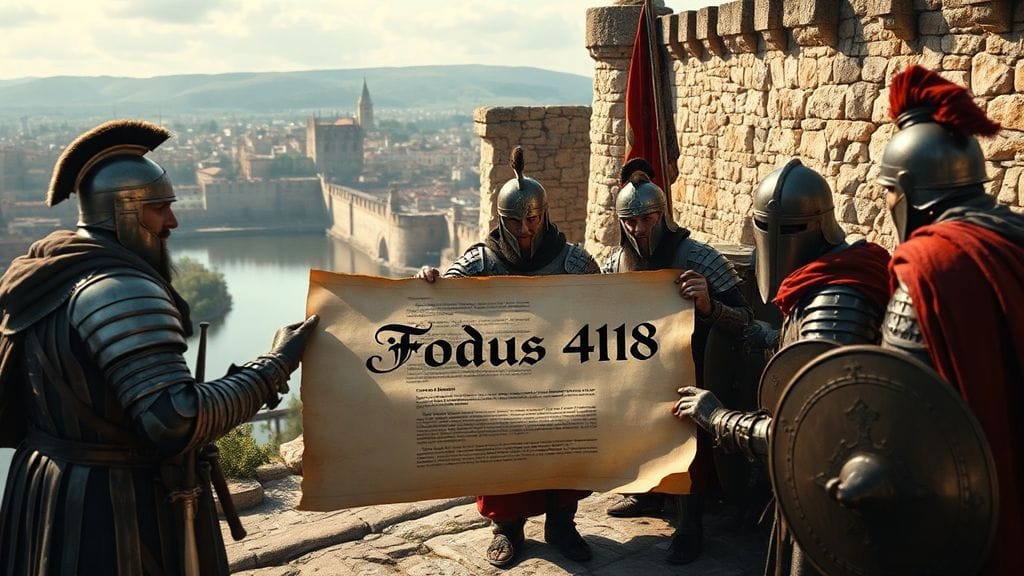
In the early spring of 418, as thick fog clung to the winding banks of the Garonne River, a moment unfolded that would quietly ripple across the fabric of late antiquity. In the heart of Aquitaine, near the city of Toulouse, a new chapter was forged—not with the clangor of swords or the roar of battles, but through ink, parchment, and mutual necessity. The Visigoths, those formidable “Western Goths” who had roamed much of the empire’s fringes, were granted a foedus—a formal and binding treaty—allowing them to settle as foederati within the Roman province of Aquitaine. This pact was more than an agreement; it marked the uneasy alliance between a fading Rome and a rising barbarian power, the quiet birth of what would become the Visigothic Kingdom of Gaul.
The year was 418 A.D., a turning point cloaked in the twilight of the Western Roman Empire’s grandeur. The world was shifting beneath the feet of Romans and Visigoths alike, and in this act of diplomacy, one could glimpse the contours of an era defined as much by adaptation and fusion as by conquest and collapse.
1. The Dawn of a New Era: Visigoths Enter Aquitaine
It was a time of tremors and transformation. The River Rhone and the Pyrenees marked the natural threshold between the Roman-controlled south and lands increasingly dominated by migratory tribes. Among these, the Visigoths stood out—warriors once enemies of Rome, now its uneasy partners. Their entrance into Aquitaine symbolized not only a geographical shift but a sociopolitical evolution that challenged what it meant to be Roman.
The Visigoths’ arrival in this lush, fertile province—the “land of the Aquitani”—was greeted with suspicion and hope in equal measure. Roman officials, fragmented and desperate, saw in them both a threat and a bulwark against other marauders. The Visigoths, meanwhile, sought stability and legitimacy in lands far from their past wanderings.
2. From Wanderers to Settlers: The Path to the Foedus
The Visigoths’ journey to their foedus began decades earlier, propelled by pressure from the Huns, Gothic migrations, and fractious Roman leadership. After the sack of Rome in 410 under Alaric I, their presence in Roman territories was problematic yet unavoidable.
By the early 5th century, their roaming bands were a destabilizing force, but also a military power Rome could leverage. The gradual shift from raiding to settlement was not merely strategic—it was existential. Survival demanded a defined place within the empire’s structure, however fractured.
3. The Waning Western Roman Empire: Context and Crisis
The empire’s internal decay set the stage for the foedus treaty. Emperor Honorius, presiding from Ravenna, struggled with fragmented authority, economic strain, and the pressure of increasingly autonomous barbarian groups inside the imperial borders.
Amid endless military rebellions, plundering, and political intrigue, the Roman state recognized that alliances with tribes like the Visigoths were a necessity rather than a preference. The foedus in Aquitaine was as much a recognition of weakness as of pragmatism.
4. Alaric to Athaulf: The Shifting Visigothic Leadership
The line from Alaric I to Athaulf defined a trajectory not just of leaders but of a people’s changing goals. Alaric’s raid on Rome stunned the world, but Athaulf, his successor, sought integration over destruction, envisioning a Gothic future within Roman civilization rather than its overthrow.
Athaulf’s marriage to Galla Placidia, daughter of Emperor Theodosius I, symbolized this shift toward diplomacy and alliance, paving the way for the foedus.
5. The Alaric Legacy: Prelude to Foedus
While Alaric’s legacy was one of force and fear, it cast shadows of inevitability. Rome could no longer ignore the Visigoths; their power was undeniable, their ambitions unmistakable. The foedus treaty was thus the diplomatic inheritance of Alaric’s bold but short-lived assault on Rome.
6. The Foedus Agreement of 418: Terms and Significance
In 418, the formal treaty was sealed: the Visigoths were granted lands in Aquitaine and made foederati—federated allies obliged to defend the region for the empire in exchange for autonomy, land, and recognition.
This arrangement was complex and delicate. It acknowledged the Visigoths’ right to settlement but demanded loyalty to Rome, military support, and respect for imperial authority. It was a legal and symbolic testimony to mutual dependence.
7. Aquitaine and Toulouse: The New Visigothic Heartland
Aquitaine became the cradle of Visigothic Gaul. Centering their power in Toulouse, the Visigoths began transforming the urban, rural, and military landscape.
Toulouse’s walls echoed with Gothic voices, and its markets humbly showed the mingling of Roman and barbarian worlds. Aquitaine was not just a refuge; it was the seedbed for an emerging kingdom with deep Roman imprints.
8. Visigothic Society and Integration into Roman Gaul
Life for ordinary Visigoths interwove adaptation and tradition. Aristocratic Goths adopted Roman dress and language; warriors merged Roman tactics with their own; and native Aquitani navigated the complexities of coexistence.
Christianity, particularly Arianism among the Visigoths, differentiated them religiously from Nicene Roman Catholics, yet over time, religious dialogues fostered coexistence and eventual conversion.
9. A Fragile Alliance: Romans and Visigoths as Foederati
This foedus was a double-edged sword. Rome gained soldiers to secure its Gallic borders, but the Visigoths gained footholds that eroded imperial sovereignty. Underneath the alliance were undercurrents of mistrust, cultural gaps, and competing agendas.
Still, for the moment, this was a strategic détente—an interlude of peace and uneasy cooperation.
10. Economic and Military Implications of the Settlement
The Visigoths’ settlement revitalized Aquitaine’s defenses and provided recruitment for Roman military campaigns. In return, Visigoths accessed Roman infrastructure, tax revenues, and trade networks.
Economically, the region benefited, but the redistribution of land and resources fueled social tensions among local Gallo-Roman elites and peasant communities.
11. The Role of Emperor Honorius and His Court
Honorius’s decisions were shaped by desperation but also by shrewd calculation. From Ravenna, his court negotiated and approved the foedus, aiming to stabilize Gaul without costly wars.
Yet, Honorius’s reign was marked by indecision and fragmentation, and his alliance with the Visigoths was a gamble that would have ramifications beyond his lifetime.
12. The Visigoths’ Transition from Raiders to Roman Allies
This new relationship evolved Visigothic identity, as they abandoned clandestine raids for formal duties as Roman collaborators.
The shift reflected pragmatic wisdom: to survive and flourish, the Visigoths embraced Roman law and customs while preserving their warrior legacy.
13. Cultural Exchanges and Transformations in Visigothic Gaul
Roman urban culture, legal tradition, and Christianity influenced the Visigoths, while Gothic art, language, and custom left enduring marks on Gaul.
The fusion was not immediate or always smooth, but over decades, it shaped the early medieval cultural mosaic that defined Western Europe’s transition.
14. Resistance and Rivalries: Roman Gaul’s Reaction
Not all in Roman Gaul welcomed the Visigothic foedus. Local elites often saw the newcomers as usurpers; peasants feared the imposition of new landlords.
Some Roman commanders resented sharing authority with their former enemies, provoking local uprisings and dissent that punctuated this era.
15. The Foedus as a Prelude to Visigothic Kingdom
Though formally allies, the Visigoths’ foothold in Aquitaine sowed seeds of future independence. Within decades, Toulouse became capital of a distinct Visigothic realm.
The foedus was thus the foundation stone for one of the earliest barbarian kingdoms to integrate Roman political models.
16. Legacy of the Foedus: Shaping Early Medieval Europe
The Visigothic settlement framed subsequent patterns of barbarian settlement in Roman territories. The notion of foederati foreshadowed new political realities where Rome was one among many powers.
Visigothic laws, cultural hybridity, and territorial rule influenced the medieval landscape for centuries.
17. Visigothic Law and Administration in Aquitaine
The Visigoths adapted Roman administrative practices while crafting their own legal code, the Breviary of Alaric, which aided Roman and Gothic subjects alike.
This dual system reflected the complexity of governing a mixed population in transition.
18. The Foedus and the Road to Future Conflicts
The settlement, while stabilizing, could not contain all tensions. Rival interests, regional ambitions, and shifting loyalties led eventually to conflicts with Franks and other groups, and to Rome’s fading control.
Yet this dynamism laid the foundations of medieval power struggles.
19. Archaeological Traces of Visigothic Toulouse
Excavations in Toulouse reveal Gothic artifacts, fortifications, and Christian basilicas blending Roman and barbarian styles, illuminating the cultural syncretism post-foedus.
These material remains give vivid testimony to a people redefining their identity through place.
20. The Emotional Pulse: How Ordinary People Lived the Change
Behind treaties and armies were everyday lives—farmers adapting to new landlords, women weaving threads of tradition and change, children growing up between two worlds.
The foedus was not just abstract diplomacy; it was a human drama of survival, hope, and uneasy peace.
Conclusion
The Visigoths’ grant of the foedus in Aquitaine in 418 was more than a diplomatic settlement—it was a pivotal act of transformation. Amid the chaos of a declining Western Roman Empire, it embodied both the fragility and resilience of late antiquity. From the meeting halls of emperors and Gothic kings to the fields farmed by common folk, this treaty carved a space where old empires and new peoples could intertwine.
It was an uneasy truce that marked the genesis of medieval Europe—a tableau where identities blurred, alliances shifted, and the world we know slowly emerged from the shadows of antiquity. The story of the Visigoths in Aquitaine reminds us that history is less about sudden ends than ongoing reinventions, about the unexpected ways defeat and alliance sow the seeds for new beginnings.
FAQs
Q1: Why were the Visigoths granted a foedus in Aquitaine?
A1: The Western Roman Empire sought to stabilize its vulnerable southwestern frontier by officially settling the Visigoths as allied federates. Granting the foedus allowed Rome to employ the Visigoths as defenders while reducing violent conflicts.
Q2: What obligations did the Visigoths have under the foedus?
A2: They were to defend the region militarily, maintain loyalty to the Roman emperor, provide troops on demand, and manage their affairs without undermining Roman authority.
Q3: How did the Visigoths maintain their identity within Roman Aquitaine?
A3: They preserved their language, traditions, and Arian Christianity while gradually adopting Roman customs, laws, and administrative practices, resulting in a blended cultural identity.
Q4: Did the foedus guarantee lasting peace between Romans and Visigoths?
A4: No, the peace was uneasy and marked by tensions and occasional conflicts; however, the foedus was a pragmatic arrangement that delayed outright war and facilitated eventual Visigothic political development.
Q5: How did local Roman populations react to the Visigothic settlement?
A5: Reactions varied from acceptance and cooperation to resentment and resistance, especially among local elites who feared loss of power and peasants wary of new landowners.
Q6: In what ways did the foedus influence European history?
A6: It set a precedent for barbarian settlements within the Roman world, influenced medieval state formation, and contributed to the cultural and political landscape of post-Roman Europe.
Q7: What role did Emperor Honorius play in this agreement?
A7: Honorius authorized the foedus as part of his strategy to secure the empire’s borders through alliances rather than direct military confrontation, though his reign was marked by increasing imperial decline.
Q8: Are there archaeological evidences of Visigothic presence in Aquitaine?
A8: Yes, excavations in Toulouse and surrounding areas have uncovered fortifications, inscriptions, and artifacts demonstrating the Visigothic settlement and cultural fusion.

