Table of Contents
- Storm Over Thrace: The Empire on the Edge in 513
- An Empire Fraying at the Seams: The Eastern Roman World Before the Revolt
- Vitalian Before the Storm: Soldier, General, and Reluctant Rebel
- Monks, Tax Collectors, and the Poor: The Religious and Social Spark
- The First Flames: How the Vitalian Revolt in Thrace Erupted
- Blood and Banners: The Rebel Army Assembles Along the Balkan Frontier
- March on Constantinople: Panic in the City of Constantine
- Negotiations at the Walls: Oaths, Gold, and a Fragile Peace
- Broken Promises: Anastasios, Vitalian, and the Collapse of Trust
- Battles by Land and Sea: Strategy, Deception, and the Turning of the Tide
- Thrace in Ashes: Villages, Veterans, and the Human Cost of Revolt
- Faith as a Weapon: Orthodoxy, Monophysitism, and Imperial Legitimacy
- From Rebel to Kingmaker: Vitalian and the Rise of Justinian’s Faction
- Assassination in the Capital: The Silent End of a Loud Revolt
- Echoes Through the Centuries: How the Revolt Shaped the Byzantine Future
- Reconstructing the Past: What Our Sources Say—and What They Hide
- Conclusion
- FAQs
- External Resource
- Internal Link
Article Summary: In the early sixth century, the Eastern Roman Empire was rocked by a turbulent uprising known to historians as the vitalian revolt thrace, a revolt that fused religious tension, social despair, and political ambition into a single, explosive crisis. From the moment Vitalian, a battle-hardened general from Thrace, raised his standard against Emperor Anastasios I in 513, the empire’s fragile balance between center and periphery began to crack. This article traces how the vitalian revolt thrace emerged from mounting grievances among soldiers, peasants, and clergy, particularly over harsh taxation and contested religious policies. It follows Vitalian’s dramatic advance on Constantinople, his uneasy negotiations with the emperor, and the bitter cycle of broken promises and renewed warfare. Along the way, it examines the human cost borne by the people of Thrace, whose lands became the battlefield on which imperial authority was tested. The narrative also explores how the vitalian revolt thrace opened doors for future rulers like Justin and Justinian, who learned from both the fears and opportunities the uprising exposed. By weaving together chronicles, ecclesiastical records, and later Byzantine historians, the article shows how the memory of the vitalian revolt thrace became part of a larger story about power, faith, and resistance in the Eastern Roman world. And in its final sections, it reflects on how this rebellion, though ultimately crushed, helped to redefine what it meant to rule—and to rebel—in Byzantium.
Storm Over Thrace: The Empire on the Edge in 513
The winter of 513 did not arrive in a single night of snow and wind. It gathered slowly, like a storm seen far off across the Thracian plains—dark clouds building behind low hills, a chill settling over villages and frontier forts. Somewhere between the provincial cities of Thrace and the towering walls of Constantinople, a line was about to be crossed. When Vitalian, a general of the Eastern Roman army and a son of the Balkan frontier, finally chose to ride against his own emperor, it was not an act born in a single day. The vitalian revolt Thrace was the outcome of years of strain: religious divisions unresolved, soldiers unpaid, farmers crushed by tax collectors, monks railing against heresy, and a capital city that believed distance meant safety.
Yet in the early sixth century, there was no true distance in the Eastern Roman Empire, only fragile threads of loyalty stretching from Constantinople to the outer provinces. Thrace—rugged, windswept, inhabited by Romanized peasants, Gothic settlers, and hardened veterans—was both shield and wound, a region where the empire defended itself, and where it bled. It is here that the vitalian revolt Thrace began, transforming local frustrations into a challenge that nearly toppled a reigning emperor.
Imagine the scene: village churches buzzing with rumors of imperial heresy; rough hands tightening around spear shafts as veterans grumbled that their pay had vanished into the pockets of distant officials; bishops whispering that right belief no longer flowed from the palace. These were the voices behind the revolt. Vitalian embraced them, sharpened them, and turned them into a weapon.
From the moment he rallied troops and towns in Thrace, the uprising threatened more than a border disturbance. It questioned the religious and moral legitimacy of Emperor Anastasios I, a ruler of remarkable administrative talent but divisive faith. The vitalian revolt Thrace was framed, from its earliest proclamations, as a defense of “orthodoxy,” of the faith of the Council of Chalcedon, against what many regarded as a heretical imperial policy. But under the banner of faith marched hunger, anger, and a profound sense of abandonment.
This was not just a revolt of swords and shields; it was a revolt of sermons, petitions, and memories of what the empire was supposed to be. It is astonishing, isn’t it, that a regional general could move tens of thousands of men, rattle the palace in Constantinople, and practically dictate religious concessions—if only for a brief and fragile moment? But this was only the beginning. To understand how the vitalian revolt Thrace became one of the most revealing crises of the early Byzantine age, we must step back into the world that produced it.
An Empire Fraying at the Seams: The Eastern Roman World Before the Revolt
By 513, the Eastern Roman Empire—what later generations would call Byzantium—was both powerful and vulnerable. Its marble colonnades and golden mosaics projected strength; its bureaucracy, drilled and precise, extracted taxes across three continents. But the façade concealed fractures. On the Danubian frontier, barbarian incursions and troop rotations left communities exhausted. In the east, relations with Persia simmered between tense peace and sporadic conflict. Within the empire, the greatest danger was not external enemies, but the question that tied faith and power together: who had the authority to define true Christianity?
Emperor Anastasios I, who came to power in 491, was no tyrant in the caricatured sense. He was a thoughtful administrator, obsessed with fiscal discipline. Under his hand, the imperial treasury swelled. Yet it swelled because taxes were rigorously enforced and often increased, especially in the provinces that were considered safe enough to squeeze. Thrace was one of these. Its farmers, small landowners, and veterans—many settled on military lands—felt the pressure of a court that needed revenue for distant campaigns and public works. Their daily reality was simpler than imperial policy: if the tax collector came and you could not pay, you lost your land, your animals, or your peace.
At the same time, the empire was still reeling from the great theological battles of the fifth century. The Council of Chalcedon (451) had declared Christ to be in two natures, divine and human, united in one person. For many in the eastern provinces—especially in Egypt and Syria—this sounded like a betrayal of the earlier emphasis on Christ’s single, unified nature. There, Monophysite theology took deep root. Anastasios, influenced by Monophysite sympathies, sought compromise formulas, issuing documents like the Henotikon to calm dispute. Instead, he deepened mistrust in Rome and among Chalcedonian bishops.
Thrace, though far from Alexandria or Antioch, was drawn into this struggle because doctrine flowed along the same channels as imperial authority. Bishops were appointed, deposed, and reinstated according to whether they echoed Constantinople’s current line. Clergy who defended Chalcedon felt increasingly isolated. Monks, who often saw themselves as guardians of pure faith, were quick to denounce the emperor’s policies. Late antique religious passion was no quiet affair; it filled streets, monasteries, and countryside shrines. It turned processions into protests and homilies into indictments.
Meanwhile, the army on the Balkan frontier harbored its own grievances. Troops were subject to irregular pay, harsh discipline, and often indifferent commanders. They watched as imperial officials rotated in and out, enriching themselves through corrupt requisitions and tax farming. For these men, loyalty was not an abstract ideal; it was a contract that could be broken. When the emperor’s government failed to honor obligations—whether in coin, land, or respect—rebellion became thinkable.
It was in this context that the vitalian revolt Thrace would take form. The empire, on paper, was united. In practice, it was held together by delicate bargains between emperor, Church, army, and provinces. In 513, those bargains were unraveling, and one man stood ready to seize the unraveling threads.
Vitalian Before the Storm: Soldier, General, and Reluctant Rebel
Vitalian did not appear out of nowhere. Born into the complex ethnic fabric of the Balkans—likely of mixed Gothic and local stock—he was part of a tradition of frontier men who could be both defenders and threats to the empire. His father, Patriciolus, served as a high-ranking officer under previous emperors, proof that families of “barbarian” origin could climb the ladder of Roman service. Vitalian grew up in a world where a man’s identity was less about birth and more about loyalty, martial skill, and the patronage he could secure.
By the time Anastasios ruled in Constantinople, Vitalian had established himself as an accomplished military leader. His career placed him in Thrace and along the Danubian frontier, commanding federate troops and local units. To his soldiers, he was not an aloof courtier but a familiar presence, sharing their hardships, speaking their languages, knowing the names of villages that imperial maps barely marked. To city officials and bishops, he appeared as a figure of order, someone who could repel raids and keep roads clear.
In the patchwork society of Thrace, Vitalian’s background may have helped him bridge divides. He could speak to Gothic foederati, Romanized peasants, and provincial elites alike. He understood that loyalty was a fragile currency and that the empire’s promises sometimes evaporated in the long distance between a decree in Constantinople and its supposed execution in the provinces. When he witnessed soldiers going unpaid and local communities squeezed for more taxes, he saw not just injustice, but danger: this was how frontiers collapsed.
We do not possess a personal letter or memoir from Vitalian—no direct window into his inner mind. What we do have are the reports of chroniclers like John Malalas and later, more polished narratives from Procopius, writing under Justinian. They portray Vitalian as ambitious, devout (at least in the language he used), and shrewd enough to wield religion and politics together. One can imagine him listening as monks poured out complaints about heretical bishops, as village elders lamented tax exactions, and as officers whispered of desertion. The seed of revolt germinated in these conversations.
But was Vitalian driven more by piety or power? The answer, as so often in late antiquity, is both. He wrapped his cause in the mantle of orthodox Christianity, championing the Council of Chalcedon and the authority of the bishop of Rome. At the same time, he demanded concrete political concessions: the dismissal of hated officials, the restoration of legitimate bishops, and the recognition of his authority in the Balkans. The vitalian revolt Thrace would show how easily a man could become the voice of the discontented and how quickly that voice could echo along roads and river valleys all the way to the capital.
Monks, Tax Collectors, and the Poor: The Religious and Social Spark
If we stand in a small Thracian village on the eve of the revolt, the empire’s crisis does not look like a debate in a council hall; it looks like a confrontation at the church door. The local bishop has been deposed because he refused to sign an imperial formula he believed compromised Chalcedon. An imperial appointee, suspected of heretical sympathies, has taken his place. Monks from nearby monasteries refuse to commemorate the new bishop in their liturgy. Sermons turn bitter. The faithful are told that their emperor has betrayed Christ’s truth.
At the same time, the tax collectors arrive. They carry scrolls stamped with imperial seals, listing quotas that seem impossible to meet after a bad harvest. They demand arrears that previous officials had temporarily waived but never erased from the records. A widow who cannot pay in coin is told to surrender grain; a veteran’s family, having lost its oxen in a recent raid, is given no mercy. Soldiers are quartered in villagers’ homes, consuming scarce food. Anxieties pile up, resentment thickens the air.
Into this atmosphere walked the monks—fiery, uncompromising, unafraid to denounce sin in high places. In Thrace and across the eastern provinces, monks had become a moral opposition, at times supporting emperors, at times excoriating them. Now, many of them saw Anastasios’s religious policy as a betrayal of orthodoxy. They circulated letters, gathered signatures, and sent envoys to Constantinople and Rome. When they found a sympathetic ear in Vitalian, they did not hesitate to encourage him. To them, he was the sword they lacked.
What made the vitalian revolt Thrace so potent was this convergence: economic misery, military discontent, and a religious cause that gave moral weight to rebellion. Vitalian did not have to invent grievances; they were already smoldering. All he had to do was convince people that he could turn their indignation into change. His proclamations spoke of restoring “the true faith” and protecting the “poor and oppressed” from unjust officials. Whether out of conviction or calculation, he harnessed the language of justice.
The stories that survived in ecclesiastical histories emphasize miracles and divine signs: visions of saints encouraging the resistance, relics carried before Vitalian’s troops, processions that transformed into war marches. Behind the miraculous, however, lies the plain reality that faith gave people courage. To rise against the emperor was a terrifying step. To do so believing you defended Christ himself, and with bishops and monks at your side, made the unthinkable possible.
The First Flames: How the Vitalian Revolt in Thrace Erupted
The outbreak of the vitalian revolt Thrace can be traced to a specific trigger: the imperial government’s treatment of the local garrison and population in the region of Lower Moesia and Scythia Minor, near the lower Danube. Sources speak of the dismissal or mistreatment of troops under Vitalian’s command, coupled with heavy-handed religious policies in the Balkan dioceses. When an attempt was made to impose a bishop perceived as heretical and to sideline local Chalcedonian clergy, Vitalian’s patience snapped.
At first, his actions may have looked like a limited military mutiny. He rallied the troops directly under his authority, promising to secure their unpaid wages and defend their religious rights. But as he moved through Thrace, something larger happened: village leaders, clerics, and disaffected landowners flocked to his banner. Soldiers stationed in nearby forts saw in him a champion against their own grievances. Refugees from earlier conflicts, including Gothic and Hunnic veterans, found in his movement a new purpose and a chance at revenge against a government that had abandoned them.
Chronicles suggest that Vitalian’s following quickly swelled to tens of thousands—some sources, likely exaggerating, speak of 50,000 or 60,000 men. Even if these numbers are inflated, they convey a basic truth: this was no small bandit uprising. It was a regional army, mobile and determined, and it moved under the sign of the cross. Priests and monks accompanied the soldiers, carrying icons, relics, and banners emblazoned with Christian symbols. To the imperial court, this was doubly alarming: a military threat draped in moral legitimacy.
Vitalian’s first acts targeted imperial representatives rather than ordinary citizens. He attacked garrisons loyal to the emperor, captured strategic points, and seized control of important roads linking Constantinople to the northern Balkans. As he did so, he published his demands. According to later reports, these included: the restoration of Chalcedonian orthodoxy; the recall of exiled bishops; and the dismissal of certain high-ranking officials—chief among them the powerful finance minister Marinus, seen as the architect of oppressive taxation.
The empire now faced a rebellion that could not easily be dismissed as simple banditry. The vitalian revolt Thrace was, from its earliest days, political and ideological. Anastasios had to decide: negotiate with a general who wrapped treason in the language of faith, or crush him and risk turning him into a martyr for orthodoxy. At first, the emperor tried a middle path—relying on his generals to contain the revolt, while publicly minimizing its seriousness. But events on the ground soon made such caution untenable.
Blood and Banners: The Rebel Army Assembles Along the Balkan Frontier
As weeks turned into months, the rebel host around Vitalian hardened into a force capable of threatening the capital itself. He drew men from the federate Gothic communities who still remembered their alliance with earlier Eastern emperors and their subsequent neglect. He recruited from the ranks of the local peasantry, promising not only religious justice but also relief from tax burdens once his demands were met. The result was an army that was heterogeneous, tough, and focused.
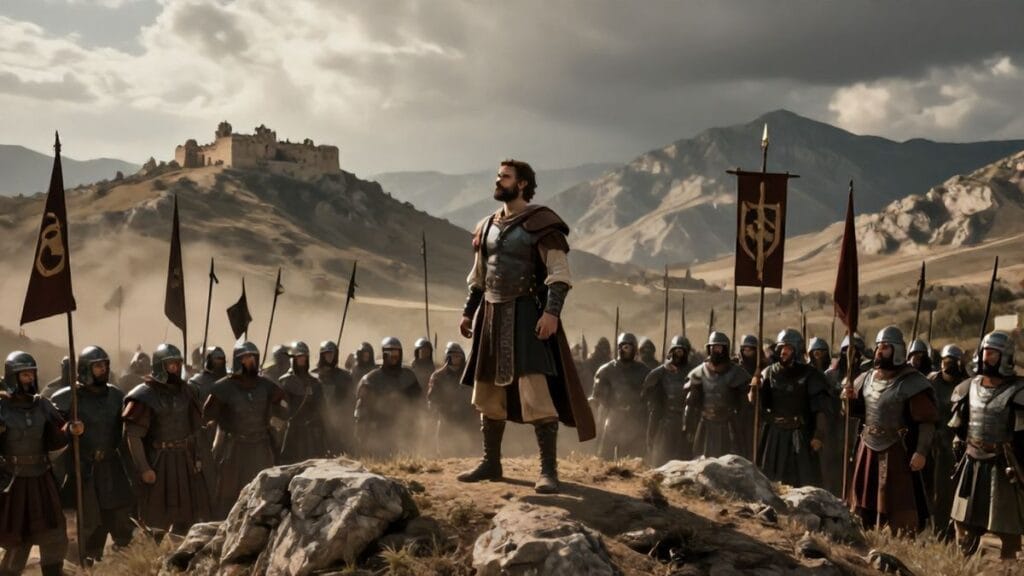
Imagine the camps that sprang up in Thrace: rough palisades erected near rivers and crossroads, the air thick with smoke from open fires, the sound of Latin, Greek, Gothic, and other tongues mingling in the night. Standards bearing Christian symbols flew alongside more traditional military vexilla. Officers, some of them veterans of imperial campaigns against Persians or Isaurian rebels, now discussed how to turn their battlefield experience against the very structure that had trained them.
Vitalian was not reckless. Before marching on Constantinople, he secured supply lines and strongholds. He established himself as master of much of Thrace and the lower Danubian region, perhaps even striking deals with neighboring barbarian groups to ensure his rear was safe. He wanted not a suicidal clash, but bargaining power. The stronger his army appeared, the more the emperor would be forced to negotiate.
Reports from contemporary observers suggest that fear swept through loyalist units stationed nearby. Some officers doubted whether their soldiers would fight with conviction against comrades who shared their grievances and faith. Desertions occurred; minor garrisons surrendered without battle. Trade caravan routes shifted as merchants avoided zones where armies moved. For ordinary inhabitants of Thrace, daily life became a bet on survival: would hosting rebels earn the wrath of imperial reprisals, or refusing them bring immediate violence?
The vitalian revolt Thrace had now passed the point of no return. Vitalian’s actions went beyond petition; they embodied open armed resistance. Every village that supplied him, every bishop who blessed his troops, every veteran who joined his ranks deepened the rift between province and palace. The stage was set for a confrontation that could no longer be kept in the shadows.
March on Constantinople: Panic in the City of Constantine
When word reached Constantinople that Vitalian’s army was moving south, something changed in the air of the capital. The city, accustomed to distant wars and far-off rebellions, suddenly felt the breath of danger against its own mighty walls. Rumors raced faster than official announcements. Some said Vitalian’s army numbered eighty thousand; others whispered that he had secret allies in the city itself, ready to open the gates from within.
In the Hippodrome, the chariot factions—the Blues and the Greens—added news of the revolt to their already volatile chants. For them, politics and sport were inseparable. Crowds roared denunciations of imperial ministers during races, mixing cheers for favorite charioteers with pleas for tax relief and doctrinal clarity. Those who favored Chalcedon, especially within the Senate and clergy, saw in Vitalian a dangerous yet appealing champion. Those aligned with Anastasios’s religious policy dreaded that appeasing him would undo years of carefully managed compromise.
As Vitalian’s forces approached the suburbs of Constantinople, Emperor Anastasios ordered the fortifications strengthened and the fleet prepared. The city’s walls, stretching like a stone ocean from the Sea of Marmara to the Golden Horn, had never fallen to an enemy. But the threat now was not just physical; it was moral. If an army claiming to defend orthodoxy camped outside the city and the capital’s own orthodox population sympathized, could the emperor trust his people?
Chronicles describe the capital’s fear in vivid terms. Lamps burned late into the night in the Great Palace. Senators debated not only military options, but theological concessions. The patriarch, torn between loyalty to the emperor and pressure from the Chalcedonian faithful, played a cautious game. The imperial navy moved into position along the shores, ready to block any attempt by Vitalian to control the waterways.
For a time, the city seemed to hold its breath. Had Vitalian stormed the walls, history might have taken a different course. But he was too astute for a headlong assault on the best-defended city in the Mediterranean. Instead, he used his position as leverage. He demanded that Anastasios restore Chalcedonian orthodoxy, recall exiled bishops, and remove despised officials. He wanted to show that he could bring the capital to the brink, forcing it to negotiate on his terms.
Negotiations at the Walls: Oaths, Gold, and a Fragile Peace
In one of the most dramatic episodes of the vitalian revolt Thrace, the rebel general and the emperor who denounced him as a traitor entered into negotiation. Picture the scene: envoys riding between the rebel camp and the palace, carrying sealed letters and oral assurances. Monks and bishops weighed in, urging the emperor to make religious concessions rather than risk a bloody siege. Senators, especially those with estates in Thrace and the Balkans, pressed for a settlement that would calm the provinces.
Eventually, Anastasios agreed to terms—at least on parchment. He promised to convene a council in Constantinople to restore the decisions of Chalcedon, to rehabilitate exiled clergy, and to address abuses by certain officials. Vitalian, in turn, pledged to withdraw his forces and recognize the emperor’s authority. To seal the agreement, he received the title of magister militum in Thrace, an official recognition of his military role, along with substantial sums of money for his troops.
Contemporary writers, including the chronicler John of Antioch, describe a procession in which Vitalian entered the capital or at least approached it in symbolic triumph, hailed as a defender of faith. Some accounts suggest that crowds greeted him enthusiastically, cheering the man they saw as having forced the emperor back into the arms of orthodoxy. Anastasios, ever pragmatic, may have calculated that a temporary humiliation was better than the disaster of open civil war on his doorstep.
Yet behind the celebrations, suspicion lingered like smoke after a fire. Did the emperor truly intend to honor his promises? Did Vitalian genuinely mean to lay down the sword once his religious demands were met? The peace was not born of reconciliation, but of exhaustion and fear. Both sides regarded it as a truce, not a final settlement.
This moment, when a rebel could compel the emperor to negotiate on doctrinal matters, is one of the clearest signs of how far the empire’s authority had frayed. The vitalian revolt Thrace turned a provincial general into a broker of imperial religious policy. No wonder later historians like Procopius treated the episode as a prelude to the more famous confrontations of Justinian’s reign; it revealed that dogma, politics, and military power were intertwined strands in the rope of empire, and that a determined man could pull on any of them to shake the whole structure.
Broken Promises: Anastasios, Vitalian, and the Collapse of Trust
For a brief period after the agreement, it seemed as if the empire might settle back into a precarious calm. Vitalian withdrew his troops from the vicinity of Constantinople and returned to Thrace, where he nominally served as a loyal magister militum. Anastasios, for his part, convened discussions that were supposed to address the doctrinal disputes. Yet, as so often in late antique politics, the letter of the agreement and its spirit parted ways.
The emperor’s reluctance to fully restore Chalcedonian orthodoxy soon became evident. Measures were half-hearted or delayed; key exiled bishops remained in limbo. Influential advisers persuaded Anastasios that yielding too much would anger powerful Monophysite constituencies in the eastern provinces. Meanwhile, he moved quietly to strengthen loyalist forces and reorganize provincial commands in a way that might limit Vitalian’s influence.
Vitalian, watching these developments from Thrace, realized he had been outmaneuvered. The gold and titles he had gained placated some of his followers, but others saw betrayal. Monks and orthodox clergy who had believed his victory would bring doctrinal clarity now murmured that the emperor had only feigned repentance. The fragile trust that had sustained the truce dissolved. Once again, petitions, letters, and sermons denounced imperial duplicity.
It is here that we see the darker side of the vitalian revolt Thrace. Having drawn the sword once and won concessions, Vitalian—and those around him—found it harder to imagine returning to quiet subordination. Their power, prestige, and even safety depended on maintaining a stance of strength. If the emperor would not honor agreements compelled by arms, perhaps only renewed pressure could secure a lasting settlement.
From Constantinople’s perspective, Vitalian’s continued influence in Thrace was intolerable. Anastasios could not risk leaving a semi-autonomous strongman in control of a key frontier region. Thus, even as the rhetoric of peace lingered in official documents, both sides prepared for the next round of conflict. Trust, once broken, became an open wound, and the empire braced itself for renewed civil war.
Battles by Land and Sea: Strategy, Deception, and the Turning of the Tide
The second and third phases of the conflict between Vitalian and Anastasios were marked by more intense and brutal fighting. The truce had given both sides time to regroup. Now, they tested each other’s strength in a series of campaigns that ranged from the Balkans to the waters off Constantinople.
Vitalian once more rallied his followers, drawing on the same reservoir of religious and social discontent that had fueled the first uprising. This time, however, the imperial government was better prepared. Anastasios had reorganized the army, fortified key positions, and placed trusted commanders—most notably his relative Hypatios and the admiral Marinus—in critical roles. The emperor’s aim was not merely to push Vitalian back, but to crush his capacity to rebel.
Several battles took place in Thrace and the neighboring provinces. Our sources, fragmentary and sometimes contradictory, nonetheless agree that fighting was fierce and casualties high. Villages were burned, crops destroyed, and refugees once again flooded roads and cities. While Vitalian initially scored successes on land, his inability to match the imperial navy at sea proved decisive. Marinus, though hated by many for his fiscal policies, demonstrated real skill as a commander. In a crucial engagement near Constantinople—later sources place it around 515—his fleet outmaneuvered Vitalian’s forces, cutting them off and inflicting heavy losses.
The image preserved in some narratives is striking: ships clashing under the shadow of the capital’s walls, the cries of sailors mingling with the distant clamor of city life. From Constantinople’s towers, spectators could watch not only a battle for their safety, but also for the soul of the empire. When imperial banners finally drove back the rebels, there was both relief and a sense that a chapter was closing.
Still, Vitalian was not immediately destroyed. He retreated again to the Balkans, where his influence persisted, though diminished. The vitalian revolt Thrace had become a war of attrition. Each side suffered, but the central government had deeper reserves. Anastasios could recruit new troops, draw on the vast resources of the treasury he had so carefully built, and rely on the inertia of imperial institutions. Vitalian had courage, local support, and religious zeal, but his base was inherently more fragile.
By the time of Anastasios’s death in 518, the rebellion had largely lost its early momentum. Yet it had not been erased from memory. It waited, like a buried ember, to flare again under a different emperor and in a transformed political landscape.
Thrace in Ashes: Villages, Veterans, and the Human Cost of Revolt
Behind the grand strategies and doctrinal debates lies the quieter, harsher story: the suffering of Thrace itself. For the people who lived in the shadow of the vitalian revolt Thrace, the years around 513 were not an abstract constitutional drama, but a series of direct blows. Fields left unharvested because the men were off fighting. Livestock stolen by marauding soldiers, whether rebel or loyalist. Churches damaged, shrines looted, homes burned to deny shelter to the enemy.
Veterans who had once taken pride in their service to the empire now found themselves torn between oaths. Some followed Vitalian, convinced that he fought for justice and true religion. Others remained loyal to the emperor yet watched in despair as their home province became a battleground. Many tried simply to survive, switching allegiances as circumstances demanded, or hiding in forests and hills when armies passed nearby.
Women bore a special burden. They managed households in the absence of men, negotiated with soldiers for safety, and sometimes fled with children to crowded cities or fortified estates. A tax official, returning after a season of conflict, might find entire villages half-deserted, their remaining inhabitants too poor or traumatized to meet obligations. The empire’s response—tightening fiscal screws to make up for lost revenue—only deepened misery.
Ecclesiastical sources hint at another dimension of the human cost: spiritual anxiety. Was it a sin to cooperate with rebels who claimed to uphold orthodoxy? Was it treachery to refuse them hospitality when they said they fought for Christ? Priests faced congregations that asked whether God was punishing the empire for heresy, or whether the suffering was a test of faith. In this way, the vitalian revolt Thrace seeded doubts not only about imperial power, but about divine favor.
Archaeology offers a sparse, mute confirmation of this turmoil. Burn layers in some rural settlements, abandoned farmsteads, and hoards of coins buried and never reclaimed all align with a period of instability in the early sixth century Balkans. Each buried coin hoard marks a family that feared robbery or violence enough to hide its savings—and never survived, or never returned, to retrieve them. These small, silent traces remind us that beneath every line in a chronicle lies a landscape of loss.
Faith as a Weapon: Orthodoxy, Monophysitism, and Imperial Legitimacy
To view the vitalian revolt Thrace purely as a social or military event is to miss its sharpest edge. At its heart, this conflict was also about who had the right to define Christian truth. Vitalian presented himself as the champion of Chalcedon, the defender of a Christ in two natures against what he condemned as the Monophysite leanings of Anastasios. In doing so, he placed himself in a long line of figures who used religious orthodoxy as a lens through which to view political loyalty.
In the Eastern Roman Empire, orthodoxy was not merely a personal conviction; it was a public badge of legitimacy. Emperors were expected to be not only good administrators and successful generals, but also guardians of true doctrine. When they seemed to falter in this role, they invited resistance from bishops, monks, and laypeople who believed that their highest allegiance was to Christ, not Caesar. Vitalian skillfully exploited this tension.
He and his supporters circulated letters—likely addressed to bishops in the West, including Rome—declaring their loyalty to Chalcedon and their horror at imperial compromises. Later sources indicate that the pope viewed Vitalian with cautious interest, seeing in him a possible ally against eastern policies deemed heterodox. Although the Vatican’s archives from this exact period are fragmentary, the very possibility of such correspondence shows how deeply the revolt cut into the fabric of church politics. As the historian Warren Treadgold has argued in his studies of the early Byzantine state, religious legitimacy was a core component of imperial power, not a mere ornament.
Meanwhile, Anastasios and his supporters defended their own theological position as a sincere attempt to heal divisions within the Church. They accused Vitalian of exploiting doctrinal disputes for ambition, turning piety into pretext. From their perspective, the emperor—who sponsored churches, monasteries, and charities—was hardly an enemy of the faith. The real threat, they insisted, came from generals who used religion to rally violence.
The struggle over orthodoxy during the vitalian revolt Thrace left a long shadow. When later emperors, such as Justinian, confronted theological controversies of their own, the memory of a general nearly toppling the throne in the name of doctrine lingered in their minds. It taught them both the power of faith as a political tool and the danger of letting doctrinal divisions fester unchecked.
From Rebel to Kingmaker: Vitalian and the Rise of Justinian’s Faction
When Anastasios died in 518, the Eastern Roman Empire again faced a moment of uncertainty. The aged emperor left no sons, and the succession was open. In a surprising turn of events, the throne passed to Justin I, a soldier of humble origins who had risen through the ranks of the imperial guard. Behind Justin, however, stood his brilliant nephew, Justinian, who would later remake the empire through wars of reconquest and legal reform.
In this shifting landscape, Vitalian reemerged from semi-exile as a figure of consequence. The new regime, anxious to consolidate support among Chalcedonians and to distance itself from Anastasios’s controversial religious stance, sought reconciliation with former opponents who had rallied behind orthodoxy. Vitalian, as the most famous of these, became an obvious candidate for rehabilitation.
According to Procopius, writing in his Secret History and his official histories, Vitalian was welcomed back to Constantinople with significant honors. He received the high rank of magister militum praesentalis, commander of troops in the emperor’s immediate presence, and was even granted the dignity of consul—one of the last men in Roman history to hold that ancient title with its full ceremonial weight. In the city, processions, games, and public celebrations marked his return. To many observers, it seemed as if the man who had once besieged the capital was now part of its ruling elite.
This rehabilitation was not merely symbolic. It signaled a deliberate move by Justin and the young Justinian to align their regime with Chalcedonian orthodoxy and to heal the rifts Anastasios’s policy had opened. By embracing Vitalian, they aimed to make peace with the constituencies he represented: Balkan troops, Thracian landowners, and staunch defenders of Chalcedon. In effect, the vitalian revolt Thrace became a stepping-stone in the consolidation of a new, more overtly Chalcedonian imperial identity.
Yet such a union was fragile. Vitalian, with his own network and history, could easily overshadow men whose legitimacy was newer. His presence in the capital raised an implicit question: who truly commanded the loyalty of the army and the Church? Justinian, ambitious and shrewd even before he wore the diadem, must have recognized both the benefits and the risks of keeping such a man close.
Assassination in the Capital: The Silent End of a Loud Revolt
The end came not on a battlefield, but in the intricate, shadowed corridors of Constantinople’s politics. Sometime around 520—chronologists differ on the exact year—Vitalian was assassinated in the capital. The circumstances, like so many palace intrigues, remain partly obscured. Yet most sources agree on one crucial point: his death was no random act of violence. It served the interests of those at the heart of the new regime.
Procopius hints, with the cautious ambiguity of a man who knew the danger of direct accusation, that Justinian himself likely ordered or at least approved the killing. Vitalian’s popularity, his orthodox credentials, and his proven ability to command troops made him a rival in everything but name. Removing him cleared the way for Justinian’s eventual unchallenged ascension to the throne in 527.
One can imagine the shock among those in Thrace and the Balkans who had followed Vitalian from the first days of the revolt. The man who had marched under the banner of orthodoxy, negotiated with emperors, and received the consulship now died not as a martyr on a battlefield, but as a victim of courtly calculation. His supporters, cut off from the corridors of power, had little recourse. Some may have been quietly sidelined, others integrated into the new order, their memories of rebellion fading into silence.
With Vitalian’s death, the vitalian revolt Thrace came to its final, muted conclusion. The cause he had once served—Chalcedonian orthodoxy—would soon become the undisputed ideological foundation of Justinian’s reign. Yet the man who had risked everything for it was erased from the official triumphal narratives. His name appears in the chronicles, but not in the list of heroes inscribed on the empire’s monuments.
Assassination, in this sense, was not only a physical act but a historical act: it attempted to separate the benefits of Vitalian’s revolt from the memory of the rebel himself. The empire could embrace orthodoxy and centralized power while quietly burying the story of how provincial discontent and a Thracian general had forced the issue.
Echoes Through the Centuries: How the Revolt Shaped the Byzantine Future
History sometimes speaks loudest through events that are later overshadowed by larger dramas. The vitalian revolt Thrace did not produce a new dynasty, nor did it permanently divide the empire. Yet its echoes can be heard in the policies and anxieties of the emperors who followed.
First, the revolt confirmed in the starkest terms that religious legitimacy could not be treated as a secondary concern. Justin and Justinian drew a clear lesson: an emperor who wished to rule securely had to present himself as the champion of orthodoxy, not a broker of compromise that pleased no one. Justinian’s energetic enforcement of Chalcedonian doctrine, his interventions in church councils, and even his controversial later efforts to appease some Monophysite groups all took place with an awareness that doctrinal missteps could fuel armed resistance.
Second, the uprising exposed the volatility of the Balkan provinces. Thrace and the Danubian frontier were not simply buffers against barbarian incursions; they were reservoirs of armed men whose loyalty could shift. Later emperors invested heavily in fortifications, road networks, and local alliances in this region, trying to bind it more tightly to the center. The memory of a rebel army marching almost to the gates of Constantinople haunted military planning.
Third, the revolt contributed to a pattern in Byzantine political culture: the uneasy integration of powerful generals into the court. For centuries after Vitalian, emperors struggled with the dilemma of rewarding successful commanders without allowing them to become alternative centers of power. The fate of Vitalian—rehabilitated, honored, and then eliminated—provided a grim template.
Finally, on a more subtle level, the revolt left a mark on the empire’s collective imagination. It stood as a warning that appeals to popular piety and provincial suffering could be weaponized against the very structures meant to uphold Christian civilization. Later chroniclers, writing in times of their own turmoil—Iconoclasm, civil wars, invasions—looked back at Vitalian as both a symptom and a cause of a deeper tension: the one between Rome’s universal claims and the fractured realities of local life.
Reconstructing the Past: What Our Sources Say—and What They Hide
Our knowledge of Vitalian and his revolt comes from a scattered mosaic of sources, each with its own agenda. The chroniclers John Malalas and John of Antioch, later compiled and excerpted in Byzantine historical collections, offer terse but valuable chronological entries. Ecclesiastical historians preserve echoes of the religious debates, focusing more on councils, bishops, and doctrinal wording than on troop movements. Procopius, writing decades later under Justinian, views the episode retrospectively, hinting at imperial complicity in Vitalian’s death while downplaying aspects that might compromise his patrons.
Modern historians must read these sources against one another, filling gaps with cautious inference. When Malalas reports the size of Vitalian’s forces, we must ask whether he magnifies numbers to emphasize the danger overcome by the emperor. When ecclesiastical writers exalt Vitalian as a defender of orthodoxy, we must consider how their own commitments color his portrayal. As Averil Cameron has noted in her work on Byzantine narrative, the chroniclers of this era often wrote with a clear understanding that history was a tool of persuasion as much as memory.
Then there is the silence—what is not said. We rarely hear the voices of Thracian peasants, of women, of minor clergy who saw their churches turned into staging grounds for larger battles. Archaeology offers only hints. A coin of Anastasios found in a burned layer; a church rebuilt in the generation after the revolt; a rural fort expanded under Justinian’s building program. These fragments, when placed alongside the narratives, give us a fuller, if still incomplete, picture.
Reconstructing the vitalian revolt Thrace is an exercise in humility. We know enough to trace its broad outlines: the grievances, the marches on Constantinople, the negotiations, the renewed wars, the final assassination. But we do not know every village that burned, every promise made and broken, every prayer whispered by those caught in its path. What we can do is recognize in this uprising a moment when the tensions of an empire—doctrinal, social, military—converged so intensely that they nearly tore it apart.
In studying it, we see not only the past, but also a pattern: how great states, ancient and modern, struggle when legitimacy, justice, and faith fall out of alignment. In that sense, Vitalian’s revolt is not just a story about Thrace in 513. It is a warning written in the margins of history about how power is held—and how it can be lost.
Conclusion
The revolt that began in Thrace in 513 under the banner of Vitalian was more than a provincial rebellion; it was a crucible in which the Eastern Roman Empire tested the limits of its authority and ideology. Emerging from a landscape scarred by economic hardship, religious division, and frontier fatigue, the vitalian revolt Thrace revealed how thin the line could be between loyalty and opposition when an emperor’s policies clashed with the convictions and needs of his subjects. Vitalian, a frontier general of complex origins, harnessed the grievances of soldiers, peasants, and clergy, transforming local indignation into a movement that shook Constantinople’s confidence in its own invulnerability.
Though the empire ultimately survived and Vitalian himself perished in the shadow of the palace he once threatened, his uprising left indelible marks. It pressured the imperial government to recognize the centrality of Chalcedonian orthodoxy, influenced the political calculus of Justin and Justinian, and highlighted the strategic and psychological importance of the Balkan provinces. The violent oscillation between negotiation and suppression, reward and assassination, stands as an enduring illustration of how Byzantine rulers managed—and sometimes mismanaged—the powerful men they both needed and feared.
In the villages and fortresses of Thrace, the revolt’s legacy was measured in burned homes, scarred fields, and altered loyalties. For the empire as a whole, it became part of a longer story of how doctrine, social justice, and military power intersected. The vitalian revolt Thrace reminds us that even in an empire famed for its bureaucracy and monumental architecture, the faith of frontier soldiers, the hunger of peasants, and the sermons of monks could redirect the course of politics. In the end, the uprising did not destroy Byzantium; instead, it forced it to adapt, harden, and redefine what it meant to rule a Christian empire in an age of ceaseless tension.
FAQs
- Who was Vitalian?
Vitalian was a high-ranking Eastern Roman general of Balkan origin, active in the early sixth century. He commanded troops along the Danubian frontier and later led a major rebellion against Emperor Anastasios I, presenting himself as a defender of Chalcedonian orthodoxy and the rights of soldiers and provincials in Thrace. - What triggered Vitalian’s revolt in Thrace in 513?
The revolt was triggered by a combination of factors: harsh and often corrupt taxation in the Balkan provinces, irregular or unpaid wages for frontier troops, and widespread resentment of Anastasios’s religious policies, which many saw as favoring Monophysitism over the Chalcedonian definition of Christian doctrine. The immediate spark seems to have been disputes over bishops and military grievances in the lower Danube region. - How close did Vitalian come to overthrowing the emperor?
Vitalian’s forces advanced to the outskirts of Constantinople and compelled Emperor Anastasios to negotiate, grant him high military office, and promise to address religious grievances. While he never breached the city’s walls or formally deposed the emperor, he came close enough to force significant concessions and to unsettle the regime, making his revolt one of the most serious internal threats of the period. - What role did religion play in the revolt?
Religion was central to the revolt’s identity and propaganda. Vitalian framed his uprising as a defense of Chalcedonian orthodoxy against what he and his supporters viewed as heretical or compromising policies by Anastasios. Monks, bishops, and lay believers who supported Chalcedon often backed Vitalian, seeing him as a champion of true faith, even as the revolt also advanced social and political aims. - How did the revolt affect the people of Thrace?
The people of Thrace endured significant hardship: battles fought in and around their communities, destruction of property, interruption of trade and agriculture, and renewed rounds of taxation and requisition from both rebels and loyalist forces. Many villages suffered depopulation and material loss, and the conflict deepened local distrust of distant imperial authorities. - What was Emperor Anastasios I’s response to the revolt?
Anastasios initially tried to contain the rebellion militarily, then negotiated with Vitalian when the rebel army approached Constantinople. He granted titles and promised religious concessions but later fell back on a strategy of strengthening loyal forces and gradually undermining Vitalian’s position. Subsequent campaigns led by his generals, particularly at sea, weakened the rebels and restored imperial control. - What eventually happened to Vitalian?
After Anastasios’s death, Vitalian was rehabilitated under Emperor Justin I, granted high office, and even made consul. However, around 520 he was assassinated in Constantinople, almost certainly as a result of court intrigue. Later writers, such as Procopius, suggest that Justinian, then a rising power at court, had a hand in eliminating him as a potential rival. - Why is Vitalian’s revolt historically important?
The revolt is important because it exposed the fragility of imperial authority when religious, social, and military discontent converged. It pushed the empire toward a firmer embrace of Chalcedonian orthodoxy, influenced the political strategies of Justin and Justinian, and highlighted the strategic significance of the Balkan provinces. It also set a precedent for how powerful generals could use religion as a rallying cry against the center. - What sources describe Vitalian’s revolt?
The revolt is described in several late antique and Byzantine sources, including the chronicles of John Malalas and John of Antioch, ecclesiastical histories that focus on the religious controversies of the time, and later narratives by Procopius. Modern historians piece these accounts together with archaeological evidence and broader studies of the early Byzantine state to reconstruct events. - Did the revolt have any long-term impact on Byzantine religious policy?
Yes. The revolt underscored the political danger of perceived doctrinal ambiguity or favoritism, encouraging later emperors, particularly Justin and Justinian, to identify more overtly with Chalcedonian orthodoxy. It helped cement a model in which imperial legitimacy was closely tied to defending a specific definition of Christian faith, a pattern that would shape Byzantine religious politics for centuries.
External Resource
Internal Link
Other Resources
- Encyclopaedia Britannica – general search for the exact subject
- Google Scholar – academic search for the exact subject
- Internet Archive – digital library search for the exact subject

