Table of Contents
- The Chilling Prelude: Berlin on the Eve of the Wannsee Conference
- The War That Darkened Europe: Setting the Stage in 1942
- Nazi Ideology and the “Final Solution”: Seeds of Genocide
- Heinrich Himmler and the SS: Architects of Systematic Murder
- Reinhard Heydrich’s Calling: The Purpose of the Wannsee Conference
- The Gathering at Wannsee: A Calculated Conspiracy
- The Participants: Faces Behind the Machinery of Death
- The Conference Room: A Calm Venue for Unspeakable Plans
- Discussing the “Final Solution”: The Language of Death
- Jewish Populations on the Agenda: Statistics and Destinies
- Bureaucratic Precision: Turning Mass Murder into Administration
- The Role of Collaborationist Governments and Deportations
- The Conference’s Minutes: A Document of Horror Preserved
- Immediate Impact and Implementation: From Paper to Action
- The Wider Context: Wannsee Amidst World War II’s Turmoil
- Resistance and Silence: The World’s Reaction Then and Now
- The Holocaust’s Escalation After Wannsee: A Darker Chapter
- Postwar Reckoning: Justice and Memory
- Historical Debates and Interpretations: Contested Narratives
- The Legacy of Wannsee: Memory, Memorials, and Education
- Conclusion: The Importance of Remembering a Deliberate Atrocity
- FAQs on the Wannsee Conference
- External Resource
- Internal Link
The Chilling Prelude: Berlin on the Eve of the Wannsee Conference
On a bitterly cold January day in 1942, the ice-clad city of Berlin hummed with ordinary winter life—streetcars rattled, smokestacks breathed curls of gray, and Berliners hurried beneath gray skies, oblivious to the horrors that were being meticulously planned in a quiet villa overlooking the shimmering waters of the Wannsee lake. Behind closed doors, men in crisp Nazi uniforms gathered not to win a battle in the traditional sense, but to finalize what would soon be etched as the darkest blueprint of human history: a comprehensive plan for the systematic annihilation of Europe’s Jews.
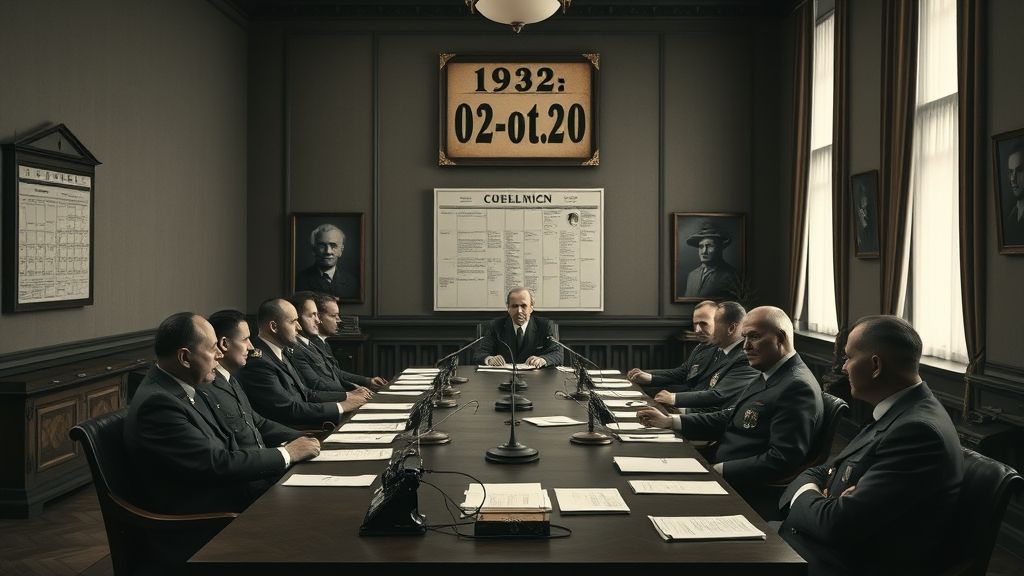
The room was eerily calm. There was no shouting, no heated confrontation. Instead, there was an air of bureaucratic efficiency and cold calculation as the officers and civil servants leaned over documents and numbers—their words sanitized to the point of clinical horror. To them, this was just another government meeting; for the world, it was a turning point from horrors committed blindly and sporadically to an organized, industrialized genocide. This was the Wannsee Conference.
The War That Darkened Europe: Setting the Stage in 1942
By early 1942, World War II had already devastated Europe for over two and a half years. The Nazi juggernaut had swept through Poland, France, Belgium, and much of Eastern Europe. The skies over the continent were blackened by warplanes; cities lay in ruins; millions had already been displaced or killed. The brutal occupation regimes imposed by the Nazis sowed terror, starvation, and despair.
Yet, beyond conventional warfare, an insidious campaign was unfolding. Nazi Germany, promoting a ruthless racial ideology, had enacted laws that ostracized Jewish populations from social and economic life. Pogroms, ghettos, and mass shootings had begun in occupied territories. However, until this moment, the “Final Solution” — the complete extermination of the Jews — lacked a single codified plan. That was about to change.
Nazi Ideology and the “Final Solution”: Seeds of Genocide
Central to understanding the Wannsee Conference is Nazi racial ideology. Adolf Hitler’s worldview painted Jews as the ultimate enemy to the so-called Aryan race. They were scapegoated for Germany’s economic woes and humiliations following World War I. Within Nazi circles, the notion of eliminating the “Jewish problem” gradually evolved from forced emigration and ghettoization to mass murder.
“Die Judenfrage,” or the Jewish Question, was a phrase cloaked in euphemism but charged with lethal intent. Prior to 1942, methods to “solve” this question varied wildly—from forced deportations to mass shootings by Einsatzgruppen in the East. Yet, these were inefficient and chaotic from the Nazis’ standpoint, requiring a coordinated operation on an unprecedented scale.
Heinrich Himmler and the SS: Architects of Systematic Murder
At the heart of this machinery was Heinrich Himmler, head of the Schutzstaffel (SS), the feared elite paramilitary organization enforcing Nazi racial policies. A man characterized by fanaticism and administrative genius, Himmler envisioned a meticulous system of oppression and genocide. Under his direction, ghettos morphed into holding pens, and mobile killing squads slaughtered tens of thousands.
His right hand, Reinhard Heydrich, often called “the Blonde Beast,” was the key executor of these plans. A ruthless and cold intellectual, Heydrich was appointed chief of the Reich Security Main Office (RSHA), consolidating police, intelligence, and SS functions. His role was to devise a “final” plan, uniting the various Nazi agencies and authorities behind one coordinated policy.
Reinhard Heydrich’s Calling: The Purpose of the Wannsee Conference
Heydrich convened the meeting at Wannsee on January 20, 1942, under the guise of a routine administrative gathering, but its purpose was anything but ordinary. He summoned fifteen senior officials from various government ministries, including the Gestapo, Foreign Office, Justice Ministry, and the SS.
Heydrich’s objective was clear: to brief his colleagues on the projects underway to deport and exterminate the Jewish populations of Europe and to secure their cooperation in carrying out the “Final Solution.” He emphasized that this was a “necessary step” in the war effort and that bureaucratic unity was essential to its effectiveness.
The Gathering at Wannsee: A Calculated Conspiracy
The villa at Wannsee, nestled amidst tall trees and overlooking the serene lake, had been purposely selected for its quiet privacy and its appearance of normalcy—a stark contrast to the brutal reality discussed inside. The invited officials arrived in silence, cognizant of the gravity yet trained for obedience.
This was not a public trial nor a military command post, but a sanitised conference room where cold administration ruled. The atmosphere was dispassionate, almost clinical. During the two-hour meeting, Heydrich outlined the logistics of mass deportation and murder, using bureaucratic language that disguised the horror with euphemisms such as “special treatment” (Sonderbehandlung).
The Participants: Faces Behind the Machinery of Death
The attendees at Wannsee were not the most famous Nazi leaders; instead, they were high-ranking bureaucrats—men who embodied the chilling efficiency of the Nazi regime. Among them:
- Adolf Eichmann, chief of the RSHA department for Jewish affairs, who was to organize deportations;
- Dr. Josef Bühler, state secretary of the General Government in occupied Poland;
- Dr. Wilhelm Stuckart, representing the Interior Ministry and a key figure in racial laws.
Together, these officials represented a cross-section of governmental power, all complicit in transforming genocide from individual acts of terror into organized state policy.
The Conference Room: A Calm Venue for Unspeakable Plans
The contrast between the peaceful lakeside setting and the agenda discussed inside is haunting. The neat conference table, lined with attendees sipping tea and exchanging documents, betrayed none of the monstrous implications.
Eyewitness accounts—primarily from minutes of the meeting known as the Wannsee Protocol—reveal a dispassionate tone. Heydrich’s delivery was marked by efficiency, emphasizing protocols, deadlines, and coordination, as if discussing a corporate merger. This bureaucratic calm underscores the terrifying ability of administrative systems to normalize inhumanity.
Discussing the “Final Solution”: The Language of Death
Heydrich’s speech introduced the plan to deport about eleven million Jews from all over Europe—under Nazi control—to extermination camps in the East. He categorised Jews by nationality and age, assessing who would be “worked to death” and who would be immediately killed.
The phrase “Final Solution of the Jewish question” became official Nazi parlance here. “Evacuation,” “resettlement,” and “special treatment” were chilling euphemisms masking the logistics of mass murder.
Jewish Populations on the Agenda: Statistics and Destinies
The Wannsee Protocol meticulously enumerated Jewish populations: 4 million in Poland’s General Government, several millions in the Soviet Union, Romania, Hungary, and beyond. Heydrich’s detailed report emphasized the necessity of coordination among the Reich's different police and administrative agencies to ensure smooth deportations.
These statistics were not abstract numbers but individual lives—men, women, children—facing a meticulously planned death sentence. The sheer bureaucratic coldness with which these numbers were discussed signals the depths of Nazi dehumanization.
Bureaucratic Precision: Turning Mass Murder into Administration
One of the most terrifying aspects of Wannsee lies in the systematization of genocide. Heydrich’s goal was not merely a plan of extermination but to institutionalize murder as a routine, administrative function.
Departments were assigned clear responsibilities: transportation, camp management, security coordination. The various ministries, courts, and police units were to work in tandem. In this light, genocide became a matter of paperwork, trains, and timetables.
The Role of Collaborationist Governments and Deportations
Another significant dimension of Wannsee was the discussion of cooperation from Axis and puppet governments. Nazi Germany expected Hungary, Romania, Slovakia, and other regimes to assist in rounding up and deporting Jewish populations.
This extended the reach of the Final Solution, implicating not only German officials but also their collaborators across occupied Europe. It foreshadowed the transnational character of the Holocaust.
The Conference’s Minutes: A Document of Horror Preserved
The minutes taken by Adolf Eichmann, known as the Wannsee Protocol, offer historians the starkest primary evidence of the conference. Discovered after the war, this document reveals the tone, the plans, and the participants’ complicity.
Its prose is disturbingly matter-of-fact—a detailed blueprint for genocide. The protocol stands as a fatal testament to the cold and calculated nature of Nazi policymaking at its worst.
Immediate Impact and Implementation: From Paper to Action
Following Wannsee, Nazi machinery accelerated the destruction of Jewish communities across Europe. Extermination camps such as Auschwitz-Birkenau, Sobibor, and Treblinka increased their killing capacities, operationalizing the formulas worked out.
The conference marked the shift from localized massacres to an industrialized genocide. The world soon witnessed the unfolding of systematic mass murder on an unprecedented scale.
The Wider Context: Wannsee Amidst World War II’s Turmoil
Though the conference focused on genocide, it was situated within the broader context of a violent and chaotic war. As the Wehrmacht battled the Soviet Union, and Allied forces planned breakthroughs, the Nazis intensified their domestic policies.
The Wannsee Conference exemplifies how war and ideology converged into a lethal cocktail, leading to one of humanity’s greatest tragedies.
Resistance and Silence: The World’s Reaction Then and Now
At the time, the true nature of Wannsee and the Final Solution remained largely hidden from the global public. Information about mass murder trickled out, but disbelief and political calculations muted reactions.
Today, unveiling the Wannsee Conference’s story is essential for Holocaust education and for confronting denial and distortion. It reminds us how silence and bureaucracy can facilitate atrocity.
The Holocaust’s Escalation After Wannsee: A Darker Chapter
The months and years following the conference witnessed the full horror of the Holocaust. Millions were deported to death camps; ghettos were liquidated; families destroyed. Wannsee was the bureaucratic heartbeat driving this dark escalation.
Not only were more victims targeted, but the methods became more “efficient” and secretive, underscoring the terrifying industrialization of murder.
Postwar Reckoning: Justice and Memory
After 1945, the legacy of Wannsee came into focus during the Nuremberg Trials and other war crime tribunals. Many conference participants were prosecuted, though some evaded justice.
Historians, survivors, and educators have since worked tirelessly to document the events, ensuring that Wannsee remains a symbol of bureaucratic evil and a reminder of the catastrophic consequences of hatred institutionalized.
Historical Debates and Interpretations: Contested Narratives
Scholars have debated the significance of Wannsee: Was it the moment the Final Solution was decided or merely formalized? How much did it represent consensus versus coercion within Nazi ranks? These discussions deepen our understanding of the complexity of history and responsibility.
The Legacy of Wannsee: Memory, Memorials, and Education
Today, the Wannsee villa is a Holocaust memorial and educational center. Visitors confront the chilling history in the very rooms where decisions were made. This transformation from a site of conspiracy into a place of remembrance epitomizes the ongoing struggle to learn from the past.
Conclusion: The Importance of Remembering a Deliberate Atrocity
The Wannsee Conference stands as a stark testament to human capacity for cruelty cloaked in bureaucracy. It forces us to confront how ordinary people, through administrative routine and obedience, enabled one of history’s darkest crimes.
Remembering Wannsee is not an exercise in morbid curiosity but a moral imperative—to honor the victims and to guard relentlessly against repetition. As the pale winter lake laps quietly nearby, the echoes of those 1942 decisions remind humanity to resist hatred, deception, and silence.
FAQs on the Wannsee Conference
Q1: What was the main purpose of the Wannsee Conference?
The main purpose was to coordinate and formalize plans for the “Final Solution”—the systematic extermination of Europe’s Jewish population—by ensuring cooperation among Nazi government agencies.
Q2: Who organized the Wannsee Conference?
Reinhard Heydrich, chief of the Reich Security Main Office and deputy to Heinrich Himmler, organized and led the conference.
Q3: Why was the conference held at Wannsee, a suburban villa?
The location offered discreet, quiet surroundings appropriate for a confidential meeting away from Berlin’s center, masking the extraordinary nature of the plans discussed.
Q4: Did the Wannsee Conference mark the start of the Holocaust?
Not exactly—the Holocaust’s mass killings had already begun. Wannsee formalized and centralized the planning for genocide, accelerating its systematic implementation.
Q5: How was the genocide described during the conference?
Using euphemisms such as “Final Solution,” “special treatment,” and “evacuation,” the genocide was discussed in sanitized bureaucratic language.
Q6: What happened to the attendees of the Wannsee Conference after the war?
Some were prosecuted during the Nuremberg Trials and other proceedings; others escaped justice or died during the war.
Q7: How is the Wannsee Conference remembered today?
It is commemorated at the Wannsee House Memorial and Education Center in Berlin, serving as a place for remembrance and Holocaust education.
Q8: How does Wannsee illustrate the role of bureaucracy in genocide?
It shows how mass murder was systematized and routinized through administrative coordination, turning atrocity into an organized state function.