Table of Contents
- The Spark in Saint-Sardos: Prelude to a Greater Flame
- Gascony in the Early 14th Century: A Land of Tensions
- The Anglo-French Rivalry: Crown Against Crown
- The Root Causes: Feudal Loyalties and Political Frictions
- Raymond-Bernard de Montpezat: The Man at the Center
- 1324: The Fateful Year Unfolds
- The Burning of Saint-Sardos: An Act of Defiance
- Edward II’s Dilemma: Gascony and the English Crown
- Philip V’s Response: Asserting French Authority
- The Role of the Parlement of Paris: Justice and Power
- The Siege of La Réole and Escalation of Hostilities
- Diplomacy Fails: The Breakdown of Negotiations
- The War Widens: From a Local Incident to an International Crisis
- The Military Campaigns of 1325: Battles in Gascony
- The Economic Stakes: Trade, Taxes, and Territory
- The Social Impact on Gascon Nobility and Peasantry
- The Legacy of the Saint-Sardos Conflict: Early Seeds of the Hundred Years’ War
- Chroniclers and Voices: How History Remembered Saint-Sardos
- Historiographical Perspectives: Interpretations Across Time
- Conclusion: The Unsung Prelude to Centuries of War
- FAQs: Understanding the War of Saint-Sardos
- External Resource
- Internal Link
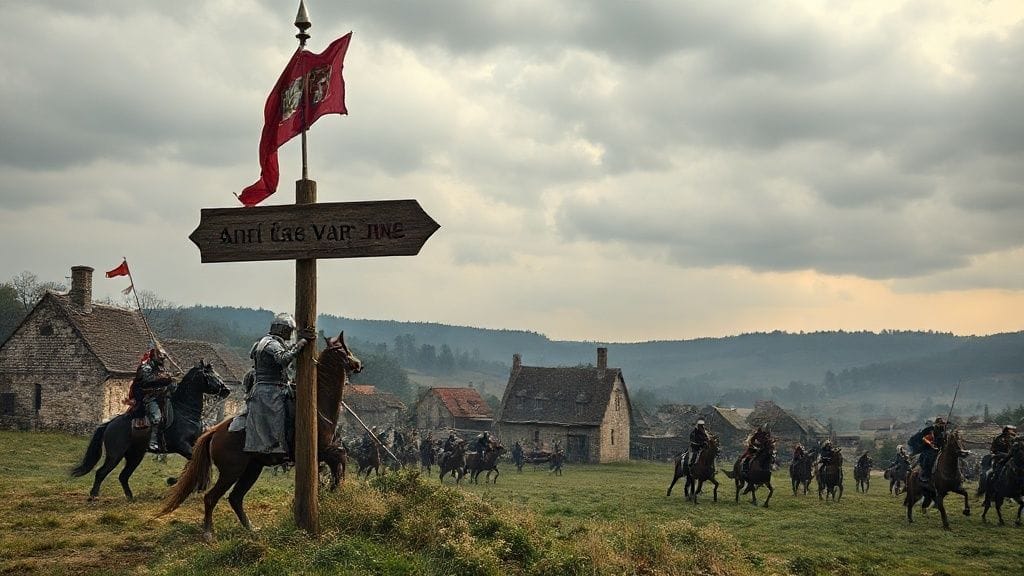
The sleepy village of Saint-Sardos, nestled in the rolling hills of Gascony, was on a quiet afternoon in 1324 about to become the stage of a fiery spark that would ignite a much larger conflict, shaking the foundations of European medieval politics. The crackling flames consuming a single building seemed insignificant in itself — a quarrel over feudal rights and jurisdiction — yet the reverberations echoing from that moment carried far beyond the borders of this small French community. This was not just a local dispute; it was the prelude to a confrontation that exposed the fragile nature of medieval sovereignty, feudal loyalties, and international diplomacy between England and France.
Gascony in the Early 14th Century: A Land of Tensions
Gascony, a jewel coveted by both the English and French crowns, was more than picturesque vineyards and lush valleys. It was a liminal realm, where allegiances were tangled, and power was disputed on multiple fronts. Since the Treaty of Paris in 1259, the English crown had held the duchy of Gascony as a fief from the French king, a situation brewing perennial tension—a contractual paradox that would ignite spectacularly in the decades to come. Local Gascon nobles, often torn between loyalties to the English king as duke and the French overlord as suzerain, maneuvered delicately to preserve their autonomy and privileges.
The Anglo-French Rivalry: Crown Against Crown
The period saw two monarchs poised against each other in a chess match of authority: Edward II of England and Philip V of France. Edward II inherited a fragile grip over his continental possessions, while Philip V sought to restore royal authority and consolidate control over French lands. The rivalry was not merely personal but structural, reflecting the evolving notions of sovereignty and feudal rights. Each crown sought to outmaneuver the other politically and militarily, especially in contested borderlands such as Gascony.
The Root Causes: Feudal Loyalties and Political Frictions
The core tensions underlying the War of Saint-Sardos lay in the ambiguous and overlapping jurisdictions within Gascony. Local seigneurs asserted rights often ignored by royal officials, while both kings claimed legal sovereignty. The French crown’s attempts to curb the autonomy of Gascon lords, especially through judicial commissions and bailiffs, were met with resistance from those accustomed to near-independence. At the same time, the English monarchy’s diminished attention and resources created a vacuum the French were eager to fill.
Raymond-Bernard de Montpezat: The Man at the Center
Central to the conflict was Raymond-Bernard de Montpezat, the lord of Saint-Sardos, a man caught between opposing demands. As a vassal to Edward II, his loyalty was expected, yet his ambitions collided with increasing French royal interference. His decision to build a small fortification, or “castellet,” near the village church was seen by French officials as a direct challenge to royal authority — a symbol of defiance that would not be tolerated.
1324: The Fateful Year Unfolds
The year 1324 marked the crescendo of simmering tensions. It began with routine legal disputes but ended with the dramatic destruction of Raymond-Bernard’s castle on May 21, 1324, by royal French forces under orders from Philip V. This act was not a mere demolition but a pointed statement — an unequivocal assertion of French jurisdiction over the contested border zone.
The Burning of Saint-Sardos: An Act of Defiance
The burning of Saint-Sardos and the symbolic destruction of the fortification sent shockwaves through the English court and Gascon nobility. For English officials and many Gascon lords, the action was an outright violation of their rights and a cause for war. The villagers, witnessing their homes consumed by fire under royal French banners, experienced not only terror but the encroaching reality of cross-Channel rivalries materializing in their fields and forests.
Edward II’s Dilemma: Gascony and the English Crown
Edward II faced a difficult dilemma. Gascony was a source of considerable income, especially through its wines, yet its defense was expensive and complicated by distance and domestic troubles in England. The English king dispatched envoys and threatened retaliation but was hamstrung by political weakness at home, including opposition from powerful nobles and internal rebellions.
Philip V’s Response: Asserting French Authority
Philip V’s government regarded the assertion in Saint-Sardos as a test of strength. The king and his advisors believed that allowing any challenge to royal authority, particularly within contested fiefs, would invite further insubordination. By acting decisively, the French crown hoped to send a clear message not only to the English but to all semi-autonomous lords under its realm.
The Role of the Parlement of Paris: Justice and Power
The Parlement of Paris, serving as France’s supreme court, played a crucial role in formalizing the conflict. Its rulings against Raymond-Bernard de Montpezat legitimated the royal intervention and underscored the judicial dimension of a conflict often perceived only through its military aspects. The increasing legal centralization represented by the Parlement was a hallmark of the evolving French state.
The Siege of La Réole and Escalation of Hostilities
As violence escalated, French forces laid siege to La Réole, a strategically vital town. The siege demonstrated the intensification from legal quarrels and petty raiding into concerted military efforts. It also attracted greater attention from both crowns, with armies maneuvering and local lords forced to choose sides amid growing uncertainty.
Diplomacy Fails: The Breakdown of Negotiations
Multiple attempts at diplomacy followed the destruction of Saint-Sardos, including envoys and papal mediation efforts. Yet these increasingly grew strained as each side hardened its stance, unwilling to compromise sovereignty or concede grievances. The failure of diplomacy was both cause and consequence of deep mistrust between England and France, foreshadowing decades of intermittent warfare.
The War Widens: From a Local Incident to an International Crisis
What began as a local dispute rapidly escalated into a broader conflict. More Gascon lords rebelled against French authorities, while English forces mobilized. The conflict now encompassed territorial control, feudal allegiance, diplomatic prestige, and economic interests, linking the fates of Gascony directly to European power politics.
The Military Campaigns of 1325: Battles in Gascony
The year 1325 saw full-scale military campaigns erupting in Gascony. Battles and skirmishes pitted English knights against French royal troops, though neither side could secure absolute supremacy. The war drained resources and destabilized the region, with peasants caught in the crossfire and towns struggling to maintain order.
The Economic Stakes: Trade, Taxes, and Territory
Gascony was no mere battlefield: it was a vital economic hub, especially through its production of wine exported to England and beyond. Control of the region meant control of lucrative customs duties and trade routes. Both crowns were acutely aware that economic dominance underpinned political power, making Gascony too precious to yield lightly.
The Social Impact on Gascon Nobility and Peasantry
Behind armies and sieges were people—nobles who faced impossible choices between loyalties, farmers whose livelihoods were disrupted, and townspeople living in fear of raids. The war exacerbated existing social fractures, sowing distrust between neighbors and undermining the delicate social contracts vital for medieval coexistence.
The Legacy of the Saint-Sardos Conflict: Early Seeds of the Hundred Years’ War
Although the War of Saint-Sardos officially concluded in 1325 with negotiated truce terms, its legacy endured far longer. It presaged the monumental Hundred Years’ War (1337–1453) by crystallizing the fundamental disputes over sovereignty, feudal obligations, and national ambitions. Historians view Saint-Sardos as a warning shot across the Channel, a microcosm of the enormous century-long struggle that would reshape Europe.
Chroniclers and Voices: How History Remembered Saint-Sardos
Contemporary chroniclers such as Jean Froissart scarcely mentioned Saint-Sardos in detail, overshadowed by later, grander conflicts. Yet local Gascon annals and French royal records preserve vivid accounts of the unrest. These sources reveal not just political facts but human experiences—fear, courage, betrayal—and the moment when feudal legalities ignited violent confrontation.
Historiographical Perspectives: Interpretations Across Time
Scholars over the centuries have debated the War of Saint-Sardos’ causes and seriousness. Early historians portrayed it as a minor border skirmish, while modern scholarship highlights its importance as a symptom of the evolving medieval state system. It serves as a key case study in the complexities of medieval sovereignty, law, and nationalism.
Conclusion
The War of Saint-Sardos, though brief and often overshadowed by the sweeping dramas of later medieval history, stands as a profound testimony to the fragility and complexity of power in the Middle Ages. It began with a single act—the burning of a small castle in a quiet village—but unleashed ripples that would affect kings and commoners alike across continents. This conflict illuminates how notions of justice, loyalty, and authority were contested not just in grand halls but in the fields and villages where people’s lives unfolded. Remembering Saint-Sardos is to acknowledge the precarious balancing act that shaped medieval Europe, a delicate dance between crown and vassal, local and royal, peace and war. And above all, it reminds us that history’s seemingly small sparks can ignite flames that blaze for centuries.
FAQs
1. What triggered the War of Saint-Sardos in 1324?
The immediate trigger was the construction of a small fortification by Raymond-Bernard de Montpezat near Saint-Sardos, which French royal authorities saw as illegal and a challenge to their sovereignty. When the French forces destroyed this fortification, it sparked open hostilities.
2. Why was Gascony so important to both England and France?
Gascony was economically vital due to its wine production and trade routes. Politically, it was a fief held by the English crown but claimed under French suzerainty, making it a flashpoint for power struggles between the two kingdoms.
3. How did the War of Saint-Sardos relate to the Hundred Years’ War?
The conflict is viewed as a precursor to the Hundred Years’ War because it exposed fundamental issues of sovereignty and feudal allegiance that would fuel the larger and longer struggle beginning in 1337.
4. Who was Raymond-Bernard de Montpezat?
He was the lord of Saint-Sardos whose actions—building the contested fortification—placed him at the heart of the conflict. His defiance of French royal authority prompted the destructive response.
5. What role did the Parlement of Paris play in the conflict?
The Parlement served as the judicial arm of the French crown, legitimizing the raid against Saint-Sardos by ruling against Raymond-Bernard’s claims and emphasizing royal jurisdiction.
6. How did the local Gascon population experience the war?
Peasants and townsfolk suffered from the instability, witnessing the destruction of property, displacement, and violence. Nobles faced difficult choices of allegiance, sometimes leading to civil strife.
7. Could the conflict have been resolved diplomatically?
Multiple diplomatic efforts were made but ultimately failed due to deep mistrust and conflicting demands over sovereignty and jurisdiction, reflecting the intractable nature of Anglo-French rivalry.
8. What was Edward II's response to the conflict?
Edward II sought to defend Gascony but was hampered by internal political struggles in England and limited military resources, complicating his ability to respond effectively.

