Table of Contents
- A Cold War World on Edge: Context Before the Pact
- The Shadow of NATO: Eastern Bloc’s Strategic Dilemma
- Warsaw, May 14, 1955: A Historic Gathering
- The Signing Ceremony: Protocol and Symbolism
- Key Figures Behind the Pact: Power Players and Puppets
- The Pact’s Groundbreaking Articles: Military and Political Dimensions
- Immediate Reactions in the West and East
- The Pact as a Counterbalance: A Shield or a Sword?
- Early Military Alignments and Joint Exercises
- Political Repercussions Within Member States
- The Warsaw Pact during the Hungarian Revolution, 1956
- The Pact’s Role Throughout the Cold War Hotspots
- Brezhnev Doctrine: Cementing Soviet Control
- The Pact and the Berlin Crisis
- Societal Impact: Life Under the Warsaw Pact
- Cracks Begin to Show: Dissent and Defections
- The Decline: From the 1980s to the Dissolution
- Legacy and Memory of the Warsaw Pact
- Warsaw Pact vs. NATO: Ideologies in Perpetual Conflict
- Reflection on the Nature of Alliances in the Cold War
- Conclusion: Beyond the Pact — Europe’s New Order
- FAQs: Understanding the Warsaw Pact
- External Resource: Wikipedia Link
- Internal Link: History Sphere
On a cool spring day in Warsaw, Poland, on May 14, 1955, a group of Eastern European leaders, under the watchful eye of the Soviet Union, convened to sign what would become one of the most defining military alliances of the Cold War era: the Warsaw Pact. Against the backdrop of a Europe divided and an increasingly tense bipolar world, this pact was more than a simple mutual defense treaty—it was a symbol of power, control, and ideological confrontation that shaped the lives of millions for nearly four decades.
It is hard to overstate the atmosphere that hung in the air that day. The air was thick with both hope and suspicion, as each delegate shook hands and affixed signatures to a document meant to bind their countries not only militarily but politically under Soviet command. Yet, beneath the surface of official speeches and heralded unity, there was a web of unease, withheld ambitions, and the unstoppable momentum towards a Cold War arms race that threatened global peace.
To understand the full gravity of what unfolded, we must first step back and trace the tangled threads leading to that day in Warsaw—a moment where strategy, fear, and ideology collided in a pact that would become a fulcrum of Cold War history.
A Cold War World on Edge: Context Before the Pact
The early 1950s were rife with tension—the aftermath of World War II left Europe physically devastated and politically fragmented. The victorious Allies quickly became wary enemies, divided by ideology and suspicions. On one side stood the capitalist democracies led by the United States and its European allies; on the other, the communist bloc dominated by the Soviet Union.
In 1949, the Western powers had established NATO (North Atlantic Treaty Organization), a collective defense alliance aimed at deterring Soviet aggression by binding the defense of member states to a mutual obligation: an attack on one would be considered an attack on all. This alliance marked a significant shift from wartime cooperation to peacetime confrontation. For the Soviets, NATO was not merely a defensive coalition but an aggressive tool threatening their sphere of influence in Eastern Europe.
The Soviet response was both strategic and ideological. Stalin, then still alive and holding rigourous control over the Eastern Bloc, sought to consolidate Soviet dominance and counterbalance NATO’s might. This was not simply military calculus but deeply tied to protecting the communist project from potential Western-backed insurrections or invasions.
However, the years between 1949 and 1955 were marked by deep Soviet suspicion toward its allies, with varying degrees of political independence seen as dangerous. The USSR needed a unifying military command that assured both control over its satellite states and deterrence against the West.
The Shadow of NATO: Eastern Bloc’s Strategic Dilemma
By 1955, NATO had matured into a formidable alliance. West Germany’s admission into NATO in May 1955 was a particularly provocative step from the Soviet perspective—transforming a nation recently devastated by war into a potential front-line bulwark against communism. The specter of German rearmament, wrapped in Western hands, revived deep fears remembered all too well from the world wars.
Facing this, the Soviet Union orchestrated a counter-move—establishing a collective security system that mirrored NATO’s structures, not only to defend against perceived Western aggression but also to ensure total Soviet control of the armed forces of its satellite states.
This was the strategic heart behind the Warsaw Pact: an answer to NATO’s expansion, but also an instrument of internal discipline among Eastern European communist parties, unyielding in their loyalty to Moscow.
Warsaw, May 14, 1955: A Historic Gathering
The date was set, the location chosen: Warsaw, the capital of Poland, a country whose fate over the previous decades symbolized the desolation and hope of continental Europe.
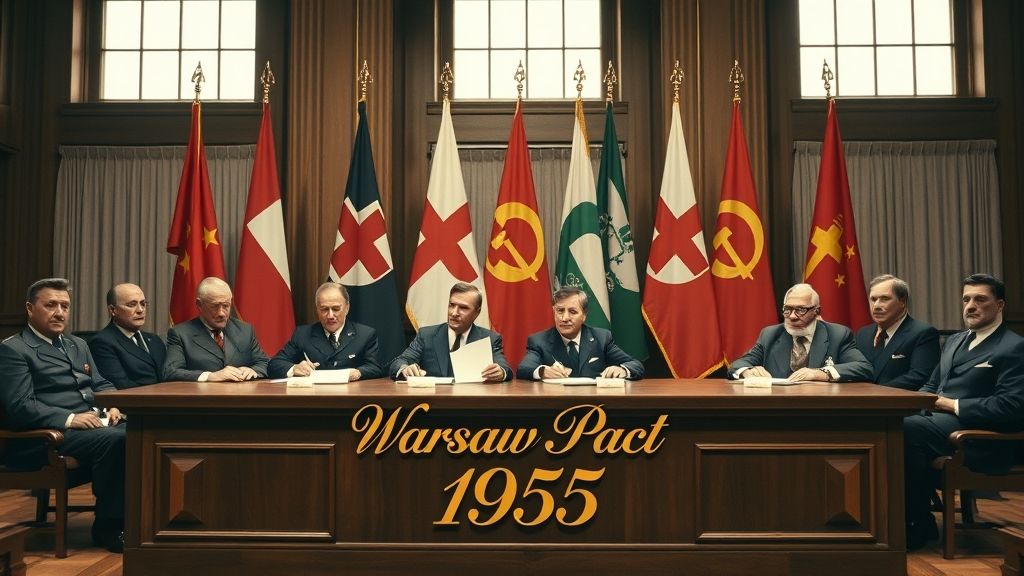
On May 14, the foreign ministers and military leaders from eight communist states met in a building in the heart of Warsaw—representatives from the Soviet Union, East Germany, Poland, Hungary, Czechoslovakia, Romania, Bulgaria, and Albania. Albania, fiercely independent but still aligned with Moscow, was included but never fully committed. Yugoslavia notably remained outside the pact after its split with Stalin in 1948.
The hall was charged with the heavy significance of their actions. Cameras clicked, speeches proclaimed friendship and solidarity, but beneath lay complex calculations—control, deterrence, and the unyielding pressure to maintain unity at all costs.
The Signing Ceremony: Protocol and Symbolism
The pact was formally titled the “Treaty of Friendship, Cooperation, and Mutual Assistance.” The text hailed collective defense against aggression and promised “joint armed forces” to defend socialist countries, but its architecture symbolized something far deeper: supranational military discipline under Soviet leadership.
Each leader stepped forward to place his signature, and with every stroke of the pen, a new chapter of the Cold War was inscribed. The handshake exchanges were formal, but eyes betrayed the unease of smaller powers caught between alliance loyalty and national sovereignty.
Key Figures Behind the Pact: Power Players and Puppets
At the center was Vyacheslav Molotov, a veteran Soviet diplomat and foreign minister whose presence reminded all of Moscow’s dominance. Nikita Khrushchev, newly at the helm after Stalin’s death in 1953, exerted a mix of brash confidence and wary pragmatism.
Representatives from satellite states, such as Poland’s Bolesław Bierut and East Germany’s Walter Ulbricht, displayed the regimented loyalty to Moscow, tempered by hopes of national assertion within the framework.
Behind the scenes, military planners and intelligence officers sketched the integration of weapon systems and command structures that would enforce Moscow’s grip on the bloc.
The Pact’s Groundbreaking Articles: Military and Political Dimensions
The treaty did not merely bind nations to mutual defense; it created the Soviet-led Unified Command, headed by Marshal Ivan Konev, which integrated armed forces from member states under Soviet control.
This went far beyond NATO’s typically consensual approach. The political clauses stipulated strict adherence to communist principles, and the pact implicitly justified Soviet intervention within allied states, a precursor to later practices like the Brezhnev Doctrine.
Immediate Reactions in the West and East
Western governments and media condemned the pact as an aggressive communist gambit. American officials deemed it a “military union of dictatorship,” accelerating the arms race and deepening mistrust.
Within the Eastern Bloc, propaganda portrayed it as a necessary shield for peaceful development and socialist solidarity. Yet among populations, the assurance of security was shadowed by the reality of subjugation and loss of sovereign will.
The Pact as a Counterbalance: A Shield or a Sword?
The Warsaw Pact stood as the Eastern bloc’s answer to NATO, providing a structured military alliance that could project strength and control. It was a shield in the rhetoric—promising protection—but a sword in practice: a tool for internal repression, as would soon be demonstrated.
Early Military Alignments and Joint Exercises
The pact’s military dimension rapidly manifested in large-scale joint exercises, signaling capability and resolve. The doctrinal development emphasised conventional forces, while strategic nuclear considerations remained firmly in Soviet hands.
Political Repercussions Within Member States
The Warsaw Pact influenced domestic politics by reinforcing Moscow’s dominance. Governments quelled dissent citing the need for “bloc unity.” The consequences were chilling: freedom curtailed, opposition branded as anti-socialist, and sovereignty compromised.
The Warsaw Pact during the Hungarian Revolution, 1956
Barely a year after its creation, the Warsaw Pact faced its first serious test: the Hungarian Revolution of 1956. When Hungary sought reforms and autonomy, the Soviet Union, invoking the pact, ordered a brutal military intervention that crushed the uprising.
This act exposed the Pact’s true nature—a military instrument for Soviet hegemony, not mutual defense.
The Pact’s Role Throughout the Cold War Hotspots
Throughout events like the Berlin Crisis, the Prague Spring, and Afghanistan invasion, the Warsaw Pact functioned as both a defensive shield and an offensive tool to maintain socialist orthodoxy.
Brezhnev Doctrine: Cementing Soviet Control
Formally announced in the late 1960s, the Brezhnev Doctrine asserted the USSR’s right to intervene militarily in any Warsaw Pact country to protect socialism, solidifying the Pact’s oppressive role.
The Pact and the Berlin Crisis
The Berlin Wall, erected in 1961, symbolized the physical and ideological division upheld by the Warsaw Pact’s presence, which kept Eastern Germany isolated but tightly controlled.
Societal Impact: Life Under the Warsaw Pact
For citizens of member states, the Pact’s presence was a constant reminder of restricted freedoms, militarization, and economic relations shaped by Moscow’s plans. It affected generations through conscription, surveillance, and the shaping of national identities within the shadow of Soviet power.
Cracks Begin to Show: Dissent and Defections
Through the 1970s and 1980s, growing economic difficulties, nationalism, and the desire for reform deepened rifts within the pact. Defections of high-profile military officers and political figures signaled cracks in the iron façade.
The Decline: From the 1980s to the Dissolution
With the rise of Gorbachev and his policies of glasnost and perestroika, the Soviet grip loosened. Reform movements, culminating in the fall of the Berlin Wall in 1989 and the collapse of communist regimes, sealed the Pact’s fate.
On July 1, 1991, the Warsaw Pact formally dissolved—marking the end of an era.
Legacy and Memory of the Warsaw Pact
Today, the Warsaw Pact is remembered both as a symbol of Soviet domination and of the Cold War’s uncompromising ideological battleground. In former member countries, it remains a complex memory—of oppression, resistance, but also of shared history shaping modern Eastern Europe’s path.
Warsaw Pact vs. NATO: Ideologies in Perpetual Conflict
The Pact and NATO reflect not only military alliances but competing visions of world order—statist socialism versus liberal democracy—each shaping international relations and the global balance of power through fear, diplomacy, and sometimes confrontation.
Reflection on the Nature of Alliances in the Cold War
The Warsaw Pact shows how alliances can serve both protection and domination. It reminds us that collective security can come at the price of national sovereignty and personal freedom.
Conclusion
The Warsaw Pact’s signing on May 14, 1955, was not just a treaty—it was a moment when history’s immense machinery locked into place the contours of a divided Europe. Behind the inked signatures lay stories of hope, fear, control, and resistance that would play out for decades in the hearts and homes of millions.
This pact embodied the contradictions of the Cold War: unity forged under coercion, defense justified through oppression, and alliances that tethered nations to a destiny shaped by ideology more than choice.
Its legacy challenges us to understand the delicate balance between security and freedom, to reflect on the human toll behind political maneuvers, and to appreciate the profound complexities that defined the Cold War.
History’s lesson is clear: alliances shape not just geopolitics but lives—and in that tension lies the human drama that continues to resonate.
FAQs
Q1: What were the primary reasons for establishing the Warsaw Pact in 1955?
A1: The Warsaw Pact was created primarily as a Soviet-led response to the formation and expansion of NATO, especially West Germany’s accession. It aimed to formalize military cooperation among Eastern Bloc countries, ensuring Soviet dominance and collective defense against Western aggression.
Q2: Which countries were original members of the Warsaw Pact?
A2: The founding members were the Soviet Union, East Germany, Poland, Hungary, Czechoslovakia, Romania, Bulgaria, and Albania.
Q3: How did the Warsaw Pact differ from NATO in terms of military command?
A3: Unlike NATO’s more consensual and multilateral approach, the Warsaw Pact established a unified command structure under Soviet leadership, effectively placing member countries’ armed forces under Moscow’s control.
Q4: What role did the Warsaw Pact play in the Hungarian Revolution of 1956?
A4: The Pact was used to justify Soviet military intervention to suppress the Hungarian uprising, emphasizing its role as a tool of Soviet control over its satellite states rather than purely defensive alliance.
Q5: When and why did the Warsaw Pact dissolve?
A5: The Pact formally dissolved on July 1, 1991, following the political transformations in Eastern Europe, the decline of Soviet power, and the end of the Cold War.
Q6: How is the Warsaw Pact remembered today in former member states?
A6: Memories are mixed—while some view it as a symbol of oppression and lost sovereignty, others see it as part of their historical identity during the Cold War era.
Q7: How did the Warsaw Pact influence Cold War military strategies?
A7: It shaped military planning in Europe, leading to large-scale joint exercises, integrated commands, and a sustained arms race that kept tensions heightened throughout the Cold War.
Q8: Did any notable defections or dissident actions occur within the Warsaw Pact?
A8: Yes, several military officers, politicians, and citizens defected or resisted the pact’s constraints, symbolizing the internal contradictions and instability beneath the alliance’s surface.