Table of Contents
- Storm on the Baltic Frontier: Setting the Scene in 1147
- Crusading Fever Reaches the North: From the Holy Land to the Elbe
- Who Were the Wends? The Polabian Slavs Before the Crusade
- Cross and Sword: Preachers, Papal Bulls, and the Call to Arms
- Kings, Dukes, and Bishops: The Coalition of Northern Princes
- Into the Marshes and Forests: The Armies March in Summer 1147
- The Siege of Dobin: Hunger, Negotiation, and a Hollow Victory
- The Campaign Against the Obotrites and the Shadow of Henry the Lion
- On the Shores of the Baltic: Rani, Pomeranians, and the Baltic Sea War
- Faith Under Fire: Forced Conversions, Baptisms, and Broken Promises
- Merchants, Missionaries, and Colonists: The Silent Advance of the Saxons
- The Wendish Crusade 1147 in the Eyes of Chroniclers
- Wendish Resistance and Survival: Memory Among the Polabian Slavs
- From Frontier to Heartland: Long-Term Consequences for Northern Europe
- A Crusade Without Glory? Historians Debate Motives and Outcomes
- Echoes in Stone and Language: Traces of the Wends Today
- Conclusion
- FAQs
- External Resource
- Internal Link
Article Summary: In the summer of 1147, as knights rode east toward the Holy Land, another, lesser-known campaign took shape along the foggy marshlands between the Elbe and the Baltic: the wendish crusade 1147. This northern crusade targeted the Polabian Slavs—often called Wends—whose pagan shrines, trading ports, and fortified hilltop settlements stood in the path of expanding Saxon and Danish power. Under banners marked with the cross, German princes and Scandinavian kings launched sieges, extorted conversions, and redrew the political map of the Baltic frontier. Yet behind crusading rhetoric lay tangled motives of land hunger, commercial rivalry, and dynastic ambition, and the results were far more ambiguous than the preachers had promised. This article follows the story from its roots in earlier missionary efforts through the campaigns at Dobin and along the Baltic coast, to the enduring cultural and political legacy of the crusade. We explore how the wendish crusade 1147 reshaped Christian–pagan relations, accelerated German eastward expansion, and set patterns for later conflicts in the Baltic world. At the same time, we recover the voices—often faint—of the Polabian Slavs who resisted, adapted, and partially survived in the shadow of conquest.
Storm on the Baltic Frontier: Setting the Scene in 1147
The year 1147 dawned gray and cold over the lowlands and forests stretching between the Elbe River and the Baltic Sea. In the wooden strongholds of the Polabian Slavs, smoke from hearth fires twisted into the sky, mingling with mist above the marshes. Wooden palisades creaked under frost, and narrow paths threaded through damp forests, connecting clusters of villages, hillforts, and sacred groves. To the north and west, on stone-built castles and cathedral towns, the bells of Christian churches rang, carried on winter air across lands where Latin prayers had only recently begun to drown out older, pagan songs.
This was a borderland in the most literal sense—a shifting frontier between worlds. To German chroniclers, it was an unruly periphery of Christendom, populated by “barbarous” Wends who clung stubbornly to their gods and customs. To the Wends themselves, it was home: a mosaic of tribal territories like those of the Obotrites, the Liutizi, and the Rani, bound by waterways and trade routes that reached as far as Scandinavia and Rus’. Cattle grazed on cleared fields, fishermen cast nets into brackish bays, and shrine-temples dedicated to deities such as Svantevit watched over harbors and hilltops.
Tension had simmered here for generations. Long before anyone had spoken of the wendish crusade 1147, there had been raids, treaties, and uneasy alliances. German dukes and Saxon counts had pushed eastward, founding new market towns, claiming tribute, and occasionally baptizing reluctant chieftains at sword point. Danish kings had sailed across the Baltic to plunder coastal settlements, sometimes carrying off idols as trophies. Missionaries had walked these roads, persuasive in their faith but sheltered by mailed escorts.
By the mid-twelfth century, however, the balance along this frontier was starting to tip. German expansion—later called the Ostsiedlung—pressed steadily against Slavic lands. Stone churches rose where wooden shrines once stood. New laws, new lords, and new taxes seeped into the social fabric. The Wends, though still numerous and formidable, now faced neighbors better organized, more tightly linked to the wide networks of Latin Christendom, and increasingly equipped with a powerful ideological tool: the crusade.
It was into this fraught and changing landscape that the idea of a holy war against the Wends arrived. At first, it seemed simply another thread in the larger tapestry of Christian mobilization against the “infidel.” Yet what was about to unfold along these northern rivers and coasts would be unlike the glorious battles sung about in connection with Jerusalem. It would be a campaign fought in muddy fields and reed-choked lagoons, a struggle where commerce and coercion intertwined, and where the line between missionary zeal and naked conquest blurred almost beyond recognition. And it would leave an imprint on Northern Europe that can still be traced in maps, place names, and fading memories today.
Crusading Fever Reaches the North: From the Holy Land to the Elbe
When news first spread of a renewed crusade to the Holy Land in the 1140s, it stirred hearts and ambitions across Western Europe. The loss of the County of Edessa in 1144 shocked Christendom, and preachers fanned out to summon knights and peasants alike to join what became the Second Crusade. In cathedrals and village churches, the rhetoric was vivid and urgent: the faithful were called to defend Christ’s tomb, reclaim lost territories, and secure spiritual reward through arms.
Yet not everyone was eager or able to march to the distant Levant. For many lords along the empire’s northeastern frontier, the cost and risk of a long journey through hostile lands seemed prohibitive. Their concerns were closer to home: restless Slavic neighbors, insecure borders, and the lure of new lands just beyond the rivers. It did not take long for someone to ask a question that would reshape the politics of the Baltic frontier: why should the crusading vow be limited to faraway Palestine, when “pagans” still lived stubbornly within reach of Saxon swords?
The answer came from the Church’s highest, most authoritative voices. In 1147, Pope Eugenius III endorsed what would become the wendish crusade 1147 in a papal bull often paraphrased as granting the same indulgences—the same promise of forgiveness of sins—to those who fought the Wends as to those who traveled to the Holy Land. The text was clear in its intent: anyone who took up arms “against the Slavs and other pagans of the North” and did so for the sake of Christ’s faith would share in the spiritual privileges of crusaders to Jerusalem.
This decision marked a crucial extension of crusading ideology. Holy war was no longer just a matter of reclaiming once-Christian lands from Muslim rulers; it could now also mean conquering, converting, or suppressing non-Christian neighbors within Europe itself. What had once been a distant, exotic adventure became a local possibility, closely aligned with the territorial ambitions of regional princes. The frontier along the Elbe and beyond the Baltic bays ceased to be merely a border; it became a theater of sanctified violence.
Preachers such as the influential Bernard of Clairvaux, already a central figure in promoting the Second Crusade, lent their authority to this northern enterprise. Chroniclers suggest that he cautiously supported the idea of fighting the Wends, provided the goal was genuine conversion rather than greedy war for spoils alone. This subtle distinction, however, would blur in practice, as the crusading armies marched beneath both crosses and dynastic banners. The crusading fever that had begun with the cry of “Deus vult” in the East now echoed over the marshlands and cedar forests of the North.
Who Were the Wends? The Polabian Slavs Before the Crusade
To understand the wendish crusade 1147, we must step for a moment into the world of those who were its targets. The term “Wends” was a broad, often imprecise German label for various West Slavic peoples living between the Elbe and the Oder rivers and along the southern Baltic coast—the Polabian Slavs, whose own identities were more finely grained. Among them were the Obotrites, settled around the lower Elbe and Warnow; the Liutizi (or Lutici), whose confederation flourished further east; and the Rani, who dominated the island of Rügen and nearby coasts.
Their societies were primarily agrarian but interwoven with lively trade networks. Fields of rye, barley, and millet bordered dense forests where wild game roamed. Wooden longhouses clustered around fortified hilltop enclosures known as burgwalls, which served both as strongholds in war and centers of administration in peace. The Wends traded furs, amber, wax, and slaves; in return, they obtained silver coins, fine cloth, and crafted wares from German, Scandinavian, and Rus’ merchants.
Religion shaped daily life and political authority. The Polabian Slavs worshipped a pantheon of deities associated with fertility, war, and the natural world. Sacred groves and springs punctuated the landscape; near the Baltic Sea, great temple-fortresses such as Arkona on Rügen housed imposing wooden idols, draped in cloth and adorned with horns or swords. Priests conducted rituals involving offerings of animals, weapons, and perhaps, as some hostile Christian sources claimed, human beings. Whether or not the more lurid tales were exaggerated, these shrines were clearly centers of both spiritual and political power.
The Wends were no strangers to Christianity. As early as the tenth and eleventh centuries, German and Scandinavian rulers had attempted to impose baptism on them by force. Some Wendish princes had accepted the new faith under pressure, often to secure alliances or respite from attack. Yet conversion frequently proved shallow or temporary. When external power weakened, traditional cults revived. Pagan sanctuaries were rebuilt, and Christian churches sometimes pulled down. The frontier thus oscillated between mission and revolt, symbolized by episodes like the Liutizi uprising of 983, which nearly swept German influence out of the region.
Politically, the Polabian Slavs were fragmented, united only intermittently under powerful chieftains and confederations. Internal rivalries could be fierce. Some leaders sought German or Danish support against their Slavic rivals, opening the door to foreign intervention; others tried to rally a broad alliance of tribes against encroaching Christians. This disunity would prove a critical weakness during the crusade of 1147. Against the more centralized, resourced, and ideologically motivated powers of the West, the Wends faced the coming storm in a patchwork of alliances and local loyalties, rather than as a single nation.
Cross and Sword: Preachers, Papal Bulls, and the Call to Arms
Once papal approval had been secured, the machinery of crusade mobilization began its familiar work, now adapted to the northern frontier. Bishops in Saxony, Brandenburg, and beyond read papal bulls from their pulpits, announcing that a holy campaign would soon commence against the neighboring pagans. The same evocative language used to summon warriors to Jerusalem—promises of remission of sins, the dignity of bearing the cross, and the chance to die as a “knight of Christ”—was now directed at those whose horses need travel only a few days’ ride to reach enemy lands.
Local clergy elaborated on the message. Parish priests described Wendish shrines as dens of idolatry and cruelty, places where, in the words of later chroniclers, “impious rites” were performed to false gods. Merchants and farmers were told that these pagans not only refused the Gospel but also threatened the security and prosperity of Christian border regions. The crusade was thus framed as both an act of piety and a necessary defense. This mixture of fear and sanctity proved potent.
Those who took the cross for the wendish crusade 1147 sewed or painted the symbol onto their garments, just as their brethren did who planned to sail for the Holy Land. They swore vows, often formalized in front of bishops or abbots, promising to participate in the campaign for a fixed period—typically from the feast of a particular saint until a given date—after which their obligation would be fulfilled. Some nobles found this local crusade particularly attractive: it allowed them to claim the spiritual prestige of crusaders without abandoning their lands and vassals for years.
Still, there were voices of caution. Some churchmen worried that worldly motives—land seizure, plunder, or the settlement of long-standing feuds—would overshadow the stated religious goal of conversion. Bernard of Clairvaux himself, according to later accounts, insisted that the Wends should be offered baptism and integration into Christendom, not simply exterminated. He is said to have warned crusaders that killing pagans merely for the sake of killing them, without seeking their conversion, would be murder, not martyrdom. Such admonitions introduced a moral tension that would become painfully evident once armies were in the field.
Yet, as the summer of 1147 approached, these reservations did little to slow the momentum. Scribes drafted charters granting privileges to monasteries and churches that might benefit from new lands; merchants calculated the opportunities of newly “pacified” harbors; ambitious younger sons of noble families imagined carved-out lordships in conquered territories. The rhetoric of salvation and the realities of geopolitics were now inseparably entwined, and the cross emblazoned on armor had to coexist with very earthly expectations of reward.
Kings, Dukes, and Bishops: The Coalition of Northern Princes
The wendish crusade 1147 did not march under a single, unified command. Instead, it brought together a shifting alliance of German and Danish rulers, each with his own agenda and claims. At the heart of the German contingent stood two powerful Saxon princes: Henry the Lion, Duke of Saxony (and later also of Bavaria), and Albert the Bear, the Margrave whose efforts would help forge the March of Brandenburg. Both men saw the crusade as an opportunity to expand their influence eastward, subdue or displace hostile Slavic elites, and promote German settlement in the newly conquered lands.
Henry the Lion, scion of the Welf dynasty, was one of the most formidable figures of his age. Ambitious, astute, and not above calculated brutality, he had long sought to tighten his grip on the Elbe region. The Obotrite territories and the important trading centers along the Baltic coast—such as the harbor at Lübeck—drew his attention. For him, the crusade’s religious justification aligned neatly with a strategic vision of controlling maritime routes and securing Saxony’s northeastern frontier.
Albert the Bear, likewise, pursued expansion into the lands of the Hevelli and other Slavic groups further east. The crusade provided him with military backing and moral cover for stronger interventions. Under his guidance, fortified positions such as Brandenburg would gradually transform from Slavic centers into German ones, with churches supplanting pagan sanctuaries and settlers from the west introduced under favorable terms.
From the north, Danish rulers joined the campaign, motivated by both religious zeal and long-standing conflicts with the Slavic tribes along the southern Baltic. Denmark’s kings had a history of raiding and occasionally subjugating Wendish coastal settlements. They had clashed with the Rani of Rügen and other groups over control of lucrative sea routes and islands. Now, participation in a papally sanctioned crusade allowed them to portray these struggles as part of a greater Christian mission.
Bishops and abbots lent institutional weight to this coalition. The Bishop of Magdeburg, the Archbishop of Hamburg-Bremen, and various local church leaders saw in the crusade a chance to extend their diocesan reach and found new bishoprics. Cloisters that had once been isolated missionary outposts could now hope to become the spiritual centers of densely settled Christian territories. Monasteries were also poised to benefit from land grants taken from Slavic elites deemed unworthy or unconverted.
Yet unity was fragile. Each prince calculated how much effort to expend, which targets to prioritize, and how to prevent allies from gaining too much. Some cooperated grudgingly, wary that a neighbor’s success in the crusade might threaten their own domains. The crusading coalition, therefore, marched not as a single army with a uniform plan but as a collection of forces converging on several key objectives, each hoping that divine favor and earthly advantage would fall primarily on their side.
Into the Marshes and Forests: The Armies March in Summer 1147
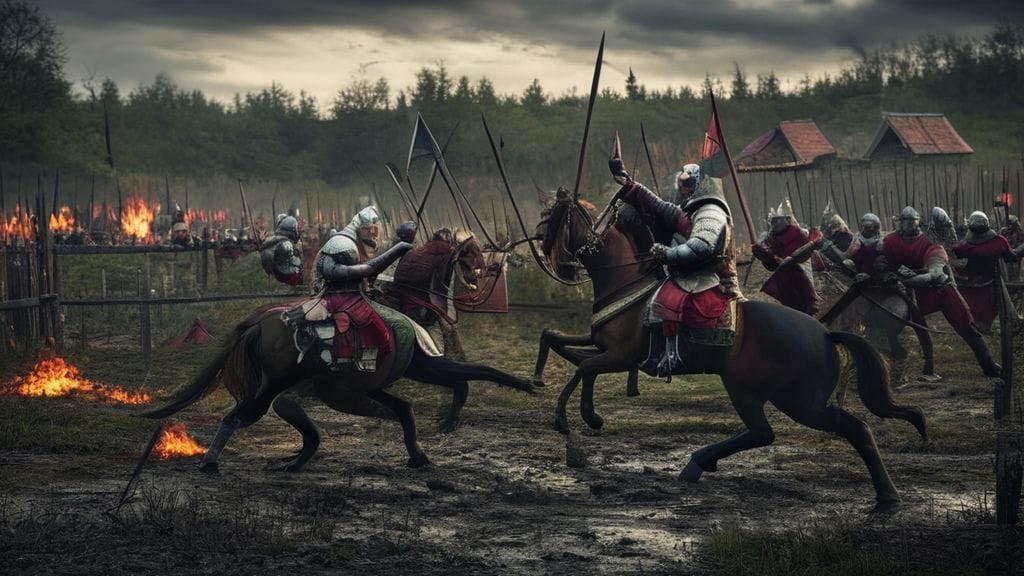
When summer came, armies gathered like storm clouds on the western shores of the Elbe and along the northern coasts. Chroniclers describe crosses fluttering from lances, knights in chainmail mounted on heavy horses, and contingents of infantry drawn from peasant levies. The expedition had the trappings of a grand holy war—banners blessed by bishops, priests accompanying the troops, and solemn vows renewed before departure.
But the terrain awaiting them was treacherous. Unlike the semi-arid plains of the Levant, the lands of the Wends were dominated by forests, rivers, lakes, and marshes. Wooden causeways, ferries, and shallow fords controlled movement. Heavy cavalry, so effective in open-field engagements, was often constrained to narrow tracks, leaving soldiers vulnerable to ambush from the tree line. The Wends knew their homeland intimately and had honed tactics suited to it: sudden raids, the burning of supply depots, and rapid retreats behind the stout earthworks and ditches of their hillforts.
The crusading forces divided into several main columns. One moved toward the Obotrite heartlands and the fortress of Dobin, near modern-day Mecklenburg. Another focused on the Liutizi and neighboring tribes, aiming to subdue strongholds further inland. A third prong, led in part by Danish forces, oriented itself toward the coastal territories and islands, where Slavic fleets and temple-forts posed both a spiritual affront and a strategic threat.
As the army advanced, the ideology of the wendish crusade 1147 clashed with the messy reality of contact and negotiation. Not every Wendish chief was eager for war. Some, sensing the overwhelming might of the coalition, offered submission, tribute, or even nominal conversion to avoid destruction. These gestures tested the moral compass of the crusade. If the stated aim was to bring the Wends to Christ, then accepting peaceful conversion should have marked success; yet some crusaders eyed the lands and riches of these same chiefs and hesitated to let such opportunity slip away.
Food and logistics posed further challenges. Supplying a large medieval army in relatively poor, sparsely populated regions was difficult. The crusaders were tempted, and sometimes compelled, to live off the land, seizing grain, livestock, and forage. For local villagers—many of whom had little say in high politics or religion—this meant devastation at the hands of both “Christian liberators” and “pagan defenders.” War, dressed in sacred colors, still looked very much like hunger, fire, and fear.
Nevertheless, the crusaders pressed on, urged forward by preachers who reminded them of their vows and by rulers who saw strategic goals within reach. Rumors circulated through the camps: stories of golden idols, vast loot, and miraculous baptisms yet to come. For some, the campaign took on the aura of a divine test against nature itself, where the swamps and dark forests were part of the enemy’s arsenal. For the Wends, it was the beginning of an ordeal that would strain every resource of their fractious alliances.
The Siege of Dobin: Hunger, Negotiation, and a Hollow Victory
Among the principal targets of the crusade was the fortress of Dobin, a key Obotrite stronghold commanding access to inland routes and coastal approaches. Perched on a defensible position near the waters of the Schwerin and the surrounding lakes, Dobin represented both a military and symbolic prize. To capture it would demonstrate to friend and foe alike that the crusaders could crack the hardened shell of Wendish resistance.
The siege that unfolded in 1147 encapsulated many of the contradictions of the wendish crusade 1147. The coalition forces—German nobles, Saxon knights, and their followers—encircled the fortress, attempting to cut off supplies and pressure the defenders into submission. Siege engines may have been constructed, though the sources are not unanimous; certainly, efforts were made to block waterways and control the surrounding countryside. Inside Dobin, warriors and noncombatants alike huddled behind earthen ramparts and wooden palisades, rationing food and water as they watched the enemy’s encampments grow.
Days turned into weeks. The high hopes of a swift, triumphant conquest yielded to the grinding realities of a protracted siege. Disease and desertion gnawed at the besieging army. Supplies ran short, and the marshy ground, ill-suited to massive siege works, made sustained operations difficult. The crusaders, who had anticipated a show of divine favor in the form of quick victories, found instead a drawn-out stalemate. The longer the siege lasted, the more urgent became the question of what, precisely, they were willing to accept as success.
Within Dobin, the Obotrite leaders also faced mounting pressure. Their people suffered, and the prospect of relief from allies appeared uncertain. The fragmented nature of Wendish politics meant that not all tribes could or would coordinate a grand rescue. In this bleak calculus, negotiation emerged as the least terrible option. Messengers passed between the walls and the crusader camp, carrying offers of submission, payment, and conversion.
According to German chroniclers, the Obotrite rulers agreed to accept baptism and acknowledge Christian overlordship. In return, their fortress would be spared from destruction. Here, the crusade’s ideological pivot came sharply into focus. If the goal was to destroy pagans, the siege might have ended with massacre and fire; if the goal was to bring them into the Christian fold, then a negotiated mass conversion could be declared a victory. Many clerics and some princes accepted this latter interpretation, though not all combatants were satisfied to depart without loot and visible devastation.
In the end, the siege of Dobin concluded with a compromise that pleased few entirely. The Wends retained a measure of autonomy, though under the watchful eye of their new Christian overlords and with the weight of tribute obligations. The crusaders dispersed without the great treasure and total conquest some had envisioned. Chroniclers later proclaimed the outcome as evidence of the crusade’s success in spreading the faith, but beneath the triumphal language lay disappointment, grumbling, and doubts about whether such coerced conversions truly transformed hearts and minds.
Dobin’s story, then, was one of a hollow victory: a fortress that did not fall in flames, a people who outwardly adopted a new religion under duress, and a crusading enterprise that emerged from the ordeal divided in its interpretation of what had been achieved. It symbolized the limits of brute force in reshaping an entire region, and it hinted at the more subtle, longer-term processes of domination and assimilation still to come.
The Campaign Against the Obotrites and the Shadow of Henry the Lion
Even beyond Dobin, the Obotrite lands bore the brunt of crusading pressure. Henry the Lion, whose ambitions along the Baltic coast were as vast as his title suggested, kept his gaze fixed not only on immediate victories but on the enduring transformation of the region. For him, the wendish crusade 1147 was not merely a campaign season; it was a step in a generational project to remake the political geography of Northern Europe.
Following the siege, Henry consolidated his influence through a combination of force, diplomacy, and calculated patronage. He used the language of crusade to justify replacing or subordinating local Slavic chieftains with figures more directly loyal to him. Some Wendish leaders, newly baptized and lacking strong external allies, accepted vassal status, hoping thereby to preserve their lands and people. Others resisted more stubbornly, finding themselves crushed in punitive expeditions that, while not formally part of the crusade proper, continued its work under another name.
The port of Lübeck, or its earlier incarnations on the Trave, became a focal point of Henry’s policy. Control of this harbor meant access to trade routes stretching across the Baltic to Scandinavia and eastward to the lands of the Rus’. By promoting Lübeck as a commercial hub under Saxon protection, Henry ensured that the long-term rewards of the crusade would flow increasingly into German, not Wendish, hands. Merchants and settlers from Westphalia, Holstein, and beyond followed his banners, attracted by promises of land, privileges, and relative protection under the ducal order.
While some chroniclers praised Henry as a champion of Christendom, others, writing with the benefit of hindsight, recognised that his driving motive was less spiritual than strategic. He applied similar energy to consolidating his power in Bavaria and aligning with broader imperial politics. The crusade offered him a unique chance to fuse piety and policy, but when the two conflicted, policy usually prevailed. His shadow loomed over the Baltic frontier long after the formal end of the 1147 campaign, as Lutheran historian Heinrich Helmold of Bosau would later suggest in his Chronica Slavorum.
For the Obotrite population, this meant living under a lord whose faith differed from their ancestral traditions and whose law gradually reshaped their everyday world. Churches and monasteries sprang up in strategic locations, endowed with lands taken from those who had opposed him. German burghers began to dominate trade and justice in emerging towns, while Slavic villagers found themselves increasingly tied to the soil as dependent peasants. The crusading fire of 1147 had given way to the slower, but perhaps more transformative, embers of colonization.
On the Shores of the Baltic: Rani, Pomeranians, and the Baltic Sea War
While Henry the Lion and his allies tightened their grip on Obotrite heartlands, another front in the wendish crusade 1147 unfolded along the Baltic coast and islands. Here, the Danish kings and their German partners confronted the Rani of Rügen and other maritime Slavic groups who had long contested control of the sea lanes. The battleground now was not only hillforts and river crossings, but also bays, harbors, and temple-forts perched above the waves.
The island of Rügen, with its imposing cliffs and sheltered inlets, held particular significance. It was the stronghold of the cult of Svantevit at Arkona, a temple complex that combined religious authority with political and economic power. Although Arkona itself would not fall until later campaigns in the 1160s, the 1147 crusade already cast a threatening shadow over its influence. Danish fleets, supported by German contingents, probed Wendish coastal defenses, testing their readiness and will.
Pomeranian territories to the east, centered on towns like Szczecin (Stettin), were also drawn into the conflict. Here, earlier missionary work—most notably by the bishop Otto of Bamberg in the 1120s—had already gained some foothold for Christianity. The Pomeranian duke Wartislaw and his successors had navigated carefully between pagan tradition and Christian alliances, seeking to preserve their autonomy while accommodating the growing power of their German and Polish neighbors. The 1147 crusade threatened to upset this delicate balance by framing the entire Baltic southern coast as a legitimate arena for holy war.
Naval engagements and raids punctuated the summer and autumn months. Villages suspected of sheltering “idolaters” or pirates were burned; coastal shrines, where accessible, were harassed or desecrated. From the perspective of Danish chroniclers, these actions formed part of a righteous struggle to stamp out paganism and secure safe passage for Christian traders and pilgrims. From the vantage point of the Wends, they were further incursions into a world in which the sea had once been a source of strength and mobility.
Yet, as in the land campaigns, results were ambiguous. Some coastal chieftains accepted baptism and pledged to curb hostile activity in exchange for peace. Others retreated, regrouped, and prepared to fight another day. The logistical challenges of maintaining naval operations, combined with the need to return home before the worst winter storms, limited the scope of conquest. The Baltic, restless and unpredictable, did not lend itself easily to permanent occupation by foreign forces in 1147.
Still, the psychological impact was profound. The Wends now knew that the sanctity of their island temples and coastal fortresses could be challenged not only by passing raiders but by a coalition that claimed divine authority for its actions. The Baltic Sea, once a contested but familiar highway, grew more dangerous and politically charged. The stage was being set for later campaigns, culminating in the dramatic destruction of Arkona in 1168, when the idol of Svantevit would be toppled and carried away as a potent symbol of Christian triumph.
Faith Under Fire: Forced Conversions, Baptisms, and Broken Promises
At the heart of the wendish crusade 1147 lay a troubling question: what did conversion mean when offered under the shadow of the sword? Throughout the campaign, crusaders encountered Wendish leaders and communities willing—or compelled—to accept baptism as the price of survival. Chroniclers speak of mass baptisms held in rivers or hastily constructed churches, with priests reciting Latin formulas as warriors stood guard, ready to enforce compliance.
For church authorities, these moments could be celebrated as victories for the Gospel. Yet even some contemporaries sensed the fragility of such faith. A man who declared himself Christian at the gates of his besieged fortress might, once the attackers withdrew, revert to calling upon his ancestral gods. Or he might keep one foot in each world, attending church on feast days while quietly maintaining older rites in forest clearings or household shrines. The boundaries between religions, so sharp in clerical rhetoric, blurred on the ground.
Moreover, not all crusaders honored the promises implicitly or explicitly made to newly converted Wends. In theory, those who accepted baptism and Christian overlordship were to be treated as brothers in faith, protected from indiscriminate violence. In practice, some crusading contingents continued to seize property, take hostages, or exact harsh tribute from those they suspected of insincerity or simply found convenient to exploit. Between the lofty ideals of Bernard of Clairvaux and the realities of war-hardened knights lay a wide gulf.
This pattern of forced or superficial conversion followed by exploitation had long-term consequences. It sowed deep resentment and mistrust among the Polabian Slavs, some of whom concluded that the Christians’ true god was not the crucified savior preached by missionaries, but power itself. While a segment of Wendish elites began to integrate into the Christian order—intermarrying with German nobles, founding churches, and patronizing monasteries—many ordinary people experienced Christianity primarily as the religion of conquerors.
Even within Christian Europe, later observers questioned the sincerity and durability of these conversions. Helmold of Bosau, writing his Chronica Slavorum in the latter half of the twelfth century, noted how often pagan practices resurfaced among newly baptized populations, lamenting that “the Slavs, though washed in the waters of baptism, remained pagans in their hearts.” His words reveal both frustration and an implicit acknowledgment that the methods employed to secure rapid mass conversions during and after the crusade had not produced the deep transformation the Church desired.
Yet, over generations, the cumulative effect of these coerced baptisms, combined with the steady presence of churches, monasteries, and Christian rulers, did erode the public practice of the old religions. Shrines were pulled down or rebranded as Christian sites, sometimes by building chapels atop former pagan sanctuaries. Sacred groves were cut back, and communal rituals replaced with church festivals. The outward face of the region grew steadily more Christian, even as invisible layers of memory and private belief persisted beneath the surface.
Merchants, Missionaries, and Colonists: The Silent Advance of the Saxons
When the war bands marched home and the crusading banners were furled, the most enduring engines of change in the former Wendish lands were not necessarily armies but people of quieter professions: merchants, missionaries, and colonists. The wendish crusade 1147, though militarily inconclusive in some respects, helped to open doors for these agents of transformation to move in with greater confidence and institutional backing.
Merchants had long plied routes across the Elbe and along the Baltic, but now their activities increasingly took place under German law and protection. Towns such as Lübeck grew into hubs of trade, with charters granting them privileges like reduced tolls, self-governance, and markets. German and Flemish traders brought new standards of weights and measures, notarial practices, and networks that linked the Baltic more firmly with the North Sea and beyond. Slavic traders, once dominant in some local circuits, found themselves marginalized or drawn into these new frameworks under unequal terms.
Missionaries, often backed by powerful bishoprics or monasteries, followed or accompanied this commercial advance. Cistercian abbeys, with their emphasis on disciplined communal life and land development, played a particularly important role. They received grants of land in recently pacified territories, drained marshes, cleared forests, and introduced more intensive forms of agriculture. These monasteries served as nodes of both spiritual and economic power, broadcasting Christian norms while integrating the land into broader economic systems.
Colonists from the west—peasants, craftsmen, and minor nobles—constituted perhaps the most visible human face of change. Enticed by promises of hereditary plots, reduced obligations, or escape from overcrowded homelands, they settled in villages laid out according to German patterns. The local landscape began to fill with new field systems, timber-framed houses, and parish churches. Over time, the demographic weight in many areas shifted toward a German-speaking majority, even if Slavic communities persisted on the margins or in mixed settlements.
This so-called “Drang nach Osten” (“drive to the East”), a later term coined with its own ideological baggage, was not a uniform or monolithic process. It involved negotiation, adaptation, and sometimes violence. Some Wendish villagers intermarried with newcomers, adopted aspects of their material culture, and gradually assimilated, losing their original language within a few generations. Others retreated to less accessible areas or clung to distinct customs within a Christian framework. In either case, the crusade had created conditions—in security, in legal justification, in elite sponsorship—that made large-scale colonization possible.
What war could not achieve by spectacle and terror, these quieter forces accomplished through persistence and structure. Fields replaced battlefields; contracts replaced war cries. Yet the fundamental dynamic of power remained: the Wends, once masters of their own political destiny, now lived increasingly within a world designed, regulated, and narrated by others.
The Wendish Crusade 1147 in the Eyes of Chroniclers
Our knowledge of the wendish crusade 1147 comes largely from a handful of medieval chroniclers, almost all of them writing from the Christian, and often specifically German, perspective. Their accounts are rich in detail but also shaped by their own loyalties, expectations, and theological frameworks. To read them is to peer through a stained-glass window: the light of past events shines through, but colored and distorted by the glass.
One of the most important sources is Helmold of Bosau, a priest who composed his Chronica Slavorum in the decades after the crusade. Helmold saw himself as both historian and missionary advocate. He described the Wends as a stubborn, often treacherous people needing firm guidance and Christian instruction. Yet his narrative is not purely triumphalist; he mourns failures in missionary zeal, criticizes the greed and cruelty of some Christian lords, and notes the persistence of pagan customs despite military and ecclesiastical efforts. In his account, the crusade appears as a necessary but imperfect step in a long, ongoing struggle to bring the Slavs into the fold.
Other chroniclers, including those associated with imperial or princely courts, tended to emphasize the heroism and piety of their patrons. They highlighted battles won, conversions secured, and temples overthrown, sometimes glossing over setbacks or inconvenient compromises like the negotiated end to the siege of Dobin. In these narratives, the crusade bolstered the legitimacy of rulers such as Henry the Lion and Albert the Bear, portraying their expansionist policies as part of a larger divine plan.
Missing from the written record are direct Wendish voices. The Polabian Slavs left no surviving chronicles of their own, no detailed accounts of how they experienced the assault on their lands and beliefs. Their perspective must be inferred from archeological findings, place-name studies, and the occasional hostile or contemptuous references in Christian texts. It is a silence that speaks volumes about power: those who lost the contest for political and cultural dominance often lost the ability to shape how their story would be told.
Modern historians, working with these partial and biased sources, have reassessed the crusade’s nature and significance. Many now stress the complex interplay of motives rather than taking crusading rhetoric at face value. They also note how the violence and coercion of 1147 formed part of a broader pattern of frontier-making in medieval Europe, where military campaigns, colonization, and ideological justifications intertwined. The wendish crusade 1147, viewed through this critical lens, becomes less a clear-cut battle of faiths and more a multi-layered episode in the long history of European state and identity formation.
Wendish Resistance and Survival: Memory Among the Polabian Slavs
Despite the crusade’s pressures and the subsequent wave of colonization, Wendish resistance did not simply evaporate. In various forms, overt and subtle, the Polabian Slavs pushed back against complete absorption. Armed uprisings flared as late as the twelfth and thirteenth centuries, challenging German lords who overreached in extraction or repression. Outlaws and local warlords haunted forests and marshes, harassing settlers and disrupting trade, forcing authorities to continually invest resources in frontier security.
In some regions, local customs and languages persisted for centuries. The Polabian language, a close relative of other West Slavic tongues, survived in certain villages into the eighteenth century before finally dying out. Traces remain in place names—rivers, towns, and landscapes whose Slavic roots were only partially overwritten by German forms. These linguistic fossils are evidence of a cultural substratum that endured long after political autonomy was lost.
Religious syncretism also formed a quiet mode of resistance and adaptation. While public pagan worship became dangerous or impossible, elements of older belief systems slipped into Christian practice. Certain saints may have taken on attributes of former deities; local pilgrimage sites might overlay ancient sacred spots. Folktales, seasonal rituals, and superstitions preserved fragments of the pre-Christian worldview, often in ways that escaped or eluded clerical censure. In this manner, the memory of the old gods and ways lived on, if only as whispers beneath the official liturgy.
Family and village networks played a crucial role. In private, elders recounted stories of the “time before,” when their ancestors were free to worship in groves and at standing stones, and when the names of tribal heroes still carried weight. These narratives, transmitted orally, helped maintain a sense of distinct identity even as public records and legal frameworks increasingly classified the population as part of a generalized “Christian” Saxon realm.
Over generations, however, the pressure to assimilate grew stronger. Economic incentives favored those who integrated into the German-dominated urban and feudal structures. Intermarriage blurred ethnic lines. For many, survival meant gradual adaptation rather than open defiance. Yet the very fact that traces of Polabian culture can still be discerned is testimony to a stubborn endurance. The Wends were not simply erased by the crusade; they were transformed, diminished, filtered through the sieve of conquest, but not entirely silenced.
From Frontier to Heartland: Long-Term Consequences for Northern Europe
When historians trace the long arc of Northern European history, they often see the wendish crusade 1147 as a hinge point—a moment when the Elbe-Baltic frontier began its transformation from contested borderland to integrated heartland of the German and Scandinavian worlds. The process was gradual and uneven, but the direction of change became clear in the decades that followed.
Politically, the crusade accelerated the consolidation of territorial states. The March of Brandenburg, nurtured by Albert the Bear and his successors, expanded eastward, drawing formerly autonomous Slavic principalities into a margravial framework that would, in later centuries, evolve into a central pillar of the Prussian and ultimately German state. Saxony, under Henry the Lion and those who followed him, developed a firmer grasp on the Baltic coast, though internal imperial politics would later complicate this trajectory.
Economically, the opening and reordering of the Baltic trade network had profound consequences. Hanseatic cities, with Lübeck at the forefront, rose as major commercial powers, linking the region to England, Flanders, Scandinavia, and even the Mediterranean. Timber, grain, furs, and other resources flowed west and south, while manufactured goods and salt traveled east and north. The former Wendish lands became embedded in a larger economic system that both enriched and constrained them.
Demographically and culturally, the eastward movement of German settlers reshaped the human landscape. In many areas, German became the dominant language of administration, law, and urban life. Gothic churches and stone town walls replaced wooden shrines and palisades. New legal codes, borrowing from Western European models, regulated property, inheritance, and civic governance. While some Slavic elements endured, they did so increasingly as localized color rather than defining features of the region.
The church, too, reaped long-term benefits. Dioceses expanded their reach; monasteries accumulated estates and built networks of daughter houses. The Baltic frontier came to be seen less as a mission field bristling with pagan resistance and more as a normal part of Latin Christendom, albeit with its own fringes and peculiarities. The memory of the crusade was folded into a broader narrative of Christianization, shaping how later generations understood their own past.
However, this transformation was not merely a story of progress or smooth integration. The methods by which the frontier was pacified—force, coercion, exploitation—left deep scars. The marginalization and eventual disappearance of Polabian language and identity foreshadowed later patterns of cultural erasure in European expansion elsewhere. The structures of dominance established in the twelfth and thirteenth centuries would, in various guises, persist into the early modern period, influencing relations between ethnic groups, confessions, and states.
A Crusade Without Glory? Historians Debate Motives and Outcomes
Compared to the more famous expeditions to Jerusalem, the wendish crusade 1147 has often seemed, in hindsight, an awkward stepchild of the crusading movement. It lacked the dramatic sieges of great stone cities, the long marches across deserts, and the rich symbolic capital of battles fought near sites central to Christian sacred history. Its theaters were marsh, forest, and riverside fortresses; its enemies, neighboring pagans rather than distant Muslims. Small wonder that for centuries, it remained relatively obscure outside specialized scholarship.
Modern historians have debated whether to classify it fully as a “crusade” or to view it instead as a traditional frontier war cloaked in pious rhetoric. Some argue that since it enjoyed papal approval and offered the same indulgences as campaigns to the Holy Land, it must count as an integral part of crusading history. Others point out that the crusaders’ mixed motives, the limited scale of operations, and the lack of permanent military occupation in 1147 itself place it on the margins of the phenomenon.
Still, the ideological significance of the campaign cannot be dismissed. By extending crusading privileges to conflicts against non-Christians within Europe, the Church helped normalize the idea that holy war might be directed not only outward but also inward. This precedent would shape later ventures in the Baltic, including the Livonian and Prussian crusades, in which militant orders like the Teutonic Knights played central roles. It also influenced policing of heresy within Western Europe, where violence against fellow Christians deemed deviant could, under certain circumstances, be sacralized.
There is also debate about the crusade’s immediate effectiveness. Militarily, its outcomes were mixed: no enduring conquests were secured solely by the 1147 campaign, and many objectives had to be revisited in subsequent decades. Religiously, conversions obtained under duress proved fragile and partial. Yet when viewed as part of a longer continuum of expansion, the crusade appears as a catalyst, giving moral legitimacy and momentum to trends that were already underway.
Some scholars, particularly in Eastern European and Slavic historiography, have cast a more critical eye on the episode, framing it as an early example of aggressive imperialism cloaked in religious justification. In this interpretation, the Wends’ fate prefigures later experiences of smaller nations subject to cultural and political domination by more powerful neighbors. The crusade becomes less a spiritual drama than a stark tale of conquest, dispossession, and uneven integration.
Ultimately, whether seen as a “crusade without glory” or a foundational moment in the making of the Baltic world, the events of 1147 force us to confront uncomfortable questions about how faith, power, and violence have mingled in European history. They remind us that even campaigns wreathed in the language of salvation may leave behind legacies of loss and silence as well as conversion and growth.
Echoes in Stone and Language: Traces of the Wends Today
Walking today through northern Germany and along parts of the Baltic coast, it is easy to overlook the Wendish past. The churches are Gothic or Baroque, their inscriptions in German; towns display coats of arms tied to medieval German dynasties or later national symbols. Yet if one listens carefully—to the names of rivers, to old customs, to faint archaeological traces—the echoes of the world transformed by the wendish crusade 1147 can still be heard.
Place names offer some of the clearest clues. Many towns and villages carry endings such as “-ow,” “-itz,” or “-in,” linguistic fossils of Slavic origins. Hydronyms—the names of rivers and lakes—often preserve even older layers of speech, hinting at how Polabian speakers once navigated and conceptualized their environment. Scholars mapping these toponyms have reconstructed, in part, the territorial extent of Wendish settlement and the patterns of their eventual replacement or assimilation.
Archaeology has unearthed the remains of hillforts, pagan shrines, and early Christian churches built atop them. Wooden idols seldom survive, but post-holes, offering pits, and distinctive artifact assemblages speak of ritual activity before the cross. Excavations at sites associated with later colonial towns sometimes reveal earlier Wendish settlements beneath, demonstrating how conquest and colonization layered one culture atop another.
In the realm of intangible heritage, certain folk customs and narratives in northern Germany and Poland may carry faint shades of Slavic tradition, though disentangling these from later influences is challenging. Seasonal festivals tied to the agricultural cycle, rites involving water and trees, and motifs in local legends provide tantalizing hints of continuity. While Christian reinterpretation and modern commercialization have altered these practices, researchers still trace underlying patterns that resonate with broader Slavic mythological structures.
The memory of the Wends has also taken on new forms in modern identity politics and regional historiography. In some parts of Germany, there has been renewed interest in pre-Germanic and Slavic layers of local history, leading to museum exhibitions, reenactments, and public discussions about multicultural origins. The surviving Sorbian minority in Lusatia—linguistically related to the Polabian Slavs, though never directly targeted by the 1147 crusade—embodies, in its modern struggle for cultural preservation, a living reminder of what was lost elsewhere.
In all these echoes, the crusade’s long shadow is present. It marks the beginning of a process that led to the near-complete disappearance of a distinct people from the historical stage. Yet through language, artifacts, and revived interest, the Wends continue to haunt the lands they once inhabited, challenging neat narratives of national and religious homogeneity.
Conclusion
The Wendish Crusade Against the Polabian Slavs in 1147 unfolded in a landscape of marshes, forests, and cold seas, but its reverberations carried far beyond those remote frontiers. Conceived under the sign of the cross and launched with papal blessings, the wendish crusade 1147 aimed ostensibly to bring the light of Christianity to neighboring pagans. In practice, it intertwined faith with ambition, piety with power, and arguments for salvation with the hard realities of conquest and colonization.
Militarily, the crusade’s achievements were ambiguous. Sieges such as Dobin ended in negotiated conversions rather than total destruction; coastal raids yielded only partial control of the Baltic shores. Many Wendish communities survived the immediate onslaught, and pagan practices persisted beneath a thin Christian veneer. Yet the true effects unfolded over decades: the consolidation of Saxon and Brandenburg power, the rise of Hanseatic trade networks, and the steady influx of German settlers who reshaped the demographic and cultural profile of the region.
For the Wends themselves, the crusade marked the beginning of the end of their autonomy. Their leaders were turned into vassals or displaced; their languages and customs gradually eroded under pressure from new legal, economic, and religious structures. The crusade did not annihilate them overnight, but it opened the door to a long process by which they were transformed from sovereign actors into a submerged and eventually largely forgotten substrate of Northern European history.
Yet even as we acknowledge the losses, we can also recognize the complexity of human responses to such upheaval. Some Wends adapted creatively, finding space within the new order to preserve fragments of identity; some Christians acted with genuine missionary concern, seeking not only to conquer but to educate and integrate. The frontier became, over time, a zone of mixing as well as of domination, its legacy written in hybrid customs, layered place names, and shared, if contested, memories.
To revisit the wendish crusade 1147 today is to confront a past that resists simple moral binaries. It demands that we hold in mind both the sufferings inflicted in the name of faith and the sincerely held convictions of those who believed they were serving a higher good. It invites us to question how narratives of holy war and civilizing missions have justified the expansion of power, and how the voices of the conquered can be sought, however faintly, in the historical record. In doing so, we gain not only a clearer view of a pivotal moment in Baltic history, but also a deeper understanding of the enduring entanglement of religion, identity, and force in the making of Europe.
FAQs
- What was the Wendish Crusade of 1147?
The Wendish Crusade of 1147 was a papally sanctioned military campaign by German and Danish rulers against the Polabian Slavs, or Wends, living between the Elbe River and the Baltic Sea. It formed part of the wider Second Crusade, with participants granted the same spiritual privileges as those fighting in the Holy Land. Its declared aim was to convert the pagan Wends to Christianity and secure the northeastern frontier of Latin Christendom. - Who led the crusading forces against the Wends?
The crusading coalition was led primarily by northern German princes such as Henry the Lion, Duke of Saxony, and Albert the Bear, Margrave of Brandenburg, alongside various bishops and abbots. Danish kings and their fleets also played a significant role, especially in operations along the Baltic coast and against island strongholds. - Why did the Church support a crusade within Europe?
The Church, under Pope Eugenius III, extended crusading privileges to the campaign against the Wends to encourage the defense and expansion of Christendom’s borders. It argued that pagan peoples living just beyond the Elbe posed both a spiritual and military threat. Granting the same indulgences as for the Holy Land helped attract participants who preferred to fight closer to home but still desired the religious benefits of crusading. - Did the Wendish Crusade result in mass conversions?
The campaign produced a number of conversions, especially among Wendish elites whose strongholds were besieged or who feared destruction. Many of these baptisms were effectively forced or undertaken under severe pressure. While they allowed crusaders to claim success, the sincerity and durability of such conversions were often questionable, and pagan practices persisted covertly for generations. - What were the main outcomes of the crusade?
In the short term, the crusade achieved limited territorial gains and mixed military results, including the negotiated submission of key fortresses like Dobin. In the longer term, however, it accelerated German eastward expansion, strengthened the power of princes like Henry the Lion and Albert the Bear, and paved the way for increased colonization, Christianization, and economic integration of the Baltic frontier into Latin Christendom. - How did the crusade affect the Polabian Slavs?
The Polabian Slavs lost much of their political independence, with many of their leaders becoming vassals of German or Danish rulers. Over the following centuries, large numbers of Wends were assimilated into a predominantly German-speaking, Christian society. Their languages and many aspects of their culture gradually disappeared, surviving mainly in place names, archaeological remains, and a few recorded traditions. - Is the Wendish Crusade considered part of the Second Crusade?
Yes. The Wendish Crusade is generally regarded as a northern branch of the Second Crusade, taking place in the same period and under similar papal authorization. While most attention has focused on the campaigns in the Levant, historians now emphasize that contemporaries saw the struggle against the Wends as part of a broader, multi-front crusading effort. - What sources describe the Wendish Crusade?
The main written sources are Christian chronicles, especially Helmold of Bosau’s Chronica Slavorum, along with other German and Danish accounts. These texts reflect the perspectives of churchmen and ruling elites, so they have to be read critically. Archaeology and place-name studies supplement them, helping to reconstruct the Wendish side of the story, which left few written records of its own. - Are there modern descendants of the Wends?
Direct cultural continuity with the medieval Polabian Wends is limited, as their distinct language and identity largely vanished by the early modern period. However, the Sorbs of Lusatia, a Slavic minority in eastern Germany, share linguistic and cultural roots with the broader West Slavic world and are sometimes referenced in discussions of Wendish heritage, even though their historical experiences differ. - Why does the Wendish Crusade matter today?
The Wendish Crusade matters because it highlights how religious ideology can legitimize expansion, conquest, and cultural transformation even within Europe itself. It illuminates the origins of the Baltic regional order, the processes by which minorities can be marginalized or assimilated, and the ways historical memory is shaped by those who control written narratives. Studying it offers insight into broader patterns of interaction between faith, power, and identity in European history.
External Resource
Internal Link
Other Resources
- Encyclopaedia Britannica – general search for the exact subject
- Google Scholar – academic search for the exact subject
- Internet Archive – digital library search for the exact subject

