Table of Contents
- The Unexpected Awakening: Morning of the Wolf Eruption
- Setting the Stage: The Galápagos Archipelago Before 2015
- The Birth of an Island: Wolf Volcano’s Geologic Story
- The Calm Before the Fire: Signs and Studies Preceding the Eruption
- The First Explosions: Witness to the Unfolding Phenomenon
- Nature’s Fury: The Flowing Lava and Raging Fires
- The Human Angle: Scientists and Residents on High Alert
- Wildlife in Peril: The Impact on Endemic Species
- A Rare Window: Observations and Data Collected During the Eruption
- Ecuador’s Response: Crisis Management on a Remote Frontier
- The Role of Technology: Satellite Surveillance and Real-Time Monitoring
- Volcanic Contributions: How Wolf Shaped Geological Science
- The Eruption’s Global Significance: Insights into Plate Tectonics and Hotspots
- The Aftermath: Environmental and Ecological Transformations
- Recovery and Resilience: Lessons for Conservation in Fragile Ecosystems
- The Volcano’s Legacy: Cultural and Scientific Narratives Born from Ash
- Returning to Silence: The Dormant Phase Post-Eruption
- The Continuing Vigil: Monitoring Wolf in a Changing Climate
- Stories from the Edge: Eyewitness Accounts and Personal Testimonies
- Remembering Wolf: Educational and Heritage Perspectives
- Conclusion: The Enduring Voice of a Living Volcano
- FAQs: Understanding the Wolf Eruption and Its Echoes
- External Resource
- Internal Link
The Unexpected Awakening: Morning of the Wolf Eruption
The island of Isabela, the largest of the Galápagos archipelago, had always held a certain grandeur — a land almost untouched, where fluctuating tides whispered secrets of an ancient past. On the morning of May 25, 2015, the tranquility shattered. A deep rumble grew beneath the earth’s surface, breaking the island’s usual silence. Wolf Volcano, dormant for more than a century, awakened with explosive violence, sending molten lava into the air and reshaping the very face of this remote Eden.
Witnesses speak of the horizon glowing, initially a faint orange flame that quickly engulfed the sky with an eerie, fiery glow. The scent of sulfur pierced the salty sea breeze, a stark reminder of the primal forces beneath. Scientists had been monitoring Wolf for years, aware of the possibility, but the eruption still caught many by surprise. For those who lived close, it was a moment of fascination and fear — a glimpse of nature’s raw power that few experience firsthand.
Yet this eruption was more than a spectacle. It was a vital chapter in the story of the Galápagos, a living laboratory for earth sciences, ecology, and the enduring resilience of life. This narrative traces the eruption of Wolf Volcano from genesis to legacy, revealing the profound interplay between fire, earth, and life on one of the planet's most extraordinary islands.
Setting the Stage: The Galápagos Archipelago Before 2015
Long before 2015, the Galápagos Islands held an almost mythical status among naturalists, travelers, and scientists. Situated roughly 1,000 kilometers off Ecuador’s coast in the Pacific Ocean, this archipelago’s isolation created a haven for evolution’s wonders. Giant tortoises lumbered in stately calm, blue-footed boobies danced comically on rocky shores, and marine iguanas basked in volcanic black sands.
But its origins, rooted in fire and upheaval, reminded all who studied it that these islands were born of ceaseless geologic forces. While smaller, more famous volcanoes like Sierra Negra and Fernandina had frequent activity, Wolf Volcano — the northernmost and highest peak of Isabela island — stood as a silent giant, a giant cloaked in forests and jagged lava flows aging centuries deep.
The Galápagos weren’t just a home to breathtaking biodiversity; they were a frontline of oceanic tectonics, where the Nazca and Cocos plates scrunched beneath the sea, fueling volcanic hotspots like Wolf. Scientists studying the region had pieced together hundreds of years of infrequent eruptions, each remaking the island piece by piece, yet the volcano’s dormancy had obscured the ticking clock hidden beneath.
The Birth of an Island: Wolf Volcano’s Geologic Story
Wolf Volcano, named after German geologist Theodor Wolf who charted the islands in the 19th century, soars to 1,707 meters—a testament to millennia of volcanic construction. Unlike many river-shaped volcanoes, its profile is shield-like, broad and sloping, built by the accumulation of ordinary basaltic flows that creep and spread rather than explode violently.
It sits on the active hotspot believed to generate the entire archipelago, where mantle plumes push molten rock upward, constructing islands as the oceanic plates slide slowly westwards. Every eruption contributes fresh rock, new fissures, and an evolving landscape that both terrifies and fascinates.
Wolf’s historic eruptions—those recorded in the 18th and 19th centuries—had been infrequent but powerful. The most recent one before 2015 was an explosive event recorded in 1982, which left fresh lava fields but nothing as significant or startling as what was about to unfold.
The Calm Before the Fire: Signs and Studies Preceding the Eruption
In the years and months preceding 2015, researchers stationed on Isabela noted subtle changes—unusual seismic activity, minor ground deformation, and increased gas emissions emanating near Wolf. Yet, volcanic monitoring in the Galápagos was a challenge. The isolated terrain, coupled with limited infrastructure, meant that Daniel Villagomez and his team at the Geophysical Institute of Ecuador relied heavily on remote sensing techniques augmented by brief expeditions.
Satellite images in early 2015 recorded increased thermal anomalies near Wolf’s summit. Locals reported faint sulfur odors and occasional tremors. But such signs were often part of the volcano’s natural breathing, and no one expected the scale that would come. For many, the apparent calm cloaked the coming storm — proof that nature’s warnings, no matter how faint, deserved heed.
The First Explosions: Witness to the Unfolding Phenomenon
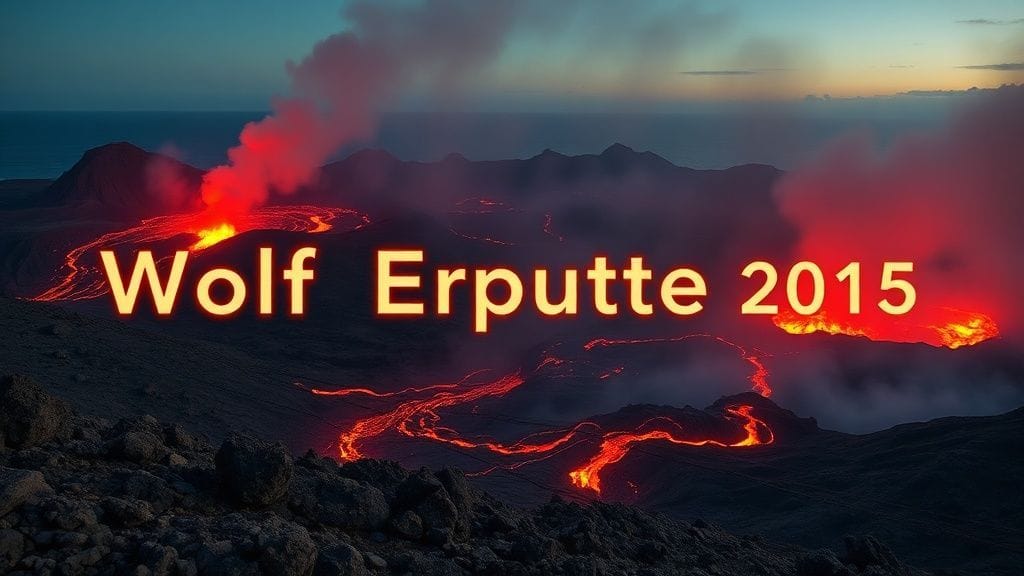
Then came May 25, 2015. At dawn, a violent release of pent-up pressure shattered the silence. Witnesses describe a booming roar that seemed to carry across the ocean, signaling the violent burst from the volcano's crater. Jets of incandescent lava shot into the sky, cascading in glowing rivers down the flanks of Wolf.
Amidst the shaking ground, ash plumes rose thousands of meters, turning day into an ominous twilight. Closer to the eruption site, fiery bombs expelled from the vent caught the light, sizzling as they landed and cooled on ancient lava frames. The volcano was alive again—with a roar that seemed to echo back to the earth’s fiery womb.
Despite the natural splendor, the event posed profound dangers—lava flows threatened the fragile highland ecosystems, and ashfall risked disrupting both flora and fauna. For the scientists, the eruptive pulse was an opportunity — an extraordinary, dangerous chance to study processes too rare to witness.
Nature’s Fury: The Flowing Lava and Raging Fires
Over the following days, Wolf unleashed rivers of molten rock that cut through vegetation, igniting fires and reshaping terrain. The lava, fluid and swift, spread over an area previously lush with endemic flora. The old growth, some patches centuries old, succumbed to the primal flood.
This spectacle was terrifying yet mesmerizing. The sight of lava meeting cooler ground, bubbling into dark glassy flows, told stories of creation amidst destruction. Across the island’s stark volcanic backdrop, the flaming rivers were nature’s brush painting anew the contours of Isabela.
Yet the eruption remained somewhat restrained, producing more lava flows than explosive pyroclastic activity, a blessing in terms of reducing airborne hazards. The dense clouds of sulfur dioxide acted as a harsh reminder of Wolf’s power, drifting over the island and sometimes visible from as far away as mainland Ecuador.
The Human Angle: Scientists and Residents on High Alert
While Isabela’s human population was small and mostly concentrated in Puerto Villamil, the eruption sent ripples through the community. Scientists, conservationists, and local officials moved quickly to ensure safety. Evacuations were considered but largely unnecessary; the eruption site was remote, inaccessible by road.
Ecologists monitored the effects with nervous anticipation. Guides and researchers recounted how the volcano’s awakening drew the island's few residents into a quiet vigil, eyes always flicking toward the sulfur-tinged skies. The event underscored the delicate balance between human presence and nature’s untamable forces.
International volcanologists arrived, drawn by the chance to study a rare island hotspot eruption firsthand. The collaboration between Ecuadorian authorities and global experts created a dynamic knowledge-sharing environment, turning the crisis into a beacon of scientific discovery.
Wildlife in Peril: The Impact on Endemic Species
The Galápagos are famous for their unique biodiversity — created over millions of years through isolation and evolution’s slow dance. But volcanic eruptions, while destructive, are also part of this evolutionary interplay, continuously redefining habitats.
The 2015 Wolf eruption challenged many species. The giant tortoise populations, already endangered and restricted mostly to the island’s slopes and highlands, found some territories veiled in fresh lava. The marine iguanas, although better adapted to sudden changes, faced threats as ash altered coastal waters and vegetation.
However, nature showed resilience. Many species rapidly fled or adapted, and scientists noted signs of rapid recolonization in the months following the eruption. The event was a harsh ecological reset — a reminder that life and lava share a tangential history of destruction and renewal.
A Rare Window: Observations and Data Collected During the Eruption
The Wolf eruption became a live classroom for volcanologists worldwide. Using drones, ground sensors, and satellite imagery, researchers gathered data on lava flow rates, gas emissions, seismic tremors, and mineralogical changes in real time.
This eruption added crucial insights into shield volcano dynamics on islands, particularly those fueled by oceanic hotspots rather than subduction zones. The chemical signatures of emitted gases helped refine models on magma source depths and plume interaction with oceanic crust.
Importantly, the eruption underscored the use of emerging technologies in remote monitoring, demonstrating how even the planet’s most isolated volcanic giants can be tracked with precision.
Ecuador’s Response: Crisis Management on a Remote Frontier
Ecuador’s government engaged swiftly with environmental agencies and local authorities. Contingency plans specific to the Galápagos, focusing on preserving both human safety and ecological integrity, were activated.
Though the wolf eruption site remained largely inaccessible, air quality monitoring stations were set up, and aerial surveys mapped advancing lava flows. Rangers increased patrols to protect sensitive wildlife areas from human disturbance amid the upheaval.
Financially and logistically, Ecuador faced the challenge of maintaining tourism — a vital sector — while safeguarding the national park. Information campaigns reassured visitors and pilgrims alike: the Galápagos, though shaken, remained open and wondrous.
The Role of Technology: Satellite Surveillance and Real-Time Monitoring
The eruption highlighted volcanology’s transformational leap in the 21st century. Instruments onboard NASA’s Terra and Aqua satellites detected heat anomalies within hours. The European Space Agency’s Sentinel satellites provided high-resolution imagery to monitor lava extent and plume dispersion.
Unmanned aerial vehicles offered unprecedented ground-level views, penetrating ash clouds and complex terrain. Ground-based GPS stations tracked subtle deformations on Isabela, suggesting ongoing magma movement beneath the surface.
Combining these technological layers allowed a more comprehensive understanding than ever before possible for such a remote volcanic event.
Volcanic Contributions: How Wolf Shaped Geological Science
This eruption enriched scientific understanding in several fields. It reinforced theories about hotspot volcanism dynamics, providing a case study on how oceanic plates interact with mantle plumes over time.
Geochemists analyzed fresh lava samples, tracing volatile compounds and mineral changes that informed magma chamber depth and chamber dynamics. The event helped clarify the patterns of shield volcano growth rates and lava flow distribution connected to eruption intensity.
Perhaps most importantly, Wolf’s activity served as a natural experiment—an open page for teaching how isolated volcanic systems evolve and respond to tectonic stresses.
The Eruption’s Global Significance: Insights into Plate Tectonics and Hotspots
Though localized, the 2015 Wolf eruption resonates globally, highlighting Earth’s restless nature. Volcanoes like Wolf serve as surface punctuation marks on deep earth processes: the clash and dance of tectonic plates, the bubbling plumes that create islands, and the constant reshaping of the globe’s face.
Understanding these processes is vital for both scientific knowledge and hazard preparedness in regions far beyond Ecuador’s shores. Wolf’s eruption reminds us each volcanic event forms a thread in the grand tapestry of geological time and planetary change.
The Aftermath: Environmental and Ecological Transformations
As the eruption waned and lava cooled, new landscapes emerged: blackened fields, jagged: obsidian layers replacing forest, rivers of cooled basalt standing stark against green backdrop. The island’s topography subtly shifted — new ridges, small craters, and chasms transformed familiar routes.
Ecological recovery began slowly, with pioneer species crossing ash-covered zones. Microbial communities first reclaimed the lifeless rock, allowing hardy plants like ferns and lichens to take root. Such succession, although slow in human terms, is the first step toward eventual ecosystem renewal.
For the animals, the event proved both a barrier and opportunity, triggering migrations and opening niches for future generations.
Recovery and Resilience: Lessons for Conservation in Fragile Ecosystems
Wolf’s eruption redefined conservation efforts. Park authorities and international scientists saw the need to integrate volcanic risk in conservation strategies — how to protect endangered species while respecting volcanic cycles.
The eruption became a case study emphasizing resilience. It illustrated nature’s capacity for rebirth and adaptation even after cataclysmic events. The preservation of biodiversity in such dynamic environments requires ongoing vigilance, research, and flexibility.
In this remote embrace of fire and life, lessons extend beyond the Galápagos, informing global efforts to maintain ecosystems shaped by both slow growth and sudden upheaval.
The Volcano’s Legacy: Cultural and Scientific Narratives Born from Ash
Wolf Volcano’s 2015 awakening etched itself not only in scientific records but in cultural memory. Ecuadorian communities embraced the event as a reminder of nature’s power and their connection to the land.
Storytellers wove narratives of the fiery mountain’s moods, while ecotourists recounted visits tinted with reverence and awe. For the scientific community, it sparked new research projects and collaborations — partnerships that continue to deepen understanding and respect.
Its legacy is a vibrant dialogue between earth, humanity, and time.
Returning to Silence: The Dormant Phase Post-Eruption
After months of fiery spectacle, Wolf Volcano's fury diminished. By late 2015, the lava flows ceased, the steaming vents cooled, and life returned toward a fragile calm.
But this quiet was only temporary. The geological forces fueling Wolf are relentless. The volcano remains on alert, a sleeping giant watching over the Galápagos, ready to remind the world that beneath the surface, change is inevitable.
The Continuing Vigil: Monitoring Wolf in a Changing Climate
Climate change introduces new variables. Warmer temperatures, altered weather patterns, and oceanic shifts may influence volcanic activity indirectly by affecting erosion, vegetation, and tectonic stress.
Ecuador’s authorities have expanded monitoring networks, combining traditional seismographs with satellite and drone technologies to maintain a proactive stance. International cooperation grows, recognizing the necessity to safeguard one of Earth's last natural laboratories.
Wolf Volcano remains a sentinel — both a hazard and a teacher in a warming world.
Stories from the Edge: Eyewitness Accounts and Personal Testimonies
As a local guide recalls: “Watching the lava flow was like seeing the earth breathe fire. It’s terrifying but beautiful. It reminded me how small we are. Nature owns this place.”
Scientists sent expeditions in rain and ashfall, often enduring exhaustion to collect samples and data. Their reports speak of awe mixed with urgency, striving to decode Wolf’s language of fire.
These personal stories add life to the rocks and gases, transforming a scientific event into a human story of wonder, respect, and resilience.
Remembering Wolf: Educational and Heritage Perspectives
Educational programs within Ecuador’s schools now include the 2015 eruption as a pivotal case study, inspiring the next generation of geologists and conservationists.
Visitor centers in the Galápagos interpret the eruption, connecting tourists not just to wildlife, but to the island’s geological heartbeat. The eruption has become part of the island's living heritage, a story told in classrooms, trails, and lecture halls.
Conclusion
The Wolf Volcano eruption of 2015 was more than a natural event; it was an awakening, a moment when the earth revealed its fiery soul in remote Pacific waters. It intertwined destruction with creation, danger with opportunity, science with wonder.
This eruption continues to teach humanity about resilience — both of nature and ourselves. It reminds us that life flourishes not in spite of fire, but often because of it. As the smoke fades and the lava hardens, Wolf’s voice still echoes, calling us to witness, to learn, and to respect the powerful forces shaping our world.
FAQs
1. What caused the Wolf Volcano to erupt in 2015 after a long dormancy?
Wolf’s 2015 eruption resulted from the movement of magma beneath the Earth's crust, linked to hotspot activity beneath the Galápagos. Years of pressure buildup and seismic activity eventually led to the sudden release of molten rock.
2. How did the eruption affect the endemic species of the Galápagos?
While some habitat loss occurred due to lava flows and ashfall, many species showed remarkable resilience, with populations adapting or migrating. The eruption also opened opportunities for ecological succession and renewal.
3. What technologies were used to monitor the eruption?
A combination of satellite thermal imaging, drone surveillance, ground-based seismic sensors, and GPS deformation measurements tracked the eruption in real time, enabling rapid scientific analysis despite the remote location.
4. How did Ecuador manage the eruption’s impact on its population and tourism?
Authorities implemented air quality monitoring, coordinated scientific and conservation efforts, and maintained communication to ensure safety while keeping the Galápagos open for eco-tourism.
5. Why is the eruption considered important for geological science?
Wolf’s eruption provided insight into hotspot volcanism, shield volcano dynamics, and magma chemistry, enriching global understanding of island-building processes on oceanic crust.
6. What is the current status of Wolf Volcano?
As of recent monitoring, Wolf remains dormant but closely watched, with seismic activity and surface changes continuously evaluated to anticipate future eruptions.
7. How has the eruption influenced conservation strategies in the Galápagos?
The event has underscored the need for integrating volcanic risk assessments into biodiversity protection plans, fostering adaptive management for fragile island ecosystems.
8. Can such eruptions happen again in the Galápagos?
Yes, the Galápagos are volcanically active, and eruptions are recurring phenomena, though the timing and magnitude vary. Continuous monitoring aims to mitigate their impact.

