Table of Contents
- Introduction
- Early Life in Lizhou
- From Concubine to Power
- Political Intrigue and Rise to Empress
- Wu Zetian as Emperor of China
- Administrative and Cultural Reforms
- Religion and Legitimacy
- Controversies and Criticisms
- Legacy of Wu Zetian
- Women in Power: Then and Now
- Lesser-Known Facts
- External Resource
- Internal Link
Introduction
She began her life in 624 in Lizhou, an ordinary daughter of a noble family. But her story would be anything but ordinary. Wu Zetian, against all odds and rigid patriarchal norms, climbed her way through the court ranks, maneuvered through betrayals and alliances, and ultimately declared herself Emperor of China—not Empress Consort, not Regent—Emperor.
To this day, she remains the only woman in Chinese history to rule the empire in her own name.
Early Life in Lizhou
Wu Zhao, later known as Wu Zetian, was born in Lizhou (present-day Guangyuan, Sichuan) during the Tang dynasty, a golden age of Chinese civilization. Her father was a well-off timber merchant turned general who gave Wu a rare gift: education.
Unlike most girls of her time, she learned reading, writing, and classical Chinese philosophy. She became well-versed in literature and politics, traits that would later serve her masterfully in the court.
From Concubine to Power
At 14, Wu was selected to become a concubine of Emperor Taizong. In the palace, she was known for her intelligence, charm, and keen observation of court politics. After the emperor’s death, Wu entered a Buddhist convent—as was customary.
But fate took a dramatic turn. She returned to court under Emperor Gaozong, Taizong’s son, with whom she had developed a relationship. Her return was controversial—concubines of previous emperors weren’t supposed to remarry, let alone re-enter court.
Wu defied custom, and with tactical brilliance, she soon became Gaozong’s favorite, eclipsing even his empress.
Political Intrigue and Rise to Empress
Wu’s ascension was no peaceful transition. She was accused of killing her own infant daughter to frame the empress, a charge still debated by historians. True or not, it worked: the empress was deposed, and Wu became Empress Consort in 655.
From there, she wielded growing influence over Gaozong, who suffered from ill health. She effectively co-ruled the empire, issuing edicts, holding court, and making appointments. After his death in 683, she ruled as Empress Dowager, manipulating the succession in her favor.
Finally, in 690, Wu did the unthinkable.
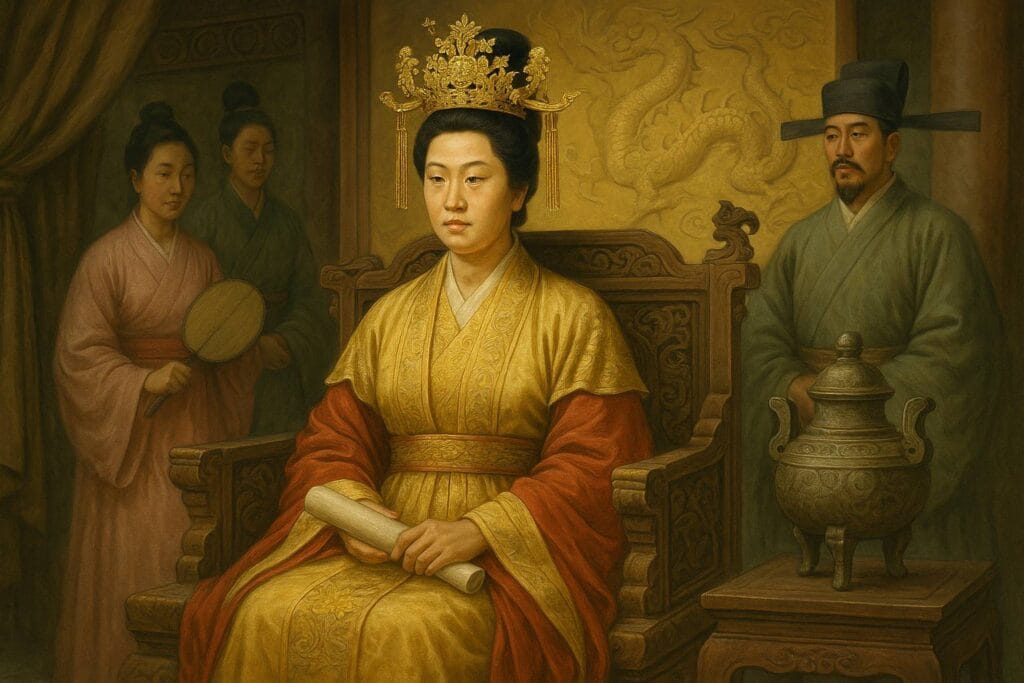
She declared herself Emperor, founding the short-lived Zhou dynasty and becoming the supreme ruler of China.
Wu Zetian as Emperor of China
Her reign was revolutionary.
She broke the traditional view that “heaven is high, and the emperor is male.” With bold symbolism and court ceremonies, she presented herself as the divinely chosen ruler, just like any male emperor before her.
Her rule, while controversial, was surprisingly effective. She appointed skilled ministers (many from lower ranks), reformed the civil service, and centralized imperial power. She was ruthless when needed, exiling or executing opponents—but she also promoted merit and education.
Administrative and Cultural Reforms
Wu Zetian’s rule wasn’t just about power—it was about governance.
She made several bold administrative reforms:
- Expanded the imperial examination system, allowing men of all classes to enter government service.
- Promoted agriculture, reducing tax burdens on farmers and redistributing land.
- Invested in public works, such as irrigation systems and roads.
- Encouraged Buddhism as a state religion, building temples and funding translations of sacred texts.
- Supported scholars and poets, helping preserve and expand Tang culture.
Under her reign, the economy stabilized, and intellectual life flourished.
Religion and Legitimacy
One of her most brilliant strategies was the use of religion for political legitimacy.
She aligned herself with Maitreya, the future Buddha, portraying herself as his earthly incarnation. Buddhist texts were even rewritten to prophesy a female ruler.
This divine framing helped justify her power in a deeply patriarchal society.
She also used religious patronage to gain favor with the clergy and the common people, commissioning massive statues, such as the famous Longmen Grottoes near Luoyang, where her image still gazes over history.
Controversies and Criticisms
Wu’s reign was not without brutality.
She established a secret police, known for tortures and purges. Some historical accounts portray her as paranoid, vindictive, and manipulative. But it’s important to remember: many of these records were written by Confucian historians, deeply uncomfortable with a woman wielding imperial authority.
Their writings often emphasize her supposed cruelty—like forcing rivals to commit suicide, or ruling through fear—to delegitimize her power.
Yet even her critics couldn’t deny her competence.
Legacy of Wu Zetian
Wu Zetian died in 705, after nearly 50 years of influence and 15 years of direct rule as emperor. She was initially buried without imperial titles, but later dynasties restored her honors.
Today, she is remembered both as a symbol of female power and a controversial figure. She shattered glass ceilings 1300 years ago, in a time when women were expected to be silent.
Her legacy is visible not just in tombs and temples, but in the questions she raised about gender, legitimacy, and the very nature of leadership.
Women in Power: Then and Now
Wu Zetian’s reign set a precedent, but sadly, no other woman would rule China as emperor. Her rise and reign remain unique in Chinese—and global—history.
Modern historians, especially women scholars, have reclaimed her image, not as a tyrant, but as a visionary ruler navigating a brutal political system dominated by men.
Her story continues to inspire debates on gender and power, reminding us that history isn’t always what it seems.
Lesser-Known Facts
- Her tomb, Qianling Mausoleum, is one of the only imperial tombs never looted—its secrets remain sealed.
- She commissioned the “Wordless Stele”, a blank stone monument near her tomb, letting history judge her legacy.
- She had four sons and two daughters; one son, Zhongzong, ruled briefly before and after her reign.
- She often interviewed officials herself, asking questions to assess their intelligence.
- She created new Chinese characters, some of which are still known today as “Zetian characters”.