Table of Contents
- Dawn of Revolution: The Quiet Birth of the Wuchang Uprising
- China on the Brink: The Late Qing Dynasty in Turmoil
- Seeds of Discontent: Social, Political, and Economic Pressures
- The New Army and the Spark of Rebellion
- October 10, 1911: The Night Wuchang Erupts
- The Revolutionary Forces: Who Were They?
- From Mutiny to Mass Movement: The Spread of Rebellion
- The Qing Court’s Response: From Underestimation to Desperation
- Wuchang’s Fight by Day and Night: Streets Painted in Defiance
- The Birth of the Republic of China: Shattering an Empire
- The Role of Sun Yat-sen: Symbol and Strategist
- The Collapse of Imperial Authority Across Provinces
- International Reactions: Empires Watching China Burn
- Human Stories from the Uprising: Courage, Tragedy, and Hope
- The Legacy of October 10: How Wuchang Shaped Modern China
- The Cultural and Political Aftershocks in the 20th Century
- Remembering the Revolution: Public Memory and National Identity
- Conclusion: The End of an Era, The Dawn of a Nation
- FAQs: Understanding the Wuchang Uprising
- External Resource
- Internal Link
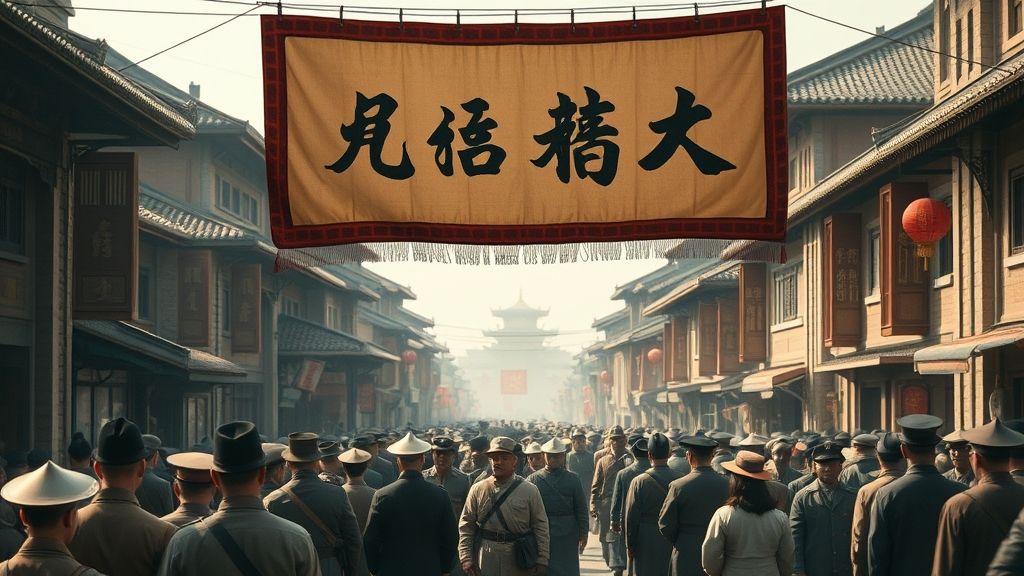
The air in Wuchang—the bustling city nestled on the southern banks of the Yangtze River—was pregnant with tension on October 10, 1911. A chill lingered in the early autumn evening, yet beneath this deceptive calm was a furious undercurrent, a storm gathering in the hearts of men and women undone by decades of dynastic decay and national humiliation. The Wuchang Uprising had begun—not as a grand war cry from a revolutionary podium, but as a spontaneous fracture in the colonial underbelly of imperial China. This moment would ignite a chain reaction that would bring down centuries of Qing imperial rule and birth a republic, rewriting the destiny of one of the world’s oldest civilizations.
Dawn of Revolution: The Quiet Birth of the Wuchang Uprising
On the surface, Wuchang was a city like many others—markets hummed with commerce, rickshaws rattled through narrow streets, and the Yangtze River flowed in its timeless, indifferent course. Yet inside one military barrack, what began as a mutiny by officers of the New Army quickly blossomed into an uprising that would topple an empire. Unlike a meticulously planned coup, it was born of desperation—a fearful, hurried revolt spurred by a botched secret rebellion and the raw anxieties of reformist soldiers. This was the Caesura in China’s long imperial poem, where old rhythms cracked and new verses began.
China on the Brink: The Late Qing Dynasty in Turmoil
To understand the seismic rupture of 1911, one must peer into the twilight of the Qing Dynasty—the Manchu rulers who had governed since 1644 but by the early twentieth century were drowning in crisis. The dynasty was a fragile vessel weary from internal rebellions, foreign invasions, and the corrosive impact of unequal treaties imposed by imperialist powers. China’s sovereignty was compromised; spheres of foreign influence carved into its vast lands. The traditional Confucian order was losing grip over an increasingly impatient and modernizing society.
The Self-Strengthening Movement had failed to rejuvenate the empire, and the Hundred Days' Reform of 1898 had been ruthlessly suppressed. The Boxer Rebellion in 1900 had only accelerated foreign intervention. By 1911, the Qing court found themselves mired in paralysis—and distrust, even within its own military commanders and officials.
Seeds of Discontent: Social, Political, and Economic Pressures
The causes of the uprising are rooted in a tangled web of socio-political stresses. Famine, poverty, and corruption undermined the social fabric, while revolutionary ideas—fed by Western liberalism and nationalism—percolated through urban intellectual circles and secret societies alike. The impact of railway nationalism, a fierce contest between imperial control and local interests over the ownership of burgeoning railway lines, was particularly potent.
Moreover, a new generation of Chinese sought to replace dynastic rule with a system resonating with the principles of democracy and nationalism articulated by reformers like Sun Yat-sen. For many, loyalty to the Qing had long decayed, replaced by a growing identification with the concept of China as a sovereign nation-state—something yet to be fully realized.
The New Army and the Spark of Rebellion
The Qing had attempted modernization of its military by creating the “New Army,” trained in modern techniques with better equipment, hoping to counter the inevitable decline of old Qing Bannermen forces. But this army, ironically, was one of the revolution’s most fertile grounds.
The soldiers were young, educated, and often imbued with revolutionary ideas. They were stationed significantly in Wuchang, Hubei Province, a strategic rail and trade node. A secret Revolutionary Alliance had infiltrated these units and planned to ignite the flames of revolt when conditions were right.
An accidental explosion early in October at a weapons depot precipitated the premature uprising. Faced with imminent exposure, officers and soldiers chose to rise and seize the moment. The mutiny quickly gained momentum.
October 10, 1911: The Night Wuchang Erupts
In the dark hours of October 10, the Wuchang New Army revolted against Qing commanders with a fierce swift fury. Fear gripped the loyalist officials and the local Manchu garrison was caught off guard. By dawn, the city was in revolutionary hands.
The rebel forces declared a new government and set in motion the machinery for a republican China. This was no mere military coup: ordinary citizens joined the uprising, emboldened by the ideology that whispered of self-rule and a future free from Manchu domination.
The initial shock became a clarion call. Other provinces soon followed.
The Revolutionary Forces: Who Were They?
The revolutionaries were a coalition of radical soldiers, intellectuals, and secret society members. Among the most prominent were figures connected to the Tongmenghui, the Revolutionary Alliance spearheaded by Sun Yat-sen. While Sun was abroad at the time, his vision and network had laid the intellectual groundwork.
Local leaders such as Huang Xing and Li Yuanhong emerged as commanders who steered the revolt. Their backgrounds bridged military experience and revolutionary zeal. They became emblematic of a shift: from old-fashioned dynastic loyalty to an ethos of national liberation and republican ideals.
From Mutiny to Mass Movement: The Spread of Rebellion
Wuchang’s fall unleashed a revolutionary chain reaction. Over the coming weeks, 15 of 18 provinces declared independence from Qing rule. From Sichuan to Guangdong, local officials and armies either defected or rose in revolt inspired by Wuchang’s audacity.
The central government, confused and slow, attempted to crush the rebellion but found itself hemorrhaging control. To many, the Qing court’s reluctance and internal squabbles signaled the dynasty’s impending death.
This domino effect turned an isolated mutiny into a full-scale revolution—one that resonated deeply with a suppressed people longing for profound change.
The Qing Court’s Response: From Underestimation to Desperation
Initially, the Qing court under the Empress Dowager Longyu and young Emperor Puyi underestimated the rebels. They believed the mutiny was isolated and would be suppressed swiftly. But as news of provincial defections arrived, panic ensued.
In Beijing, the court turned to Yuan Shikai, a powerful general and skilled politician, to command loyalist troops and restore order. Yuan’s ambitions, however, complicated matters—he was neither a true loyalist nor an avowed revolutionary. His maneuvering would ultimately tip the scales towards a negotiated end to Qing rule.
The court’s reliance on military force to crush the rebellion failed to stabilize the empire—political paralysis and loss of loyalty dealt fatal blows.
Wuchang’s Fight by Day and Night: Streets Painted in Defiance
Wuchang itself became a crucible of revolutionary fervor and brutal conflict. Revolutionary councils organized civilian militias, local elites, and defected troops into a fighting force to defend their new administration.
Fierce street battles, trained artillery duels, and acts of sabotage marked the days that followed. The courage and determination of common citizens—shopkeepers, students, laborers—were essential to holding the city.
Local hospitals overflowed with the wounded. Families witnessed horrifying reprisals by Qing loyalists. Yet amidst the smoke and blood, a profound hope blossomed: the hope for a China reborn.
The Birth of the Republic of China: Shattering an Empire
Within weeks of Wuchang’s initial rebellion, revolutionary assemblies convened to establish a new government. The Republic of China was proclaimed on January 1, 1912, with Sun Yat-sen elected as its provisional president.
This audacious act ended over two millennia of imperial tradition. The symbolic end of the Qing came when the young Emperor Puyi abdicated in February 1912, under heavy pressure.
What began as a localized mutiny thus culminated in the birth of a republic—a seismic transformation of China’s political landscape.
The Role of Sun Yat-sen: Symbol and Strategist
Though absent at Wuchang’s outbreak, Sun Yat-sen’s role was pivotal in the uprising’s intellectual and political engine. His Three Principles of the People—nationalism, democracy, and people’s livelihood—provided an ideological compass.
Sun’s charisma and global support galvanized revolutionaries and created an image of a unified national movement. Returning from abroad, he negotiated skillfully with Yuan Shikai, balancing revolutionary idealism and political pragmatism.
His leadership transformed scattered rebellions into a coherent revolutionary cause.
The Collapse of Imperial Authority Across Provinces
The Qing government’s loss of control was swift and irreversible after Wuchang. Provinces declared independence, and local warlords filled the power vacuum.
The dynasty’s military was splintered; loyalty was often to provincial leaders or personal interests rather than central authority. This fragmentation set the stage for the warlord era—decades of instability following the collapse of imperial rule.
Yet, the republic’s establishment hinted at a new order, even if fragile and contested.
International Reactions: Empires Watching China Burn
Foreign powers with vested interests in China watched the upheaval with varying degrees of concern and opportunism. Japan, Russia, Britain, Germany, and the United States each followed the unfolding events carefully.
Some supported the Qing court hoping to preserve their concessions; others saw the republic as an opportunity for new alliances. The revolution thus occurred within the broader context of imperial geopolitics—a complex interplay of domestic struggle and foreign calculations.
Human Stories from the Uprising: Courage, Tragedy, and Hope
Beyond images of strategy and politics, the Wuchang Uprising was shaped by individuals whose lives were forever altered. Soldiers who mutinied faced execution or exile. Civilians were caught between hope and horror—stores looted, homes destroyed.
Stories of bravery surged: a nurse tending wounded revolutionaries, a merchant secretly supplying arms, a young student running messages under fire. But there were also tragedies—the families torn apart, the reprisals by Qing loyalists, and the innocent victims of crossfire.
The uprising was both a collective endeavor and a tapestry of personal narratives filled with suffering and aspiration.
The Legacy of October 10: How Wuchang Shaped Modern China
October 10 became an emblematic date—“Double Ten Day”—celebrated as a cornerstone of Chinese nationalism. The uprising not only ended an era but seeded modern Chinese identity.
It opened debates about governance, citizenship, and sovereignty that resonate to this day. Despite later turmoil, including civil wars and foreign invasion, the revolution laid foundational stones for modern Chinese institutions and political thought.
Its legacy permeates literature, art, and popular memory—reminding China’s people of resilience and the price paid for freedom.
The Cultural and Political Aftershocks in the 20th Century
The fall of the Qing Dynasty did not end China’s struggles. Instead, it propelled the nation into a century marked by profound transformations.
The republican experiment struggled against warlordism, foreign aggression, and ideological battles between communism and nationalism. Yet the spirit ignited in Wuchang continued to inspire reformers, revolutionaries, and ordinary citizens seeking renewal.
Modern China’s political culture—its emphasis on unity, sovereignty, and modernization—cannot be understood without acknowledging the Wuchang moment.
Remembering the Revolution: Public Memory and National Identity
Today, the Wuchang Uprising is enshrined in museums, textbooks, and annual commemorations. Monuments stand in Wuhan, and the day is marked with ceremonies symbolizing national pride.
This remembrance shapes how China reckons with its past—a balance of honoring revolutionary sacrifice and affirming continuity with national traditions.
The narrative foregrounds resilience and progress, inviting reflection on revolutionary ideals and the complex realities of nation-building.
Conclusion
The night of October 10, 1911, in Wuchang was no ordinary night, no fleeting spark. It was the eruption of a compendium of hopes, despairs, and irrepressible yearnings that had been gathering for decades. The Wuchang Uprising was both sudden and inevitable—a historical tempest that dismantled an empire and opened the gates for a new China.
Yet, the revolution was neither seamless nor pure. It was fraught with contradictions—a struggle of ideals against pragmatism, unity against fragmentation, past against future. The man on the street, the soldier in the barracks, the intellectual in the city—they all carved their part in this vast, sweeping narrative.
More than a series of battles or a political coup, the Wuchang Uprising was a human story of transformation—of ordinary people challenged to envision and make real a new destiny. In the twilight of a collapsing empire, they lit a candle whose flame continues to define the waking dream of modern China.
FAQs
Q1: What were the immediate causes of the Wuchang Uprising?
A1: The uprising was triggered by a combination of internal discontent within the New Army, accidental exposure of revolutionary secrets, and pressures from widespread dissatisfaction with Qing rule. The seizure of weapons and premature revolt stemmed from fear of imminent crackdown on revolutionaries.
Q2: Who led the Wuchang Uprising and the subsequent revolution?
A2: While no single leader orchestrated the initial uprising, local commanders like Li Yuanhong and Huang Xing played key roles on the ground. Sun Yat-sen, though absent, was the ideological and symbolic center of the Revolutionary Alliance, providing vision and legitimacy.
Q3: How did the Qing government respond to the uprising?
A3: Initially dismissive, the Qing court soon turned to military intervention led by Yuan Shikai. However, internal weaknesses, political infighting, and defections undermined efforts to suppress the rebellion, leading ultimately to the dynasty's collapse.
Q4: Why is October 10 called “Double Ten Day” in China and Taiwan?
A4: October 10 marks the beginning of the Wuchang Uprising, considered the birth of the Republic of China in 1911. It is celebrated annually as “Double Ten Day” to commemorate the founding of republican ideals and the overthrow of the Qing dynasty.
Q5: What was the international reaction to the revolution?
A5: Foreign powers reacted with a mix of concern and opportunism. While some supported the Qing to preserve interests, others saw the new republic as a chance for fresh alliances. The revolution affected China’s geopolitical standing amidst imperial rivalry.
Q6: How did the Wuchang Uprising influence later Chinese history?
A6: It ended imperial rule and initiated republican governance, profoundly altering China's political structure. Despite ensuing chaos and civil war, it inspired subsequent efforts at modernization, nationalism, and reform that shaped 20th century China.
Q7: What role did ordinary citizens play in the uprising?
A7: Civilians participated actively, from joining militias to providing support to revolutionaries. Their involvement was crucial both militarily and morally, reflecting widespread popular desire for change.
Q8: How is the Wuchang Uprising remembered today?
A8: It is commemorated in China and Taiwan as the founding event of the Republic. Public holidays, monuments, and educational curricula ensure that the uprising remains a key symbol of national identity and revolutionary heritage.