Table of Contents
- The Dawn of a Relentless Siege: Vikings at the Gates of York
- York in the Mid-9th Century: A City Between Worlds
- Northumbria’s Fragile Kingdom: Power, Politics, and Precarity
- The Great Heathen Army Arrives: Shadows Over England
- The Siege and Fall of York: A City Surrenders
- The Vikings’ Strategic Masterstroke: From Raids to Kingdoms
- The Price of Defeat: Northumbria’s Collapse and its Aftermath
- The Rise of the Viking Kingdom of Jórvik
- The New Lords of York: Culture, Law, and Society Under Norse Rule
- The Anglo-Saxon Response: Fragmentation and Resistance
- Legacy of 866: York as a Viking Capital
- Myth and Memory: Vikings in English Imagination
- Archaeological Revelations: Unearthing Viking York
- The Fall of Northumbria in the Wider European Context
- Reflections on Conquest and Identity: The Battle for England’s North
- Conclusion: The Turning Point that Shaped Medieval England
- FAQs: Understanding the Viking Capture of York
- External Resource
- Internal Link
1. The Dawn of a Relentless Siege: Vikings at the Gates of York
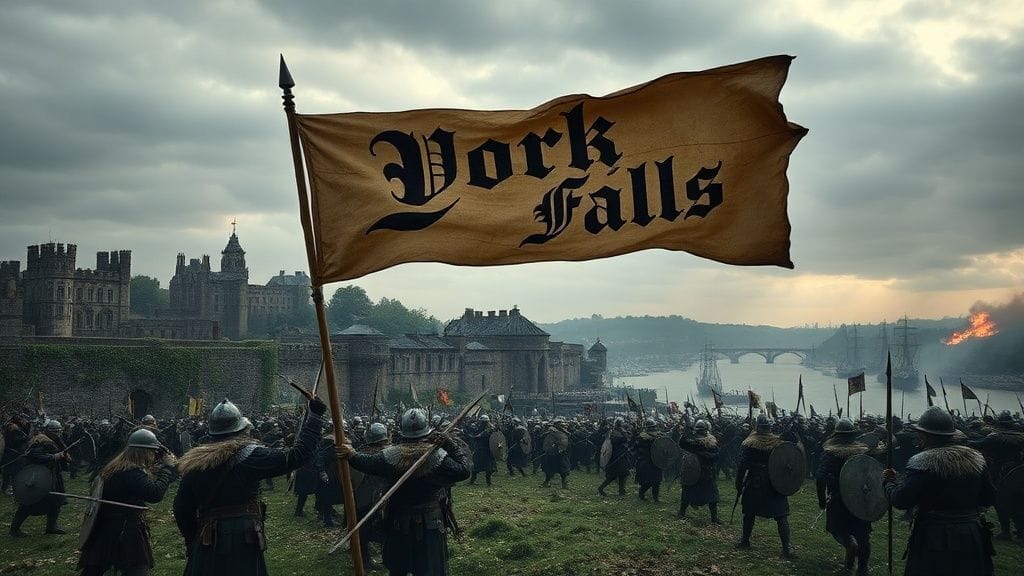
It was a morning like any other in late 866 — the crisp chill of autumn hanging heavily in the air as the citizens of York went about their daily routines. Yet, no one could have predicted that day would mark a dramatic transformation for the city, nor that history was unfolding in its streets as the dark sails of the Viking fleet appeared on the horizon. York, one of Anglo-Saxon England’s greatest cities, was about to fall.
The Viking warriors, hardened by decades of raids and wars across the coasts of Europe, approached not simply as marauders but as harbingers of conquest. Their arrival was a thunderous alarm that rippled through Northumbria, one of the last independent Anglo-Saxon kingdoms standing defiantly against the tide of Norse expansion. The city’s defenses, comprised of ancient fortifications and a population unprepared for siege, would soon meet the cold steel of an invading force whose brutal efficiency reshaped the political landscape of England.
This moment, fraught with tension and charged with fierce defiance, carved an indelible mark in the story of England — the fall of York in 866 was not just a loss of territory but the beginning of a cultural and political transformation that would echo through centuries.
2. York in the Mid-9th Century: A City Between Worlds
To understand the significance of York’s fall, one must first peer into the vibrant life of the city before its capture. York, or Eoforwic as the Anglo-Saxons called it, was more than a mere settlement; it was a thriving hub of commerce, religion, and administration. Situated on the River Ouse, it served as a critical junction for trade routes stretching across Britain and beyond.
By the 9th century, York had evolved from its Roman origins into a prosperous Viking-age city. Its walls had witnessed the clashes of Angles, Romans, and native Britons. By this time, it was the ecclesiastical heart of Northumbria, boasting an influential bishopric and a loyal populace steeped in Christian tradition and Northumbrian culture.
Its strategic importance was undeniable — controlling York meant controlling the northern gateway to England and dominating trade in the Irish Sea and North Sea. This made York a jewel to be possessed by any power with ambitions over northern England.
3. Northumbria’s Fragile Kingdom: Power, Politics, and Precarity
Northumbria in the mid-800s was a kingdom rife with internal strife and external pressures. Once a dominant force in Anglo-Saxon England, it had been weakened by dynastic quarrels, Viking raids, and shifting alliances. Its rulers struggled to maintain authority over fractious nobles and competing interests that often undermined centralized governance.
Politically divided between its southern core around York and the northern frontier territories near Scotland, Northumbria’s resources were stretched thin. Its armies, though valorous, were insufficiently organized to repel the growing Norse threat. Meanwhile, the Vikings were no longer mere raiders—they were becoming a formidable invading force with long-term objectives.
This vulnerability was noted keenly by the Great Heathen Army, Viking warriors whose ambitions had shifted from plundering monasteries to seizing kingdoms.
4. The Great Heathen Army Arrives: Shadows Over England
Autumn of 866 saw the arrival of a Viking force unlike any England had faced before — the so-called Great Heathen Army, a coalition of various Scandinavian warbands, united under a purpose beyond typical raids. Their leader, identified in some sources as the formidable Ivar the Boneless, was a tactician and strategist intent on conquest.
Landing on the east coast, this massive force quickly began striking at the heartlands of Northumbria. Their military efficiency and ruthlessness were terrifying. Towns and villages fell in succession; resistance crumbled under their onslaught.
When the Heathen Army reached York, the city’s populace had little choice but to respond; surrender or face destruction.
5. The Siege and Fall of York: A City Surrenders
The siege of York was both swift and brutal. Unlike the drawn-out sieges common in medieval warfare, the Vikings leveraged their combination of naval mobility, surprise tactics, and psychological warfare to overwhelm the city.
Chroniclers describe how the gates were breached without prolonged bloodshed, a testament to either treachery within or the realization among York’s leaders that resistance was futile. Some accounts suggest local nobles may have negotiated with the Vikings, hoping to preserve some status under new rulers—though what remained was a bleak reality of occupation.
The fall was catastrophic for Northumbria, representing not only a military defeat but a shattering blow to its identity and sovereignty.
6. The Vikings’ Strategic Masterstroke: From Raids to Kingdoms
The capture of York marked a turning point in Viking strategy. What had begun as seasonal raids for wealth morphed into sustained territorial acquisition. Establishing York as their power base — re-named Jórvik by the Norse — the Vikings transitioned into rulers and administrators.
This was a strategic masterstroke, allowing them to control trade and resources, expand influence southwards, and integrate themselves into the existing political fabric of England. They adapted local customs, forged alliances, and created hybrid societies blending Norse and Anglo-Saxon elements.
The capture of York also signaled to other Viking bands across Europe the viability of permanent settlement and governance, planting seeds for future Norse states.
7. The Price of Defeat: Northumbria’s Collapse and its Aftermath
For the kingdom of Northumbria, the Viking conquest was a death knell. Once an independent and influential kingdom, it fragmented rapidly. The king, Ælla, either slain or deposed, left no unifying figure to rally resistance.
The north fractured into smaller domains, many under Viking influence or direct control. This political fragmentation weakened any coordinated response to future threats and accelerated the decline of Northumbrian culture and institutions.
For the people, the aftermath was grim: loss of lands, imposition of foreign laws, and cultural upheaval. Churches and monasteries, which had been centers of learning and religion, suffered plundering or conversion to Viking patronage.
8. The Rise of the Viking Kingdom of Jórvik
From the ashes of Northumbria’s defeat rose a new polity — the Viking Kingdom of Jórvik. York became the capital of an emerging Viking realm stretching into the northern territories.
Led by Norse rulers who combined warrior ethos with administrative acumen, Jórvik flourished economically and culturally. The city’s markets bustled with goods from Scandinavia, the British Isles, and continental Europe. Norse legal codes and customs were implemented alongside Anglo-Saxon traditions, producing a vibrant societal fusion.
Jórvik endured for several decades, becoming a cornerstone of Scandinavian influence in Britain and a vital player in the power dynamics of the British Isles.
9. The New Lords of York: Culture, Law, and Society Under Norse Rule
Life under Viking rule was complex and multifaceted. Far from a simple story of oppression, the Norse presence introduced new cultural and social elements. Viking artisans, traders, and settlers mingled with the Anglo-Saxon population, influencing language, art, and governance.
Archaeological finds reveal a cosmopolitan city — runic inscriptions alongside Christian symbols in the same neighborhoods, evidence of mixed marriages, and shared traditions. The Vikings brought Norse laws that coexisted with Christian practices, and a pragmatic tolerance for varying customs to maintain order and prosperity.
This hybrid identity paved the way for a distinct York character that would survive beyond the Viking era.
10. The Anglo-Saxon Response: Fragmentation and Resistance
Not all in England submitted quietly to the Viking advance. The capture of York sent shockwaves southwards, especially to the kingdoms of Mercia and Wessex.
Leaders like King Alfred the Great of Wessex began organizing resistance, fortifying cities, and rallying the Anglo-Saxon people under the banner of defending their heritage. The fall of Northumbria became a cautionary tale, spurring military and political reforms.
Yet, Anglo-Saxon England was deeply fragmented, and coordination proved difficult. Smaller kingdoms fashioned uneasy alliances, while Viking influence remained entrenched in the north.
11. Legacy of 866: York as a Viking Capital
The year 866 etched York indelibly into the Viking saga of Britain. As Jórvik, it served as a base for Norse power projection for nearly a century, embodying the Viking transformation from foreign marauders to established rulers.
This legacy influenced not only England’s political map but also cultural memories — York became synonymous with Vikings in English folklore and historical chronicles.
The city’s Viking chapter enriched its identity, making it a symbol of resilience and cultural fusion still celebrated today.
12. Myth and Memory: Vikings in English Imagination
The capture of York also fueled myths and legends that have colored Viking history in England. Chroniclers like the Anglo-Saxon Chronicle, often hostile to the Norse, portrayed them as terrifying "heathens."
However, over generations, the narrative grew complex. Vikings were villainized, romanticized, and even integrated into local heritage. York’s Viking past became a source of fascination, inspiring literature, art, and popular culture.
This ambivalent memory continues to shape how the Viking Age is remembered in England.
13. Archaeological Revelations: Unearthing Viking York
Modern archaeology has peeled back layers of time to reveal the Viking world beneath medieval York. Excavations reveal streets, homes, workshops, and burial sites teeming with Norse artifacts.
From intricately carved combs to coins minted in Jórvik, the material culture confirms textual records and enriches our understanding of daily life under Viking rule.
These discoveries have transformed York into an open-air museum of Viking history, attracting scholars and visitors eager to connect with a turbulent past.
14. The Fall of Northumbria in the Wider European Context
York’s capture was not an isolated event but part of a wider European upheaval reshaping the continent. Scandinavian incursions destabilized kingdoms from the British Isles to the Frankish Empire.
The Viking campaigns accelerated the decline of old power structures and stimulated new political arrangements. In this context, the fall of Northumbria was both cause and consequence of broader transformations, marking the end of an era and the dawn of a new medieval order.
15. Reflections on Conquest and Identity: The Battle for England’s North
The story of York’s fall raises timeless questions about conquest, identity, and cultural survival. How do societies adapt when invaded? What does it mean to be conqueror or conquered?
York’s new Viking rulers did not erase the past but built upon it, illustrating resilience and hybridity in the face of upheaval. Their legacy reminds us that history is rarely black and white, but a mosaic of intertwined destinies.
16. Conclusion: The Turning Point that Shaped Medieval England
The capture of York in 866 was more than a military event — it was a profound turning point in English history. The fall of Northumbria dismantled a powerful kingdom and heralded the Viking transformation from raiders to rulers.
York’s Norse chapter enriched the cultural and political fabric of medieval England, influencing laws, commerce, and identities that persist today. This event underscores how moments of conflict can birth new societies and how history is written at the juncture of loss and renewal.
Understanding York’s fall invites us to appreciate the complexities of cultural encounters and the enduring human capacity to adapt and thrive.
FAQs: Understanding the Viking Capture of York
Q1: Why was York such an important target for the Vikings?
A1: York was the political and economic heart of Northumbria and a major trade hub connecting the British Isles and the continent, making it a prize for controlling northern England.
Q2: Who led the Viking forces during the capture of York?
A2: Although sources vary, figures like Ivar the Boneless are often cited as leaders of the Great Heathen Army that took York.
Q3: How did the fall of York affect the Anglo-Saxon kingdoms?
A3: It destabilized Northumbria, fragmenting its power, and pressured other kingdoms like Mercia and Wessex to strengthen defenses and unify against Viking threats.
Q4: What was life like in York under Viking rule?
A4: Life became a fusion of Norse and Anglo-Saxon cultures, with shared customs, trade, pagan and Christian practices, and evolving legal systems.
Q5: Did the Vikings completely destroy Northumbrian culture?
A5: No, while there was disruption, many aspects of Anglo-Saxon culture persisted alongside Norse influences, resulting in a hybrid society.
Q6: How has archaeology expanded our understanding of Viking York?
A6: Excavations have uncovered artifacts, buildings, and inscriptions that provide insight into daily life, trade, and cultural intermingling during Norse rule.
Q7: Why is the capture of York viewed as a turning point in English history?
A7: It marked the transition from Viking raids to sustained conquest and settlement, reshaping political boundaries and cultural landscapes across England.
Q8: How is this event remembered today in England?
A8: It is celebrated as a key chapter in York’s history, represented in museums, literature, and festivals that honor the city’s Viking heritage.

