Table of Contents
- The Twilight of Sovereignty: Zanzibar’s Strategic Importance in the Late 19th Century
- The East African Coast: A Contest for Influence
- Zanzibar in the 19th Century: From Sultanate’s Glory to British Ambitions
- The Geopolitical Chessboard: Britain’s Rivalry with Germany in Africa
- The Heligoland-Zanzibar Treaty: A Diplomatic Gamble
- November 4, 1890: The Day Zanzibar Became a British Protectorate
- The Sultan’s Dilemma: Power under the Shadow of Empire
- The Role of the British Empire: Protector or Colonial Overlord?
- Local Reactions: From Elite Ambivalence to Popular Unease
- The Impact on the Indian Ocean Slave Trade and Commerce
- British Administration’s Early Challenges and Policies
- Germany’s Gains and Losses: The Broader Colonial Repercussions
- Zanzibar’s Transformation: Economic, Social, and Political Shifts
- The Protectorate’s Legacy on Zanzibari Identity and Autonomy
- Twentieth Century Ripples: The Road to Independence
- Reflections on Imperialism: Zanzibar as a Microcosm of Global Shifts
- Conclusion: The British Protectorate’s Enduring Echo
The Twilight of Sovereignty: Zanzibar’s Strategic Importance in the Late 19th Century
As the sun dipped below the horizon of the Indian Ocean on that fateful day in November 1890, Zanzibar Town was not merely witnessing a sunset but the extinguishing of a sovereign flame. This was a city steeped in the perfume of clove groves and the memories of sultans, whose ancient glory intertwined with the whirlwinds of incoming European empires. The air was thick with the hum of dhows, the chatter of markets, and the silent undercurrent of political change. For centuries, Zanzibar had thrived at the crossroads of African, Arab, and Indian commerce—its wealth radiating from spices and slaves, a jewel of the Swahili coast.
But by November 4, 1890, the winds of empire had rearranged the contest for control. On this day, Britain formally declared Zanzibar a protectorate, marking a profound transformation for the island’s governance and its place in the world—a declaration that reverberated far beyond the turquoise waters and sandy shores. This was not merely a bureaucratic change but a story of imperial ambitions, local resilience, and cultural metamorphoses whose echoes are still felt today.
The East African Coast: A Contest for Influence
Zanzibar’s location off the coast of East Africa made it a coveted prize. For centuries, Arab traders had established the island as a vibrant nexus of trading networks extending as far as India, Persia, and even China. This cosmopolitan outpost was the nerve center of the clove and spice trade, enriched further by its role as the premier East African slave market until the 19th century abolitionist campaigns sought to curtail this dark commerce.
By the late 1800s, the island stood at the intersection of great powers’ ambitions. The British Empire, newly victorious in an era of “New Imperialism,” coveted the island as a gateway to the mainland territories and as a base for naval operations. Meanwhile, Germany eyed the mainland strip of East Africa—Tanganyika—and sought to check British influence. The international atmosphere was charged with rivalries seeking to carve Africa into spheres of influence, often ignoring the voices of the local rulers and peoples.
Zanzibar in the 19th Century: From Sultanate’s Glory to British Ambitions
The Sultanate of Zanzibar, under the Al Said dynasty, had peaked in the early 19th century. This dynasty, originally from Oman, had transplanted its capital to Zanzibar in the 1840s, leveraging the island’s prosperity to build one of the richest realms in the Indian Ocean. Sultans ruled a complex society where Arab, African, Persian, and Indian cultures mingled.
Yet, the 19th century also witnessed the gradual erosion of this autonomy. British missionaries and abolitionist pressures challenged the slave trade that had been the bedrock of Zanzibar’s economy. At the same time, the rise of European colonial powers introduced competing forces that would redefine the island’s fate. Britain sought not only to protect its commercial privileges but also to impose a new political order—one where the Sultan’s rule was superseded by imperial oversight.
The Geopolitical Chessboard: Britain’s Rivalry with Germany in Africa
The late 19th century heralded an explosive phase of imperial territorial acquisitions, and East Africa was no exception. Britain and Germany, both rising colonial powers, found themselves on a collision course. Britain’s control of the Suez Canal and India made Zanzibar strategically vital.
In this tense atmosphere of diplomatic brinkmanship, the Heligoland-Zanzibar Treaty of 1890 emerged. Britain ceded the small North Sea island of Heligoland to Germany in exchange for formal recognition of its protectorate over Zanzibar—an act that exemplified the cold calculation underpinning imperial diplomacy. This treaty symbolized the subjugation of a diverse African kingdom under the dictates of far-flung European capitals, prioritizing strategic concerns over local sovereignty.
The Heligoland-Zanzibar Treaty: A Diplomatic Gamble
Signed on July 1, 1890, the Heligoland-Zanzibar Treaty was a masterstroke of European statecraft yet a devastating blow to the independent spirit of Zanzibar. Britain traded away Heligoland—of minor colonial importance but significant for German naval ambitions—in return for Germany’s acquiescence to a British protectorate over Zanzibar and the adjacent East African coast.
This treaty was a vivid reminder of the European powers’ disregard for African voices in their scramble. The Sultan of Zanzibar was informed after the fact, and while his position was to be “protected,” his sovereignty was effectively curtailed. British consuls began to wield power behind the scenes, reshaping the island’s administration under imperial guidance.
November 4, 1890: The Day Zanzibar Became a British Protectorate
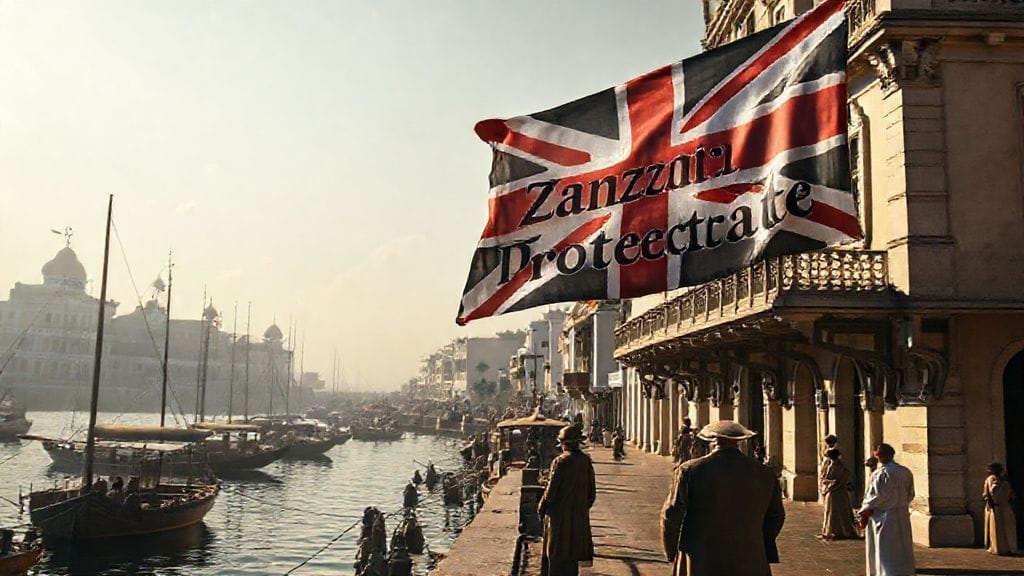
On November 4, 1890, Zanzibar’s transformation was formalized. The British flag was raised over the Sultan’s palace, and a protectorate proclamation was read aloud, signaling the arrival of British imperial authority. The event was both symbolic and practical—the island remained nominally under the Sultan, but British officials controlled foreign policy, defense, and economic decisions.
This moment was charged with ambivalence: for some local elites, it offered protection and stability amid regional uncertainties; for others, it foreshadowed the loss of independence and increasing subjugation to European colonial norms. Streets bustling with traders and sailors softened under the weight of new regulations and bureaucracy.
The Sultan’s Dilemma: Power under the Shadow of Empire
For Sultan Ali bin Said, who ruled at the time, becoming a British protectorate was a bitter pill. His authority was now circumscribed by British Residents who reported directly to London. The Sultan was permitted some internal jurisdiction, but his international stature was diminished.
Balancing between appeasing the British and maintaining his legitimacy before his subjects demanded delicate political maneuvering. Sultan Ali’s reign was marked by cautious accommodation, but the shadow of empire left little room for independent decision-making.
The Role of the British Empire: Protector or Colonial Overlord?
The British portrayed the protectorate as a benevolent oversight designed to ensure stability, end the slave trade definitively, and guide the island’s modernization. Yet, beneath this rhetoric lay clear imperial objectives: control of maritime routes, influence over mainland trade, and suppression of rivals.
British Residents enacted policies transforming the island’s economy and infrastructure. The abolition of the slave trade was enforced rigorously, though black market activity persisted. Britain invested modestly in public works, schools, and health services, often framed as “civilizing missions.”
Nonetheless, the protectorate status placed Zanzibar firmly within the British imperial orbit, blurring the line between protection and colonial dominance.
Local Reactions: From Elite Ambivalence to Popular Unease
Among Zanzibari society, responses were mixed. Some members of the Arab elite saw cooperation with the British as a means to retain their privileges. Others, especially African and Swahili communities, were wary of foreign interference.
Traditional traders and religious leaders sometimes perceived British policies as disruptive to established social orders and economic practices. Stories circulated of tensions sparked by new regulations and cultural misunderstandings. Though Zanzibar was to retain some forms of customary law, colonial imposition undercut many indigenous institutions.
The Impact on the Indian Ocean Slave Trade and Commerce
One of the core justifications for the protectorate was eradicating the Indian Ocean slave trade, which, despite international prohibition, lingered clandestinely. Britain intensified patrols of the surrounding seas, intercepting dhows and liberating captives.
The protectorate also reshaped trade patterns. The clove industry suffered from competition and land reorganization. At the same time, new commercial connections with the British dominions and mainland East Africa flourished.
This transition was painful—economically and socially—as long-established networks and livelihoods faced disruption. Yet it also opened pathways toward integration into a globalized economy, albeit under foreign terms.
British Administration’s Early Challenges and Policies
Administratively, the British had to navigate an island rich in cultural diversity and complex class hierarchies. Early Residents like Sir Lloyd Mathews confronted resistance and logistical obstacles.
Policies targeted reforming taxation, justice, and land ownership. British authorities suppressed slaveholding aristocracies, restricted clan alliances, and promoted Western education. These measures unsettled some while catalyzing social transformations others would later celebrate.
Germany’s Gains and Losses: The Broader Colonial Repercussions
While Britain secured Zanzibar, Germany cemented its hold over mainland Tanganyika. The Heligoland-Zanzibar Treaty exemplified the give-and-take shaping Africa’s borders, often at the expense of local peoples.
This reshuffling increased tensions between European powers, sowing seeds for future conflicts. Zanzibar’s surrender as a protectorate allowed Germany an unchallenged presence on the East African mainland, fueling rival imperialist ambitions that influenced regional dynamics well into the 20th century.
Zanzibar’s Transformation: Economic, Social, and Political Shifts
Over the coming decades, Zanzibar absorbed profound changes. British influence catalyzed modernization efforts—from the introduction of railways on the mainland to reforms in education, health, and governance.
Yet, social cleavages persisted. The Arab-dominated government coexisted uneasily with African populations whose political aspirations were often sidelined. Economic inequality deepened amidst shifting global markets.
Throughout these strains, Zanzibar remained a vibrant center of culture, poetry, and religious life, its identity forged anew under the overarching canopy of empire.
The Protectorate’s Legacy on Zanzibari Identity and Autonomy
Though the protectorate status maintained the facade of sultanic rule, it irrevocably altered Zanzibar’s political trajectory. The gradual loss of sovereignty sowed seeds for later nationalist movements.
Zanzibaris wrestled with mixed legacies: pride in their cosmopolitan heritage tempered by memories of colonial subjugation. The protectorate period is now viewed as a complex era of both suppression and foundation-building for future self-determination.
Twentieth Century Ripples: The Road to Independence
The British protectorate endured until 1963, when Zanzibar gained independence and briefly united with Tanganyika to form Tanzania. Yet the patterns established earlier—centralized control, ethnic divisions, economic dependency—remained challenges for post-colonial leaders.
The protectorate’s end unleashed a wave of political activism, culminating in the 1964 revolution that overthrew the Sultanate. The historical memory of 1890 lingered as a symbol of both loss and a call to reclaim sovereignty.
Reflections on Imperialism: Zanzibar as a Microcosm of Global Shifts
Zanzibar’s transition in 1890 encapsulates the broader themes of New Imperialism—diplomatic intrigue, economic exploitation, and cultural collisions. The protectorate stands as a testament to the human costs of imperial designs cast thousands of miles away.
Yet, the story is not solely of domination. It also reveals the resilience of local societies and cultures enduring, adapting, and ultimately shaping their destiny beyond the shadow of empire.
Conclusion: The British Protectorate’s Enduring Echo
Looking back at November 4, 1890, one can sense the weight of history pressing on Zanzibar—an island forever transformed by that imperial decree. The protectorate was both an end and a beginning: the end of unchallenged sultanic rule, the beginning of a new era where Zanzibar’s destiny was intertwined with global power struggles.
But beneath the political shifts lay human lives—merchants, clergy, slaves freed or displaced, rulers negotiating their survival, and ordinary citizens confronting a world in flux. Zanzibar’s story reminds us that history is not merely an abstract narrative of treaties and flags but a living chronicle of change, resilience, and hope.
FAQs
Q1: Why did Britain want Zanzibar as a protectorate?
Britain sought control over Zanzibar primarily because of its strategic position along key Indian Ocean trade routes, its role in the clove economy, and as a base for suppressing the slave trade and countering German expansion in East Africa.
Q2: How did the Heligoland-Zanzibar Treaty affect the island?
The treaty formalized British protectorate control over Zanzibar in exchange for Germany gaining Heligoland and recognition of its East African territories. It effectively ended Zanzibar’s sovereignty and marked it as a pawn in larger imperial negotiations.
Q3: What was the reaction of the local Sultan to becoming a British protectorate?
Sultan Ali bin Said was placed in a constrained position, maintaining nominal rule but ceding real power to British Residents. His dilemma was balancing ceremonial authority with the reality of British dominance.
Q4: How did becoming a protectorate change life for ordinary Zanzibaris?
Ordinary citizens experienced changes ranging from shifts in legal systems, economic restructuring away from slave trade reliance, to increased foreign influence in governance and culture, which created both opportunities and frustrations.
Q5: What was the role of Zanzibar in the Indian Ocean slave trade before British control?
Zanzibar was the hub of the East African slave trade until 1873. British abolition efforts and naval patrols forced the suppression of the trade, which intensified after the protectorate was established.
Q6: Did the protectorate pave the way for Zanzibar’s independence?
Indirectly, yes. The protectorate laid the administrative groundwork and exposed tensions that would fuel nationalist sentiments, culminating in independence in 1963 and the 1964 revolution.
Q7: How did Germany’s role in East Africa relate to Zanzibar’s protectorate status?
Germany’s agreement to British control over Zanzibar allowed it to consolidate its own East African holdings (modern Tanzania, Rwanda, Burundi), shaping the regional colonial landscape.
Q8: What cultural legacies from the protectorate era are still visible today?
Zanzibar retains its Swahili-Arab cultural heritage, colonial-era architecture, and a complex social fabric influenced by decades of British administrative policies, blending indigenous, Arab, and European elements.