Table of Contents
- The Night Before Freedom: Zimbabwe Poised on the Edge of 1980
- From Colony to Crisis: The Long Road to Rebellion
- Seeds of Revolt: Land, Race, and the Making of a Liberation Struggle
- Guns and Exile: The Rise of ZANU, ZAPU, and the Guerrilla War
- Life in the Shadows of War: Villages, Camps, and Everyday Survival
- The World Takes Notice: Sanctions, Neighbors, and Cold War Calculations
- Ian Smith’s Gamble: UDI, Internal Settlements, and Fading Power
- Road to Lancaster House: Negotiating the End of Rhodesia
- Ballots After Bullets: The 1980 Elections and a Nation Holds Its Breath
- Midnight at Rufaro Stadium: The Birth of Zimbabwe on 18 April 1980
- Robert Mugabe Ascends: Hope, Forgiveness, and Political Calculus
- Reimagining the Nation: Flags, Names, and the Symbolic Break with Rhodesia
- The First Years of Independence: Promise, Compromise, and Fragile Unity
- Gukurahundi and the Fracturing of the Dream
- Land, Liberation, and the Unfinished Business of 1980
- Women, Youth, and the Silent Architects of Independence
- Memory, Monuments, and How Zimbabwe Tells Its Own Story
- Echoes Across Africa: Regional and Global Legacies of Zimbabwe’s Liberation
- Forty Years On: Reassessing Zimbabwe Independence 1980
- Conclusion
- FAQs
- External Resource
- Internal Link
Article Summary: On the night of 17–18 April 1980, as the Union Jack slid down the flagpole in Salisbury and the green, yellow, red, and black banner of Zimbabwe rose, an era ended and another began. This article journeys through the deep roots of colonial conquest, racial dispossession, and armed resistance that culminated in zimbabwe independence 1980. It traces the evolution from Southern Rhodesia to Rhodesia and finally to Zimbabwe, following the ambitions and fears of settlers, guerrillas, villagers, diplomats, and ordinary families caught in the struggle. We move from bush camps and secret political meetings to the negotiating tables of London’s Lancaster House, where the future of millions was mapped in dense legal lines. The narrative explores how hope and trauma intertwined in the early years of independence, from reconciliation speeches to violent crackdowns. It also examines long shadows—land disputes, economic inequality, and contested memories of liberation—that continued to shape the country. Finally, the article reflects on how the promise and paradox of zimbabwe independence 1980 still echo in today’s Zimbabwe and in liberation movements across Africa.
The Night Before Freedom: Zimbabwe Poised on the Edge of 1980
On the evening of 17 April 1980, the air over Salisbury—soon to be Harare—was charged with a tension that felt almost physical. A fine autumn dust hung above the city’s streets, catching the yellow light of lamps and car headlights, as crowds began to swell toward Rufaro Stadium. In the suburbs, some white Rhodesian families sat glued to their television sets, curtains half-drawn, listening to commentators speak in careful, measured tones about a transition that only years earlier had seemed unthinkable. In the townships and high-density areas, people walked in groups, laughing, singing, sometimes falling silent as the reality pressed itself into their minds: by sunrise, their country would no longer be Southern Rhodesia, nor Rhodesia, but something entirely new. The phrase was on many lips, whispered as both promise and question—zimbabwe independence 1980.
Inside Rufaro Stadium, preparations were under way for a choreography that had taken decades, not days, to arrange. Soldiers of the outgoing Rhodesian security forces and the incoming British contingent, sent to supervise the transition, moved with rigid ceremony, checking positions, flags, and the order of events. At one end of the stadium, a group of former guerrillas, some still bearing the scars of war, tried on their new roles as members of the national army, their fatigues a little too neat, their steps uncertain in the formal drills. Around them, workers hammered last-minute fixtures into place for sound systems, stands, and the dais where dignitaries would sit to witness the transfer of power.
For many who would later recall that night, sensory fragments remained sharp: the smell of damp soil under the stadium lights; the sound of liberation songs rising in unison; the metallic glint of bayonets beside the soft, rippling fabric of flags not yet raised. Older women clutched small radios as if they were relics; young men wrapped themselves in makeshift banners, some sewn hastily from cloth in the new national colors. Children asked impatient questions—“When will the ceremony start? What will it look like?”—and were met with replies that were part history lesson, part dream. The emotions were complex: joy braided with grief for those who had not lived to see this moment, relief intertwined with anxiety about what independence might actually mean when the music stopped.
But this was only the beginning. The night of 17–18 April 1980 would enter the iconography of modern Africa, captured in photographs of Prince Charles standing stiffly as the Union Jack descended, and of Robert Mugabe, in a dark suit and thick glasses, taking the oath of office as the first Prime Minister of Zimbabwe. Yet behind the celebrations lay a long and painful journey—from the first British colonial incursions in the 1890s, through settler entrenchment, racial segregation, armed insurrection, and haunted negotiations in faraway London. To understand the intensity of that April night, we must step back, decades earlier, to a time when the very idea of a black-majority government in this land seemed an impossible fiction.
From Colony to Crisis: The Long Road to Rebellion
The story of Zimbabwe’s independence begins not in 1980, but in 1888, when Cecil John Rhodes turned his imperial gaze northward from the Cape. Through the British South Africa Company (BSAC), Rhodes obtained mineral concessions from King Lobengula of the Ndebele in a deal steeped in mistranslation, coercion, and calculated ambiguity. What was presented to the Ndebele as an agreement for limited mining rights became, in the hands of the BSAC and the British government, a license to occupy and administer the territory that would soon be called Southern Rhodesia.
By 1890, the Pioneer Column—a contingent of settlers, police, and fortune-seekers under company charter—marched into the plateau, raised the Union Jack at Fort Salisbury, and proclaimed a new colonial era. The local Shona and Ndebele peoples watched this encroachment with growing alarm. Their lands, long managed through communal systems and spiritual relationships with the soil, were surveyed, fenced, and parceled out to white settlers under the language of “development” and “civilization.” In drawing rooms in London and Bulawayo, the territory’s future was mapped out: a white settler colony with black labor at its foundation.
Resistance came swiftly. The First Chimurenga—literally “the first uprising”—erupted in 1896–1897, as Shona and Ndebele fighters rose against BSAC rule, attacking farms, mines, and outposts. It was a multi-front revolt driven by land dispossession, cattle seizure, hut taxes, and the crushing of traditional authority. The colonial response was brutal. By the end of the conflict, as many as 8,000 Africans had been killed, along with hundreds of settlers and soldiers. The hanging of spirit mediums like Nehanda Charwe Nyakasikana, whose last words are remembered as “My bones will rise again,” would echo across generations as a prophecy of future struggle.
Southern Rhodesia shifted from company rule to self-governing colony in 1923, after white settlers rejected incorporation into the Union of South Africa. This status granted the white minority enormous political power. In elections restricted by race-based franchise rules, only settlers and a tiny number of propertied Africans could vote. The Legislative Assembly became the preserve of white politicians who legislated to protect settler interests—in particular, access to land and black labor. The Land Apportionment Act of 1930 divided the country into European and African areas, giving some 50,000 white settlers privileged claim to the most fertile regions, while millions of Africans were crowded into “native reserves.” This legal geography would haunt Zimbabwe’s politics deep into the late twentieth century.
It’s astonishing, isn’t it, how calmly official documents could describe the wholesale restructuring of life and livelihood. Maps shaded in neat colors masked human dislocation: families uprooted from ancestral graves, cattle driven off, rivers that could no longer be approached because they now lay on the wrong side of a barbed-wire fence. The colonial state did not require the daily presence of armed troops in every village; its power flowed through laws, taxes, pass controls, and the ever-present fear of punishment for those who dared to question the new order.
By the mid-twentieth century, Southern Rhodesia was firmly embedded within the British Empire’s economic and political framework. Tobacco, maize, and minerals flowed outward; British manufactured goods and capital flowed in. African workers were funneled into mines and farms under low wages and strict control, their unions and political organizations subject to surveillance and suppression. Yet beneath the façade of settler prosperity and “order” lay a slow-burning anger. It would take the winds of global decolonization, however, to fan that anger into a nationwide liberation struggle.
Seeds of Revolt: Land, Race, and the Making of a Liberation Struggle
By the 1950s, the world was changing, and so too was Southern Rhodesia. Across Africa and Asia, anti-colonial movements were challenging European empires. Ghana moved toward independence under Kwame Nkrumah; in Kenya, the Mau Mau Uprising shook British confidence and exposed the brutality of settler rule. In urban townships of Salisbury, Bulawayo, and other towns, African residents followed these developments closely, listening to radio broadcasts, reading smuggled newspapers, and trading rumors about speeches delivered at the United Nations.
Locally, grievances were piling up. Land remained the central wound. The overcrowded reserves, later renamed Tribal Trust Lands, were plagued by soil erosion, lack of infrastructure, and limited access to markets. Young men often left to seek work in South African mines or Rhodesian farms, returning home only periodically, if at all. Families were split, village economies weakened, and traditional authority increasingly undermined by colonial administrative intermediaries. Education, too, was starkly unequal: while white schools enjoyed generous funding and low teacher–pupil ratios, African schools were under-resourced, their graduates channelled into menial or semi-skilled work.
Out of this terrain emerged the first modern nationalist organizations. The Southern Rhodesia African National Congress (SRANC), formed in the 1950s under leaders such as Joshua Nkomo, linked local concerns to broader calls for African self-determination. SRANC meetings filled community halls and churchyards, as speakers denounced racial discrimination, pass laws, and the political exclusion of the African majority. The colonial government responded with repression: bans on gatherings, arrests of leaders, and periodic states of emergency.
Meanwhile, Southern Rhodesia’s political status became further entangled with regional power games. In 1953, Britain engineered the Central African Federation, linking Southern Rhodesia with Northern Rhodesia (now Zambia) and Nyasaland (now Malawi) in an economic and political bloc dominated by white settler interests. Many Africans saw the Federation as an attempt to freeze white supremacy into the region’s constitutional fabric. Protests escalated; nationalist parties gained strength. By 1963, as resistance intensified in Northern Rhodesia and Nyasaland, the Federation collapsed—but Southern Rhodesia’s white political class was not about to surrender control without a fight.
In this cauldron, the liberation movement fractured and multiplied. As the early nationalist organizations were banned and leaders detained, younger, more militant activists began to look beyond polite petitions. The Zimbabwe African People’s Union (ZAPU), led by Joshua Nkomo, drew significant support among the Ndebele-speaking communities and in urban areas. In 1963, ideological and ethnic tensions led to a split: the formation of the Zimbabwe African National Union (ZANU), with figures such as Ndabaningi Sithole, Robert Mugabe, Herbert Chitepo, and Leopold Takawira at its core, which found a broad base among many Shona speakers and rural networks. Both ZANU and ZAPU increasingly concluded that armed struggle, not negotiations alone, would be necessary.
Yet even then, many Rhodesian whites clung to the belief that they could manage “orderly change” on their own terms, preserving white dominance indefinitely. It was this conviction, combined with a deepening fear of African majority rule, that would set the stage for a dramatic break with Britain—and for a war that would redefine the land once called Southern Rhodesia.
Guns and Exile: The Rise of ZANU, ZAPU, and the Guerrilla War
The decision to take up arms was not made lightly. In the early 1960s, as nationalist leaders moved into exile or underground, Rhodesian security forces intensified their crackdowns. Leaders were arrested and imprisoned, among them Robert Mugabe, detained in 1964 and held for more than a decade. Others escaped across borders, seeking support in newly independent African countries and from the rival camps of the Cold War. ZAPU built strong ties with the Soviet Union and Eastern bloc states, while ZANU found military and ideological backing primarily from China and, to a lesser extent, other Asian socialist governments.
Training camps began to appear in Zambia, Tanzania, and later in Mozambique. Young recruits, many having slipped out of Rhodesia via clandestine routes, arrived in ragged clothes, sometimes without shoes, carrying little more than their determination. They were issued uniforms, drilled in Marxist-Leninist theory, and taught how to dismantle and reassemble rifles blindfolded. Some took on noms de guerre, shedding their birth names—if only temporarily—for identities that blended politics, myth, and aspiration.
Inside Rhodesia, Ian Smith and his Rhodesian Front party moved decisively to entrench white supremacy. On 11 November 1965, Smith’s government issued a Unilateral Declaration of Independence (UDI) from Britain, declaring Rhodesia a sovereign state under continued minority rule. The British government, unwilling to accept such a rebellious precedent from a settler colony, refused recognition and imposed sanctions. But Smith calculated that economic hardship could be weathered with the help of sympathetic neighbors such as apartheid South Africa and Portuguese-ruled Mozambique.
The liberation movements responded by moving from rhetoric to action. Incursions into Rhodesia began, at first small and sporadic, later more organized. ZANU’s military wing, ZANLA (Zimbabwe African National Liberation Army), concentrated on infiltrating rural areas, especially after Mozambique gained independence in 1975 and opened its eastern border as a critical rear base. ZAPU’s ZIPRA (Zimbabwe People’s Revolutionary Army) focused on more conventional military preparations, including training units capable of large-scale assaults.
Skirmishes turned into a full-scale guerrilla war, known as the Second Chimurenga. Mines were laid on roads, farms were attacked, government outposts ambushed. Rhodesian security forces, drawing on support and expertise from South African and Portuguese forces before 1975, struck back with overwhelming firepower, air raids, and cross-border operations. Villages suspected of aiding guerrillas faced collective punishment: beatings, detentions, and sometimes massacres. “Protected villages” and curfews sought to sever the connection between fighters and civilians, but often only deepened rural resentment.
Numbers can only hint at the scale of suffering. By the late 1970s, tens of thousands had died in the conflict; estimates vary, but about 20,000–30,000 people, mostly black civilians, are believed to have perished during the war years. Hundreds of thousands were displaced. In one oft-cited study, historian Terence Ranger notes that the war did not just redraw political lines; it transformed the social fabric of entire regions, imprinting fear and militarization onto everyday life.
And yet, within the pain of war, a sense of purpose flowed. Guerrillas spoke of “taking the war to the people,” not only militarily but politically—holding night meetings in the bush, teaching the basics of revolutionary ideology, promising that after victory, land would be redistributed, schools built, hospitals opened. For many villagers, these promises glowed like beacons against a backdrop of colonial neglect. The dream of zimbabwe independence 1980, though not yet named in those exact words, had begun to crystallize in the minds of thousands who had never seen a ballot paper or entered a government office except in fear.
Life in the Shadows of War: Villages, Camps, and Everyday Survival
War is often described through its battles and its leaders, but in Rhodesia, as in so many conflicts, it inscribed itself most deeply in the lives of ordinary people. In the countryside, villagers learned to navigate a perilous dual reality. By day, they might be summoned by Rhodesian security forces for interrogations about guerrilla activity—questions asked with rifle barrels resting against their shoulders. By night, they were visited by ZANLA or ZIPRA cadres who needed food, shelter, and recruits, and who insisted that betrayal to the regime would not be tolerated.
A farmer in the eastern highlands might plant maize knowing that some portion of his crop would be demanded by both sides. A schoolteacher might alternate between teaching arithmetic and reading out clandestine political messages sent by the guerrillas, carefully hiding pamphlets when patrols approached. Women bore especially heavy burdens: cooking for both soldiers and guerrillas, smuggling information, and maintaining households while husbands, sons, and brothers disappeared into the bush or across borders.
In exile camps in Mozambique, Zambia, and Tanzania, a different but equally complex existence unfolded. These were places of both discipline and hope, hardship and camaraderie. Young people attended political education classes, where instructors explained concepts like imperialism and socialism, but they also wrote letters home that often never arrived, fell in love, and worried about parents they might never see again. Some children grew up almost entirely in camps, their memories of “home” pieced together from stories and songs.
Humanitarian agencies and church organizations, such as the World Council of Churches, established relief programs for refugees and war victims. One Catholic priest later recalled, in a memoir, standing in a camp in Mozambique and watching a line of newly arrived children—many barefoot, some carrying younger siblings—stretch farther than he could see. “They had walked for days,” he wrote, “and in their eyes burned not just fear, but a fierce expectation that we would help them toward a better tomorrow.” The war, in other words, was as much a war of expectations—what independence would bring—as it was one of bullets.
Yet behind the celebrations that would eventually mark independence lay scars. Families still tell stories of relatives who “went to war” and never returned, of mass graves whose locations are whispered about but not officially acknowledged, of acts of violence committed not only by the Rhodesian forces but sometimes by guerrillas themselves in the heat of suspicion and revenge. These memories complicate any easy narrative of good versus evil, making the triumph of 18 April 1980 both deeply cherished and quietly troubled.
The World Takes Notice: Sanctions, Neighbors, and Cold War Calculations
The Rhodesian conflict did not unfold in isolation. From the moment of UDI in 1965, Rhodesia found itself at the center of global debates about race, sovereignty, and decolonization. The United Nations condemned the Ian Smith regime and imposed economic sanctions—the first time comprehensive mandatory sanctions were applied to break a white-minority government. Oil embargoes, trade restrictions, and diplomatic isolation were intended to force concessions toward majority rule.
Yet enforcement was uneven. South Africa and Portugal, themselves governed by white-minority or authoritarian regimes, provided crucial lifelines. Rhodesia’s tobacco and other exports slipped through loopholes and across porous borders. Sanctions raised costs and constrained growth, but they did not break the regime overnight. What they did do, however, was gradually erode Rhodesia’s room for maneuver and deepen its dependence on neighbors whose own political futures were uncertain.
When Mozambique achieved independence in 1975 and the FRELIMO government embraced the liberation movements, Rhodesia’s strategic position deteriorated sharply. Suddenly, its eastern flank became a launching pad for ZANLA operations. At the same time, Zambia continued to host ZAPU and ZIPRA forces despite Rhodesian air raids and sabotage. The frontline states—Tanzania, Mozambique, Zambia, Botswana, and later Angola—coordinated through the Organization of African Unity (OAU) to keep the pressure on Rhodesia and its backers.
The Cold War added another layer. In Western capitals, officials weighed their distaste for Smith’s racial policies against their fear that a liberation victory might align Zimbabwe firmly with the Soviet bloc or China. In Moscow and Beijing, the Rhodesian war was one battleground among many in a global contest for influence. Weapons, training, and diplomatic support flowed to ZANU and ZAPU, but so did ideological expectations. Liberation leaders learned to navigate this terrain carefully, accepting aid while trying to maintain some autonomy in shaping their visions for a postcolonial Zimbabwe.
International sentiment increasingly favored a negotiated settlement. The collapse of Portuguese colonial rule and the independence of Angola and Mozambique demonstrated that Europe’s grip on Africa was loosening irreversibly. In Britain, successive governments grappled with the “Rhodesia problem,” seeking a formula that would restore legal sovereignty while addressing African demands for majority rule and safeguarding, at least to some degree, white economic interests. Each attempt at a constitutional compromise faltered on the central question: could white Rhodesians accept that their political supremacy was coming to an end?
Ian Smith’s Gamble: UDI, Internal Settlements, and Fading Power
Ian Smith famously declared that there would be “no majority rule in Rhodesia in a thousand years.” It was a statement of defiance meant to reassure white voters that their way of life would be defended at all costs. But as the 1970s wore on, the war intensified, international condemnation mounted, and the demographic reality—some 250,000 whites ruling over roughly 6 million blacks—became impossible to ignore. A thousand years had collapsed into a decade and a half.
In an attempt to break the deadlock, Smith sought to create what he called an “internal settlement.” In 1978, he struck a deal with moderate African leaders, including Bishop Abel Muzorewa and the Reverend Ndabaningi Sithole, to form a transitional government in which Africans would hold some cabinet posts and sit in parliament, but whites would retain effective control over key levers of security and economic policy. The new entity was rebranded as “Zimbabwe-Rhodesia” in 1979, a symbolic nod to the inevitability of change without substantive transfer of power.
This gambit failed to win international recognition. ZANU and ZAPU, excluded from the arrangement, denounced it as a sham meant to sideline the true liberation forces. Many black Rhodesians saw through the veneer: soldiers in the same khaki uniforms, land still overwhelmingly in white hands, and security forces continuing operations against guerrillas and suspected sympathizers. The war did not abate; if anything, it intensified.
Within the white community, anxiety curdled into desperation. Casualties among security forces rose, guerrilla attacks reached deeper into previously “safe” areas, and emigration ticked upward as families quietly sold properties and relocated to South Africa, Britain, or Australia. At the same time, a small but vocal group of whites began to argue that some form of majority rule was not only inevitable but also survivable—if negotiated under the right conditions.
By 1979, with the economy under strain, military victory receding, and diplomatic isolation tightening, Smith’s government had little choice but to accept a return to British authority as a prelude to internationally supervised elections. The stage was set for the talks that would become known as the Lancaster House Conference—and for the political choreography that would lead to zimbabwe independence 1980.
Road to Lancaster House: Negotiating the End of Rhodesia
In September 1979, delegations from the Rhodesian government, the Muzorewa administration, ZANU, ZAPU, and the British government gathered in London’s Lancaster House, an elegant Georgian mansion turned political crucible. Inside its panelled rooms, history unfolded in long sessions of argument, delay, and fragile compromise. Outside, protestors marched, journalists hovered, and exiled Zimbabweans clustered in cafés, speculating about what was being conceded in their name.
For the British, represented by Foreign Secretary Lord Carrington, the goals were complex: restore legal sovereignty, achieve a transition acceptable to the international community, avoid a bloodbath, and protect, where possible, the property and security concerns of the white minority. For the Patriotic Front—a loose alliance between ZANU and ZAPU led primarily by Robert Mugabe and Joshua Nkomo—the aims were more fundamental: secure majority rule, guarantee political freedoms, and create conditions for genuine elections back home. The Muzorewa delegation, backed by some white Rhodesian officials, hoped to preserve as much as possible of the internal settlement’s gains and to prevent the Patriotic Front from monopolizing the liberation narrative.
The talks grappled with thorny issues: the future constitution, the structure of the army, the timing and supervision of elections, and, not least, land. Land lay at the emotional heart of the liberation struggle, but it was also the cornerstone of white economic power. In the end, Lancaster House produced a compromise that left many liberation leaders uneasy. Land redistribution would occur on a “willing seller, willing buyer” basis, with Britain and other donors pledging funds to purchase land from white farmers for resettlement. There would be no compulsory seizures in the short term, and white representation in parliament would be guaranteed through reserved seats for a decade.
Robert Mugabe initially balked at aspects of the agreement, but pressure from frontline states and the broader African community pushed the Patriotic Front toward acceptance. War had taken an immense toll; prolonging it risked further devastation and potential fragmentation. As historian Jocelyn Alexander has noted, the decision to accept Lancaster House reflected both principle and pragmatism: “Liberation leaders were forced to choose between the ideal of immediate transformative justice and the urgent need to end the bloodshed.”
By December 1979, the accords were signed. Rhodesia returned—temporarily—to British colonial status as the “Southern Rhodesia” that had existed on paper before UDI. A British governor, Lord Soames, was appointed to oversee the transition and the forthcoming elections. Thousands of guerrillas were to be assembled in designated areas under a ceasefire; weapons would be monitored; political parties would prepare to compete at the ballot box instead of the battlefield. The path to zimbabwe independence 1980 now ran through the will of the people, as expressed in elections held under the world’s watchful gaze.
Ballots After Bullets: The 1980 Elections and a Nation Holds Its Breath
In early 1980, Zimbabwe—still officially Southern Rhodesia—entered a new and uncertain phase. The ceasefire held, though uneasily. Guerrillas gathered in assembly points where they received basic supplies and, for the first time, encountered their former enemies under a fragile truce. In some areas, ex-fighters walked past Rhodesian soldiers with whom they had recently traded fire, each group eyeing the other warily. Occasional skirmishes flared, but the overwhelming dynamic was one of suspended confrontation, as if the country itself were holding its breath.
Voter registration teams fanned out across townships and rural districts. For many black Zimbabweans, this was their first direct experience with the machinery of formal democracy. Long queues formed outside registration points—men and women in work clothes and Sunday best, elders leaning on walking sticks, young mothers with babies tied to their backs. In kitchens and beer halls, people debated who to support. ZANU, now formally ZANU-PF, campaigned on its record of sustained guerrilla struggle and promised sweeping social reforms. ZAPU, under Joshua Nkomo, appealed especially in Matabeleland and among urban workers. Bishop Muzorewa’s United African National Council (UANC) emphasized stability and continuity, hoping to leverage its brief stint in the internal settlement government.
The white community faced a different set of choices. Under the Lancaster House arrangements, 20 seats in the new parliament were reserved for whites, elected from a separate roll. Many whites rallied behind the Rhodesian Front (renamed the Republican Front), still led by Ian Smith, seeing it as their best defense in an uncertain future. Others quietly edged away from Smith’s hardline posture, considering more moderate or even liberal options, or preparing to emigrate regardless of the outcome.
As the campaign progressed, fears swirled. Would ZANU-PF accept defeat if it lost? Would the Rhodesian security apparatus mount a coup if liberation parties won overwhelmingly? Would external powers intervene? The British governor, Lord Soames, walked a tightrope, criticized by some for being too lenient toward ZANU-PF’s campaigning tactics, by others for not doing enough to neutralize old Rhodesian structures.
In late February and early March 1980, voting finally began. Across the country, people lined up at polling stations from dawn, some walking for miles. Ballots were cast in cardboard boxes under the watchful eyes of international observers from the Commonwealth and beyond. Stories circulated of elderly voters who wept as they marked their papers, unsure if they were doing it correctly, overwhelmed by the idea that their choice now mattered in a way it never had before.
When the results were announced, they reverberated far beyond Zimbabwe’s borders. ZANU-PF secured a clear majority of the common roll seats—57 out of 80—giving it a commanding position in the new parliament. ZAPU won 20 seats, largely concentrated in its heartlands, and the UANC was relegated to a minor role. The reserved white seats were, as expected, dominated by Smith’s Republican Front. The people, after years of war and sacrifice, had delivered a decisive mandate. The way was now open for formal independence, with Robert Mugabe poised to lead the new government.
Midnight at Rufaro Stadium: The Birth of Zimbabwe on 18 April 1980
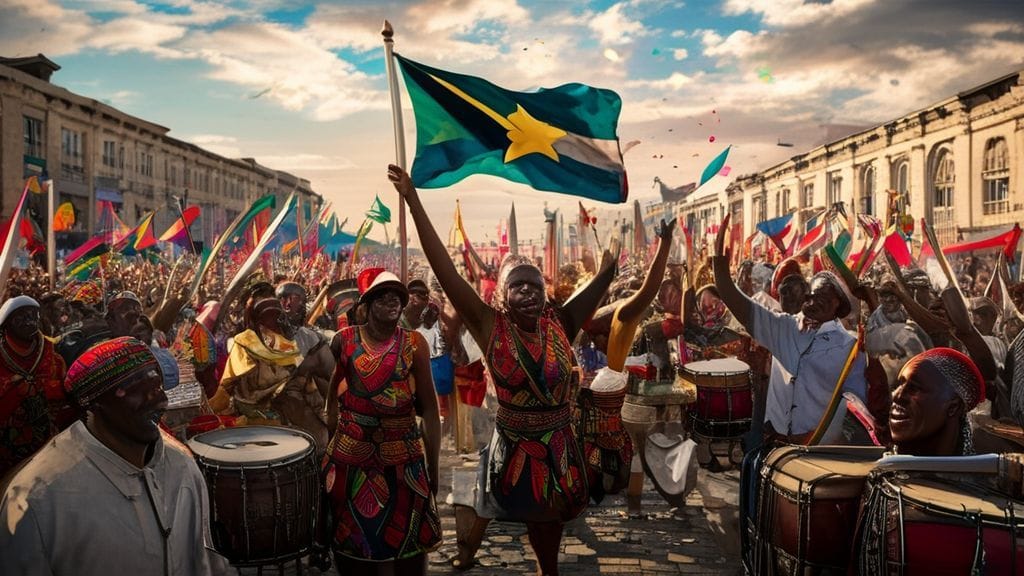
And so we return to that electric night at Rufaro Stadium. The stands were packed with tens of thousands of people, some of whom had arrived hours earlier to secure a place from which to witness history. Liberation songs rolled across the crowd, waves of sound rising and falling. Banners and hand-painted signs proclaimed “Welcome to Zimbabwe” and “Down with Colonialism.” A group of women ululated, their high-pitched cries piercing the night in an ancient gesture of joy and release.
On the field, soldiers from the outgoing Rhodesian forces and the incoming British detachment stood in formal formation, their uniforms crisp under the floodlights. Flags fluttered. Dignitaries took their seats: Prince Charles representing Queen Elizabeth II; leaders from neighboring African states; diplomats; church figures; and, at the center of the moment, Robert Mugabe, the former political prisoner turned prime minister-elect.
As the ceremony unfolded, a hush fell over the stadium. The Union Jack, symbol of nearly a century of colonial rule, began its slow descent down the flagpole. For some watching, especially among the older generation who had known nothing but British authority, the sight brought a pang of nostalgia or uncertainty. For the vast majority, it signaled the end of a deeply unequal era. At the precise stroke of midnight, on 18 April 1980, a new flag was hoisted: green for agriculture, yellow for mineral wealth, red for the blood shed in the struggle, black for the African majority, with the Zimbabwe Bird superimposed on a red star—the ancestral and revolutionary fused.
Fireworks burst into the sky; cheers erupted; people embraced strangers beside them. In that instant, the formal transition was complete: Southern Rhodesia and Rhodesia were gone; the Republic of Zimbabwe had been born. International recognition followed swiftly. Diplomatic cables flashed back and forth; radio broadcasts carried the news to every corner of the globe. In villages and townships, people who could not attend the ceremony huddled around radios, listening as announcers repeated the same phrase with awe: zimbabwe independence 1980 was now a fact.
Later that night, and into the early hours of the morning, celebrations spilled into the streets of Harare, Bulawayo, and countless smaller towns. Cars honked their horns, people danced in impromptu circles, bottles of beer and homemade brew were passed around. For one brief, unforgettable moment, the burdens of war and the complexities of politics were set aside in an outpouring of collective euphoria. The morning light would bring sober realities, but on that night, the impossible had been achieved.
Robert Mugabe Ascends: Hope, Forgiveness, and Political Calculus
The day after the flag was raised, the world waited to hear how the new prime minister of Zimbabwe would frame the future. Robert Mugabe’s first major speeches as leader were closely scrutinized, not only at home but across the globe. Would he call for vengeance against former enemies, or for reconciliation? Would he lean sharply toward one Cold War bloc, or seek a more non-aligned stance?
Standing before crowds and cameras, Mugabe struck a tone that surprised some of his critics. He called for “reconciliation, not retribution,” inviting white Zimbabweans to stay and help build the new nation. “If yesterday I fought you as an enemy, today you have become a friend and ally with the same national interests, loyalty, rights, and duties as myself,” he declared. For many black Zimbabweans who had suffered under Rhodesian rule, these words were bittersweet—understandable as statecraft, yet difficult to reconcile with the pain still fresh in their memories. For many whites, however, they came as an immense relief, a reassurance that they would not face immediate dispossession or persecution.
Mugabe also set out ambitious plans for social transformation. Education and health were to be prioritized; rural development would be expanded; the injustices of land distribution would gradually be addressed. In the glow of early independence, international donors lined up to support these efforts. Aid money flowed in, development projects were launched, and Zimbabwe was hailed, in some circles, as a model of a relatively peaceful transition from minority rule to majority governance—especially in contrast to the grinding wars still raging in neighboring South Africa and in other parts of the continent.
But even in these first hopeful years, political fault lines were visible. ZANU-PF held the dominant position in government, controlling key ministries and the prime minister’s office. ZAPU, despite its role in the liberation struggle, found itself largely sidelined, with Joshua Nkomo appointed to a limited cabinet role that belied his stature as a long-time nationalist leader. Official rhetoric spoke of unity, but the reality of power-sharing was fraught. The military integration process, meant to merge ZANLA, ZIPRA, and the remnants of the Rhodesian forces into a single national army, quickly became a site of mistrust and competition.
Mugabe’s call for reconciliation was therefore both genuine and strategic. It signaled to the international community that Zimbabwe would be a responsible partner, capable of attracting investment and avoiding the extremes some had feared. At the same time, it bought his government breathing room—time to consolidate authority, build institutions, and, as he and his allies hoped, gradually reshape the economic and social order in line with liberation ideals. The vision of zimbabwe independence 1980, as articulated from the podium, was of a nation that could transcend its violent past without becoming captive to it. Whether that vision would endure under the pressures to come was another question entirely.
Reimagining the Nation: Flags, Names, and the Symbolic Break with Rhodesia
Independence is not only a legal or political event; it is a profound act of reimagining. In the months following April 1980, Zimbabwe embarked on a cultural and symbolic transformation. Street names changed, statues were reconsidered, and official emblems were redesigned. Salisbury became Harare, adopting the name of a Shona chief associated with the area before colonial rule. Fort Victoria became Masvingo; Umtali, Mutare; Gwelo, Gweru. Maps were amended, but more importantly, the mental geography of the country shifted.
The new flag, with its bold colors and Zimbabwe Bird, flew from schools, government buildings, and rural council offices. Schoolchildren learned a new national anthem, “Simudzai Mureza wedu WeZimbabwe” (“Raise Our Flag, Zimbabwe”). Textbooks were rewritten to include, for the first time, accounts of the First and Second Chimurenga told from African perspectives, not as “rebellions” or “terrorism” but as liberation struggles. Heroes of the resistance, both from the 1890s and from the recent war, were elevated in curricula and public discourse.
Heroes’ Acre, a monumental burial ground and memorial site outside Harare, was commissioned to honor those who had died in the liberation struggle. Its design fused modernist forms with traditional motifs, linking the ancient Zimbabwe Bird with the contemporary imagery of guerrilla fighters. Ceremonies at Heroes’ Acre became key rituals in the new state narrative, reaffirming that the legitimacy of the government flowed from the sacrifices of the war. Yet questions quickly arose: who would be buried there, and who would be excluded? Which versions of heroism would be officially recognized?
For many citizens, smaller gestures carried equal or greater emotional weight. Churches began incorporating prayers for Zimbabwe into their liturgies, sometimes in multiple languages, symbolizing a fragile national unity. Radio broadcasts increasingly used Shona, Ndebele, and other local languages alongside English. Independence days were marked by community festivals where traditional dances and liberation songs shared the stage. In these spaces, a sense of belonging began to take root—the feeling that this country, at last, was theirs.
At the same time, reminders of the colonial past remained embedded in the landscape. Large commercial farms, often still owned by white families, continued to dominate the most fertile regions. Luxury suburbs with tree-lined avenues and golf courses coexisted with crowded townships lacking basic services. Independence had not erased material inequalities overnight. The symbols of sovereignty—flags, names, memorials—were vital, but they also highlighted the gap between aspiration and daily reality.
The First Years of Independence: Promise, Compromise, and Fragile Unity
The early 1980s in Zimbabwe were a study in contrasts. On one hand, there were genuine achievements that gave substance to the promises of liberation. The new government launched an ambitious education drive, abolishing discriminatory school fees and rapidly expanding access, especially in rural areas. Within a decade, literacy rates rose dramatically, and Zimbabwe came to be cited as one of Africa’s success stories in basic education. Clinics and rural health centers multiplied, contributing to improved maternal and child health indicators.
Economically, the government pursued a mixed strategy. It maintained many of the existing commercial structures inherited from Rhodesia, in part to avoid capital flight and agricultural collapse, while also investing heavily in social services and introducing gradual reforms aimed at inclusion. International donors—Britain among them—provided substantial funding, partly as a political investment in the success of the Lancaster House settlement. For a time, tobacco yields remained strong, industrial output was relatively stable, and Zimbabwe’s currency was respected in regional markets.
Politically, however, cracks were forming. ZANU-PF’s dominance in parliament translated into a tendency toward centralization. Opposition voices, including those within ZAPU and smaller parties, struggled to find space in a political environment where the ruling party increasingly equated itself with the nation. State-controlled media elevated Mugabe’s image, presenting him as the father of the new Zimbabwe—a wise, if stern, patriarch guiding the country through its formative years.
Ethnic and regional tensions simmered beneath the surface. Many Ndebele-speaking Zimbabweans in Matabeleland felt that their contributions to the liberation struggle—channeled primarily through ZAPU and ZIPRA—were being marginalized in official narratives and in the distribution of state resources. Integration of the armed forces was fraught with mutual suspicions, occasional clashes, and allegations of favoritism toward ex-ZANLA fighters. For ordinary people, particularly in the southwest, the dream promised by zimbabwe independence 1980 began to feel unevenly delivered.
Still, for many in these early years, hope outweighed disappointment. Teachers entering newly built rural schools, nurses staffing expanded clinics, young civil servants drafting policies in government ministries—all believed they were participating in the creation of something unprecedented: a state born of armed struggle that might yet deliver peace, justice, and development. The road ahead looked challenging but not impossible. Few could imagine how quickly the optimism would be overshadowed by a new wave of violence in the very regions that had struggled so long for liberation.
Gukurahundi and the Fracturing of the Dream
In the mid-1980s, the promise of national unity was shattered by events that remain among the most painful in Zimbabwe’s post-independence history. In Matabeleland and parts of the Midlands, the government launched a counterinsurgency campaign against what it described as “dissidents”—armed groups, some linked to ZIPRA, others bandits exploiting the unsettled post-war environment. To confront this perceived threat, the state deployed the Fifth Brigade, an elite military unit trained by North Korean advisers and directly answerable to the prime minister’s office.
What followed was not a limited security operation but a broad campaign of terror against civilians, overwhelmingly Ndebele-speaking. Villages were cordoned off, mass detentions carried out, and reports of torture, beatings, and extrajudicial killings mounted. Survivors tell of bodies dumped in disused mine shafts, of public executions meant to intimidate entire communities, of families forced to watch as soldiers beat or shot their loved ones. The word “Gukurahundi”—a Shona term meaning “the early rain that washes away the chaff”—became synonymous with systematic atrocity.
Estimates of the death toll vary, but most credible studies suggest that between 10,000 and 20,000 people were killed between 1983 and 1987. Thousands more were traumatized, displaced, or left destitute. Independent reporting was constrained; international attention, focused on apartheid South Africa and Cold War flashpoints elsewhere, largely failed to grasp or prioritize the scale of the crisis in Zimbabwe. Within the country, fear silenced many. The same state that had been celebrated for liberating the nation was now the instrument of devastating violence against its own citizens.
The political outcome of Gukurahundi was the signing of the 1987 Unity Accord between ZANU-PF and ZAPU. Under this agreement, ZAPU was effectively absorbed into an enlarged ZANU-PF, and the narrative of a renewed, singular ruling party was promoted. Joshua Nkomo accepted a largely ceremonial vice-presidency. Publicly, the accord was framed as the culmination of the ideals of the liberation struggle—unity, peace, and reconciliation. Privately, many in Matabeleland experienced it as the price of survival, a forced political surrender under the shadow of military coercion.
The long-term impact of Gukurahundi on the meaning of zimbabwe independence 1980 is profound. For survivors and their descendants, independence is a story with two sharply divided chapters: the fall of colonial rule and the rise of a new, internally inflicted trauma. The dream of a nation liberated from oppression was complicated by the realization that power, once attained, could be turned inward. In later years, calls for truth-telling, justice, and acknowledgment of Gukurahundi would become a recurring theme in Zimbabwean civil society, a reminder that the work of liberation cannot end with the raising of a flag.
Land, Liberation, and the Unfinished Business of 1980
From the outset, land lay at the heart of the liberation narrative. The Second Chimurenga had been fought in large part over the dispossession of African communities and the entrenchment of a racially skewed agrarian structure. Yet the Lancaster House compromise delayed radical land reform, binding the new state to a “willing seller, willing buyer” model for at least a decade. In practical terms, this meant that any redistribution would depend on the willingness of white landowners to sell and the availability of donor funds to buy.
In the 1980s, some progress was made. Government programs purchased and resettled a portion of large-scale commercial farms, creating new smallholder plots for land-hungry families. By the early 1990s, around 3 million hectares had been redistributed, benefiting hundreds of thousands of people. Clinics and schools were sometimes built in these resettlement areas, integrating them into the broader development agenda. For many beneficiaries, this represented a tangible, if modest, realization of the promises tied to independence.
However, the scale of land inequality remained stark. A relatively small number of white commercial farmers continued to own a disproportionate share of the country’s most fertile land. Economic and political elites, including some connected to the ruling party, acquired farms under resettlement schemes, raising questions about fairness and favoritism. As economic pressures grew in the late 1980s and 1990s—exacerbated by structural adjustment programs, rising unemployment, and declining social services—the land question returned with renewed intensity.
Veterans of the liberation war, many of whom felt marginalized in the post-independence order, became vocal advocates for more aggressive reform. They argued that the spirit of zimbabwe independence 1980 had been compromised by the slow pace of land transfers and by the persistence of what they saw as colonial-era patterns of ownership. Demonstrations, occupations, and political mobilization around land issues intensified, feeding into broader opposition movements that challenged ZANU-PF’s long-standing dominance.
In the early 2000s, long after the initial post-independence period described in this article, Zimbabwe would embark on a chaotic, often violent “fast-track” land reform program that fundamentally reshaped ownership patterns but also contributed to economic collapse, international isolation, and further political polarization. That later chapter, while beyond the immediate focus on 1980, cannot be fully separated from the compromises and deferred decisions of the independence era. The unfinished business of land remained a fault line running directly from colonial conquest through liberation and into the evolving story of the Zimbabwean state.
Women, Youth, and the Silent Architects of Independence
Much of the official narrative of liberation has centered on male leaders, guerrilla commanders, and political negotiators. Yet the achievement of Zimbabwe’s independence rested equally—often invisibly—on the labor, courage, and resilience of women and young people. Their contributions stretched from the earliest days of nationalist organizing through the darkest hours of war and into the complex tasks of post-independence reconstruction.
Women served as combatants in both ZANLA and ZIPRA, enduring the same harsh training and battlefield risks as their male counterparts. They also filled indispensable roles as couriers, nurses, cooks, and political mobilizers in rural and urban networks. Many carried weapons and babies in the same journeys, attending political education sessions between chores, blending tradition and revolution in their daily lives. In exile camps, women often shouldered the burden of caring for children whose parents were scattered across frontlines or distant missions.
At the village level, older women became guardians of continuity and survival. They hid guerrillas in grain silos, smuggled food under the eyes of soldiers, and used songs and folktales to encode political messages that evaded the censors. Their homes became informal clinics, meeting points, and safe houses. After independence, however, many of these women saw their roles diminished in the public record. The new Zimbabwe celebrated “the guerrilla” and “the comrade,” but often in images that defaulted to masculine archetypes.
Youth, too, were central. Teenagers and even younger children served as runners, scouts, and sometimes fighters. The war interrupted formal schooling for a generation, yet it also politicized young people in ways that would shape Zimbabwe’s civic culture for decades. Independence brought the opportunity to rebuild education, but it also imposed upon youth the weighty expectation that they would be the ones to fulfill the uncompleted promises of 1980—jobs, dignity, and a more equal society.
In the post-independence years, women and youth entered universities, civil service, and the professions in increasing numbers, benefiting from expanded educational opportunities. Some became outspoken critics of corruption and authoritarianism, invoking the same liberation ideals to challenge the postcolonial state. Their activism—whether through student movements, women’s organizations, or community projects—forms a vital, if sometimes overlooked, continuation of the story of zimbabwe independence 1980: a reminder that independence is not a single event but an ongoing process negotiated by each new generation.
Memory, Monuments, and How Zimbabwe Tells Its Own Story
As the years passed, Zimbabwe crafted and recrafted the narrative of its own birth. Official histories, school textbooks, state ceremonies, and public monuments all contributed to a particular vision of how independence had been won and what it meant. In this narrative, ZANU-PF—and especially ZANLA’s armed struggle—occupied center stage, while alternative experiences and voices were often pushed to the margins.
Heroes’ Acre, national museums, and annual independence celebrations presented a coherent storyline: colonial oppression, united resistance, victorious liberation, and the wise leadership of those who had guided the struggle. Radio and television broadcasts replayed archival speeches, war songs, and footage from Rufaro Stadium. On 18 April each year, the president’s address would reaffirm these themes, linking current challenges to the sacrifices of the chimurenga generation.
At the same time, other layers of memory persisted outside official channels. Families kept their own records—photographs of relatives in fatigues, letters from exile camps, stories of secret meetings and midnight marches. In Matabeleland, the memory of Gukurahundi added an additional, bitter strand to local understandings of independence. Activists and scholars, both inside Zimbabwe and in the diaspora, collected oral histories that complicated the triumphant official story, highlighting ambiguities, contradictions, and silenced suffering.
In one interview conducted by a researcher in the 1990s, a rural elder summed up this tension succinctly: “We are free from the white man, yes. But we are not free from fear. Independence opened the gate, but the path is still dangerous.” His words capture a central truth of zimbabwe independence 1980: it was both a real and extraordinary achievement and a beginning rather than an endpoint. The task of reconciling different memories—victory and trauma, pride and disillusionment—remains a central challenge for Zimbabwean society.
Today, debates about how to teach history, which heroes to honor, and how to remember events like Gukurahundi or the later land seizures are not merely academic. They shape political legitimacy, social cohesion, and the very sense of what it means to be Zimbabwean. The story of independence is therefore a living field of contestation, in which each new generation asks: What exactly did we win in 1980, and how far have we come in realizing its promise?
Echoes Across Africa: Regional and Global Legacies of Zimbabwe’s Liberation
Zimbabwe’s road to independence did not only transform one country; it resonated across a continent still wracked by struggles against minority rule and external domination. In 1980, apartheid South Africa remained entrenched, and Namibia was still under South African occupation. For liberation movements in those territories—such as the African National Congress (ANC), the Pan Africanist Congress (PAC), and SWAPO—zimbabwe independence 1980 offered both inspiration and a set of cautionary lessons.
On the inspirational side, Zimbabwe’s successful transition demonstrated that a determined liberation movement, backed by regional solidarity and international pressure, could defeat a well-armed settler regime. The presence of newly independent Zimbabwe on South Africa’s northern border provided logistical and moral support to anti-apartheid activists. Harare became a hub for exiles, conferences, and solidarity networks that spanned the globe. Images of the flag-raising at Rufaro Stadium were circulated in underground newspapers and leaflets from Cape Town to Windhoek.
Yet the Zimbabwean experience also highlighted the complexities of post-liberation governance. The combination of economic dependence on former colonial structures, delicate ethnic balances, and the temptations of centralized power served as a cautionary tale. Scholars of African politics have often cited Zimbabwe alongside countries like Angola and Mozambique as examples of how the pressures of war, Cold War alignments, and fragile institutions can distort revolutionary dreams. In one academic article, the political scientist Patrick Bond described Zimbabwe as a “mirror” in which other postcolonial societies could see both their aspirations and their potential pitfalls reflected.
Globally, Zimbabwe’s independence marked one of the final acts in the formal dismantling of the British Empire in Africa. It reinforced the norm that racial minority rule was no longer acceptable in the international system, adding momentum to sanctions and diplomatic campaigns against apartheid South Africa. At the United Nations, Zimbabwe’s admission as a member state and its active participation in the Non-Aligned Movement strengthened the voice of the Global South on issues ranging from economic justice to anti-racism.
For many ordinary people in the African diaspora—whether in London, New York, or the Caribbean—news of Zimbabwe’s independence was deeply personal. It evoked memories of their own countries’ journeys to self-rule and rekindled hopes that unfinished struggles elsewhere might yet succeed. In this sense, the meaning of 18 April 1980 extends far beyond the borders of one nation; it belongs to a broader tapestry of twentieth-century decolonization, a shared chapter in the ongoing story of freedom’s possibilities and limits.
Forty Years On: Reassessing Zimbabwe Independence 1980
With the passage of time, the glow surrounding any foundational moment inevitably dims, revealing its cracks and contradictions. Zimbabwe is no exception. Four decades after independence, Zimbabweans and observers alike have re-evaluated the legacy of 1980 through the lens of subsequent events: economic crises, contested elections, land seizures, state repression, and waves of emigration that have scattered millions abroad.
For some, the central tragedy is that the liberators became, in important respects, new oppressors. They point to crackdowns on opposition parties, restrictions on media, and episodes of politically motivated violence as evidence that the democratic promise of zimbabwe independence 1980 was betrayed. They highlight how corruption and patronage hollowed out institutions, undermining the capacity of the state to deliver the very social services—education, health, rural development—that once distinguished Zimbabwe in the region.
For others, especially those who lived through the war and its aftermath, the picture is more mixed. They acknowledge the failings and abuses of the post-independence leadership but insist that the fundamental achievement of ending white-minority rule and reclaiming sovereignty should not be discounted. They remember the apartheid regime across the Limpopo, the long history of land theft, and the omnipresent daily humiliations of colonial Rhodesia. From this vantage point, independence remains a necessary, if incomplete, victory.
Economic collapse in the 2000s—with hyperinflation, empty store shelves, and mass unemployment—cast a long shadow over the earlier decades. Many young Zimbabweans, born long after 1980, experienced independence not as a triumphant liberation but as a set of commemorative rituals disconnected from their struggles to find work, access quality education, or secure basic services. For them, the keyword “independence” raises as many questions as it answers: independence for whom, and to do what?
Yet even among critics, few argue that the clock should or could be turned back to the days of Rhodesia. The debate is instead about how to reclaim, reinterpret, and reapply the ideals that animated the Second Chimurenga—justice, dignity, popular participation—under conditions profoundly different from those of the 1970s. Civil society initiatives, truth-telling projects, and grassroots economic experiments all represent attempts to breathe new life into those ideals, to make the spirit of 1980 relevant again without ignoring its dark sides.
In this contested terrain of memory and aspiration, one thing is clear: zimbabwe independence 1980 continues to matter. It remains a touchstone in political rhetoric, a subject of intense scholarly inquiry, and, most importantly, a living presence in the stories families tell each other about where they have come from and where they hope still to go.
Conclusion
The journey to Zimbabwe’s independence is a story of endurance, sacrifice, and profound ambiguity. It begins with the violent imposition of colonial rule, travels through decades of racial dispossession and political exclusion, and explodes into the fires of the Second Chimurenga—a war in which villagers, students, workers, and exiles all played roles that blurred the line between heroism and survival. Along the way, global forces—the waning British Empire, the Cold War, African regional solidarity—shaped the terrain on which Zimbabweans fought and negotiated their future.
The night of 17–18 April 1980 at Rufaro Stadium stands as the symbolic climax of this saga: flags changing, anthems rewritten, a nation reborn in ceremony and hope. Yet that moment cannot be understood apart from the conflicts and compromises that preceded and followed it: the Lancaster House settlement that deferred radical land reform; the early post-independence achievements in education and health; the trauma of Gukurahundi; the slow corrosion of institutions under the pressures of power, inequality, and economic strain. The phrase zimbabwe independence 1980 thus names both a triumphant rupture with colonial Rhodesia and the beginning of a long, unfinished struggle to translate sovereignty into justice.
To honor this history is to resist both romanticization and cynicism. It means recognizing the extraordinary courage of those who fought and organized against a powerful settler state, while also listening to the voices of those who suffered under post-independence abuses. It calls for acknowledging that liberation was and remains a process, not a single event—a process in which each generation must decide how to carry forward, reinterpret, or challenge the legacies it inherits. In that sense, the true measure of Zimbabwe’s independence lies not only in what happened in 1980, but in the ongoing efforts of its people to live up to the dreams, and confront the failures, born on that unforgettable April night.
FAQs
- What was the date of Zimbabwe’s independence?
Zimbabwe formally gained independence on 18 April 1980, following British-supervised elections held earlier that year under the terms negotiated at the Lancaster House Conference. - What does the phrase “zimbabwe independence 1980” refer to?
It refers to the political and legal transition from white-minority-ruled Rhodesia to the sovereign Republic of Zimbabwe in 1980, encompassing the ceasefire, elections, flag-raising ceremony at Rufaro Stadium, and international recognition of the new state. - Who became the first Prime Minister of independent Zimbabwe?
Robert Mugabe, leader of ZANU-PF, became the first Prime Minister after his party won a clear majority of the common roll seats in the 1980 elections. - What role did the Lancaster House Agreement play in independence?
The Lancaster House Agreement, signed in London in 1979, ended the armed conflict, temporarily returned Rhodesia to British authority, set the framework for supervised elections, and laid down constitutional and land provisions that governed the early years of independence. - How did land reform feature in the early independence period?
Land reform was constrained by the “willing seller, willing buyer” principle agreed at Lancaster House. The government purchased some large-scale farms for resettlement, but wholesale redistribution was postponed, leaving significant inequalities in place and fueling later conflicts over land. - What was Gukurahundi and how is it related to independence?
Gukurahundi was a violent counterinsurgency campaign carried out mainly in Matabeleland and parts of the Midlands in the 1980s by the Fifth Brigade, targeting alleged “dissidents” but resulting in the deaths of an estimated 10,000–20,000 civilians. It revealed deep fractures in the post-independence state and challenged the ideal of unity celebrated in 1980. - How did the international community respond to Zimbabwe’s independence?
Most countries quickly recognized Zimbabwe, welcomed its admission to the United Nations, and provided development aid. The country was widely seen as a key example of successful decolonization and a potential model for negotiated transitions in other conflict zones. - What happened to white Rhodesians after independence?
Many stayed, reassured by the government’s early policy of reconciliation and constitutional protections for property and parliamentary representation. Others emigrated over time, particularly as political and economic conditions deteriorated in the 1990s and 2000s. - Why is Zimbabwe’s independence still debated today?
Independence ended institutionalized white-minority rule, but subsequent state violence, economic decline, and contested land reforms have led many to question how fully the ideals of the liberation struggle were realized. The legacy of 1980 is therefore viewed both as an essential victory and as a promise only partially fulfilled. - How is Zimbabwe’s independence commemorated each year?
Independence Day is marked on 18 April with official speeches, military parades, cultural performances, and community celebrations. Schools and media revisit liberation history, while civil society groups sometimes use the occasion to call for deeper democratization and acknowledgment of unresolved historical injustices.
External Resource
Internal Link
Other Resources
- Encyclopaedia Britannica – general search for the exact subject
- Google Scholar – academic search for the exact subject
- Internet Archive – digital library search for the exact subject