Table of Contents
- A Winter Build in Williamsburg
- From Vision to Blueprint: Why Print a Home
- The Partnership: Habitat, Alquist, and a Local Chapter
- Materials, Machine, and Method
- The Print Days: Hours on the Slab
- Keys and a New Routine: Dedication Day, December 21, 2021
- Affordability Math: Costs, Savings, and Trade-Offs
- Labor and Skills in a Changing Jobsite
- Safety, Codes, and the Concrete Question
- From Prototype to Policy: Permits and Inspectors
- Headlines, Hope, and Skepticism
- After Williamsburg: Replication and Setbacks
- Global Comparisons and Cautions
- What Historians Will Watch Next
- Conclusion
- FAQs
- External Resource
- Internal Link
Article Summary: In late 2021, a small Habitat for Humanity affiliate in Virginia completed a 3D-printed house and handed over the keys to a first-time homeowner. This article reconstructs the build, the technology, and the partnership that made it possible. It evaluates costs, codes, labor, and public reaction, using contemporary reporting and measured analysis. We track what changed after the dedication and where replication struggled. Above all, we ask what the “habitat for humanity 3d-printed house” reveals about housing innovation, community work, and the risks of being first.
Why keep reading: A printer on a winter slab promised speed and savings—but the real story winds through permits, skepticism, and a family’s first night in a home whose walls were layered by machine. Follow how a single house became a test case for affordability, craft, and the meaning of “build” in American neighborhoods.
At a glance:
- Event: Completion and dedication of a 3D-printed Habitat for Humanity house
- Date: December 21, 2021
- Place: Williamsburg, Virginia (Peninsula and Greater Williamsburg affiliate)
- Main figures: Habitat for Humanity local chapter; Alquist 3D; city inspectors; the homeowner family
- Why it mattered: A widely reported first for Habitat’s U.S. work, signaling both potential and limits of concrete 3D printing for affordable housing
01 – A Winter Build in Williamsburg
Cold air hung over a quiet Williamsburg street as crews gathered around a foundation that looked like any other. The difference perched on rails: a gantry printer capable of laying concrete in careful, layered courses. By week’s end, a family would lock their first front door to a home shaped by code, community labor, and the promise of rapid construction.
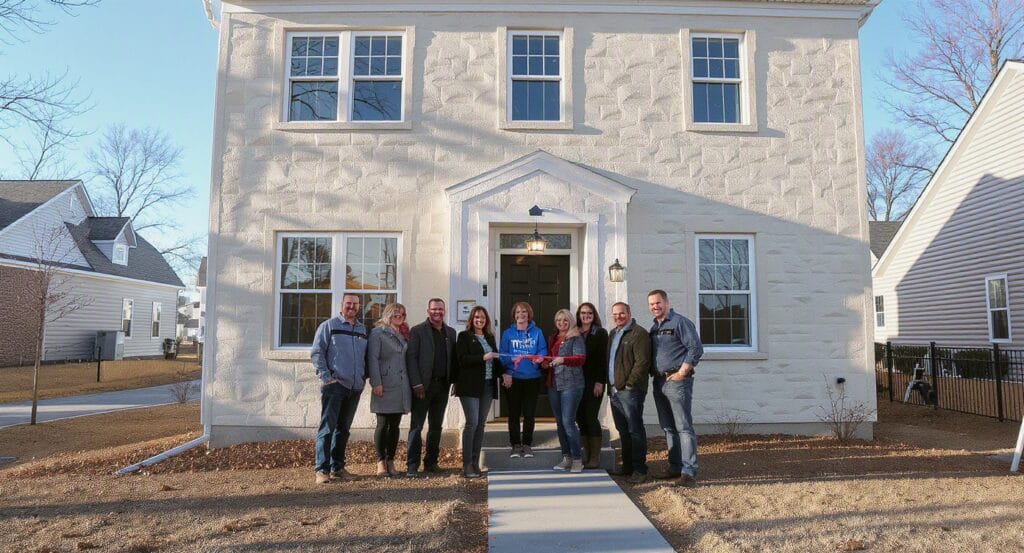
The dedication on December 21, 2021, crowned months of planning and a compressed on-site process. The language was sober and proud—no miracle claims, no utopia promised—just a milestone for affordable housing. Reporters framed it as a national first for a Habitat for Humanity 3D-printed house, and neighbors brought folding chairs to see history performed on a corner lot.
The house was ordinary in the ways that matter: bedrooms for sleep, a kitchen for late homework and early coffee, a porch. Yet it also stood as a proposition. If a printer could help volunteers and contractors build cheaper, faster walls, perhaps the long queue for decent housing might shorten. That hope hummed beneath the applause.
02 – From Vision to Blueprint: Why Print a Home
Habitat affiliates are practical institutions, measuring ideas in site plans and budgets rather than slogans. In 2021, the housing market was hot, wages lagged, and materials were volatile. Printing walls with a concrete mix promised fewer framing materials, less waste, and a repeatable process, if the technology could be tuned to local conditions.
National coverage emphasized novelty, but the core question was simple: would this approach reduce total cost per square foot without sacrificing safety or longevity? Print speeds looked compelling on paper. Yet every minute saved had to survive realities like curing time, inspection schedules, and trades coordination. A printer could not install wiring, plumbing, or cabinets.
Advocates framed 3D-printed construction as a bridge between skilled labor shortages and escalating demand. Skeptics pointed out that savings often migrate to unexpected line items. Concrete material costs, machine rentals, specialized technicians, and training time could reshape the ledger. The Williamsburg project became a controlled experiment run in public view.
03 – The Partnership: Habitat, Alquist, and a Local Chapter
The build depended on an alliance between Habitat for Humanity Peninsula and Greater Williamsburg and Alquist, a startup specializing in large-format concrete printing. The local affiliate brought land, community ties, and the homeowner program; Alquist supplied the printer, the mix design, and operational expertise. City officials agreed to evaluate a new wall system under existing codes.
Partnerships like this walk a line between demonstration and delivery. Habitat protects families from being treated as publicity props while still leveraging attention to fund future houses. Local leadership emphasized that, printed or not, every Habitat home undergoes mortgage vetting, sweat equity, and homeowner education. Novelty could not override those guardrails.
Newsrooms described the collaboration as the first of its kind for Habitat in the United States. That phrasing reflected careful caveats in affiliate announcements and Associated Press coverage, which stressed that other 3D-printed houses existed but not with this particular mission and model. The habitat for humanity 3d-printed house became shorthand for a pilot with roots in a long-running, volunteer-driven tradition.
04 – Materials, Machine, and Method
Large-format printing relies on a gantry or robotic arm that extrudes a cementitious mix in successive layers, forming structural or non-structural walls. In Williamsburg, the printer rode rails around the foundation, guided by a digital model. The mix needed to be pumpable, fast-setting enough to bear subsequent layers, and stable during temperature swings.
Contractors coordinated around the printer like a pit crew. Hoses were checked for clogs, nozzles calibrated for bead size, and rebar or fiber reinforcement integrated as specified. Openings for doors and windows were left as voids or framed-in pours. The walls functioned as a cavity system, later smoothed, insulated as needed, and finished inside.
Public curiosity centered on durability. Concrete resists rot and pests, and layered walls potentially handle wind loads differently than stick-framed structures. Yet long-term performance data remain developing. Modern building science emphasizes whole-envelope behavior—thermal bridges, moisture management, and sealing—which must be measured rather than assumed in any printed design.
Tool choice was also interpretive. Contemporary trade press suggested the machine was a COBOD-style gantry unit, though project statements focused less on brand than outcomes. The broader record is fragmentary here; observers agree on the presence of a large-format printer and custom mix, but not every technical spec reached the public domain.
05 – The Print Days: Hours on the Slab
Reporting varied on the exact print time for the wall system, with figures ranging from roughly 12 hours to just over a day. The differences likely reflect whether pauses, setup, and partial reprints were counted. What matters historically is that the active extrusion phase compressed a job that would otherwise require days of framing labor.
On site, each pass of the nozzle left a ridged line, corrugating into walls that resembled carefully stacked rope. The machine did not roar so much as hum, with crews attentive to feed rates and corners. As layers rose, neighbors measured the unfamiliar with familiar questions: Where will the couch go? What about winter drafts and summer heat?
Mini timeline:
- Early 2021: Local partnership and design planning underway.
- Late 2021: Printer arrives; site prepped and slab cured.
- December 2021: Wall printing completed; follow-on trades begin.
- December 21, 2021: Keys presented; homeowner moves in soon after.
06 – Keys and a New Routine: Dedication Day, December 21, 2021
Dedications are the heartbeat of Habitat’s calendar. Volunteers, donors, and city officials gather, a pastor or neighbor offers words, and a family steps across a threshold. On December 21, 2021, that ceremony doubled as a public test of an idea. The homeowner, widely profiled in local media, thanked the crew that layered her walls instead of nailing studs.
The house’s most radical quality disappeared once furniture arrived. A Christmas tree by a window, a skillet on the stove, a hallway filling with shoes—these daily facts anchor innovation to ordinary life. Critics and champions alike deferred to the simple stakes: a stable payment, decent space, and a mortgage path that Habitat carefully calibrates to income.
Coverage reiterated the home as a first for Habitat’s U.S. work with 3D printing, though genealogies of “firsts” can tangle. Modern historians prefer precise framing: a Habitat-built, owner-occupied house in the United States with printed concrete walls, completed and dedicated on that winter day. The phrase habitat for humanity 3d-printed house stuck because it felt both new and graspable.
07 – Affordability Math: Costs, Savings, and Trade-Offs
Affordability lives in line items. 3D printing trimmed lumber purchases at a time of spiking prices and reduced waste through digital control. But up-front equipment, technician labor, and concrete mix costs push the other way. True savings often emerge only when multiple houses spread setup costs and training across an entire build season.
Supporters argued that faster wall systems free schedules for finish work, compressing carry costs and letting affiliates serve more families annually. However, the printer does not replace electricians, plumbers, roofers, or inspectors; their availability and rates dominate the budget. Where labor markets were tight, schedule gains might be absorbed by bottlenecks elsewhere on site.
Media interviews with the affiliate suggested that savings were real but situational, a theme echoed by construction economists who warned against single-project extrapolation. Weather, supply chains, and local code interpretation all shaped outcomes. Even so, the project’s transparency created a benchmark that peers could query as they weighed their own pilots.
In this sense, the habitat for humanity 3d-printed house functioned as a ledger you could walk through, each room an entry in a live spreadsheet of innovation, risk, and community patience. Its most persuasive argument was tangible: an address, a mortgage affordable to the buyer, and a schedule that survived demanding months on the calendar.
08 – Labor and Skills in a Changing Jobsite
Construction is a choreography of skills, and new tools rewrite the dance. The printer required operators fluent in software and materials, alongside concrete handling and safety protocols. Volunteers shifted from swinging hammers to supporting layout, cleanup, and finishing tasks. Some missed the tactile rhythm of framing; others welcomed the precision and calmer pace.
Local training mattered. If a technology depends on a traveling specialist, costs and delays rise. Affiliates needed regionally based teams able to troubleshoot clogs or misalignments and reset within hours, not days. The Williamsburg build showed that when operations run smoothly, morale rises and neighbors become curious rather than alarmed by a machine towering over the foundation.
The broader labor question extends beyond one lot. Could printing attract new entrants to the trades—digital natives who also respect jobsite realities? Or would it displace some roles while creating fewer new ones? Modern academic analyses, drawing on U.S. Bureau of Labor Statistics projections, suggest both effects may unfold at once, varying by region and project type.
09 – Safety, Codes, and the Concrete Question
Every innovation must translate into the grammar of building codes. In the United States, jurisdictions often draw from International Code Council standards, then adapt for local context. Williamsburg’s inspectors assessed the printed wall system against performance requirements: structural capacity, fire resistance, energy efficiency, and moisture control. Wall appearance was secondary; behavior under stress was primary.
Questions clustered around insulation and reinforcement. Concrete alone conducts heat; printed walls typically rely on cavities, inserts, or applied insulation to meet energy codes. Reinforcement strategies vary—rebar, fibers, or hybrid systems—so documentation and on-site verification matter. In a pilot, inspectors and builders often meet daily, translating between rulebooks and tool paths.
Durability claims also carried nuance. Concrete resists rot and some pests, but walls must still shed water, manage vapor, and handle freeze-thaw cycles. The promise of resilience against high winds drew interest in coastal regions, yet true hurricane performance requires testing and anchorage details rather than confident headlines. The project advanced debate by forcing specifics into view.
10 – From Prototype to Policy: Permits and Inspectors
Permitting is where civic trust meets engineering. Williamsburg’s process, as described in local briefings, treated the print as an alternate means of compliance that had to satisfy the intent of existing provisions. This created a roadmap for peers: submit engineering, coordinate inspection stages, and prepare to document mix design and reinforcement like any other system.
Inspectors are often unfairly cast as barriers rather than guardians of public safety. In experimental builds, their role becomes collaborative. The print sequence, curing schedule, and follow-on trades had to align with inspection windows. If a bead slumped or a corner needed rework, plans accounted for patching methods that preserved structural performance and aesthetics.
Policy implications followed. If multiple pilots succeed, jurisdictions can adopt clearer guidance for printed walls, reducing uncertainty and accelerating schedules. Conversely, a publicized failure would ripple across offices, making approvals harder. The Williamsburg approval did not end debate; it created a documented precedent others could cite, refine, or resist based on local priorities.
11 – Headlines, Hope, and Skepticism
National attention arrived fast. Television crews filmed the ridged walls, and headlines promised a future of cheap, quick homes. Yet seasoned reporters balanced fascination with caveats: a house is a system, not just walls. Electrical, HVAC, roofing, and finishes still dominate budgets and timelines. The printer was loud visually but only one instrument in the orchestra.
Habitat leadership, experienced in managing expectations, stressed mission over machinery. The story, they said, was not the nozzle but the mortgage, sweat equity, and community backing. NPR segments and regional dailies echoed that framing, while also noting the symbolism of a nonprofit piloting a technology often showcased by glossy startups overseas.
Online comments captured the split mood. Some readers championed a replicable solution to America’s housing crisis; others feared bland, concrete clones or worried about embodied carbon. The affiliate’s response was patient: this was a single house, tuned to local codes, not a universal template. Even so, the habitat for humanity 3d-printed house became a rallying phrase for debate.
Communications teams had to translate technical nuance without losing momentum. They avoided utopian claims, pointed to code approvals, and invited residents to see the finished rooms themselves. In an era of polarized opinion, a walk-through tour did more to calm doubts than any press release could manage, anchoring promise in painted trim and quiet bedrooms.
12 – After Williamsburg: Replication and Setbacks
Success breeds invitations. Other affiliates, city housing offices, and college programs called to ask what it would take to print a house on their streets. Some explored MOUs; others ran small material tests. The early months of 2022 saw enthusiasm braided with caution, as each jurisdiction weighed soil, climate, codes, and contractor networks against the Virginia example.
Replication faced headwinds. Supply chains remained fragile, technicians were booked, and not every site had the power capacity or staging room a gantry demanded. In several regions, local officials requested extensive engineering packages, elongating schedules. The hope of “plug and print” met the reality that housing is uniquely local, with weather and regulation shaping every decision.
Yet progress continued. Alquist and similar firms sought to standardize processes, while academics proposed post-occupancy monitoring to measure energy use and comfort. Some pilots expanded to larger footprints or duplex configurations. Others paused after feasibility studies. The Williamsburg project’s legacy thus became methodological: share lessons, price contingencies, and invite inspectors early.
For Habitat affiliates, governance mattered. Boards evaluated risk tolerance, donor expectations, and volunteer culture before committing to a print. The most persuasive case drew directly from the Virginia ledger: a finished home, a stable mortgage, and a family rooted in place. The phrase habitat for humanity 3d-printed house evolved from headline to checklist—can our town do this, too?
13 – Global Comparisons and Cautions
Internationally, 3D-printed buildings range from demonstration pavilions to multi-unit housing. Europe has documented projects under stricter energy standards, while parts of the Middle East and Latin America have tested rapid construction models for heat and seismic conditions. Comparisons help, but translation is tricky; codes, materials, and labor costs vary as much as climates and soils.
Some overseas projects highlighted architectural freedom—the curves and voids made cheap by layer-by-layer fabrication. Williamsburg chose a simpler geometry, prioritizing code clarity and speed over expressive walls. That modesty may age well; utility bills, repairs, and resale behavior often matter more to families than museum-ready façades that delight designers more than occupants.
Modern historians note a pattern: new building techs shine in pilots, then settle into niches shaped by economics and regulation. Concrete printing may excel in disaster rebuilding, accessory dwelling units, or boundary walls, while competing less well in cold climates without careful insulation strategies. Evidence, not enthusiasm, decides which niches grow.
Environmental accounting remains live. Concrete’s carbon footprint is significant; advocates counter with reduced waste, potential for lower-cement mixes, and operational energy savings from tight envelopes. Robust life-cycle analyses, still emerging in the literature, will test those claims. The Williamsburg project did not close that chapter; it placed a bookmark on a real street.
14 – What Historians Will Watch Next
Several threads merit attention in the years after 2021. First, homeowner experience: comfort, maintenance, and perceptions of safety during storms. Second, cost behavior across multiple builds: do learning curves lower expenses, or do specialized inputs keep margins thin? Third, policy: do codes evolve to recognize printed walls explicitly, smoothing approvals and clarifying responsibilities?
We will also watch culture. Does the sight of a printer become normal in mixed-income neighborhoods, or does it mark affordable housing as “different,” unintentionally deepening stigma? The answer depends on design quality, resident voices, and how quickly printed elements blend into the ordinary grammar of porches, windows, and yards.
Finally, labor pathways matter. If printing attracts new workers while upskilling veterans, the technology gains allies. If it hollows out craft pride without clear benefits, resistance will harden. The Williamsburg build did not decide this debate, but it framed it in a household story rather than an abstract white paper, which is where public memory begins.
Immediate consequence:
A family received a code-compliant home before winter’s end, and a local affiliate gained a tested playbook for integrating a printer into Habitat’s volunteer-centered model.
Long-term consequence:
Municipalities and nonprofits now cite the Williamsburg case when crafting policy, budgets, and training around printed construction—either as a model to emulate or a caution to adapt.
15 – Conclusion
On a December day in Williamsburg, a key turned in a lock and a housing experiment became a home. The moment mattered less for its novelty than for its discipline: a printed wall system threaded through permits, inspections, and community ritual until it fit where it counted—an address and a mortgage. In that balance lies the enduring value of the habitat for humanity 3d-printed house.
Its legacy will not be measured by the number of cameras on dedication day but by durability, bills paid on time, and copies that improve on the original. If future streets quietly absorb printed walls into their ordinary silhouettes, the technology will have succeeded in the way history prefers: by disappearing into daily life while leaving opportunity more evenly spread.
16 – FAQs
- When was the house completed and dedicated?
It was dedicated on December 21, 2021, marking the formal completion of the project and the handover of keys to the homeowner. - Where did the build take place?
In Williamsburg, Virginia, under the auspices of Habitat for Humanity Peninsula and Greater Williamsburg, working with the City’s permitting and inspection offices. - Who were the main figures behind the project?
The local Habitat affiliate led the effort, partnering with Alquist 3D for printing operations, with city inspectors, volunteers, and tradespeople ensuring code compliance and completion. - Why did they choose 3D printing for this home?
To test whether a printed wall system could lower costs, reduce waste, and accelerate schedules for affordable housing without compromising safety or code compliance. - What were the main consequences of the build?
Immediately, a family moved into a stable, affordable home. Longer term, the project created a reference point for policy, budgeting, and training, with the habitat for humanity 3d-printed house cited in discussions across U.S. municipalities. - What is the legacy of the Williamsburg project?
It stands as an early, well-documented U.S. example of nonprofit-led printed housing, shaping debates on cost, labor, and codes while encouraging cautious replication anchored in local conditions and rigorous inspection.
17 – External Resource
18 – Internal Link
Other Resources
- Encyclopaedia Britannica – general search for the exact subject
- Google Scholar – academic search for the exact subject
- Internet Archive – digital library search for the exact subject
Sources and References
-
Habitat for Humanity Peninsula and Greater Williamsburg. “Habitat for Humanity and Alquist 3D Announce Nation’s First 3D-Printed Owner-Occupied Habitat Home.” Press release, December 2021. Available via HabitatPGW.org.
Note: Primary organizational source for the Williamsburg project’s date of completion, location, partnership with Alquist 3D, description of the printing process, and the statement that this was the first owner-occupied 3D-printed Habitat for Humanity home in the United States. -
Alquist 3D. “Habitat for Humanity Williamsburg, VA 3D Printed Home Case Study.” Project documentation, 2021–2022. Available via Alquist3D.com.
Note: Provides technical details on the concrete 3D-printing system, build time, design features, and energy-efficiency claims for the Williamsburg house, supporting descriptions of the construction technology and performance characteristics. -
Virginia Housing. “Innovative Housing: 3D Printed Home in Williamsburg.” Program summary and project profile, 2021. Available via VirginiaHousing.com.
Note: Supports information about public and institutional backing for the project, its role as an affordable-housing demonstration in Virginia, and the policy context for experimenting with 3D-printed residential construction. -
Buswell, R. A., Leal de Silva, W. R., Jones, S. Z., & Dirrenberger, J. “3D Printing Using Concrete Extrusion: A Roadmap for Research.” Cement and Concrete Research, vol. 112, 2018, pp. 37–49.
Note: Academic overview of concrete extrusion technology that underpins 3D-printed houses; used to contextualize the Williamsburg project within broader research on 3D-printed concrete, including structural behavior, material properties, and construction workflows. -
Perkins, Ian, and Sigrid Adriaenssens. “Structural Implications of 3D Concrete Printing for Building Construction.” Engineering Structures, vol. 255, 2022, 113938.
Note: Provides scholarly analysis of structural design, load-bearing capacity, and safety considerations in 3D-printed concrete buildings, supporting general claims about the durability and engineering rationale for 3D-printed housing such as the Williamsburg home. -
U.S. Department of Housing and Urban Development (HUD). “3D Printed Housing: Emerging Technologies in Residential Construction.” Office of Policy Development and Research, Research Brief, 2021. Available via HUD User.
Note: Offers federal policy and research context for 3D-printed homes, including potential cost, schedule, and labor impacts; used to situate the Williamsburg house within national discussions on innovative methods to address housing affordability. -
United States Census Bureau. “Housing Vacancies and Homeownership (CPS/HVS).” Washington, DC: U.S. Census Bureau, annual tables for 2020–2021. Available via Census.gov.
Note: Provides quantitative background on U.S. homeownership and rental markets around 2021, supporting contextual statements about the housing shortage and affordability pressures that frame the significance of the Williamsburg 3D-printed Habitat home. -
National Association of Home Builders (NAHB). “Costs of Constructing a Home.” Economics and Housing Policy Report, 2020 Edition. Washington, DC: NAHB.
Note: Used for comparative context on conventional residential construction costs and timelines, highlighting the potential advantages of 3D-printed construction discussed in relation to the Williamsburg project.