Table of Contents
- A Night When the Sea Roared: Setting the Scene on Zakynthos
- Islands Born of Fire: The Seismic Story of the Ionian Sea
- Warnings in the Archives: Remembering Quakes Before 2018
- October 25, 2018: The Hours Before the Tremor
- When the Fault Snapped: The Exact Moment the Earth Shook
- “I Thought the Island Would Split”: Voices from the Epicenter
- The Port, the Church, and the Cliff: Mapping the Damage
- Aftershocks and Sleepless Dawn: The First 24 Hours
- Scientists in the Rubble: Measuring the Zakynthos Earthquake 2018
- Between Athens and Brussels: Political Responses and Media Narratives
- Tourists, Locals, and Fear of the Next Season
- Church Bells and Rescue Sirens: Faith and Community Under Strain
- Engineering Against the Inevitable: Building Codes and Lessons Learned
- Numbers, Maps, and Human Stories: Counting the Cost
- From Local Shock to Global Data: What the World Learned
- Living with a Restless Earth: Memory, Trauma, and Preparedness
- Echoes Across the Ionian: Comparing 2018 with Past Greek Quakes
- A Future Written in Fault Lines: Zakynthos After 2018
- Conclusion
- FAQs
- External Resource
- Internal Link
Article Summary: On a late October night in 2018, the Greek island of Zakynthos was shaken by a powerful earthquake that rattled the Ionian Sea and reverberated through the lives of thousands. This article traces the full story of the zakynthos earthquake 2018, from the island’s fiery geological origins to the tense hours when stone, sea, and sky seemed to collide. It explores the human voices that emerged from the darkness, the political decisions taken at dawn, and the scientific investigations that followed. Moving beyond statistics, it examines how infrastructure, tourism, and everyday life were tested by a single shudder of the Earth. Along the way, the narrative revisits earlier Greek earthquakes, drawing parallels that deepen our understanding of risk and resilience. It also unpacks the technical meaning of a “6.8 magnitude” shock in a region historically poised on the edge of tectonic conflict. Finally, the article reflects on how memory, trauma, and preparedness shape the island’s relationship with its restless foundations—and what the world can learn from a night when the sea itself seemed to roar.
A Night When the Sea Roared: Setting the Scene on Zakynthos
On the evening of October 25, 2018, Zakynthos looked as it always had in late autumn: an island easing into its off-season, when the heat of summer fades and the last flights of tourists thin into sparse departures. Tavernas along the waterfront in Zakynthos Town still glowed with muted light, but many tables sat empty. Fishing boats bobbed quietly in the harbor, their reflections shivering on the surface of the Ionian Sea. Above the town, the castle ruins on the hill were dark silhouettes against a sky where the first winter clouds were gathering.
No one, at least on the surface, seemed particularly worried. The islanders had grown up with the knowledge that their home rested on a restless part of the Earth. They knew about quakes; they could point to cracks in old stone walls and say, “That one was from ’53,” or, more recently, “That was from 2006.” And yet, familiarity is not the same as readiness. People put their children to bed in concrete apartments and whitewashed houses. Elderly men played backgammon, wooden pieces clacking on the boards. In the port, truck drivers waited for the last ferries. The island’s churches locked their doors for the night, their bell towers rising above narrow streets like watchmen that could not speak.
But beneath the quiet of that October night, below the polished stones of the esplanade and the roots of olive groves, the Earth was restless. The African tectonic plate was grinding northward, wedging itself under the Eurasian plate in a collision so slow that no human could sense it—until the moment that stored energy, gathered over decades, decided to rip free in an instant. The zakynthos earthquake 2018 was not a sudden accident of nature. It was the inevitable punctuation mark in a story written over millions of years.
Still, when it came—at 01:54 local time, in the small hours of October 26 according to the island’s clocks—it felt like a betrayal. People would remember not only the motion, the groan of their buildings, the cascade of objects from shelves, but something less tangible: the sensation that the ground, their most basic certainty, had abandoned its promise to stay still.
Islands Born of Fire: The Seismic Story of the Ionian Sea
To understand why Zakynthos shook that night, one must look far beyond the glimmering lights of its port and the contours of its shores. The Ionian Sea, idyllic in postcards and tourist brochures, is really a thin, shifting skin resting on deeper forces. Greece sits near the boundary of two massive tectonic plates: the African plate pushing northward, and the Eurasian plate resisting, bending, and sometimes fracturing.
In the eastern Mediterranean, this struggle plays out along the Hellenic Arc, a vast, curving zone of subduction where the African plate dives beneath the Aegean microplate—a fragment of the larger Eurasian system. Zakynthos is perched on the outer edge of this arc. Off its coast, thousands of meters below the sea surface, the leading edge of Africa descends, dragging sediments, rocks, and enormous stresses with it. The friction, compression, and bending along this interface store energy. When that energy overcomes the friction binding rocks together, the Earth ruptures. The result is an earthquake.
It’s astonishing, isn’t it, that something so slow—plate motion measured in centimeters per year—can produce something as abrupt and terrifying as the zakynthos earthquake 2018? The scientific explanation is clinical: the event occurred along a fault connected to the Cephalonia Transform Fault Zone and the Hellenic subduction system, producing a magnitude 6.8 shock (moment magnitude scale) at a depth of around 10–15 kilometers. Yet behind the numbers lies a landscape shaped again and again by these invisible shifts. The steep cliffs along Zakynthos’s western coast, the staggered terraces, the fact that entire villages in the Ionian Islands were rebuilt in the twentieth century—all are chapters in a geological drama few witnesses truly comprehend.
Long before seismographs and satellite networks, islanders knew in their bones that the ground could turn against them. Traditional stories spoke of days when the sea rolled back from the shore or rushed inland without warning; when bells rang by themselves as towers swayed; when masonry crumbled as if it were sand. These memories, sometimes framed as divine anger, sometimes as bad luck, were in fact observations of Earth’s tectonic machinery. Zakynthos was not an exception. It was the rule, lived in stone and fear.
Warnings in the Archives: Remembering Quakes Before 2018
The zakynthos earthquake 2018 did not arrive in a vacuum. It was one in a long succession of shocks that have defined life in the Ionian Islands. The most famous, and perhaps the most traumatic in modern memory, is the 1953 Ionian earthquake sequence. On August 12 of that year, a magnitude 7.2 event devastated Kefalonia and Zakynthos, toppling nearly every building in some areas. Fires broke out amid the ruins; people lived in tents for weeks; entire architectural traditions were swept away in a matter of seconds.
It is difficult to overstate how profoundly 1953 shaped both policy and psychology in the region. Contemporary accounts describe Zakynthos Town as “leveled,” with thousands left homeless. Photographs show priests celebrating mass in open fields, surrounded by collapsed churches and makeshift wooden crosses. In those black-and-white images, one can already glimpse the outline of a society that would later face the 2018 shock: an island forced to rebuild with a new understanding of seismic risk.
From that catastrophe emerged some of Greece’s strictest building codes, especially in the Ionian. Concrete frames were strengthened; designs were revised; engineers and architects were instructed to prioritize survival over aesthetics. In the decades that followed, smaller but significant quakes—such as those in 1983, 2003, and 2006—served as reminders that the laws were not theoretical. Each event cracked a few more walls, broke a few more windows, and sent older residents tumbling back into memories of 1953.
In university libraries and seismological institutes in Athens and Patras, researchers compiled these events into catalogs, plotted them on maps, and wrote dense papers in which each shock was one more data point in a grand pattern. Yet on Zakynthos, those “data points” were homes altered, streets patched, and people who slept a little less soundly when the wind howled. In the years before 2018, many locals felt that they had already paid dearly for their location above an active plate boundary. Others, especially younger islanders born in the 1980s and 1990s, had grown up in reinforced buildings and wondered whether the big, devastating quakes were part of a past that would not return.
History, though, is not linear comfort. It is cyclical tension. And the archives—both written and living—were full of warnings that another major jolt would one day test everything the island had learned.
October 25, 2018: The Hours Before the Tremor
On October 25, 2018, the last daylight faded from Zakynthos much as it always had that time of year. The tourist strip of Laganas was quiet compared to August’s chaos. Hotels had shuttered most of their floors, leaving only a handful of rooms open for late-season travelers and business visitors. In Zakynthos Town, a few tourists ambled along the Solomos Square, taking pictures of the statue of national poet Dionysios Solomos, whose verses had once called for Greek freedom against foreign rule—never imagining the foreign forces beneath the island itself.
Weather forecasts had mentioned shifting winds and the chance of rain in the coming days, but nothing dramatic. Local news focused more on national politics: debt negotiations, reforms, and the ever-present discussion of Greece’s place in the European Union. Earthquakes, though always lurking in the background of Greek consciousness, were not the headline, not that day.
Inside one of the town’s concrete apartment buildings, a young woman named Eleni scrolled idly through her phone on the couch, her two-year-old son asleep in the adjoining room. She read messages from friends now working in Germany and the UK, part of the Greek diaspora that had grown after the financial crisis. On the northern part of the island, an elderly couple locked their farmhouse doors, checked on their olive trees one last time, and turned in early. In the port, a ferry crew prepared for a routine trip, unaware that their vessel would soon be tossed against the pier like a toy.
The island’s seismographs, however, had already begun to whisper among themselves. Minor tremors, too small for humans to feel, flickered across the digital feeds watched by the Institute of Geodynamics at the National Observatory of Athens. To a specialist’s eye, the patterns might have offered hints of a larger event building offshore, south of Zakynthos. But earthquakes do not issue invitations. They arrive unannounced, demanding instant response.
By midnight, the island grew quieter. Streetlights cast orange halos onto empty pavements. Dogs barked intermittently. The sea was obscured by darkness, but it was there, a vast black mirror stretching toward the Peloponnese and the distant North African coast. Beneath it, rocks strained, grinding and catching along a fault that had not broken at this magnitude for years. Those final hours before 01:54 passed like any others; only in retrospect did they become the prelude to a defining moment.
When the Fault Snapped: The Exact Moment the Earth Shook
At 01:54:49 local time on October 26 (22:54:49 UTC on October 25), the fault finally gave way. Deep under the Ionian Sea, approximately 50 kilometers south of Zakynthos, a segment of rock that had been locked in place for decades slipped violently. In less than a dozen seconds, energy equal to hundreds of thousands of tons of TNT rippled through the surrounding crust. That energy traveled outward as seismic waves, racing toward the island at several kilometers per second.
The first people to feel it often describe a strange, rising unease. A gentle sway, as though standing on the deck of a moored boat. Glasses clinked, doors rattled in their frames. Then the motion intensified. P-waves, the fastest but least damaging, were quickly followed by slower S-waves and rolling surface waves that slammed into Zakynthos like invisible breakers. The town shook. The hills shook. Even the old Venetian fortress above the harbor trembled on its rocky outcrop.
Eleni woke abruptly, not entirely sure whether the shaking had pulled her from sleep or she had somehow sensed it coming. A low rumble filled the apartment, rising to a roar as objects toppled from shelves. Her son began to cry in the dark. Instinct took over; she staggered to his room, the floor bucking under her feet. Plates shattered in the kitchen. Outside, car alarms began to scream.
Down at the port, dock workers clung to railings as the concrete around them pitched and heaved. One later recalled, “I thought the sea itself was angry. The water seemed to boil, and the boats were slamming against the pier, cables snapping.” In some places, power flickered, then failed, plunging entire streets into darkness save for the eerie flashes of transformers sparking on distant poles.
The quake lasted only seconds—researchers estimate strong shaking for roughly 10 to 15 seconds in many areas—but in the human mind, time stretched. Those seconds carved themselves into memory, expanding into what felt like minutes of disbelief and fear.
Within minutes, seismological centers across Greece registered the event: a magnitude 6.8 earthquake south of Zakynthos, relatively shallow, with an epicenter in the Ionian Sea. Automatic alerts pinged on research station screens, followed by phone calls between sleepy scientists and civil protection officials. The phrase “zakynthos earthquake 2018” would soon appear in international news headlines, but at that moment on the island, the story was not yet one of statistics. It was of people fumbling for flashlights, shouting to neighbors, and pouring half-dressed into the streets to see if the world outside had changed.
“I Thought the Island Would Split”: Voices from the Epicenter
In the hours and days that followed, Zakynthos filled with stories. Everyone who had been awake, or pulled from sleep, seemed compelled to retell where they were at 01:54, how the walls looked, what sounds they heard. These narratives, shared over coffees, on television, and in social media posts, stitched together a mosaic of human experience that no accelerometer could capture.
“I was closing the bar,” remembered Nikos, who worked in a small establishment near the waterfront. “The last customer had just left, and I was stacking chairs. Suddenly the bottles started to rattle. At first I thought a truck was passing, but then the whole building started to rock. The glasses flew off the shelves. I grabbed the doorframe and just held on. I honestly thought the island would split in two.”
In a village inland, Maria, a widow in her seventies, was awake praying when the tremor hit. For her, the quake was not just a physical phenomenon but a spiritual challenge. “The icons on my wall shook, and one fell,” she recalled. “I cried out, ‘Panagia, help us!’ I have lived through many quakes, but this one felt different. It felt like a warning from God, or maybe a test.”
Children’s accounts were simpler but no less telling. A ten-year-old boy described the sound “like a monster under the house,” while his younger sister said she thought “giants were walking outside.” Their words revealed a truth: earthquakes rewrite the familiar world into something uncanny. Beds, walls, roofs—these things are supposed to be safe. When they move, the imagination scrambles to make sense of the betrayal.
Journalists who arrived on the island soon realized that, despite the intensity of the tremor, something remarkable had happened: there were no confirmed deaths directly attributed to the shaking. A few serious injuries were reported, along with many minor ones—twisted ankles, cuts from broken glass, bruises from falling objects. But the mass casualties that had haunted the island’s history in 1953 did not repeat themselves in 2018. One local official told a reporter, “We were lucky. But it’s not only luck. Our buildings, at least the newer ones, did what they were supposed to do.”
Yet behind the celebrations of survival lay quieter stories of shock. People slept in cars or beneath blankets in open squares, too afraid to return to their homes. Hospitals reported a surge in patients suffering from anxiety, dizziness, and heart palpitations. One doctor noted, “The body reacts not just to the shaking but to the anticipation of more. Every aftershock feels like a question: is this the next big one?” The zakynthos earthquake 2018 had spared the island the worst physical toll, but it had reopened wounds of vulnerability that would take longer to heal.
The Port, the Church, and the Cliff: Mapping the Damage
As dawn crept over Zakynthos, the outlines of the quake’s impact came into focus. Emergency teams, local authorities, and curious residents moved through the streets, documenting what had changed in those few violent seconds of the night. The pattern soon emerged: while many buildings held, key pieces of infrastructure and heritage had suffered notable damage.
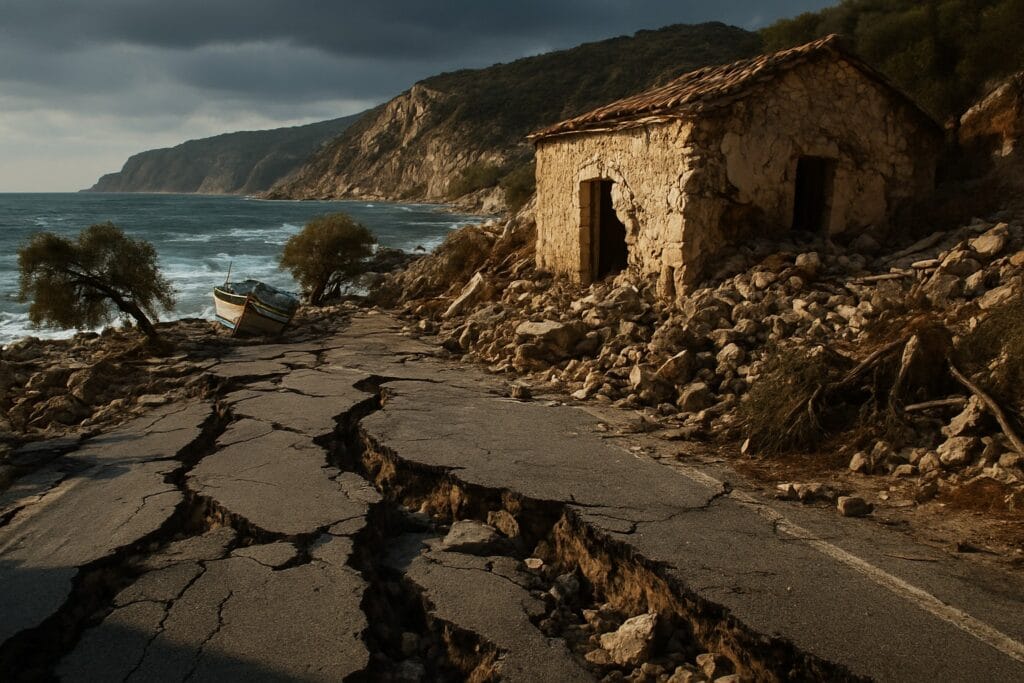
The port of Zakynthos Town was among the most visibly affected. Sections of the quayside had cracked and shifted, creating jagged steps where smooth surfaces had once met the water. In some places, the ground had subsided, leaving gaps between the pier and the sea that were large enough to startle seasoned sailors. Concrete blocks had tilted; mooring bollards leaned at odd angles. Ferries and boats, having thrashed wildly during the shaking, sat again in relatively calm water, but their mooring lines told the story—some frayed, some snapped entirely.
Nearby, the Church of Agios Dionysios, dedicated to the island’s patron saint, stood as a symbol of both resilience and vulnerability. Its tall bell tower, a landmark on the Zakynthos skyline, had swayed alarmingly during the quake, bells clanging out a discordant, involuntary alarm. After the shock, cracks appeared in parts of the structure, prompting engineers to cordon off areas for inspection. Faithful islanders, who had rushed to the church steps in the early hours to offer prayers of thanks for surviving, found their sanctuary ringed by caution tape and scaffolding within days.
On the western side of the island, famous for its dramatic cliffs and hidden coves, landslides tumbled rock and dust into the sea. At Navagio (Shipwreck) Beach, one of Greece’s most photographed locations, the quake triggered rockfalls that altered the shape of the cove and raised immediate concerns about visitor safety. Tour operators, who had long ferried tourists into the narrow bay to take postcard-perfect pictures, now faced the prospect of restricted access and stricter regulations.
Roads across Zakynthos bore scars in the form of fresh cracks and deformations. Some rural routes became temporarily impassable, blocked by fallen rocks or sections of collapsed retaining walls. Schools and public buildings were inspected one by one, with a checklist that had become grimly familiar in earthquake-prone Greece: visible cracks, foundation shifts, masonry failures. Older structures, particularly those predating the post-1953 building codes, were most at risk.
Still, as aerial images and official assessments accumulated, a new narrative took shape alongside the images of damaged infrastructure: despite a magnitude 6.8 quake close to the island, overall structural damage was less catastrophic than it could have been. The zakynthos earthquake 2018, powerful though it was, had tested the island’s earthquake-resistant designs—and many had passed. This outcome would soon become central to both political talking points and scientific studies.
Aftershocks and Sleepless Dawn: The First 24 Hours
The ground did not settle immediately after the main shock. As is typical after a large earthquake, a swarm of aftershocks followed, some of them strong enough to send renewed waves of panic through the population. Within the first day, seismological networks recorded dozens of smaller tremors in the region. One of them, around magnitude 5, rattled nerves and prompted new evacuations from already-frightened households.
This was the rhythm of that first day: a strong aftershock, people pouring into the streets, then a tense return indoors as officials urged calm but advised caution. Schools, which might have opened under normal circumstances, remained closed while structural inspections continued. Parents, many of whom had spent part of the night outside with their children wrapped in blankets, were in no hurry to sit them beneath concrete ceilings again.
Local authorities activated emergency protocols. The mayor’s office became a hive of activity, coordinating with Greece’s General Secretariat for Civil Protection and the Fire Service. Teams were dispatched to assess damage and respond to reports of people trapped or injured. Thankfully, such incidents were rare, but the uncertainty kept nerves frayed. Helicopters surveyed remote areas, and coast guard vessels patrolled the waters, watching for signs of a possible tsunami—even though the risk, as later analyses would confirm, was limited by the nature of the fault movement.
Radio stations and television channels carried continuous updates, punctuated by expert commentary. Seismologists explained the basics of earthquakes: why aftershocks occur, why another large quake was unlikely but not impossible, and why the structures that had held up could be trusted—within reason. One researcher, quoted widely in Greek media, emphasized, “This is a significant event, but it fits within the seismic character of the region. We are not dealing with an anomaly; we are facing the reality of living on the Hellenic Arc.”
In squares and parking lots, improvised communities formed. Families parked their cars side by side, sharing food, stories, and information. Children played between vehicles, adapting quickly to the strange circumstance of sleeping outdoors. Elderly residents, less adaptable, sat in folding chairs with blankets draped over their shoulders, eyes fixed on the horizon as if the next tremor might materialize visibly there.
As night fell again on October 26, many Zakynthians chose not to return to their homes, despite official reassurances. The memory of the night before was too fresh. The zakynthos earthquake 2018 had lasted only seconds, but its echo filled an entire day and spilled into another night of uneasy rest beneath the open sky.
Scientists in the Rubble: Measuring the Zakynthos Earthquake 2018
While residents grappled with fear and practical concerns, teams of scientists saw in the event an urgent opportunity. Within hours of the quake, researchers from Greek seismological institutes, universities, and European collaborators mobilized field surveys and instrument deployments. Their goal was not only to understand what had happened beneath the Ionian Sea, but also to refine broader models of seismic risk in the eastern Mediterranean.
The initial magnitude estimate of 6.4 was quickly revised upward to 6.8 on the moment magnitude scale, reflecting a more accurate calculation of the total energy released. The epicenter, located roughly 50 kilometers south of Zakynthos at a shallow depth, aligned with known structures in the region: a complex web of thrust and strike-slip faults linked to the Hellenic subduction zone and the Cephalonia–Lefkada transform system. GPS stations recorded subtle shifts in the island’s position, measured in millimeters to centimeters, as the crust adjusted.
Field teams fanned out across Zakynthos and nearby coastal areas to document physical effects: cracks in the ground, displaced roadbeds, rockfalls, and small instances of coastal uplift or subsidence. Their notebooks filled with coordinates, sketches, and photographs. One report, later published in a peer-reviewed journal, noted that the damage distribution suggested a strong directional effect, with shaking particularly intense along certain azimuths from the epicenter. This was consistent with the rupture propagating in a specific direction along the fault.
In interviews, seismologists repeatedly emphasized that while the quake was large, it was not surprising. “This is the kind of event we model for when we set design standards,” one said. “The risk here has always been known. The question is never if, but when.” In that sense, the zakynthos earthquake 2018 became a real-world test of long-debated assumptions. Were the existing seismic hazard maps accurate? Did building codes perform as intended? Did public awareness campaigns achieve their goal?
Early analysis suggested that many answers were cautiously positive. The island’s modern structures had mostly withstood the shaking reasonably well, vindicating decades of policy shaped by disasters like the 1953 earthquake. However, the scientists also pointed out vulnerabilities: older masonry buildings, certain types of coastal infrastructure, and landslide-prone cliff areas. In the long run, their work would feed into updated risk assessments, not only for Zakynthos but for other populated islands along the Hellenic Arc.
Citing seismologist Gerassimos Papadopoulos, a veteran of many post-earthquake investigations, Greek media reported his observation that the 2018 event “reminds us, without tragic loss of life, that nature has not changed its character. We must adjust our lives and our planning accordingly.” His words encapsulated the dual nature of the earthquake as both a scientific object of study and a social turning point.
Between Athens and Brussels: Political Responses and Media Narratives
The morning after the quake, images of cracked piers, damaged churches, and frightened residents began to circulate across Greece and beyond. News channels looped video of swaying buildings, heaving water in swimming pools, and jars crashing from supermarket shelves. Within hours, the zakynthos earthquake 2018 had become both a local trauma and a national political issue.
In Athens, government officials convened emergency meetings. Greece had, by 2018, already endured years of financial crisis, austerity policies, and public distrust of state institutions. Natural disasters—such as the deadly wildfires in Mati earlier that same year—had raised tough questions about preparedness and accountability. Against this backdrop, the response to the Zakynthos quake carried heavy symbolic weight. It was not simply about one island; it was a test of whether the state could protect its citizens in yet another form of crisis.
The prime minister issued statements expressing relief that there had been no immediate loss of life and pledging rapid support for repairs. Ministers visited the island, touring the damaged port and meeting with local officials. Civil protection agencies emphasized the speed of their deployment and the coordination with municipal authorities. European Union representatives also expressed solidarity, offering technical assistance if needed. In Brussels, the quake served as another reminder that Europe’s peripheries, often thought of in terms of economic metrics, were also zones of environmental and geological risk.
Media narratives reflected a mix of criticism and cautious praise. Some commentators focused on the resilience of infrastructure and the apparent effectiveness of building codes, presenting the event as a “success story” in disaster mitigation compared to past catastrophes. Others, more skeptical, highlighted the anxiety among residents, the fragility of tourism-dependent economies, and the persistent gaps in retrofitting older structures.
Political opposition parties seized on the moment to call for increased funding for seismic retrofitting, better public education on earthquake drills, and more transparent hazard mapping. They pointed out that while Zakynthos had been “lucky” in terms of casualties, the next quake—whether on the island or elsewhere in Greece—might not be as forgiving. In parliamentary debates, references to the zakynthos earthquake 2018 appeared alongside discussions of budget allocations and EU structural funds.
Amid this, local politicians in Zakynthos walked a delicate line. They needed to convey the seriousness of the damage to secure aid, without broadcasting an image of total devastation that might further scare away tourists. The island’s political discourse became an exercise in controlled alarm: enough urgency to spur action, but not so much that it tipped into fatalism.
Tourists, Locals, and Fear of the Next Season
Although the quake struck toward the end of the tourist season, its implications for tourism were immediate and far-reaching. Zakynthos, like many Greek islands, relies heavily on visitors from across Europe. In 2018, many of those visitors were either already gone or planning to leave within days. Some were on the island when the quake hit, and their stories soon spread across social media and into foreign news outlets.
Videos filmed on smartphones—hotel corridors shaking, pool water sloshing dramatically, frightened tourists huddled in lobbies—circulated rapidly. For potential visitors planning trips for 2019 and beyond, “Zakynthos” was suddenly associated with images of trembling buildings alongside its usual turquoise bays and sunlit beaches. Travel forums buzzed with questions: Was it safe? Were more quakes expected? How badly damaged was the infrastructure?
Local business owners watched these discussions with a sinking feeling. Many had already endured years of economic uncertainty, first from the global financial crisis, then from Greece’s own debt woes. Now a natural event, beyond anyone’s control, threatened to scare away the very customers they depended on. “If people only see the damage,” said one hotel manager, “they will forget that the island is still here, still beautiful, still safe most of the time.”
The reality was nuanced. Many hotels and tourist facilities suffered minimal structural damage. Within weeks, life on Zakynthos had settled into a new normal, with repairs underway and businesses reopening. Yet perception often lags behind reality, especially when distant audiences remember dramatic footage more vividly than calm follow-up reports. In some source markets, tour operators fielded concerned calls, while a few travelers chose alternative destinations for the following year.
Local authorities and tourism boards launched subtle campaigns to reassure would-be visitors. Press releases emphasized that the island’s main attractions remained intact, that safety inspections had been carried out, and that building standards had proven robust. At the same time, they could not deny the truth: Zakynthos, like much of Greece, sits in a seismically active zone. The zakynthos earthquake 2018 had merely reminded the world of that fact.
This tension—between marketing an island as a carefree paradise and acknowledging its geological reality—would continue in subsequent seasons. Some saw an opportunity to educate visitors about earthquakes, turning risk into awareness. Others preferred to let the subject fade, hoping that memories of that October night would blur into the background noise of global news.
Church Bells and Rescue Sirens: Faith and Community Under Strain
In Greek islands like Zakynthos, faith is more than private belief; it is woven into architecture, rhythms of daily life, and collective memory. The 2018 earthquake shook not only concrete and stone but also the institutions that anchored community identity: churches, neighborhood networks, informal systems of mutual aid.
Throughout the island, priests opened churchyards as gathering places in the hours after the quake. People clustered under bell towers and near icons, seeking both spiritual comfort and physical proximity to familiar landmarks. In some villages, liturgies of thanksgiving were held outdoors in the days that followed, with congregants standing on uneven ground, eyes occasionally darting to nearby walls at the slightest tremor.
The damage to religious buildings—cracks in walls, weakened bell towers, fallen masonry—had a symbolic weight beyond their material cost. For older residents who remembered 1953, seeing scaffolding around a beloved church stirred painful echoes of earlier losses. Yet the churches also became centers of coordination for relief: distributing blankets, food, and information, and offering a place where fear could be expressed openly.
Parallel to this spiritual response ran a secular lifeline: the wail of rescue sirens, the coordinated movement of fire brigade vehicles, ambulances, and municipal trucks. Rescue workers, trained through drills that sometimes felt abstract, now translated those protocols into action. They moved from building to building, checking for structural instability, responding to reports of people trapped in elevators or beneath fallen furniture. Thankfully, such incidents were limited, but their presence reassured residents that the island was not abandoned to its fate.
Community relations showed their strength in smaller moments: neighbors checking on the elderly living alone; store owners handing out water and snacks to families sheltering in open spaces; volunteers helping to clear debris. In many accounts collected in the weeks after the disaster, people emphasized that “no one was truly alone that night.” The earthquake, for all its terror, had momentarily cut through social divisions of class and nationality. Tourists and locals huddled side by side. Political differences quieted in the face of a shared vulnerability.
Yet behind the scenes, tensions simmered as well. Some residents complained about uneven distribution of inspections and aid, about rural areas feeling neglected compared to Zakynthos Town. Others voiced frustration at what they saw as a fatalistic attitude from authorities—that earthquakes were presented as “acts of God” rather than challenges requiring structural solutions. In this way, the zakynthos earthquake 2018 illuminated not just community solidarity, but also fault lines in trust and governance.
Engineering Against the Inevitable: Building Codes and Lessons Learned
Long before the 2018 quake, Zakynthos had been a laboratory for seismic engineering, though few outside specialist circles used that term. The devastation of the 1953 Ionian earthquakes led Greek authorities to overhaul building standards, particularly in the western part of the country. New codes mandated reinforced concrete frames, better connections between structural elements, and more rigorous design for lateral forces—the side-to-side motion that topples walls and columns during quakes.
In the aftermath of the zakynthos earthquake 2018, engineers returned to their drawings and spreadsheets with a question: had those efforts worked? The evidence suggested that, broadly, they had. Many modern buildings exhibited cosmetic damage—cracked plaster, fallen tiles, deformed railings—but remained structurally sound. Critical failures were relatively rare and often associated with older construction that predated the strictest codes, or with structures modified over time in ways that undermined their original integrity.
Teams of civil engineers conducted detailed post-earthquake assessments, categorizing buildings into degrees of habitability. Green tags indicated safe structures; yellow suggested temporary issues; red signaled serious damage or collapse risk. These judgments carried enormous weight for residents whose homes and livelihoods were tied to those walls. The process was technical but also deeply personal, blending calculations of shear forces with discussions about where families would sleep that night.
From these evaluations emerged a series of lessons, some familiar, others newly sharpened. Unreinforced masonry remained a major concern. Additions to buildings—extra floors, enclosed balconies, altered load paths—could compromise seismic performance. Critical infrastructure, such as ports and hospitals, required not just compliance with minimum codes but regular retrofits in light of new geological data.
Engineers also highlighted the importance of non-structural elements: heavy fixtures securely anchored, emergency exits kept clear, and gas and water systems designed to minimize leak risks during shaking. In many households, injuries from falling objects outnumbered those from structural failures. Public education campaigns, prompted by the earthquake, began to stress simple measures families could take: securing bookshelves, knowing safe spots to “drop, cover, and hold on,” and having emergency kits prepared.
On a broader level, the 2018 event contributed to ongoing debates about performance-based design in seismically active regions. Should buildings be designed merely to prevent collapse, or to remain usable after strong quakes? How should economic constraints be balanced against the desire for robust resilience? The answers varied among stakeholders, but the shared baseline was clear: in a place like Zakynthos, earthquakes were not hypotheticals. They were recurrent tests of choices made in blueprints and policy meetings years earlier.
Numbers, Maps, and Human Stories: Counting the Cost
As weeks turned into months, the process of “counting the cost” of the zakynthos earthquake 2018 unfolded in parallel on several levels. On one hand, there were the tangible metrics: estimated economic losses, repair budgets, insurance claims, tourism revenue impacts. On the other, there were less quantifiable tolls: sleeplessness, lingering anxiety, and altered perceptions of home and safety.
Preliminary estimates placed direct physical damage in the tens of millions of euros—a significant burden for a small island but far less than the devastation wrought by historic quakes in the region. Port repairs alone required substantial investment, given the strategic importance of maritime connections to Zakynthos’s economy. The Greek state, along with EU funds in some cases, allocated resources for reconstruction projects, but bureaucratic delays and competing national priorities complicated their swift deployment.
Insurance coverage, where it existed, softened the blow for some homeowners and businesses. However, as in many Mediterranean communities, a large portion of the building stock was either underinsured or not insured against seismic events at all. For these families and entrepreneurs, the cost of repairs came straight from savings or new debts. Some postponed rebuilding, living instead with cracks and makeshift fixes, hoping that no larger quake would test those compromises.
Beyond the spreadsheets, sociologists and psychologists observing the aftermath noted patterns of emotional and behavioral change. Children displayed heightened sensitivity to loud noises and sudden movements. Adults reported a sense of hypervigilance—listening for the slightest creak at night, sleeping with one eye open. As one resident put it, “You start to think of your house as an enemy that might fall on you.” That shift in perception can be as disruptive as any physical damage.
Mental health professionals, often under-resourced in rural regions, sought ways to integrate trauma-informed approaches into community life. Group discussions at schools, church gatherings addressing fear and faith, and informal support networks among neighbors all played roles in easing the psychic aftermath. While the absence of mass casualties made the event less visible in global disaster statistics, its psychological imprint on Zakynthos remained profound.
Researchers studying risk perception pointed to the 2018 quake as an example of an intermediate event: severe enough to reshape attitudes, but not so catastrophic as to overwhelm local coping capacities. Such events can be turning points in a society’s relationship with hazard: either spurring sustainable mitigation measures or fading into the background as “another scare” soon forgotten. Which path Zakynthos would take was still, in the years after the earthquake, an open question.
From Local Shock to Global Data: What the World Learned
In the age of digital sensors and instant communication, a major earthquake is never purely local. The zakynthos earthquake 2018 generated not only human stories but also streams of data that flowed into global scientific repositories. Seismographs across Europe and beyond had recorded the passage of its waves. GPS stations detected subtle crustal displacements. Satellite radar imagery, processed in the weeks afterward, revealed patterns of ground deformation invisible to the naked eye.
International teams, including researchers from Italy, France, and other countries along the Mediterranean’s restless shores, collaborated with Greek institutions to analyze these datasets. They compared the 2018 event with previous earthquakes in the Hellenic Arc, refining models of how strain accumulates and is released along the plate boundary. Some studies suggested that the quake had slightly altered stress distributions on nearby fault segments, raising questions about whether it might influence the timing of future events elsewhere in the arc.
These scientific exercises had practical implications. Better understanding of seismic sources feeds into hazard maps used for building codes, land-use planning, and emergency preparedness strategies not only in Greece but in Turkey, Italy, and other seismically active nations. In one widely cited article, a team of geophysicists argued that “the Zakynthos 2018 earthquake reinforces the need to consider multi-fault interactions in regional seismic hazard assessments,” highlighting how one rupture can influence stress conditions over a broad area.
At the same time, social scientists and disaster risk experts examined the event as a case study in resilience. They noted the relatively low casualty rate, the rapid activation of emergency protocols, and the role of pre-existing building codes as examples of progress in Mediterranean disaster management. However, they also warned against complacency, emphasizing that “near-miss” events can either spur sustained investment or lead to dangerous overconfidence.
International organizations, including the United Nations Office for Disaster Risk Reduction, referenced the Zakynthos quake in discussions about aligning national policies with the Sendai Framework for Disaster Risk Reduction 2015–2030. The island, in this view, became a microcosm—a place where the interplay of natural hazard, exposure, vulnerability, and capacity could be observed in a manageable scale, with lessons extrapolated to larger urban centers at risk of even more devastating quakes.
Thus, a rupture beneath the Ionian Sea on a quiet October night fed not only local fears and memories, but also global conversations about how humanity coexists with the unpredictable pulse of the Earth.
Living with a Restless Earth: Memory, Trauma, and Preparedness
Years after the shaking stopped, the zakynthos earthquake 2018 still lives in the island’s collective memory. For children who were small at the time, it is a half-remembered night of confusion and parent’s hurried footsteps. For adults, it is a story they can place precisely in their life timeline: “before the quake” and “after the quake.” For the elderly, it is one more marker in a lifetime punctuated by tremors.
Memory serves a dual function in such contexts. On one hand, it preserves valuable experiential knowledge. People remember where they felt safest, how quickly they could evacuate, what objects became hazards inside their homes. Such recollections can improve preparedness if they are translated into action—rearranging furniture, keeping emergency supplies, participating seriously in drills. On the other hand, memory can amplify fear, haunting some individuals with persistent anxiety that undermines their sense of stability.
In Zakynthos, schools have incorporated earthquake education into their curricula, teaching students not only to “drop, cover, and hold on,” but also to understand, in age-appropriate ways, why their island shakes. Preparedness campaigns, often coordinated with national civil protection authorities, emphasize the importance of knowing safe exit routes, having family communication plans, and respecting official guidance rather than rumors in the immediate aftermath of a quake.
Community-level initiatives have emerged as well. Some neighborhoods have organized informal response teams—residents trained in basic first aid and equipped with shared tools like crowbars and fire extinguishers. These efforts reflect a growing recognition that, in the crucial minutes and hours after a disaster, neighbors are often the first responders long before external help arrives.
At the same time, mental health professionals advocate for a more open conversation about trauma. They warn that dismissing fear with phrases like “we Greeks are used to earthquakes” can silence those struggling with ongoing distress. Instead, they encourage spaces—workshops, support groups, even casual gatherings—where people can process their experiences without stigma. In this sense, emotional preparedness is as vital as stockpiled supplies.
The broader cultural memory of earthquakes in Greece, stretching back through centuries of chronicles and folk tales, offers both comfort and sobering perspective. The zakynthos earthquake 2018 is one episode in that long story, neither the worst nor the last. Accepting this reality is difficult but necessary. It calls for a kind of everyday resilience: living fully, investing in homes and communities, while acknowledging that the ground beneath is not permanently still.
Echoes Across the Ionian: Comparing 2018 with Past Greek Quakes
To place the Zakynthos event in context, one must look sideways across both time and space, comparing it with other notable Greek earthquakes. The 1999 Athens earthquake, for instance, registered a similar magnitude (6.0–6.1) but struck a densely populated metropolitan area, killing 143 people and collapsing several buildings. The 2020 Samos–Izmir earthquake, magnitude 7.0, triggered a small tsunami and caused significant damage in both Greece and Turkey. Against these benchmarks, the 2018 Zakynthos quake appears, in purely statistical terms, as a relatively “lucky” event.
Yet such comparisons risk obscuring the lived reality on the island. For Zakynthians, the 2018 quake was not a footnote; it was an immediate test of their built environment and institutions. Moreover, comparisons highlight a lesson seismologists have long stressed: magnitude alone does not dictate impact. Depth, distance from population centers, local geology, time of day, and building quality all intertwine to shape outcomes.
Historically, the Ionian Islands have been hit repeatedly by strong quakes: the 1867 and 1893 events, the 1909 Patras quake, the 1953 sequence, the 2014 Cephalonia earthquake cluster. Each left a distinct pattern of damage and adaptation. In 1953, widespread collapse forced wholesale rebuilding, enabling a leap in building standards but erasing much of the islands’ traditional architecture. In 2014, modern codes were again tested, with mixed results across different structure types.
In this lineage, the zakynthos earthquake 2018 occupies an intermediate position. Its damage was serious but not transformative; its casualties minimal; its structural test notable but not overwhelming. Precisely because of this, it can be easily overlooked in broader histories of Greek disasters. However, historians and risk scholars argue that such “in-between” events are vital to study. They reveal which systems bend rather than break, where incremental improvements have paid off, and where complacency still lurks.
Comparative analysis also underscores the interconnectedness of the broader region. Fault systems do not obey political boundaries. A rupture beneath the Ionian Sea alters stress not only under Zakynthos but also along segments affecting Kefalonia, the Peloponnese, and potentially more distant regions. Understanding the 2018 event, therefore, is part of understanding future risks for a wide swath of the eastern Mediterranean—home to millions more people than those who felt the shaking that night on Zakynthos itself.
A Future Written in Fault Lines: Zakynthos After 2018
In the years that followed, Zakynthos continued much as it had before: summers filled with tourists drawn to its bays and beaches, winters quieter, the cycles of fishing and agriculture persisting alongside service-sector work. Yet the memory of the zakynthos earthquake 2018 remained embedded in the island’s physical and psychological landscape.
Reconstruction and repair projects gradually transformed damaged sites. The port, once cracked and uneven, was strengthened and in some cases redesigned, incorporating lessons about subsidence and lateral loading. Churches and heritage buildings underwent careful restoration, balancing historical fidelity with discreet structural reinforcement. Roads blocked by landslides were cleared and, in some cases, equipped with new protective measures against future rockfalls.
Policy discussions that the quake had sparked did not disappear entirely. Municipal authorities and national agencies continued to debate funding for retrofits, the updating of hazard maps, and the integration of seismic considerations into broader climate and development planning. Civil protection exercises, including evacuation drills and communication protocols, were refined, with the 2018 experience serving as a real-world test case referenced in training sessions.
On a more intimate scale, many families made quiet adjustments. Some moved heavy wardrobes away from beds. Others reinforced balconies or repaired hairline cracks that had been ignored before. A few chose to relocate—either within the island or to the mainland—seeking homes they perceived as safer. For those who stayed, the decision was less an act of denial than a recognition that risk could be managed but not eliminated.
Zakynthos’s identity, outwardly marketed through images of turquoise water and dramatic cliffs, now also included a less visible dimension: a community seasoned by earthquakes, balancing beauty with vulnerability. Tour guides sometimes mentioned the 2018 quake in passing, noting how little obvious damage remained. Older residents occasionally pointed to repaired cracks, telling children and visitors, “That’s where the Earth reminded us who is in charge.”
Ultimately, the future of Zakynthos is, like that of any seismically active region, written partly in fault lines and partly in human choices. The island cannot change its position atop a subduction zone. But it can choose how to build, how to remember, how to teach the next generation about living on dynamic ground. The zakynthos earthquake 2018, viewed from this perspective, is not only a finished chapter but also a guiding reference for those ongoing decisions.
Conclusion
On a late October night in 2018, Zakynthos was reminded, forcefully and without warning, of its place on a restless Earth. The magnitude 6.8 quake that rolled beneath the Ionian Sea and shook the island’s buildings was not an aberration but a manifestation of deep tectonic processes that have shaped Greece for millennia. Yet, in its details, the zakynthos earthquake 2018 was also very much a product of human history: of building codes born from earlier tragedies, of political systems tested by crisis, of communities knit together by faith, memory, and mutual aid.
The event exposed vulnerabilities—cracked ports, fragile older structures, anxious hearts—but also highlighted strengths: modern buildings that held, emergency systems that activated, and a populace that, though afraid, responded with resilience. In the aftermath, scientists gained new data, policymakers found both cautionary tales and encouraging evidence, and islanders themselves carried away lessons about preparedness entwined with lingering unease.
Comparisons with past Greek earthquakes reveal both continuity and progress. Zakynthos has suffered far worse in earlier decades; the relatively limited destruction in 2018 testifies to decades of incremental, often uncelebrated, work in engineering and regulation. At the same time, the quake underscores that the island’s beauty is inseparable from its geologic restlessness. To live there is to accept that the ground may move again, perhaps in another quiet night when the sea seems calm and nothing appears amiss.
In that sense, the true legacy of the 2018 earthquake may lie less in its immediate damage than in how it reshapes the island’s long-term relationship with risk. If its memory continues to inform how Zakynthos builds, educates, plans, and dreams, then those brief seconds of terror will have left behind more than cracks and scars. They will have contributed to a culture better equipped to face the tremors that, sooner or later, will once again rise from the depths of the Ionian Sea.
FAQs
- When did the Zakynthos earthquake 2018 occur?
The earthquake struck in the early hours of October 26, 2018 local time (late on October 25 UTC). The main shock occurred at about 01:54 local time, waking most residents from sleep and causing strong shaking across the island. - What was the magnitude of the earthquake?
The zakynthos earthquake 2018 had a moment magnitude of 6.8. Initial estimates were slightly lower, but subsequent analysis of seismic data confirmed the higher value, making it one of the stronger recent quakes in the Ionian region. - Where was the epicenter located?
The epicenter was in the Ionian Sea, roughly 50 kilometers south of the island of Zakynthos. The quake originated at a relatively shallow depth of around 10–15 kilometers, which contributed to the intensity of surface shaking. - Were there any deaths or major injuries?
Remarkably, no deaths were directly attributed to the shaking from this earthquake, and serious injuries were relatively few. Most reported injuries were minor, caused by falling objects, broken glass, or panic during evacuation. - What kind of damage did Zakynthos experience?
The island suffered notable but uneven damage. The port of Zakynthos Town experienced cracking and subsidence; some churches and older masonry buildings developed significant structural issues; and landslides occurred along the western cliffs. Many modern, code-compliant buildings sustained only cosmetic damage. - Did the earthquake trigger a tsunami?
A small sea-level disturbance was recorded, and authorities monitored for possible tsunami effects, but no destructive tsunami struck the coasts. The style of faulting and the quake’s specific characteristics limited the tsunami potential in this case. - How did building codes affect the outcome?
Post-1953 building codes in the Ionian Islands, designed with strong earthquakes in mind, played a crucial role in limiting structural collapse. Reinforced concrete frames and modern seismic design standards helped many newer buildings withstand the shaking without catastrophic failure. - How did the earthquake impact tourism on the island?
Because the quake occurred late in the tourist season, immediate disruption to visitors was limited. However, images and reports circulated internationally, briefly affecting perceptions of safety. In subsequent seasons, most tourism activity resumed, with local authorities emphasizing both the island’s resilience and ongoing safety inspections. - What did scientists learn from this earthquake?
Researchers gained valuable data on fault behavior in the Hellenic Arc, patterns of ground motion, and the performance of infrastructure under strong shaking. The event helped refine seismic hazard models for the Ionian region and highlighted the importance of considering multi-fault interactions in risk assessments. - Is Zakynthos still at risk of future earthquakes?
Yes. Zakynthos lies in one of Europe’s most seismically active zones, near the Hellenic subduction system and related fault networks. While the 2018 earthquake released significant energy, it did not “use up” the region’s seismic potential. Ongoing preparedness, strict building practices, and public education remain essential for future safety.
External Resource
Internal Link
Other Resources
- Encyclopaedia Britannica – general search for the exact subject
- Google Scholar – academic search for the exact subject
- Internet Archive – digital library search for the exact subject