Table of Contents
- Dawn over the Banda Sea: Setting the Stage for Disaster
- Islands on the Ring of Fire: The Geological Fate of Flores
- Life in Maumere and Along the Coast on the Eve of 12 December 1992
- 12 December 1992, 13:29 Local Time: The Earth Shudders
- The Sea Retreats, the Shore Gathers: Minutes Before the Wave
- Walls of Water: The Three Waves That Struck Flores
- Maumere’s Day of Ruin: Urban Destruction and Human Loss
- Babi Island and the Vanishing Villages
- Nightfall over Debris: The First 24 Hours of Chaos
- Searching, Counting, Naming: From Missing Persons to Death Tolls
- Faith, Ritual, and Grief: How Flores Mourned Its Dead
- From Local Tragedy to International Headline: The World Takes Notice
- Rebuilding Maumere: Politics, Money, and the Long Road Home
- Tsunami Science Transformed: Lessons Drawn from the Flores Event
- The Unheard Warnings: Oral Traditions, Memory, and Risk
- Children of the Wave: Survivors Growing Up in the Shadow of 1992
- From Flores to the Indian Ocean: How 1992 Shaped 2004
- Living with the Next Wave: Preparedness, Drills, and Denial
- The Sea as Enemy and Provider: Cultural Shifts After the Tsunami
- Archival Echoes: Remembering 12 December in Modern Indonesia
- Conclusion
- FAQs
- External Resource
- Internal Link
Article Summary: On 12 December 1992, the Indonesian island of Flores experienced one of the deadliest tsunamis of the late twentieth century, turning ordinary coastal life into a scene of sudden ruin. This article traces the flores tsunami 1992 from the quiet hours before the earthquake through the brutal arrival of three destructive waves and the long months of recovery that followed. It situates the event within the geology of the Ring of Fire, explaining how tectonic forces and submarine landslides combined to devastate Maumere, Babi Island, and dozens of fishing villages. Through survivor stories, demographic data, and official records, it explores how communities mourned, rebuilt, and attempted to understand a catastrophe that arrived without warning. The narrative also follows the political and humanitarian responses, revealing how an ostensibly local disaster helped to reshape Indonesia’s disaster management policies. At the same time, scientists used the flores tsunami 1992 as a crucial case study that would later influence tsunami modelling and warning systems in the Indian Ocean. Decades on, memories of the event live on in drills, stories, and rituals that reframe the relationship between the people of Flores and the unpredictable sea. By weaving together human voices, archival evidence, and scientific insight, the article shows how the flores tsunami 1992 became both a national tragedy and a turning point in global understanding of coastal hazards.
Dawn over the Banda Sea: Setting the Stage for Disaster
On the morning of 12 December 1992, the eastern Indonesian island of Flores woke to a sky washed in the soft haze of the monsoon season. Fishing boats, their paint flaking from years of salt and sun, bobbed restlessly in the sheltered waters of Maumere Bay. Roosters crowed from behind woven bamboo fences; schoolchildren in neat uniforms walked along dusty roads, the smell of frying bananas and clove cigarettes trailing through the air. It was a Saturday, and while some offices were open, the rhythm was slower, more languid, the kind of day when the sea seemed more like a neighbor than a threat.
In Maumere, then a bustling town and the largest on Flores, the markets were already crowded. Women bargained over mounds of red chilies and silver fish laid out on banana leaves, while traders from the hills arrived with sacks of coffee and cassava. Tourists—few but noticeable—lounged near the piers, planning island-hopping journeys or dives in the coral-rich waters of the Flores Sea. Along the coastline and on small islands like Babi, houses made of wood and thatch leaned toward the water, evidence of a life and economy built around the tides.
Nobody that morning suspected that in a matter of hours the shoreline would be reshaped, neighborhoods erased, and thousands of lives altered forever. The words “tsunami warning system” were, for most residents, abstract or entirely unknown; the ocean’s moods were read by clouds, currents, and the instincts of local fishers, not by seismographs and satellite links. A sense of routine security pervaded daily life. Older villagers still recalled past quakes, but their stories blurred into a general awareness that the land sometimes shook—and then calmed again.
Yet far beneath the Banda and Flores seas, immense tectonic forces had been building tension for years, even centuries. The interface between the subducting Australia Plate and the overriding Eurasian and micro-plates was locked, straining like a drawn bow. On that deceptively ordinary morning, the fault was edging toward rupture. The people of Flores had no way of knowing that their island was about to become the epicenter of what historians and geophysicists would come to call, with stark simplicity, the flores tsunami 1992.
Islands on the Ring of Fire: The Geological Fate of Flores
Flores lies along the southern fringe of the Indonesian archipelago, perched within the tumultuous arc of the Pacific “Ring of Fire.” Here, the Indo-Australian Plate dives beneath the complex Eurasian margin, creating deep ocean trenches, active volcanoes, and steep underwater slopes. This geologic setting gives rise to fertile soils, rich marine ecosystems, and also to some of the world’s most destructive earthquakes and tsunamis.
By the early 1990s, scientists already understood that Indonesia’s islands were no strangers to tsunamis. Historical records and colonial archives had documented waves following major quakes in 1852, 1899, and 1938, among others. Yet detailed local histories for Flores were sparse, scattered across mission reports and village oral traditions. Many residents knew the land could shake, but relatively few had heard explicit warnings of massive waves that could follow. As in so many coastal regions, knowledge of tsunamis flickered like a candle—present, but fragile.
The tectonic architecture around Flores is unusually complex. The Flores Back-Arc Thrust and associated faults cut beneath the island, while steep submarine slopes extend north toward the Flores Sea. When stress finally overcomes friction along these faults, the sudden movement of the sea floor can displace enormous volumes of water. Sometimes, the shaking also destabilizes coastal and submarine sediments, triggering landslides that act like shovels, scooping the sea upward into waves that radiate outward in all directions.
Geophysicists studying the flores tsunami 1992 would later calculate that the triggering earthquake reached a magnitude of approximately 7.8 on the moment magnitude scale. Its rupture stretched for more than a hundred kilometers, propagating beneath Flores and the nearby ocean. Seismograms recorded around the world captured a prolonged, violent event. But in December 1992, such data—while collected—were not yet part of an automated local warning system that could transform distant measurements into life-saving alerts along the coast.
This geological fate of Flores, written over millions of years, made a disaster of some kind almost inevitable. What nobody knew was when. Geology operates over vast timescales, but people live in decades. The island’s residents, caught between these tempos, built their homes along the water’s edge, trusting their lived memories more than abstract probabilities. The Ring of Fire remained, for most, an explanation in school textbooks rather than a daily, tangible risk.
Life in Maumere and Along the Coast on the Eve of 12 December 1992
To understand the shock that followed, one must first grasp how ordinary and anchored to the sea life was along the Flores coastline in 1992. Maumere, with a population approaching 30,000 at the time, was a bustling regional hub—administrative center, port, and cultural crossroads. The town sat on low-lying ground near the bay, with houses, churches, schools, and government offices clustered not far from the water. From dawn to dusk, this waterfront thrummed with activity: ferries unloading goods, fishing boats selling their catch, schoolchildren cutting through side streets on their way home.
Further along the coast, and on islands like Babi, life followed older rhythms. Villages consisted of wooden and bamboo houses, some raised on stilts, arranged in loose rows parallel to the shore. A thin strip of sand, sometimes only a few meters wide, separated front doors from the tide line. Coconut trees offered shade; small chapels, mosques, and community halls formed the social heart of each settlement. Many families had lived in the same location for generations, their attachment to place woven from land inheritance, ancestral graves, and the daily companionship of the sea.
Economically, the region was not rich, but it was not destitute either. Fishing, small-scale trade, subsistence farming, and remittances from relatives working elsewhere sustained a fragile but functioning livelihood system. Tourists, drawn by coral reefs and the relative remoteness of Flores, added a modest stream of income, mostly concentrated in Maumere. Local politics, though overshadowed by the centralized New Order regime of President Suharto, involved village leaders, church authorities, and district officials, all balancing limited budgets against pressing needs for roads, schools, and clinics.
Risk, when discussed, usually meant poverty, disease, or crop failure—not natural cataclysm. The memory of an earlier destructive earthquake in 1972 lingered in some families’ stories, but coastal construction continued to push closer to the water, driven by practical necessity more than by ignorance. The higher, safer ground further inland was often rocky, less fertile, or already claimed. For fishers, the distance between house and boat was measured not only in steps but in seconds. Proximity to the sea was an asset, not a liability.
On the eve of 12 December, there were no drills, no evacuation maps pinned on community hall walls, no loudspeakers reserved for tsunami alerts. Disaster was not imminent; it was distant, abstract, something that happened “elsewhere” along the long Indonesian shoreline. As a result, the coming flores tsunami 1992 would not only strike homes and bodies but also shatter this fragile sense of geographic immunity. The illusion that some places are naturally spared would vanish in a matter of minutes.
12 December 1992, 13:29 Local Time: The Earth Shudders
The decisive moment came in the early afternoon. At 13:29 local time, while the sun hung high and the heat pressed down on roofs of tile and thatch, the Earth beneath Flores convulsed. Survivors later recalled a low, guttural rumble that seemed to come from everywhere at once—“like a giant truck under the ground,” some said. Then the shaking began.
In Maumere, buildings swayed violently. People ran from shops and offices as windows shattered and masonry cracked. The quake lasted an agonizingly long time—more than a minute by some accounts—long enough for panic to spread and for the strongest structures to reveal their weaknesses. Wooden houses creaked and groaned; concrete pillars twisted. The earth itself, in some places, appeared to ripple. On the outskirts of town, landslides tumbled from unstable slopes, sending dust billowing into the air.
Along the coast and on Babi Island, the experience was similarly terrifying but uneven. Some villages stood on slightly firmer ground and experienced mostly horizontal shaking that, though frightening, did not collapse many homes. Others, built on softer sediments, suffered extraordinary motion. Walls split; heavy furniture toppled; cooking fires spilled embers across bamboo floors. People grabbed children, shouted prayers, and ran into open spaces, trying to escape falling debris.
Yet, for all its violence, the earthquake alone was not the ultimate killer. In many disasters, the ground shaking is the main event; in Flores, it was the opening act. The earthquake damaged roads, downed power lines, and fractured buildings, but in many areas, structural collapse was limited. Some residents, reassured when the shaking finally subsided, began to move back indoors, to assess cracks in their walls or gather scattered belongings. They did not yet know that the sea itself had been disturbed, that the quake’s energy had already begun to warp the surface of the Flores Sea and the adjacent basins.
Seismological stations in distant cities recorded the quake and estimated its magnitude, yet communication bottlenecks and the absence of a tsunami warning infrastructure meant that these data did not translate into action on the Flores coastline. No sirens blared; no radio announcers urged flight to higher ground. The window of thirty to forty minutes between the earthquake and the largest waves remained tragically unused, a silence that would later haunt policymakers and scientists alike.
The Sea Retreats, the Shore Gathers: Minutes Before the Wave
In the scattered villages that lined the coast, something strange began to happen in the minutes following the earthquake. The sea, which had long defined the community’s sense of orientation and security, suddenly appeared to misbehave. In some places, the water line rushed inland briefly, as if the tide were surging unnaturally. In others, it did the opposite—it pulled back with eerie speed, exposing stretches of seabed that nobody had ever seen dry.
Children pointed and shouted as fish flopped on the suddenly bare sand and rocks. Curious adults stepped forward to gather them, following an instinct as old as hunger itself. Boats that had been bobbing in shallow water now rested on mud. For some villagers, the sight triggered a nameless dread, as though a story from their grandparents’ time were trying to surface through half-forgotten words. For others, it was a bewildering spectacle, more fascinating than frightening.
There were, in these crucial minutes, very few authoritative voices calling out a warning. Indonesia’s coastal communities, like many around the world, had not institutionalized the basic tsunami rule now taught to children in hazard zones: “If the ground shakes strongly and the sea withdraws, run uphill immediately.” A handful of elders, remembering older tales of waves that followed earth tremors, reportedly urged people to head for higher ground. But their warnings competed with confusion, disbelief, and the pressing urge to rescue belongings or help injured friends and relatives.
In Maumere, some residents instinctively ran away from the shoreline after the earthquake, seeking safer open areas. Others, however, moved toward the waterfront, concerned about boats, docks, and warehouses. Taxi drivers, shopkeepers, and port workers all had reasons to return to the economic heart of the town. This movement toward the sea, driven by care, duty, or curiosity, unknowingly placed many in the direct path of the coming waves.
Science would later explain this eerie withdrawal as a result of complex interactions between vertical seafloor displacement and potential submarine landslides along the steep underwater slopes. But such explanations could not turn back the clock. Those few minutes of hesitation, of wonderment at the strange sight of the naked seabed, formed an invisible border between life and death. The flores tsunami 1992 was now fully in motion, its immense energy racing toward the shore faster than most people could run.
Walls of Water: The Three Waves That Struck Flores
Witness testimony and post-event analyses converge on a chilling sequence: not one wave, but three, struck the coastline around Flores in the aftermath of the 12 December earthquake. The first arrived perhaps twenty to thirty minutes after the ground had stopped shaking, its timing varying by location. The sea, after withdrawing unnaturally, returned with lethal intent.
Survivors often struggle to describe the moment they first saw the wave. Some speak of a dark line racing toward them, a shifting wall where there had been only horizon. Others recall an overwhelming roar, “like many trains at once,” or “like the sky collapsing,” as the water heaped up and surged inland. Heights reported by eyewitnesses vary widely, as fear and perspective bend memory, but scientific reconstructions estimate run-up heights of up to 26 meters on parts of Babi Island, and several meters along much of the north coast of Flores.
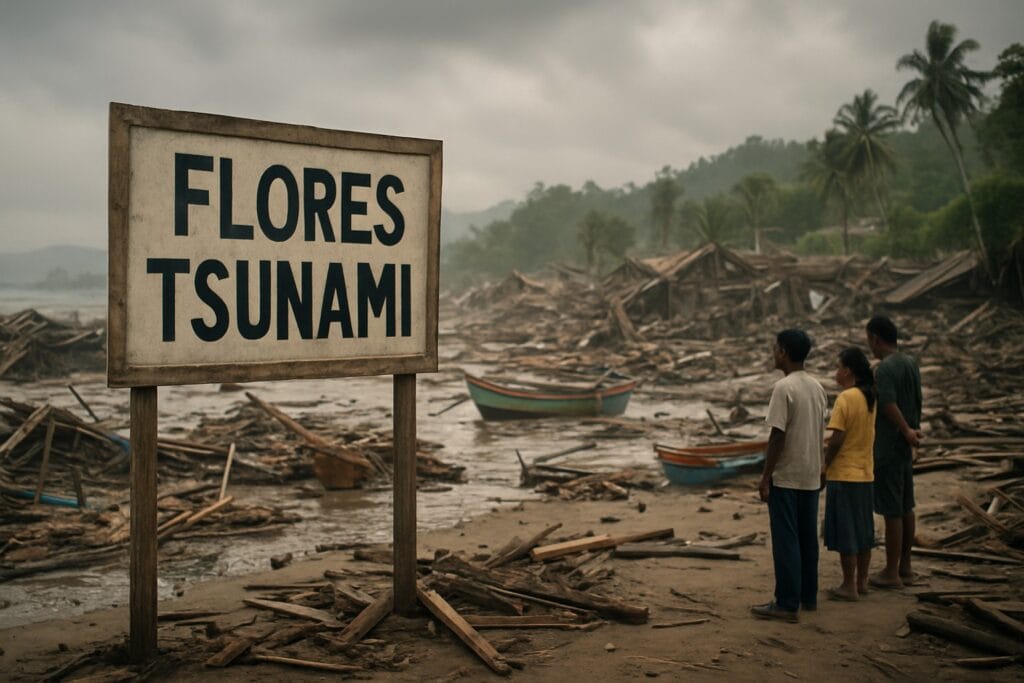
The first wave smashed into wooden houses, tore boats from their moorings, and uprooted palm trees. In villages built only a few meters above sea level, it swept entire rows of homes from their foundations, grinding them into splintered debris. People who had lingered near the shore were caught with no time to flee. Some attempted to cling to trees, walls, or their own rooftops; others were pulled under by the violent churning of water thick with wood, metal, and household objects.
The second and third waves compounded the devastation. In some areas, they were higher than the first; in others, they followed closely behind, striking while people were still struggling to orient themselves in the chaos. Debris became a weapon, battering those who managed to reach temporary refuges. Concrete structures that had withstood the earthquake crumbled when undermined by scouring water. In Maumere, coastal neighborhoods disintegrated. On Babi Island, the combination of steep topography and direct exposure to incoming waves turned certain villages into death traps.
For historians trying to reconstruct the flores tsunami 1992, these multiple waves present both a challenge and a revealing pattern. The layering of destruction—earthquake damage followed by several inundations—helps to explain the extraordinary casualty figures and the near-total obliteration of some communities. In one frequently cited study, researcher Kenji Satake and colleagues identified both fault rupture and possible landslides as contributors to the tsunami’s power, demonstrating how a single seismic event can cascade into a complex, multi-wave disaster (“Tsunami Heights along the Flores Island, Indonesia,” 1993).
To those living through it, however, technical distinctions between seismic and landslide tsunamis meant little. What they saw were houses, relatives, neighbors, thrown into a churning, muddy torrent. What they heard were screams snatched away by the crashing water. What they felt, as the waves finally began to recede, was an almost unbearable silence—the silence of a world abruptly and irreversibly changed.
Maumere’s Day of Ruin: Urban Destruction and Human Loss
Maumere, the largest town on Flores, bore the brunt of both the earthquake and the tsunami. Before 12 December, it had been a modest but growing urban center with paved streets, market squares, churches, government buildings, and a port that linked the island to the wider Indonesian archipelago. After the waves, large swaths of this urban landscape resembled a battlefield.
The coastal districts were the most devastated. Aerial photographs taken in the days following the disaster show a chaotic expanse of wreckage stretching inland from the former shoreline—roofs scattered like leaves, piles of timber marking where houses once stood, small boats flung onto roads and into courtyards. Keels and hulls pointed at impossible angles, as though a giant hand had shaken the town. Streets disappeared beneath layers of mud and debris, making navigation slow and dangerous for rescuers.
Casualty estimates for Maumere alone run into the thousands, contributing substantially to the overall death toll of approximately 2,000 to 2,500 people attributed to the flores tsunami 1992. Many died by drowning or impact; others were crushed as buildings collapsed under the combined stress of shaking and inundation. Hospitals, themselves damaged, quickly overflowed with the injured—broken limbs, deep lacerations, head trauma, near-drownings. Medical staff worked by candlelight when power failed, improvising splints and bandages from whatever materials they could find.
The social fabric of the town was torn as painfully as its physical infrastructure. Entire families vanished, leaving behind only a few disoriented survivors. Schools lost students and teachers; parishes lost priests and parishioners. The neat bureaucratic order of population registers gave way to handwritten lists of the missing, posted on church doors and public noticeboards. People wandered the ruins calling names, searching for recognizable clothing or features among the dead.
Yet even amid this horror, the first currents of solidarity began to flow. Neighbors rescued neighbors, forming human chains to pull people from swirling floodwaters or collapsing debris. Local officials, themselves shocked and often homeless, tried to coordinate emergency shelters on higher ground. Churches and mosques opened their doors as makeshift refuge centers. The instinct to help—to salvage not only lives but also some semblance of shared order—surfaced quickly, a fragile but vital counterforce to the chaos unleashed by the sea.
Babi Island and the Vanishing Villages
If Maumere represented the urban face of the disaster, the story of Babi Island and the surrounding small settlements encapsulates the vulnerability of isolated communities. Babi, a small, steep-sided island off the north coast of Flores, sat directly in the path of the incoming tsunami waves. Its villages were typically located in narrow coastal strips squeezed between the sea and rising terrain, a configuration that offered little room for horizontal escape.
When the earthquake struck, residents of Babi clung to trees and fled out of swaying houses, but the real catastrophe came with the waves. Post-disaster surveys found that on parts of the island the tsunami reached astonishing heights—up to 26 meters above sea level, one of the most extreme run-ups recorded for the flores tsunami 1992. In practical terms, this meant that water and debris slammed far up the slopes, wiping out houses that had seemed relatively safe at modest elevations.
Entire villages were effectively erased. Wooden homes disintegrated; even sturdier structures were gutted. The death toll on Babi Island alone was measured in hundreds, a staggering figure for such a small population. In some hamlets, the majority of inhabitants perished, leaving only a handful of survivors to tell the tale. The demographic imprint was brutal: lines of family trees simply ended on 12 December 1992.
Rescue and relief were slower to reach Babi than Maumere, not only because of distance but also because the island’s own boats were destroyed. Surviving residents used whatever floating debris they could find to reach neighboring shores or to ferry the injured. When outside help finally arrived—first local fishers, later government and military boats—they found scenes of near-total devastation. The distinction between land and sea was blurred; familiar landmarks were gone.
In the months that followed, discussions emerged about whether some of these obliterated communities should be rebuilt in the same locations. The logic of traditional settlement patterns collided with the stark evidence of hazard. Some villagers insisted on returning, citing ancestral graves and the lack of alternative land. Others, traumatized, refused to live so close to the water again. These debates, though specific to Babi and neighboring coasts, reflected a broader dilemma in post-disaster reconstruction policy: how to honor cultural continuity while acknowledging the deadly lessons written into the landscape.
Nightfall over Debris: The First 24 Hours of Chaos
As the sun began to sink on 12 December, the full extent of the catastrophe had not yet been grasped, even by those standing amid the ruins. The human mind, confronted with scenes of mass destruction, tends to focus narrowly: finding family members, locating basic necessities, responding to the immediate cries for help. People fashioned stretchers from doors, beds, and bamboo poles; they used fishing nets to drag floating bodies to shore. Fires were lit to provide light and to comfort shivering survivors soaked in seawater.
In Maumere, the night brought a new layer of fear. With electricity cut in many areas, the town was plunged into a darkness broken only by flashlights, candles, and occasional vehicle headlights. Rumors circulated wildly: that another, larger wave was coming; that the ground might open again; that volcanoes nearby were awakening. Some people fled to higher ground, camping in church compounds and on hillsides, too afraid to sleep under any roof that might collapse in another tremor.
Local authorities scrambled to establish command posts, often working from partially damaged buildings. Communications with provincial and national centers were patchy. Radio operators sent fragmented reports of an earthquake and tsunami, listing casualty estimates that rose with each passing hour. The Indonesian military and police, accustomed to maintaining order under the centralized New Order regime, suddenly found themselves improvising as first responders—digging through rubble, directing traffic around impassable roads, and helping to organize makeshift morgues.
On Babi Island and in remote coastal stretches, the first night was even more precarious. Many survivors were injured, exhausted, and stranded without adequate shelter. Drinking water sources had been contaminated by saltwater and debris. The dead lay where the waves had left them, their presence both a source of horror and, for many, the first bitter confirmation that loved ones were gone. In the absence of outside assistance, villagers relied on traditional leadership structures—village heads, religious figures, respected elders—to allocate scarce resources and guide immediate decisions.
The first 24 hours after the flores tsunami 1992 thus unfolded as a battle not only against physical dangers but also against disorientation. People improvised categories—“missing,” “injured,” “safe”—long before official lists could be drawn up. Time itself seemed distorted: for some, the day would be remembered as an endless present of shock; for others, it split into a “before” and “after” with astonishing clarity. Nightfall over debris sealed the tragedy into memory, but it also marked the beginning of a long and uneven journey toward recovery.
Searching, Counting, Naming: From Missing Persons to Death Tolls
In the days that followed, the work of counting the dead and the living began. This process, at once bureaucratic and deeply intimate, is a recurring pattern in disaster history. Numbers give shape to tragedy, but behind each digit lies a name, a face, a story interrupted. In Flores, this process was complicated by destroyed records, displaced populations, and the sheer scale of the devastation.
Initial casualty estimates varied widely. Local authorities, overwhelmed, could only offer rough figures based on incomplete reports from villages and urban neighborhoods. As more bodies were recovered and as communication with isolated communities improved, the numbers climbed. By the time a more stable consensus emerged, the death toll was generally cited as between 2,000 and 2,500 people, with many more injured and tens of thousands left homeless.
Yet even these figures mask considerable uncertainty. In some villages, entire households had vanished, leaving no one to report them missing. Migrant workers, travelers, and unregistered residents further complicated efforts to crosscheck names against population lists. Officials, relief agencies, and volunteers set up tables and chalkboards where survivors could write the names of missing relatives. The act of writing, of inscribing a name into public space, became an assertion that this person had existed, had mattered, even if their body was never found.
Mass graves, while pragmatic in tropical climates where decomposition is swift, posed emotional and ethical challenges. Religious leaders from the Catholic Church, Protestant congregations, and local Islamic communities worked alongside traditional authorities to ensure that burials respected both public health needs and spiritual beliefs. Simple markers, often just wooden crosses or stakes, dotted newly designated burial sites on higher ground. Families visited these places with flowers and candles, performing rites that were both collective and painfully personal.
For historians and demographers, the flores tsunami 1992 stands as a grim case study in the difficulties of quantifying loss. Numbers submitted to national agencies and international organizations were influenced by politics, logistical capacities, and the desire to convey urgency. Yet, however imperfect, these counts mattered. They shaped the scale of aid that would arrive, the policies that would be drafted, and the long-term narrative of what had happened. As one local official later reflected, “We counted because we had to. But no number felt big enough to describe what we had lost.”
Faith, Ritual, and Grief: How Flores Mourned Its Dead
Flores is a region where faith—largely Catholic, but intertwined with older indigenous beliefs—plays a central role in community life. Churches, chapels, and roadside shrines dot the landscape, and religious calendars shape the rhythm of the year. When the tsunami struck, it not only destroyed homes and lives but also tore through this spiritual landscape, collapsing churches and washing away sacred objects. Yet religion also provided one of the most powerful frameworks for mourning and making sense of the catastrophe.
In the days and weeks after the disaster, mass funerals were held in open fields, church courtyards, and hastily cleared plots of high ground. Priests, many themselves newly bereaved, led prayers over rows of bodies or closed coffins. Survivors gathered to recite rosaries, sing hymns, and share memories. The language of sermons shifted to themes of suffering, solidarity, and the mysteries of divine will. For some, faith offered comfort: the belief that the dead were now with God, that earthly pain was not the final word.
At the same time, older traditions resurfaced or adapted to the new context. In certain villages, offerings were made to the spirits of the sea and ancestors, asking for protection and for the restless souls of the drowned to find peace. Stories circulated of dreams and visions in which the dead appeared, not to frighten, but to reassure or warn. These accounts, while impossible to verify in a strictly empirical sense, formed part of the community’s effort to weave the incomprehensible into a meaningful narrative.
Grief took many forms. Some survivors threw themselves into relief work, channeling sorrow into action—cooking for displaced families, digging latrines, distributing donated clothes. Others retreated into silence, sitting for hours among the ruins of their homes, staring toward the horizon where the waves had come from. Psychologists and trauma experts were not yet widely deployed in Indonesian disaster zones, but church workers and local leaders intuitively recognized signs of deep emotional shock: insomnia, sudden outbursts of anger, children afraid to go near the water or to sleep without a light.
Anniversary commemorations quickly emerged as another key ritual. On 12 December 1993, one year after the flores tsunami 1992, church bells rang, candles were lit, and names were read aloud. Similar ceremonies continued in subsequent years, sometimes small and intimate, sometimes larger and officially sanctioned. Through these acts of remembrance, communities asserted that, while reconstruction would change the built environment, the memory of those lost would not be washed away like footprints on the sand.
From Local Tragedy to International Headline: The World Takes Notice
In 1992, global media networks were already well developed, but instantaneous, social-media-driven coverage was still years away. News of the Flores earthquake and tsunami traveled outward along more traditional pathways: wire services, radio broadcasts, and evening television bulletins. At first, the story appeared as a brief mention—“Strong earthquake hits eastern Indonesia”—accompanied by limited details. As casualty estimates rose and as foreign journalists and aid workers began to reach the affected areas, coverage deepened.
Photographs of flattened villages, grieving families, and inundated coastlines appeared in newspapers from Jakarta to Tokyo, from Sydney to London. International audiences, who might have struggled to locate Flores on a map, were confronted with stark images of vulnerability: houses built a few meters from the sea, communities with little protective infrastructure, emergency responders using rudimentary tools. The narrative was familiar, echoing earlier coverage of disasters in developing countries, but it also highlighted specific Indonesian realities under Suharto’s New Order—centralized control, limited local autonomy, and uneven development across regions.
Aid organizations, both domestic and international, began to mobilize. The Indonesian Red Cross (PMI), church-based charities, and NGOs like World Vision and Catholic Relief Services issued appeals for funds and material support. Foreign governments offered assistance in the form of relief supplies, medical teams, and logistical support. The scale was modest compared to later mega-disasters, but for Flores it represented a significant influx of resources and attention.
For many outside observers, the flores tsunami 1992 served as a wake-up call about the tsunami risk in the region. Scientific conferences and specialist journals carried analyses of the event, mapping inundation zones, modeling wave propagation, and assessing building performance. A United Nations report on disaster mitigation in the Asia-Pacific region cited Flores as a case study, warning that “the absence of an effective early warning system and public education on tsunami hazards contributed significantly to the loss of life” (UN Department of Humanitarian Affairs, mid-1990s).
Yet international attention, like the waves themselves, eventually receded. Other crises emerged; cameras turned elsewhere. For the people of Flores, however, the story was far from over. Long after headlines faded, the work of rebuilding—and of integrating the lessons of 1992 into everyday life—continued in schools, government offices, and village assemblies.
Rebuilding Maumere: Politics, Money, and the Long Road Home
Reconstruction in Flores unfolded within the political context of Suharto’s Indonesia, a regime known for its centralized control, emphasis on stability, and careful management of information. In the immediate aftermath of the disaster, the central government in Jakarta pledged support, dispatching officials, military units, and material aid. Photographs of high-ranking politicians visiting ruined neighborhoods and speaking with survivors appeared in national newspapers, underlining the message that the state was present and compassionate.
In practice, rebuilding Maumere and the surrounding coastal areas was a complex, uneven process. Funds had to be allocated, contracts awarded, and priorities established. Should the focus be on rebuilding homes, restoring infrastructure like roads and ports, or repairing schools and clinics? Could reconstruction be used as an opportunity to relocate the most vulnerable communities to safer ground, or would economic and cultural pressures push people back to the old shorelines?
Urban planners and engineers drawn into the process argued for safer building standards and more thoughtful land-use planning. They recommended setbacks from the shoreline, sturdier construction materials, and the reinforcement of key structures such as hospitals and evacuation centers. However, these proposals often collided with budget constraints, local preferences, and the inertia of existing patterns. Many residents, desperate to rebuild their lives and lacking access to alternative land, reconstructed houses close to where they had stood before.
International donors and NGOs became crucial actors in this landscape. Their funding supported housing projects, water and sanitation systems, and community-based initiatives. In some neighborhoods, new housing developments were built slightly inland or on elevated sites, sometimes with standardized designs that reflected donor priorities as much as local tastes. This created both opportunities—better-built homes, improved services—and tensions, especially when new settlements detached people from their traditional livelihoods tied to the sea.
Politically, the flores tsunami 1992 fed into a broader narrative about development and marginalization. Flores had long been seen as a peripheral region, distant from the economic centers of Java and Sumatra. The disaster exposed the consequences of this marginality: limited infrastructure, weak health systems, and an absence of robust disaster preparedness. Local leaders leveraged the catastrophe to argue for greater investment and attention, framing reconstruction not merely as a humanitarian necessity but as a matter of long-overdue justice.
The road home, for many survivors, was thus literal and metaphorical. They walked back through ruined streets, carrying salvaged possessions, and they navigated new bureaucratic pathways—applications for housing assistance, compensation claims, identity document replacements. Each rebuilt house, each repaired road, was a testament to persistence, but also a reminder that the forces which had turned the sea into a killer remained just offshore, unseen but not inactive.
Tsunami Science Transformed: Lessons Drawn from the Flores Event
From a scientific standpoint, the Flores event rapidly became one of the most studied tsunamis of the late twentieth century. Researchers from Indonesia, Japan, Europe, and elsewhere conducted field surveys along the affected coasts, measuring inundation distances and run-up heights, interviewing survivors, and collecting sediment samples. Their findings enriched understanding of how tsunamis generated by complex earthquakes and submarine landslides behave in near-field settings—where waves strike nearby shores within minutes of being created.
One key lesson concerned the role of local topography and bathymetry in amplifying or mitigating wave impacts. The steep underwater slopes near Babi Island, for example, appeared to have focused energy, contributing to extraordinary run-up heights. Narrow bays and inlets funneled water inland, concentrating destruction in specific communities while leaving other areas, just a short distance away, relatively less damaged. This spatial variability underscored the need for detailed, site-specific hazard mapping rather than generalized assumptions about average wave heights.
Another crucial insight related to the timing and sequence of the waves. Field interviews documented that in many areas, the first wave was not the largest, a pattern also seen in other tsunamis but often forgotten by those who attempt to return to low-lying areas too soon. For emergency planners, this reinforced the importance of advising populations to remain at high ground for extended periods after an initial inundation, even if the sea appears to calm.
The flores tsunami 1992 also contributed to advances in numerical modeling. Using data from the event, scientists calibrated computer simulations to better replicate observed wave behavior. These models in turn improved forecasts for hypothetical future tsunamis originating in similar tectonic settings. By the late 1990s and early 2000s, the Flores case was frequently cited in scientific literature and regional workshops as a reference event—evidence of what near-field tsunamis can do in the Indonesian archipelago and beyond.
At the institutional level, Indonesian agencies involved in meteorology, geophysics, and disaster management took note. While the comprehensive Indian Ocean Tsunami Warning and Mitigation System would only be established after the catastrophic 2004 Indian Ocean tsunami, the groundwork for recognizing the tsunami threat in eastern Indonesia partly traced back to Flores. Training programs, educational materials, and local hazard assessments began, albeit slowly and unevenly, to incorporate the knowledge distilled from 1992.
The Unheard Warnings: Oral Traditions, Memory, and Risk
One of the more poignant threads in the story of Flores concerns the gap between scientific knowledge and local memory. In many coastal societies, traditional stories and oral histories preserve recollections of past tsunamis—waves described as “the sea climbing the land” or “the ocean swallowing villages.” These tales can function as informal warning systems, guiding behavior across generations. On Flores, such traditions existed but were fragmented and not widely integrated into contemporary risk awareness.
In interviews conducted years after the disaster, some elders recalled vague stories from their grandparents about a time when the sea had come far inland after the ground shook. These narratives, however, had not been codified into clear, actionable advice. Without reinforcement through education and public discourse, the lessons embedded in them had faded. As younger generations engaged more with modern schooling and media, certain aspects of oral tradition lost visibility, including those with potential protective value.
The flores tsunami 1992 thus revealed a painful irony: knowledge about tsunamis existed in both global scientific communities and in pieces of local tradition, yet mechanisms to translate that knowledge into timely action were weak or absent. Historians of disaster often emphasize this interface between memory and risk. When a devastating event is still within living memory, communities may be cautious; but as decades pass and no similar disaster occurs, complacency can grow, and precautions may be abandoned.
After 1992, survivors became living repositories of warning. In classrooms and village meetings, they recounted what they had seen: the long shaking, the withdrawing sea, the towering waves. Teachers began to use these accounts, alongside more formal educational materials, to teach children how to recognize tsunami signs and how to respond. Storytelling, once peripheral, now became central to risk communication. The very act of narrating—from eyewitness to audience—helped to transform individual trauma into shared, functional memory.
It’s astonishing, isn’t it, how the same act—telling a story—can both soothe grief and save future lives? The challenge, then and now, is to ensure that these stories do not once again fade into the background as years pass and new concerns crowd the public agenda. The flores tsunami 1992, if remembered not only as tragedy but also as teacher, can continue to speak across generations.
Children of the Wave: Survivors Growing Up in the Shadow of 1992
Among those most profoundly shaped by the events of 12 December 1992 were the children who lived through it. Some lost one or both parents; others saw siblings, friends, and neighbors swept away. Their formative years were thus marked by sudden loss, displacement, and the slow process of rebuilding. To trace their stories is to glimpse the long echo of the tsunami in human lives.
In the immediate aftermath, many children were relocated—some to camps on higher ground, others to relatives’ homes in different parts of Flores or beyond. Schools, damaged or destroyed, took time to reopen. Temporary classrooms were set up under tarpaulins or in undamaged church halls. Teachers struggled to resume lessons in the midst of collective trauma. Attendance was inconsistent as families moved between shelters and reconstruction sites.
Psychologically, the impact varied. Some children displayed remarkable resilience, quickly adapting to new circumstances, playing among the ruins, and forming new friendships in the camps. Others developed intense fears of water, rainstorms, or even ordinary waves lapping at the shore. Nightmares were common. Without specialized mental health services, support came mostly from families, peers, and religious communities. Simple routines—prayers, games, songs—became tools for restoring a sense of normalcy.
As these children grew into adolescents and adults, their experiences continued to shape their choices. Some gravitated toward professions related to disaster response, community organizing, or social work, motivated by a desire to prevent similar suffering for others. A few became local advocates for tsunami drills and preparedness, telling their stories in schools and at community events. Others left the coast entirely, seeking work inland or in larger cities, unable or unwilling to live again within sight of the sea that had taken so much from them.
For historians, the testimonies of this generation are invaluable. They offer a longitudinal perspective—memories of both immediate chaos and slow recovery. Their narratives reveal not only the acute terror of the waves but also the chronic challenges of rebuilding identity and community under the shadow of loss. Through their voices, the flores tsunami 1992 emerges not as a single date circled in red on a calendar, but as a thread running through decades of personal and collective history.
From Flores to the Indian Ocean: How 1992 Shaped 2004
When the catastrophic Indian Ocean tsunami struck on 26 December 2004, killing more than 220,000 people across multiple countries, global attention turned urgently to questions of preparedness and early warning in the region. In the rush to understand how such a massive tragedy could unfold with so little warning, earlier events like Flores suddenly gained renewed relevance. Scientists, policymakers, and journalists searched the historical record for precedents, and the flores tsunami 1992 emerged as a crucial reference point.
The parallels were striking in some respects: strong undersea earthquakes near densely populated coasts, limited local awareness of tsunami signs, the absence or breakdown of effective warning systems, and devastating near-field impacts. Yet there were differences, too. The 2004 event was much larger in magnitude and geographic extent, and it struck countries with varying levels of infrastructure and governance capacity. Still, lessons drawn from Flores fed into post-2004 reforms in important ways.
When regional and international bodies convened to design the Indian Ocean Tsunami Warning and Mitigation System, case studies like Flores informed technical thresholds for issuing alerts, calibrating models, and designing communication protocols. The documented run-up heights, wave arrival times, and damage patterns from 1992 helped refine estimates of what might happen to similar coastlines in future events. Indonesian scientists who had cut their teeth on the analysis of Flores now played key roles in shaping their country’s contribution to the new warning architecture.
On a more local level, the memory of 1992 gave added urgency to efforts in eastern Indonesia to improve community preparedness after 2004. Training programs in schools and villages across Flores, Alor, and nearby islands often referenced the earlier disaster: “Remember what happened in Maumere and Babi. When the ground shakes and the sea withdraws, go up, don’t wait.” This layering of 1992 and 2004 in public discourse created a kind of historical double exposure in people’s minds, reinforcing the idea that tsunamis were not rare, freak events, but recurring features of life in the region.
It would be misleading to claim that the flores tsunami 1992 single-handedly transformed global tsunami policy; 2004 was the true watershed. Yet without the scientific and institutional groundwork laid in part through the study of 1992, the post-2004 response might have been slower and less coherent. In this sense, the suffering of Flores contributed, indirectly but undeniably, to saving lives in subsequent disasters by sharpening the world’s understanding of tsunami dynamics and coastal vulnerability.
Living with the Next Wave: Preparedness, Drills, and Denial
In the decades since 1992, communities along the Flores coast have lived with a paradoxical awareness: they know, more clearly than ever, what tsunamis can do, yet daily life requires a certain degree of forgetting in order to function. Too much fear can paralyze; too little can kill. Navigating this tension has been a central challenge for disaster preparedness initiatives in the region.
Schools in Maumere and other towns now incorporate basic disaster education into their curricula. Children learn to recognize earthquake intensity, to move away from windows and heavy objects during shaking, and—crucially—to run to higher ground if they feel a strong or long-lasting quake near the coast. Periodic drills simulate evacuation, with students lining up and walking or running along predetermined routes toward hills or designated safe zones. Sirens, whistles, and loudspeakers are tested, and teachers explain their meanings.
Community-level efforts complement these institutional measures. Village heads and local NGOs have organized mapping exercises in which residents identify evacuation paths, potential bottlenecks, and safe gathering points. Simple signs depicting waves and arrows have been installed in some areas, guiding people inland. Public ceremonies marking the anniversary of the flores tsunami 1992 sometimes include educational components, blending memory with practical instruction.
Yet preparedness is not a linear success story. Over time, participation in drills may wane; funding for educational materials can dry up; new residents arrive who did not experience 1992 firsthand. Economic pressures draw people back to high-risk zones, building houses, hotels, and shops near the waterfront to access fishing grounds, transport links, or tourist flows. Developers, eager to capitalize on coastal views, may downplay risk, arguing that “light” structures or insurance will suffice.
Denial, too, has its subtle voices. After years without a major tsunami, some begin to whisper that such an event is unlikely to recur in their lifetime, that the earth has already released its anger. This psychological dynamic is not unique to Flores; it appears in hazard-prone regions worldwide. The task for educators, leaders, and survivors who remember is to hold the line—to keep the lessons of 1992 alive without allowing them to overshadow the possibility of joy and normalcy by the sea.
The Sea as Enemy and Provider: Cultural Shifts After the Tsunami
Before 12 December 1992, the sea along the Flores coast was predominantly seen as a provider—of fish, of trade routes, of cooling breezes and scenic beauty. After the tsunami, this view became more complicated. In conversations with survivors, one hears a recurring theme: ambivalence. The ocean is still a source of livelihood and identity, but it is also a remembered source of terror.
Fishermen who lost boats and family members returned to the water with mixed feelings. Some reported initial reluctance, a hesitancy to push their repaired or newly built boats beyond the calm shallows. Others, driven by necessity, resumed their routines quickly, but with an altered inner narrative: watchful, wary, more attuned to unusual patterns in waves or currents. Traditional ceremonies blessing boats and seeking protection from sea spirits took on added weight, their symbolism sharpened by recent memory.
In coastal art, song, and storytelling, the tsunami began to appear as a motif. Murals in some communities depict towering waves alongside images of saints, crosses, and ships, visualizing the intersection of faith, fear, and resilience. Folk songs reference the “day the sea came to land,” transforming individual accounts into shared cultural material. These expressions do not simply relive trauma; they also reassert a kind of agency, framing the disaster within narratives that emphasize survival, mutual aid, and moral lessons.
At the same time, tourism narratives had to adapt. Before 1992, promotional materials highlighted coral reefs, quiet beaches, and “untouched” coastal villages. Afterward, the flores tsunami 1992 entered guidebooks and travel articles as part of the region’s recent history. Some authors treated it respectfully, acknowledging loss while celebrating recovery; others risked sensationalism, turning tragedy into a dramatic backdrop for adventurous travelers. Locals, conscious of the economic importance of tourism but protective of their dignity, navigated these external representations carefully.
Ultimately, the relationship between the people of Flores and the sea remains dynamic, layered, and unresolved. The ocean is neither purely enemy nor purely friend; it is a powerful neighbor whose moods must be respected. This reframing, born of hard experience, may be one of the most enduring cultural consequences of the disaster.
Archival Echoes: Remembering 12 December in Modern Indonesia
Three decades on, the Flores tsunami occupies a distinctive place in Indonesia’s disaster memory. It is not as globally famous as the 2004 Indian Ocean tsunami, yet within the country—especially in eastern Indonesia—it remains a reference point, a date that older residents recall with a quick intake of breath. How this memory is preserved, taught, and integrated into broader national narratives tells us much about how societies process catastrophe.
Archives, both formal and informal, play a key role. Government reports, scientific papers, and NGO documents store technical details: casualty statistics, damage assessments, policy recommendations. Newspaper clippings, television footage, and radio transcripts capture how the event was represented at the time. These materials, now digitized in part, allow researchers to trace shifts in discourse—from initial shock to reconstruction debates and policy critiques.
Equally important, however, are the personal archives: photo albums with missing faces, letters describing what happened, diaries written in cramped handwriting under candlelight. Some families keep small shrines in their homes, displaying portraits of relatives lost in 1992 alongside rosaries, flowers, or shells. These intimate memorials rarely appear in official histories, yet they sustain memory at the micro level, one household at a time.
Education systems have begun to incorporate the flores tsunami 1992 into textbooks and lesson plans dealing with natural hazards, geography, and civic education. Students learn not only the basic facts—date, magnitude, death toll—but also the human stories. Teachers invite survivors to speak, showing that history is not something distant found only in books, but something that lives in the person standing before the class.
Nationally, the event is sometimes referenced in broader discussions about disaster risk reduction, decentralization, and development policy. It is cited alongside other catastrophes—earthquakes in Aceh and Yogyakarta, volcanic eruptions in Java and Sumatra—as evidence of Indonesia’s chronic exposure to natural hazards and the need for robust, community-based preparedness. In this sense, Flores is both a local wound and a national lesson.
Yet the work of remembrance is never complete. As survivors age and younger generations grow up with no direct recollection of 1992, the challenge will be to keep the story alive in ways that remain meaningful. The archive, in its widest sense, must therefore be more than a static repository; it must be a living conversation, passed from hand to hand, voice to voice, wave to wave.
Conclusion
The story of the Flores tsunami of 12 December 1992 is, at its core, a story of sudden rupture and long recovery. A quiet coastal Saturday became, within an hour, a milestone dividing time into “before” and “after.” A magnitude 7.8 earthquake, born of deep tectonic processes along the Ring of Fire, set in motion a series of waves that erased villages, shattered families, and transformed how an entire region understood the sea. The flores tsunami 1992 was both a physical event—measurable in run-up heights, casualty figures, and damaged infrastructure—and a profound human experience that rippled through faith, memory, politics, and science.
In the years since, Flores has rebuilt. Maumere’s streets once again bustle; boats leave harbor at dawn; children play on beaches that bear few visible scars of the waves that once climbed so far ashore. Yet beneath this return to normalcy runs an undercurrent of remembered fear and hard-won knowledge. Survivors have become teachers; their stories shape evacuation drills, school lessons, and community debates about where and how to build. Scientists, drawing on data gathered in 1992, have refined models that now undergird regional early warning systems, helping to protect millions across the Indian Ocean basin and beyond.
At the same time, the disaster exposes enduring tensions. Economic necessity continues to push settlements toward high-risk shorelines; political and budgetary constraints limit the reach of preparedness programs; human psychology oscillates between vigilance and denial. The legacy of Flores is therefore not a simple tale of “lessons learned” and “problems solved,” but a more nuanced, ongoing negotiation between hazard, vulnerability, and resilience.
As a historical episode, the Flores tsunami reminds us that catastrophes are never purely “natural.” They are shaped by where people live, how societies distribute resources, what knowledge is shared or ignored, and which voices are heard when warnings—scientific or traditional—are raised. To honor those who died in 1992 is not only to remember their names and the day the waves came, but also to act on the insights their suffering has yielded: to build smarter along coasts, to teach children what to do when the ground shakes and the sea withdraws, and to listen carefully to both science and story. In doing so, we acknowledge that while we cannot stop the earth from moving, we can choose how we live upon it, and how we face the sea that both sustains and tests us.
FAQs
- What caused the Flores tsunami in 1992?
The Flores tsunami in 1992 was primarily caused by a powerful undersea earthquake of about magnitude 7.8 that struck near Flores Island on 12 December 1992. The quake involved significant vertical displacement of the sea floor along a complex fault system, likely combined with submarine landslides on steep underwater slopes. This sudden movement of the seabed displaced large volumes of water, generating multiple tsunami waves that struck nearby coasts within minutes. - How many people died in the Flores tsunami 1992?
Estimates vary, but most sources place the death toll between 2,000 and 2,500 people. Many more were injured, and tens of thousands were left homeless. The majority of fatalities occurred in and around Maumere and on Babi Island, where entire villages were destroyed by waves that in some places reached run-up heights of over 20 meters. - Which areas were most affected by the tsunami?
The most severely affected areas included the town of Maumere on the north coast of Flores and several nearby coastal villages, as well as Babi Island, where extreme wave heights caused catastrophic destruction. Other coastal stretches along northern Flores also suffered heavy damage, with buildings, roads, and agricultural land inundated and eroded by the waves. - Was there a tsunami warning system in place in 1992?
No effective local tsunami warning system existed for Flores in 1992. Although seismic networks detected the earthquake, there was no integrated mechanism to rapidly translate this information into public warnings along the coast. Communities had little formal education about tsunami signs, and few people recognized the significance of the sea’s sudden withdrawal before the waves arrived. - How did the Flores tsunami 1992 influence later tsunami research and policy?
The Flores event became an important case study for tsunami scientists and disaster planners. Field surveys and numerical modeling based on 1992 data improved understanding of near-field tsunami behavior, run-up variability, and the role of submarine landslides. These insights influenced later hazard assessments and contributed to the design of regional tsunami warning systems after the 2004 Indian Ocean tsunami, particularly within Indonesia and the broader Indian Ocean basin. - Have communities in Flores recovered from the disaster?
Physically, many communities have rebuilt homes, infrastructure, and local economies since 1992. Maumere functions again as a regional hub, and coastal villages have resumed fishing and farming. However, recovery is an ongoing process. Some survivors still bear psychological scars, and debates continue over safe settlement locations, building practices, and how best to maintain preparedness in the face of economic pressures and fading firsthand memories. - What should people do if they experience a strong earthquake near the coast?
The general advice, informed by events like the flores tsunami 1992, is clear: if you are near the coast and feel a strong or long-lasting earthquake that makes it difficult to stand or lasts more than about 20 seconds, evacuate immediately to higher ground without waiting for official warnings. If you see the sea suddenly withdraw or behave unusually, treat it as a natural tsunami warning and move inland or uphill as quickly as possible, staying there until authorities declare it safe to return.
External Resource
Internal Link
Other Resources
- Encyclopaedia Britannica – general search for the exact subject
- Google Scholar – academic search for the exact subject
- Internet Archive – digital library search for the exact subject