Table of Contents
- Dusk over Manila: The Night the Philippine–American War Begins
- From Ally to Adversary: The Broken Promise of 1898
- Empires in Transition: Spain’s Collapse and America’s Ascent
- A Revolutionary Republic in Waiting: Aguinaldo and the Hope of Independence
- On the Edge of War: Tension in the Trenches around Manila
- The Shot on the San Juan Bridge: How the Philippine–American War Begins in Fire
- A City Awakens in Panic: Night Fighting and the Siege of Manila
- Proclamations, Rhetoric, and Denial: Washington and Malolos React
- The War Spreads beyond the Capital: Battles, Towns, and Burning Villages
- Transformation into a Guerrilla Struggle: When Open Battle Fades
- The Human Cost: Civilians between Two Flags
- Race, Empire, and the American Conscience
- Letters, Diaries, and Voices from the Archipelago
- Diplomacy, Silence, and Global Reactions to a New Empire
- Ending the War without Ending the Struggle
- Memory, Monuments, and the Long Shadow of February 4, 1899
- Conclusion
- FAQs
- External Resource
- Internal Link
Article Summary: On the evening of February 4, 1899, on the outskirts of Manila, a single shot sliced through the humid air and the philippine american war begins in that instant. This article traces the long road to that shot, from the fall of Spanish rule to the fractured alliance between Filipino revolutionaries and American forces. It explores how imperial ambitions, racial ideologies, and political calculations transformed a celebrated victory over Spain into a brutal new conflict in the Philippines. Through detailed narrative and historical analysis, it follows the war from its “official” start near the San Juan Bridge, across battlefields, villages, and forests where a guerrilla struggle took shape. It examines the human impact on soldiers and civilians, the debates raging in the United States, and the desperate determination of Filipinos who believed independence had already been promised. As the philippine american war begins, it also marks a turning point in global history, announcing America’s arrival as an overseas empire. The article closes by considering how this war is remembered, forgotten, and contested, and why the moment when the philippine american war begins still echoes in contemporary Philippine–American relations.
Dusk over Manila: The Night the Philippine–American War Begins
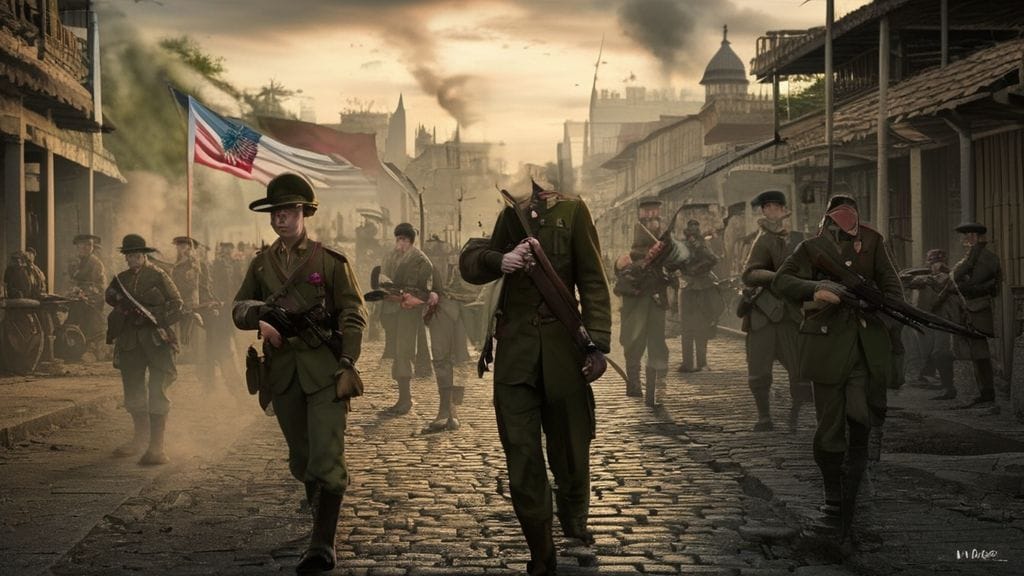
The sun slipped behind the low hills and church spires of Manila on February 4, 1899, leaving behind a sky stained with the last embers of a tropical sunset. The air was thick and damp, clinging to uniforms and rifle stocks, to the sweat-soaked shirts of American sentries and Filipino guards alike. Outside the walls of the old walled city of Intramuros, along a ragged, shifting front of trenches and outposts, men who had once eyed each other as uneasy allies now stared across the darkness as potential enemies. Before the night ended, the philippine american war begins—not with a formal declaration, not with the solemn ceremony of diplomats, but with confusion, fear, and a trigger pulled in the shadows.
On the American side of the lines, volunteer regiments from the American Midwest and Far West—raw recruits and veterans of the war with Spain—waited in the humid gloom. Many were barely out of their teens, hunched in shallow trenches, boots muddy, fingers wrapped around the cool metal of their rifles. Some whispered jokes, others cursed the mosquitoes, but behind the small talk lay an unspoken anxiety: why were they still in the Philippines months after Spain had surrendered? On the other side, Filipino soldiers of the fledgling First Philippine Republic, their uniforms mismatched but their purpose clear, watched the foreign troops with growing resentment. They had bled to oust Spain; they believed independence had been won. Now they watched a new flag fly over Manila.
By early 1899, the phrase “philippine american war begins” had not yet entered anyone’s vocabulary. To the Americans, there was not yet a war at all—only a tense occupation and, at worst, the possibility of “trouble” from what they sometimes called “insurgents.” To the Filipinos under Emilio Aguinaldo, however, war felt increasingly inevitable. Their capital at Malolos pulsed with revolutionary energy, but their fighters were hemmed in by American positions near the city they had hoped to reclaim as their own. The lines were so close in places that at night, sentries could hear each other cough, could smell each other’s tobacco.
As darkness fell that February evening, lanterns flickered in nipa huts and along narrow roads. In the district of Santa Mesa, in the area near the San Juan Bridge, the frontier between American and Filipino lines was poorly defined—a patchwork of posts, patrol routes, and misunderstandings. Patrol orders were clear yet fragile; one wrong turn, one frightened sentry, one misunderstood shout could unleash something neither side could recall. And as the hours ticked by, that fragile peace thinned. It would take only one sound—a crack of a rifle—to tear it apart.
The story of how the philippine american war begins on this night is not just the tale of a single bullet, a single frightened soldier, or a single misunderstanding in the dark. It is the culmination of years of upheaval, of empire in retreat and empire emerging, of promises made and broken, of two revolutions whose timelines fatally overlapped. Before that shot was fired, the war had already been seeded in negotiations in Paris, in proclamations in Manila, in debates in Washington, and in the hearts of Filipinos who believed that after three centuries under Spain, their time had finally come.
From Ally to Adversary: The Broken Promise of 1898
To understand why that February night became the moment the philippine american war begins, it is necessary to step back to 1898, when the word “ally” still had meaning between Americans and Filipinos. In the spring of that year, the United States and Spain were suddenly at war. The explosion of the USS Maine in Havana Harbor ignited a storm of outrage in the American press. “Remember the Maine! To hell with Spain!” newspapers shouted, and Washington, eager for a swift, victorious war, turned its gaze toward Spanish possessions across the globe.
In Asia, that meant the distant Philippine Islands, a Spanish colony for over three hundred years. There, a long-simmering Filipino revolution, already sparked in 1896, had been brutally repressed, then tentatively reborn. Leaders like Emilio Aguinaldo and Apolinario Mabini carried the scars of this first struggle. When American Commodore George Dewey sailed into Manila Bay on May 1, 1898, and shattered the Spanish fleet in a few hours of thunderous gunfire, Filipino revolutionaries saw in the United States not a future conqueror, but a potential liberator and partner.
In Hong Kong and elsewhere, talks took place between American officials and Aguinaldo. The details remain contested—exact words lost in translation, layers of assumption and hope piled atop one another—but the thrust was clear to Aguinaldo and his followers: the Americans would aid the Filipinos against Spain, and in return, independence would follow. Aguinaldo returned to the islands in May 1898 with American assistance, greeted as a hero by Filipinos who believed the long Spanish nightmare was ending in freedom.
For a time, the two forces fought side by side. Filipino troops, organized under the banner of the new revolutionary army, tightened the noose around Spanish garrisons on land, while American warships ruled the bay. Filipino units swarmed through the countryside, liberating town after town, raising their flag and organizing local revolutionary governments. The air buzzed with the language of nationhood: constitution, republic, independence.
Yet even as they cooperated militarily, a profound disconnect simmered between American commanders and their Filipino counterparts. Where Aguinaldo saw a shared anti-colonial struggle, American leaders increasingly viewed Filipinos as convenient auxiliaries in a war whose real prize was control of the archipelago itself. Private letters and newspaper editorials in the United States spoke of “tutelage,” “civilizing missions,” and “commercial opportunities”—words that Filipinos did not yet hear but that shaped decisions being made far from Manila.
The summer of 1898 planted the first seeds of betrayal. In August, as Spanish power in Manila crumbled, American and Spanish commanders quietly arranged a mock battle for the city, an event known as the “Battle of Manila” but orchestrated more as theater than genuine combat. Filipino troops, who had done so much to isolate the city, were deliberately kept outside its defenses during the final assault. When the Spanish governor finally agreed to surrender, it was to the Americans alone. Filipino officers, stunned and angered, watched from the outskirts as the flag of the United States rose over the city they had longed to claim as their own capital.
Rumors and resentment spread swiftly through Filipino ranks. They had been barred from entering the city they had encircled. American military authorities, now in possession of Manila, treated the revolutionary government based in nearby Malolos as, at best, an awkward reality to be managed, not a sovereign power to be recognized. Even so, Filipino leaders clung to hope. Perhaps, they reasoned, once the formal war with Spain concluded, once peace was signed, the Americans would keep their supposed promise.
But in the winter of 1898, in Paris, diplomats from Spain and the United States negotiated a treaty that gave Spain’s empire in the Pacific and Caribbean to Washington for a price—twenty million dollars for the Philippines alone. No Filipino representative was allowed in the room. When word of the Treaty of Paris reached the archipelago, the revolution’s most idealistic supporters felt a chill. On paper, their homeland had simply changed owners. And as the treaty moved toward ratification in the U.S. Senate, it became increasingly clear that the stage was being set for a new conflict. In that sense, even before the first shot on February 4, the philippine american war begins in the realm of diplomacy and deception, not only on the battlefield.
Empires in Transition: Spain’s Collapse and America’s Ascent
The year 1898 marked a turning point in global history, a hinge upon which empires swung. Spain, once the dominant Catholic empire of the early modern world, staggered under internal decay, economic weakness, and colonial unrest. The loss of Cuba, Puerto Rico, Guam, and the Philippines in a single brief conflict signaled the end of an era. But for the United States, the same year marked an unexpected ascent into the ranks of overseas powers. When the philippine american war begins less than a year later, it is intertwined with this dramatic reconfiguration of imperial power.
In Washington, debates about the future of the Philippines were fierce. Some politicians and intellectuals argued that to abandon the islands after defeating Spain would be both strategically foolish and morally irresponsible. They framed their arguments in the language of uplift and progress, describing Filipinos as “child races” in need of guidance. Others, such as members of the American Anti-Imperialist League—among them figures like Mark Twain and former President Grover Cleveland—denounced the acquisition as a betrayal of American republican ideals, a step away from liberty and toward empire.
Yet strategic considerations carried enormous weight. The Philippines, with their deep harbors and proximity to China, were envisioned as a crucial gateway to Asian markets. Military planners saw in Manila Bay a future naval strongpoint, a coaling station for an ambitious U.S. fleet. This convergence of strategic interests and racialized ideologies turned the islands into something more than a postscript to a war with Spain. They became central to a new vision of America’s role in the world.
Spain’s collapse thus opened a vacuum that the United States rushed to fill. In the minds of many American policymakers, the question was not whether they would control the Philippines, but how. Would it be direct colonial rule? Some form of protectorate? A gradual pathway to self-government under American tutelage? What was conspicuously absent from most of these conversations was any presumption that Filipinos themselves might already possess the capacity—and the right—to rule their own land.
This imperial mindset clashed directly with the revolutionary ideology emerging from Malolos, where Aguinaldo’s government painstakingly drafted a constitution and arranged the trappings of a modern republic. To Filipino nationalists, their revolution was not a local disturbance but part of a global wave of people casting off colonial rule. To many Americans in positions of power, by contrast, the islands were territories to be managed, populations to be guided, and resources to be tapped. It is within this collision of worldviews that the philippine american war begins to shimmer on the horizon, an almost inevitable outcome of incompatible ambitions.
By the time Spanish diplomats in Paris agreed to sell the Philippines to the United States, the writing was on the wall. Spain was exiting as an imperial landlord; America was arriving as the new one. In this global drama, the Filipino revolutionaries were treated as incidental figures—useful insurgents during wartime, inconvenient nationalists in peacetime. The terms of the Treaty of Paris, concluded on December 10, 1898, set the legal foundation upon which American sovereignty over the islands would be built. But the treaty’s ratification in February 1899 would take place under the shadow of events already unfolding around Manila—as the philippine american war begins in earnest.
A Revolutionary Republic in Waiting: Aguinaldo and the Hope of Independence
North of Manila, in the town of Malolos, the air carried a different energy in late 1898 and early 1899. Here, the revolutionary leadership gathered in wooden halls lit by oil lamps, drafting documents that would, they hoped, solidify a new nation. On January 23, 1899, the Malolos Constitution was promulgated, and the First Philippine Republic was formally proclaimed. Emilio Aguinaldo, a young leader barely in his thirties, became its president.
In the clay streets and churches adorned with hastily sewn flags, there was an almost palpable sense of rebirth. Local officials took oaths, courts began to function, and newspapers championed the language of liberty. Aguinaldo’s cabinet included intellectuals and reformers who had long dreamed of an end to Spanish rule. Influenced by liberal ideas from Europe and Latin America, they imagined the Philippines as a modern constitutional republic, multiethnic but united, Catholic yet tolerant, rooted in Filipino culture but conversant with global ideas.
Yet even as they proclaimed their republic, they knew their survival depended on forces beyond their control. Madrid had lost the will and capacity to reconquer the islands, but Washington held the power to either recognize or crush the new state. Aguinaldo’s government sent letters, proclamations, and envoys to the Americans, hoping to secure some form of acknowledgment, or at least a negotiation of terms. Instead, they encountered ambiguity, delay, and a growing sense of condescension.
On the ground, Filipino and American forces stood uncomfortably close to each other. Filipino troops ringed Manila, holding positions in towns and suburbs, while Americans occupied the city and its immediate environs. Negotiations over demarcation lines faltered. Each side accused the other of encroachment. Skirmishes flared occasionally but were contained. Tension became the daily weather of life along the front—never quite war, never quite peace.
Meanwhile, Aguinaldo felt compelled to project confidence to his people. Newspapers in the revolutionary zone spoke optimistically of eventual American recognition. Public speeches emphasized friendship between the two republics, drawing parallels between the American Revolution and the Filipino struggle against Spain. Yet privately, some advisers warned that the United States was moving inexorably toward outright annexation. As American troops continued to arrive, as new regiments marched through Manila’s streets, the mismatch between Filipino hopes and American plans widened into a dangerous gulf.
In this liminal moment, the philippine american war begins to take shape in the minds of Filipino officers who watched American fortifications grow stronger by the week. They trained their men, stockpiled weapons, and studied foreign military manuals, aware that if diplomacy failed, they would be forced into a conflict against a vastly better-equipped enemy. For them, the question was not if they would defend the republic, but when the final rupture would come—and who, in the flickering darkness, would fire the shot that history would remember.
On the Edge of War: Tension in the Trenches around Manila
By January 1899, the regions surrounding Manila had settled into a fragile and dangerous routine. The city itself, now under American control, buzzed with the activities of an occupying army—drills, patrols, watch rotations, and the construction of defensive works. Just beyond its edges, Filipino trenches and outposts carved shallow scars into the earth. In some places, the opposing lines were less than a few hundred meters apart, separated by roads, rice paddies, and thickets of bamboo.
American soldiers, many volunteers from states like Nebraska, Kansas, and Colorado, found themselves in an unfamiliar environment. They sweated through their woolen uniforms, battled disease, and tried to interpret orders that were often vague about the emerging political stakes. Their letters home, later collected by historians, reveal a mixture of boredom, prejudice, curiosity, and unease. Some saw Filipinos as potential friends, others as “little brown brothers,” still others as barely human “savages”—a vocabulary that would soon make violence easier to justify.
Across the way, Filipino troops were equally wary. They dug earthworks, manned sentry posts, and scavenged for scarce ammunition. Many were peasants recently turned soldiers, clutching Mausers, Remingtons, or whatever rifles they could procure. Officers of the young republic drilled them and tried to maintain discipline, but morale was pulled in contradictory directions. Hope for a peaceful settlement tugged against a rising tide of bitterness. The notion that their land might simply be transferred from one foreign master to another felt unbearable.
Friction points abounded. Roads used by both sides became zones of confrontation. A farmer passing between lines could be stopped and questioned by either army, fueling rumors of espionage. Misunderstandings over boundaries—whether a particular trench or tree line belonged to one side or the other—sparked shoves, shouted insults, sometimes warning shots fired into the air. Officers on both sides anxiously tried to restrain hotheaded men from escalating minor incidents into full-scale clashes.
Yet the structural forces pushing toward war were stronger than any single captain’s patience. In Manila, American commanders received instructions from Washington that increasingly assumed U.S. sovereignty over the entire archipelago. In Malolos, Aguinaldo’s government issued orders to consolidate positions, prepare for resistance, and hold firm in the face of American encroachment. Each side suspected the other of bad faith. Each interpreted every movement of troops, every rumor, as confirmation of their worst fears.
In late January, efforts to negotiate clear demarcation lines failed. Reports circulated of Americans expanding their patrols and Filipinos reinforcing their forward positions. Nervous sentries tried to distinguish between routine noises in the night and potential infiltrations. In such a charged atmosphere, the idea that the philippine american war begins with a simple misunderstanding does not trivialize the conflict; rather, it underscores how taut the lines had become. A shouted halt not understood, a startled reaction, or a trigger squeezed too quickly could unleash the pent-up violence of months of distrust.
The Shot on the San Juan Bridge: How the Philippine–American War Begins in Fire
The moment the philippine american war begins has been retold countless times, often with slight variations, shaped by memory, politics, and the fog of war. The most widely accepted narrative centers on an encounter near the boundary between American-occupied Manila and Filipino-held territory, close to the San Juan Bridge, on the night of February 4, 1899.
Private William Grayson, a soldier of the Nebraska Volunteers, stood on sentry duty that night. The darkness was thick, the kind that seemed to swallow even the flicker of lanterns along the road. Sometime around eight o’clock, he saw figures approaching along the path. According to later accounts, Grayson called out a challenge—some say “Halt! Who goes there?”—but the figures continued to advance, perhaps not understanding English, perhaps uncertain about what was being asked of them.
Grayson raised his rifle. The distance closed: thirty yards, twenty, ten. In his recollection, the figures—Filipino soldiers or scouts—did not stop. Fear and training converged. He fired. Another American soldier beside him fired as well. One or more of the approaching men fell; the others scrambled back into the darkness. In that sharp, echoing crack of gunfire, the philippine american war begins in the most literal, audible sense. Within minutes, nearby American outposts, hearing the shots, went on alert. Filipino positions, in turn, saw muzzle flashes and responded with their own volleys.
What had happened in those few seconds remains partly veiled. Filipino accounts suggest their men had not intended to provoke a fight, that they were merely moving within what they believed to be their own lines. Some historians have proposed that neither side truly wanted war that night, but that local tensions and miscommunications made some kind of clash almost unavoidable. One Filipino officer later lamented that “a farmer could have stepped wrong and begun it.” Whether or not that is strictly true, the effect was the same: a chain reaction of fire and fear.
Once the first exchange erupted, restraint collapsed. American units along the perimeter, primed by weeks of anxiety, opened fire on suspected Filipino positions. Filipino trenches and blockhouses answered with their own fusillades. Bullets hissed through palm fronds, slammed into wooden huts, and tore through the night sky. Villagers huddled on their floors as the sound of war roared past their doors, many not yet aware that history would later say: this is when the philippine american war begins.
American commanders swiftly interpreted the clash as a coordinated attack by Filipino forces, a justification for unleashing their full firepower. Orders went out to advance along key roads and drive back the supposedly aggressive “insurgents.” On the Filipino side, officers scrambled to understand what had happened. Some rushed to restrain their men, hoping to avoid an all-out conflict while negotiations were still theoretically possible. Others, seeing the American volleys as confirmation of hostile intent, urged counterattacks.
The San Juan Bridge and its surroundings, an unremarkable patch of earth on most days, became that night the symbolic ground zero of a new war. The darkness hid faces and expressions, but the sound of rifles and the panicked shouts of men in multiple languages made one thing unmistakable: the uneasy peace was over. By dawn, the world would wake to headlines and telegrams announcing that the Philippines had erupted into open conflict with the United States. The brief period when the future of the islands could still plausibly have unfolded without another bloody struggle had ended in the staccato echo of a sentry’s shot.
A City Awakens in Panic: Night Fighting and the Siege of Manila
As the first shots spread along the perimeter, Manila itself stirred and then shuddered awake. In the mixed streets of the city—Spanish mansions, Chinese shops, Filipino homes, American barracks—people jolted from sleep to the unmistakable sound of sustained gunfire. Dogs barked, church bells clanged, and soldiers scrambled to their stations. Within an hour of that first deadly encounter, entire sections of the American defensive line were engaged.
In the districts of Santa Mesa, Pandacan, and along the Caloocan road, barrages of rifle and artillery fire rumbled through the night. American officers, fearing a general assault, ordered their men to hold their positions at all costs. Ammunition crates were cracked open, and the dark sky erupted in flickers of orange and white. The rumble of U.S. field artillery, positioned to defend key approaches to the city, added a deeper, more ominous thunder to the cacophony.
Filipino forces, taken by surprise, scrambled to respond. Some units had assumed that any outbreak of large-scale hostilities would be preceded by clear orders from Malolos. Instead, they heard the war begin as a night of chaos. Officers ran from trench to trench, rallying their men, trying to form coherent lines in the darkness. In a few sectors, Filipino fighters attempted to push forward, probing American positions, testing their strength. In others, they chose to hold their ground, firing from entrenched positions to slow any American advance.
Civilians bore the terror in silence and screams. Families ducked beneath windows, children cried as bullets splintered wooden shutters, and candles were snuffed to avoid drawing fire. Some households gathered rosaries, praying that the Virgin Mary might shield their homes from stray rounds. In the districts closest to the fighting, fires broke out as embers from burning buildings drifted on the night wind. Shadows flickered across walls while the roar of battle seemed to draw ever nearer.
Inside American headquarters, a narrative rapidly took shape. Reports from the front filtered in periodically, framed by the belief that the Filipinos had launched a premeditated assault. This framing would matter. Once the conflict was presented to Washington and the American public as an “attack on our troops,” the mental space for compromise narrowed. For Aguinaldo’s government, still digesting news of the outbreak, it was clear that once the philippine american war begins in this manner—amid accusations and counteraccusations—it would be extremely difficult to persuade Americans that Filipinos were legitimate belligerents rather than rebellious subjects.
By dawn on February 5, the first contours of the new war were visible. American forces, having held their lines through the night, prepared to counterattack. Filipino units, many exhausted and under-supplied, awaited orders from Malolos. Smoke hung over the northern and eastern outskirts of Manila. The once-cooperative coexistence of two armies had collapsed. In its place stood a city poised at the center of a storm that would, over the next months and years, pull in villages and islands far beyond its walls.
Proclamations, Rhetoric, and Denial: Washington and Malolos React
News of the night’s fighting traveled quickly—by telegraph wires from Manila to Hong Kong and on to Washington, by couriers rushing between outposts and Malolos, by rumor in the markets and by headlines in newspapers. As the first official reports arrived, the narrative battle over what had happened began almost as quickly as the military one.
In Manila, American commanders framed the outbreak as an unprovoked attack by Filipino forces on lawful U.S. occupation troops. General Elwell Otis, the American military governor, composed dispatches emphasizing American restraint and Filipino aggression. This was more than a simple interpretation; it was a political strategy. If the conflict could be depicted as defensive on America’s part, it would bolster support for a firm response and blunt criticisms from anti-imperialists back home.
Emilio Aguinaldo, for his part, moved to present a starkly different picture. In proclamations from Malolos, he insisted that Filipino forces had not intended to start a war and that they had been attacked by American troops encroaching on their lines. He pointed to months of provocation, the exclusion of Filipinos from Manila’s final surrender, and the terms of the Treaty of Paris as evidence that the United States had already decided to deny Philippine independence. For Aguinaldo, the night of February 4 was the moment when the mask fell from American policy.
Within days, President William McKinley in Washington addressed the conflict in a tone of grave necessity. He spoke of the duty to “suppress insurrection” and to maintain order in the newly acquired territories, reinforcing the view that Filipino sovereignty was a legal impossibility now that Spain had ceded the archipelago. The phrase “benevolent assimilation,” coined weeks earlier to describe the American agenda in the Philippines, now stood in stark and chilling contrast to the reports of bloody engagements around Manila.
American newspapers mostly rallied around the official line. Sensationalist headlines decried the “treachery” of the “insurgents” who had dared to fire on American soldiers. Some columns openly used dehumanizing language to describe Filipinos, making it easier for readers to accept the idea of a prolonged war thousands of miles from home. Yet there were dissenting voices. The New York Evening Post and other anti-imperialist outlets questioned whether the United States was, in fact, becoming the new Spain. Mark Twain, soon to become one of the war’s most eloquent critics, would later write that America had gone to the Philippines “to conquer, not to redeem.”
In Malolos, the mood mixed outrage with grim determination. Revolutionary leaders read American proclamations with a sense of bitter vindication: their worst suspicions were confirmed. They began to frame the conflict not as a civil disturbance against a legitimate sovereign, but as a continuation of their anti-colonial revolution—the same struggle, now against a different flag. Filipino pamphlets and articles urged the people to see that the philippine american war begins not as a mere misunderstanding at a bridge, but as the latest chapter in a long fight for national dignity.
The gap between these two narratives—insurrection versus independence struggle—would define how the war was waged and remembered. In military terms, the battle lines were forming around rivers, roads, and ridges. In political and moral terms, they were forming around words, symbols, and stories that would echo long after the guns fell silent.
The War Spreads beyond the Capital: Battles, Towns, and Burning Villages
Once fired, war rarely stays confined. In the weeks and months after February 4, combat spread outward from Manila like ripples from a stone thrown into water. American forces, enjoying superior numbers, firepower, and organization, launched offensives northward toward Caloocan and Malolos, and southward into the provinces of Laguna and Cavite. Filipino troops, organized in regional commands, tried to mount conventional resistance, holding positions, launching counterattacks, and then falling back under punishing U.S. artillery barrages.
The early battles were brutal but uneven. At Caloocan, north of Manila, American troops stormed Filipino entrenchments with coordinated infantry advances and naval gunfire from ships off the coast. Filipino ranks broke under the weight of this onslaught, and the town fell, leaving in its wake burned houses, scattered bodies, and displaced civilians. Similar patterns repeated in other engagements: Filipinos fought valiantly, sometimes inflicting significant casualties, but the disparity in matériel and logistical support took its toll.
Villages caught in the path of advancing columns often fared worst. American soldiers, frustrated by elusive enemies who melted away into the countryside, sometimes took out their anger on the built environment. Huts suspected of harboring fighters were burned. Rice stores were seized or destroyed. Civilians were interrogated harshly, their loyalties always suspect in the eyes of an occupying army. In more than one town, the smoke of burning homes rose as a grim signal of what it meant to live on the fault line between empires.
For Filipino fighters, the hope of matching American forces in open battle dwindled. Yet even as they suffered defeats, they learned. Commanders observed which tactics caused the heaviest American casualties. They noted the vulnerabilities of small patrols, the blind spots of large columns moving through jungle paths and rice paddies. Bit by bit, a shift occurred—from conventional battle lines and set-piece engagements toward guerrilla tactics that exploited local terrain and popular support.
Still, in the first year of the conflict, battles around towns and transport routes remained crucial. Control of rail lines and roads meant the ability to move troops and supplies; control of towns meant a semblance of governance and symbolic authority. American occupation forces planted flags in municipality after municipality, while Filipino revolutionaries slipped into the hills, vowing to return. “We lose towns, but we do not lose the nation,” one officer reportedly told his men, capturing the determination that undergirded their retreat.
The war that had begun near the San Juan Bridge now engulfed provinces whose inhabitants had only vaguely heard of the first night’s shots. For a farmer in Bulacan or a fisherman in Laguna, the philippine american war begins the moment armed men from either side marched into their barrio, demanded support, or turned their fields into camps. In that sense, the “beginning” of the war was an ongoing phenomenon, arriving in waves, village by village, as the front lines shifted.
Transformation into a Guerrilla Struggle: When Open Battle Fades
By late 1899 and into 1900, the nature of the conflict changed. Early in the war, Filipino leaders had tried to oppose the Americans with regular armies—lines of troops, formal command structures, battles fought over towns and trenches. This strategy, while honorable and comprehensible in the conventions of the time, proved increasingly unsustainable against a better-equipped adversary. Gradually, Aguinaldo and his generals turned to guerrilla warfare, a style of fighting more attuned to their strengths and to the geography of the archipelago.
In the dense forests of Luzon, among the sugarcane fields of the Visayas, and in the mountainous interior regions, small bands of Filipino fighters adopted hit-and-run tactics. They ambushed patrols, sabotaged telegraph lines, and struck supply convoys, then vanished into landscapes they knew intimately. Civilians provided information, food, and shelter—often out of conviction, sometimes out of fear, sometimes both. The war became more diffuse, less visible to the outside world, but no less deadly.
For American troops, this shift was bewildering and enraging. Accustomed to thinking in terms of clear front lines and decisive battles, they now faced an enemy who did not always wear uniforms, who blended into the villages by day and acted as combatants by night. In some areas, any Filipino male of fighting age was suspected of being a guerrilla. This suspicion poisoned everyday interactions, turning every roadside conversation, every market encounter, into a potential battlefield.
The U.S. military adjusted with a combination of innovation and harshness. They created “flying columns” of mobile troops to chase guerrillas, established outposts in contested regions, and instituted systems of passes and identification. More troublingly, they embraced punitive tactics: the burning of villages, the destruction of crops, the establishment of “zones of protection” in which civilians were forced into camps to separate them from guerrillas. On some islands, such as Samar, these methods reached terrifying extremes, with officers like General Jacob H. Smith reportedly ordering their men to turn the island into a “howling wilderness.”
Guerrilla warfare also demanded sacrifices from Filipino fighters and civilians. Living on the run, constantly hunted, the guerrillas endured hunger, disease, and the risk of betrayal. The lines between civilian and combatant blurred, making everyone more vulnerable to retaliation. Yet for many Filipinos, this form of struggle was a return to traditions of local resistance honed during centuries of Spanish rule—banditry and rebellion recast as nationalist warfare. The continued fight, even in the face of mounting odds, testified to the depth of their desire for independence.
When historians look back and say that the philippine american war begins in February 1899 as a conventional conflict and ends years later as a guerrilla war, they are capturing this evolution in broad strokes. On the ground, however, the shift felt less like a clear demarcation and more like a gradual darkening, as the war seeped deeper into the fabric of everyday life, making heroism and atrocity equally likely in the next unremarkable village along the road.
The Human Cost: Civilians between Two Flags
Wars are often narrated through generals and presidents, through treaties and troop movements. Yet the people who most fully absorbed the impact of the war that began that February night were those who had no say in its coming: the civilians. In the Philippine–American War, they bore the brunt of displacement, hunger, disease, and violence that stretched far beyond the battlefield.
Exact numbers are difficult to establish, but historians estimate that hundreds of thousands of Filipinos—perhaps as many as 200,000 or more—died from a combination of combat, famine, and epidemic disease during the course of the conflict. Many of these deaths were indirect: crops destroyed in scorched-earth operations left communities without food; the concentration of villagers into “protected zones” created breeding grounds for cholera and other diseases; the stress of constant displacement weakened bodies already worn down by years of Spanish misrule and revolutionary upheaval.
In town after town, families faced wrenching choices. When an American column approached, some fled to the hills, fearing reprisals; others stayed, hoping that cooperation would spare them. Guerrillas, in need of supplies and shelter, sometimes punished those they believed too accommodating to the Americans. Meanwhile, American officers, desperate to break the guerrillas’ support networks, often treated villages as extensions of the hostile forces they were trying to defeat. Civilians found themselves pulled between two flags, with little room for neutrality.
The war also upended social structures. Local elites—principales and landowners—calculated how best to preserve their status, sometimes aligning with American authorities, sometimes supporting the revolution, sometimes trying to stand with one foot in each camp. Priests, teachers, and shopkeepers faced their own dilemmas, torn between community obligations and the demands of occupying or passing armies. Women, in particular, carried an immense burden: keeping families alive, protecting children, and sometimes acting as couriers or spies for the resistance, all while facing the threat of sexual violence from soldiers on either side.
Amid this suffering, moments of quiet courage and humanity still surfaced. American doctors treated Filipino patients in makeshift clinics, sometimes saving lives that war had imperiled. Filipino villagers risked execution to hide wounded guerrillas or even wounded American soldiers, guided by personal moral codes that transcended national lines. In diaries and letters, both American and Filipino voices occasionally expressed horror at what they witnessed. As one American private wrote, “If this is benevolence, I shudder to think what malice looks like.”
In the urban and rural spaces alike, the philippine american war begins each day anew wherever its consequences are felt most acutely—not only at the moment of first gunfire near Manila, but every time a mother searches in vain for food, every time a family returns to the ashes of its home, every time a village mourns its dead. These experiences, often undocumented and unremembered, form the true human ledger of the war.
Race, Empire, and the American Conscience
Behind the military events that began with that February night lay a set of ideas that both justified and challenged the expansion of American power. Race and empire were central to how many Americans understood the conflict. The language used to describe Filipinos in newspapers, speeches, and even official documents reveals a worldview that made colonial rule appear not only acceptable but, to some, morally necessary.
Pro-annexation voices frequently described Filipinos as “uncivilized,” “barbarous,” or “unfit” for self-government. Although there were certainly educated and cosmopolitan Filipino elites, American commentators often portrayed the entire population as backward, childlike, and needing guidance. This racialized framing dovetailed with the era’s broader currents of Social Darwinism—the belief that stronger races and nations had the right, even the duty, to dominate weaker ones. Under such logic, when the philippine american war begins, it can be presented as a burdensome but noble task undertaken by a mature republic for the sake of a “less developed” people.
Yet not all Americans accepted this justification. The Anti-Imperialist League, formed in 1898, brought together an unlikely coalition of businessmen, labor leaders, intellectuals, and religious figures. They argued that ruling the Philippines without the consent of its inhabitants violated the core principles of the American Revolution. In speeches and pamphlets, they asked how a nation founded on “no taxation without representation” could impose rule by force on distant islands. Mark Twain, in a famous essay, imagined the American flag “with the white stripes painted black and the stars replaced by the skull and crossbones” to symbolize the transformation he saw in U.S. policy.
Within the military itself, attitudes varied. Some officers and enlisted men adopted the era’s racist tropes wholeheartedly. Others, through contact with Filipino communities, developed more nuanced views, recognizing intelligence, bravery, and organizational skill in their adversaries. Still others were simply swept along, their primary concern survival rather than ideological clarity. Letters from soldiers occasionally reveal cognitive dissonance: pride in serving one’s country mingled with nagging doubts about the nature of the mission.
The debate over empire forced Americans to confront uncomfortable questions: Could the United States be both a republic and an empire? Could it extol liberty at home while denying it abroad? Did racial hierarchies justify the suspension of those ideals in certain places? The Philippine conflict made these issues impossible to ignore. As one contemporary critic observed, “The day the philippine american war begins is the day America must choose whether its flag stands for all men or only for some.”
These questions would not be resolved quickly. They would resurface in later conflicts—in the Caribbean, in Central America, in Vietnam—each time echoing the choices made when the United States first grappled with the responsibilities and temptations of overseas empire in the Philippines.
Letters, Diaries, and Voices from the Archipelago
Beyond official reports and grand speeches, the Philippine–American War lives most vividly in the personal testimonies of those who experienced it firsthand. Diaries, letters, memoirs, and oral histories open windows into the fears and hopes, the prejudices and revelations, that shaped daily life as the war unfolded from that first shot in Manila.
American soldiers wrote to families in Iowa, Ohio, or Massachusetts trying to explain why they were in a place most of their relatives could barely find on a map. Some described the beauty of the landscape—the palm trees, the rice fields shimmering under the sun—and the strangeness of tropical storms. Others focused on the danger and the moral ambiguity of their tasks. One corporal recounted, “We advanced on a village that our captain said harbored insurrectos. We found mostly women and children. Orders were to burn the huts. I did as I was told, but I have not slept well since.” Such testimonies complicate any simplistic view of the American soldier as either pure villain or pure hero.
Filipino accounts, sometimes penned years later, record a different set of emotions. Revolutionaries remembered the exhilaration of the early days when they believed the end of Spanish rule would bring true freedom, and the crushing disappointment when they realized one empire was simply being replaced by another. A veteran of Aguinaldo’s army, interviewed decades later, recalled hearing that the philippine american war begins near Manila: “We had waited, prayed that the Americans would see the justice of our cause. When we heard the first volleys, we knew that God had chosen a harder road for us.”
Civilians, too, left traces of their experiences. Parish records noted spikes in burials during periods of intense fighting or epidemic outbreaks. Schoolteachers kept sparse journals describing classes interrupted by the arrival of soldiers or the flight of families into the hills. Merchants wrote in their account books of sudden losses as warehouses were looted or destroyed, margins between profits and starvation erased by the march of armies.
Perhaps the most poignant voices belong to those who straddled cultural divides. Filipino students educated in Spanish and beginning to learn English sometimes found themselves interpreting between American officers and local villagers, caught between loyalty to their homeland and curiosity about the world the Americans represented. Missionaries, both American and Filipino, wrestled with the tension between the gospel of peace they preached and the violence around them. In one published missionary letter, a writer asked, “How do we speak of Christ’s love while bullets fly from men wearing the same flag that sponsors our mission?”
These scattered voices, when gathered together, form a chorus that enriches our understanding of why and how the war that began on February 4 unfolded as it did. They remind us that history is not only the story of states and armies but of ordinary people facing extraordinary circumstances—people who heard, in their own ears, the moment the philippine american war begins and had to decide, in that instant and in all the days that followed, how to live with it.
Diplomacy, Silence, and Global Reactions to a New Empire
While rifles cracked in Luzon’s fields and forests, diplomacy unfolded in quieter, carpeted rooms across the world. Other imperial powers watched closely as the United States assumed control over the Philippines. In London, Berlin, and Tokyo, governments evaluated the implications of a new player asserting itself in Asia. Some welcomed the distraction from their own colonial ambitions; others saw a rival or potential partner emerging in the region.
European responses tended to be pragmatic. Britain, with vast interests across Asia, was inclined to view American expansion as a stabilizing factor against other European rivals. Germany, nursing its own imperial aspirations in the Pacific, weighed the possibility of future friction. None of these powers, however, were likely to champion Filipino independence. Recognizing the First Philippine Republic would have risked undercutting their own claims to colonial rule elsewhere.
In Asia, the situation was more complex. Japan, then rising as a regional power after its victory over China in 1895, watched the U.S. move into the Philippines with a mixture of caution and calculation. A new Western navy based in Manila might challenge Japanese influence, but it also rebalanced the colonial presence in ways that might be advantageous against traditional European rivals. For China, weakened by internal strife and external pressures, the change in masters in the Philippines was yet another sign of foreign encroachment along its maritime periphery.
Within the Catholic Church, reactions were equally layered. Spanish friars who had long dominated religious life in the Philippines faced expulsion or marginalization under American rule, especially as Filipino nationalist sentiment targeted them as symbols of Spanish oppression. At the same time, American Protestant missions saw the war as an opening for evangelization, even as some missionaries denounced the violence. Vatican diplomats monitored the situation but largely refrained from overtly challenging the new American administration, cautious not to jeopardize Catholic institutions that might survive under U.S. governance.
One historian has observed that “the philippine american war begins in relative diplomatic silence,” and there is truth in that. Unlike the struggles for independence in Latin America earlier in the century, which had eventually garnered recognition from other states, the Filipino fight against the United States found few advocates among governments. Moral sympathy existed in scattered quarters, but political calculation prevailed. The global order of 1900 was built on empire, not on the recognition of small, newly declared republics, especially when their existence clashed with the interests of powerful states.
Yet the conflict did resonate in transnational networks of activists, journalists, and thinkers. Anti-colonial intellectuals in India, Egypt, and elsewhere read about the Philippine war and drew parallels to their own situations. Some newspapers in Asia and Latin America expressed cautious admiration for Filipino resistance. In small but significant ways, the story of how the philippine american war begins and continues seeped into a broader global discourse about imperialism and national self-determination—foreshadowing the great waves of decolonization that would transform the twentieth century.
Ending the War without Ending the Struggle
Wars rarely end as neatly as they begin. If the narrative of the Philippine–American War has a clear starting point in the shots fired near Manila on February 4, 1899, its ending is diffuse, stretched out over years of surrenders, proclamations, and lingering resistance. Officially, the United States declared the conflict over in 1902, after capturing Emilio Aguinaldo in 1901 and securing the surrender of many Filipino commanders. But on the ground, in scattered pockets of the archipelago, fighting and unrest persisted beyond that date.
Aguinaldo’s capture was a psychological and political blow. In March 1901, he was taken prisoner in Palanan, Isabela, after a daring operation in which American forces infiltrated his camp using deception and local collaborators. Brought to Manila, he eventually swore allegiance to the United States, a move that dismayed some of his followers but reflected the harsh reality he faced. With their president in custody and their forces fragmented, many revolutionaries concluded that further large-scale resistance would bring only more suffering.
American authorities, meanwhile, moved to consolidate their rule. They established a civil government, headed by William Howard Taft as the first civilian governor-general. Taft and his successors presented their policies as a gradual preparation for self-government, building schools, roads, and administrative structures. The policy of “benevolent assimilation” sought to justify the earlier violence as a necessary prelude to a supposedly enlightened colonial administration.
Yet the memory of how the philippine american war begins, and of all that had followed, could not be erased by schools and roads alone. In many Filipino hearts, the war had revealed not only American might but also the limits of American ideals. While some local elites cooperated with the new regime, others nursed quiet resentment. Regional revolts and banditry, some with political overtones, persisted, particularly in remote areas. In the Muslim-majority regions of Mindanao and the Sulu Archipelago, resistance to both Spanish and American rule took on its own distinct character, rooted in religious and cultural autonomy.
Over the following decades, the U.S. gradually introduced forums for limited Filipino participation in governance: legislative assemblies, local elections, and, eventually, the promise of independence. The Jones Act of 1916 declared that U.S. policy was to grant independence “as soon as a stable government can be established,” and the Tydings–McDuffie Act of 1934 set a timetable for eventual sovereignty. In 1946, after the devastation of World War II and the Japanese occupation of the Philippines, the Republic of the Philippines finally achieved recognized independence.
But the path from the San Juan Bridge to July 4, 1946, was not a straight line of progress. It was marked by compromises, inequalities, and the imprint of a colonial relationship that outlasted formal warfare. Economic structures favored American interests; military bases anchored U.S. strategic presence in the region for decades. Filipino political life, shaped in part by institutions established under American rule, carried forward both the strengths and distortions of that experience.
Thus, while the Philippine–American War can be said to end in a formal sense in the early years of the twentieth century, the struggle it represented—between empire and self-determination, between lofty rhetoric and raw power—continued in other forms. The moment the philippine american war begins is not simply a footnote in history; it is the opening of a chapter whose themes would recur in Philippine–American relations for generations.
Memory, Monuments, and the Long Shadow of February 4, 1899
Today, the events of that February evening in 1899 occupy a complex place in the collective memories of both nations. In the Philippines, the war against the United States is sometimes overshadowed by the earlier struggle against Spain and the later trauma of Japanese occupation during World War II. Yet for historians and for communities whose ancestors fought and died in those years, the war remains a vital, if sometimes underappreciated, chapter in the narrative of national identity.
Monuments and markers dot the Philippine landscape, commemorating key battles and heroes. Streets are named after Aguinaldo, Mabini, Luna, and countless others. In some locales, small plaques or statues mark where local units resisted American advances, where civilians were massacred, where villages rose or fell in the tide of war. School textbooks recount the basic storyline: the revolution against Spain, the arrival of the Americans, the outbreak of conflict, and the eventual establishment of American colonial rule. Yet the degree of emphasis varies, and not all curricula dwell in detail on the cruelties and complexities of the Philippine–American War.
In the United States, the war sits uneasily in historical consciousness. It is often overshadowed by the Spanish–American War that preceded it and by the much larger global conflicts of the twentieth century. Many American students can recall the slogan “Remember the Maine,” but fewer know the names of places like Samar or Balangiga. The very phrase “philippine american war begins” appears far less frequently in public memory than comparable phrases like “the Civil War begins” or “World War I begins.” This relative obscurity reflects, in part, an uneasiness about a war that challenges America’s self-image as a purely anti-colonial republic.
Nonetheless, scholars and activists have worked to restore the war to its proper place in historical narratives. Academic studies have examined its military, political, and cultural dimensions. Museums and exhibitions have displayed artifacts—rifles, uniforms, letters, photographs—that bring the period to life. In some cases, joint Philippine–American projects have sought to foster a more nuanced understanding, acknowledging both the violence and the subsequent, complicated partnership between the two countries.
Certain anniversaries have prompted renewed reflection. On centennial commemorations, for instance, essays and symposia revisited the question of when exactly the philippine american war begins and what that beginning signifies. Does it mark the birth of the modern Philippine nation, hardened by the test of two colonial powers? Does it mark the moment America crossed a threshold from continental power to global empire? Or is it, perhaps, both at once—a hinge in the histories of two nations whose fates became entangled that night near Manila?
Memory is never static. As new generations confront contemporary issues of sovereignty, migration, and military alliances, they reinterpret the past. Filipinos who work in or migrate to the United States carry with them family stories that reach back, sometimes dimly, to the war. American veterans stationed at bases in the Philippines during the twentieth century stepped, often unknowingly, onto ground once contested by their predecessors and Filipino revolutionaries. Each encounter, each conversation, has the potential to reopen questions about what was begun in 1899 and how it continues to matter now.
In this way, the war that started with the crack of a rifle in the humid darkness of Manila has never entirely ended. Its echoes resound in the languages spoken, the legal frameworks adopted, the monuments built, and the silences maintained. The long shadow of February 4, 1899, stretches across more than a century, inviting both nations to remember—not to be trapped by the past, but to understand the depth of the roots from which their present relationship grows.
Conclusion
On a single night in February 1899, near the edge of a colonial city in transition, a frightened sentry fired at approaching figures in the dark. From that moment, conventionally marked as the point when the philippine american war begins, a chain of events unfolded that reshaped the destinies of both the Philippines and the United States. Yet as we have seen, the true origins of the conflict lay deeper—in diplomatic bargains struck without Filipino participation, in clashing visions of sovereignty, in racial ideologies and strategic ambitions that made peaceful coexistence ever more unlikely.
The war’s course, from open battles around Manila to the grueling years of guerrilla struggle, revealed the asymmetries of power and the resilience of a people determined to claim their own future. It left behind a landscape of grief: destroyed villages, shattered families, soldiers on both sides haunted by what they had done and endured. At the same time, it forced Americans to confront uncomfortable truths about empire and democracy, truths that would reverberate into later episodes of foreign intervention.
To trace the story from the night the first shots sounded to the eventual granting of Philippine independence is to move through a tapestry woven of courage and cruelty, of idealism and betrayal. It shows us that beginnings in history are rarely simple. The moment when the philippine american war begins is both a clear marker and the visible crest of deeper currents that had been flowing for years. Recognizing those currents—colonial legacies, economic desires, racial hierarchies—helps us see that what happened in Manila was not an accident in the dark, but the culmination of choices made in capitals and countrysides across oceans.
Today, as the Philippines and the United States continue to engage as allies, trading partners, and sometimes critics, the memory of this war offers a lens through which to examine questions of power, justice, and historical responsibility. It reminds us that alliances can be born in the aftermath of conflict, but also that the scars of that conflict do not simply vanish. To remember the Philippine–American War honestly is to acknowledge pain as well as progress, to honor those who fought for independence, and to reflect on how a republic dedicated to liberty navigated—and sometimes violated—its own professed ideals.
History does not offer easy resolutions, but it does offer clarity. By listening to the voices of those who lived through these events, by examining the decisions that led from partnership to war, we gain a deeper understanding of how fragile peace can be and how grave the consequences when it fails. The night over Manila when the first shot rang out remains a powerful symbol, not just of a war’s outbreak, but of the moment when two nations’ paths intertwined in ways that continue to shape their shared story.
FAQs
- When did the Philippine–American War officially begin?
The Philippine–American War is conventionally dated as beginning on February 4, 1899, when shooting broke out near the San Juan Bridge outside Manila between American and Filipino forces. Although tensions had been building for months, this clash is widely regarded as the moment the philippine american war begins in a formal, military sense. - What caused the Philippine–American War?
The war grew out of conflicting aims in the aftermath of the Spanish–American War. Filipino revolutionaries expected independence after helping the United States defeat Spain, while the U.S. government decided to annex the Philippines under the Treaty of Paris. Mutual suspicions, disputed boundaries around Manila, and racialized imperial attitudes on the American side made violent conflict increasingly likely. - Who were the main leaders during the conflict?
On the Filipino side, Emilio Aguinaldo served as president of the First Philippine Republic and commander-in-chief of its forces, supported by leaders such as Apolinario Mabini and General Antonio Luna. On the American side, key figures included President William McKinley, General Elwell Otis, and later military and civilian administrators such as Arthur MacArthur Jr. and William Howard Taft. - How long did the war last?
Fighting began in early 1899 and large-scale resistance was largely suppressed by 1902, when the U.S. declared the war over. However, guerrilla resistance, localized revolts, and unrest continued in various parts of the archipelago for years afterward, especially in more remote regions. - How many people died in the Philippine–American War?
Estimates vary, but historians generally agree that several thousand American soldiers and tens of thousands of Filipino combatants were killed. Civilian deaths, driven by violence, famine, and disease, are believed to have reached into the hundreds of thousands, making the human cost of the conflict extraordinarily high. - What role did race and imperial ideology play in the war?
Racial attitudes were central to how many Americans justified the war and the subsequent colonial rule. Filipinos were often depicted as “uncivilized” and incapable of self-government, providing ideological cover for annexation. At the same time, anti-imperialists in the United States argued that such views betrayed American principles of liberty and consent of the governed. - When did the Philippines gain independence from the United States?
The United States gradually moved toward granting Philippine self-government, first through limited political institutions and later through formal commitments. Full independence came on July 4, 1946, after the Philippines had endured Japanese occupation during World War II and had been reoccupied by American forces. - Why is the Philippine–American War less well known in the United States?
The war is often overshadowed by the Spanish–American War that preceded it and by later, larger conflicts such as the World Wars and the Vietnam War. Its nature as a colonial war that challenged American self-perceptions as an anti-imperial nation has also contributed to its relative neglect in popular memory and education. - How is the war remembered in the Philippines today?
In the Philippines, the conflict is part of the broader narrative of the struggle for independence. It is commemorated through monuments, place names, and school curricula, though emphasis can vary. For many, it represents a second chapter in the fight for nationhood, following the revolution against Spain and preceding the war against Japan. - What lessons does the Philippine–American War offer for modern foreign policy?
The war highlights the dangers of underestimating nationalist aspirations, the moral and strategic costs of occupying distant territories, and the gap that can open between democratic ideals and imperial practices. It serves as an early case study of how counterinsurgency campaigns and nation-building projects can become mired in violence and controversy.
External Resource
Internal Link
Other Resources
- Encyclopaedia Britannica – general search for the exact subject
- Google Scholar – academic search for the exact subject
- Internet Archive – digital library search for the exact subject