Table of Contents
- A Storm over England: The Last Days of King John
- A Troubled Reign: From Hopeful Prince to Hated King
- Losing an Empire: Normandy, Broken Oaths, and Rising Fury
- Barons in Revolt: The Road to Magna Carta
- From Seal to Sabotage: Magna Carta Unravels
- England Invaded: Prince Louis and the War for the Crown
- A King on the Run: The Final Campaign of 1216
- The Wash Disaster: Treasure Lost, Fate Sealed
- Illness on the Road: King John’s Final Journey to Newark
- Nightfall at Newark Castle: The Last Hours of a King
- What Killed King John? Poison, Dysentery, and Historical Rumors
- A Kingdom in Crisis: The Immediate Aftermath of John’s Death
- The Boy King Henry III and the Reinvention of Magna Carta
- Church, Crown, and Chroniclers: Judging John’s Soul and Legacy
- The Long Shadow of Newark: How John’s Death Shaped English History
- Fact, Legend, and Reputation: Rethinking King John
- From Newark Castle to the Modern World: Why John’s Death Still Matters
- Conclusion
- FAQs
- External Resource
- Internal Link
Article Summary: On a cold October night in 1216, in the stone chambers of Newark Castle, the life of King John of England came to a turbulent end. This narrative traces the long path that led to king john of england death, from his troubled youth and ruthless politics to the loss of Normandy, the baronial revolt, and the sealing and shattering of Magna Carta. It follows the drama of civil war as Prince Louis of France invades, while John fights a desperate, itinerant campaign across a kingdom torn apart. The article lingers over the fateful disaster in the tidal flats of The Wash, the king’s sudden illness, and his final hours surrounded by a handful of loyalists. It explores the mystery of how he died—dysentery, exhaustion, or poison—and the chaos that followed his passing. From the hurried coronation of the nine‑year‑old Henry III to the political resurrection of Magna Carta, it shows how John’s failure reshaped English monarchy. Drawing on medieval chroniclers and modern historians, it disentangles legend from fact while returning, again and again, to that last chamber at Newark. In doing so, it reveals why the death of a deeply unpopular king still casts a long, defining shadow over English law, kingship, and national memory.
A Storm over England: The Last Days of King John
On the night of 19 October 1216, the corridors of Newark Castle rang with the hushed, hurried footsteps of servants and knights, their whispers echoing against cold stone. Outside, the autumn wind swept across the River Trent and rattled the shutters, as if the weather itself sensed that a chapter in England’s story was ending. Inside, on a bed that did not belong to him, lay the most isolated man in the kingdom: King John, Lord of Ireland, Duke of Normandy in name if not in reality, and ruler of a realm breaking beneath his hands. The moment of king john of england death, whether from sickness, exhaustion, or something darker, was more than the demise of a single monarch; it was the pivot on which the fate of England, its laws, and its monarchy turned.
He had come to Newark not as a triumphant king returning from campaign, but as a hunted ruler fleeing disaster. Only days before, John had tried to march across the treacherous tidal estuaries of The Wash in eastern England, rushing to outmaneuver his enemies. It was there, in that vast, deceptive landscape of mudflats and swirling tides, that he lost much of his royal baggage: chests of coin, jewels, documents, and perhaps even the crown jewels themselves, swept away by the incoming sea. Some chroniclers swore that this catastrophe broke him, that the king wandered away from the shore “half-dead with grief.” Others would later claim that it was not sorrow alone, but a vicious illness, likely dysentery, that dragged him towards his end.
By the time he reached Newark Castle, a stronghold held in the name of the Bishop of Lincoln, John was already fading. The courtiers who clustered around his bed knew that their world could be overturned in a single night. Across the Channel, the Capetian dynasty of France watched closely; in London, where Prince Louis of France had been proclaimed “King of England” by his rebel baron allies, there was every reason to believe that John’s death would open the gates of the kingdom to a foreign ruler. Yet the story of how England avoided that fate begins in those suffocating chambers at Newark, with a dying king whose reign had been a litany of failures, betrayals, and desperate gambles.
To understand why the king’s passing in that castle would reverberate through the centuries, we must walk back through the storms of his life: from his beginnings as the overlooked youngest son of Henry II, to the fracturing of the Angevin Empire, to the moment when a group of furious barons forced him to seal Magna Carta at Runnymede. Only then does the full meaning of king john of england death come into focus—not as an isolated event, but as the last act in a story of ambition, miscalculation, and unintended transformation.
A Troubled Reign: From Hopeful Prince to Hated King
John was never meant to be king. Born in 1166 or 1167, the youngest son of King Henry II and Eleanor of Aquitaine, he entered a world already crowded with heirs. His elder brothers—Henry the Young King, Richard, and Geoffrey—stood between him and the throne. Perhaps it was this status as the unexpected son, the one without a clear landed inheritance, that shaped his character. His father jokingly called him “Lackland,” because there seemed to be no obvious domain to assign him. It is astonishing, isn’t it, that this sidelined child would one day preside over the near collapse of royal authority in England.
While his brothers were trained as warrior princes, John’s early life was steeped in court intrigue. He saw at close range the relentless political chess game played by Henry II and Eleanor, the rebellions of his older brothers, and the delicate balance between English, Norman, and Angevin power. When his brother Richard—later famed as “the Lionheart”—took the throne in 1189, John hovered in the background, neither fully trusted nor completely dismissed. During Richard’s long absence on crusade and subsequent captivity, John’s ambitions burst into the open. He plotted with Philip II of France, seeking to displace his brother and seize the crown. Those attempts failed, and when Richard returned in 1194, John narrowly escaped total ruin and was, at least for a time, reconciled.
But fate intervened in 1199, when Richard died unexpectedly from a crossbow wound sustained during a siege in Limousin. The question of succession was not simple. According to strict primogeniture, the throne might have gone to Arthur of Brittany, the teenage son of John’s deceased elder brother Geoffrey. Yet many English and Norman lords, wary of a minor and encouraged by practical considerations, supported John. With legal maneuvering and quick alliances, John took the throne. In that moment, England gained a king with powerful administrative gifts but a deeply compromised character: suspicious, vindictive, and often startlingly short-sighted.
In the early years of his reign, John showed flashes of competence. He reorganized royal finances, asserted authority over recalcitrant barons, and used law courts as tools of power. He could be charming in person, even ingratiating, and he entertained with wit and intelligence. But beneath that surface lay a ruler whose methods bred fear rather than loyalty. He squeezed his subjects with harsh fines and arbitrary justice, not because it was necessary, but because he had come to rely on coercion rather than consensus. As the chronicler Roger of Wendover acidly recorded, “He was a tyrant rather than a king.” Whether that verdict is strictly fair or not, it captures how deeply John had alienated the ruling class he depended on.
Losing an Empire: Normandy, Broken Oaths, and Rising Fury
The beginning of John’s downfall was not in England at all, but across the Channel, in the vast, fragile web of territories his father had assembled—the so-called Angevin Empire. This empire stretched from the Scottish borders to the Pyrenees, yet it was bound together more by personal rule and marriage alliances than by solid institutions. The French king, Philip II, had long sought to weaken this network, playing one Plantagenet prince against another. With Richard gone, John faced a master strategist in Philip.
John’s treatment of his nephew Arthur of Brittany became a turning point. In 1202, Arthur allied with Philip and revolted against John, hoping to claim Anjou and possibly the English crown. John captured Arthur that year. What happened next is one of the darkest mysteries of medieval politics. By 1203, Arthur had vanished from the record. Rumors spread that John had personally killed the boy, perhaps in a drunken rage, and thrown his body into the River Seine. Whether or not John actually wielded the knife, the suspicion alone was damning. Many nobles in Brittany and beyond, horrified by what they saw as child-murder and dynastic sacrilege, turned decisively against him.
Philip II seized the opportunity. Through a combination of military pressure, diplomatic skill, and John’s own missteps, the French king wrested away Normandy, Anjou, Maine, and Touraine. By 1204, Normandy—a duchy tied to the English crown for more than a century—was lost. For the Anglo-Norman aristocracy, whose lands and marriages sprawled across the Channel, this was an earthquake. They saw a king who failed to defend their interests and demanded heavy taxes without delivering results. The prestige of the English crown shriveled in continental eyes. The “Angevin Empire” was not entirely gone—Gascony and a few enclaves remained—but it was fatally wounded.
In response, John attempted to rebuild his resources the only way he seemed to know: by extracting more money and service from his subjects. He raised scutage, the tax in lieu of military service, to unprecedented levels; he imposed arbitrary fines and exploited feudal incidents to the full. On parchment, his government looked efficient, even modern, keeping detailed financial records such as the Pipe Rolls that historians still marvel at today. But behind the paperwork was raw resentment. One can almost feel the tension building with each new levy, each legal humiliation of a baron in the king’s courts. The story of king john of england death cannot be told without acknowledging this mounting, slow-burning fury that would later ignite into open rebellion.
Barons in Revolt: The Road to Magna Carta
By the second decade of the thirteenth century, John had made enemies in nearly every direction. His feud with the Church had been particularly destructive. When the monks of Canterbury elected Stephen Langton as Archbishop in 1207, John refused to accept him, seeing the appointment as an intrusion by Pope Innocent III into royal prerogative. The Pope responded with spiritual weapons: in 1208 he placed England under interdict, suspending most church services, and in 1209 he excommunicated the king himself. For years, bells fell silent, and burials were moved outside consecrated ground. Though politics continued, and ordinary life went on, the sense of a king at odds with the divine order gnawed at the conscience of many.
John eventually capitulated in 1213, accepting Langton and even surrendering England and Ireland as papal fiefs, receiving them back as a vassal of the Pope. In practical terms, this strengthened the king’s position—Rome now had a vested interest in John’s survival. But to many barons, it looked like one more sign that their king was willing to trade anything, even national honor, for his own security.
Meanwhile, John plotted to regain his continental lands. In 1214 he launched a massive campaign, financed by those extraordinary taxes, against Philip II. The scheme was bold: John would attack from the south, while his allies—including the Holy Roman Emperor Otto IV—pressed from the north. Yet at the crucial Battle of Bouvines in July 1214, Philip’s forces shattered the coalition. Bouvines was not merely a defeat; it was a humiliation. The money had been spent, the risks taken, and the result was a debacle. When John returned to England, the patience of his leading subjects had been exhausted.
By 1215, a group of barons, many from the north and east of England, had formed a hard core of opposition. They swore oaths to one another, seized control of London, and—most shockingly—revived the language of feudal contract to justify resistance. To them, John had broken the ancient customs and obligations of kingship. Their revolt was not simply personal; it was framed as a defense of law and liberty, even if those terms meant something narrower then than they do now. With London lost and his enemies advancing, John was forced to negotiate.
Thus, in June 1215, on the meadows of Runnymede beside the River Thames, king and barons came face to face. The result was a document that would outlive them all: Magna Carta. Under its terms, John promised to respect certain rights of the Church and the nobility, to limit arbitrary fines, to guarantee swift justice, and—most famously—to accept that even the king was bound by law. Clause 39, in particular, would echo through the centuries: “No free man shall be seized or imprisoned…except by the lawful judgment of his equals or by the law of the land.” As historian J. C. Holt observed, Magna Carta was at once a product of its time and “a statement of political society’s perception of itself.”
Yet behind the celebrations at Runnymede lay distrust and calculation. John had not suddenly become a constitutional monarch. He saw the charter as a temporary expedient, something to be evaded or crushed when circumstances allowed. The barons, wary of his character, insisted on a security clause that allowed them to enforce the charter by arms if necessary. Magna Carta was less a peaceful settlement than an armed truce drawn on parchment. It would not last long.
From Seal to Sabotage: Magna Carta Unravels
In the weeks after Runnymede, copies of Magna Carta were dispatched across the realm, carried by royal officials to be read aloud in shires and towns. For a brief moment, it seemed that a new balance might be found between crown and aristocracy. But this was only the beginning of a deeper confrontation. John, stung by the humiliation and exasperated by the demands, quickly sought a way out.
His opportunity came from Rome. As a papal vassal, John appealed to Pope Innocent III, arguing that Magna Carta had been extracted from him under duress and that it violated both royal rights and church authority. The Pope, already suspicious of aristocratic leagues that might threaten papal power elsewhere, agreed. In August 1215, Innocent issued a bull annulling Magna Carta, denouncing it as “illegal, unjust, harmful to royal rights and shameful to the English people” (as preserved in later registers), and excommunicating the rebel barons.
With the Pope’s backing, John moved swiftly to take revenge. Civil war ignited. Castles were besieged, lands ravaged, and loyalties tested. Some nobles wavered, trying to find a path back to royal favor; others doubled down, determined to resist what they saw as tyranny. The king hired foreign mercenaries, particularly from Flanders and Poitou, to bolster his forces—another insult to many English lords, who watched their own countrymen cut down by hired swordsmen from abroad.
As the fighting spread, the charter that had briefly promised a new order collapsed into ashes. Yet its clauses were not forgotten. Even as John tore up his promises, the memory of them, and the principle that the king could be constrained by written agreement, would haunt his successors. When we trace the path to king john of england death, we must remember that he died in the middle of this conflagration, a king at war with his own barons, attempting to rule a country that was, in parts, already slipping from his grasp.
England Invaded: Prince Louis and the War for the Crown
The rebel barons, backed into a corner by the Pope’s condemnation and the king’s reprisals, made a decision that would have seemed unthinkable a generation earlier: they invited a foreign prince to take the English throne. Their choice fell on Louis, the eldest son of Philip II of France. Louis had a plausible dynastic claim through his marriage to Blanche of Castile, granddaughter of Henry II. More importantly, he was the spearhead of Capetian ambition, a figure ready to cross the Channel and challenge John directly.
In May 1216, Louis landed in England with a sizeable force. Many towns and castles opened their gates; some lords saw in him not a conqueror, but a savior who might restore order after John’s chaotic rule. In London, Louis was proclaimed “King of England” in a solemn ceremony at St Paul’s, though not crowned. For a time, it truly appeared that the Plantagenet line in England might be extinguished, replaced by a Capetian monarchy ruling from Paris.
John’s reaction mixed fury with ruthless energy. He crisscrossed his kingdom, trying to shore up loyalists and crush resistance. But his strategic situation was dire. In the southeast and around London, Louis and the rebels held sway. In the north and west, allegiances were split; some barons remained firmly with John out of calculation or genuine loyalty, others hedged their bets, waiting to see who would prevail. The king relied heavily on the Church’s support—papal legate Guala Bicchieri publicly branded Louis and his English allies as excommunicates and invaders, defending John as the rightful, if flawed, monarch.
Still, war is decided on fields and in sieges, not in papal bulls. Winter skirmishes, summer campaigns, and sudden raids wore down the countryside. Villages burned; supplies were seized; ordinary people, who had little say in whether they sided with king or prince, paid the heaviest price. It was in the midst of this grinding conflict, with no clear victor yet emerging, that the final chapter of John’s life unfolded. The stage was set not for a glorious last stand, but for a weary, fever-stricken retreat that would end at Newark Castle.
A King on the Run: The Final Campaign of 1216
By the summer and early autumn of 1216, John’s movements grew more frantic. His itinerary—preserved in royal records—shows a king almost perpetually on the road. He darted from fortress to fortress, from coastal ports to inland strongholds, trying to hold together a patchwork of loyalty with promises, threats, and occasional successes in the field. Yet behind this frenetic tempo lurked a sense of impending collapse.
That year’s harvest had been poor, and famine stalked parts of the kingdom. Supplies were scarce; armies lived off the land, often by force. John’s personal reputation had deteriorated so badly that even victories yielded limited political gains. Some lords feared Louis’s growing power and still clung to the royal cause, but few did so out of affection for their king. In such times, kingship itself becomes fragile: it no longer rests on awe or reverence, but on the thin thread of military necessity.
During these months, John also seems to have shown flashes of the cunning that had once impressed his father. He managed surprise attacks, broke sieges, and moved swiftly enough to keep Louis from overrunning the entire country. Yet the cost was immense. His reliance on mercenaries further alienated many of his subjects, while the constant marching and campaigning wore down his own body. Medieval medicine could offer little help to a man who ate irregularly, slept poorly, and moved through landscapes rife with contaminated water and disease.
In October 1216, John turned his attention to the eastern counties, a region of rich farmlands and strategic coastal access. It was here, in the marshy, tidal flats and river estuaries of East Anglia and Lincolnshire, that fate delivered the blow from which he would not recover. The king’s journey towards his death at Newark was about to intersect with the dangerous geography of The Wash—a reminder that in medieval war, as in life, nature itself could be an implacable adversary.
The Wash Disaster: Treasure Lost, Fate Sealed
On or about 11–12 October 1216, John attempted to move from Bishop’s Lynn (modern King’s Lynn) across the estuarial region known as The Wash, heading towards Lincolnshire. The Wash was a wide, shallow bay where rivers emptied into the North Sea, fringed by tidal flats that could appear solid at low tide but be engulfed hours later by surging waters. It was a place of shifting sands and deceptive paths, where local guides were essential and a miscalculated schedule could prove fatal.
John did not personally ride with his baggage train on the most dangerous stretch; instead, he took a safer inland route. His wagons, however—laden with royal treasures, important documents, and chests of coin—ventured out into the flats. According to some chroniclers, the guides misjudged the tides or took a route too far from firm ground. As the water rushed in, wagons bogged down in the mud, horses flailed and drowned, and men abandoned what they could not drag to safety. The sea swept over the king’s treasure, swallowing much of it forever. The image is almost too cinematic: gold and silver vanishing under gray waves, banners sinking beneath the foam.
Modern historians debate the scale of the loss. Some argue that tales of entire wagon trains being engulfed are exaggerated, that later storytellers inflated the disaster to symbolize divine judgment on a wicked king. Yet there is little doubt that something catastrophic happened. John lost money, equipment, and, perhaps most crushingly, prestige. Rumor spread quickly in an oral culture. To many ears, the story of a greedy king whose treasure was swallowed by the sea sounded like an allegory written by God Himself.
For John, whether through physical strain or emotional shock, the effects were immediate. Soon afterward he began to show signs of serious illness: fever, weakness, and, according to some accounts, violent diarrhea—symptoms consistent with dysentery or another gastrointestinal disease that had been brewing for days. As he moved inland, away from the drowned wagons and the bitterly cold waters of The Wash, his condition worsened. The disaster did not kill him outright, but it set the stage. From this point on, the narrative arc of king john of england death bends sharply downward.
Illness on the Road: King John’s Final Journey to Newark
Following the Wash catastrophe, John paused at places like Sleaford, where the royal household tried to continue business as usual. Yet clerks and knights must have seen that something in their master had changed. He ate heavily one night, according to some chronicles, consuming peaches and copious amounts of cider or new wine—an unwise indulgence for a man already weakened. Whether this feast triggered a sudden decline or simply aggravated an existing infection, his health rapidly deteriorated.
As the king’s fever climbed, the court pressed north and west towards Nottinghamshire, drawn to the safety of strong castles and more loyal territory. Newark, lying on the River Trent and controlling important road and river routes, beckoned as a secure refuge. The castle there, held by Alexander, Bishop of Lincoln, was a substantial royal fortress, with thick stone walls and a great hall capable of housing a royal party. Word would have gone ahead to prepare chambers, fires, and food for the king and his entourage.
By the time John arrived at Newark Castle, probably on 18 or early on 19 October, he was seriously ill. Medieval travel was brutal even for the healthy; for a sick man, jolting along rutted roads or being carried in a litter, every mile was an ordeal. Within the castle, courtiers and local officials did what they could. Fires were lit. Priests were summoned. A physician, if available, might have been consulted, though medicine then relied more on balancing humors than fighting infections. Yet beyond these gestures, little of real help could be done.
It is here, as we picture the king being led or carried into Newark, that the human dimension of this story becomes vivid. John was only about fifty years old, not an advanced age even by medieval standards. He was not the heroic warrior his brother Richard had been, but he had spent a lifetime in the brutal school of high politics and war. Now his world had shrunk to a chamber in someone else’s castle, his fate tied to the ebb and flow of an unseen illness. Outside, the struggle for his kingdom continued, but inside, another, more intimate battle was beginning.
Nightfall at Newark Castle: The Last Hours of a King
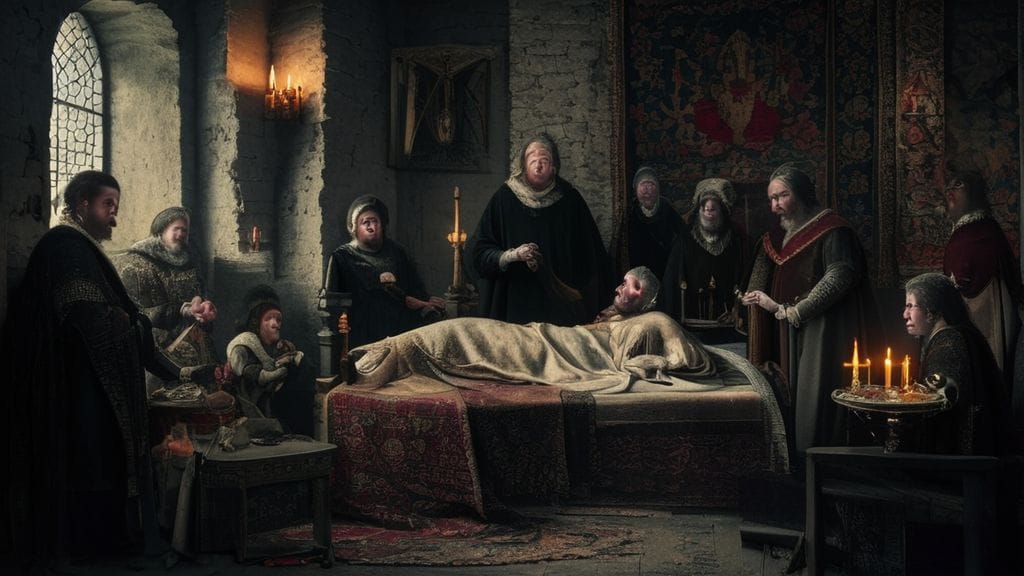
On the night of 18–19 October 1216, Newark Castle became the theater for John’s final act. Chroniclers later painted the scene with varying degrees of drama, but certain elements recur. The king lay in a chamber—likely on an upper floor, away from the bustle of the great hall—attended by a small circle of clerks, knights, and servants. News filtered in from the countryside: positions of armies, changing allegiances, whispers of what Louis and the rebel barons might do if the king died.
John, for all his faults, retained clarity of mind to the end if the sources are to be believed. He gave instructions about the succession, naming his nine-year-old son Henry as heir and entrusting him to a group of loyal magnates and churchmen, including William Marshal, Earl of Pembroke. This was not simply paternal care; it was a political calculation. By rallying the royalist cause around an innocent child rather than a hated adult, John may have hoped to preserve his dynasty where his own personality could not.
A priest was brought to administer the last rites. Confession, anointing, and the Eucharist would have been offered, giving the dying king a spiritual passage that many of his subjects might have wondered if he deserved. For a man once excommunicated and long at odds with the Church, this moment was symbolically crucial. If John died reconciled to God, then, in the eyes of many, rebellion against his heir would sit more uneasily on the conscience.
Some accounts, such as that of Roger of Wendover, relate that the king’s pain was intense, his bowels racked by disease. Others emphasize his composure. Even in death, chroniclers bent the story to their moral and political aims. Yet all agree that as the night deepened and the castle quieted, the king’s strength failed. Sometime on 19 October 1216, in that chamber overlooking the Trent, John of England exhaled his last.
What was said in those final moments? Which loyal servants held his hand, which adversaries waited impatiently for the news beyond the walls? We cannot know for certain. What we do know is that with king john of england death at Newark Castle, the crisis of 1216 entered a new phase. The most hated man in England, as some saw him, was gone. But the problems he had created—or failed to solve—remained very much alive.
What Killed King John? Poison, Dysentery, and Historical Rumors
Almost as soon as John’s death became known, rumors sprouted. Some claimed he had been poisoned, perhaps by a monk or a cupbearer sympathetic to the barons or Louis. The image of a wicked king struck down by a cup of tainted ale or a dish of fruit was irresistible to storytellers. After all, a reign so full of betrayal seemed destined to end with one last, intimate treachery.
Yet when the evidence is sifted, the case for poison collapses. No contemporary chronicler provides a convincing account of deliberate poisoning, only vague insinuations. Medieval writers loved moral drama, and a poisoned tyrant offered a neat, cautionary tale. Modern historians generally agree that John died of natural causes, most likely dysentery, exacerbated by exhaustion and stress. The symptoms described—severe intestinal distress, rapid decline over several days, and the timing following hard campaigning—fit this diagnosis well.
Moreover, John was not alone in falling victim to such maladies. Armies in the Middle Ages were plagued more by disease than by enemy swords, especially when marching through marshy, contaminated, or famine-stricken regions. The Wash area, with its stagnant waters and risky supplies, would have been a breeding ground for illness. One can imagine the bacteria silently colonizing the royal gut even as the king barked orders and signed charters, oblivious to the microscopic assault within.
Theories about overindulgence at that fateful feast of peaches and cider also persist. While a single meal was unlikely to cause lethal dysentery by itself, it could have triggered or intensified gastrointestinal distress in a man already weakened. There is a touch of tragic irony here: a king who had gorged on the rights and properties of others, as his enemies claimed, may have been undone in part by his own gluttony.
Why, then, do poison stories linger? Because they speak to how deeply people wanted John’s end to feel like justice rather than chance. As historian Ralph Turner notes in his work on John’s reign, the king’s reputation has long been “trapped between the poles of villainy and victimhood.” The legends of perfidy and poison reflect society’s attempt to make moral sense of a messy, contingent death. Yet when we look closely at king john of england death, the image that emerges is less theatrical and more human: a tired, sick ruler, undone not by a dagger in the dark but by the same vulnerabilities that plagued ordinary men.
A Kingdom in Crisis: The Immediate Aftermath of John’s Death
News of the king’s death rippled outward from Newark like waves in a disturbed pond. Messengers rode to nearby castles, then on to cathedral cities and baronial estates, carrying the stark tidings: the king is dead. For some, the reaction may have been grim satisfaction; for others, genuine anxiety. Whatever they felt personally, all politically minded men understood that the balance of power in England had shifted overnight.
Practically speaking, John’s corpse could not remain long in Newark. Arrangements were made to transport his body south-west to Worcester Cathedral, a journey of around a hundred miles. Along the way, villagers and townsfolk might have gathered to watch the solemn passage: a royal funeral procession in the midst of civil war, banners hanging listlessly, soldiers riding with drawn but unused swords. At Worcester, in accordance with John’s own wishes, he was buried near the shrine of St Wulfstan, a popular local saint. To lie near a revered holy man was thought to aid one’s soul in the afterlife—a final act of spiritual insurance by a king who had long lived dangerously close to the edge of damnation.
Politically, the question of succession could not be delayed. John’s eldest surviving son, Henry, was only nine years old. In an age when kings were expected to lead armies in person and dispense justice with authoritative presence, a child ruler seemed a perilous proposition. Yet the alternative was worse: to concede the throne to Prince Louis and effectively surrender England to French control.
Royalists and church leaders moved quickly. They framed John’s death not as the deserved end of a tyrant, but as a providential chance to reset the political order. In their narrative, the sins of the father did not taint the son. Henry, young and untainted, could be the focus of reconciliation. This reframing was vital. It allowed barons who had rebelled against John to reconsider their position without admitting treason against the monarchy itself. If they would not fight for John, perhaps they would fight for a boy who had never wronged them.
The Boy King Henry III and the Reinvention of Magna Carta
On 28 October 1216, scarcely more than a week after John’s death, Henry was crowned at Gloucester. The ceremony, hastily arranged and lacking many of the usual regalia—some of which had been lost in The Wash—was a modest affair by royal standards. Yet its symbolism was immense. Here was a fragile thread of continuity in a broken world: the crown passing from father to son, Plantagenet line preserved, however precariously.
At Henry’s side stood William Marshal, Earl of Pembroke, an aging but revered knight whose reputation for honor and martial skill was unmatched. Marshal, appointed as regent, effectively became the ruler of England in the boy king’s name. He and the papal legate Guala understood that swords alone would not win back the kingdom; they needed a political strategy. That strategy hinged on what John had tried to crush: Magna Carta.
In November 1216, the regency government issued a revised version of the charter. Some of its more radical or impractical clauses, including the infamous security clause that had allowed barons to lawfully make war on the king, were removed. But the core principles remained: limits on arbitrary royal power, protections for baronial rights, and assurances regarding justice. By reissuing Magna Carta voluntarily, in the name of a penitent government and an innocent child, the royalists transformed a wartime concession into a foundational statement of good kingship.
This move was politically brilliant. It drove a wedge between the hardline rebels, now allied with a foreign prince, and more moderate barons who might be tempted back into the royal fold. “See,” the regents effectively said, “we are not John. We honor the law. Join us, and you will have both stability and liberties.” Over the next two years, this message, combined with military victories such as the Battle of Lincoln in 1217 and the naval triumph at Sandwich, gradually eroded Louis’s support.
By September 1217, the French prince agreed to withdraw, renouncing his claim to the English throne in the Treaty of Lambeth. The immediate crisis that had framed king john of england death was resolved, but in a way John himself could never have foreseen: by embracing, rather than rejecting, those limits on royal power that he had fought so hard against. The charter once forced upon a reluctant king became, in the hands of his successors, a badge of legitimacy and a cornerstone of English political identity.
Church, Crown, and Chroniclers: Judging John’s Soul and Legacy
After John was laid to rest at Worcester and Henry III’s reign began, another battle quietly unfolded: the struggle to define the late king’s memory. Medieval chroniclers, often monks, wielded their pens as moral arbiters. Many had witnessed John’s long conflict with the Church, the interdict, and the excommunication; they had also seen his late reconciliation with Rome and his pious burial wishes. How, then, should his soul be judged?
Writers like Roger of Wendover and the author of the Margam Chronicle painted John in starkly negative colors. They accused him of cruelty, lechery, and sacrilege, recounting tales of forced marriages, unjust executions, and blasphemous remarks. Some claimed he had tried to starve his nephew Arthur to death, others that he robbed churches and mocked religion. In their narratives, the disaster at The Wash and the king’s sudden illness appeared as divine retribution, a fitting prelude to his wretched end at Newark. For such authors, king john of england death was a moral lesson: God punishes wicked rulers.
Yet not all voices were uniformly condemnatory. Some royal clerks and later commentators acknowledged John’s administrative talents, his attention to legal detail, and his resourcefulness under pressure. The Church hierarchy, benefiting from the king’s decision in 1213 to submit England as a papal fief, had reasons to view him more ambivalently. Pope Innocent III himself, though he had annulled Magna Carta at John’s behest, also praised the king’s eventual obedience to Rome.
Over the centuries, John’s reputation hardened into that of the archetypal bad king. Shakespeare, in his history play “King John,” presented a troubled, morally compromised ruler haunted by guilt over Arthur’s fate. Later, Victorian historians, fascinated by constitutional progress, often cast him as the villain whose excesses had unintentionally birthed English liberty through Magna Carta. As the legal historian William Stubbs influentially argued in the nineteenth century, John’s reign marked a turning point in the development of parliament and the rule of law, precisely because his failures forced the nobility to articulate their rights.
This interpretive tradition turned Newark Castle into a kind of moral stage: the place where an unworthy king died so that a better political order might emerge. Reality, as always, was more complex. John was neither a caricature of pure evil nor a misunderstood genius. He was a capable, deeply flawed ruler whose particular blend of suspicion, aggression, and misfortune made his downfall—and his death—extraordinarily consequential.
The Long Shadow of Newark: How John’s Death Shaped English History
When we look back from the vantage point of later centuries, it is tempting to treat John’s death as the neat end of an era: the close of the Angevin age, the prelude to a more “English” monarchy under Henry III and his successors. Yet the shadow of Newark stretched much farther, touching not only royal policy but the very vocabulary of rights and governance in the English-speaking world.
First, John’s demise made room for the political rehabilitation of Magna Carta, which might otherwise have remained a failed peace treaty. Freed from the personality of the king who had sealed it under duress and then disowned it, the charter could be reimagined as a solemn pledge between ruler and ruled. Successive reissues in 1217, 1225, and beyond cemented its status. Over time, lawyers and parliamentarians would return to its clauses again and again, mining them for precedents in struggles against later kings who overreached.
Second, the crisis of 1216 highlighted the importance of legitimacy in monarchy. Louis of France commanded armies and enjoyed the backing of powerful barons, yet in the end he could not convincingly claim to be England’s rightful king. Henry III, crowned in modest circumstances as a boy, carried the advantage of hereditary continuity and papal support. Newark, therefore, teaches a quiet lesson: a crown rests not only on military might but on stories people tell about who has the right to wear it.
Third, John’s reign and death accelerated the shift from a sprawling Angevin empire to a more insular English kingdom. With Normandy gone and continental ambitions curtailed, future kings turned increasingly inwards. They built institutions, codified laws, and cultivated a specifically English political community. None of this was inevitable, but king john of england death marks a symbolic hinge in this gradual reorientation—from empire to kingdom, from personal rule to something edging, however faintly, towards common law and communal consent.
Finally, the memory of John’s failures served as a cautionary background for later rulers. When Edward I summoned parliaments, when Edward III and Henry V sought support for continental wars, when even Tudor monarchs justified their actions, they did so in a world where the ghost of John still lurked. A king who lost Normandy, fought the Church, alienated his barons, and died in civil war was not a model to emulate. Instead, he became the warning at the edge of ambition.
Fact, Legend, and Reputation: Rethinking King John
Modern historians, sifting through royal records, charters, and chronicle narratives, have tried to peel back the layers of myth surrounding John. They ask: was he truly worse than other medieval rulers, or merely less successful, and thus more harshly judged? The answer is nuanced. Many kings were ruthless, many demanded heavy taxes, many waged wars that ended badly. But in John’s case, the convergence of personal flaws and political disasters magnified the consequences.
He was, by most accounts, intelligent and administratively gifted. The machinery of royal government expanded dramatically under his watch; some of the meticulous record-keeping that delights historians today owes much to his insistence on control. Yet he lacked the charisma, magnanimity, or steady judgment that might have balanced his harsher traits. Instead, he cultivated fear, relied on short-term fixes, and failed to build lasting coalitions.
Take, for instance, his relationship with the nobility. Where his father Henry II had alternated sternness with conciliation, and his brother Richard had inspired awe as a warrior, John alienated many of his most important vassals through petty cruelty and mistrust. Hostages disappeared, opponents’ lands were seized, and grievances piled up. Even those who might have preferred a strong central monarchy to rampant feudalism found it hard to rally behind a king they despised personally.
At the same time, some of the darker stories about John are clearly embellished. Tales of him attempting to seduce noblewomen by force, or of gleefully mocking sacred relics, may say more about later clerical hostility than about the man himself. The more lurid the tale, the more likely it was to be copied and retold. As with many notorious figures, his memory attracted accusations that filled in any gaps in knowledge with scandal.
In reconsidering king john of england death, then, we also reconsider his life. He was not born a monster, nor was he doomed by fate alone. Choices, circumstances, and character flaws combined to steer him onto a collision course with his own realm. His death at Newark closed one path, but the road that opened beyond it—towards Magna Carta, parliamentary government, and the later myth of English liberties—owes much to the failure written across his reign.
From Newark Castle to the Modern World: Why John’s Death Still Matters
Walk today through Newark-on-Trent, and you will find the ruins of the castle still brooding over the river, its broken walls bearing silent witness to centuries of conflict, from the age of John to the English Civil War and beyond. Tourists and locals pass by, some aware, others not, that within this fortress a king once died whose name is woven, darkly, into the fabric of modern constitutional thought.
Why does king john of england death matter, eight centuries on? Because it encapsulates a moment when the unchecked power of a monarch collided with the collective resistance of the political community, and something new emerged from the wreckage. John did not intend to plant the seeds of constitutionalism; he fought tooth and nail against limits on his authority. Yet his failure forced his successors to rule differently, to cloak their will in law and seek consent—or at least the appearance of it.
Magna Carta, born in rebellion against him and resurrected after his passing, became a touchstone not only in England but across the Anglophone world. Its clauses were cited in the struggles between Parliament and the Stuarts in the seventeenth century; its language echoed in the American colonies’ resistance to British rule; its principles are still invoked in debates over due process and human rights today. While historians rightly warn against romanticizing it as a fully formed “bill of rights,” they also recognize its symbolic power as an early assertion that rulers are bound by law.
The story that leads from Newark Castle to modern constitutions is not a straight, inevitable line. It is twisted, broken, and full of reversals. But John’s death stands at a critical junction on that path. A different outcome in 1216—Louis triumphant, the Plantagenet line extinguished, Magna Carta buried—might have set English and European history on a very different course. That alternate world did not come to pass, in part because a sick, embattled king died when he did and how he did, leaving room for compromise and reinvention.
There is, finally, a human lesson in this tale. Power without trust is brittle. Fear can sustain authority for a time, but when crisis comes—when tides rise unexpectedly, when illness strikes, when foreign banners loom on the horizon—only genuine loyalty can hold a kingdom together. John, for all his administrative acumen, never understood this fully. His death in a borrowed bed, in a castle owned by a bishop rather than by himself, surrounded by a few anxious loyalists rather than a nation in mourning, is a quiet testament to that failure.
And yet from that failure, others learned. The boy who succeeded him, Henry III, and the generations that followed, would have to reckon with the memory of John: a warning carved into the foundations of English rule. Newark Castle thus becomes more than a picturesque ruin. It is a landmark in the long, unfinished story of how societies struggle to bind power with principle, and how even a king’s last breath can help reshape the future.
Conclusion
On 19 October 1216, in the dim chamber of Newark Castle, a life ended that had done more than most to test the limits of medieval kingship. John of England died not as a martyr or a hero, but as a deeply unpopular monarch worn down by war, disease, and his own misjudgments. His passing, however, did not simply close a troubled chapter; it opened the door to a fragile but transformative era. In the uncertain days after king john of england death, as Henry III was crowned with missing regalia and William Marshal reissued Magna Carta, the foundations of a new political order were quietly laid.
The king who had tried to stand above the law became the negative example against which later ideals of lawful rule were defined. His loss of Normandy narrowed the horizons of English kings, forcing them to build more firmly at home. His bitter conflicts with the Church and the barons demonstrated the peril of governing by intimidation alone. And his lonely death in Newark underscored how quickly power can drain away when fear replaces respect.
Eight centuries on, the ruins of Newark Castle and the tomb in Worcester Cathedral invite reflection not only on a single man’s fate, but on the long chain of consequences that followed. John’s reign reminds us that institutions often grow in response to failure, that law sometimes takes shape in the shadow of oppression, and that even the most flawed rulers can unwittingly contribute to enduring principles. His story, from the ambitions of his youth to the fevered hours before his end, is a cautionary tale and a hinge of history at once. In understanding how and why he died, we understand more clearly how England became the realm it is—and how the idea that even a king must answer to the law first found such dramatic, if reluctant, expression.
FAQs
- Where and when did King John of England die?
King John of England died on 19 October 1216 at Newark Castle in Nottinghamshire, England. He was on campaign during the First Barons’ War and had fallen seriously ill after the disastrous loss of his baggage train in the tidal flats of The Wash. - What was the cause of King John’s death?
Most historians believe King John died of dysentery, likely compounded by exhaustion and stress from continuous campaigning. Medieval rumors of poisoning exist, but there is no solid contemporary evidence to support them; the symptoms described by chroniclers fit a natural gastrointestinal illness. - How is King John’s death connected to Magna Carta?
John’s conflict with his barons led to the sealing of Magna Carta in 1215, which he soon repudiated, plunging the kingdom into civil war. After king john of england death, his regents reissued a revised Magna Carta in the name of his young son Henry III, transforming it from a forced concession into a foundational statement of lawful kingship and helping to end the war. - Who succeeded King John after his death at Newark Castle?
John was succeeded by his nine-year-old son, who became King Henry III. Because Henry was a child, real power initially rested with his regent, William Marshal, Earl of Pembroke, and with church leaders such as the papal legate Guala Bicchieri. - Where is King John buried?
King John is buried in Worcester Cathedral in western England. Honoring his own wishes, he was laid to rest near the shrine of St Wulfstan, a revered local saint, in the hope that the holy man’s presence would aid his soul in the afterlife. - Did King John really lose the crown jewels in The Wash?
Chroniclers report that much of John’s baggage, including treasure and important documents, was lost when his wagons were caught by the rising tide in The Wash. Whether the actual crown jewels were among the lost items remains uncertain, but the story of royal regalia swallowed by the sea has become a powerful and enduring legend. - Why was King John so unpopular?
John’s unpopularity stemmed from heavy taxation, arbitrary justice, suspected involvement in the death of his nephew Arthur of Brittany, conflict with the Church, and repeated military failures such as the loss of Normandy. He relied heavily on coercion and mercenaries, undermining trust and alienating many of his own barons. - How did King John’s death affect Prince Louis of France’s invasion?
John’s death weakened the rebels’ justification for supporting the French prince, since many of their grievances were personal to John. By rallying around the innocent child-king Henry III and reissuing Magna Carta, the royalist government gradually peeled away Louis’s supporters, ultimately forcing him to abandon his claim and withdraw in 1217. - What role did Newark Castle play in English history after John?
Newark Castle remained an important stronghold in subsequent centuries, notably during the English Civil War, when it endured several sieges. However, its most famous association remains as the place of King John’s final illness and death, a moment that marked a turning point in medieval English politics. - How do historians today view King John’s legacy?
Modern historians see King John as a capable administrator but a politically inept and often vindictive ruler whose failures had far-reaching consequences. While they reject some of the more lurid medieval accusations, they agree that his reign was marked by serious misjudgments that led directly to rebellion, foreign invasion, and the emergence of Magna Carta as a lasting constitutional symbol.
External Resource
Internal Link
Other Resources
- Encyclopaedia Britannica – general search for the exact subject
- Google Scholar – academic search for the exact subject
- Internet Archive – digital library search for the exact subject