Table of Contents
- A River, an Empire, and an Omen in the Sky
- The Tetrarchy in Crisis: An Empire Fractured
- Constantine and Maxentius: Rivals in Blood and Ambition
- March on Rome: The Road to the Tiber
- The Night Before: Visions, Dreams, and a Mysterious Sign
- Dawn over the Tiber: Armies Converge at the Milvian Bridge
- Steel, Shield, and Panic: How the Battle Unfolded
- The Death of Maxentius: A Tyrant Lost to the River
- Rome Opens Its Gates: Triumph, Spectacle, and Silent Fears
- From Victory to Vision: How Constantine Told the Story
- Pagan Gods, Christian Cross: A Religious Turning Point
- The Edict of Milan and the New Language of Power
- Winners, Losers, and the Common People of Rome
- Rewriting Memory: Monuments, Propaganda, and the Arch of Constantine
- Echoes across Centuries: How the Battle Shaped Europe
- Historians at War: Debating the Vision and the Miracle
- Conclusion
- FAQs
- External Resource
- Internal Link
Article Summary: On the morning of 28 October 312, at the northern edge of Rome, the battle of the milvian bridge decided the fate of the Roman Empire and, indirectly, the religious future of Europe. This article traces the road to that confrontation, from the crumbling Tetrarchy and the rivalry between Constantine and Maxentius to the fateful night when Constantine reportedly saw a divine sign in the sky. It follows the armies as they clashed by the Tiber, explores the drowning of Maxentius and the jubilant yet uneasy reception of Constantine in Rome, and shows how the battle of the milvian bridge was quickly transformed into a story of providence. We examine how Constantine’s victory reshaped imperial politics, empowered Christianity, and led to new laws of religious tolerance that would echo for centuries. At the same time, we look at the people left in the shadows—the soldiers, citizens, and pagans who struggled to adapt to this new order. Drawing on ancient sources and modern scholarship, the narrative confronts doubts about Constantine’s vision and probes the line between faith, propaganda, and genuine experience. By the end, the battle of the milvian bridge emerges not as an isolated clash of armies, but as a hinge of history where river, empire, and belief converged.
A River, an Empire, and an Omen in the Sky
On an autumn morning in the year 312, mist clung to the waters of the Tiber like a veil that refused to lift. The Milvian Bridge—an old, sturdy crossing on the Via Flaminia, just north of Rome—stood as it had for generations, stone arches locked against the slow, indifferent current. Yet this day would not pass like others. Before noon, the bridge would groan under the weight of panicked men, horses, and shattered shields; the river would be choked with bodies; and the name of the place would be remembered wherever the story of Rome was told. The battle of the milvian bridge was not just another clash between rival emperors. It was, in the eyes of contemporaries and many who came after, the moment when fate—or perhaps a god—intervened to tip the scales of history.
To the soldiers assembling on the northern side of the river, this day felt charged with omens. Rumors had spread quickly through the camp of Constantine, the emperor of the West: their leader had seen something in the sky, a sign unlike any other, and it had promised victory. Some said it was a cross of light; others whispered of letters, of strange Greek words they could not pronounce. Whatever the details, one fact was clear in the murmurs around the cookfires: their shields had been marked with a new symbol overnight. In a world that still prayed to Mars, Jupiter, and Sol Invictus, this sign was neither old nor familiar. It hinted at a rising faith that had long lived on the fringes of Roman life—Christianity.
Across the water, Rome lay tense and wary. Maxentius, the emperor who had guarded the city for six uneasy years, had ordered his engineers to prepare for battle. He, too, had sought divine guidance. The priests of the old gods had promised him victory if he stayed within Rome’s walls. Yet he had chosen to march out and confront Constantine at the river, building a temporary bridge of boats to support his army’s advance. It was a gamble taken by a man surrounded by omens, prophecies, and, above all, the heavy weight of Roman expectation. If he won, he would secure his rule. If he lost, he would not merely be defeated—he would be erased.
As spears were checked and formations drawn up, none of the men on either side could have understood the full scale of what was about to unfold. For them, it was a campaign like others: dusty marches, nervous waiting, the familiar dread before battle. But this was only the beginning of a story that would reach far beyond their lifetimes. The battle of the milvian bridge would ripple outward into law, belief, and identity, transforming the Roman Empire from a world of many gods into one increasingly dominated by a single, crucified deity. It is astonishing, isn’t it, how a few hours of struggle by a river could redirect the faith of continents?
To understand how that morning came to bear such weight, we must step back—to an empire divided, to emperors made and unmade by soldiers, and to a revolutionary political experiment already cracking under its own strain.
The Tetrarchy in Crisis: An Empire Fractured
Decades before the two armies stared each other down at the Tiber, Rome had already acknowledged a disturbing truth: the old way of ruling, with a single emperor at the center, was no longer enough to hold the empire together. In the late third century, emperors came and went in dizzying succession, thrust upon the throne by mutinous legions and toppled by the next charismatic general. Foreign invasions, economic chaos, and civil war had made the imperial purple seem more like a curse than a prize. Then came Diocletian, a soldier from the Balkans with an eye for structure and control.
Diocletian’s answer was radical. Around 293, he crafted what historians now call the Tetrarchy—the “rule of four.” The empire would be divided administratively into East and West, each governed by an Augustus (senior emperor) and a Caesar (junior emperor and designated successor). The aim was simple yet profound: no more bloody scrambles for power. Instead, smooth, planned succession; shared burdens; and coordinated defense against external threats. In practice, this system meant that when Diocletian and his fellow Augustus, Maximian, stepped down voluntarily in 305, their Caesars—Galerius in the East and Constantius in the West—would take their places, appointing new Caesars beneath them.
On paper, it was order out of chaos. In reality, human ambition proved harder to manage than imperial frontiers. When Constantius died in 306 at Eboracum (modern York) after a campaign in Britain, his son Constantine was proclaimed emperor by his father’s troops almost immediately. This was an old reflex in Roman political life—the army asserting its will—directly contradicting the carefully staged Tetrarchic structure. Meanwhile, in Rome, another legacy of Maximian soon collided with the fragile system. Maxentius, Maximian’s son, was not part of Diocletian’s design; he had been passed over in the official hierarchy. But Rome still mattered symbolically, and the city resented its loss of prestige under the new system. In October 306, angry at new taxes and the decline of the city’s central role, the Praetorian Guard and the urban populace hailed Maxentius as princeps, then as Augustus.
With that, the Tetrarchy began to unravel. Instead of four emperors working together, the empire soon sustained six or more claimants at once, their loyalties interwoven like a knot that could only be cut with the sword. Galerius, the senior Augustus in the East, refused to recognize Maxentius, denouncing him as a usurper. Constantine’s position in the West, though initially limited to the provinces his father had controlled—Britain, Gaul, and parts of Germany—was also contested by rivals like Severus II and later Licinius. Treaties, marriages, and alliances flickered on and off like lamps in a storm.
Rome, the old heart of the empire, found itself caught between systems. Maxentius claimed to be the defender of the city’s traditions, restoring buildings, sponsoring games, and presenting himself as the champion of the Roman Senate and people. Propaganda on his coins emphasized Roma, the goddess of the city, and conservative, time-honored images. Constantine, by contrast, though still very much a man of the traditional Roman world, was evolving a different style of kingship from his bases farther north—one that would eventually blend imperial authority with a new religious narrative.
By the early 310s, the fiction of a harmonious Tetrarchy had collapsed entirely. Civil wars spanned from the Balkans to northern Italy. Legions shifted allegiance, governors hesitated, and ordinary people learned to read rapidly changing portraits on their coins as a map of who truly ruled their region. In that shifting landscape, two figures gradually emerged as the main contenders for mastery of the West: Constantine, the son of Constantius, and Maxentius, the unrecognized ruler of Rome. The battle of the milvian bridge was the endgame of a political experiment gone wrong, a personal confrontation born of decades of imperial crisis.
Constantine and Maxentius: Rivals in Blood and Ambition
Both Constantine and Maxentius were sons of emperors, but their paths to power could not have been more different. Constantine, born around 272 in Naissus (modern Niš in Serbia), grew up in the hard, mobile world of the military frontier. His father, Constantius Chlorus, was a capable general who rose under Diocletian and eventually became Caesar in the West. Constantine spent his youth moving across the empire’s trouble spots, learning the arts of war, command, and survival. He saw battlefields in the East under the stern eye of Galerius, and he learned that, in an empire of soldiers, loyalty was earned with victories, not court ceremony.
Maxentius, likely born around 278, lived a different childhood. As the son of Maximian, he experienced the pomp and expectation of the imperial household more than the raw brutality of distant campaigns. Raised closer to Rome and the Italian heartland, he was aware of the city’s deep symbolic power and its sense of being sidelined by the Tetrarchy. When Diocletian’s system passed him over for promotion, resentment simmered. If Constantine’s life had taught him to rely on legions, Maxentius’s life had pushed him to rely on the city, on the Senate, and on the Praetorian Guard.
When Maxentius seized power in 306, he wove his public image around Rome’s grievances. He abolished some unpopular taxes, finished or initiated grand building projects—including the magnificent Basilica of Maxentius (later partly appropriated by Constantine)—and celebrated the city’s ancient gods. Statues, inscriptions, and coins presented him as the restitutor urbis, the “restorer of the city.” Yet behind the marble and rhetoric, his regime was precarious. Without official recognition from the other emperors, he was always vulnerable to the charge of usurpation. He relied heavily on the Praetorian Guard, whose loyalty had unseated rulers before and could do so again.
Constantine, meanwhile, slowly consolidated his position in Gaul and Britain. He cultivated the loyalty of provincial elites and frontier soldiers alike, showing an unusual willingness to adapt and listen, even while asserting a clearly monarchical style. His coinage increasingly emphasized Sol Invictus, the unconquered sun, a deity that bridged the gap between traditional Roman religion and new, more universal conceptions of divine power. While he had Christians in his entourage and seems to have shown them favor earlier than most emperors, he had not yet broken publicly with the old religious vocabulary. He was, at this stage, a pragmatist among shifting gods.
The rivalry between the two men hardened over time. Maxentius could not accept Constantine’s presence in the West without seeing it as a threat; Constantine could not ignore an emperor in Rome who was widely denounced as illegitimate by the Eastern court. Personal insults and political maneuvers deepened the divide. At one point, Maximian—Maxentius’s own father—quarreled with his son and sought refuge with Constantine, even marrying his daughter Fausta to the Western emperor. The imperial family was no longer a tree with clear branches; it was a tangle of competing claims, broken alliances, and buried grudges.
By 312, it was becoming clear that the West was not large enough for both Constantine and Maxentius. Previous attempts to dislodge Maxentius by other emperors had failed, but Constantine was different: battle-tested, patient, and increasingly confident in his star—or his god. He knew that as long as Rome remained in Maxentius’s hands, his own authority would be incomplete. The city that had once been only one center among many suddenly became the stage for a decisive act. And so Constantine began to plan a campaign that would bring him down the spine of Italy, straight toward the Milvian Bridge and the final reckoning.
March on Rome: The Road to the Tiber
In the spring and summer of 312, the roads of northern Italy felt the drumbeat of destiny. Constantine’s decision to invade Maxentius’s territory was bold, perhaps even reckless. He is thought to have commanded roughly 40,000 men—a formidable force, yet not overwhelmingly larger than what Maxentius could muster from Italy and Africa. Nevertheless, the psychological impact of his advance would prove as decisive as the raw numbers.
Constantine moved quickly, crossing the Alps with the confidence of a man who had already measured his own fortune against the hazards of war. His legions, veterans of campaigns in Gaul and Germany, knew how to move fast and hit hard. As they descended into the plains of northern Italy, they encountered Maxentian forces near Turin and later near Verona. In both engagements, Constantine’s troops prevailed, sometimes in the face of tactical disadvantages. At Verona, he defeated the experienced general Ruricius Pompeianus, a key pillar of Maxentius’s military strength. Each victory sent ripples of fear and doubt southward.
Town by town, city by city, Constantine’s reputation preceded him. Some communities opened their gates without a fight, calculating that resistance would only bring destruction. Others wavered, watching coin portraits, listening for news from battlefields that seemed both far away and ominously near. To many Italian elites, Maxentius’s six-year reign had brought stability but also heavy financial demands and the constant sense of being at the center of a usurper’s fragile world. Constantine’s victories offered an alternative future, one that promised a return to recognized imperial order.
Maxentius, inside Rome, felt the pressure mounting. His advisers were divided. Some urged him to remain behind the city’s massive Aurelian Walls, which had been strengthened precisely to ward off threats like Constantine. Within those defenses, with ample supplies and support from the Praetorian Guard, he could force a siege that might grind down Constantine’s momentum. Others, appealing to the old Roman spirit and perhaps to Maxentius’s own pride, argued for battle in the open. To cower behind walls while an invader approached the sacred city might look like weakness, even sacrilege. Rome, they said, must not be seen as a fortress hiding a fearful emperor.
In such a charged atmosphere, omens gained heightened importance. Ancient authors report that Maxentius consulted the Sibylline books, the sacred prophetic texts of Rome, and received a disturbing response: “On that day, the enemy of the Romans will perish.” It sounded like encouragement; Maxentius took it to mean that Constantine, the invader, would fall. But oracles are slippery tools, their phrasing deliberately vague. In hindsight, later writers would note bitterly that Maxentius himself had been, in the eyes of many, the enemy of the Romans, and that the prophecy had been fulfilled in a darker sense than he intended.
Constantine, for his part, understood the symbolism of his approach. He was not merely moving toward a military target; he was embarking on a kind of pilgrimage to the heart of Roman political identity. The Via Flaminia, the road that led from the north into Rome, would bring him eventually to the Milvian Bridge—a crossing both practical and symbolic, the northern gate to the city’s soul. As his troops marched, he must have been acutely aware that every step brought him closer not simply to Maxentius, but to a moment that could either crown his career or destroy it utterly.
Every conquest raises the stakes for what comes next. By the time Constantine reached the outskirts of Rome, there was no easy retreat, no graceful way to back away from the confrontation he had set in motion. The empire, watching from its many provinces, waited to see which banner would prevail. And in the days just before the clash by the Tiber, a story began to take shape—a story of a sign in the heavens that would, in time, come to define the battle of the milvian bridge more than the clash of steel itself.
The Night Before: Visions, Dreams, and a Mysterious Sign
We stand now at one of the most contested moments in late Roman history: the night before the battle. According to some accounts, as Constantine’s army camped near the Tiber, he experienced an event that would change the way he framed his entire reign. The fourth-century Christian bishop Eusebius of Caesarea, writing later in his Life of Constantine, relates that, as the sun was setting, Constantine saw in the sky a cross of light above the sun, accompanied by the Greek words “ἐν τούτῳ νίκα”—“In this sign, conquer.” That night, Christ himself allegedly appeared to Constantine in a dream, instructing him to mark his soldiers’ shields with a celestial sign associated with the Christian god.
It is a gripping scene, cinematic in its detail. A weary emperor looks to the sky; the heavens answer. Overnight, rough wooden shields receive new marks—perhaps the chi-rho, a monogram formed from the first letters of “Christ” in Greek. Soldiers murmur, some confused, some intrigued, a few perhaps crossing themselves in secret recognition. The Pagans among them might have been reassured to think of the sign as yet another manifestation of the sun god, or of a mysterious new divine ally. After all, Roman religion had long been generous in adopting foreign deities. Why not this one?
Yet our sources are far from simple. An earlier writer, Lactantius, a Christian intellectual close to imperial circles, offers a somewhat different version. In his work On the Deaths of the Persecutors, he describes a dream in which Constantine was commanded to mark the heavenly sign of God on his soldiers’ shields—but without the elaborate vision in the sky. The timing and exact nature of the symbol remain debated. Some modern historians even argue that Constantine’s deeper turn toward Christianity came after the battle, and that the story of the pre-battle vision was later embellished to lend divine sanction to his victory.
Still, whether we accept the vision as literal, metaphorical, or politically retrofitted, it clearly mattered to Constantine. He chose to tell it, to authorize its telling, and to shape his image through it. This decision alone reveals a profound shift. Previous emperors had claimed the favor of Jupiter, Mars, or Apollo; Constantine increasingly claimed the favor of the Christian god. The battle of the milvian bridge would not just be another civil war; it would be remembered as a contest fought under a new standard, one that made sense of triumph through the language of faith.
In the quiet hours before dawn, the camp must have been threaded with unease. Soldiers rolled in their blankets, thinking of home, of wounds, of the faces they might never see again. Officers traced out formations by firelight, rehearsing the maneuvers that would, they hoped, bring order to the chaos of the coming day. Constantine, whether or not he had seen a blazing sign in the sky, knew that he faced not only Maxentius but also the judgment of history. If he lost, his story would be short, his experiments in religion forgotten, his name another in the long list of failed usurpers. If he won, he had the chance to present his victory as no mere accident of arms, but as the visible proof of divine support.
“In this sign, conquer.” The phrase, whether actually shining in the sky or penned later by eager Christian chroniclers, would become a motto for an age. By tying his military success to a particular deity and faith, Constantine was laying the groundwork for a new kind of imperial legitimacy—one that reached beyond Rome’s old pantheon and appealed to a growing, if still minority, community spread across the empire. The tension between faith and pragmatism, sincerity and propaganda, is impossible to fully untangle. Yet it is exactly in that tangle that the power of the story lies.
As the sky paled and the morning of 28 October 312 began, the Tiber flowed on, unaware of visions and oracles. What came next would be decided not in dreams but in dust, blood, and the iron discipline of men in formation.
Dawn over the Tiber: Armies Converge at the Milvian Bridge
With first light, the strategic importance of the Milvian Bridge became brutally clear. The bridge carried the Via Flaminia across the Tiber into the northern edge of Rome. Whoever controlled it not only commanded the main approach road but also symbolically possessed the key to the city. Maxentius, wary of being cut off or outmaneuvered, had ordered the construction of a temporary pontoon bridge alongside the ancient stone structure. This makeshift crossing, built from boats fastened together and reinforced with timber, would allow his troops to move forward aggressively—but it also introduced a dangerous point of weakness.
Maxentius arranged his army on the southern bank of the river, closer to Rome, with part of his force already across or in the process of crossing, depending on the reconstruction one accepts. His goal seems to have been to draw Constantine into an engagement near the river, where sheer numbers might favor the defender and where retreat routes would, in theory, still lead back toward the safety of Rome’s walls. Ancient estimates of the armies’ sizes vary wildly. Some sources suggest that Maxentius outnumbered Constantine significantly, drawing tens of thousands from Italy and Africa. Constantine, for his part, had perhaps 40,000 or somewhat fewer, hardened by campaigns but still stretched thin across the campaign trail.
On the northern side, Constantine deployed his troops with care. He knew the risks of attacking a position anchored on a river. If his soldiers were pushed back in confusion toward the water, they might be trapped and slaughtered. Yet he also recognized an opportunity. If he could break Maxentius’s line and force a hurried retreat across the limited crossings, the river itself would become his ally—a merciless one.
The morning air would have been filled with the familiar yet always unsettling sounds of armies forming: barked commands, clinking armor, horses snorting and stamping, the rattle of spearheads and shield rims. Standards were raised, catching the early sun. Among them, if we trust our Christian sources, stood a new emblem, the labarum—Constantine’s imperial standard bearing the sign associated with Christ. For pagan observers, it might have looked like just another mysterious symbol in a world crowded with divine signs. For Christian soldiers, it was a daring claim: that their god now marched at the head of Roman legions.
Ordinary soldiers likely cared less about theological nuances than about the terrain in front of them. They could see the line of enemy shields, the gleam of helmets, the banners snapping in the wind. They could also see the river, glinting deceptively calm beyond the mass of men. Somewhere down that line stood Maxentius himself, clad in imperial armor, perhaps beneath a purple cloak. He had chosen this ground, this moment, in defiance of the advice to remain behind Rome’s walls. His presence on the battlefield was both an encouragement to his troops and a bet with his life.
At some signal—a trumpet blast, a shouted order—the battle of the milvian bridge truly began.
Steel, Shield, and Panic: How the Battle Unfolded
The exact choreography of the battle has been lost to time. No ancient historian stood on a nearby hill and took notes; no detailed battle maps survived the centuries. What we have instead are fragments, summaries, and the shape of events inferred from their outcome. Yet within those fragments, a vivid scene still flickers: two armies colliding in tight formation, dust rising, shouts mingling with screams, the Tiber watching like a silent juror.
Constantine, experienced in field warfare, seems to have struck hard and fast. His troops, drawn from frontier units accustomed to mobile tactics, may have advanced in tight, heavily armored infantry blocks supported by cavalry thrusts along the flanks. Their discipline and cohesion, tested in previous campaigns, gave them an advantage over Maxentius’s forces, which included the Praetorian Guard but also large numbers of less battle-hardened Italian levies. Once the first lines met, the combat would have devolved into a brutal, intimate struggle of shield against shield, short sword against short sword, each side trying to break the other’s resolve.
Some ancient accounts suggest that Constantine’s cavalry played a decisive role, outflanking and disturbing Maxentius’s formations. Whether or not this detail is fully accurate, what matters is the psychological shift. As parts of Maxentius’s line began to waver, the pressure concentrated around the narrow points of retreat across the river. Men who joined battle believing they had Rome at their backs suddenly felt the Tiber like a wall instead of a refuge. Rumors likely flew through the ranks within minutes: “The left is collapsing!” “The bridge is clogged!” “The emperor is retreating!” In ancient warfare, panic could spread faster than any commander could counter it.
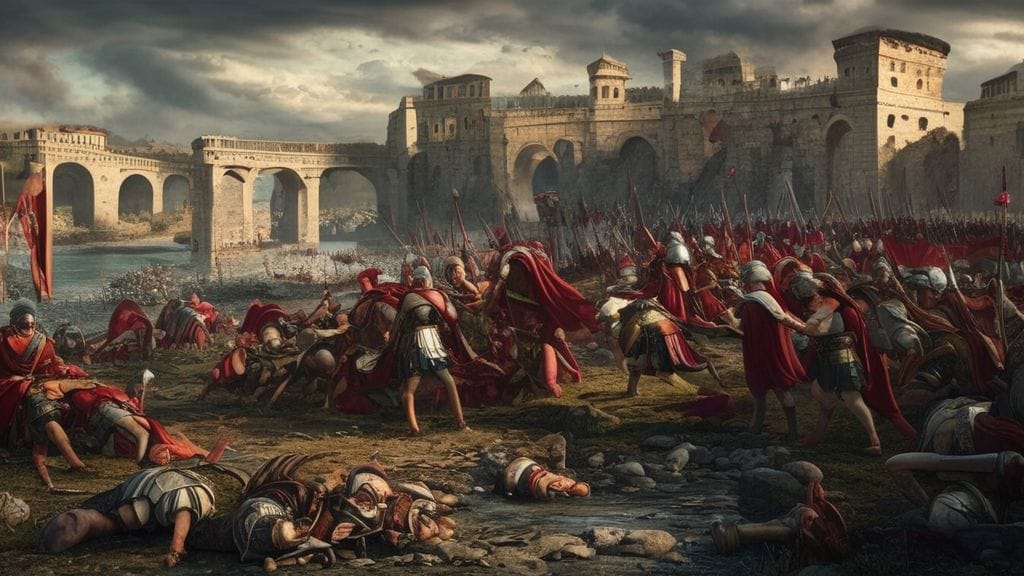
It is at this point that the engineering of the day turned deadly. Maxentius’s pontoon bridge, built to enable his army’s forward movement, became a funnel of catastrophe. According to one tradition, he had designed it with a removable section, perhaps to trap Constantine’s forces mid-crossing in a future maneuver. Whether or not this is accurate, the temporary structure was never meant to withstand a mass of terrified men and horses trying to force their way back across at once. As Constantine’s troops pushed forward, gaining ground, the retreating soldiers of Maxentius crushed into the fragile crossing. Chaos did the rest.
We should pause and imagine the sensory reality of that moment. The wooden planks flexing and splintering under iron-shod feet. The press of bodies so tight that men could barely lift their arms to defend themselves. Some stumbling and vanishing between boats. Others pushed off the sides, armor dragging them down like lead weights. Those behind, unable to see clearly, feeling only that the way forward was blocked, the way back filled with enemies. On the riverbanks, the water turned thick with bodies and floating debris. Drowning, in such circumstances, was swift and anonymous.
For Constantine’s men, pursuing a broken enemy toward the crossings, the scene must have been both shocking and exultant. Victories in ancient warfare often ended in massacres; a fleeing enemy exposed his back and his fear, inviting deadly pursuit. But here, the river took much of the work upon itself. The battle of the milvian bridge, in the crucial minutes of its resolution, became less a duel of courage than a tragedy of engineering and panic. And in its center, weighed down by imperial prestige and heavy armor, was Maxentius himself.
The Death of Maxentius: A Tyrant Lost to the River
The fate of emperors on the battlefield had long fascinated Roman writers. They told stories of noble deaths, cowardly flights, miraculous survivals. Maxentius’s end at the Tiber added a new, grim chapter to that tradition. As his lines broke and his army surged toward the makeshift bridge, he, too, was drawn into the deadly press. Whether he tried to direct the retreat, to rally his men, or simply to escape, we cannot know. What we do know is that he did not reach safety.
In the chaos at the crossings, Maxentius fell into the river and drowned. Ancient historians present this moment with the satisfaction of moralists. For Christian authors such as Lactantius, who had vilified Maxentius as a tyrant, persecutor, and corrupt ruler, his death was divine justice. The Tiber itself seemed to collaborate with heaven, swallowing the usurper who had dared to occupy Rome under false auspices. Pagan or more neutral writers, while less inclined to theological interpretation, still treated his fall as the fitting close of a precarious, contested reign.
Later that day, as Constantine’s men secured the area and gathered the spoils of victory, Maxentius’s body was found, or at least a body they believed to be his. His head was removed and stuck on a spear—a grim yet traditional symbol in Roman political warfare. For centuries, enemies of the state, rebels, and rival claimants had met the same fate. But this time, the severed head carried more than just the weight of another defeated emperor. It represented, in Constantine’s telling, the corpse of an era: the age of persecuting emperors, of illegitimate rulers in Rome, of a city held hostage by its own Praetorian Guard.
The spectacle that followed was brutal and theatrical. Constantine ordered Maxentius’s head to be paraded through Rome, a wordless proclamation to the populace that their former master was dead and that a new ruler had emerged from the north. For some, this would have brought relief—an end to uncertainty, the hope of favor from a victorious emperor. For others, perhaps those who had benefited from Maxentius’s patronage or truly believed in his role as the city’s restorer, it must have been a horrifying sight. Behind the celebrations, as always, stood grief, confusion, and fear of what came next.
Yet in Constantine’s narrative—shaped by both his own proclamations and the pens of Christian writers—the river’s role took on a larger meaning. The Tiber became not just a geographic feature but a moral boundary. On one bank stood Constantine’s army, bearing the sign of the Christian god; on the other, Maxentius’s forces, loyal to an emperor soon branded a tyrant. The waters themselves seemed to choose a side. The battle of the milvian bridge became, in this retelling, the visible proof that the Christian deity had intervened in human affairs, plunging a usurper into oblivion and lifting His chosen emperor toward destiny.
It is important to remember, however, that the dead emperor in the water had once been hailed as Rome’s defender. Historical memory is written by the victors, and few episodes illustrate that more starkly than the way Maxentius’s reputation was flattened and blackened after his defeat. In life, he had been complex—a ruler trying to navigate a fractured system, a patron of building projects, a man shaped by ambition and insecurity. In death, he became a symbol, a cautionary tale, and a convenient villain in the story of Constantine’s rise.
Rome Opens Its Gates: Triumph, Spectacle, and Silent Fears
In the days immediately following the battle, Rome held its breath. The sound of distant fighting had faded; rumors rushed into the vacuum. Soon enough, the visual confirmation arrived: the victorious army, marching south along the Via Flaminia, led by Constantine. At their head, displayed with unmistakable finality, was the severed head of Maxentius. The people lining the streets could not misread the sign. Whatever loyalties they had held were now rearranged by the cold clarity of survival. Constantine was master of Rome.
Ancient sources tell us that Constantine entered the city on 29 October 312, greeted with acclamations and ceremony. The Senate, ever attuned to the winds of power, moved quickly to honor the new ruler. Statues were ordered, inscriptions commissioned, and official decrees drafted to present Constantine as the liberator of Rome from a cruel tyrant. The elasticity of political language is striking. Just days before, those same institutions had coexisted with Maxentius, attended his ceremonies, and inscribed his titles. Now, they rewrote him as a monster from whom Constantine had saved them.
For the urban population, the moment was more ambivalent. On the one hand, Maxentius’s regime had been harsh at times, demanding taxes and loyalty in a period of deep instability. On the other, he had invested in the city: the massive basilica that still dominates part of the Roman Forum today began under his name; he had restored structures, sponsored games, and presented himself as a friend of the Roman people. As Constantine’s troops marched in, some citizens must have wondered what kind of ruler this northern emperor would be. Would he keep faith with the city? Would he continue to value its ancient gods and rituals? Or would he bring strange new practices from the provinces?
Publicly, Constantine was careful. He did not immediately appear as an iconoclast or an enemy of Rome’s traditions. He paid solemn visits to key temples and participated in some of the expected ceremonies, even as he gradually shifted his religious focus elsewhere. Politically, he acted decisively. The Praetorian Guard, the elite force that had made and unmade emperors for centuries and which had been central to Maxentius’s power, was disbanded. Their barracks, the Castra Praetoria, were partially demolished. This was not just a tactical move; it was a symbolic one. Constantine was announcing that the age of palace coups by privileged soldiers was over—at least as long as he ruled.
Rewards and punishments followed in predictable patterns. Maxentius’s closest supporters were executed or exiled; their properties confiscated to reward Constantine’s backers. The Senate found itself both chastened and courted. Constantine needed its prestige and administrative experience, but he also needed to ensure that no new Maxentius could emerge from its ranks. He balanced severity with clemency, punishing selected individuals while presenting himself as generally forgiving. In such calibrations, the new order took shape.
Meanwhile, Rome itself, the physical city, absorbed the shock almost as it always had—by continuing its daily life under a new set of names and faces. Markets reopened; children played in the streets; sacrifices smoked on altars; Christian gatherings whispered prayers in private homes and modest meeting places. The battle of the milvian bridge had changed the political horizon, but the rhythms of daily survival persisted. Still, for those with sharp eyes, hints of deeper change were already visible in the emperor’s words and gestures.
From Victory to Vision: How Constantine Told the Story
In the months and years that followed, Constantine began the labor of transforming a military victory into a foundational myth. Battles, left to themselves, are just events—bloody, chaotic, soon forgotten by anyone not directly touched by them. To endure in collective memory, they must be narrated, interpreted, framed. Constantine understood this deeply. The battle of the milvian bridge, in his hands, became not merely the defeat of Maxentius but the decisive moment when the Christian god revealed His favor for a new kind of emperor.
The shaping of this narrative began early. Coins, inscriptions, and imperial proclamations gradually introduced religious language that pointed away from the old pantheon. Constantine did not immediately abandon Sol Invictus, the Unconquered Sun, whose radiate crown appeared on his coinage and in public monuments. But he began to fuse this imagery with Christian ideas, blurring the lines between traditional solar worship and the divinity he now credited with his victory. Some scholars see this as a transitional theology, one in which Constantine and his propagandists sought continuity even as they prepared for radical change.
Eusebius and Lactantius, Christian authors writing with access to court circles, played a crucial role. Their accounts of the vision and the dream before the battle framed Constantine as a “new Moses,” a ruler chosen and guided by God to lead his people out of oppression. Eusebius, in particular, quotes Constantine as personally testifying to the vision in the sky years later, underscoring its sincerity and centrality. Whether or not every detail of the story corresponds to the historical moment on the eve of battle, the way it was told—and retold—shaped how generations would understand both the emperor and the event.
Monuments also spoke. Perhaps the most famous is the Arch of Constantine, still standing near the Colosseum today. Erected to commemorate the victory over Maxentius, it proclaims in its Latin inscription that the Senate and people of Rome dedicated the arch “to the liberator of the city,” who acted “by the inspiration of a divinity and by the greatness of his mind” (instinctu divinitatis mentis magnitudine). The phrase is deliberately ambiguous. It does not name Christ, perhaps to retain broad appeal in a still largely pagan environment, but it clearly points to supernatural guidance. For Christian readers, the reference was obvious; for others, it could be read as an allusion to more traditional gods.
Intriguingly, much of the sculptural decoration of the arch was taken from earlier monuments of emperors like Trajan, Hadrian, and Marcus Aurelius, then refashioned to glorify Constantine. This practice of “spolia” symbolically grafted Constantine’s victory onto the lineage of Rome’s greatest rulers. Yet new reliefs were also added, some of which depict Constantine in scenes of generosity and piety, distributing largesse or engaged in sacrificial acts that viewers could interpret in different religious keys. The arch thus became a stone narrative, layered with meanings that could be re-read as Constantine’s religious policy evolved.
Through words, images, and rituals, Constantine framed the battle as the pivot of his life and reign. He returned to it again and again in speeches, reminding audiences that he had staked everything on the favor of a new god and had been vindicated. The story gave him not only legitimacy against surviving rivals like Licinius but also a mandate to intervene in religious conflicts, especially those involving Christians. Once the Christian god had “chosen” him at the Milvian Bridge, it made sense—for Constantine and for many of his supporters—that he should act as that god’s representative on earth.
Pagan Gods, Christian Cross: A Religious Turning Point
To say that the battle of the milvian bridge “made” the Roman Empire Christian would be an exaggeration, but it is not far from the truth to say that it made such a transformation possible. Before 312, Christianity had endured cycles of tolerance and persecution. Under emperors like Decius and Diocletian, brutal campaigns sought to break the stubborn resolve of Christians who refused to sacrifice to the gods of the state. Many were executed, imprisoned, or stripped of property. Others lapsed, then sought reconciliation when the storm passed. The faith survived, but it survived in tension with the imperial power.
Constantine’s victory transformed that relationship. By crediting the Christian god with his triumph at the Milvian Bridge, he sent a clear signal: no longer would Christians be hunted as enemies of the state; instead, their god would be publicly honored by the emperor himself. This did not mean immediate equality or dominance over other cults. Paganism remained strong, especially in Rome and the senatorial aristocracy. Temples continued to function, sacrifices to the old gods continued, and pagan philosophers still debated in public forums. Yet the balance of power had irreversibly shifted.
Christian communities across the empire responded with a mixture of joy and caution. They had lived too long under threat to trust easily. Some wondered whether Constantine’s faith was sincere or opportunistic. Others, particularly bishops who now found themselves summoned to imperial audiences, saw in him the instrument of divine providence. The image of the emperor as a new Constantine—God’s chosen agent in history—would become a lasting pattern in Christian political thought, echoed centuries later in the rhetoric surrounding medieval kings and Byzantine basileis.
At the same time, the old gods did not disappear quietly. Many pagans could interpret Constantine’s victory without reference to Christianity, seeing in it the familiar pattern of divine favor for a strong and capable leader. The ambiguous language of monuments like the Arch of Constantine allowed them to continue venerating Sol, Jupiter, and other deities without open conflict with the new religious direction at the top. For a time, the empire existed in a kind of religious twilight, where crosses and altars, bishops and augurs, coexisted in a fragile, evolving balance.
Yet behind the surface of continuity, a tectonic shift was underway. The presence of Christian symbols on imperial standards and in the emperor’s personal piety gave believers new social and political confidence. Churches became more visible; bishops more assertive. Where once Christians had avoided serving in public office or the army because of the compromises required with pagan rituals, some now reconsidered. If the emperor himself worshipped Christ, then participation in imperial structures could be reimagined not as complicity with idolatry but as service to God’s purposes in history.
The battle of the milvian bridge thus marks a turning point not only in politics but in the psychology of faith. For centuries, Christians had wrestled with the fact that their God allowed pagan emperors to rule. After Constantine, many began to believe that the time of vindication had come—that history itself was bending toward their confession. It is within this context that the next major milestone becomes understandable: the Edict of Milan.
The Edict of Milan and the New Language of Power
In 313, barely a year after the battle, Constantine met with Licinius, his fellow emperor and sometime rival, in the northern Italian city of Mediolanum—modern Milan. The result of their discussions is what we now call the Edict of Milan, though it was technically a letter of imperial policy rather than a single carved edict. Its significance cannot be overstated. In deliberate contrast to the persecutions of the previous decades, the document proclaimed religious toleration throughout the empire, with particular emphasis on the rights of Christians.
The text, preserved by Lactantius and Eusebius, is striking in its language. It speaks of allowing each person to worship whatever divinity they prefer, so that “whatever divinity resides in the heavens may be benevolent and propitious to us and to all who are placed under our authority.” This is not yet a full-throated Christian theological manifesto. Instead, it reflects the transitional, pragmatic outlook of emperors who saw religious peace as a political necessity and divine favor as a precious, if somewhat abstract, commodity. By including all cults in its promise of tolerance, the Edict aimed to heal wounds opened by earlier, targeted persecutions.
Yet within this broad umbrella, Christianity received special attention. Confiscated church properties were to be returned; Christian communities were to be free to assemble and organize. The state, which had once smashed church doors and burned scriptures, now promised to protect and even compensate the institutions it had previously attacked. It is difficult to imagine such a reversal without the legitimizing story of the battle of the milvian bridge hovering in the background. Constantine could defend this new policy to skeptics by pointing not to abstract theories but to his own experience of victory. The Christian god, he could argue, had proven His power on the battlefield. To oppose His followers now would be folly.
The Edict of Milan also marked a shift in the relationship between emperor and religious authority. By involving himself directly in questions of property, worship, and church organization, Constantine was pioneering a new kind of imperial role: not merely the pontifex maximus of the traditional Roman cult, but a kind of external patron and arbiter of Christian affairs. In the decades to come, he would convene councils, settle disputes among bishops, and intervene in theological controversies—not as a theologian, but as a ruler who believed that religious unity underwrote political stability.
The language of power changed accordingly. Imperial laws and letters began to invoke divine grace and favor in explicitly Christian terms. Bishops, in turn, started to frame their moral exhortations with reference to the emperor’s duty before God. A symbiosis, often uneasy, was born. Without the dramatic victory near Rome, it is possible that Constantine’s religious policies would have developed more cautiously. With the battle of the milvian bridge as a divine endorsement, however, he had the confidence to move faster, to push the empire along a path that would culminate, decades later, in Christianity being favored, then privileged, and eventually becoming the sole officially recognized religion.
Winners, Losers, and the Common People of Rome
History tends to focus on emperors, bishops, and generals, but the impact of the battle of the milvian bridge was felt most acutely in the lives of ordinary people—soldiers, artisans, farmers, widows, and children. For the men who had fought under Maxentius and survived, defeat meant more than political disappointment. Many were killed in the rout; others were wounded, captured, or scattered. Some may have quietly melted back into civilian life, exchanging armor for tools, trying to fold their memories into everyday survival. Veterans of Constantine’s army, by contrast, could expect rewards: land grants, promotions, a share of the spoils taken from defeated enemies and confiscated properties.
In Rome itself, social hierarchies shifted. Families closely tied to Maxentius faced pressure or outright repression. Their wealth might be seized, their sons barred from prestigious offices, their daughters’ marriages suddenly less attractive. Those who quickly aligned themselves with Constantine—perhaps the same senators who had cheered Maxentius in earlier years—strengthened their positions in the new order. Patronage networks, the lifeblood of Roman society, rearranged around the new apex of power.
For Christians living in Rome, especially those who had suffered under previous persecutions, the change would have been palpable. They could emerge more openly, secure in the knowledge that the emperor himself favored their faith. Meeting places damaged or confiscated under hostile regimes might be rebuilt or reclaimed. Bishops gained not only spiritual authority but increasing influence in local governance, mediation, and charity. Still, not all Christians were comfortable with imperial favor; some feared that the church would be corrupted by wealth and proximity to power.
Pagan priests and traditional religious specialists found themselves in a more ambiguous position. Officially, their cults were not persecuted or outlawed. Temples remained active, and sacrifices continued. Yet the subtle currents of prestige and access began to shift against them. When city councils sought funds or favors, was it wiser now to flatter bishops or to invest in grand festivals for Jupiter and Mars? When a young aristocrat planned his career, should he cultivate relationships with Christian patrons or cling to venerable but possibly declining cultic roles? These dilemmas did not resolve overnight, but the direction of travel was increasingly clear.
Women, often absent from official chronicles, also experienced the aftershocks. Some aristocratic Christian women found new scope for influence through patronage of churches, monastic communities, and charitable works. Others, tied to pagan priestly families or Maxentian loyalists, watched their social world shrink. In the slums and crowded tenements, food prices, tax burdens, and employment mattered more immediately than theological disputes. Yet even there, the gradual reorientation of imperial charity and public works—frequently channeled through Christian institutions—would slowly redraw the map of opportunity and support.
The battle of the milvian bridge was, above all, a moment when one story of Rome’s future prevailed over another. Maxentius’s vision—of a Rome-centered empire underpinned by traditional cults and the Praetorian Guard—died with him in the Tiber. Constantine’s vision—of a more centralized, mobile imperial court, allied with a rising universal faith—began its long, complex realization. The winners and losers were not just individuals but entire ways of imagining what Rome could be.
Rewriting Memory: Monuments, Propaganda, and the Arch of Constantine
Control of the present brings with it a powerful temptation: control of the past. After 312, Constantine and his supporters set about not only governing the empire but also reshaping the memory of how he had come to power. The battle of the milvian bridge, already rich in drama, became the keystone of a carefully managed memory palace, supported by monuments, inscriptions, and public rituals.
The Arch of Constantine stands as the most visible testament to this effort. Erected between 312 and 315, it spans the Via Triumphalis near the Colosseum, marking the route by which victorious emperors entered the city in procession. Its dedicatory inscription famously attributes Constantine’s victory to “the inspiration of a divinity” and his own “greatness of mind,” a formula that delighted Christians and did not overly offend pagans. Around and above this text, sculpted scenes from earlier imperial triumphs were repurposed, their original subjects replaced with Constantine’s name and titles. Trajan’s victories over the Dacians, Hadrian’s beneficent acts, Marcus Aurelius’s clemency—all were, in effect, annexed to Constantine’s image.
This recycling was not mere economy; it was a statement. By weaving older imperial glories into his own arch, Constantine claimed continuity with the best of Rome’s past while suggesting that his own deeds, especially the victory over Maxentius, were of equal or greater magnitude. New panels carved specifically for the arch depict battle scenes, speeches, and acts of clemency. In one, Constantine addresses the people of Rome from a high platform, flanked by senators and soldiers. The absent figure in these compositions is Maxentius, whose presence is felt only as a vanquished ghost, a necessary precondition for Constantine’s elevation.
Elsewhere in the city and across the empire, inscriptions damned Maxentius’s memory by omission or condemnation. His name was removed from some monuments or left to decay without maintenance. Official histories downplayed his achievements and emphasized his vices. As one modern scholar observed, “Maxentius lost not only his life but his biography.” Constantine, by contrast, was surrounded by a halo of constructed virtue: pious, just, brave, chosen by God. As Eusebius wrote, with understandable partiality, “Thus did the emperor, relying on God as his helper, gain a complete victory” (Ecclesiastical History 9.9).
Propaganda also flowed through rituals. Annual celebrations of the victory at the Milvian Bridge reinforced the narrative of deliverance from tyranny. Games, processions, and speeches retold the story in ways that highlighted Constantine’s courage and divine favor. Over time, the Christian elements of the tale came to dominate especially within church circles, while the broader population could continue to interpret the events through more traditional lenses if they wished.
Memory, however, is never fully controllable. Local communities retained their own recollections of Maxentius’s rule, both good and bad. Soldiers who had fought on either side carried private memories of fear and comradeship that did not always align with official stories. Pagans and Christians alike sometimes questioned the neat morality tale implied by the propaganda. It is in the minor dissonances between these private and public narratives that historians today find room to question, to compare sources, and to reconstruct a more intricate picture of what actually happened in October 312.
Still, the overarching success of Constantine’s memory project is undeniable. For most who hear of the event today, the battle of the milvian bridge is not merely a civil war between rival emperors; it is the day a Christian emperor won under the sign of the cross. That framing, born of fourth-century politics and piety, continues to shape our understanding of the ancient world.
Echoes across Centuries: How the Battle Shaped Europe
The consequences of the battle reached far beyond Constantine’s lifetime. By aligning the imperial office with Christianity, even in a gradual and contested way, Constantine set in motion a chain of events that would profoundly shape the medieval and modern worlds. The Christianization of the empire accelerated: churches became major landowners; bishops gained political and social clout; theological debates gained imperial stakes. By the end of the fourth century, under emperors like Theodosius I, Christianity would move from a favored religion to the officially endorsed faith of the Roman state, while public pagan rituals would be increasingly restricted and eventually outlawed.
In this long arc, the Milvian Bridge stands as an early, decisive bend. Had Constantine lost that day, it is entirely plausible that a different religious policy would have emerged. Maxentius, while not a rabid persecutor in the mold of Diocletian, showed no signs of adopting Christianity as his personal patron. Another ruler might have maintained a cautious tolerance or even revived harsh measures against Christians, especially if they were seen as politically subversive. The alignment of throne and church might have been delayed by decades or centuries, or taken a different form entirely.
Instead, with Constantine’s victory, the cross gradually moved from the catacombs onto banners, coins, and eventually crowns. In the centuries that followed, European rulers—kings, princes, and emperors—would inherit his model: the idea that political authority was sanctioned, even bestowed, by the Christian God. Medieval coronation rituals echoed, in distant fashion, the aura of Constantine at the Milvian Bridge: the chosen ruler, singled out by divine favor, entering sacred space under a holy sign.
The ripple effects were not confined to Europe. As Christianity spread beyond the former Roman frontiers—to Armenia, Ethiopia, the Germanic kingdoms, and later across oceans—it carried with it a memory of imperial endorsement rooted in Constantine’s experience. Missionaries, theologians, and political thinkers often appealed to Constantine as an example of how a ruler should relate to the church, whether to encourage cooperation or to warn against overreach. Debates over church-state relations, from the Investiture Controversy in medieval Europe to arguments about religious freedom in more recent centuries, have been haunted by the legacy of that one emperor who marched into battle with a new symbol painted on his shields.
Even in secular scholarship, the battle of the milvian bridge occupies a central place in narratives about “the triumph of Christianity.” Scholars like H. A. Drake and Peter Brown have emphasized the complexity of this process, warning against overly simple stories of sudden conversion and monolithic religious shifts. Yet they, too, recognize that without Constantine’s victory, Christianity’s path to dominance would have looked very different. The riverbank north of Rome thus belongs not only to ancient history but to the prehistory of debates we still conduct today about faith, power, and identity.
It is a testament to the event’s enduring resonance that artists, writers, and filmmakers have repeatedly returned to it. Renaissance painters depicted Constantine gazing up at a luminous cross; baroque sculptors carved triumphant Roman horses and standards; modern authors imagine the inner turmoil of an emperor perched between pagan tradition and Christian possibility. The battle has become a canvas upon which each age paints its own concerns—about conversion, about leadership, about how individuals and societies change their minds.
Historians at War: Debating the Vision and the Miracle
No account of the battle of the milvian bridge is complete without acknowledging the intense debates among historians about what “really” happened—especially regarding Constantine’s vision. Was there an actual celestial phenomenon? A vivid dream later embellished into a sky-borne miracle? A retrospective invention designed to justify the emperor’s shift toward Christianity? The answers depend partly on one’s reading of the sources and partly on deeper assumptions about how to interpret religious experiences in the past.
We have, broadly speaking, three main early accounts. Lactantius, writing not long after the battle, mentions a dream in which Constantine was instructed to mark a heavenly sign on his soldiers’ shields. Eusebius, writing later and with a more overtly theological agenda, describes the vision in the sky with the famous words “In this sign, conquer” and claims to have heard the story from Constantine himself. A panegyric delivered in 313, while praising Constantine, makes no explicit mention of a Christian vision, though it does allude to divine favor. The differences among these texts have fueled centuries of argument.
Some scholars, taking a relatively skeptical view, suggest that Constantine’s pre-battle religious experience was initially more ambiguous—perhaps centered on Sol Invictus or on a more generic sense of divine support—and only later refocused explicitly on Christ as his commitment to Christianity deepened. Others accept that Constantine may indeed have had a powerful visionary experience, perhaps catalyzed by the stress of the impending battle and his exposure to Christian ideas through his mother Helena or advisers in his court. In such a reading, the exact details preserved by Eusebius matter less than the broader truth that Constantine sincerely believed, or came to believe, that the Christian god had intervened on his behalf.
Still others highlight the political utility of the story. By presenting his victory as a miracle, Constantine could delegitimize rivals who lacked such divine endorsements and justify his increasingly active role in church affairs. The miraculous narrative also helped unify Christians across doctrinal lines: whether Donatist, Catholic, or otherwise, many could rally around an emperor portrayed as God’s instrument. As historian Ramsay MacMullen once observed, Constantine’s adoption of Christianity cannot be separated from the “power of the miraculous” in late antique culture, where signs, visions, and wonders were widely expected and deeply persuasive.
Beyond the question of the vision, historians also debate the battle’s military details, the precise dispositions of forces, and the engineering of the pontoon bridge. Archaeological evidence near the traditional site of the Milvian Bridge has uncovered traces of ancient structures but nothing that definitively resolves contested narratives. As is often the case in ancient history, we move within a fog of partial information, triangulating from texts, inscriptions, and material remains, aware that some aspects of the past will remain stubbornly resistant to our reconstruction.
What is perhaps most revealing is that, despite these uncertainties, the battle of the milvian bridge retains its central place in both scholarly and popular imaginations. That persistence suggests that, at some level, we recognize in this story an archetype: a leader standing at a crossroads, choosing a god, staking everything on the belief that the universe is not indifferent to human struggles. Whether we view Constantine as cynically manipulative, genuinely devout, or somewhere in between, his choice to link sword and symbol, empire and cross, continues to provoke reflection, admiration, and unease.
Conclusion
On that misty October morning in 312, as the Tiber flowed beneath the Milvian Bridge, the men who tightened their grips on spear and shield could not have known that they stood at one of history’s turning points. For them, the battle was immediate and visceral: fear, noise, commands, and the desperate urge to survive. And yet, in the clash between Constantine and Maxentius, something more than a throne was at stake. The battle of the milvian bridge became, in the hands of contemporaries and later generations, the moment when an empire’s soul seemed to tilt toward a new god.
We have followed the story from the crumbling experiments of the Tetrarchy to the rivalry of two imperial sons, from marches across Italy to the midnight vision of a cross in the sky. We have watched Maxentius drown and Constantine enter Rome, seen how propaganda, monuments, and laws turned a civil war into a sacred narrative. We have traced the consequences outward: the Edict of Milan, the rise of Christian institutions, the gradual marginalization of pagan cults, and the long echo of Constantine’s choice in European political and religious thought.
At every step, the line between faith and politics, sincerity and strategy, remains blurred. Constantine was both a calculating ruler and a man touched—whether by genuine vision or by the compelling rhetoric of those around him—by a sense of divine destiny. The Christian authors who celebrated him were both grateful for relief from persecution and eager to inscribe their beliefs into the very fabric of imperial power. Their success in doing so ensured that the Milvian Bridge would never again be just a crossing over a river. It became a symbol: of victory, of conversion, of the deep entanglement between sword and scripture.
In the end, perhaps the most enduring lesson of the battle lies in its reminder that history turns not only on grand ideas but on contingent events—on the decisions of individuals under pressure, on the collapse of a hastily built bridge, on the stories told afterward to make sense of it all. A different swing of a sword, a more stable pontoon, a missed step on the riverbank, and the religious map of the world might look utterly different today. To stand on the modern Ponte Milvio, hearing the hum of traffic where legions once marched, is to feel that contingency in your bones. The river still flows, indifferent yet bearing the memory of an empire’s fateful day.
FAQs
- What was the Battle of the Milvian Bridge?
The Battle of the Milvian Bridge was a decisive clash fought on 28 October 312 near a bridge over the Tiber River just north of Rome. It pitted the Western Roman emperor Constantine against his rival Maxentius. Constantine’s victory gave him control over the western half of the Roman Empire and became famous because he later credited it to the intervention of the Christian god. - Why is the battle considered so important for Christianity?
The battle is crucial for Christian history because Constantine claimed to have seen a divine sign—often described as a cross of light in the sky—before the fighting, and he attributed his victory to the Christian god. In the aftermath, he favored Christianity, ended persecutions, and soon helped issue the Edict of Milan, which granted religious toleration and allowed the church to grow openly and rapidly. - Did Constantine really see a cross in the sky?
Our main sources, Lactantius and Eusebius, describe a powerful religious experience before the battle, but they differ in details. Eusebius, writing later, speaks of a cross-shaped light above the sun accompanied by the words “In this sign, conquer,” while Lactantius mentions a dream commanding Constantine to mark a heavenly symbol on his soldiers’ shields. Historians disagree on whether there was an actual visual phenomenon, a dream later elaborated into a sky vision, or a story shaped afterward for political and religious purposes. - How did Maxentius die during the battle?
Maxentius died while trying to retreat across the Tiber River. As his forces broke and crowded onto a temporary pontoon bridge built beside the ancient Milvian Bridge, panic and weight caused the structure to fail. Maxentius, heavily armored and caught in the chaos, fell into the river and drowned. His body was later recovered, and his head was displayed in Rome to signal Constantine’s victory. - What immediate changes followed Constantine’s victory?
Immediately after the battle, Constantine entered Rome as the sole ruler of the West, dissolved the Praetorian Guard that had supported Maxentius, and began rewarding allies while punishing close supporters of his rival. Within a year, he and Licinius issued the Edict of Milan, restoring confiscated Christian property and granting religious freedom. Over time, Constantine increasingly supported Christian institutions, funded churches, and involved himself in church affairs. - Was Maxentius really a “tyrant,” as later sources claim?
The label “tyrant” largely reflects the propaganda of Constantine and Christian writers who wanted to portray Maxentius as an illegitimate and cruel ruler. While his regime had harsh aspects, especially in taxation and political repression, he also invested heavily in Rome’s infrastructure and public buildings and enjoyed genuine support in some circles. Modern historians view him as a complex figure rather than simply a villain. - Where exactly did the battle take place?
The battle occurred near the Milvian Bridge (Pons Milvius), an important crossing of the Tiber on the Via Flaminia north of Rome’s walls. While the general location is clear, the precise arrangement of troops and the position of Maxentius’s pontoon bridge remain subjects of scholarly debate, as the ancient sources offer limited tactical details and the landscape has changed over time. - Did the battle instantly make the Roman Empire Christian?
No, the empire did not become Christian overnight. After 312, pagan cults continued to operate, and many elites remained attached to traditional religions. However, Constantine’s victory and his subsequent policies dramatically improved the status of Christianity, allowing it to grow in numbers, wealth, and influence. Over the following decades, especially under later emperors, Christianity moved from tolerated to dominant. - What role did the Arch of Constantine play in shaping memory of the battle?
The Arch of Constantine, erected near the Colosseum, commemorated the victory over Maxentius and helped construct the official narrative of the event. Its inscription credits a generic “divinity” for inspiring Constantine, while its mix of reused and newly carved reliefs links him with earlier great emperors. The arch visually and textually reinforces the idea that Constantine was a divinely guided liberator of Rome. - Can we visit the site of the battle today?
Yes. The modern Ponte Milvio stands near the site of the ancient Milvian Bridge, on the northern edge of Rome. While the surrounding landscape has changed considerably since 312 and much of the ancient military context has vanished, the bridge and the Tiber still provide a tangible connection to the battlefield where Constantine and Maxentius fought for control of the Western Roman Empire.
External Resource
Internal Link
Other Resources
- Encyclopaedia Britannica – general search for the exact subject
- Google Scholar – academic search for the exact subject
- Internet Archive – digital library search for the exact subject