Table of Contents
- A Quiet Wheatbelt Morning Before the Shaking Began
- The Moment the Earth Tore Open: 14 October 1968
- Meckering at the Epicenter: A Town Thrown Off Its Foundations
- Witnesses to Rupture: Voices from Farms, Schools, and Rail Sidings
- The Scar Across the Paddocks: Surface Rupture and Geology Revealed
- Measuring the Unthinkable: Magnitude, Intensity, and Scientific Assessment
- In the Shadow of Collapsing Walls: Injuries, Survival, and Human Loss
- Broken Lines and Silent Wires: Railways, Roads, and Utilities in Crisis
- The Town That Had to Move: Rebuilding Meckering from the Ground Up
- Politics, Policy, and the Price of Complacency
- From Curiosity to Commitment: The Rise of Australian Seismology
- Comparisons and Echoes: Other Australian Earthquakes in Meckering’s Shadow
- Memory, Trauma, and the Stories Families Still Tell
- From Rubble to Roadside Museum: Sites of Memory in Meckering Today
- Lessons Etched in Fault Lines: Engineering, Planning, and Preparedness
- A Disaster in the Wheatbelt and the Idea of the Australian Interior
- Global Eyes on a Small Town: International Research and Collaboration
- The Long Aftershock: Economic and Demographic Ripples Across Decades
- How We Remember 1968: Commemorations, Archives, and Competing Narratives
- Conclusion
- FAQs
- External Resource
- Internal Link
Article Summary: On 14 October 1968, the small Western Australian town of Meckering became the unlikely stage for one of the most powerful inland earthquakes in the nation’s recorded history. This article traces the meckering earthquake 1968 from its quiet prelude in the Wheatbelt to the moment the earth ripped open, flinging buildings from their foundations and shattering complacency about Australia’s supposed geological calm. Moving through eyewitness accounts, scientific analysis, and political reaction, it reveals how a local disaster reshaped national understandings of risk, engineering, and rural vulnerability. It follows the town’s struggle to recover, including the extraordinary decision to relocate parts of Meckering rather than simply rebuild in place. Alongside the physical damage, the narrative explores the emotional and cultural scars that lingered in families and communities for generations. The article also situates the meckering earthquake 1968 within both Australian and global seismological history, showing how researchers rushed to document a rare example of spectacular surface rupture in a continental interior. Finally, it asks how memory, commemoration, and planning have—or have not—kept pace with the lessons so violently carved into the Western Australian landscape. Through this blend of storytelling and analysis, the article invites readers to reconsider what it means to live with hidden faults beneath seemingly stable ground.
A Quiet Wheatbelt Morning Before the Shaking Began
On the morning of 14 October 1968, the Wheatbelt town of Meckering in Western Australia woke to a routine that had hardly changed in decades. Just over 100 kilometers east of Perth, surrounded by rolling fields of wheat and barley, Meckering was the kind of place that seemed almost immune to the larger dramas of the world. The railway siding hummed with the slow rhythm of freight, the hotel prepared for another day of passing motorists, and farm families checked the sky for hints of rain. The Australian interior, so often cast in the national imagination as vast, steady, and unshakeable, felt exactly that underfoot—solid and dependable.
Yet beneath those fields and gravel roads, stresses had been building along an ancient fault line, invisible to the people who walked above it. Australia sits far from the edges of tectonic plates, and by 1968, the popular assumption was that meaningful earthquakes happened elsewhere—on the Pacific “Ring of Fire,” in places like Chile or Japan, not in the quiet paddocks of the Western Australian Wheatbelt. Scientists knew that intraplate earthquakes were possible, but even many experts believed that truly destructive seismic events were rare in the continent’s interior. Life in Meckering reflected that complacency: no one designed houses with quakes in mind, and very few, if any, residents had ever practiced what to do if the earth began to move.
Children walked to school along streets lined with brick facades and corrugated-iron roofs that had weathered summer heat and winter storms. Bakers set loaves in their ovens; shopkeepers arranged window displays to catch the attention of the sparse traffic rolling along the Great Eastern Highway. The rhythm of the day was governed not by tremors or alarms but by the familiar timetable of trains and the agricultural cycle. It seemed unthinkable that within minutes this comforting world would be torn apart by the meckering earthquake 1968, an event that would rewrite not just the town’s landscape but the whole story of Australian seismic risk.
But this was only the beginning of the day, and the sense of normality was so deep that even a slight creak in a wall or a shudder in a timber floor would likely have been blamed on trucks or the wind. In homes across town, clocks ticked steadily. Radios murmured the news from Perth, mixing national politics with cricket scores and weather forecasts. Nowhere in those bulletins was there a warning that the ground itself was moments away from becoming an agent of sudden, violent change. The serenity that wrapped Meckering that morning—bright sun, wide sky, and a hint of dust on the breeze—would soon stand in stark contrast to the chaos that followed.
The Moment the Earth Tore Open: 14 October 1968
Just before eleven o’clock in the morning—10:59 a.m. local time—the illusion of stability shattered. Without warning, a powerful jolt ran through the earth beneath Meckering, followed by a deep, grinding roar that survivors later likened to a freight train passing directly under their feet. This was the main shock of the meckering earthquake 1968, estimated at magnitude 6.5 on the Richter scale, one of the strongest recorded in Western Australia and among the most significant ever to strike the Australian mainland in modern times.
In an instant, the solid ground became fluid. People described being thrown off their feet, or pinned to walls that bucked and twisted like the deck of a ship in a storm. Some barely had time to register that something was wrong before being hurled across rooms. The quake’s hypocenter lay relatively shallow beneath the surface, which meant that ground accelerations were fierce. In Meckering itself, the intensity reached at least VIII on the Modified Mercalli scale—regarded as “severe”—with many structures sustaining heavy damage or complete collapse.
Telephones went dead as lines snapped. The noise was deafening: bricks crashing, glass exploding, timber cracking in sharp reports like rifle fire. Dogs howled, horses bolted through broken fences, and clouds of red Wheatbelt dust rose to mingle with the thick grey of dislodged mortar. The shaking lasted for around 40 seconds—less than a minute, but for those experiencing it, the sensation was of an eternity during which every second might be their last.
Even beyond Meckering, the shock was widely felt. In Perth, more than 100 kilometers away, office workers reported swaying buildings, rattling windows, and light fittings swinging in wide arcs. Some rushed out into the streets in confusion and fear, convinced a bomb had gone off or a major industrial accident had occurred. The Western Australian capital, accustomed to heatwaves and storms but not to the ground itself moving, suddenly realized that geological forces could reach even into its modern concrete core.
Yet the worst devastation remained concentrated in Meckering and its surrounds. As the main shock eased, a stunned silence fell, punctuated by the distant barking of dogs and the plaintive cries of children. Almost immediately, the first aftershocks began—smaller tremors that kept nerves on edge and dissuaded people from returning to dangerously damaged buildings. In some accounts collected by later historians, residents described the uncanny sensation of trying to stand on ground that they no longer trusted, flinching at each new tremor, expecting walls to fall again.
Meckering at the Epicenter: A Town Thrown Off Its Foundations
When the dust settled, Meckering hardly looked like the same town. Brick shops along the main street had lost their facades, spilling goods and rubble into the roadway. The hotel, a social hub for travelers and locals alike, suffered extensive damage; its upper walls crumbled, and verandas were warped or destroyed. Many of the town’s timber-framed houses fared only slightly better. Although timber has some natural resilience to shaking, these homes were not designed for seismic loads. Chimneys toppled, weatherboards separated, and roofs sagged under the strain of twisted frames.
Some buildings were displaced in ways that defied comprehension. Entire structures were shifted off their stumps or foundations by tens of centimeters, their doorways now skewed, windows cracked or shattered. Locals walking the streets afterward found once-familiar landmarks bizarrely misaligned. Water tanks had been thrown down, their metal skins crumpled like paper. Sheds collapsed onto farm machinery. In the railway yards, tracks had buckled and kinks appeared in what had been smooth lines of steel.
A particularly notorious image from the meckering earthquake 1968 shows a house thrust sideways, partly collapsed yet eerily intact enough that furniture remained more or less where it had been inside. This visual contradiction—of ordinary domestic life frozen in the midst of structural chaos—captured the surreal nature of the disaster. The buildings had not gradually decayed; they had been brutally rearranged by a sudden, invisible force.
In the town center, clouds of dust partially obscured the skyline for some time after the main shock. People stumbled out of shops and homes, coughing and wiping grit from their eyes, trying to make sense of what had happened. Cars had been jolted against one another in driveways or shifted slightly on the road. The Great Eastern Highway, that crucial conduit between Perth and inland towns, was scarred in several places where the ground itself had heaved. Motorists who had been driving at the time found their vehicles swerving uncontrollably as the road bucked beneath them.
Unlike in many urban earthquakes, Meckering’s relatively low population density and the time of day played a role in limiting casualties. Most residents were awake and active, not trapped asleep beneath collapsing roofs. Students were at school in relatively simple buildings; many farmers were outdoors or near doorways. But even with those relative advantages, the psychological impact was immense. The town’s sense of itself—as a modest yet enduring settlement anchored on a solid continent—was ripped away in less than a minute, leaving a community looking not just at rubble but at the sudden realization of its own vulnerability.
Witnesses to Rupture: Voices from Farms, Schools, and Rail Sidings
One of the most compelling aspects of the meckering earthquake 1968 is the rich body of eyewitness testimony it left behind. Oral historians, journalists, and seismologists all rushed to collect accounts from those who had lived through the temblor, and their stories still resonate decades later. On farms outside town, some recalled seeing the land move in great ripples, like waves crossing a suddenly fluid sea of soil. Fence posts rose and fell, and in some paddocks, cracks opened wide enough to swallow the hoof of a terrified horse.
At the local school, children initially thought a low rumble and gentle shaking might be an approaching train or heavy truck on the highway. Seconds later, desks danced across classroom floors and plaster rained down from ceilings. Teachers shouted for students to get under desks or to run outside, guessing their way to what might be safest. Many years later, former students would remember the combination of chaos and calm—the screams, the crashes, and the firm voices of adults trying to impose order on a world that suddenly refused to stay still.
Railway workers at the siding told of freight wagons lurching and couplings straining as the earth surged beneath the tracks. Some were convinced that the derailment of one train was imminent and tried desperately to move or secure rolling stock once the shaking subsided. In town, shopkeepers saw shelves empty themselves in seconds as goods cascaded to the floor, shattering glass and scattering produce. One grocer recalled looking up and realizing that the front of his shop was simply gone, replaced by a jagged gap opening onto the street.
In later written recollections and interviews, certain themes recur. People speak of the noise—the deep, subterranean growl accompanied by the crash of buildings—and of the strange, dizzying sensation that their reliable sense of balance had been yanked away. Many thought first of explosions or accidents; few immediately guessed “earthquake.” Some, especially older residents, interpreted the experience through religious language, seeing it as a kind of apocalyptic warning. Others, more wryly, remarked that they had wanted excitement in town, but not like this.
One particularly poignant story concerns a family gathered around their kitchen table just before the quake hit. As cups rattled and the table slid across the floor, the mother grabbed her youngest child and hurled them under the thick wooden structure, using her own body to shield them from falling crockery and plaster. Years later, that child would describe emerging into a kitchen that no longer felt like home but a battlefield, with every surface damaged, every familiar item displaced. The memory of the mother’s instinctive action, however, remained as a testament to the fierce, split-second choices that disasters demand.
The Scar Across the Paddocks: Surface Rupture and Geology Revealed
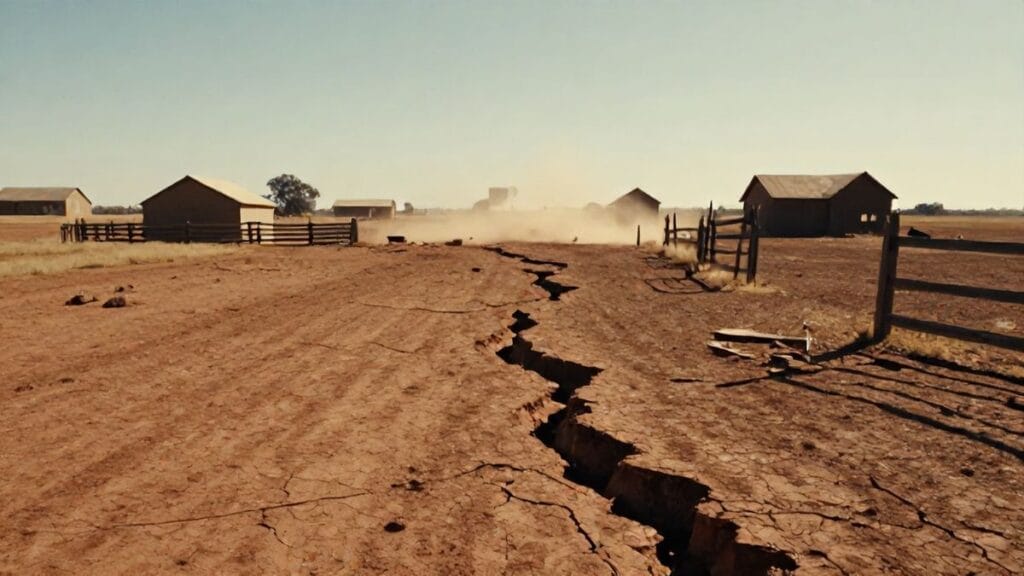
As startling as the destruction in Meckering was, the earthquake’s most extraordinary physical legacy lay not in the town itself but in the countryside to its north. There, along a roughly 37-kilometer stretch, the earth’s surface ruptured visibly, leaving a dramatic fault scarp up to two meters high in places. Fences were offset by more than a meter; roads kinked abruptly where they crossed the break; pipelines and rail lines were stretched, bent, or snapped. In an interior continental setting, such striking surface expression of faulting is rare, and it quickly drew the attention of geologists and seismologists from across Australia and overseas.
The Meckering fault scarp became a kind of outdoor laboratory. Photographs from the weeks and months after the quake show researchers walking along the jagged line of rupture, measuring offsets, sketching the geometry of the fault, and interviewing local landowners about their observations. The scarp’s presence made the usually invisible mechanics of an earthquake suddenly tangible. Here was the line along which one side of the earth had lurched upward and over the other, releasing decades—perhaps centuries—of accumulated stress in a matter of seconds.
For nearby farmers, this geological revelation was mingled with exasperation. Fences painstakingly erected over years were now broken, their posts staggered awkwardly across the rupture. In some paddocks, the fault line cut through irrigation channels and access tracks, creating new obstacles to everyday work. Yet many landowners allowed scientists free access to their properties, curious about the forces that had so rudely rearranged their terrain. Some even served as amateur guides, pointing out where particular cracks had opened or deepened during aftershocks.
Geologically, the meckering earthquake 1968 reinforced the reality that even the seemingly stable interior of a tectonic plate is crisscrossed by ancient faults, weaknesses in the crust that can be reactivated under the right conditions. Western Australia’s Yilgarn Craton, within which Meckering lies, is composed of rocks more than two billion years old. Over that immense timescale, countless stresses have built and released, leaving behind structures that, though dormant for long periods, are not permanently dead. The Meckering rupture thus served as a potent demonstration to scientists and policy makers alike that Australia’s seismic hazard could not be dismissed simply because it lay far from plate margins.
One researcher later wrote in a technical paper that “the Meckering event provided a unique opportunity to correlate observed damage with a clearly defined surface break”—a rare chance to connect the abstract equations of seismology with the very real upheaval of a rural community. It is astonishing, isn’t it, that a line only a few meters high and a few tens of kilometers long could translate into ruined homes, buckled rails, and decades of anxiety, yet also into invaluable data that would help protect future generations?
Measuring the Unthinkable: Magnitude, Intensity, and Scientific Assessment
In 1968, the tools for measuring earthquakes in Australia were far less sophisticated than those used today, yet the meckering earthquake 1968 was recorded clearly enough to make headlines in scientific circles. Seismographs at observatories in Perth and beyond captured the distinctive waveforms of the main shock and its aftershocks. Analysis of these records, combined with field observations, led to an estimated magnitude of around 6.5—a figure that placed Meckering in the same league as some of the more destructive earthquakes in better-known seismic regions.
Magnitude, of course, is only part of the story. Intensity, measured by how people experience shaking and how structures respond, varied across the region. In Meckering and its immediate surroundings, intensities reached VIII or even approaching IX on the Modified Mercalli scale, corresponding to severe to violent shaking. At such levels, poorly constructed buildings are likely to collapse, chimneys fall, and the ground itself to crack. In Perth, intensities were lower—around V to VI—but still strong enough to cause widespread alarm, dislodge objects from shelves, and remind city dwellers that they lived on the same tectonic plate as Meckering’s rattled residents.
Australian scientists, some of whom had trained in Europe or North America where earthquakes were better studied, recognized that they were witnessing a landmark event. They meticulously catalogued structural performance: which building types had failed, which had survived, and why. Unreinforced masonry—brick walls without internal steel—emerged as a major culprit, performing poorly under lateral seismic loads. Timber-framed structures often did better, but only if they were well-braced and properly connected to their foundations.
At the same time, international seismologists took notice. The clear surface rupture, combined with a well-documented pattern of damage, provided a rare chance to validate models of intraplate earthquakes. Some researchers compared Meckering to quakes in the central United States and in parts of Africa, arguing that such events, though infrequent, posed an underappreciated risk to inland regions worldwide. In one later comparative study, the authors observed that “Meckering stands as a benchmark intraplate event against which others can be measured,” a testament to the quake’s enduring scientific relevance.
Within Australia, the data gathered after the quake would feed into an evolving understanding of seismic hazard mapping. The Western Australian government, working with federal counterparts, began to look more carefully at where faults lay, how towns were built, and what standards might be needed to prevent future disasters. The mere fact that a small Wheatbelt town had generated such a wealth of measurements and models highlighted the unsettling but unavoidable conclusion: if it happened in Meckering, it could happen in other seemingly quiet places too.
In the Shadow of Collapsing Walls: Injuries, Survival, and Human Loss
Amid all the talk of magnitudes and fault scarps, it is easy to forget the human bodies caught in the shaking. One of the paradoxes of the meckering earthquake 1968 is that while the physical damage was extensive and spectacular, the death toll remained remarkably low. No one in Meckering was killed outright by the quake, a fact often cited as evidence of extraordinary luck. But there were serious injuries and many close calls, and the near-misses weighed heavily on the survivors’ minds.
Several people were trapped beneath fallen masonry when brick walls or chimneys collapsed. Rescue efforts began almost immediately, organized not by professional emergency services—thin on the ground in rural Western Australia at the time—but by neighbors, volunteers, and passing motorists. Men and women clawed through rubble with bare hands, jacks, and makeshift tools, listening intently for voices beneath the debris. In one case, a woman pinned by a collapsed wall kept up a conversation with her rescuers to reassure them she was still conscious. She emerged with broken bones and bruises but alive, owing her survival to a combination of structural chance and human determination.
Hospitals in nearby towns quickly filled with patients suffering from fractures, lacerations, and shock. Some had been struck by falling bricks; others had leapt through windows or doors in panic and hurt themselves in the process. There were reports of heart attacks triggered by the terror of the shaking, particularly among older residents. Medical staff improvised as best they could, dealing not only with physical trauma but also with the less visible wounds of fear and disorientation.
Psychologically, the earthquake was a profound rupture. Children developed nightmares, replaying the chaos in their dreams. Adults found themselves flinching at the rumble of passing trucks or the slam of a door, their bodies primed to expect another tremor. For months, and even years, memories of the event would intrude unexpectedly—a sudden image of a collapsing chimney, a remembered scream, the sensation of the floor buckling. In an era before widespread understanding of post-traumatic stress, many simply carried these burdens in silence.
Yet behind the trauma lay a powerful narrative of mutual aid. Communities in neighboring towns sent food, blankets, and manpower. Church groups organized collections; local councils coordinated temporary accommodation for those whose homes were uninhabitable. The absence of fatalities was widely celebrated, sometimes framed as a kind of miracle. Survivors themselves often attributed their escape to luck, quick thinking, or faith, but all agreed that without the instinctive solidarity that emerged in those first chaotic hours, the story might have turned out very differently.
Broken Lines and Silent Wires: Railways, Roads, and Utilities in Crisis
Beyond the town’s shattered buildings, the meckering earthquake 1968 wreaked havoc on the arteries of transport and communication that connected Western Australia’s interior to its coastal capital. The Great Eastern Highway, a vital route for freight and travelers, suffered cracks, offsets, and localized collapse where the fault rupture crossed its path. Motorists encountered jagged steps in the roadway, uneven surfaces, and, in some sections, complete obstructions. Road crews worked rapidly to patch and reroute traffic, but the sense of vulnerability lingered: if a single quake could sever such a crucial link, what did that say about the security of inland supply chains?
The railway line fared no better. Tracks were bent and warped, in some places lifted several centimeters out of alignment. The precise engineering tolerances that keep trains safely on their rails were suddenly violated, and services had to be halted or severely restricted. Photographs from the period show stretches of track with sharp kinks, like steel ribbons twisted by an invisible hand. Restoring railway operations required not just labor but careful surveying to ensure that the repaired lines would be safe under load.
Underground infrastructure suffered too. Water mains cracked, disrupting supply and adding to the post-quake confusion. In certain areas, power lines were downed, plunging streets into dark uncertainty once night fell. Telephone services, essential for coordinating relief, were intermittent at best, hampered by broken lines and overloaded exchanges as people tried desperately to contact relatives and authorities. In an age before mobile phones and the internet, the loss of landlines meant that information traveled slowly and often unreliably.
The disruption extended well beyond Meckering. Freight movements along the Perth–Kalgoorlie corridor slowed; schedules were torn up. Businesses dependent on timely supplies found themselves scrambling. The earthquake thus laid bare the fragility of the networks on which modern Australia depended. Though the nation prided itself on engineering prowess—dams, highways, mines, and railroads carving order into a harsh environment—one violent shrug from the earth was enough to bring parts of that system to a halt.
In the months that followed, engineers and planners pored over the patterns of infrastructure damage. They catalogued where pipelines had failed, where bridges had cracked, where embankments had slumped. The lessons were sobering. Many structures had never been designed with seismic loads in mind, built instead to withstand storms, floods, or heat. Earthquake-resistant design, where it existed at all, was rudimentary. The Meckering quake became a case study in the need to expand the checklist of environmental hazards that Australian infrastructure had to endure.
The Town That Had to Move: Rebuilding Meckering from the Ground Up
Once the immediate crisis passed and the injured were tended to, Meckering faced a daunting question: should the town be rebuilt where it stood, patched up and restored, or should something more radical be done? The severity of the damage, the ongoing aftershocks, and the dramatic fault scarp cutting through nearby lands all spoke to the risks of simply carrying on as before. After consultations among residents, local officials, engineers, and the Western Australian government, a remarkable decision emerged. Rather than attempt to resurrect every damaged structure in situ, parts of Meckering would be relocated to slightly more stable ground nearby.
This choice was both pragmatic and symbolic. Pragmatically, many of the worst-damaged buildings were beyond repair; demolishing them and starting anew offered a more cost-effective path than salvage. Symbolically, moving the town—even if only a short distance—acknowledged that the meckering earthquake 1968 had fundamentally altered the relationship between community and landscape. The old town site, with its cracked foundations and fractured streets, became in effect a memorial to a way of life that could not simply be resumed.
Residents were offered new housing blocks, and plans were drawn up for a reimagined town center built to higher standards. Streets were realigned; services re-laid with a greater, if still evolving, awareness of seismic risk. For some, this was an opportunity—to build more modern homes, to improve amenities that had long been considered outdated. For others, it was a painful uprooting, a forced farewell to places rich with memories. The schoolyard where they had played, the shop where they had worked, the front verandah from which they had watched the sunset—all now sat in a zone marked by damage, destined either for demolition or for future preservation as ruins.
The relocation process was neither quick nor easy. Bureaucratic delays, insurance disputes, and limited resources all slowed progress. In the interim, many families lived in temporary accommodation—caravans, makeshift shacks, or crowded in with relatives in nearby towns. The sense of dislocation went beyond the physical; people spoke of feeling “between lives,” no longer at home in the old Meckering but not yet settled in the new. Community institutions, from churches to sporting clubs, had to find ways to maintain continuity amid shifting addresses.
Yet over time, the rebuilt Meckering took shape. New houses rose, often single-story, lighter structures that seismologists hoped would fare better in any future quake. Streets once again echoed with children’s voices and the everyday bustle of town life. The decision to move, controversial to some at the outset, gradually came to be seen as an act of resilience—a community refusing to surrender to disaster, choosing instead to adapt. The old town site, or what remained of it, never fully disappeared. Portions were preserved as stark reminders of the 1968 event, allowing future generations to walk among cracked slabs and distorted walls and imagine, however dimly, the day the earth turned against them.
Politics, Policy, and the Price of Complacency
The impact of the Meckering earthquake reverberated quickly through Western Australian and federal politics. In the immediate aftermath, attention focused on relief funds, reconstruction grants, and the logistics of supporting a displaced rural community. Politicians visited the town, touring the devastation, posing for photographs, and promising assistance. Some were genuinely shaken by what they saw: a reminder that their constituencies’ security depended not only on economic fortunes and law-and-order policies but on understanding and preparing for natural hazards that could strike without warning.
Behind the public displays of concern lay more difficult conversations. Had Australia underestimated its earthquake risk? Had building codes, where they existed at all in rural regions, been too lax? In parliamentary debates and committee hearings, these questions began to surface, though not always with the urgency that hindsight might demand. Australia in the late 1960s was a nation preoccupied with growth, urbanization, and its role in Cold War geopolitics; the idea of investing heavily in seismic research and retrofitting rarely damaged buildings in the Wheatbelt might have seemed, to some, a lower priority.
Yet Meckering had planted a seed. Reports commissioned by the Western Australian government highlighted the need for better hazard mapping and stronger construction standards in seismically active zones. Federal agencies, including what would later become Geoscience Australia, took note as well. Over the next decades, incremental changes filtered into building regulations, particularly for critical infrastructure like dams, bridges, and power stations. In some ways, the meckering earthquake 1968 served as an early warning shot whose full implications would only be appreciated when later earthquakes—such as the 1989 Newcastle event—brought urban casualties and massive financial losses.
The politics of disaster, however, are rarely straightforward. Compensation disputes arose as residents and business owners sought fair valuation for their damaged properties. Insurance companies, unaccustomed to such claims in inland Western Australia, sometimes balked at payouts or contested assessments of structural loss. Local councils faced the delicate task of balancing ratepayer expectations with limited budgets and evolving guidelines from state authorities. The question of how much public money should be invested in a small town whose long-term economic viability was already under strain from changing agricultural markets remained a quiet but potent undercurrent.
Nonetheless, the earthquake altered the language of risk in Australian political discourse. Meckering became a touchstone, invoked occasionally when new projects were proposed in seismically suspect areas or when skeptics questioned the need for enhanced engineering standards. As one later commentator put it in a policy review, “We forget Meckering at our peril; the Wheatbelt has already reminded us once that the ancient crust can still move.” That observation, half warning, half lament, captures how a single day in 1968 forced a slow rethinking of what safety meant on a supposedly stable continent.
From Curiosity to Commitment: The Rise of Australian Seismology
Before 1968, seismology in Australia was often a niche pursuit—a small community of researchers monitoring occasional tremors and contributing to global networks but rarely commanding broad public attention or substantial funding. The meckering earthquake 1968 helped change that. The dramatic surface rupture, the wide area over which the quake was felt, and the sheer volume of structural damage combined to make seismology suddenly relevant, even urgent, in the eyes of governments and universities.
Observatories in Perth, Canberra, and other centers began to expand their instrumentation. New seismographs were installed, and data-sharing protocols with international agencies strengthened. The Australian National University and other institutions developed more robust research programs into the continent’s crustal structure, intraplate stress fields, and the statistical patterns of earthquake occurrence. Field trips to Meckering and its fault scarp became almost a rite of passage for geology students, grounding their theoretical learning in the tangible evidence of rupture.
International collaboration blossomed as well. Researchers from Europe, North America, and Asia saw in Meckering a rare opportunity to study a major intraplate earthquake in detail. Joint publications emerged, comparing Meckering’s characteristics with those of similar events elsewhere. Techniques for paleoseismology—studying prehistoric earthquakes through trenching and sediment analysis—were applied to the Australian context, seeking evidence of earlier, unrecorded quakes along the same or related faults.
This scientific attention had practical spin-offs. Better hazard maps were produced, indicating where the likelihood and potential magnitude of earthquakes were highest. While Meckering itself remained an iconic site, seismologists pointed out that the forces responsible for the 1968 event extended far beyond a single town. Other parts of Western Australia, as well as regions in South Australia and the southeast, showed signs of comparable stress fields. The comforting narrative of Australia as seismically inert was gradually replaced by a more nuanced view: earthquakes were infrequent, but when they occurred, they could be severe—and preparations were necessary.
Funding, of course, ebbed and flowed with political winds and competing priorities. Yet the memory of Meckering lingered in grant proposals and budget discussions. Whenever skeptics asked why so much effort should be devoted to studying a hazard that seemed rare, seismologists could gesture toward the 1968 event as an example of what could happen when the earth chose to remind Australians of their place atop a restless planet.
Comparisons and Echoes: Other Australian Earthquakes in Meckering’s Shadow
Meckering did not exist in a vacuum. Before 1968, other Australian communities had already felt the sting of seismic activity. The 1954 Adelaide earthquake, for instance, had rattled South Australia’s capital, causing damage to buildings and reminding urban Australians that they too lived on a continent with faults. But Meckering’s combination of intensity, rural devastation, and spectacular surface rupture set it apart, making it a reference point for later events.
In 1979, another significant earthquake struck Western Australia near Cadoux, a farming settlement not unlike Meckering. Although smaller in magnitude—around 6.1—it caused considerable damage to local buildings. Many analysts immediately drew comparisons, asking whether lessons from Meckering had been fully absorbed. Some improvements in building practices were evident, yet vulnerabilities remained. Then, in 1989, the Newcastle earthquake in New South Wales, with a magnitude of 5.6, caused 13 deaths and widespread structural damage, largely because it struck a more densely populated urban area with many older buildings.
Each subsequent quake recast Meckering in a new light. Where once it had been seen as an outlier, an oddity of the Wheatbelt, it slowly came to be recognized as part of a broader pattern of intraplate seismic hazard in Australia. Policy documents and research papers often mentioned Meckering and Newcastle in the same breath—one rural and dramatic in its geology, the other urban and tragic in its human toll. Together, they underlined that location and building type could be as important as magnitude in determining an earthquake’s consequences.
Comparative studies also strengthened the case for national standards. If quakes could strike Adelaide, Meckering, Cadoux, and Newcastle, no region could reasonably claim to be entirely exempt. Engineers and planners began to push for harmonized building codes that accounted for seismic risk across the country, not just in isolated pockets. Meckering thus played an indirect role in shaping safer structures in cities and towns that had never themselves felt a major quake.
Internationally, Meckering found a place in compilations of noteworthy intraplate earthquakes. Researchers studying central U.S. quakes near New Madrid, or events in India’s Koyna region, cited Meckering as a southern hemisphere counterpart. One scholarly article, reflecting on global intraplate seismicity, observed that “the Meckering, Western Australia, earthquake of 1968 underscores the need to treat continental interiors with as much respect as plate boundaries when it comes to hazard assessment” (as paraphrased from seismological literature). In this way, a small Wheatbelt town became a global case study.
Memory, Trauma, and the Stories Families Still Tell
For all the graphs, maps, and technical reports generated in the wake of the meckering earthquake 1968, perhaps its most enduring legacy lies in personal memory. In households across Western Australia and beyond, stories of “the quake” became part of family lore, recounted at gatherings, passed down to children and grandchildren. These narratives varied in detail but often shared common motifs: the sudden roar, the violent shaking, the terror of not knowing when it would stop or what would fall next.
Some memories took on an almost mythic quality. Children who had lived through the quake tended, as adults, to remember the event as larger, louder, and longer than the seismological record might suggest. This is not mere exaggeration but an expression of how trauma imprints itself, stretching time and amplifying sensations. For many, the quake became the yardstick by which all subsequent experiences of fear or instability were measured. Floods or storms could be serious, but the memory of the earth itself turning unreliable had a unique power.
Psychologists studying disaster memory have noted that such events often create what they call “flashbulb memories”—vivid, enduring recollections of where one was and what one was doing at the moment of impact. Meckering generated thousands of such memories across the region. Even people in Perth who experienced only moderate shaking sometimes recalled decades later exactly which office they were in, which cup fell from a shelf, which colleague screamed. The quake thus served as a temporal anchor in personal histories: “That was before Meckering” or “it was just after the earthquake.”
At the same time, not all stories were easily shared. Some survivors found it difficult to talk about their experiences, especially in the immediate aftermath. Feelings of helplessness, guilt at having survived when others were injured, or anger at perceived institutional failings all complicated the narrative. Over time, community-support networks, churches, and informal gatherings offered spaces where these emotions could be voiced. Oral history projects, conducted years later, provided another outlet, allowing survivors to place their individual experiences within a broader historical frame.
Younger generations, hearing these stories secondhand, sometimes struggled to fully grasp their intensity. A cracked slab preserved in the old town site or a grainy photograph of a skewed house could only convey so much. Yet the persistence of these tales—told at kitchen tables, in school classrooms, and at commemorative events—ensured that the quake did not fade entirely into the background hum of local history. Instead, it remained a defining moment, a shared point of reference that bound community members together across time.
From Rubble to Roadside Museum: Sites of Memory in Meckering Today
In the years and decades that followed, Meckering faced another challenge: how to remember the earthquake visibly in the landscape. As the new town site grew and daily life resumed its rhythms, there was a risk that the extraordinary trauma of 1968 would be swallowed by the forward march of development. Yet residents and local authorities took deliberate steps to preserve traces of the event—turning ruins and relics into what might be called a modest open-air museum of seismic memory.
Along the highway and in the vicinity of the old town, visitors can find remnants of collapsed structures left in situ or carefully relocated as displays. A distorted section of pipeline, contorted by the fault rupture, serves as a stark illustration of the forces at work beneath the soil. Interpretive signs explain the basics of the meckering earthquake 1968 in accessible language, linking each physical artifact to the broader story of that October morning. For travelers who stop, what might have been just another name on a map becomes a place marked by deep geological and historical significance.
The fault scarp itself, though softened by erosion and the passage of time, remains visible in places. Walking along it, one can still trace the subtle rise and fall where the land was abruptly offset. Farmers continue to work paddocks that straddle the rupture, their tractors passing each day over a line that once tore fences apart. In this sense, Meckering’s scars are not confined to curated heritage sites; they are integrated into the living landscape, quietly reminding those who know how to read them.
Local museums and community halls display photographs, newspaper clippings, and personal artifacts from the day of the quake and its aftermath. Visitors might see a cracked clock stopped at 10:59 a.m., a cupboard door battered by flying crockery, or a child’s toy rescued from a ruined bedroom. Such items might seem mundane in isolation, but together they form a mosaic of lived experience. As historian Tom Griffiths has written in another context, “objects carry the weight of events, holding time in their worn edges and broken surfaces” (paraphrased to reflect his approach to material memory). Meckering’s collections embody this truth.
Commemorative events, particularly on significant anniversaries, also play a role. On the fiftieth anniversary in 2018, for example, former residents, scientists, politicians, and curious visitors gathered to reflect on what had changed and what had not. Speeches acknowledged both the suffering of 1968 and the resilience that followed. Tours of the old town site and the fault scarp linked memory with place, ensuring that the story of Meckering remained grounded in the very earth that had once turned against it.
Lessons Etched in Fault Lines: Engineering, Planning, and Preparedness
The technical lessons of the meckering earthquake 1968 continue to influence Australian engineering and planning. One of the clearest takeaways was the vulnerability of unreinforced masonry. Brick walls without internal reinforcement or proper tying to roofs and floors performed poorly, often collapsing outward in dangerous ways. In response, building codes were gradually revised to require stronger connections, better detailing, and, in some areas, the inclusion of reinforcing steel or shear walls designed to absorb lateral loads.
Critical infrastructure design also evolved. Bridges in seismically aware regions began to incorporate features that allowed for controlled movement during shaking, reducing the risk of catastrophic failure. Pipelines were laid with greater attention to fault crossings; flexible joints and careful routing aimed to mitigate the kind of damage seen near Meckering. Electrical substations and communication hubs were assessed for seismic vulnerability, leading to targeted upgrades over time.
Land-use planning, too, absorbed some of Meckering’s lessons. Awareness grew that building directly atop active or potentially active faults carried particular risks. While it is impossible to avoid all such structures—many are buried or poorly mapped—planners increasingly considered geological data alongside floodplains and fire-prone areas when designating zones for development. Hazard maps, though imperfect, became tools not just for scientists but for local councils and developers.
Perhaps more subtly, Meckering contributed to a cultural shift in how Australians think about preparedness. While large urban centers might still focus more on bushfires, cyclones, or floods, emergency management agencies began to incorporate earthquake scenarios into their planning. Drills, public information campaigns, and educational materials occasionally referenced Meckering as a reminder that earthquakes were part of the national hazard profile. In schools, lessons on natural disasters sometimes included the story of the Wheatbelt town that shook in 1968, teaching children not only what to do in such an event but that such events were possible at all.
The challenge, of course, lies in sustaining attention over the long term. As years pass and direct memories fade, the imperative to maintain and update building codes, invest in monitoring networks, and educate the public can wane. Here, again, Meckering functions as a touchstone. Engineers and seismologists invoking the 1968 quake are not merely telling an old story; they are using history as a tool to insist that safety is an active, ongoing project, not a one-time achievement.
A Disaster in the Wheatbelt and the Idea of the Australian Interior
Beyond its technical and local significance, the Meckering earthquake reshaped, in subtle ways, the cultural imagination of the Australian interior. The Wheatbelt, like much of inland Australia, had often been portrayed in literature and media as harsh but fundamentally enduring—a land of droughts and flooding rains, to borrow a famous phrase, but with bedrock that could be trusted. Meckering complicated that image. If even the earth under the paddocks could buckle and break, then the relationship between settlers and land was more fragile than many had assumed.
In some narratives, the quake was framed as yet another example of the continent’s indifferent power, akin to bushfires or dust storms. But earthquakes differ from those hazards in an important way: they come not from weather or climate but from deep geological time. The fault that ruptured beneath Meckering was part of a crust billions of years in the making, its stresses accumulating far beyond human lifespans. For some observers, this underscored a sense of human smallness, of lives lived on the surface of processes that far surpassed any individual or generation.
Writers and journalists grappled with this notion. Feature articles in newspapers and magazines asked how a “stable” land could produce such violence. Some invoked metaphors of awakening—“the sleeping continent stirs”—suggesting that Australia’s interior might hold more dynamism than previously acknowledged. Others used the quake to question the wisdom of overconfidence in engineering or settlement in marginal regions. The Wheatbelt, already under pressure from salinity and changing agricultural economics, now had to contend with a new dimension of risk.
At the same time, Meckering fed into a broader conversation about national identity. Australians had long prided themselves on resilience in the face of environmental extremes. The response to the earthquake—rapid mutual aid, pragmatic decision-making, and the eventual rebuilding of the town—fit neatly into this self-image. Yet it also raised uncomfortable questions: to what extent was resilience being used as a cover for underinvestment in prevention and preparedness? Did celebrating stoicism mask structural inequities that left rural communities more exposed?
These questions remain open. But Meckering’s place in the cultural history of the interior is secure. Whenever Australians think about the land as fixed and dependable, the memory of a town that moved—literally shifted off its foundations—stands as a quiet, unsettling counterpoint.
Global Eyes on a Small Town: International Research and Collaboration
In the months after the meckering earthquake 1968, scientists from abroad arrived in Western Australia, drawn by the rare chance to study a well-documented intraplate event with clear surface rupture. Their presence turned Meckering, briefly, into a hub of international geophysical inquiry. Collaborations were forged between Australian agencies and institutions in the United States, Europe, and Asia, leading to joint field campaigns and comparative analyses.
Some of this work focused on refining global models of earthquake mechanics. By examining the precise geometry of the Meckering fault scarp, measuring displacement, and correlating these with seismic records, researchers tested theories about how stress accumulates and releases in continental interiors. Insights from Meckering fed into broader efforts to predict which faults were more likely to rupture and how severe future quakes might be. While earthquake prediction in the precise sense remains elusive, improved probabilistic hazard assessments emerged, helping planners allocate resources more effectively.
Other studies used Meckering as a case to explore the interplay between geology and infrastructure. How did pipelines crossing the fault respond? Which types of foundations fared better when the ground beneath them shifted? Answers gleaned from Meckering were applied not only in Australia but in other countries facing similar challenges—places where critical infrastructure spanned active but infrequently moving faults. In one international conference on intraplate seismicity, Meckering was repeatedly cited as a classic example, its data sets shared and reanalyzed with new methods.
These collaborations also had a human dimension. Local residents found themselves hosting visiting scientists, sharing stories over kitchen tables or at community halls. The scientists, in turn, brought news of earthquakes elsewhere and of how other communities had coped. This exchange underscored a paradox: while Meckering’s quake was locally unique, its themes—sudden disruption, fragile infrastructure, the struggle to rebuild—were globally resonant.
In this way, Meckering became part of an international conversation about living with seismic risk. Its name, once known mainly in Western Australia as a small Wheatbelt stop, began appearing in scientific journals and at conferences far from the Wheatbelt’s dry fields. The town’s trauma thus contributed, in however small a way, to a global pool of knowledge aimed at preventing or mitigating similar disasters elsewhere.
The Long Aftershock: Economic and Demographic Ripples Across Decades
Earthquakes are often understood as momentary events—brief episodes of shaking followed by a period of reconstruction. Yet the economic and demographic effects of the Meckering quake unfolded over years, even decades, in ways that are harder to measure but no less important. Before 1968, Meckering had been a modest but viable Wheatbelt town, its fortunes tied to grain prices, rainfall patterns, and the ebb and flow of traffic along the highway and railway. The quake disrupted this trajectory.
In the short term, reconstruction brought a flurry of activity. Builders, engineers, and government officials arrived, spending money and creating work. Grants and insurance payouts funded new homes and infrastructure. For a while, it might even have seemed that the disaster had injected fresh energy into a community that might otherwise have slowly declined. But as the years passed and the initial burst of rebuilding faded, more complex patterns emerged.
Some residents chose not to return after the quake, relocating permanently to larger towns or to Perth. Traumatic memories played a role for some; for others, the disruption simply accelerated decisions they had already been considering. The agricultural sector, meanwhile, faced its own challenges from changing markets, mechanization, and environmental pressures. Meckering, like many rural communities, had to cope with a gradual thinning of its population and services. The earthquake did not cause these broader trends, but it intersected with them, adding an extra layer of difficulty for those determined to keep the town alive.
Property values and investment patterns also shifted. The perception of Meckering as a “quake town” lingered, affecting how outsiders viewed the area. Some potential investors shied away, wary of geological risk, even as scientists emphasized that large earthquakes in any given spot remained rare. Others saw opportunity in cheaper land or in the town’s unique story, exploring tourism and heritage initiatives. The balance between stigma and opportunity has colored Meckering’s economic prospects ever since.
Demographically, the town aged, as younger generations often left for education and work elsewhere. Those who remained carried the memory of 1968 as both a point of pride and a burden. They had survived and rebuilt, but they also bore the ongoing responsibility of maintaining the sites and stories that kept the earthquake from disappearing into obscurity. In this sense, the quake’s aftershocks were not only geological but social, rippling through population structures, local economies, and community identities long after the last tremor faded.
How We Remember 1968: Commemorations, Archives, and Competing Narratives
As with any significant historical event, the story of the Meckering earthquake is not fixed; it has evolved over time as new voices, new evidence, and new priorities have emerged. In the immediate aftermath, official narratives emphasized resilience and the effectiveness of government and community response. Newspaper articles highlighted the miracle of no deaths, the speed of relief efforts, and the determination to rebuild. These accounts served important functions: they offered comfort, justified policy choices, and crystallized a sense of collective achievement.
Later histories, however, have added nuance. Oral history projects have captured dissenting voices—those who felt underserved by relief programs, who struggled with insurance claims, or who believed that long-term mental health effects were overlooked. Academic historians have asked hard questions about how class, gender, and geography shaped experiences of the quake. Whose homes were prioritized for rebuilding? Who had access to information and who did not? Which stories were amplified in the media and which were left largely untold?
Archives—collections of photographs, official reports, personal letters, and recorded interviews—have become key battlegrounds in this process of remembrance. They preserve multiple perspectives, allowing later generations to piece together a mosaic that is richer and more complicated than any single narrative. One archival photo might show a smiling politician touring the ruins; another, taken from a different angle, might capture a resident standing just outside the frame, arms folded, expression skeptical. Together, they invite critical reflection on how disasters are represented and understood.
Commemorative practices also reflect changing interpretations. Early anniversaries tended to focus on heroism and survival. More recent ones sometimes incorporate sessions on trauma, mental health, and lessons for contemporary disaster management. Exhibitions and talks in local museums may juxtapose glowing media reports from 1968 with candid oral history excerpts gathered decades later. In doing so, they acknowledge that history is not simply what happened but how we choose to tell and retell what happened.
Competing narratives do not necessarily cancel one another out. Rather, they offer a fuller, more humane picture of the meckering earthquake 1968. A community can celebrate its resilience while also critiquing the shortcomings of its response. It can honor the bravery of individuals while recognizing that not everyone had the same opportunities to recover. In this multiplicity lies the real strength of historical memory: its capacity to hold contradictions and to keep asking new questions of old events.
Conclusion
The story of the Australia (Meckering) Earthquake of 14 October 1968 is, at its core, a story about the sudden revelation of hidden forces—geological, social, political, and emotional. In less than a minute, a quiet Wheatbelt town was thrust into the center of national and international attention, its streets transformed into a field laboratory, its residents into reluctant witnesses to the power of the earth beneath their feet. The meckering earthquake 1968 shattered not only bricks and mortar but also the comforting assumption that Australia’s interior was immune to serious seismic events.
In the decades since, Meckering’s experience has informed building codes, infrastructure design, hazard mapping, and emergency planning across the country. Scientists have pored over its fault scarp and seismograms, extracting lessons about intraplate earthquakes that resonate far beyond Western Australia. Politicians and planners have invoked its name when arguing for stronger standards or greater investment in monitoring and preparedness. And at the human level, families and communities have carried its memory forward, transforming trauma into stories, commemorations, and a modest but powerful heritage landscape.
Yet the earthquake’s legacy is not solely one of progress and enlightenment. It also reveals the limits of attention, the uneven distribution of resources, and the persistent vulnerabilities of rural communities whose importance can be overshadowed by urban priorities. Meckering reminds us that resilience is not a static trait but an ongoing practice, requiring continual effort to remember, to learn, and to adapt. The fault lines that tore through the Wheatbelt in 1968 are still there, mostly quiet, mostly invisible, but capable, as all such faults are, of moving again.
In walking along the preserved ruins of the old town or tracing the subtle rise of the fault scarp in a farmer’s paddock, one senses both the fragility and the tenacity of human settlement. People return, rebuild, tell stories, and plant new crops on ground that once betrayed them. The Meckering earthquake thus offers not just a cautionary tale about geological hazard but a profound meditation on what it means to live on a restless planet—to build homes, communities, and futures in full knowledge that the earth itself is not as fixed as it may seem.
FAQs
- What was the magnitude of the Meckering earthquake in 1968?
The Meckering earthquake of 14 October 1968 is generally estimated to have had a magnitude of about 6.5 on the Richter scale. This makes it one of the largest recorded inland earthquakes in Australian history and certainly one of the most significant in Western Australia. - Where exactly did the Meckering earthquake occur?
The earthquake struck near the small town of Meckering in the Wheatbelt region of Western Australia, roughly 110 kilometers east of Perth. The epicenter lay close to the town, and a surface fault rupture about 37 kilometers long extended through surrounding farmland. - How much damage did the 1968 Meckering earthquake cause?
The quake caused extensive damage to buildings, roads, and infrastructure in Meckering and surrounding areas. Many brick structures collapsed or were severely damaged, railway lines and the Great Eastern Highway were distorted, and underground utilities like water mains and pipelines were ruptured. Economic losses ran into the millions of dollars in 1968 terms, not counting long-term impacts. - Were there any fatalities in the Meckering earthquake?
Remarkably, no deaths were directly attributed to the Meckering earthquake, despite the severe damage. However, dozens of people were injured, some seriously, and there were reports of heart attacks and longer-term psychological effects. The absence of fatalities is often cited as a testament to timing, building occupancy patterns, and swift local rescue efforts. - Did the town of Meckering move after the earthquake?
Yes. Due to the extent of the damage and concerns about rebuilding on compromised ground, parts of the town were relocated to a slightly different site nearby. New houses and public buildings were constructed on this safer ground, while some ruins and features of the old town were preserved as memorials. - How did the Meckering earthquake change Australian building codes?
The earthquake highlighted the vulnerability of unreinforced masonry and inadequately tied structures. Over time, its lessons fed into revisions of Australian building codes, promoting stronger connections between walls, roofs, and foundations and greater consideration of seismic loads, especially for critical infrastructure and in regions identified as seismically active. - Is Western Australia still at risk of earthquakes like Meckering?
Yes, although large earthquakes remain relatively rare, Western Australia, particularly its inland regions, contains numerous ancient faults capable of producing significant seismic events. Modern hazard maps reflect this risk, and seismograph networks monitor activity across the state, but the exact timing and location of future large quakes cannot be predicted. - Can visitors still see evidence of the 1968 Meckering earthquake today?
Visitors can view preserved ruins, interpretive displays, and artifacts in and around Meckering, including a section of distorted pipeline and remnants of the old town site. Parts of the fault scarp, though weathered, are still visible in the surrounding countryside, and information boards explain their significance. - How does the Meckering earthquake compare to the 1989 Newcastle earthquake?
Both were significant Australian earthquakes, but they differed in context and impact. Meckering (1968) was larger in magnitude and produced a dramatic surface rupture in a rural area; Newcastle (1989), though smaller in magnitude, struck a densely populated urban region, causing 13 deaths and widespread structural damage. Together, they underscore the varied ways earthquakes can affect different parts of Australia. - What should people do if a similar earthquake occurred today in Australia?
Standard earthquake safety advice applies: drop to the ground, take cover under sturdy furniture or next to an interior wall, and hold on until the shaking stops. Stay away from windows, chimneys, and heavy objects that could fall. After the shaking, check for injuries, avoid damaged buildings, and listen to official instructions via radio, television, or mobile alerts. Preparedness, including knowing these steps in advance, is a key lesson drawn from Meckering and later events.
External Resource
Internal Link
Other Resources
- Encyclopaedia Britannica – general search for the exact subject
- Google Scholar – academic search for the exact subject
- Internet Archive – digital library search for the exact subject