Table of Contents
- A Summer of Reckoning: Setting the Stage at Bannockburn
- A Kingdom in Chains: Scotland before the Storm
- Edward I’s Shadow and the Rise of Robert the Bruce
- Siege at Stirling: The Wager that Forced a Battle
- Mustering the Hosts: Who Fought at Bannockburn?
- The Eve of Battle: Prayers, Fears, and Quiet Resolutions
- June 23, 1314: The First Clash at the New Park
- The Single Combat: Bruce, De Bohun, and a Broken Axe
- Night Between Battles: Confidence in One Camp, Chaos in Another
- June 24, 1314: The Schiltrons Advance and the English Line Breaks
- Panic on the Carse: Rout, Flight, and the Deaths in the Bannock Burn
- Captives, Spoils, and Bargains: The Human Aftermath
- From Battlefield to Nationhood: Political Consequences in Scotland
- England in Defeat: Royal Embarrassment and Internal Strains
- Remembering Bannockburn: Chronicles, Myths, and Songs
- Weapons, Tactics, and Terrain: Why the Underdog Won
- Women, Peasants, and Priests: The Often-Silent Voices of 1314
- From Medieval Battlefield to Modern Symbol: Bannockburn in Memory and Politics
- Conclusion
- FAQs
- External Resource
- Internal Link
Article Summary: On two hot June days in 1314, the fields and wooded ridges outside the small settlement of Bannockburn became the unlikely stage on which the future of Scotland was fought for with spear and steel. This article follows the battle of bannockburn from its roots in conquest and resistance to its lasting impact on politics, identity, and memory. We begin by stepping into a Scotland fractured by civil war and English occupation, then watch Robert the Bruce gamble everything on a risky confrontation to relieve the besieged castle of Stirling. Through eyewitness chronicles, reconstructed movements of troops, and personal stories, the narrative reconstructs the ferocious clashes, the famous duel between Bruce and de Bohun, and the sudden collapse of a seemingly invincible English army. But this narrative does not end when the noise of battle fades; it traces the prisoners, widows, and peasantry who lived with the consequences, and explores how a tactical victory turned into a symbol of independence. Along the way, the article weighs myth against evidence, studying how poets, kings, and later politicians recast Bannockburn to serve their own times. Drawing on both military history and social context, it shows how one battle reshaped the map of Britain and the imagination of generations. In the end, Bannockburn emerges not as a simple heroic triumph, but as a hard-fought, deeply human moment in a long and painful struggle for sovereignty.
A Summer of Reckoning: Setting the Stage at Bannockburn
On the morning of 23 June 1314, a warm sun rose over the low ridges and marshy hollows south of Stirling, its light catching on spear-points, helm-rims, and the nervous eyes of thousands of men who knew, in their bones, that the coming hours might decide the fate of a kingdom. This was the opening of the battle of bannockburn, though no one there would have called it that yet. To them, it was simply the moment when uneasy years of war, rebellion, and occupation finally collided in one desperate encounter. To the west, in the wooded New Park, Scottish soldiers tightened their grips on ash-wood shafts and muttered hurried prayers in rough Gaelic and Lowland Scots. To the east, on the flat carseland near the Bannock Burn stream, the great host of King Edward II of England assembled with all the pomp and confusion of a vast medieval army: banners whipping in the wind, camp followers calling, horses snorting impatiently under their mailed riders.
The land itself seemed to conspire in the drama. North lay Stirling Castle, its gray bulk perched on volcanic rock, a symbol of whoever ruled central Scotland. South and east stretched the open approaches from England, the routes Edward’s men had marched, dragging with them wagons of supplies, siege engines, and the expectations of a realm that had grown used—under Edward I—to Scottish submission. Between these poles of power ran the banks of the Bannock Burn, not a mighty river but a twisting, often marshy stream that would play a deadly role in what was to follow. The ground, the weather, the very geography of Bannockburn would shape events as much as any single man’s courage.
In the Scottish camp, the atmosphere was different: fewer tents, fewer banners, far fewer men, but a certain hard-earned calm. They knew, roughly, how badly they were outnumbered. Contemporary estimates vary wildly, some claiming tens of thousands of English against perhaps 8,000–10,000 Scots, but all agree that the English army was much larger and more lavishly equipped. Yet the Scots had chosen this ground, had paced it, dug into it, prayed on it. And they had a leader who understood something essential about his enemy and about the moment. Robert the Bruce, King of Scots by a crown claimed in blood and contested ever since, had wagered everything on the coming clash.
It is astonishing, isn’t it, that a relatively small battle outside a nondescript village would echo across the centuries as Bannockburn has done? At the time, people thought in terms of sieges, taxes, and oaths of homage, not modern nationalism. But over the two days that followed, patterns of power painstakingly built by English kings over decades began to unravel. This article will retrace how that happened: from the troubled years before 1314, through the tense march to Stirling, into the chaos of the fighting, and beyond, into the long afterlife of memory and myth that made the battle of bannockburn a symbol far greater than the clash itself.
A Kingdom in Chains: Scotland before the Storm
To understand why men were willing to stand in tight ranks before charging English cavalry at Bannockburn, we must step back several decades, into a Scotland that had already been wrenched and broken long before Robert the Bruce raised his royal banner. The late thirteenth century had brought unexpected crisis. When King Alexander III of Scotland died in 1286, followed by his only surviving heir, the young Margaret, Maid of Norway, Scotland found itself without a clear successor. The resulting uncertainty opened the door to interference from the south that would ultimately set the stage for the battles to come.
Edward I of England, later dubbed the “Hammer of the Scots,” presented himself initially as an arbiter among the competing Scottish claimants to the throne. Two main rivals emerged: John Balliol and Robert Bruce, grandfather of the future king. In 1292, Edward selected Balliol, but the price was heavy. The new Scottish king found himself treated more as a subordinate lord than a sovereign ruler, compelled to accept English overlordship and dragged into Edward’s continental quarrels. Dissatisfaction grew among the Scots nobility, who bristled at the erosion of their kingdom’s independence.
When Scottish resistance finally flared, Edward responded with ruthless efficiency. He invaded, deposed Balliol in 1296, and carried off the Stone of Destiny from Scone—a symbolic theft of Scotland’s royal soul. Towns were burned, nobles forced to swear fealty. It was in this brutal context that figures such as William Wallace emerged, not as romantic freedom-fighters in the modern sense, but as men pushed toward rebellion by a mixture of patriotism, wounded pride, and opportunity.
Wallace’s victory at Stirling Bridge in 1297 proved that English armies could be beaten, but his crushing defeat at Falkirk the following year, and his eventual capture and execution in 1305, seemed to confirm English supremacy. Yet the embers of resistance never quite died. Among those watching—and calculating—was Robert Bruce, a noble of mixed loyalties, with lands in both Scotland and England, and a claim to the Scottish throne that would soon set him on a dangerous path. The kingdom, its institutions battered and its nobility divided, was fertile ground for both civil war and regeneration.
By the time of the battle of bannockburn, Scotland had endured nearly two decades of intermittent war, confiscations, exiles, and oaths of allegiance made and broken. Ordinary people bore the brunt: crops trampled by marching armies, barns plundered to feed garrisons, sons conscripted or dragged into feuds not of their making. For them, the conflict was as much about survival as sovereignty. Yet this background of suffering also forged communities that could support long campaigns, hide fugitives, and supply guerrilla bands. Bannockburn did not explode from nowhere; it grew from this steady, grinding experience of occupation and resistance.
Edward I’s Shadow and the Rise of Robert the Bruce
Edward I died in 1307 on campaign, an old king still riding north to stamp out Scottish resistance once and for all. His death left a shadow that loomed over both his son, Edward II, and over Robert the Bruce, whose own ascent to the Scottish throne was marked by bloodshed and desperation. In February 1306, Bruce had shocked Scotland by stabbing his rival, John Comyn, before the high altar of Greyfriars Church in Dumfries. This act, part impulse, part calculation, shattered what remained of political compromise. Bruce was excommunicated, yet within weeks he was crowned King of Scots at Scone, his coronation a bold defiance of English power and of his domestic enemies.
The early years of Bruce’s kingship went badly. Defeats in battle, the capture and execution of his brothers, and his own period of fugitive hardship—possibly on remote islands off the west coast—nearly destroyed his cause. Chroniclers and later storytellers would embellish this time with the famous tale of Bruce watching a spider repeatedly weaving its web, drawing from it the maxim “try, try, and try again.” Whether or not this anecdote is literally true, it captures something of Bruce’s transformation. He emerged from exile not as a wavering noble but as a hardened war leader determined to win by any means available.
From 1307 onward, Bruce waged a war unlike the pitched confrontations Edward I had preferred. He launched rapid raids, targeted castles, and avoided major battles unless the terrain and conditions favored him. Many English-held strongholds were not merely taken but systematically dismantled. Without fortresses to hold, English authority in much of Scotland began to evaporate. At the same time, Bruce dealt ruthlessly with internal rivals, asserting his kingship through a combination of patronage and terror. It was during these years that he forged the core of the army that would eventually stand with him at Bannockburn—men who had fought with him in skirmishes in Galloway, sieges in the north, and desperate marches through borderlands.
Edward II, in contrast, struggled to live up to his father’s reputation. More comfortable with favorites and court politics than with the grinding discipline of campaigning, he alienated many of his own barons. Yet he could still muster formidable military resources when pushed, and as Bruce’s power grew, so did pressure in England to crush this upstart king once and for all. The stage was thus set: a veteran guerrilla commander whose authority rested on continued success, and a king whose prestige demanded a decisive act of re-conquest. They would meet, indirectly at first, through the stones and walls of Stirling Castle.
Siege at Stirling: The Wager that Forced a Battle
In the intricate chessboard of medieval warfare, castles were often the pieces that mattered most, and none more so in central Scotland than Stirling. Guarding the crossing of the River Forth, the castle was a key gateway between Highlands and Lowlands, between north and south. By 1313, it remained one of the last major strongholds in Scotland still held by the English. Robert the Bruce understood that as long as Stirling flew the banner of Edward II, his control of the kingdom would be incomplete and insecure.
Bruce entrusted the siege not to himself but to his resolute younger brother, Edward Bruce. The garrison inside, under Sir Philip Mowbray, resisted doggedly, and the campaign dragged on. It was then that a fateful agreement was made—one that historians have debated ever since. Facing shortages and pressure, Mowbray negotiated a pact with Edward Bruce: if an English relief army did not arrive to lift the siege by Midsummer Day, 24 June 1314, the castle would surrender to the Scots.
To Bruce, the agreement was disastrous. It guaranteed that Edward II would be forced to march north at the head of a great army, with a fixed deadline compelling him to act. Instead of continuing his strategy of attrition and selective engagements, Bruce would now be confronted with the likelihood of a major pitched battle near Stirling, on ground that might not favor his smaller force. According to the later fourteenth-century chronicler John Barbour, Bruce was furious with his brother for binding them to such terms, yet there was no going back. The clock was now ticking toward a confrontation whose timing and place were no longer entirely in Scottish hands.
The pact at Stirling transformed a regional siege into a kingdom-wide crisis. In England, news of the threatened fall of such a vital fortress spurred recruitment and royal resolve. In Scotland, allies and former enemies alike recognized that the coming summer would be decisive. Supporters of Bruce hastened to his side; others waited, watching to see which way the wind would blow. Bandits, small lairds, and town councils all had to weigh their choices. War, in this sense, seeped far beyond the walls of any castle or the field of any battle.
When Edward II finally set out with his army, he did so not simply to relieve Stirling but to reassert an imperial vision of overlordship that his father had nearly achieved. Bruce, for his part, knew that a victory might solidify his reign, while a defeat could dismantle all he had built since 1306. Bannockburn was emerging on the horizon, not yet as legend, but as an unavoidable gamble of survival and ambition.
Mustering the Hosts: Who Fought at Bannockburn?
The armies that converged on Bannockburn in June 1314 were not just anonymous masses of steel-clad warriors. They were mosaics of social classes, languages, and motives. To look closely at who fought there is to understand why the battle of bannockburn has such a strong human texture in the historical record, and why its outcome reverberated far beyond the soldiers’ ranks.
On the English side stood a composite host drawn from across Edward II’s domains. There were heavily armored knights and men-at-arms, the elite of feudal warfare, mounted on powerful destriers, their gear a glittering display of wealth and status. Alongside them marched Welsh archers, famed for their longbows, and infantry levies from English shires and border towns. Some chroniclers, such as the Lanercost Chronicle, describe a force numbering in the tens of thousands, though these figures are likely exaggerated. Modern historians tend to estimate perhaps 15,000–20,000 English troops, including a large cavalry contingent.
Among these men were magnates like the Earl of Gloucester and the Earl of Hereford, whose own reputations and local power were tied up with the campaign. Many had fought in earlier Scottish campaigns or on the continent. Yet not all hearts beat with enthusiasm. The court politics surrounding Edward II’s favorites had alienated some powerful barons, and though they answered the call to arms—feudal obligations were not easily ignored—the sense of unified purpose that had driven Edward I’s campaigns was missing. For some, Bannockburn was less a holy cause than a duty done under a clouded sky of mistrust.
The Scottish army was smaller, but in its way no less diverse. Robert the Bruce’s core was composed of infantry organized in dense formations known as schiltrons—tight hedges of spears projecting outward to repel cavalry. These were drawn largely from the lesser nobility, free farmers, and townsmen who had come to see Bruce’s cause as their own. Unlike earlier Scottish hosts dominated by reckless cavalry charges, this army was built to fight on foot, shoulder-to-shoulder, its discipline forged in years of guerrilla conflict.
There were, too, mounted Scottish nobles who dismounted willingly to fight beside their men: a visible declaration that they would not try to win glory separately but share the fate of their followers. Gaelic-speaking warriors from the western highlands and isles, Lowland spearmen, archers from the Ettrick Forest, and retainers of powerful families such as the Douglas and the Stewart all stood in the same ranks. Behind them, in shadow, were camp followers: wives, craftsmen, priests, servants. Many would not wield a weapon in the main clash, but they would tend the wounded, strip the dead, and carry back stories to their homes.
Both armies carried not just arms but memories. English veterans remembered the messy victory at Falkirk and the years of chasing elusive Scottish enemies through harsh terrain. Scots remembered the humiliations of occupation and the harsh reprisals that followed failed risings. In their minds, Bannockburn was already layered with grief and hope. Some likely thought of it in terms of faith—God’s judgment on king and country. Others thought only of pay, plunder, and survival. Together, these competing motivations formed the true face of the hosts that would collide over two burning June days.
The Eve of Battle: Prayers, Fears, and Quiet Resolutions
As Edward II’s army approached Stirling, the looming deadline of Midsummer pressed on everyone involved. On the Scottish side, Robert the Bruce deliberately drew his forces south of the castle, into the New Park, a royal hunting preserve of woodland and rough ground bordered by more open carseland and the winding line of the Bannock Burn. He had chosen this ground with care. The marshy stream and the constricted approach would hinder Edward’s preferred tactics of massed cavalry and give the Scottish spearmen their best chance.
In the days leading up to 23 June, Bruce’s men labored to prepare the field. They dug pits—“pottes” as some sources call them—concealed with branches and turf, intended to break up cavalry charges and unseat riders. Tracks and paths were scouted, positions assigned. This was not a random rabble awaiting fate, but a carefully arranged defense designed by a commander who knew that one uncontrolled English charge might sweep his whole army away.
Night in the Scottish camp must have been a mixture of tension and grim camaraderie. Chroniclers speak of Bruce hearing Mass, of soldiers confessing sins and receiving absolution in anticipation of death. The air would have been thick with the smell of smoke, sweat, and horses, with the sound of murmured prayers and low voices telling stories to keep fear at bay. For a peasant spearman from Fife or a minor laird from Ayrshire, this might have been his first time so close to a great king. For Bruce, every individual in those ranks was a test of his decade-long effort to weld a fractured land into a single, if fragile, nation-in-arms.
In the English camp, the atmosphere was different, colored by the confidence of numbers but also by the strain of marching and the knowledge that the deadline at Stirling left little room for maneuver. Edward II had with him the symbols of royal authority—the great seal, banners, household knights—but he did not possess his father’s aura of invinctibility. Some magnates doubted his judgment; some resented his favorites. Yet none could dismiss the strength of the host assembled on the carse. They anticipated another Falkirk—another moment when weight of cavalry and discipline of archers would crush Scottish defiance.
That night, under a sky turning slowly from blue to indigo, no one could know exactly what patterns of blood and fortune the next day would write across the landscape. They only knew that the die Bruce’s brother had cast at Stirling was about to be thrown for real, in steel and flesh.
June 23, 1314: The First Clash at the New Park
The first day of the battle of bannockburn began not with grand lines of soldiers advancing in perfect unison, but with scouting, probing, and a sudden, fierce collision that tested the nerve of both sides. As Edward’s army moved towards Stirling, detachments were sent forward to reconnoiter the Scottish positions and, if possible, brush aside any forward elements. It was one such force, led by the Earl of Gloucester and the Earl of Hereford, that clashed with Bruce’s advance guard near the edges of the New Park.
Robert the Bruce himself rode out to oversee the Scottish forward positions. He was not alone; a small mounted escort and nearby schiltrons of spearmen gave him some measure of security. Yet the ground here, broken by woods and narrow tracks, made it possible for confrontations to happen fast and with little warning. A group of English cavalry, more eager than cautious, spurred ahead, seeking to clear what they may have thought was a minor obstacle on the way to a larger engagement.
The Scots on this first day demonstrated the discipline Bruce had drilled into them. Rather than scatter or engage in chaotic brawls, the spearmen formed tight groups, bracing their long weapons against the weight of charging horses. In the cramped spaces between trees and pits, the English advantage in cavalry was blunted. Horses reared, men fell, and the impression of invincible mounted might began to crack. Yet the day’s fighting was not decisive. It was a bloody prelude, a testing of tactics and nerves.
The most memorable moment of 23 June, however, came not from the grinding push of schiltron against charge, but from a startling episode of personal combat that, in later retelling, would become almost emblematic of the entire conflict. It happened when Robert the Bruce, easily identifiable by his royal surcoat and the circlet of gold around his helm, found himself momentarily exposed on the field.
The Single Combat: Bruce, De Bohun, and a Broken Axe
As the skirmishing on 23 June unfolded, a young English knight, Sir Henry de Bohun, spotted an opportunity that could, he thought, end the war in a single stroke. Mounted on a warhorse and armed with a fearsome lance, de Bohun saw the Scottish king riding somewhat ahead of his men, mounted on a smaller horse and armed with a battle-axe. To a knight raised on tales of chivalric glory, the vision was irresistible: slay the rebel king, break the enemy’s heart, and win undying fame.
De Bohun lowered his lance and charged. It must have seemed, in that instant, as if the whole field held its breath. Chroniclers like John Barbour, writing later in the fourteenth century, linger on this moment, shaping it into a near-mythic duel. Bruce, they say, held his ground until the last possible heartbeat, then turned his mount with remarkable agility, sidestepping the impact of the lance. As de Bohun thundered past, off balance from his missed strike, Bruce rose in his saddle and brought his axe crashing down on the knight’s helmet, splitting both metal and skull in a single blow.
The axe-shaft shattered with the force, leaving Bruce momentarily standing, weapon ruined, on a field still alive with danger. When he returned to his men, they crowded around, some no doubt praising his courage, others aghast at the risk he had taken. Barbour reports Bruce’s laconic rebuke to himself: he was, the king allegedly said, “sorry for having broken my good axe.” Whether or not those words are exact, their spirit captures something vital about how the Scots wished to remember their king—calm, practical, unshaken by the drama of near-death.
This episode, repeated in chronicles and later in popular imagination, did more than decorate the battle with chivalric color. It had real psychological impact. To the Scots who saw it, their king’s cool triumph in the face of a headlong English charge was proof that God and fortune favored them. To English observers, the fall of de Bohun under Bruce’s axe was a bad omen, a sign that recklessness and overconfidence might be punished on this unfamiliar ground. In a battle where numbers were against the Scots, morale and belief mattered enormously. In that sense, a single axe-stroke helped tip an intangible but potent balance.
As the sun lowered on 23 June, the Scots had held their positions and bloodied their opponents. They fell back into the New Park that evening with growing confidence. The English, for all their numbers, had been unable to brush them aside. Yet this was only the beginning. The true decision would come on the morrow, when the full weight of Edward’s army attempted to break through to Stirling.
Night Between Battles: Confidence in One Camp, Chaos in Another
The night between 23 and 24 June has been described in starkly different tones by various sources. In Scottish tradition, it was a time of composed preparation and renewed faith. Some accounts speak of Robert the Bruce addressing his men, reminding them of the hardships they had endured and of what was at stake. He presented the coming fight as a struggle for their homes, their families, and the very idea of a free Scotland. Many knelt, we are told, as priests moved among them with blessings and the cross was raised. The men slept, if at all, on rough ground under stars, with their spears close at hand.
Across the field, the English camp was a sprawling, bustling city of tents, wagons, and restless horses. Officers argued over plans, and lines of communication tangled in the sheer mass of people and equipment. The terrain ahead—hemmed in by woods, watercourses, and the position of Stirling Castle—offered less room for the grand, sweeping maneuvers that Edward’s commanders preferred. Some of the king’s advisors, recognizing how the Scots had anchored themselves on favorable ground, reportedly urged caution. Others pressed for immediate and crushing attack at dawn; time, after all, was running out before Midsummer Day closed and with it the terms of the Stirling agreement.
Edward II himself faced more than strategic puzzles. Inside his own ranks, resentments simmered. Tensions with the Earl of Gloucester are hinted at in several chronicles, and the uneasy coalition of magnates did not produce the unified vision of command that Edward I had once imposed. Yet for the common English soldier, these disputes were distant murmurs. They saw the Scottish fires in the distance and knew only that in the morning they would march to clear a defiant enemy from their king’s path.
Both camps, in their own ways, must have felt the weight of dawn pressing nearer. Horses were checked, armor repaired, prayers murmured to saints and to God. Some men no doubt wrote or dictated hurried letters, though few would ever see safe delivery. War, that night, felt like both an ancient ritual of kings and a painfully sharp personal risk. As the darkness thinned toward gray, trumpets began to sound, and the armies rose to meet the day that would make Bannockburn a byword in history.
June 24, 1314: The Schiltrons Advance and the English Line Breaks
When the sun crept over the horizon on 24 June, it lit a scene of controlled determination on the Scottish side and congested ambition on the English. Robert the Bruce had organized his army into several large schiltrons, each a bristling block of spearmen trained to move as one. Unlike the static defensive circles of earlier Scottish battles, these formations were designed to advance, slowly but relentlessly, like living walls of iron-tipped wood.
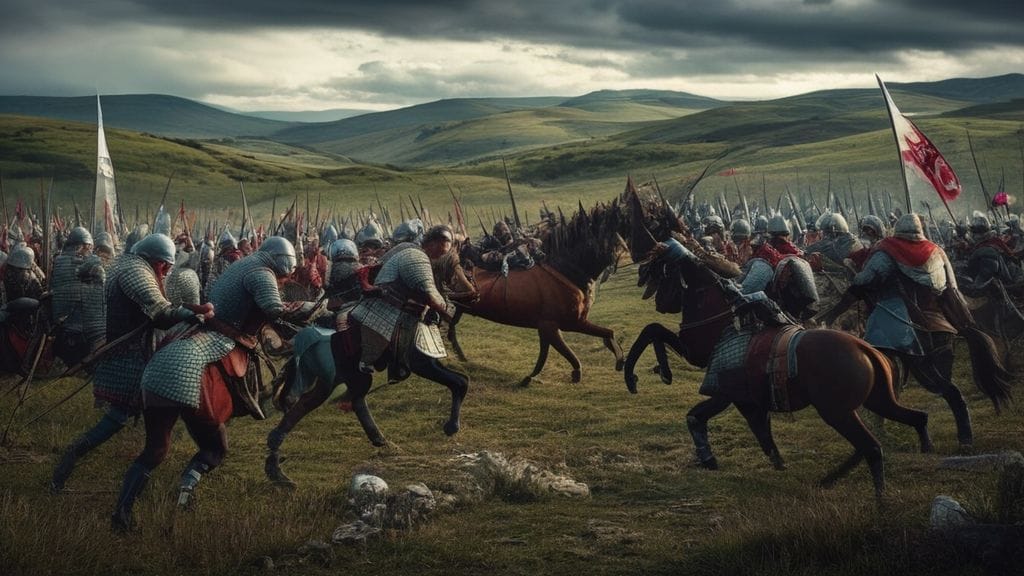
As the English cavalry began to move forward, they found themselves constrained by the narrow space between the Bannock Burn and the higher ground of the New Park. The pits and rough terrain Bruce’s men had prepared did their work. Horses balked or stumbled; riders struggled to deploy into proper battle-lines. Instead of sweeping arcs of heavy cavalry enveloping fragile infantry, the field became a series of cramped funnels, where numbers were as likely to cause chaos as victory.
At Bruce’s signal—one can imagine the royal standard lifting high in the morning breeze—the Scottish schiltrons advanced. To some observers, this must have seemed suicidal. For generations, infantry had been expected to endure cavalry charges, not march to meet them. Yet the Scots, spears leveled, moved downhill with surprising cohesion, chanting prayers and war-cries. When the first English charges hit, the spears bit deep into horseflesh, and knights found themselves pressed against an unyielding forest of ash poles and iron. Those who fell were trampled by their own mounts or crushed by comrades behind them.
English archers, the deadly arm that had helped win at Falkirk, tried to come into play. But in the constrained space, with their own cavalry struggling and Scottish troops pressing forward, they were unable to establish the wide, clear fields of fire they needed. According to some later accounts, a flanking attack by Scottish horse under Sir Robert Keith, the Marischal of Scotland, further disrupted the archers, scattering them before they could bring their full power to bear.
Moment by moment, the situation tipped. The English front ranks were pushed back into their own second lines. Men shouted orders that could not be heard, banners twisted and fell, horses screamed as they were skewered or slipped in mud and blood near the banks of the burn. The Scottish spearmen, for their part, felt their fear begin to harden into something else: the realization that the enemy was not invincible, that the wall of armor before them could buckle.
Somewhere in the press, the Earl of Gloucester was killed, reportedly while bravely attempting to rally the English forces. His death, like de Bohun’s the previous day, carried both tactical and symbolic weight. Leadership was literally being cut down in the crush, and with it any remaining sense of coordinated resistance. The battle of bannockburn was turning from a contest of formations into a desperate struggle for escape.
Panic on the Carse: Rout, Flight, and the Deaths in the Bannock Burn
Once panic takes hold in a medieval army, it spreads like fire in a dry field. At Bannockburn, the spark was the growing sense among English soldiers that they were trapped between the advancing Scottish schiltrons and the obstacle of the Bannock Burn itself. Men pushed backward by the unrelenting forest of spears found themselves stumbling into the marshy banks and waters of the stream. Horses, maddened by pain and terror, reared and plunged, dragging riders under.
Contemporary and near-contemporary accounts paint a vivid picture of the rout. Giovanni Villani, a Florentine chronicler writing with the detachment of distance, described the English as thrown into such confusion that “they could neither advance nor retreat.” Others speak of men driving each other into the water as they fought to escape, armor dragging them down beneath the surface. Whether every detail is exact or not, the core truth remains: the broken field and the pressed mass of retreating troops turned the Bannock Burn from a geographical feature into a killing ground.
Edward II himself fled the field, escorted by loyal knights who fought to carve a path through the chaos. He would eventually reach Dunbar and then the safety of a ship back to England, his personal safety preserved at the cost of his army’s ruin and his honor deeply wounded. Many of his men were not so fortunate. Some died trying to swim across the river; others were cut down as they abandoned their mounts or cast off armor to run. The Scottish pursuit, though not as methodically organized as in later professional armies, was fierce enough to turn the retreat into a slaughter in places.
Yet even in victory, the Scottish side did not become a blood-mad mob. Robert the Bruce had to balance the desire to annihilate his enemy with the practical benefits of capturing valuable prisoners. Noble captives could be ransomed for large sums, providing both wealth and political leverage. Many high-ranking English lords were taken and would spend months or years in Scottish custody, their families back home negotiating their eventual release.
When the din finally faded, the field at Bannockburn and the approaches to the stream were littered with evidence of the catastrophe: broken lances, discarded shields, unhorsed destriers wandering amidst human bodies. Survivors, Scottish and English alike, moved among the dead seeking friends, relatives, or plunder. Priests offered hurried last rites where they could. The battle had ended, but its consequences—personal, political, and symbolic—were only beginning to unfold.
Captives, Spoils, and Bargains: The Human Aftermath
The immediate aftermath of the battle of bannockburn was a time of sharp contrasts: jubilation and grief, profit and ruin, liberation and captivity. For Robert the Bruce and his leading commanders, the scale of the victory became clear as the rolls of prisoners and dead were compiled. Important English nobles had fallen into Scottish hands; their names read like a roll-call of the realm’s aristocracy. Each represented not only a military loss for Edward II but a potential source of ransom income and diplomatic leverage.
Ransom in the medieval world was a grim but accepted business. Captured lords were valuable precisely because they were alive. Their families and liege lords were expected to pay, sometimes in coin, sometimes in concessions or exchanges of other captives. Some English knights and nobles would find themselves lodged in Scottish castles or monasteries, their treatment varying with their captors’ character and the ongoing political calculations. For the lower ranks, the options were harsher: some might be pressed into labor, others simply released, stripped of valuables, to carry tales of defeat back across the border.
Scottish soldiers, too, had their dead and wounded to reckon with. Victory does not erase the sharpness of loss for those who see familiar faces missing at the morning roll. Villages in Ayrshire, Fife, the Lennox, and beyond would receive both joyful tidings and heartbreaking news. Widows and orphans were created on both sides of the conflict that day. Yet in Scottish communities, the sense that these sacrifices had secured something tangible—relief from occupation, a step toward acknowledged independence—gave mourning a particular, bitter pride.
The spoils of victory were not limited to weapons and armor. The English baggage train, though partially protected and partially saved by elements of the retreating army, yielded significant capture. Silver plate, fine cloth, tents, and provisions all fell into Scottish hands. For men who had known scarcity under years of war, this sudden wealth was as striking as the strategic rewards. Bruce, mindful of the loyalty he needed to maintain, distributed some of the plunder among his followers, reinforcing bonds of service and gratitude.
At the same time, diplomatic messages began to move. Edward II’s humiliation could not be concealed; it was written on the fields around Bannockburn. But he remained king of a powerful realm, and Bruce understood that the battle, though decisive in the moment, did not automatically grant international recognition of Scottish independence. That would require years more of negotiation, pressure, and occasionally further warfare. Bannockburn was a turning point, not an end point. Yet for those who walked the bloody ground in late June 1314, that distinction likely mattered little. They had survived a day in which the world they knew seemed to tilt on its axis.
From Battlefield to Nationhood: Political Consequences in Scotland
The political shockwaves from Bannockburn within Scotland were immediate and profound. Robert the Bruce, whose claim to the throne had once seemed precarious and divisive, emerged from the victory as the unchallenged military leader of his people. Powerful families that had hesitated or even opposed him now had to acknowledge that he, and not an absent Balliol or a distant English king, held real power on the ground.
In the years that followed, Bruce consolidated this authority through a mixture of reward and punishment. Loyal supporters at Bannockburn were granted lands confiscated from those who had stood with Edward II or who persisted in opposing the Bruce regime. This redistribution of estates reshaped the map of aristocratic power in Scotland. New families rose, older ones diminished or disappeared. The political landscape we associate with later medieval Scotland—names like Douglas and Stewart looming large—was in part forged in the crucible of post-Bannockburn realignment.
The victory also gave Bruce the confidence and resources to press his claims abroad. Raids into northern England became a regular feature of the next decade, both as a means of exerting pressure and as a way to sustain his war machine. Castles still held by the English in Scotland came under renewed assault. Bit by bit, the practical reality of an independent Scottish kingdom was reinforced.
Yet behind the celebrations lay ongoing fragility. Bruce’s health would eventually decline; succession issues simmered beneath the surface; and not all within Scotland embraced his rule with equal enthusiasm. The Declaration of Arbroath in 1320—famously asserting that the Scots would never accept English domination and that the king ruled by their consent—must be read in this context. It was both an appeal to the Pope for recognition and a carefully crafted statement of unity in a country still healing from civil war. Bannockburn made such documents plausible; it did not make them unnecessary.
Still, without the military triumph of 1314, it is difficult to imagine Robert the Bruce securing the Treaty of Edinburgh–Northampton in 1328, by which the English Crown formally recognized Scotland’s independence and Bruce’s kingship. Bannockburn was thus a central, though not solitary, pillar in the construction of medieval Scottish statehood. It turned Bruce from a contested usurper into a king with a legendary victory, a story that could be told and retold to justify his dynasty’s place in history.
England in Defeat: Royal Embarrassment and Internal Strains
For England, the defeat at Bannockburn was not only a military disaster but a political embarrassment that deepened existing fissures within the realm. Edward II returned from Scotland with his prestige badly tarnished. His failure to rescue Stirling and to crush the Bruce rebellion invited criticism from nobles who already resented his favoritism toward men like Piers Gaveston (recently executed) and, later, Hugh Despenser the Younger. The image of an English king fleeing a battlefield while his army died in confusion did little to restore confidence.
The practical consequences were felt along the northern border almost immediately. English garrisons, under-supplied and increasingly isolated, found it harder to hold out against renewed Scottish offensives. Communities in Northumberland and other border counties became exposed to raids and “chevauchées” launched by Bruce and his lieutenants. These destructive expeditions, designed to extract resources and sow fear, pushed English nobles and towns to demand stronger royal leadership—or, failing that, to consider asserting their own local authority more aggressively.
Internally, Bannockburn fed into a narrative of royal incompetence that would eventually contribute to Edward II’s downfall. Barons who gathered in parliaments and councils could point to the debacle in Scotland as evidence that the king’s counsel was poor, his judgment compromised by personal attachments. While it would be an oversimplification to say that Bannockburn alone caused his later deposition, it certainly weakened his hand in the long game of English politics.
On a more personal level, the families of those who had fallen or been captured at Bannockburn had to navigate the aftermath—arranging ransoms, coping with economic strain, and renegotiating alliances. The defeat disrupted the delicate web of obligation and reciprocity that underpinned medieval noble society. Some lines ended abruptly with deaths in the burn or on the trampled carse; others were forced to shift loyalties or sell lands to meet financial burdens.
Thus, while Bannockburn is often remembered primarily as a Scottish victory, it also marks a turning point in English history. It highlighted the limits of Plantagenet power, contributed to domestic discontent, and helped shape the conditions under which English kings would wage war and manage their nobility in the decades that followed.
Remembering Bannockburn: Chronicles, Myths, and Songs
The story of Bannockburn did not end with the last dying soldier on the field. Very quickly, it began to live a second life in words—chronicled, sung, and eventually romanticized. This process of remembrance is as important to understanding the battle of bannockburn as the tactics and troop numbers, for it is through these stories that later generations have come to know, or think they know, what happened there.
One of the most influential early narrators was John Barbour, whose poem “The Bruce,” written in the late fourteenth century, offered a sweeping, patriotic account of Robert the Bruce’s career, culminating in Bannockburn. Barbour blended historical detail with literary flourish, shaping episodes like the slaying of de Bohun and the night before battle into scenes of almost cinematic clarity. Although modern historians treat his work with caution, cross-checking it against other sources, his verses became foundational in the Scottish imagination. As historian G. W. S. Barrow has noted, Barbour’s “Bruce” was less a chronicle than a national epic, one that helped define the narrative of Scottish independence.
Other accounts, such as the English Lanercost Chronicle, naturally cast Bannockburn in a different light: as a tragic reversal and a warning about the consequences of poor leadership and divine displeasure. Interestingly, even some English sources concede the bravery and skill of the Scottish forces, suggesting a grudging respect that outlasted political hostility. Foreign observers like Giovanni Villani added further layers, interpreting the battle within a broader European context of shifting powers and divine providence.
Over time, popular memory embroidered the battle with additional motifs. The tale of the “small folk”—non-combatants who, according to some accounts, appeared on a nearby hill and were mistaken by the English for fresh Scottish reinforcements—became a symbol of how the common people’s presence helped seal the victory. Whether or not this episode unfolded exactly as told, it reflects a desire to see Bannockburn as not just a kings’ battle, but a people’s battle.
Songs and later ballads carried these images into taverns and hearth-sides, long before printing presses fixed them on the page. By the time poets like Robert Burns took up the theme in the eighteenth century, Bannockburn had become a touchstone for struggles far beyond medieval feudalism. The battle entered a kind of timeless pantheon of resistance narratives, invoked whenever questions of sovereignty and identity arose in Scotland’s complex relationship with its powerful neighbor.
Weapons, Tactics, and Terrain: Why the Underdog Won
Military historians have long been fascinated by Bannockburn because it confounds simplistic assumptions about medieval warfare. How did a smaller, more lightly equipped Scottish army defeat a larger English host that, on paper, possessed clear advantages in cavalry, archery, and wealth? The answer lies in a combination of weapons, tactics, and terrain—and in the way Robert the Bruce orchestrated these elements on those June days.
At the heart of the Scottish success was the schiltron: a dense, disciplined formation of spearmen. Unlike looser medieval infantry lines that could easily be ridden down, the schiltron functioned as a kind of human fortress. Each man’s long spear overlapped with his neighbors’, creating a bristling hedge that presented an almost impenetrable barrier to frontal cavalry attacks. The key, however, was not merely to stand and receive charges, but to move in coordinated fashion. Bannockburn demonstrated that such infantry formations could advance, pushing cavalry back and disrupting their momentum.
The Scots also made the ground itself an ally. By anchoring their position between the New Park and the Bannock Burn and by digging pits and obstacles, they funneled the English into narrower approaches. This denied Edward’s commanders the space needed to deploy large numbers of mounted men in extended lines, forcing many to crowd together in a way that magnified the effects of fear and confusion once the tide turned. The marshy edges of the burn, harmless enough to a small party, became lethal when thousands tried to maneuver there in armor.
English capabilities were not negligible. Their longbowmen, if properly deployed, could have wrought havoc on the tightly packed Scottish spearmen, as they had done to French knights in later battles like Crécy and Agincourt. But at Bannockburn, the combination of constrained terrain, rapid Scottish advances, and active harassment by Scottish cavalry limited their effectiveness. They never achieved the clear, uncontested shooting lines that archery tactics required.
Leadership and morale formed the final, crucial layer. Robert the Bruce had spent years fighting in and learning from Scotland’s difficult landscapes. He knew when to retreat, when to press, and how to make a smaller force hit above its weight. His soldiers trusted him, not just as an anointed king but as a proven commander who shared their dangers. Edward II, by contrast, faced internal dissent and lacked his father’s grim authority. When stress mounted and the battle’s shape turned against him, the English king could not impose order on chaos.
Thus Bannockburn did not overturn the logic of medieval warfare; it revealed its subtleties. Numbers and armor mattered, but so did preparation, choice of ground, command cohesion, and the psychology of men in battle. The underdog won because it understood, and exploited, those subtleties better.
Women, Peasants, and Priests: The Often-Silent Voices of 1314
Most accounts of Bannockburn focus on kings, earls, and knights, but the silence of the sources about others should not deceive us into thinking they were absent. Women, peasants, and clergy moved through the margins of the battlefield and the wider conflict, their experiences essential to the full story even if sparingly recorded.
Women’s roles in the wars of Scottish independence were varied. Noblewomen managed estates in the absence of husbands and sons, negotiated ransoms, and sometimes arranged critical political marriages that could heal or exacerbate factional divides. Queens and countesses served as symbols of continuity in times of upheaval. On a more immediate level, women in the Scottish and English camps at Bannockburn would have cooked, mended, nursed the wounded, and in some cases looted the dead. A handful may have fought, disguised or otherwise, though concrete evidence is rare. What is more certain is that the outcome of the battle changed the lives of women far from the field: widows faced altered economic circumstances, daughters saw their marriage prospects shift, and communities recalculated their social hierarchies.
Peasants and small townsfolk bore the brunt of the logistical demands that led to Bannockburn. They supplied food, fodder, and labor to both armies, sometimes willingly, often under duress. In Scotland, support for Bruce’s cause among the lower orders was not uniform, but years of shared suffering under English garrisons created a reservoir of resentment that his propaganda and policies tapped into. Some men from these backgrounds stood in the schiltrons, trading the relative anonymity of village life for the terrifying intimacy of close combat. Others watched from hedgerows or distant hills, witnesses to a turning point they would carry in memory long after the nobles had moved on.
Priests and monks played complex roles. On the eve of battle, they provided spiritual comfort, heard confessions, and framed the coming clash in terms of divine judgment. In Scotland, some churchmen supported Bruce actively, seeing in him a defender of national and ecclesiastical autonomy against English encroachment. Others, wary of his excommunication and the violence of his seizure of power, hesitated. After the battle, clerics would help craft narratives of victory or defeat, embedding Bannockburn within theological readings of history. The later Declaration of Arbroath, signed by Scottish nobles and sent to the Pope, bears the mark of educated churchmen who could turn a battlefield into an argument about rights and liberty.
Though their voices are faint in the surviving documents, these groups formed the human fabric around the famous figures. Without their labor, endurance, and belief—or at times their reluctant compliance—the grand strategies of kings could never have been carried through to places like Bannockburn.
From Medieval Battlefield to Modern Symbol: Bannockburn in Memory and Politics
Over the centuries, Bannockburn has been transformed from a specific medieval battle, fought for reasons deeply rooted in feudal politics and dynastic claims, into a powerful symbol wielded in modern debates about nationhood and identity. This transformation did not happen all at once; it unfolded gradually, as each era revisited the story and found in it echoes of its own concerns.
In the later Middle Ages and early modern period, Bannockburn served primarily as a point of pride in Scottish chronicles and a cautionary tale in English ones. As the crowns of Scotland and England united in 1603 under James VI and I, and later as the two kingdoms merged politically in the 1707 Act of Union, the memory of Bannockburn had to be carefully navigated. Too much emphasis on ancient enmity could be destabilizing; too little risked erasing a cherished part of Scottish heritage. Writers and politicians threaded the needle by framing the battle as a heroic moment in a shared, if sometimes contentious, island story.
The Romantic era brought a fresh wave of Bannockburn enthusiasm. Poets like Robert Burns and later historians infused the event with emotional and ideological weight, transforming Bruce into a paragon of liberty and resistance. The battle was no longer merely about which king would hold Stirling; it became, in popular imagination, a clash between tyranny and freedom, between domination and self-determination. Songs invoking Bannockburn were sung in contexts far removed from medieval warfare, from political meetings to public commemorations.
In the nineteenth and twentieth centuries, as Scottish identity evolved within the framework of the British state and, later, the modern world, Bannockburn took on new dimensions. Monuments were erected, anniversaries marked, and school curricula wove the story into national narratives. At times of heightened political tension—whether in debates about Home Rule or, more recently, independence referendums—the battle resurfaced as a reference point, a reminder that arguments over Scotland’s constitutional future had deep historical roots.
Historians, meanwhile, have sought to strip away some of the mythic glow without dismissing the battle’s significance. Careful studies of charters, muster rolls, and archaeological evidence at the site have tried to reconstruct the event as it was, not as later ages wished it to be. As one modern scholar has observed, Bannockburn is “both an outcome and an origin”: the culmination of long struggles in the early fourteenth century and the beginning of a powerful tradition of remembering and reimagining the Scottish past.
Today, visitors to the battlefield encounter not only gentle fields and carefully curated exhibits but also the echo of centuries of storytelling layered onto that landscape. The battle of bannockburn has become, in effect, a conversation across time—between those who fought there, those who first wrote about it, and those who continue to invoke it when grappling with enduring questions of power, belonging, and freedom.
Conclusion
The Battle of Bannockburn, fought across two charged June days in 1314, stands at the junction of lived experience and lasting legend. On one level, it was a military engagement shaped by the familiar elements of medieval warfare: kings and nobles weighing strategy, infantry and cavalry clashing in the mud, and the stubbornness of men who refused to yield. On another level, it became a crucible in which the idea of a distinct Scottish kingdom was hardened and publicly proved, not only to its own people but to its powerful neighbor and, eventually, to a watching Europe.
By tracing the path to Bannockburn—from contested successions and brutal occupations through Bruce’s tenuous rise and the siege of Stirling—we see how deeply rooted the battle was in larger currents of politics and society. Its outcome did not magically solve every problem. Years of further negotiation and conflict were needed before treaties would acknowledge what the spearmen on the carse had made possible. Yet without Bannockburn, it is difficult to imagine the Declaration of Arbroath or the Treaty of Edinburgh–Northampton unfolding as they did.
For the individuals who stood within the schiltrons or fled toward the Bannock Burn’s treacherous banks, the battle was not an abstract symbol but an intimate confrontation with fear, hope, and mortality. Their stories—some preserved in chronicles and poems, most lost to time—form the human core of the event. Around them, later generations have woven layers of meaning, turning Bannockburn into a rallying cry, a point of pride, a subject of scholarly debate, and a tourist destination. It remains all these things at once.
In the end, to study the battle of bannockburn is to engage with the complex ways in which power is won and remembered. A smaller army, led by a king forged in hardship, chose its ground wisely, trusted in its discipline, and seized a moment when a larger foe faltered. The ripples of that choice have reached far beyond 1314, reminding us that even in ages of kings and castles, the shape of history can be changed by the courage and calculations of people who stand their ground on a single field.
FAQs
- What was the Battle of Bannockburn and when was it fought?
The Battle of Bannockburn was a major engagement in the First War of Scottish Independence between the forces of Robert the Bruce, King of Scots, and King Edward II of England. It took place over two days, 23–24 June 1314, near the village of Bannockburn, just south of Stirling in central Scotland. The battle ended in a decisive Scottish victory that dramatically shifted the balance of power between the two kingdoms. - Why was Bannockburn so important for Scotland?
Bannockburn was crucial because it secured Robert the Bruce’s position as de facto king of an independent Scotland and broke the immediate threat of large-scale English re-conquest. The victory allowed Bruce to consolidate his rule, redistribute lands, and wage offensive campaigns into northern England. It also laid the foundation for diplomatic recognition of Scottish independence, culminating in the Treaty of Edinburgh–Northampton in 1328. - How large were the armies at Bannockburn?
Exact numbers are uncertain, as medieval chroniclers often exaggerated figures, but most modern historians estimate that the English army may have numbered around 15,000–20,000 men, including a substantial force of heavy cavalry and longbowmen. The Scottish army was significantly smaller, perhaps 8,000–10,000 strong, composed largely of infantry organized in schiltrons, with a smaller contingent of cavalry. Despite being outnumbered, the Scots made effective use of terrain and tactics to neutralize English advantages. - What tactics did Robert the Bruce use to win the battle?
Robert the Bruce relied on disciplined infantry formations known as schiltrons—dense groups of spearmen that could repel and even advance against cavalry. He chose ground between the New Park and the Bannock Burn that restricted English movement, prepared pits and obstacles to disrupt charges, and moved his schiltrons forward aggressively rather than waiting passively. By combining careful use of terrain, coordinated advances, and harassment of English archers, he turned a numerical disadvantage into a tactical advantage. - Did the Battle of Bannockburn immediately end the war?
No. While Bannockburn was a decisive victory, it did not end the war overnight. English garrisons still held some Scottish castles, and political recognition of Bruce’s kingship and Scotland’s independence took years to secure. The conflict continued through raids, sieges, and diplomatic maneuvering until the Treaty of Edinburgh–Northampton in 1328, which formally acknowledged Scotland as an independent kingdom under Robert the Bruce. - How reliable are the historical sources about Bannockburn?
The sources for Bannockburn include contemporary and near-contemporary chronicles such as the Lanercost Chronicle, English royal records, foreign accounts like that of Giovanni Villani, and later works such as John Barbour’s “The Bruce.” Each has biases and limitations: some exaggerate numbers, others simplify complex events, and literary works mix fact with patriotic embellishment. Modern historians cross-reference these texts with archaeological evidence and broader context to reconstruct the battle as accurately as possible. - What happened to King Edward II after the defeat?
After the English collapse at Bannockburn, King Edward II fled the battlefield with a small escort, eventually reaching Dunbar and then returning by ship to England. His authority was badly damaged by the defeat, which compounded existing tensions with his barons. In the years that followed, he faced mounting opposition and political crises, culminating in his deposition in 1327. Bannockburn did not cause his fall on its own, but it significantly undermined his prestige and credibility. - Is the story of Bruce and the knight de Bohun historically true?
The famous tale of Robert the Bruce killing Sir Henry de Bohun with a single blow of his axe on 23 June 1314 is reported in several sources, most vividly in John Barbour’s “The Bruce.” While the exact details—such as Bruce’s reported remark about breaking his “good axe”—may be literary flourish, historians generally accept that some form of this single combat did occur. It likely had real psychological impact on both armies, becoming a symbol of Scottish courage and English miscalculation. - Can you visit the Bannockburn battlefield today?
Yes. The Bannockburn site near Stirling is preserved as a historic battlefield with a visitor centre, monuments, and interpretive displays. While the exact positions of all medieval units are debated, the landscape still gives a sense of the constraints and features that shaped the fighting. Modern exhibitions use digital reconstructions and artifacts to help visitors understand the course of the battle and its wider historical context. - How is Bannockburn remembered in modern Scottish culture and politics?
Bannockburn is remembered as a landmark victory in the struggle for Scottish independence and has become a powerful symbol in literature, song, and political rhetoric. It features in school history, on monuments, and in public commemorations, and is sometimes invoked during debates over devolution and independence. While historians emphasize the complexity of its medieval context, the battle continues to resonate as a shorthand for questions of sovereignty, identity, and the relationship between Scotland and the rest of the United Kingdom.
External Resource
Internal Link
Other Resources
- Encyclopaedia Britannica – general search for the exact subject
- Google Scholar – academic search for the exact subject
- Internet Archive – digital library search for the exact subject

