Table of Contents
- On the Volga Frontier: A City Between Two Worlds
- From Golden Horde to Border Khanate: The Making of Kazan
- Muscovy Looks East: Ivan the Terrible’s Rising Ambition
- First Clashes and Failed Campaigns Before 1552
- A Realm at Crossroads: Life Inside the Kazan Khanate
- Religious Frontiers: Orthodoxy, Islam, and the Language of Holy War
- The Road to War: 1550–1552 and the Final Decision to Strike
- March to the Volga: Logistics, Guns, and the Tsar’s Banner
- Encircling Kazan: The Siege Lines Tighten
- Under Fire: Inside the Besieged City
- Mines, Countermines, and Thunder: The Day the Walls Shook
- 2 October 1552: Storming the Breach and the Fall of the Khanate
- Blood, Plunder, and Silence: The Human Cost of Victory
- Rebuilding Kazan: Churches, Deportations, and New Orders
- From Kazan to an Empire: How the Volga Opened Siberia
- Memories and Myths: How the Capture of Kazan 1552 Lives On
- Historians’ Debates: Crusade, Conquest, or Colonial War?
- Echoes in the Modern Age: Identity, Resistance, and Commemoration
- Conclusion
- FAQs
- External Resource
- Internal Link
Article Summary: In the autumn of 1552, on the high banks above the Volga, Muscovite guns and Tatar banners faced one another in a confrontation that would reshape Eastern Europe: the capture of Kazan 1552. This article traces the long road to that moment, from the legacy of the Golden Horde to the ambitions of Ivan IV, later known as “the Terrible.” We follow the armies along muddy roads, down the river routes, and into the trenches around Kazan’s oak and earth ramparts, where miners and gunners worked in the dark to shatter the city’s defenses. Through eyewitness accounts and later chronicles, we reconstruct the final assault on 2 October and the chaotic hours when Kazan’s fate was decided in sword strokes and explosions. Yet behind the drama of battle lie deeper stories of faith, language, and empire, as Orthodox Muscovy confronted a Muslim Tatar state that had once dominated it. The capture of Kazan 1552 opened the Volga to Russian control, accelerated the conquest of Siberia, and laid foundations for a multiethnic empire encompassing Tatars, Chuvash, Mari, and many others. At the same time, it left a wound in regional memory, remembered by some as liberation and by others as catastrophe. The article closes by exploring how the capture of Kazan 1552 still shapes political narratives, historical debates, and cultural identities in Russia and Tatarstan today.
On the Volga Frontier: A City Between Two Worlds
On a bend of the Volga River, where the waters swell wide and the banks rise in steep terraces, stood Kazan—a city of timbered walls, mosque towers, and bustling markets. In the mid-sixteenth century, it was more than a provincial town; it was a frontier capital poised between forests and steppe, between Orthodox Muscovy and the Muslim world of the Tatars. To approach it from the river was to see, from afar, its kremlin cresting the hill, its fortifications a mix of ancient earth ramparts and heavy oak palisades, bristling with towers.
This was the prize at stake in the capture of Kazan 1552: not only a stronghold, but a crossroads. Merchants from Central Asia and the Crimean coast brought furs, cloth, salt, and slaves. Russian traders came with iron, wax, and textiles, paying customs to a Tatar ruler whose ancestors had once demanded tributes from their own grand princes. The streets were crowded and polyglot—Tatar, Chuvash, Mari, Russian, and more—an echo of the older Golden Horde, whose fragments had hardened into independent khanates after the Mongol empire’s decline.
Yet Kazan was also a city under pressure. To its north and west, Muscovy was expanding, swallowing smaller principalities and pushing its frontiers ever closer. To its south and east, rival khanates and nomadic confederations jostled for influence. A fragile political balance kept Kazan independent, but that balance was tilting. Muscovite envoys arrived with demands, merchants with grievances, frontier garrisons with restless commanders. Border raids erupted with numbing regularity, leaving burned villages and seized captives on both sides. By the 1540s and 1550s, it was clear that coexistence was giving way to confrontation.
In this landscape of shifting power, Kazan’s people lived lives that were, in many respects, ordinary. Smiths hammered metal in smoky forges; farmers brought grain and flax from nearby fields; muezzins called the faithful to prayer from simple wooden minarets; Orthodox Russians gathered in their own small churches. Children learned to navigate both Tatar and Russian words in the markets. But the ordinary was increasingly overshadowed by extraordinary tension. Rumors of troop movements carried along the river. Preachers on both sides invoked God’s favor for coming struggles. Muscovite chroniclers would later frame the capture of Kazan 1552 as the culmination of a holy mission. For many inside the city, it would instead feel like the end of a world.
From Golden Horde to Border Khanate: The Making of Kazan
To understand why Kazan mattered so fiercely, one must look back two centuries. In the thirteenth century, the Mongol invasion had swept across the Rus’ principalities, burning cities and imposing tribute on the surviving rulers. The overlordship that followed—often called the “Tatar Yoke” in Russian memory—was in fact the dominion of the Golden Horde, a successor state of the Mongol Empire whose camps and cities stretched along the Volga and into the steppe. Kazan, then a small settlement on the Volga’s banks, gradually grew within this orbit.
By the late fourteenth and early fifteenth centuries, internal conflicts and external pressures fractured the Golden Horde. Out of its western and northern lands emerged a patchwork of new powers: the Crimean Khanate, the Astrakhan Khanate, and the Kazan Khanate among them. Around the 1430s, Kazan became the center of an independent khanate ruled by descendants of Genghis Khan. It inherited not only territory but also the legacy of overlordship over Rus’ lands. In the fifteenth century, Kazan’s rulers conducted raids deep into Muscovy, taking captives and plunder, enforcing, in practice if not by law, a continuation of the old tributary relationships.
But the political geometry was changing. Moscow, which had once paid tribute to Tatar khans, was rising fast. Through strategic marriages, shifting alliances, and occasional rebellions, the grand princes of Moscow expanded their realm, swallowing rival centers like Tver and Novgorod. They used their position as key tax collectors for the Horde to strengthen their own authority, then gradually cast off Tatar overlordship altogether. By the time of Ivan III, Muscovy had largely broken free.
Kazan, however, retained the aura of a former master. Its khans could still threaten Russian borderlands. Its raiders could still seize thousands of captives, later sold into slavery in Central Asian markets or the Ottoman Empire. Muscovy’s growing sense of destiny—of creating a unified Russian state under Orthodox rule—clashed with the reality of a powerful Muslim khanate on its very doorstep. So long as Kazan stood independent, the story of Muscovy’s liberation from the “Tatar Yoke” felt incomplete.
This is why, for many Muscovite chroniclers, the capture of Kazan 1552 was more than a military victory: it was a kind of historical revenge, the moment when the roles of master and subject finally reversed. They described the Volga city as an ancient oppressor whose time had come. Tatar sources, by contrast, present a state trying to navigate hostile neighbors and internal strife, sometimes allied with Moscow, sometimes resisting it, always walking a thin line between autonomy and dependence. In this tension lay the seeds of the coming catastrophe.
Muscovy Looks East: Ivan the Terrible’s Rising Ambition
Ivan IV ascended the throne of Muscovy as a child in 1533, becoming grand prince at three years old and, later, the first ruler crowned as “Tsar of All Rus’.” His early years were marked by boyar factional struggles, palace intrigues, and personal traumas that would scar his personality. By the late 1540s, however, Ivan had begun to assert a more independent, autocratic rule. He convened councils, undertook limited reforms, and surrounded himself with a circle of advisors known as the “Chosen Council.” But one of his chief obsessions lay beyond the palace walls: the expansion of his realm.
To the west, Muscovy’s ambitions were checked by powerful neighbors: the Grand Duchy of Lithuania and the emerging Polish-Lithuanian union, as well as Sweden. To the south, the Crimean Tatars, linked to the Ottoman Empire, posed a constant danger, frequently raiding as far as Moscow itself. Eastward, however, lay a different landscape: the river routes of the Volga and beyond, with fragmented Tatar polities and forest peoples whom Muscovy’s rulers regarded as ripe for subjugation.
Ivan’s religious worldview also shaped his ambitions. He saw Muscovy as the defender of Orthodoxy, the “Third Rome” after the fall of Constantinople, and thus possessing a divine mandate. The existence of a powerful Muslim khanate in Kazan, raiding Orthodox lands and holding Christian captives, became a challenge not only to Muscovite security but to this sacred narrative. Influential churchmen and chroniclers urged military action, casting it as a righteous campaign. One later chronicle, quoted by historians like Isabel de Madariaga, presents the conquest of the Volga khanates as “bringing to the true faith those who sat in the darkness of error.”
At the same time, there were colder calculations. Control of the Volga would mean access to new trade routes and customs revenues, a secure passage toward the Caspian Sea, and the possibility of tapping rich fur resources in the forests inland. The capture of Kazan 1552, in this sense, promised both spiritual glory and economic dividends. It would secure Muscovy’s eastern flank, reduce Tatar raids, and project Russian power deeper into the heart of Eurasia.
Ivan IV was still young in the early 1550s, but already he burned with a desire to leave a mark. His first attempts to subdue Kazan had been clumsy and inconclusive, but they taught valuable lessons. By 1552, he was ready to try again—with more men, better artillery, and a clearer sense of what was at stake.
First Clashes and Failed Campaigns Before 1552
The assault of 1552 did not come out of nowhere. For more than a decade, Muscovy and Kazan had been locked in an uneasy dance of war and diplomacy. Attempts at imposing a pro-Moscow khan on the Kazan throne alternated with violent backlashes and coups that restored anti-Russian factions. Each side used raids as tools of pressure, with borderlands paying the price.
In 1547 and again in 1549–1550, Muscovite forces marched toward Kazan. One of the most notable early efforts was the winter campaign of 1549–1550, in which Ivan personally led troops across frozen rivers, hoping to bring Kazan to heel. The harsh season, poor supplies, and stubborn defenses, however, blunted his efforts. Russian forces were forced to withdraw, leaving Kazan still defiant. The humiliation stung. Chronicles record Ivan weeping and praying, torn between rage and a sense of having failed his divine mission.
These failed campaigns spurred innovation. Muscovite commanders understood that Kazan’s position on a high bluff, its stout walls, and its access to river routes made it difficult to storm quickly. Long sieges required supply lines and forward bases that Muscovy simply lacked in the mid-1540s. The solution was to create those bases. In 1551, Russian forces built the strong fortress of Sviyazhsk some kilometers upriver from Kazan, on a strategically located promontory overlooking the Volga and Sviyaga rivers. Remarkably, much of the wooden fortress was prefabricated in Uglich and floated downriver like a colossal kit, then assembled on-site—an engineering achievement that impressed contemporaries.
Sviyazhsk became Ivan’s anvil on which he planned to hammer Kazan. It provided a foothold, a garrison, and a staging ground for supplies, troops, and especially artillery. Russian commanders experimented with new siege techniques, learning from Italian and German gunners in their employ. They refined their use of cannon, mines, and earthworks. Each skirmish with Kazan’s forces, each winter march, served as a rehearsal, however bloody, for the decisive encounter still to come.
Kazan, for its part, was hardly passive. It sought allies among the Nogais, the Crimean Khanate, and various Volga peoples, played factions in Muscovy’s borderlands, and fortified its own defenses. Yet internal conflicts weakened its unity. Competing noble families, rival claimants to the khanate, and deep disagreements over policies toward Moscow created a brittle political structure. When the final crisis arrived, the city would have courage—but not the unity it desperately needed.
A Realm at Crossroads: Life Inside the Kazan Khanate
To imagine Kazan solely as a fortress waiting to be besieged is to miss its deeper reality. The Kazan Khanate was a complex society that drew on steppe traditions and settled agriculture, Islamic law and local custom. Its population was ethnically mixed. The ruling elite and significant segments of the population were Turkic-speaking Tatars, heirs to the Golden Horde. But the khanate also encompassed Finno-Ugric peoples such as the Mari and Udmurts, as well as Chuvash groups and a growing community of Russian settlers and captives.
Islam was the dominant religion among the ruling class and much of the urban population. Mosques dotted Kazan’s skyline; Islamic courts adjudicated many disputes; religious scholars wrote and taught in Arabic and Turkic. Yet the countryside was far from uniformly Muslim. Pagan traditions persisted among the forest peoples, and Orthodox Christian villages dotted the borderlands, particularly in areas under mixed control. This religious mosaic, tense but functional, was one of the khanate’s distinctive features.
The economy of Kazan thrived on trade and tribute. The Volga trade route was its lifeline, bringing caravans of goods from Central Asia, Persia, and further afield. The khan’s court benefited from customs duties and from the proceeds of slave raids. Captives taken from Russian lands were a grim but significant commodity. They could be ransomed, enslaved locally, or sold southward. In turn, Kazan’s merchants purchased textiles, metals, and luxury goods. The city’s markets, with their clamor and smells—spices, leather, wool, sweat—symbolized its role as an intermediary between forest and steppe, Christian and Muslim worlds.
Politically, Kazan’s rulers tried to balance these worlds as well. Some khans maintained relatively cooperative ties with Moscow, accepting its influence in exchange for peace and trade. Others took a more hostile line, supporting raids and opposing any hint of Russian interference. These swings intensified Muscovy’s frustration. From Ivan’s vantage point, Kazan seemed an unreliable neighbor at best and a mortal enemy at worst. From within Kazan, however, such maneuvers were often desperate attempts to preserve autonomy in the face of larger predators.
For the ordinary inhabitants—craftsmen, farmers, small merchants—the rising tension was felt in disrupted trade, increased taxation, and the ever-present possibility of war. When Russian armies finally approached in 1552, many of these people had no say in the decisions that had brought them to this brink. Yet they would pay the highest price once the siege began.
Religious Frontiers: Orthodoxy, Islam, and the Language of Holy War
The clash between Muscovy and Kazan was not purely about faith, but religion shaped how contemporaries understood and justified it. Ivan IV, raised in the Orthodox tradition and deeply imbued with apocalyptic and biblical imagery, framed his wars against the Volga khanates as campaigns for the liberation of Christian captives and the defense of the true faith. Church leaders, notably Metropolitan Macarius, supported this vision. They organized services, processions, and special prayers for victory, sanctifying the coming violence.
Russian chronicles from the period are saturated with religious language. They describe the capture of Kazan 1552 as a triumph granted by God to the pious tsar, punishing the “godless” Tatars for their raids and their enslavement of Christians. One chronicle likened Ivan’s army to the Israelites taking Jericho, and Kazan’s walls to the pride of heathen nations brought low. Yet behind these exalted images, the conflict remained a war over territory, trade routes, and political control.
On the Kazan side, Islam provided a different framework of meaning. While surviving Tatar narratives are fewer and often recorded later, they suggest that resistance to Muscovy was also seen through a religious lens—as defense of a Muslim realm against an encroaching Christian power. Kazan’s imams called the faithful to prayer, urged steadfastness, and framed the looming battle as a defense not only of city and family but of the community of believers.
But religion did not divide people neatly. There were Muslims inside Muscovy and Orthodox Christians inside Kazan’s sphere. Pragmatic alliances sometimes bridged confessional lines. Still, when Ivan’s propagandists later celebrated the fall of Kazan, they highlighted the baptism of some surviving Tatars, the erection of churches on the conquered city’s soil, and the destruction or reuse of mosques. These acts cemented the idea that the capture of Kazan 1552 marked a decisive victory for Orthodoxy over Islam—an interpretation that would echo for centuries.
It is astonishing, isn’t it, how language can turn complex, tangled conflicts into simple moral tales? For those in the trenches around Kazan, however, the religious rhetoric coexisted with more immediate concerns: finding food, surviving artillery barrages, and keeping fear at bay as the siege tightened.
The Road to War: 1550–1552 and the Final Decision to Strike
By the early 1550s, both Muscovy and Kazan were trapped in a spiral of mistrust. Attempts at diplomacy and the installation of pro-Moscow khans had failed to produce stable peace. In 1551, under intense Russian pressure and with troops looming near, Kazan’s elites had briefly accepted a ruler favorable to Moscow and certain limitations on their autonomy. But such arrangements were fragile, dependent on shifting factions among the nobility and clergy.
In 1552, matters came to a head. Hardline elements within Kazan, supported by part of the Tatar aristocracy and bolstered by anti-Russian sentiment, took control. They rejected the pro-Moscow arrangements, rallied the city for resistance, and sought support from neighboring powers like the Crimean Khanate. For Ivan IV and his advisors, this was the final straw—a clear sign that compromise would not secure the Volga frontier.
The tsar convened his council. According to several chronicles, he was deeply affected by reports of Russian captives languishing in Kazan and by raids on border villages. His decision was made: a major campaign would be launched to bring Kazan under permanent Muscovite control. This time, there would be no half measures. The capture of Kazan 1552 would be total, the khanate effectively dismantled.
Preparations were massive. Orders went out across the realm to assemble troops, gather provisions, and ready the artillery train. Engineers, gunners, and miners were recruited. Fortresses like Sviyazhsk were strengthened as staging points. The Orthodox Church called for prayers and fasts, framing the campaign as a sacred duty. In towns and villages, rumors spread that this would be the greatest war in a generation.
In Kazan, too, preparations began. The city’s defenders stockpiled grain, repaired walls and towers, and summoned warriors from surrounding lands. The khan’s court scrambled for allies, sending messages south and east. Yet time was short, and the political divisions within the khanate made organizing a unified defense difficult. Nevertheless, the city resolved to stand. Few could have imagined the scale of the storm that was about to descend upon them.
March to the Volga: Logistics, Guns, and the Tsar’s Banner
In the summer of 1552, the Muscovite army began to move. Contemporary estimates vary, but many historians suggest that Ivan’s force may have numbered between 100,000 and 150,000 men, if one includes not only frontline troops but also support personnel, engineers, and camp followers. It was a vast host by the standards of the time, a sign of how seriously the tsar took this campaign.
The march was a logistical feat. Supplies—grain, salt, dried fish, powder, shot, timber for siege works—had to be gathered and transported over long distances. Some traveled by river barges along the Volga and its tributaries; others were carried overland by wagon trains. Heavy artillery pieces, including large bombards capable of battering fortifications, were hauled with great effort. Foreign gunners and military specialists, some from German lands, accompanied the army, bringing knowledge of the latest siege techniques.
Ivan himself led the campaign, accompanied by a retinue of boyars and princes. The tsar’s presence gave the expedition both political authority and religious significance. Camp chapels were set up along the march route; icons were carried in processions; services were held to bless the guns and the warriors. Chroniclers describe Ivan praying fervently, torn between his fear of failure and his conviction that God had chosen him to break Kazan’s power.
The army advanced in stages, converging on the Volga and moving toward Sviyazhsk, which had been constructed precisely for such a purpose. Once there, the forces regrouped, stockpiled additional supplies, and prepared for the final leg of the journey to Kazan itself. Scouts and light cavalry probed ahead, skirmishing with Tatar detachments, securing critical fords and roads. The sense in camp was that history was about to pivot.
For many common soldiers—service nobles, Cossacks, archers (streltsy), and militia—the campaign blended duty, faith, and opportunity. Victory might bring spoils, promotion, perhaps a land grant in the conquered territories. Defeat could mean death on foreign soil or slavery in Tatar hands. As the banners fluttered over the Volga and the tents dotted the riverbanks, the stakes felt impossibly high.
Encircling Kazan: The Siege Lines Tighten
By late August and early September 1552, Ivan’s army reached the vicinity of Kazan. The city loomed on its high bluff above the confluence of the Kazanka and Volga rivers, its fortifications a daunting obstacle. Yet the Russians came prepared. They began by establishing camps on advantageous ground, erecting palisades and earthworks to protect their positions and artillery. The ring around Kazan slowly tightened.
The siege of Kazan unfolded in stages. First came the bombardment. Russian guns were positioned to target key sections of the walls and towers, as well as the gates. Heavy bombards and smaller cannon roared day after day, their blasts echoing over the river. Smoke hung in the air as cannonballs smashed into timber and earth, splintering beams and sending debris into the city streets. Kazan’s own artillery responded, though it was generally weaker. Still, the defenders managed to inflict casualties, and duels between gunners became a deadly routine.
At the same time, Russian engineers and sappers began constructing lines of approach—zigzagging trenches and covered ways that allowed them to move closer to the walls under partial protection. From these positions, they could not only bombard more effectively but also begin the most feared aspect of sixteenth-century siegecraft: mining.
Inside Kazan, the defenders watched with a mixture of defiance and dread. They launched sorties—sudden raids against the besiegers’ lines—to disrupt the siegeworks and burn siege engines. Some succeeded in sowing confusion, killing gunners or destroying equipment before retreating to the safety of the walls. But with each passing week, the Russian grip grew firmer. Supply lines from the countryside were cut; hope of major relief forces arriving dwindled.
The siege was not entirely one-sided. Russian sources acknowledge setbacks—counterattacks that overran forward trenches, nights when Tatar warriors slipped through gaps to attack supply wagons or burn wooden fortifications. The struggle around Kazan was not a static tableau but a fluid, deadly chess game. Yet, in the long run, the sheer weight of Muscovy’s resources favored the attackers. The city was alone against a realm.
Under Fire: Inside the Besieged City
While the Muscovite army dug, blasted, and advanced, the people of Kazan endured a different, more intimate terror. Daily life inside a besieged city is a slow unspooling of fear, waiting for the unknown blow. In Kazan, the constant thud of cannon fire, the rattle of musket shots, and the cries of the wounded became part of the city’s soundscape. Roofs shook under impacts; splinters and rubble turned familiar streets into obstacle courses.
Food stores, initially adequate, began to dwindle. The khan’s officials tried to ration grain and manage supplies, but siege conditions are always chaotic. Wealthy households might have reserves; poorer families suffered sooner. Salt and fresh vegetables became scarce; disease, always a companion to siege, took root in cramped and unsanitary quarters. Wells were anxiously guarded and checked for contamination. Smoke from fires—both domestic and from bombardments—filled the air, stinging eyes and lungs.
Religious life intensified. In mosques, imams led prayers for deliverance, invoked God’s mercy, and urged unity. The city’s leaders sought to maintain morale, promising divine reward for those who defended their homes and faith. Some chronicles suggest that even in this dark time, disputes and rivalries persisted among the elite, an all-too-human failing that history punishes inexorably. Yet, overall, Kazan’s population rallied behind the defense. They had little choice.
Rumors spread like wildfire: that Crimean aid was coming, that Nogai allies were on the march, that the Russian army was running out of provisions. Such hopes sustained many in the face of the terrifyingly visible truth—the siege lines tightening, the mines inching closer, the walls shuddering under repeated cannonades. Women and children helped carry water, tend the wounded, and even assist in repairing damaged walls. Craftsmen worked overtime to reinforce defenses, fashioning new beams and filling breaches with hastily packed earth and timber.
Imagine a child in Kazan that autumn, woken at night by explosions, seeing flashes of fire over the ramparts, listening to adults whisper in the next room. That child’s memories, if they survived, would forever fix the siege as the moment when a known world dissolved into chaos.
Mines, Countermines, and Thunder: The Day the Walls Shook
By late September, the siege entered its most lethal phase. The Russian commanders, guided by experienced foreign engineers, decided that bombardment alone would not suffice to bring down Kazan’s defenses quickly. They turned to mining—digging tunnels under key sections of the city’s walls, packing them with gunpowder, and detonating them to create breaches.
Mining was as much art as science. Sappers worked in suffocating conditions, underground, often in unstable soil. They had to estimate the thickness of the walls above, the distance to critical supports, and the right amount of powder to use. Meanwhile, Kazan’s defenders, aware of this danger, dug their own countermines, listening for the telltale sounds of enemy digging. Sometimes the two sides met in the darkness, underground skirmishes fought by torchlight and blade.
Contemporary accounts, including later Russian chronicles, describe at least one major mine that played a crucial role in the final assault. The sappers dug beneath a significant stretch of the fortifications, carefully shoring up the tunnel until it was ready. Then they filled a chamber with barrels of gunpowder, packed earth, and debris to maximize the explosive effect. The fuse, when lit, would unleash a subterranean thunderclap.
On the appointed day—shortly before or on 2 October 1552, depending on the exact chronicle—Muscovite troops were readied for the assault. Scaling ladders and storming parties were prepared to rush forward once a breach appeared. Priests blessed the soldiers, sprinkling them with holy water. Banners fluttered, drums beat, and orders were shouted over the roar of artillery.
When the mine detonated, the earth itself seemed to convulse. A great section of Kazan’s fortifications—timber, earth, and stone—blew outward and upward, collapsing in a cloud of dust and screams. Defenders on the wall were killed instantly; others staggered in shock. This was the moment the Russians had prepared for. As the dust began to settle, storming parties surged toward the gap, beginning the final, brutal act of the siege.
The capture of Kazan 1552 would be remembered in part for this fusion of old and new forms of warfare: hand-to-hand combat framed by the innovative, horrifying power of gunpowder mines. Technology had tipped the scales in Muscovy’s favor—but it was human courage and desperation, on both sides, that determined what happened in the breach.
2 October 1552: Storming the Breach and the Fall of the Khanate
The decisive assault on Kazan took place on 2 October 1552 (Old Style calendar), a date etched into the memory of both conquerors and conquered. Dawn broke over a landscape already scarred by weeks of siege, but this day would be different. Muscovite commanders had coordinated a multi-pronged attack. While the main thrust focused on the newly blown breach, other units launched demonstrations and assaults at different points along the walls to stretch the defenders thin.
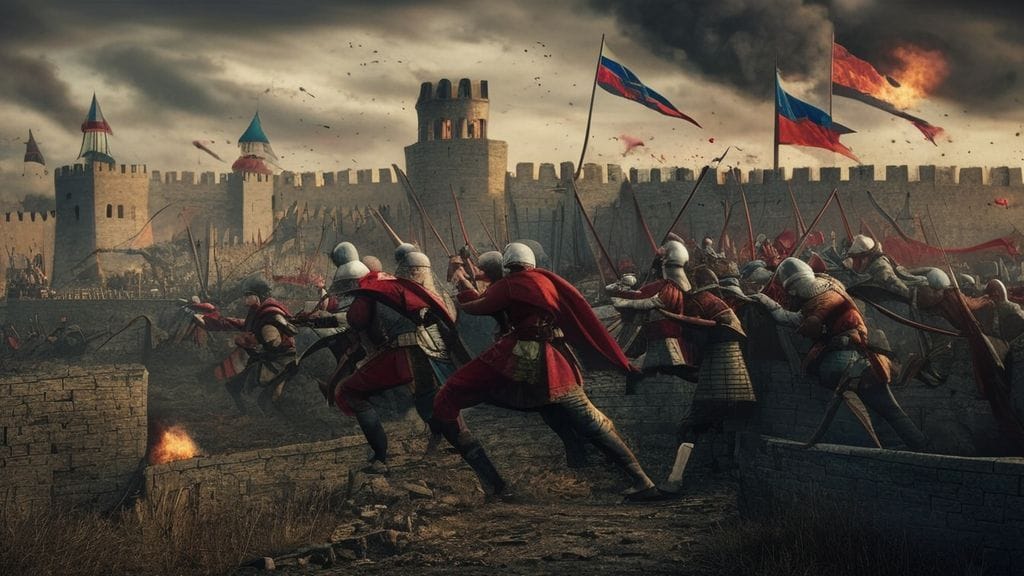
As the signal was given, Russian troops surged forward, shields raised, scaling ladders in hand. Archers and gunners covered their advance, firing at the parapets. The breach was a chaotic jumble of splintered timbers, earth, and bodies, difficult terrain under fire. Tatar defenders, recovering from the shock of the explosion, rushed to meet the attackers. What followed was an infernal melee—arrows, spears, sabers, and axes in close quarters, men slipping on rubble and blood.
One Russian chronicle, cited by modern historian Sergei Soloviev, describes the storming parties as “like waves of the sea, crashing again and again upon the rocks” of Kazan’s defenders. Some were beaten back; others gained footholds; officers shouted themselves hoarse, urging their men forward. The sounds of battle—screams, the clash of steel, the boom of guns—echoed within the city, mingling with the cries of noncombatants scrambling for safety or fleeing toward inner strongpoints.
Gradually, the balance shifted. Russian forces, benefiting from superior numbers and the disarray caused by the explosion, began to force their way into the city proper. Once past the outer fortifications, the fight devolved into street-by-street combat. Houses were set aflame, sometimes intentionally to root out defenders, sometimes as collateral damage. Smoke and confusion made command difficult. Small groups of warriors on both sides found themselves isolated, fighting and dying in courtyards and alleyways no chronicler would ever name.
The khan’s palace area and central strongpoints became focal points of resistance. But resistance could not last indefinitely. As key positions fell, Tatar morale crumbled. Some leaders attempted to break out; others died where they stood. By the end of the day, Muscovite troops controlled most of the city. The banner of the tsar flew over Kazan’s skyline. The khanate, as an independent state, was effectively finished.
For Ivan IV, the capture of Kazan 1552 was a moment of vindication. He entered the conquered city in triumph, accompanied by clergy and boyars, visiting churches and sites of particular significance. Chroniclers describe tears of joy, solemn processions, and proclamations of thanks to God. Yet behind the celebrations lay an ocean of suffering—corpses in the streets, prisoners in chains, smoke rising from burned districts. Victory, as always, came at a terrible price.
Blood, Plunder, and Silence: The Human Cost of Victory
When the fighting ended, a different kind of violence began. Conquered cities in the sixteenth century rarely escaped plunder, and Kazan was no exception. Russian troops, including many who had endured weeks of hardship, saw the fall of the city as their opportunity for reward. Houses were looted, valuables seized, and, tragically, lives taken even after organized resistance collapsed.
The exact number of dead is impossible to determine, but estimates by modern historians suggest that thousands perished during the final assault and its aftermath—combatants and civilians alike. Many others were taken as prisoners. Some Tatar nobles and warriors were killed outright; others were captured and later executed, exiled, or forced into service. Women and children were not spared the horrors of conquest: families were torn apart, some sold into bondage, others relocated deep into Muscovite territory under guard.
The city itself bore the scars. Significant portions of Kazan were damaged or destroyed by fires and bombardment. Mosques and public buildings suffered; markets lay in ruins. The once-lively streets fell eerily silent save for the trudging of soldiers and the cries of the dispossessed. In the days immediately following the capture of Kazan 1552, Ivan issued orders intended to restore a semblance of order—to prevent uncontrolled slaughter, to secure key sites, to begin the process of administering the conquered territory. But the damage had already been done.
For the surviving Tatar population, the fall of Kazan meant an abrupt and brutal shift in their world. Their ruling institutions were dismantled; their elites decimated or displaced. Religious life faced new constraints; property changed hands under duress. The trauma of those days, though only sparsely recorded in contemporary Tatar sources, lived on in oral traditions, laments, and later histories that remembered the conquest as a national tragedy.
On the Russian side, veterans of the campaign returned home with loot, stories, and scars. Some were granted lands near Kazan or in other newly acquired regions, embedding them as local elites in a transformed frontier. For them, the capture of Kazan 1552 was both triumph and turning point, the moment they helped push Muscovy into a new phase of empire-building. Yet even among the victors, there were those who could not but be haunted by what they had seen and done on that October day.
Rebuilding Kazan: Churches, Deportations, and New Orders
Conquest was only the beginning. In the months and years after 1552, Muscovy set about reshaping Kazan and the surrounding lands into a province of a growing Russian state. This process combined calculated policy, improvisation, and, at times, harsh repression. It also laid the foundations for the unique, multiethnic character of the region that endures to this day.
One of the first visible changes was religious. Orthodox churches were established, including the Annunciation Cathedral within the Kazan Kremlin, symbolizing the triumph of Orthodoxy. Some mosques were destroyed, others converted or allowed to function under supervision, depending on shifting policies. The authorities encouraged the settlement of Russian Orthodox populations in and around the city, granting lands to nobles and service people who would guard the frontier and help secure Muscovite control.
Tatar elites faced a difficult fate. Some were deported deeper into Muscovy, their lands redistributed to Russian nobles. Others negotiated accommodations, swore loyalty to the tsar, and retained a measure of local influence. Conversion to Orthodoxy could open doors to service in the Russian state, but it also cost individuals their traditional social identities. The mass of ordinary Tatars remained, now subjects of a distant Christian ruler who viewed them with a mixture of suspicion and paternalism.
Administrative reforms followed. The former khanate was reorganized into a province governed by Muscovite officials. New fortresses and towns sprang up along the Volga and its tributaries, solidifying the corridor of Russian control. Tribute obligations shifted; taxes were imposed according to Muscovite patterns. The Volga trade route, once under Kazan’s taxation, now fed revenues to the tsar’s treasury.
Not all was smooth. Resistance flared among local populations, particularly in forested regions where Muscovite authority was thin. Sporadic uprisings and raids testified to the ongoing bitterness toward the conquest. Some of these would be suppressed brutally; others would smolder, feeding later movements of protest and autonomy. Yet in the long run, the demographic and political transformation expanded Muscovy’s reach decisively. The city that had once symbolized Tatar power over Rus’ became, paradoxically, one of the jewels of the Russian crown.
From Kazan to an Empire: How the Volga Opened Siberia
The consequences of the capture of Kazan 1552 radiated far beyond the Volga hills. With Kazan subdued and, a few years later, Astrakhan also brought under Muscovite control (in 1556), the entire middle and lower Volga region came firmly under Russian domination. This reoriented the geography of power in Eastern Europe and Central Eurasia.
Control of the Volga gave Muscovy access to the Caspian Sea and the trade routes of Persia and Central Asia. It enabled the state to tax and regulate commerce more effectively, bolstering its finances. Just as importantly, it freed the eastern frontier from one of its most persistent military threats. While the Crimean Khanate and the Ottomans remained formidable to the south, the Volga corridor now lay in Russian hands.
This new security and wealth underpinned the next phase of expansion: the push across the Urals into Siberia. Legendary figures like Yermak Timofeyevich—Cossack leader and, in later lore, conqueror of Siberia—operated within a framework made possible by the earlier conquest of the Volga khanates. Troops, settlers, and traders could now move eastward with supply lines anchored along the Volga and Kama rivers. Forts and ostrogs sprang up as far as the Ob and Yenisei, extending Russian influence over vast territories inhabited by diverse indigenous peoples.
Historians sometimes speak of “internal colonization” to describe Russia’s expansion—an empire growing contiguous to its core rather than across seas. The seizure of Kazan exemplifies this pattern. It was not just a border adjustment but a radical redefinition of what the Russian state was and where it could go. Within a few generations, the tsar’s writ would run from the Baltic to the Pacific, and Kazan would be remembered as one of the critical stepping stones.
Yet this grand narrative of expansion often obscures the local stories of dispossession, adaptation, and survival. The peoples of the Volga—Tatars, Mari, Chuvash, Udmurts, and others—had to renegotiate their existence under Russian rule. Some integrated into the imperial system; others clung fiercely to their languages and beliefs; still others migrated or rebelled. The empire that emerged from the capture of Kazan 1552 was many things at once: powerful and fragile, integrative and oppressive, fertile in cultural exchange yet rooted in conquest.
Memories and Myths: How the Capture of Kazan 1552 Lives On
Centuries after the smoke cleared over Kazan’s walls, the events of 1552 continue to live in memory, myth, and political rhetoric. Russian and Tatar narratives about the conquest often diverge sharply, revealing how history can serve different communities in different ways.
In many Russian historical traditions, especially those shaped by imperial-era scholarship and Orthodox ecclesiastical writing, the capture of Kazan 1552 appears as a pivotal step in the formation of a centralized Russian state. It is celebrated as the end of Tatar domination, the liberation of Christian captives, and the extension of “civilization” into the eastern lands. Church calendars include commemorations linked to the conquest, and icons such as Our Lady of Kazan, though originating in more complex contexts, have been associated symbolically with the city’s Christianization.
In Tatar collective memory, by contrast, 1552 often marks a national catastrophe—the loss of statehood, the onset of subjugation, and the beginning of centuries of struggle to preserve language, faith, and identity. Folk songs, poems, and later nationalist histories portray the siege as a heroic but doomed defense against overwhelming odds. Names of local heroes and martyrs, often obscure in mainstream Russian histories, circulate in Tatar narratives as symbols of resistance.
These parallel memories can be mutually incomprehensible. One side’s liberation is the other side’s tragedy. As historian Geoffrey Hosking has noted in his analysis of Russian empire-building, the same event can foster a sense of “historic mission” among the dominant group and of “historic trauma” among the conquered. The capture of Kazan 1552 is a textbook case of this duality.
Myths grew around key figures: Ivan the Terrible as fierce but divinely favored ruler; nameless Tatar warriors dying on the walls; saints and holy fools who, in popular tales, warned of the coming catastrophe or interceded miraculously. Over time, these stories were reworked to suit changing eras—imperial, Soviet, and post-Soviet—each drawing different lessons from the same bloody day in October 1552.
Historians’ Debates: Crusade, Conquest, or Colonial War?
Modern historians have long debated how best to characterize the fall of Kazan. Was it primarily a religious war, a political conquest, or an early form of imperial colonialism? The answer, unsurprisingly, is that it was all three, in varying measures.
Those who emphasize the religious dimension point to the rhetoric of holy war in Muscovite sources, the role of the Orthodox Church in blessing the campaign, and the subsequent Christianization policies in the Volga region. They interpret the capture of Kazan 1552 as a kind of Orthodox crusade against Islam, framed by contemporaries as a divine mission. This view finds support in the language of the chronicles and in the symbolic acts following the conquest, such as the building of churches on former Tatar sites.
Others focus on pragmatic power politics. From this angle, Ivan IV’s campaign was a classic territorial war aimed at securing borders, controlling trade routes, and eliminating a troublesome neighbor. The use of advanced siege techniques, foreign engineers, and massive logistical support suggests a carefully planned conquest driven by state interests more than religious zeal. The fact that Muscovy would later form alliances with some Muslim powers, like certain Nogai groups, reinforces the idea that faith was sometimes subordinate to strategy.
A third school, influenced by postcolonial perspectives, highlights the colonial character of Muscovite expansion. They note that the capture of Kazan 1552 inaugurated a long-term process of domination over non-Russian, non-Orthodox peoples. It involved land seizures, cultural imposition, and administrative control over “others” within a growing empire. From this vantage point, Kazan was not simply a victory over a rival state but the first major step in transforming Russia into a multiethnic empire with all the tensions and inequalities that entailed.
These interpretive frames are not mutually exclusive. Rather, they illuminate different aspects of a complex event. A careful reading of sources—including Russian chronicles, Tatar oral traditions, diplomatic correspondence, and archaeological evidence—reveals a multilayered story in which faith, power, greed, fear, and hope all played their parts. The capture of Kazan 1552 defies easy categorization, which is precisely why it continues to intrigue scholars and provoke heated debate.
Echoes in the Modern Age: Identity, Resistance, and Commemoration
In the modern era, particularly after the fall of the Soviet Union, the memory of Kazan’s conquest acquired renewed political and cultural resonance. In Russia as a whole, the sixteenth-century expansion is often invoked as evidence of historical greatness and state-building genius. In Tatarstan—the republic whose capital is modern Kazan—it is also remembered as the loss that preceded a long struggle for autonomy and cultural survival.
Monuments, museums, and public ceremonies in Kazan today reflect this layered heritage. The restored Kazan Kremlin, now a UNESCO World Heritage Site, includes both Orthodox churches and the Qolşärif Mosque, rebuilt in the 1990s as a symbol of Tatar cultural revival. Its very presence within the kremlin walls, near cathedrals erected after the conquest, speaks to a negotiated coexistence between Russian and Tatar identities.
Debates flare periodically over how to mark the anniversary of 1552. Some activists in Tatarstan treat 2 October as a day of mourning, holding events that honor the defenders and emphasize the tragedy of conquest. Others prefer a more reconciliatory narrative, stressing centuries of coexistence and cultural exchange. Russian nationalist groups, for their part, may celebrate the date as a moment of national triumph. The same event serves, simultaneously, as a symbol of pride, grief, and complex coexistence.
In literature, film, and popular culture, the siege of Kazan continues to be reimagined. Novels dramatize the siege, choosing heroes and villains according to contemporary sensibilities. Documentaries revisit the archaeology of the city’s fortifications, trying to pinpoint exactly where the mines exploded and how the final assault unfolded. School textbooks in different regions frame the story in subtly different ways, revealing the ongoing contest over historical meaning.
These echoes remind us that the past is not dead. The capture of Kazan 1552 still shapes how communities see themselves and one another, how they justify claims to autonomy or unity, how they narrate their place in the broader sweep of Russian and Eurasian history. Beneath the tourist-friendly vistas of modern Kazan lies a palimpsest of memories, some reconciled, others still raw.
Conclusion
On a crisp October day in 1552, under a sky thick with smoke, the fate of a city and a region was sealed in fire and blood. The siege and capture of Kazan 1552 were not isolated episodes but culmination points in a long history: the rise and fall of the Golden Horde, the ascent of Muscovy, the tangle of trade, raids, and religious difference along the Volga frontier. When Ivan IV’s banners finally flew over Kazan’s shattered walls, the world of the Volga peoples changed irreversibly.
The immediate consequences were stark: thousands dead or enslaved, a khanate extinguished, a city repopulated and reshaped under foreign rule. Over the longer term, the conquest opened pathways for Russian expansion to the Caspian and into Siberia, transformed the economic geography of Eurasia, and laid the foundations of a multiethnic empire that would endure, in various forms, into the modern era. It also etched a deep mark in the memories of both conquerors and conquered, giving rise to traditions of triumph, martyrdom, and resistance.
That the same event can be remembered as liberation and catastrophe is not a paradox unique to Kazan; it is a universal feature of conquest. But the particularities of the capture of Kazan 1552—its blend of religious rhetoric and cold strategy, its use of emerging gunpowder technology, its location at a civilizational crossroads—make it especially revealing. To study it is to see, in sharp relief, how states are made and unmade, how identities harden around wounds, and how the lines of today’s politics trace the scars of yesterday’s wars.
As we watch modern Kazan’s skyline, with mosque minarets and church cupolas rising side by side above the Volga, we might see, not a resolved story, but an ongoing dialogue between past and present. The city’s survival and reinvention suggest that even the most devastating conquests do not fully silence the voices of the conquered. They adapt, endure, and sometimes, quietly, reshape the legacy of the victors. In that uneasy but fertile space, the true history of 1552 continues to unfold.
FAQs
- What was the capture of Kazan 1552?
The capture of Kazan 1552 was the successful siege and conquest of the capital of the Kazan Khanate by the army of Ivan IV of Muscovy. It ended the independence of the Muslim Tatar khanate on the Volga and brought the city of Kazan and its territories under Russian control. - Why did Ivan the Terrible attack Kazan?
Ivan attacked Kazan to end recurring Tatar raids, free Russian captives, secure control of the vital Volga trade route, and assert Muscovy’s dominance over its eastern frontier. Religious motives also played a role, as the campaign was framed as a holy war by Orthodox church leaders. - How long did the siege of Kazan last?
The main siege in 1552 lasted a little over a month, from late August to the final assault on 2 October. However, it was preceded by years of intermittent warfare, failed campaigns, and the construction of forward bases such as the fortress of Sviyazhsk. - What military technologies were important in the fall of Kazan?
Artillery and gunpowder mining were crucial. Russian forces used heavy cannon to batter the walls and employed experienced sappers to dig mines under the fortifications, detonating large charges that created breaches for storming parties. These techniques reflected cutting-edge siege warfare of the time. - What happened to the Kazan Khanate after 1552?
After the conquest, the khanate ceased to exist as an independent state. Its territories were reorganized as a province of Muscovy, with Russian governors, garrisons, and settlers. Tatar elites were killed, exiled, or integrated into Russian service, and the region underwent significant demographic and religious changes. - How did the capture of Kazan 1552 affect Russia’s later expansion?
The conquest secured the middle Volga, provided access to the Caspian Sea, and removed a major military threat on Muscovy’s eastern flank. This enabled further expansion down the Volga to Astrakhan and, crucially, laid the logistical and strategic groundwork for the Russian advance across the Urals into Siberia. - How is the fall of Kazan remembered today?
In Russian national narratives, it is often seen as a key step in building a unified state and defending Orthodoxy. In Tatar and regional memory, it can represent the loss of statehood and the beginning of subjugation. Modern Kazan commemorates both its Tatar heritage and its role within the Russian Federation, reflecting a complex, sometimes contested history. - Were religious conversions forced after the conquest?
There were instances of forced or pressured conversion, particularly among elites and in certain periods, and the state promoted Orthodoxy through church-building and incentives. However, large segments of the Tatar population remained Muslim, and over time the Volga region evolved into a space of enduring religious pluralism.
External Resource
Internal Link
Other Resources
- Encyclopaedia Britannica – general search for the exact subject
- Google Scholar – academic search for the exact subject
- Internet Archive – digital library search for the exact subject

