Table of Contents
- Storm over the Sand: Setting the Stage at Dunkirk, 1658
- Broken Empires and Restless Kingdoms: Europe on the Eve of Battle
- France Ascendant: Mazarin, Louis XIV, and the Long War with Spain
- Cromwell’s Shadow: Why English Soldiers Fought on French Sands
- The Siege of Dunkirk: A Port, a Prize, a Trap
- Armies in the Dunes: Who Fought, Who Led, Who Paid the Price
- The Night before the Storm: Fear, Faith, and Rumors in the Camps
- The Morning of 14 June 1658: Winds, Tides, and Tactical Gambles
- Shifting Sands: The French–English Assault on the Heights
- Collapse of the Spanish Line: Panic, Valor, and the Turning of the Tide
- Aftermath on the Shore: Prisoners, Plunder, and the Cost of Victory
- From Battlefield to Treaty: Dunkirk, the Pyrenees, and Spain’s Decline
- Kings, Generals, and Exiles: The Human Faces of the Dunes
- Faith, Flags, and Identity: Religion and Allegiance in a Fractured Europe
- From Sand to Stage: How the Battle Echoed through Memoirs and Chronicles
- The Long Shadow of the Dunes: Military Lessons and Tactical Innovations
- Dunkirk Transformed: Commerce, Fortresses, and a City between Kingdoms
- Memory on the Wind: How Later Centuries Remembered 1658
- Conclusion
- FAQs
- External Resource
- Internal Link
Article Summary: On 14 June 1658, outside the wind‑whipped port of Dunkirk in the Spanish Netherlands, the battle of the dunes 1658 brought to a head decades of shifting alliances, religious conflict, and imperial decline. French troops under the young Louis XIV’s banner, reinforced by Oliver Cromwell’s seasoned English soldiers, confronted a Spanish army stiffened with French royalist exiles and famed tercios. This article traces the road to that day—through the exhausting Franco‑Spanish War, the ambitions of Cardinal Mazarin, and the calculating diplomacy of the English Protectorate. It then follows the battle itself in close detail, from the tactical use of the dunes to the sudden collapse of the Spanish line under pressure from disciplined English infantry. Beyond the clash of arms, it explores the political and social consequences, including the sale of Dunkirk to England and the acceleration of Spain’s decline as a European superpower. Throughout, it lingers on the human experience: the fear of common soldiers, the hopes of exiled princes, and the ruthlessness of commanders. The memory of the battle of the dunes 1658 would echo for generations, reshaping military thought and redefining the balance of power in Western Europe. In the end, this windswept encounter on a stretch of shifting sand helped usher in the age of Louis XIV and a new European order.
Storm over the Sand: Setting the Stage at Dunkirk, 1658
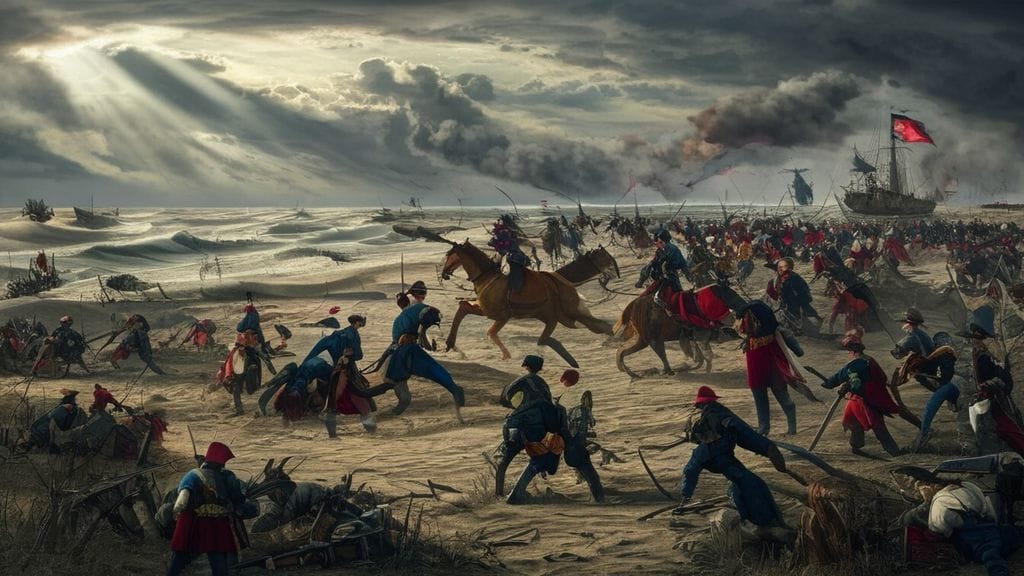
The dawn that broke over the coast near Dunkirk on 14 June 1658 was not gentle. A harsh Channel wind scoured the shoreline, driving sand like needles across faces and armor, rattling the canvas of tents, and whipping pennants into frantic motion. Between the gray sea and the low, wavering line of the horizon rose the dunes—heaps of tawny sand, tufted with coarse grass and scattered scrub, seemingly fragile yet dominating the approach to the besieged port. On those shifting mounds of earth, the fate of empires would be tested.
This was the setting of the battle of the dunes 1658, a clash that on the surface appeared local, even provincial: two coalitions wrestling over a single coastal fortress, Dunkirk, a town of wind, salt, and merchants. But the wind that drove sand into the eyes of soldiers that morning also carried with it the dust of an entire century’s turmoil. The Thirty Years’ War had only recently ended, yet its aftershocks still reverberated. Spain, once the unassailable Habsburg giant, found itself exhausted, its treasuries drained by endless war and its fabled infantry increasingly brittle. France, long encircled and harried, now surged into prominence under the shrewd guidance of Cardinal Mazarin and the emerging authority of King Louis XIV. And across the Channel, England—having executed a king, survived civil war, and dismantled a monarchy—had reappeared on the European stage under the stern figure of Oliver Cromwell.
On that June morning, alliances that would have seemed fantastical only a generation earlier had become reality. English Puritan soldiers, veterans of battles at Naseby and Worcester, stood side by side with Catholic French regiments beneath fleur-de-lis banners, preparing to attack staunchly Catholic Spain. Facing them, in a cruel twist of fate, were French royalist exiles fighting under Spanish colors, men who believed themselves defenders of the true French monarchy against the cardinal they detested. The dunes near Dunkirk were not just a battlefield; they were a crossroads of loyalties, ideologies, and personal destinies.
The air was thick with the smell of seaweed, gunpowder, and damp wool. Drums beat the assembly, trumpets called officers to their posts, and chaplains murmured hurried prayers among the ranks. Confrontation had been inevitable ever since the French and their English allies had wrapped Dunkirk in a tightening noose of trenches and earthworks. Within the town, a Spanish garrison held grimly on, waiting for relief that was now marching toward them in the form of Don Juan José of Austria and the celebrated Marshal Turenne’s former rival, the Prince de Condé, now fighting under the Spanish flag. The stage was set for a battle in which the elements themselves—wind, sand, and tide—would serve as silent participants.
Yet this morning, fierce and hurried as it felt to the men fidgeting with muskets and tightening sword belts, was the product of a long, grinding history. The drama about to unfold on the dunes was not an isolated episode but the culmination of years of war stretching across Europe’s fields, rivers, and fortresses. To understand why France and Spain bled each other white on these sands, and why English boots sank into foreign dunes for the promise of a harbor, one must step back from the roar of the surf and the rattle of drumsticks and trace the long, tangled road that led here.
Broken Empires and Restless Kingdoms: Europe on the Eve of Battle
At the midpoint of the seventeenth century, Europe was a continent littered with scars. The Peace of Westphalia in 1648 had brought formal closure to the Thirty Years’ War, but it had not brought peace of mind. Rather, it froze shifting frontiers into uneasy lines and left many questions unresolved: Who would dominate Western Europe—Habsburg Spain or Bourbon France? Could small states survive in the shadow of giant powers? Would the religious wars of the previous century finally quiet, or merely mutate into conflicts waged in the language of dynasties and territorial ambition?
Spain entered this era still claiming the title of a global empire: its American silver fleets, its sprawling possessions in Italy and the Low Countries, its proud tercios renowned across Europe for discipline and courage. Yet the empire was hollowing. Revenues from the New World declined; vast wars had drained the royal coffers; revolts in Catalonia and Portugal had shaken the seemingly solid pillars of Habsburg authority. The Eighty Years’ War with the Dutch had ended in 1648, carving an independent Dutch Republic from the once-unified Low Countries. To the south and west, Spain’s great rival—France—watched with careful, predatory interest.
France, by contrast, was a kingdom with long memories of encirclement. Habsburg Spain to the south and west, Habsburg Austria to the east: for decades, French statesmen saw their country squeezed between two jaws of the same dynastic beast. Cardinal Richelieu, then Cardinal Mazarin, sought to break that encirclement. Even during the ostensibly religious Thirty Years’ War, Catholic France had allied with Protestant powers to bleed Catholic Habsburgs. By 1658, that Machiavellian strategy was bearing fruit. French armies had learned, adapted, and hardened. The monarchy had survived the convulsions of the Fronde, those civil uprisings that had rocked the kingdom in the 1640s and early 1650s. The boy-king Louis XIV now emerged into adulthood, his authority gradually consolidating behind the velvet gloves and iron will of Mazarin.
Over all this loomed the question of the Spanish Netherlands—the broad, rich, and strategically crucial swath of territory that included modern-day Belgium and parts of northern France. For Spain, it was the northern rampart of their empire, a corridor of fortresses and cities that guarded access to the North Sea and the Channel. For France, the Spanish Netherlands were both threat and temptation: a neighbor armed to the teeth and a potential avenue for expansion. Battlefield after battlefield—from Rocroi to Lens—had pitted French and Spanish troops in this contested borderland.
England, too, had transformed itself. The English Civil Wars had toppled a king in 1649, ushering in a republic and then a Protectorate under Oliver Cromwell. Where once kings might have chosen sides in continental conflicts based on dynastic ties, Cromwell’s regime evaluated alliances through the prism of trade, security, and ideological suspicion of Catholic monarchies. Though devoutly Protestant and suspicious of French Catholicism, Cromwell was less threatened by a distant Catholic king in Paris than by a decaying but still formidable Catholic empire in Madrid, whose navy and ports could menace English trade routes.
The wider European context leading to the battle of the dunes 1658 therefore reads like a ledger of grievances and opportunities. Spain clung to its possessions in the Low Countries, desperate not to lose another key territory after the Dutch secession. France pushed steadily northward, seeking coastal access and fortified frontiers. England watched the Channel nervously, determined that no single power should dominate ports like Dunkirk, which privateers had long used as a nest from which to prey on English commerce.
Into this roiling environment stepped ambitious commanders, displaced princes, and hardened soldiers of fortune. The Prince de Condé, once France’s most brilliant general, had turned against the crown during the Fronde and, branded a rebel, now served Spain. Henri de la Tour d’Auvergne, Vicomte de Turenne, who had once campaigned alongside Condé, remained loyal to France and rose to near-legendary status as a commander. These two men, bound by history and divided by allegiance, would soon face each other across the dunes outside Dunkirk, embodying the fractured loyalties of their age.
France Ascendant: Mazarin, Louis XIV, and the Long War with Spain
The Franco-Spanish War, which had begun in 1635, outlived Richelieu, Louis XIII, and many of the men who had first taken up arms at its outset. By 1658 it was a conflict of attrition—even of habit—a war that had become background noise to European politics. Its theaters stretched from Flanders to the Pyrenees, its toll measured in ruined harvests, shifting fortresses, and exhausted tax-paying populations. Yet for Cardinal Mazarin and the young Louis XIV, the struggle with Spain was also an opportunity: a chance to redefine France’s place in Europe.
Mazarin, Italian by birth but French by political destiny, understood the importance of timing. France had survived the internal revolts of the Fronde, during which nobles, magistrates, and Parisian crowds had challenged royal authority. Condé’s rebellion, in particular, had threatened the monarchy’s survival, forcing Mazarin to flee and the royal family to rely on foreign mercenaries and loyal officers like Turenne. When the smoke cleared and the Fronde dissolved into exhaustion and compromise, Mazarin emerged bruised but still in control. His priority was to ensure that such a humiliation never repeated. That meant strengthening the monarchy, rewarding loyalty, and humbling external enemies.
Spain, for all its prestige, appeared vulnerable. Its armies were stretched across too many fronts; its finances, already strained by the Thirty Years’ War and revolts at home, staggered beneath the weight of continued campaigning. French successes at Rocroi (1643), where Condé had shattered a Spanish army early in his career, had punctured the myth of Spanish military invincibility. Yet victory had not yet translated into a decisive political outcome. Border fortresses changed hands, then changed back. Towns were burned, rebuilt, and burned again. France needed a breakthrough—a dramatic success that would force Spain to negotiate seriously.
In this context, the coast of Flanders, and particularly the port of Dunkirk, loomed large. From Dunkirk, Spanish-aligned privateers—Dunkirkers—ravaged French and, critically, English shipping. Their swift, shallow-draft vessels darted from the harbor to ambush merchantmen and even warships, then slipped back under the cover of formidable coastal defenses. As long as Dunkirk remained in Spanish hands, it could serve as a dagger pointed at the economic lifelines of France and England alike.
Louis XIV, though still in his early twenties by 1658, had been tempered by crisis. He remembered fleeing Paris as a child before the rage of Frondeurs; he remembered insults hurled at the royal carriage, the fear in his mother’s eyes. These experiences fueled his lifelong determination to assert royal authority, both at home and abroad. A decisive victory over Spain would not only enhance France’s strategic position but also bolster his personal prestige as a king of war, worthy heir to the line of Capetians.
Turenne emerged as the ideal instrument of this policy. A commander of rare calm and method, he understood both siegecraft and open battle, logistics and morale. Under his direction, French armies adopted more flexible tactics, emphasizing coordinated infantry and cavalry operations and effective use of terrain. Turenne’s campaigns in the 1650s had already pushed French frontiers forward in Alsace and Flanders. Now, in 1658, he aimed for a prize that would echo across Europe: the seizure of Dunkirk and the crippling of Spanish power in the north.
The alliance with England, improbable on the surface, was Mazarin’s masterstroke. By aligning with Cromwell, he gained naval support and veteran infantry; by promising territorial concessions, he ensured English commitment. Together, they would squeeze Spain where it hurt, and in doing so, reconfigure the geopolitical map. The battle of the dunes 1658 would be the crucible in which these calculations were tested with blood and iron.
Cromwell’s Shadow: Why English Soldiers Fought on French Sands
To many English soldiers trudging through the dunes outside Dunkirk, the landscape must have felt familiar and foreign at once. The cold wind, the gray sea, and the low sky resembled the Channel coasts of Kent or Sussex. Yet the language of the villagers, the cut of the uniforms around them, and the banners snapping overhead were French. Why were veterans of a civil war that had toppled their own king now fighting on foreign soil at the side of a Catholic monarch?
The answer lay in Oliver Cromwell’s mix of hard-nosed pragmatism and religious ambition. After taking power as Lord Protector, Cromwell sought to secure England’s trade routes, expand maritime power, and position the new Commonwealth as a leading Protestant force in Europe. Spain, not France, appeared as the more immediate threat. Spanish port cities in the Low Countries and along the Atlantic coast sheltered privateers and war fleets that could menace English shipping. Catholic Spain also symbolized, to Cromwell and many of his supporters, the old order of persecution and papal tyranny.
In 1655, Cromwell launched the “Western Design,” an ambitious but ill-fated attempt to seize Spanish possessions in the Caribbean. While its results were mixed, it signaled an open breach with Madrid. An alliance with France, however ideologically awkward, offered a counterweight. Negotiations culminated in the Treaty of Paris in 1657. Under its terms, France and England agreed to cooperate against Spain, particularly in the Spanish Netherlands. England pledged ships and troops; France, in turn, promised to hand over key coastal strongholds—Gravelines, Mardyck, and, crucially, Dunkirk—once captured.
For English officers like Sir William Lockhart, Cromwell’s ambassador in Paris and a commander in the field, the alliance was not just a matter of trade and strategy; it was also a chance to ensure that no single Catholic power dominated the Channel. Dunkirk, long a nest for privateers who attacked English commerce, was an especially coveted target. If it passed into English hands, the Commonwealth would gain not only a valuable base on the continent but also the satisfaction of eliminating a longstanding maritime threat.
The troops sent to Flanders were hardened men, many of them veterans of the New Model Army that had fought at Marston Moor, Naseby, and Worcester. Disciplined, accustomed to harsh conditions, and steeped in a stern Protestant ethos, they would play a decisive role in the coming battle. In many contemporary accounts, even French ones, their steadiness under fire on the dunes is singled out with respect. One French observer, with a hint of grudging admiration, later wrote that the English “mounted the sands as if upon a staircase,” a vivid line cited in later histories of the campaign.
Yet this alliance came with bitter ironies. Among the Spanish ranks near Dunkirk were English and Irish Royalists—exiles who had fled after the defeat of Charles I and now fought wherever Catholic monarchs offered them pay and shelter. On 14 June 1658, therefore, Englishmen faced Englishmen across a wind-lashed stretch of sand, each side claiming, in its own way, to fight for the true future of their homeland. The battle of the dunes 1658 thus became, in a quiet, grim fashion, another chapter in the unresolved story of the Wars of the Three Kingdoms, its echoes carrying across the Channel and back into English political life.
The Siege of Dunkirk: A Port, a Prize, a Trap
By the spring of 1658, Dunkirk was already a beleaguered city. French and English forces, acting in concert, had advanced methodically along the coast, seizing key positions and tightening the noose around the port. In May, Turenne opened the formal siege, his engineers and laborers fanning out across the dunes and marshes to dig trenches, throw up earthworks, and emplace batteries. For the city’s defenders and inhabitants, the siege meant sleepless nights, dwindling supplies, and the oppressive rhythm of artillery fire.
Dunkirk’s importance lay not only in its harbor but in its geography. The town perched amid a treacherous landscape of shifting dunes, tidal flats, and low-lying wetlands. Approaches were difficult, especially for heavy artillery, and the sea itself could serve as both moat and highway, depending on the tide and the quality of one’s fleet. Spain understood the port’s value all too well; it had spent considerable sums over the years fortifying Dunkirk and nurturing its corsair community. For decades, “Dunkirkers” had been a byword for swift, ruthless privateers whose depredations enraged English and Dutch merchants.
Turenne saw both the obstacles and the opportunities. If he could bring his siege lines close enough to batter the city walls while denying the Spanish any chance of substantial relief or resupply, Dunkirk would eventually succumb. But he also knew that the Spanish crown could not afford to let such a key fortress fall without a fight. A relief army was all but guaranteed. Thus, every trench dug around Dunkirk was also a move in a larger game, one that anticipated a climactic field battle somewhere along the approaches to the city.
The besieged garrison, composed of Spanish regulars, Walloon and German contingents, and local militias, held out with grim determination. Food supplies were rationed, wells carefully guarded, and every able-bodied man pressed into service on the walls. The city’s civilian population endured bombardment and shortages, yet life had to go on in some form. Bakeries continued to operate, though with thinning loaves; churches held services, now interspersed with prayers for deliverance; children learned to distinguish between the whistle of incoming cannonballs and the thud of those that landed too close.
Outside the walls, the allied French-English camp presented its own harsh realities. Soldiers slept under canvas or makeshift shelters, their bodies caked with salt and sand. Water sources had to be managed carefully in the marshy landscape; disease lurked, as always, in cramped conditions. And yet, the camp was also a world unto itself, with sutlers selling wine and bread, armorers repairing pikes and muskets, and rumor-mongers whispering the latest tales of politics in Paris or London. Every new rider who arrived from inland brought not only dispatches but gossip: news of Spanish movements, speculation about Condé’s intentions, hints of factional struggles at court.
By early June, word reached the besiegers that a formidable Spanish force was indeed marching northward, under Don Juan José of Austria and the Prince de Condé. They aimed not merely to harry the siege lines but to smash them, drive the French and English into the sea, and relieve Dunkirk in dramatic fashion. Turenne, remote yet attentive, considered his options. He could entrench further and risk being pinned; he could withdraw, sacrificing the siege; or he could meet the relief army on ground of his choosing. The dunes, with their deceptive fragility and commanding heights, began to suggest themselves as a stage for the decisive encounter.
Armies in the Dunes: Who Fought, Who Led, Who Paid the Price
The forces that converged near Dunkirk in June 1658 were more than mere numbers on a ledger; they were mosaics of nations, languages, and personal stories. On the French-English side, Turenne commanded roughly 14,000 to 15,000 men, though exact figures vary in contemporary accounts. Among them were French infantry and cavalry, German and Swiss contingents, and about 6,000 to 7,000 English troops drawn from Cromwell’s New Model Army, now serving as expeditionary veterans under the Allied treaty.
These English regiments, organized into compact, disciplined units, were led by officers who had cut their teeth in the bitter civil wars of the British Isles. They were accompanied by chaplains who carried well-thumbed Bibles and preached of providence and duty. Soldiers’ letters, where they survive, speak of a curious blend of religious conviction and homesickness: some wrote of feeling like instruments of God’s judgment against “Popish Spain,” while others simply longed for news of wives, children, and the familiar mists of home.
The French component of Turenne’s army included both line infantry and cavalry, as well as elite units like the Gardes Françaises. Many of these men had followed Turenne through previous campaigns; they trusted his judgment and revered his calm. Officers hovered nervously near maps and reconnaissance reports, discussing the terrain and the likely direction of Spanish approach. The presence of the young Louis XIV near the theater of war, though not directly on the battlefield, added an extra layer of urgency. Every victory or setback in Flanders now carried a sheen of dynastic prestige.
Facing them, the Spanish-relief army fielded between 11,000 and 14,000 troops—again, numbers differ depending on which chronicler one trusts. Its core consisted of Spanish infantry, including remnants of the famed tercios, whose tight pike-and-shot formations had once dominated European battlefields. Alongside them marched Walloon, German, and Italian regiments, as well as French royalist exiles under Condé. These exiles, drawn by loyalty to the old order or by personal vendettas against Mazarin, now found themselves in the bitter position of fighting countrymen under foreign colors.
At their head was Don Juan José of Austria, the illegitimate son of Philip IV of Spain, and the Prince de Condé, once the brightest star in the French military constellation. Condé’s decision to side with Spain had shocked Europe years earlier; his presence here, on the field opposite Turenne, gave the coming clash a personal dimension. Many soldiers on both sides knew the legends that surrounded these men. They remembered how Condé had crushed Spanish forces at Rocroi, or how Turenne had saved royal armies during the Fronde. Now their reputations met face to face.
It is astonishing, isn’t it, how battles are often told through the names of a handful of commanders, while the thousands of unnamed soldiers—and the civilians who suffered around them—are reduced to shadowy masses. In reality, the armies on both sides were composed of peasants who had been conscripted or lured by pay, townsmen seeking adventure or escape from debt, and professional soldiers who had known no other life for decades. They carried with them not only muskets and pikes but also memories of villages left behind, of bad harvests, of promises made by recruiters that seldom matched the hard reality of campaign life.
Among the rank and file there were also camp followers: wives, children, traders, and servants whose presence rarely finds a line in official dispatches but whose labor kept the armies supplied and (barely) functioning. They cooked, mended, carried water, and sometimes even took up arms in desperate moments. The battle of the dunes 1658, for all its grand strategic implications, would exact its heaviest price from these anonymous lives, scattered across sandy hollows and trampled grass when the day’s fighting ended.
The Night before the Storm: Fear, Faith, and Rumors in the Camps
On the eve of 14 June, as the sun sank in a blaze of red over the Channel, an uneasy stillness settled over the encampments. In the allied camp, sentries paced along the newly prepared lines, muskets slung and eyes fixed on the darkening dunes. Fires flickered in shallow pits, their smoke dragging low under the weight of the wind. Men crowded around these small islands of warmth, sharing coarse bread, salted meat, and nervous speculation.
The rumors had solidified into certainty: the Spanish relief force was near, perhaps only hours away. Scouts and light cavalry patrols had returned with consistent reports of dust clouds inland, of campfires glimpsed through gaps in hedgerows, of marching columns moving toward Dunkirk. Turenne, walking the lines with quiet concentration, knew now that withdrawal or delay would only embolden the enemy and endanger the siege. A decision had already been made—tomorrow, they would fight.
In chaplains’ tents, candles burned late. Protestant preachers among the English held impromptu services, calling on their men to steel themselves as instruments of divine will. Psalms were sung in rough, wavering harmony, their words swallowed and scattered by the ceaseless wind. Among the French, Catholic priests offered Mass or heard hurried confessions, murmuring absolutions to soldiers who half-believed they might not live to see another sunrise. Faith, in its diverse confessional forms, served as a thin yet vital armor against the terror of what awaited them.
Across the yet-uncontested dunes, in the Spanish camp, similar scenes unfolded with subtle differences. Many soldiers were veterans of long wars in Italy or the Low Countries. They had faced Frenchmen before, and some had perhaps even shared fires with them in temporary truces. Now they eyed the sandy ground uneasily. This was not the level farmland or fortified lines to which the tercios were accustomed. The dunes, with their treacherous slopes and uneven footing, favored flexible, aggressive infantry and well-handled cavalry. Some officers worried aloud whether their formations could adapt quickly enough.
Condé, whose brilliance as a tactician had once been beyond doubt, now wrestled with the constraints of a weakened empire and a coalition force. He did not command these troops as absolutely as he had commanded French armies years earlier; he had to navigate Spanish priorities, Don Juan’s wishes, and the hard limits of exhausted men and officers. Some later accounts suggest that he argued for different deployments than those ultimately adopted on the morning of battle, though separating truth from retrospective justification is difficult. What seems clear is that both sides spent the night engaged in intense councils of war, drawing lines on maps by candlelight, trying to imagine how best to use a landscape none had fully mastered.
For ordinary soldiers, the night was a swirl of practical concerns and private fears. Equipment was checked and rechecked; powder horns were refilled; musket flints examined for flaws. Some men sharpened swords or repaired damaged straps. Others wrote letters—short, earnest lines to be entrusted to comrades should they fall. There were jokes, too, coarse and sometimes forced, as men tried to laugh away the knot in their stomachs. In one French regiment, an officer later recalled, a veteran simply lay back on his cloak, looked up at the rapidly clouding sky, and said, “Tomorrow, we shall see who truly owns these sands.”
The Morning of 14 June 1658: Winds, Tides, and Tactical Gambles
Dawn broke cold and gray, the sun a pale disk struggling through low clouds. The wind, which had haunted the siege for days, was still strong but shifted subtly, now blowing more from the sea toward the inland. For Turenne, this was a gift. The wind would carry gun smoke away from his advancing troops and toward the Spanish lines, veiling the defenders’ vision, complicating their volleys. In battles of the era, where black powder weapons spat thick, acrid clouds, such details of weather could become decisive factors.
The allied army moved to deploy along the dunes southeast of Dunkirk, forming a line that roughly paralleled the shoreline but angled inland. On the right, closer to the sea, Turenne placed the English infantry—Cromwell’s veterans—knowing their discipline and steadiness would be crucial in assaulting the steepest, most exposed slopes. On the left and center, he arrayed his French troops, interspersing cavalry where the terrain allowed. Artillery, hauled with difficulty into position on firmer patches of sand and grass, was sited to rake likely Spanish approaches.
Across the sandy undulations, the Spanish and allied royalist forces took up their own positions on a series of higher dunes. Their line, though shorter, enjoyed the advantage of elevation. The tercios and other infantry regiments anchored the center and right, while cavalry massed where the ground fell more gently, offering potential for charges. On paper, they held a strong defensive posture: uphill, with the wind at their backs, and the psychological advantage of fighting to save a beleaguered city whose walls they could glimpse in the distance.
But this was only the beginning of the day’s complexities. The dunes themselves were both friend and foe to all who marched upon them. Soldiers trudged through sand that gave way beneath their feet, each step a small battle. Formations that looked tidy on the parade ground became ragged as men negotiated uneven slopes and hidden hollows. Officers struggled to keep lines aligned, shouting orders that were quickly lost in the gusts. The constant roar of the sea, just out of sight beyond the higher ridges, added a low, insistent backdrop to the clatter of arms.
Turenne’s decision, bold to some and reckless to others, was to attack uphill against these Spanish-held dunes, trusting in the superior training and cohesion of his troops and in the psychological momentum of seizing the initiative. He also believed—correctly—that the Spanish army, marching to relieve Dunkirk, had not yet fully recovered from its exertions. Some units were fatigued, their supply lines stretched. By forcing a battle now, on ground he had at least partially reconnoitered, Turenne aimed to prevent the enemy from entrenching or bringing up heavier guns.
As ranks finalized and flags found their places, drums beat the tempo of readiness. Officers rode along the lines, exchanging last words with their men. Some delivered brief speeches about honor and duty; others simply nodded, knowing that at this point words could do little to soften what was coming. The battle of the dunes 1658 was about to move from the realm of tense expectation into the brutal clarity of action.
Shifting Sands: The French–English Assault on the Heights
When the order finally came, it did not arrive in some transcendent, cinematic moment. It came through the prosaic rhythm of signals: drumbeats, shouted commands, flags dipping and rising along the line. The English on the allied right began to advance, boots digging into the loose sand, ranks leaning forward under the pull of gravity and the weight of equipment. To their left, French infantry stepped out in measured pace, standards snapping in the wind.
Almost at once, the terrain asserted itself. Loose sand slid underfoot; musketeers struggled to keep their formation as they climbed. Officers and sergeants roamed along the flanks, realigning files, urging men to close gaps. On the Spanish-held heights above, muskets leveled and fired, the first volleys sending plumes of smoke rolling down the slopes. Bullets whined through the air, thudding into sand or flesh. Here and there, solitary figures crumpled, swallowed almost immediately by the advancing mass behind them.
The English veterans, hardened by years of fighting in fields and hedgerows far from these dunes, showed the steadiness for which they had been chosen. Contemporary accounts describe them advancing as if “upon a staircase,” each rank climbing, pausing only briefly to fire and then pressing on. Turenne had tasked them with seizing one of the key sandhills on the Spanish right, a position whose capture would unhinge the entire enemy line. To do so meant braving repeated volleys at close range while toiling upward on unstable ground.
As they approached within effective musket shot, the air grew thick with smoke and sand. Visibility shrank; officers could barely see beyond a few ranks. The noise overwhelmed conversation—only the hoarse shouts of commands and the shrill calls of fifes cut through the din. Upward they went, into a maelstrom of fire. Spanish and allied infantry at the crest, many drawn from the once-elite tercios, poured shot into the climbing ranks, but they now faced an enemy that refused to break, closing relentlessly even as men fell.
Then came the critical moment: the clash of cold steel. Up the final stretch of slope, English and French soldiers surged at a run, dropping muskets to draw swords, bayonets, and plugs, or simply wielding the butts of their firearms as clubs. The defenders, who had watched the ascent with a mix of grim admiration and mounting unease, met them with pikes and blades. On the narrow crest, there was no room for elegance, only chaos: men grappled, slipped, rolled in the sand, rose again or did not. For a time, the outcome hung in the balance, an ugly knot of humanity locked in struggle.
Elsewhere along the line, French infantry pressed their own attacks, sometimes finding the slopes slightly less forbidding, sometimes more treacherous. Cavalry, where the contours allowed, sought to exploit any weaknesses—charging around the flanks of embattled positions, scattering light troops, and threatening to roll up exposed segments of the Spanish formation. Turenne, watching from a vantage point, dispatched reserves where he sensed opportunity or crisis. His gift, as many chroniclers noted, was not only in designing the initial plan but in reading a battlefield as it unfolded and adjusting in real time.
Gradually, in these overlapping combats, the balance began to tilt. On the key dune assaulted by the English, the defenders’ line wavered, then cracked. Some Spanish units, their officers dead or wounded, began to fall back in disorder, sliding downhill in clumps. A few tried to form rallying squares, pikes bristling, but the pressure was relentless. English soldiers, panting and bloodied, planted their flags on the hard-won crest. From there, they could fire down into the flanks of neighboring Spanish positions, turning the high ground from shield into dagger.
Yet behind the celebrations that must have flickered in a few eyes as banners snapped triumphantly on the captured dune, the battle was far from over. These early successes needed to be consolidated quickly before the Spanish could counterattack or bring in fresh troops to retake the heights. On both sides, officers scrambled to turn local gains or losses into broader advantage, shouting new orders over the pounding of surf and cannon.
Collapse of the Spanish Line: Panic, Valor, and the Turning of the Tide
It is often in moments of partial victory or defeat that a battle’s fate is sealed. Once the allied troops secured the crucial dune on their right, a subtle but deadly shift unfolded across the Spanish line. What had been an anchored defensive position—high ground commanding the approaches—suddenly became exposed to enfilading fire and pressure from angles not foreseen when the day began.
Spanish officers attempted to plug the gaps. Some units were ordered to pivot, creating new fronts facing the now-occupied dune. But in doing so, they exposed their flanks to other French attacks. The tight, geometrically neat maneuvers envisioned in headquarters tents dissolved amid swirling smoke and the brutal realities of uneven ground. Lines that appeared solid on a map became, in practice, a chain of vulnerable segments linked by exhausted, confused men.
At several points, the Spanish and their allies fought with extraordinary bravery. Isolated companies held their ground against overwhelming odds, buying precious minutes for comrades to regroup or retreat. There were reports of officers refusing to yield, standing amid dwindling entourages, swords gleaming briefly before disappearing under surging enemies. In one such stand, a tercio reputedly lost more than half its strength in a desperate attempt to prevent a breakthrough that, in the end, came anyway.
But courage alone could not compensate for the mounting structural disadvantages. The wind now blew smoke from French and English muskets and cannon directly into the Spanish ranks, stinging eyes and filling lungs. Commanders struggled to see clearly; miscommunication spread. As some units began to fall back irregularly, gaps opened that cavalry were quick to exploit. French horsemen, seizing the opportunity with the instinct drilled into them by long campaigns, charged into the disordered spaces, cutting down stragglers and scattering groups that might otherwise have reformed.
On the Spanish right and center, the pressure became unbearable. Units that had believed themselves safely anchored by their positions atop dunes now found enemy troops pouring around their flanks or appearing unexpectedly through smoke on their rear slopes. Fear, that ancient and contagious adversary, took hold. Once men begin to suspect that they are cut off, that the ground they stand on may become a trap rather than a bastion, their resolve can crumble with shocking speed.
Witnesses later described a moment when the Spanish front seemed to buckle like a rotted beam. Sections of the line collapsed inward, men streaming down the far side of the dunes toward not reinforcements but confusion. Officers shouted, waved swords, even struck fleeing soldiers in a doomed effort to stem the tide. Some succeeded in forming small rearguards that slowed the allied advance, sacrificing themselves to protect others. Many more, however, were simply carried along by the human river of retreat.
Condé, according to several accounts, threw himself into the fray, rallying pockets of resistance and personally leading countercharges. His presence, still formidable despite years in exile, inspired respect and fear among those who recognized him. Yet even his famed energy could not reverse the emerging catastrophe. The structural weaknesses of the Spanish position, the fatigue of their troops, and the relentless momentum of Turenne’s attack had combined into a storm no single man could dispel.
As the Spanish line unraveled, the field became a patchwork of local fights, desperate stands, and chaotic flights. The dunes, which had seemed so still and indifferent at dawn, now bore the scars of battle: churned sand darkened with blood, abandoned equipment half-buried where men had fallen, banners lying trampled where their bearers had died. To the west, closer to Dunkirk, the garrison watched helplessly, limited in its ability to intervene. The relief they had hoped for was dissolving before their eyes.
By midday, the outcome was no longer in serious doubt. The allied forces held the key heights, controlled much of the field, and had transformed Spanish attempts at orderly withdrawal into an increasingly disorganized retreat. Prisoners began to be taken in large numbers; others fled southward, seeking any route that might lead away from the killing ground. The battle of the dunes 1658 had pivoted from contest to pursuit.
Aftermath on the Shore: Prisoners, Plunder, and the Cost of Victory
When the fighting ebbed, it did not cease so much as splinter into smaller acts of violence and mercy scattered across the dunes. Wounded men cried out from shallow hollows where they had fallen; some called for water, others for a priest, a chaplain, or a comrade. The wind, indifferent as ever, tore at torn flags and sent loose pages from abandoned journals skittering over the sand.
Allied soldiers moved cautiously through the area, disarming surrendering enemies, checking bodies for signs of life, and, in too many cases, relieving the dead and dying of what little valuables they had. Plunder was an ugly but entrenched reality of seventeenth-century warfare, a supplement to often irregular pay. Officers attempted, with mixed success, to restrain the worst excesses. Certain regiments maintained better discipline than others; the English veterans, drilled under the severe codes of the New Model Army, were generally noted for relative restraint, though they were not immune to the temptations of victory.
Spanish casualties were heavy. Precise numbers are elusive, but contemporary chronicles suggest that thousands were killed, wounded, or captured. Among the prisoners were officers of note, whose ransoms or exchanges would become bargaining chips in the diplomatic maneuvers that followed. The tercios, once the proud terror of Europe, suffered grievous losses that further eroded their already waning reputation. The psychological blow to Spanish prestige was perhaps even greater than the immediate material damage.
On the allied side, the price of success was also significant. French and English regiments counted their dead and wounded, many of them men who had survived previous campaigns only to fall on this strip of sand. Field surgeons set up makeshift stations using whatever shelter could be found—collapsed tents, lee sides of dunes, abandoned wagons. Without anesthetics beyond alcohol and crude opiates, amputations and other surgeries were brutal affairs. The cries from these stations, some witnesses report, rivaled those that had filled the air during the battle itself.
The sea, an ever-present spectator, began to reclaim some of the field as the tide crept higher along the lower dunes and flats. In a few tragic instances, wounded men who had crawled downhill to escape the fighting found themselves overtaken by rising water. Others, carried for treatment, were ferried awkwardly across wet sands, stretchers dipping and jolting as bearers navigated pools and rivulets. Nature, uninterested in human conflicts, continued its ceaseless rhythms.
One striking scene, recounted in later memoirs, describes Turenne riding slowly across part of the battlefield in the late afternoon, pausing occasionally to speak with his officers or to observe enemy prisoners being guarded in huddled groups. His demeanor, calm and almost melancholic, made an impression on those who watched him. Victory, for him, was never a cause for exultation alone; it was an instrument toward a larger end, purchased at a cost he understood all too well.
Within Dunkirk, news of the defeat spread rapidly, carried by messengers and visible in the changing pattern of flags and troops outside the walls. Hope for relief ebbed like the tide. The garrison now faced a grim calculation: continue to hold out in the face of an invigorated besieging army, or negotiate terms while they still possessed some leverage. For the city’s inhabitants, the meaning of the day’s events was no less profound. The colors flying above their walls would soon change; with them would come new laws, new authorities, and new uncertainties.
From Battlefield to Treaty: Dunkirk, the Pyrenees, and Spain’s Decline
The military outcome of 14 June was clear: the allied forces had routed the Spanish relief army and tightened their grip on Dunkirk. But battles, however decisive they may seem, fully reveal their meaning only in the months and years that follow. For the battle of the dunes 1658, the consequences reverberated from the damp chambers of the Dunkirk town hall to the gilded halls of European courts and, ultimately, to the negotiating tables where the end of a long era of conflict was scripted.
In the immediate aftermath, Dunkirk’s fate was sealed. Isolated and demoralized, the garrison entered into surrender negotiations. True to the terms agreed with Cromwell, France prepared to hand the city over to English control once it had formally capitulated. In late June, English forces took possession, raising their flags above a stronghold that had once been a thorn in their maritime flank. For Cromwell’s Commonwealth, this was a triumph: a major continental port wrested from Spain and turned into a Protestant—and, crucially, English—outpost on the European mainland.
For Spain, the loss of Dunkirk and the defeat on the dunes signaled a deeper malaise. The Habsburg monarchy could no longer credibly claim mastery over the Spanish Netherlands, at least not in the way it once had. Each lost fortress, each battered army, chipped away at the edifice of imperial prestige constructed over the previous century. The war with France had become unsustainable, not just financially but strategically. The empire needed respite, and Philip IV’s ministers knew it.
The following year, 1659, saw the culmination of peace negotiations between France and Spain, resulting in the Treaty of the Pyrenees. The treaty, often described by historians as a milestone in the decline of Spanish hegemony and the rise of French power, formally ended the long Franco-Spanish War. Spain ceded territories to France, including important lands along their mutual border and in the Low Countries. The balance of power in Western Europe tilted decisively toward Louis XIV’s kingdom.
The treaty also cemented a dynastic union of immense symbolic weight: the marriage of Louis XIV to Maria Theresa, daughter of Philip IV of Spain. This union, meant as a gesture of reconciliation and alliance, contained within it the seeds of future conflicts over succession and territorial claims, but at the time it announced France’s arrival as the premier power of the continent. The victory at Dunkirk, and the defeat of Spanish arms in the north, had strengthened France’s bargaining position and made such favorable terms possible.
In diplomatic correspondence of the era, we see how contemporaries linked the battle’s outcome with the broader shift in European affairs. A French diplomat boasted in a letter later quoted by historians that “the sands of Dunkirk have swallowed the last illusions of Spanish greatness,” a line that, while exaggerated, captured a real perception. Spain would remain a significant player for decades, but never again with the unchallenged aura it had once enjoyed.
England, too, reaped short-term benefits, though its hold on Dunkirk would prove less durable than expected. The Commonwealth’s prestige rose; English merchants took some comfort in the neutralization of a major privateering base. Yet the internal politics of the British Isles soon intervened. Cromwell died in 1658, the same year as the battle, and the Protectorate quickly unraveled. In 1660, the monarchy was restored under Charles II, altering the country’s foreign policy calculus and ultimately leading to a controversial decision about Dunkirk’s fate.
Kings, Generals, and Exiles: The Human Faces of the Dunes
Although the battle of the dunes 1658 is often described in terms of strategy and statecraft, it was also a human drama, shaped by personalities whose lives intersected in complicated ways. At its center stood Turenne and Condé, two Frenchmen whose parallel careers had diverged into opposition, embodying the fractures within their homeland.
Turenne, reserved and introspective, had slowly built his reputation through consistent performance rather than spectacular flair. A Huguenot by birth who later converted to Catholicism, he navigated France’s religious and political shoals with a pragmatism that matched his battlefield caution. On the dunes, his mastery of timing and terrain, his ability to read the flow of combat, and his trust in disciplined attacks against difficult positions all contributed decisively to the outcome. To his soldiers, he was not a flamboyant hero but a steady, almost comforting presence—a commander who rarely gambled recklessly with their lives.
Condé, by contrast, burst onto the scene with brilliance. His crushing victory at Rocroi in 1643, where he shattered a Spanish army and dealt a mighty blow to the tercios’ reputation, made him a legend while he was still in his early twenties. But his relationship with the crown soured during the Fronde, and his rebellion pushed him into exile and the arms of France’s old enemy, Spain. At Dunkirk, he fought against his countrymen with the same ferocity he had once shown in defending France. Many contemporaries viewed his trajectory with a mix of admiration and dismay: a great man, they felt, turned against his natural allegiance by pride and political miscalculation.
Above them both loomed the figure of Louis XIV, not yet the fully formed “Sun King,” but already absorbing the lessons that would shape his long reign. His experiences during the Fronde, his observation of commanders like Turenne, and his reception of news from battles such as Dunkirk all fed into his evolving understanding of power. The victory in Flanders offered him a narrative of royal success, even if the credit in practice belonged largely to his general. It confirmed the wisdom of Mazarin’s policies and set the young king on a path where military glory and personal authority intertwined.
On the Spanish side, Don Juan José of Austria bore the heavy burden of representing an empire in decline while also struggling with the limitations placed upon him as an illegitimate royal son. He was ambitious, eager to prove himself on the field of battle, yet constrained by the resources and politics of a court increasingly beset by crises. His failure at Dunkirk was not solely his own; it grew from structural weaknesses and strategic overextension. Still, history often judges commanders harshly in defeat, and Don Juan was no exception.
Then there were the exiles: English and Irish Royalists who had fought for Charles I and now served in Spanish ranks, and French nobles who had thrown in their lot with Condé and the Habsburgs. For them, the dunes were a place of painful dilemmas. Some reportedly recognized former comrades or even relatives across the battlefield, their flags and uniforms now reversed. The sense of fighting not only for pay or religion but against one’s own past choices lent a tragic depth to their participation.
We must also remember the many minor figures whose names seldom appear in formal histories but whose accounts—when they survive—bring the event into sharp, intimate focus. A French officer might note in his diary the expression on a young recruit’s face before the assault; an English sergeant might write home about the strange feeling of hearing Catholic Mass conducted nearby in a friendly camp. In one later citation by a nineteenth-century historian, an anonymous soldier recalls how, after the battle, he found himself sharing a canteen of water with a wounded enemy who “spoke a tongue I knew not, yet whose eyes told me the same fear of death as any Christian man.” Such moments, fleeting and fragile, reveal the humanity woven through the grand tapestry of war.
Faith, Flags, and Identity: Religion and Allegiance in a Fractured Europe
At a glance, the battle at Dunkirk might seem a straightforward contest between Catholic Spain and Catholic France, with Protestant England intruding as a pragmatic ally. In reality, the religious and political alignments were far more intricate, reflecting the broader transformation of European conflicts from overt wars of religion to wars where faith, while still potent, intertwined with dynastic and national interests in complex ways.
Only a generation earlier, the Thirty Years’ War had ravaged central Europe in battles framed explicitly in confessional terms: Catholic against Protestant, Emperor against rebel princes. By 1658, those conflicts had formally ended, yet religion continued to shape how men and women understood the struggles around them. Cromwell’s alliance with France did not erase his profound mistrust of Catholicism; his propaganda at home often stressed the anti-Spanish, anti-papal nature of the campaign. For many English soldiers on the dunes, they were not simply aiding a Catholic monarch; they were dealing a blow to what they perceived as the tyrannical might of Rome embodied in Spain.
In France, the picture was more layered. The monarchy had long presented itself as “Most Christian,” yet it had allied with Protestant powers against Catholic Habsburgs when it suited raison d’état. Turenne himself, with his Huguenot background and later conversion, embodied the tensions between personal faith and political necessity. Catholic priests in the French army encouraged soldiers to view the conflict as a just war against an overbearing neighbor, yet many of those same soldiers had a keen sense that dynastic rivalry, not doctrinal difference, lay at the heart of their struggle with Spain.
On the Spanish side, Catholicism remained central to imperial identity. The defense of the faith and of Christendom had long been part of Habsburg rhetoric, from the battles against the Ottomans to the suppression of Protestantism in their realms. The loss at Dunkirk, and the subsequent concessions in the Treaty of the Pyrenees, stung not only pride but also a sense of sacred duty. Spanish chroniclers, writing in the aftermath, tended to emphasize the courage of their soldiers and the treachery of fate, rather than any suggestion that God had turned away from their cause.
Amid this tapestry, the battle of the dunes 1658 reveals how allegiance was rarely a simple matter of creed. French Catholic royalists fought with Spanish Catholics against a coalition that included English Protestants and French Catholics loyal to Louis XIV. Irish Catholics, exiled after Cromwellian conquest, served under Spanish banners against English Protestants and French Catholics alike. For many, loyalty ran not along clear lines of confessional identity but along strands of dynastic allegiance, regional attachment, personal patronage, and sheer survival.
This complexity did not make religion irrelevant; it made it more personal. Soldiers prayed to the same God—or believed they did—while killing each other over frontiers drawn in distant courts. Chaplains on each side assured their flocks that righteousness was on their side, that victory would confirm divine favor, while defeat would test but not break it. When the smoke cleared on the dunes and the Spanish lay defeated, interpretations varied. Some saw it as a sign of God’s blessing on France and England; others framed it as a temporary chastisement or a call to moral renewal.
In a broader sense, Dunkirk’s battlefield serves as a snapshot of a Europe in transition. The wars of the future would be ever less about mass conversions or religious uniformity and ever more about borders, trade, and the ambitions of monarchs. Yet the emotional vocabulary of faith—sacrifice, martyrdom, providence—remained deeply woven into how people understood those struggles. The banners and flags on the dunes bore crosses, lilies, and heraldic symbols; behind each fluttered not only political claims but visions of the sacred order of the world.
From Sand to Stage: How the Battle Echoed through Memoirs and Chronicles
Events like the battle of the dunes 1658 do not end when the last musket is fired or the final treaty signed. They live on in the stories people tell—in official chronicles designed to shape reputation, in private diaries written for no eye but the author’s, in later histories that mine these sources for meaning. Dunkirk’s battle, though not as universally famous as some other seventeenth-century clashes, left a rich trail of narrative traces.
French accounts naturally highlighted Turenne’s skill and the bravery of the troops, particularly the surprising effectiveness of the English infantry in storming the dunes. Official reports sent to Paris framed the victory as a vindication of Mazarin’s policies and a sign of Louis XIV’s auspicious star. Court poets went to work, transforming the prosaic details of wind and sand into epic metaphors of destiny. One contemporary poem likened the Spanish ranks to waves crashing futilely against the unyielding “rock” of French courage—an image that conveniently inverted the actual terrain of shifting dunes.
English chroniclers, writing for a readership eager to see the Commonwealth’s foreign ventures justified, emphasized the role of Cromwell’s troops. The image of Protestant soldiers humbling Catholic Spain on foreign soil resonated strongly with certain political and religious factions. In pamphlets and sermons, Dunkirk was occasionally portrayed as a sign of England’s new, godly prominence among nations. Even after the Restoration, when Charles II took the throne and the political meaning of Cromwell’s legacy became delicate, the martial reputation of English infantry forged in these campaigns remained a point of pride.
Spanish sources, understandably, treated the battle with more reticence. Official histories tended to pass quickly over the defeat, focusing instead on episodes of individual heroism or on the broader narrative of Spain’s longstanding struggles against many foes. Yet in more private letters and local chronicles, one can glimpse the shock and dismay that rippled through Spanish society at yet another setback. The erosion of the tercios’ mystique, already under way since Rocroi, became harder to deny.
Among the most valuable testimonies are those from individuals who fought or served at Dunkirk and later set down their recollections. A French officer’s memoir, cited by a nineteenth-century historian, vividly describes the impression the dunes made on newcomers: “They seemed to rise not from earth but from the breath of the sea, pale and shifting, as if the Lord Himself might roll them away at a word.” Such passages remind us that for those who were there, the battlefield was not an abstract diagram but a sensory experience—of wind, sand, sound, and fear.
In later centuries, as historians looked back on the mid-seventeenth century, Dunkirk often appeared as part of a broader narrative: the decline of Spain, the rise of France, the complex foreign policies of Cromwell’s England. Some writers elevated it almost to the status of a hinge point; others treated it as one among many engagements contributing to a long-term shift. Yet even those who dwelt little on tactical details recognized that something emblematic had occurred there: the confirmation of a new European order born on a windswept shore.
The Long Shadow of the Dunes: Military Lessons and Tactical Innovations
From a strictly military perspective, the battle of the dunes 1658 offers a fascinating case study in adaptation to terrain, combined arms coordination, and the evolving art of infantry warfare. It took place at a moment when the heavy, rigid formations of the earlier seventeenth century were giving way to more flexible, firepower-oriented doctrines—a transition starkly illustrated in the contrast between French-English methods and those of many Spanish units.
The dunes themselves forced innovation. Traditional tercio formations, with their deep pike blocks supported by musketeers, found it difficult to maintain coherence on unstable slopes. Tight, deep ranks lost much of their advantage when footing was treacherous and visibility obscured by smoke. Turenne’s willingness to send disciplined, line-forming infantry—especially the English—uphill in relatively thinner formations, combining steady volleys with aggressive close combat, showed how battlefield practice was moving toward linear tactics that would dominate the eighteenth century.
Command and control also faced new challenges in such a landscape. The rolling dunes broke lines of sight, making it harder for commanders to observe the entire field or to send timely orders. Turenne mitigated this through careful preliminary reconnaissance and by delegating authority to trusted subordinates who could exercise initiative within his overall scheme. The Spanish command structure, strained by coalition politics and the integration of diverse contingents, proved less able to respond dynamically as the situation deteriorated.
Artillery, though limited by the difficulties of moving guns across sand, still played a role. Emplaced on firmer ground where possible, allied batteries supported infantry assaults by softening targeted positions and disrupting enemy concentrations. The battle reinforced a growing understanding that artillery needed to be integrated closely with infantry operations rather than functioning as an entirely separate arm. This lesson, only partially realized at Dunkirk, would mature in subsequent decades.
The cooperation between French and English forces added another dimension. Coordinating troops from different nations, with distinct languages, drill systems, and command traditions, was no small feat. The relative success of this cooperation at Dunkirk testified both to Turenne’s leadership and to the professionalism of the English regiments, who adapted quickly to operating under a foreign general. In later coalitions—during the War of the Spanish Succession or the Seven Years’ War—such multinational interoperability would become a recurring theme.
From the Spanish perspective, the defeat underscored the perils of clinging to past glories without fully modernizing tactics and training. The tercios had been Europe’s elite for over a century, but by 1658 their structure and doctrine no longer matched the evolving realities of the battlefield. Attempts at reform were under way, but the pressures of constant war and financial strain limited their scope. Dunkirk became one of several painful reminders that military prestige, once lost, is difficult to regain.
Modern historians often view the battle as a transitional engagement—a snapshot of warfare in mid-transformation. Old and new coexisted uneasily: pikes still bristled alongside muskets; cavalry charges still sought to exploit gaps even as firepower increasingly dictated outcomes. On the dunes, where every step sank into sand and every shot disappeared into smoke, the future of European warfare was being tested, grain by grain.
Dunkirk Transformed: Commerce, Fortresses, and a City between Kingdoms
The city whose name the battle carries did not freeze in time once the guns fell silent. Dunkirk’s story after 1658 is one of repeated transformation, as flags changed, walls were redesigned, and its role in European politics evolved. The immediate consequence of the battle was its transfer from Spanish to English control, reshaping not only military alignments but also the lives of its inhabitants.
Under English rule, Dunkirk became both asset and liability. It offered the Commonwealth, and then the restored monarchy, a valuable foothold on the continent—a base from which to project naval power into the Channel and North Sea. English engineers and officers surveyed its defenses, considering how best to integrate them into broader strategic plans. Yet the cost of maintaining and fortifying such a distant possession weighed heavily on the royal treasury, especially after the political and financial turbulence of the Restoration.
For local residents, the change of masters meant adjustments in law, language, and commerce. English garrisons brought new customs and, at times, tensions with the French-speaking population. Trade patterns shifted as English authorities sought to redirect certain flows of goods and to curb privateering activities that had once been the city’s lifeblood. Some Dunkirkers adapted readily, finding ways to profit from the new regime. Others resented foreign control, yearning for a return to more familiar overlords.
In 1662, in a move that shocked some observers and confirmed long-standing doubts about the city’s net value, Charles II sold Dunkirk to France. The sale, driven by immediate financial needs and changing strategic assessments, returned the city to the authority of Louis XIV. French royalists celebrated; English critics fumed that a hard-won prize, purchased with blood at the battle of the dunes 1658, had been traded away for short-term cash.
Once back under French rule, Dunkirk entered into the orbit of Louis XIV’s grand designs. The king’s famed military engineer, Sébastien Le Prestre de Vauban, would later leave his mark on the city, reshaping its defenses in accordance with the star-shaped bastioned system that became synonymous with French fortress architecture. The harbor, walls, and outworks were improved, turning Dunkirk into a formidable stronghold that could serve French interests in future conflicts with England and the Dutch Republic.
Commerce, too, rebounded under French administration, though in new forms. Privateering did not vanish; rather, it evolved as the city once again became a base for corsairs operating under French letters of marque. Over the next century, Dunkirk’s name would echo in English and Dutch shipping reports as a byword for agile, dangerous raiders. The legacy of 1658 thus blended into a longer history of maritime struggle and rivalry.
For the city’s inhabitants, these shifts meant living at the fault line of great power competition. Their streets heard the tramp of Spanish, English, then French boots; their churches hosted prayers for different kings in succession; their markets absorbed the ebb and flow of trade linked to distant decisions in Madrid, London, and Paris. The dunes outside their walls, once a site of terror and death, slowly reverted to their quieter existence—yet the memory of that June day lingered in local stories and, perhaps, in the unmarked graves beneath the sand.
Memory on the Wind: How Later Centuries Remembered 1658
As the centuries rolled by, the battle of the dunes 1658 gradually receded from immediate memory, yet it never vanished entirely. Its significance waxed and waned depending on who was telling the story and for what purpose. In France, it was overshadowed by later, more famous victories associated with Louis XIV’s reign, yet among military historians and certain regional traditions, it remained a point of reference—a proof of Turenne’s genius and an early chapter in the Sun King’s ascent.
In Spain, the battle blended into a broader narrative of seventeenth-century decline, often treated more as one symptom among many than as a discrete catastrophe. Historians interested in the tercios and their fate, however, have returned to Dunkirk repeatedly, using it to illustrate the challenges faced by an army transitioning—or failing to transition—into a new era. The dunes became, in this interpretive frame, a kind of symbolic graveyard not only for soldiers but for a particular style of imperial warfare.
English memory of the battle passed through filters of regime change and shifting alliances. Under Cromwell and immediately after, it could be celebrated as a triumph of English arms and Protestant valor. After the Restoration and especially in later centuries, when relations with France swung between rivalry and cautious cooperation, the fact that English troops had fought as allies of a French king complicated the story. Nevertheless, among students of the New Model Army and of England’s mid-century experiments with republicanism, the campaign around Dunkirk has retained a certain fascination as one of the last great exertions of Cromwellian military power abroad.
Locally, around Dunkirk and along the Flemish coast, the battle lived on in more intimate ways. Place names, family memories, and occasional discoveries—unearthed musket balls, fragments of armor, bone—kept 1658 from slipping entirely into abstraction. Nineteenth- and twentieth-century antiquarians sometimes walked the dunes with old maps and chronicles in hand, trying to match lines on paper with contours in the sand. The landscape, ever shifting under wind and tide, resisted easy alignment, yet something of the old field could still be felt in the rolling ridges and sudden drops.
Modern scholarship, with its emphasis on broad structures as well as individual experiences, has placed Dunkirk within multiple overlapping narratives: the military revolution, the decline of Spain, the forging of Louis XIV’s France, the global reverberations of English civil conflict. It appears in footnotes and monographs, in maps of shifting frontiers, and in studies of early modern siegecraft and coalition warfare. Every new archival discovery—a letter, a pay list, a forgotten report—can add nuance to our understanding of what happened on those dunes.
Yet there is also something irreducibly elusive about such a battle, something that resists being fully captured by statistics or strategic analysis. The feel of sand under hurried boots, the taste of salt on cracked lips, the blur of faces glimpsed for a second before disappearing into smoke—all of this lives only in imagination, prompted by sparse descriptions in sources written long ago. The wind that blew over Dunkirk in 1658 still sweeps its shores today, indifferent to our efforts to pin down every detail. But through careful reading and empathetic reconstruction, we can at least stand, in thought, upon those dunes and listen for the echoes of that distant day.
Conclusion
Viewed from a distance of centuries, the events of 14 June 1658 might appear as just one more battle in a crowded age of war. Yet the battle of the dunes 1658 was more than a local contest over a wind-swept port. It crystallized the decline of one great power—Spain—and the ascent of another—France—while drawing England into continental affairs in new and consequential ways. On a narrow strip of shifting sand beside the gray waters of the Channel, long-term trends in diplomacy, military practice, and state formation converged in a single, violent collision.
The story of that day cannot be told solely through maps and treaties. It is also the story of Turenne’s measured resolve, Condé’s tragic brilliance, Cromwell’s far-reaching ambitions, and the countless anonymous soldiers who climbed dunes under fire or waited anxiously behind city walls for relief that never came. It is a tale of how weather and terrain, faith and fear, loyalty and ambition all intertwined to shape choices and outcomes. The victory at Dunkirk hastened the Treaty of the Pyrenees, reshaped borders, and contributed to the world in which Louis XIV would soon stride as the embodiment of royal absolutism.
At the same time, the battle reveals the ambiguity of triumph. Dunkirk changed hands more than once, its population repeatedly adapting to new rulers. The English victory that helped secure the city for the Commonwealth was followed within a few years by the Restoration and the sale of the port back to France. The tercios’ defeat signaled a shift in military doctrine, yet war itself did not become any less destructive or costly. The sands, churned and bloodied in 1658, were smoothed again by wind and tide, even as the human scars endured.
To remember the dunes of Dunkirk is to remember an age in motion: empires straining to hold onto their past, new powers testing their strength, and individuals caught between ideals and necessities. It invites us to see history not as a sequence of inevitable outcomes but as a field of contingent choices made under pressure—by kings and commoners, generals and foot soldiers alike. And it suggests that even on a remote, windswept shore, decisions and actions can ripple outward to alter the shape of continents.
FAQs
- What was the Battle of the Dunes in 1658?
The Battle of the Dunes in 1658 was a major engagement fought on 14 June near Dunkirk in the Spanish Netherlands between a Franco–English allied army under Marshal Turenne and a Spanish-led force including French royalist exiles commanded by Don Juan José of Austria and the Prince de Condé. The allies attacked Spanish positions on sand dunes overlooking the besieged port of Dunkirk and won a decisive victory, leading directly to the town’s fall. - Why was the battle of the dunes 1658 strategically important?
It was strategically important because Dunkirk was a key privateering and naval base on the Channel, used by Spain and its allies to harass English and French shipping. The defeat of the Spanish relief army and the capture of Dunkirk weakened Spanish control in the Spanish Netherlands, enhanced French power, and gave England temporary possession of a valuable continental port, shifting the balance of power in Western Europe. - Who commanded the armies at the Battle of the Dunes?
The allied Franco–English army was commanded by Marshal Henri de la Tour d’Auvergne, Vicomte de Turenne. The Spanish-led relief force was commanded by Don Juan José of Austria, with the famed French exile Louis II de Bourbon, Prince de Condé, leading key elements on the Spanish side. - What role did English troops play in the battle?
English troops, supplied by Oliver Cromwell under the 1657 alliance with France, played a crucial role on the allied right wing. These veteran infantry units, many drawn from the New Model Army, led the assault up some of the steepest dunes, helping to seize key high ground and break the Spanish line. Contemporary observers widely credited their discipline and determination as decisive factors in the victory. - How did the battle affect the Franco-Spanish War?
The defeat at Dunkirk seriously undermined Spain’s ability to continue effective operations in the Spanish Netherlands and contributed to its willingness to negotiate. The battle’s outcome strengthened France’s hand in the peace talks that culminated in the Treaty of the Pyrenees (1659), which ended the long Franco-Spanish War in terms favorable to France and confirmed Spain’s declining dominance. - What happened to Dunkirk after the battle?
After the battle and the subsequent surrender of the city, Dunkirk was handed over to English control as promised in the Franco–English treaty. It remained an English possession until 1662, when King Charles II, facing financial pressure and shifting strategic priorities, sold it to France. Under Louis XIV, Dunkirk was refortified and became an important French naval and privateering base. - Did the battle mark the end of the Spanish tercios?
The battle did not literally end the existence of the tercios, but it was one of several defeats that highlighted their declining effectiveness in the face of evolving linear tactics and improved fire discipline. Dunkirk reinforced the perception that Spain’s once-dominant infantry system was no longer suited to contemporary warfare, accelerating efforts—only partially successful—to reform Spanish military institutions. - How is the Battle of the Dunes remembered today?
Today the battle is remembered primarily by historians of early modern Europe as a key episode in the decline of Spanish power and the rise of France under Louis XIV, as well as an important example of coalition warfare and tactical adaptation. Locally, around Dunkirk, it remains part of regional history, while in broader public memory it is sometimes overshadowed by later conflicts in the same region, notably the World Wars.
External Resource
Internal Link
Other Resources
- Encyclopaedia Britannica – general search for the exact subject
- Google Scholar – academic search for the exact subject
- Internet Archive – digital library search for the exact subject

