Table of Contents
- A Day of Spectacle at the Edge of Rome
- Fidenae: A Border Town in the Shadow of the Capital
- Games, Glory, and the Fever for Entertainment
- A Wooden Colossus Rises: Construction of the Amphitheater
- The Morning of the Games: Crowds, Colors, and Expectations
- Moments Before Disaster: Cracks in the Illusion
- The Collapse: When Joy Turned to Catastrophe
- A City of Cries: Rescue, Chaos, and Silence After the Fall
- Counting the Dead: Numbers, Stories, and Human Ruin
- Blame and Responsibility: The Speculator and the State
- Tiberius Reacts: Imperial Policy Born of Tragedy
- Engineering Lessons: From Wooden Risks to Stone Monuments
- Social Wounds: Families, Memory, and the Fear of Public Gatherings
- From Local Disaster to Imperial Story: Ancient Sources Speak
- Echoes Through Time: Comparisons with Later Stadium Disasters
- Fidenae After the Dust: Decline, Obscurity, and Archaeology
- The fidenae amphitheater collapse in Modern Memory and Scholarship
- What This Catastrophe Reveals About Rome Itself
- Conclusion
- FAQs
- External Resource
- Internal Link
Article Summary: On a spring day in the year 27 CE, thousands of spectators gathered in a newly built wooden arena at Fidenae, just north of Rome, and within moments their day of celebration turned into one of the worst mass-casualty events of the ancient world. This article reconstructs, in vivid detail, the fidenae amphitheater collapse: its causes, its victims, and its aftermath in Roman politics and law. Moving from the border-town setting of Fidenae to the feverish culture of Roman spectacle, we follow how greed, shoddy construction, and a failure of oversight converged into catastrophe. Drawing on ancient historians such as Tacitus and Suetonius, we examine how the disaster reshaped imperial building codes and the regulation of public entertainments. The narrative lingers on human stories—families separated, survivors haunted, and a city forced to reckon with its appetite for blood and spectacle. At the same time, it connects the fidenae amphitheater collapse to broader questions of crowd safety and state responsibility that still resonate today. By the end, the tragedy at Fidenae emerges not as a grim curiosity of antiquity, but as a window into the ambitions, vulnerabilities, and moral limits of Roman civilization itself.
A Day of Spectacle at the Edge of Rome
The morning light over the Tiber valley must have seemed almost theatrical that day. It was in the year 27 CE, under the principate of Tiberius, when crowds streamed along the dusty road north of Rome toward the small town of Fidenae. Wagons creaked, sandals scuffed the earth, vendors called out their wares—wine diluted with river water, figs in baskets, cheap garlands of wilting flowers. The mood was festive, tinged with the anticipation that always accompanied gladiatorial games. Rumor had spread that the new wooden amphitheater at Fidenae was vast, a marvel thrown up almost overnight by a man hungry for status and profit. Curiosity was as much a draw as the promise of blood.
Men from the city brought wives and children; freedmen and slaves walked side by side with tradesmen and minor officials. Some came because tickets were cheap; others because the location, just outside the urbs, offered a holiday feel without the intimidating grandeur of Rome’s own arenas. The event symbolized the spread of Roman spectacle culture beyond its monumental core—out into the ring of towns that clung to the capital like barnacles around a great ship. No one in the throng, from seasoned veterans of the Circus Maximus to farm boys seeing their first set of games, imagined that within a single day this place would be synonymous with horror: the fidenae amphitheater collapse.
Yet behind the celebrations, there were tells—subtle signs that the triumph on display was a fragile facade. The amphitheater rose like a dark shell above the town’s low buildings, its wooden framework latticed with beams that looked, to the more cautious eye, rather slender for the mass of humanity they were meant to support. Still, people laughed, jostled, and hurried forward. In a society that had grown accustomed to monumental feats of construction—bridges, aqueducts, concrete temples—doubt about a mere wooden arena seemed almost un-Roman. To question was to spoil the fun, and the day felt too full of promise for that.
As drums sounded within and the distant roar of early arrivals swelled, the road narrowed with bodies. Vendors moved between the pressing lines, exploiting pockets of open space. Children were hoisted onto shoulders to see over the crowd, their eyes wide at the sight of banners flapping above the stands. Fidenae, a town usually described, if at all, as a satellite of Rome, had briefly become the center of the world for those walking its streets. Yet in that very concentration of joy and expectation lay the seeds of disaster. The arena had been built to contain and direct human energy; instead, before the day ended, it would magnify terror in ways that even Rome’s grim historians struggled to encompass.
Fidenae: A Border Town in the Shadow of the Capital
To understand why this tragedy took place at Fidenae rather than in the heart of Rome, we have to trace the peculiar history of this small but strategically placed town. Fidenae lay only about eight kilometers north of Rome, perched near the Tiber, a hinge between the powerful city and the cultural landscapes of Etruria. In the early days of the Roman Republic, Fidenae was a contested prize, an ally at times, an enemy at others. Its very position made it important: close enough to threaten Rome, close enough to serve as a buffer, close enough to be drawn, inevitably, into Rome’s orbit.
By the time of Tiberius, the town’s days as a political rival were long past. Roman annexation and colonization had folded Fidenae into a broader suburban zone around the capital, full of villas, farms, and minor urban centers. It was neither wholly rural nor fully urban; it lived between categories. Here, landowners from Rome might maintain small estates, and local populations—Latin-speaking, yet with memories of older cultural currents—carried on quieter lives than their counterparts in the capital. Public entertainment on the scale of what Rome saw in the Circus or the great stone theaters was rare. When something grand appeared, it was a rupture in the ordinary fabric of life.
Fidenae’s proximity to Rome made it attractive to ambitious speculators. The town was close enough that a large portion of Rome’s population could reach it on foot in a few hours, but outside the rigid administrative and elite oversight that surrounded the capital’s most important venues. Land was cheaper, local authorities more malleable, and regulations—where they existed at all—thinly enforced. In such liminal spaces, late-Republican and early-Imperial entrepreneurs saw opportunity. So did those eager to court favor with the masses without having to compete directly with the colossal spectacles staged by the emperor himself in Rome.
Fidenae had also, by this time, become part of the psychological geography of Rome: not quite “abroad,” but not entirely “home” either. To venture to Fidenae was to leave the strict ceremonial confines of the capital while remaining in its cultural field of gravity. For many of the spectators who would die there, the journey had the feel of a modest escape, a day-trip with the safety of the city just behind them. The very ordinariness of the town—its mix of fields, modest houses, and workshops—made what followed all the more jarring. Catastrophes, in the Roman imagination, belonged to battlefields, barbarian frontiers, and volcanic eruptions, not quiet settlements like this.
But this was only the beginning of the story. In this unassuming setting, the forces that defined Rome’s era—spectacle, social competition, architectural ambition, and the blurred lines between public and private initiative—would coalesce into one lethal structure. The fidenae amphitheater collapse was not simply an accident in a backwater; it was the explosion of tensions that had built up at the periphery of the empire’s most powerful city.
Games, Glory, and the Fever for Entertainment
By the early first century CE, the Roman love of spectacle had become something like a social compulsion. Gladiatorial games, animal hunts, staged sea battles, theatrical performances—these were not mere diversions. They were engines of political capital, expressions of Roman identity, and subtle battlegrounds of status. To host games was to inscribe one’s name into the emotional memory of the people. A well-executed spectacle could buy loyalty, admiration, or at least a momentary suspension of criticism.
Senators and equestrians, provincial governors and municipal elites, all understood this logic. In Rome, the emperors had, by Tiberius’ time, largely monopolized the grandest shows. But there were still gaps—occasions when ambitious men could slip in and offer something spectacular without directly challenging imperial prerogative. The suburban belt around Rome was perfect for this: close enough to draw huge crowds from the capital, yet not formally classified as the same symbolic space as the city center.
In such a context, the wooden amphitheater at Fidenae was more than a building; it was a calculated move in a social game. The man behind it, known in the sources as Atilius (or Atilius the freedman), was not one of the great magnates of his day. He was a speculator, someone of modest origin who had gained some wealth and now sought more. Sponsoring gladiatorial games offered him a ladder upward, a route to visibility, perhaps even to new patrons. He promised the populace entertainment on a scale rarely seen so close to, but outside of, Rome.
The appetite he sought to feed was immense. The Roman crowd, accustomed to deadly spectacles, had grown ever more demanding. Exotic animals, great numbers of combatants, elaborate stage machinery—these were no longer special, but expected. The more lavish the show, the more likely the crowd was to remember the sponsor. The more spectators crammed into the stands, the louder the roar at each moment of bloodshed. Atilius knew that to make an impression he needed quantity as much as quality: thousands of bodies, shouting in unison, their experience bound to his name.
Yet behind the fervor for spectacle lay a more troubling reality. Games like these were also a way for authorities, imperial or local, to distract and pacify. “Bread and circuses,” as Juvenal would later sneer, were the tools for managing a populace whose political voice had been largely reduced to acclamation. The fidenae amphitheater collapse would reveal how fragile that bargain was. The very apparatus meant to satisfy and contain the people’s desire for entertainment would fail spectacularly, transforming passive spectators into victims and turning a holiday into an indictment of the system that produced it.
A Wooden Colossus Rises: Construction of the Amphitheater
The amphitheater that loomed over Fidenae on that fateful day was, in essence, a gamble built of timber. Unlike the later Colosseum in Rome—massive, stone-ribbed, anchored in concrete foundations—this structure was a temporary giant, thrown together quickly to seize a fleeting opportunity. According to Tacitus, the builder was unacquainted with such large works and, crucially, had not been required to demonstrate adequate means or expertise. That single detail carries a world of meaning: in a culture that prided itself on engineering, an inexperienced speculator had been allowed to erect a building intended to hold tens of thousands of people.
Wooden amphitheaters were not unheard of in Rome and its environs. Indeed, before the age of permanent stone arenas, such temporary structures were common. They could be assembled relatively quickly, dismantled, or left to decay. But they required careful planning and a solid understanding of load distribution, bracing, and the stresses that large, moving crowds would impose. To miscalculate was to invite disaster. Each support beam, each join, each set of stairs bore a share of the collective weight of those who trusted the structure with their lives.
Atilius apparently chose speed and low cost over safety. Inferior materials, shallow foundations, and insufficient bracing turned the amphitheater into a kind of trap. From afar, its rising tiers of seats would have looked impressive, even imposing. Up close, some more experienced eyes may have noticed the telltale signs of danger: slight sways in the planking, gaps where beams met, posts sunk into soil that had not been properly compacted. But for the vast majority of visitors, the structure’s very existence implied that it had passed some sort of standard. Rome, after all, did not seem like a place where such negligence could happen. That assumption would cost them dearly.
The political economy of such a project was simple enough. Atilius minimized expenses, maximizing the number of paying seats. The more levels of wooden seating he added, the more people he could fit, the more tickets he could sell, the louder and more impressive the crowd would appear. In his calculation, structural redundancy—extra supports, deeper foundations, better joinery—would have been pure loss. The disaster later known as the fidenae amphitheater collapse was, in material terms, the result of these choices: a series of cost-cutting measures that transformed a building from a venue of entertainment into an instrument of mass death.
It is astonishing, isn’t it, how familiar this logic feels even in our own era of cost-benefit analysis and value engineering? The wooden colossus at Fidenae existed at the precise intersection of greed, ambition, and institutional neglect. No inspector stopped construction. No law, yet, required that those who summoned crowds by the thousands guarantee their safety by demonstrable means. The amphitheater stood as both a monument to a man’s aspiration and a symptom of a system that allowed such fragile monuments to rise unchallenged.
The Morning of the Games: Crowds, Colors, and Expectations
On the morning of the games, all these calculations were invisible beneath a surface of excited movement and sound. The amphitheater’s entrances—arched spaces under the wooden superstructure—swallowed up streams of people. Vendors clustered near the gates, shouting prices, raising their trays of food and drink high above their heads. The smell of sweat mingled with wine, roasted meat with dust kicked up by thousands of sandal-clad feet. Somewhere inside, gladiators prepared themselves—stretching, tightening belts, checking the feel of weapons that would soon be slick with sweat and, perhaps, blood.
The sky, we must imagine, was clear enough for the sunlight to blaze down through gaps in the wooden stands. Inside the arena, the sand had been raked smooth, perhaps sprinkled with some aromatic herbs or sawdust to absorb what was to come. Early arrivals claimed their seats greedily, spreading their cloaks to hold spaces for latecomers. People joked, gossiped, argued over minor slights in seating order. Children wriggled, alternately bored and excited. From the upper tiers, one could glimpse the fields and low hills around Fidenae, the river’s gleam in the distance. But most eyes were turned inward, toward the yet-empty arena floor, as if gazing into a held breath.
The social composition of the crowd reflected Rome’s complex hierarchy. There were citizens and non-citizens, freedmen and slaves, local inhabitants and visitors from the capital. For some, this was a rare break from labor; for others, a relatively routine outing in a life orbiting around the city’s never-ending calendar of shows. Seating was not fully egalitarian; as in Rome’s own arenas, status shaped where one sat and how one entered. Yet in the overall effect—tens of thousands of people gathered in a single structure, their voices blending into a single rising murmur—distinctions blurred. They were, for a few hours, above all a crowd.
Announcements, perhaps delivered by heralds, punctured the noise now and then. Musicians tested instruments; the deep thud of drums echoed under the stands, vibrating through the wooden frame. Some spectators may have noticed those vibrations. A particularly heavy group rushing up a staircase could send a faint tremor through a section of seats. Wooden planks creaked audibly under massed feet. But in such a place, movement and sound were part of the expected atmosphere. Few would have interpreted these warning signs as anything more sinister than the usual groaning of a building straining to contain the energy of a joyful multitude.
Yet behind the celebrations, the amphitheater was already beginning to fail. Load-bearing posts were stressed beyond safe limits; joints were loosening imperceptibly with each new wave of arrivals. Where thousands saw an arena ready to host combat, the physical structure had become a mechanism primed for sudden, cascading collapse. The fidenae amphitheater collapse did not arrive out of nowhere; it was the final event in a chain of unnoticed, incremental failures that began the moment the first beam was set into the earth.
Moments Before Disaster: Cracks in the Illusion
As the last groups squeezed into their places and the sound level reached its fevered peak, there were flickers of unease. Some accounts suggest that certain sections of the seating seemed to sway, a subtle oscillation felt through wooden benches like a faint sea swell under a boat. A mother might have tightened her grip on a child’s shoulder; an older man, more familiar with buildings and their moods, could have frowned, scanning the nearest supports. But the expectation that something would actually give way was vanishingly small. Roman arenas, whether stone or wood, had held larger, louder crowds before.
Minutes before the first formal event, perhaps a parade of gladiators or a display of animals, the crowd’s attention focused as one on the arena entrance. Trumpets blared, the shrill, metallic notes ricocheting off the wooden tiers. Spectators leaned forward, shifting their weight toward the inner edge of the seating. This collective motion—tens of thousands of bodies subtly reorienting themselves—translated directly into new stresses on the already-strained structure. At the weak points where beams had been improperly joined or where supports rested in unstable soil, forces concentrated like pressure at the tip of a spear.
From underneath, in the dark corridors that threaded through the substructure, perhaps some creaking sounded louder than before. A servant, sent to fetch water or wine for a patron, might have paused, startled by a sharp crack somewhere above. Dust drifted down from a joint where two beams met and parted minutely under load. In another sector, a slight sag in the floor caused a few people to stumble as they moved along a row, eliciting brief laughter, then annoyed muttering. None of these micro-events, taken alone, would have signaled catastrophe. Together, though, they were the final thinning of a structure that was about to tear.
It is important to imagine those moments not as a frozen, silent prelude but as part of a living, breathing crowd experience. People shouted to friends, exchanged food, called down insults or encouragement to the fighters they favored, argued about betting odds. Children whined; lovers whispered. For many, this was joy, community, the shared experience that bound Romans to one another in spaces of public spectacle. The amphitheater, with all its flaws, was the stage on which this brief feeling of solidarity unfolded.
Then, somewhere, one sound ripped through the layered noise: a long, splitting crack, deeper and more resonant than the others, like a tree trunk snapping in a storm. Heads turned. A line of movement, a shudder, ran through one section of seats as if the building itself had flinched. People shouted—not in celebration now, but in alarm. Yet even now, few would have grasped what was coming. Human imagination has difficulty leaping from minor disturbance to total collapse. The fidenae amphitheater collapse unfolded faster than the crowd’s ability to process it, the mind lagging behind the body as the world literally fell away beneath them.
The Collapse: When Joy Turned to Catastrophe
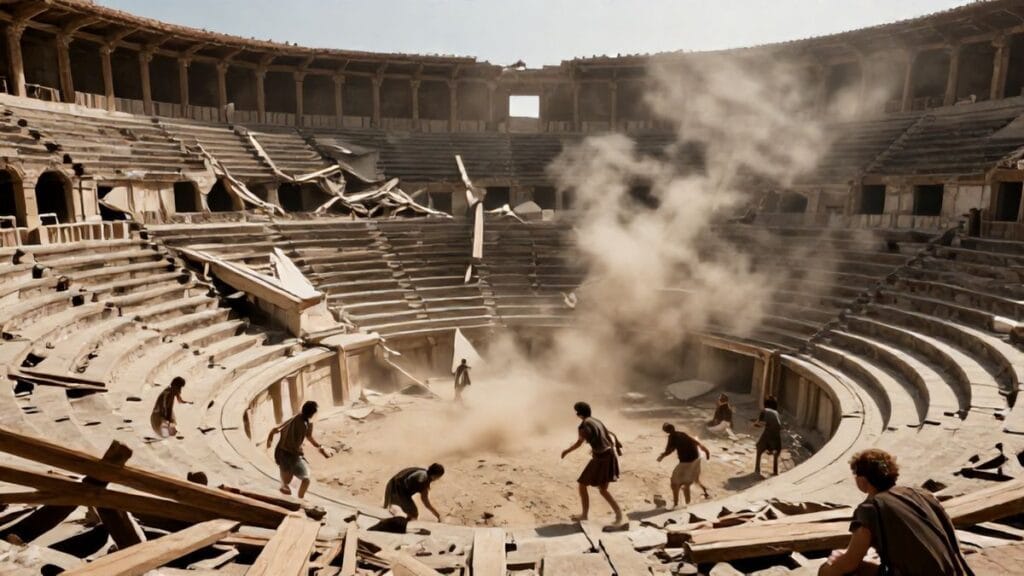
What followed, the ancient historian Tacitus describes with a restraint that belies the horror: the amphitheater, he writes, gave way “either sinking into the ground or toppling outward,” and a vast multitude was crushed. To translate that understatement into human experience, we must picture entire sections of seating—supports, benches, and the tightly packed bodies on them—suddenly losing their purchase on the earth. One moment, people sat perched above the arena floor; the next, they were in motion, falling, thrown, and buried in a chaos of splintering wood and screaming flesh.
The failure was likely progressive but rapid. A major support gave way, dragging adjacent beams with it, triggering a cascade. Where the amphitheater toppled outward, spectators were hurled from significant heights, their bodies slamming into the ground or onto those below. Where it sank inward, the stands folded like a collapsing shelf, layers of people and timbers punching down into the void. The sound would have been deafening: the roar of a crowd turned instantly to shrieks, the thunder of thousands of kilograms of wood slamming together, the almost inhuman crunch of bones and joints being shattered.
Dust and debris exploded into the air, turning bright daylight into a choking, disorienting haze. Visibility dropped to almost nothing in some areas; people could not even see their own hands before their faces. Those who survived the initial fall found themselves trapped in contorted positions, limbs pinned, ribs crushed but still drawing thin, desperate breaths. The suffocating closeness of other bodies—dead or alive—pressed in on them. For some, immediate unconsciousness may have been a mercy. Others remained all too awake, every nerve registering pain as they tried to cry out over the cacophony around them.
This was not a single, clean break but a fragmented disaster, different in each part of the amphitheater. In some sectors, the stands may have cracked but not fully collapsed, leaving people clinging to tilted benches, scrambling, or leaping down to more solid ground. In others, the entire superstructure ripped free, turning spectators into falling debris themselves as they tumbled in waves, striking beams and one another on the way down. The arena floor, once the stage for choreographed combat, became a pit of wreckage and human bodies, its sand churned into drifts of dust and blood.
The fidenae amphitheater collapse was not a matter of a few hundred victims but of thousands. Ancient accounts vary, but some speak of 50,000 people involved, with at least 20,000 killed or maimed. These numbers, even if approximations, give a sense of scale matched by few other urban disasters of the ancient world. In the span of minutes, perhaps even seconds, a large fraction of the crowd’s living energy was converted into stillness. The day that had begun with expectation and noisy joy ended, for many, in instant annihilation.
A City of Cries: Rescue, Chaos, and Silence After the Fall
When the last major beams had crashed to earth and the rumble of structural failure faded, a different sound took over—an uncoordinated storm of screams, weeping, and shouted names. Those who had been seated in still-standing sections or who had been approaching the amphitheater from outside now faced a scene that defied comprehension. Where moments before an ordered, tiered arena had stood, there was now a twisted landscape of timber and bodies. Some parts of the superstructure leaned at impossible angles; others lay flat, a tangle of splinters covering what had been rows of spectators.
Rescue began at once, but with almost no coordination. People clawed at the wreckage with bare hands, heaving aside planks, straining to lift beams far too heavy for them. The air was filled with dust that burned the lungs and eyes. Survivors trapped under debris cried out—some clearly, others with voices already blurred by internal injuries. Parents shouted children’s names over and over, their voices raw with panic. Friends called for friends. In the crush, no one could know who lay beneath a particular mound of wreckage—kin, enemy, stranger, or all three.
Local authorities, overwhelmed, tried to impose some order. Slaves were driven into the work of clearing debris; soldiers, if any garrison was near enough, may have been summoned to help. Tools were scarce. The same carts and wagons that had brought eager spectators now became impromptu ambulances, bearing the injured to whatever spaces could serve as makeshift infirmaries—temple porches, house courtyards, open fields. Physicians, accustomed to tending individual patients or battlefield casualties in smaller numbers, confronted injuries on a grotesque scale: broken limbs, crushed chests, severed fingers, head wounds bleeding into mats of hair and dust.
For those trapped deeper in the wreck, time was an enemy. Each minute of delay reduced their chances of survival. Some must have listened as the sounds above them changed—from frantic shouting and heavy thuds of moved timbers to slower, more exhausted efforts. The terrible calculus of triage began, whether consciously or not: rescuers focused where there were still clear sounds of life, where movement could be seen. Entire pockets of trapped victims may have been left untouched for hours, or forever, their cries drowned out by others or too faint to be heard. For them, the fidenae amphitheater collapse was not a single blow but a drawn-out entombment.
By evening, the chaos would have given way to a different kind of stillness. The dust settled. The sun’s lowering light revealed more clearly the contours of ruin. Bodies, some covered with cloaks or hastily arranged, lay in rows. Family members moved among them, lifting corners of fabric, peering into faces, sometimes collapsing when they recognized a loved one, sometimes dissolving into a different kind of despair when they did not—a missing body could mean death in the deeper layers of wreckage, or a wounded person taken elsewhere, or both at once until confirmed. Fidenae, which had woken as a town hosting a festival, went to sleep—if anyone slept at all—as a city of the bereaved.
Counting the Dead: Numbers, Stories, and Human Ruin
Ancient sources, wrestling with the enormity of what had occurred, reached for numbers that might somehow encompass the loss. Tacitus speaks of some 50,000 people present, with a large portion killed or maimed; later writers repeat and sometimes amplify these figures. Even if we discount some exaggeration, it is clear that the disaster ranks among the deadliest in the history of public entertainment. Yet numbers, however staggering, flatten the lived reality of individual lives interrupted—lives that, in most cases, the record does not preserve by name.
Among the dead were likely entire families who had attended together, each member lost in the same violent moment. Others died separated: a father in one section, a child in another; a master crushed while his slave survived to bear witness; a visiting merchant from Rome whose body was never identified among the heaps. There were also survivors marked for life. Some had limbs crushed beyond healing, leading to amputations and permanent disability in a society that had limited tolerance or infrastructure for the impaired. Others carried invisible wounds: recurring nightmares, sudden panic at the sound of creaking wood or large crowds, a new, sharp awareness of mortality at public festivities.
One can imagine, for instance, a young boy from the Aventine Hill in Rome who persuaded his parents to take him to Fidenae for his first gladiatorial games. He survived, perhaps because they were late arriving and stood near an entryway when the collapse occurred. His last sight of his father might have been the man’s back as he disappeared into the stands ahead of him, urging the family to hurry. After the disaster, the boy and his mother might have searched frantically among the wounded and dead, finally finding his father’s body only by recognizing a ring or the pattern of his cloak. Such stories, multiplied thousands of times, constituted the true human ledger of the fidenae amphitheater collapse.
The injured who lived struggled with long recoveries. In a world before modern surgery and antibiotics, fractures set imperfectly, infections festered in wounds contaminated by soil and splinters. Some who initially survived died days or weeks later. Others, surviving with mutilated bodies, became walking reminders of the catastrophe. They would have been hard to ignore on Roman streets: men missing arms, women limping, faces scarred and eyes clouded. Their very presence pressed a question at the conscience of the city and its rulers: who was responsible for what had happened to them?
Yet even amid the grief, life in Rome and its environs continued. Markets opened, grain was distributed, other shows were eventually held. The dead of Fidenae joined the vast, mostly anonymous legions of those taken by war, disease, and accident in the ancient world. What set this disaster apart, however, was its concentration in time and place—and the fact that it unfolded in a venue explicitly designed for pleasure and communal joy. In that sense, the fidenae amphitheater collapse was not just a tally of casualties, but a moral shock, a rupture that forced Romans to confront the risks they were willing to accept, or impose, in pursuit of spectacle.
Blame and Responsibility: The Speculator and the State
As the scale of the tragedy became clear, anger turned toward Atilius, the man behind the amphitheater. In Roman moral language, he embodied several vices at once: greed, recklessness, and a gross indifference to the safety of those he invited—or lured—into his structure. Ancient accounts make it clear that he had neither the funds nor the skill to undertake such a project safely. Yet he had done so anyway, driven by the promise of profit and the intoxicating possibility of winning favor with the crowd.
In a sense, Atilius functioned as a convenient lightning rod. By focusing blame on his lack of qualification, Romans could begin to believe that the disaster was the product of singular negligence rather than systemic failure. But reality was more complex. Why had he been allowed to proceed with construction at all? Where were the magistrates whose job it was to safeguard public order, including the safety of buildings that drew massive crowds? The absence of effective oversight pointed to gaps in the legal and administrative framework of the early Principate, gaps that the fidenae amphitheater collapse would make impossible to ignore.
Accounts differ on Atilius’ ultimate fate. Some traditions indicate that he was punished severely, his property confiscated, perhaps his person subjected to exile or worse. Regardless of the exact details, his name entered the historical record not as a benefactor of the people but as a cautionary example—proof of what could happen when private ambition intersected with public entertainment without sufficient regulation. He became, in effect, the negative of the ideal Roman patron: instead of winning eternal glory through generous and safe spectacles, he secured infamy through lethal incompetence.
But to focus solely on one man’s guilt is to miss the broader implications. The disaster exposed how the Roman state had gradually ceded parts of the spectacle economy to semi-private actors without erecting clear standards. As Rome expanded and the appetite for games grew, the need for delegated organization increased. At the same time, imperial rule concentrated formal political power in the emperor’s hands, leaving other ambitious men to find new avenues—like entertainment—through which to assert themselves. The Fidenae tragedy showed the dark side of this diffusion of practical responsibility without matching diffusion of accountability.
The debates that must have swirled in the aftermath—among senators, in the imperial council, in the streets—revolved around a core question that would echo down through centuries of urban life: when the state invites or permits large public gatherings, what duty does it bear for the safety of those who attend? The answer that emerged under Tiberius would shape Roman policy on public building for generations.
Tiberius Reacts: Imperial Policy Born of Tragedy
Emperor Tiberius, often portrayed in the sources as aloof, suspicious, and withdrawn from the public eye, could not ignore the enormity of the Fidenae catastrophe. News of the collapse traveled swiftly along the roads and rivers that tied the suburban belt to the capital. In Rome, the Senate convened to discuss the disaster, its members confronted not only with the suffering of citizens and allies but with the stark evidence that imperial oversight had failed at a basic, material level.
Tacitus, in his Annals, preserves the outlines of the response. In the wake of the tragedy, new regulations were imposed. No one was to build an amphitheater or similar structure for public spectacle without demonstrating adequate wealth and securing approval from local authorities. The intent was clear: only those with sufficient resources and social standing—those who had something to lose—could undertake such risky projects. The fidenae amphitheater collapse thus became the catalyst for a more formalized approach to crowd safety in the Roman world.
Critics might argue that this solution reinforced existing hierarchies, effectively locking poorer aspirants out of the spectacle game. But from the Senate’s perspective, that was precisely the point. Wealth and status, in Roman ideology, were supposed to correlate with virtuous behavior and a concern for the common good. Atilius’ daring had inverted that logic: a man of modest means had been able to gamble with thousands of lives, his personal ruin insufficient to balance the scale of loss. By reasserting that only the well-resourced and well-born could build for the masses, Tiberius and his advisors hoped to prevent a repeat.
The reforms likely went beyond simple wealth requirements. Though details are sparse, we can infer that building standards were tightened, at least for large wooden structures. Approval from magistrates would, in theory, involve some judgment of stability and safety, though the technical knowledge available was limited compared to modern engineering. Still, the principle had been established: the state recognized an obligation to regulate spaces of mass entertainment. Tacitus explicitly links these measures to the events at Fidenae, making the disaster one of the rare urban tragedies directly and concretely reflected in Roman law.
It is tempting to see in this episode an early form of what, in modern times, we call building codes and safety regulations. The Romans did not systematize such codes in the way later societies would, but Tiberius’ reaction shows that they were capable of learning from catastrophe. The price of that learning, in this case, was paid in tens of thousands of broken bodies. The fidenae amphitheater collapse stands as one of those grim markers in history where blood and rubble are translated into new lines of law.
Engineering Lessons: From Wooden Risks to Stone Monuments
In the centuries that followed, Roman amphitheater design evolved, with the great stone arenas of the Empire drawing, in part, on hard-earned lessons from places like Fidenae. The fundamental danger of large wooden structures, especially when built quickly and cheaply, had been made tragically clear. While timber continued to be used—particularly in smaller towns or temporary installations—the prestige and perceived safety of masonry amphitheaters increased.
Stone arenas, with their robust foundations and carefully calculated arches and vaults, distributed loads far more effectively than improvised wooden frames. They were also, as modern archaeology demonstrates, products of sophisticated engineering knowledge, involving precise calculations of stress and the controlled use of concrete and stone to resist the dynamic forces imposed by crowds. The Colosseum in Rome, begun under Vespasian decades later, can be read as both an answer and a rebuke to the fidenae amphitheater collapse: a massive, permanent structure that embodied imperial grandeur while implicitly promising security to the tens of thousands who entered its gates.
But even within wooden construction, practices shifted. Builders became more aware of the need for deeper foundations, cross-bracing, and the limitation of overhanging tiers that placed excessive stress on supporting elements. The collapse had shown that the problem was not wood per se—it was the combination of overambitious scale with underdeveloped technique and absent oversight. In regions of the Empire where stone was scarce or too expensive, improved wooden arenas continued to host games, hopefully less precariously than the one that fell at Fidenae.
The tragedy also left its imprint on the cultural perception of building. Spectators, especially those old enough to remember the news from Fidenae, must have viewed large wooden stands with a new cautiousness. Rumors and fears likely persisted for years: a creak heard during a festival in some distant town might prompt anxious glances at supports, whispered mentions of Fidenae, quick, nervous jokes. In this way, the fidenae amphitheater collapse functioned as a lived reference point, a kind of negative benchmark for what public architecture must not be.
Modern scholars of Roman engineering sometimes cite the Fidenae disaster as a key data point in reconstructing Roman attitudes to risk and safety. While we cannot say that it single-handedly drove the shift toward monumental stone amphitheaters, it fits within a broader pattern of the Empire turning its wealth and technical capacity toward ever more durable structures. The wooden colossus that failed at Fidenae and the stone colossus that still stands in Rome are, in a sense, bookends of a story about how a civilization grappled with the challenge of containing its own vast crowds without destroying them.
Social Wounds: Families, Memory, and the Fear of Public Gatherings
Beyond law and engineering, the disaster left scars in the social fabric that are harder to trace but no less real. For families who lost members, Fidenae became a site of pilgrimage or avoidance. Some may have returned in the months that followed to search again among the ruins, hoping for remains that could be given proper burial. Others would have shunned the place entirely, unable to look upon the landscape without reliving the moment of loss. In a culture where memory and ancestor veneration were central, the catastrophe wove itself into family stories and private rituals.
Fear, too, lingered. For a time, attendance at large public gatherings may have dipped, especially at wooden venues. Parents might have hesitated before allowing their children to go to games in makeshift arenas. Wives might have pleaded with husbands to stay away from structures that looked insufficiently solid, invoking Fidenae as a warning. Gossip circulated stories of near-misses elsewhere—cracking stands, swaying platforms—each retelling adding a new layer to the collective unease around crowded entertainment spaces.
Yet Romans were not, on the whole, a risk-averse people. The same society that packed amphitheaters also sent legions across dangerous frontiers and built cities in the shadow of active volcanoes. Over time, the sharpness of the fear would have dulled, replaced by a more generalized awareness. The fidenae amphitheater collapse became less a living nightmare and more a cautionary tale, part of the background knowledge that shaped how people thought about buildings, crowding, and the fallibility of human endeavors.
There is also the intimate psychology of survivors to consider. Those who walked away physically intact carried with them memories that could erupt unexpectedly. The smell of fresh-cut wood, the sight of a crowded staircase, the sudden snap of a branch in a garden—any of these might have triggered flashes of that day: the grinding sound of beams splitting, the sensation of falling, the weight of another person’s body crushing down. In a world without formal therapy, such memories had to be absorbed into the narrative of one’s life, managed through storytelling, religious ritual, or simple stoicism.
If we listen carefully to the silences of the historical record, we can imagine that these survivors contributed, in subtle ways, to shifts in popular attitudes. A father who had barely escaped might speak more critically of reckless benefactors; a mother who lost a child could become a fierce voice in neighborhood discussions about whether to trust a new building. Through such everyday conversations, the fidenae amphitheater collapse resonated long after the rubble had been cleared.
From Local Disaster to Imperial Story: Ancient Sources Speak
Our knowledge of the Fidenae disaster comes primarily from a handful of ancient authors, each with their own agenda and style. The most important is Tacitus, whose Annals offer a terse but powerful account. Writing in the early second century CE, he used the catastrophe as part of his larger narrative of Tiberius’ reign, illustrating both the emperor’s governance and the moral state of Roman society. Tacitus, ever alert to the interplay of private vice and public harm, emphasizes Atilius’ incompetence and the lack of oversight that allowed such a man to endanger thousands.
Other writers, such as Suetonius, allude more briefly to the event, often in the context of Tiberius’ legislative responses. Their accounts, while less detailed, help confirm the broad outlines: a new or newly enlarged amphitheater at Fidenae, a massive collapse, huge numbers of casualties, and subsequent legal measures. Later commentators, summarizing earlier histories now lost, sometimes embellished the story, treating the fidenae amphitheater collapse as one instance in a larger catalogue of prodigies and calamities that expressed Rome’s moral or political condition.
These sources, while invaluable, are also limited. They were written by elite men, for elite audiences, with particular interests. They do not preserve the voices of victims or survivors beyond generalities. No letter from a bereaved mother, no poem by a wounded gladiator, no inscription dedicated “to the memory of those lost at Fidenae” has survived to us. What we have is mediated through the lens of those who saw the event as material for historical, moralizing, or political reflection. As one modern scholar has noted, “the screaming multitude at Fidenae enters the record only as a statistic and an admonition.”
Yet those admonitions are revealing. Tacitus uses the disaster to criticize the erosion of traditional Roman virtues under the Principate, where men like Atilius could exploit the people with insufficient restraint. Suetonius, whose biographies of emperors often dwell on their responses to crises, presents Tiberius’ reforms as part of his complex legacy—evidence that even a suspicious and reclusive ruler could act decisively when pushed. Through their words, the collapse becomes more than an isolated freak accident; it is tethered to questions of leadership, law, and the moral obligations of power.
Modern historians, engaging with these ancient texts, must read between the lines. They cross-check reported numbers with estimates of amphitheater capacity, compare legislative references with surviving legal texts, and situate the disaster within archaeological knowledge of Roman building practices. Some debate the precise figures of the dead; others question how far-reaching the legal reforms truly were. But on one point there is broad consensus: the fidenae amphitheater collapse was an event of such magnitude that it imprinted itself indelibly on the Roman historical imagination, emerging in the sources as both a tragedy and a lesson.
Echoes Through Time: Comparisons with Later Stadium Disasters
It is impossible, reading about the Fidenae catastrophe, not to hear echoes of more recent tragedies. The collapse of poorly built stadiums, fatal crowd crushes at sporting events and concerts, fires in overcrowded venues—these haunt the modern era as surely as wooden beams haunted the early Principate. The core dynamics are strikingly similar: large crowds, inadequate infrastructure, cost-cutting measures, and failures of oversight converging into sudden, large-scale loss of life.
Modern architects and engineers, armed with advanced materials and sophisticated modeling tools, might seem far removed from the timber-framed amphitheater of Fidenae. Yet time and again, inquiries into contemporary disasters return to familiar themes: ignored warning signs, overstretched capacities, and regulatory systems that looked robust on paper but faltered in practice. In this sense, the fidenae amphitheater collapse functions as an early chapter in a very long book—a reminder that the problem of safely managing mass gatherings is as old as urban civilization itself.
Comparisons also reveal differences. Today, victims’ families often pursue legal action, compensation, and public inquiries. Media coverage brings images and testimonies across the world within hours. In ancient Rome, information spread more slowly, and formal channels for redress were fewer. The emperor and Senate could legislate; local magistrates could be praised or blamed. But the voices of the ordinary dead were heard mostly through the advocacy of others, not directly. Their suffering became part of rhetorical arguments about imperial responsibility rather than a subject of sustained, empathetic documentation.
Yet, across this gulf of time and institutions, one thing remains constant: the moral shock felt when places of joy and celebration turn, without warning, into sites of mass death. Whether in wood-built Fidenae or a modern steel-and-concrete stadium, such events force societies to confront a disquieting truth: the infrastructure that supports communal life can, if mismanaged, become suddenly lethal. The memory of Fidenae survives as a stark early instance of this truth, one that still speaks, with unnerving clarity, to our own age.
Fidenae After the Dust: Decline, Obscurity, and Archaeology
What became of Fidenae after the disaster? The town did not vanish overnight. Life, even amid devastation, has a way of reasserting itself. The ruins of the amphitheater would have been cleared gradually, recyclable timber salvaged, reusable metal fittings pried loose. The site itself may have remained a scar—an open, unsettling space where locals recalled the dead with a shudder. Over time, as new generations grew up with only secondhand stories, the rawness of that scar would have faded, blending into the normal landscape of memory and forgetting that marks any long-inhabited place.
Historically, Fidenae slipped increasingly into the shadow of Rome. Its strategic significance waned; its identity as a distinct community blurred into the broader urban sprawl that eventually characterized the surroundings of the capital. Archaeologically, the area presents a challenge. Centuries of continuous occupation, construction, and erosion have left only fragmentary traces of the early Imperial town and its ill-fated amphitheater. Scholars have proposed various locations for the structure, guided by topography and stray finds, but no definitive, fully excavated remains have yet emerged that can be tied beyond doubt to the very arena that collapsed.
This absence of clear physical evidence contrasts sharply with the clarity of the literary references. We know, from texts, that such a place existed and that it failed catastrophically. We can infer its approximate scale, materials, and general form. Yet the earth has, for now, kept its exact footprint concealed. The fidenae amphitheater collapse thus hovers awkwardly between the tangible and the imagined: we can reconstruct it in words and models, but we cannot walk its surviving corridors or touch its stones, as we can the Colosseum’s weathered arches.
Nonetheless, the broader archaeological context of Roman amphitheaters illuminates its likely appearance. Excavations at other sites have uncovered wooden seating supports, post-holes marking the lines of vanished beams, and the outlines of temporary superstructures attached to more permanent foundations. These finds, taken together, suggest that Fidenae’s amphitheater, though large, was not unique in its basic design. Its uniqueness lay instead in the combination of its scale, the inexperience of its builder, and the absence of effective checks—aspects that remain invisible in soil layers but searingly visible in historical narrative.
Today, travelers passing near the area that once held Fidenae might see nothing dramatic—just suburbs, fields, and infrastructure radiating out from modern Rome. No grand ruin proclaims, “Here, thousands died.” The story survives not in standing walls but in texts and the careful work of historians and archaeologists who, piece by piece, reassemble an event that altered Roman law and memory even as its physical traces decayed.
The fidenae amphitheater collapse in Modern Memory and Scholarship
In modern scholarship, the fidenae amphitheater collapse has taken on a dual role: it is both a case study in ancient crowd safety and a touchstone in discussions of Roman spectacle culture. Historians analyze the event to understand how quickly the Empire responded to structural failures, what legal mechanisms were in place to manage risk, and how much value was placed on the lives of ordinary spectators. Engineers and classicists collaborate to model possible load distributions and failure sequences, turning lines from Tacitus into diagrams and simulations.
The disaster also features in broader narratives about the social costs of Roman entertainment. Works on gladiatorial games and public spectacles often mention Fidenae as a counterpoint to the usual focus on the violence of the arena floor. Here, it was not gladiators or animals that slaughtered the masses, but the very building meant to frame their deaths as entertainment. The fidenae amphitheater collapse shifts attention from choreographed violence to structural violence—the harm done by systems that prioritize profit, prestige, or complacency over safety.
Some modern writers draw parallels between this ancient event and contemporary questions of urban planning and crowd management. In lectures and articles, they invoke Fidenae as a reminder that even societies celebrated for their engineering prowess can make catastrophic mistakes when political and economic pressures eclipse technical prudence. The fact that Rome, with its aqueducts and roads and massive monuments, allowed such a shoddy structure to be built speaks volumes about the uneven distribution of expertise and care across its territory.
Popular culture has, so far, largely overlooked the disaster. No major film has dramatized it; novels that mention it are few. Yet in more specialized circles—academic conferences, museum exhibitions on Roman architecture, scholarly monographs—it is a recurring presence. One might say that the fidenae amphitheater collapse lives a second life as a cautionary narrative in the minds of those who study how humans inhabit built environments. Its victims, silent in the archaeological record, speak through the questions and ethical reflections that their fate continues to inspire.
As a citation in this ongoing conversation, Tacitus’ Annals 4.62–63 remains central: it is there that he describes the collapse and the subsequent legislation, offering a rare glimpse of cause and effect in Roman policy. Modern commentators from Mommsen to more recent scholars have returned repeatedly to these passages, unpacking their implications for our understanding of Roman law and imperial administration. Through such sustained attention, the event refuses to sink fully into oblivion.
What This Catastrophe Reveals About Rome Itself
In the end, the collapse of the wooden amphitheater at Fidenae is not merely a grim anecdote; it is a lens through which we can see Rome more clearly. It illuminates, first of all, the extraordinary centrality of public spectacle in Roman life. That so many people would travel to a small town for games, that a relative nobody like Atilius would invest what he could muster in such a structure, that the state would subsequently legislate so explicitly in response—all testify to the immense social weight carried by arenas and their events.
At the same time, the disaster exposes the cracks in Rome’s vaunted system of order and control. Here was an Empire that could marshal legions across continents and raise aqueducts over valleys, yet failed, at least once, to ensure that a building meant for thousands would stand. The fidenae amphitheater collapse reveals a state still learning how to regulate the gray zone between public and private initiative, how to distribute responsibility for safety, and how to reckon with the consequences when that distribution failed.
The event also foregrounds the precariousness of ordinary lives in an imperial system. The dead at Fidenae were not senators debating high policy or generals on distant frontiers; they were largely common people, drawn by the promise of entertainment. Their suffering entered official consciousness mainly as a number and as a problem to be solved, not as a chorus of individual stories. This does not mean the Romans were indifferent—grief and anger were real—but it underscores how easily the experiences of the many could be subsumed under the narratives crafted by the few.
Yet, paradoxically, it is precisely through those elite-crafted narratives that the many at Fidenae are not wholly forgotten. The reforms that followed, the architectural shifts they anticipated, the discussions among historians ancient and modern—all these form a kind of memorial, however indirect. The fidenae amphitheater collapse reminds us that even in societies where power is concentrated, tragedy can force concessions, adjustments, and acts of acknowledgment that ripple outward far beyond the disaster’s immediate circle.
Ultimately, the story of Fidenae is a story about the delicate balance between ambition and responsibility. Rome, in its drive to entertain, impress, and bind its population through spectacle, pushed the limits of what its structures and institutions could handle. When those limits were exceeded in a small town north of the capital, the result was catastrophic. But from that catastrophe emerged new norms, new cautions, and a sharpened sense—however imperfect—of the duties owed by those who build to those who trust and enter their buildings.
Conclusion
The wooden amphitheater at Fidenae rose quickly and fell even faster, but its story stretches across centuries. On a single day in 27 CE, the joyful energy of thousands was transformed, in the space of heartbeats, into fear, pain, and loss. The fidenae amphitheater collapse was among the worst disasters of public entertainment in antiquity, a lethal convergence of greed, inexperience, and institutional negligence. Its victims, though mostly nameless to us, forced an empire to confront the inadequacies of its laws and the risks inherent in its love of spectacle.
From the vantage point of history, we can trace the consequences: new regulations under Tiberius, heightened awareness of building safety, and a gradual shift toward more durable and carefully engineered amphitheaters. We can see how ancient historians seized on the disaster as a moral example, a warning about the dangers of unregulated ambition. We can also recognize the event’s eerie resonance with modern tragedies in stadiums and arenas, where similar dynamics of crowd, structure, and oversight have produced similarly devastating results.
Yet beyond lessons and parallels, Fidenae compels a more basic reflection. Every society builds spaces where people gather in great numbers to share powerful experiences—whether of sport, ritual, or entertainment. In doing so, it takes on a profound responsibility, often only dimly acknowledged until something goes terribly wrong. The collapse at Fidenae makes that responsibility visible in stark relief. It asks, across the gulf of time, how much risk we are willing to accept in the pursuit of communal joy, and what we do—legally, politically, ethically—when that risk proves greater than we imagined.
In the end, the memory of Fidenae endures not only in ancient texts and scholarly debates but in the very notion that large public structures must be designed, inspected, and regulated with care. The splintered beams and crushed lives of that day have long since vanished, but the questions they raised remain as urgent as ever.
FAQs
- What was the Fidenae amphitheater and where was it located?
The Fidenae amphitheater was a large wooden arena built in the town of Fidenae, about eight kilometers north of Rome, on the left bank of the Tiber. It was intended to host gladiatorial games and other spectacles for audiences drawn both from the local population and from Rome itself. - When did the fidenae amphitheater collapse occur?
The fidenae amphitheater collapse took place in the year 27 CE, during the reign of Emperor Tiberius. The disaster happened on the day of its inaugural or early games, when the structure was packed with tens of thousands of spectators. - How many people were killed or injured in the disaster?
Ancient sources, especially Tacitus, suggest that as many as 50,000 people were present and that a large proportion were killed or maimed. Estimates vary, but many modern scholars accept that tens of thousands were affected, with at least 20,000 casualties likely, making it one of the deadliest known stadium disasters in history. - What caused the amphitheater to collapse?
The collapse was primarily caused by shoddy construction and inadequate foundations. The builder, Atilius, lacked the expertise and resources to safely erect such a large wooden structure and cut corners to save money. Under the weight and movement of the massive crowd, key supports failed, triggering a rapid, cascading collapse. - How did Emperor Tiberius and the Roman government respond?
In response to the fidenae amphitheater collapse, Tiberius and the Senate introduced new regulations. These required that anyone wishing to build an amphitheater or similar venue for public entertainment must demonstrate sufficient wealth and obtain official approval. The goal was to ensure that only responsible, well-resourced individuals undertook such risky projects and that basic safety checks were in place. - Do any remains of the Fidenae amphitheater survive today?
To date, no definitive, fully excavated remains of the specific amphitheater that collapsed at Fidenae have been identified. Archaeologists have proposed possible locations based on topography and scattered finds, but the exact site remains uncertain, partly because of later building and landscape changes in the area. - Which ancient sources describe the disaster?
The most detailed account comes from Tacitus in his Annals (4.62–63), where he narrates the collapse and the ensuing legislation. Suetonius and later writers also mention the event, often in the context of Tiberius’ reforms. These texts, while brief, form the core evidence for reconstructing the disaster. - Why is the fidenae amphitheater collapse still studied today?
The disaster is studied because it illuminates Roman spectacle culture, engineering practices, and legal responses to urban risk. It offers a rare example of a specific tragedy directly prompting new regulations, and it resonates strongly with modern concerns about stadium safety, crowd management, and the ethical responsibilities of builders and authorities.
External Resource
Internal Link
Other Resources
- Encyclopaedia Britannica – general search for the exact subject
- Google Scholar – academic search for the exact subject
- Internet Archive – digital library search for the exact subject