Table of Contents
- Whispers Over Phrygia: Setting the Stage for Rebellion
- An Empire in Turmoil: Valentinian, Valens, and the Shadow of Procopius
- From Dead Emperor to Living Pretender: The Legacy of Julian the Apostate
- Procopius Steps from the Shadows: Conspiracy in Constantinople
- The March to Phrygia: Camps, Rumors, and Splintering Loyalties
- On the Road to Nacoleia: Landscapes of Fear and Expectation
- The Morning of 15 April 366: Soldiers, Standards, and Silent Calculations
- Clash at the Edge of the Plain: How the Battle Unfolded
- Banners Reversed: The Sudden Collapse of Procopius’s Cause
- Captive in His Own Empire: The Hunt, Betrayal, and Death of Procopius
- The Soldiers’ Choice: Loyalty, Pay, and Survival in Civil War
- Phrygia After the Battle: Villages, Roads, and Ordinary Lives
- The Battle of Nacoleia and the Stabilization of Valens’s Rule
- Religions, Laws, and Fear: The Ideological Aftershocks
- Echoes in Ink: How Ancient Historians Remembered Nacoleia
- From Local Skirmish to Imperial Turning Point: Why Nacoleia Matters
- Lessons from a Forgotten Battlefield: Power, Legitimacy, and Chance
- Conclusion
- FAQs
- External Resource
- Internal Link
Article Summary: In April 366, on the plains near the small Phrygian town of Nacoleia, a relatively modest clash between Roman forces decided the fate of the Eastern Empire. Known to us as the battle of nacoleia, it pitted the rebel usurper Procopius, a distant relative of Julian the Apostate, against the loyalist generals of Emperor Valens. Behind the dust and shouting of that single day lay months of conspiracy in Constantinople, shifting loyalties in the legions, and a population exhausted by civil strife. This article follows the long road that led to the battle of nacoleia, the hour-by-hour drama of the engagement itself, and the brutal aftermath that crushed the rebellion. It explores the political stakes for Valens, the anxieties of soldiers forced to choose sides, and the fragile identities of cities and villages caught between rival emperors. By weaving together the narrative of events with analysis of power, religion, and propaganda, it shows how the battle of nacoleia became a turning point in the career of Valens and a warning to future pretenders. Though overshadowed today by larger and bloodier confrontations, the battle of nacoleia reveals how small, seemingly provincial battlefields could reshape the destiny of a world-spanning empire.
Whispers Over Phrygia: Setting the Stage for Rebellion
On an unnamed ridge above the rolling plains of Phrygia, a Roman scout might have paused in the early spring of 366, his horse snorting in the chill air, to gaze across the land that would soon decide an emperor’s fate. To his right, low hills folded into each other like sleeping animals; to his left, a road traced a pale scar through the earth, connecting outposts, villages, and the restless heart of an empire. Somewhere beyond that horizon lay the modest town of Nacoleia, a place of markets, mules, and little renown—until the day it gave its name to a battle that would echo through the corridors of Constantinople.
At first glance, Phrygia seemed an unlikely stage for high drama. It was inland, far from the sea-borne silk of the eastern trade routes, far from the imperial capitals dressed in marble and porphyry. Farmers here worried more about late frosts and tax collectors than about questions of imperial succession. And yet, like so many quiet provinces of the Later Roman Empire, Phrygia lay on the roads that mattered: the lines along which grain, silver, and soldiers moved. When power fractured, when banners were raised for rival emperors, these same roads could carry rumor as quickly as they carried troops.
By mid-366, rumor was almost a currency of its own. The death of the once dazzling, now controversial Emperor Julian—later called “the Apostate” by Christian writers—had left a trail of unfinished stories, oaths, and resentments. Officers who had thrived in his campaigns against Persia now found themselves shuffled aside. Families who had traced some loose bond of kinship to Julian whispered that their time might yet come again. One of them, a man named Procopius, had already tested those hopes in secret.
From Phrygia’s inns, where muleteers swapped tales over sour wine, to the makeshift shrines along the highways, people had begun to speak quietly of a new name: Procopius, Julian’s kinsman, the man once described by the historian Ammianus Marcellinus as “a little man, of slinking gait, with eyes askance, and a thick voice.” That hardly sounded like a hero destined to challenge emperors. But as spring drew near, his shadow lengthened over Phrygia, and all who lived near Nacoleia were about to discover that history sometimes turns on thin, anxious men who know how to read the cracks in a weakening regime.
An Empire in Turmoil: Valentinian, Valens, and the Shadow of Procopius
The battle near Nacoleia cannot be understood without first stepping back into the political storm that swept over the Roman state in the mid-fourth century. By 366, Rome was no longer ruled by a single towering figure but by brothers—Valentinian I in the West and Valens in the East. This twin-emperor arrangement, common in the Later Empire, was born of practicality: no single man could manage Rhine frontiers, Danubian crises, Persian diplomacy, and internal unrest all at once. Yet with shared power came shared vulnerabilities.
Valentinian, the elder brother, was a hardened soldier with a fearsome temper and a stern sense of duty. He had been acclaimed emperor in 364 by the army at Nicaea after the sudden death of Jovian. Wary of the enormous responsibilities before him, and perhaps of the dangers of seeming too ambitious, Valentinian chose to divide authority. He appointed his younger brother Valens as co-emperor, granting him rule over the East—an area rich in wealth, cities, and cultural prestige, but riddled with complex factions and frontier threats.
Valens was not, by temperament or background, a natural ruler of the East. More reserved than his brother, less tested in grand campaigns, he shouldered an office for which he was not fully prepared. Even worse, he inherited a court still haunted by the memory of Julian, the last emperor to rule the entire Roman Empire alone. The surviving officers, administrators, and notables of Julian’s reign did not all welcome the Pannonian soldier-family that now wore the purple. Some watched, some sulked, and some began to calculate the odds of defiance.
Among these calculation-makers was Procopius, who had once served Julian in the Persian campaigns. Though of obscure origins, he had two advantages: a modest kinship tie to Julian and the aura of a man passed over by fate. In a world where legitimacy could be forged from bloodlines and battlefield glory alike, Procopius embodied a rival narrative to the one Valens wanted to project. If Valens was the sober, dutiful emperor sanctioned by the army’s acclaim and his brother’s choice, Procopius might claim to be the echo of Julian’s lost promise, the rightful heir snatched from his destiny by cowardly courtiers.
This was the infection at the heart of Valens’s authority. To heal it, he needed not just victories at the frontiers but a decisive, unequivocal blow against the pretenders who drew strength from Julian’s ghost. That blow would fall, unexpectedly, on the damp soils near Nacoleia.
From Dead Emperor to Living Pretender: The Legacy of Julian the Apostate
Julian had died on a distant Persian battlefield in 363, his life pouring out into foreign soil, his story abruptly cut off. But political ghosts are harder to bury than bodies, and the memory of the last pagan emperor of Rome clung tenaciously to the Eastern provinces. For some, he was a tragic hero, a philosopher-king who had tried to restore the ancient gods and the pride of Rome, only to be betrayed by circumstance. For many Christians, he was a cautionary figure, proof that even a brilliant ruler who turned against the true faith could be struck down.
In this contested legacy, Procopius found an opening. Sources suggest that he was a relative of Julian, though not a close one—perhaps a cousin or more distant kinsman. In an age that placed great weight on the language of blood, even a tenuous connection could be amplified into something grand. Procopius had also been entrusted by Julian with military commands in the East. As Ammianus and other chroniclers relate, Julian had once even considered Procopius as a possible successor, a man who could be raised up if the emperor fell in his Persian venture. That idea had never been fully realized, but it lingered like an unspoken promise.
After Julian’s death, the new ruler, Jovian, saw the dangers clearly. He tried to neutralize that threat by drawing Procopius closer and then, sources suggest, asking him to lay aside any claims. Later, under Valentinian and Valens, Procopius was further marginalized. He was, for a time, a man in hiding, wandering or keeping discreet company, careful not to provoke suspicion. But an unfulfilled expectation can be more powerful than an open revolt. Procopius’s supporters—real or imagined—began to ask the dangerous question: if Julian’s blood still flowed in the veins of a living man, could the empire truly ignore him?
We must remember that, by the 360s, the Roman Empire was a place of intense debate about what it meant to be Roman, Christian, loyal, or legitimate. The Christianization of the state had not yet smoothed into routine. Pagan traditions still filled city squares, law courts, and festivals. Men like Procopius could present themselves as champions of a more traditional Roman order, one less dominated by the increasingly Christian and increasingly bureaucratic style of Valentinian and Valens. Whether Procopius consciously played this card is debated by scholars, but the mere association with Julian lent his uprising an ideological color. He was, perhaps unwillingly, the vessel into which countless hopes and grievances could be poured.
Procopius Steps from the Shadows: Conspiracy in Constantinople
The city in which Procopius finally made his move was itself a symbol of shifting imperial fortunes. Constantinople, once merely Byzantium, had been elevated by Constantine the Great into a “New Rome”—a city of stratified hills, gleaming forums, and vast walls gazing over the Bosporus. By 365, it was the nerve center of the Eastern Empire, a place where news arrived first, decisions were weighed, and loyalties sometimes changed overnight.
In late 365, Valens was not in the city. The emperor had gone west to deal with troubles along the Danube, leaving behind a capital rich with troops but deprived of its supreme authority. Such absences were always dangerous in the Late Empire. Procopius understood this. He had, according to later accounts, spent months quietly sounding out officers, gauging discontent, and cultivating a reputation as the alternative emperor who might, if fortune smiled, step forward to save the state from incompetent rulers.
The exact choreography of his usurpation remains blurred in our sources, but certain elements are clear. Procopius seized a moment when he could take control of the imperial insignia—the purple robe, the diadem, perhaps even the standards guarded in the city. He courted key guards units, especially those with lingering connections to Julian. Gold changed hands. Promises of back pay, land, and promotion flowed like warm honey through the barracks. Some commanders, resentful of being passed over or disciplined by Valens, responded eagerly.
When Procopius at last appeared in public in the imperial regalia, the effect on Constantinople was electric. Crowds gathered, some curious, some exhilarated, many simply bewildered. The news traveled with astonishing speed: a new Augustus had arisen, a rival to Valens, one who bore Julian’s blood. For a few brief weeks, Procopius commanded not only soldiers but momentum. Cities in Asia Minor declared for him. Tax officials recalculated their loyalties. Bishops held their breath.
But this was only the beginning. For a usurper, the first triumph is almost always illusory. What matters is not only seizing a capital, but confronting the loyalist armies that inevitably march to crush the rebellion. Procopius had lit the fuse. The explosion would happen elsewhere—on the roads and fields of Asia Minor, and finally near the town of Nacoleia in Phrygia.
The March to Phrygia: Camps, Rumors, and Splintering Loyalties
As Procopius consolidated his shaky rule in Constantinople, Valens reacted with a mix of anger and fear. The Eastern emperor had faced doubts from the beginning of his reign; now a living rival claimed the mantle of Julian. Panic might have led him to rash decisions, but Valens did something more measured: he gathered loyal legions, confirmed their pay and privileges, and began the slow, inexorable march toward Asia Minor.
It is astonishing, isn’t it, how the life of an empire can come down to such familiar sights: soldiers breaking camp at dawn, wagons rattling over uneven stones, officers poring over maps by lamplight. In these mundane scenes of military logistics, history was made. Each contingent that joined Valens’s cause—units from Thrace, from the Danube, from Syria—was a tiny referendum on his legitimacy. Veterans who had once fought under Julian now weighed their options in hushed conversations: should they embrace Procopius as the rightful heir, or trust that Valens’s hand would be steadier on the reins of power?
Procopius, for his part, could not simply wait behind the walls of Constantinople. That would cede the countryside and the narrative of initiative to Valens. So, he dispatched generals with orders to block, delay, and, if fortune allowed, defeat the loyalist armies before they could unite. The civil war that unfolded in 365–366 was not a sprint but a grinding race of marches, skirmishes, and mutual probing.
Asia Minor, that great bridge between continents, became the chessboard. Cities along the western coast hesitated before declaring their allegiance. Inland, in regions like Phrygia, the local commanders read the signs uneasily. To guess wrong was to court annihilation. If you proclaimed for Procopius and Valens won, you risked execution or disgrace; if you remained faithful to Valens and the usurper triumphed, your earlier loyalty might be reinterpreted as treason.
Some soldiers, lured by donatives and stirred by nostalgia for Julian, defected to Procopius. Others, hardened by years of frontier warfare and tired of imperial musical chairs, decided that the lawful emperor—however imperfect—was the safer bet. In the night-lit camps pitched along Phrygia’s roads, torchlight flickered over faces furrowed by doubt. Men listened to rumors of distant clashes, of banners captured or lost. The name “Nacoleia” had not yet acquired its fatal weight, but the region was filling with armed men, and the empire was bracing for a reckoning.
On the Road to Nacoleia: Landscapes of Fear and Expectation
Phrygia’s interior, where Nacoleia lay, was a country of wide valleys, modest rivers, and low, watchful hills. Vineyards and olive groves patched the earth with green; herds moved in slow, dusty files. It was here, amid such workaday scenery, that imperial couriers now galloped with messages sealed in wax: reports of troop movements, pleas for reinforcements, orders to burn bridges or garrison towns.
For the inhabitants of villages near Nacoleia, the signs were unmistakable. First came the scouts who demanded food and information; then came units of infantry tramping past in columns, their armor glinting in the pale spring light. Grain stores were requisitioned; barns were emptied to feed horses. The war they had heard about in tavern gossip was now literally pounding their roads into dust.
One can imagine an old farmer standing beside the track, watching a column of Procopius’s soldiers pass by. Perhaps they wore improvised badges, tokens supplied by their officers to mark them as the emperor’s men. Behind them, a train of supply wagons lurched and squealed. The farmer might have asked, under his breath, Which emperor? The banners said Procopius; the laws, until very recently, had spoken only of Valens. In that gap between flag and law, between shouted slogans and imperial rescripts, millions of small calculations of loyalty took shape.
Nacoleia itself, though not a great metropolis, lay at a nodal point. Roads from Bithynia and Galatia met the routes crossing Phrygia. Whoever controlled Nacoleia could influence the flow of troops eastward or westward, redirect supplies, and send a clear signal about who commanded the interior. Both sides recognized this. Thus the town—accustomed, no doubt, to seasonal fairs and the rhythms of rural trade—suddenly found itself the object of intense strategic attention.
By early April 366, advance elements of the loyalist forces under generals appointed by Valens were converging on the region. Procopius’s commanders, determined to prevent their union with other imperial troops, moved to intercept them. The confrontation, once a vague specter looming somewhere over Asia Minor, was now imminent. The stage around Nacoleia was set; the actors were in place. The date—15 April—would be remembered, if at all, not by the farmers who counted their lambs but by chroniclers who understood that the fate of emperors was about to be sealed.
The Morning of 15 April 366: Soldiers, Standards, and Silent Calculations
Dawn on 15 April 366 may have broken gray and uncertain, the way it often does in upland spring. The breath of men and horses would have hung in the air like faint smoke as camps stirred to life. On one side of the plain near Nacoleia, Procopius’s forces prepared for battle; on the other side, the loyalist army aligned under its own commanders, bearing the images of Valens.
The number of troops engaged at the battle of Nacoleia was not vast by the standards of earlier Roman wars. We are likely speaking of several tens of thousands at most, divided between the two sides. Yet for every man there, the moment was enormous. Trumpets blared; officers shouted orders in Latin and Greek; standards were raised—the labarum of the Christian emperors, Chi-Rho emblazoned, facing perhaps older symbols still cherished by those who remembered Julian’s pagan devotions.
The commanders on Procopius’s side knew that this might be their only chance to break Valens’s power in the East. They had to win more than the field; they had to win a moral victory that would send cities and border garrisons rushing to their support. The loyalist generals, by contrast, had a simpler task: destroy the rebel army, capture its leaders, and demonstrate to soldiers and civilians alike that rebellion against Valens was a death sentence.
Yet at the heart of that morning lay something less visible but far more decisive: fear. Many of Procopius’s soldiers had not committed to him out of love or ideological zeal. They had done so because he controlled Constantinople, because he had promised them money, and because, at that moment, he seemed powerful. Now, as they gazed across the field at an army fighting under the legal emperor’s name, the calculation shifted. Would the gods—or the Christian God—truly side with a man many regarded as an upstart?
As shields were checked, helmets adjusted, and lines dressed, one could sense an unspoken question running down Procopius’s ranks: If this goes wrong, will we be forgiven? The answer would be written not only in steel and blood but in the subtle negotiations that happen whenever men stand between two masters and must choose one.
Clash at the Edge of the Plain: How the Battle Unfolded
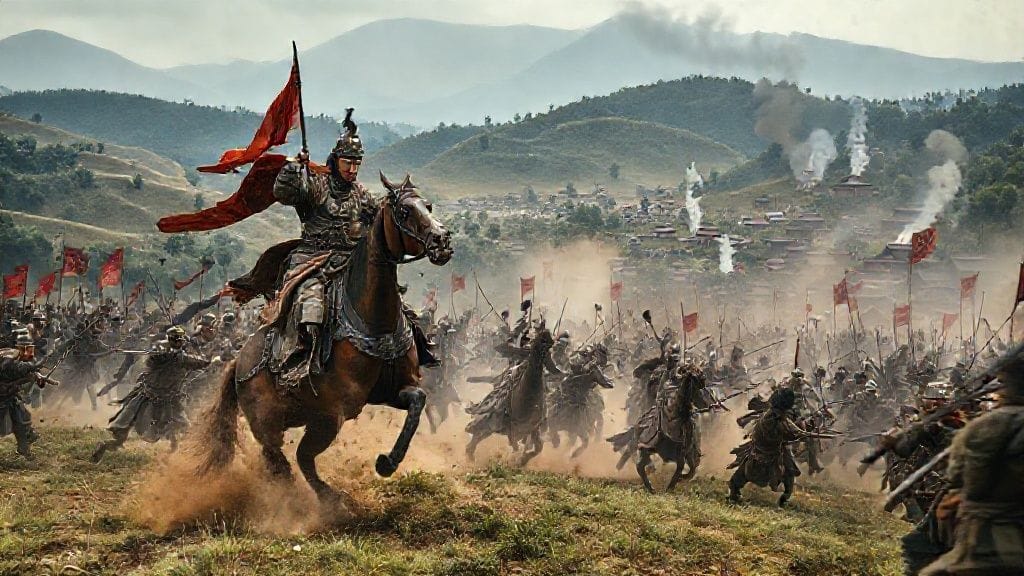
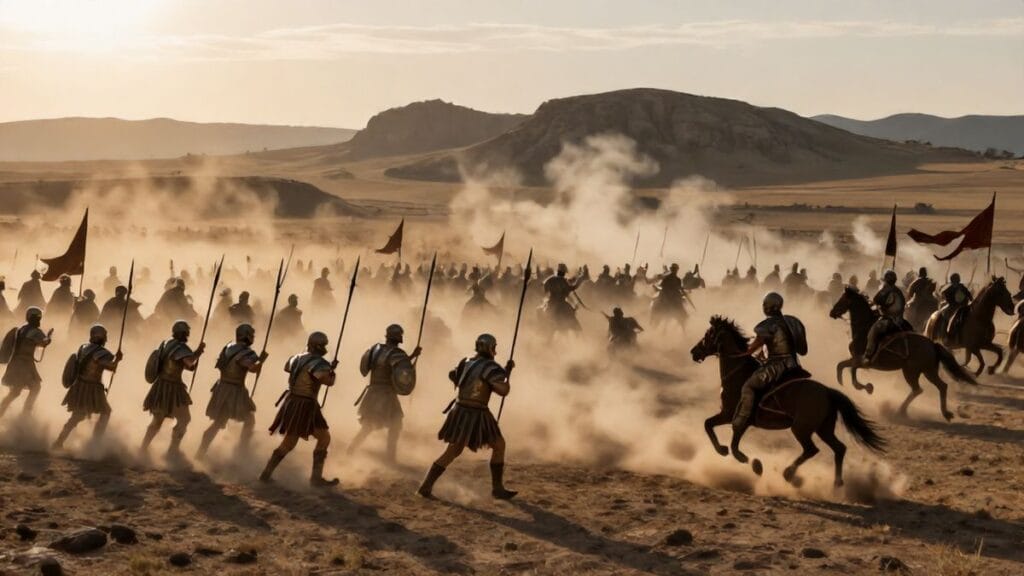
The battle of Nacoleia began, like most Late Roman engagements, with ritualized violence. Skirmishers advanced—archers, slingers, perhaps light-armed troops from the provinces—slipping out ahead of the heavy infantry lines. Arrows arced through the air; stones cracked against shields; the first shouts and cries rippled over the field. Dust, once settled peacefully on the plain, rose in uneasy spirals as feet and hooves churned it up.
Behind the skirmishers came the main bodies of infantry, the core of Roman military power. Even in the fourth century, after centuries of reforms, the ideal of the disciplined, shield-bearing legionary still shaped how battles were fought and imagined. Ranks clicked into formation, shield to shield, spearpoints bristling. Officers walked the lines, clapping shoulders, invoking the emperor’s name, promising victory and reward. On Procopius’s side, some may have also invoked the name of Julian, recalling past glories to stiffen wavering hearts.
When the lines finally met, the sound would have been a sickening chorus of impacts: metal on metal, metal on bone, bodies colliding. Men slipped in the mud; others fell and were trampled. Standards dipped and swayed as their bearers fought to hold them high. At first glance, it might have seemed a straightforward clash—two Roman armies, similarly armed and trained, grappling for advantage. But even in the thick of fighting, something else was happening, something quieter and more dangerous to Procopius’s cause.
Word spread through parts of the rebel lines that certain units on the loyalist side had offered terms. If Procopius’s soldiers would abandon their positions, if they would switch their allegiance in the midst of battle, they might be spared—and even rewarded. Such offers were not mere rumor; they were part of a deliberate strategy. The loyalist commanders knew that brute force alone might not suffice. They sought to hollow out the usurper’s army from within.
For a time, the battle may have seesawed, with local successes and failures on both sides. Dust and confusion obscured the larger picture. But in the hearts of men where fear and hope struggled, the tide had already begun to turn. Here, at the edge of the plain near Nacoleia, the real weapon was not the sword but the possibility of pardon.
Banners Reversed: The Sudden Collapse of Procopius’s Cause
Every civil war battle has a tipping point—a moment when hesitation crystallizes into action. At Nacoleia, that moment came when parts of Procopius’s army simply stopped fighting for him. According to later accounts, entire contingents shifted their allegiance during the engagement. Some lowered their rebel banners and raised the imperial insignia of Valens; others broke from the line, refusing to advance or hold their ground.
Imagine standing in Procopius’s ranks, pressed shoulder to shoulder, when suddenly the unit next to you turns and marches toward the enemy, not in attack but in submission. The cohesion that holds an army together—its trust that everyone is fighting for the same cause—shatters. Murmurs would have swelled into shouts: They’re changing sides! Fear spreads faster than fire across dry grass.
The loyalist generals seized the opportunity. Trumpets sounded renewed assaults where rebel morale seemed weakest. Cavalry charged at points where Procopius’s lines had rippled or broken. The visual drama on the field must have been overwhelming: imperial standards surging forward, rebel banners drooping, men casting down their shields in hopes of mercy.
Procopius himself does not appear to have been a master battlefield commander. His strength lay, if anywhere, in intrigue and the manipulation of symbols, not in the orchestration of complex maneuvers under pressure. As his army began to crumble, he could offer no miraculous reversal. There was no decisive reserve to throw in, no brilliant flank attack to redeem the day. The battle of Nacoleia devolved, for his followers, from contested fight into rout.
By afternoon, it was over. The field belonged to Valens’s loyalists. Bodies lay scattered among broken spears and shattered shields. Survivors of Procopius’s army streamed away in disorder, some casting off their armor to run faster, others dropping to their knees to beg pardon from the advancing imperial troops. Nacoleia, which had that morning watched formations assemble with fearful awe, now stood as witness to a destroyed rebellion.
Captive in His Own Empire: The Hunt, Betrayal, and Death of Procopius
Defeat on the field did not instantly mean capture for Procopius. Civil war often grants its failed protagonists a brief, agonizing interval between ruin and death. After Nacoleia, the usurper fled, seeking either to rally the fragments of his support or, more likely, to find some refuge while he pondered an escape that no longer truly existed.
He might have imagined that loyal officers would shield him, that cities still under his nominal authority would offer sanctuary. But the same logic that had driven soldiers to defect during the battle now worked against him across the region. To harbor Procopius was to invite the wrath of Valens. To deliver him up, on the other hand, was to demonstrate one’s loyalty in the most concrete way imaginable.
Ancient sources, including Ammianus Marcellinus, describe what happened next in curt, brutal terms: Procopius was betrayed by his own followers. Captured—perhaps in a rural villa or a fortified refuge—he was taken to the victors, bound and humiliated. His imperial regalia, which only months before had dazzled crowds in Constantinople, was stripped away. The man who had dared to call himself Augustus now stood as a common criminal.
His execution was swift and exemplary. For Valens, mercy was not an option. To allow Procopius to live would be to acknowledge that imperial kin might rise and fall and rise again. Instead, the usurper’s death was made into a message: those who claimed Julian’s legacy against the lawful emperor would meet the same fate. Procopius was put to death—likely beheaded—and his body treated as that of a traitor, not a fallen prince.
Some of his closest associates suffered, too, but not all to the same degree. Those who had switched sides early or who could demonstrate useful future loyalty were sometimes spared, underscoring the ruthless pragmatism that governed late Roman power. In the wake of Nacoleia and its aftermath, one lesson rang loudest: in this empire, legitimacy was enforced not only by victory but by the memory of what happened to those who failed.
The Soldiers’ Choice: Loyalty, Pay, and Survival in Civil War
The battle of Nacoleia illuminates a truth often hidden behind the abstractions of imperial history: soldiers were not chess pieces; they were men making hard, often cynical decisions under pressure. When we read that units deserted Procopius in the midst of battle, we should resist the urge to see only cowardice or duplicity. We should instead glimpse the complex world that shaped their choices.
Late Roman soldiers were bound to their emperors by oaths and by the expectation of regular pay, donatives, and land grants. Yet those bonds had frayed in the fourth century, as inflation, frontier crises, and palace intrigues disrupted ordinary rhythms. An emperor who failed to pay his troops, who neglected their families, or who exiled their favorite generals risked losing their affection—and eventually their obedience.
Procopius tried to exploit these vulnerabilities. His initial success in Constantinople owed much to his ability to win over guard units whose trust in Valens was not unshakable. But money and promises could only carry a usurper so far. On the plains of Phrygia, soldiers had to ask themselves not only who has paid me? but who will still be paying me in a year? Self-preservation, in the grim calculus of civil war, often trumped ideological commitments.
For soldiers who chose to abandon Procopius at Nacoleia, the decision was a gamble: would Valens accept their renewed allegiance or punish them as rebels? The fact that many did indeed switch sides suggests that the loyalist commanders had signaled a willingness to forgive. Such signals were themselves a weapon. Where fear of imperial vengeance ran highest, resistance might harden; where hope of pardon lingered, armies could dissolve from within.
In this sense, the battle of Nacoleia was not just a clash of spears and shields, but a referendum among the men whose swords decided imperial successions. When enough of them decided that Valens was the safer bet, Procopius’s imperial adventure—grand in aspiration, fragile in reality—collapsed like a stage set too hastily built.
Phrygia After the Battle: Villages, Roads, and Ordinary Lives
When armies move on, they leave behind more than footprints and broken weapons. In the wake of the battle of Nacoleia, Phrygia had to find a way to return to something resembling normal life. Fields that had been trampled by marching columns needed to be replanted. Roads rutted by supply wagons required repair. Livestock seized to feed soldiers had to be replaced, if they could be.
For the villagers and townsfolk of Nacoleia and its surroundings, the memory of the battle likely resolved itself not into dates and imperial names, but into personal stories: a barn burned, a son conscripted, a well fouled with blood. The imperial rhetoric that would later frame Nacoleia as a victory of lawful order over sedition meant little to the man counting his lost sheep or the woman who had to rebuild her household with fewer hands.
And yet, life did resume. Markets reopened. Officials returned to their posts or were replaced. Tax collectors assessed damages with a cold eye, noting what could still be extracted from a landscape that had just paid in blood. The empire relied on this resilience. Its vast machinery of governance could not afford to linger over every scar it inflicted. Like a great beast that tramples the ground as it passes, Rome moved on, expecting the earth to settle behind it.
One wonders how long the people of Nacoleia spoke of that April battle. Did fathers gesture toward a hillside and say to their sons, “That is where the two emperors’ men fought”? Or did the memory fade quickly, swallowed by more immediate concerns—poor harvests, local quarrels, the slow grind of taxes? For modern historians, Nacoleia stands out as a key moment in Valens’s consolidation of power. For those who lived there, it might have been a brutal interruption, then a story told less often with each passing year.
The Battle of Nacoleia and the Stabilization of Valens’s Rule
Politically, the impact of Nacoleia was clear and immediate: Valens had survived his first great internal challenge. The usurpation of Procopius had revealed how fragile his authority could be; the victory at Nacoleia—and the subsequent capture and execution of the rebel—demonstrated that the emperor could, when cornered, defend his throne with sufficient force.
In the short term, this translated into a consolidation of power in the East. Officials who had hesitated or wavered rushed to reaffirm their loyalty. Provincial governors who had flirted with Procopius found reasons to present themselves as victims of his coercion. Bishops and city councils crafted carefully worded letters of congratulations to Valens, praising divine providence for the restoration of order. Coins bearing the emperor’s image continued to be minted, their inscriptions implicitly asserting that his rule had never been seriously in doubt.
But behind the celebrations lay unease. Valens had learned how easily a man with dynastic connections could rally discontented troops and officials. He had also learned how much his survival depended on the attitudes of the very armies he commanded. That knowledge left a mark. After Nacoleia, Valens governed with a sharper awareness of internal threats, sometimes responding with heavy-handed policies toward those he suspected of disloyalty.
The battle also strengthened his hand in dealings with his brother Valentinian. A failed attempt to seize the Eastern throne by invoking Julian’s legacy had been crushed; the balance of power between the Western and Eastern courts could now settle into something more stable, at least for a time. Valens, once the less experienced younger brother, could now point to a civil war survived as proof of his mettle.
In this sense, the dusty fields around Nacoleia became, paradoxically, a foundation stone for a decade of relative internal stability in the East. It did not spare Valens from future disasters—most famously his catastrophic defeat at Adrianople in 378—but it ensured that the Eastern Empire would face its external enemies under the direction of a ruler whose authority, for all its cracks, had been decisively reaffirmed in 366.
Religions, Laws, and Fear: The Ideological Aftershocks
Beyond the immediate political outcome, the suppression of Procopius’s revolt at Nacoleia carried important ideological and social consequences. The usurper’s association—however tenuous—with Julian the Apostate gave the conflict a religious undercurrent, even if the battle itself was fought over power rather than doctrine.
Christian writers, eager to frame the narrative in providential terms, later depicted Procopius as a tool of old, pagan forces trying to reassert themselves against Christian emperors. The Ecclesiastical Histories of later church historians suggest that Valens’s victory affirmed the divine favor still resting on the Christian imperial order. In this telling, the battle of Nacoleia was not merely a military engagement; it was a test of heaven’s approval, passed successfully by the lawful emperor.
At the same time, Valens himself—an Arian-leaning Christian—continued to pursue policies that generated conflict within the church. His own theological positions sometimes placed him at odds with Nicene bishops and communities. The suppression of a rebellion gave him greater freedom to shape religious policy without immediate fear of dynastic challengers. Yet behind the scenes, the memory of how quickly Procopius had rallied support must have fed a quieter anxiety: what if another claimant emerged, one even more skillful at weaponizing religious differences?
Legally, the aftermath of Nacoleia was marked by purges, confiscations, and reaffirmations of imperial prerogatives. Laws enhanced the stigma attached to maiestas—treason against the emperor—and broadened the grounds on which property could be seized from those deemed rebels. The families of Procopius’s closest allies faced the harsh logic of collective punishment; their estates were targeted, their reputations blackened.
Fear, as much as doctrine or legislation, helped enforce the new order. The image of Procopius’s abrupt fall and grim execution, circulating through rumor and official proclamations alike, worked as a warning. Even those who privately reminisced about Julian or sympathized with more traditional religious practices would think twice before aligning themselves with another pretender. The battle of Nacoleia, in this sense, policed the boundaries of permissible dissent long after the last corpse had been buried.
Echoes in Ink: How Ancient Historians Remembered Nacoleia
Our knowledge of Procopius and the battle near Nacoleia comes to us through the eyes—and pens—of ancient writers who had their own agendas. Chief among them is Ammianus Marcellinus, a former soldier turned historian whose Res Gestae provides a rich, if not entirely impartial, account of the late fourth century. Ammianus, who had served under Julian, viewed the shifting fortunes of emperors with a veteran’s cynicism and a moralist’s concern.
In Ammianus’s narrative, Procopius appears as a dangerous opportunist, a man whose personal ambitions threatened the stability of the state. His physical description of the usurper is almost caricatured, emphasizing his unheroic appearance as if to argue that his claim to the purple offended not only law but nature. The battle of Nacoleia thus takes on the flavor of poetic justice: the unworthy pretender brought low by the very soldiers he sought to seduce.
Later church historians, such as Socrates Scholasticus and Sozomen, placed Procopius within a providential framework. They echoed the idea that Valens’s victory was guided by divine favor, even as they sometimes criticized the emperor for his theological positions. In these accounts, Nacoleia is not described in great tactical detail; what matters is the outcome and its moral meaning. The usurper’s swift end demonstrates that God ultimately supports the legitimate Christian ruler, despite temporary setbacks or internal controversies.
Modern historians, influenced by both these ancient sources and critical analysis, see the battle through a more complex lens. They note that civil wars in the Later Empire were as much about structural stresses—economic strains, military overextension, religious conflict—as about the personalities of emperors or rebels. Nacoleia becomes a case study in how contested legitimacy could destabilize even a heavily militarized state, and how the loyalty of soldiers functioned as the linchpin of political order.
And yet, despite this rich historiography, the battle of Nacoleia remains relatively obscure in the broader story of Rome. Overshadowed by cataclysms like Adrianople, it survives mostly in the footnotes of imperial biographies. But sometimes, as the historian Fergus Millar once suggested in another context, it is in the quieter, less famous episodes that we see most clearly how the machinery of power actually worked.
From Local Skirmish to Imperial Turning Point: Why Nacoleia Matters
At first, one might be tempted to dismiss Nacoleia as a minor skirmish, one of many civil war encounters that flickered briefly before the grander lights of history. No iconic monuments mark the site; no epic poems celebrate the courage of its combatants. And yet, when we look closely, the battle of Nacoleia reveals itself as a hinge moment in the evolution of the Eastern Roman Empire.
Without Nacoleia—without the defeat of Procopius—Valens’s reign might have unraveled within its first years. The East could have fallen into a spiral of competing claimants, each invoking some thread of dynastic legitimacy or religious grievance. Frontier defenses might have crumbled, leaving the Danube and the Euphrates vulnerable. The delicate equilibrium between East and West, brothers ruling separate halves, could have collapsed into chaos.
Instead, Nacoleia shut down one of the last serious attempts to restore something like Julian’s vision of imperial power. The victory effectively ended any hope that a relative of Julian could rally sufficient support to overturn the new dynastic reality. From this point forward, the line of Valentinian and Valens would shape the empire’s trajectory—through the policies they enacted, the wars they fought, and the disasters they failed to avert.
Moreover, Nacoleia illustrates the degree to which the Later Roman Empire had become a military-bureaucratic organism in which legitimacy was constantly negotiated. Usurpers like Procopius could no longer rely merely on senatorial support or urban crowds. They had to win over key armed units, secure crucial logistical routes, and present a compelling ideological narrative. At Nacoleia, we see the limits of such efforts: the moment when promises meet the hard floor of battlefield reality and of soldiers’ self-interest.
Thus, this “local” battle played a part in steering the empire toward the world that would eventually become Byzantium—an Eastern Roman state centered on Constantinople, wary of internal revolt, and acutely conscious of the symbolic power attached to emperor, capital, and army alike.
Lessons from a Forgotten Battlefield: Power, Legitimacy, and Chance
Standing, in imagination, on the quiet fields where the battle of Nacoleia once roared, we can distill a few enduring lessons about how power works in any complex state. The first concerns legitimacy. Procopius’s revolt demonstrates that official titles and legal claims are never enough on their own. Legitimacy is a story that must be believed by enough of the people who matter—in this case, soldiers, governors, and city leaders. Procopius tried to tell a story in which he was Julian’s rightful heir and the savior of a misgoverned empire. For a time, many believed him. Once belief faltered, his revolt collapsed.
The second lesson is about the centrality of military loyalty. The Later Roman Empire had built a vast, professional army with deep traditions and complex chains of command. Yet in moments of crisis, everything depended on whether these soldiers still identified their fates with that of the reigning emperor. At Nacoleia, the decision of rebel troops to defect mid-battle was more decisive than any particular tactical maneuver. When they walked away from Procopius, they were not only changing sides in a civil war; they were reasserting, in their own rough way, the principle that the empire could not endure endless fragmentation.
The third lesson is about chance. Had a few more units stood firm for Procopius, had a loyalist general blundered, had weather or illness disrupted Valens’s march, the outcome at Nacoleia might have been different. History, as one modern historian put it, is “a series of accidents remembered and forgotten.” The fact that Valens emerged victorious does not mean that his triumph was inevitable. It simply means that, on that particular April day in 366, the web of contingencies—from whispered offers of pardon to the morale of troops—twisted in his favor.
Lastly, Nacoleia reminds us that great imperial dramas always play out on ordinary landscapes. The plowed fields of Phrygia, the roads lined with poplars, the small town of Nacoleia—these were not built to host the struggles of emperors. Yet, for a brief moment, they became the center of the Roman world. Today, little marks the place where Procopius’s hopes collapsed, but the patterns of power that shaped that collapse—the struggle over legitimacy, the role of armies, the exploitation of fear and hope—remain deeply familiar. They echo whenever states face internal division and whenever those who hold power fear, as Valens once did, that somewhere a rival is already gathering his forces.
Conclusion
On 15 April 366, a provincial plain in Phrygia bore witness to events that would ripple across an empire. The battle of Nacoleia, though modest in scale compared to Rome’s grandest wars, brought to an end the last serious bid of a Julianic claimant to seize the Eastern throne. It exposed both the fragility and the resilience of Valens’s rule, showing how the seemingly solid façade of imperial power could be shaken by a single ambitious relative—and then reaffirmed in blood.
We have traced the path to that battlefield through corridors of intrigue in Constantinople, along the dusty roads of Asia Minor, and into the minds of soldiers forced to choose between rival emperors. We have seen how Procopius tried to weave his connection to Julian the Apostate into a mantle of legitimacy, and how that mantle unraveled when belief in his cause faltered at the crucial moment. The soldiers’ decisions at Nacoleia, as much as any decree issued from a palace, determined the shape of the Eastern Empire’s future.
In the aftermath, Valens emerged stronger at home but more wary, ruling a state that had brutally demonstrated its intolerance for internal challenges. Laws hardened, memories of rebellion were weaponized as warnings, and the narrative of divine favor for the lawful emperor was reinforced by church historians. Yet, as later disasters such as Adrianople would show, internal stability could not by itself protect an empire from the storms gathering on its frontiers.
Nacoleia has largely slipped from popular memory, overshadowed by more famous battles, but it remains a crucial moment in the long story of how Rome changed into Byzantium. It illustrates that the fate of vast political orders can turn on seemingly small engagements, on the moral weather in an army camp, and on the choices made by men who, standing in rows beneath fluttering standards, must decide which master they truly serve. To look back at Nacoleia is to be reminded that history is made as much in the forgotten fields of provincial towns as in the marble halls of capitals—and that every empire carries, within its own ranks, the seeds of both rebellion and renewal.
FAQs
- What was the Battle of Nacoleia?
The Battle of Nacoleia was a military engagement fought on 15 April 366 near the town of Nacoleia in Phrygia, in the Eastern Roman Empire. It pitted forces loyal to Emperor Valens against the army of the usurper Procopius, a relative of the former emperor Julian. The victory of the loyalist troops effectively ended Procopius’s revolt and secured Valens’s hold on the Eastern throne. - Who was Procopius, and why did he rebel?
Procopius was a Roman noble and military officer with a distant kinship to Emperor Julian the Apostate. He had served under Julian in the Persian campaigns and was rumored to have been considered as a possible successor if Julian died. After being sidelined under later emperors, he launched a rebellion in 365, seizing Constantinople and claiming the imperial title. His revolt drew strength from dissatisfaction with Valens and from lingering loyalty to Julian’s legacy. - Why was the Battle of Nacoleia important for Emperor Valens?
The battle was crucial because it allowed Valens to defeat the most serious internal challenge of his early reign. By crushing Procopius’s forces at Nacoleia and overseeing the usurper’s capture and execution, Valens demonstrated that he could maintain control over the Eastern Empire. This victory discouraged further dynastic revolts for a time and helped stabilize his regime, even though it did not prevent later military disasters like Adrianople. - How did the battle unfold, and why did Procopius lose?
The battle of Nacoleia seems to have begun as a standard clash between two Roman armies, with infantry lines and skirmishers engaging in open terrain. Procopius ultimately lost because key elements of his army defected during the fighting, choosing to switch their allegiance to Valens in exchange for the hope of pardon and reward. This wavering of loyalty undermined the coherence of his forces, leading to a collapse of morale and a rapid disintegration of his battle line. - What happened to Procopius after the defeat?
After his army was routed at Nacoleia, Procopius fled but was soon betrayed by his own followers and captured. He was handed over to the loyalist authorities and executed, most likely by beheading, as a public example of what awaited those who rose against the emperor. His supporters faced various punishments, ranging from execution and confiscation of property to conditional pardons for those who had defected early. - Did religion play a role in the conflict?
Religion was not the direct cause of the battle, but it formed an important backdrop. Procopius’s association with Julian, remembered as “the Apostate” for his attempts to restore paganism, colored how later Christian writers interpreted the revolt. They portrayed Valens’s victory as evidence of divine favor for the Christian imperial order. Within the empire, however, the conflict was primarily about power and legitimacy, even if religious identities and memories influenced how people understood it. - How do historians know about the Battle of Nacoleia?
Most of what we know comes from late antique historians such as Ammianus Marcellinus, who described Procopius’s character, rebellion, and downfall, and from later church historians like Socrates Scholasticus and Sozomen. These accounts, while shaped by their authors’ perspectives and biases, provide enough detail for modern scholars to reconstruct the main lines of the usurpation and the significance of Nacoleia in Valens’s reign.
External Resource
Internal Link
Other Resources
- Encyclopaedia Britannica – general search for the exact subject
- Google Scholar – academic search for the exact subject
- Internet Archive – digital library search for the exact subject