Table of Contents
- Storm over the Nile: Setting the Stage in Seventh-Century Egypt
- From Imperial Jewel to Contested Frontier: Alexandria before the Arab Conquest
- The First Arab Conquest of Egypt and the Fall of Byzantine Power
- A City Lost and Won: The Byzantine Counterattack of 645
- A General Called Back: Why Amr ibn al-As Recaptures Alexandria
- March to the Sea: The Overland Campaign against the Byzantine Bridgehead
- Walls, Harbors, and Flames: Inside the Recapture of Alexandria, 646
- The People of Alexandria: Fear, Bargains, and Everyday Lives in a Besieged City
- After the Gates Opened: Terms of Surrender and the Fate of a Metropolis
- Faiths in Collision: Copts, Chalcedonians, and Muslims in a Changing Religious Landscape
- Caliphs, Emperors, and Generals: The High Politics behind the Recapture
- Ships, Grain, and Gold: Strategic Consequences for the Mediterranean World
- Libraries, Legends, and Loss: Memory of Alexandria after the Arab Reconquest
- From Province to Pivot: How Egypt Was Transformed under Early Islamic Rule
- Echoes through the Centuries: Historians Debate Why Alexandria Fell and Stayed Fallen
- Chronicle of a Turning Tide: Reconstructing 646 from Fragmented Sources
- Legacies on the Shore: Alexandria’s Role in the Emerging Islamic Mediterranean
- Modern Reflections: Memory, Identity, and the Story of a Recaptured City
- Conclusion
- FAQs
- External Resource
- Internal Link
Article Summary: In 646, amid crumbling empires and shifting faiths, the Arab general Amr ibn al-As recaptures Alexandria and fixes the fate of Egypt for centuries to come. This article traces how a once-glittering Byzantine port became the arena for one of Late Antiquity’s decisive struggles, when fleets, fortifications, and fragile loyalties collided on the Mediterranean shore. It follows the first Muslim conquest of Egypt, the shock of a Byzantine counterstroke, and the dramatic campaign in which amr ibn al-as recaptures alexandria and extinguishes imperial hopes of returning. Through the eyes of soldiers, monks, merchants, and statesmen, it explores the human cost of siege and surrender, the bargains struck in narrow streets, and the fear that tomorrow might belong to a different ruler, a different language, a different God. The narrative also unpacks the political calculations in Constantinople and Medina, weighing how the loss of Egypt’s grain and gold shifted the balance of power. It examines the religious tensions between Copts and Chalcedonians, the myths of burning libraries, and how chroniclers from Theophanes to al-Tabari remembered – and reshaped – the event. By the time amr ibn al-as recaptures alexandria for the last time, Egypt has begun its transformation from a Byzantine province to the beating fiscal heart of an expanding Islamic commonwealth. In doing so, the story of 646 becomes not just a tale of conquest, but a lens on how cities die, survive, and are reborn under new banners.
Storm over the Nile: Setting the Stage in Seventh-Century Egypt
The year 646 did not arrive in silence. Across the eastern Mediterranean, rumors moved faster than caravans: Constantinople’s grip was loosening, the deserts had awakened, and armies marching under unfamiliar banners were overturning a world that believed itself eternal. Egypt, perched between the Mediterranean and the desert, was the prize at the center of this storm. To understand the moment when amr ibn al-as recaptures alexandria, one must first picture the grand but fragile edifice that was Late Antique Egypt—rich in grain and gold, yet riddled with fractures of creed, class, and empire.
For centuries, Egypt had been the jewel of imperial economies. Under the Romans and then the Byzantines, its black Nile soil fed millions. The silent procession of grain ships from Alexandria to Constantinople was as vital to the empire as arteries are to a living body. To emperors, the province meant revenue, food, and prestige; to the people of Egypt, it meant crushing tax burdens, conscription, and recurrent struggles over doctrine and identity. The countryside was dominated by great estates and monasteries, massive landholders that negotiated with imperial agents while peasants, the fellahin, paid the ultimate cost.
This world was already under immense pressure before the first Arab riders appeared on its fringes. The long wars between the Byzantine Empire and the Sassanian Persians had drained treasuries and emptied garrisons. In the early seventh century, Persian armies had briefly torn Egypt from imperial hands, shocking bishops and bureaucrats alike. Even when the Byzantines under Emperor Heraclius reconquered the province, the scars remained: ruined fortifications, resentful taxpayers, and religious communities that felt more estranged than ever from the distant, Greek-speaking capital.
In the churches and monasteries of Egypt, debates over the nature of Christ were not abstract theology but burning political realities. The majority of Egyptian Christians—the Copts—rejected the official imperial creed of Chalcedon, which spoke of Christ in two natures, divine and human. Instead, they embraced miaphysite doctrine, seeing Christ’s nature as one united nature out of two. For insisting on this, they believed themselves persecuted, dismissed from high office, and pushed to the margins by the imperial church, whose senior ranks often came from or were aligned with Greek-speaking, Chalcedonian elites in Alexandria and Constantinople.
Thus, on the eve of the Arab conquests, Egypt was a province where the imperial army was stretched thin, where the bureaucracy was both feared and hated, and where significant portions of the population felt estranged from imperial orthodoxy. It was a place of immense strategic and spiritual importance that nonetheless rested on shaky foundations. When the armies of Islam began to roll out from Arabia—first over the deserts of Syria and Palestine, then towards the fertile lands of the Nile—Egypt was not a strong fortress but a magnificent, overburdened estate whose master could not be everywhere at once.
This is the world that shaped the story in which, a few years later, amr ibn al-as recaptures alexandria and closes a chapter in Byzantine Egyptian history forever. But this was only the beginning of the storm that would reshape the riverine landscapes and coastal skylines of the eastern Mediterranean.
From Imperial Jewel to Contested Frontier: Alexandria before the Arab Conquest
Long before the banners of Islam appeared on the horizon, Alexandria was a city of paradoxes. Founded by Alexander the Great, reshaped by the Ptolemies, and glorified under Rome, it embodied both cosmopolitan grandeur and simmering conflict. By the seventh century, its streets had seen philosophers and patriarchs, riots and processions, pagan shrines turned to churches and churches turned into battlegrounds of doctrine. High colonnades led down towards the great harbor, where masts rose like a forest, and warehouses bulged with grain, papyrus, wine, and the goods of three continents.
Politically, Alexandria was the second city of the empire’s eastern half—after Constantinople itself—a city whose population may have hovered in the hundreds of thousands, even after centuries of upheaval. Greek remained the language of power and commerce, but Coptic, reflecting the older Egyptian tongue, echoed through the markets and monasteries. Latin, the language of Rome, lingered mostly in legal and military contexts, a ghost in the paperwork of an empire that now thought and dreamed in Greek.
Religiously, the city had long been a tinderbox. The Patriarch of Alexandria was one of the great sees of Christendom, rivaling Antioch, Jerusalem, and Rome. Yet the council of Chalcedon in 451 had divided the Christian world. Many Alexandrians rejected its definition and had endured centuries of alternating crackdowns and uneasy toleration from Constantinople. Patriarchs appointed by the emperor often faced hostile crowds. Behind theological formulas about natures and wills lay issues of power, identity, and language—Greek versus Coptic, imperial center versus provincial periphery.
In this labyrinth of politics and piety, the imperial garrison marched as a separate world. Soldiers from across the empire—Isaurians, Thracians, perhaps Armenians—maintained order, manned the walls, protected the harbor. The city’s formidable defenses, strengthened over centuries, made it a natural fortress. Its location at the mouth of the Nile Delta offered multiple routes inland and out to sea, giving it an advantage that inland cities like Babylon-Fustat could never fully replicate. Any force that hoped to control Egypt in a durable way had to reckon with Alexandria. To hold the land without holding the city was to grasp the body without its head.
Yet behind the city’s lofty walls, contradictions festered. Tax collectors, civilian administrators, and church officials played delicate games of alliance and rivalry. Imperial orders from Constantinople could be slow to arrive, and slower still to enforce. Local elites maneuvered to preserve their privileges, while ordinary Alexandrians bore the brunt of fluctuations in grain prices, outbreaks of plague, and the occasional harsh reform. Social tensions, occasionally erupting into riots, left their marks on the psyche of the city—a memory of fragility beneath the facade of strength.
It is astonishing, isn’t it, that such a mighty city could stand at the crossroads of three continents and yet be so vulnerable? And yet, that vulnerability had already been brutally exposed once, during the Persian occupation earlier in the century. When Byzantine arms restored the city to imperial control, celebrations in the churches and forums were shadowed by the knowledge that the world was changing fast. The rise of Islam in Arabia was still a rumor at first, then a news item, then an approaching tide. When it finally reached the Egyptian frontier, Alexandria’s fate as an imperial bastion would be tested, broken, and briefly reclaimed—before the moment when amr ibn al-as recaptures alexandria altered its trajectory for good.
The First Arab Conquest of Egypt and the Fall of Byzantine Power
The first Arab invasion of Egypt did not begin with Alexandria. It flowed instead from the desert frontiers, tracing the same fault lines that had plagued the empire for decades. By the early 640s, Muslim forces had already seized Syria and Palestine, crushing Byzantine armies at battles like Yarmouk. The empire was bleeding territory; its once-confident commanders now calculated where to retreat rather than where to advance. It was in this context that Amr ibn al-As, a seasoned commander and former merchant with deep knowledge of the region, turned his gaze to Egypt.
Amr’s path to fame had begun earlier, as he joined the Prophet Muhammad’s cause and later distinguished himself in the campaigns of the Rashidun Caliphate. By the time he proposed an expedition into Egypt, he had already shown a combination of daring and pragmatism that made his superiors both admire and occasionally mistrust him. When Caliph Umar ibn al-Khattab hesitated over the Egyptian campaign, knowing the risks of overextension, Amr pushed forward with a relatively small force—some accounts speak of around 4,000 men at first, later reinforced—gambling that the weakness and disunity of Byzantine rule in Egypt would compensate for his modest numbers.
The first major test of this gamble came at Pelusium, the gateway fortress on Egypt’s eastern frontier. After a siege, the city fell, and Amr’s army poured into the Nile Delta. Roman roads and river routes carried them deeper into the province, their progress slowed by fortified towns and the intricate geography of canals and branches of the Nile. Yet as they advanced, they also exploited local grievances, reaching understandings with Coptic communities weary of imperial tax demands and doctrinal persecution. Some later Coptic sources would portray the Arabs as liberators at first, though these images must be weighed carefully against the broader realities of conquest.
The crucial clash came at Babylon, near modern Cairo, where a massive fortress guarded the approach to the Egyptian heartland. Here, the Byzantine military made its stand, hoping to pin down and exhaust the invaders. The siege lasted months, a grinding test of endurance. It was during these months that Amr’s reputation was forged: the commander who, with limited resources, combined negotiations, limited assaults, and the patient tightening of a noose around a fortified enemy. Eventually, Babylon fell, and with it the last major inland obstacle to Muslim control of Egypt.
From there, the road to the capital was open in principle, but Alexandria did not surrender at once. The city’s walls, its garrison, and its sea access made it a formidable bastion. Nonetheless, after maneuver and pressure—sources vary on the exact details—Alexandria capitulated around 641. The terms were relatively moderate by the harsh standards of the age: payment of tribute, retention of local administration under Muslim oversight, and some degree of security for property and worship. The Byzantine garrison began to withdraw, and Amr took control of the city.
In these years, the phrase “amr ibn al-as recaptures alexandria” would not yet have existed; Alexandria was newly taken, not retaken. Yet beneath the surface of this early conquest lay the seeds of later reversal. The Byzantines, stunned but not annihilated, still commanded fleets and could still dream of restoration. Caliph Umar, wary of coastal vulnerability and perhaps mindful of Alexandria’s distance from his power base, encouraged Amr to establish a new administrative center inland. Thus, Fustat was founded near Babylon, a new Muslim city that would eventually overshadow Alexandria in administrative importance, but not yet in symbolic weight.
For a brief moment, it seemed as though the story might end here: the empire retreats, the new rulers consolidate, and Alexandria adjusts as it had adjusted so many times before. But the sea—always Alexandria’s strength—made it the stage for one last imperial gamble, one that would hurled the city, its inhabitants, and its conquerors into a fresh cycle of warfare, hope, and dread.
A City Lost and Won: The Byzantine Counterattack of 645
The fall of Alexandria in the early 640s shocked Constantinople, but it did not entirely extinguish Byzantine ambition. Emperors had lost provinces before and fought to reclaim them. The Nile’s grain remained a tantalizing lure, especially as the empire grappled with the loss of Syria, Palestine, and large parts of Mesopotamia. Moreover, the Byzantine navy, though far from invincible, still enjoyed experience, shipyards, and a maritime tradition that the young Islamic polity had not yet fully matched.
In 645, an opportunity seemed to present itself. The new rulers of Egypt were still consolidating their hold, distributing garrisons, negotiating arrangements with local elites, and learning to manage a largely Christian population with complex internal disputes. The Muslim forces were relatively thin on the ground, their lines of communication stretched back towards Syria and Arabia. Alexandria, with its harbor and walls, stood like an open challenge to any fleet that dared approach.
Into this fragile situation sailed a Byzantine expeditionary force, whose size remains debated among historians but was sufficient to seize and hold the city, at least temporarily. The sources—Byzantine, Coptic, and Arabic—are terse and sometimes contradictory, but they agree on the essentials: under cover of naval power, the empire briefly retook Alexandria. Imperial banners once more flew over the ramparts; Greek-speaking officials and officers reassumed authority. To some inhabitants—especially those aligned with imperial Chalcedonian orthodoxy—this must have felt like a miraculous reversal, a vindication that God had not abandoned the empire.
Yet behind the celebrations lurked uncertainty. The Byzantines had retaken a city but not the province. Much of Egypt remained in Muslim hands, and Amr ibn al-As, though recalled from some posts, had not vanished from the stage. The empire’s ability to project sustained force deep into the Nile valley was limited. Without control of the countryside and its resources, Alexandria risked becoming an isolated outpost, a gleaming but vulnerable island of imperial authority in a sea increasingly dominated by the new power from Arabia.
For the city’s residents, this oscillation of rulers could be terrifying and bewildering. Tax systems and currencies might shift; alliances carefully woven with one conqueror had to be renegotiated with another. Soldiers returned to garrisons they had abandoned years before, perhaps confronting locals who had accommodated themselves to the new Muslim authorities. Religious tensions flared anew as imperial church officials sought to reassert orthodoxy, while Coptic communities weighed whether the brief triumph of their old rulers would bring reprieve or renewed crackdowns.
This was the precarious situation that set the stage for the moment when amr ibn al-as recaptures alexandria once more. The Byzantine gamble in 645 was daring, but it was also incomplete. Without the means to crush the Muslim forces controlling the interior, the empire had seized a symbol rather than a solution. It would fall to Amr to show that symbols, however brilliant, could not stand against determined land power and the slow but inexorable tightening of the noose around an isolated city.
A General Called Back: Why Amr ibn al-As Recaptures Alexandria
When news reached the Muslim authorities that Alexandria had fallen back into Byzantine hands, the shock was real but not paralyzing. Egypt was too important to lose. It was fast becoming the financial backbone of the Rashidun Caliphate, its grain and taxes underwriting garrisons, stipends, and new campaigns. If Byzantium were allowed to reestablish itself on the Nile, not only would that revenue be threatened, but the prestige of the burgeoning Islamic state would suffer a serious blow.
In this tense atmosphere, Amr ibn al-As was drawn back into the spotlight. Some traditions suggest that he had been relieved of overall command in Egypt, his relationship with Caliph Umar occasionally strained by questions of fiscal policy and governance. Yet when the crisis erupted, his experience and knowledge of the land made him the obvious choice to lead the counteroffensive. The phrase “amr ibn al-as recaptures alexandria” would become a shorthand for this decisive moment, but at the time it was a complex political and military calculation.
Umar, cautious by temperament, is said to have warned against reckless ventures, yet he also understood the strategic logic. To allow a powerful enemy to maintain a foothold in Egypt’s greatest port was to invite endless incursions. So orders were given, provisions gathered, and messages carried to tribal contingents and garrisons: prepare for a new campaign. Amr, recalled to command, must have moved with a mixture of vindication and grim determination.
Contemporary chroniclers, like al-Tabari (writing later but drawing on earlier reports), portray Amr as convinced that the recapture of Alexandria was not merely a tactical necessity but a definitive step in securing Egypt for Islam. His aim was not another negotiated balance but a lasting solution in which Byzantine flags would never again rise over the city’s walls. In the historian Theophanes the Confessor’s later Greek chronicle, the loss of Alexandria in this period is etched as part of a broader saga of imperial decline, a sign that, as he wrote, “the wrath of God had turned away” from the emperor.
In planning his campaign, Amr had to consider several factors. The city was strongly fortified and supplied by sea. A direct assault without preparation would be costly. Yet delay carried its own dangers: the longer the Byzantines held the city, the more time they had to strengthen their defenses, repair walls, and perhaps win back allies in the countryside. Amr’s solution would be characteristically measured: tighten the grip on the land approaches, isolate the city from its hinterland, and then, at the right moment, strike hard at its defenses.
Thus began the campaign that, in retrospect, historians encapsulate in the phrase: amr ibn al-as recaptures alexandria in 646. It was not a single battle but a sequence of marches, skirmishes, and psychological maneuvers, driven by the awareness on both sides that this might be the final contest over Egypt’s allegiance for generations to come.
March to the Sea: The Overland Campaign against the Byzantine Bridgehead
Amr’s army did not materialize at Alexandria’s gates overnight. It had to move across the landscapes of Egypt—canals, villages, and marshlands—reasserting control and gauging loyalties along the way. The march northward was itself a display of power, a reminder to local notables and former officials that the Muslim government retained its reach and that siding too openly with the returned Byzantines could be fatal.
Despite the fragmentary nature of the sources, we can imagine the columns of troops: Arab warriors in light armor, perhaps reinforced by local converts or allies, guides leading them along the dikes and causeways that crisscrossed the Delta. Every village they passed through was a node of potential resistance or support. Tax registers, religious disputes, and memories of previous occupations all shaped how peasants and town elders reacted to the new campaign. Some provided food and fodder, understanding that their future lay with the power that commanded the countryside, not the distant city by the sea.
Skirmishes likely broke out as advanced elements probed the approaches to Alexandria. The Byzantines, aware that the decisive threat would come by land, may have sent out cavalry raids or small infantry detachments to test the invaders’ strength. Yet their main hope lay in the walls and the harbor, not in open-field battles on terrain that now favored their enemy. If the Muslim forces maintained cohesion and supply, every day that passed drew the noose tighter around the city.
Amr’s strategic goal was clear: cut Alexandria off from Egypt. While he could not directly challenge the Byzantine navy in its own element, he could ensure that the city’s population and garrison could not rely on the granaries and estates of the Nile. Starving a city was a cruel but time-honored method of war. It would sap morale, generate internal conflicts, and perhaps push some factions within the city towards negotiation or even covert contact with the besiegers.
Yet behind the cold logic of strategy were human stories. As Amr’s army advanced, news preceded them. In monasteries, monks debated whether this was divine punishment, divine deliverance, or simply another chapter in a world that had always been unsafe. In market squares, merchants calculated which currency would prevail, whose taxes they would be paying next year. In village churches, priests decided how openly to pray for the emperor when the local Muslim commander might be attending to their caution.
When, after this determined march, the Muslim forces finally drew close enough that the city’s walls loomed on the horizon, every man in the army must have felt that they were participating in a moment that would be remembered. It would be here, on this shoreline, that the line would be drawn: either Byzantium would reassert itself, or amr ibn al-as recaptures alexandria and seals the province’s allegiance to a new center of power.
Walls, Harbors, and Flames: Inside the Recapture of Alexandria, 646
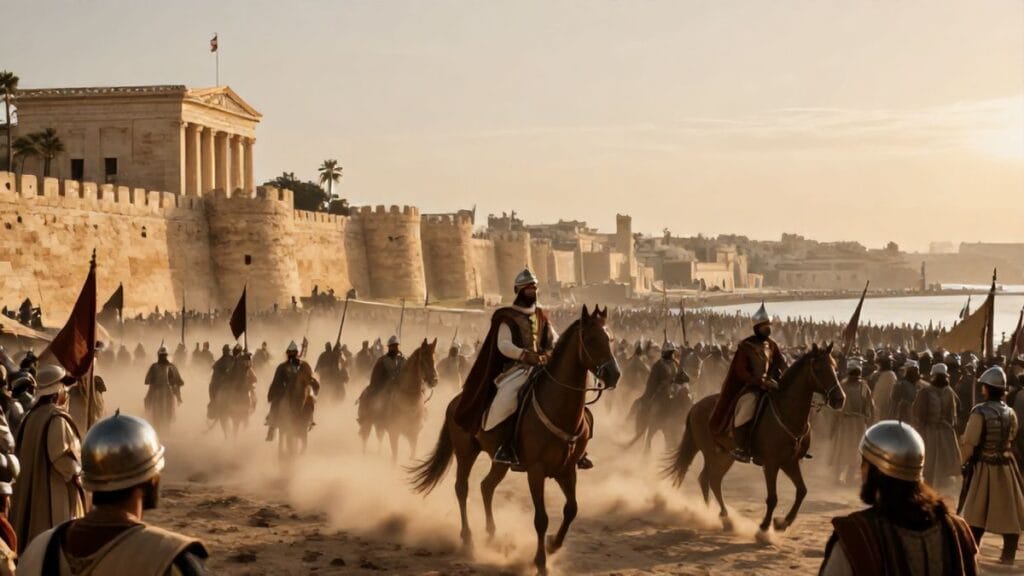
Alexandria’s walls, strengthened over centuries, were a formidable obstacle. Towering over moats and embankments, lined with towers at intervals, they enclosed the bustling quarters, markets, churches, and docks that made the city famous. From atop those ramparts, Byzantine soldiers could watch the approaching Muslim forces, dust rising behind them, banners snapping in the sea wind. Inside, the harbor sheltered the warships that had carried the expeditionary force, their presence a constant reminder that imperial power still rode the waves.
Details of the siege tactics are scarce, and later chroniclers often compress events into a few lines. But the logic of warfare in this era allows us to imagine the rhythms of the recapture. Muslim forces likely established camps around key gates and approaches, digging earthworks for protection, setting up lines of communication, and cutting the main roads from the hinterland to the city. Patrols would watch for any attempt by the Byzantines to sally out, while envoys might be sent under flags of truce to probe for weakness among the defenders.
Inside the city, supplies would have begun to dwindle. Although resupply by sea remained possible, it was costly and subject to delay. Grain twice baked to survive ocean voyages was not the same as fresh shipments from the Delta. Hunger gnawed at the civilians first, then at the garrison. Disease, always a threat in crowded urban environments, could spread quickly under siege conditions. In such a climate, morale becomes as important as walls. Officers had to convince their men that relief was coming, that Constantinople would not abandon them to their fate.
But Constantinople was far away, its resources strained by pressures on multiple frontiers. As the weeks or months dragged on, even the most loyal soldiers must have asked themselves whether reinforcements would ever materialize. With each unanswered hope, Amr’s hand grew stronger. His soldiers, acclimated to harsh conditions, fought for both religious conviction and the promise of reward.
At some point, pressure turned into action. Perhaps the decisive moment came in a concentrated assault on a section of wall, exploiting a structural weakness or a lapse in vigilance by the defenders. Siege engines, scaling ladders, or even sappers undermining the foundations may have played their part. The sources whisper of fighting in the streets, of houses and churches caught in the crossfire. Fire—deliberate or accidental—may have licked at the edges of neighborhoods, filling the air with smoke and the shouts of families fleeing their homes.
When the walls were finally breached, or when the gates were forced open, the terrifying intimacy of urban combat began. Narrow streets funneled fighters into deadly choke points; rooftops became perches for archers; doorways turned into last-stand fortresses. For ordinary Alexandrians, the day when amr ibn al-as recaptures alexandria was not a line in a chronicle but a cacophony of screams, steel, and collapsing masonry. Some sought refuge in churches, clutching icons and relics. Others, more pragmatic or more terrified, may have waved white cloths from balconies, hoping to signal surrender or at least nonresistance.
Eventually, organized resistance broke. Whether by negotiated terms or sheer exhaustion, the Byzantine garrison yielded. Their commanders may have bargained for safe passage by sea, as they had in earlier episodes. The city’s formal submission brought an end to the immediate carnage, but not to the long work of reordering lives and loyalties. The phrase “amr ibn al-as recaptures alexandria” thus encapsulates both a military triumph and a moment of profound disruption for tens of thousands of people who had no say in the clash of empires over their heads.
The People of Alexandria: Fear, Bargains, and Everyday Lives in a Besieged City
Behind the abstractions of conquest lay the anxious days and nights of real people. What did it mean to wake up in Alexandria in 646, knowing that armies encircled your city and that the outcome could determine not only your ruler but your faith, your language, even the value of the coins in your purse?
Consider a Coptic artisan in one of the city’s mixed neighborhoods, where Greek and Coptic intermingled on shop signs and in the cries of vendors. Under Byzantine rule, he had watched imperial officials and Chalcedonian clergy wield power that often felt distant and unsympathetic to his own religious convictions. When the Muslims first took the city in the early 640s, he had experienced uncertainty, but also a curious relief as some burdens shifted, some persecutors departed. Now, with the brief Byzantine restoration and then the siege that followed, he might have felt trapped between two uncertain futures, neither fully his own.
Or picture a Greek-speaking merchant whose wealth depended on stable trade networks linking Alexandria to Cyprus, Constantinople, and beyond. The shifting of regimes disrupted his business, threatened his investments abroad, and upended the credit arrangements that underpinned his operations. His loyalties might have inclined towards the empire that had built the world he knew, yet he also had to weigh the costs of open resistance to the new power outside the walls. During the siege, his warehouses ran low, his customers dwindled, and he had to consider whether partnership with Muslim traders could someday secure his fortunes.
Women experienced the siege from yet another angle. For mothers, scarcity of food meant watching children grow weaker. For widows of soldiers or sailors, the sound of fighting was an echo of already-lived loss. Some may have sought refuge in religious spaces, praying that saints and martyrs would intercede. Others, pragmatic to the core, focused on finding water, bread, and some measure of safety in buildings less likely to attract the attention of looters or soldiers once the final assault came.
Among the clergy, debates must have been fierce. Should the church align itself openly with the emperor’s cause, risking reprisal if the Muslims triumphed? Or should it adopt a posture of cautious neutrality, arguing that its primary duty was to protect its flock whatever banner flew above the city? For Coptic bishops, who had long suffered under imperial religious policy, the calculation was even more complex. Some later Coptic traditions portrayed the Arab conquest as a tragic but also providential event that ended certain forms of Byzantine persecution. Whether such views were already formed in 646 or took shape only after decades of hindsight, the seeds of ambivalence were certainly present.
As amr ibn al-as recaptures alexandria and the city passed definitively under Muslim rule, all these individuals—artisans, merchants, women, clergy—would have to remake their lives in small, quiet ways. Street by street, contract by contract, ritual by ritual, the human fabric of Alexandria adjusted to a political shift that none of its inhabitants had chosen, but all would have to endure.
After the Gates Opened: Terms of Surrender and the Fate of a Metropolis
When the fighting subsided and the city submitted, the question that hung over Alexandria was simple and brutal: what now? In Late Antique warfare, the fate of a conquered city depended heavily on whether it had surrendered willingly or resisted to the bitter end. A city taken by storm might expect looting, executions, perhaps even depopulation. A city that negotiated, by contrast, could sometimes secure more favorable terms, preserving property, lives, and communal autonomy in exchange for tribute and political loyalty.
The surviving Arabic and Coptic sources suggest that Amr, despite the ferocity of the struggle, opted for a policy that combined firmness with pragmatism. Alexandria was too valuable to destroy. Its harbor, its artisan class, and its tax base were essential to the long-term prosperity of Egypt under Muslim rule. While some buildings may have been damaged or repurposed, there was no wholesale annihilation of the city, no salting of the earth. Instead, systems were put in place: registers updated, governors appointed, tax regimes adjusted to fit the patterns already established in other conquered territories.
Christians, both Coptic and Chalcedonian, were generally allowed to practice their faith in exchange for payment of the jizya, a poll tax on non-Muslims, and acceptance of Muslim political dominance. Churches continued to function; bishops continued to ordain. The civic and ecclesiastical landscapes were not wiped clean but woven into a new order where Muslim authorities held ultimate power. For the Muslim conquerors, this was both a religious policy and a practical one: forced mass conversions would have disrupted revenue and likely provoked rebellions.
The departure of remaining Byzantine troops, probably by sea, was a melancholy spectacle for those loyal to the empire. Ships slipped from the harbor carrying officers, soldiers, and perhaps some civilian families who feared life under the new regime. On the docks, tearful farewells must have played out in a dozen languages, as households split between those who left and those who stayed. For those left behind, the last sight of imperial sails on the horizon would also be the last realistic hope that imperial power might return in their lifetimes.
In administrative terms, Alexandria retained importance as a port and trading center, but it slowly ceded its role as the political capital of Egypt to Fustat. Amr and his successors preferred a power center closer to the Nile’s communications arteries and free from the strong imperial imprint of the coastal metropolis. This gradual shift in administrative gravity would, over the coming decades and centuries, reshape the urban hierarchy of Egypt. Yet Alexandria remained a critical node in Mediterranean commerce, even as its identity and demography began to evolve under Islamic rule.
In the immediate aftermath, though, what mattered most was simple survival. As amr ibn al-as recaptures alexandria and consolidates his rule, the city’s inhabitants faced new legal categories—Muslim, dhimmi (protected non-Muslim), slave—each with different rights and obligations. Some converted sincerely out of conviction, others strategically out of hope for lower taxes or greater opportunities. Many more clung to their inherited faiths, adjusting to the new reality with a mixture of resignation and resourcefulness that only an urban population long used to upheaval could muster.
Faiths in Collision: Copts, Chalcedonians, and Muslims in a Changing Religious Landscape
The recapture of Alexandria in 646 was not only a military and political event; it was also a turning point in the complex religious ecology of Egypt. The city, and the wider province, were home to overlapping Christian communities: Coptic miaphysites, Greek-speaking Chalcedonians aligned with imperial orthodoxy, and smaller groups with their own theological nuances. The arrival and consolidation of Muslim rule introduced a new player—a community with its own scripture, legal traditions, and expanding intellectual horizons.
Before the Arab conquest, religious strife within Christianity had been a defining feature of Egyptian life. Copts remembered episodes of persecution and marginalization under emperors who saw doctrinal unity as essential to imperial strength. Chalcedonian bishops in Alexandria drew authority from Constantinople, often at the expense of local sentiment. In this environment, some Coptic sources later portrayed Muslim rule as a mixed blessing: while it brought foreign domination, it also removed direct imperial control, allowing Copts somewhat greater space to organize their church life without the same level of interference from Chalcedonian hierarchs.
Muslim policy towards these Christian communities was guided by principles that had been developing since the early conquests. The People of the Book—Christians and Jews—were granted protected status if they accepted Muslim sovereignty and paid the jizya. Churches were generally allowed to remain; new ones might be restricted, but the existing ecclesiastical infrastructure was not systematically razed. Such arrangements did not mean equality—Muslims occupied the highest political tiers—but they did create a stable, if hierarchical, framework for coexistence.
It is within this framework that the aftermath of the siege must be understood. When amr ibn al-as recaptures alexandria, he does not inaugurate a religious purge. Instead, a gradual process unfolds, in which Arabic begins to make more inroads as an administrative and eventually cultural language, even as Coptic and Greek remain vital in church and commerce. Over generations, the balance shifts: conversions, intermarriage, and the appeal of proximity to power slowly enlarge the Muslim population, particularly in urban centers and among certain elites.
Yet in 646 itself, the Christian skyline of Alexandria—its churches, monasteries, and episcopal palaces—still dominated the horizon. The call to prayer from early mosques added a new sound to the city, but for decades Christian liturgies would ring louder and more often. Tensions surely persisted: disputes over property, accusations of blasphemy, and periodic outbreaks of communal violence. But the long arc was one of negotiated coexistence, not immediate erasure.
Over time, Alexandria would also become a site of learning for Muslim scholars, as texts, traditions, and scientific knowledge inherited from Hellenistic and Roman cultures filtered into the intellectual currents of the Islamic world. In that sense, the religious and cultural collision sparked by conquest eventually gave rise to new syntheses, even as older communities mourned what they had lost.
Caliphs, Emperors, and Generals: The High Politics behind the Recapture
Events in Alexandria were never purely local. Behind every decision taken by Amr ibn al-As stood the shadow of the caliph in Medina, and behind every move by Byzantine commanders loomed the distant figure of the emperor in Constantinople. The recapture of Alexandria in 646 thus belongs to a larger story of how two very different political systems grappled with crisis and change.
The Rashidun Caliphate, still young in 646, derived its legitimacy from its close ties to the Prophet Muhammad and from the successes of its armies. Caliphs like Umar and, later, Uthman saw themselves as stewards of a community defined by faith, but they also had to manage the mundane realities of governance: revenue, justice, the integration of new territories. Egypt, with its administrative sophistication, was both a boon and a challenge. It provided massive income but also demanded careful oversight to prevent abuses that could spark rebellion or alienate local populations.
Within this context, Amr’s role was delicate. As conqueror and governor, he wielded tremendous influence. Yet that very influence could make a caliph wary. Some sources hint at tensions over how tax revenues were assessed and distributed, or over Amr’s personal networks and ambitions. The fact that he was recalled and then effectively reinstated to lead the campaign when amr ibn al-as recaptures alexandria speaks to a dynamic in which trust, utility, and suspicion were constantly recalibrated.
On the Byzantine side, the emperor faced his own labyrinth of constraints. The empire had only recently survived the battering of the Persian wars and then the initial Arab conquests. Its military and fiscal apparatus were under immense strain. Decisions about where to deploy limited resources—whether to defend Anatolia, attempt to hold on to North Africa, or launch a bold strike at Egypt—were fraught with risk. The choice to send a fleet to retake Alexandria in 645 reflects both desperation and a lingering confidence in naval power as a trump card.
Yet once the Byzantines reoccupied the city, the emperor seems to have lacked the means or the will to commit further resources to its defense when Amr’s counteroffensive gathered pace. This may have been due to other pressing threats, political instability at court, or a sober assessment that holding a single coastal city without its hinterland was untenable. Historians continue to debate whether the empire could realistically have saved Alexandria or whether its loss was virtually inevitable given the broader strategic picture.
In the end, the confrontation over Alexandria in 646 reflects a critical transitional moment. The Byzantine Empire was beginning its long transformation into a more compact, militarized state centered on Anatolia and the Aegean. The Islamic polity, in contrast, was expanding into a complex imperial formation in its own right. The day that amr ibn al-as recaptures alexandria marks the point at which Egypt’s allegiance firmly shifted from one imperial center to another—a realignment with profound repercussions for centuries of Mediterranean history.
Ships, Grain, and Gold: Strategic Consequences for the Mediterranean World
The recapture of Alexandria was not merely a local triumph; it was a continental pivot. Control of Egypt and its capital had always meant more than prestige. It was first and foremost about resources. When Amr ibn al-As secured Alexandria in 646, he effectively guaranteed that the Nile’s bounty would no longer flow to Constantinople but instead support the Rashidun Caliphate and its successors.
Under Roman and Byzantine rule, Egypt had been the breadbasket that sustained large urban populations, especially in the imperial capital. The disappearance of that steady, massive grain supply forced the Byzantine state and society to adapt. Cities shrank; diets changed; the logistical networks that had underpinned long-distance provisioning were reconfigured. While the empire survived—leaner, more defensive, and more focused on its Anatolian and Balkan core—the psychological impact of losing Egypt cannot be overstated. An era in which the emperor could confidently rely on Nile grain was over.
For the Islamic world, by contrast, Egypt’s integration was transformative. Revenue from land taxes and trade duties poured into state coffers. Alexandria’s harbor offered a base from which Muslim fleets would, in time, challenge Byzantine naval dominance, first tentatively and then with growing confidence. The conquest of North Africa and, eventually, Iberia would build on foundations laid by holding Egypt and its principal port.
The economic integration of Egypt into the Islamic polity also facilitated the movement of people, ideas, and goods across a new kind of Mediterranean. Muslim merchants, many of them Arabic-speaking but increasingly joined by converts from local populations, entered networks that once had been dominated by Greek, Latin, or Syriac merchants. Over time, this contributed to a reorientation of trade routes, with cities like Fustat and later Cairo playing increasingly central roles in long-distance commerce linking India, East Africa, and the Mediterranean basin.
Yet the story is not one of simple replacement. Byzantine and later Latin merchants continued to ply the seas; Christian and Jewish communities remained active middlemen and financiers. What changed was the balance of power and the direction in which taxes and strategic decisions flowed. The moment when amr ibn al-as recaptures alexandria thus stands as a hinge between two Mediterranean worlds: the Late Antique world dominated by Rome’s heirs, and the emerging Islamic Mediterranean in which new centers of power and culture flourished along the same old sea lanes.
Libraries, Legends, and Loss: Memory of Alexandria after the Arab Reconquest
No city’s fall is as wrapped in legend as that of Alexandria. For centuries, storytellers have spoken of its great library, its philosophers, its churches, its scholars. The Arab conquest and reconquest of the city in the seventh century became fertile ground for myths, particularly in later polemics about the clash between Islam and classical learning. One of the most persistent tales claims that when the Arabs, under Amr ibn al-As, took Alexandria, they burned its legendary library at the order of Caliph Umar, who is supposed to have declared that if the books agreed with the Qur’an they were redundant, and if they disagreed they were dangerous.
Modern historians, however, have thoroughly questioned this story. The great library of the Ptolemies had likely ceased to exist in any recognizable form long before the seventh century, harmed by successive catastrophes, including Julius Caesar’s fires, imperial confiscations, and the gradual decline of pagan institutions in a Christianizing empire. Surviving sources closest in time to the conquest do not mention such a colossal destruction. The tale appears only centuries later, in works like that of the 13th-century writer Ibn al-Qifti, raising serious doubts about its historical reliability. What we are likely dealing with is a symbolic story, crafted in hindsight to dramatize the tensions between faith and reason, center and periphery, old and new orders.
Nonetheless, the idea that a world of books and learning perished when amr ibn al-as recaptures alexandria has proven stubbornly attractive. It plays into broader narratives of civilizational decline or triumph, depending on the storyteller. Some Christian polemicists used it to paint Islam as an enemy of knowledge; some Muslim apologists countered by highlighting the flourishing of learning in later Islamic centers, arguing that the Arab conquest ultimately preserved and expanded classical knowledge.
The truth, as usual, is more complex. Alexandria did lose some of its prominence as a center of philosophy and science, but this process had begun earlier, as Constantinople, Athens, and Antioch competed for imperial favor and as Christian theological controversies reshaped the intellectual landscape. After the conquest, elements of Greek scientific and philosophical tradition continued to circulate, eventually feeding into the translation movements in Baghdad and elsewhere. The city’s bishops and scholars, though operating under a new political regime, maintained schools and scriptoria where texts were copied and debated.
In collective memory, however, events crystallize around symbols. The recapture of Alexandria came to symbolize the irreversible shift of Egypt into the orbit of Islam, and with it the end of a particular version of Alexandria—the pagan and Hellenistic city of the Ptolemies and early Romans. That older Alexandria had, in many ways, already vanished under layers of Christianization and imperial restructuring. Yet the alliance of conquest and cultural change in the seventh century gave later ages a convenient fulcrum around which to pivot stories of loss.
From Province to Pivot: How Egypt Was Transformed under Early Islamic Rule
With Alexandria firmly under Muslim control after 646, the long transformation of Egypt from a Roman-Byzantine province to a central province of the Islamic world accelerated. Political sovereignty shifted, but so too did patterns of landholding, taxation, language, and culture. Fustat, near the old fortress of Babylon, grew rapidly as a new capital, its mosques and markets attracting administrators, soldiers, and merchants. Alexandria remained important, but it was no longer the unquestioned heart of Egyptian governance.
Taxation under the new regime adapted many existing Byzantine practices but reoriented their purpose. Land surveys and censuses continued, but now they served the fiscal needs of the caliphate. Over time, the use of Arabic in administrative documents increased, gradually displacing Greek and Demotic scripts. This linguistic shift did not occur overnight; for decades, scribes who knew Greek or Coptic were indispensable. Yet by the eighth and ninth centuries, Arabic would become the default language of both administration and elite culture.
The agrarian structure of Egypt also evolved. Some lands were set aside as state domains or military allotments, while others remained in private or ecclesiastical hands, taxed by the new authorities. Monasteries adapted, negotiating their status and obligations. The Coptic Church, freed from direct imperial oversight, developed a stronger internal hierarchy and identity, even as it navigated the constraints of living under non-Christian rule.
Socially, the arrival and settlement of Arab tribes, many of them garrisoned in Fustat and other strategic points, introduced new ethnic elements into Egyptian society. Over generations, intermarriage and conversion blurred distinctions, producing an Arabized and increasingly Islamized population, particularly in urban centers. In rural areas, Coptic remained strong for centuries, and Christian communities continued to form a significant portion of the population well into the Middle Ages.
All of this hinged on the fact that Egypt’s transition to Islamic rule, sealed on the day that amr ibn al-as recaptures alexandria, was durable. Unlike some regions that changed hands repeatedly, Egypt remained under Muslim control with only brief interruptions for over a millennium. This stability allowed the new systems to take root. The revenues of Egypt financed further expansions and then, in later centuries, the splendors of dynasties like the Fatimids and Mamluks. In a real sense, the world-altering conquests of Islam elsewhere—in North Africa, Spain, and beyond—rested on foundations laid by the consolidation of Egypt after 646.
Echoes through the Centuries: Historians Debate Why Alexandria Fell and Stayed Fallen
Why did Alexandria fall in the first place, and why was it never recovered by Byzantium after 646? These questions have long fascinated historians, who have proposed a web of explanations: military, economic, religious, and environmental. The answers are not simple, because they must account both for short-term events—battles, sieges, and political decisions—and for deeper structural shifts in Late Antiquity.
On the military level, the effectiveness of Arab command under leaders like Amr ibn al-As is undeniable. Their armies were mobile, disciplined, and strongly motivated. They exploited the weaknesses of their foes, striking when Byzantine garrisons were depleted and their commanders uncertain. The decision to press on with the Egyptian campaign despite initial hesitations demonstrates a strategic boldness that contrasted with Byzantine caution after earlier defeats.
But military prowess alone does not explain why, once amr ibn al-as recaptures alexandria, the empire did not mount a serious, sustained attempt to retake it again. For that, one must look at the cumulative strain on Byzantine resources. The loss of Syria and Palestine had not only territorial implications but fiscal ones. The empire’s tax base shrank; its ability to field large, well-equipped armies dwindled. The need to defend the Anatolian heartland, the Balkans, and remaining possessions in North Africa stretched every reserve.
Religious and social factors inside Egypt also matter. Deep divisions between Coptic and Chalcedonian Christians undermined the sense of a unified front against the new Muslim power. While it would be an exaggeration to say that Copts “welcomed” the Arabs wholesale, the lack of enthusiasm for imperial restoration among some segments of the population likely reduced the chances of organized resistance or lasting collaboration with any future Byzantine expedition.
Some historians emphasize longer-term economic and environmental trends: shifts in trade routes, possible changes in Nile flooding patterns, and the impact of earlier plagues that had depopulated certain areas. Such factors weakened both the imperial state and the resilience of local societies, making them more susceptible to abrupt political change.
In the end, the consensus that has emerged in modern scholarship—drawing on sources as varied as Theophanes’ chronicle and al-Tabari’s histories—is that the conquest and reconquest of Alexandria represent the meeting point of opportunistic military action and a world already in transition. The day amr ibn al-as recaptures alexandria became permanent not because of a single decisive stroke but because the forces that might have reversed it were by then too exhausted, too divided, or too focused elsewhere to mount a credible challenge.
Chronicle of a Turning Tide: Reconstructing 646 from Fragmented Sources
Reconstructing the recapture of Alexandria in 646 is a historian’s challenge. The surviving sources are fragmentary, biased, and often written long after the events they describe. Arabic, Greek, Coptic, and later Syriac and Latin authors all had their own agendas when they narrated how amr ibn al-as recaptures alexandria. To weave a coherent account from these strands requires careful comparison, skepticism, and sometimes an acceptance of irreducible uncertainty.
On the Muslim side, chroniclers like al-Tabari, writing in the ninth and early tenth centuries, compiled earlier reports and traditions. These texts often emphasize divine favor, prophetic predictions, and the heroism of commanders like Amr. They are vital for details about troop movements, negotiations, and administrative decisions, but they must be balanced against the literary conventions and theological aims of their authors.
Byzantine narrative sources, such as Theophanes the Confessor (writing in the early ninth century), present the loss of Egypt within a larger framework of imperial suffering and divine chastisement. For Theophanes, the fall of Alexandria and the triumphs of the “Saracens” were signs that God had turned away from rulers who had deviated, in his view, from true doctrine. Dates and specifics can be imprecise or influenced by rhetorical goals, but the sources reveal how the events were experienced from the vantage point of the losing side.
Coptic sources, including church histories and martyrologies, add yet another layer. They focus more on the fate of bishops and monastic communities than on military operations, yet they often contain precious glimpses into how Egyptian Christians perceived the change in rulers. Sometimes, as in the History of the Patriarchs of Alexandria, the tone can be surprisingly pragmatic, acknowledging new realities while preserving a sense of distinct Christian identity under Muslim rule.
Modern historians cross-reference these narratives with documentary evidence—papyri, inscriptions, and administrative texts—that show the gradual linguistic and fiscal transition from Byzantine to Islamic administration. While we may never know precisely how many soldiers fought at each gate or what exact words were spoken in the negotiations for surrender, the broad contours of the story are clear enough: an empire in retreat, a new power consolidating, and a city whose fate tipped the balance of a region.
Two citations, often discussed in scholarly work, illustrate how divergent perspectives can be. Theophanes, in his Chronographia, laments the fall of Egypt as part of a divine punishment narrative, while al-Tabari, in his History of Prophets and Kings, celebrates its conquest as a sign of God’s support for the believers. Reading them side by side reveals as much about the mental worlds of Byzantium and early Islam as it does about the events themselves.
Legacies on the Shore: Alexandria’s Role in the Emerging Islamic Mediterranean
After 646, Alexandria embarked on a long journey of adaptation. No longer the second city of a Christian empire, it became one of several crucial ports in an Islamic Mediterranean that stretched from the Atlantic shores of North Africa to the Levant and beyond. This transformation was neither immediate nor uniform, but over centuries the city found new roles to play.
Commercially, Alexandria remained a vital emporium. Ships continued to arrive from Cyprus, Sicily, and later even from Italian city-states, carrying textiles, metals, and luxury goods, and returning laden with grain, sugar, flax, and spices. Muslim and non-Muslim merchants alike made fortunes in its warehouses and fronted capital for ventures that linked the Nile valley to the wider world. The harbor facilities, though periodically damaged by storms or conflict, were maintained and sometimes improved under successive dynasties.
Culturally, Alexandria contributed to the intellectual currents of the Islamic world. Though Baghdad and later Cairo and Cordoba would outshine it as global centers of learning, Alexandria hosted scholars of law, hadith, and the Arabic language. It became one node in networks of scholars traveling between Medina, Kufa, Basra, and other early centers of Islamic scholarship. Meanwhile, its Christian institutions—Coptic and Melkite—maintained their own educational traditions, copying manuscripts and preserving theological and liturgical texts.
Strategically, the city’s role evolved as Muslim naval power grew. By the eighth and ninth centuries, fleets sailing under Islamic banners would challenge Byzantine control of the Aegean and central Mediterranean, raid as far as the coasts of southern Italy, and carry troops for campaigns in North Africa and Iberia. Alexandria’s shipyards and docks played a part in this maritime resurgence, providing both infrastructure and seasoned sailors.
All these developments rested on the foundation laid when amr ibn al-as recaptures alexandria and anchors Egypt firmly within the Islamic political sphere. The city’s identity, once so tightly bound to Hellenistic and Roman traditions, adapted to an Islamic framework while retaining distinct local and Christian elements. Its story after 646 is one of continuity through change, a reminder that conquest does not simply erase the past but forces it into new shapes.
Modern Reflections: Memory, Identity, and the Story of a Recaptured City
Today, when historians, theologians, or ordinary readers look back at the year 646 and the moment amr ibn al-as recaptures alexandria, they do so through layers of later history. The Crusades, Ottoman rule, European colonialism, and modern nationalism have all reshaped how this early encounter between Byzantium and the Islamic world is remembered. Each era has found its own meanings in the story.
In some modern Arab and Muslim narratives, the conquest and reconquest of Alexandria are portrayed as milestones in a heroic expansion, moments when a new faith, carrying the banner of monotheism and justice, overcame a corrupt and divided empire. The figure of Amr ibn al-As emerges as a symbol of daring and strategic intelligence, a leader who secured Egypt for Islam and set the stage for its future cultural achievements.
In certain Christian and Western accounts, especially older ones, the loss of Alexandria can be cast as part of a tragic decline, a fall from a classical and Christian golden age into perceived darkness. Such narratives often exaggerate or misinterpret the impact of the conquest, underestimating the continuities and new forms of learning that flourished under Islamic rule. Modern scholarship has increasingly challenged these simplistic arcs of decline, emphasizing instead the complex interplay of loss and creativity in periods of transition.
Within Egypt itself, both Muslim and Christian communities regard this epoch as foundational, though in different ways. For Muslim Egyptians, the arrival and consolidation of Islam are inseparable from their sense of national and religious heritage. For Egyptian Christians, especially Copts, the seventh century marks both the end of imperial oppression and the beginning of life as a protected but subordinate minority under new rulers. Memory here is layered: pride in ancient roots, grief over past sufferings, and pragmatic accommodation to changing political orders.
In academic circles, the recapture of Alexandria has become a case study in how empires lose provinces, how new states integrate conquered lands, and how religious and cultural identities survive or mutate under pressure. It reminds us that the archives of history are incomplete, that legends can obscure more than they reveal, and that even well-known events must be constantly reexamined in the light of new evidence and perspectives.
Standing on the modern Alexandria waterfront, gazing at the Mediterranean, it is hard to imagine the siege lines and warships of 646. The city has been rebuilt, reimagined, and reinscribed many times since. Yet beneath the concrete and glass, the echoes of that year remain, a quiet but insistent reminder that cities live many lives, and that the day amr ibn al-as recaptures alexandria was one of the turning points that sent this particular city down the path that led to the present.
Conclusion
In 646, when amr ibn al-as recaptures alexandria, Egypt crossed a threshold from which there would be no turning back. What began as a campaign to suppress a Byzantine counteroffensive ended as a decisive realignment of one of the ancient world’s most vital provinces. The recapture sealed the transfer of Egypt’s resources—its grain, gold, and strategic harbors—from Constantinople to the Rashidun Caliphate and its successors, altering the material and political balance of the Mediterranean for centuries.
The story is not only one of generals and empires, though they loom large. It is also the story of artisans wondering which ruler to placate, monks debating how to live under new laws, merchants recalculating trade routes, and families watching different flags rise over the same walls. The moment of conquest, encapsulated in the phrase amr ibn al-as recaptures alexandria, compresses countless individual experiences of fear, adaptation, and, eventually, routine under a new order.
By tracing the deep background of Byzantine Egypt, the first Arab conquest, the brief Byzantine restoration, and the final Muslim reconquest, we see how contingent yet decisive this moment was. Alexandria’s fall and transformation did not occur in a vacuum; they were the product of long-term religious tensions, economic strains, and military evolutions in both the Byzantine and Islamic worlds. At the same time, the permanence of the change—Byzantium’s failure ever to reclaim Egypt—speaks to the exhaustion of one imperial system and the vigor of another.
The legacies of 646 are still with us: in the shape of Egyptian society, where Islam became the majority faith; in the configuration of Mediterranean trade and power; and in the layered memories of a city that has been many things to many peoples. To study the year when amr ibn al-as recaptures alexandria is therefore to study not only a siege or a treaty, but the very processes by which worlds end and begin, often in the same streets, under the same sun, along the same enduring shore.
FAQs
- Who was Amr ibn al-As?
Amr ibn al-As was an early Muslim commander and statesman, originally a Meccan merchant who embraced Islam and became one of the key generals of the Rashidun Caliphate. He led the first Muslim conquest of Egypt and later, in 646, commanded the campaign in which he recaptured Alexandria from a brief Byzantine restoration. Known for both his military skill and political acumen, he played a central role in integrating Egypt into the Islamic world. - Why was Alexandria so important in 646?
Alexandria was Egypt’s principal port, a major commercial hub, and a crucial outlet for the Nile’s grain exports, which had long sustained the populations of imperial capitals. Strategically, controlling Alexandria meant access to the Mediterranean and a strong coastal fortress. Whoever held the city effectively controlled Egypt’s connection to the wider world, making its recapture in 646 a decisive event for both the Byzantine Empire and the early Islamic state. - Did Amr ibn al-As really destroy the Library of Alexandria?
The famous story that Amr ibn al-As, on the orders of Caliph Umar, burned the Library of Alexandria is widely regarded by modern historians as a later legend. The great library had likely declined or disappeared long before the Arab conquest due to earlier conflicts and institutional changes. Contemporary or near-contemporary sources do not mention such a burning; the tale appears centuries later and is viewed as more symbolic than factual. - How did local Egyptians react to the shift from Byzantine to Muslim rule?
Reactions were varied and complex. Some Coptic Christians, alienated by earlier Byzantine religious policies, may have seen Muslim rule as a relief from imperial persecution, while others feared the loss of familiar institutions. Many ordinary people responded pragmatically—paying taxes to the new authorities, negotiating protections for their communities, and adjusting to new legal categories—rather than engaging in open resistance or enthusiastic collaboration. - Why didn’t the Byzantine Empire try again to recover Alexandria after 646?
By the time Alexandria was recaptured by Amr ibn al-As, the Byzantine Empire was under severe military and economic pressure. It had lost Syria and Palestine, was struggling to defend its Anatolian heartland, and faced fiscal constraints that made large overseas expeditions risky. Holding a single coastal city without control of its hinterland was already difficult; launching yet another attempt to retake Egypt likely seemed beyond the empire’s means or strategic priorities. - What changed in Egypt after Alexandria was permanently brought under Muslim control?
After 646, Egypt’s revenues and grain flows came under Islamic control, supporting the expansion and consolidation of the caliphate. Administratively, Arabic gradually replaced Greek and Coptic in state documents, though the transition took generations. Fustat emerged as the new political capital, while Alexandria remained a major port. Over time, conversion, intermarriage, and migration led to an increasingly Muslim and Arabized society, even as Christian communities, especially the Copts, persisted. - Were there large-scale massacres when Alexandria was recaptured in 646?
Available sources do not describe large-scale massacres comparable to the worst-case scenarios of ancient siege warfare, though urban combat and localized violence certainly occurred. Amr ibn al-As had strong incentives to preserve Alexandria’s population and infrastructure for fiscal and strategic reasons. While many individuals undoubtedly suffered loss of property, freedom, or life, the city as a whole was not annihilated or depopulated. - Did Alexandria lose its cultural importance after the Arab conquest?
Alexandria’s role changed but did not vanish. It gradually ceded political primacy to Fustat and later Cairo, yet remained a significant commercial and maritime center. Its Christian institutions continued, and it contributed to emerging Islamic scholarship and trade networks. Over time, other cities in the Islamic world—Baghdad, Cairo, Cordoba—eclipsed Alexandria as intellectual capitals, but the city remained an important node in Mediterranean and Red Sea commerce.
External Resource
Internal Link
Other Resources
- Encyclopaedia Britannica – general search for the exact subject
- Google Scholar – academic search for the exact subject
- Internet Archive – digital library search for the exact subject