Table of Contents
- On a Winter Morning in Rome: The Year the Future Was Rewritten
- The Roman World on the Edge: Empire at a Quiet Apex
- From Obscurity to the Fasces: The Rise of Lucius Ceionius Commodus
- The Old Nobility Endures: Sextus Vettulenus Civica Pompeianus
- The Consular Year 136: Ceremonies, Spectacle, and Hidden Calculations
- Hadrian’s Problem of Succession: Why This Consulship Mattered
- Patrician Masks and Private Anxieties: The Human Side of Power
- Senators, Soldiers, and Citizens: How Rome Watched Its Leaders
- The Machinery of Governance: What a Consul Really Did in 136
- Echoes in the Provinces: From Britannia’s Rain to Egypt’s Sun
- Patronage, Alliances, and Quiet Rivalries in the Senate House
- The Fragility of Imperial Plans: Illness, Rumor, and Sudden Death
- From Lucius Ceionius Commodus to Lucius Verus: How a Name Survived
- Memory, Marble, and Silence: How History Preserved 136
- Reconstructing a Year from Fragments: What the Sources Tell Us
- Why One Consular Year Still Matters: Power, Image, and Uncertainty
- Conclusion
- FAQs
- External Resource
- Internal Link
Article Summary: In 136 CE, the joint consulship of Lucius Ceionius Commodus and Sextus Vettulenus Civica Pompeianus unfolded at the quiet height of Rome’s imperial power, yet beneath the marble calm lay deep anxieties about the future. This article follows the political and personal trajectories that converged in that year, placing lucius ceionius commodus consul at the center of an empire wrestling with succession, identity, and stability. It traces how Hadrian’s careful staging of this consulship was meant to reassure a watching world that Rome’s governing class remained united and capable. Yet behind the ceremonies, alliances were being tested, rivalries were muted but real, and the health of both emperor and heir stirred whispers in corridors and porticoes. By examining the administrative work of the consuls, the provincial reactions, and the social textures of elite Roman life, the narrative reveals 136 as a hinge moment rather than a mere administrative milestone. It explores how the early death of Hadrian’s chosen successor reshaped imperial plans and paved the way for the later prominence of Lucius Verus. Ultimately, the article shows that the year of lucius ceionius commodus consul embodies the paradox of Rome at its peak: magnificent, orderly, and yet never fully secure.
On a Winter Morning in Rome: The Year the Future Was Rewritten
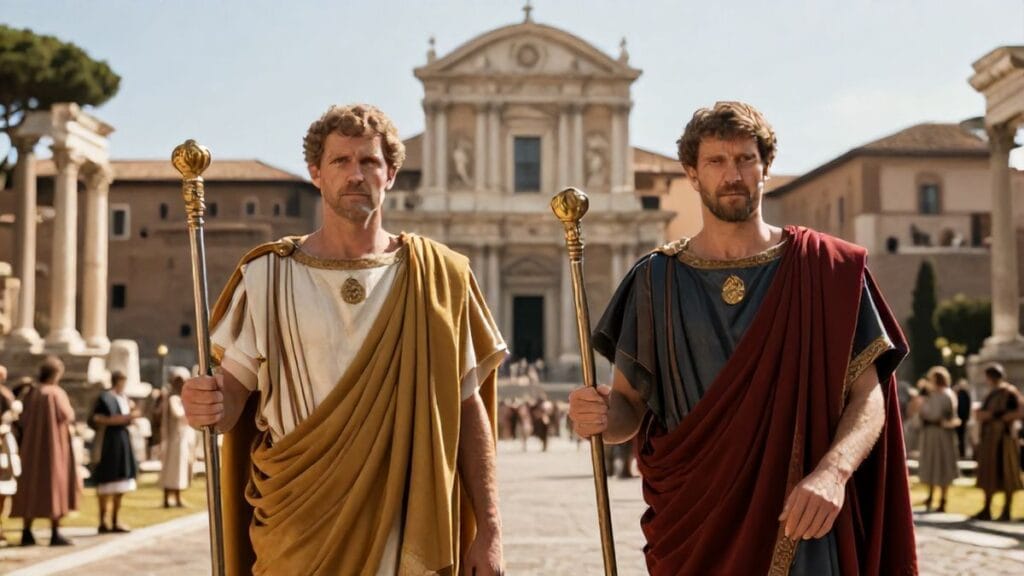
On a cold morning early in the year 136 CE, the Forum of Rome stirred awake under a pale winter light. Frost clung briefly to the paving stones before the footsteps of slaves, magistrates, and petitioners melted it into a thin sheen of water. The bronze statues that lined the sacred street—generals in rigid armor, orators forever mid-speech—looked down on a pageant they had seen countless times, yet this year the ritual carried a different, heavier meaning. Lucius Ceionius Commodus, wrapped in the purple-bordered toga of high office, made his way toward the Curia Julia beside his consular colleague, Sextus Vettulenus Civica Pompeianus. Rome had seen consuls come and go for centuries, but this pairing was an unmistakable message from the emperor Hadrian to the senate, to the armies, and to the farthest edges of the empire.
The office they were assuming was ancient, older than empire itself. The consulship had once embodied the entire Roman state, when two elected magistrates held the imperium and lent their names to the year. By 136, the power of the consul was overshadowed by that of the emperor, but the symbolism remained potent. Names inscribed in stone, on papyri, on coins—lucius ceionius commodus consul with civica pompeianus as his partner—would define contracts, laws, and memories for generations. Each legal document dated to this consular year, every inscription in a distant fort that recorded “under the consuls Lucius Ceionius Commodus and Sextus Vettulenus Civica Pompeianus,” would silently bear witness to this day’s ceremonies.
But this was only the beginning. Behind the carefully choreographed processions, behind the lictors bearing fasces and the sacrifices at the Capitoline, lay a story of illness and ambition, of imperial anxiety and aristocratic calculation. Hadrian’s choice to elevate Lucius Ceionius Commodus to the consulship—and soon, to far higher status—was not simply a reward to a promising aristocrat. It was a wager on the future of the Roman world. The year 136 would become one of those quiet turning points, when decisions taken in shadowed council chambers would ripple outward across the Mediterranean, shaping an age that later historians would remember as peaceful and golden, without always seeing the cracks beneath the surface.
The Roman World on the Edge: Empire at a Quiet Apex
By the time lucius ceionius commodus consul took office, the Roman Empire seemed to rest at an enviable summit. Hadrian, now in the later years of his reign, presided over a realm that stretched from the damp frontiers of Britannia to the irrigated fields of Egypt, from the trading harbors of Syria to the olive groves of Hispania. Wars of conquest had given way to wars of consolidation. The emperor, lover of Greek culture and architect of stone frontiers, had spent much of his reign touring the provinces, inspecting legions, ordering new cities, and—perhaps most crucially—drawing firm lines where expansion would stop.
From a distance, the system glittered. Grain flowed into Rome’s warehouses from Africa and Egypt, ensuring that the city’s enormous population was fed by the regular distribution of the grain dole. Provincial elites in Gaul and Asia, arrayed in white togas and Greek cloaks, vied for local honors while learning to weave their fortunes into the imperial order. The legions, though restless on certain frontiers, were well supplied and well paid. The coinage of the empire, stamped with Hadrian’s bearded profile, declared security and abundance to every hand that touched it.
Yet behind the celebrations of stability there loomed a single, unsettling question: what would happen when Hadrian died? The emperor had no biological sons. He had spent years crafting the image of a princeps who traveled, inspected, and personally cared for each corner of his realm, but this same personalism sharpened fears of what could follow. The empire, after all, had been shaken not long before by the erratic reign of Domitian, then by the rapid turnover of emperors in the year of the four emperors. The memory of civil war, of legions choosing emperors, still lingered. It’s astonishing, isn’t it, how quickly a system that appears unshakable can become fragile once the question of succession is raised?
In 136, the interior of the imperial palace on the Palatine was a theater of courtiers, advisors, and family members, all attuned to Hadrian’s moods and health. The emperor’s body, which had once carried him across mountains and seas, now began to fail him. Ancient sources like the biographer in the “Historia Augusta” describe cycles of illness and recovery, the careful management of appearances, and the undercurrent of urgency in his decisions. In that climate, the consulship of Lucius Ceionius Commodus and Sextus Vettulenus Civica Pompeianus was less a simple honor than a piece on a complex board, moved with deliberate calculation.
From Obscurity to the Fasces: The Rise of Lucius Ceionius Commodus
Lucius Ceionius Commodus did not emerge from nowhere, but from that dense web of family connections that defined Rome’s senatorial aristocracy. The Ceionii were an established family, of sufficient rank and reputation to move in the highest circles. Still, the sudden brilliance of lucius ceionius commodus consul in 136—and soon after, his adoption as Hadrian’s heir—surprised and, in some quarters, dismayed contemporaries. His rise was too rapid, his reputation too thinly established beyond the capital for everyone’s comfort.
Like most members of his class, Lucius would have passed through the cursus honorum, the ladder of offices that led from junior magistracies toward the consulship. He would have served as quaestor, then perhaps as praetor, overseeing aspects of law and administration. He learned, as all senators did, to read the language of gestures in the Curia—the slight inclination of a head that signaled agreement, the studied neutrality that meant opposition, the way laughter could be used as a weapon or a shield. But unlike some of his contemporaries, Lucius also possessed something more elusive: the favor of the emperor.
Modern historians debate why Hadrian singled him out. Some suggest personal affinity or a shared philosophical outlook. Others point to political balancing: by choosing a man from a prominent but not excessively powerful family, Hadrian might have hoped to avoid stoking rivalries among the most ancient houses and the military aristocracy. The ancient biographer Aurelius Victor hints that Lucius was cultivated, handsome, perhaps even overly indulgent in pleasure—a characterization echoed, with some malice, in later texts. Whether entirely accurate or not, such portraits suggest why conservative senators might have frowned when they heard that lucius ceionius commodus consul would share the year with a man of stricter, more traditional reputation, Civica Pompeianus.
His appearance on that first day of the year, however, would have conformed to all the expectations of Roman dignity. Hair carefully arranged, beard regulated in the fashion Hadrian had popularized, toga draped with studied effortlessness, Lucius stepped into a role older than nearly every stone around him. He was the living emblem of Rome’s continuity. For the crowd watching, he was one more aristocrat in white. For Hadrian, he was the possible future of the empire.
The Old Nobility Endures: Sextus Vettulenus Civica Pompeianus
If Lucius Ceionius Commodus represented a future shaped by imperial favor, Sextus Vettulenus Civica Pompeianus embodied the persistence of Rome’s older aristocratic traditions. His very name carried the weight of earlier generations. The Vettuleni had produced consuls before, and the cognomen “Civica” evoked a Roman ideal—civic virtue, duty to the state. In pairing lucius ceionius commodus consul with Civica Pompeianus, Hadrian was doing more than filling a line on an official list; he was staging a tableau of continuity and compromise.
Civica’s career likely followed a trajectory that blended military command and civilian governance. He may have governed a province, commanded a legion, or overseen crucial financial responsibilities. Men of his type were the connective tissue of the empire, bridging the capital’s politics with the practical requirements of ruling millions of subjects. Even if his name is less familiar now than that of emperors and rebels, in his own time he would have been recognized, discussed, and evaluated by his peers with the microscopic attention Romans reserved for those close to power.
We can imagine Civica walking beside Lucius on their way to the Senate House, measuring his younger colleague with a mix of curiosity and caution. Did he approve of Hadrian’s silent elevation of Lucius? Did he see in him a necessary adaptation to a changing world, or a dangerous experiment? The sources do not record his private thoughts, but the structure of Roman political life suggests that their partnership was anything but casual. To share a consulship was to share authorship of the year, to be linked forever across inscriptions and in the scribbles of our surviving papyri. Each time a distant governor dated a decree “in the consulship of Lucius Ceionius Commodus and Sextus Vettulenus Civica Pompeianus,” he reinforced that bond.
The Consular Year 136: Ceremonies, Spectacle, and Hidden Calculations
The first days of the consular year were thick with ritual. Religious observances marked the transition, binding political authority to divine favor. The consuls offered sacrifices to Jupiter Optimus Maximus on the Capitoline Hill; the smell of burning incense and animal fat mingled with the winter air as priests chanted and augurs watched the flight of birds for omens. Trumpets blared, lictors parted the crowd, and processions threaded through the Forum’s crowded space, where senators, equestrians, and ordinary citizens jostled for vantage points.
This was theater, but it was also reassurance. Rome’s people had endured wars, fires, plagues, and tyrants. They understood, in a visceral way, the importance of seeing the machinery of power move smoothly at the start of a year. To see lucius ceionius commodus consul seated on the curule chair, accompanied by Civica Pompeianus, was to be told that the senate still functioned, that law still had a face and a voice, that the emperor’s will was channeled through recognizable institutions. The empire might be vast, but here, in the stone heart of Rome, the two men whose names would mark every document of 136 sat visibly in judgment.
Yet behind the façade of unity, calculations proliferated. Senators watched who approached which consul, who lingered near Lucius and who gravitated toward Civica. A word in the right ear, a favor granted, a petition endorsed—these were the threads from which careers were woven and unmade. Hadrian’s agents, formal and informal, would have observed all of this, reporting any sign of dissent or factional formation. After the traumas of earlier dynastic conflicts, emperors were wary of any aristocratic bloc that might one day claim the right to choose a successor of their own.
The consular inauguration also triggered practical shifts. Cases awaiting judgment passed formally into their hands. Delegations from cities and provinces, already in Rome to conduct business, sought audiences. Festivals were scheduled, games were promised, and the calendar of the year took shape around their names. The spectacle of the opening days masked the continuous, less visible work that would define the consulship’s legacy.
Hadrian’s Problem of Succession: Why This Consulship Mattered
To understand why lucius ceionius commodus consul in 136 occupies such a significant place in the narrative of Hadrian’s reign, we must return to the emperor’s central problem: succession. The Principate, from Augustus onward, had no fixed law of inheritance. Emperors adopted heirs, promoted relatives, or, in darker episodes, eliminated rivals with ruthless efficiency. Stability depended less on formal rules than on the perception of legitimacy—among the senate, the armies, and the people.
Hadrian, as Cassius Dio later recounted, had already navigated dangerous waters at the start of his own reign, when he was suspected of involvement in executions of prominent senators. Over time he rebuilt a cautious cooperation with the aristocracy, but the question of who would follow him reopened those wounds. By 136, he knew his health was precarious. The Bar Kokhba revolt in Judaea, brutal and costly, had only recently been crushed, reminding him of the empire’s capacity for sudden conflagration.
In this context, the elevation of Lucius Ceionius Commodus to the consulship was a step toward something larger. The emperor was testing his candidate in the most visible magistracy available short of the purple itself. How would he handle the senate? How would the senate handle him? Could he, a man whose virtues and vices were still a matter of whispered debate, carry the weight of imperial expectation? In the months that followed, Hadrian would go further, adopting Lucius as his heir under the name Lucius Aelius Caesar. But the year 136 was already the prelude to that choice, staging lucius ceionius commodus consul as a man whose authority could be accepted by tradition-bound senators and practical-minded provincial commanders alike.
Hadrian’s calculation was risky. Adoption could reframe Lucius’s identity overnight, but it could not erase the memories or prejudices of those who regarded him as too luxurious, too untested in war, too dependent on the emperor’s favor. The very qualities that may have endeared him to Hadrian—his cultural refinement, his urbanity, his alignment with the emperor’s Hellenizing tastes—might have alienated officers on the Danube or the Rhine, who measured leadership in campaigns, not philosophy.
Patrician Masks and Private Anxieties: The Human Side of Power
From a distance, the lives of consuls look like a sequence of honors, offices, and inscriptions. Up close, they were also lives of strain, calculation, and uncertainty. Imagine Lucius Ceionius Commodus reclining at dinner in a marble-lined triclinium, surrounded by friends and hangers-on, the buzz of conversation rising above the clink of cups and the notes of a flute. News from the provinces might arrive mid-meal—the appointment of a governor, a disturbance on a frontier, the completion of a new aqueduct in some distant city bearing an imperial name. Each piece of information carried implications: whom did it favor, whom did it weaken, what pattern did it suggest?
For lucius ceionius commodus consul, every social occasion was also a stage. A misplaced joke, an ill-timed criticism of imperial policy, a too-eager embrace of a controversial ally—any of these could haunt him later. He had to be charming but not frivolous, serious but not gloomy, ambitious but not threatening. The theater of Roman elite life was relentless. Letters preserved from other periods show how senators agonized over seating arrangements at banquets, over who received an invitation and who did not. Such decisions broadcast political alignments more clearly than any public speech.
Civica Pompeianus faced his own pressures. As the more traditional figure, he was expected to embody Roman gravitas, the weighty seriousness that generations of moralists had praised. But he too had to navigate a world in which emperors, not consuls, were the true center of gravity. He could not oppose Hadrian’s will without courting disaster, yet he also bore the responsibility of representing the senate’s enduring dignity. Tension between these expectations beat quietly beneath the polished surface of his daily routines.
In the privacy of their homes—behind walls decorated with frescoes of mythological scenes and landscapes—both men would have confronted the same fear that haunted most of their class: that all of this could vanish. Confiscation of property, exile, forced suicide—these were not abstract possibilities but well-known outcomes in Rome’s recent history. The consulship conferred prestige, but it also made one highly visible. Being named in every document of the year was both a badge of honor and a silent target.
Senators, Soldiers, and Citizens: How Rome Watched Its Leaders
The consulship of 136 did not unfold in a vacuum of marble corridors and polished floors; it took place in a living, noisy city and across a vast, restless empire. The Roman people, crowded into insulae—multi-story apartment blocks that leaned precariously over narrow streets—heard of their consuls through proclamations, through the announcements posted on notice boards, and through the gossip that flowed from the Forum to the Subura. For many, lucius ceionius commodus consul was simply a name attached to new taxes, new games, or a legal decree that touched their lives in minor ways.
Among the senatorial and equestrian orders, however, perceptions were more finely tuned. Senators weighed each speech Lucius delivered in the Curia, each ruling he issued in legal cases, for signs of character and inclination. Was he lenient or severe? Did he favor one faction over another? Did Civica counterbalance him, or reinforce his tendencies? The dance between the two consuls became a kind of diagnostic test for the political health of the regime itself.
Far away along the frontiers, legionary officers received official letters dated “under the consuls Lucius Ceionius Commodus and Sextus Vettulenus Civica Pompeianus.” In a fort along the Rhine, a centurion might watch his clerk carve those names into a stone dedicatory inscription or scratch them onto papyrus. To most soldiers, the consuls were distant abstractions, but to ambitious tribunes and legates, they were power-brokers whose favor could accelerate or stall a career. A recommendation from a consul, a word transmitted through the right channels, might one day mean a provincial governorship.
Meanwhile, in great cities like Alexandria and Antioch, Greek-speaking elites folded the consuls’ Latin names into their own bureaucratic prose. Local festivals might honor the emperor, not the consuls, but administrative acts still ticked to the rhythm of Roman timekeeping. Every time a city council recorded that a new gymnasium was built or a benefactor endowed a theater “in the year of the consulship of Lucius Ceionius Commodus and Sextus Vettulenus Civica Pompeianus,” it stitched local memory to the central narrative of power in Rome.
The Machinery of Governance: What a Consul Really Did in 136
To modern eyes, the consulship of the imperial period can appear ceremonial—a vestige from a republican past kept alive for tradition’s sake. Yet lucius ceionius commodus consul did more than preside over rituals. Within the constraints imposed by the emperor’s overarching authority, the consuls wielded significant legal and administrative power, especially in Rome itself.
They presided over the senate, opening sessions, managing debates, and putting motions to the vote. In that capacity, they could influence what issues reached the floor, how they were framed, and which proposals seemed to carry the weight of official approval. They oversaw important legal cases, particularly those affecting senators and high-ranking individuals. Their judgments in such matters could send ripples through elite society, rewarding allies and warning opponents.
Each consul also had a defined sphere of judicial competence, which might touch on matters ranging from inheritance disputes to criminal prosecutions. Petitioners, lawyers, and clients swarmed their antechambers. The day of a consul could begin at dawn with consultations and run late into the evening with hearings. Decisions had to be justified in terms of legal precedent and Roman tradition, but everyone understood that political considerations were never far from the surface.
Beyond Rome, consuls sometimes received special assignments or became the notional heads of administrative initiatives. Even if, in 136, much of the day-to-day provincial governance lay in the hands of governors and procurators, the image of lucius ceionius commodus consul as a working magistrate was essential. His later adoption as heir would have seemed more plausible—indeed, more tolerable to the aristocracy—because he could be pointed to as a man who had already carried the weight of consular responsibility.
Echoes in the Provinces: From Britannia’s Rain to Egypt’s Sun
The empire in 136 was a mosaic of climates, languages, and local traditions. What did the consulship of Lucius Ceionius Commodus and Civica Pompeianus mean in practice to the people who lived far from Rome’s marble core? A papyrus contract from Egypt, for example—though surviving ones are often dated by other years—would typically record a legal transaction in the form: “In the consulship of Lucius Ceionius Commodus and Sextus Vettulenus Civica Pompeianus, in the month of…” The farmers who signed such documents, often with unsteady hands or through scribes, acknowledged the authority of men they would never see.
In Britannia, along the emerging lines of Hadrian’s Wall, soldiers huddled against the relentless rain and wind. Official orders reached them bearing the date of the consular year. The construction of stone milecastles, the rotation of patrols, the distribution of supplies—all these processes unfolded within a time marked by lucius ceionius commodus consul. The men joked perhaps that the consuls never had to endure this weather, but the chain of command that governed their lives was anchored in the same Roman institutions that Lucius and Civica symbolized.
In Asia Minor, prosperous cities like Ephesus and Smyrna thrived on commerce and local pride. Their elites competed to erect statues of emperors and benefactors, inscribing dedications that fused Greek civic traditions with Roman datekeeping. A new bath complex might be dedicated “in the year of the consulship of Lucius Ceionius Commodus and Sextus Vettulenus Civica Pompeianus,” tying a tangible improvement in urban life—a warm bath in winter, a shaded portico in summer—to the distant rhythms of Roman politics.
Even in Judaea, still scarred by the recent and devastating Bar Kokhba revolt, the official machinery of empire turned according to the Roman calendar. New governors took office, tax assessments were organized, confiscated lands were redistributed. The inscription of the consuls’ names on documents there held a particular irony: the empire’s assertion of continuity in a land where, only a short time before, continuity had been shattered in war. The consular year of 136 thus became a thread stitching together places that would never meet except in the language of imperial authority.
Patronage, Alliances, and Quiet Rivalries in the Senate House
At the center of Roman political life stood the senate, an assembly of a few hundred men whose collective prestige remained immense, even if their formal powers had been overshadowed by the emperor. It was here that lucius ceionius commodus consul and Civica Pompeianus most visibly exercised their roles as intermediaries between imperial will and aristocratic opinion. Inside the Curia Julia, beneath its coffered ceiling, speeches were made that no longer decided the fate of empires but still shaped reputations and alliances.
Patronage flowed through this space like an invisible currency. A young senator might seek the endorsement of Lucius for a provincial posting; an older one might turn to Civica to support his son’s candidacy for a junior magistracy. Behind the scenes, secretaries and freedmen maintained lists—who had been helped, who still owed a favor, who had been disappointed. The literal seating of senators in the Curia, according to seniority and office, reinforced unspoken hierarchies, while the consuls presided from the front, calling on speakers and steering debate.
Quiet rivalries simmered beneath the decorous surface. Hadrian’s known preference for certain men—a historian like Suetonius in earlier years, or military commanders who had impressed him on his travels—had created patterns of inclusion and exclusion. The promotion of lucius ceionius commodus consul risked upsetting carefully balanced expectations. If a seemingly less experienced man could be lifted so high by imperial favor, what did that imply for others who had spent decades in service, commanding legions or governing provinces?
Still, most senators adjusted. The survival instinct honed by a century of imperial rule taught them to adapt their networks to new realities. Courteous gestures toward Lucius, respectful deference to Civica, carefully pitched public support for Hadrian’s policies—all these became part of a daily choreography meant to preserve honor without courting danger. As one modern scholar has observed, the Roman senate under the High Empire was “a body powerful in decorum, not in decision,” yet within that decorum lay the subtle politics that men like Lucius and Civica had to master.
The Fragility of Imperial Plans: Illness, Rumor, and Sudden Death
The story of lucius ceionius commodus consul in 136 cannot be told without acknowledging the shadow that lay over Hadrian’s remaining years: the stubborn, unpredictable course of illness. Ancient authors, including the anonymous compiler of the “Historia Augusta,” speak of the emperor’s failing health, his bouts of depression, and his growing preoccupation with securing a successor. Within a short span after the consular year, he would formally adopt Lucius Ceionius Commodus as Lucius Aelius Caesar, presenting him to the world not just as a favored senator but as the future emperor.
For a time, the plan seemed set. Coins were minted bearing Aelius Caesar’s image, inscriptions heralded his new status, and the machinery of imperial propaganda began to reshape public perception. The consul of 136 had become the prince of tomorrow. Yet behind the celebrations, rumors swirled. Whispers in the baths, over wine, or in the shadowed corners of porticoes questioned his health, his temperament, his readiness. Some said he was sickly, others that he was overly indulgent. The tension between official optimism and private skepticism thickened the atmosphere of Rome’s political class.
Then, in a grim twist that underscored the precariousness of all human planning, Lucius Aelius Caesar died suddenly in early 138, reportedly of an illness, shortly before he was to take up a provincial command on the Danube. The dream of a smooth transition shattered. Hadrian, weakened and embittered, scrambled to find a new heir, eventually adopting Antoninus Pius, with conditions attached that ensured the further adoption of Marcus Aurelius and Lucius Verus. The line of succession bent again, this time in ways that would echo through decades of imperial history.
Thus the consular year of 136, which once seemed like the solid foundation of a future Aelian dynasty, became in retrospect a poignant prelude to disappointment. The image of lucius ceionius commodus consul presiding over the senate took on an almost ghostly quality, a snapshot of a future that never was. Power, in Rome, was not only a matter of will and strategy; it was hostage to the vulnerabilities of the human body.
From Lucius Ceionius Commodus to Lucius Verus: How a Name Survived
Although Lucius Ceionius Commodus himself did not live to rule as emperor, his story did not end with his death. Through his lineage, his name and legacy bled into the subsequent generation of Roman leadership. His son, born Lucius Ceionius Commodus as well, would later be adopted by Antoninus Pius and become known to history as Lucius Verus, co-emperor with Marcus Aurelius. In this way, the man we speak of as lucius ceionius commodus consul in 136 became the pivot of a family saga that bridged two generations of imperial power.
When Antoninus Pius adopted the younger Lucius and Marcus Aurelius together, he effectively wove the Ceionii into the highest fabric of Rome’s future. The name “Verus” might have been new, but beneath it lay the memory of the earlier Lucius, the consul and failed heir. Some Romans, recalling the events of 136–138, would have seen in Lucius Verus a kind of restoration—a fulfillment of a path that had been prematurely cut short for his father. The consular dignity of the elder Lucius lent a retrospective legitimacy to the son’s elevation.
Lucius Verus’s reign alongside Marcus Aurelius, particularly during the Parthian War, would later be judged ambivalently by historians like Cassius Dio, who criticized his indulgent lifestyle. The echo of such criticisms back to the father is difficult to miss. The pattern suggests that the aristocratic judgment of the Ceionii—cultured, charming, but perhaps lacking in the austere virtues of older Roman models—persisted over time. Yet these judgments also underscore the enduring significance of that consular year: without lucius ceionius commodus consul in 136, the subsequent rise of Lucius Verus might have unfolded very differently.
In a sense, the consular fasces carried by the father in 136 cast a shadow long enough to touch the imperial purple worn by the son decades later. The choices Hadrian made in the quiet rooms of his palace reverberated into the age of Marcus Aurelius, shaping not only political outcomes but the moral narratives Romans would later construct about their rulers.
Memory, Marble, and Silence: How History Preserved 136
What remains of the consular year 136 today comes to us in fragments, etched in stone, inked on papyrus, or preserved in the often-biased pages of ancient historians. In Italy and across the provinces, inscriptions record building dedications, legal rulings, and honorary statues, each casually anchored in time by the formula that names the consuls. A milestone along an old Roman road, now half-buried beside a modern highway, might still bear the faintly legible date: “under the consuls Lucius Ceionius Commodus and Sextus Vettulenus Civica Pompeianus.” Such stones do not narrate; they simply affirm that these men once stood at the center of Rome’s official calendar.
Inside museums, small bronze inscriptions and fragments of marble testify to the same truth. Contracts discovered in the sands of Egypt, stored now in archival boxes, show scribes dutifully noting the consular year at the head of legal texts concerning loans, leases, and sales. To the farmers and merchants who signed them, lucius ceionius commodus consul was a line of ink that made a transaction valid in the eyes of the law. Yet to us, those same lines are a thread we can follow backward through time, tracing the reach of Roman administration into the most ordinary corners of life.
Literary sources are more selective. Cassius Dio mentions the adoption of Lucius Ceionius Commodus as heir, emphasizing Hadrian’s controversial choice, but he does not linger over the quotidian workings of the consular year. The “Historia Augusta,” a late and often unreliable collection of imperial biographies, offers color—perhaps more than truth—about Lucius’s character and the disapproval he faced. Modern historians, aware of these distortions, treat such sources warily, sifting them for kernels of plausibility while acknowledging their tendency toward moralizing anecdote.
Silence, too, is a source. The very paucity of detailed accounts about the everyday actions of lucius ceionius commodus consul and Civica Pompeianus suggests how normalized their work had become within the imperial system. A year without spectacular disasters or dramatic usurpations often leaves fewer traces, yet it may be precisely such years that sustain the long arcs of stability we later admire. 136 appears in our records as one of those quiet, sustaining years—its importance visible mostly in retrospect, when the threads of succession and memory are pulled taut.
Reconstructing a Year from Fragments: What the Sources Tell Us
To write the history of a year like 136 is an act of reconstruction, an attempt to reassemble a mosaic from scattered tesserae. We rely on epigraphic corpora—the vast collections of inscriptions cataloged by scholars—to map where and how often lucius ceionius commodus consul is mentioned. Each inscription, however brief, locates the consuls in space: a frontier fort, a provincial city, a small town in Italy. Together, they reveal the geographical spread of Roman bureaucratic consciousness, the way a date formula unified distant regions under a shared temporal order.
Papyri from Egypt, painstakingly edited and translated over the past two centuries, provide another layer. Rent contracts, marriage settlements, tax receipts—the everyday paperwork of empire—sometimes carry the consular year, embedding Lucius and Civica in the private lives of individuals far from Rome. From these, historians infer patterns of legal practice, economic life, and administrative continuity. As one papyrologist observed, the consular names are like “the empire’s heartbeat recorded in the margins of its documents.”
Literary narratives, though rarer for such specific years, supply context. Hadrian’s travels, his architectural projects, his policies toward Jews and Christians, his relationship with the senate—all these themes are illuminated in works by authors like Cassius Dio, the anonymous biographers of the “Historia Augusta,” and later commentators. While none of them give a day-by-day account of 136, they allow us to situate the consulship within larger patterns: the post-war consolidation after the Bar Kokhba revolt, the gradual worsening of the emperor’s health, the experimental shaping of succession plans.
Modern historical analysis knits these sources into plausible narratives. A scholar like Anthony Birley, in his study of Hadrian, evaluates the evidence for Lucius Ceionius Commodus’s character and career, weighing the hostile tone of some ancient reports against the clear signs of high favor he enjoyed. Another historian might focus on prosopography—constructing detailed biographies of Roman elites—to show how the careers of Lucius and Civica fit into wider patterns of aristocratic advancement. The result is not certainty, but a reasoned story, grounded in material traces and critical reading.
Why One Consular Year Still Matters: Power, Image, and Uncertainty
Why should we care, now, about the year when lucius ceionius commodus consul shared office with Sextus Vettulenus Civica Pompeianus? Part of the answer lies in the way this year crystallizes enduring themes in the history of power. In 136, Rome appeared strong, unified, and secure. Its borders were fortified, its cities adorned, its economy integrated across distances once unimaginable. Yet at its center, the question of “what comes next?” gnawed at the minds of rulers and ruled alike.
Hadrian’s decision to elevate Lucius, first to the consulship and soon after to the rank of heir, reflects a deeply human impulse: to shape the future in one’s own image. The choice of a cultivated, perhaps cosmopolitan aristocrat as successor signaled the emperor’s desire to be followed not by a conqueror, but by a steward of a mature empire. The resistance this choice encountered—subtle, voiced in private, recorded in often-hostile accounts—shows the countervailing preference for older Roman virtues of military austerity and traditional gravitas.
The unexpected death of Lucius and the subsequent rearrangement of the succession remind us how fragile such plans always are. Political systems, no matter how sophisticated, rest in the end on bodies that age and fail, on contingencies that no one can fully anticipate. The line from Hadrian to Antoninus Pius to Marcus Aurelius and Lucius Verus, often praised as the pinnacle of the “adoptive emperors,” is shot through with accidents and improvisations. The consulship of 136 is one such improvisation, a moment when an emperor tried to align the ancient prestige of the consulship with the modern needs of imperial succession.
On another level, the year 136 invites reflection on how we remember history. Some years become famous because of wars, revolutions, or catastrophes. Others, like this one, acquire importance more quietly, as staging grounds for decisions whose consequences only appear decades later. To follow lucius ceionius commodus consul through that year—through ceremonies, senate sessions, legal cases, dinner parties, and rumors—is to see history not as a sequence of isolated events, but as a dense weave of choices, expectations, and unforeseen outcomes.
Conclusion
In the hushed chill of that early morning in 136, as Lucius Ceionius Commodus and Sextus Vettulenus Civica Pompeianus took up the fasces and the weight of the consulship, no one could have foreseen exactly how their year would reverberate through time. Yet, looking back, we can see how this consular pairing condensed the hopes and anxieties of a mature empire. The consulship of lucius ceionius commodus consul was both an assertion of continuity—reaffirming an office older than empire itself—and a daring experiment in succession, revealing Hadrian’s intention to entrust Rome’s future to a man whose virtues seemed more suited to peace than to conquest.
The year 136 stands at a crossroads. It follows the brutal suppression of revolt, precedes the famed “good emperors” of later memory, and sits within the so-called Pax Romana that textbooks celebrate. Yet beneath the surface calm ran deep currents: senatorial rivalries, provincial dependence, military watchfulness, and the constant negotiation between tradition and adaptation. Lucius Ceionius Commodus and Civica Pompeianus moved within this world as both symbols and agents, channeling imperial will through ancient forms while adjusting age-old offices to a new political reality dominated by a single princeps.
The premature death of Lucius Aelius Caesar in 138 shattered Hadrian’s immediate design, but the legacy of his consular year endured. Through his son, Lucius Verus, and through the institutional memories preserved in inscriptions and administrative practices, lucius ceionius commodus consul remained woven into the story of Rome’s second century. His rise and fall, the emperor’s gamble and its unraveling, reveal the precariousness of even the most carefully laid plans at the summit of power.
In the end, the year 136 teaches us that history’s turning points are not always marked by battlefields or palaces in flames. Sometimes they are inscribed in the quiet regularity of official formulas, in the pairing of two names at the head of a document, in the shadows cast by men who seemed destined for greater things but whose paths veered unexpectedly. To trace the story of Lucius Ceionius Commodus and Sextus Vettulenus Civica Pompeianus is to glimpse the Roman Empire not as an immutable monument, but as a living, uncertain project, always in the process of becoming something slightly different from what its rulers intended.
FAQs
- Who was Lucius Ceionius Commodus in the year 136?
In 136 CE, Lucius Ceionius Commodus was a Roman senator who served as one of the two ordinary consuls of the year, alongside Sextus Vettulenus Civica Pompeianus. His consulship marked his emergence into the top rank of Roman political life and paved the way for his later adoption by Emperor Hadrian as heir under the name Lucius Aelius Caesar. - Why is the consulship of 136 considered historically important?
The consulship of 136 is important because it formed part of Hadrian’s broader strategy to secure the imperial succession. By elevating lucius ceionius commodus consul to such a visible office, Hadrian tested and showcased the man he intended as his successor, making this year a crucial prelude to the later adoption and the eventual reshaping of the imperial dynasty. - What role did Sextus Vettulenus Civica Pompeianus play during this year?
Sextus Vettulenus Civica Pompeianus, Lucius’s colleague, represented the continuity of Rome’s older aristocratic traditions. As co-consul, he shared responsibility for presiding over the senate, handling high-level legal cases, and lending his established reputation to a year in which imperial policy and senatorial expectations had to be carefully balanced. - How did the people of the Roman provinces experience the consular year 136?
Provincial inhabitants encountered the consuls mainly through documents and inscriptions that used their names to date events. Legal contracts, tax receipts, building dedications, and military orders were often headed with the formula naming lucius ceionius commodus consul and Civica Pompeianus, tying local life and administration to the rhythms of politics in Rome. - Did Lucius Ceionius Commodus ever become emperor?
No. Although Hadrian later adopted him as Lucius Aelius Caesar and promoted him as successor, Lucius died unexpectedly in early 138 before Hadrian himself. His death forced a rapid reconfiguration of the succession and led Hadrian to adopt Antoninus Pius, with the further condition that Antoninus adopt Marcus Aurelius and Lucius Verus. - How is Lucius Ceionius Commodus connected to Lucius Verus?
Lucius Verus, who would later reign as co-emperor with Marcus Aurelius, was the son of Lucius Ceionius Commodus. After his father’s death, he was adopted by Antoninus Pius and renamed Lucius Verus. Thus, the consular figure of 136 became the progenitor of a future emperor, ensuring that his line still reached the imperial throne. - What sources do historians use to study the year 136 and its consuls?
Historians draw on inscriptions, papyri, coinage, and literary sources such as Cassius Dio and the “Historia Augusta” to reconstruct the events and significance of 136. Inscriptions and documents provide precise dating formulas, while literary texts offer interpretive narratives—though these must be treated critically due to their biases and occasional inaccuracies. - Did the consulship still hold real power under Hadrian?
Yes, though diminished compared to the Republic, the consulship under Hadrian retained substantial legal and administrative authority, especially in Rome. Consuls like lucius ceionius commodus consul presided over the senate, oversaw important trials, and functioned as visible guarantors of the legal order, even as ultimate sovereignty rested with the emperor.
External Resource
Internal Link
Other Resources
- Encyclopaedia Britannica – general search for the exact subject
- Google Scholar – academic search for the exact subject
- Internet Archive – digital library search for the exact subject