Table of Contents
- A Summer Day in Gaul: The Moment an Heir Was Chosen
- Empire in Turmoil: The Fractured Roman World of the 360s
- From Imperial Nursery to Frontier Camp: The Early Life of Gratian
- Valentinian I and the Gamble of Dynasty
- Ambion and the Gallic Frontier: Why This Remote Place Mattered
- The Day Gratian Proclaimed Augustus: Ceremony, Spectacle, and Strategy
- The Army Reacts: Loyalty, Grumbling, and the Price of Acclamation
- Senators, Bishops, and Bureaucrats: How Elites Read the New Augustus
- A Child with an Empire’s Weight: Gratian’s Education and Ideology
- From Co-Emperor to Ruling Augustus: Crises that Shaped a Boy-Emperor
- Religious Storms: Gratian, Christianity, and the Old Gods
- Borders of Fire: Goths, Alamanni, and the Military Legacy of Ambion
- Court Intrigues and Quiet Knives: The Human Cost of Imperial Succession
- The Road to Disaster: From Imperial Confidence to Rebellion
- The Fall of Gratian: Betrayal, Flight, and a Young Emperor’s Death
- Memory, Propaganda, and Silence: How Historians Remembered Gratian
- From Ambion to the End of Empire: Why This Proclamation Still Matters
- Conclusion
- FAQs
- External Resource
- Internal Link
Article Summary: On a late summer day in 367 CE, far from the marble forums of Rome, gratian proclaimed augustus at a camp near Ambion in Gaul, and the Roman Empire quietly changed direction. This article reconstructs that moment in all its human and political dimensions, following the child-emperor from his early years at court through the ceremony that placed the purple on his shoulders. It traces how the decision that gratian proclaimed augustus beside his father was intended to prevent civil war yet helped shape the military and religious tensions that later tore the West apart. We explore the reactions of soldiers, senators, and bishops, and the way this fragile co-rule redefined imperial legitimacy in an age of uncertainty. From the Gallic frontiers to the palaces of Milan and Constantinople, the narrative shows how gratian proclaimed augustus became more than a family gesture; it was a statement about dynasty, Christianity, and the future of Roman power. The story continues through the crises of invasions, theological conflict, and internal rebellion that culminated in Gratian’s tragic early death. Along the way, we see how the memory that gratian proclaimed augustus at Ambion was used by later writers either to praise an earnest Christian ruler or to blame a naive youth for the empire’s decline. Ultimately, this account argues that when gratian proclaimed augustus, the late Roman world stepped decisively into a new age of hereditary Christian emperors—an age pregnant with both stability and catastrophe.
A Summer Day in Gaul: The Moment an Heir Was Chosen
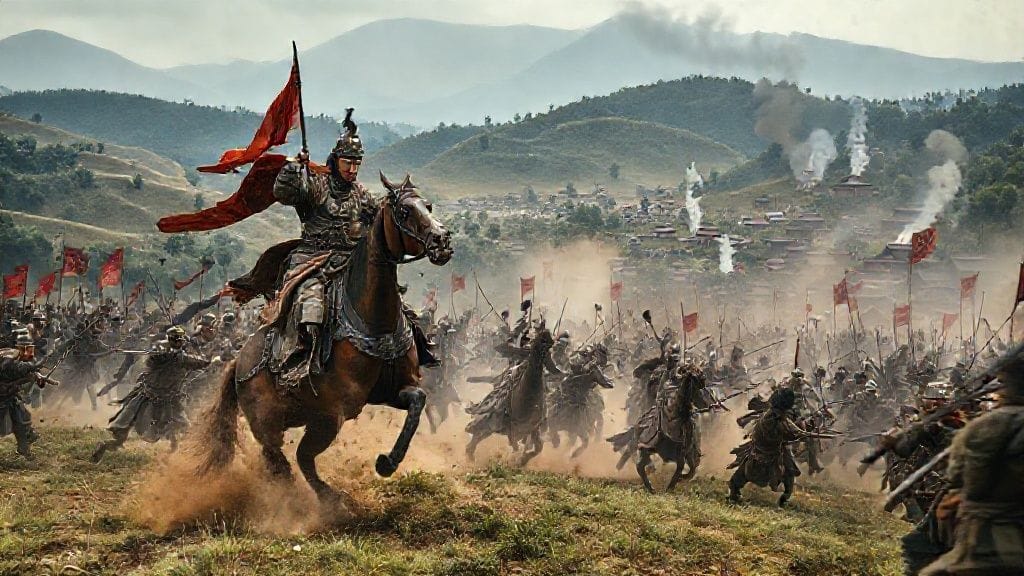
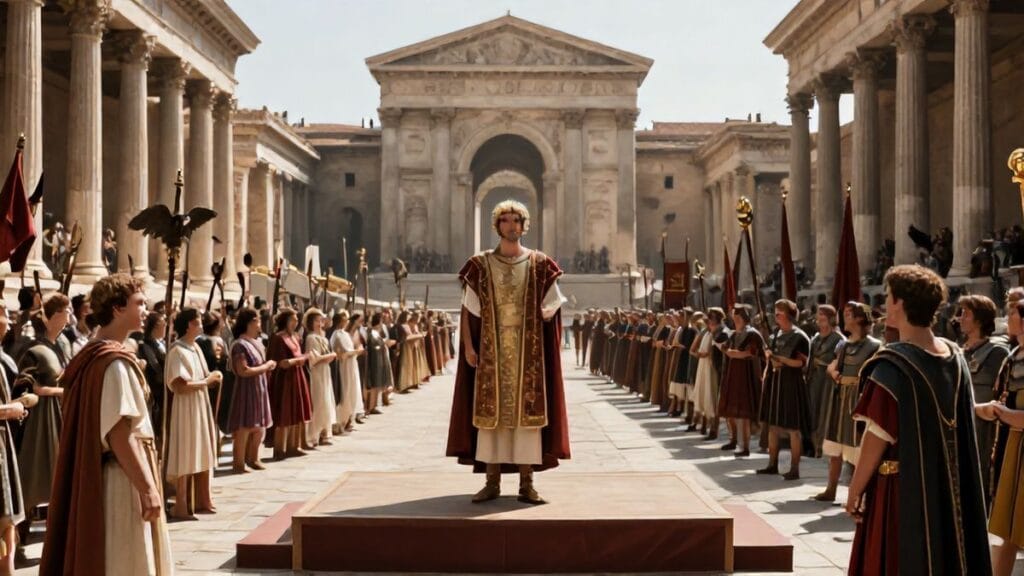
The air over Ambion in Gaul on 24 August 367 was dry and brittle, carrying the dust of the marching camps and the sharp smell of horse sweat. Sunlight flashed along spearheads and bronze fittings as the Roman field army gathered in rough formation around a hastily erected platform. They were far from Rome, far even from the imperial capitals of Milan and Trier, but here, on a frontier that had seen more barbarian raids than civic processions, something astonishing was about to happen.
At the center of the camp, surrounded by standard-bearers whose cloth banners hung limp in the summer stillness, an imperial guard detachment opened their ranks. A small figure appeared. He was perhaps seven or eight years old—sources disagree, and the chroniclers write with that unnerving vagueness that history often reserves for the young. He wore a cloak too grand for his frame, its purple edge catching the light, and, beneath it, the half-martial, half-ceremonial dress of a boy being asked to play a man’s role. This was Gratian, eldest son of the emperor Valentinian I, and within minutes he would be standing where only hardened soldiers and seasoned politicians usually stood: beneath the weight of the diadem.
Trumpets sounded, the brass notes cutting through the murmur of the assembled troops. Valentinian, a stocky, formidable presence hardened by years on the Danube and Rhine, stepped forward. The emperor’s eyes were on his men, but his hand rested on the boy’s shoulder in a gesture that blended paternal pride with political calculation. When, in this frontier camp of Ambion, gratian proclaimed augustus—through his father’s voice, through the acclamation of the soldiers, and through the ritual that cloaked him in the authority of Rome—it was not simply a family promotion. It was an answer to a question that had haunted emperors for a generation: who would rule next, and how would power pass without plunging the empire into yet another civil war?
The crowd of soldiers shifted, restless. Some had served under emperors who had risen from their own ranks; others had seen colleagues die in civil conflicts that began with similar gatherings and rival acclamations. There was excitement, curiosity, and perhaps a trace of cynicism. Yet when the imperial herald shouted the formula—the words that made gratian proclaimed augustus in law as well as in ceremony—the response swelled like a wave. “Augustus, Augustus!” they cried, spears thudding against shields in a drumbeat of approval. For a moment, the frontier camp sounded like the Forum of old.
But this was only the beginning. The dust would settle, the banners would be furled, and the army would march again. Behind that brief blaze of ritual lay a world cracking at the seams, and a child about to be bound to its fate.
Empire in Turmoil: The Fractured Roman World of the 360s
To understand why Ambion mattered, we must step back from the dust of the Gallic camp and look at the wider map of the Roman world in the 360s. The empire stretched, in theory, from the misty Hadrian’s Wall in Britain to the sun-blasted deserts of Egypt, but its unity was more illusion than reality. The decades before 367 had been a carousel of crises: usurpations, border wars, religious conflicts, and the constant strain of governing a territory too vast for any single man to hold securely.
The house of Constantine, which had provided emperors for a half-century, had collapsed into bloodshed and intrigue. Constantius II’s long reign had been consumed by struggles with his cousin Julian, civil war hovering over every campaign. Julian’s own meteoric rule—brilliant, philosophically charged, and controversial—ended abruptly in 363 on a Persian battlefield. After his death, the army had elevated Jovian in a hasty and desperate move, more to escape encirclement in Mesopotamia than from careful political calculation. Jovian, in turn, died less than a year later, likely from smoke inhalation in his tent.
It is astonishing, isn’t it, that an empire so massive could be tossed from one ruler to the next by such accidents of war and misfortune? In 364, with Jovian dead, the senior officers again assembled to choose an emperor. This time they selected Valentinian, a tough Pannonian officer with a reputation for severity and competence. He, in a move now routine in the late empire, divided authority almost immediately, raising his brother Valens as co-emperor in the East. Rome, by Valentinian’s time, had become accustomed to shared rule, to multiple Augusti and Caesars whose coordination—or lack of it—could make or break border defenses and tax systems.
But the power-sharing arrangements of emperors were as fragile as they were necessary. The Gothic federates beyond the Danube watched carefully for cracks in the imperial façade. Alamanni and Franks pressed on the Rhine, probing for weakly held stretches of frontier. In Britain, the Saxon Shore was more than a name; raiders splashed across the Channel in hit-and-run attacks. In North Africa, the desert limes could no longer be manned as it once had been, while in the East, Sasanian Persia remained a deadly rival, waiting for the moment when Roman infighting would invite a strike.
Internally, too, the empire resembled a patchwork quilt pulled too tight. Christian orthodoxy, as defined by ecumenical councils and enforced—or contested—by emperors, bishops, and mobs, was not settled. The Nicene creed, championed by figures like Athanasius of Alexandria, contended with Arian and Homoian forms of belief, especially favored by many Gothic and eastern elites. Pagan aristocrats still held senatorial power in Rome and other cities. Imperial appointments could shift the balance between these groups overnight.
In such a context, the question of succession became not merely a private concern but the linchpin of security. Every time an emperor sickened, every time a campaign went wrong, generals, bishops, and barbarian kings watched the throne. A disputed succession could mean civil war; civil war could mean stripped border garrisons; stripped garrisons could mean invasions and plunder. The chain was cruelly clear. It was to break this chain—or at least to weaken its first links—that Valentinian turned to his son and to the soldiers of Ambion.
From Imperial Nursery to Frontier Camp: The Early Life of Gratian
Gratian was born on 18 April 359, likely at Sirmium in Pannonia, a city that had become one of the empire’s crucial military and administrative hubs. He arrived into a world of barracks and courtiers, of leather tents and marble halls. His father, Valentinian, was not yet emperor, but he was already steeped in the brutal calculus of frontier command. Gratian’s early years thus unfolded in a household perpetually traveling, always tethered to the needs of the army and the movements of imperial authority.
His mother, Marina Severa, remains a shadowy presence in the sources, a reminder of how women who shaped emperors could vanish into the margins of history. Still, we can imagine the world Gratian saw as a child: imperial processions in provincial capitals, the fluttering of purple standards, bishops and generals passing in and out of audience halls, the low murmur of petitions and the sharp clash of argument over theology and taxes. For him, the idea of “normal” life would have been inseparable from the ceremonies and anxieties of court.
When Valentinian was proclaimed emperor by the army at Nicaea in 364, Gratian was about five years old. The boy would have watched, perhaps from a balcony or behind a curtain, as the same rituals he would later undergo were performed for his father—acclamations, the diadem placed on a soldier’s head, the uneasy fusion of military election and dynastic ambition. From that moment, his life trajectory shifted. He was no longer just the son of an officer; he became the potential nucleus of a new dynasty.
In the imperial household, tutors were appointed, and Gratian’s days would have been divided between lessons in Greek and Latin, reading poets and historians, and instruction in Christian doctrine. The late Roman ideal of a ruler was not merely a commander of armies but a cultivated man, someone who could quote Virgil and Scripture with equal ease. Ammianus Marcellinus, the soldier-historian who chronicled much of this period, speaks of emperors who failed in this balance, and by implication he praises those who did not.
Gratian’s education, then, was preparation for a future that was never clearly defined but always present. Was he to be a Caesar, the junior partner to his father? A reserve heir, to be deployed only if Valentinian’s brother Valens faltered in the East? Or a symbol, a human pledge to make the troops believe that the empire would not collapse into a succession free-for-all if misfortune struck? No one could know. Yet even as a child, Gratian would have felt the invisible weight of expectation settling over his shoulders.
It is in this context that the phrase “gratian proclaimed augustus” acquires its emotional depth. When that moment came, it would not fall from a clear blue sky. It would be the culmination of lessons learned in palace schools, of whispers overheard in corridors, of watching envoys bow slightly lower to him each year as his status rose. The little boy who arrived in Ambion in 367 was not as naive as his age suggests. He had already been living, in a sense, in the shadow of the purple.
Valentinian I and the Gamble of Dynasty
Valentinian I knew the taste of insecurity. He had watched emperors rise and fall not by hereditary right but by the sharp turn of fortune on the battlefield and in the barracks. Chosen by the army, beholden to its loyalty, he understood the fragile, conditional nature of imperial power. Elevating a son as co-ruler, therefore, was both a gamble and a statement.
The Roman Empire had known dynasties before—Julio-Claudians, Flavians, Severans, and, most recently, the Constantinian house—but none had been secure. Adoption, assassination, and military coups repeatedly shattered the fiction of orderly, hereditary succession. Constantine the Great had tried to reshape this pattern by dividing authority among his sons, but this had led to bloody purges and internecine war. Valentinian, as a seasoned officer, had seen the cost of those experiments.
Yet the alternative was worse. Without a clearly marked heir, every imperial illness could trigger a silent competition among generals. Each commander might begin to cultivate his own circle of loyalty, to test the waters of ambition. The armies stationed along the Rhine and Danube, already restless and overburdened, were fertile soil for usurpers promising bonuses and glory. In this sense, when gratian proclaimed augustus at Ambion, Valentinian hoped to close off the most dangerous path: he wanted no Magnentius, no Procopius, no new contender to claim that the army had to step in and choose a savior.
Choosing his son served a second purpose as well. Valentinian was building something larger than a temporary partnership with his brother Valens in the East; he was trying to carve out a dynastic space in the West. This space would give western aristocrats, bishops, and provincial elites a stable point of reference. They would know that, barring catastrophe, the same family would hold power across decades. That promise might encourage loyalty, investment, and cooperation.
But there was a risk. The army still clung to the belief that elevation to Augustus should reflect proven merit, especially military prowess. A boy of seven, whatever his tutors might say, could not lead legions. To present such a child to hardened veterans was to walk a narrow line between inspiring confidence in the future and provoking contempt in the present. Valentinian had to rely on his own charisma, his record of victories, and the subtle but powerful leverage of imperial patronage to carry the day.
He also had to navigate the delicate relationship with Valens. By raising Gratian in the West, Valentinian was, in effect, saying: “When I am gone, this line will continue here, whatever happens in Constantinople.” It might be read as a slight or as a practical necessity. The dynasty was being rooted not in the old city of Rome or in the Eastern capital, but in the military zones of Gaul and the Danube. Ambion, in this sense, was more than a backdrop. It symbolized a West that defined itself by its frontiers, its soldiers, and the constant echo of marching boots.
Ambion and the Gallic Frontier: Why This Remote Place Mattered
Ambion—its precise location still debated by modern scholars—stood somewhere amid the rolling landscapes and fortified roads of Roman Gaul. It was not a grand metropolis like Trier or Lugdunum. It was a node in the empire’s defensive lattice, a place where roads met, where supply wagons turned toward river crossings and where scouts slipped out into the forests beyond the limes.
Why here, then, of all places, when gratian proclaimed augustus? Why not in a city bathed in classical prestige, with marble forums and venerable senates? The answer lies in the nature of late Roman power. By the fourth century, the beating heart of imperial authority had moved outward, toward the frontiers. Emperors spent more time in mobile courts than in Rome itself, oscillating between campaigns and administrative tours. To be visible to the troops, to the officers, and to the communities directly exposed to barbarian pressure was vital.
In the years around 367, Gaul was restless. The “Great Conspiracy” of 367–368—a confluence of raids on Britain from Picts, Scots, Saxons, and Franks—was either underway or on the horizon. Across the Rhine, Alamannic confederations probed Roman defenses. The Danube front was hardly quiet. Valentinian had chosen to be in Gaul because that was where the storm clouds gathered, and he needed the army to see him in the flesh, resolute and present.
Proclaiming his son Augustus at Ambion wrapped the act of succession in the aura of frontier vigilance. It said to the soldiers: “This boy is part of your world. He is not a creature of distant senates but of your own camps.” To local populations, it symbolized imperial commitment: the emperor did not merely use Gaul as a recruiting ground and tax base; he bound his family’s future to it.
Later sources hint at the itineraries of the imperial court in Gaul, of how high officials, bishops, and provincial governors moved in Valentinian’s orbit as he shuttled between strongholds. Ambion was one stop along that mobile axis. But because gratian proclaimed augustus there, its name, otherwise destined to sink into oblivion, flickers through our surviving texts, a ghostly reminder of how many such places shaped the late Roman story.
The Day Gratian Proclaimed Augustus: Ceremony, Spectacle, and Strategy
We return now to that August day in 367, to the platform in the camp, to the moment when ritual and politics fused. The sources—Ammianus Marcellinus and later chroniclers—do not give us a minute-by-minute account, but if we weave together what we know of such ceremonies, a vivid picture emerges.
The army was drawn up in formal array, units sorted by rank and type: comitatenses, the mobile field troops; auxiliaries; perhaps detachments of imperial guards and cavalry. Standards rose above their heads, each bearing the image of the emperor and symbols of the legions. Trumpets and horns punctuated the gathering, enforcing order as officers barked commands. The imperial tent, recognizable by its ornate decoration and protective cordon, formed the backdrop.
Valentinian would have stepped onto the dais first, clad in the richly embroidered cloak and jeweled diadem that marked him out unmistakably as Augustus. An imperial herald or magister officiorum might have addressed the troops, reminding them of the emperor’s campaigns and victories, his care for their pay and supplies, his justice—and perhaps hinting, with carefully chosen words, at the ever-present dangers along the borders.
Then Gratian emerged. “Behold,” the emperor or herald could have proclaimed, “my son, born under the auspices of Rome, raised among you, destined by Providence to share in our burdens.” The rhetoric would have been thick with traditional phrases—“restorer of peace,” “guardian of the Republic”—but in the midst of these grand words stood a child looking out over a sea of faces, many hardened by scars and years of campaigning.
At some signal, the imperial chamberlain or a senior court official stepped forward, carrying the symbols of the office: a small diadem, perhaps a purple cloak. Valentinian, in a deliberate gesture pregnant with symbolism, placed the diadem on his son’s head and draped him in the purple. In that act, gratian proclaimed augustus not by his own voice, which might have been too high and uncertain to carry across the ranks, but by accepting the investiture and standing silent, a living emblem of future continuity.
The soldiers were then invited—indeed, expected—to acclaim him. “Gratian Augustus! Gratian Augustus!” The shout rose, caught, amplified. Some meant it, imagining extra donatives, enhanced prestige, a more stable line of succession. Others shouted because it was safer to follow the crowd. Yet the sound itself mattered; in Roman tradition, acclamation by the army validated the theory of dynastic right with the reality of military consent.
Coins would later be minted bearing Gratian’s image and the title Augustus, spreading news of the event as far as North Africa and the Black Sea. Official letters and laws would bear his name alongside his father’s. From the perspective of the imperial bureaucracy, gratian proclaimed augustus at Ambion meant that every document, every inscription, every legal formula now had to adjust to acknowledge a new partner in rule.
Behind the ceremonial sheen, however, strategy was at work. Valentinian used the event to bind officer corps and provincial elites. Promotions might have been distributed, pay arrears promised, new commands confirmed. By linking these favors to the acclamation of Gratian, the emperor ensured that loyalty to the boy became intertwined with personal advancement. Even skeptics thus had practical reasons to embrace the new Augustus.
The Army Reacts: Loyalty, Grumbling, and the Price of Acclamation
Military enthusiasm is rarely unanimous. Even as the chant “Augustus!” rolled across the camp, individual soldiers and officers would have weighed their responses. For the senior commanders, many of whom had survived the paranoid purges and tumultuous promotions of earlier reigns, the elevation of a child may have felt at once reassuring and unsettling.
On the one hand, a boy-emperor posed no immediate threat to their own positions. He could not lead a rival faction or orchestrate a purge. Under a long-lived father, Gratian’s youth meant that the real decisions would continue to come from Valentinian and the existing inner circle of generals and ministers. The title Augustus, then, was more about optics and long-term succession than about everyday command.
On the other hand, the troops were acutely aware that such a title implied future expectations. A child raised as Augustus would one day claim the right to command armies, to judge victories and failures, and to reshuffle their careers. Some might have worried that this future ruler, trained in courtly ideals rather than the harsh realities of the frontier, would misunderstand them. The memory of emperors who had alienated the army with perceived softness or religious zeal—like Constantius II in some interpretations—still lingered.
Furthermore, acclamation was not a purely symbolic act; it had material implications. Traditionally, the elevation of a new Augustus could be accompanied by a donative, a special cash payment to the troops. Any hint that such rewards would follow, even if postponed, greased the wheels of acceptance. Gratian’s name, shouted in unison, might thus have become associated, in some minds, with silver coins clinking in leather purses.
Yet behind the cheers, grumbling would have circulated in the tents that evening. “What can a child know of Alemanni raids?” one might mutter. “We swore loyalty to Valentinian; now we are tied to his son as well.” These are the kinds of voices that do not survive in official histories but can be faintly heard between the lines of historians like Ammianus, who understood the complicated, often cynical attitudes of soldiers toward emperors.
Still, at Ambion, the reaction was good enough. No mutiny broke out; no rival candidate emerged. The fact that gratian proclaimed augustus without provoking immediate upheaval was itself a kind of success. The army had accepted, at least provisionally, the experiment in hereditary co-rule. The real tests, however, would come years later, when the boy became a man and the purple ceased to be a mere cloak borrowed from his father’s shoulders.
Senators, Bishops, and Bureaucrats: How Elites Read the New Augustus
Word that gratian proclaimed augustus in Gaul spread quickly along the empire’s well-worn communication channels. Couriers galloped from camp to city, carrying sealed messages to provincial governors, praetorian prefects, and bishops. In distant Rome, where the Senate still clung to a vestigial authority wrapped in antique dignity, the news would have been read aloud in the Curia, perhaps with measured applause and exchanges of knowing glances.
Senatorial elites, especially those steeped in the old pagan traditions, had mixed feelings about each new emperor. Many had resented the rise of the Christian Constantine, then learned to work with his successors. Valentinian himself, though Christian, had tolerated pagan practices to a degree, allowing the old aristocracy some space. Gratian’s elevation introduced a new unknown. Would this boy, molded by the latest generation of Christian teachers and imperial advisers, one day attack their altars and ancestral privileges?
Bishops, by contrast, watched with keen interest and hope. The fourth century had taught them that imperial favor could tilt doctrinal conflicts with startling speed. A sympathetic Augustus meant councils might decide in their favor, rival bishops might be exiled rather than they themselves. For western Nicene bishops—those who upheld the creed formulated at Nicaea in 325—the rise of a young prince in the West offered an opportunity. They could try to shape him, through letters, sermons, and personal audiences, into a protector of orthodoxy.
In the bureaucratic hubs of Milan, Trier, and Constantinople, scribes updated formulae: “Our Lords Valentinian and Gratian, forever Augusti…” Seals were recut with dual images; fresh portraits of the imperial pair were commissioned for display in audience halls and city squares. The everyday machinery of government absorbed the change quickly; the imperial college had shifted, but the tax demands, the recruitment orders, and the legal rescripts continued to flow.
One contemporary source, the orator and statesman Symmachus, would later write speeches and letters revealing how senators navigated such changes. He does not dwell at length on Ambion, but the pattern is clear: outward loyalty, carefully crafted praise of the new Augustus, and a constant search for signs of how the political wind might shift. In this elite world, platitudes about the “eternal stability of the Republic” masked a very real anxiety about how a boy-emperor might reshape their patronage networks.
A Child with an Empire’s Weight: Gratian’s Education and Ideology
After Ambion, Gratian’s life changed in ways both visible and subtle. On coinage, his youthful portrait, sometimes with a fringe of curls, bore the legend “Gratianus Augustus.” In ritual processions, he walked not as a prince but as a co-emperor, even if deference to his father still structured every interaction. When laws were issued in his name, they often came accompanied by Valentinian’s authority, yet legally the young Augustus had stepped onto the stage as a participant in governance.
His education intensified. Tutors would have stressed not only literary and rhetorical skills but also the ideological underpinnings of imperial rule. He was taught that the emperor was God’s chosen representative on earth, a guardian of order charged with protecting both the Roman state and the true faith. Christian imperial ideology, refined over the previous decades, presented rulership as a sacred trust, a partnership with the divine.
This training mattered because the boy who once watched his father don the diadem now had to internalize a new identity. “When gratian proclaimed augustus,” wrote one later Christian author, “he was placed in the service of Christ’s peace.” Whether this line, preserved in paraphrase by modern scholars, is exact or not, it captures the thrust of the education Gratian received. He was being groomed not just as a soldier-king but as a Christian sovereign.
Hunting might have formed a crucial part of his formation as well. Late Roman aristocrats and emperors alike valued the hunt as a rehearsal for war and a display of courage. In forests near Trier or along the Rhine, Gratian would have ridden with older officers, spear in hand, learning how to read terrain, how to command a small party, how to keep his nerve amidst sudden danger. Such experiences built the masculine and martial persona expected of an Augustus, even one still growing into his armor.
At court, he absorbed the subtler arts of emperorship: how to listen to petitions, how to speak with dignified brevity, when to show clemency and when to approve harsh measures. After Ambion, people approached him with the deference due to an emperor. Their flattery, their requests, their gossip—all of it taught him, in ways that no formal curriculum could, about power and its illusions.
In this crucible of education and expectation, the boy became the man who would later make decisions that stunned his contemporaries: removing the Altar of Victory from the Senate house, refusing to bear the title of pontifex maximus, redistributing resources away from pagan cults. These were not the arbitrary acts of an ignorant youth; they were the logical outgrowth of an Augustus shaped, from the day gratian proclaimed augustus at Ambion, as a Christian ruler with a special responsibility toward the “true religion.”
From Co-Emperor to Ruling Augustus: Crises that Shaped a Boy-Emperor
Gratian remained, for more than a decade after Ambion, in the shadow of his father. Yet events kept pushing him closer to real power. In 374, when Valentinian campaigned against the Quadi on the Danube, the young emperor may have accompanied the court, observing first-hand the strain of distant campaigns and the difficulty of maintaining discipline among frontier troops.
Valentinian’s temper, notorious even among his contemporaries, exploded during these years. Ammianus recounts how, during an audience with Quadi envoys in 375, the emperor, enraged by what he perceived as their insolence, shouted himself into a fatal apoplexy. Suddenly, at the age of about sixteen, Gratian found himself no longer the junior partner but the senior Augustus in the West.
Yet even this transition did not proceed simply. Before Valentinian died, a powerful clique of officers and courtiers near the Danube proclaimed his infant son, Valentinian II, as Augustus. The West thus found itself with two child-emperors—one a teenager, the other barely out of the cradle. Real power, inevitably, clustered around regents and generals, but Gratian, by virtue of age, residence in the established capitals, and recognition by the eastern court, was first among equals.
The years that followed tested the foundations laid at Ambion. The “gratian proclaimed augustus” moment had created an expectation that this young man was more than a placeholder; he was the legitimate continuation of Valentinian’s line. Now, as he issued laws in his own right, commanded armies, and negotiated with bishops, he had to live up to that early promise.
One of his early significant decisions involved entrusting the defense of the Danube and the Balkans to the capable general Theodosius the Elder and, after his death, to his son, the future emperor Theodosius I. This alliance between western and eastern elites, forged in response to the mounting Gothic crisis beyond the Danube, would have lasting consequences. Gratian’s willingness to share responsibility and to recognize talent beyond his immediate circle reflects both prudence and the continuing logic of multiple Augusti.
But the crises multiplied. In 376, large groups of Goths, fleeing the Huns, sought refuge inside the empire’s borders, with Valens in the East agreeing to their settlement. Mismanagement, exploitation, and mutual distrust soon turned this into a catastrophe, culminating in the Battle of Adrianople in 378, where Valens was killed and much of the eastern field army destroyed. Gratian, still in the West, had rushed eastward but arrived too late. The empire shuddered; for the first time in memory, a Roman emperor had fallen in battle against barbarians on such a scale.
At that moment, the decision once made at Ambion bore a new and unexpected fruit. Because gratian proclaimed augustus years earlier, his authority now carried the weight and longevity of an established reign. He could step in to stabilize the East by appointing Theodosius as co-emperor there, a move that might have been harder to justify had Gratian himself been newly elevated or less securely entrenched.
Religious Storms: Gratian, Christianity, and the Old Gods
If the frontiers were aflame, the cities of the empire were equally combustible with religious tension. Gratian, now ruling in his own right, increasingly saw his role through the lens of Christian commitment. This had been anticipated from the day gratian proclaimed augustus at Ambion, when his tutors and bishops around him framed his future as a holy duty. By the 380s, this framing translated into concrete policies.
He withdrew state subsidies from many traditional pagan cults and, famously, refused to accept the title pontifex maximus, the old republican and imperial role as head of the Roman state religion. This refusal shocked the pagan aristocracy; for centuries, emperors had held this title without necessarily believing in its gods. For Gratian, it was incompatible with his Christian conscience.
In Rome, the removal of the Altar of Victory from the Senate house became a lightning rod for discontent. The senator Symmachus, in his famous “Third Relatio,” petitioned for its restoration, arguing that the prosperity of the Roman state had always been tied to the favor of the traditional gods. Ambrose, bishop of Milan and one of Gratian’s most formidable advisors, replied in a series of letters insisting that Christian emperors could not, and must not, support such symbols. Gratian sided with Ambrose.
These decisions fueled a narrative among pagan writers and later critics that connected the weakening of Rome’s frontiers with the abandonment of the old religion. “When the altars fell, so did the eagles,” one late antique voice might have murmured. Christian authors, by contrast, celebrated Gratian as a model of piety, a ruler willing to sacrifice popular approval for the sake of truth. The historian Sozomen, writing in the fifth century, cast Gratian’s reign as a turning point in the full Christianization of imperial policy.
The human cost of these religious shifts should not be ignored. Priests of old cults found their incomes slashed; temple staff saw their responsibilities reduce or vanish; communities that had once gathered for festivals now sensed the weight of imperial disfavor. In the streets of Rome and other cities, arguments over statues, processions, and public rituals could turn violent. Gratian’s policies did not create these conflicts, but they intensified and focused them.
Still, from Gratian’s perspective, this was part of the same logic that once put a diadem on his head at Ambion. If God had granted him the purple—and Christian bishops regularly framed his rule as divinely ordained—then he was answerable to that God for how he used it. To compromise on what he deemed idolatry would be, in this view, a betrayal not just of doctrine but of the very foundation of his right to rule.
Borders of Fire: Goths, Alamanni, and the Military Legacy of Ambion
While religious debates raged in councils and basilicas, the outer edges of the empire were being tested as never before. The Rhine frontier, where Ambion had stood as a symbol of imperial proximity, faced renewed pressure from Alamannic and Frankish groups. The Danube, destabilized by the migration and settlement of the Goths, threatened to become a permanent wound in the imperial body.
Gratian, often criticized by ancient and modern commentators for favoring light cavalry and foreign auxilia over traditional heavy infantry, attempted to adapt the army to these new realities. He recruited heavily among Gothic groups, using them as federates in imperial service. This policy—controversial in his own day—reflected both necessity and a long-standing Roman practice of integrating barbarians into the military. But it also deepened the empire’s reliance on leaders whose primary loyalties might not align neatly with Roman interests.
In 378, as Valens marched to meet the Goths near Adrianople, Gratian fought his own campaigns against Alamannic forces along the Rhine, winning a victory at Argentovaria. His presence on the frontier, the same frontier where gratian proclaimed augustus years earlier, showed continuity: the emperor still came in person when the borders burned. Yet strategic coordination with Valens faltered, and Adrianople ended in disaster before Gratian could unite their forces.
After Adrianople, Gratian’s decision to raise Theodosius in the East was both pragmatic and symbolic. It acknowledged that the empire could no longer afford the luxury of rivalry between western and eastern courts. Cooperation was the only way to hold the line. The memory of Ambion, where dynasty and military acclamation had first intermingled in Gratian’s fate, now extended across the empire. Multiple Augusti, with regional spheres but shared responsibility, became the fragile backbone of Roman resilience.
Yet even as he tried to patch the frontiers, Gratian’s changes to the composition and deployment of the army unsettled some of his subjects. Traditionalists in the officer corps resented the promotion of foreign-born commanders. The dependence on federate troops, who often fought under their own leaders and with their own interests in mind, seemed to erode the disciplined core of the legions. Such grievances would later be one of the threads woven into the narrative of his downfall.
Court Intrigues and Quiet Knives: The Human Cost of Imperial Succession
Every imperial court is a web of hopes and fears. Around Gratian, as around all emperors, clustered ministers, generals, chamberlains, eunuchs, secretaries, and their families, all of them navigating the shifting tides of favor. The day gratian proclaimed augustus at Ambion had created not only a new emperor but an entire ecosystem of expectations: those who attached themselves early to his star hoped for future rewards; those who remained loyal to older factions watched warily.
After Valentinian’s death, the question of who truly governed in Gratian’s name became acute. Was it the young emperor himself, increasingly shaped by Christian advisors like Ambrose? Was it his generals, who controlled the troops and the logistics of war? Or was it the palace bureaucracy, which managed the day-to-day operations of the state and controlled access to the emperor’s person?
We know the names of some of these figures—Merobaudes, the Frankish magister militum; Bauto, another Frankish commander; high-ranking officials of the palace and finance ministries—but the full scope of their rivalries eludes us. What is clear is that decisions at court could mean life or death for distant governors and bishops. A whisper in the emperor’s ear might lead to an appointment, an exile, or a quiet order to a prison cell.
In this atmosphere, Gratian’s increasing identification with a more austere, Christianized image of emperorship may have alienated some of his older supporters. He reportedly surrounded himself with a bodyguard of Alan horsemen, a choice that fed rumors of favoritism toward foreigners and raised questions about whether he trusted his own Roman troops. Laws granting privileges to the church and curbing traditional religious practices were celebrated in some circles but resented in others.
The human cost of these tensions shows up in scattered references: senatorial families withdrawing from public life, provincial elites hedging their bets by cultivating contacts in both western and eastern courts, bishops maneuvering for influence over the consciences of rulers. The same machinery that had once staged gratian proclaimed augustus now ran on, churning out ceremonies, titles, and favors, but beneath the formal surface, loyalties were fraying.
The Road to Disaster: From Imperial Confidence to Rebellion
By the late 370s and early 380s, Gratian stood at a crossroads. He had survived the dangerous transition from underage Augustus to sole Western ruler. He had coped, as best he could, with the shockwaves of Adrianople, forged an alliance with Theodosius in the East, and pushed forward a program of Christian imperial reform. To many observers, his position might have seemed secure.
Yet cracks were widening. Provincial grievances over taxation and recruitment simmered. In Gaul and the Rhine regions, longtime garrisons saw resources diverted to the Balkans and East to deal with the Gothic crisis. Commands shifted hands; officers felt overlooked or slighted. The narratives of favoritism toward barbarian federates, of excessive devotion to religious matters at the expense of the army, slowly coalesced into more dangerous forms of discontent.
In Britain and northern Gaul, where the memory of frontier insecurity went back generations, the sense that distant emperors did not understand local needs was especially acute. The same frontier space that had once celebrated gratian proclaimed augustus now became fertile ground for a different kind of proclamation. In 383, at Lugdunum (Lyon), troops hailed Magnus Maximus, a commander with roots in Britain, as emperor.
The pattern repeated: a camp, standards, acclamations, a man lifted onto a shield or dais, shouts of “Augustus!” But this time, the ceremony challenged an existing emperor rather than ratifying a dynastic plan. The resonance with Ambion was grimly ironic. What Valentinian had sought to prevent by elevating his son—military usurpation—now erupted nonetheless.
Gratian’s response to the uprising of Magnus Maximus was swift but ultimately fatal. He marched to confront the usurper, relying on the loyalty of his troops and the legitimacy derived from his long-established status as Augustus. As he advanced, however, defections began. Units whose officers had their own grievances or ambitions quietly shifted allegiance. The exact sequence is murky, but by the time Gratian faced his rival near Paris and then retreated toward the Rhone, his support had crumbled.
The Fall of Gratian: Betrayal, Flight, and a Young Emperor’s Death
In August 383, only sixteen years after that summer day in Ambion, the narrative arc that began when gratian proclaimed augustus reached its violent end. Near Lugdunum, Gratian’s dwindling forces faced those of Magnus Maximus. The battle, if we can call it that, was less a pitched engagement than a disintegration. Key officers deserted; troops, torn between fear and opportunism, drifted toward the camp of the usurper.
Gratian fled, heading toward the safety he hoped to find farther south. One can imagine the scene: the imperial baggage train thrown into confusion, messengers riding back and forth, rumors spreading faster than orders. The diadem that had once been placed on his head before cheering soldiers at Ambion now marked him as a target. Loyalty narrowed to a shrinking circle of attendants and guards.
He was captured at a place called Singara or Sigidunum in some sources—more reliably, near Lugdunum itself. There, in the custody of Andragathius, one of Maximus’ generals, the young emperor was murdered. He was around twenty-four years old. No great last speech is recorded; no martyrdom narrative unfolds in vivid detail. The chroniclers, perhaps numbed by the frequency of such deaths, treat it almost as routine.
Yet the pathos of the moment is hard to ignore. The boy who had grown into the purple, who had been told since childhood that he was God’s chosen ruler, died as many usurpers had: isolated, betrayed, cut down in obscurity. The imperial machine rumbled on, now stamping the name of Magnus Maximus on its coins and documents in the West, even as Theodosius in the East bided his time for a counterstroke.
Gratian’s body likely received at least a modestly honorable burial, though the details are lost. His memory, however, could not be so easily interred. Bishops who had benefited from his pious policies remembered him with gratitude; pagan aristocrats, resentful of his religious measures, viewed his fate as a kind of cosmic retribution. The meaning of that day when gratian proclaimed augustus at Ambion was now up for debate.
Memory, Propaganda, and Silence: How Historians Remembered Gratian
The Gratian who appears in our sources is a composite of memories, polemics, and silences. Ammianus Marcellinus, whose narrative ends before Gratian’s fall, describes him initially as a promising youth with a gentle disposition and a taste for hunting, implying that his later failings lay in neglecting the harsher disciplines of rule. Christian historians, such as Socrates Scholasticus and Sozomen, tend to emphasize his piety and his support for orthodoxy, framing his reign as a prologue to the more decisive religious policies of Theodosius.
Pagan voices, fewer in number but striking in their candor, often critique his religious zeal and his perceived disdain for traditional elites. Symmachus, though cautious, hints at the injury done to senatorial dignity by the removal of the Altar of Victory and the redirection of temple revenues. For such writers, the line that began when gratian proclaimed augustus at Ambion led not to a golden age of peace but to an erosion of Rome’s spiritual foundations.
Later centuries would revisit these judgments. Medieval Christian chroniclers, reading Gratian through the lens of their own confessional concerns, sometimes soften his image, seeing in him a forerunner of Christian kingship. Modern historians, armed with critical methods and a wider array of sources, debate whether he was an earnest but overburdened youth manipulated by advisors, or an active agent whose policies, however sincere, destabilized key pillars of the old order.
One striking feature of Gratian’s afterlife is the relative brevity of his memory compared to towering figures like Constantine or Theodosius. The place where gratian proclaimed augustus, Ambion, is obscure; his statues have crumbled or been recut; his laws, preserved in the Theodosian Code, are studied mostly by specialists. Yet the pattern his life illustrates—a young ruler elevated in a time of crisis, tasked with reconciling competing religious and military demands, and destroyed by a rebellion arising on the very frontiers that had once hailed him—echoes forward through history.
The silences around him, too, are instructive. We have no personal letters from Gratian, no speeches in his own hand, no theological treatises or manifestos. He exists as an object in other people’s stories: the bishop’s ideal prince, the senator’s misguided youth, the soldier-historian’s cautionary tale. Between these layers, a human being once walked, looked out over the camp at Ambion, and tried to make sense of the role thrust upon him.
From Ambion to the End of Empire: Why This Proclamation Still Matters
What, then, does it mean to say that gratian proclaimed augustus at Ambion on 24 August 367? At one level, it is a specific historical fact, a line in a chronicle, a date that can be noted and then passed over. At a deeper level, it is a symptom and symbol of a world in transformation.
In choosing to elevate a child as co-emperor on a frontier in Gaul, Valentinian I affirmed that the future of the Roman Empire lay not in the old republican ideal of the “first citizen” chosen from the Senate, nor even solely in the soldier’s rough election of a capable general, but increasingly in the hereditary transmission of a sacralized office. From now on, it would be common for emperors to groom sons as successors from an early age, to share titles while still living, to wrap dynastic continuity in Christian rhetoric.
The location of Ambion, on the contested edge of Roman Gaul, highlights another truth: that the late empire’s fate was tied to its frontiers in ways that both empowered and endangered military elites. The same structures that allowed an emperor to project power quickly—mobile courts, frontier acclamations, federate allies—also provided opportunities for ambitious generals to seize the purple. Magnus Maximus’ rebellion was the dark mirror of Ambion’s staged loyalty.
Gratian’s life, stretching from the imperial nurseries of Sirmium to the battlefield politics of Gaul, from the classrooms of Christian tutors to the turbulent councils of bishops, embodies the complexities of late Roman identity. He was at once Roman and provincial, soldier and theologian’s patron, child of a harsh frontier commander and disciple of urbane clerics. His decisions on religious policy accelerated the Christianization of the state, even as his military dilemmas foreshadowed the growing autonomy of barbarian generals who would, in the fifth century, shape the very map of the West.
The proclamation at Ambion thus sits at a crossroads of themes that would define the centuries to come: dynastic monarchy, Christian kingship, frontier militarization, and the precarious balance between central authority and regional power. When we look back at that dusty camp in 367, at the small boy struggling to keep his diadem straight under the weight of thousands of eyes, we are not just watching a quaint ceremony. We are witnessing an empire rehearsing the problems it would never quite solve.
Conclusion
On a late summer day in 367, the Roman Empire gathered itself around a wooden platform in a Gallic camp and tried, one more time, to outrun its own fragility. There, at Ambion, gratian proclaimed augustus in a choreography of banners, trumpets, and shouted acclamations meant to fuse dynasty with military consent. The act looked backward, invoking the prestige of past imperial families, and forward, sketching a future in which hereditary Christian kingship would become the norm. Yet behind the gilded language lay unresolved tensions: between soldiers and civilians, Christians and pagans, center and frontier.
Gratian’s short, intense life traced the fault lines of his age. Elevated as a child, he grew into a ruler who sought to marry piety with power, strengthening the church while attempting to hold the borders against an increasingly mobile and desperate world beyond the Rhine and Danube. His decisions—on religion, on the composition of the army, on the sharing of authority with Theodosius—were not the clumsy flailings of a youth but reasoned responses to a set of impossible choices. They nevertheless alienated crucial constituencies and fed the resentments that allowed Magnus Maximus to rise on the same frontiers that had once embraced Valentinian’s dynastic project.
His death in 383 closed one chapter but did not resolve the contradictions swirling around the imperial office. The structures that raised him—frontier acclamations, Christian imperial ideology, dynastic planning—continued to shape the fates of his successors. Within a generation, the Western Empire would see child-emperors manipulated by generals, the further entrenchment of Christian orthodoxy in law, and the deepening entanglement of Roman and barbarian elites. In this sense, Ambion was both a particular place and a metaphor: a borderland where old certainties ended and new experiments in rule began.
To remember that gratian proclaimed augustus on 24 August 367 is to recall not just a date but a moment when an empire stood at the edge of change and believed, for an instant, that a child in purple might bridge the gap between its past glory and its uncertain future. The hope was genuine, the ceremony sincere, and the strategy intelligible. That it failed to deliver lasting stability does not make it less human—or less haunting. History, as ever, is written in such moments: in the fragile space between intention and outcome, between the cheers of an army and the silence that follows a fallen emperor.
FAQs
- Who was Gratian?
Gratian was a Roman emperor of the late fourth century, born in 359 CE, the eldest son of Valentinian I. Elevated as co-emperor at a very young age, he ruled the Western Empire from his father’s death in 375 until his own overthrow and assassination in 383. - What does it mean that Gratian was proclaimed Augustus at Ambion?
It means that in a military camp near Ambion in Gaul, on 24 August 367, Gratian was formally elevated to the rank of Augustus—full emperor—alongside his father Valentinian I. This involved a public ceremony before the army, the bestowal of imperial insignia, and acclamation by the troops, marking him as an official partner in imperial rule. - Why did Valentinian I elevate his young son instead of a seasoned general?
Valentinian aimed to secure the succession and prevent the kind of civil wars that had plagued the empire when emperors died without clear heirs. By making his son Augustus early, he tried to bind the army to his dynasty and create a sense of continuity, even though Gratian was far too young to command on his own. - How did Gratian’s religious policies affect the Roman Empire?
Gratian strongly favored Nicene Christianity, removed some state support from traditional pagan cults, refused the pagan title pontifex maximus, and supported bishops like Ambrose of Milan. These moves accelerated the Christianization of imperial policy but angered many pagan aristocrats and contributed to social and political tensions. - What was Gratian’s role in the aftermath of the Battle of Adrianople?
After the Eastern emperor Valens was killed at Adrianople in 378, Gratian, as the senior surviving Augustus, appointed Theodosius as co-emperor in the East to stabilize the situation. This decision helped preserve imperial authority after a devastating defeat, though it also reshaped the balance of power between East and West. - How and why did Gratian lose his throne?
In 383, dissatisfaction among troops in Britain and Gaul led to the elevation of the general Magnus Maximus as a rival emperor. As Gratian marched to confront him, key units defected. Deserted by much of his army, Gratian fled and was soon captured and killed, allowing Maximus to take control of much of the Western Empire. - How do historians today assess Gratian’s reign?
Modern historians view Gratian as a sincere, often energetic ruler constrained by age, circumstance, and the structural weaknesses of the late empire. Opinions differ on whether his religious and military policies were visionary or short-sighted, but most agree that he faced an almost impossible combination of frontier crises and internal divisions. - Why is the proclamation at Ambion still considered historically significant?
The event at Ambion illustrates key trends of the late Roman Empire: the move toward hereditary Christian monarchy, the central role of frontier armies in legitimizing emperors, and the increasingly precarious balance between dynastic planning and military power. It marks an early, emblematic moment in the transition from the classical Roman world to the Christian monarchies of late antiquity and the early Middle Ages.
External Resource
Internal Link
Other Resources
- Encyclopaedia Britannica – general search for the exact subject
- Google Scholar – academic search for the exact subject
- Internet Archive – digital library search for the exact subject