Table of Contents
- Rome in Turmoil: Setting the Stage for the Lateran Council of 769
- A City Between Empires: Rome on the Eve of 769
- Blood on the Pavements: The Tumultuous Election of an Antipope
- Kings, Bishops, and Ambitions: The Road to the Lateran Council 769
- The Gathering in the Old Palace: Opening of the Lateran Council 769
- Inside the Hall: Voices, Accusations, and the Drama of Testimony
- Judging a Pope: The Condemnation of Constantine II
- Drawing the Line: Canon Law and the Future of Papal Elections
- Icons, Images, and Faith: The Council’s Subtle Response to Iconoclasm
- The Shadow of Byzantium: A Rome Turning Toward the Franks
- Charlemagne’s Rising Star: Frankish Power in the Background of 769
- Ordinary Romans, Extraordinary Times: How the Council Shaped Daily Life
- Violence, Mercy, and Memory: Punishments After the Council
- From Decrees to Institutions: The Long Afterlife of the 769 Canons
- Echoes in the Later Middle Ages: How 769 Haunted Future Conclaves
- Remembering and Rewriting: Historians, Chronicles, and the Legacy of 769
- Conclusion
- FAQs
- External Resource
- Internal Link
Article Summary: In April 769, as Rome trembled under factional violence and shifting alliances, bishops from across the West gathered in the Lateran Palace for what would become one of the most consequential church synods of the early Middle Ages: the lateran council 769. Convened under Pope Stephen III, the assembly sought to heal the wounds of a bloody schism, to condemn the antipope Constantine II, and to redefine how future popes would be chosen. The council took place at a moment when Rome was drifting away from Byzantine authority and edging into the orbit of the rising Frankish power, in particular the future emperor Charlemagne. Its decrees, especially those on papal elections and clerical conduct, tried to fence off the papacy from lay interference and aristocratic violence. Yet behind the lofty language of the canons lay stories of mutilated rivals, fearful monks, and politicized mobs, revealing a church at once spiritual and deeply entangled in worldly struggle. Over the centuries, the memory of the lateran council 769 would resurface whenever the church agonized over contested elections and the purity of its leaders. This article traces that turbulent story, from the streets of Rome to the halls of the Lateran, and from the tense April days of 769 to the distant echoes in later medieval church history, returning again and again to the way the lateran council 769 tried, and only partially succeeded, to impose order on chaos.
Rome in Turmoil: Setting the Stage for the Lateran Council of 769
On an April morning in 769, the old Lateran Palace loomed over the city of Rome like a fortress of memory. Its walls, once the proud residence of Roman emperors, now served as the beating heart of the papal court. Inside, candles flickered, bishops murmured prayers, and scribes prepared blank parchments that would soon be filled with decrees. The lateran council 769 was about to begin. Outside, however, the city still bore the scars of a brutal civic war—shattered doors, charred beams, and memories of men dragged from churches and beaten in the streets. Rome looked as if it were waking from a nightmare, and this council was meant to ensure that the nightmare would never be repeated.
The council did not emerge from calm deliberation but from panic, fear, and a desperate need for legitimacy. In the preceding years, Rome had seen competing visions of authority: aristocratic clans jostling for influence, military officers asserting brute power, and a frightened clergy trying to preserve some semblance of sacred order. A pope had been overthrown, another proclaimed in dubious circumstances, and a layman—barely trained in theology—had been forced through the ranks of ordination to become a puppet pontiff. The council was convened to clean this wound, to declare what was lawful and what was not, and to offer the city a narrative of justice in place of raw force.
Yet even as the bishops gathered, nothing was guaranteed. The outcome of the lateran council 769 might have further divided the church rather than healed it. Rome’s connections to the distant emperor in Constantinople were frayed; the city increasingly turned its eyes north, to the Frankish kings who offered soldiers and silver. The council would thus be not only a court of law and a liturgical assembly but also a turning point in Rome’s geopolitical orbit. As the people of Rome watched processions of bishops and clergy cross their streets, some may have wondered whether the city they knew was about to be remade.
A City Between Empires: Rome on the Eve of 769
To understand why the lateran council 769 mattered, one must first step into the eerie half-light of eighth-century Rome. This was no longer the bustling capital of a world-spanning empire. The Senate had faded into memory, the imperial apparatus had migrated east generations earlier, and the Tiber carried more whispers of the past than promises of the future. But Rome still possessed something no other city could claim: the tombs of the apostles Peter and Paul, and with them, a powerful religious magnetism that drew pilgrims, donations, and political claims from across the Mediterranean.
Rome in the 760s was nominally under the sovereignty of the Byzantine emperor, a distant ruler whose face appeared on coins but whose soldiers were increasingly absent from Italian soil. In practice, the pope had become one of the central power-brokers of the region, controlling lands, collecting revenues, negotiating with Lombard kings, and corresponding with the Frankish court. The papacy stood at a crossroads: it could cling to its theoretical loyalty to Constantinople or build a new alliance with the rising Frankish dynasty under Pepin the Short and his more ambitious son, Charlemagne.
Inside the city, power was splintered further. Roman aristocratic families—descendants of senatorial houses or newly enriched landholders—jostled for proximity to the papal court. Military commanders, especially those associated with the city militia or remnants of Byzantine administration, often acted with near-impunity. The clergy itself was divided, with factions forming around different papal candidates and regional interests. In this unstable terrain, a papal election was never a purely spiritual matter; it was a struggle for control over the city and its patrimonies.
Foreign pressures compounded the chaos. To the north, the Lombard kingdom eyed Roman territories hungrily; to the east, Byzantium roiled in theological and political conflict, especially over the veneration of icons. Roman elites understood that their city’s safety depended on striking the right balance with these powers. By 769, it was increasingly evident that the balance was failing. The lateran council 769 did not arise in a vacuum—it was an attempt to impose order on a city that had become a battleground for competing visions of authority.
Blood on the Pavements: The Tumultuous Election of an Antipope
The immediate catalyst for the council was not some abstract doctrinal issue, but a very concrete political scandal: the violent rise and fall of an antipope named Constantine II. His story began in 767, when Pope Paul I died, leaving behind a city poised on the edge of an abyss. With the throne of Peter empty, factions moved swiftly. There was no settled, universally accepted procedure for papal elections; custom dictated that the clergy and people of Rome should acclaim the new pontiff, but in practice, brute force often tilted the scales.
Among the most forceful of these factions was a powerful Roman noble family led by a man named Toto of Nepi. Toto, a military strongman from a town north of Rome, marched into the city with armed followers. He and his allies stormed the political space that should have been governed by clergy and tradition. Instead of waiting for a canonical choice to emerge, they imposed one of their own: Constantine, Toto’s brother, a layman whose only qualification was his bloodline and his usefulness as a political puppet.
In a shocking sequence compressed into a few days, Constantine was rushed through the clerical ranks. He was tonsured, ordained a subdeacon, then a deacon, then a priest, culminating in his proclamation as pope—an ascent that canon law and ancient custom would have seen as an affront to the gravity of holy orders. Some bishops and clergy objected, but they were silenced, imprisoned, or threatened. Streets that should have echoed with hymns of “Vivat Papa!” rang instead with the clatter of weapons and the cries of those beaten into submission.
For nearly a year and a half, Constantine II sat on the papal throne, his rule a living symbol of how easily sacred institutions could be seized by violent men. When his enemies finally rallied, their retaliation was equally brutal. A coalition led by Christopher, the primicerius of the notaries (a high papal official), and his ally Sergius, the treasurer, worked with Lombard forces from Spoleto and perhaps with quiet encouragement from the Frankish court. In a swirl of betrayal, ambushes, and street-fighting, Toto was slain and Constantine captured. The later chronicler, the Liber Pontificalis, recounts with chilling brevity how Constantine was blinded and imprisoned, a gruesome fate typical of early medieval power struggles.
These events left a deep psychological mark on Rome. The spectacle of a layman forced onto the papal throne, the spectacle of his bloody fall, and the ongoing vendettas between the factions created an atmosphere of dread. It is against this background that Pope Stephen III, elected in the aftermath of the crisis, decided that only a solemn synod could restore confidence. The city needed not just a new pope but a story that explained why Constantine’s election was invalid and why such an outrage must never happen again. That story would be written at the lateran council 769.
Kings, Bishops, and Ambitions: The Road to the Lateran Council 769
Stephen III, who emerged as the legitimate pope after the fall of Constantine, was not a free agent. He was entangled in obligations to the factions that had helped him ascend, and he faced expectations from powerful rulers beyond Rome. When he decided to convene what would become the lateran council 769, he did so as a man trying to balance multiple, sometimes conflicting pressures.
One of his crucial allies was Desiderius, king of the Lombards, who had played a role in the overthrow of Constantine by allowing or supporting the intervention of forces from Spoleto. Yet the Lombards were also Rome’s most immediate territorial threat. Stephen knew that he could not afford to appear a mere Lombard puppet; his authority as pope required a broader base of legitimacy. For that he turned his gaze north of the Alps, toward the Frankish kingdom ruled jointly by Charlemagne and his brother Carloman.
The Frankish rulers had already been drawn into Italian affairs under their father, King Pepin, who in 754–756 campaigned in Italy and granted lands to the papacy in what would later be remembered—somewhat mythically—as the “Donation of Pepin.” By 769, Charlemagne was consolidating his influence. Although he had not yet donned the imperial crown, he was already the most formidable military power in Western Europe. Stephen III sent envoys to the Frankish court, seeking both moral support for his reforms and a signal that Rome and the Franks shared interests in curbing Lombard ambitions and stabilizing the church.
At the same time, Stephen faced voices from within the Roman clergy who feared that any strong stance against Constantine’s election might rebound against them. Some had acquiesced under pressure; others had participated enthusiastically. To declare the entire episode null and void meant, in an indirect way, admitting that a large portion of the Roman clergy had been cowed by a mob. This called for delicate rhetoric: the council would later blame “the wickedness of certain laymen” and the ignorance of the people while painting the faithful bishops as victims compelled by fear.
In late 768 and early 769, letters crisscrossed the Alps, messengers rode through dangerous passes, and invitations spread through the ecclesiastical networks of Italy and Gaul. Bishops from Tuscany, the Campanian territories, and further afield received calls to gather at the Lateran. Stephen’s aim was ambitious: not only to justify his own election and condemn his rival, but to set out clear, binding rules for future papal successions. The lateran council 769 would be, in a sense, Rome’s attempt to anchor its most sacred office in law rather than in the shifting tides of violence.
The Gathering in the Old Palace: Opening of the Lateran Council 769
On 12 April 769, the Lateran Palace—not the Vatican—became the stage for a drama that blended ritual and realpolitik. The palace was still closely tied to the memory of Constantine the Great and earlier Christian emperors, and by convening the council there, Stephen III wrapped his synod in the aura of imperial authority, even though no emperor now ruled from Rome. The basilica of Saint John Lateran, adjoining the palace, provided the sacred space; the great audience halls provided the setting for debate and judgment.
We can imagine the scene from sparse but evocative sources, pieced together by later historians like Philippe Levillain and others: bishops arriving in travel-worn garments, their retinues carrying chests of documents; scribes hunched over desks preparing to record every word; Roman clerics whispering about which faction would prevail. Above all, there was a sense of anticipation. This was not a small, local synod. It was a gathering meant to speak for the church of Rome and, by extension, for all Latin Christendom.
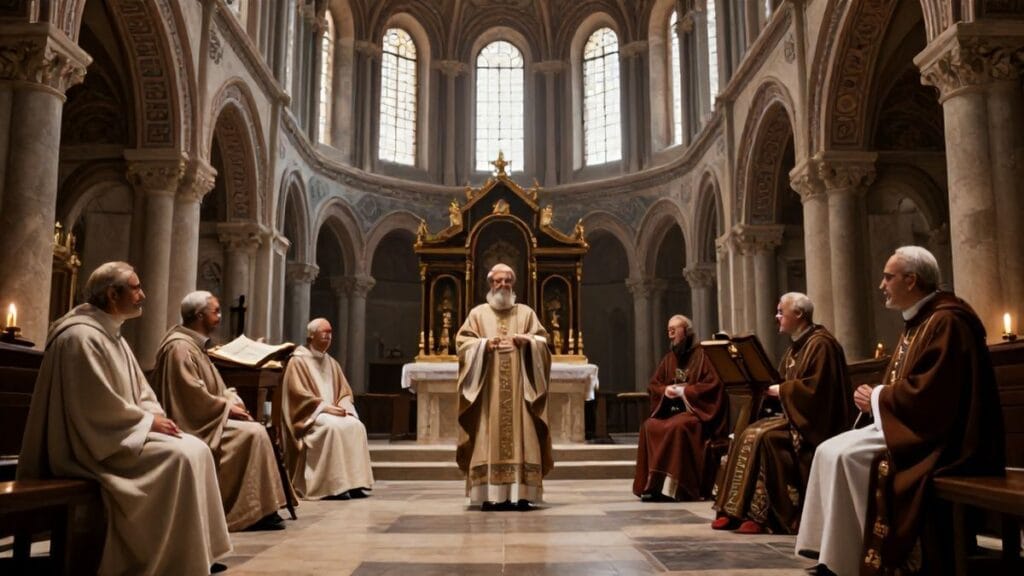
The council opened with solemn liturgy. The bishops processed into the basilica, chanting psalms, invoking the Holy Spirit to guide their deliberations. Pope Stephen III presided, flanked by senior Roman clergy. Relics may have been displayed, incense filled the air, and the flickering light of candles cast moving shadows on marble columns. Every gesture, every chant, reinforced the idea that what was about to happen was not merely political retribution but divinely guided judgment.
Yet behind the chanting lingered the memory of recent bloodshed. Among the assembly were men who had, under duress or opportunism, once recognized Constantine II as pope. There were also bishops who had opposed him and now came eager to see him humiliated. The air must have crackled with unspoken accusations. When the liturgy ended and the first formal session convened in the palace hall, the council moved from prayer to interrogation.
The lateran council 769 was not just about issuing canons; it was a trial—a trial of a man, a movement, and a method of seizing power. The initial session focused on establishing the facts: how had Constantine been elected, who had supported him, and what threats or bribes had been used? Witnesses were summoned, records read aloud, and a narrative carefully constructed. This narrative would anchor the council’s decrees and, in time, shape historical memory.
Inside the Hall: Voices, Accusations, and the Drama of Testimony
Within the stone walls of the Lateran audience chamber, voices rose and fell, echoing down the long hall as witnesses gave their accounts. The proceedings, as preserved in fragments in the Liber Pontificalis and later collections of canon law, show a council obsessed with detail: who had been present in which church, what words had been spoken, what forces had been deployed. The delegates knew that legitimacy depended not only on the outcome but on the appearance of due process.
Prominent Roman officials, such as the aforementioned Christopher, stepped forward to describe how the “tyrant” Toto of Nepi had stormed into the city. They spoke of armed men posted at the city gates, of threats hurled at hesitant clerics, and of the hasty ordinations that turned Constantine from layman to supposed pope. Others recalled how certain bishops, summoned under armed escort, were forced to participate in the illegal consecration. One can almost see them, years later, standing in the council hall, seeking to frame their own actions as coerced, not complicit.
As testimony unfolded, the council’s narrative sharpened: the villainy of secular lords intruding into sacred election, the weakness of some clergy, and the suffering of those who resisted. Reading between the lines, historians have noted that the story is hardly neutral; it is a carefully curated account intended to justify Stephen III’s rule. Yet even through this bias, a grim realism shines: Rome in the 760s was a place where force could batter down church doors, where monks could be beaten until they signed documents, where spiritual authority hung by a thread.
At one point, the council turned to the question of Constantine’s personal character. Was he an ignorant upstart, or had he, as some hinted, tried genuinely to act as a shepherd to his flock? The sources largely condemn him, but the vehemence of their language—calling him “pseudo-pope” and “robber of the apostolic see”—suggests a need to erase any trace of his legitimacy. It is astonishing, isn’t it, how fiercely institutions work to cover the ambiguity of the past with the clean lines of official verdicts?
Throughout this process, scribes recorded every statement. Their work would later feed into canon law collections and chronicles, ensuring that the version of events crafted at the lateran council 769 became the dominant one. These records allowed later ages to cite the council as an authoritative precedent whenever questions arose about the proper conduct of papal elections. In that sense, the drama inside the hall was not only for the benefit of the men present; it was staged for the future.
Judging a Pope: The Condemnation of Constantine II
Eventually, the council had to move from gathering evidence to pronouncing judgment. The figure at the center of this storm, Constantine II, was likely brought before the assembly or, at the very least, judged in absentia but with all the trappings of a public condemnation. By this time, he was blind, mutilated after the violent upheaval that toppled him. His physical state testified to the cruelty of his enemies, but in the rhetoric of the council, it may have been interpreted as divine judgment.
The bishops declared that Constantine had never been a legitimate pope. His rapid ordinations were annulled, his acts voided. Every sacrament he had conferred as pope, every appointment he had made, was thrust into uncertainty. The council faced a theological problem: if his election was invalid, what of those who had received sacraments at his hands? In practice, the church tended to protect the faithful from the consequences of clerical misdeeds—sacraments were considered valid even if administered by an unworthy minister. The focus of condemnation fell on Constantine himself and on those who had knowingly abetted his rise.
The council also condemned the laymen who had engineered his election. Names were listed, guilt apportioned, and penalties assigned. Some were exiled; others had already been killed in the street fighting that restored Stephen III. The decrees of the council thus retroactively justified their fate. What might otherwise have been seen as a brutal power struggle became, in the official record, a righteous purging of usurpers.
Yet behind this rhetoric lay a deeply human tragedy. Constantine II had once walked Rome’s streets as a lay nobleman, perhaps never imagining he would sit on the throne of Peter. Torn by factions, threatened, manipulated, he became both actor and victim in a deadly game. His blinding and imprisonment reveal a world in which politics offered little mercy. The lateran council 769, even as it anathematized him, in effect sealed his disappearance from respectable memory. Only in later centuries would scholars resurrect his story from the margins of manuscripts and from the unhappy footnotes of church history.
By dramatizing his fall, the council delivered a warning that echoed through the centuries: anyone who tried to seize the papacy through violence or without due canonical election would be branded a usurper and enemy of the church. This message, inscribed in the canons and proceedings, was meant not only for Rome’s present factions, but for any ambitious ruler who, in the future, might dream of placing a puppet on the apostolic throne.
Drawing the Line: Canon Law and the Future of Papal Elections
With the condemnation of Constantine II complete, the council turned to its most enduring task: crafting norms to prevent any repetition of such chaos. The canons issued by the lateran council 769 speak in the solemn, formulaic language of ecclesiastical law, but they pulse with the urgency of lived experience. Above all, they sought to lock secular armies and aristocratic schemers out of the sacred space of papal elections.
One of the central decrees insisted that only the Roman clergy—particularly the cardinal priests and deacons, along with representatives of the lower clergy and certain key officials—should take part in electing the pope. The role of the laity, though not completely erased, was drastically circumscribed. Gone was the ideal of a purely popular acclamation; in its place arose a more clerically controlled process. The council banned laymen from intruding with arms into the election, explicitly condemning the kind of invasion Toto of Nepi had carried out.
Another canon forbade the elevation of laymen directly to the papacy. Any future candidate had to be chosen from among the clergy, ideally those who had lived a life of service in the church. This was a direct response to Constantine’s meteoric and scandalous rise. By insisting on a stable clerical career before election, the council hoped to filter out opportunistic nobles who might see the papacy as mere political loot.
The canons reached further into the fabric of church life. They addressed simony—the buying and selling of church offices—seeking to ensure that the highest office in Christendom could not be purchased. They reinforced norms about the moral character of the clergy, attempting to tether the spiritual credibility of the church leadership to visible standards of conduct. One gets the sense that the bishops at the lateran council 769 believed law could be a dam against the flood of human ambition.
Of course, laws alone could not transform the political realities of Rome. Still, these canons acquired a special authority. They were later cited by reformers in the eleventh century, during the age of Gregory VII, as proof that the church had long sought to protect papal elections from secular contamination. In the short term, they provided Stephen III with a legal framework to claim that his own election stood firmly within canon law, in stark contrast to the “pseudo-pontiff” Constantine.
Icons, Images, and Faith: The Council’s Subtle Response to Iconoclasm
While the crisis of papal election dominated the council’s agenda, the bishops gathered in 769 also confronted another burning issue of the age: the controversy over religious images. In the Byzantine East, emperors had launched waves of iconoclasm—state-sponsored destruction of icons—claiming that veneration of images violated the commandment against idolatry. This policy had triggered fierce resistance from monks and many bishops, and it had strained relations between Rome and Constantinople.
The lateran council 769 did not stage a grand theological showdown over iconoclasm—that would come later, more famously, at the Second Council of Nicaea in 787. Yet it did quietly plant a flag. The council affirmed, in guarded but unmistakable language, the legitimacy of venerating images of Christ, the Virgin Mary, and the saints. It condemned those who dishonored or destroyed such images, aligning Rome with the iconophile camp that defended traditional devotional practices.
This stance had both spiritual and political dimensions. Spiritually, it reassured Roman clergy and laity that their long-standing customs—kissing icons, lighting lamps before images, carrying painted banners in processions—were not superstitions but acts of piety. Politically, it signaled that Rome would not simply follow the theological fashions of the Byzantine court. The pope and his council asserted a degree of doctrinal independence, subtly implying that the emperor’s authority did not extend to reshaping the church’s core devotional life.
In later centuries, chroniclers would connect the lateran council 769 with the broader resistance to iconoclasm. One modern historian has noted that “the Roman synod of 769 stands as a prologue to Nicaea II, a quieter but firm witness to the West’s refusal to bow to imperial iconoclast policy” (as discussed, for instance, in some modern analyses of early medieval synods). The council’s decrees about images, though not as elaborate as those of 787, helped set a trajectory toward eventual reconciliation between East and West over this painful controversy.
Thus, while the council is chiefly remembered for its rulings on papal elections, its engagement with the question of images reveals a Rome increasingly conscious of its role as a theological center in its own right. The lateran council 769 did not simply react to a local political crisis; it subtly positioned the papacy within a broader, empire-wide debate about the nature of Christian worship and authority.
The Shadow of Byzantium: A Rome Turning Toward the Franks
Throughout the eighth century, Rome lived in the shadow of a distant empire. Byzantium still claimed theoretical sovereignty over the city and its territories, and the pope’s official documents continued to acknowledge the emperor. But the relationship had grown strained—financial support had dwindled, military protection was erratic, and the iconoclast policies of some emperors had angered Roman sensibilities.
The lateran council 769 reflects, in subtle ways, this deteriorating relationship. By asserting strong norms against secular interference in papal elections, the council implicitly resisted not only local Roman aristocrats but also any future attempt by an emperor to impose his candidate on the see of Peter. The pope was not merely the emperor’s bishop; he was the successor of Peter, with a unique, divinely granted role. This theology of papal primacy, still in an early and evolving form, gave Rome a way to challenge imperial overreach.
At the same time, the council’s participants were acutely aware that Rome needed a powerful protector. The Lombards, despite occasional cooperation, remained a looming danger. The Franks, by contrast, appeared as potential saviors of Roman autonomy. Although Charlemagne and his brother Carloman did not attend the council, their envoys and letters carried weight. The mere presence of Frankish observers signaled that what happened at the Lateran would be noticed beyond the Alps.
Some scholars argue that the council’s firm stance on papal elections was partly a message to the Franks: Rome was capable of governing its own spiritual affairs and was worthy of alliance as an independent power, not as a vassal. Others see in the council an early hint of the ideological partnership that would culminate in Charlemagne’s imperial coronation in 800. The papacy would bless Frankish kingship; in return, Frankish arms would defend the pope’s lands.
Even if such long-term plans were not fully articulated in 769, the direction of travel is clear. The lateran council 769 was a step away from Byzantine orbit and toward a new, Western-centered political order. In this emerging world, Rome sought to anchor itself not to a single empire but to its own identity as the seat of Peter. This shift, once begun, would prove impossible to reverse.
Charlemagne’s Rising Star: Frankish Power in the Background of 769
In the spring of 769, Charlemagne was still a relatively young king, ruling alongside his brother Carloman after their father’s death in 768. He had not yet conquered the Lombard kingdom, subdued the Saxons, or been crowned emperor. Yet even then, his name carried a resonance that reached the streets of Rome. Frankish envoys, traveling the long road over the Alps, brought news of campaigns, alliances, and court intrigues that would shape the future of Europe.
Although the lateran council 769 does not present Charlemagne as a main character, he hovered at the margins of its drama. Pope Stephen III had to consider what message his council would send to the Frankish court. If Rome appeared fractured and lawless, the Franks might be tempted to intervene more directly or to dismiss papal pleas for support. If, however, Rome demonstrated that it could heal its own wounds through law and synod, it could present itself as a serious partner in shaping Christendom.
We know from surviving letters and chronicles that communication between Rome and the Frankish kingdom intensified in these years. Stephen III would soon write to Charlemagne about the dangers posed by the Lombard king Desiderius and about the need for Frankish support. In those exchanges, the pope’s moral authority mattered. Councils like that of 769, with their elaborate canons and solemn proceedings, were part of the papacy’s attempt to speak with a voice that resonated not only in churches but in royal courts.
In later decades, when Charlemagne finally descended into Italy, deposed the Lombard king, and forged a new political order, the memory of earlier Roman synods would influence how he and the popes negotiated their relationship. It is telling that when, in 800, Pope Leo III crowned Charlemagne emperor in Saint Peter’s, the ceremony was framed as a sacred collaboration between spiritual and temporal power. The seeds of that collaboration were planted in the era of Stephen III, in councils such as the lateran council 769, where Rome began to articulate a vision of the papacy as an indispensable partner in the governance of Christian society.
Thus, even if Charlemagne never set foot in the Lateran hall during the council, his silhouette stretches across its proceedings. The bishops, crafting canons and condemning usurpers, were also shaping the kind of papacy that a future emperor would encounter—a papacy that claimed autonomy in spiritual matters while eagerly seeking political alliances.
Ordinary Romans, Extraordinary Times: How the Council Shaped Daily Life
When historians write about councils and popes, it is easy to forget the ordinary women and men whose lives were touched, indirectly but powerfully, by decisions taken in echoing halls. In 769, the citizens of Rome did not read Latin canons as you or I might read a newspaper, but they felt the consequences in the rhythms of their streets, their markets, and their churches.
Consider the families who had supported Constantine II, whether out of conviction or fear. With the council’s condemnation of the antipope, they now found themselves on the losing side of history. Some may have seen relatives exiled, property confiscated, or reputations blackened. Others watched as new officials, loyal to Stephen III, took over city offices and church benefices. The balance of power in neighborhoods shifted: patrons lost influence, clients scrambled to attach themselves to new protectors.
For the clergy, the effects were even more direct. Priests and deacons who had acquiesced to Constantine’s elevation had to seek rehabilitation; those who had resisted gained prestige. The council’s strict regulations on future papal elections also reshaped the career paths of ambitious clergymen. Advancement would now depend more on one’s standing within the clerical community than on ties to lay magnates. This could foster a more coherent clerical identity, but it also risked turning the Roman clergy into an insulated elite.
In the devotional life of the people, the council’s quiet support for the veneration of images offered reassurance. Pilgrims could continue to touch and kiss icons, mothers could still light lamps before painted Madonnas, soldiers could carry images into battle, secure in the knowledge that their church had not yielded to the iconoclast fervor sweeping parts of the East. In a city densely layered with sacred art—frescoes, mosaics, reliquary shrines—this continuity mattered.
The presence of so many bishops in Rome for the council also had more immediate, even festive, implications. Inns overflowed, markets bustled, and craftsmen found extra work providing vestments, candles, and liturgical furnishings. For a brief time, the city became a crossroads of regional cultures within Latin Christendom. As visiting clerics returned home, they carried with them stories of Rome’s struggles and triumphs, spreading the council’s influence far beyond the Tiber’s banks.
Violence, Mercy, and Memory: Punishments After the Council
Even after the bishops dispersed and the ink dried on the parchments, Rome was not instantly pacified. The enforcement of the council’s decisions required further acts of power—some legal, some violent. Supporters of Constantine II who had escaped initial retribution were hunted down. Some were dragged before local tribunals, others quietly disappeared into prisons or monastic confinement.
The line between justice and vengeance was thin. Stephen III needed to show strength; any lingering perception that Constantine’s faction remained formidable could undermine the prestige of the lateran council 769. Yet there were practical limits to how much blood could be spilled without reopening civil strife. Some culprits were allowed to live out their days under surveillance; others, especially those of lesser status, bore the brunt of punishment while more powerful backers negotiated their way into partial forgiveness.
One can imagine the whispered conversations in Roman households: Was it right to blind a former pope, even a usurper? Did the church’s talk of mercy square with the mutilations ordered in its name? Such questions rarely surface in official records, but they hover at the edges of our knowledge, suggesting that not all Romans accepted the official narrative without unease.
Over time, the raw violence of the 760s was transformed into a more sanitized memory. Chronicles like the Liber Pontificalis framed the story as a clear moral drama: wicked lay magnates versus rightful clerical order, a false pope versus a legitimate one. The suffering of victims became evidence of divine chastisement; the brutal acts of victors were recast as necessary measures to protect the church. This is a pattern familiar to historians of many ages: power consoles itself by turning its own excesses into episodes of moral instruction.
Yet the wounds did not vanish. Families of the punished nursed grudges; rivalries persisted among clerical lineages. In later conflicts, echoes of 769 would resurface, as factions accused one another of repeating the sins of Toto, Constantine, or their enemies. The council, meant to draw a firm line under a period of chaos, thus became another thread woven into the complex tapestry of Roman feuds.
From Decrees to Institutions: The Long Afterlife of the 769 Canons
One of the most striking aspects of the lateran council 769 is how its legislative output outlived the immediate political crisis that birthed it. The canons issued in that old palace hall were copied, recopied, and integrated into collections of church law, influencing debates centuries later.
In the early Middle Ages, canon law did not yet exist as a single, unified code. Instead, bishops and scholars worked with patchwork collections of conciliar decrees, papal letters, and regional regulations. The decisions of important councils like that of 769 were especially prized, because they bore the authority of Rome and often addressed questions of universal significance. Over time, the canons of 769 made their way into influential compilations such as the so-called “Collectio Hadriana” sent by Pope Hadrian I to Charlemagne.
These texts framed the papal election not as a casual affair but as an act governed by sacred law. By insisting that the Roman clergy, especially cardinal priests and deacons, should control the process, the council helped lay the groundwork for the later development of the College of Cardinals as the exclusive body electing popes. Although the full institutionalization of the conclave would come centuries later, the basic impulse was already present: to shield the choice of the pope from the raw pressures of urban mobs and secular lords.
In periods of later reform, particularly in the eleventh century, churchmen looked back at earlier synods for precedents. When Pope Nicholas II, in 1059, issued the decree In Nomine Domini specifying cardinal-bishops as the primary electors of popes, reformers cited the long tradition of Roman councils condemning secular intrusion into elections. The lateran council 769 was among those precedents, its voice echoing across three centuries of turmoil and change.
Even in the high Middle Ages, when the papacy wielded far greater temporal power and the College of Cardinals had taken on a formal structure, legal scholars continued to reference 769 in their glosses on canon law. The council had become part of the legal memory of the church, a milestone in the slow construction of rules and institutions intended to protect the sanctity of the apostolic see.
Echoes in the Later Middle Ages: How 769 Haunted Future Conclaves
When later generations of cardinals filed into locked rooms to elect a new pope—amid rumors, pressures, and political maneuvers—they carried with them not only the immediate concerns of kings and cities, but also the long shadow of earlier crises. The specter of an unlawfully elected pope, of a “pseudo-pontiff” like Constantine II, haunted their conscience and their rhetoric.
In the thirteenth century, for instance, when the papal election of 1241 dragged on amid factional and imperial pressures, some contemporaries explicitly recalled earlier Roman councils that had sought to regulate elections and prevent outside interference. The very word “conclave,” derived from the practice of locking cardinals together to force a decision, reflected a deep anxiety that secular powers might once again attempt to coerce the process. The ideals articulated in the lateran council 769—that elections should be free of armed intrusions and that candidates must be drawn from the ranks of the clergy—remained touchstones, even if often honored in the breach.
During the Western Schism (1378–1417), when rival popes claimed legitimacy from Rome, Avignon, and elsewhere, canonists and theologians engaged in heated debate over what constituted a valid election. Although the immediate reference points were more recent councils and decrees, the broader historical memory of episodes like the Constantine II affair colored the discussion. No one wanted their preferred candidate to be tarred as a usurper in the mold of 768–769. The fear of producing another figure whom history would brand an antipope made cardinals and kings more desperate to claim procedural correctness.
Even when not explicitly cited, the lessons of 769 lived on as a kind of institutional instinct. The church had learned, painfully, that a papal election marred by visible violence and lay coercion could fracture loyalty and spawn long-lasting divisions. The remedies—legal norms, closed-door elections, elaborate ceremonial protocols—were attempts to build a protective shell around a fundamentally fragile act: the choosing of a single human being to stand, symbolically, at the apex of Christendom.
In this sense, the lateran council 769 can be seen as a distant ancestor of the modern conclave, a moment when the church first tried to wrest the papacy from the grip of street battles and family militias. The fact that it had to keep trying, again and again, across the centuries, only underscores how deep the currents of power run beneath the surface of spiritual institutions.
Remembering and Rewriting: Historians, Chronicles, and the Legacy of 769
The way we know the lateran council 769 today is itself the product of centuries of remembering, forgetting, and rewriting. Our principal early narrative source, the Liber Pontificalis, offers a papacy-centered account that emphasizes Stephen III’s legitimacy and Constantine II’s villainy. Later chroniclers—from medieval annalists to Renaissance humanists—relied heavily on this text, sometimes paraphrasing, sometimes embellishing, but rarely questioning its basic framework.
Modern historians, working with a more critical eye, have revisited the evidence. They ask who wrote these accounts, whose interests they served, and what voices are missing. While no one today seriously doubts that Constantine’s election violated existing norms, scholars are more attentive to the structural factors that made such a usurpation possible: the weakness of Byzantine oversight, the ambitions of local nobility, and the lack of clear canonical procedures. As one modern scholar has put it, “the synod of 769 was less the origin of papal independence than a symptom of Rome’s contested and precarious autonomy” (a sentiment echoed in several contemporary studies of early medieval papal history).
There is also renewed interest in the human dimensions of the story. Historians seek to reconstruct not only what the council decreed, but how it was experienced by different actors: the frightened cleric forced at swordpoint to sign a document, the noblewoman watching her family’s fortunes rise or fall with a pontiff’s fate, the anonymous scribe whose careful pen strokes preserved the words that we now read across centuries. These micro-histories add texture to what might otherwise seem a distant legal event.
At the same time, the lateran council 769 has entered broader discussions about the development of papal monarchy, the roots of Western legal tradition, and the complex interplay between violence and institutional formation. In classrooms and scholarly books, it appears as a case study in how crises can accelerate the creation of norms. The council shows how church leaders, confronted with a scandalous abuse of power, tried to codify their response in language that would outlast them.
In that sense, the story of 769 is not confined to medieval history. It speaks to wider questions: How do institutions respond when their legitimacy is shaken? Can laws crafted in the heat of crisis truly prevent future abuses, or do they simply channel them into new forms? The lateran council 769 offers no easy answers, but it gives us a vivid, unsettling frame through which to consider them.
Conclusion
In the flickering candlelight of the Lateran Palace in April 769, bishops and clerics tried to do something extraordinarily difficult: to transform the raw chaos of violence and usurpation into a story of justice, law, and renewal. They condemned a blind, deposed antipope, excoriated the lay lords who had installed him, and proclaimed canons that sought to protect the papal throne from future assaults. The lateran council 769 thus stands as both a product of crisis and a blueprint for institutional resilience.
Yet the council’s legacy is not simply one of triumph. Its very necessity reveals how fragile the papacy was in the eighth century, caught between fading Byzantine influence, predatory Lombard neighbors, and the rising star of the Frankish kingdom. The laws it issued—about who could elect a pope, who could become one, and how images could be venerated—were acts of self-defense by a Rome unsure of its external protectors and internal cohesion. They were also aspirational, envisioning a church where spiritual authority could somehow remain uncontaminated by brute force.
Over time, the canons of 769 outlived their immediate context, feeding into the slow construction of canon law and the eventual emergence of the conclave. Whenever the church wrestled with contested elections or the specter of antipopes, echoes of that early synod resurfaced. In the background of later reforms and schisms, the memory of Constantine II’s rapid rise and disastrous fall served as a cautionary tale about the perils of fusing sacred office with unchecked worldly ambition.
Today, when we read the records of the lateran council 769, we encounter not a neatly resolved episode but a vivid snapshot of a church in motion—improvising, arguing, and legislating its way through fear and uncertainty. The council reminds us that institutions, even those cloaked in the language of eternity, are forged and reforged in specific historical moments, by fallible human beings responding to urgent problems. Rome in 769 was such a moment, and its debates in the Lateran still speak, across the centuries, to our own struggles over authority, legitimacy, and the difficult work of turning conflict into law.
FAQs
- What was the Lateran Council of 769?
The Lateran Council of 769 was a major synod held in Rome under Pope Stephen III to address the violent and unlawful election of the antipope Constantine II. It condemned his claim to the papacy, clarified who could elect a pope, and set rules to protect future papal elections from secular interference. It also made statements supporting the veneration of religious images in the context of the wider iconoclast controversy. - Why was the lateran council 769 convened?
The council was convened in response to a crisis in Rome, where the noble Toto of Nepi had used armed force to impose his brother Constantine, a layman, as pope. After Constantine was overthrown and mutilated, Pope Stephen III needed a solemn, canonical forum to delegitimize his rival, restore order, and prevent similar abuses by issuing binding church legislation. - What did the council decide about papal elections?
The lateran council 769 decreed that papal elections should be carried out primarily by the Roman clergy, especially the cardinal priests and deacons, and it banned armed lay interference in the process. It also insisted that future popes must be chosen from among the clergy, not elevated directly from the laity, and it condemned simony and other corrupt practices that could distort the choice of a pontiff. - How did the council address the issue of religious images?
While not exclusively focused on iconoclasm, the council affirmed the legitimacy of venerating images of Christ, the Virgin, and the saints, and it condemned those who dishonored or destroyed them. In doing so, it aligned Rome with the iconophile position against the iconoclast policies of some Byzantine emperors, anticipating the more detailed rulings of the Second Council of Nicaea in 787. - What was the political significance of the Lateran Council of 769?
Politically, the council marked a step away from dependence on Byzantine authority and toward a closer relationship with the Frankish kingdom. By asserting the autonomy of papal elections and resisting secular control, the council helped define a more independent papal role, which would later fit naturally with Charlemagne’s rise and the formation of a Western-centered Christian empire. - How did the lateran council 769 influence later church law?
The canons of the council were copied into major canon law collections and cited by later reformers. They contributed to the evolving idea that papal elections should be free from lay coercion and controlled by a defined clerical body, a principle that eventually culminated in the institution of the College of Cardinals and the conclave. In later debates over contested elections, jurists often looked back to 769 as an early, authoritative precedent. - What happened to Constantine II after the council?
Before the council convened, Constantine II had already been overthrown, blinded, and imprisoned during the violent reversal of his regime. The council formally condemned him as a “pseudo-pope,” declared his acts invalid, and reinforced the legality of his deposition, effectively erasing any remaining claim he might have had to legitimacy in the eyes of the church. - Why is the lateran council 769 still studied today?
Historians and theologians study the council because it illuminates a pivotal moment in the development of the papacy, church law, and Western political structures. It offers a detailed case study of how the church responded to internal crisis, how it negotiated its relationship with secular powers, and how legal norms emerge in the wake of scandal and violence.
External Resource
Internal Link
Other Resources
- Encyclopaedia Britannica – general search for the exact subject
- Google Scholar – academic search for the exact subject
- Internet Archive – digital library search for the exact subject