Table of Contents
- A Winter of Mourning and Ascension in Cao Wei, 226 CE
- The World Before the Succession: From Han Collapse to Cao Wei
- Cao Pi’s Rise and the Fragile Foundations of a New Dynasty
- A Crown Prince in the Shadows: Cao Rui’s Youth and Character
- Illness in Luoyang: The Last Days of Emperor Cao Pi
- When Cao Rui Succeeds Cao Pi: The Night of Transition
- Regents, Ministers, and Power Behind the Throne
- Announcing an Emperor: Rituals, Edicts, and the Theater of Legitimacy
- The Shadow of Shu and Wu: External Threats to a New Reign
- Inside the Palace Walls: Family, Consorts, and Courtly Intrigue
- Taxation, Armies, and Grain: Governing an Exhausted Empire
- Faith, Omens, and Portents: Heaven’s Verdict on the New Emperor
- Voices from the Records: Chroniclers on Cao Rui and His Father
- Ordinary Lives in an Extraordinary Transition
- From Promise to Ambiguity: The Later Years of Cao Rui’s Rule
- Assessing the Succession: Strengths, Weaknesses, and Lost Possibilities
- Conclusion
- FAQs
- External Resource
- Internal Link
Article Summary: In the winter of 226 CE, the Cao Wei court in Luoyang stood at a delicate crossroads as cao rui succeeds cao pi, turning a prince into an emperor overnight. This article reconstructs the political, emotional, and social drama surrounding that transition, moving from the collapse of Han to the creation of Wei and then to the fragile second generation of the dynasty. It follows Cao Rui’s path from a largely quiet, overshadowed youth to the moment he mounted the imperial throne, and it examines how ministers, soldiers, and commoners experienced the change. As we trace how cao rui succeeds cao pi in ritual, in law, and in perception, we uncover the calculations of regents, the fears of rival states, and the hopes pinned on a new reign. Yet behind the formal ceremonies, the narrative reveals anxieties over legitimacy, succession, and the burden of founding a stable imperial order after decades of war. We explore the policies, campaigns, and palace intrigues that defined Cao Rui’s government and ask how effectively he preserved his father’s legacy. Through chronicles, anecdotes, and modern historical interpretation, the article shows that when cao rui succeeds cao pi, the event is not just a dynastic fact but a lens on a world struggling to rebuild itself. And by the end, we see how this single succession helped shape the fate of the Three Kingdoms and the memory of empire in China.
A Winter of Mourning and Ascension in Cao Wei, 226 CE
The winter air in Luoyang in 226 CE would have tasted of ash and incense. In the imperial palace, long corridors were draped in white, the color of mourning, while outside the city walls, soldiers and officials waited anxiously for news that had already begun to seep through the streets: Emperor Cao Pi was gravely ill. Within days, the founder of the Cao Wei dynasty, the man who had dared to declare the end of the Han and proclaim himself Son of Heaven, would be dead. In that tense and grieving atmosphere, another figure moved quietly into the center of history—a man in his late twenties, not yet hardened by age, but old enough to understand both ambition and fear. His name was Cao Rui, and before the winter ended, he would be emperor.
When later generations read the bare chronicle entry—“In the seventh year of Huangchu, Emperor Wen (Cao Pi) died; Crown Prince Rui ascended the throne”—it sounds almost serene. Yet behind that simple line lay decades of war, betrayals, and fragile alliances. The moment when cao rui succeeds cao pi was not merely a ceremonial relay of power; it was the test of whether a new dynasty, born in civil war, could endure the passage from its charismatic founder to his heir. Courtiers checked their loyalties, generals tallied their armies, rival states measured the opportunity in another man’s grief, and in the dim-lit palace halls, an empire held its breath.
This was the world of the Three Kingdoms, where titles were newly minted and old institutions bent under the weight of necessity. For people in Cao Wei, the year 226 did not arrive with the clean certainty that comes retroactively with a date in a textbook. It arrived as a series of rumors: the emperor’s illness, the drafting of edicts, the whispered mention of regents’ names. Messengers thundered down frozen roads with sealed documents; scribes worked by oil lamps through the night, copying the decrees that would proclaim a new emperor without undermining the authority of the old. Cao Rui’s ascension was both a private loss and a public spectacle, and the way it unfolded would shape the fate of his realm.
To understand why this succession mattered so deeply, one must step back from that winter and trace the fault lines that ran beneath it—back to the fall of the Han, the rise of warlords, and the decisive emergence of the Cao clan as the master of the north China plains. Only then does the significance of the phrase “cao rui succeeds cao pi” emerge in its full light: a second-generation emperor trying to steady a dynasty still wet with the blood of conquest.
The World Before the Succession: From Han Collapse to Cao Wei
The story of Cao Rui’s rise begins long before his birth, amid the slow unravelling of the Eastern Han dynasty. By the late second century, the imperial court was hollow: eunuchs and cliques squabbled for influence while the Yellow River changed its course and harvests failed. The Yellow Turban Rebellion in 184 CE, a massive peasant uprising infused with millenarian religious fervor, exposed the state’s inability to maintain order. Provincial governors scraped together their own armies, ostensibly to restore peace, but in truth to secure their own power bases. The empire that had once stretched with confidence from the Tarim Basin to the South China Sea now fractured into a patchwork of warlord domains.
Among the ambitious men who rose in that chaos, none would cast a longer shadow than Cao Cao, Cao Rui’s grandfather. Born into a minor aristocratic family, Cao Cao combined administrative talent with ruthlessness and a keen sense of timing. He took command of imperial troops, “protecting” the young Han emperor while steadily stripping the office of actual power. In 196 CE, he escorted the hapless Emperor Xian to his stronghold at Xu, effectively taking the entire imperial apparatus hostage in the name of loyalty. With the emperor as a legitimizing symbol, Cao Cao defeated rival warlords, secured the north, and built a power structure that would become the skeleton of Cao Wei.
Yet even as he gained control of vast territories, Cao Cao never claimed the throne. Partly this was calculation: the empire was not fully pacified, and to usurp too early was to invite a united backlash. Partly it was deference to Confucian norms, or at least a careful performance of them. As Sima Guang would later note in his monumental Zizhi Tongjian, Cao Cao understood that “the mandate of Heaven, though desired, must not be seized in haste.” Instead, he accepted titles—Duke, Prince of Wei—that skirted the line between minister and monarch. The stage was being set for someone else to step fully into imperial robes.
Cao Rui was born into this world of half-veiled monarchy, of a court where everyone knew Han was dying, but nobody dared pronounce it dead. The region of north China was already being reshaped by Cao Cao’s reforms: armies of peasant-soldiers settled on military farms, canals dug and repaired, registers compiled. Even from an early age, Cao Rui would have known that his family’s power rested not only on military strength but on its claim to restore order after decades of bloodshed. The Han empire was no longer a comforting constant; it was a fading memory. The future belonged to whoever could claim that Heaven had shifted its favor.
Cao Pi’s Rise and the Fragile Foundations of a New Dynasty
When Cao Cao died in 220 CE, the question everyone had avoided became urgent: what would his heir do with the captive Han emperor, and with the immense authority Cao Cao had accumulated? The answer came swiftly. Cao Pi, Cao Rui’s father, moved with the decisiveness that had marked his rise to the position of heir apparent. Within months, he compelled Emperor Xian to abdicate, accepted the imperial seal, and proclaimed the Wei dynasty, taking the era name Huangchu. The Han, which had stood for over four centuries, was formally over.
Cao Pi’s ascension was bold but precarious. He inherited a powerful state apparatus, but also the resentment and suspicion of many who saw him as a usurper. In Shu Han, Liu Bei claimed to uphold the legitimate Han lineage, and in Eastern Wu, Sun Quan balanced between nominal submission and practical independence. Inside Cao Wei, nobles and old-line gentry families negotiated their place in the new order, some eagerly, some with quiet reluctance. Cao Pi needed to consolidate quickly: to reward allies, neutralize rivals, and frame his takeover as the fulfillment of cosmic necessity rather than a mere act of force.
He did so partly through law and ceremony. Confucian scholars were summoned to justify the transfer of the Mandate of Heaven: the Han had failed morally and lost Heaven’s favor; Cao Wei, through its restoration of order, had been chosen to replace it. Imperial rituals were revived and reconfigured; ancestral temples built; the bureaucratic system refined. At the same time, Cao Pi could be suspicious and harsh, often executing or demoting those he feared might become threats. The early years of Wei thus combined ideological polish with underlying nervousness.
Into this tension Cao Rui grew to manhood. As the son of a new dynasty’s first emperor, he was both immensely privileged and profoundly vulnerable. Any sign of weakness, any hint that he might not be fit to rule, could invite maneuvering by brothers, uncles, or powerful ministers. Cao Pi, aware of the problems that succession had created in other ruling houses, moved early to designate Cao Rui as crown prince. Yet every step toward consolidating the succession also advertised its importance—and its potential to destabilize the regime if mishandled. The notion that someday, inevitably, cao rui succeeds cao pi was less a peaceful expectation than a looming test of the dynasty’s viability.
A Crown Prince in the Shadows: Cao Rui’s Youth and Character
Cao Rui’s early life is obscured by the biases and gaps of the sources, but enough shards remain to piece together a picture. Born around 205 CE, he came of age during his grandfather’s final campaigns and his father’s first years as emperor. Unlike many imperial heirs raised in long-established dynasties, he did not grow up surrounded by unassailable traditions; he grew up in a court still inventing its own rituals, in which yesterday’s innovation might become tomorrow’s orthodoxy.
His mother’s identity is a subject of some dispute among later historians, a reflection perhaps of the complicated politics of the inner palace. The Sanguozhi (Record of the Three Kingdoms) by Chen Shou, our primary source for the era, offers relatively restrained details about Cao Rui’s personality, noting that he showed literary talent and a measure of filial respect. Some anecdotes suggest he was sensitive and even sentimental, capable of generosity but also of sudden extravagance. As a crown prince, he studied the classics, history, and the arts of governance, attended court audiences beside his father, and learned how to read the shifting expressions of ministers and generals as carefully as he read the texts on bamboo and silk.
Yet he lived under a constant, if unspoken, pressure. The new dynasty was only a few years old; succession wars or palace coups had undone many regimes in the past. Every imperial heir knew the story of the Western Han’s fratricidal struggles, of Empress Lü’s ruthless purges, of the short-lived Wang Mang’s usurpation and fall. Cao Rui’s fate would not simply be to inherit a throne; it would be to prove that such an inheritance could be stable.
Imagine him, walking the palace gardens of Luoyang as a teenager, listening to his tutors recite passages of the Shiji and Hanshu. The stories of emperors and ministers would not have been abstract tales, but warnings. He would have heard how Emperor Wu of Han expanded the empire but overtaxed the people, how Emperor Ai’s indulgences fed court factionalism, how the later Han emperors surrendered power to eunuchs. Each story whispered a question: what kind of emperor will you be, if the day comes when cao rui succeeds cao pi?
The answer would depend not only on his character but on the political environment his father left behind. A strong, united court might support a young emperor; a divided, fearful elite might tear him apart. Thus Cao Rui’s youth cannot be separated from the broader architecture of Cao Pi’s reign, and from the careful—or sometimes careless—choices that shaped the succession.
Illness in Luoyang: The Last Days of Emperor Cao Pi
By the mid-220s, Emperor Cao Pi was still relatively young, but years of strain had taken their toll. Ruling in an age of almost constant military readiness, he juggled campaigns along the empire’s borders with internal reforms and familial tensions. Sources suggest that by 226, his health had begun to fail. The exact nature of his illness is unknown, but chronic disease and sudden fevers were common in the period, exacerbated by stress and the limitations of contemporary medicine.
In Luoyang, the signs would have been unmistakable. Audiences grew shorter, then more infrequent. Courtiers were summoned into the inner palace; physicians entered and left with increasingly troubled faces. The emperor’s diet was adjusted, prayers offered at temples, and sacrifices made in hopes of Heaven’s mercy. But the mandarins and generals knew the pattern: when a ruler’s illness became public knowledge, especially in a recently founded dynasty, it was already a political event.
Cao Pi, like many rulers before him, had to think not only of his own survival but of what would follow his death. In his final weeks, he is said to have entrusted his son to a small group of powerful men who would serve as regents: Cao Zhen, a relative with strong military backing; Chen Qun, an experienced administrator and drafter of laws; and Sima Yi, a brilliant and cautious strategist whose name would someday eclipse theirs. These choices were both practical and symbolic. By naming such figures, Cao Pi attempted to balance military power and bureaucratic experience, to create a protective ring around Cao Rui without allowing any single regent to dominate the throne.
But this balance was delicate. Ministers had their own factions, allies, and ambitions. Each would interpret the dying emperor’s instructions in a way that preserved his own influence. And outside the palace, rival states watched closely. If Cao Wei stumbled during the transition, Shu under Zhuge Liang or Wu under Sun Quan might strike. The pressure on Cao Pi as he lay ill, composing his final edicts, must have been immense. He was not merely a father deciding his heir; he was a founding emperor trying to ensure that his dynasty would not die with him.
In this suffocating atmosphere, the idea that cao rui succeeds cao pi was no longer an abstract future. It was an imminent reality, one that had to be enacted carefully through words, seals, and rituals, or the realm might plunge into another round of chaos.
When Cao Rui Succeeds Cao Pi: The Night of Transition
The moment of succession itself likely unfolded over several tightly choreographed days, but to contemporaries it would have felt like one long, sleepless night. In the inner palace, the emperor’s breath grew shallow; in the outer court, officials stood by in full ceremonial dress, awaiting news. As the final hour approached, the regents and senior ministers gathered. The edict naming Cao Rui as heir and outlining the regency arrangements would be presented, confirmed, and sealed.
When Cao Pi finally died, the palace erupted into formal mourning. His body was prepared according to elaborate rites; wails filled the air as consorts and women of the inner palace expressed their grief in ways both genuine and expected by ritual. Meanwhile, outside the women’s quarters, a different drama began. The Crown Prince had to be transformed into the Son of Heaven with both speed and solemnity. Any delay could invite panic or opportunism.
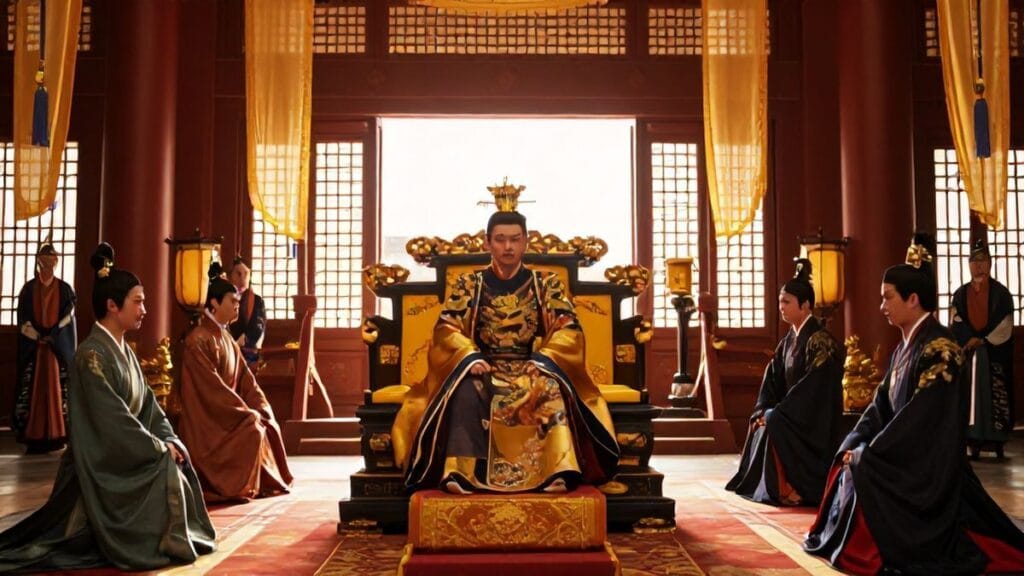
Cao Rui, now in mourning robes, was escorted to the audience hall. There, the edict proclaiming him emperor was read aloud in a voice meant to reach even the furthest corners of the chamber. Kneeling officials struck their foreheads against the floor in ritual prostration as the formulaic phrases rolled out: Heaven and Earth, the ancestors, the suffering of the people, the undeserved weight of the Mandate. Even if he had anticipated this day for years, the experience must have been overwhelming. One day, he was a prince walking carefully under his father’s gaze; the next, he was the axis around which the state officially turned.
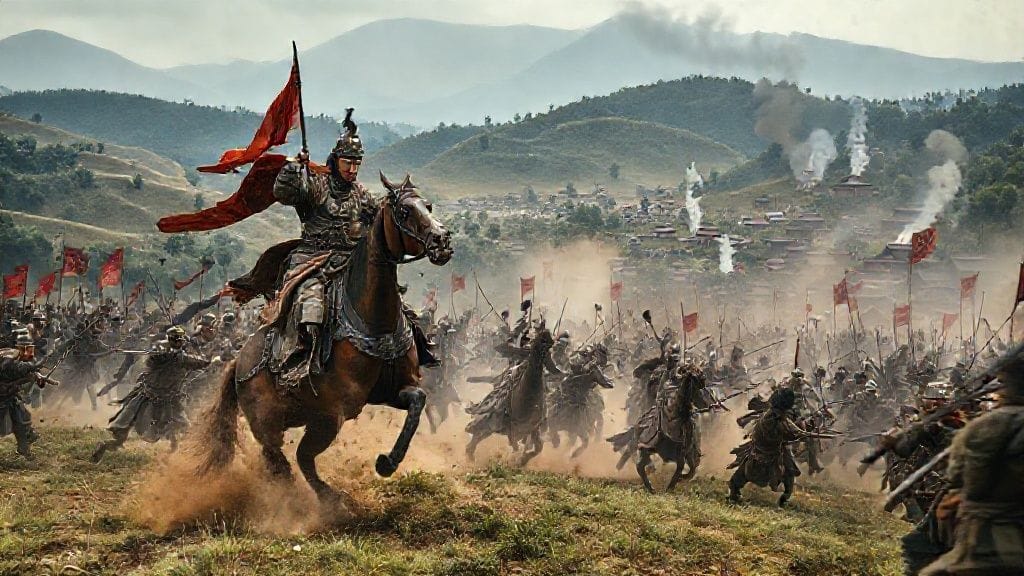
Yet behind the celebrations of continuity, fear endured. Would the armies accept the new emperor? Would distant commanderies recognize his authority? Secret couriers rode out to provincial governors and frontier generals, carrying news of Cao Pi’s death and Cao Rui’s accession, along with commands to hold their positions, maintain order, and mourn the late emperor. Along the northern frontier, where Cao Wei stared down threats from non-Han tribes and residual Han loyalists, generals like Cao Zhen had to ensure that no opportunistic revolt broke out in the confusion.
This was the pivotal instant when cao rui succeeds cao pi not only in name but in practice. If even a few key actors refused to recognize him, the empire might fracture. But the machinery of Cao Wei, built on decades of war and administration, did not falter. Officials read the signs: the regents were united; the capital remained calm; the new emperor spoke the language of filial piety and continuity. For now, at least, the transition held. The founding emperor lay in his new mausoleum, and his son wore the dragon robes.
Regents, Ministers, and Power Behind the Throne
An emperor’s power in early medieval China was never exercised in isolation. When a relatively young man like Cao Rui inherited the throne, the practical governance of the realm often hinged on the ministers who stood closest to him. The trio of regents—Cao Zhen, Chen Qun, and Sima Yi—were the pillars on which Cao Pi hoped the regime would rest. Each brought a different strength, and each represented a faction within the state.
Cao Zhen, a cousin within the Cao clan, commanded major military forces and enjoyed the loyalty of numerous officers. His presence reassured the imperial family and deterred would-be rebels, but it also posed a latent risk: powerful generals near a weak or untested emperor had, in other eras, become kingmakers or even usurpers. Chen Qun, by contrast, was a legal and administrative mind, credited with formalizing Wei’s nine-rank system of official selection. He embodied the literati elite that supplied the bureaucracy. Sima Yi, perhaps the most consequential of the three in retrospect, had proven his strategic genius in campaigns and his political acumen in court. Skilled at reading men and situations, he kept his ambitions veiled behind a mask of loyal service.
For Cao Rui, navigating these relationships was an immediate and ongoing challenge. He needed the regents’ support to stabilize his rule, yet he could not afford to be overshadowed. In early edicts, he adopted a tone of humility, stressing his inadequacy and reliance on worthy ministers. This was conventional rhetoric, but it also reflected reality: at the moment when cao rui succeeds cao pi, he inherited not just a throne but a set of guardians whose own power bases could either sustain or strangle him.
The regency system, never fully codified in law, operated through trust and precedent. Confucian ideals stressed that ministers should guide a young ruler without usurping his authority, while the ruler, in turn, should accept guidance but gradually assume full control. The line between guidance and domination, however, was thin. Court audiences became the stage on which this balance was tested: who spoke first, whose advice was adopted, how the emperor framed his decisions. Chroniclers later noted instances where Cao Rui deferred to his senior advisors, but also moments when he asserted himself, rejecting their counsel in favor of his own judgment.
At stake in these interactions was more than personal prestige. Policies regarding taxation, military deployments, and internal security all passed through this web of relationships. If Sima Yi pressed for a cautious approach to Shu and Wu while Cao Zhen advocated bold campaigns, the emperor’s choice between them could alter the strategic direction of the dynasty. In this sense, the succession was not a single event but an extended process of negotiating authority—years in which the phrase “cao rui succeeds cao pi” described not just a transfer of titles, but a slow, contested filling of imperial shoes.
Announcing an Emperor: Rituals, Edicts, and the Theater of Legitimacy
In the political culture of the Three Kingdoms period, power had to be seen and heard to be real. The succession thus unfolded not only in private councils but in public rituals and pronouncements. The proclamation of Cao Rui’s accession was the opening act in a carefully choreographed theater of legitimacy designed to persuade officials, subjects, and Heaven itself that the transition was proper.
Edicts framed the narrative. The first major proclamation in Cao Rui’s name likely followed a familiar template: a self-deprecating confession of unworthiness, expressions of grief for his father, and a promise to rule by virtue, ease burdens, and heed remonstrance. These texts circulated throughout the empire, copied by local scribes and read aloud in county offices and commandery halls. Illiterate villagers would have heard the words filtered through the voices of minor officials, but the key messages were clear: the emperor was dead; his son now ruled; order would continue.
Rituals complemented the written word. Funeral ceremonies for Cao Pi were conducted with imperial grandeur: processions, offerings, invocations to ancestral spirits. The construction of his mausoleum, with its elaborate tomb chamber and accompanying sacrificial structures, linked him to a line of legendary rulers. At the same time, investiture rites for Cao Rui—receiving the imperial seal, performing sacrifices at the ancestral temple, making the ritual ascent to the throne—visually and symbolically fused son to father, heir to founder.
Scholars like Rafe de Crespigny have emphasized how new dynasties in this era leaned heavily on ritual to assert their claim to the Mandate of Heaven. Cao Wei, in particular, sought to present itself as a rightful successor to Han, not merely a usurping warlord regime. When cao rui succeeds cao pi, therefore, the court went to pains to show continuity: the same calendar system slightly adjusted, the same Confucian rhetoric, the same emphasis on stabilizing the people’s livelihoods. Yet the very need for such displays revealed underlying anxieties. If legitimacy were unquestioned, it would not need such costly performances.
Still, the ceremonies worked, at least in the short term. No major regional power within Wei openly challenged the succession. Local officials reported their compliance and organized their own mourning rites in honor of Cao Pi. For countless ordinary people, the change of emperor may have meant little more than different characters on official seals and proclamations. But in the minds of those who understood the precariousness of power, the successful completion of these rites was a profound relief. For the moment, the state had survived the founder’s death.
The Shadow of Shu and Wu: External Threats to a New Reign
As Cao Rui settled onto the throne, his attention and that of his ministers could not remain focused solely on the internal scene. To the southwest lay Shu Han, ruled in the name of the Han dynasty by Liu Bei’s successor Liu Shan and governed in practice by the formidable strategist Zhuge Liang. To the southeast, along the Yangtze River, stretched Eastern Wu under Sun Quan, a maritime and riverine power with its own ambitions. Both regimes had watched Cao Pi’s usurpation of Han with alarm, and both would scrutinize his son’s succession for signs of weakness.
Strategically, Cao Wei held the advantage: it controlled the economically vital north China plain, with its dense populations and fertile fields. But this dominance created vulnerabilities. Long borders had to be defended, supply lines maintained, and large armies kept ready. A misstep at the moment when cao rui succeeds cao pi could invite simultaneous offensives from Shu and Wu—an existential nightmare for the new emperor’s court.
Zhuge Liang, ever alert to opportunities, had already launched northern campaigns against Wei earlier in the 220s. Though these efforts had not achieved decisive gains, they maintained pressure on Wei’s western front and tested its defenses. The news of Cao Pi’s death in 226 must have prompted intense debate in Shu’s court: should they strike while Wei reorganized, or assume that a show of stability meant that an attack would still be too costly? In the end, Shu’s major northern expeditions would come slightly later, but the mere possibility of attack shaped Wei’s early policies under Cao Rui.
In the east, Sun Quan maneuvered between accommodation and aggression. He sought recognition and titles from Wei when convenient, but also from Shu, playing one rival off against the other. For him, the generational transition in Luoyang was a puzzle and an opportunity. Would Cao Rui be more conciliatory than his father, seeking secure borders through diplomacy, or would he push forward with campaigns to crush Wu and complete unification?
Early in his reign, Cao Rui authorized some military actions to maintain pressure and demonstrate resolve, but he also showed caution. Perhaps influenced by advisors like Sima Yi, he avoided reckless offensives that might sap Wei’s strength. His strategy seemed to be one of defense with punctuated shows of force, aiming to keep rivals off-balance without overextending. The fact that cao rui succeeds cao pi without triggering immediate disasters on the frontiers was itself a kind of success. Yet the persistent existence of Shu and Wu also meant that his reign would be defined, in part, by the wars inherited from his father rather than entirely on his own terms.
Inside the Palace Walls: Family, Consorts, and Courtly Intrigue
While armies watched borders and ministers drafted edicts, another theater of power lay within the palace walls. The imperial harem, the network of consorts, concubines, and female relatives, played a vital though often veiled role in shaping succession and politics. Cao Rui, now at the center of this web, had to manage not only external governance but also the delicate balance of his own household.
Historical records depict Cao Rui as a ruler with refined tastes and a fondness for architectural projects and palace women. Over time, he was criticized for excessive building and for amassing a large harem, including the infamous incident of selecting tens of thousands of women from across the realm—a move that angered many and strained the state’s resources. These later developments cast a retroactive shadow over his entire reign, but in the early years, the palace question was more tightly linked to continuity and heirs.
The memory of Cao Pi’s own path to the throne lingered. He had faced rivalry from his brothers and had not always been gentle in suppressing it. To avoid repeating such internal strife in the next generation, Cao Rui had to designate and protect his own line of succession. Yet this was complicated by deaths, political interventions, and the fraught status of imperial consorts. Empresses could rise and fall with court factions; favored concubines could become conduits for ministerial influence. The choice of whom to elevate, whom to marry into powerful families, and whom to marginalize had direct repercussions on political alignments.
Behind the brocade screens, whispers and alliances formed. A princess’s marriage might link the imperial house to a key general; the fall of a favored consort might signal a shift in court factions. When later generations read that cao rui succeeds cao pi, they might imagine a clean, linear passage of imperial authority from father to son. But inside the palace, the reality was more tangled. The new emperor’s relationships with his relatives, including surviving uncles and half-brothers, had to be carefully managed to prevent any from becoming figureheads for discontented officials.
The emotional dimension should not be discounted. Cao Rui had lost a father and gained an empire almost at once. The women who had known him as a prince now had to adjust to him as emperor, a change that could warp personal bonds. Confidantes became subjects; affection had to be balanced against the omnipresent demands of statecraft. In such an environment, even private conversations could acquire political weight, and a moment of frustration or indulgence could cascade into broader consequences.
Taxation, Armies, and Grain: Governing an Exhausted Empire
Beneath all the pageantry and intrigue, the core question of any emperor’s reign remained brutally simple: could he feed, protect, and tax his people without breaking them? Cao Rui inherited a state that, though more stable than many of its rivals, was still deeply scarred by decades of war. Fields lay fallow in some regions; populations had been uprooted and resettled; local elites had been killed, co-opted, or displaced.
Cao Wei’s administrative system relied on the continuation and refinement of institutions developed under Cao Cao and Cao Pi: military colonies where soldier-farmers cultivated land; a graded bureaucracy appointed through the nine-rank system; a network of granaries and tax offices. As cao rui succeeds cao pi, he also succeeded to the budgetary pressures of maintaining large standing armies along multiple frontiers. These forces had to be paid, clothed, and fed, even in years of poor harvests.
Early in his reign, Cao Rui issued edicts aimed at easing some burdens, remitting certain taxes or corvée obligations in regions that had suffered particular hardship. Such measures were both humanitarian and strategic: reducing resentment, encouraging agricultural recovery, and signaling that the new emperor cared for his subjects. At the same time, he could not simply slash revenues without endangering military capability. The balance between relief and extraction became a defining challenge.
Grain logistics were a constant concern. Moving grain from the fertile central plains to frontier garrisons required coordinated transport over rivers and roads, vulnerable to banditry, floods, and mismanagement. Corruption among local officials could exacerbate shortages, as could overambitious campaigns that stretched supply lines too thin. When crop failures struck, as they periodically did, Cao Rui faced the dual threat of local unrest and weakened defenses.
His response to these structural problems reflected both continuity with his father’s rule and his own priorities. He maintained large armies but was wary of reckless offensives, suggesting an awareness of fiscal limits. Yet he also poured resources into palace construction and other projects that contemporaries and later historians deemed extravagant. The same emperor who could remit taxes in one edict might divert labor and materials to build grand halls in another. This tension within his governance would color assessments of his reign long after his death.
Faith, Omens, and Portents: Heaven’s Verdict on the New Emperor
In the cosmology of early imperial China, no political event was merely human. The succession of emperors was inseparable from Heaven’s will, read through a tapestry of omens: eclipses, comets, earthquakes, unusual births, and strange happenings in the natural world. When cao rui succeeds cao pi, therefore, the court did not view it solely as a matter of lineage and law; it looked for signs that Heaven endorsed or condemned the new regime.
Astrologers and ritual specialists monitored the skies and the earth, reporting phenomena that could be interpreted as auspicious or ominous. A timely clearing of storms on the day of an investiture, or a sudden appearance of a rare animal, might be hailed as Heaven’s blessing. Conversely, an eclipse soon after an emperor’s accession could provoke memorials urging self-criticism and policy change. Ministers might submit petitions urging the ruler to reform his conduct lest Heaven withdraw its favor.
Cao Rui, like his predecessors, had to perform the role of a morally attentive Son of Heaven. This meant responding to omens with ritual humility: ordering fasts, issuing edicts confessing to unspecified failings, remitting punishments, or pardoning offenders. Such acts were not mere show; they were understood as a necessary negotiation between throne and cosmos. If the people suffered from drought or flooding, Heaven’s anger might be blamed on imperial misrule, and the emperor’s contrition became a form of political as well as spiritual repair.
Religious practices were not limited to state cults. Buddhism had begun to seep into China during the late Han, and popular Daoist movements like those associated with the Yellow Turbans remained influential among the common people. While Confucian ritual furnished the official language of legitimacy, these other currents shaped the religious imagination of the era. Cao Rui’s court patronized certain temples and shrines, and individuals within the elite consulted monks, Daoist adepts, or seers in private.
Later historians, interpreting portents with the benefit of hindsight, sometimes read disasters during Cao Rui’s reign as foreshadowing the eventual downfall of Cao Wei to the Sima clan. Whether or not one accepts such cosmic causality, it is clear that contemporaries took omens seriously. In their eyes, the statement that cao rui succeeds cao pi was not only a legal fact but also a question: would Heaven confirm this succession with blessings, or answer it with calamities?
Voices from the Records: Chroniclers on Cao Rui and His Father
Our understanding of this succession and its significance depends heavily on the records compiled in subsequent generations. Chief among these is Chen Shou’s Sanguozhi (third century), supplemented by Pei Songzhi’s fifth-century annotations, and later synthesized by historians such as Sima Guang in the eleventh century. These works are not neutral; they weave moral judgments and political agendas into the narrative threads of fact.
Chen Shou, writing under the Western Jin—founded by the Sima family that ultimately toppled Cao Wei—had to tread carefully. He acknowledged the achievements of Cao Cao, Cao Pi, and Cao Rui, but he also subtly undermined their legitimacy by emphasizing their status as usurpers relative to the Han. Pei Songzhi, adding quotations from lost documents centuries later, painted a sharper, sometimes more critical picture of Cao Rui’s extravagances. One anecdote he preserves describes the anger of officials when Cao Rui forcibly conscripted women for his harem, a policy seen as both morally suspect and socially destabilizing.
Sima Guang, in the Zizhi Tongjian, took a didactic approach. He saw history as a teacher for rulers and used episodes from the Three Kingdoms era to illustrate virtues and vices. In recounting how cao rui succeeds cao pi, he praised the careful arrangements of Cao Pi in naming regents but criticized the later moral laxity and strategic misjudgments of his son. From Sima Guang’s perspective, the failure of Wei to unify the realm and its eventual subjugation by Jin was tied to the personal failings of its emperors as much as to structural factors.
Modern historians, such as the late Rafe de Crespigny, offer a somewhat more sympathetic and nuanced view. They situate the Wei rulers within the harsh realities of their time: governing war-torn territories, facing resource constraints, and managing ambitious elites. From this angle, the fact that when cao rui succeeds cao pi the dynasty does not immediately crumble is evidence of considerable institutional strength. Yet even these contemporary scholars acknowledge that Cao Rui’s choices—especially his lavish constructions and heavy demands on manpower—contributed to long-term weaknesses.
Thus, the succession of 226 CE appears in the sources as both continuity and turning point. Continuity, because the state apparatus functioned and the dynasty survived a crucial generational test. Turning point, because under Cao Rui the seeds were sown for later shifts in power, including the rise of Sima Yi’s family and the gradual erosion of imperial authority. History, in their telling, does not allow us to treat the phrase “cao rui succeeds cao pi” as a static caption; it is the beginning of a new, complex chapter.
Ordinary Lives in an Extraordinary Transition
Royal biographies and court debates dominate the historical record, but the impact of an imperial succession is perhaps most poignantly felt in the margins, among the lives we can only glimpse. For a farmer in Henan, a craftsman in Luoyang, or a soldier on the frontier, the day Cao Rui became emperor was not marked by direct audience or personal encounter. It was marked, instead, by echoes: the sound of drums in the capital, the announcement of new reign titles, the arrival of fresh edicts at local offices.
Imagine a family in a small village under Wei control. They had survived the Yellow Turban uprising years ago, endured requisitions of grain by passing armies, and seen some of their sons taken as conscripts. Under Cao Cao and later Cao Pi, life may have slowly stabilized: fields reclaimed, irrigation channels repaired, local markets revived. Then word comes: the emperor has died; his son now rules. The village headman gathers the people to hear a proclamation. There will be days of official mourning, perhaps the suspension of certain festivities, maybe an amnesty for minor crimes. For many, the change in names might feel distant, but they would sense the undercurrent of uncertainty: Will taxes rise? Will more men be drafted?
For soldiers, the succession was more immediate. Loyalty oaths sworn to Cao Pi now had to be transferred to his heir. Commanders watched their men’s reactions; rumors about court politics might drift through the camps. A charismatic general dissatisfied with the new emperor could, in theory, spark a rebellion, dragging thousands into another round of civil war. That this did not happen on a large scale when cao rui succeeds cao pi suggests not only the discipline within the armies but also a degree of acceptance, or at least resignation, among the rank and file.
Women, whose voices are rarely recorded, experienced the transition in yet different ways. Some, especially in regions targeted by later harem recruitments, might have felt the emperor’s presence in the most direct and painful form: being taken from their homes to serve in the palace. Others might have seen small changes in legal enforcement, inheritance rules, or patterns of local authority as new policies filtered downward. In religious life, temples and shrines might receive new donations or patronage in response to imperial edicts tied to omens or disasters.
The emotional texture of these experiences is largely lost to us, but we can infer that for most people, the phrase “Cao Rui succeeds Cao Pi as Emperor, Cao Wei, China | 226” would not have been a crisp historical caption but a hazy turning of the seasons, marked by a new name on documents and a quiet recalibration of hopes and fears. Stability, even under a usurping dynasty, was precious; the specter of renewed chaos haunted every rumor of change at the top.
From Promise to Ambiguity: The Later Years of Cao Rui’s Rule
In the early years after 226, many in Cao Wei might have hoped that the smooth transition heralded a long and constructive reign. Cao Rui demonstrated competence in certain areas, oversaw defensive victories against Shu and Wu, and maintained the basic integrity of the state. But as time went on, patterns emerged that troubled both contemporaries and later commentators.
One such pattern was his growing penchant for large-scale building projects: palaces, terraces, towers, and other monumental structures in Luoyang and elsewhere. These works consumed vast amounts of labor and resources. While imperial architecture was a traditional means of expressing authority and cultivating court culture, excessive construction during a time of ongoing military tension and economic recovery struck many as indulgent. Officials submitted remonstrances, warning that such expenditures risked overburdening the people and inviting Heaven’s displeasure. Sometimes Cao Rui heeded them; sometimes he did not.
Another concern was his handling of succession within his own household. Several of his sons died young; his designated heir changed more than once. The palace intrigues and deaths surrounding these shifts fostered rumors and eroded confidence. By the time he died in 239, Cao Rui left the throne to an adopted son, Cao Fang, who was still a child—creating conditions ripe for regent dominance and factional struggle. The careful balance of regency that Cao Pi had attempted when cao rui succeeds cao pi did not repeat itself cleanly in the next generation.
Meanwhile, the power of the Sima family grew. Sima Yi, whom Cao Rui both relied upon and watched warily, continued to accrue military and political clout. Campaigns against Shu, particularly the famous confrontation at Wuzhang Plains, showcased his strategic acumen. Although Cao Rui managed to keep Sima Yi within the bounds of loyal service during his lifetime, the emperor’s death would remove that personal check. It is difficult to escape the sense that in his later years, Cao Rui was presiding over a system whose future trajectory he could not fully control.
Yet we should not reduce his reign to decadence and decline. Under Cao Rui, Cao Wei withstood multiple serious external threats, maintained comparatively effective administration in many regions, and continued cultural and intellectual life. Poetry, calligraphy, and philosophy did not vanish amid war; they adapted. The ambiguity of his legacy lies in this mixture: a ruler who successfully held together what he inherited, yet also made decisions that weakened his successors’ position.
By the time of his death, the judgment of Heaven and history on the moment when cao rui succeeds cao pi was still unsettled. The dynasty remained intact, but the fault lines had widened. What had begun in 226 as a cautious triumph of continuity was, by 239, becoming the prologue to a slow but decisive shift in who really commanded the empire’s destiny.
Assessing the Succession: Strengths, Weaknesses, and Lost Possibilities
Looking back from the vantage point of later centuries, historians have asked a deceptively simple question: did the succession of 226 succeed? On the narrow metric of immediate stability, the answer is yes. When cao rui succeeds cao pi, there is no major civil war within Wei, no significant defection of provinces, no catastrophic military defeat triggered by internal chaos. The apparatus of state functions; taxes are collected; armies are maintained; edicts issue from Luoyang.
But broader assessments must consider the long-term trajectory. The transition from founder to heir is often the most perilous test for a dynasty. Those that navigate it successfully may endure; those that fail may collapse quickly. Cao Wei passed this first test, but only partially. The regency arrangements worked in the short term, yet they could not prevent the gradual empowerment of figures like Sima Yi, whose descendants would eventually usurp the throne. Cao Rui himself maintained central authority during his life, but some of his policies—lavish building, heavy labor demands, insufficiently secured succession—contributed to later instability.
There is a haunting sense of lost possibility. With its control of the north, its relatively advanced administration, and its cadre of capable commanders, Cao Wei had a genuine chance to unify China under its banner. If the energy of the early years, when cao rui succeeds cao pi and the court focuses keenly on consolidation, had been sustained with consistent restraint and institutional strengthening, perhaps the story would have ended differently. Instead, the dynasty endured for only a few more decades before giving way to the Jin, which itself soon fractured in civil war.
Still, it would be unfair to lay all this at the feet of one succession. Structural forces—demographic displacement, entrenched militarization, the rise of powerful aristocratic clans—limited what any single ruler could accomplish. Cao Rui governed within constraints that would have challenged even the most virtuous and brilliant of emperors. That he managed to keep the state intact amid incessant threats is, in its way, an achievement.
The significance of the event “Cao Rui succeeds Cao Pi as Emperor, Cao Wei, China | 226” thus lies in its dual nature. It is a moment of continuity, proving that the machinery built by Cao Cao and Cao Pi could survive the founder’s death. It is also the beginning of a subtle shift, as the second generation’s choices opened pathways that would later be exploited by ambitious ministers and rival families. In this tension between what was preserved and what was imperiled, we find the true historical weight of that winter in Luoyang.
Conclusion
The winter of 226 CE in Luoyang was more than a change of names on imperial seals. It was the intersection of memory and anticipation: the death of a founder, the enthronement of his heir, and the collective wager of a society exhausted by war that this new arrangement might hold. When cao rui succeeds cao pi, the moment condenses decades of struggle and centuries of tradition into a fragile promise—that the Mandate of Heaven, once seized, could be wielded responsibly enough to bring peace.
Tracing this succession reveals layers of history that a bare chronicle entry cannot capture. We see a young emperor navigating the expectations of ministers and the weight of ritual, contending with rival states and internal factions, balancing the demands of armies with the needs of farmers. We glimpse the palace intrigues, the spiritual anxieties, and the everyday adjustments of common people whose lives were tethered to decisions made far away. Through the voices of chroniclers and the lens of modern scholarship, the event emerges not as a static milestone but as a dynamic, contested process.
In the end, Cao Rui’s reign did not deliver unification, nor did it transform Cao Wei into an unassailable dynasty. It preserved what it could and compromised where it must, sometimes wisely, sometimes shortsightedly. The succession of 226 stands as both a demonstration of institutional resilience and a reminder of how quickly human choices can erode even the strongest structures. That is why historians continue to return to that winter, to the dim-lit hall where a grieving son became an emperor, and to the question of what it truly means, in a world shaken by war, for one man to succeed another upon the throne.
FAQs
- Who was Cao Rui?
Cao Rui was the second emperor of the Cao Wei dynasty during the Three Kingdoms period in China. Born around 205 CE, he was the son and heir of Cao Pi, who had founded the Wei dynasty after forcing the last Han emperor to abdicate. Cao Rui ruled from 226 to 239 CE, overseeing a state that controlled much of northern China and maintained a delicate balance of power against the rival states of Shu and Wu. - How did Cao Rui come to the throne?
Cao Rui became emperor when Cao Pi died in 226 CE after a period of declining health. Already designated crown prince, he was supported by a group of powerful regents, including Cao Zhen, Chen Qun, and Sima Yi. The succession was formalized through imperial edicts, funeral and investiture rituals, and proclamations sent throughout the empire, marking the moment when cao rui succeeds cao pi in both legal and ceremonial terms. - Why was the succession of 226 CE historically important?
The succession of 226 CE was crucial because it tested whether the newly established Cao Wei dynasty could endure beyond its founding emperor. Many regimes in Chinese history faltered during the first generational transition, as rival factions exploited the uncertainty. The fact that Cao Wei remained intact when cao rui succeeds cao pi demonstrated a degree of institutional strength and helped stabilize northern China during a volatile era. - What challenges did Cao Rui face during his reign?
Cao Rui faced challenges on multiple fronts: persistent military threats from the rival states of Shu and Wu, the need to maintain large frontier armies while not overtaxing an exhausted population, and complex political maneuvering among powerful ministers and generals, especially the rising Sima family. He also grappled with internal court issues, including managing the imperial harem, securing his own succession, and responding to criticism over large building projects. - How did Cao Rui’s policies affect ordinary people?
For ordinary people, Cao Rui’s reign brought a mixture of stability and strain. On one hand, he continued the administrative structures that allowed agriculture and local markets to recover from earlier wars, and he sometimes remitted taxes or labor obligations in hard-hit regions. On the other hand, his military commitments and palace constructions required substantial manpower and resources, contributing to ongoing burdens of taxation and corvée labor. - What role did Sima Yi play during Cao Rui’s reign?
Sima Yi served as one of the key strategists and high officials under Cao Rui. He played a major role in defending Cao Wei from Shu’s northern campaigns and gradually accumulated significant military and political authority. While he remained formally loyal during Cao Rui’s lifetime, the foundations laid in this period enabled his family to dominate politics after the emperor’s death and eventually to usurp the throne, founding the Jin dynasty. - How do historians today view Cao Rui?
Modern historians tend to see Cao Rui as a capable but flawed ruler. He is credited with maintaining the integrity of Cao Wei and handling the succession after Cao Pi with relative success, but criticized for costly building programs and inconsistent decisions regarding succession and court politics. Rather than a simple villain or hero, he is understood as a ruler struggling with immense structural constraints in a turbulent age. - Did Cao Rui attempt to unify China?
Like other rulers of the Three Kingdoms, Cao Rui ultimately aimed at unifying China, but his approach was generally cautious. He authorized military campaigns and maintained pressure on Shu and Wu, yet he avoided the most reckless offensives that could have drained Wei’s resources. His reign was characterized more by defense and consolidation than by bold conquests, which helped preserve stability but left the larger goal of unification unrealized. - What happened to the Cao Wei dynasty after Cao Rui’s death?
After Cao Rui died in 239 CE, he left the throne to a child heir, Cao Fang, under the regency of powerful ministers including Sima Yi. Over the next decades, the Sima family’s influence grew, and internal power struggles weakened imperial authority. In 265 CE, Sima Yan, Sima Yi’s grandson, forced the last Wei emperor to abdicate and founded the Jin dynasty, bringing the Cao Wei line to an end. - Where can I learn more about Cao Rui and the Three Kingdoms period?
For deeper study, the primary historical source is Chen Shou’s Sanguozhi with Pei Songzhi’s annotations, while Sima Guang’s Zizhi Tongjian offers a later, synthesized narrative. In English, works by scholars such as Rafe de Crespigny provide detailed and accessible analyses of the period, exploring both the political history and the broader cultural and social context of the Three Kingdoms era.
External Resource
Internal Link
Other Resources
- Encyclopaedia Britannica – general search for the exact subject
- Google Scholar – academic search for the exact subject
- Internet Archive – digital library search for the exact subject