Table of Contents
- A Winter Morning in Constantinople, 519
- From Chalcedon to Crisis: How Division Took Root
- Patriarch Acacius and the Emperor’s Gamble
- The Henotikon: An Edict Meant to Heal, Destined to Divide
- Rome Reacts: Popes, Letters, and the Breaking of Communion
- Two Empires of the Same Faith, Now Strangers
- The Long Night of the Acacian Schism
- Voices in the East: Monks, Bishops, and Crowds in Turmoil
- An Emperor Falls, Another Rises: Anastasius, Vitalian, and the Road to Reconciliation
- Justin I and the Turning of the Imperial Tide
- Negotiating Peace: Legates from Rome and Diplomats of the Bosporus
- The Day the Diptychs Changed: 28 March 519 in Hagia Sophia
- When Theology Meets Politics: What the End of the Schism Really Settled
- Winners, Losers, and the Silent Majorities
- The Human Face of Reunion: Stories from the Frontiers of Faith
- From Constantinople to Ravenna: Western Echoes of Eastern Peace
- Shadows Cast Forward: How the Settlement Shaped Later Schisms
- The Acacian Schism in the Eyes of Later Historians
- Conclusion
- FAQs
- External Resource
- Internal Link
Article Summary: In March 519, in the glittering city of Constantinople, the acacian schism end was marked not simply by a ceremony in Hagia Sophia, but by the slow healing of a tear that had ripped through the Christian world for nearly four decades. This article traces how a seemingly technical dispute over Christ’s nature spiraled into a full-blown rupture between Rome and Constantinople, shaping loyalties from Egypt to Italy. We follow emperors, popes, patriarchs, monks, and ordinary believers as they are drawn into the conflict, and as the political storms of the late fifth and early sixth centuries alternately deepen and soften the divide. The acacian schism end becomes a dramatic climax brought about by shifting imperial policies, religious agitation in the streets, and the awed hush of congregations hearing Rome’s name restored to the liturgy. Yet behind the triumphant declarations of unity, long-term tensions remained, and new fractures were already forming in the shadows. By telling the story from both sides of the Bosporus, this narrative shows how fragile and contingent the acacian schism end truly was. It also reveals how the memory of the schism became a tool in later arguments over authority, orthodoxy, and the very idea of Christian empire.
A Winter Morning in Constantinople, 519
The air over Constantinople in the early months of 519 tasted of smoke, sea-salt, and expectation. Winter winds whipped across the Bosporus, rattling the masts in the harbors and driving waves against the seawalls of the imperial city. From the great palace district to the crowded quarters of fishmongers and sailors, rumors fluttered through alleyways and porticoes: the schism is ending, Rome and New Rome will be one again. To the men and women huddled in cloaks along the Mese, the main thoroughfare, these were not abstract phrases. They had lived for years under bishops whose names were controversial, whose commemorations in the liturgy could start a riot. Now, people said, the time of division was passing; the acacian schism end was close enough to imagine.
On certain mornings that winter, one might have seen parties of foreign clerics threading their way through the streets, their Latin speech and Italian bearing setting them apart from the Greek-speaking crowds. These were the papal legates, representatives of Pope Hormisdas, come from Ravenna and Rome by way of the Adriatic and the Aegean. They moved under imperial escort past bronze statues, public fountains, and book stalls, toward the complex of halls and gardens that formed the Great Palace. There, Emperor Justin I—soldier, peasant-born, now ruler of the Eastern Roman Empire—would receive them in gilded chambers, anxious to translate promises into a settlement that could be proclaimed from every ambo and altar of the city.
But this was only the beginning of the last chapter. To understand the charged atmosphere of Constantinople in 519, one must step back to the Council of Chalcedon in 451, where bishops debated the mystery of Christ with words that could topple thrones. The people streaming through Constantinople’s markets that winter carried within them the weight of these past generations of conflict. Elderly monks remembered decrees pinned to church doors under Emperor Zeno; artisans could recall street fights sparked by a single name being pronounced or omitted in the Eucharistic prayers. The acacian schism end would be celebrated as a victory of unity, yet its roots lay in decades of fear, political calculation, and the stubborn conviction that the truth of God made flesh could not be compromised.
On the morning of March 28, 519, the day of formal reconciliation, the city awoke to a quiet that felt unnatural. Officials, clergy, and laypeople all knew this was not a normal feast or imperial birthday. It was a day when words—carefully crafted formulas assembled across years of negotiation—would be spoken aloud in Hagia Sophia, the great cathedral whose dome seemed to hover over the city like a second sky. The emperor would appear in solemn procession. The patriarch would read declarations. The names inscribed in the diptychs—the liturgical lists of living and dead to be commemorated—would change, and with them, the map of the Christian world. Yet behind the celebrations, questions lingered: what exactly was being resolved, who would be left out, and how long would this peace last?
From Chalcedon to Crisis: How Division Took Root
To arrive at the acacian schism end in 519, we must first walk the long road that began at Chalcedon in 451. This great council, convened near the Bosporus under imperial authority, sought to settle a seething controversy over the nature of Christ. Was he one nature (physis) after the Incarnation, as many in Egypt and Syria passionately proclaimed, or two natures—divine and human—united in one person, as others asserted? The Council of Chalcedon, drawing on earlier debates and the Tome of Leo, the bishop of Rome, affirmed that Christ was indeed one person in two natures, “without confusion, without change, without division, without separation.” It was meant as a careful balance, a bridge between extremes.
Yet formulae that seemed elegant to bishops assembled in marble halls often felt like betrayal to the faithful in distant provinces. In Alexandria and other centers of the eastern Mediterranean, the Chalcedonian definition appeared to diminish the unity of Christ. Many monks and laypeople feared that some bishops were drifting back toward Nestorianism, the teaching that had been condemned at the Council of Ephesus for proposing too sharp a distinction between Christ’s divine and human realities. From their perspective, Chalcedon looked like a step backward, a subtle surrender.
The empire at mid–fifth century was a patchwork of local loyalties and theological nuances. In the cosmopolitan capital of Constantinople, the Chalcedonian formula could be presented as a triumph of orthodoxy, aligning the East more closely with Rome. But in the monasteries of Egypt, where the spiritual legacy of Athanasius and Cyril cast a long shadow, the new creed sparked protests, riots, and rival episcopal appointments. The emperors needed unity; they saw doctrine not only as a question of salvation but as a tool to keep far-flung provinces loyal to the imperial project.
It is astonishing, isn’t it, how a few lines of theological definition could alter the destinies of cities and empires? And yet, the logic becomes clearer when we remember that religion in this era was a public, communal affair. To challenge a council was to challenge the emperor who endorsed it. To reject a patriarch was to reject the very structures that ordered daily life. The seeds of the Acacian Schism were sown in this soil of hurt piety and bruised authority, where no one could retreat without seeming to apostatize from truth or betray the empire.
By the time the century closed, the divisions ignited at Chalcedon were no longer just theological arguments. They were insurrections, alternative hierarchies, and embittered memories. The bishops of Rome, deeply attached to the dogmatic formulas they believed guaranteed the authentic faith of Peter, were increasingly suspicious of conciliatory gestures toward anti-Chalcedonian groups. In contrast, Eastern emperors and bishops began asking whether rigid adherence to Chalcedon was worth the cost of unrest in Egypt and Syria. That question would soon be taken up in earnest by a man who gave his name to the schism itself: Patriarch Acacius of Constantinople.
Patriarch Acacius and the Emperor’s Gamble
Acacius, who became patriarch of Constantinople in 471, had the manner of a seasoned court politician as much as a spiritual shepherd. He knew the intricacies of imperial favor and the fragile balance of doctrinal loyalty that held the empire together. When Emperor Zeno came to power, first briefly and then again after a period of exile, he faced a world fraying at the edges: barbarian kingdoms in the West, religious unrest in the East, and suspicion from both Chalcedonian and anti-Chalcedonian factions.
Zeno’s problem was Alexandria. There, fiercely anti-Chalcedonian Christians—often labeled “Monophysites” by their opponents—had gained broad popular support. Attempts to impose pro-Chalcedonian bishops had resulted in violence and deadlock. Zeno wanted a formula that would silence extremes and keep Egypt, a vital grain supply and cultural powerhouse, firmly within the imperial fold. Patriarch Acacius, with his instinct for compromise and his proximity to power, became the architect of a new strategy.
The plan was bold: issue an imperial document that would affirm the core of Christological orthodoxy but avoid language that inflamed the anti-Chalcedonian majority in Alexandria and beyond. It would not explicitly condemn Chalcedon, but neither would it trumpet the council as the final word. The emperor would be seen as a peacemaker, the patriarch as a unifier, and the empire as a house restored to harmony. That plan would soon be written into a document whose name echoes through the centuries: the Henotikon.
In the corridors of the Great Palace, Acacius and Zeno worked out the wording, consulting carefully with advisors who understood both the mood of Constantinople and the passions of Egypt. Stories from the period describe courtiers and prelates poring over phrases, asking which words would reassure Alexandrian monks and which might alarm Rome. Behind the door of every compromise stood a potential new enemy. Yet, for both emperor and patriarch, the urgency of peace—political peace, even more than doctrinal clarity—outweighed the risk.
By the late 470s, the stage was set. The Henotikon would be proclaimed, bishops would be asked to sign, and the ancient sees of the Christian world would be invited—or pressured—to accept it. Acacius believed that he could steer the church between Scylla and Charybdis, avoiding both perceived Nestorianism and uncompromising Monophysitism. What he did not fully reckon with was the granite resistance of the Roman bishop and the possibility that this imperial bridge might appear, from the West, as a knife aimed at the Council of Chalcedon itself.
The Henotikon: An Edict Meant to Heal, Destined to Divide
The Henotikon, promulgated around 482, was in many ways a masterpiece of political theology. It denounced Nestorius and Eutyches, affirmed the faith of the Council of Nicaea and the authority of Cyril of Alexandria’s celebrated Twelve Anathemas, and insisted on Christ as one and the same Son, true God and true man. Yet, in a deliberate move, it made no explicit mention of the Council of Chalcedon or its “two natures” formula. Its authors aimed to affirm faith while sidestepping the very flashpoints that had set empire and Church ablaze.
In the East, response was mixed but cautiously hopeful. For many bishops and monks weary of conflict, the Henotikon offered a way to remain within imperial structures without feeling that they had betrayed their convictions. In Alexandria, the document paved the way for the recognition of Peter Mongus, an anti-Chalcedonian patriarch whose legitimacy had long been contested. By clasping Mongus’s hand, Acacius of Constantinople believed he was reknitting a torn fabric. The names of both hierarchs began to appear alongside each other in the diptychs, those liturgical lists that silently testified to communion.
But far to the West, in Rome, the Henotikon looked rather different. To Pope Felix III and his advisors, it seemed like a subtle repudiation of Chalcedon, a dangerous attempt to smooth over essential dogmatic truths for the sake of fragile political peace. Worse still was Acacius’s recognition of Peter Mongus, whom Rome regarded as an intruder and heretic. In the papal view, it was not only that Constantinople had embraced the wrong patriarch; it had done so while attempting to erase Chalcedon from the center of Eastern theological identity.
Letters flew across seas. Envoys were dispatched, recalled, and replaced. When papal representatives in Constantinople appeared too accommodating, Felix III excommunicated them. Then, in 484, he took the fateful step of excommunicating Patriarch Acacius himself. Acacius, for his part, erased the pope’s name from the diptychs in Constantinople. In the quiet, formal act of crossing out a name from a liturgical book, an abyss opened: Old Rome and New Rome were no longer in communion. The Acacian Schism had truly begun.
One can imagine the confusion in parish churches when word first spread that Rome and Constantinople had broken relations. Most believers did not read imperial edicts or conciliar minutes, but they sensed the gravity. Was the bishop at the altar still a guardian of the apostolic faith if he commemorated names condemned elsewhere? The Henotikon, intended to be a peace treaty, had become instead the catalyst for a rupture that would endure for decades and make the acacian schism end feel, to later generations, almost like a miracle.
Rome Reacts: Popes, Letters, and the Breaking of Communion
In Rome, the news from the East arrived by way of battered ships and exhausted messengers: Acacius had embraced the Henotikon, reconciled with Peter Mongus, and seemed intent on marginalizing Chalcedon in the hierarchy of councils. To Pope Felix III, successor of the same Leo whose Tome had been read at Chalcedon as a touchstone of orthodoxy, this was not a mere political misstep. It was an affront to the very legacy of Petrine authority.
Felix III convened synods, wrote letters, and sent delegations. His correspondence bristled with a firm conviction that only by openly reaffirming Chalcedon and renouncing the Henotikon could the bishops of the East remain in full communion with the See of Peter. The pope’s letters often carried a moral intensity that set them apart from the more careful, diplomatic tone of many Eastern documents. Where emperors and patriarchs in Constantinople spoke of peace and unity, Felix and his successors spoke of truth and fidelity.
When imperial and patriarchal authorities in Constantinople proved unwilling to retreat, the schism hardened. The Roman synod of 484 formally condemned Acacius. In response, the patriarch, backed by the emperor, eliminated the pope’s name from the diptychs. This was not a mere symbolic deletion. It meant that, in the public prayer life of the capital, the bishop of Rome ceased to exist as a recognized partner in the communion of churches.
A later historian, Evagrius Scholasticus, would recount the turmoil of these years, noting how diplomatic attempts collapsed under the weight of mutual suspicion and incompatible expectations. [As one modern scholar summarized Evagrius’s account, “The schism rested not only on Christological discord, but on competing visions of primacy and conciliar authority” (J. Meyendorff, Imperial Unity and Christian Divisions).] Rome saw itself as the custodian of unbroken tradition; Constantinople saw itself as the necessary coordinator of imperial religious life.
Pope Gelasius I, who succeeded Felix, intensified Rome’s theological argument. He elaborated a strong doctrine of papal primacy and emphasized the distinction between the spiritual and temporal powers, an idea whose implications would echo throughout Western history. For Gelasius, emperors had no right to dictate doctrine, and any suggestion that an imperial edict like the Henotikon could determine orthodoxy was deeply suspect. In a sense, the Acacian Schism gave birth not only to estrangement but also to sharpened, more self-conscious ecclesiology in the West.
By the turn of the century, a pattern had set in. Popes came and went, but the fundamental Roman demand remained: repudiation of the Henotikon, full rehabilitation of Chalcedon, and removal of compromised Eastern bishops from the diptychs. From the Eastern side, emperors and patriarchs wavered, occasionally looking for formulae that might mollify Rome, yet rarely willing to risk the backlash in Egypt and Syria that a full embrace of Chalcedon might provoke. The two great sees had become like estranged relatives, each increasingly certain of its own perspective, each suspicious that the other sought to dominate.
Two Empires of the Same Faith, Now Strangers
In an age before mass media, schisms spread through small, repeated gestures rather than dramatic proclamations. A priest in a Syrian village left Rome’s name out of his prayers. A Roman deacon sat uneasily through news of an imperial celebration in Constantinople. Merchants sailing between Greek and Italian ports traded not only grain and silk but also rumors of excommunications and reconciliations. Yet, for nearly four decades, the overarching reality was this: the two leading centers of the Christian Roman world were no longer united at the altar.
The irony lay in the absence of a parallel political schism. Officially, there was still one Roman Empire, even if barbarian kings in the West exercised de facto power over Italy, Gaul, and Spain. In the East, the emperor in Constantinople continued to claim authority over the whole Roman oikoumene. But religious estrangement cast a long shadow over diplomatic and cultural contacts. When envoys traveled from East to West, they faced awkward questions about where they stood in the dispute. Bishops in border regions found themselves torn: should they recognize the imperial church of Constantinople or maintain solidarity with Rome?
This ambiguity seeped into daily life. In Illyricum and the Balkans, for instance, where ecclesiastical allegiance was historically fluid, some bishops swung toward Rome, others toward Constantinople. The schism could split dioceses, monasteries, even families. A monk who had studied in Alexandria might look with sympathy on anti-Chalcedonian movements, while his brother, now a cleric in Rome, dedicated himself to defending the council’s decrees. Their letters—if any survived—would have been tinged with grief and bewilderment at how a shared baptism could lead to such bitter division.
Yet, for all the estrangement, a strange kind of normalcy developed. Councils in the East continued to meet; popes in Rome continued to issue decrees. Pilgrimages to the Holy Land went on, though not without tension. When Eastern and Western pilgrims met in Jerusalem, did they pray together, or did they seek separate clergy to minister to them? The sources are often silent, but the theological and liturgical fault lines could not have been far from anyone’s mind. The acacian schism end, when it came, would therefore feel like the lifting of a chronic pain, long endured but never fully accepted.
The Long Night of the Acacian Schism
From the 480s through the 510s, the Acacian Schism became a fixture of Christian life. Generations grew up knowing only a divided church. Children baptized in Constantinople during these decades might have reached adulthood without ever hearing the pope of Rome named in their parish liturgies. In the West, young clerics trained under popes like Gelasius and Symmachus came to view Constantinopolitan diplomacy as a near-synonym for theological compromise.
Several factors prolonged this “long night.” First, emperors Zeno and Anastasius were reluctant to alienate the large anti-Chalcedonian populations of Egypt and Syria. Both rulers needed the taxes and grain of these provinces in order to maintain their armies and feed the capital. To embrace Chalcedon openly and reestablish full communion with Rome would mean provoking unrest at a time when external threats from Persians, Bulgars, and other neighbors already demanded vigilance.
Second, internal politics in Rome itself were not always stable. The Laurentian schism—a contested papal election between Symmachus and Laurentius in the late fifth century—absorbed energy that might otherwise have been dedicated to negotiating with the East. When Roman clergy were fighting among themselves, their capacity to exert pressure beyond the Alps and Adriatic was temporarily weakened.
Third, the theological spectrum within the East itself was complex. Not everyone who resisted Chalcedon was a radical Monophysite; many embraced nuanced formulas that emphasized the unity of Christ but rejected what they regarded as Chalcedonian “division.” In this mosaic of positions, the Henotikon seemed to some like a wise middle path, preserving unity without forcing anyone into positions they found unacceptable. As long as emperors believed such middle ways could hold the empire together, they had little incentive to provoke Rome by abandoning them.
Therefore, the years slipped by under the sign of a divided communion. Occasional embassies traveled between Rome and Constantinople, but their success was limited. Powerful figures like Patriarch Euphemius of Constantinople made tentative steps toward Rome, even inserting some references to Chalcedon back into public statements, but the basic disagreements over the Henotikon and the list of acceptable bishops remained unresolved. It was as if both sides stood on opposite banks of a rushing river, calling across terms of surrender rather than terms of mutual understanding.
And yet, history rarely allows such stalemates to last forever. External events—rebellions, invasions, dynastic changes—would soon jolt both East and West out of their entrenched positions. In that turbulence, the foundations would finally be laid for the acacian schism end and the solemn day in 519 when names once erased would be spoken again.
Voices in the East: Monks, Bishops, and Crowds in Turmoil
To understand why the emperors hesitated for so long to yield to Rome’s demands, we must step away from the marble halls and listen to the streets and monasteries of the East. In cities like Alexandria, Antioch, and Edessa, theological alignments were not just topics for reading rooms; they could provoke brawls and processions, chants and counter-chants echoing between colonnades.
Monks were often at the forefront. Many Egyptian ascetics saw their mission as guardians of the true faith, fiercely loyal to the memory of Cyril and convinced that Chalcedon had betrayed his emphasis on the unity of Christ’s nature. When imperial authorities tried to enforce Chalcedonian bishops on them, they responded with protests, occupations of churches, even open revolt. To these monks and their many lay supporters, any hint that Constantinople might return fully to Chalcedon under Roman pressure smelled of defeat and capitulation.
In this atmosphere, the Henotikon looked like a reprieve, a sign that the emperor was willing to listen. Bishops appointed under its terms—men like Peter Mongus in Alexandria—commanded significant popular followings. To anathematize them now, as Rome demanded, would be to tell vast swaths of the Eastern faithful that their shepherds were wolves in disguise and that their hard-fought victories in the streets had been in vain.
Patriarchs of Constantinople in the decades after Acacius—Euphemius, Macedonius II, and others—often found themselves squeezed between imperial policy and monastic agitation. Some, convinced personally of Chalcedon’s orthodoxy, tried to placate Rome by offering subtle concessions. Yet they faced the reality that any obvious move toward the West risked bringing angry crowds to the doors of Hagia Sophia. An emperor whose capital erupted into religious violence could not long retain his authority.
Letters from Eastern bishops of the era, preserved in fragmentary form, reveal the tension. On one hand, they speak of Christ’s natures, councils, and anathemas with great seriousness; on the other, they constantly mention riots, seditious slogans, and the fear that one wrong move would spill blood in the streets. The eventual acacian schism end, when it came under a new emperor in 519, would only be possible because the balance of forces in the East had shifted, and new priorities—military security, dynastic stability, and the legitimacy of a new regime—began to outweigh prior calculations.
An Emperor Falls, Another Rises: Anastasius, Vitalian, and the Road to Reconciliation
Emperor Anastasius I, who reigned from 491 to 518, is a pivotal yet often underappreciated figure in this story. Personally inclined toward anti-Chalcedonian theology, he initially supported policies that kept the East at arm’s length from Rome. His long reign was marked by attempts to maintain the Henotikon as the empire’s doctrinal anchor, thereby sustaining communion with non-Chalcedonian strongholds while tolerating a simmering estrangement from the West.
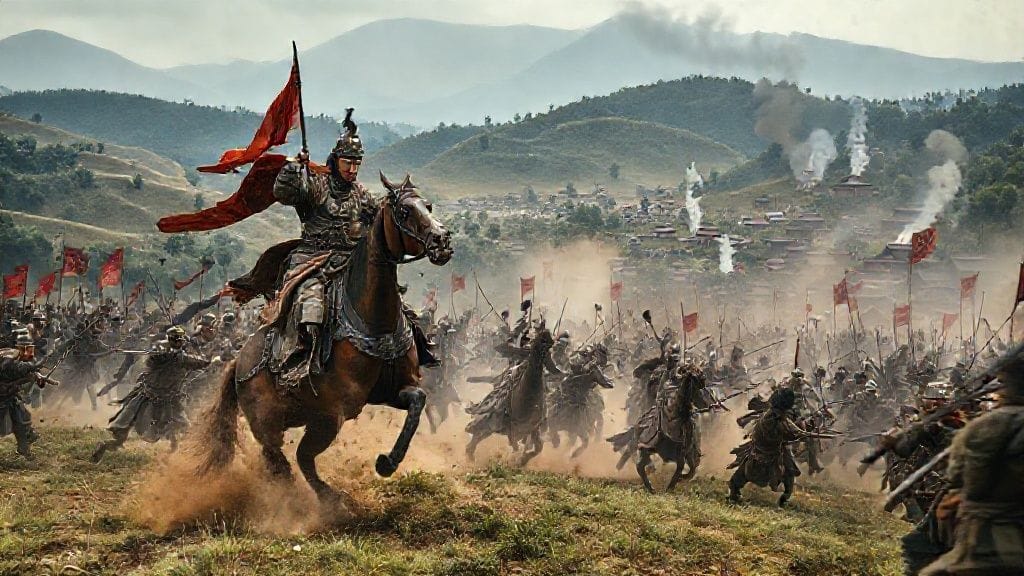
Yet Anastasius also faced internal opposition. In Thrace, a military commander named Vitalian led a major revolt against the emperor in the 510s, rallying soldiers and provincials under the banner of defending Chalcedonian orthodoxy and the rights of the Roman see. Marching toward Constantinople, Vitalian threatened not only Anastasius’s religious policy but his very throne. The emperor eventually managed to placate the rebellious general with promises of a council and partial concessions, but the episode revealed how precarious his religious stance had become.
From Rome’s perspective, Vitalian looked like an unexpected ally. Here was a powerful Eastern commander who brandished Chalcedon and friendship with the papacy as part of his political platform. Although the West could not control him, his revolt demonstrated to Anastasius that continued resistance to Chalcedonian definitions and Roman overtures carried real costs in terms of military loyalty.
As Anastasius aged, uncertainties about the succession loomed large. He had no sons, and his attempts to secure a smooth transfer of power were complicated by factional rivalries. In this context, the religious question remained disruptive. Could a new emperor afford to inherit the schism with Rome and the smoldering resentments it fueled among Chalcedonian believers in the Balkans and elsewhere? Many in the imperial court quietly wondered if a shift in policy might be inevitable under Anastasius’s successor.
When Anastasius died in 518, reportedly during a storm whose lightning and thunder some took as an omen, the throne passed not to a carefully groomed dynastic heir but to Justin, an aging but shrewd officer of peasant origin. Justin’s rise was itself a story of chance and ambition: head of the imperial guards, he managed to secure his own election by distributing gold to key troops and courtiers. Once in power, he faced a complex religious landscape—yet also a unique opportunity. As a new ruler without deep ties to the Henotikon policy, he could credibly change course without seeming inconsistent. That new course would soon lead directly toward Rome and the acacian schism end.
Justin I and the Turning of the Imperial Tide
Justin I, crowned in 518, was no theologian. He was an experienced soldier, a man of rustic origins, more comfortable in the language of command than the subtleties of Christological debate. Perhaps for that very reason, he approached the religious conflicts of his empire with a certain pragmatism. He wanted stability, legitimacy, and clear alliances, and he understood that a lasting breach with Rome undermined all three.
Almost immediately, Justin signaled a change of direction. Reports from contemporary chroniclers describe an atmosphere of relief among Chalcedonian supporters in the capital and the provinces. The emperor began to rehabilitate bishops who had been deposed for their loyalty to Chalcedon during Anastasius’s reign. Monks who had been harassed for their doctrinal views found their fortunes reversed. The pendulum swung back toward the Council of 451.
Justin also recognized that Rome, whatever its diminished political power in the West, carried immense symbolic weight. To restore communion with the papacy would not only placate Chalcedonian believers throughout the East; it would also enhance his own standing as the restorer of orthodoxy and order after a period of doctrinal ambiguity. A new emperor could afford to blame the schism on past misjudgments and present himself as the healer.
Consequently, Justin sent envoys to Pope Hormisdas in Italy, expressing his desire for reconciliation. The letters carried a tone of humility and goodwill unusual in imperial correspondence of the time. Yet goodwill alone would not suffice. Rome had clear, long-standing conditions: the explicit condemnation of the Henotikon, formal acceptance of Chalcedon, and the removal of the names of certain patriarchs—including Acacius—from the diptychs. On these points, Justin would have to walk a delicate line, especially given that segments of his own population were still deeply attached to anti-Chalcedonian formulas.
Negotiations over the coming months exposed the limits and possibilities of imperial power. Justin could promote Chalcedonian bishops, silence extreme opponents, and stage public ceremonies. But he could not wholly erase the theological diversity of his realm. The final text of the formula accepted in 519, therefore, would bear the marks of both Roman insistence and Eastern realism. In the fragile space between, the acacian schism end took shape as both a doctrinal statement and an act of statecraft.
Negotiating Peace: Legates from Rome and Diplomats of the Bosporus
Pope Hormisdas, who had ascended to the papal throne in 514, approached the possibility of reconciliation with a mixture of hope and caution. He had seen earlier emperors make half-hearted overtures only to retreat under internal pressure. So when Justin’s envoys arrived with messages of goodwill, Hormisdas responded with a detailed formula that left little room for ambiguity.
Central to Hormisdas’s demands was a clear affirmation of the Council of Chalcedon, a repudiation of the Henotikon, and the anathema of those patriarchs who had supported it—among them Acacius, Euphemius, and others. The pope also insisted on the principle that the faith preached in Rome, the see of Peter, must be the standard by which orthodoxy was measured. In one of his most cited statements, he wrote: “In the Apostolic See the Catholic religion has always been preserved without stain.” This was not mere rhetoric; it was a claim about the role of Rome that would reverberate through later centuries.
The Eastern court received this formula with apprehension. On the one hand, Justin and his advisors recognized that without substantial concessions to Rome, the schism could not end. On the other, the idea of condemning revered patriarchs and repudiating an edict that had shaped imperial religious policy for nearly forty years was politically risky. The names inscribed in the diptychs represented not only individuals but entire eras of imperial ideology.
Enter the papal legates, a small group of Latin-speaking clerics who traveled to Constantinople in 518–519 to negotiate in person. They were lodged with honor but also carefully watched. In audience with the emperor, they presented Hormisdas’s formula and explained Rome’s perspective. Between receptions and banquets, they likely met in quieter rooms with Eastern bishops and imperial secretaries, working line by line through the proposed text.
One point of contention concerned how far back the condemnation of compromised patriarchs should reach. Was it necessary to anathematize Acacius, dead for decades, or could a more general formula suffice? Rome insisted on naming names. Eventually, a compromise was formed not by softening the language but by appealing to the emperor’s authority to implement it gradually and manage its reception. Justin, confident in his control of the capital and bolstered by Chalcedonian support among soldiers and urban elites, decided to accept the papal terms.
Thus was crafted the Formula of Hormisdas, a text that Eastern bishops were required to sign as a condition of restored communion. Its language proclaimed the primacy of the Roman see and condemned those who had tried to oppose or circumvent it. For Rome, it was a resounding vindication; for Constantinople, a calculated surrender in service of a greater good. As signatures were collected and lists drawn up, the stage was set for a public ceremony that would display, before the eyes of the empire, the acacian schism end in solemn rites and chanted words.
The Day the Diptychs Changed: 28 March 519 in Hagia Sophia
On March 28, 519, Constantinople awoke to a day that would be remembered for generations. The sky was likely still cool with spring’s hesitant warmth, but the city pulsed with anticipation. Notices had spread that in Hagia Sophia, before the emperor, the patriarch, and representatives from Rome, a great act of reconciliation would take place. After nearly forty years of estrangement, Old Rome and New Rome would once again share the same altar of communion.
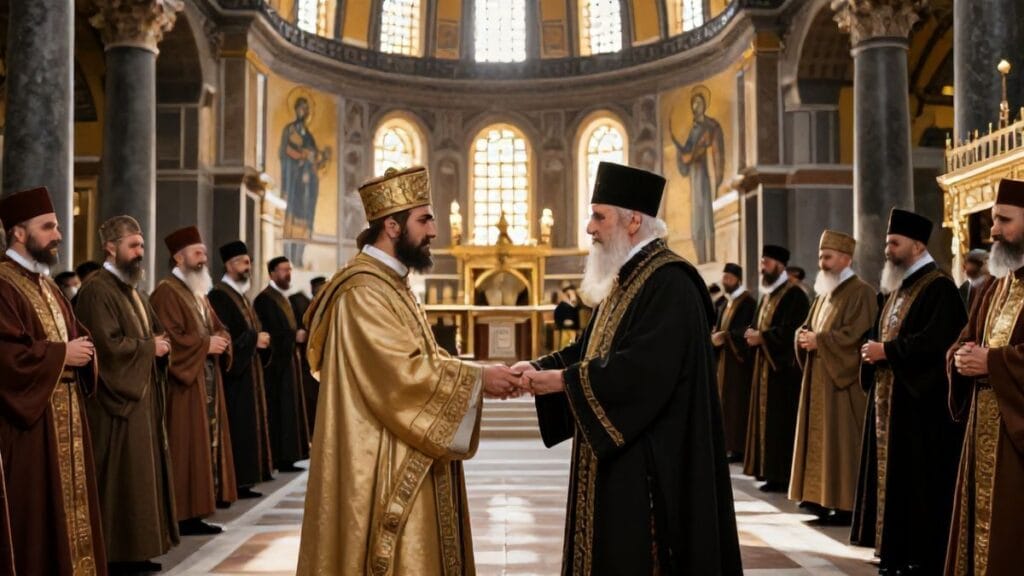
Inside the vast basilica of Hagia Sophia—the pre-Justinian structure, smaller than the later domed marvel but still imposing—crowds pressed in, filling the nave, the galleries, and the side aisles. Clergy in shimmering vestments processed along the marble floor, carrying candles that flickered against gilded mosaics. The air was thick with incense and whispered prayers. At the center of it all stood Patriarch John II of Constantinople, flanked by bishops, while Emperor Justin I occupied a prominent place from which he could be seen by all.
The papal legates stood near the sanctuary, holding the text of the Formula of Hormisdas. At the appointed moment, a deacon stepped forward and read aloud the key passages. He proclaimed the faith of the councils, including Chalcedon, confessed the authority of the Apostolic See of Rome, and condemned those who had broken communion in previous decades. As the Latin-phrased affirmations were translated into Greek for the assembled faithful, ripples of reaction moved through the congregation—some in relief, others in anxious silence.
Then came the moment that gave the ceremony its defining drama: the alteration of the diptychs. In the presence of the emperor and the entire assembly, the names of those patriarchs associated with the Henotikon and resistance to Chalcedon—Acacius among them—were solemnly removed from the lists of the commemorated. In their place, the name of the current pope, Hormisdas, and his predecessors were reinserted. Liturgically, this meant that when the Eucharist was celebrated, Rome would once again be invoked as a living partner in the communion of churches.
Contemporary chroniclers describe the reaction of the crowd with language that borders on the ecstatic. According to one report, the people cried out acclamations to the emperor and the patriarch, praising them as restorers of unity. Some wept openly. Others shouted the names of Chalcedon and Orthodoxy. The acacian schism end was not merely a statement on parchment; it was a collective release of tension, the lifting of a burden that many had carried so long they scarcely remembered what it felt like to be without it.
Yet behind the celebrations, there were undoubtedly those who watched with unease. Supporters of anti-Chalcedonian theology, marginalized by Justin’s new policies, saw in this ceremony not a healing but a betrayal. For them, the removal of Acacius’s name signaled the triumph of what they considered a compromised council. They left Hagia Sophia that day feeling that their truth had been defeated. The acacian schism end, glorious for some, was the beginning of a new chapter of alienation for others.
When Theology Meets Politics: What the End of the Schism Really Settled
It would be soothing to imagine that March 28, 519, brought an end not only to the Acacian Schism but also to the deep currents of tension that had caused it. In reality, the settlement achieved that day was both impressive and limited—solid in its formal definitions, fragile in its underlying consensus.
Theologically, the acacian schism end affirmed several crucial points. First, the Council of Chalcedon stood vindicated as a cornerstone of Christological orthodoxy in both East and West. Second, the Henotikon was effectively discredited as a doctrinal standard, even if its memory lived on in the hearts of those who had once seen it as a path to peace. Third, the Formula of Hormisdas codified a high view of Roman primacy, at least on paper. Eastern bishops who signed it acknowledged that the Apostolic See in Rome held a special role in preserving the purity of the faith.
Politically, the settlement strengthened Justin I’s position. He could present himself as the emperor who healed a decades-long rift and restored the empire’s unity under orthodox banners. For Rome, the reconciliation bolstered the papacy’s claim to moral and doctrinal leadership, especially at a time when its political weight in Italy was contested by Ostrogothic kings. A united front with Constantinople gave the pope a valuable ally in the ongoing dance with secular rulers in the West.
Yet the limitations were equally real. The reconciliation did not fully resolve the status of anti-Chalcedonian communities in Egypt, Syria, and Armenia. Many of these believers, now increasingly organizing their own hierarchies apart from imperial structures, rejected both Chalcedon and the terms of the reunion. In effect, the acacian schism end intensified the separation between the imperial church, aligned with Chalcedon and Rome, and what would later be known as the Oriental Orthodox churches.
Moreover, the Eastern acceptance of the Formula of Hormisdas was, in some respects, situational. While Justin and many of his bishops were sincere in their commitment, later emperors and patriarchs would interpret Roman primacy more modestly than the text might suggest. The language adopted in 519 did not settle, once and for all, the question of how East and West understood the balance between papal authority and conciliar, imperial, or patriarchal power. It planted seeds that future controversies—such as the disputes over monothelitism and the Filioque—would water in complex ways.
Still, within its historical horizon, the achievement of 519 was remarkable. It demonstrated that even after long periods of estrangement, reconciliation was possible through carefully crafted formulas, patient negotiation, and the willingness of political leaders to bear the cost of doctrinal clarity. The acacian schism end stands as a testament to the capacity of institutions and individuals to step back from the brink, even when they have spent decades walking steadily toward it.
Winners, Losers, and the Silent Majorities
Every settlement leaves behind a map of winners and losers, and the end of the Acacian Schism was no exception. On one level, Rome clearly emerged with enhanced prestige. The papacy had insisted, year after weary year, that any reconciliation must include acknowledgment of Chalcedon and the condemnation of those who had undermined it. The Formula of Hormisdas read, in many ways, like a Roman manifesto accepted by the East. To later Latin theologians and canonists, 519 became a landmark moment illustrating the resilience and authority of the Apostolic See.
In Constantinople and the broader East, Chalcedonian bishops and theologians also counted themselves among the victors. Their council had not only survived but been reaffirmed under imperial seal. Monks and clergy who had suffered under Anastasius for their loyalty to Chalcedon now enjoyed imperial favor. The mood in their circles mixed genuine joy at restored communion with Rome and a certain quiet satisfaction that their long fidelity had been vindicated.
For anti-Chalcedonian Christians, however, the acacian schism end marked a darker turning point. The Henotikon had once offered them a measure of recognition and space within the imperial church. With its repudiation and the enthronement of Chalcedon as the unambiguous standard, their position within official structures deteriorated. Many found themselves increasingly pushed to the margins, forced either to accept a council they distrusted or to embrace a more clearly separated communal existence. Out of these pressures would emerge parallel hierarchies and traditions that, over time, solidified into enduring non-Chalcedonian churches.
And then there were the silent majorities—the ordinary believers who had never fully understood the nuances of the Christological debates but felt their consequences keenly. Craftsmen in Antioch who saw their bishop deposed and replaced, peasants in Egypt who heard conflicting sermons about Christ’s nature, sailors who passed between ports where the same Gospel was read but different names were chanted at the altar. For them, the acacian schism end brought, perhaps, more stability and fewer sudden changes in their local churches. Yet the scars of confusion and distrust did not vanish overnight.
These everyday Christians remind us that history is not only made by emperors, popes, and patriarchs. It is also carried in the hearts and habits of the many whose names never appear in chronicles. When they gathered after 519 for liturgy and heard Rome and Constantinople named together once more, some must have felt genuine peace. Others, shaped by decades of hearing contrary slogans, likely wondered what bargains had been made above their heads. Reconciliation, like schism, always unfolds not just in formal texts but in the slow reshaping of communal memory.
The Human Face of Reunion: Stories from the Frontiers of Faith
We can catch glimpses of the human dimension of the acacian schism end in scattered narratives and letters from the early sixth century. Consider, for example, a hypothetical bishop in Illyricum, a region on the frontier between East and West. For decades, he had navigated a treacherous middle ground. His flock included soldiers stationed by Constantinople, traders dealing with Italy, and villagers loyal to older local traditions. Every Easter, he faced the question of whom to commemorate in the Eucharistic prayers. To name Rome might anger imperial officials; to omit Rome might scandalize Latin-speaking congregants.
When news arrived in 519 that Justin and Hormisdas had reconciled, this bishop’s burdens shifted. No longer did he have to choose between imperial loyalty and Roman communion; the two had converged. In homilies, he could now speak of a united church without gliding over the reality of divided altars. Perhaps he wrote to fellow bishops in both Rome and Constantinople, expressing relief that the long ambiguity had ended. The details are lost to us, but the outlines of such joy can be inferred from later accounts praising Justin’s restoration of unity.
Or picture a small monastery on the outskirts of Constantinople, where an elderly monk named Theodoros had lived since the days of Zeno. When he first took vows, the memory of Chalcedon was still fresh. He had seen the Henotikon posted in public places, heard argued in heated tones in the refectory, and watched as the names of bishops appeared and disappeared from the diptychs. For much of his life, the question of whether Rome and Constantinople were in communion had oscillated between hope and resignation.
On the morning after the ceremony of March 28, 519, Theodoros processed with his brothers into their small chapel. As the liturgy unfolded, he listened closely to the commemorations. When the name of Hormisdas, bishop of Rome, rang out clearly, the old monk reportedly wept. In that moment, decades of uncertainty resolved into the simple assurance that Christians from the Tiber to the Bosporus, at least for now, stood together at the same table.
Even in Egypt and Syria, where many Christians rejected Chalcedon and saw the reconciliation with Rome as a betrayal, the acacian schism end had tangible human effects. Some priests who had long tried to maintain a tenuous unity with the imperial church now found themselves forced to choose. A few may have attempted to reinterpret Chalcedon in ways compatible with their convictions, seeking local accommodations. Others broke decisively, joining or forming non-Chalcedonian communities that would pass their distinct identity down through centuries.
In each of these stories—imagined but plausible, anchored in the patterns the sources reveal—we see how the end of a schism is never merely a matter of documents. It is a reorientation of loyalties, memories, and hopes. The men and women who lived through 519 carried those shifts in their prayers, their conversations, and their journeys across a Mediterranean still bound together by trade routes and shared scriptures, yet increasingly conscious of doctrinal borders.
From Constantinople to Ravenna: Western Echoes of Eastern Peace
While the great drama of the acacian schism end unfolded in Constantinople, its echoes reverberated across the West—in Rome, naturally, but also in cities like Ravenna and in the courts of barbarian kings who now ruled much of the former Western Empire. The sixth century was an age when bishops and kings negotiated constantly over status, territory, and allegiance. The renewed bond between Rome and Constantinople added another strand to this complex web.
At the time of the reconciliation, Italy lay under the rule of the Ostrogothic king Theoderic the Great, an Arian Christian who nonetheless prided himself on his tolerance toward Catholic subjects. Theoderic maintained a careful balance between respecting papal authority in spiritual matters and asserting his own supremacy in political affairs. From his perspective, the peace between Rome and Constantinople was a mixed blessing. On one hand, it reduced the likelihood that Byzantium might use religious discord as a pretext for interventions in Italy. On the other, it strengthened the pope’s symbolic clout, potentially complicating the king’s efforts to keep ecclesiastical disputes under control.
Yet for many Western bishops beyond Italy, the reunion was inspiring. In Gaul, where local synods and regional powers often overshadowed papal influence, news that Constantinople had accepted the Formula of Hormisdas lent new weight to Roman directives. Bishops who had hesitated to align themselves too closely with Rome, wary of imperial displeasure or Eastern theological fashions, could now point to 519 as proof that fidelity to the Apostolic See and unity with the empire were not mutually exclusive.
In North Africa, still reeling from the legacy of Vandal persecutions and the complex aftermath of their overthrow, the story was similar. Catholic communities there, often isolated and beset by local challenges, drew encouragement from the idea that the two great pillars of Christendom were at last in harmony. For clergy struggling to rebuild churches, reclaim confiscated properties, or revive educational institutions, the symbolism of unity at the top mattered—even if it did not immediately resolve local grievances.
Western theologians and chroniclers also took note. Later Latin authors, such as those whose works would shape medieval canon law, looked back on the acacian schism end as a paradigmatic case in which perseverance, doctrinal clarity, and papal resolve triumphed over ambiguity and political expediency. They cited 519 in debates over the proper relationship between councils, emperors, and the papacy, arguing that even the mighty rulers of Constantinople had ultimately bowed to the judgment of the Roman see.
In this way, the ceremonies in Hagia Sophia radiated outward, influencing not only the immediate relations between Rome and Constantinople but also the self-understanding of the Western church as it navigated a world now shared with Germanic, often Arian, rulers. Unity with the East bolstered the West’s confidence in its mission, even as cultural and political divergences between the two halves of Christendom quietly deepened under the surface.
Shadows Cast Forward: How the Settlement Shaped Later Schisms
History often repeats itself not in identical events but in recurring patterns of conflict and reconciliation. The acacian schism end in 519 provided a model—both inspiring and cautionary—for later generations facing doctrinal and institutional crises. The memory of how Rome and Constantinople had clashed over Christology, imperial edicts, and the names in the diptychs influenced how they approached new controversies.
In the seventh century, when debates erupted over monothelitism—the teaching that Christ had only one will—both sides recalled the Acacian Schism. Some Eastern statesmen hoped to craft new formulas of union that, like the Henotikon, would appease disparate factions by finding a carefully worded middle ground. Rome, however, wary of past compromises, was less inclined to accept ambiguous language. The ghost of Acacius and the shadow of the Henotikon haunted every attempt at doctrinal diplomacy.
Likewise, the question of papal primacy, so sharply defined in the Formula of Hormisdas, never faded from Eastern consciousness. While Eastern bishops in 519 had signed a document that appeared to grant sweeping authority to the Roman see, many of their successors would interpret that concession within a narrower framework, emphasizing the context of a particular crisis. When later disputes over the insertion of the Filioque clause into the Creed, or the jurisdiction over Bulgaria, emerged in the ninth and tenth centuries, Eastern theologians and canonists drew on a complex heritage in which 519 figured but did not dictate the outcome.
By the time of the Great Schism of 1054, when mutual excommunications were once again pronounced between Rome and Constantinople, the memory of the Acacian Schism had become part of a broader narrative of recurring tensions. Some Eastern writers cited it as evidence that Rome had a tendency to overreach; some Western writers saw it as proof that only firm papal pressure could preserve orthodoxy in the face of imperial and patriarchal vacillation. The past was not forgotten; it was repurposed in new polemics.
At the same time, the very fact that the acacian schism end had been achieved through negotiation and ceremony offered a glimmer of hope to later peacemakers. If union could be restored once, perhaps it could be restored again. Councils in Lyons and Florence, centuries later, would echo with the logic of 519: painstaking formulas, balancing act between doctrinal fidelity and political necessity, solemn public rites sealing fragile agreements. Though those later unions proved short-lived, they bore witness to a recurring conviction that the precedent of 519 still mattered.
In this sense, the Acacian Schism is more than a remote episode in early Byzantine history. It stands as an early test case in the enduring question of how Christian communities negotiate truth and unity in the face of disagreement, power, and memory. The acacian schism end is not merely an item of chronology; it is a mirror in which later ages have repeatedly seen their own struggles reflected.
The Acacian Schism in the Eyes of Later Historians
How we tell the story of the Acacian Schism—and its end—has changed over time. Early chroniclers like Evagrius Scholasticus emphasized imperial and ecclesiastical personalities, portraying emperors and patriarchs as heroes or villains depending on their adherence to Chalcedon. Medieval Western historians highlighted the triumph of papal authority in 519, sometimes treating the Formula of Hormisdas as a clear and permanent settlement of the primacy question. Byzantine writers, in contrast, often folded the episode into a broader narrative about the empire’s struggle to maintain unity amid theological turmoil.
Modern scholarship has added layers of nuance. Instead of focusing solely on doctrinal formulas, contemporary historians have explored the social, cultural, and political factors that shaped the schism. They examine how provincial elites, monastic movements, and popular piety influenced imperial policy. They also trace how the language of councils and edicts interacted with economic realities, military pressures, and the fragile structures of late antique governance. [As historian John Moorhead has noted, “the schism was as much about the nature of authority in a Christian empire as it was about the mysteries of Christ’s natures” (The Roman Empire Divided).]
One key insight from recent studies is that the acacian schism end did not represent a simple victory of one “side” over another but rather a contingent compromise shaped by the particular circumstances of Justin I’s reign. Had Anastasius lived longer, or had Justin lacked the political support he enjoyed among Chalcedonian bishops and soldiers, the outcome might have looked very different. The settlement was not historically inevitable; it was the result of calculated decisions, risks, and personal convictions among a relatively small group of leaders.
Another modern emphasis is the long-term impact on non-Chalcedonian communities. Where older accounts sometimes treated these Christians as mere dissidents or obstacles to unity, contemporary historians recognize them as vibrant traditions in their own right, with rich theological, liturgical, and monastic legacies. From this perspective, the acacian schism end appears not only as the healing of a division between Rome and Constantinople but also as a moment that deepened another divide—between the imperial church and the emerging Oriental Orthodox communions.
Finally, the episode has attracted interest from scholars of ecumenism and church diplomacy. In a world still marked by Christian divisions, the story of 519 offers both inspiration and warning. It shows that reconciliation is possible even after long estrangement, but also that such settlements can leave unresolved questions that resurface centuries later. For historians and theologians alike, the Acacian Schism remains a case study in the complex interplay of doctrine, power, and human longing for unity.
Conclusion
On that spring day in 519, when incense drifted through Hagia Sophia and names once stricken from the diptychs were restored or removed, few present could have grasped just how enduring the legacy of their moment would be. They knew, of course, that something extraordinary was happening: a schism of nearly forty years was ending, Rome and Constantinople were embracing again, and the emperor himself stood as patron of this fragile peace. The acacian schism end was, for them, a tangible relief, a clearing of the air after a storm that had rumbled through their entire lives.
Yet from our vantage point, the event appears as both resolution and prelude. Resolution, because it affirmed Chalcedon, repudiated the Henotikon, and restored formal communion between East and West in a way that would last for generations. Prelude, because the deeper issues of authority, regional identity, and the place of non-Chalcedonian Christians in the Christian oikoumene remained unresolved. The healing of one rift exposed others that had been partially hidden beneath it.
Still, there is something profoundly moving about the story. It reminds us that institutions capable of division are also capable of repentance and return; that emperors can choose conciliation over stubbornness; that popes can hold fast to convictions without forever closing the door to dialogue. The actors in this drama—Acacius, Zeno, Felix, Anastasius, Justin, Hormisdas, and countless unnamed monks and laypeople—were not abstractions but human beings caught between their sense of divine truth and the messy demands of politics and survival.
The End of the Acacian Schism in Constantinople in 519 stands, therefore, as a moment when the church and empire paused, reconsidered, and chose unity at a cost. It did not solve every problem, nor did it prevent future schisms. But it left behind a record of courage and calculation, of prayer and policy intertwined. In the quiet that followed the chants in Hagia Sophia that day, one could imagine an exhausted empire breathing out, hopeful that, at least for a time, the words spoken at the altar and the decrees proclaimed in the palace were pulling in the same direction.
FAQs
- What was the Acacian Schism?
The Acacian Schism was a prolonged rupture (c. 484–519) between the Church of Rome and the Church of Constantinople, triggered by Patriarch Acacius’s support for the Henotikon, an imperial edict that tried to reconcile Chalcedonian and anti-Chalcedonian factions but was rejected by the papacy. - When did the Acacian Schism officially end?
The Acacian Schism officially ended on March 28, 519, when Emperor Justin I, Patriarch John II of Constantinople, and papal legates representing Pope Hormisdas celebrated a public reconciliation in Hagia Sophia, restoring the pope’s name to the diptychs and accepting the Formula of Hormisdas. - What was the Henotikon, and why did it cause controversy?
The Henotikon was an edict issued by Emperor Zeno around 482 that attempted to define Christological doctrine in a way acceptable to both Chalcedonian and anti-Chalcedonian Christians, notably avoiding explicit mention of the Council of Chalcedon. Rome saw it as undermining Chalcedon and granting legitimacy to bishops it regarded as heretical, which led to Pope Felix III excommunicating Patriarch Acacius. - Who were the key figures in ending the schism?
The key figures were Emperor Justin I, who shifted imperial policy toward full acceptance of Chalcedon; Pope Hormisdas, who articulated the Roman conditions for reunion in the Formula of Hormisdas; and Patriarch John II of Constantinople, who implemented the reconciliation in the capital’s liturgy and ecclesiastical practice. - Did the end of the Acacian Schism solve all theological disputes in the East?
No, it did not. While it reaffirmed Chalcedon and restored communion between Rome and Constantinople, large numbers of Christians in Egypt, Syria, and Armenia continued to reject Chalcedon and evolved into the Oriental Orthodox churches, maintaining their own hierarchies and theological traditions. - How did the Formula of Hormisdas affect papal authority?
The Formula of Hormisdas strongly asserted Roman primacy, declaring that the Apostolic See had preserved the faith without stain and requiring Eastern bishops to condemn those who had opposed Rome. Although later Eastern theologians interpreted this in context, Western canonists often cited it as a landmark affirmation of papal authority. - What role did politics play in the schism and its resolution?
Politics played a central role: emperors sought formulas like the Henotikon to keep restive provinces loyal, while popes defended Chalcedon as a non-negotiable standard. The eventual resolution under Justin I was driven not only by theological conviction but also by his desire for stability, legitimacy, and alliance with the papacy. - How did ordinary Christians experience the schism?
Ordinary Christians often encountered the schism through changing names in liturgical commemorations, disputes over local bishops, and occasional unrest in streets and churches. Many did not grasp all the theological nuances but felt the instability caused by shifting allegiances and competing claims to orthodoxy. - Did the end of the Acacian Schism prevent later divisions between East and West?
No. Although it restored communion and set a precedent for reconciliation, deeper issues about authority, culture, and doctrine remained. These unresolved tensions contributed, over centuries, to the gradual estrangement that culminated in the Great Schism of 1054. - Why is the end of the Acacian Schism still studied today?
Historians and theologians study it as a key moment in the development of relations between Rome and Constantinople, a case study in how doctrine and politics interact, and an early example of both the possibilities and limits of ecumenical reconciliation within a divided Christian world.
External Resource
Internal Link
Other Resources
- Encyclopaedia Britannica – general search for the exact subject
- Google Scholar – academic search for the exact subject
- Internet Archive – digital library search for the exact subject