Table of Contents
- A New Star Over an Ancient Empire
- The Han Dynasty World Beneath the Sky
- Court Astronomers and the Mandate of Heaven
- The Night the Heavens Caught Fire
- Recording the Celestial Visitor on Bamboo and Silk
- Omens, Portents, and Imperial Anxiety
- The Empire in 185 CE: Crisis Behind Palace Walls
- From Battlefield to Sky: How People Interpreted the New Star
- Forgotten for Centuries: The Long Sleep of a Stellar Ghost
- Modern Astronomers Go Hunting for an Ancient Explosion
- Decoding the Records: Distances, Constellations, and Time
- RCW 86 and the Astronomical Detective Story
- Supernovae, Cosmic Rays, and the Physics Behind the Spectacle
- When Heaven Speaks: Political Uses of the 185 Supernova
- Echoes in Culture, Myth, and Memory
- Comparing Ancient Skywatchers: China, Rome, and Beyond
- What Supernova SN 185 Tells Us About Time and Human Fragility
- Conclusion
- FAQs
- External Resource
- Internal Link
Article Summary: In the winter of 185 CE, during the Eastern Han dynasty, Chinese astronomers quietly noted a “guest star” that would later be known as supernova SN 185 observed high above a fragile empire. This article follows their gaze, reconstructing the political intrigues, social tensions, and spiritual fears that framed that blazing point of light. It traces how the careful records of Han scholars were preserved, misread, nearly forgotten, and finally revived by modern scientists searching the sky for the stellar corpse of that distant explosion. Along the way, it examines how rulers, rebels, peasants, and philosophers all tried to interpret the message they believed Heaven was sending. The narrative then shifts to the twentieth and twenty‑first centuries, where X‑ray telescopes, radio arrays, and patient calculations converge on the supernova remnant now labeled RCW 86. Through this fusion of ancient testimony and modern physics, the piece shows how one explosion has become a bridge across nearly two millennia. It reflects on what it means that humans can read an event both as a political omen and as a thermonuclear death of a star. Above all, it uses the story of supernova SN 185 observed to explore the fragile interplay between power, belief, and our enduring need to find meaning in the night sky.
A New Star Over an Ancient Empire
On a cold night in the year 185 of the Common Era, somewhere within the vast domains of the Eastern Han dynasty, a court astronomer looked up and saw that the sky had changed. A point of light blazed where none had been recorded before, bright enough to disturb the familiar pattern of the constellations. In a world where the heavens were mapped, named, and infused with political meaning, a new star was never merely a curiosity. It was a message.
This was the supernova SN 185 observed by Chinese court specialists and later immortalized in terse lines of classical prose. To the modern reader, it is tempting to reduce the scene to a data point, a first entry in the catalog of historical supernovae. Yet for the men standing on stone terraces of the imperial observatory, wrapped in heavy robes against the northern winds, it was something far more intimate: a potential omen about the fate of the Son of Heaven, and perhaps a sign that the cosmic order was slipping out of alignment.
The night sky above them was not empty space but an extension of the empire itself. Every asterism—small groupings of stars that functioned like Western constellations—was tied to institutions, noble families, border regions, or ministries in the capital. To gaze upward was to read a celestial gazette. When the guest star appeared near the asterism known as Nanmen, the “Southern Gate,” in the region we now call Centaurus, the observers knew at once that Heaven was speaking in a familiar vocabulary of light and shadow. The problem was deciphering the grammar.
Yet behind the carefully measured angles and brightness scales, behind the calm lines written on bamboo slips, lay a sense of urgency. The Eastern Han state in 185 was already staggering. Eunuch factions whispered in palace corridors, warlords gathered strength in the provinces, and peasants in yellow headscarves were remembering that they had once risen in righteous rebellion. Against that background, the sudden birth of a savage, short‑lived star could not be neutral. The chroniclers might write with restraint, but history crackles beneath their words like unseen lightning.
It is astonishing, isn’t it, that across nearly two thousand years, the aftershock of that night still reaches us? Today we can point telescopes toward a faint, expanding shell of gas and dust in the southern sky—an object labelled RCW 86—and say with some confidence that this is the ghost of supernova SN 185 observed in Han dynasty China. In the union of these cold images and those warm, fragile records lies one of the most moving collaborations between ancient observers and modern science. But this was only the beginning of the story.
The Han Dynasty World Beneath the Sky
To understand what that new star meant to those who first saw it, we must descend from the heavens to the world it shone upon. In 185, the Eastern Han dynasty had ruled for nearly two centuries. Its capitals—first Luoyang and earlier Chang’an—had rivaled Rome and Alexandria in scale and sophistication. The empire’s population probably exceeded fifty million souls, scattered across river valleys, crowded cities, and remote commanderies along the steppe frontier.
This was a realm of wheat fields and rice paddies, of elaborately carved tombs, lacquered coffins, and paper scrolls inked with Confucian classics. The bureaucratic machine of the state stretched into nearly every county, dispatching edicts written in a uniform script. Taxes in grain and labor flowed toward the center, while imperial decrees radiated outward. The emperor—by 185, the young Emperor Ling—was styled the Son of Heaven, a title that fused political sovereignty with cosmic responsibility.
The ideology that underpinned Han power linked the cycles of nature, the fortunes of the dynasty, and the harmony of the cosmos. According to the doctrine of the Mandate of Heaven, Heaven (Tian) bestowed authority upon a ruling house so long as it governed with virtue, moderation, and justice. When that virtue decayed—when corruption flourished, peasants starved, or ministers abused their power—Heaven signaled its displeasure through anomalies: earthquakes, floods, eclipses, comets, and, crucially, new stars.
In such a universe, astronomy and politics were inseparable. The palace archives stored not only tax registers and legal codes but also centuries of celestial records stretching back to earlier dynasties. To fail to observe the sky was to neglect a vital channel of communication between Heaven and the throne. To misinterpret or hide an ominous sign could be an act of treason—or a weapon in the hands of a faction hoping to topple a rival.
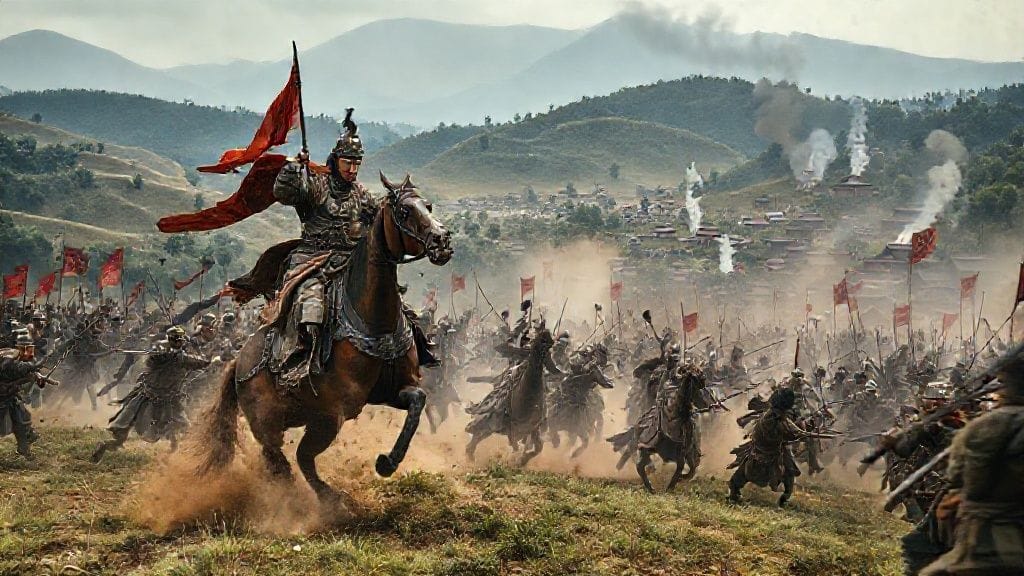
Beneath these lofty principles, ordinary people lived lives that were precarious and often harsh. The second century saw mounting pressures: land concentration in the hands of great families, crushing debt for smallholders, droughts and locust plagues that tipped subsistence farmers into disaster. When the Yellow Turban Rebellion erupted in 184, led by Daoist healers promising a Great Peace, it exposed just how fragile the imperial order really was. The revolt was brutally suppressed, but the armies raised to defeat it would soon become private warbands loyal to their commanders rather than the court. In 185, as the embers of rebellion glowed on the landscape, the empire stood at the threshold of collapse.
It was into this charged atmosphere that the new star intruded—silent, brilliant, and impossible to ignore. Above a landscape of fear and ambition, the sky had spoken. The question was: What exactly was it saying?
Court Astronomers and the Mandate of Heaven
The men who first recorded the supernova SN 185 observed from within an institution as old as the dynasty itself. The imperial observatory was not an ivory‑tower academy but a critical organ of state. Its staff—astronomers, calendar specialists, and astrologers—occupied a small but potent niche in the bureaucratic hierarchy. Their mandate was twofold: to keep the empire’s calendar accurate and to interpret celestial phenomena for the throne.
At the heart of their work stood the Chinese sky itself, divided into three concentric regions known as the Three Enclosures, surrounded by 28 lunar lodges (xiu) that tracked the Moon’s motion. The “Southern Gate” asterism where the guest star appeared formed part of this elaborate map. Each enclosure and lodge corresponded to earthly domains: the imperial palace, ministries, regional commanderies, and even specific clans. A flaw in the sky was thus a flaw in the state.
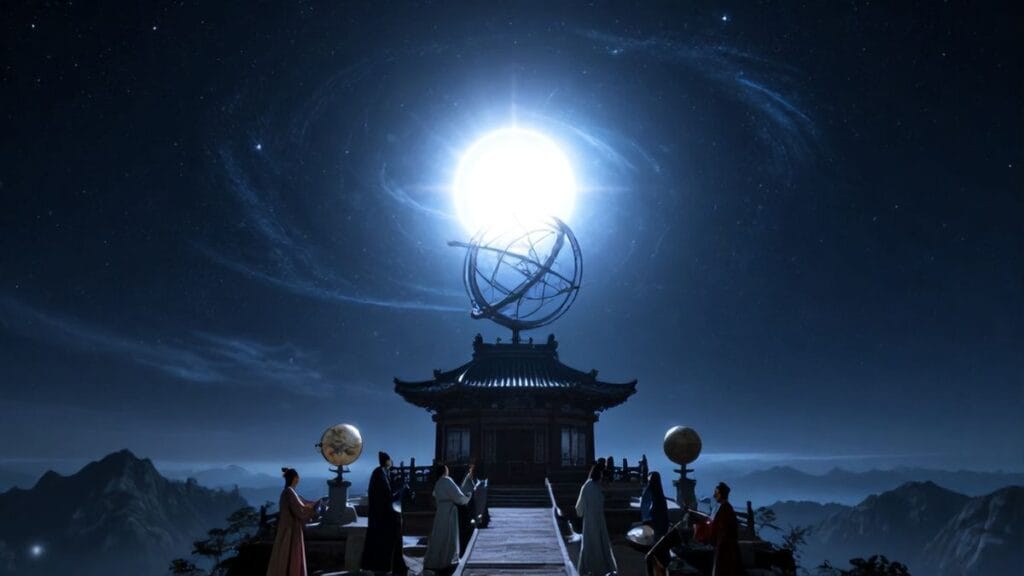
These specialists were not “scientists” in the modern sense, but they combined meticulous observation with sophisticated mathematical techniques. They tracked the paths of the Sun, Moon, and planets across the ecliptic, calculated eclipses, and refined calendar systems that regulated everything from harvests to court sacrifices. Their instruments—sighting tubes, gnomons, and armillary spheres—turned the roof of the observatory into an open‑air laboratory.
Yet behind the exactitude lay anxiety. The court was steeped in a culture where ministers could chain natural disasters to political arguments. A devastating flood might be cited by a remonstrating official as proof that the emperor had strayed from the Way. An unseasonal frost could be woven into a memorial pleading for policy reform. A blazing new star could become a rhetorical dagger aimed at the heart of a disfavored faction.
For the astronomers, therefore, every unusual sight carried risk. If they reported nothing, they might be accused of negligence or concealment. If they reported too much, opportunistic censors and moralists could seize upon their words to stir controversy. In the mid‑second century, one official complaint even alleged that court astronomers had “hidden the portents to please the powerful,” underscoring the perilous tightrope they walked.
When the supernova SN 185 observed first burned itself onto their retinas, the observers would have hurried to measure its position relative to known stars. They compared it with star charts, estimated its brightness, and did what they had been trained to do: turn an overwhelming sensory shock into orderly data. Still, one imagines the uneasy glances exchanged in the observatory courtyard, the whispered guesses about what such a radiant, long‑lived guest might portend. A new star that lingered in the sky for months, brighter than nearly all others, was no minor omen; it was a statement, perhaps even an indictment.
The Night the Heavens Caught Fire
We have no surviving diary entry that tells us precisely who first saw the new star or how they reacted in that initial instant. Instead we have a handful of lines preserved in later compilations such as the Hou Han Shu (Book of the Later Han). Their language is compressed, formulaic, almost painfully restrained. Yet if we read them closely and place them against the backdrop of astronomical knowledge, a striking picture emerges.
The record notes that in the second year of the Zhongping reign period—corresponding to 185 CE—“a guest star appeared within Nanmen. It was seen in the sixth month of that year and was visible for over eight months before gradually disappearing.” These few phrases, copied and recopied over the centuries, are our most direct textual window into the event. Hidden within them are clues about both the nature of the exploding star and the way the Han astronomers perceived it.
“Guest star” (ke xing) was the standard term used in Chinese astronomy for any new, transient point of light: comets, novae, and supernovae alike. It expressed a worldview in which the fixed stars were permanent residents of the sky, while newcomers were treated as temporary visitors drifting through a cosmic court. By labeling it as such, the observers acknowledged both its novelty and its impermanence.
The reference to Nanmen anchors the star in a particular asterism, one associated in Han thought with border defenses and southern gates of the imperial domain. Later scholars, cross‑mapping Chinese asterisms with Western constellations, placed Nanmen near what we call Alpha and Beta Centauri. This region of the sky is relatively rich in stars and lies along the Milky Way—an ideal backdrop against which a brilliant intrusion would be especially striking.
Most telling of all is the duration: the supernova SN 185 observed remained visible for eight months or longer. This is far too long for a typical nova, whose brightness usually wanes within weeks, and the recorded brightness suggests it rivaled or outshone Jupiter. These features align well with a genuine supernova, the catastrophic death of a massive star unleashing energies on a scale almost impossible to grasp.
One can imagine the sequence of nights: at first, an almost painful sharpness to the new light, casting faint extra shadows in the courtyard; then the slow, barely perceptible dimming that would become obvious only when compared with earlier notes. The astronomers would have risen at strange hours, bending over armillary spheres, sighting the star against brass rings etched with degrees. They may have tracked its color, checking whether its hue shifted from bluish‑white toward red as it faded—subtle details that modern readers can only yearn for but which Han observers sometimes recorded for other events.
While the observers worked, life in the capital went on—petitions debated in the audience hall, prisoners interrogated in district offices, market stalls bustling at dawn. Yet the new star subtly altered everything, like a rumor too powerful to ignore. Servants gossiping on kitchen steps likely pointed upward, telling one another that Heaven was angry or that a great official was about to fall. Somewhere, perhaps in a remote village, an old man teaching a child the familiar patterns of the sky would have to pause, baffled, at the uninvited brilliance now punching a hole in his memory of the constellations.
Recording the Celestial Visitor on Bamboo and Silk
How, exactly, did the observation of the supernova SN 185 observed make its way from the eye of an astronomer to the pages that modern historians study? The answer lies in the physical culture of Han documentation: bamboo slips bound with cord, wooden tablets, and silk scrolls carefully rolled and stored in lacquered chests.
The process usually began with what we might call a “field note.” The observer, perhaps assisted by apprentices, jotted down preliminary details: date according to both lunar and sexagenary cycles, approximate position, brightness compared to known stars, and any visible motion. Over subsequent nights, they added follow‑ups, tracking changes. These working notes were then transformed into more polished reports compiled for the Bureau of Astronomy.
At the bureau, specialists organized the material according to established categories—eclipses, comets, meteors, guest stars. They annotated the raw observations with interpretations drawn from omen literature. Such literature, a sprawling body of texts accumulated over centuries, linked particular celestial patterns with earthly outcomes. A guest star within a gate asterism, for example, might be associated with troubles at the borders, upheaval among military commanders, or shifts in control over important passes and fortresses.
These reports did not remain within the observatory’s walls. They were copied for inclusion in the official annals and sometimes excerpted in memorials to the throne. In theory, the emperor had the final say in how a portent was to be addressed. He might order sacrifices to Heaven and Earth, issue general amnesties, or proclaim reforms as gestures of repentance. Whether Emperor Ling in 185 took such steps in direct response to this star is uncertain, but we know from other reigns that emperors frequently reacted to celestial events with public rituals.
Preservation was another matter. Fires, invasions, and political purges destroyed countless scrolls over the centuries. What survives owes much to later compilers of dynastic histories who scoured older archives to construct coherent narratives. The Hou Han Shu, completed in the fifth century under the Liu Song dynasty, sought to capture the rise and fall of the Eastern Han with moral clarity. Its authors embedded astronomical records in their chronologies because such phenomena formed part of the moral texture of the age.
One can picture those later scribes, more than two hundred years after the star’s appearance, unrolling damaged scrolls to copy the terse line about a guest star in Nanmen. To them, the object was not a physical remnant in the sky but a past omen that had been fulfilled by the dynasty’s collapse. Without intending to, they were handing a baton to observers some sixteen centuries further in the future—astrophysicists with photographic plates and CCD detectors—who would read the same line but hear a very different message.
Omens, Portents, and Imperial Anxiety
In Han political thought, no bright celestial anomaly could be ethically neutral. A guest star was not simply a natural occurrence but a sign woven into a moral universe. When the supernova SN 185 observed flared into existence, the question among the court’s intellectuals was not whether it meant anything, but what, and for whom.
Omen interpretation was a specialized art rooted in texts like the now‑lost Gan De’s Treatise on Astrology and the evolving Chunqiu Fanlu (Luxuriant Dew of the Spring and Autumn Annals) ascribed to Dong Zhongshu. These works proposed intricate correspondences between the Five Phases (wood, fire, earth, metal, water), the directions, the seasons, and various organs of the state. A fiery intrusion in a southern asterism might thus be linked to the element of fire, the season of summer, and the domain of military affairs.
Officials could exploit these correspondences to advance arguments. If a guest star appeared near a constellation associated with the Ministry of Justice, critics of harsh punishments might cite it as evidence that laws had grown too cruel. If the star lingered above an asterism tied to the palace women’s quarters, it might be framed as Heaven’s rebuke of excessive influence by empresses or consorts.
In 185, such debates unfolded against the backdrop of deepening imperial anxiety. Emperor Ling was widely criticized by later historians for indulgence and for allowing eunuch favorites to dominate the court. Great families in the provinces seethed at their exclusion from power, while generals who had crushed the Yellow Turbans wielded armies larger than anything the central government could easily disband. The moral narrative of the dynasty, in the eyes of many Confucian scholars, was one of decline.
The new star thus offered both a threat and an opportunity. Censors and remonstrating officials, those whose duty was to speak uncomfortable truths to power, could seize upon it to compose memorials urging reform. Their language would have been oblique but forceful: “Recently, a guest star has appeared within Nanmen, blazing in the southern sky. The Classics teach that when fire invades the southern gate, it warns of turmoil among the border armies and of ministers who neglect the people. Your servant trembles and begs that Your Majesty curb extravagance, lighten levies, and attend to wise counsel.”
For the emperor and his favorites, such texts were nettlesome. To ignore them was to risk seeming indifferent to Heaven’s warnings; to act on them was to concede that misrule had occurred. We do not know how many such memorials were drafted in 185, or how many were quietly suppressed. But we can be sure that the star’s light, invisible by day, nevertheless suffused the politics of the court. Each night, as it rose again over the palace roofs, it renewed a silent, shimmering pressure on those who believed their fates were tied to its glow.
The Empire in 185 CE: Crisis Behind Palace Walls
To contemporary historians, the year 185 sits squarely within the terminal crisis of the Eastern Han. The Yellow Turban Rebellion of 184 had been the largest peasant uprising in Chinese history up to that point, driven by grievances that had built over decades. Its suppression did not heal the underlying wounds. Instead, the very measures used to crush the revolt—enlisting powerful regional warlords and arming local militias—tore holes in the central government’s authority.
At court, eunuch factions vied with scholar‑officials for access to the emperor. The “Ten Attendants,” a cabal of influential eunuchs, were accused by Confucian writers of selling offices, hoarding wealth, and stifling criticism. In this environment, omens became weapons in factional conflict. A comet could be invoked to argue against a eunuch clique; an earthquake could be blamed on the moral failures of a particular minister.
Provincial governors, meanwhile, watched the sky with their own agendas. If Heaven was signaling displeasure with the current regime, might that not legitimize a transfer of mandate? Warlords like Dong Zhuo, Cao Cao, and Liu Bei—names that would soon fill the pages of both history and later romance—had not yet fully risen in 185, but the structural conditions that would nourish their power were already present.
In such times, the supernova SN 185 observed would have been read not as an isolated event, but as part of a cascade of signs. Droughts in one province, locust swarms in another, troubling dreams reported by high officials—all could be woven into a single narrative of decline. A brilliant new star that would not go away for months might feel like a final, burning exclamation point.
Yet behind the grand narratives and political scheming were millions of commoners who had no direct say in imperial politics but felt its every consequence. For them, omens were not primarily tools of policy but elements of a shared cosmology. A peasant woman in the north, hearing that a guest star glowed over the southern gate of Heaven, might worry not about imperial virtue but about whether the harvest would fail again. A merchant pondering a long journey along the Silk Road might wonder if the sign boded ill for caravans on distant frontiers.
Thus the star’s light was refracted through countless human perspectives, each coloring it with personal fears and hopes. The empire in 185 was not a monolith but a teeming multitude of lives, all briefly sharing a single, spectacular point of reference in the night sky.
From Battlefield to Sky: How People Interpreted the New Star
We rarely hear directly from ordinary voices in Han‑era sources, yet it is possible to reconstruct the range of reactions that the supernova SN 185 observed would have elicited. The Han world was saturated with stories linking heaven and earth. Ballads and popular tales, many now lost, circulated oral commentaries on celestial events that official historiography barely hints at.
Soldiers stationed along the empire’s southern or western frontiers, far from the capital, might have felt a peculiar intimacy with the star. In many cosmological texts, the Nanmen asterism symbolized passes and gates. To men who slept under the open sky, guarding mountain approaches and river crossings, the idea that a brilliant new guardian—benevolent or wrathful—had appeared over their domain would have been irresistibly suggestive. A commander facing supply shortages or local unrest might interpret the omen as encouragement to act boldly or as a warning to show restraint.
In villages scarred by the recent Yellow Turban Rebellion, the star could be woven into religious expectations. The rebels had drawn on Daoist eschatology, promising that the “Azure Heaven” would soon be replaced by a “Yellow Heaven,” inaugurating a new age. After their defeat, their ideas did not simply vanish. Charismatic healers and sect leaders continued to court followers with promises of cosmic renewal. A new star blazing overhead might be seized upon as confirmation that Heaven was indeed preparing to overturn the old order.
Somewhere, perhaps, a healer in a thatched shrine stood before his followers and gestured toward the sky: “Look! The Yellow Heaven has lit a lantern above Nanmen. The old mandate falters; a new age approaches.” The same light that court officials interpreted as a call for moderate reform could thus nourish revolutionary fantasies in the countryside.
Even within elite circles, interpretations varied. Philosophers steeped in Daoist texts might urge humility in the face of such vast natural processes, warning against reading every anomaly as a personal message. Legalist‑minded administrators could downplay the omen to prevent panic, insisting that good laws and strong institutions mattered more than flickers of starlight. Confucian traditionalists, however, would often press the moral reading with vigor, citing classics and precedents to argue that Heaven’s messages, though subtle, were never aimless.
The same guest star, therefore, became a kind of cosmic Rorschach test. It reflected back to each observer their deepest concerns: justice, security, legitimacy, survival, hope. That layered human response is as much a part of the historical reality of supernova SN 185 observed as the physical explosion itself.
Forgotten for Centuries: The Long Sleep of a Stellar Ghost
After months of brilliance, the guest star faded. By the time it slipped below naked‑eye visibility, the empire it had illuminated was no less troubled, but the immediate sense of shock had passed. Life resumed its familiar patterns. The star remained in the archives, but not in living memory.
Over the following decades, the Eastern Han disintegrated. In 189, Emperor Ling died, leaving a child heir, Emperor Shao, on the throne and opening the door to the violent rise of Dong Zhuo. By the early third century, the empire had fractured into the contending states of Wei, Shu, and Wu—the famous Three Kingdoms era later romanticized in novels and opera. Armies marched, cities burned, and countless people died or were uprooted. In such times, few cared about an astronomical record from a previous generation.
The physical remnant of the explosion, a shell of expanding gas far beyond any human reach, continued its silent journey. The shock wave plowed into the surrounding interstellar medium, heating it to millions of degrees, compressing pockets of gas, perhaps even seeding regions that would one day collapse into new stars. But to human eyes, there was nothing more to see; the luminous drama had ended.
In the centuries that followed, astronomical records were copied and recopied, but the specific entry for the guest star of 185 received no special prominence. Unlike Halley’s Comet, whose periodic returns would later highlight the continuity of celestial cycles, the 185 event was a one‑time apparition. Without a recurring reminder in the sky, it became one datum among many in the annals.
The rise of Buddhism, the fluctuations between unity and division, the grand projects of the Sui and Tang dynasties—all these historical waves washed over the textual shoreline where that brief line about a guest star lay. A Tang scholar might have glanced at it while compiling an anthology of omens; a Song dynasty calendar expert might have transcribed it while revising star catalogs. But never again, for more than a millennium, did the record carry the raw immediacy it had held for the Han observers.
Then, in the nineteenth and twentieth centuries, an extraordinary shift occurred. Western astronomy, shaped by telescopic observations and Newtonian physics, encountered the deep time of East Asian historical records. Sinologists translated and annotated classical texts; astronomers began to search those texts for references to meteors, comets, novae, and, crucially, supernovae. The line about a guest star in Nanmen in 185, almost an afterthought in the ancient annals, suddenly became a precious clue in a cosmic detective story.
Modern Astronomers Go Hunting for an Ancient Explosion
By the mid‑twentieth century, astronomers had identified several probable historical supernovae using Chinese, Japanese, Korean, and Arab chronicles—among them the spectacular events of 1006 and 1054, the latter associated with the Crab Nebula. The 185 record, however, remained relatively obscure. Its brevity posed challenges, yet it tantalized researchers because it might be the earliest recorded supernova in human history.
As radio and X‑ray astronomy developed, scientists began to map the sky for supernova remnants—the ghostly shells left by ancient explosions. Many such remnants had no known historical observation; conversely, some historical records lacked a clear modern counterpart. Matching them required both astrophysical insight and philological skill.
In the 1960s and 1970s, Australian and European astronomers cataloged a faint, roughly circular nebula in the southern sky, visible in hydrogen emission and radio wavelengths. It was designated RCW 86, after Rodgers, Campbell, and Whiteoak’s survey of H II regions. Initially, it was not obvious that this object had anything to do with the Han‑era guest star. Its shape seemed somewhat irregular, and preliminary estimates of its age varied widely.
Meanwhile, scholars of Chinese astronomy revisited the ancient texts. Joseph Needham’s monumental series Science and Civilisation in China and the works of Ho Peng Yoke and Xu Zhuoyun brought greater attention to the sophistication of pre‑modern East Asian skywatching. Textual analysts scrutinized the phrasing of the 185 record, its dating, and its positional information. Some posed a seemingly simple question: if a bright, long‑lived guest star had appeared in the region of Alpha and Beta Centauri in 185, what remnant would we expect to see there now?
Gradually, attention converged on RCW 86. Its sky position roughly matched the Nanmen asterism. Its size suggested an age compatible with an explosion roughly 1,800–2,000 years ago, depending on models of expansion. X‑ray observations revealed a hot, thin shell characteristic of a supernova remnant. As instruments like the Einstein Observatory, ROSAT, and later Chandra and XMM‑Newton turned their gaze upon it, a more detailed picture emerged.
In the early twenty‑first century, a combination of X‑ray and infrared data allowed astronomers to refine their models. They found evidence that the supernova shock wave was plowing through a cavity carved into the interstellar medium—perhaps by winds from the progenitor star or by previous outflows in a binary system. This configuration can allow the shock to travel faster and farther, making a remnant appear older than it really is unless the cavity is accounted for. Correcting for this effect brought the estimated age into closer alignment with an event around 185 CE.
One paper in particular, published in 2006 in The Astrophysical Journal, argued strongly for the identification of RCW 86 with the supernova SN 185 observed in Han dynasty China, citing both astronomical and historical evidence. The authors combined hydrodynamic simulations with careful reading of the ancient record, illustrating a new kind of interdisciplinary scholarship. The ghost of the 185 explosion, long invisible to human eyes, had finally been recognized.
Decoding the Records: Distances, Constellations, and Time
Reconstructing an astronomical event from a terse historical note is a delicate art. The phrase “a guest star appeared within Nanmen” contains more ambiguity than might appear at first glance. What, precisely, did ancient Chinese astronomers mean by “within” an asterism? Did it indicate a specific bounded region or a more general area? How accurate were their positional estimates, and how stable were constellation boundaries over time?
Scholars approached these questions by cross‑referencing star charts from different dynasties, examining works like the Tang‑era Xin Tang Shu astronomical treatises and the Song‑era star atlas of Su Song. By identifying the Chinese asterisms with known bright stars—Alpha Centauri, Beta Centauri, and nearby formations—they could approximate the sky region in modern coordinates. RCW 86 lies comfortably within that zone, a promising sign.
The temporal aspect is equally crucial. The Chinese calendar in 185 CE was lunisolar, with months tied to lunar cycles and intercalary months inserted to keep seasons aligned. The chronicle’s reference to the sixth month anchors the star’s first appearance to a window that can be converted, with some uncertainty, to a span in our modern calendar. Astronomers then use models of supernova light curves to estimate how long after explosion the star would have been visible at a given brightness.
Distance is inferred from modern observations. RCW 86 is estimated to lie about 8,000 light‑years away, though values vary between roughly 2,500 and 10,000 light‑years in some studies due to uncertainties in absorption and modeling. At such a distance, a typical Type Ia supernova, for example, would have reached an apparent magnitude bright enough to rival the brightest stars and perhaps be visible even in daylight near maximum—consistent with the impression of exceptional brilliance implied by its eight‑month visibility.
Whether the explosion was Type Ia (a white dwarf igniting in a binary system) or core‑collapse (a massive star’s death) remains debated. X‑ray spectra from RCW 86 show enhanced iron, which often points toward a Type Ia origin, but the history of mass loss inferred from the surrounding cavity muddies the picture. Regardless of subtype, the energy scale involved—some 1044 joules ejected in a matter of seconds—is staggering, far beyond anything humans can produce.
Ironically, the Han chroniclers cared little for these physical specifics. For them, the key parameters were location in the celestial bureaucracy, duration as an omen, and, perhaps, color as a clue to its character. Modern astronomers, in contrast, see the same event as a calibrator: a data point that helps refine models of supernova evolution, shock physics, and the heating of interstellar gas. Yet both communities share a fundamental act: they turn fleeting photons—whether caught by the naked eye on a cold night in Luoyang or by a silicon chip in an orbiting telescope—into lasting meaning.
RCW 86 and the Astronomical Detective Story
The case for identifying RCW 86 as the remnant of supernova SN 185 observed rests on a constellation of clues, each imperfect on its own but powerful in combination. At its core is a simple question: if a supernova occurred in the region of Nanmen in 185 CE, what should we see today, and does RCW 86 match that expectation?
First, the sky position aligns. RCW 86 lies near the modern coordinates of Alpha and Beta Centauri, which historical star charts consistently associate with Nanmen. Second, the estimated angular size of the remnant—roughly 40 arcminutes in diameter—combined with expansion velocities inferred from X‑ray and optical data, yields an age on the order of 1,800 to 2,000 years when models account for the low‑density cavity. This nicely brackets 185 CE.
Third, the morphology of the remnant supports a scenario in which a star exploded into a bubble carved by prior winds. Infrared observations from the Spitzer Space Telescope and ground‑based facilities show dust heated by the shock, while Chandra’s X‑ray images reveal regions of different temperature and density. Hydrodynamic simulations can reproduce these features by positing a supernova expanding asymmetrically in a pre‑shaped environment.
One influential study—Vink et al., 2006, for instance—constructed a model in which a Type Ia supernova exploded roughly 2,000 years ago within such a cavity. Their predicted X‑ray spectra and remnant size matched observations closely, bolstering the link to the 185 guest star. Another study by Williams et al. refined the understanding of dust emission, further supporting the age estimate. While no single piece of evidence is a smoking gun, the convergence of position, size, age, and brightness makes RCW 86 a compelling match.
There were alternative candidates. Earlier in the twentieth century, some researchers proposed that other remnants in the region might correspond to the historical record. Yet as data improved, those options became less tenable; the candidate remnants were either too young, too old, or too displaced from Nanmen. RCW 86 remained the best fit.
This detective story illustrates the remarkable way in which human knowledge can bridge vast gaps in time. A line of classical Chinese, copied by scholars who had never seen a telescope, now forms part of the evidence chain in a twenty‑first‑century astrophysical argument. The collaboration is unplanned, almost accidental, yet profound. Without the Han record, RCW 86 would still be a fascinating object—but we would not know that it once blazed in earthly skies. Without RCW 86, the line about a guest star in 185 would remain a ghost without a body.
Supernovae, Cosmic Rays, and the Physics Behind the Spectacle
Stripped of its cultural meanings, the supernova SN 185 observed was, in purely physical terms, a titanic release of energy that briefly made a single star outshine an entire galaxy. Whether the progenitor was a massive star collapsing under its own weight or a white dwarf pushed over a critical mass in a binary system, the result was the same: the outer layers of the star were hurled outward at thousands of kilometers per second, slamming into the surrounding medium and creating a shock wave that heated gas to tens of millions of degrees.
The remnant we call RCW 86 is the visible aftermath of that explosion. Its X‑ray glow comes from gas heated by the shock front; its optical filaments mark zones where the shock encounters denser clumps, exciting emission lines of hydrogen, oxygen, and other elements. These observations allow astrophysicists to measure temperatures, densities, and velocities within the remnant, turning it into a laboratory for high‑energy plasma physics.
Supernova remnants are also prime suspects in the origin of Galactic cosmic rays—high‑energy particles that constantly bombard Earth’s atmosphere. As the shock wave propagates, it can accelerate charged particles through processes like diffusive shock acceleration, imparting energies far beyond what human‑built accelerators can achieve. RCW 86, with its somewhat unusual environment and structure, offers a test case for models of how efficiently such acceleration occurs in a low‑density cavity.
The chemical fingerprints of the explosion linger as well. Supernovae are major factories of heavy elements: iron in your blood, calcium in your bones, silicon in rocks, and many elements in our planet’s crust were once forged in such stellar furnaces. Spectroscopic studies of RCW 86’s emission lines reveal overabundances of certain elements relative to the interstellar background, clues to the nucleosynthesis that occurred in 185. In this sense, the star that startled Han astronomers also contributed—very indirectly—to the eventual material composition of planets, plants, and people in its galactic neighborhood.
To know all this is to stand at a peculiar crossroads of comprehension. The same event that a Han court astrologer read as a moral admonition, a message about tax policy and courtly decorum, we now interpret as a supersonic shock wave, magnetohydrodynamic turbulence, and nuclear reaction chains. Neither reading entirely invalidates the other; each answers to a different level of human curiosity. One asks, “What does this mean for us?” The other asks, “How does this work?”
When Heaven Speaks: Political Uses of the 185 Supernova
From the moment it was noticed, the supernova SN 185 observed became entangled with politics. We can trace this entanglement not through explicit references to the star in policy debates—those are mostly lost—but through patterns in how omens were used during the late Eastern Han period and how later historians retroactively interpreted them.
Contemporary memorials from the 180s repeatedly linked natural anomalies to calls for reform. A locust plague was cited as proof that local officials squeezed peasants too hard. An earthquake was invoked to argue against extravagant palace construction. In one surviving case, a minister used a series of eclipses to warn the emperor that Heaven was “drawing a curtain” over his virtue. Against this backdrop, a months‑long guest star would have been irresistible rhetorical ammunition.
Later chronicle writers, composing their narratives with hindsight, incorporated such portents to frame the dynasty’s collapse as morally inevitable. The Hou Han Shu intersperses accounts of political misdeeds—corruption, factional purges, the sale of offices—with lists of ominous phenomena. In this literary structure, the 185 guest star becomes one bead on a rosary of heavenly rebukes. By placing it in proximity to descriptions of imperial failures, the historian invites readers to see cause and effect, even if no explicit link is drawn.
This technique served a didactic purpose. Dynastic histories in China were not neutral chronicles but moral instruments, written to instruct future rulers. By showing that Heaven had signaled its displeasure long before the final crises, historians implied that collapse could have been averted had those in power repented and reformed. The unheeded star thus became a symbol of warnings ignored, a luminous “I told you so” written across the sky.
Even centuries later, political thinkers mined such cases for lessons. Neo‑Confucian philosophers of the Song and Ming eras debated the extent to which Heaven literally intervened through portents. Some leaned toward allegorical readings, seeing omens as opportunities for introspection rather than direct supernatural messages. Others clung to a more literal view. Either way, the 185 event remained part of the inherited repertoire of examples demonstrating the intimate link between cosmic and human orders.
In a way, the star’s afterlife in political discourse has outlasted its physical visibility. Long after its light faded from the sky, it continued to shine in commentaries, memorials, and treatises—an enduring reminder that in much of human history, the sky has never been just a backdrop, but an active participant in the drama of power.
Echoes in Culture, Myth, and Memory
Unlike later supernovae, such as the 1054 event that likely seeded tales of a “guest star” in Native American rock art, the 185 explosion has left no clear trace in surviving myths or popular stories. Yet its cultural resonance can be glimpsed indirectly in the evolving Chinese imagination of the heavens.
The Han dynasty saw the flowering of celestial imagery in tomb art. Murals and carved stone reliefs from this period depict constellations, the Milky Way, and hybrid creatures traversing the sky. While none can be confidently tied to the specific guest star of 185, they attest to a worldview in which the boundary between earthly and heavenly realms was porous. The dead were often imagined as ascending into a cosmic bureaucracy mirroring that of the empire. A spectacular new star would have fed into such visions, perhaps being interpreted as a newly promoted immortal or a celestial envoy sent to inspect the realm.
Daoist texts of the late Han and post‑Han periods, rich with star gods and astrological talismans, likely absorbed the memory of bright guest stars into their symbolic repertoire. Certain rituals called for invocations to stellar deities associated with protection, longevity, or justice. While we cannot pinpoint a direct line from the 185 event to particular cults, the cumulative weight of such phenomena helped shape a culture where stars were not mere balls of fire but agents with personality and purpose.
There is a quieter, more diffuse way in which the event echoes: through the simple fact that it reinforced the practice of precise skywatching. Each time a spectacular phenomenon appeared and was duly recorded, it validated the social role of astronomers and the value of preserving their notes. Over centuries, that accumulation of trust and habit laid the groundwork for China’s extraordinary archive of celestial observations, which later benefitted not only Chinese descendants but the entire global scientific community.
When modern researchers, in the twentieth century, pored over translations of the Hou Han Shu in university libraries from Cambridge to Beijing, they were participating in this long chain of cultural memory. The star that once glared over Han battlefields and palaces now flickered in the minds of physicists, historians, and philosophers. Its light, converted into ink, had become part of humanity’s collective heritage.
Comparing Ancient Skywatchers: China, Rome, and Beyond
The supernova SN 185 observed in China raises a tantalizing comparative question: did other civilizations notice it, and if so, how did they record it? The sky, after all, is shared. A sufficiently bright supernova in Centaurus would have been visible across much of the globe, from the Mediterranean to India and perhaps even to the southernmost fringes of the Roman Empire.
Yet no unambiguous Roman or Greek record of a brilliant new star in 185 survives. Classical writers such as Pliny the Elder (who died in 79 CE) had discussed “new stars” and comets, but the Roman tradition of systematic skywatching was weaker than China’s. By the late second century, Rome grappled with its own crises—the Marcomannic Wars, the reign of Commodus, and intermittent plagues. Astrological practice flourished, but it was often focused on personal horoscopes rather than meticulous catalogs of transient events.
In Indian astronomical texts, references to “smoky” or “hairy” stars—likely comets—abound, but clear notices of supernovae are rare and difficult to date securely. The 185 event might have been too low on the horizon from some northern latitudes, or its appearance may simply not have been recorded in surviving works. Oral traditions among peoples in the southern hemisphere also remain an intriguing but elusive source of evidence; rock art and stories referencing sudden stars are hard to date.
This asymmetry in records highlights the uniqueness of the Chinese astronomical archive. The combination of a state‑sponsored observatory, a cosmology that endowed celestial anomalies with political meaning, and a bureaucratic culture that prized written documentation created conditions in which an event like the 185 supernova was almost certain to be noted. Elsewhere, where such conditions did not converge, equally spectacular events may have passed into oblivion.
The contrast is instructive. It reminds us that what we call “the historical record” is not a neutral sampling of past realities but a reflection of particular institutions, values, and anxieties. The 185 supernova did not belong only to China; its photons rained down on many lands. But its memory survives most vividly in the culture that chose to see in it both a scientific puzzle and a moral sign.
What Supernova SN 185 Tells Us About Time and Human Fragility
Standing today beneath a dark, rural sky in the southern hemisphere, you could point a telescope toward RCW 86 and, with the right filters, see a faint, filamentary bubble of light—delicate arcs and knots etched against the black. You would be gazing at the afterglow of the supernova SN 185 observed nearly two millennia ago, seeing the same object that once stunned Han astronomers, but in a form they could never have imagined.
To contemplate this continuity is to confront the strange elasticity of time. The explosion itself occurred about 8,000 years before it was seen on Earth; its light spent millennia traversing the void before spilling into Han eyes. Those observers, in turn, were closer in time to us than to the explosion they witnessed. Their scribbles on bamboo and silk have crossed a mere two thousand years to reach our desks and screens. Between the death of the star and the birth of our interpretations, whole civilizations have risen, flourished, and fallen.
Amid such spans, an individual human life is a flicker. Many of the people whose fates were supposedly tied to that star—the emperor, ministers, generals, peasants—left no trace beyond mentions in texts, if that. Even the dynasty it allegedly warned came and went, one of many in China’s long succession. Yet the star’s physical remnant endures, and so do the records of its sighting. This inversion of expected permanence—light lasting longer than empires, data outliving dynasties—can be both humbling and strangely consoling.
The story also reveals how meaning accumulates. For the Han, the guest star was part of an unfolding moral drama. For modern scientists, it is part of a network of observations that help calibrate cosmic distances, refine models of shock physics, and chart the chemical enrichment of galaxies. For historians and philosophers, it is a case study in how humans across cultures and eras invest the same phenomenon with radically different significance.
There is, finally, an existential whisper in all this. The elements in our bodies were forged in ancient stars, some in explosions not unlike the one that created RCW 86. We are, in a sense, descendants of supernovae. When Han astronomers tilted their heads back and saw a new star blaze forth, they were watching a kind of ancestral drama—the death of one stellar generation making possible the birth of others. Their awe and fear, recorded in ink, now meet our curiosity and analytic tools, closing a loop that stretches across eons.
The supernova SN 185 observed reminds us that we inhabit a universe where cataclysm and continuity coexist, where a single night’s surprise can, if faithfully recorded, become a bridge between distant epochs. It invites us to take seriously both the scientific and the symbolic dimensions of the sky, recognizing that our urge to read meaning into the stars is itself a profound feature of what it means to be human.
Conclusion
In the end, the guest star of 185 CE is more than just the earliest reasonably secure supernova in the written record. It is a lens through which we can watch multiple histories unfolding at once. In one trajectory, a massive star dies in a thermonuclear blaze, its shock wave carves a bubble in the interstellar medium, and its remnants cool over thousands of years into the delicate shell we call RCW 86. In another, a human empire falters, officials argue in measured prose about virtue and mandate, rebels dream of heavenly revolutions, and court astronomers hurry to turn a shattering spectacle into a neat, bureaucratic entry.
The supernova SN 185 observed in Han dynasty China stands at the intersection of these trajectories. It reveals how a particular culture—sophisticated, anxious, and deeply attuned to the sky—responded to cosmic disruption. It shows how later historians, guided by moral agendas, wove the event into narratives of rise and fall. And it demonstrates, with quiet power, how modern science can reanimate ancient testimony, turning a handful of characters in a chronicle into a detailed physical model spanning light‑years and millennia.
To follow this story from bamboo slips to X‑ray observatories is to appreciate the cumulative, collaborative nature of human knowledge. People who could not have imagined our instruments nevertheless took the care to write what they saw; their descendants, in cultures separated by language and time, learned to read those marks and aim telescopes accordingly. The star’s light has long since faded from naked‑eye view, but its meaning continues to expand as each generation finds new questions to ask beneath the same sky.
Perhaps the most enduring lesson is that our interpretations of the cosmos are always entangled with our hopes, fears, and systems of power. The Han saw omens of imperial destiny; we see laboratories of shock physics. Both readings, in their own ways, are testimonies to a single fact: that when confronted with sudden brilliance in the dark, humans cannot help but try to understand—and remember.
FAQs
- What exactly was supernova SN 185?
Supernova SN 185 was a stellar explosion recorded by Chinese astronomers in 185 CE as a “guest star” within the Nanmen asterism, near what we now call Centaurus. Modern astrophysics interprets it as a true supernova—either a Type Ia event involving a white dwarf in a binary system or a core‑collapse of a massive star—whose remnant is very likely the object known as RCW 86. - How do we know the Han record refers to a supernova and not a comet or nova?
The key clues are the description as a stationary “guest star” and its longevity: the object was visible for over eight months without recorded motion across the sky. Comets are typically described as “broom stars” with noticeable tails and movement, while ordinary novae usually fade more quickly. The duration and implied brightness strongly favor a supernova interpretation. - Why is RCW 86 considered the remnant of SN 185?
RCW 86 lies in the right region of the sky corresponding to the Chinese Nanmen asterism, and its size, expansion velocity, and structure, when modeled as an explosion in a pre‑existing cavity, suggest an age of around 1,800–2,000 years. That age matches the 185 CE event well. X‑ray and infrared observations further support the supernova nature of the remnant, making the association highly plausible. - Did people outside China see and record the 185 supernova?
It is very likely that the supernova was visible across much of the globe, including the Mediterranean and parts of India, but no securely dated and clearly described record from other cultures has survived. Roman and Indian sources from this period are less systematic in recording transient celestial events, so the Chinese observation remains our primary historical evidence. - How bright would SN 185 have appeared in the sky?
Although we cannot reconstruct its exact brightness, models suggest it was at least as bright as Jupiter and possibly brighter, perhaps even briefly visible in daylight. The fact that it remained visible for over eight months indicates that it would have been a dominant feature of the night sky for much of that time, especially in regions with dark, unpolluted skies. - What role did omens play in Han dynasty politics?
In the Han ideological framework, celestial anomalies were seen as messages from Heaven about the moral state of the ruler and the government. Officials used records of eclipses, comets, and guest stars to argue for reforms or to criticize policies, while emperors were expected to respond with ritual acts of contrition or policy adjustments. The 185 guest star would have been interpreted within this omen system. - What modern instruments have been used to study RCW 86?
A wide array of telescopes have observed RCW 86, including X‑ray observatories such as Einstein, ROSAT, Chandra, and XMM‑Newton, as well as infrared facilities like the Spitzer Space Telescope and various ground‑based optical and radio telescopes. Each wavelength reveals different aspects of the remnant, from hot gas to shocked dust and magnetic‑field structures. - Why is the SN 185 record significant for modern astronomy?
It provides a rare, precisely dated anchor point for studying the evolution of a supernova remnant over nearly 2,000 years. By knowing when the explosion was first seen, astronomers can better constrain models of shock expansion, cosmic‑ray acceleration, and interaction with the interstellar medium. Historical records like this effectively lengthen the observational baseline of astrophysics beyond the era of telescopes. - Could another similarly bright supernova appear in our sky soon?
In astronomical terms, yes—supernovae occur regularly in our galaxy, perhaps a few times per century, though many are obscured by interstellar dust. From a human perspective, it’s impossible to predict exactly when and where the next naked‑eye supernova will appear, but it could happen any year. When it does, our response will likely mix scientific excitement with the same sense of awe and unease felt by the Han observers in 185. - What lessons does the story of SN 185 offer beyond astronomy?
It underscores how deeply cultures embed their values and anxieties in their readings of nature. The same explosion has been viewed as a moral admonition, a political portent, a data point in plasma physics, and a symbol of our shared cosmic origins. The story invites us to reflect on the ways we project meaning onto the universe—and on the remarkable continuity of human curiosity across vast spans of time.
External Resource
Internal Link
Other Resources
- Encyclopaedia Britannica – general search for the exact subject
- Google Scholar – academic search for the exact subject
- Internet Archive – digital library search for the exact subject