Table of Contents
- Shadows over Ravenna: The Fateful Autumn of 454
- From Young Emperor to Cornered Ruler: Valentinian III’s Troubled Reign
- Aetius the Last Roman: Origins of an Unlikely Savior
- Empire on the Edge: The Western Roman World before the Murder
- Allies, Rivals, and Regents: The Political Chessboard of the 5th Century
- The Long Dance of Power: Valentinian and Aetius in Uneasy Partnership
- The Huns at the Gates: Attila, Catalaunian Fields, and the Making of a Legend
- Whispers in the Palace: Court Intrigue and the Road to Betrayal
- The Day Steel Flashed in the Palace: How Valentinian III Murders Aetius
- Shockwaves through the Empire: Aftermath in Ravenna and Beyond
- The Assassination of an Emperor: Valentinian’s Own Violent End
- The Collapse Accelerates: Political, Social, and Military Consequences
- The Human Stories: Fear, Loyalty, and Loss in a Dying Empire
- Memory, Blame, and Legend: How Later Generations Judged the Murder
- From Ravenna to Rome’s Ruin: The Long Echo of a Single Blade
- Historians at Work: Sources, Bias, and the Problem of the Past
- Why the Murder Still Matters: Power, Fragility, and Human Blindness
- Conclusion
- FAQs
- External Resource
- Internal Link
Article Summary: On a September day in 454, the Western Roman Empire watched, almost without understanding, as Emperor Valentinian III murdered his own greatest general, Flavius Aetius, inside the palace at Ravenna. This article traces how fear, jealousy, and political intrigue converged so that valentinian iii murders aetius in an act of desperate violence that would help unmake the Western Empire. It explores the contrasting lives of the insecure emperor and the hardened soldier who had once saved Rome from Attila the Hun. Moving through court factions, barbarian alliances, and a crumbling frontier, the narrative shows how the killing shattered what little remained of Rome’s stability. From the murder itself to Valentinian’s own assassination just months later, each step reveals a world running out of time and options. Drawing on ancient chroniclers and modern interpretations, it examines the political, social, and human consequences of that moment. In doing so, it invites the reader to see the death of Aetius not as an isolated crime, but as a symbol of how empires destroy themselves from within.
Shadows over Ravenna: The Fateful Autumn of 454
In the late summer of 454, the city of Ravenna lay swaddled in mists and marshes, the strange lagoon capital of a shrinking empire. Once, the world had turned around Rome; now, the Western court had retreated into this watery fortress, ringed by canals and brackish inlets. Imperial messengers splashed along half-flooded roads; soldiers watched from crumbling walls; clerics moved quietly through basilicas whose mosaics glittered with a glory the present no longer possessed. The air was heavy with decay and premonition.
Inside the imperial palace, though, everything seemed orderly enough: courtiers bowed, secretaries copied decrees, and soldiers in their best armor stood at attention. The emperor, Valentinian III, now in his mid-thirties, nominally commanded legions, provinces, and peoples from Britain to Spain and from Gaul to Africa. But the outward rituals of power concealed a desperate truth. The treasury was strained. Barbarian kings carved out realms on land that had once flown the imperial standard. Commanders in the provinces increasingly acted like independent princes rather than Roman officers. And in this failing system, one man had long served as the hinge on which survival turned: the general Flavius Aetius.
It is within this uneasy setting that the story of how valentinian iii murders aetius begins to take shape. Not in a single flash of fury, but in the quiet accumulation of resentment, fear, and whispered accusations. To understand how an emperor could plunge a dagger into the breast of the very man who had saved his empire, we must walk the slow path that led to that September day: through childhood guardianship, civil wars, barbarian treaties, and the rise of Attila. Only then does the murder in Ravenna become more than an isolated act of madness; it becomes a chilling emblem of an empire turning on itself.
Yet on the eve of that crime, to the casual observer, life went on. Merchants in Ravenna still sold their wares in bustling markets. Fishermen, oblivious to politics, guided their boats through the reeds. Senators whispered in marble halls, speculating about appointments, tax exemptions, and marriages. Somewhere within the palace compound, Aetius, the man many would later call “the last of the Romans,” moved with the weariness of a soldier who had seen too much war and too much folly. Valentinian, meanwhile, looked out over the marshes from his chambers, haunted not by the barbarians at the frontier, but by the shadow of the man who commanded the empire’s swords.
But this was only the beginning of the tragedy. To see how it would unfold, we must go back—back to the childhood of a timid prince and the rise of a ruthless, gifted general, and to an empire already beginning to disintegrate under the weight of its own contradictions.
From Young Emperor to Cornered Ruler: Valentinian III’s Troubled Reign
Valentinian III did not begin his life as a monster. He began it as a pawn. Born in 419, he was the son of Constantius III, a capable general briefly elevated to co-emperor, and Galla Placidia, the strong-willed daughter of Theodosius I. His bloodline shimmered with imperial pedigree, yet his earliest memories were marked not by security but by exile and upheaval. When court politics turned against his family, Valentinian and his mother were driven from power and found temporary refuge in Constantinople, under the watchful gaze of the Eastern Roman emperor Theodosius II.
It was there, amidst the gilded halls and endless intrigues of the Eastern court, that little Valentinian learned the first rule of imperial survival: power is never guaranteed. He returned to the West not as a self-made ruler, but as the carefully positioned piece in a larger game. In 425, at the age of six, he was proclaimed Western emperor, largely through the pressure and support of the Eastern court and his mother’s relentless efforts. Real power, however, lay elsewhere. It lay with generals like Aetius, with ambitious courtiers, and most of all with Galla Placidia herself, who governed on her son’s behalf.
Growing up in this world, Valentinian internalized a persistent insecurity. Every ally could be a future enemy; every savior, a possible usurper. As he matured, he struggled to assert himself against the towering personalities around him. He was not without intelligence, nor without charm, but he lacked the iron discipline and strategic vision that an empire on the brink required. Moreover, his education had been less about military leadership and more about surviving courtly storms.
By the 440s, the young boy-emperor had become a man, at least by the standards of his time. He married Licinia Eudoxia, daughter of Theodosius II, further cementing the link between East and West. He fathered children. He performed the ceremonial duties of emperor: attending games, issuing edicts, sponsoring churches. Yet the fundamental imbalance remained. The empire’s armies did not move at his command; they moved at the command of generals like Aetius. Provincial governors responded more readily to the strongman in armor than to the distant, bookish ruler cloistered in Ravenna.
It is astonishing, isn’t it? The man whose name would be forever tied to the phrase valentinian iii murders aetius began his political life overshadowed by the very general he would later kill. Again and again, Valentinian watched as Aetius resolved crises—quelling usurpers, steering barbarian federates, negotiating with powerful kings. And as the decades wore on, admiration curdled into resentment. In Valentinian’s mind, the general was no longer a loyal servant, but a looming threat, a contender for the imperial purple.
By the early 450s, his isolation had only deepened. His mother, Galla Placidia, whose authority had previously balanced Aetius’s power, was dead. Influential figures at court, such as the eunuch Heraclius, whispered into the emperor’s ear, feeding his fears. Instead of seeing Aetius as a shield against the chaos beyond the frontiers, Valentinian began to see him as an obstacle to his own autonomy, perhaps even as a rival plotting his downfall. Whether this was paranoia or prescience remains one of the questions that haunts historians, but the result is clear: the emperor moved steadily from dependence to suspicion, and finally to deadly resolve.
Aetius the Last Roman: Origins of an Unlikely Savior
If Valentinian III’s youth was shaped by palaces and dynastic calculations, Aetius’s childhood unfolded on a very different stage. Born around 390, probably in Durostorum on the Danube frontier, Aetius was the son of a Roman officer of Scythian or Gothic origin and a wealthy Italian noblewoman. He grew up not among philosophers and courtiers, but among soldiers and borderlands, where the roar of cavalry and the mutter of foreign tongues were constant companions.
As a teenager, he was sent as a hostage first to the Goths, and later to the Huns—a standard diplomatic practice intended to guarantee treaties. It was an arrangement that would have broken some boys, but it formed Aetius. In the camps of the Huns, he learned their language, their customs, and, most crucially, their style of war. He became a superb horseman, comfortable in the saddle for long, grueling campaigns. He learned to read the intentions of chieftains and warlords, to win their respect, and to survive their moods. This unusual education forged a man who understood, perhaps better than any other Roman officer of his age, the shifting mosaic of peoples beyond the imperial frontier.
When he eventually returned to Roman service, Aetius brought with him an asset no textbook could provide: a network of personal connections with barbarian leaders, especially the Huns. In a world where the legions were increasingly manned by non-Roman recruits, and where entire tribes were settled within imperial borders as allies or “federates,” such relationships were priceless. Aetius made full use of them. Over the next decades, he moved steadily up the ranks, playing Huns against Goths, Goths against Burgundians, and all of them, ultimately, against the empire’s enemies—or its internal rivals.
Aetius’s rise was not peaceful. He fought in civil wars, backed and opposed various usurpers, and sometimes defied the court in Ravenna outright. At times he seemed a mere warlord among many; at others, he was the indispensable man without whom no policy could be enforced. Eventually, by the 430s and 440s, he had become the true power in the West, holding the title of magister militum, master of the soldiers, and acting in practice as the empire’s chief minister and supreme commander.
In the popular imagination of later centuries, Aetius would be remembered above all for one moment: his stand against Attila the Hun at the Battle of the Catalaunian Fields in 451. Yet his long career was filled with smaller, less dramatic victories: pacifying rebellious tribes in Gaul, maintaining a fragile balance of power, and keeping, for a time, the barbarians from tearing the Western Empire to pieces. To many senators and provincial elites, he was problematic—too powerful, too close to barbarians, too ambitious. But he was also, undeniably, the man who made it possible for the West to endure as long as it did.
It is this contrast that makes the story in which valentinian iii murders aetius so poignant and so perverse. The rough soldier from the frontier, hardened in barbarian camps, became the pillar of a civilization that distrusted him. The nervous emperor, raised in palaces and bathed in the rhetoric of Roman greatness, would ultimately choose to destroy the only general capable of defending that greatness in practice. Before we can examine the fatal encounter in Ravenna, we must first grasp the larger stage on which both men were forced to act.
Empire on the Edge: The Western Roman World before the Murder
By the mid-5th century, the Western Roman Empire was no longer an unchallenged superpower, but a battered survivor. The map of the Mediterranean, once colored almost entirely in imperial red, now looked like a mosaic fractured by stress. In Gaul, Visigothic and Burgundian kingdoms were entrenched. In Spain, the Suebi carved out domains. In North Africa, the Vandals had seized the rich provinces that fed Rome’s people and funded its armies. Britain, abandoned earlier in the century, was essentially lost. The emperor still claimed dominion over these lands, but reality told a different story.
This decline was not sudden. It had been building for generations through a combination of economic strain, demographic shifts, political instability, and the mounting pressure of migrating peoples. The Roman state struggled to maintain roads and cities, to field and pay troops, to enforce its laws in distant provinces. Tax burdens grew heavier, prompting landowners to seek refuge in local power structures rather than imperial authority. The empire that had once prided itself on universal citizenship increasingly offered its inhabitants insecurity and decay.
Nevertheless, the imperial machine still functioned—barely. Coins bearing Valentinian’s image circulated. Laws were promulgated in his name. Bishops corresponded with the throne. But like a grand theater whose backstage was falling apart, the front-facing façade concealed a profound structural weakness. The emperor’s writ extended only as far as someone was willing and able to enforce it. In the West, that someone was usually Aetius.
Aetius’s policy was pragmatic and often ruthless. He treated barbarian groups not merely as enemies, but as potential allies who could be settled within imperial borders in exchange for military service. Critics claimed he was “barbarizing” the empire; supporters pointed out that without such arrangements, there would be no army at all. The Senate in Rome, jealous of its ancient prestige and deeply conservative in temperament, eyed him with suspicion, even as it depended on his protection.
Meanwhile, religious tensions simmered. The empire was officially Christian, but disputes over doctrine and the authority of bishops raged. Rome, Ravenna, and Constantinople competed for influence. Some bishops supported Aetius; others whispered against him. The emperor, caught among these factions, struggled to project an image of piety and justice, even as his control over events slipped.
It was this fragile, overburdened structure that faced one of its most terrifying threats in the 440s and early 450s: the rise of Attila and the unified Hunnic confederation. When Attila turned his gaze upon the West, it was Aetius who shouldered the task of resistance. That he succeeded in stopping the Huns, at least temporarily, would later make the fact that valentinian iii murders aetius seem not just tragic but suicidal.
Allies, Rivals, and Regents: The Political Chessboard of the 5th Century
Rome’s crises were not only military; they were deeply political. Within Ravenna’s palace complex, a complex network of alliances and rivalries determined who could whisper in the emperor’s ear and whose advice would be shunned. No decision—even those that seemed impulsive—emerged from a vacuum. Behind each order there were factions, fears, and carefully cultivated resentments.
At the center of this web, for many years, stood Galla Placidia. As regent for the young Valentinian, she exercised a combination of maternal authority and dynastic legitimacy. She navigated between strong generals, including Aetius and his rivals, seeking to balance their power and prevent any single man from dominating the state. Her death in 450 removed one of the few figures who could simultaneously command respect from both the military and the civilian elites. With her gone, the emperor was more exposed than ever to the crosswinds of courtly intrigue.
The Senate in Rome, though far from its republican past, still commanded immense wealth and social prestige. Many senators resented Aetius, whose pragmatic dealings with barbarians and reliance on martial force offended their nostalgic vision of a more orderly Roman past. Some among them may have dreamed of a different strongman, one more aligned with senatorial interests, or of a system where the Senate quietly dominated a weak emperor. Valentinian, conscious of their disdain, could be tempted by their flattery whenever it promised to free him from his overbearing general.
Then there were the court officials: eunuchs, secretaries, and chamberlains who controlled access to the emperor. One of the most notorious was Heraclius, a eunuch whose influence waxed as others faded. Figures like Heraclius, lacking military credentials but skilled in the subtleties of palace politics, often saw powerful generals as direct threats to their own survival. Aetius, with his battle-hardened retinue and formidable prestige, was the most obvious threat of all.
Finally, the Eastern court in Constantinople played its own game. It alternately supported and undermined Western figures, using subsidies, marriages, and diplomatic pressure to shape outcomes. While Eastern emperors had their own concerns—Persian wars, internal religious disputes—they could not ignore the slow collapse of their western counterpart. Some in the East favored Aetius as a stabilizing figure; others worried that his power might one day be turned eastward.
In this crowded and treacherous arena, Aetius walked a narrow line. He had to be strong enough to keep the empire’s enemies at bay, but not so strong that the court would unite against him. Valentinian, on the other hand, had to assert his authority without provoking a confrontation he could not win. It was a balance that could not last forever. As ancient chronicler Hydatius later suggested, the moment when valentinian iii murders aetius was prepared as much by these years of delicate maneuvering as by any single spark of rage.
The Long Dance of Power: Valentinian and Aetius in Uneasy Partnership
For more than two decades, Valentinian III and Aetius circled one another in a complex dance of dependence and distrust. On paper, their roles were clear: the emperor ruled; the general obeyed. In practice, their relationship resembled that of a fragile monarch relying on a warlord he could neither fully control nor dispense with.
At times, cooperation seemed genuine. Aetius could present himself as the devoted servant of the imperial house, defending the dynasty from usurpers and rebels. Valentinian, in turn, confirmed his titles, rewarded his victories, and allowed him a free hand in military affairs. When Attila menaced Gaul, the emperor had little choice but to entrust the defense of the West to Aetius. To abandon him then would have meant abandoning the empire itself.
Yet even in moments of apparent harmony, seeds of tension were sown. Aetius’s victories enhanced his prestige far more than they enhanced Valentinian’s. The general’s influence over barbarian federates made him indispensable, but also, in the emperor’s eyes, dangerously independent. Provincial elites often sought Aetius’s favor for protection or patronage, bypassing imperial channels. A parallel authority structure emerged, with one center in the throne room and another in the general’s headquarters.
As years passed, rumors began to swirl. Was Aetius planning to marry his son to the imperial princess? Did he harbor ambitions to place his own bloodline on the throne? Was he hoarding resources and troops loyal more to him than to the emperor? Some of these rumors were doubtless exaggerated by his enemies; others may have had a kernel of truth. A pragmatic statesman, Aetius surely considered the future beyond Valentinian’s reign, and in troubled times, such foresight could easily be misread as treachery.
The emperor chafed under the implied tutelage. He was no longer the child who had needed a regent to sign on his behalf. He was a man, a father, the nominal master of the Roman world. To be overshadowed by a general—one born outside Italy, with barbarian connections and a history of independent action—must have stung his pride more deeply with every passing year. The phrase valentinian iii murders aetius, often presented in modern accounts as the endpoint, was preceded by countless small humiliations and slights, at least in Valentinian’s own perception.
Meanwhile, Aetius likely saw himself as the empire’s guardian, a realist forced to make harsh choices while an inexperienced emperor played at power. For him, the crisis was not the emperor’s wounded pride but the Vandals in Africa, the Visigoths in Gaul, the restless Huns, and the frailty of Roman defenses. From this vantage, political maneuvering in Ravenna was a dangerous distraction. Yet he could not ignore it entirely. A commander who loses the emperor’s confidence, whatever his battlefield successes, stands eventually on quicksand.
This was the climate of simmering inequality and mutual dependence that framed the final act. It required only a few decisive pushes—some whispered accusations, a sense of imminent danger—for the balance to collapse into lethal violence.
The Huns at the Gates: Attila, Catalaunian Fields, and the Making of a Legend
No telling of this story is complete without the looming figure of Attila the Hun, the so-called “Scourge of God.” In the 440s, Attila unified disparate Hunnic and barbarian groups into a formidable confederation stretching from the Danube to the Hungarian plain. His campaigns ravaged the Balkans, threatened Constantinople, and extracted enormous payments in gold from the Eastern Empire. When he turned his attention westward, the Western Roman state faced perhaps its gravest external danger in generations.
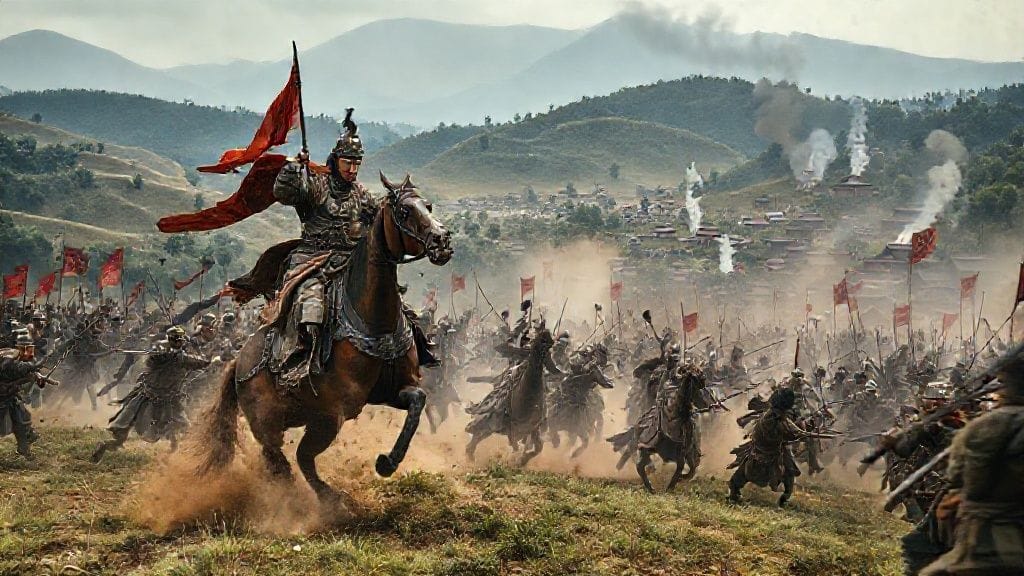
In 451, Attila invaded Gaul with a coalition army, drawing in subject and allied peoples. Cities trembled; bishops begged for divine protection; refugees streamed southward. It was in this crisis that Aetius stepped fully into the role that later generations would romanticize. He forged an alliance with the Visigothic king Theodoric I, long a foe and uneasy neighbor, as well as with other federate forces. Together, Roman and barbarian marched to meet Attila on the plains of northeastern Gaul, near a place later known as the Catalaunian Fields.
The battle that followed was brutal, chaotic, and decisive enough to halt Attila’s drive into Gaul. Ancient sources, such as Jordanes, portray it as one of the great clashes of the age, with tens of thousands dead and the fate of Western civilization at stake. While modern historians debate the exact scale of the engagement, its symbolic importance is undeniable. Aetius emerged as the man who had faced down Attila and survived. The empire’s supporters could breathe—if not easily, then at least more hopefully.
Attila would invade Italy the next year, in 452, ravaging cities but ultimately withdrawing, his forces weakened by famine, disease, and diplomatic pressures. Aetius’s role in organizing defenses and negotiating this perilous moment further solidified his standing. For Valentinian, however, each triumph of his general deepened the imbalance in their partnership. Rome’s survival was increasingly linked with the name of Aetius, not of the emperor.
Later chroniclers, such as the 6th-century historian Procopius, would look back and see in Aetius’s deeds the final flicker of Roman martial greatness in the West. Some even called him “the last of the Romans,” a title both admiring and elegiac. Knowing that, the phrase valentinian iii murders aetius takes on a darker hue: it is not merely a sovereign eliminating a rival, but a civilization extinguishing one of its last effective defenders.
When Attila died in 453, his empire crumbled quickly, fragmented by internal disputes. The most terrifying external menace to the West faded, at least for a time. But instead of marking the beginning of a Roman recovery, this reprieve exposed the internal fractures that external danger had temporarily concealed. With the Huns less threatening, Valentinian felt less dependent on Aetius. The general’s indispensability—the shield that had long protected him—now looked, to the emperor’s anxious mind, like a prison gate he needed to break.
Whispers in the Palace: Court Intrigue and the Road to Betrayal
As soon as the shadow of Attila receded, the shadow of suspicion in Ravenna grew longer. The court, always a hive of rumor, turned even more febrile. Embassies came and went. Senators from Rome arrived with grievances and proposals. Bishops offered counsel, cloaked in pious language but often laced with political intent. Eunuchs and chamberlains jockeyed for influence, each seeking to place themselves as the trusted intermediary between emperor and world.
Heraclius, the influential eunuch, emerges in several accounts as a key figure in the final phase of tension between Valentinian and Aetius. He and others in his circle feared that if Aetius remained supreme, their own positions would be doomed. Some likely recalled earlier episodes in imperial history when powerful generals deposed weak emperors and seized the throne. Whether Aetius actually harbored such ambitions is uncertain, but his power made the fear plausible enough to wield as a political weapon.
Then there were financial disputes. The Western Empire’s resources were dwindling, and debates over taxation, distribution of land, and military pay grew more bitter. Aetius, who oversaw military logistics, had enormous leverage over the flow of money and supplies. His enemies seized on any irregularity or delay as evidence of corruption, disloyalty, or preparation for a coup. The emperor, hungry for greater personal control over finances and anxious about the general’s autonomy, listened.
Marriage politics sharpened matters further. There was talk that Aetius sought to marry his son, Gaudentius, to one of Valentinian’s daughters, perhaps Eudoxia or Placidia. Such a union would have bound Aetius’s family intimately to the imperial line, potentially positioning his descendants as heirs to the throne. To some, this seemed a reasonable strategy for stabilizing the regime through alliance. To Valentinian, whose sense of dynastic privilege was acute, it might have appeared like the first step toward displacing his own blood.
In this suffocating atmosphere, every gesture became ammunition. If Aetius delayed in obeying a summons, it might be read as insolence. If he brought too many armed followers to court, it was interpreted as intimidation. Conversely, if he arrived lightly escorted, it might be seen as a sign of overconfidence or as an opportunity for his enemies. To live so close to the center of power was to live under a constant, invisible sword.
Ancient chroniclers tell us that advisers repeatedly warned Valentinian that Aetius was a danger. According to one later account, a counselor is said to have told the emperor, “If you wish to live, Caesar, it is necessary that you kill Aetius.” It is in this kind of stark, brutal advice that we hear the drumbeat leading to the moment when valentinian iii murders aetius with his own hands. Whether those exact words were spoken, the logic behind them—kill or be killed—had clearly taken root in the imperial mind.
The emperor, long conditioned to see betrayal everywhere, began to accept that logic. Aetius had been the empire’s savior, but now he was framed as its would-be master. The stage was set for a fateful audience in the palace at Ravenna, one that both men likely saw as another in a long series of tense, complex meetings. Only one of them would leave it alive.
The Day Steel Flashed in the Palace: How Valentinian III Murders Aetius
The date was September 21, 454. In Ravenna, the air was still heavy with the residual warmth of late summer. Delegations and officials came and went through the palace gates, each bearing petitions, reports, or pleas. Aetius, too, had business there: matters of finance and administration, according to later sources. It was, outwardly, just another day in the life of an emperor and his foremost general.
Valentinian had summoned Aetius to a meeting in the palace. Present in the chamber, we are told, were the emperor’s close attendants, among them the eunuch Heraclius and possibly other high-ranking courtiers. The general entered expecting a discussion, perhaps a contentious one, about budgets, troops, or strategy. If he suspected a trap, he did not bring enough armed men to deter it. Perhaps he trusted the sanctity of the imperial audience. Perhaps, after surviving so many dangers on distant frontiers, he could not imagine that the deadliest threat awaited him in a polished hall of marble and gold.
The precise sequence of words exchanged that day is lost, but the gist survives. Valentinian accused Aetius of various misdeeds—embezzlement, plotting, ambitions beyond his station. Aetius, a seasoned veteran unused to bowing before civilian criticism, may have defended himself bluntly, perhaps even with scorn. Tempers flared. And then, in a moment that would echo through history, the emperor acted.
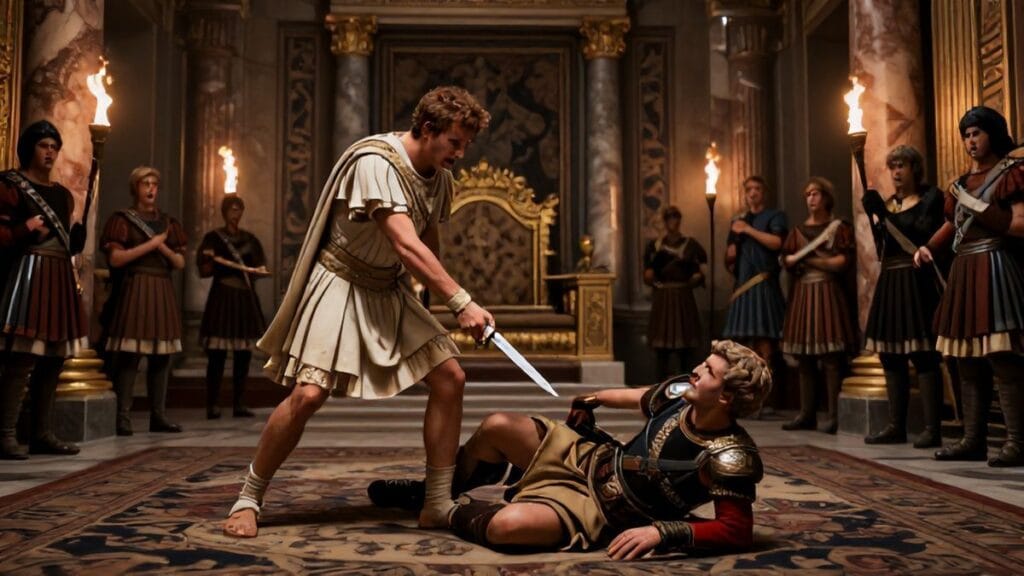
Drawing a weapon—some sources say a sword, others a knife—Valentinian III lunged at his general. It was not a judicial execution; it was a personal, sudden attack. The emperor’s attendants joined in, striking Aetius as well. Surprised, unarmed, or at least unprepared, the great general could not defend himself. In short order, Flavius Aetius, the man who had stood against Attila, lay bleeding on the floor of his emperor’s chamber, his life spent not on a battlefield but in an imperial office.
One later historian, John of Antioch, preserves a bitterly famous remark. When asked afterward by a courtier what he had done, Valentinian is said to have boasted that he had “cut off his right hand with his own left.” Whether the words were truly spoken or crafted later as a moral commentary, they capture the essence of the act: in killing Aetius, the emperor had maimed his own power.
Thus, in a single, brutal moment, valentinian iii murders aetius and with him destroys the last major figure capable of organizing the West’s defenses. There was no trial, no formal condemnation, only the raw assertion of imperial prerogative manifested in a stabbing. The scene, shocking even by the standards of Roman political violence, revealed how far the empire had slid from the institutional norms it once prided itself on. The emperor, who should have been the embodiment of law, had become its violator.
Blood soaked the polished floor. The courtiers, some complicit, others stunned, watched as guards carried away the corpse of the man upon whom, until that very hour, their security had rested. Outside, the city carried on for the moment, unaware that within those walls, the fragile balance that had kept the Western Empire upright had been shattered beyond repair.
Shockwaves through the Empire: Aftermath in Ravenna and Beyond
Word traveled swiftly, as such news always does. By the next day, if not the same afternoon, Ravenna’s elite knew: Aetius was dead, killed by the emperor himself. Reactions were mixed—some privately rejoicing, others genuinely horrified—but almost all were tinged with fear. If a man of Aetius’s standing could be struck down without warning, what safety did any of them truly possess?
The army’s response was critical. Aetius had commanded loyalty from many officers and soldiers, some of whom had served under him for years in Gaul and Italy. They had shared hardships, victories, and narrow escapes. To them, the news that valentinian iii murders aetius was more than court gossip; it was the sudden decapitation of their chain of command. Some were too far away to react immediately, but those closer to the capital seethed.
Valentinian attempted to present the killing as a necessary act of justice and self-preservation. He cited alleged plots and financial misdeeds, framing Aetius as a traitor who had misused his trust. Yet many were unconvinced. They saw no formal proceedings, no evidence, only a burst of imperial rage channeled into violence. The emperor’s moral authority, already strained, suffered a severe blow. In politics as in war, perception can be more important than facts, and the prevailing perception was damning.
Certain members of the Senate in Rome, who had long distrusted the general, may have initially welcomed his removal. But joy was tempered by anxiety. Without Aetius to hold the frontiers and manage alliances, who would protect their estates, their tenants, their very lives? The Vandals in North Africa still menaced the sea lanes. The Visigoths and other federates in Gaul remained powerful and restive. The Hunnic confederation had fractured, but its warriors had not vanished from the European landscape. The idea that the emperor would now personally direct these complex military affairs was met, in many circles, with incredulity.
In the provinces, reactions were more distant but no less important. Governors and local magnates, hearing of the assassination, had to reconsider their calculations. Should they maintain loyalty to a court that acted so capriciously? Should they seek new patrons among local strongmen or barbarian kings? Each such decision, multiplied across countless towns and estates, chipped away at what remained of central authority.
Within the palace, the immediate victors appeared to be Valentinian and his closest advisers, especially Heraclius. They had eliminated a rival and tightened their grip. Yet even as they celebrated, darker currents gathered. Among the late Aetius’s circle of officers and allies, anger burned hot. Two of them, in particular—Optila and Thraustila—would soon choose revenge over resignation, setting in motion the next act of the tragedy.
The Assassination of an Emperor: Valentinian’s Own Violent End
Less than a year after the day valentinian iii murders aetius, blood once again stained imperial robes—this time the emperor’s own. On March 16, 455, Valentinian rode out to the Field of Mars in Rome to practice archery, surrounded by a small retinue. He had moved from Ravenna to Rome, perhaps attempting to reconnect with the old capital, perhaps seeking to project an image of confidence and normalcy after the general’s death.
As he dismounted to watch the exercises, men approached him—perhaps familiar faces in the crowd, armored but not obviously hostile. Among them, according to several sources, were Optila and Thraustila, former retainers of Aetius. They had not forgotten their commander’s murder, nor forgiven the emperor who had ordered and performed it.
In a sudden, carefully timed assault, they turned on Valentinian. Swords drawn, they attacked the emperor before his guards could form a proper line of defense. Struck repeatedly, Valentinian fell to the ground mortally wounded. The emperor who had personally stabbed his most powerful general now died in a similarly brutal, intimate fashion—cut down at close quarters, in broad daylight, by men who saw themselves as avenging a great wrong.
Heraclius, the eunuch whose influence had helped bring about Aetius’s death, was killed as well, his blood mingling with that of the emperor he had served. For many onlookers, the killings must have seemed not just shocking but uncannily fitting: a grim symmetry in which the hand that struck down Rome’s defender was itself struck down in turn. Later writers, such as the chronicler Hydatius, could not resist framing the sequence as divine retribution, a moral narrative imposed upon the chaos of political violence.
With Valentinian’s body cooling on the Field of Mars, the Western Empire lost its legally anointed ruler. There was no strong successor waiting in the wings, no clear plan for transition. The imperial court, already shaken by Aetius’s assassination, now plunged into a vortex of uncertainty. In quick succession, new emperors would be proclaimed, installed, and toppled, often with the backing of barbarian kings or powerful generals. The continuity that had once been Rome’s greatest strength vanished in a haze of coups and foreign interventions.
When we place the two murders side by side—first Aetius by Valentinian, then Valentinian by Aetius’s men—the narrative assumes the quality of a tragic cycle. Each act of violence, meant to secure power, instead deepened instability. Each attempt to eliminate a perceived threat only created new ones. The empire, in effect, was tearing itself apart faster than its enemies could destroy it from without.
The Collapse Accelerates: Political, Social, and Military Consequences
The murders of Aetius and Valentinian did not single-handedly cause the fall of the Western Roman Empire; the processes of decline were already long in motion. Yet these killings acted as accelerants, stripping away the last remnants of effective centralized leadership and plunging the state into a final, fatal spiral.
Politically, the vacuum at the top was glaring. After Valentinian’s death, Petronius Maximus seized the throne, but his reign lasted barely two and a half months. He lacked the military backing or moral stature to unify the empire. In a move that would have seemed shocking even in calmer times, he compelled Valentinian’s widow, Licinia Eudoxia, to marry him, hoping to legitimize his rule through association with the Theodosian dynasty. Instead, this action alienated segments of the court and, according to some accounts, led Eudoxia to call upon the Vandals for help.
In June 455, the Vandal king Geiseric sailed to Italy and captured Rome itself. Over fourteen days, his forces plundered the city in an event remembered as the Vandal Sack of Rome. While the exact scale of destruction has been debated, the psychological impact was catastrophic. The eternal city, though sacked before by the Goths in 410, suffered another massive humiliation. Wealth, sacred objects, and captives—including members of the imperial family—were carried off to North Africa.
Could Aetius have prevented this disaster had he lived? No one can say with certainty, but the question haunts the historical imagination. At minimum, his experience and authority might have offered a more coherent defensive strategy than the improvisations of a rapidly rotating cast of lesser men. As it was, the empire confronted its enemies leaderless and fractured.
Socially, the erosion of central power accelerated the drift toward regionalism. Local elites, faced with the unreliability of distant emperors and generals, increasingly entrusted their protection and interests to nearby strongmen—sometimes Roman, often barbarian. The concept of a unified Roman citizenry, bound together under a single political order, weakened. In its place emerged a patchwork of alliances and loyalties that would, in time, form the basis of medieval polities.
Militarily, the consequences were perhaps the most immediate. Aetius had spent decades cultivating relationships with federate groups and balancing one barbarian people against another. With his death, many of these arrangements unraveled. Commanders lacked his personal authority and knowledge. Some federate troops deserted; others shifted their allegiance to rising kings beyond imperial borders. The Western army, already stretched thin, became even less capable of coordinated action.
When we say that valentinian iii murders aetius, then, we are not simply recounting a personal betrayal. We are describing an act that fractured the fragile lattice of agreements and loyalties holding an entire political-military system together. Without Aetius, there was no one powerful enough—and respected enough—to play the role of broker, defender, and negotiator across the empire’s many frontiers.
Within just two decades of these events, the last Western emperor, Romulus Augustulus, would be deposed in 476 by the Germanic leader Odoacer. The imperial title survived in the East at Constantinople, but in the West, the Roman Empire as a political unit ceased to exist. Historians may argue about turning points, but few can deny that the murders in 454 and 455 mark a decisive downward lurch on the path to that end.
The Human Stories: Fear, Loyalty, and Loss in a Dying Empire
Grand narratives of imperial rise and fall often obscure the experience of ordinary people. Yet beneath the abstractions—“the Western Empire collapses,” “Rome falls”—were countless men and women whose lives were shaped, and sometimes shattered, by these events.
Consider the soldiers who had fought under Aetius at the Catalaunian Fields. Many of them were not Romans in the old sense at all: they were Goths, Franks, Alans, and others, settled within the empire and bound to it by service. Their loyalty was personal and practical. They followed Aetius because he paid them, led them competently, and honored their valor. When they learned that valentinian iii murders aetius in a moment of palace treachery, how many felt that the empire they had bled for no longer deserved their faith?
Or think of the landowners in Gaul and Italy, overseeing estates that had endured through decades of turmoil. Aetius’s policies, harsh as they sometimes were, at least offered a degree of predictability. They knew whom to bribe, whom to petition, to whom to offer their sons as officers. After his death, the lines of authority grew more tangled, the demands more arbitrary. Some of these elites would, within a generation, be swearing oaths not to Roman emperors but to barbarian kings.
In the cities, artisans and traders felt the change as disruptions in markets, sudden spikes in taxes, or the arrival of unfamiliar troops. The sack of Rome in 455 was not merely a symbolic blow; it meant looted shops, violated homes, and families dragged away in chains. Among the captives Geiseric carried off were members of the imperial household, but also anonymous men, women, and children whose personal tragedies never made it into the chronicles.
Religious figures, too, grappled with the meaning of it all. Bishops preached sermons interpreting these disasters as divine judgments or tests of faith. Some saw the assassination of Aetius as punishment for pride; others viewed Valentinian’s own death as retribution for his earlier crime. In a world where theology and politics intertwined, the fact that the empire’s last great general had been killed by his Christian emperor raised unsettling questions about the nature of authority and the justice of God.
In private letters and local records that survive only in fragments, we catch brief glimpses of these human responses: fear, anger, resignation, hope that some new order might bring stability, and nostalgia for a past that perhaps never existed in the golden hues memory bestowed upon it. The narrative in which valentinian iii murders aetius is not only a story of toppling regimes; it is a story of trust shattered, communities displaced, and futures foreclosed.
Even those closest to the center of power were not immune. Valentinian’s own family suffered immensely: his widow remarried unwillingly, his daughters were used as bargaining chips in the diplomacy of the Vandals, and the imperial dignity they had been raised to embody was dragged through the mud of political expediency. For them, the murder in Ravenna and the assassination in Rome were not historical turning points but intimate traumas, lived in real time.
Memory, Blame, and Legend: How Later Generations Judged the Murder
In the centuries that followed, the episode in which valentinian iii murders aetius took on an almost mythic quality in the historical imagination. Medieval chroniclers, Renaissance scholars, and modern historians alike have returned to it as a symbol of political folly, moral blindness, and the self-destruction of empires.
Ancient and early medieval writers tended to view events through a strongly moral lens. To them, the murder of Aetius was a clear-cut crime, one that invited divine retribution. Hydatius, a contemporary bishop in Hispania, saw in the sequence of killings a pattern of punishment: the emperor had violated the natural order by murdering his protector, and God had swiftly allowed him to be struck down in turn. For such authors, the lesson was obvious: rulers who abandon justice and prudence invite disaster.
Later historians, such as the 6th-century Procopius or the Gothic historian Jordanes, folded the story into larger narratives of Rome’s decline and the rise of barbarian powers. Aetius was portrayed as the last bulwark against chaos, his death signaling the final unravelling. These accounts often idealized him, smoothing over his own ruthlessness and political maneuvering to cast him as a tragic hero undone by a weak and jealous emperor.
Modern scholars have been more cautious. They scrutinize the sources, aware of their biases and gaps. Was Aetius truly as loyal and selfless as some later traditions suggest? Or did he, too, harbor ambitions that threatened the throne? Was Valentinian driven solely by paranoia, or did he reasonably fear that his general’s power might one day be turned against him? The answers remain elusive, in part because the surviving evidence is sparse, contradictory, and often colored by the agendas of those who wrote it.
Still, certain assessments recur. Many historians agree that, whatever Aetius’s personal flaws, his removal at that particular moment was disastrously timed. The West lacked any comparable figure with his combination of experience, connections, and authority. In that sense, the act by which valentinian iii murders aetius appears as an extreme example of short-term thinking at the expense of long-term survival.
Popular culture, when it has touched upon this era, tends to favor vivid characters and stark contrasts. Aetius is cast as the rugged last champion of Rome; Valentinian as the decadent, cowardly emperor who destroys what he most needs. Such portrayals may oversimplify, but they speak to a deep narrative instinct: the desire to locate in individuals the causes of great historical shifts. It is easier to blame one jealous emperor than to grapple with the complex web of social, economic, and demographic forces that also drove the empire’s decline.
Two modern works of scholarship, for example—though differing in many details—both highlight the emblematic nature of the murder. In one, the historian J. B. Bury characterizes the killing of Aetius as “a blunder so ruinous that it has few parallels in history,” while another, A. H. M. Jones, notes that the general’s death “removed the linchpin of what remained of Western authority.” These assessments, while cautious in tone, echo the moralizing thrust of much older accounts: this was not just a crime; it was a catastrophic mistake.
From Ravenna to Rome’s Ruin: The Long Echo of a Single Blade
When we draw a line from the polished floor of the Ravenna palace where Aetius fell to the battered walls of Rome in 455 and then onward to the deposition of Romulus Augustulus in 476, the path appears almost preordained. But history is never so linear. Countless contingencies, choices, and accidents shape each moment. Yet even amid that complexity, the decision by which valentinian iii murders aetius stands out as a pivot around which many subsequent disasters turned.
Imagine a counterfactual: Aetius survives. Perhaps he and Valentinian reach a new accommodation; perhaps the emperor, recognizing his dependency, tolerates the general’s ascendancy. In that scenario, it is possible—though far from guaranteed—that the Western Empire might have endured a bit longer, that the sack of 455 might have been averted, that the transfer of power to barbarian kings could have been slowed or negotiated under more favorable terms. The Roman state, as a recognizable entity, might have faded rather than crashed.
Instead, the emperor chose the path of immediate, personal relief over strategic patience. By killing Aetius, he freed himself—from tutelage, from fear, from the daily reminder of his own dependence. But he also freed Rome’s enemies from their most formidable opponent. The empire’s fate did not change in that instant, but the margins within which it could maneuver shrank dramatically.
The echo of that choice reverberated through subsequent decades. Every failure to mount a coordinated defense, every botched succession, every local capitulation to barbarian leaders carried within it, in some small way, the absence of Aetius’s guiding hand. Of course, no single man, however talented, could permanently arrest the massive structural decline of the Western Roman state. But great individuals can bend trajectories for a time, and Aetius had been such an individual. Without him, the descent steepened.
The story’s symbolic power extends beyond Late Antiquity. Politicians, generals, and thinkers in later centuries have sometimes invoked the episode as a cautionary tale about rulers who destroy their most capable servants out of jealousy or fear. It has served as a metaphor for institutions that sabotage their own best elements, for organizations that purge dissenting voices only to discover they have silenced their last defenders.
In this sense, the scene in which Valentinian drew his weapon and struck Aetius is more than a historical anecdote. It is an enduring image of self-destructive power: the hand that cuts off its own right, the leader who confuses personal comfort with the common good. The Western Roman Empire, already weakened by decades of crisis, could ill afford such folly. When it indulged in it, the end, though not instantaneous, moved into clearer view.
Historians at Work: Sources, Bias, and the Problem of the Past
Reconstructing the moment when valentinian iii murders aetius is not a simple matter of reading a single authoritative account. Our knowledge of these events comes from a patchwork of sources, each with its own perspective, gaps, and agendas. Understanding these limitations is essential if we are to treat the story not as legend but as history.
Key sources include chroniclers like Hydatius, writing in Hispania; the later historian John of Antioch; and fragments preserved in Byzantine compilations. These accounts provide basic outlines: the date and place of the murder, the involvement of the emperor and his attendants, the broad political context. Yet they often differ in details and emphasize different moral lessons. Some focus on the divine punishment that followed; others linger on the personalities involved.
There are also legal codes, letters, and administrative documents from the period that, while not narrating the murder directly, help us understand the political and economic environment in which it occurred. Archaeological evidence—from coin hoards to the remains of fortifications—adds further texture, revealing patterns of instability, depopulation, and shifting centers of power that framed the choices of Valentinian and Aetius.
Modern historians, such as R. W. Mathisen and Peter Heather, compare and contrast these ancient testimonies, weighing their credibility and cross-checking them against material evidence. They ask difficult questions: To what extent did later Christian moralizing shape the image of Valentinian as a villain and Aetius as a near-saint? How much of the narrative is retrospective storytelling, arranging messy events into a neat pattern of sin and punishment? Where might ancient authors have exaggerated, omitted, or misunderstood?
Citation within this field often reflects scholarly debates. For instance, Peter Heather, in his studies of the late empire, emphasizes the immense structural pressures bearing down on the West—economic, demographic, and military—arguing that while Aetius’s death was tragic, it did not alone doom the empire. On the other hand, J. B. Bury, in his classic “History of the Later Roman Empire,” underscores the tactical catastrophe of removing the one man capable of managing those pressures, calling the assassination a critical misstep (Bury, History of the Later Roman Empire, vol. I).
Such works remind us that every retelling is an interpretation. Even the stark phrase “Emperor Valentinian III murders General Aetius” implies a certain framing, one that highlights agency, culpability, and hierarchy. Some scholars prefer to speak of “the assassination of Aetius” to avoid casting the emperor as a lone, conscious villain and instead emphasize the broader environment of intrigue and fear that shaped his choice.
Ultimately, our understanding remains provisional. New interpretations emerge, old assumptions are questioned, and the thin thread of surviving evidence is reread in the light of fresh questions. Yet even acknowledging these uncertainties, the core remains remarkably consistent across centuries of scholarship: Aetius was killed by his emperor in 454; the act was widely regarded as unjust and foolish; and it came at a moment when the West could least afford such internal bloodletting.
Why the Murder Still Matters: Power, Fragility, and Human Blindness
Why does the story of how valentinian iii murders aetius continue to fascinate us today? After all, the Roman Empire is long gone, its palaces in Ravenna and Rome reduced to archaeological sites and tourist attractions. Yet the themes embedded in this episode are anything but ancient. They speak to enduring truths about power, leadership, and the ways human beings misjudge their own interests.
At one level, the episode illustrates the perennial tension between rulers and their most capable subordinates. A strong leader must delegate authority, yet in doing so creates potential rivals. A weak leader may be tempted to eliminate those whose competence makes his own inadequacy visible. The challenge lies in balancing trust and vigilance without descending into paranoia. Valentinian failed that test catastrophically.
The story also highlights the fragility of complex systems. The Western Roman Empire in the mid-5th century was not a monolith; it was a web of agreements, institutions, and personal relationships. Aetius, for all his flaws, served as a key node in that web. Removing him did not yield a vacuum to be easily filled; it caused strands to snap in unpredictable ways. Modern states and organizations, just as reliant on a few critical individuals or institutions, can suffer similar shocks when those linchpins are abruptly removed.
There is, too, a psychological dimension. Valentinian’s decision seems, from a distance, almost suicidally irrational. Yet from his vantage point, shaped by years of fear and flattery, it may have appeared as the only path to safety. This gap between perception and reality—between what feels necessary in a moment of anxiety and what proves disastrous in the long run—is a human constant. Leaders today, no less than in the 5th century, are vulnerable to echo chambers, manipulation, and the distortions of their own insecurity.
Finally, the story challenges us to consider responsibility in times of decline. It is comforting to blame collapse on external enemies: the Huns, the Vandals, the Visigoths. But the tale of how Emperor Valentinian turned his blade on his own defender forces us to look inward, at the ways societies can undermine their own resilience through shortsightedness, infighting, and the sacrifice of competence to comfort.
In that sense, the muffled sounds that echoed through the Ravenna palace on September 21, 454, are not merely the dying gasps of one man or one empire. They are a warning, carried across centuries, about what happens when leaders confuse personal control with collective strength, and when fear of losing power outweighs the duty to use it wisely.
Conclusion
On a misty day in Ravenna in 454, imperial ceremony and private terror collided. Valentinian III, a ruler shaped by childhood vulnerability and adult insecurity, confronted Flavius Aetius, the hardened general who had long propped up his faltering empire. In a moment of violence that shocked contemporaries and still grips the historical imagination, valentinian iii murders aetius and, in so doing, cripples his own regime.
The act cannot be understood in isolation. It sprang from years of uneasy partnership, court intrigue, shifting alliances, and deep structural crises afflicting the Western Roman Empire. Aetius, forged on the frontiers and in the camps of barbarians, had become the empire’s last great field commander, balancing hostile kingdoms, federate troops, and internal rivals. His death, followed swiftly by the assassination of Valentinian himself, removed the final supports of a system already tottering on the edge.
The consequences were profound: intensified political instability, accelerated military disintegration, and the rapid erosion of central authority. Within a year, Rome would endure another devastating sack; within a generation, the Western imperial title would vanish altogether. While many long-term forces drove this collapse, the murder in Ravenna stands as a crystallizing moment when human fear and folly hastened the inevitable.
Beyond its historical particulars, the story offers enduring lessons. It shows how leaders, blinded by jealousy or anxiety, can destroy the very people and institutions on which their survival depends. It reminds us that complex systems often hinge on a few critical figures whose removal can unleash cascading failure. And it forces us to reckon with the uncomfortable truth that empires, like individuals, are often undone not only by their enemies but by their own hands.
FAQs
- Who was Flavius Aetius?
Flavius Aetius was a powerful Roman general and statesman of the 5th century, often called “the last of the Romans.” Born on the Danube frontier and once a hostage among both Goths and Huns, he rose to become magister militum (master of the soldiers) in the Western Roman Empire. He is best known for leading a coalition of Romans and Visigoths against Attila the Hun at the Battle of the Catalaunian Fields in 451, halting Attila’s advance into Gaul. For decades, Aetius was effectively the empire’s chief defender and political strongman. - Why did Emperor Valentinian III kill Aetius?
Valentinian III killed Aetius out of a mixture of fear, jealousy, and political manipulation by court advisers. Aetius’s military power and prestige overshadowed the emperor, leading Valentinian to suspect that his general might one day seize the throne or control the succession through marriage alliances. Influential courtiers, such as the eunuch Heraclius, fed these suspicions, portraying Aetius as a threat to the emperor’s life and authority. Convinced that it was a matter of “kill or be killed,” Valentinian stabbed Aetius during an imperial audience in Ravenna on September 21, 454. - How did Aetius’s death affect the Western Roman Empire?
Aetius’s death removed the last experienced and broadly respected military leader capable of coordinating the empire’s defense and managing its complex network of barbarian federates. Without him, the Western court struggled to respond effectively to threats, including the Vandals in North Africa and various groups in Gaul and Spain. Political instability worsened, culminating in the assassination of Valentinian III in 455 and subsequent rapid changes of ruler. Many historians regard Aetius’s murder as a decisive blow that accelerated the Western Empire’s decline. - Was Valentinian III’s assassination connected to Aetius’s murder?
Yes. Valentinian III’s assassination in 455 was directly linked to his earlier killing of Aetius. The emperor was murdered in Rome by two former retainers of Aetius, Optila and Thraustila, who acted in revenge for their commander’s death. They attacked Valentinian while he observed military exercises on the Field of Mars, killing him and the courtier Heraclius. Contemporary and later observers saw this as an act of retribution, even divine justice, for the emperor’s betrayal of his greatest general. - Did Aetius plan to usurp the throne?
The evidence is inconclusive. Some ancient sources and modern historians suggest that Aetius may have pursued a marriage alliance between his son and one of Valentinian’s daughters, potentially positioning his family close to the imperial succession. This could be interpreted as ambition toward the throne, though it might also have been a pragmatic attempt to stabilize the regime. There is no clear proof that Aetius was actively plotting a coup, and many scholars believe that court intrigue exaggerated his intentions to justify the emperor’s fears. - What role did Attila the Hun play in Aetius’s career?
Attila was both a former associate and later a formidable adversary of Aetius. As a young man, Aetius spent time as a hostage among the Huns, learning their language and gaining familiarity with their leaders. Later, as magister militum, he used his connections with the Huns as part of his strategy to balance various barbarian groups. When Attila invaded Gaul and Italy in the 450s, Aetius became the key figure organizing Roman resistance and allied forces against him, particularly at the Catalaunian Fields, a victory that greatly enhanced his prestige. - Where did the murder of Aetius take place?
The murder of Aetius occurred in the imperial palace at Ravenna, which served as the capital of the Western Roman Empire at the time. Ravenna, located on the Adriatic coast amid marshes and lagoons, was chosen as a capital in part because of its defensible position. Despite its apparent security from external attack, the palace proved lethal to Aetius, who was killed not on the battlefield but in the supposed safety of an imperial audience chamber. - How reliable are the historical sources about the murder?
The main sources—chroniclers like Hydatius, John of Antioch, and later historians such as Procopius—provide consistent outlines of the event but differ in details and interpretation. They often write with strong moral or religious agendas, portraying the murder as an obvious injustice leading to divine punishment. Modern historians treat these accounts critically, cross-referencing them with legal texts, inscriptions, and archaeological evidence. While some specifics remain uncertain, the core facts—that Valentinian killed Aetius during an audience in 454 and was himself killed in 455 by Aetius’s former followers—are widely accepted. - Did the murder of Aetius cause the fall of the Western Roman Empire?
It did not cause the fall by itself, but it was a significant contributing factor. The Western Empire was already under severe strain from economic difficulties, military pressures, and political fragmentation. Aetius’s death removed a key stabilizing figure at a critical moment, making it harder for the empire to respond to crises like the Vandal sack of Rome in 455. Most historians see the murder as an important turning point that accelerated an ongoing process of decline, rather than a single, isolated cause of collapse. - Why is this event still studied today?
The murder of Aetius by Valentinian III continues to draw attention because it encapsulates broader themes of political power, leadership failure, and institutional fragility. It offers a vivid case study of how personal insecurity and court intrigue can lead rulers to sabotage their own survival. The episode also serves as a symbolic moment in the story of Rome’s fall, prompting reflection on how great states come apart from within as well as from external pressures. For historians, it remains a rich field for exploring the interplay of personality, structure, and chance in history.
External Resource
Internal Link
Other Resources
- Encyclopaedia Britannica – general search for the exact subject
- Google Scholar – academic search for the exact subject
- Internet Archive – digital library search for the exact subject