Table of Contents
- Twilight in Athens: A World on the Eve of Closure
- From Plato’s Garden to Imperial Edict: How the Academy Was Born
- Neoplatonists of Late Antiquity: Mystics, Mathematicians, and Guardians of a Tradition
- Athens under Christian Emperors: A Pagan Island in a Christian Sea
- Justinian’s Sacred Empire: Law, Faith, and the Quest for Unity
- The Road to 529: Laws, Anxieties, and Pressure on Pagan Learning
- When justinian closes the neoplatonic academy: The Edict and Its Immediate Shock
- The Philosophers in Exile: Damascius, Simplicius, and the Road to Persia
- At the Court of Khosrow: A Brief Philosophical Asylum in Ctesiphon
- Return without a Home: Silent Legacies of the Last Athenian Platonists
- The End of an Era, Not of an Idea: How Platonic Thought Survived
- From Academy to Monastery: How Christian Thinkers Rewrote the Intellectual Map
- Echoes in the Islamic Golden Age: Plato and Aristotle in New Tongues
- Renaissance Reverberations: Humanists, Manuscripts, and the Ghost of Athens
- Was 529 Really “The End of Antiquity”? Debating a Convenient Date
- The Human Cost: Students, Teachers, and a City without Its School
- Memory, Myth, and Misunderstanding: How Later Ages Told the Story
- Conclusion
- FAQs
- External Resource
- Internal Link
Article Summary: In 529 CE, when justinian closes the neoplatonic academy in Athens by imperial decree, a thousand-year-old tradition of philosophical teaching met its abrupt political end. This article traces the Academy’s journey from Plato’s humble garden to its last Neoplatonist guardians, who blended rigorous logic with mystical theology at the fringes of a Christianizing empire. It situates Justinian’s act within his wider project of religious and legal unity, showing how the closure was less a sudden stroke of intolerance than the climax of long-building pressures on pagan institutions. Yet, as we follow the exiled philosophers to the court of the Persian king and back again, we see that ideas traveled farther than their teachers, slipping into Christian theology, Islamic philosophy, and eventually the European Renaissance. Through narrative and analysis, we ask what it really meant that justinian closes the neoplatonic academy, and whether 529 truly marks the death of ancient philosophy or merely a change in its costume. Along the way, we explore the human consequences for students, teachers, and a city losing its intellectual heartbeat. By the end, the story reveals how an act of imperial suppression became, paradoxically, a catalyst for the wider diffusion and transformation of the Platonic heritage. It’s a story not only about an edict, but about the resilience of thought when institutions fall.
Twilight in Athens: A World on the Eve of Closure
In the spring of 529, the streets of Athens did not fall silent overnight. Merchants still argued over prices in the Agora, olive presses still groaned at the edge of the city, and the Acropolis still cast its familiar shadow as the sun slid toward the Saronic Gulf. Yet beneath this mundane rhythm, something ancient was slipping away. For nearly a millennium, young men had come to Athens not only to admire its statues and ruins, but to sit at the feet of philosophers, to learn how to reason, to contemplate the soul and the cosmos. Now, under the authority of an emperor hundreds of miles away in Constantinople, that long conversation was about to be forcibly interrupted.
The moment when justinian closes the neoplatonic academy did not look like a grand spectacle. There were no burning libraries, no public bonfires of scrolls. Instead, there was an imperial law—one more in a long series—issued in Latin and Greek, carried by couriers, discussed in hushed tones in the colonnades. It commanded that those who still taught the “pagan” philosophies of the old gods could no longer enjoy the protection and legitimacy of the state. Without subsidies, without legal status, and under increasing religious suspicion, the last circle of Athenian Neoplatonists faced an impossible choice: convert, silence themselves, or leave.
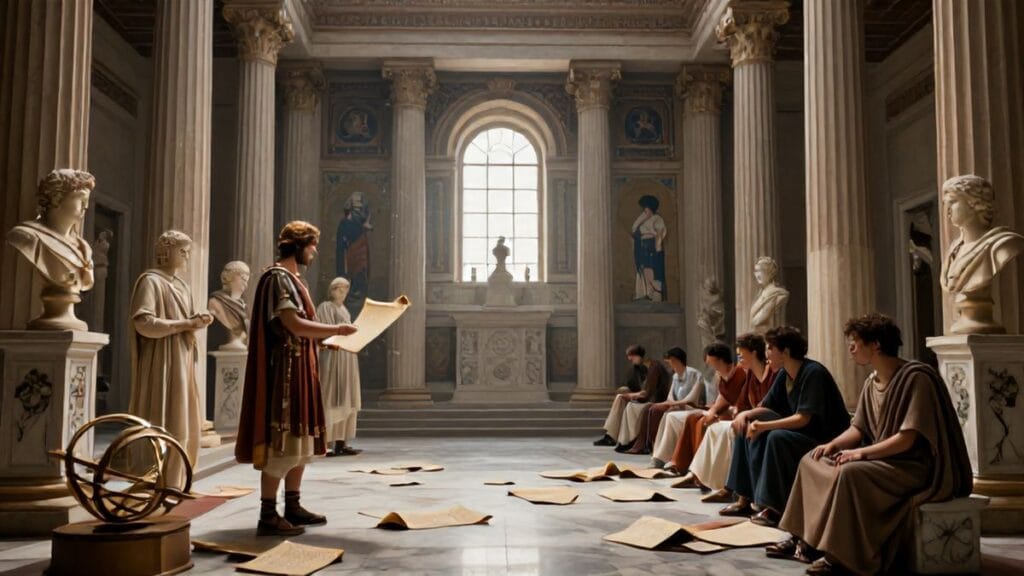
Imagine, for a moment, a young student from a provincial city—perhaps from Asia Minor, perhaps from Egypt—who had arrived in Athens just months earlier. He had heard of the old Academy since childhood, had copied lines from Plato and Aristotle, had pictured the city as a kind of living museum of wisdom. He might have met Damascius or Simplicius, gray-headed men whose calm voices carried entire worlds of argument. Then word spread: the emperor’s new edict, the accusation that their school bred impiety, the warning whispers from Christian neighbors. The lesson that day might still have gone on, but every phrase would have been tinged with the knowledge that this could all vanish.
To understand why justinian closes the neoplatonic academy, and why this act still echoes across intellectual history, we need to step back into the deep time of Athens itself. The story is not only about a decree in 529; it is about how a small circle of thinkers in a cramped garden outside the city walls became a symbol of reason, skepticism, and metaphysical daring across centuries. It is about how that symbol came to be perceived as threatening in a world now governed by a different faith, a different set of political anxieties, and a different vision of unity.
But this was only the beginning. The closure of the Academy, often treated as a neat “end” to antiquity, opens up a more complex story of exile, translation, and transformation. The figures who walked away from Athens did not simply vanish; they carried books, notes, and above all, habits of thought. They would find new patrons in unexpected places, including the court of the Persian shah. They would leave traces in the writings of Christian theologians who condemned them, and in the Arabic philosophers who revered their ancient masters. When justinian closes the neoplatonic academy, he sets in motion not the extinction of Platonism but its scattering, like embers caught by the wind.
From Plato’s Garden to Imperial Edict: How the Academy Was Born
The Neoplatonic Academy that Justinian shut down in 529 liked to think of itself as the heir of a much older institution: the Academy founded by Plato around 387 BCE. The original Academy was not a university in the modern sense; it was a shady grove just outside the walls of classical Athens, dedicated to the hero Akademos, where Plato gathered students and interlocutors. There were no degrees, no official curriculum, but there was a shared pursuit: to question, to define, to test arguments in the light of reason.
Plato’s Academy survived him. His successors, like Speusippus and Xenocrates, refined and sometimes altered his teachings. The school evolved, veering into skepticism under Arcesilaus and Carneades, oscillating between dogmatic and questioning tendencies. Through war, political upheaval, and the shifting fortunes of the Hellenistic world, the Academy persisted as an idea: a place where philosophy could be pursued free from the immediate demands of politics or commerce, even if never entirely untouched by them.
Yet the physical continuity of Plato’s own Academy did not last. In 86 BCE, the Roman general Sulla besieged Athens during the Mithridatic War and devastated the city; according to later reports, the groves of the Academy were cut down for timber and siege works. The institutional line of scholarchs—the leaders of the Platonic school—had already become blurred. The old Academy, in a strict sense, died with the turbulent Hellenistic period. What survived was something less tangible and perhaps more enduring: the prestige of Plato’s name, the canonical authority of his dialogues, the cultural memory of a place where philosophy had once flourished.
When, centuries later, a new school of Platonists arose in Athens, its members claimed descent from Plato’s Academy. Historically, the connection was more spiritual than legal. The late antique “Academy” was not a continuous institution from the fourth century BCE; it was a revival, one among several centers of higher learning in the Greek-speaking East. Yet its teachers wrapped themselves in Plato’s mantle, reading his texts with almost religious devotion, constructing a complex metaphysical system that wove together logic, ethics, theology, and ritual. They were part of a philosophical movement that modern scholars call Neoplatonism, even though they would simply have called themselves Platonists.
By the time the Roman Empire adopted Christianity in the fourth century CE, this new Platonic tradition was already flourishing. Plotinus, Porphyry, Iamblichus, and Proclus—the major architects of Neoplatonism—did not all teach in Athens, but their works were read there with awe. They saw Plato not merely as a philosopher but as a divinely inspired sage whose texts concealed ascending levels of meaning. They read the myths of the dialogues as allegories of the soul’s journey, the cosmological passages as veiled theology of the One, the Intellect, and the World-Soul.
Thus, by late antiquity, “the Academy” had become both a place and a myth. It was a school in Athens with real teachers and paying students; it was also the symbol of a continuous philosophical lineage running from Plato through generations of interpreters. To end such a school would be, in the eyes of its defenders, not simply an administrative decision, but an assault on the very memory of Greek rationality. It is this long shadow that makes the moment when justinian closes the neoplatonic academy so charged with meaning.
Neoplatonists of Late Antiquity: Mystics, Mathematicians, and Guardians of a Tradition
The word “Neoplatonist” can be misleading. It suggests a tidy school with a modern label, but the people it describes were anything but tidy. They were commentators and mystics, grammarians and ritual specialists, mathematicians and theologians. To walk into a late antique Neoplatonic classroom was to enter an environment where metaphysics, ethics, logic, and even theurgy—the performing of sacred rites—were tightly braided together.
The core of Neoplatonic thought was a hierarchy of reality. At the summit stood the ineffable One, beyond being and knowledge, the ultimate source of all that exists. Below it, emanating like light from the sun, lay Intellect (Nous), the realm of perfect Forms or Ideas that Plato had described. Below that, in turn, was Soul, mediating between the intelligible and the material. The physical world, changeable and imperfect, was the farthest echo of the One’s overflowing goodness. Human souls, in this scheme, were exiles, fragments of the higher world wandering in bodies, called to ascend back through philosophy and purification.
In Athens, these ideas took on an institutional shape. Teachers like Plutarch of Athens (not to be confused with the earlier biographer), Syrianus, and above all Proclus, built the local school into a magnet for students from across the empire. They lectured line by line on Plato and Aristotle, wrote dense commentaries, and developed elaborate curricula that began with logic and ethics before leading to the more dangerous heights of metaphysics and theology. Mathematics, especially geometry and astronomy, played a crucial role; they were not merely practical sciences but disciplines that trained the mind to contemplate eternal structures.
Yet the Athenian Neoplatonists were not ivory-tower rationalists. They believed that pure thought alone could not save the soul. Alongside philosophical exercises, they practiced theurgy—rituals, prayers, and symbolic acts meant to align the human soul with the divine powers that filled the cosmos. To their Christian critics, this looked like sorcery, a revival of old pagan cults in thin metaphysical disguise. To the Neoplatonists, it was a higher form of worship, elevating traditional religion through philosophical insight.
By the fifth and early sixth centuries, when the figures most relevant to our story—Damascius, Simplicius, and their peers—were active, the Neoplatonic school in Athens had become a small but proud island. Its teachers saw themselves as guardians of an ancient wisdom facing oblivion. They treated Plato’s texts as sacred scriptures, Aristotle as his indispensable interpreter, and their own commentaries as bridges to a fading world. When justinian closes the neoplatonic academy, he is not merely shutting down a college; he is, in effect, breaking the institutional link that connects living teachers to this intricate chain of commentary stretching back to antiquity.
It is astonishing, isn’t it, that in dim lecture halls lit by oil lamps, while the imperial world around them convulsed through wars, plagues, and theological disputes, these thinkers traced geometric diagrams on wax tablets and debated the nature of the Good?
Athens under Christian Emperors: A Pagan Island in a Christian Sea
By the early sixth century, Athens was no longer the political or economic powerhouse it had once been. It had been drawn into the Roman orbit centuries earlier, lost its independence, and seen its civic life reconfigured under imperial rule. Yet it retained a unique aura as a city of culture and memory. Roman aristocrats had sent their sons there to polish their Greek and learn philosophy; statues of gods and heroes still crowded its streets; its theatres and temples, though sometimes repurposed, testified to an unmatched classical past.
Christianity, however, changed the city’s relationship to its own heritage. From the fourth century onward, Christian emperors had steadily curtailed public pagan worship. Temples were closed or converted into churches, sacrifices banned, priesthoods abolished. In Athens, this process was more gradual and perhaps more hesitant, precisely because the city was so symbolically loaded. Some Christian visitors admired its monuments while denouncing its “idols.” Others saw in its ruins a triumphant testimony that the old gods had fallen.
Within this shifting landscape, the Neoplatonic school stood out. Its teachers continued to venerate the traditional gods of Greece, albeit in a philosophical, allegorical way. Zeus, Athena, Apollo—these were not merely mythological figures but hypostases in a vast hierarchy of divine intellects. Their rites, if performed, had an air of secrecy; their language of “gods” could sometimes be coded, wrapped in metaphors that only the initiated fully understood. To Athenian Christians, this small group of philosophers may have seemed at once quaint and dangerous: a relic of the past, yet one that claimed a living spiritual power.
Imperial officials in Constantinople regarded Athens with a mixture of respect and suspicion. It was an important educational center, but it was also, unmistakably, a bastion of pagan culture. Over the fifth century, Christian schools of rhetoric and philosophy emerged in other cities—Alexandria, Gaza, Antioch—offering alternative pathways for elite education that did not require immersion in overtly pagan milieus. The Athenian Academy was increasingly an outlier, its reason for existence resting on the claim that true philosophy transcended all cults, even as it clung to the old religious symbols.
This tension did not automatically lead to violence. For long stretches, Neoplatonists could teach in relative peace, so long as they avoided explicit challenges to imperial religion and did not encourage public resistance. The state’s focus was often elsewhere: defending frontiers, managing taxation, arbitrating church disputes. But under the surface, a political question was ripening: could an aggressively Christian empire tolerate, in its midst, a celebrated institution that embodied the religious and intellectual values of a world it claimed to have superseded?
Justinian’s Sacred Empire: Law, Faith, and the Quest for Unity
When Justinian came to the throne in 527, he inherited an empire both powerful and fragile. Its armies still commanded vast territories around the Mediterranean, but its internal cohesion was threatened by doctrinal disputes within Christianity, by economic strains, and by the memory of older, pagan and Jewish traditions that persisted in various corners. Justinian’s vision was not modest. He wanted to restore Roman greatness—militarily, legally, and spiritually—under a single, orthodox Christian faith.
His reign is often remembered for two grand projects. The first was legal: the codification of Roman law into the Corpus Juris Civilis, a monumental compilation that would shape European jurisprudence for centuries. The second was religious and architectural: the building of churches like Hagia Sophia in Constantinople, whose soaring dome and glittering mosaics proclaimed the glory of a Christian empire. But woven through these visible achievements was another ambition: to align the empire’s intellectual life with its faith.
For Justinian, heresy and paganism were not simply private errors; they were political threats. Divergent beliefs could fracture unity, undermine loyalty, and invite divine wrath. His laws targeted various groups—Arians, Monophysites, Samaritans, Jews, and pagans—with varying degrees of severity. He revoked privileges, restricted public worship, and at times encouraged forced baptisms. The emperor saw himself as a guardian of right belief, responsible not only for the bodies of his subjects but for their souls.
In this climate, a school like the Neoplatonic Academy in Athens stood in an increasingly exposed position. Its teachers were not rabble-rousers, but their loyalty was divided: they belonged intellectually to a pagan philosophical tradition, even if they could utter polite phrases about a single highest god that might, superficially, resemble Christian monotheism. More troubling to Justinian and his advisers was the Academy’s prestige. It trained elites; it shaped minds that could, later in life, occupy important offices. To allow such an institution to operate outside the bounds of Christian orthodoxy seemed ever less tolerable.
By the late 520s, Justinian had already enacted several laws constricting the lives of non-Christians. He barred them from certain public roles, restricted their ability to teach, and demanded conversions in some cases. The closure of the Athenian Academy, when it came, was not an isolated whim but the logical culmination of a broader policy: to make the empire’s educational and religious institutions reflect a single, sanctioned truth. In Justinian’s self-understanding, when justinian closes the neoplatonic academy, he is not silencing philosophy; he is purifying it, directing minds away from what he sees as idolatrous error and toward the light of the Gospel.
The Road to 529: Laws, Anxieties, and Pressure on Pagan Learning
The decision of 529 did not fall from a clear blue sky. It was preceded by decades of mounting legal and cultural pressure on pagan philosophies and cults. Already under Theodosius I in the late fourth century, imperial laws had banned public sacrifices and closed many temples. In the fifth century, pagan senators in Rome and intellectuals in Alexandria and Gaza had gradually yielded to the new religious order or retreated into smaller, semi-private circles.
In this context, Athens looked increasingly like an anomaly. The Neoplatonic school there, revived under Plutarch of Athens and expanded under Syrianus and Proclus in the fifth century, had produced brilliant students who became well-known teachers in their own right. Yet its adherence to pagan religious frameworks made it vulnerable. Edicts in the early sixth century began to specify that those who did not accept Christian baptism could not hold certain teaching positions. Some laws, like the one enacted in 529 itself, appear to target pagan schools more directly, effectively disqualifying them from legal and financial support.
There was also a growing anxiety about the power of philosophy itself. Christian leaders such as Augustine of Hippo had long wrestled with the double-edged nature of classical learning. On the one hand, they admired the logical rigor of Plato and Aristotle, the ethical insight of the Stoics. On the other, they feared the seduction of doctrines at odds with Christian revelation. By Justinian’s time, a compromise position had emerged: classical texts could be studied, but only within frameworks that subordinated them to Christian truth. Independent, pagan-led institutions that treated Plato as a quasi-divine authority were, in this calculus, unacceptable.
Thus, when the imperial edict came that effectively ordered the closure of the Academy, it rested on years of doctrinal debate and legal restriction. The specific text often cited by historians refers to the exclusion of those who sacrifice to idols or profess pagan beliefs from teaching positions and public support. One modern historian, paraphrasing the law, notes that the emperors “forbid the teaching of philosophy and jurisprudence by those who are not of the Catholic faith,” an astonishingly blunt attempt to draw a tight boundary around intellectual authority.
Behind the dry language of legislation, fear flickered. Fear that alternative cosmologies might undermine the Christian narrative of creation; fear that alternative ethical systems might question imperial policies; fear that the gods of the old pantheon might still exert a pull on educated imaginations. In that sense, when justinian closes the neoplatonic academy, he is acting less as a bored administrator and more as a man trying to extinguish what he perceives as lingering embers of a rival world.
When justinian closes the neoplatonic academy: The Edict and Its Immediate Shock
Sometime around 529, the act itself unfolded with almost bureaucratic simplicity. There was no single dramatic “closing of the doors” captured in contemporary chronicles; our knowledge is mostly indirect, reconstructed from later accounts and legal texts. But the effect was immediate and devastating for the tiny circle of Athenian Neoplatonists. Their institution, deprived of legal standing and imperial tolerance, could no longer function as it had.
Damascius, the last head (or scholarch) of the Athenian school, and his colleagues found their public work abruptly curtailed. Students, especially those from Christian families, could no longer safely attend classes associated with a now-illicit pagan institution. Wealthy patrons, sensitive to the shifting winds at court, hesitated to be seen supporting a school the emperor had implicitly condemned. The Academy’s revenues, as far as we can tell, dried up. Teaching could continue in private conversations, but the dream of an enduring Platonic institution in Athens—that symbolic link back to Plato’s original circle—had been broken.
Sources from later centuries, especially the stories preserved by the historian Agathias, emphasize the sense of shock. The philosophers, we are told, felt as though the earth had shifted under their feet. They had lived as if the long history of Greek philosophy guaranteed their right to exist, as if their careful, reverent commentaries on Plato would shield them from the storms of politics. Suddenly, that illusion was pierced. “Their hope of continuing their way of life in security was utterly crushed,” Agathias reports in a tone that mingles sympathy and distance.
Among those affected were some of the most learned men of their age: Damascius himself, a profound metaphysician; Simplicius, a brilliant commentator on Aristotle; Eulamius, Priscian of Lydia, and others whose names barely flicker in surviving texts. They had dedicated their lives to absorbing and transmitting a tradition they considered the highest expression of human reason. The imperial decision rendered those lives, in worldly terms, almost meaningless. It is in this moment that the phrase “when justinian closes the neoplatonic academy” ceases to be a mere political fact and becomes a human tragedy.
Yet behind the celebrations in Christian circles—where some preached sermons of triumph over pagan “error”—there lingered unease. Was it wise to suppress such learning outright? Could the Church not appropriate some of this philosophical legacy for its own use? These questions would not be resolved in 529; they would instead accompany the exiled philosophers on their journey east, and shadow the Christian scholastics who later quoted, often unknowingly, from their works.
The Philosophers in Exile: Damascius, Simplicius, and the Road to Persia
With their school dismantled and prospects dim in a rapidly Christianizing empire, the Athenian philosophers made a radical decision: exile. Agathias tells us that a group of seven, including Damascius and Simplicius, left Roman territory and traveled to the court of Khosrow I (Chosroes), the powerful king of the Sasanian Persian Empire. Their destination, the grand capital of Ctesiphon on the Tigris, lay in a world that to them must have felt both alien and strangely familiar, a land with its own venerable philosophical and religious traditions.
This journey was not only physical but existential. In leaving Athens, they were stepping out of the city that had, for centuries, been synonymous with philosophy. They were also entering the court of a ruler long at war with Justinian’s empire. Khosrow, however, was no narrow barbarian in their eyes. He styled himself a patron of wisdom, engaged in grand reforms, and surrounded by Zoroastrian priests, astrologers, and scholars. For a brief moment, it seemed that the ancient torch of Greek philosophy might find shelter under an eastern sky.
We know frustratingly little about what Damascius and his companions actually did in Persia. No detailed diary survives, no Greek text records their exact conversations. But we can imagine the encounter: Greek metaphysicians explaining their hierarchy of the One, Intellect, and Soul to courtiers steeped in Zoroastrian dualism and Iranian cosmology; debates over the nature of time, fate, and the soul’s destiny beyond death. If any of these exchanges were written down, they are lost, but their very possibility illustrates how, in the wake of the Academy’s closure, philosophical currents began to flow along new routes.
The exiled philosophers did not idealize their host. Agathias suggests that they grew disillusioned with life in Persia. The cultural gap was wide; the political stakes of being associated with a foreign court in a time of intermittent war weighed heavily. Their Neoplatonic way of life—contemplative, textual, deeply tied to the Greek language and its canon—could not easily be transplanted wholesale. Their sojourn, though dramatic, was brief.
Yet even in its brevity, the episode is symbolically powerful. When justinian closes the neoplatonic academy, he drives the last representatives of a continuous Greek philosophical tradition into the arms of a rival empire. For a moment, the very idea of “Athens” migrates eastward, reminding us that intellectual boundaries rarely align neatly with political ones. Later, when Greek philosophical works would be translated into Syriac and Arabic in the Abbasid era, that eastward migration of ideas would seem less an anomaly than a prelude.
At the Court of Khosrow: A Brief Philosophical Asylum in Ctesiphon
The Persian king Khosrow I, who reigned from 531 to 579, cultivated a reputation as a lover of wisdom. He initiated administrative reforms, sponsored translations of Indian and Greek texts, and sought to present his monarchy as both powerful and enlightened. The arrival of Greek philosophers fleeing Justinian’s religious policies may have seemed, to him, like an opportunity: a chance to display his tolerance and to appropriate some of the prestige long associated with Hellenic learning.
According to Agathias, Khosrow received the philosophers graciously. He offered them hospitality and perhaps positions at court. The details are lost, but the tone of the account suggests a certain exotic fascination. Here were men from the fabled city of Athens, bearers of a wisdom that had once awed Alexander the Great and later Roman conquerors. To the Zoroastrian priests who dominated Persian religious life, however, these strangers’ metaphysical speculations might have seemed both intriguing and alien.
The philosophers, for their part, found themselves in an environment where their familiar reference points—Plato’s dialogues, Athenian topography, Greek civic life—had no obvious resonance. They were outsiders twice over: pagans in a Christianizing world, Greeks in a Persian court. Whatever books they had carried with them, whatever commentaries they continued to write, their sense of being the last custodians of a dying tradition must have intensified.
Their stay in Persia overlapped with one of the most important diplomatic events of the age: the “Eternal Peace” treaty of 532 between Justinian and Khosrow. In the negotiations leading up to this agreement, the fate of the philosophers became a bargaining chip. One clause, described by Agathias, stipulated that the exiled Greeks would be allowed to return to Roman territory and live “according to their own laws” without persecution. It was an extraordinary moment when abstract metaphysical teachers, previously marginal to imperial politics, found their lives guaranteed by an international treaty.
Thus, when justinian closes the neoplatonic academy, the story does not end in silence; it arcs through the chancelleries of rivals, shaped by scribes and diplomats. The exiles’ journey to Ctesiphon and back was a final, ironic twist in the saga of the Academy: born in an independent city-state, nurtured under Roman patronage, and briefly sheltered in a Persian empire, its last representatives returned to a world in which their institution no longer existed, but in which their ideas would find new, unexpected hosts.
Return without a Home: Silent Legacies of the Last Athenian Platonists
With the signing of peace, the philosophers came back. They did not, however, return to the Academy as it had been. The building—if it was still recognizable as a school—was no longer legally theirs; the institutional network of students, donors, and public recognition had unraveled. They were, at best, private scholars in a suspicious environment. There would be no reopening, no quiet resumption of classes. The Neoplatonic Academy in Athens, as a functioning institution, was gone.
The later lives of Damascius, Simplicius, and their companions unfolded in relative obscurity. Damascius may have continued writing; his “Difficulties and Solutions of First Principles,” a dense exploration of the limits of metaphysical language, survives as a testimony to his restless, uncompromising mind. Simplicius, perhaps settling in Syria or elsewhere in the East, produced massive commentaries on Aristotle’s “Physics,” “Categories,” and “On the Heavens,” as well as on Epictetus. These works are anything but the products of a broken man; they are lively, critical, and extraordinarily learned.
Ironically, it is through these very commentaries that the last Athenian Platonists exercised their greatest influence. Christian, Muslim, and later Latin readers would come to know Aristotle largely through the lens of commentators like Simplicius. His detailed reports of earlier philosophical positions preserve fragments of pre-Socratic and Hellenistic thinkers that would otherwise be lost. A Christian student in Alexandria or Constantinople, reading Aristotle centuries after justinian closes the neoplatonic academy, might unknowingly be guided by the careful exegesis of a pagan philosopher whom Justinian had effectively driven from his institutional home.
The human dimension of this “return without a home” invites reflection. Picture Simplicius at his desk, surrounded by scrolls and codices, writing painstaking explanations of Aristotelian terms while knowing that there would be no new generation of pagan Platonists trained in Athens to inherit his work. His audience was, in some sense, the future: unknown readers in unknown lands, perhaps of different faiths, perhaps translating his Greek into Syriac or Arabic. The Academy had vanished as a place, but as a method—as a way of reading, arguing, and connecting texts across centuries—it persisted in his pen.
The End of an Era, Not of an Idea: How Platonic Thought Survived
It is tempting to narrate 529 as a sharp rupture—the day philosophy died in Athens, the moment when antiquity yielded to the Middle Ages. Some older historians indeed treated the phrase “when justinian closes the neoplatonic academy” almost as a symbolic punctuation mark in the grand story of civilization. Yet the reality was less simple. While the institutional framework of the pagan Academy was destroyed, Platonic thought itself did not vanish. It flowed into new channels, often under new names and allegiances.
Even before Justinian, Christian intellectuals had been engaging deeply with Plato. Origen, Basil of Caesarea, Gregory of Nyssa, and above all Augustine had read and wrestled with Platonic ideas, reinterpreting them in the light of Christian doctrine. Augustine’s famous ascent of the mind to God, described in his “Confessions,” owes much to the contemplative language of Neoplatonism. The very notion of an immaterial, transcendent God, distinct from the world yet immanent in it, resonated strongly with Platonist metaphysics, even as Christians rejected the eternity of the world and the cycle of reincarnation.
In the East, figures like Pseudo-Dionysius the Areopagite—writing around the late fifth or early sixth century—translated Proclean Neoplatonism almost directly into a Christian mystical key. His “Mystical Theology” and “Celestial Hierarchy” speak of a God beyond being, accessible only through apophatic (negative) language, and of a layered hierarchy of angels mediating divine light to the world. Scholars have long noted how closely his works echo Proclus. One modern citation puts it plainly: “The Areopagite’s metaphysical architecture is deeply indebted to Proclus’s Elements of Theology,” even as he coats it in biblical language.
Thus, by the time justinian closes the neoplatonic academy, Christian thought is already saturated with Platonic concepts. What changes after 529 is less the content of high-level metaphysics than the institutional control over its teaching. Pagan schools vanish or go underground; Christian monasteries, cathedral schools, and later universities become the custodians of philosophical inquiry. Platonic ascent becomes Christian contemplation; the One becomes the God of Abraham, Isaac, and Jacob; the hierarchy of hypostases is compressed into the Trinity and the orders of angels. But the underlying habits of abstraction, of seeing material things as shadows of higher realities, remain decidedly Platonic.
From Academy to Monastery: How Christian Thinkers Rewrote the Intellectual Map
In the centuries following Justinian, new institutional forms arose to replace the old pagan schools. Monasteries in Egypt, Palestine, Syria, and Asia Minor became centers of learning, copying manuscripts and preserving fragments of Greek philosophy even when they regarded them with suspicion. Cathedral schools in cities like Constantinople and, later, in Western Europe, trained clergy not only in scripture but in grammar, rhetoric, and logic—the classic trivium inherited from Greco-Roman education.
Within these Christian settings, Plato was not taught as a master to be obeyed, but as a voice to be interrogated and harnessed. Teachers used his dialogues to sharpen debate skills, his myths to illustrate moral points, his metaphysics to articulate the soul’s relationship to God. Aristotle, mediated by commentators like Simplicius and John Philoponus, provided the tools of logic and natural philosophy. The old curricula of the Academy—the ordering of studies from logic through ethics to metaphysics—reappeared in Christian guise.
This process was not seamless. Some church fathers worried that too much exposure to pagan authors would corrupt young minds. Others, like Basil, argued in his famous “Address to Young Men on the Right Use of Greek Literature” that classical texts could be read selectively, as bees gather nectar from flowers while avoiding thorns. The compromise was uneasy but enduring: philosophy was admissible, even necessary, but only under the watchful eye of theology.
From this perspective, when justinian closes the neoplatonic academy, he does not extinguish the philosophical impulse but relocates its center of gravity. The questions that had animated Plato’s grove—What is the good life? What is the soul? What is the nature of reality?—continued to be asked in cloisters and lecture halls, now framed in terms of creation, sin, grace, and salvation. The Academy’s spirit, if not its letter, survived in the dialectical practices of Christian scholasticism, in the debates over universals, free will, and the attributes of God.
Echoes in the Islamic Golden Age: Plato and Aristotle in New Tongues
The story extends farther still. From the eighth to the tenth centuries, under the Abbasid caliphs in Baghdad, a massive translation movement brought Greek philosophical and scientific texts into Arabic via Syriac intermediaries. Works of Plato (often in summarized form) and, more extensively, of Aristotle and his commentators, crossed linguistic and religious boundaries. Among the texts rendered into Arabic were commentaries that traced back, directly or indirectly, to the last generations of pagan Neoplatonists.
Philosophers such as al-Kindi, al-Farabi, Avicenna (Ibn Sina), and Averroes (Ibn Rushd) engaged deeply with this Hellenic heritage. Though they regarded Aristotle as the “First Teacher,” many of their metaphysical structures are thoroughly Neoplatonic: the emanation of intellects from a First Cause, the ascent of the human soul through knowledge and virtue, the distinction between necessary and contingent being. In some cases, as with the “Theology of Aristotle” (a paraphrase of Plotinus misattributed to Aristotle), Platonic and Aristotelian elements fused seamlessly.
Thus, ideas first nurtured in Plato’s Academy, reshaped in the Neoplatonic schools of Athens and Alexandria, and curtailed institutionally when justinian closes the neoplatonic academy, found new life in Islamic theology (kalam) and philosophy (falsafa). Muslim thinkers debated how to reconcile the eternity of the world with Qur’anic creation, how to understand God’s knowledge of particulars, how to define the soul’s immortality—questions haunted by the same Platonic and Aristotelian ghosts that had once walked the colonnades of Athens.
These Arabic works, in turn, would be translated into Latin in medieval Spain and Italy, feeding back into Christian Europe’s own revival of philosophy in the twelfth and thirteenth centuries. In this intricate relay, the closure of the Academy appears not as a full stop but as a comma, a pause in one region that coincided with new beginnings in another. The chain of transmission was tenuous and indirect, but it held.
Renaissance Reverberations: Humanists, Manuscripts, and the Ghost of Athens
Fast forward to Renaissance Italy. In the fifteenth century, humanists in Florence, Rome, and elsewhere became obsessed with reviving classical antiquity. They scoured monastic libraries for forgotten manuscripts, paid high prices for Greek texts brought from the crumbling Byzantine Empire, and learned the Greek language with passionate intensity. Among the treasures they sought were the works of Plato and the Neoplatonists, many of which had been little read in the Latin West for centuries.
Figures like Marsilio Ficino, under the patronage of the Medici in Florence, translated Plato’s dialogues and the writings of Plotinus into Latin. Ficino even spoke of reviving a kind of “Platonic Academy,” an informal circle of friends and scholars dedicated to Platonic contemplation. They met in villas rather than sacred groves, their discussions shaded by Tuscan cypresses instead of Athenian olives, but the symbolism was clear: they were reanimating a tradition they believed Justinian had tried to kill.
Yet this Renaissance “Academy” was not a simple restoration. Its Platonism was steeped in Christian mysticism, its understanding of ancient philosophy filtered through centuries of patristic and scholastic interpretation. Ficino and his contemporaries read Plato in dialogue with Augustine and Pseudo-Dionysius; they embraced a Christianized Neoplatonism in which the ascent of the soul culminated in the beatific vision of Christ. They revered the story of how justinian closes the neoplatonic academy as a cautionary tale about intolerance, even as they themselves lived in a world where heretics could still be burned.
In their hands, Plato became a prophet of Christian truths veiled in pagan language. The old Academy’s metaphysical hierarchies took on new life in discussions of love, beauty, and the harmonies of the cosmos. Artistic masterpieces—from Botticelli’s “Birth of Venus” to Michelangelo’s more esoteric sculptures—vibrated with Platonic themes. The ghost of Athens, evicted from its city of origin, walked the streets of Florence and Rome, now speaking Italian and Latin instead of classical Greek.
Was 529 Really “The End of Antiquity”? Debating a Convenient Date
Historians love dates. They allow us to divide the chaos of time into periods, to say that one age ends and another begins. The year 529, when justinian closes the neoplatonic academy, has often served as one such convenient marker—the “end of ancient philosophy,” the “death of pagan antiquity,” the beginning of the “Byzantine Middle Ages.” But convenient markers can be misleading. Human lives and ideas do not obey our calendrical cuts.
Arguments against treating 529 as a hard boundary are strong. For one, the Academy in Athens was not the only locus of philosophy in late antiquity. Schools in Alexandria, Gaza, and other cities continued to teach, often under Christian auspices, long after Justinian’s edict. Philosophical debate thrived within Christian theology itself, as thinkers argued over Christology, the Trinity, and grace using concepts borrowed from Plato and Aristotle. In the East, Syriac Christian scholars engaged deeply with Greek logic and cosmology; in the West, Boethius had already translated and commented on portions of Aristotle, setting the stage for later developments.
Moreover, paganism as a religious force did not disappear overnight. Rural cults, local rituals, and folk beliefs persisted in various forms well into the early medieval period. The Academy’s closure marked the end of one particular, highly visible expression of pagan philosophy, but not the extinction of pagan religiosity or of philosophical exploration altogether.
At the same time, the choice of 529 is not arbitrary. It does capture something real: the last official, state-tolerated institutional continuity of a self-consciously pagan philosophical school in the Roman world. After Justinian, no openly pagan schools of this stature would reemerge. The arena in which philosophy had once flourished—from the agora to the Academy—was now firmly under Christian control. The symbolic power of this shift is immense, even if its practical consequences were more diffuse.
Perhaps it is best, then, to treat the phrase “when justinian closes the neoplatonic academy” not as the end of antiquity but as the end of a certain story we like to tell about antiquity: the story of free, secular philosophical inquiry unfolding under the Mediterranean sun, unsupervised by priests or dogmatic canons. Whether that story was ever fully true is another question. But its passing in 529 has haunted the Western imagination, feeding both nostalgia and critique.
The Human Cost: Students, Teachers, and a City without Its School
Amid grand narratives, it is easy to forget the individuals. The closure of the Academy was not only a philosophical or political event; it was a shattering blow to the people who had structured their lives around that institution. Teachers lost not just income but identity. Students lost mentors and, with them, a sense of intellectual direction.
Imagine a young Athenian around 530, perhaps the son of a minor local official. He has spent his adolescence memorizing Homer, learning rhetorical figures, and saving to pay for instruction from the Neoplatonists. He has just begun to grasp Aristotle’s logic when the edict arrives. His teachers discuss leaving for Persia; some do. The lecture hall grows emptier each week. Christian neighbors suggest that he attend a different school, one where the Bible is read alongside Homer, where Christ is praised instead of Zeus. He hesitates, torn between loyalty to his teachers and the desire to belong, to have prospects in a world increasingly dominated by Christian institutions.
For the philosophers themselves, the crisis exposed the limits of their contemplative retreat from politics. Damascius’s writings, suffused with a sense of metaphysical mystery, rarely speak of the state. Yet now the state had intruded forcefully into his life. Was this, he must have wondered, the destiny of all human institutions—to rise, flourish, and fall under the indifferent gaze of the One? Did the Academy’s destruction reveal something about the fragility of all human attempts to build enduring vessels for truth?
Athens, too, felt the loss. The city’s reputation as a center of higher learning dimmed. While visitors would still admire its ruins, its role as a living school of philosophy was over. Economic activity associated with the Academy—lodging for students, copyists of philosophical texts, book sellers—declined. A subtle, almost invisible network of relationships unraveled. A city that had once taught the world how to think now became, in the eyes of many, a museum of its former glory.
Memory, Myth, and Misunderstanding: How Later Ages Told the Story
The story of how justinian closes the neoplatonic academy did not remain a dry legal note in the annals of law. Over the centuries, it accumulated myths, exaggerations, and ideological uses. Enlightenment thinkers in the eighteenth century, hostile to clerical authority, seized on 529 as an emblem of religious intolerance crushing free thought. They sometimes imagined the Academy’s closure as a dramatic raid, as if soldiers had stormed lecture halls and burned books—scenes for which we have no evidence.
Romantic writers in the nineteenth century, infatuated with classical Greece, cast the last Athenian philosophers as tragic heroes, stoically maintaining the flame of reason against the encroaching darkness of the Middle Ages. In some paintings and historical novels, Damascius and his friends appear in classical robes, surrounded by statues, gazing mournfully at a departing sun. The Christian emperor, in these retellings, becomes a kind of villain, the prototype of dogmatic power stamping out dissent.
Modern scholarship has, in many ways, complicated this picture. Historians such as Pierre Hadot and others have emphasized that ancient philosophy was always entangled with religious and political forces; it was never the purely secular, autonomous activity imagined by some moderns. They note, too, that Christian monasteries preserved and transmitted many philosophical texts that might otherwise have vanished. The closure of the Academy was an act of repression, yes, but not the simple story of ignorance triumphing over knowledge.
Yet myths have their own power. The image of Justinian as the man who killed the Academy has continued to influence debates about the relationship between faith and reason, church and state, tradition and innovation. In an age when universities again face political pressures, funding cuts, and ideological scrutiny, the memory of that distant edict can feel uncannily fresh. It invites us to ask uncomfortable questions: Who controls institutions of learning? What ideas are deemed dangerous? What happens when power decides that certain traditions, however ancient, must end?
Conclusion
In 529, when justinian closes the neoplatonic academy in Athens, he could not have foreseen how long that act would echo. For him, it was part of a larger project: to unify his empire under a single faith, law, and vision of order. For the philosophers who lost their school, it was a catastrophe, the shattering of a fragile continuity they had labored to preserve. For later ages, it became a symbol—sometimes of tyranny, sometimes of transition, always of the fraught relationship between power and thought.
Yet the Academy’s story also teaches a quieter, more paradoxical lesson. Institutions die; ideas migrate. The metaphysical architectures built in Plato’s dialogues and elaborated in Neoplatonic commentaries seeped into Christian theology, Islamic philosophy, and eventually modern thought. The very categories with which we talk about the soul, eternity, and the good bear the imprint of that lost school. The exile of Damascius and Simplicius, their lonely work in the shadow of an abolished Academy, contributed silently to the libraries of Baghdad, the disputations of Paris, the reveries of Renaissance Florence.
There is a certain melancholy in this recognition, but also a kind of hope. If the closure of the Academy proves anything, it is that no single edict, however powerful, can fully contain or extinguish inquiry. It can disband communities, silence classrooms, scatter teachers. It cannot prevent readers in other lands, in other faiths, from picking up the same books and asking similar questions. The river of thought finds new channels.
Standing today among the scant remains near the supposed site of the ancient Academy—stones half-buried in grass on the outskirts of modern Athens—it is hard to connect the silence with the noise that once filled this place. Yet if one listens with a historian’s ear, the echoes are there: in the logic of a legal code, in the structure of a theological argument, in the metaphors of a poem about the soul’s ascent. The story of how justinian closes the neoplatonic academy is not just about an ending. It is about the uncanny resilience of human attempts to understand themselves and the world, even when the rooms in which they once gathered are long gone.
FAQs
- What was the Neoplatonic Academy that Justinian closed in 529?
The Neoplatonic Academy was a late antique philosophical school in Athens that claimed spiritual descent from Plato’s original Academy. Led in its final phase by thinkers like Damascius and Simplicius, it taught a form of Platonism enriched by centuries of commentary, integrating metaphysics, ethics, mathematics, and ritual practices. It was openly rooted in pagan religious frameworks, which made it suspect in the eyes of a Christian imperial government. - Why did Justinian decide to close the Academy?
Justinian pursued a policy of religious and ideological unity in his empire, targeting non-Christian groups through a series of laws. The Academy represented an independent, prestigious pagan institution training elites outside Christian control. By issuing laws that barred non-Christians from teaching and receiving public support, he effectively forced the Academy to shut down, seeing this as part of his broader mission to safeguard orthodox Christianity and imperial cohesion. - Did the closure of the Academy end ancient philosophy?
No, it ended one important institutional expression of pagan philosophy but did not extinguish philosophical activity. Christian schools and monasteries continued to teach logic, ethics, and metaphysics, now reframed within a Christian worldview. Neoplatonic ideas in particular migrated into Christian theology, Syriac and Arabic philosophy, and later medieval and Renaissance thought. The year 529 is symbolically powerful but not a strict boundary between “ancient” and “medieval” thinking. - What happened to the philosophers after the Academy was closed?
Several of the last Athenian philosophers, including Damascius and Simplicius, went into exile at the court of the Persian king Khosrow I, seeking patronage and safety. A later peace treaty between Khosrow and Justinian guaranteed their right to return and live without persecution in Roman territory. They did return, but the Academy itself was not restored, and they spent the rest of their lives as private scholars, producing influential commentaries that would shape later philosophical traditions. - How did Neoplatonic thought influence Christianity and Islam?
Christian theologians such as Augustine and Pseudo-Dionysius adopted and adapted Neoplatonic concepts like the hierarchy of being, the immaterial nature of God, and the soul’s ascent through contemplation. In the Islamic world, Greek philosophical works—often Aristotelian texts infused with Neoplatonic elements—were translated into Arabic and studied by philosophers like al-Farabi and Avicenna. Through these channels, ideas developed in the Neoplatonic schools of Athens and Alexandria helped shape both Christian and Islamic intellectual traditions. - Is it accurate to say Justinian was anti-intellectual?
The picture is more complex. Justinian sponsored ambitious legal, architectural, and theological projects that required and fostered high levels of learning. His issue was not with philosophy as such but with forms of learning he considered religiously dangerous or politically destabilizing. He was willing to suppress institutions like the pagan Academy while supporting Christian scholarship that aligned with his vision of orthodoxy and imperial order. - Are there any physical remains of Plato’s Academy or the Neoplatonic school in Athens today?
Archaeological remains near the modern district of Akadimia Platonos in Athens are generally associated with the area of the ancient Academy, though the exact locations of Plato’s original school and the later Neoplatonic teaching spaces are uncertain. What visitors see today are scattered foundations and fragments of buildings in a public archaeological park, rather than a clearly preserved campus. The institutional and intellectual legacy, however, survives far more vividly in texts than in stone.
External Resource
Internal Link
Other Resources
- Encyclopaedia Britannica – general search for the exact subject
- Google Scholar – academic search for the exact subject
- Internet Archive – digital library search for the exact subject