Table of Contents
- Rome on the Edge: The Night the Temple of Peace Caught Fire
- From Vespasian’s Dream to Imperial Showcase: The Birth of the Temple of Peace
- Marble, Gold, and Silence: Daily Life Around the Temple Before the Flames
- A City of Rumors and Omens: Rome in the Tumultuous Year 192
- The First Sparks: How the Temple of Peace Fire Began
- Flames in the Forum: Panic, Ash, and the Struggle to Save the Monument
- Treasures in the Inferno: What Was Lost Inside the Burning Temple
- Commodus Under Fire: Politics, Propaganda, and the Search for Blame
- Priests, Scholars, and Commoners: Human Stories from the Night of Destruction
- After the Smoke Cleared: Ruins, Rebuilding, and the Fate of the Forum of Peace
- A Wounded Capital: Religious, Social, and Economic Consequences for Rome
- From Local Disaster to Imperial Symbol: How Historians Read the Fire
- Echoes Through the Centuries: The Temple of Peace Fire in Memory and Archaeology
- Reconstructing a Lost World: What Modern Research Reveals About the Fire
- Myths, Omens, and Portents: Ancient Interpretations of the Destruction
- Rome After Peace: From Commodus to the Severans and Beyond
- Conclusion
- FAQs
- External Resource
- Internal Link
Article Summary: In late 192 CE, a fire tore through the heart of imperial Rome and consumed one of its most symbolic monuments: the Temple of Peace. Built by Emperor Vespasian to celebrate the end of the Jewish War and to project an image of restored order after civil strife, the temple embodied Rome’s ideals of stability, prosperity, and cosmic harmony. The temple of peace fire shattered that illusion in a single, terrifying night, scattering ash over forums and palaces and throwing the city into panic. This article traces the rise of the Temple of Peace from triumphal foundation to glittering cultural center, then follows the flames as they race across its marble colonnades and gilded roofs. It examines how ancient writers, officials, priests, and ordinary Romans reacted to the devastation, and how the disaster intersected with the troubled reign of Commodus. The narrative weaves together eyewitness-style storytelling, political analysis, and modern archaeological evidence to show how the temple of peace fire became both a physical catastrophe and a powerful symbol of imperial decline. Along the way, it explores what was lost in the blaze—art, archives, and rituals—and how Rome struggled to rebuild a monument that had once promised eternal peace. In doing so, it reveals how a single night in 192 reverberated across centuries of memory, scholarship, and imagination.
Rome on the Edge: The Night the Temple of Peace Caught Fire
On a winter night in 192 CE, long after the last rays of sunlight had slipped behind the Palatine Hill, Rome’s center should have been settling into its usual murmur of tavern songs, watchmen’s calls, and the clatter of late carts. Instead, an orange glow began to rise above the rooftops near the Forum, flickering uneasily against the darkness. At first, it was dismissed—another workshop accident, perhaps, or a careless household brazier. But then came the shouts, the frantic footsteps, and the acrid smell of burning timbers threading its way through the cool night air. Within moments, the alarm surged through the streets: the Temple of Peace was on fire.
The temple of peace fire, as later generations would remember it, was not merely an episode in the long list of urban blazes that scarred Rome. It struck at a place that was both monument and message. The Temple of Peace—Templum Pacis, also known as the Forum of Peace—stood just east of the bustling Roman Forum, a vast rectangular complex of colonnades, gardens, halls, and shrines. Raised by Emperor Vespasian after civil war, it was a stone proclamation that order had returned, that the gods had smiled again upon Rome, and that the empire’s conquests had been sublimated into tranquility and art. To see it burn was, for many Romans, to watch peace itself go up in flames.
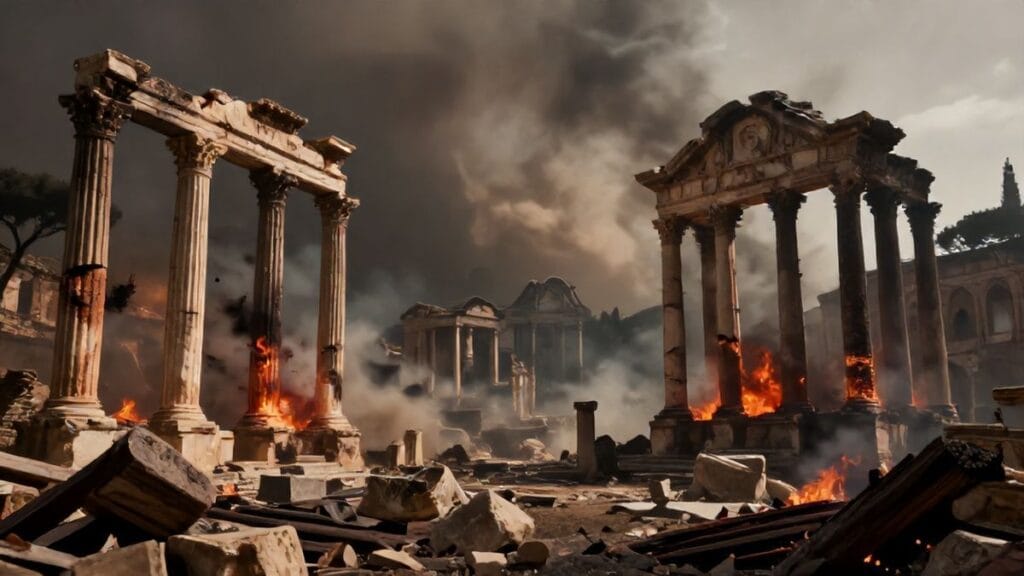
Witnesses on the surrounding hills would have seen the fire spread across its roofs, licking at gilded beams, catching on stored timbers, and exploding in sudden bursts as oil, wax, and precious furnishings fed the inferno. The temple’s white marble colonnades, patient and immovable, glowed red in the furnace of reflected light, while the gardens within shriveled into blackened silhouettes. High above, embers spiraled upward like a storm of crimson insects, carried by the winter winds toward neighboring districts. It must have felt, for a moment, as if the city’s very heart had been cut open.
As panicked crowds surged toward the site, the narrow streets leading to the Forum of Peace choked with people—slaves bearing buckets, vigiles (Rome’s fire brigades) hauling equipment, priests clutching sacred objects, and curious onlookers drawn by that ancient, terrible magnet: disaster. From among them rose a chorus of voices—prayers in Latin and Greek, angry accusations, whispered speculations that this was no accident. In a city where every event bore moral and political meaning, the temple of peace fire could not be merely a misfortune; it would quickly become an omen, a sign, perhaps a judgment.
Yet even as the flames raged, the building itself seemed to resist annihilation. The marble walls and columns did not burn, but they cracked, spalled, and stained; statues blackened and softened under the heat; painted ceilings crumbled, and in the inner halls, scrolls, paintings, and ivory decorations curled and vanished in minutes. The soundscape must have been as haunting as the sight: roaring fire, collapsing beams, the screams of trapped animals and men, the clang of bronze fittings torn from their fixings, and over it all, the chanted appeals of priests desperate to save not just a masterpiece of architecture but a focal point of Rome’s spiritual and political identity.
It is astonishing, isn’t it, that a city so accustomed to spectacle could still be shocked? Rome had known fires before: the great conflagration under Nero in 64, countless smaller blazes in crowded neighborhoods, warehouses, and public baths. But this was different. The Temple of Peace was not merely a temple; it was the embodiment of an imperial promise, a monument built with the spoils of war to guarantee that war’s end. To watch the temple of peace fire consume it was, for many, to witness the unraveling of an entire narrative about Rome’s destiny.
And yet, this was only the beginning. To understand why that night in 192 felt so heavy with meaning, we must step back to the temple’s birth in another turbulent age, when a new dynasty sought to turn civil war into serenity and ashes into marble.
From Vespasian’s Dream to Imperial Showcase: The Birth of the Temple of Peace
The Temple of Peace was born not out of tranquility, but out of blood, chaos, and rubble. In 69 CE—the infamous Year of the Four Emperors—Rome had torn itself apart in a storm of civil wars. Galba, Otho, and Vitellius rose and fell in rapid succession, their supporters fighting in the streets of the capital. The city’s temples, markets, and homes bore scars of looting and violence. When Vespasian finally emerged as emperor, he inherited not just an empire exhausted by conflict but a physical capital in need of healing.
Vespasian was no patrician prince; he was a hard-edged provincial commander who had won the Jewish War in the East. From Judea, he brought back not only legions and captives but immense amounts of treasure: gold, silver, sacred vessels, and artworks. According to the Jewish historian Josephus, the spoils included items from the Temple in Jerusalem itself, carried in triumph through Rome’s streets and memorialized on the reliefs of the Arch of Titus. These spoils would help finance monuments that proclaimed the Flavian dynasty’s legitimacy and Rome’s renewed stability.
Among them, the Temple of Peace stood out. Completed around 75 CE, the complex was designed as much as an open forum as a traditional temple. It occupied a wide, carefully ordered space: a rectangular precinct surrounded by colonnades, with a central garden laid out in geometric harmony. Along its sides, marble halls and exedrae held statues, paintings, and treasures from across the empire. In the midst of this calm, the sanctuary of Peace—Pax—stood as the focal shrine. The message was impossible to miss: the spoils of war had been sublimated into the architecture of peace.
Contemporary observers were impressed. The historian Pliny the Elder, writing only a few years after its construction, described the Forum of Peace as one of the most beautiful buildings in the world, stating in his Natural History that it was “the most magnificent of all” public works of that era. His praise was not only aesthetic; it was ideological. The temple’s design carefully staged Rome’s relationship to the world. Art and wealth captured in battle were not merely displayed as trophies; they were tamed into a tranquil, ordered environment, suggesting that Rome’s might had brought cosmic balance.
But the Temple of Peace was more than propaganda. It was a working space at the center of urban life. Its wide courtyards invited citizens to stroll and socialize. Scholars and officials had reason to visit too: some important public archives and maps, including the famed Forma Urbis Romae—a massive marble map of the city—were kept in buildings associated with the complex. As generations passed, the temple’s function diversified. It became a museum of empire, a garden of philosophy and art, a semi-sacred promenade where politics, religion, and culture intertwined.
From Vespasian through the reigns of his sons Titus and Domitian, and into the second century under the adoptive emperors, the Temple of Peace remained a stable point in an evolving city. Fires and restorations altered other districts, but this complex retained its aura of calm. It represented, in stone and silence, the hope that the frenzy of 69 CE would never return. And for nearly 120 years, that hope seemed to hold.
Yet the monument’s very name—Peace—invited fate’s irony. For beneath the shining marble of Rome’s “peace” lay simmering tensions: between emperor and senate, between elite and commoner, center and provinces, army and civilians. By the time Commodus came to power in 180 CE, the empire still looked strong from afar, but cracks had begun to appear. The temple that once celebrated peace would soon be consumed by a fire that many would read as a warning that that peace was ending.
Marble, Gold, and Silence: Daily Life Around the Temple Before the Flames
To grasp the full weight of the temple of peace fire, it helps to imagine the monument on an ordinary day—before the night sky glowed with embers and smoke. Picture, instead, a bright winter morning in Rome around 185 CE. The sun rises behind the Esquiline Hill and strikes the marble colonnades of the Temple of Peace, turning them pale gold. Vendors are already at work in nearby streets, selling hot bread, figs, and watered wine. The complex, though dedicated to a goddess, has the hum of a civic square.
Within the precinct, the first to arrive might be the priests and attendants of Pax. They move with measured precision, cleaning altars, preparing offerings, and inspecting votive tablets left by those who had prayed for safe journeys, successful negotiations, or an end to local disputes. In Rome, peace was not just an abstraction; it was a deity with rituals and responsibilities. The temple’s inner sanctuary, rich with perfumes and incense, was a place where Rome negotiated, symbolically, with the concept of peace itself.
Outside the sanctuary, the air feels different. The broad courtyard opens under the sky, lined by porticoes whose shade offers respite even in summer heat. Beneath them walk senators on their way from the Curia, lawyers heading to meet clients, and scholars deep in discussion. The Temple of Peace belongs to no single group. Wealthy matrons come here with their attendants to see the famous artworks lining the halls: paintings by Greek masters, statues carried from fallen palaces, and intricate mosaics that draw the eye down to the pavement beneath their sandaled feet.
Nearby, a pair of scribes might be seen huddled over wax tablets, preparing to copy an inscription from one of the walls. In a chamber adjacent to the main precinct, massive marble slabs bearing the Forma Urbis Romae are affixed to the wall—an official map of the city, engraved with obsessive detail. Magistrates and architects consult it; curious visitors gaze at the stone outline of their own neighborhoods. Here too, peace takes on a spatial dimension: the ordered layout of Rome inscribed in marble, a city supposedly tamed by law and imperial will.
Children weave in and out of the columns, chased by exasperated nurses. A retired centurion, his military diploma folded carefully under his cloak, pauses before a statue taken from the East and wonders at the journey that brought both of them to this place. Street philosophers find shady corners where they can engage passersby in debates about fate, virtue, or the nature of the gods. One quotes Virgil in a high, theatrical voice; another counters with a line from Seneca.
And presiding over this scene is silence—the cultivated, deliberate silence that large spaces produce. Sounds echo gently, never overwhelming. The creak of a cart in a neighboring street is muffled by the high walls enclosing the precinct. Inside, the Temple of Peace is a curated oasis, its tranquility all the more striking because just beyond its boundaries lies the tumult of the Roman Forum, with its trials, elections, and noisy traders.
This daily life gave the monument its soul. The Temple of Peace was not only a backdrop for imperial ceremonies but a living environment where thousands of small, anonymous stories unfolded: deals sealed with a handshake under its porticoes, couples meeting in secret in its gardens, anxious supplicants lighting incense before its altars. No one there in those ordinary days imagined that, within a decade or two, the same colonnades would be lit not by the morning sun but by the savage illumination of fire.
Yet behind the serenity of those scenes, the currents of politics and personality were shifting. Commodus, the emperor who would one day be connected—fairly or not—to the temple’s destruction, had already begun to unsettle Rome with his erratic behavior. A palace could be rebuilt; archives could be recopied; but once peace itself seemed fragile, what meaning would a Temple of Peace still hold?
A City of Rumors and Omens: Rome in the Tumultuous Year 192
By the year 192, the mood in Rome had darkened. On the surface, the empire under Commodus remained intact: legions guarded the frontiers, grain ships still arrived from Africa, and the coinage, though debased, still carried the emperor’s confident face. But in the capital, anxiety, satire, and whispered dread coursed through the elite and the plebs alike.
Commodus, who had inherited the throne from his father Marcus Aurelius in 180 CE, began his reign as the hoped-for continuation of a golden era. Instead, he drifted into excess. He styled himself a new Hercules, fought in the arena before astonished crowds, and renamed months and institutions after his own titles. The Senate seethed as he sidelined them, and conspiracies blossomed and failed in turn. The city grew accustomed to purges and informers; no one felt entirely safe.
In such a climate, every unusual event took on a sinister tone. A sudden eclipse? A cracked statue? A lightning strike on a temple roof? All of these could be read as signs that the gods had turned away. Ancient authors such as Cassius Dio, writing with hindsight, framed Commodus’s final year as a sequence of mounting portents. Among them, the temple of peace fire would later be woven as a central thread—a literal conflagration mirroring the metaphorical burning of order in Rome.
Daily life adapted uneasily. Senators performed their duties but with a wary eye; some fortified their rural estates as potential refuges. Shopkeepers raised prices, sensing uncertainty. Behind closed doors, families told stories of better emperors—Trajan, Hadrian, Antoninus Pius—contrasting their calm leadership with the dangerous whims of the current ruler. In taverns, storytellers embroidered tales of Commodus’s cruelty and foolishness, some exaggerated, others disturbingly close to the truth.
The religious sphere was equally unsettled. Priests debated what sacrifices might appease the gods; astrologers found their services in high demand. The guardians of Rome’s great temples, including the Temple of Peace, maintained rituals with renewed urgency. If the divine order could be persuaded to hold, perhaps the political order might yet stabilize.
But while ritual provided a sense of control, fear still seeped through the city’s cracks. The memory of the fire of 64 under Nero lingered in Rome’s collective consciousness. That conflagration, which had destroyed much of the city, had been followed by rumors that the emperor himself had set it, and by vicious persecutions of scapegoats. Some older citizens who had survived that blaze must have felt a shiver when they saw small fires break out in crowded neighborhoods. The idea that fire could be both accidental and political, both physical and symbolic, was deeply embedded in Roman minds.
Against this backdrop, the Temple of Peace stood like a stubborn reminder of a more hopeful time. Its very name challenged the reality of Commodus’s Rome. Peace? Yes, there was no civil war—for now. But what peace was it, when the ruler terrified his own city, when senatorial dignities were mocked, and when the line between spectacle and governance blurred so dangerously?
By late 192, rumors swirled that Commodus planned to appear in public on New Year’s Day not as emperor but as a gladiator, to mark the beginning of a new age under his personal cult. The Senate’s dread intensified; courtiers calculated their chances under different futures. The air felt heavy, as if Rome held its breath. In such a charged atmosphere, when smoke began to rise one night from the area of the Temple of Peace, it was inevitable that the event would be read as something more than a mere accident of sparks and timber.
The First Sparks: How the Temple of Peace Fire Began
Our sources are frustratingly silent on the precise cause of the temple of peace fire. No ancient chronicler offers a detailed, minute-by-minute description, and even Cassius Dio, who later mentioned the blaze, focused more on its symbolic aftermath than its technical origins. This silence leaves a space that historians must fill with carefully reasoned speculation, grounded in what we know about Roman buildings, urban hazards, and the particular nature of the Temple of Peace.
One plausible scenario is simple accident. The complex, though monumental in stone, contained plentiful flammable materials: wooden roof structures, interior paneling, furniture, scrolls, tapestries, and offerings of oil and wax. Torches and lamps lit the porticoes at night; braziers warmed enclosed rooms in winter. A careless servant, a dropped torch, or an overfilled oil lamp could have started a small blaze behind the scenes—perhaps in a storage chamber or service corridor—where it might grow unnoticed for crucial minutes.
Another possibility is structural weakness. After more than a century of use, renovations and repairs might have introduced vulnerabilities: improperly secured beams, aging joinery, gaps where embers from nearby hearths could drift into concealed spaces. Rome’s building regulations were loose, and while a complex as prestigious as the Temple of Peace would have received good maintenance, it was not immune to the wear and tear of time.
There is also the darker hypothesis of intentional fire. In a city simmering with resentment, sabotage was never unthinkable. An arsonist could have targeted the complex to send a message—against Commodus, against the senatorial establishment that frequented the temple, or even against the gods themselves. Yet, we must be cautious: ancient writers, eager for moral drama, might have seized on any whisper of deliberate destruction. The lack of clear accusations in surviving texts suggests that, at the very least, no widely accepted culprit emerged.
Whatever the specific cause, what turned a small ignition into the temple of peace fire we remember was the architectural and climatic context. The temple’s roofs, likely covered in tiles but supported by extensive wooden frameworks, formed a continuous network over the colonnades and halls. Once fire reached these beams, it could race along them, carried by drafts created by the building’s own spatial dynamics. Winter winds funneled through the open court might have fanned the flames, driving them from one wing to another.
At first, those on duty—temple guards, servants, junior priests—may have tried to contain it themselves, perhaps afraid to raise an alarm that would expose their own negligence. By the time they realized the extent of the blaze, precious minutes had been lost. Then came the critical transition, that moment when a local mishap becomes a public catastrophe: flames breached a visible façade, bursting from windows or catching on the outer porticoes, where passersby and neighboring residents could see them clearly.
Shouts rang out. A slave, eyes wide with horror, pelted down the street toward the nearest watch station of the vigiles, Rome’s fire brigades. In the tight web of the urban center, warnings passed quickly—one neighbor to another, a vendor to her customers, a watchman to a patrol. Within a surprisingly short time, hundreds knew: the Temple of Peace was burning. Fear moved faster than the flames.
What began with a handful of sparks would, before the night ended, scar one of Rome’s proudest monuments and leave a charred wound in the urban landscape. And as the temple of peace fire grew, each new onlooker brought not only water and labor but also interpretations, suspicions, and emotions that would shape how the event was remembered.
Flames in the Forum: Panic, Ash, and the Struggle to Save the Monument
When the vigiles arrived, their torches must have seemed feeble against the blaze already blooming along the temple’s roofs. Rome’s firefighters were organized into seven cohorts, each responsible for different districts of the city. They brought tools—hooks for pulling down burning structures, pumps and buckets for water, and blankets soaked in vinegar to smother smaller fires. They were experienced men; urban conflagrations were part of their grim routine. But this was no ordinary tenement blaze on the Subura’s crowded slopes. This was a sacred complex at the city’s core.
The first priority was containment. Orders were shouted in the din: clear the surrounding streets, protect neighboring buildings, form bucket lines from cisterns and wells. While some firefighters tried to enter the colonnades, hacking away at doorways to create firebreaks, others climbed ladders in desperate attempts to reach the eaves. Heat drove them back again and again. Marble reflected and intensified the blaze, turning the complex into a radiant furnace.
Inside, the experience was even more terrifying. As the fire advanced, pockets of people found themselves trapped by collapsing timbers and falling debris. Priests trying to save sacred images from the inner sanctuary had to choose between their own lives and those of the statues and cult objects they had served for years. Some, we can imagine, rushed forward anyway, coughing in the smoke, cloaks pressed against their faces, clutching small icons or reliquaries to their chests.
The crowd outside lived through a different ordeal: the helplessness of spectators. From the open space just beyond the precinct, onlookers watched tiles crack and explode, sending shards hurtling into the night. Sparks floated down like lethal snow. Someone cried out that the fire would leap to the Forum and devour the Curia or the nearby basilicas. Women covered their mouths with their veils; children wept; older men stared in stunned silence, their memories flaring with echoes of earlier, greater fires.
Then came the smell of burning treasures. As interior rooms succumbed, the contents—wooden chests, wax tablets, papyrus scrolls, woolen hangings, ivory chairs—added their own smoke to the rising column. There was a particular agony in watching not just stone and wood, but knowledge and artistry, vanish into the flames. Those familiar with the temple whispered to their neighbors about what lay inside: the celebrated paintings, the rare marbles, the spoils from eastern campaigns. Each new rumor about a destroyed artifact added another layer of grief.
The fight against the temple of peace fire was not entirely in vain. The stone walls and paved courts slowed its outward spread. Firefighters likely managed to save some peripheral structures and prevented a blowout into the adjacent Forum, where older, more combustible buildings might have offered a clear path for the flames. But the core of the complex—its grand halls, its decorated interiors, its intimate shrine to Pax—suffered heavily. Roof trusses collapsed, sending showers of burning debris into lower rooms. Statues toppled; columns, though standing, blackened and cracked.
By the time the sky began to lighten in the east, the worst was over. The flames had exhausted themselves, having consumed the most accessible fuel. Smoke still rose from smoldering pockets, and firefighters moved cautiously through the ruins to douse them. Bodies—of men who had fought the blaze, of servants trapped inside, perhaps of unlucky visitors caught by surprise—were carried out under smoke-stained sheets or hastily arranged cloaks. A sobering smell of wet ash and charred wood hung over the district.
And all around, people stared at what remained: a monument that had once proclaimed everlasting peace, now gutted and fragile. In their faces, we might see not only horror and sadness but something more difficult to name: the dawning perception that an age was closing, that the flame-lit night they had just witnessed would not be easily folded back into the fabric of ordinary days.
Treasures in the Inferno: What Was Lost Inside the Burning Temple
One of the most haunting aspects of the temple of peace fire is the cultural and intellectual devastation it wrought. The Temple of Peace was more than a shrine; it was a curated treasury of the empire’s spoils and masterpieces. Behind its colonnades and in its chambers lay objects that connected Rome to conquered kingdoms, lost cities, and vanished masters of art.
Ancient sources hint at the richness of this collection. Pliny the Elder, writing a century earlier, mentioned that some of the most renowned paintings in Rome were displayed in the Forum of Peace. He noted works by celebrated Greek artists, including masterpieces seized from aristocratic houses and royal palaces across the Mediterranean. These canvases and panels, already centuries old by the time of Vespasian, gained a new layer of meaning when hung in the Temple of Peace: they became trophies of culture as well as of conquest.
Many of these works likely perished in the blaze. Unlike marble and bronze, which can sometimes survive even intense heat, paintings on wood or plaster are exquisitely vulnerable to fire. In minutes, pigments carefully laid by long-dead hands could have blistered, blackened, and drifted upward as indistinguishable ash. A line of landscape by a Greek master, a face rendered with almost living subtlety, a mythological scene that once dazzled a visitor in Pergamon or Corinth—gone, irretrievably, in the choking darkness.
Other treasures suffered different fates. Bronze statues might have toppled but survived, though softened or warped, their surfaces pitted by the heat. Marble figures cracked, noses and limbs snapping off as internal stresses found sudden release. Gilded surfaces flaked away; inlaid eyes of glass or precious stone popped from their sockets. The temple, once a carefully arranged theater of aesthetic perfection, became an accidental sculpture garden of ruin.
Then there were the archives. Although the exact distribution of record-keeping in the Temple of Peace complex is debated, we know that important documents and inscriptions were associated with the site, including the monumental marble map of the city. Whether the Forma Urbis itself was directly damaged in 192 or spared by the particular spread of the flames, smaller sets of documents stored in adjacent offices were almost certainly lost. These might have included legal records, cadastral surveys, or administrative accounts—materials that knit together the functioning of the imperial bureaucracy.
The loss of archives is less immediately dramatic than that of statues and paintings, yet its long-term impact can be profound. A destroyed ledger might mean a dispute over land could never be fully resolved; the disappearance of a boundary record could sow confusion along a provincial frontier decades later. For modern historians too, each vanished document from the Roman world is a path of inquiry forever blocked.
Perhaps the most intangible losses, however, were religious. Within the sanctuary of Pax, sacred implements, garments, and votive offerings dedicated over generations would have been stored. Some might be purely symbolic—a finely worked bowl used only at festivals, a veil draped over the statue of the goddess on holy days. Others were tokens of deeply personal devotion: small figurines, inscribed plaques, or jewelry gifted in thanks for answered prayers. To the people who had given them, these objects were physical links to experiences of fear, hope, and gratitude. In the temple of peace fire, those links snapped.
Out of this catalog of destruction emerges a paradox. The Temple of Peace, built on the spoils of war, had long been a silent witness to the violence that enriched Rome. Its treasures were, in many cases, the spoils of sacked temples and palaces elsewhere. Now, they themselves fell victim to catastrophe. The cycle had turned. The empire that had consumed the possessions of others saw its own symbolic heart devoured in turn. For some Romans, watching the smoke curl upward from the ruins, that irony must have been bitterly clear.
Commodus Under Fire: Politics, Propaganda, and the Search for Blame
No major disaster in Rome existed outside the sphere of politics. The temple of peace fire unfolded in the final, fevered weeks of Commodus’s reign, and it was inevitable that contemporaries would link the event to the emperor—whether as scapegoat, victim of fate, or focus of divine wrath. The physical flames illuminated more than marble and timber; they lit up the already tense relationship between ruler and ruled.
The first question in any Roman catastrophe was: who is responsible? If arson were suspected, accusations might fall on political enemies, religious minorities, or even the emperor himself. Under Nero, lurid rumors had claimed that he enjoyed the city’s burning as artistic spectacle, “playing the lyre while Rome burned”—a story modern scholars consider more legend than fact, but one that stuck in public imagination. In 192, some might have been quick to reach for similar narratives about Commodus.
Yet our surviving sources, composed mostly by senatorial writers hostile to him, do not focus on direct blame for the fire. Instead, they weave it into a tapestry of ominous events that seemed to signal the impending collapse of his regime. Cassius Dio, a contemporary senator who later wrote an extensive history of Rome, notes that several important buildings burned around this time, reading them as portents of a coming transformation. The Temple of Peace, with its loaded name, served in such accounts as a perfect symbol of the peace Commodus had failed to maintain.
In the immediate aftermath, imperial propaganda may have tried to soften the blow. Orders for investigations would be announced; rewards promised for information about possible arsonists; talk of rebuilding circulated in the forums and baths. Commodus could, in theory, have presented himself as a restorer of peace, pledging to rebuild the temple even more splendidly. Monuments and coins throughout Roman history show emperors leveraging reconstruction as proof of their piety and generosity.
But Commodus’s regime by 192 was already so discredited among the elite that any such messaging would have faced deep skepticism. Senators, many of whom loathed him, saw in the temple’s ruin a sign that his supposed Pax Commodi was hollow. Ordinary Romans, too, might have connected the fire to a broader sense that things were coming apart. The temple of peace fire hence became part of a wider discourse of decline, an event to be cited in later conversations: “Did we not see even Peace herself burned under Commodus?”
Within weeks, events would overtake any imperial spin. On the last day of 192, Commodus was assassinated in a palace conspiracy involving his mistress Marcia, the chamberlain Eclectus, and the Praetorian prefect Laetus. Strangled in his bath by a wrestler, the emperor died as the old year closed. The Senate quickly declared him a public enemy, his statues toppled, his memory damned. In the flood of decrees and denunciations that followed, the fire at the Temple of Peace found a new place: as one of many disasters that “proved” the gods had abandoned the tyrant.
Later, as historians like Herodian and the already mentioned Dio crafted their narratives, the temple’s destruction slotted neatly into a moral framework. It was no random tragedy, but part of a divine commentary on misrule. Herodian describes (though in more general terms) how fires and plagues marked the end of Commodus’s time, reinforcing a pattern familiar to Roman readers: bad emperors attracted bad omens. The Temple of Peace could hardly fail to be part of that pattern.
And yet, beneath the ideological overlay, the human dimension remained. Senators who had once strolled its colonnades, priests who had tended its altar, vendors who had relied on its crowds, all faced a reality stripped of varnish: one of Rome’s most beloved spaces now lay broken. Whatever stories they later told about gods and portents, in the moment, grief and bewilderment were surely more palpable than theology.
Priests, Scholars, and Commoners: Human Stories from the Night of Destruction
History often records monuments and emperors, but the temple of peace fire also unfolded in the lives of men and women whose names we will never know. To approach their experiences, we must read between the lines of ancient texts and lean on what we understand about Roman society, imagining plausible scenes that could have unfolded that night.
Picture a middle-aged priest of Pax, perhaps a freedman elevated by years of service. He knows every column and corridor of the temple complex. On nights of major festivals, he has stood on the steps of the sanctuary, incense brazier at his side, feeling the murmur of the crowd like a living tide at his back. When the fire breaks out, he rushes toward the innermost chamber, heart pounding, not for his own safety but for the statue of the goddess and the small treasury of ritual tools kept in a side room.
Smoke swirls through the halls as he pushes forward. He recognizes the scent of burning cedar from the roof beams and the harsher smell of melting wax. Behind him, two younger attendants shout that the roof is about to give way. For an instant, he hesitates—duty pulling one way, survival the other. Then a beam crashes down in front of him, showering sparks across the marble floor. He staggers back, eyes watering, realizing that the goddess will have to fend for herself in the flames. Later, when he stands outside the ruins, cloak singed and eyes red, he will replay that choice in his mind for the rest of his life.
Not far away, a young student of rhetoric, perhaps in his early twenties, had been spending the evening in a nearby lodging, preparing a speech on the theme of “Peace and Empire.” The Temple of Peace served as his inspiration; earlier that day, he had walked through its colonnades, taking notes on inscriptions, contemplating statues of conquered peoples. The fire’s alarm reaches him as he is crafting a particularly elegant period. At first, he thinks it an exaggeration, some tavern rumor. But when he steps outside and sees the glow, his essay becomes instantly obsolete. Peace is not a stable concept to dissect in safely distant terms; it is a building currently being devoured.
Down in the streets, a fruit seller from the Subura, her day’s work finished, had chosen the route home that cuts past the temple precinct. She arrives just as the crowd thickens. Her first thought is practical: if the flames spread, will her own insula be in danger? But as she watches the temple’s interior light up like a kiln, another emotion takes shape: anger, not at gods or emperors, but at the senseless loss. She never set foot inside the inner chambers; those spaces were for the well-connected. Yet the Temple of Peace belonged to her city, its beauty part of her own landscape. As embers land at her feet, she feels that something has been stolen from her as well.
In the shadows, a small group of slaves belonging to the temple staff huddle together, uncertain of their future. Their masters’ positions, tied to the functioning of the complex, may now be in question. Will they be sold off, reassigned, punished for supposed negligence? One of them, a boy barely fifteen, had been entrusted just that week with tending lamps in a side corridor. In his fear, he wonders if something he did sparked the blaze. The thought traps him in guilt. Even if no one else blames him, he will carry that possibility as a private burden.
Meanwhile, in a house on the Palatine, an elderly senator with aching joints is shaken awake by the noise outside. Servants pull back the shutters, revealing the sky over the Forum painted with violent orange. He leans on a slave’s arm, straining to see. When he learns which building is burning, he closes his eyes. For him, the Temple of Peace is bound to memories of younger days, of debates, of imperial audiences under Vespasian and Titus, of quieter emperors and predictable procedures. The fire, to him, is like watching his own past crack and fall. Softly, he murmurs a half-remembered verse from Virgil about Troy’s burning, then shakes his head: “We are no better than they,” he might say.
These scenes, though reconstructed, align with how Romans interacted with their built environment. Temples were not abstractions; they were workplaces, landmarks, memories. The temple of peace fire thus did not only damage masonry; it altered social trajectories, reshaped private emotions, and left psychological scars. In the months that followed, people would arrange their stories of that night into narratives, some casting themselves as valiant helpers, others omitting their own panic or helplessness. In time, their individual experiences blurred into a collective memory: “Do you remember when Peace burned?”
After the Smoke Cleared: Ruins, Rebuilding, and the Fate of the Forum of Peace
When dawn spread its pale light over the central valleys of Rome, it revealed a landscape both familiar and utterly transformed. The outlines of the Temple of Peace were still there—the embracing walls, the great colonnades—but the colors had changed. Where once white and colored marbles gleamed, now gray and black dominated. The precinct smelled of wet dust and smoke. The first full survey of the damage began.
Officials from the imperial administration, perhaps accompanied by engineers and architects, would have walked the perimeter, making notes, measuring cracks, testing the stability of columns with wary hands. Fallen rubble was cleared from major corridors to allow assessment teams through. Here, a roof entirely gone, open to the sky; there, a hall partially preserved but with its interior scorched. Artifacts that had somehow survived—half-melted bronzes, chipped statues, surviving inscriptions—were gathered and set aside.
Very quickly, a question moved from whispers to formal debate: what now? Could the Temple of Peace be restored? Should it be? The resources required to rebuild such a complex were considerable: stone, timber, laborers, sculptors, painters, architects, funds. An emperor eager to project renewal might seize the opportunity to sponsor a grand restoration. But Commodus’s death soon after complicated matters. His brief successor, Pertinax, ruled too briefly to attempt such an undertaking. The subsequent Year of the Five Emperors, with civil wars raging between Didius Julianus, Pescennius Niger, Clodius Albinus, and Septimius Severus, shifted priorities to survival and military spending.
It was under Septimius Severus, who emerged victorious and founded a new dynasty, that reconstruction efforts in central Rome gained momentum. Severus sought to associate himself with peace and stability after the chaos that had followed Commodus. Restoring a temple dedicated to Pax offered rich symbolic potential. Archaeological and textual evidence suggest that the Forum of Peace did see significant rebuilding under the Severans. Roofs were repaired or replaced; damaged statuary was recarved or substituted; new decorative programs perhaps introduced.
Yet even with reconstruction, something irretrievable had been lost. The Temple of Peace after the fire was not the same as before. Many of the original Flavian artworks and spoils, especially those that had been entirely consumed, could not be replaced. New pieces, however beautiful, carried different histories. The complex now bore an invisible layer of memory: beneath every fresh coat of plaster, under each re-erected beam, lay the knowledge that this was a restored monument, a survivor of catastrophe.
In the city’s mental map, too, the precinct changed. For some years, perhaps decades, people would refer to “before the fire” and “after the fire” when recalling events connected to the Temple of Peace. Children who had witnessed the blaze grew into adults who told their own children how they had seen Peace burn. Visitors from the provinces, arriving after the restoration, might hear these stories and struggle to reconcile them with the renovated colonnades they saw before them. The building thus became layered not just in stone but in time, its identity split between original and scarred versions.
Eventually, as later centuries passed, the Temple of Peace would suffer again—from neglect, from new fires, from earthquakes, from the slow cannibalization of its materials for medieval and Renaissance projects. By late antiquity, some parts of the complex remained in use, repurposed for new administrative or commercial functions; others slid into ruin. The memory of the specific fire of 192 blurred into the building’s longer history of damage. But for the Romans who lived through it, that first great inferno remained a defining moment, a fissure line in the story of their city.
A Wounded Capital: Religious, Social, and Economic Consequences for Rome
The destruction of any major temple in Rome had consequences beyond its immediate precinct. The temple of peace fire rippled outward through religious practice, social habits, and even economic networks, subtly altering how the city functioned day to day.
Religiously, the most direct impact was the interruption of rituals dedicated to Pax. Festivals that required ceremonies in the temple had to be adapted, relocated, or temporarily suspended. Priests who had performed carefully prescribed rites for years now faced the challenge of improvisation. Roman religion placed enormous importance on proper form; a misstep in ritual could be seen as invalidating the entire act. The sudden loss of a cult site thus provoked anxiety: were the gods now unappeased? Would divine favor waver until the sanctuary was restored?
Augurs and haruspices found themselves in demand. The Senate, anxious to interpret the event in a way that could stabilize public feeling, might commission official inquiries into its religious significance. Was the fire a punishment for some specific offense? A warning about current policies? Or a more general reminder of human fragility? Different factions could push different readings. Those hostile to Commodus, now safely dead, would emphasize the fire as a sign of the gods’ displeasure with his impieties.
Socially, the loss of the Temple of Peace as a functioning space disrupted routines. The precinct had served as a quiet meeting place near but not inside the more politically charged Forum Romanum. Senators, advocates, and petitioners could use its shaded walks to discuss matters in relative calm. Scholars and students drew inspiration and sources from its inscriptions and artworks. With the complex out of commission, these activities were scattered to other venues—baths, porticoes, private houses. In a city where public architecture shaped social interaction, such displacement subtly reshuffled power dynamics and social networks.
Economically, the fire had both immediate and longer-term effects. Craftsmen were needed for cleanup and eventual reconstruction, generating work for stonecutters, carpenters, mosaicists, and painters. Suppliers of building materials found new contracts. On the other hand, vendors who had relied on the daily traffic around the temple suffered losses: food sellers, trinket markets, copyists who produced souvenirs or texts for visitors. Properties near the damaged precinct might temporarily lose value due to smoke damage or fears of instability, while those adjacent to alternative gathering places gained prominence.
There was also the question of public finances. Large-scale restorations required significant expenditure from the imperial treasury. In an era already marked by military spending and occasional coinage debasement, allocating funds to rebuild a temple—however important—competed with paying the army and subsidizing grain for the population. Decisions about how much to invest in the wounded monument thus reflected broader priorities and constraints. An emperor who lavished too much on marble at the expense of donatives risked unrest among the soldiers; one who neglected urban monuments signaled indifference to the capital.
Psychologically, the city carried a wound. As people passed the charred remains in the days before reconstruction began, they were confronted with a constant reminder of vulnerability. Rome prided itself on eternity—Roma aeterna—yet here was proof that even its most sacred spaces could be undone in a single night. For a society that saw its own history as a progression from hut villages to marble metropolis, such reversals were deeply unsettling.
And yet, Romans were also resilient. Just as they had rebuilt after earlier fires and invasions, they folded the temple of peace fire into a narrative of recovery. Stories of brave firefighters, of priests who saved sacred objects at great personal risk, of emperors who funded restorations—these counterbalanced tales of loss. The burned temple became not only a symbol of fragility but also a testament to the city’s capacity to endure and renew. In this way, even disaster found its place within Rome’s enduring self-image.
From Local Disaster to Imperial Symbol: How Historians Read the Fire
For modern historians, the temple of peace fire is more than an isolated event; it is a lens through which to examine the transformations of the late second century. The destruction of a building, especially one so loaded with ideological meaning, allows scholars to trace connections between urban life, imperial politics, religious sensibilities, and long-term change.
One interpretive strand sees the fire as emblematic of the end of the so-called Antonine “golden age.” From Nerva through Marcus Aurelius, the empire had enjoyed relatively stable succession, economic growth, and a flourishing of culture. By contrast, the late reign of Commodus and the civil wars that followed marked a transition toward the more crisis-ridden third century. In this reading, the temple of peace fire is a material manifestation of a broader unraveling: the burning of a monument to peace at the moment when enduring peace was slipping from Rome’s grasp.
Another approach is more cautious, emphasizing continuity as much as rupture. Fires, after all, were common in ancient cities; the specific choice of the Temple of Peace as a symbol of decline might owe more to rhetorical convenience than to objective impact. The fact that the complex was repaired and continued in use suggests that Roman society adapted, re-inscribing the building with new meanings. From this perspective, the temple’s story exemplifies Roman resilience and the capacity of built spaces to be reborn after trauma.
Scholars also debate the fire’s role in shaping perceptions of Commodus. Ancient literary sources, written mostly by members of the senatorial elite, are harshly critical of him. They tend to emphasize any event that supports a narrative of cosmic disorder under his rule. The temple’s destruction thus becomes, in some accounts, part of a moral indictment. Modern historians, aware of this bias, are careful to distinguish between the fire as an actual urban disaster and the fire as a literary motif. Did ordinary Romans link it so directly to imperial misconduct, or was that association primarily a product of later historiography?
There is, too, an architectural and urbanistic dimension. The Temple of Peace formed part of a broader ensemble of so-called “imperial fora”—grand complexes built by Julius Caesar, Augustus, Vespasian, Nerva, and Trajan. Studying the fire’s damage and the subsequent rebuilding offers clues about how these spaces evolved over time. Archaeological layers of burning, reconstruction, and reuse help date modifications, clarify building phases, and reveal shifts in function. Even the distribution of collapsed debris tells a story about the intensity and direction of the flames.
In their analyses, modern scholars often cite both literary and material evidence side by side. For example, Cassius Dio’s mention of the temple’s destruction is weighed against excavated traces of burning in the area generally identified with the Forum of Peace. Where they align, confidence grows; where they diverge, new questions emerge. As one modern researcher aptly put it, “Fire is a historian’s paradox: it destroys what we would like to see, but in destroying, it also leaves scars that guide our reconstruction.”
Ultimately, the temple of peace fire has moved from being a purely Roman tragedy to a point of dialogue between past and present. Each generation of historians brings its own concerns to the story—decline and fall, resilience, urban risk, cultural memory—and finds in the burning temple a case study through which to explore them. The flames of 192 have long since died, but their reflections flicker on the pages of modern scholarship.
Echoes Through the Centuries: The Temple of Peace Fire in Memory and Archaeology
After the last embers cooled, the memory of the temple of peace fire began its own journey through time. In the centuries that followed, as emperors rose and fell and Rome itself transformed, the story of that night remained, shifting in tone and emphasis depending on who told it and when.
In late antiquity, Christian authors sometimes folded the event into larger narratives about the fragility of pagan cults. The burning of a temple dedicated to Peace could easily be read as a sign that pagan “peace” was illusory, contrasted with the new peace promised by Christ. Such interpretations, while theologically driven, demonstrate how flexible the fire’s symbolic value had become: from a commentary on Commodus to a parable about religious transition.
Physically, the site evolved. By the time the Western Roman Empire formally fell in the fifth century, the Temple of Peace and its precinct had already undergone multiple phases of reuse. Parts of the complex were likely converted into warehouses, workshops, or even private dwellings. Earthquakes and further fires took their toll. Medieval Rome, shrinking in population and shifting its center of gravity, viewed the area less as a sacred forum and more as a quarry for readily available building materials. Marble slabs were pried off, columns toppled and reused in churches, decorative stones burned in lime kilns.
Yet even amid this spoliation, faint echoes of the temple’s past survived. Local toponyms, legends, and the stubborn presence of massive foundation walls kept alive a vague remembrance that something grand had once stood there. Renaissance antiquarians, wandering the overgrown ruins of the Forum area, tried to match visible remains to descriptions in ancient texts. The Temple of Peace, mentioned by Pliny, Dio, and others, emerged as a tantalizing but elusive target of identification.
Archaeological work in the modern era gradually sharpened the picture. Excavations in and around the Roman Forum and adjacent valleys uncovered structures whose plan, location, and construction techniques corresponded well to what was known of the Forum of Peace. Layers of ash and burning identified in certain zones were tentatively linked to documented fires, including the one in 192. Inscriptions found reused in later buildings offered further clues about which monuments had once stood where.
The process was iterative and often contentious. Scholars debated the exact boundaries of the complex, the placement of its sanctuary, and the interpretation of scorched surfaces. Yet each trench, each recovered fragment of a charred cornice, added a piece to the puzzle. Visitors to Rome today, standing amid the fragmentary remains near the Via dei Fori Imperiali, may find it hard to visualize the original splendor of the Temple of Peace, but archaeology has at least restored its rough outlines to view.
Memory, meanwhile, also took artistic forms. Painters, engravers, and later photographers captured the ruins in different moods: bathed in golden sunset, cloaked in mist, overgrown with wildflowers. In such images, the temple’s history of fire blends with the romantic fascination for decay. The building’s story becomes part of a broader meditation on time, loss, and the persistence of beauty amid destruction.
Modern tourism adds yet another layer. Guides lead groups past the site, gesturing toward scant stones and reconstructing in words the night of the temple of peace fire. For many visitors, the details blur; what remains is the impression of Rome as a place where every broken wall hints at catastrophe survived. The Temple of Peace, though far less famous than the Colosseum or the Pantheon, quietly continues to shape how people from around the world imagine antiquity’s fragility.
Reconstructing a Lost World: What Modern Research Reveals About the Fire
Recreating the story of the temple of peace fire demands an alliance between disciplines: historiography, archaeology, architectural history, even fire science. Each offers partial insights; together, they approximate a more complete picture of what happened in 192 and what it meant.
Historians begin with the texts. Cassius Dio, writing in Greek in the early third century, offers one of the few explicit references to the destruction of important buildings during Commodus’s reign, including the Temple of Peace. His account, however, is brief, folded into a moralizing narrative of degeneration. Other authors, like Herodian, mention fires and unrest in more general terms. Comparing these sources allows scholars to establish at least a rough chronology and to understand how elite contemporaries framed the event.
Archaeologists then turn to the ground. Excavations in the area traditionally identified as the Forum of Peace have revealed burn layers—distinct strata of ash, charcoal, and heat-altered materials—dating by associated finds to the late second century. Structural analysis shows where heat stress may have cracked stones or weakened mortar. In some cases, collapsed roof tiles form telltale patterns over the floors they once covered, indicating how and where the roof failed. By mapping such evidence, researchers can infer the intensity and spread of the blaze within the complex.
Architectural historians contribute by reconstructing the monument’s original design and materials. Based on surviving fragments, parallels with other Flavian constructions, and ancient descriptions, they estimate the proportion of wood to stone in roofs and interior finishes. Such reconstructions are crucial for fire modeling. A largely stone building behaves very differently in a blaze than one with extensive timber elements. Knowing where wood was likely used helps locate zones of maximum vulnerability.
Recently, some scholars have even applied principles from modern fire engineering to ancient contexts. By estimating fuel loads (wood, textiles, wax), ventilation patterns (open courtyards, door and window placement), and potential ignition sources (lamps, braziers), they simulate how quickly a fire could have grown and which architectural features might have helped or hindered its spread. While these models are necessarily approximate, they offer a valuable check on purely narrative reconstructions that might under- or overestimate the fire’s ferocity.
Epigraphic and art-historical evidence also play roles. Inscriptions commemorating restorations, if datable to the early third century and associated with the Temple of Peace, confirm that significant rebuilding took place after 192. Stylistic analysis of sculptures and decorative elements found in the precinct can reveal which pieces predate the fire and which belong to later repair campaigns, marking the boundary between pre- and post-conflagration aesthetics.
Through this mosaic of methods, a consensus image has emerged: the temple of peace fire was a major but not total annihilation. It severely damaged roofs, interiors, and many artworks, yet left enough of the structural framework intact to allow for substantial restoration. The Temple of Peace, then, should not be imagined as reduced to ground level rubble, but as a charred, hollowed-out shell, its bones surviving even as its flesh was burned away.
This image aligns with the broader pattern of urban fires in Rome, where monumental stone construction often limited worst-case scenarios. It also underscores the duality of the event: catastrophic from the standpoint of cultural loss, yet survivable in terms of the city’s physical continuity. The fire changed the Temple of Peace forever, but it did not erase it from the map.
In a sense, the modern scholarly reconstruction of the temple of peace fire mirrors Rome’s own experience: out of ruins, a new structure takes shape. The difference is that where ancient builders worked with stone and timber, today’s historians build with fragments of evidence and careful inference, raising in the mind’s eye a vanished night of fear and flame.
Myths, Omens, and Portents: Ancient Interpretations of the Destruction
For Romans, the burning of the Temple of Peace could never be a purely accidental matter of faulty timber and stray sparks. In a culture steeped in augury and prodigy lists, such a dramatic event demanded interpretation. Priests, politicians, and ordinary citizens reached instinctively for patterns, seeking to understand what the gods were saying through the crackle of flame.
Officially, the Roman state had mechanisms for handling prodigies—unusual occurrences believed to signal divine displeasure. The Senate might receive reports of marvels and calamities from across Italy: comets, two-headed animals, statues that wept blood. Committees would evaluate their significance, and prescribed rituals—sacrifices, processions, special prayers—would be ordered to expiate any perceived offense. The temple of peace fire, given its prominence, almost certainly entered such lists, prompting debates about appropriate responses.
One line of interpretation likely framed the fire as a direct reproach to Commodus. If the emperor, styled as a new Hercules and indulging in gladiatorial games, had overstepped divine and moral bounds, the gods might choose to strike at a monument embodying Roman peace to signal that his “peace” was in fact false. Senators opposed to him could quietly encourage such readings, strengthening the perception that his removal would restore cosmic harmony.
At the same time, popular mythmaking could spin more colorful tales. In taverns and markets, storytellers might claim that a neglected sacrifice had angered Pax, prompting her to abandon her temple in a storm of fire. Others might whisper that some forbidden ritual, conducted at night by secretive cultists, had gone wrong and called down divine flames. The relative paucity of surviving popular voices from antiquity forces us to infer such stories, but analogous reactions to later medieval and early modern disasters make them plausible.
Christian observers, still a minority in 192 but increasingly vocal, might have interpreted the fire differently. To them, the burning of a pagan temple could be read as another sign that the old gods were powerless or false. Later Christian authors sometimes retrojected such views backwards, reading earlier disasters as prefigurations of Christianity’s triumph. Whether any Christians in Commodus’s Rome actually saw the fire and formulated such thoughts at the time, the event would fit neatly into later Christian narratives about the gradual unraveling of pagan structures.
Omens also accumulate meaning over time. After Commodus’s assassination and the subsequent civil wars, retroactive interpretations could pile up: the temple of peace fire was a sign not just against one emperor but against the stability of the entire era. As the third century unfolded with its invasions, plagues, and rapid imperial turnovers, writers could look back at 192 as the moment when the façade cracked. “Did we not see Peace herself set ablaze before the storms came?” a rhetorician might declare in a later speech, using the memory as a rhetorical flourish.
It is important, though, to recognize that such mythic and omen-laden readings coexisted with practical reactions. Even as priests pondered divine intent, masons measured damaged walls; even as storytellers embroidered tales of angry deities, city officials calculated costs and logistics. Romans moved fluidly between religious and pragmatic modes of thought, seeing no contradiction in reading a fire both as a physical problem and as a metaphysical message.
In their dual response, they were not so different from us. Modern societies, too, often react to disasters with both scientific analysis and symbolic interpretation, whether speaking of “nature’s revenge,” “historical turning points,” or “wake-up calls.” The temple of peace fire thus offers a mirror, reflecting not only ancient habits of mind but enduring human impulses to weave meaning into catastrophe.
Rome After Peace: From Commodus to the Severans and Beyond
The night the Temple of Peace burned did not, of course, end Rome. Life went on; emperors succeeded emperors; the city continued to evolve. Yet in retrospect, the fire aligns uncannily with a turning point in imperial history. To trace its echoes forward is to follow Rome into a new, more unsettled world.
Commodus’s assassination at the end of 192 plunged the empire into a year of rapid succession. Pertinax, an elderly senator of good reputation, attempted a reformist program but was killed by the Praetorian Guard after only three months. Didius Julianus effectively bought the throne in an infamous auction, only to be overthrown by forces loyal to provincial commanders. Civil war ensued between claimants representing Britain, Syria, and the Danubian provinces. Cities far from Rome felt the tremors in troop movements, requisitions, and uncertainties about allegiance.
Out of this chaos emerged Septimius Severus, who established a new dynasty and sought to legitimize his rule by associating himself with Marcus Aurelius and promising restored stability. His building program in Rome included repairs and enhancements to key monuments, among them the Temple of Peace and the adjacent imperial fora. By reconstructing a temple so visibly wounded under Commodus, Severus could present himself as a healer of both city and empire.
Yet the Severan peace was not the same as the serene confidence of earlier Antonine decades. The army’s political power had grown; emperors now depended more openly on military support. Economic pressures increased; coinage debasement became more pronounced. The third century would see frontiers under greater strain, provinces break away in short-lived splinter empires, and emperors rise and fall with dizzying speed. Against this backdrop, the Temple of Peace’s restoration took on a somewhat poignant character: an attempt to reinscribe an ideal—peace—onto a world where it was increasingly precarious.
By the time of Diocletian and Constantine, the focus of imperial power had begun to shift away from Rome toward new centers such as Nicomedia, Milan, and eventually Constantinople. Rome remained venerable, its ancient monuments still powerful symbols, but it was no longer the undisputed operational hub. The Temple of Peace, like many older structures, adapted or faded. Some halls may have housed administrative offices; others fell into partial ruin. Christian churches rose nearby, repurposing columns and stones from once-pagan precincts.
Centuries later, as barbarian armies passed through Italy, as the Ostrogothic and Byzantine wars ravaged the peninsula, and as the medieval city shrank to a fraction of its imperial footprint, the temple’s story folded into a more generalized ruin. Few, if any, remembered the specific night in 192 when it had burned; the structure’s scars were overlaid by newer damage. Yet on some level, each subsequent blow echoed that first great fire, contributing to a long, slow unmaking punctuated by sudden shocks.
In the long arc from Vespasian’s inaugural dedication to the scattered stones visible today, the Temple of Peace encapsulates Rome’s larger trajectory: from triumphant expansion to anxious maintenance, from confident centrality to reflective antiquity. The temple of peace fire is a waypoint on that journey—a bright, terrifying flare marking the moment when the empire’s golden façade began, visibly, to darken.
And still, the story does not end in ashes. Modern Rome, noisy and alive, flows around the archaeological remains. Tour buses hum nearby; local Romans cross the area on their way to work or school. The site continues to mediate between past and present. In this, perhaps, the Temple of Peace has found a new kind of peace: not the static, imperial calm Vespasian envisioned, but a dynamic, layered coexistence of eras, memories, and meanings.
Conclusion
The destruction of the Temple of Peace in 192 was more than a single night’s misfortune. It was the convergence of architecture, politics, religion, and human experience in a moment of terrifying clarity. Vespasian’s monument, built from the spoils of war to celebrate a fragile ideal, had long stood as a serene center in Rome’s urban heart. When the temple of peace fire tore through its roofs and chambers, that serenity shattered, exposing how precarious the empire’s peace had always been.
We have followed the temple’s story from its triumphant foundation in the aftermath of civil war, through its everyday life as a place of ritual, scholarship, and quiet sociability, to the chaos of the blaze itself: firefighters struggling against impossible odds, priests making heartbreaking choices, citizens staring in disbelief as treasures and archives vanished in smoke. We have traced how the fire intersected with the troubled reign of Commodus, feeding ancient narratives of divine displeasure and imperial decline, while also examining the pragmatic realities of damage, reconstruction, and adaptation.
Through the lenses of archaeology and modern scholarship, the event emerges not as an apocalyptic endpoint but as a profound transformation. The Temple of Peace was wounded, rebuilt, repurposed, and ultimately absorbed into the layered ruin we see today. Its burning marked a hinge in Roman history, aligning eerily with the empire’s shift from confident stability to a more contested, crisis-prone era. Yet the monument’s survival, however partial, also testifies to Rome’s capacity to endure and reinterpret its own catastrophes.
In the end, the temple of peace fire invites us to reflect on how societies invest their hopes and identities in buildings, and how the destruction of such places reverberates far beyond stone and timber. It reminds us that peace is not a permanent state enshrined once and for all in marble, but a fragile achievement, always vulnerable to the stray spark, the gathering storm, the unforeseen night when flames suddenly rise.
FAQs
- What was the Temple of Peace in ancient Rome?
The Temple of Peace, or Templum Pacis, was a monumental complex built by Emperor Vespasian around 75 CE near the Roman Forum. More than a traditional temple, it functioned as a forum-like precinct with colonnades, gardens, halls, and a sanctuary dedicated to the goddess Pax. It housed artworks, war spoils, and some important archives, including, in its broader complex, the famous marble map of Rome known as the Forma Urbis Romae. - When did the temple of peace fire occur?
The destructive fire that badly damaged the Temple of Peace took place in 192 CE, during the final year of Emperor Commodus’s reign. Ancient sources, particularly the historian Cassius Dio, mention the burning of major buildings in this period, including the Temple of Peace, and later writers treated the event as a portent of Commodus’s fall and the subsequent civil wars. - Do we know what caused the fire?
The exact cause is unknown. No surviving ancient account provides a clear explanation, leaving historians to consider possible scenarios. These range from accidental ignition—such as a lamp, brazier, or faulty roofing structure—to deliberate arson in a politically tense climate. Given the building’s extensive timber roofs and flammable interior furnishings, even a small ignition could have escalated quickly, but evidence for intentional sabotage remains speculative. - What was lost in the blaze?
The temple of peace fire likely destroyed many paintings, wooden furnishings, scrolls, textiles, and ritual objects, as well as damaging statues and architectural elements. Pliny the Elder had earlier praised the Forum of Peace for its collection of masterpieces by Greek artists, and many of these paintings would have been extremely vulnerable to fire. Some marble and bronze works probably survived in damaged form, but the cultural and archival losses were immense and irrecoverable. - How did Romans interpret the destruction of a temple dedicated to Peace?
Many Romans saw the fire as a powerful omen. In a culture that closely linked public disasters to divine will, the burning of a shrine to Pax during Commodus’s troubled reign seemed to signify the withdrawal of divine favor and the fragility of imperial “peace.” Senators hostile to Commodus used the event rhetorically as part of a broader moral indictment of his rule, while ordinary people likely circulated their own stories about angry gods, neglected rituals, or cosmic warnings. - Was the Temple of Peace rebuilt after the fire?
Yes, at least in substantial part. Archaeological evidence of later construction phases and literary references to Severan building activity indicate that the complex was repaired and continued in use. Roofs were replaced, damaged interiors restored, and new decorative programs likely introduced. However, the restored temple could not fully replicate the original collection of treasures and artworks lost in the blaze, and its post-fire identity was inevitably shaped by the memory of the catastrophe. - How do archaeologists study the temple of peace fire today?
Archaeologists combine literary testimony with physical evidence from excavations. Burn layers—strata of ash and heat-altered materials—identified in the area corresponding to the Forum of Peace are dated using associated finds such as coins and pottery. Structural damage patterns, collapsed roof tiles, and traces of repair help reconstruct the fire’s impact and the phases of rebuilding. Architectural historians and even fire engineers contribute models of how a blaze would have behaved in a complex of this type. - What is the significance of the fire for understanding the Roman Empire’s history?
The temple of peace fire is significant not only as a dramatic urban disaster but as a symbolically charged event at a pivotal moment in Roman history. Occurring in the final year of Commodus and shortly before a period of civil war, it has been read as emblematic of the end of the Antonine “golden age” and the onset of a more crisis-ridden era. At the same time, the subsequent restoration of the temple illustrates Roman resilience and the ongoing effort to project continuity and stability despite mounting challenges. - Can visitors to Rome see remains of the Temple of Peace today?
Yes, though what survives is fragmentary and partly buried under later layers of the city. The area traditionally identified as the Forum of Peace lies just east of the Roman Forum, near the modern Via dei Fori Imperiali. Excavated walls, pavements, and architectural fragments give a sense of the complex’s scale and layout. While the specific traces of the 192 fire are not easily visible to casual visitors, the site’s ruined state evokes the long history of damage, reuse, and excavation that began with that ancient conflagration. - Why does the story of the temple of peace fire still matter today?
The story matters because it illuminates how societies invest meaning in their built environments, and how the destruction of symbolic places can shape political narratives, religious interpretations, and personal memories. It also highlights the fragility of cultural heritage—how a single night’s blaze can erase centuries of artistic and intellectual work. In an age when fires, wars, and disasters continue to threaten monuments worldwide, the fate of the Temple of Peace offers a sobering historical parallel and a reminder of the importance of preservation.
External Resource
Internal Link
Other Resources
- Encyclopaedia Britannica – general search for the exact subject
- Google Scholar – academic search for the exact subject
- Internet Archive – digital library search for the exact subject