Table of Contents
- Storm over the Empire: Setting the Stage for Verona, 249
- A Fractured World: The Third-Century Crisis Unfolds
- Emperor Philip the Arab: From Desert Frontier to Imperial Purple
- Decius the Reluctant Commander: Duty, Doubt, and Destiny
- Italy on Edge: Verona and the Road to Revolt
- The Spark of Rebellion: How a March Became a Civil War
- Gathering Armies: Numbers, Legions, and Vows Before Battle
- The Morning of Blood: Terrain, Weather, and Omens at Verona
- Clash of Legions: Inside the Battle of Verona 249
- The Death of Philip and the Fall of a Dynasty
- Decius Triumphant: From General to Emperor
- Verona’s Silent Witnesses: Civilians, Merchants, and Soldiers’ Families
- Faith, Fear, and Sacrifice: Religion after the Battle of Verona 249
- Echoes in the Provinces: How the Empire Reacted
- From Victory to Tragedy: Decius’s Short, Haunted Reign
- Remembering Verona: Ancient Sources and Their Silences
- Why Verona 249 Matters: Power, Loyalty, and the Price of Rule
- Conclusion
- FAQs
- External Resource
- Internal Link
Article Summary: In September 249, near the city of Verona in northern Italy, Roman soldiers turned their weapons not on foreign enemies but on each other, in what we now call the battle of verona 249. This clash between Emperor Philip the Arab and the upstart general Decius unfolded against the deeper chaos of the third-century crisis, when emperors rose and fell with dizzying speed. The article follows the political intrigues and personal doubts that led to civil war, then reconstructs the battle itself: the marching legions, the shouted commands, and the brutal hand-to-hand fighting on the plains near the Adige. It shows how Verona’s victory elevated Decius to the purple while erasing Philip’s dynasty in a single day. Yet behind the drama of power, we also hear the quieter stories of frightened townspeople, grieving families, and religious anxieties that would soon fuel fierce persecution. Across its arc, this narrative reveals how the battle of verona 249 became both a symptom and an accelerant of Rome’s wider unraveling. In doing so, it explores memory, propaganda, and what it meant for Romans to kill Romans in the name of preserving the very empire they were tearing apart.
Storm over the Empire: Setting the Stage for Verona, 249
In the late summer of 249 CE, the northern Italian air carried a tension that could almost be felt on the skin. Merchants in Verona glanced more often toward the city gates, listening for distant drumbeats. Travelers arrived dust-covered and breathless, bringing conflicting rumors from the south and the Danube frontier: an emperor marching north, a general marching south, legions changing sides, coins bearing different faces. Somewhere between the whispers and the clatter of hooves on Roman roads, the outlines of the coming disaster began to form. Within weeks, on these same plains and hills, the battle of verona 249 would be fought, and with it the fate of an emperor and the direction of a crumbling world.
This was not a campaign against Parthians in the east or Goths in the north; it was something far more intimate and more terrible. It was Romans confronting Romans, men trained in the same discipline, swearing the same oaths, now bracing to spill each other’s blood. The long shadow of civil war fell over Italy. What had begun as a distant frontier crisis was converging upon the very heartland of the empire. And Verona—strategically set between Alpine passes and the roads to Rome—would find itself at the hinge of history.
To understand why, one must step back from the battlefield and see the empire as it stood that year: strained by external threats, riddled with internal doubts, and living under an emperor whose throne rested upon the shifting sands of military support. The battle of verona 249 was not an isolated catastrophe. It was the violent eruption of pressures that had been accumulating for decades: economic weakness, political instability, and the erosion of old certainties. The story that follows is less the tale of a single clash than the biography of a crisis that finally found its most tragic expression in the fields outside Verona.
A Fractured World: The Third-Century Crisis Unfolds
By 249, the Roman Empire was more fragile than its monuments suggested. Marble temples, stately forums, and colonnaded streets still proclaimed grandeur, yet behind this architectural confidence lay a society in slow-motion disarray. Historians call this period the “Third-Century Crisis,” an era when emperors rarely died in their beds, and borders were as uncertain as the loyalty of the armies that defended them.
The threats came from every direction. Along the Rhine and Danube, Germanic peoples pressed harder, their raids probing deeper. Across the eastern frontier, the resurgent Sasanian Empire under rulers like Shapur I tested Roman defenses. Inside the empire, plagues had swept through cities and countryside, cutting down taxpayers and soldiers alike. Inflation gnawed at the coinage; silver content was tampered with; prices in the marketplace fluctuated in ways ordinary Romans had never seen.
Yet the most corrosive threat lay not at the borders but in the corridors of power. The imperial succession had become less a staged handover and more a knife fight in the dark. Legions elevated their favorites, only to abandon them for better prospects. Provincial governors eyed the purple with a mixture of fear and temptation. Coin portraits changed with dizzying speed; oaths of loyalty could be dissolved with the rumor of a lost battle. In such a world, rule meant surviving, and survival often meant preemptive violence.
This is the larger canvas upon which the battle of verona 249 must be painted. It was not merely an emperor confronting a rebellious general; it was the symptom of a system that had begun to devour itself. The army, once the unshakeable pillar of Roman power, had become simultaneously its shield and its executioner. Each victory only heightened the victor’s vulnerability, for glory made a man both indispensable and dangerous.
Ordinary people lived with the consequences. A farmer on the Po plain might be called upon to provide grain for yet another army on the march. A craftsman in Verona could see taxes rise to fund fortifications or coinage debased to pay the troops. News of a new emperor—this time from the Balkans, next time from Syria—meant uncertainty, not celebration. The empire still functioned, but it did so like a fevered body, staggering from one crisis to the next.
Emperor Philip the Arab: From Desert Frontier to Imperial Purple
At the center of the drama stood one man: Marcus Julius Philippus, remembered by history as Philip the Arab. Born in the Roman province of Arabia, likely near modern-day Shahba in Syria, Philip was not the product of ancient senatorial lineages but of the empire’s expanding frontier aristocracy. His ascent tells us much about how the Roman system had changed by the mid-third century.
Philip’s early life unfolded on the edge of the desert, in lands where Roman roads met caravan routes, and Latin titles rubbed against Aramaic and Arabic names. He rose as so many did in this era—through military and administrative service, cultivating the favor of higher officers and eventually emperors. Under Gordian III, the young emperor who marched east against the Persians, Philip served as praetorian prefect, one of the most powerful posts in the imperial court.
Then came the turn. In 244, amidst the chaos of a Persian campaign gone wrong, Gordian died under murky circumstances near Circesium. Ancient sources like Zosimus and the Historia Augusta, colored by later politics, would darkly hint that Philip had something to do with it. Whether opportunist or mere survivor, Philip emerged as emperor, hailed by the army and recognized by the Senate. The boy-emperor of noble lineage had vanished; in his place stood a seasoned administrator from the provinces, now master of the Roman world.
Philip’s reign, which began in blood and uncertainty, sought legitimacy in spectacle and conciliation. In 248, he staged a magnificent celebration in Rome: the millennium of the city, one thousand years since the legendary founding by Romulus in 753 BCE. Games, races, wild-beast hunts, and lavish distributions tried to fuse his foreign birth with the most Roman of anniversaries. For a moment, it worked. The empire—battered but still breathing—could imagine continuity.
But the ground beneath Philip’s feet was never stable. Rebellions flared in the provinces; frontier wars demanded attention and money. His brother Priscus, installed in positions of influence, was widely suspected of arrogance and greed, alienating both elites and soldiers. In the Balkans, the Danubian legions, perpetually in the thick of frontier conflicts, watched events with weary cynicism. They had seen emperors rise and fall. Why should Philip be different?
Philip’s authority depended above all on whether the men with swords believed in him. When rumors spread that he was mishandling frontier defense, or that he was too far removed in Rome to grasp their struggles, trust frayed. It is in this crumbling confidence that the seeds of the battle of verona 249 were sown. For in those same Balkan provinces another figure was rising—a man Philip himself had promoted.
Decius the Reluctant Commander: Duty, Doubt, and Destiny
Gaius Messius Quintus Decius was not, at first glance, the sort of man one expected to lead a mutiny. A senator of respectable stock from Pannonia or possibly lower Moesia, he embodied the old ideal of the Roman statesman: disciplined, conservative, devoted to ancestral customs. He was neither a flamboyant orator nor a notorious plotter. He was, instead, something more dangerous in an age of crisis—a competent administrator with a reputation for integrity.
Under Philip, Decius served as governor in the Balkans, where Roman power met the turbulence of the Danube frontier. When discontent stirred among the legions there, Philip made what seemed a logical move: he sent Decius to restore order. According to the late fourth-century historian Aurelius Victor, Decius himself later claimed that he tried to dissuade Philip, warning that a popular general sent to troubled troops was always at risk of being proclaimed emperor.
Whether this story is self-serving or not, it captures an uncomfortable truth about Roman politics. To be trusted with command was to be suspected of ambition. When Decius arrived among the Danubian legions, he was stepping into a pressure cooker. The soldiers were battle-hardened, resentful of perceived neglect, and used to seeing their commanders as potential emperors. They had likely heard of Philip’s failures or compromises, perhaps exaggerated by local grievances. In their eyes, Rome needed a stronger hand.
The turning point came—if we trust the outline provided by later chroniclers—when the legions refused to accept half-measures. They did not want Decius simply as a negotiator with a distant emperor; they wanted him as emperor. Whether the acclamation was spontaneous or carefully nudged along by officers will never be known. But at some moment, on some windswept parade ground along the Danube, thousands of soldiers raised their right hands and shouted his name, proclaiming Decius Augustus.
Imagine the inner conflict of a man like Decius in that instant. Acceptance meant treason against Philip, the man who had entrusted him with this mission. Refusal meant possibly his own death at the hands of troops whose loyalty to their new choice was now all-consuming. One can almost see him, lips pressed tight, realizing that history had backed him into a corner. Duty to the emperor and duty to the army were now incompatible. The road to Verona began right there, not with shouted insults between rival camps, but with a moral and political trap closing around a single man.
Italy on Edge: Verona and the Road to Revolt
As Decius’s troops began to move, what had started in the Balkans became Italy’s problem. Geography dictated the pattern of the coming war. From the Danubian regions, any army marching on Rome would cross through the Alpine passes into northern Italy, follow the great arterial roads—especially the Via Postumia and Via Claudia Augusta—and pass through or near cities like Aquileia, Altinum, and Verona. These were not mere dots on a map, but living communities now caught between loyalty to the reigning emperor and fear of the advancing legions.
Verona was a city of stone and memory. Its amphitheater—today’s Arena—had already stood for over a century and a half. Its inhabitants traded wine, olive oil, and wool, and served as a key node between Italy and the provinces beyond the Alps. They were accustomed to the movement of troops, for the empire’s northern defenses relied on these roads. But 249 was different. This time, the soldiers coming down from the north were not just passing through on their way to some distant barbarian foe. They were the barbarism, in Roman eyes: a challenge to the lawful emperor, a question mark over every oath sworn.
News in the third century did not travel at the speed of light but at the speed of hoof and sail. Still, it moved quickly enough for anxiety to outrun clarity. Reports reaching Verona likely came layered with bias: Philip loyalists framing Decius as a traitor; Danubian sympathizers murmuring that the emperor had failed them; merchants translating politics into the language of risk—“Will the roads be safe?” “Will the garrison stand with Rome, or with the newcomer?”
Philip understood the stakes. To let Decius march unopposed into Italy would be to accept his own deposition. The emperor therefore gathered his forces, drawing upon the praetorian guard, Italian units, and any loyal legions still within reach. The road north from Rome to Verona became not just a geographic route, but a funnel into which flowed everything Philip had left: his authority, his remaining trust with the army, his hope that a field victory could erase doubts born on the frontiers.
For Verona’s inhabitants, each fresh contingent of troops was a reminder that their fields and homes might soon be trampled. Some people must have fled to neighboring villages, hoping distance would spare them. Others stayed, boarding up shops, hiding valuables, or making quiet arrangements with officers on both sides. When civil war comes close, neutrality becomes a treacherous performance. You must appear loyal to whoever is strongest today, while guarding your survival should another banner fly tomorrow.
The Spark of Rebellion: How a March Became a Civil War
The transformation from contested authority to open war pivoted on decisions made in rapid succession. Once hailed as emperor, Decius had a limited set of choices. He could pause and negotiate, attempting to turn his acclamation into a formal power-sharing agreement or a carefully staged abdication. Or he could move swiftly, trusting momentum and surprise to unsettle Philip and win more legions to his side.
Our sources—Eutropius, Aurelius Victor, Zosimus—are frustratingly terse about the details, but their consensus is clear enough: diplomacy took a back seat to steel. Decius advanced. His troops, fresh from declaring their faith in him, had no interest in parley that might dilute their bold gesture. Their pay, their future privileges, perhaps even the safety of their families along the Danube now depended on seeing their chosen man installed in Rome. The civil war was no longer a possibility; it was already a reality marching on Roman roads.
Philip, for his part, also chose war. Some later writers would portray him as hesitant, aware that his support among the legions was brittle. Yet he could hardly remain in the city and allow a rival with a hardened Balkan army to approach unchallenged. An emperor was expected to defend his throne with his life. To flee without a fight would be to admit that his legitimacy was nothing but a costume. Instead, he gathered reinforcements, entrusted some matters to loyal associates, and marched north, away from the marble of Rome toward the uncertain fields of Verona.
Between the two armies stretched not just distance but a country watching with held breath. Many Italian communities, already overtaxed, reluctantly furnished supplies to whichever side reached them first. Landowners weighed which emperor might be kinder to their estates. City councils—curiales—debated behind closed doors how to declare loyalty without provoking later retribution. The Parthian and Gothic threats that had once preoccupied political minds faded, temporarily eclipsed by the frightening intimacy of civil conflict.
Somewhere along that route, the two forces came within striking distance of each other. Scouts brought back reports of marching columns, the glint of armor on distant hills, the pattern of camps laid out each night. The battle of verona 249 was not an unforeseen collision in the fog. It was the logical, almost mechanical outcome of two political wills set on confrontation, drawn inexorably toward a meeting point by the geometry of roads and the imperatives of power.
Gathering Armies: Numbers, Legions, and Vows Before Battle
How many men fought at Verona? The ancient sources are silent on precise numbers, and modern historians can only estimate based on the typical strength of legions and auxiliary units. A reasonable reconstruction suggests that each side might have fielded between 20,000 and 30,000 troops—perhaps more, perhaps less, but surely enough to turn the plains outside Verona into a dense, clashing mass of iron and flesh.
On Decius’s side marched the legions of the Danubian frontier, experienced in the harsh discipline of northern wars. They had fought Germans and Carpi, faced sudden raids for which hesitation meant annihilation. Their officers were hardened professionals, their loyalties recently tested by the very act of proclaiming a new emperor. These were not parade-ground soldiers; they were veterans with scars, bringing to Italy a style of warfare learned along rivers and forest lines, among forts that knew more winters than ceremonies.
Opposing them, Philip commanded what remained of the central and Italian forces, possibly including elements of the praetorian guard. These men prided themselves on proximity to the imperial court, on being the emperor’s personal troops. They were not inexperienced; Rome’s legions were constantly rotated and deployed as crises demanded. But they may have lacked the single-minded cohesion of Decius’s Danubian army, whose very identity had been reforged by the act of rebellion.
On the eve of battle, camps on both sides would have buzzed with fearful energy. Fires flickered; smiths checked armor straps and weapon points. Officers walked the lines, offering a mixture of encouragement and warning. Chaplains and augurs performed rites: sacrifices to Mars, Jupiter, and the genius of the emperor—Philip on one side, Decius on the other. Entrails of animals were examined, flights of birds interpreted, weather signs parsed for hidden messages. In a world where gods and fate were woven into daily life, no general would risk a battle without first seeking omens.
Imagine a centurion in Decius’s camp, a man in his forties with twenty years of service etched into his face. He whispers to his contubernales—his tentmates—that this fight is different, that defeat might mean crucifixion as traitors. In Philip’s ranks, a similar figure reassures younger recruits that they fight for the lawful emperor, that the gods favor legitimacy over revolt. Both believe, or need to believe, that they are on the right side of history. Both are about to test that belief in the cruelest of ways.
The Morning of Blood: Terrain, Weather, and Omens at Verona
The landscape around Verona in the third century, though not identical to today’s, followed the same broad outlines: a city nestled near the Adige River, with rolling plains and low hills stretching outward, crisscrossed by roads built under the Republic and early Empire. For an army, this terrain offered both opportunities and dangers. Open ground allowed legions to form tight, disciplined ranks, but also gave cavalry room to maneuver. Rivers and marshy patches could become traps if poorly understood.
The sources do not record the weather that September day, yet we may reasonably imagine a late-summer sky: perhaps a hazy sun, perhaps thin clouds drifting over the pre-Alpine horizon. It was a season when the earth would still be dry enough for dust to rise under marching feet, but the nights grew cooler, a reminder that campaigns could not drag on forever. Both Philip and Decius would have known that this confrontation had to be decisive; the empire could not endure a prolonged stalemate with two emperors claims competing everywhere.
Before dawn, trumpets sounded in each camp. Men rose from uneasy sleep, some having whispered prayers in the dark, others having stared at the tent’s canvas until exhaustion claimed them. Morning rituals began: a hurried meal, final adjustments to armor, a last sharpening of sword edges and spear points. Standards—the eagles of the legions, the vexilla bearing unit symbols—were unfurled, gleaming in the first light. In each camp’s central space, the emperor appeared: Philip in his purple cloak, Decius in his own imperial garb, both walking among their troops, a visible reassurance that they would share the day’s dangers.
Auguries may have been taken again at first light. A sudden flight of crows, a stray bolt of lightning on the horizon, a sacrificial animal’s heart slightly misshapen—any of these could send a shiver through the ranks. Roman historians, writing with hindsight, loved to weave such signs into their narratives as foreshadowing. Even if we strip away legend, we cannot ignore how keenly soldiers watched the world around them that morning, searching in the indifferent sky and soil for some hint of what awaited them.
By mid-morning, the two armies would have moved into position, lines forming perhaps within sight of Verona’s distant walls, whose citizens watched from ramparts and rooftops, straining to see which way the tide would turn. The stage was set, the actors in place. The battle of verona 249 was about to begin—not as an abstract event in a chronicle, but as a living, screaming collision between thousands of human beings.
Clash of Legions: Inside the Battle of Verona 249
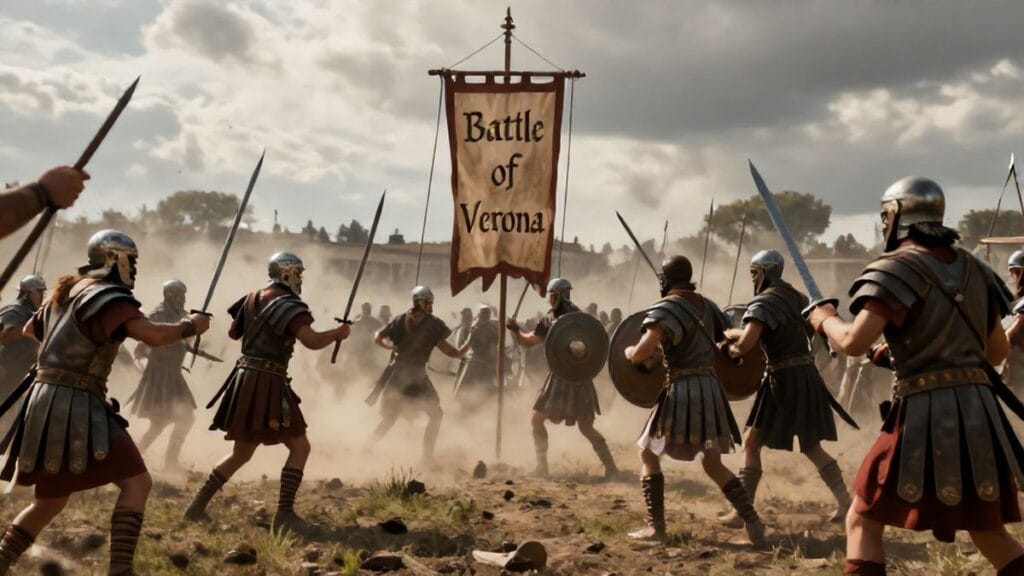
On the field outside Verona, drums beat and horns blared as the Roman war machine performed its terrible choreography. Each general would have deployed his forces according to the familiar grammar of Roman battle: heavy infantry in the center, auxiliary units and lighter troops on the flanks, cavalry poised to exploit any weakness. Standards rose above the mass of helmets and shields, rallying points in what would soon become a chaos of dust and cries.
At some signal—perhaps a trumpet blast, perhaps a shouted command—the front ranks advanced. The mass of men, shields locked, gladii ready, moved forward with what veteran observers recognized as the lethal walk of Roman infantry. Javelins flew first. A shower of pila arced overhead, heavy shafts designed to bend on impact, sticking to enemy shields and weighing them down, making them unwieldy. A second volley followed, then the lines closed.
We must resist the temptation to see this as a contest of automatons. The battle of verona 249 was fought by men who knew, with horrifying clarity, that they were facing their own kind. The armor glinting across the field looked like theirs. The Latin curses shouted in the heat of combat were their mother tongue. Each thrust of a blade, each shove of a shield was an act of fratricide. That knowledge did not stay their hands, but it must have burned in their minds.
Initial contact likely produced that sickening crunch of shield against shield, spear against armor, followed by the close-in work of short swords. Lines bent but tried not to break. Officers, identifiable by their crested helmets and decorations, roamed behind, barking orders, pushing laggards forward, pulling the wounded away when they could. Dust rose, mixing with sweat and blood into a hot, choking haze. To a soldier in the midst of it, the grand strategies of Philip and Decius meant nothing. There was only the man in front of you and the need to make him fall before you did.
On one flank, cavalry may have clashed in swirling engagements, hooves smashing into soft ground, riders leaning low to slash or thrust at opponents. Auxiliary archers, perhaps from the east or from the Balkans, loosed arrows over the heads of their own infantry, hoping to strike commanders or key standard-bearers on the enemy side. A dropped eagle standard could send ripples of panic through a unit; to capture or defend it was a matter of almost religious urgency.
As the hours wore on, the strengths and weaknesses of each army began to tell. The Danubian troops under Decius, hardened by brutal frontier warfare, may have pushed more relentlessly, used to grinding, attritional fights where retreat meant devastation of their homelands. Philip’s forces, perhaps more varied in origin, might have shown moments of brilliance and bravery but also pockets of anxiety as rumors swept through the ranks: “The left is faltering,” “The emperor is wounded,” “A unit has gone over to the enemy.” In civil wars, rumor is a deadlier weapon than any sword.
At some critical moment, the tide turned. One of Philip’s flanks likely gave way, whether through exhaustion, a cavalry breakthrough, or a crack in morale. Once a section began to fall back in disordered fashion, panic could spread quickly. Officers shouting for calm were ignored; men who had fought valiantly for hours suddenly imagined encirclement and slaughter. A few broke ranks and ran; others, seeing them, decided they too must flee. The coherent line became a fractured, wavering thing.
Decius and his senior officers, alert for just such a sign, would have ordered a general advance, pressing the advantage. Trumpets signaled a forward surge. The Danubian legions, sensing victory, redoubled their assault. For Philip’s army, this was the moment when battle turned to rout.
The Death of Philip and the Fall of a Dynasty
The end of Emperor Philip at Verona is shrouded in a mixture of fact and later storytelling, but the outcome is clear: he did not leave the field alive. Eutropius, writing in the late fourth century, notes that Philip was defeated and killed in battle against Decius. The details, whether a final stand surrounded by loyal guards or a desperate attempt to rally fleeing troops, remain in the fog of unrecorded moments.
One can, however, imagine the scene with some historical plausibility. As his lines began to buckle, Philip may have ridden to the threatened sector, seeking to restore order by personal example. The purple cloak that symbolized his rule also made him a conspicuous target. Opponents knew that felling the emperor could shatter the last vestiges of resistance. In the thick of swirling combat, a thrown spear, a well-aimed arrow, or a sword stroke at close quarters might have struck him down.
It is also possible that his own troops, sensing defeat and the harsh realities that awaited them under the victor, abandoned him in those final minutes. The emperor who had once presided over Rome’s millennium celebrations, who had sought to root his foreign origins in the city’s most ancient myths, now found himself reduced to one more casualty on a blood-soaked Italian field. His body, if recovered at all, would not be borne in triumph but in quiet, hurried burial.
News of Philip’s fall would have spread through his army with explosive effect. Some units might have fought on briefly, bound by discipline or trapped in formations unable to disengage. But more likely, resistance crumbled as men threw down arms, sought to surrender, or fled individually into the countryside. The battle of verona 249 ended not with a neat, ceremonial conclusion, but with a messy dissolution of organized fighting into pockets of chaos and surrender.
Philip’s death did not only end a life; it erased a dynasty in the making. His young son, Philip II, who had been elevated as Caesar and then co-emperor, was still in Rome. When the news reached the capital, the boy’s fate was sealed. According to later accounts, the praetorian guard, ever sensitive to the winds of power, executed him—perhaps in the palace, perhaps in some shadowed corner where the last flicker of the fallen regime could be extinguished without spectacle. Thus father and son, who had briefly represented continuity and stability, vanished almost overnight.
Coins bearing Philip’s image would soon be melted down or overstruck with Decius’s profile. Statues erected in his honor were toppled or quietly removed. In official memory, his reign became a cautionary episode, a prelude to the supposed restoration of old Roman virtues under Decius. Yet Verona’s soil still held its own record: the graves of men who had died shouting Philip’s name, and of those who had killed them in the belief that they were saving Rome.
Decius Triumphant: From General to Emperor
When the din of battle faded and the last pockets of resistance were stamped out, Decius stood as the unchallenged master of the field. The eagles of the Danubian legions had prevailed; the purple he had worn under contested claim was now, in Roman eyes, sanctified by victory. Yet behind the formal triumph lay a man who must have been acutely aware of what this victory had cost and what it demanded.
Entering Verona, Decius would have been greeted cautiously. City officials emerged to profess loyalty, to present symbolic keys, to beg for protection from looting. It was in these ritualized encounters that the new emperor began to craft his image. He was not merely the conqueror of Philip; he was, or so he presented himself, the restorer of the old Roman order, the champion of discipline and traditional piety. The battle of verona 249 became in his hands more than a civil war; it became a foundational myth of renewal.
From Verona, the road to Rome lay open. Decius marched south, no longer as a mutinous general but as the victorious savior of the state. In the capital, the Senate—never in a position to resist armed reality—conferred formal legitimacy. Decrees were passed, statues commissioned, titles granted. Coins began to bear his name and portrait, often accompanied by reverses celebrating virtues like “Pietas” and “Virtus,” piety and courage, as if to contrast his reign with the supposed failings of Philip.
Decius himself, steeped in traditionalist ideology, believed—or convinced himself—that his ascent was not simply the product of military politics, but the working of Rome’s ancient gods, displeased with laxity and eager for a more rigorous observance. In this sense, Verona was not just his military triumph; it was his sacred calling card. He had been chosen in the crucible of battle to guide the empire back to ancestral ways, no matter the blood spilled along the way.
Yet victory is a double-edged sword. By proving that a provincial army could make and unmake emperors on Italian soil, the battle of verona 249 also signaled to everyone watching that the pattern could repeat. Today it was Decius sweeping aside Philip; tomorrow, who might sweep aside Decius? Even as he celebrated, even as his image was carved and minted across the empire, the logic of his own rise cast a long, dark shadow over his future.
Verona’s Silent Witnesses: Civilians, Merchants, and Soldiers’ Families
History tends to remember emperors and generals, but the true weight of a battle falls on quieter shoulders. In Verona, the days before and after the fighting reshaped lives that no chronicler would ever name. Consider the innkeeper whose establishment lay near one of the main roads. In the week before the clash, his rooms filled with soldiers, the air thick with sweat, oil, and anxiety. He overheard snatches of conversation—boasts, fears, bitter jokes about pay and pensions—but knew better than to repeat them. When the armies moved out, he watched their backs recede and wondered which faces he would never see again.
On the morning of the battle, townspeople likely climbed the city walls despite any official warnings, straining to see the distant stir of formations, to pick out banners in the heat shimmer. Women whose husbands or sons had been conscripted stood in tight clusters, saying little. Merchants fretted about wagons commandeered for military use, about fields that might be trampled, about whether the city would be sacked in victory or revenge. Children, too young to grasp the stakes, sensed only that something enormous and frightening was happening just beyond the horizon.
When wounded soldiers began to filter back, the war ceased to be distant spectacle. Makeshift infirmaries sprang up in temples, warehouses, and courtyards. Local physicians, slaves trained in medicine, and army medici worked side by side, binding wounds, setting bones, amputating limbs too mangled to save. Cries of pain echoed through streets that normally heard the sounds of trade and daily life. The city’s water, its herbs, its linens—all were conscripted into the aftermath of the battle of verona 249.
For some Verona families, the war brought both ruin and opportunity. Those with storehouses of grain or wine could sell to the victorious troops, at prices that reflected both risk and scarcity. Others saw their livestock seized without compensation. A few, perhaps, exploited confusion to settle old grudges, denouncing rivals as secret supporters of the losing emperor. Civil wars twist social bonds as surely as they alter political ones; trust becomes a rare and fragile commodity.
Beyond Verona’s walls, in the countryside dotted with villas and small farms, the scars were more physical. Fields were churned by thousands of marching feet, ditches filled for faster passage, fences broken, woodlands stripped for fuel. The dead—human and animal—had to be buried or burned before disease could take hold. For years, farmers turning the earth would bring up fragments of broken spearheads, buckles, bits of rusted mail: tiny artifacts of the day when the empire’s fate washed over their land like a wave.
Faith, Fear, and Sacrifice: Religion after the Battle of Verona 249
The victory at Verona did more than transform political power; it reshaped the religious atmosphere of the empire. Decius, from the outset of his reign, framed his rule as a return to traditional Roman virtues and cults. In his eyes, and in the rhetoric he encouraged, the troubles of the time—foreign invasions, plagues, economic turmoil—were at least partly the result of religious negligence. The gods, offended by lax worship, had withdrawn their favor. Verona, as his great vindication in battle, seemed like a divine endorsement of this worldview.
Shortly after taking power, Decius issued edicts that would become infamous in Christian memory. He ordered that all inhabitants of the empire perform public sacrifices to the Roman gods and for the well-being of the emperor, under the supervision of local commissions. Compliance was to be recorded on written certificates, libelli, which people had to present on demand. For many traditional pagans, this was no burden; it was a reaffirmation of civic piety. But for Christians, bound by conscience to reject such sacrifices, the edicts posed an agonizing choice between faith and survival.
Persecution followed. Some Christians complied under pressure, later lamenting their weakness. Others refused, facing imprisonment, torture, or execution. Writers like Cyprian of Carthage, reflecting on these events not many years later, would frame Decius as a fearsome antagonist of the church, the first emperor to attempt a systematic empire-wide enforcement of sacrifice. The moral logic that had underpinned his rise—that Rome’s health depended on renewed devotion to the gods—now translated into policies that tore communities apart.
How did Verona itself experience this new religious climate? Specific records are scarce, but we can infer patterns from other cities. Local elites eager to prove loyalty to the new regime may have organized conspicuous public rites, parading statues of deities, erecting altars, supervising lines of citizens coming forward to sprinkle incense or pour libations. Temples, some of which had grown quiet in previous decades, came alive with forced fervor. Those who hesitated drew suspicious looks; neighbors wondered whether failing to sacrifice might draw divine and imperial anger upon the whole community.
Thus the battle of verona 249, remembered now primarily as a military event, became in its long-term consequences a religious watershed. The soil where Roman soldiers had fought each other for imperial legitimacy also nourished a new kind of conflict, one between competing understandings of loyalty—to gods, to emperor, to conscience. It is astonishing, isn’t it, how a single day of blood can echo for decades in prayers, in whispered fears, and in the quiet courage of those who refuse to bend their knee.
Echoes in the Provinces: How the Empire Reacted
While Verona buried its dead and Decius advanced to Rome, the wider empire absorbed the news in ripples of shock, relief, or opportunism, depending on vantage point. In the eastern provinces, where Philip had strong ties and had once governed, his fall was particularly disorienting. Local elites who had prospered under his favor now faced an uncomfortable recalibration. Statues and inscriptions honoring Philip might quietly be removed or rededicated to Decius. Governors waited for hints about whether they would be confirmed in office or replaced by men from the victors’ circle.
On the Danube frontier, the mood was different. The legions that had first acclaimed Decius now basked in vindication. Their gamble had paid off. Their chosen emperor wore the purple by right of conquest. For these soldiers, the battle of verona 249 was not just a military success; it was proof that their grievances against Philip had been justified. They could expect rewards—donatives, privileges, perhaps improved provisioning. Yet they also knew that they had set a precedent. They had made an emperor once. Who could say they would not be asked, or tempted, to do so again?
In Syria and Arabia, Philip’s homeland, sorrow mingled with unease. Families who had boasted of connections to the imperial court now fell silent. Municipal councils that had proclaimed holidays for Philip’s accession or for Rome’s millennium celebrations found those memories suddenly awkward. The empire’s capacity for rapid rebranding took hold: civic orators shifted their praise from the defeated emperor to the new one with almost gymnastic agility, speaking of Decius as if his ascent had always been fated.
North Africa, Spain, and Britain, distant from the immediate theater of war, experienced Verona more as a line in an official dispatch than as a tangible event. A governor in Carthage might read the imperial letter announcing Philip’s defeat and Decius’s victory, then order a day of sacrifice and games in honor of the new ruler, even as his thoughts turned anxiously to the security of granaries and the reliability of shipping lanes. In London, legionaries on the frontier would receive the news with stoic shrugs. Another emperor, another portrait on the coin; the walls still had to be manned, the local tribes still had to be watched.
Yet everywhere, sotto voce, people noted the pattern. Emperors now rose and fell with alarming regularity, many meeting their end not in foreign wars but at Roman hands. Verona, following on earlier civil conflicts and followed by yet more, contributed to a growing sense that the imperial office itself had become perilous, unstable. For some, this fueled nostalgia—a yearning for the supposed stability of the Antonine age. For others, it was simply the new normal, a political climate in which prudence meant not investing too much hope in any single man at the top.
From Victory to Tragedy: Decius’s Short, Haunted Reign
Decius’s triumph at Verona might have seemed like the opening of a long reign. In reality, it marked the start of a brief, intense, and ultimately tragic chapter in Rome’s history. No sooner had he secured power than the wider crises of the empire demanded his attention. On the Danube and beyond, Gothic groups and other northern peoples pressed against the border, emboldened perhaps by Rome’s evident internal distractions. Economic strains persisted; the coinage did not magically improve simply because a new face appeared on it.
Yet Decius devoted significant energy to his religious program, insisting on sacrifices and public demonstrations of loyalty to the gods and the emperor. This dual focus—on external defense and internal piety—created a kind of moral fervor around his regime. He was not merely an emperor in the secular sense; he sought to be a reformer of souls, a restorer of what he saw as Rome’s fading sacred foundations. The edicts that tormented Christian communities were part of this larger vision.
But the gods, if they were watching, did not grant him a peaceful reign. In 251, barely two years after the battle of verona 249, Decius faced a major Gothic incursion in the Balkans. Determined to embody the old Roman ideal of the emperor who fought alongside his troops, he led the army in person against the invaders near Abrittus in modern-day Bulgaria. The battle turned disastrous. Roman forces were lured into treacherous terrain, perhaps marshland, where their formations could not function properly.
There, in the mire of a foreign field far from Verona’s dust, Decius met his end. According to the historian Jordanes, writing centuries later, Decius’s body was never recovered, a grim contrast to the noble funerals of earlier emperors. For a man who had framed his rule in terms of piety and destiny, it was a cruel finale. His son, who had shared in his campaigns and titles, likely died with him. The dynasty born in victory at Verona expired in slaughter at Abrittus.
Rome, once again, had to absorb the shock of an emperor’s death in battle. Once again, armies and politicians scrambled to anoint a successor. The victory that had seemed to promise renewal now receded into the ongoing pattern of turbulence. Verona was not an anchor point of stability; it was a flare of brightness in a storm that continued to rage.
Remembering Verona: Ancient Sources and Their Silences
Our knowledge of the battle of verona 249 comes to us through a glass darkly, refracted by the agendas and limitations of later writers. No contemporary historian’s detailed account survives. Instead, we rely on brief mentions in concise works like the Breviarium of Eutropius, the epitomes of Aurelius Victor, the ecclesiastical narratives of later Christian authors, and the patchwork of the so-called Historia Augusta. Each gives us fragments: that Philip fought Decius near Verona, that Philip was killed, that Decius became emperor. The rest must be patiently reconstructed.
These sources were not neutral observers. Eutropius, writing under a Christian emperor in the late fourth century, tended to compress the chaotic third century into a series of moral lessons about good and bad rulers. Christian authors like Lactantius and Cyprian, though not offering detailed battle narratives, shaped our image of Decius as a persecutor, viewing his reign primarily through the lens of faith and martyrdom. The result is a memory of Verona that is more a shadow than a portrait.
Modern historians cross these textual shards with other evidence: coin hoards that show the sudden end of Philip’s issues and the rise of Decius’s; inscriptions that record commands or dedications under different emperors; archaeological traces of military presence in northern Italy. Through this interdisciplinary effort, a more textured understanding emerges, though it will always remain incomplete. As one modern scholar remarked in passing—“In the case of Verona, we have everything but the story” (a pithy observation often paraphrased in discussions of third-century battles)—the challenge is not lack of data points, but lack of narrative glue.
This ambiguity invites imaginative reconstruction but also demands humility. When we envision the clash of legions, the cries of the wounded, the posture of Philip as he fell, we are filling gaps with educated conjecture. It is tempting to create certainty where none exists, to claim knowledge of tactics and speeches never recorded. A responsible history acknowledges these limits, even as it strives to bring the past to life.
Yet even the silences are telling. That ancient authors treated the battle of verona 249 briefly suggests how accustomed they had become to civil conflict. What would have been unthinkable in the second century—two emperors meeting in pitched battle in Italy—had, by the mid-third, become one episode among many. The extraordinary had become almost routine, and so the chroniclers moved on with barely a pause.
Why Verona 249 Matters: Power, Loyalty, and the Price of Rule
Looking back from the present, it might be tempting to relegate Verona 249 to the status of a minor civil war among many, overshadowed by larger turning points like Constantine’s victory at the Milvian Bridge or Diocletian’s Tetrarchy reforms. Yet to do so would be to miss the subtle but profound ways in which this battle illuminates the deeper logic of Rome’s third-century crisis.
First, the battle of verona 249 lays bare the militaryization of legitimacy. By this stage, an emperor’s right to rule was no longer anchored primarily in senatorial approval, family lineage, or even long service. It rested in the steel of the legions and the willingness of soldiers to kill and die for a particular leader. Philip’s earlier efforts at legitimacy—grand games, careful positioning as Rome’s millennial emperor—evaporated the moment his troops broke at Verona. Decius’s claim, initially a fraught act of mutiny, became unassailable when ratified by victory.
Second, Verona forces us to confront the human cost of political systems that rely on violence for succession. Each time one army marched against another in the name of choosing an emperor, thousands of lives were gambled for what was, in essence, a change of face on the coinage. For the peasants trampled underfoot, the widows left behind, the children growing up fatherless, the nuances of imperial policy mattered far less than the raw fact that war had come to their doorstep.
Third, the battle’s aftermath reveals the intricate interplay between political authority and religious ideology. Decius did not see himself as merely a lucky general. He fashioned his victory as a divine endorsement, then translated that conviction into policies that policed conscience and worship. In this, Verona became the hinge between military and religious history, foreshadowing later episodes when emperors would invoke God—or the gods—to justify persecution, reform, or even tolerance.
Finally, Verona exemplifies the tragic paradox of the third century: each attempt to restore order through force deepened the patterns of instability. By rising on the backs of the Danubian legions, Decius validated their power, signaling to future armies that they, too, could make emperors. The more battles like Verona occurred, the more normal they became, until civil war itself was part of the empire’s political grammar. Stability required a different answer—structural reform, shared power, new forms of legitimacy—solutions that would only begin to emerge under later rulers like Diocletian.
In this sense, standing imaginatively on that field outside Verona is to stand at a crossroads in Roman history. Around you, soldiers shout, standards sway, commands echo. Above you, the Italian sky spreads indifferent and wide. And beneath your feet, the ground drinks the blood that will, imperceptibly but inexorably, nourish the transformation of an empire.
Conclusion
The clash outside Verona in September 249 was, on the surface, a straightforward struggle for the imperial throne: an emperor defending his rule against a general hailed by restless legions. Yet when we trace the arcs leading into and out of that moment, the battle of verona 249 becomes something larger, a prism through which to view an entire era’s anxieties and transformations. It grew from the soil of the third-century crisis—military overstretch, economic strain, and the erosion of old political norms—and then fed back into that crisis by confirming the army’s decisive power over succession.
We have followed Philip the Arab from the desert frontier to his violent end in Italy, and Decius from reluctant governor to victorious yet doomed emperor. Around them swirl the less-visible figures who nonetheless bore the consequences: Veronese civilians, Danubian veterans, provincial elites recalibrating their loyalties, Christians facing unbearable choices under new religious edicts. The battle did not create these tensions, but it crystallized them in a single, brutal day.
In the end, neither Philip’s millennial celebrations nor Decius’s pious rigor could halt the empire’s descent into further turmoil. Verona did not restore the past or secure the future; it marked another turn of the wheel in a century when power shifted rapidly and bloodily. Yet by peering closely at this one encounter—its causes, its conduct, its aftermath—we gain insight into how empires unravel: not in a single cataclysm, but in a series of choices, battles, and policies that, taken together, reshape what is possible.
Today, the fields around Verona show little trace of that September day. Modern roads and vineyards overlay the ancient landscape; the city thrives as a place of art and tourism more than of war. But the past has not vanished. It lingers in the buried remnants of weapons, in the altered strata of the soil, and in the stories we continue to tell—stories that remind us that behind every change of ruler lie countless individual lives, caught up in currents they did not choose yet could not escape.
FAQs
- What was the Battle of Verona 249?
The Battle of Verona 249 was a civil war engagement fought near the city of Verona in northern Italy between the reigning Roman emperor Philip the Arab and the usurper Decius, who had been proclaimed emperor by the Danubian legions. The battle ended in a decisive victory for Decius and the death of Philip, leading to Decius’s formal recognition as emperor. - Why did the Battle of Verona 249 happen?
The battle occurred because dissatisfaction among frontier troops, especially along the Danube, led them to reject Philip’s rule and proclaim Decius as emperor. Philip, unable to ignore this challenge, marched north from Rome to confront the rebel army. Both sides committed to a military resolution, turning a political crisis into open civil war. - Where exactly was the battle fought?
The precise battlefield cannot be pinpointed today, but it was fought in the vicinity of Verona, a key city in northern Italy near the Adige River. The terrain would have consisted of plains and low hills traversed by major Roman roads, ideal for large-scale legionary combat. - Who won the Battle of Verona 249 and what happened afterward?
Decius won the battle. Philip the Arab was killed, either during the fighting or immediately afterward, and his army collapsed. Following this victory, Decius marched to Rome, where the Senate and institutions recognized him as emperor, effectively ending Philip’s dynasty. - How many soldiers fought at Verona?
No ancient source gives firm numbers, but historians estimate that each side may have fielded between 20,000 and 30,000 troops. These included Roman legions, auxiliary units, and possibly elements of the praetorian guard, making it a major engagement by the standards of the time. - What role did the battle play in the Third-Century Crisis?
The battle of verona 249 exemplified the Third-Century Crisis by showing how imperial power had come to depend on the support of provincial armies. It reinforced the pattern of military-made emperors and demonstrated that succession disputes were increasingly settled by civil war, deepening the instability that characterized the century. - How did the battle affect ordinary people in Verona?
Residents of Verona and the surrounding countryside endured troop movements, requisitions of food and supplies, and the danger of fighting near their homes. After the battle, the city had to cope with wounded soldiers, economic disruption, and the political uncertainty that followed a change of emperor. - What were the religious consequences of Decius’s victory?
Decius interpreted his victory as proof of divine favor and embarked on a program to revive traditional Roman religion. This led to edicts requiring public sacrifices and the issuance of certificates of compliance, measures that sparked a significant persecution of Christians who refused to participate. - How do we know about the Battle of Verona 249?
Information comes from brief accounts in late Roman historians such as Eutropius and Aurelius Victor, alongside references in Christian writers who discuss Decius’s reign. Modern scholars supplement these texts with numismatic evidence (coins), inscriptions, and archaeological data to reconstruct the event. - Did the Battle of Verona 249 bring long-term stability to the empire?
No. Although Decius’s victory secured his rule in the short term, his reign was brief and ended with his death in battle against the Goths in 251. The underlying problems of the empire—external threats, economic strain, and military-driven politics—continued, and civil wars and rapid changes of emperor remained common.
External Resource
Internal Link
Other Resources
- Encyclopaedia Britannica – general search for the exact subject
- Google Scholar – academic search for the exact subject
- Internet Archive – digital library search for the exact subject