Table of Contents
- Rome in 254: A City Between Empire and Underground Church
- The Shadow of the Martyrs: Setting the Stage for a Tumultuous Election
- From Deacon to Bishop: The Quiet Rise of Stephen
- May 12, 254: Reconstructing the Day of the Election
- Choosing a Shepherd in Dangerous Times: How the Early Papal Elections Worked
- The Ghost of Decius: Persecution, Apostasy, and a Divided Church
- Novatian and the Wounds of Schism
- Rome and Carthage: The Brewing Conflict with Cyprian
- Baptism, Heresy, and Identity: The Theological Stakes of Stephen’s Pontificate
- The Human Face of Authority: Stephen as Pastor, Judge, and Brother
- Letters Across the Sea: Disputes, Negotiations, and Broken Communion
- Stephen and the Wider Empire: Bishops, Emperors, and the Web of Power
- The Threat of Valerian and the Rumor of Martyrdom
- Legacy Forged in Controversy: How Stephen Shaped the Roman Primacy
- Memory, Legend, and the Afterlife of a Third-Century Pope
- Conclusion
- FAQs
- External Resource
- Internal Link
Article Summary: On 12 May 254, in a Rome still trembling from persecution and riven by schism, the pope stephen i election brought to the chair of Peter a man destined to stand at the crossroads of doctrine, discipline, and survival. This article reconstructs the world of mid-third-century Rome, tracing how Christian communities, still illegal and vulnerable, managed to choose a bishop who would become a focal point of global controversy. Through a blend of narrative and analysis, it explores the scars left by Emperor Decius’s persecution, the furious debates over the lapsed and the validity of heretical baptism, and the tense relationship between Rome and Carthage. The story follows Stephen’s rise from deacon to bishop, the fragile mechanics of early papal elections, and the bitter clashes that made his pontificate anything but peaceful. Along the way, the pope stephen i election is shown not as an isolated ceremony, but as the opening scene of a drama that would shape the future of papal authority. Far from a dry institutional history, this is a tale of frightened congregations, strong-willed bishops, and ordinary believers caught between rigor and mercy. The article closes by examining Stephen’s contested legacy, his possible martyrdom, and the way memory has remade him into a symbol of both unity and intransigence. Ultimately, the pope stephen i election appears as a turning point where the underground church of the martyrs began to look—tentatively—like a world-spanning institution.
Rome in 254: A City Between Empire and Underground Church
On the morning of 12 May 254, Rome was awake long before the sun warmed its tiled roofs and marble temples. The city that called itself “the eternal” was, by then, a bustling metropolis of perhaps a million souls. The Tiber rolled sluggishly under its bridges, carrying the refuse of markets and workshops toward the sea, while the air vibrated with the sounds of vendors, soldiers, slaves, and magistrates moving through their daily rituals. Above everything, the imperial cult and the traditional gods presided from their hilltop shrines.
Yet beneath this noisy, ordered surface, another Rome was stirring—hidden, anxious, and fiercely hopeful. This was the Rome of the Christians: a scattered collection of house-churches, graveyard chapels, and whispered gatherings led by presbyters and deacons. Their faith was still illegal, their leaders watched, their assemblies occasionally raided. The memory of the brutal persecution ordered by Emperor Decius just a few years earlier still clung to the community like the smell of smoke after a fire.
In this clandestine world, word had spread quickly: the bishop of Rome, Lucius I, was dead. The see of Peter was vacant again, after only a brief respite from turmoil. That day—12 May—the community would choose his successor. The pope stephen i election would take place not in a grand basilica, which Christians did not yet possess, but probably in a modest hall or a cemetery church, perhaps in the shadowed depths of the catacombs along the Via Appia or at another suburban burial ground where Christians could gather a little more safely.
Above ground, life went on according to the empire’s rhythms: tax collectors, judges, and merchants paid scant attention to what a minority religious group might be doing behind unmarked doors. But in the cramped rooms and courtyards where Christians assembled, the atmosphere was charged. This was no ordinary clerical appointment. Whoever was chosen would have to guide a community still staggering from arrest, torture, and apostasy, and now increasingly divided by hard questions: Could those who had denied Christ under threat of death be readmitted? Were baptisms performed by heretical groups valid or void? What did it mean to be part of the “one” Church when local communities disagreed so bitterly?
In that Rome, the election of a bishop of the Christians was an act at once spiritual and political, dangerous and necessary. It was the expression of a community’s stubborn refusal to vanish. And on that spring day in 254, the man they would raise up, Stephen, did not yet know that his name would one day be recited in lists of popes and martyrs, nor that his choices would echo across continents and centuries.
The Shadow of the Martyrs: Setting the Stage for a Tumultuous Election
To understand the pope stephen i election, one must first walk back through the smoke and blood of the 250s. A few years before Stephen’s rise, the emperor Decius had issued an edict that changed everything for the Christians of the empire. For the first time, the persecution was not merely sporadic or local; it was empire-wide and systematic. Every inhabitant was required to offer sacrifice to the Roman gods and for the welfare of the emperor, then obtain a certificate—known as a libellus—proving compliance.
For Christians, this was not a bureaucratic formality; it was a direct challenge to the core of their faith. Refusing to sacrifice could mean imprisonment, torture, or execution. Many stood firm, becoming confessors or martyrs. Others, under pressure, yielded: some went to the altars, burned incense, and received their certificates; others bribed officials for forged documents without actually sacrificing. These lapsi—those who had “fallen”—would haunt the conscience of the Church for decades.
Rome’s Christian community suffered deeply. Its bishop, Fabian, had been killed in 250, leaving the see vacant for more than a year as persecution raged. Catacombs filled more quickly with Christian dead, some executed, others simply poor and pious, buried alongside the confessors whose tombs would soon become shrines. In the dim corridors of these underground cemeteries, with their oil lamps flickering against damp walls, the Church reorganized itself, sustained by deacons who distributed alms and presbyters who celebrated the Eucharist in secret.
It was in this climate that Cornelius, and later Lucius, had been elected bishops of Rome, each inheriting a fractured, traumatized flock. Every choice they made about discipline—how, when, and whether to readmit the lapsed—carried enormous moral weight. Was mercy a betrayal of the martyrs? Was strictness a betrayal of the Gospel’s promise of forgiveness? Rigorist groups, convinced that the Church should be a community of the pure, broke communion with what they saw as a compromised mainstream.
The scars of Decius’s persecution had not faded by 254. Many of those gathering for Stephen’s election bore them on their bodies: missing fingers, badly healed bones, or the haunted look of those who had watched friends led away in chains. Others carried invisible wounds—guilt for having denied Christ, resentment at being judged by those who had never faced the interrogator, anger at bishops whom they viewed as either too strict or too lenient. The pope stephen i election unfolded in the long, uncertain dawn after catastrophe, when no one yet knew whether the age of the martyrs was ending or only pausing.
From Deacon to Bishop: The Quiet Rise of Stephen
Stephen did not come out of nowhere. By the time his name began to circulate among the Roman clergy as a possible successor to Lucius, he had already spent years in the engine room of the Church’s daily life. Tradition tells us that he was a Roman by birth, likely of Greek-speaking background, as many Christians in the city were. He had served as a deacon under Bishop Lucius I and possibly earlier, responsible for the material care of widows, orphans, prisoners, and the poor.
In the third century, the office of deacon was no mere stepping-stone. Deacons managed the Church’s finances, oversaw relief to the needy, and often had direct contact with confessors in prison and with bishops in distant cities through letters and envoys. They knew both the internal tensions of the community and the external pressures of imperial administration. Stephen’s experience as a deacon meant he had handled money, negotiated with officials, and comforted the suffering—a crucial apprenticeship in leadership during crisis.
Sources from the era do not give us his physical description or personal quirks. Yet one can reasonably imagine, from his later actions, a man of firm conviction and steady temperament, perhaps not naturally conciliatory, but deeply persuaded of the authority of Rome’s tradition. He would soon insist that the practice of the Roman Church in recognizing baptisms performed even by heretics was not a local oddity but part of an older, wider inheritance. That confidence suggests years of reflection within the clergy’s inner circle.
As deacon, Stephen stood beside Lucius at liturgies, assisted in the distribution of the Eucharist, and carried the bishop’s decisions to other communities. When Lucius was exiled—some sources say briefly banished under Valerian—Stephen would likely have helped coordinate the Church’s response, ensuring that alms continued to flow and that lines of communication remained open. These responsibilities quietly marked him out as a man already acting, if not as bishop, then as a key pillar under the bishop’s authority.
So when Lucius died in early 254, Stephen’s name was not that of an outsider breaking into the circle of power. It was the name of a man whom priests, deacons, and laity had already seen at work during their darkest days. The pope stephen i election was, in many ways, the community’s decision to trust someone they already knew—to place in his hands not only their spiritual future but their very survival within a hostile empire.
May 12, 254: Reconstructing the Day of the Election
No chronicle gives us a moment-by-moment account of 12 May 254. There is no diary entry describing the smell of the incense or the words of the prayers. And yet, from what we know of early Roman practice, from scattered references in later writers like Cyprian of Carthage and from the rhythms of the Church’s life, we can sketch a plausible picture of what that day might have been like.
The gathering was almost certainly not public. Christian leaders, though somewhat more tolerated in the aftermath of Decius’s death, could not presume safety. Some scholars have suggested an assembly in a cemetery basilica on the Via Appia or another suburban catacomb complex, where Christian property allowed them limited control over access. An underground chapel, carved into soft tufa, its walls scratched with symbols of fish and anchors, would have provided both sanctuary and symbolism: above lay a world of emperors and idols; below, the bodies of martyrs and confessors, witnesses to a different lordship.
Clergy and laity would have come in small groups, blending with ordinary foot traffic to avoid drawing attention. Women wrapped in shawls, freedmen in simple tunics, a few wealthier patrons in better fabrics but without ostentation: the Church of Rome was socially mixed, though still marginal in the eyes of the elite. They greeted one another quietly, some with the kiss of peace, mindful that informers lurked in every city.
The election process itself, while not minutely documented, followed principles that later writers would summarize: the bishop of Rome was chosen with the consent of the clergy and the acclamation of the people. It was not yet the tightly regulated, cardinals-only conclave of later centuries. Instead, presbyters and deacons discussed candidates, but ordinary believers’ voices mattered. A bishop imposed on a hostile congregation risked failure from the start.
Stephen’s supporters, likely among the clergy who had seen his administrative skill, might have spoken in favor of his steadfastness during Lucius’s troubles. Others may have raised concerns: Did he lean too heavily toward a particular policy on the lapsed or on baptism? Was he too close to certain families or factions? The details are lost, but the tensions are not. The very fact that his later decisions provoked fierce opposition abroad suggests that even at his election, decisions about direction weighed on voters’ minds.
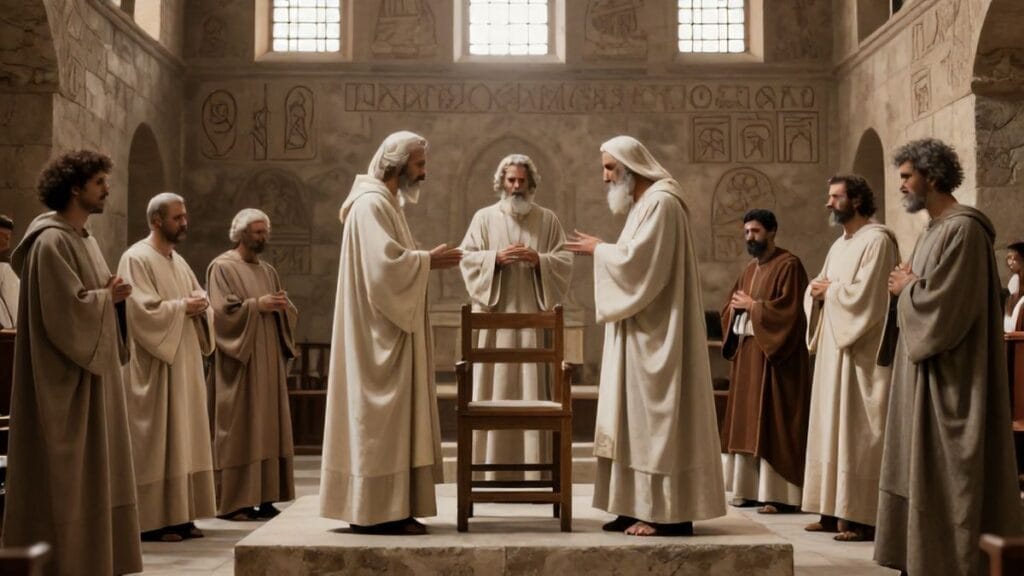
At some point, a consensus formed. Perhaps his name was repeated louder than others, his virtues described as fitting for a bishop in perilous times. The moment of acclamation would have been both solemn and electric. Here was the community, so often forced into silence, now allowed to shout, if only within those stone walls, the name of the man they believed God had chosen. The pope stephen i election thus became a rare instance when this persecuted minority could enact its own form of democracy under the eye of heaven, if not yet recognized by any earthly law.
After the acclamation, the liturgy would seal the decision. Hands were laid upon Stephen in consecration; prayers invoked the Holy Spirit; references to Peter and the apostolic succession traced an invisible line from a fisherman on the Sea of Galilee to this quiet man in a Roman catacomb. Oil was poured, the Eucharist celebrated, and the new bishop gave his first blessing. Outside, Rome went on with its business, unaware that another link had just been forged in the chain of its future spiritual rulers.
Choosing a Shepherd in Dangerous Times: How the Early Papal Elections Worked
The mechanics of the pope stephen i election belong to a broader pattern of how early Christian communities chose their leaders. Unlike later centuries, when canon law would specify every step, the mid-third century still operated with customs that blended apostolic memory, local practice, and pragmatic adaptation to danger.
The bishop of Rome was, by this time, already a figure of considerable influence. The city’s Christian community was large, wealthy by comparison to many provincial churches, and situated at the center of imperial communications. Requests for guidance flowed along the imperial roads and sea routes from Africa, Gaul, and the East to Rome. As a result, the Roman clergy—especially its presbyters and deacons—had a strong say in who could bear such responsibility.
Yet the idea that bishops should be “elected” was not a Roman innovation; it reflected a broader Christian conviction that a shepherd must be accepted by his flock. Cyprian of Carthage, writing roughly in this same era, insisted that bishops are “chosen in the presence of the people, under the eyes of all,” so that the community can assess their character. Here, narrative and prescription blur: while persecution often forced selections into semi-secrecy, the principle of communal consent remained powerful.
Elections were also constrained by the small pool of viable candidates. To be bishop, a man needed not only personal piety and doctrinal orthodoxy, but also networks of trust, administrative skills, and the courage to face imprisonment or martyrdom. Deacons like Stephen, who had direct experience with famine relief, corruption, and the art of discreet negotiation, were natural contenders. Presbyters, responsible for teaching and liturgy in local congregations, were another primary source of candidates.
Factionalism, too, played its part. Old wounds from doctrinal disputes, personal rivalries, and competing visions of discipline could all crystallize around particular names. The Novatianist schism, which had already produced a rival “anti-pope” in Rome, left behind clusters of the faithful who deeply distrusted perceived leniency toward the lapsed. Their presence in the city meant that any new election unfolded in the shadow of a fractured unity.
The result was an election culture where unity was the ideal but compromise a necessity. A candidate too closely aligned with one extreme risked reigniting schism; one perceived as ambiguous might be seen as weak. Choosing Stephen, the deacon-turned-bishop, suggests that the Roman church opted for someone they believed could hold the center—even if, as later events would show, that center was more contested than they imagined.
The Ghost of Decius: Persecution, Apostasy, and a Divided Church
Behind the formalities of the pope stephen i election loomed the long shadow of Emperor Decius, whose short but ferocious rule had reshaped Christian identity. Though Decius himself was dead by 251, the questions his edict provoked remained unhealed wounds.
In Rome and across the empire, Christian leaders confronted the uncomfortable reality that their communities were now split into three rough categories: the martyrs and confessors, who had stood firm; the lapsed, who had sacrificed or obtained false certificates; and the silent, who had managed to evade testing altogether. Each group viewed the others through a particular lens. Confessors sometimes felt that those who had escaped interrogation had enjoyed an undeserved safety; the lapsed felt judged and humiliated; ordinary believers resented seeing confessors claim quasi-episcopal moral authority.
How to heal these divisions? Cornelius, Stephen’s predecessor but one, had taken a path of measured mercy, allowing that the lapsed could be reconciled after suitable penance. Novatian, a Roman priest of powerful intellect and rigid conscience, had denounced such leniency. For him and his followers, certain sins—especially apostasy—were so grave that the Church had no right to forgive them. They split from Cornelius, setting up Novatian as a rival bishop and creating a rigorist parallel church that would survive for centuries.
Stephen inherited this fractured landscape. Though the intensity of persecution had waned after Decius’s death, memories of betrayal did not. Every time a lapsed Christian approached the Church seeking readmission, old debates reignited: Could someone who had publicly denied Christ truly be trusted again? Were they like Peter, who wept bitterly and was restored, or like Judas, whose betrayal led to destruction?
The issue was not merely moral, but theological and social. To readmit the lapsed signaled that the Church was a field hospital for sinners; to bar them permanently signaled that it was a community of almost angelic purity. In practice, both positions could fracture families and friendships. One household member might have stood firm, another faltered. Reconciliation policies thus shaped dinner tables as much as doctrine.
Stephen’s Rome, still negotiating this post-Decian landscape, could not discuss any matter of discipline without touching these bruised nerves. His election signaled that the community was ready to move forward—but “forward” did not mean agreement. It meant that the unresolved conflicts of the past would now play out under his watch, and his decisions would either soothe or deepen the rifts within the wider Christian world.
Novatian and the Wounds of Schism
The schism sparked by Novatian was not some minor, local disagreement; it was a trauma that reshaped Christian conceptions of sin, holiness, and the nature of the Church. When Cornelius had been elected bishop years earlier, a sizable and intellectually formidable minority in Rome had rallied around Novatian, a respected theologian who argued that the Church had no authority to restore those who committed grave post-baptismal sins, especially apostasy.
Novatian’s followers did not see themselves as seceding from the Church; they believed they were preserving its purity against a lax majority. Their communities practiced strict discipline, their clergy lived simply, and their members often accepted persecution with zeal. That made them, in the eyes of many ordinary believers, disturbingly compelling. A Church of the pure had a certain dark allure in an age when martyrdom was a real possibility.
By 254, when Stephen took office, Novatian’s network extended beyond Rome, with bishops and congregations scattered across the empire. The presence of this rigorist alternative meant that any Roman bishop’s stance on the lapsed was not merely a pastoral choice but a competitive factor in the religious marketplace of the time. If Stephen was too lenient, he risked driving stricter souls into the Novatian camp; if too strict, he risked betraying what many saw as Christ’s endless mercy.
We do not possess a manifesto from Stephen on the Novatianists. But the fact that he stood firmly within the line of Cornelius—who had excommunicated Novatian and rejected his claims—makes clear that he saw the Church as both holy and hospital. The bishop, in this vision, was not merely guardian of a sacred boundary but healer of wounded souls. Unity, for Stephen, required embracing the penitent, not freezing the Church into a society of the nearly flawless.
Yet the cost of unity was controversy. Every policy of readmission, every penitential ritual, every restored lapsed person taking the Eucharist alongside the steadfast, might provoke quiet outrage in those who still bore scars for having refused to sacrifice. The pope stephen i election thus placed at the Church’s helm a man who had to navigate between a rigorist past that refused to die and a future in which mercy would increasingly define the Church’s public face.
Rome and Carthage: The Brewing Conflict with Cyprian
If internal Roman tensions were not enough, Stephen also had to contend with powerful voices abroad—none more important than Cyprian, bishop of Carthage. Carthage, a major North African port and the center of a vibrant Christian community, had faced the Decian persecution with its own particular drama. Cyprian himself had gone into hiding during the worst of the repression, a decision for which he was both criticized and praised, and later returned to organize the reconciliation of the lapsed.
Cyprian was no obscure provincial prelate. His letters and treatises reveal a sharp mind and a profound concern for ecclesial unity. He insisted on the close bond among bishops, whom he saw as collectively sharing in the one episcopate, each in his local church but all in communion. In his famous work On the Unity of the Catholic Church, he memorably described the Church as a seamless garment, not to be torn by schism.
And yet this great advocate of unity would soon find himself in direct conflict with the bishop of Rome. The seeds of that conflict lay in differing local responses to heresy and the lapsed. In North Africa, Christians had endured not only persecution but also the rise of rival groups whose doctrines and practices they regarded as profoundly corrupt. For Cyprian and many African bishops, baptism administered outside the visible Catholic Church seemed undeniably tainted. How could a sacrament performed by heretics, who were themselves cut off from the Church’s life, convey the grace of incorporation into that very Church?
Rome, by contrast, had long accepted the validity of baptisms performed by heretical or schismatic groups, on the condition that they used the proper Trinitarian formula. For them, the power of baptism derived from Christ, not from the moral or doctrinal purity of the minister. Someone coming into full communion from a heretical group would therefore receive not a new baptism, but the laying on of hands as a sign of reconciliation.
These differing approaches were more than technical disagreements; they expressed contrasting visions of where the Church’s boundaries lay and how they were crossed. When Stephen, newly elected, looked across the sea to Carthage, he saw brothers in the faith but also brewing controversy. The pope stephen i election, in effect, had handed him not only the Roman chair but also the unenviable role of arbiter in a dispute that touched the heart of Christian identity: Who belongs, and how do they enter?
Baptism, Heresy, and Identity: The Theological Stakes of Stephen’s Pontificate
The conflict between Stephen and Cyprian over baptism might at first appear remote, an abstract quarrel among bishops. In reality, it was a visceral struggle over what made someone a Christian at all. Was Christian identity bound so tightly to the visible, orthodox community that anything done outside it was void? Or did God’s grace operate even through flawed channels, so long as the formal elements of the sacrament—water, invocation of the Trinity—were present?
Stephen’s position was clear: baptism conferred in the name of the Father, Son, and Holy Spirit, even by heretics, truly baptized. Those entering the Catholic Church from such groups needed reconciliation, not repetition of the sacrament. Cyprian and the African bishops, convinced that heresy severed one from Christ, insisted on rebaptism. Their stance, shaped by pastoral realities in North Africa, was not a mere whim, but a deeply held conviction that the Church’s unity and holiness were at stake.
The dispute was not conducted in hushed private conversations but in letters that travelled slowly across the Mediterranean, carried by couriers who risked arrest or shipwreck. These letters, quoted and paraphrased by later writers, show flashes of temper and moments of moving concern. Stephen, appealing to the custom of the Church at Rome and to what he believed was an older and wider tradition, refused to budge. Cyprian, supported by regional councils in Carthage, held equally firm. Each was convinced that he was defending the integrity of the Gospel.
The tone, at times, hardened. Stephen reportedly threatened to break communion with those who rebaptized, treating them almost as schismatics. Cyprian, in turn, emphasized the autonomy of each bishop within his own see. Church historian Eusebius, writing in the fourth century, preserves fragments of these debates, hinting at the intensity with which both sides clung to their convictions (Eusebius, Ecclesiastical History, Book VII).
What is astonishing is how quickly a local disciplinary question escalated into a struggle over authority. When Stephen invoked the tradition of Rome, he did more than offer an argument; he implicitly claimed a special responsibility—one might say a primacy—in preserving what he saw as apostolic practice. Cyprian, while deeply respectful of Rome, resisted any notion that one bishop could unilaterally impose his disciplinary views on another. Unity, for him, was a chorus of bishops in harmony, not a solo performance from Rome.
Thus the pope stephen i election had unintentionally initiated a pontificate that would crystallize an issue at the heart of later Catholic self-understanding: the scope and limits of Roman authority in matters of doctrine and discipline. The conflict over baptism was its stage; the deeper question of primacy was its script.
The Human Face of Authority: Stephen as Pastor, Judge, and Brother
Behind the abstractions of doctrine and the formality of episcopal titles lay a man who had to meet people’s eyes, listen to their stories, and make decisions that would shape their lives. Stephen was not merely a figure in correspondence with African bishops; he was the pastor of a network of Roman house-churches filled with flesh-and-blood believers whose struggles were immediate and concrete.
Imagine the line of supplicants one might have seen at the door of his residence—likely a modest complex owned by the Church or a wealthy patron. A woman whose husband had been executed under Decius, trying to raise children while navigating poverty. A former soldier, recently converted, haunted by the memory of participating in persecutions. A merchant seeking advice on whether he could in good conscience pay municipal dues at temples dedicated to the gods. A lapsed Christian, certificate of sacrifice burned long ago in shame, now begging to be reconciled before death.
Stephen’s role required constant discernment. He had to judge individual cases of repentance, assign penances that were both meaningful and bearable, and avoid creating the impression that forgiveness was cheap. He needed to encourage confessors without letting them become tyrants of conscience. He had to maintain the Church’s financial stability, ensuring that food, clothing, and burial were available to the poor, all while Rome’s economic climate fluctuated under the pressures of war and inflation.
The theology he defended in correspondence was informed by these encounters. To argue that heretical baptism could be recognized was not, for him, merely a word game; it meant that a person who had already undergone a profound conversion and symbolic death-and-rebirth in water would not be told that their first step toward Christ had been utterly meaningless. To treat that baptism as real, even if later distorted by heresy, was to honor the mysterious freedom of God to work in unexpected places.
But such pastoral choices also had costs. Some in Rome, perhaps influenced by African or Eastern rigor, may have grumbled that Stephen was too tolerant. Others, on the receiving end of discipline, might have judged him severe. Authority in the early Church was a heavy burden, carried without the institutional protections of later centuries. Bishops could be arrested, exiled, or even executed at the whim of imperial administrators. Each public stance Stephen took, each letter he signed, exposed him to potential danger. Yet he continued to act, convinced that a bishop could not lead by silence.
Letters Across the Sea: Disputes, Negotiations, and Broken Communion
The network of letters that bound Stephen to other bishops was the nervous system of the third-century Church. Messages travelled slowly, sometimes taking weeks or months to reach their destination, and could be delayed or lost entirely. Yet through these fragile channels, debates raged with as much intensity as if the disputants had been in the same room.
Cyprian convened councils in Carthage to address the baptism question, producing decisions that contradicted Roman practice. Bishops from other regions—Asia Minor, for instance—often sided with the Africans. Stephen, informed of these developments, responded with firmness that many found startling. According to later accounts, he labelled those who rebaptized as innovators and threatened to sever communion with them. His language, if reported accurately, suggests a man who believed that he was not introducing a new idea but defending what had always been believed.
These letters were not merely doctrinal treatises; they carried real consequences. Communion between churches in this period was expressed symbolically and concretely: through the mutual recognition of bishops, through the sharing of the Eucharist, and through letters of peace exchanged on significant occasions. To break communion was to declare that a relationship had been gravely wounded, if not severed.
Yet even in the heat of controversy, complete rupture did not necessarily follow. Cyprian continued to insist on the unity of the episcopate, and there is evidence that, despite harsh words, many churches attempted to maintain at least a minimal bond with Rome. The disagreements were serious, but not yet the kind that produced permanent schisms on the scale of Novatianism. The Church was testing the elasticity of its unity, stretching it to the breaking point but not entirely snapping it.
In later centuries, some of these letters would be quoted in support of various positions on papal authority. For instance, later advocates of Roman primacy would point to Stephen’s insistence on Roman tradition as a precedent, while critics would emphasize Cyprian’s defense of episcopal equality. The very ambiguity of the episode—strong Roman rhetoric, yet no definitive enforcement—left room for competing narratives. The pope stephen i election thus became, retrospectively, the opening of a chapter in which the identity of the papacy itself was being written in ink that was not yet fully dry.
Stephen and the Wider Empire: Bishops, Emperors, and the Web of Power
Stephen’s Rome did not exist in a vacuum of purely religious concerns. The mid-third century was one of the most turbulent periods in imperial history, a time sometimes called the “Crisis of the Third Century.” Emperors rose and fell with alarming speed; border wars, internal usurpations, and economic fragmentation strained the empire’s capacity to govern.
By the time of Stephen’s election, the emperor was Valerian, a man whose early years in power did not immediately spell disaster for Christians but whose later policies would darken their horizon. At first, Valerian appeared relatively benign, focusing on stabilizing the empire. Christians might even have enjoyed a brief respite from the worst state-sponsored violence, though local persecutions and social hostility never fully disappeared.
The Church, for its part, navigated a delicate relationship with imperial power. Christians prayed for the emperor’s welfare, as earlier writers like Tertullian insisted, but refused to participate in the cultic acts that symbolized loyalty. This dual posture—spiritual support without religious compromise—put bishops like Stephen in a complicated position. They had to encourage civic peace and obedience to just laws while preparing their flock for the possibility of renewed persecution at any moment.
Stephen also had to manage relations with other bishops whose cities stood at critical imperial crossroads. Antioch, Alexandria, Carthage, and smaller centers like Caesarea in Palestine each had their own dynamics, shaped by local politics and ethnic tensions. When theological crises erupted—over the lapsed, baptism, or other issues—these local factors colored the responses in ways that were not always visible from Rome. To govern from the capital required not only knowledge of doctrine but also an intuition for the interplay between local needs and universal principles.
In this sense, Stephen’s insistence on a consistent Roman practice can be seen as an attempt to create stability in a chaotic age. If imperial frontiers and dynasties could shift almost yearly, perhaps the Church’s sacramental policies could provide a counterweight of continuity. That desire for sameness, for something that did not change when everything else did, may help explain the determination with which he resisted what he saw as innovations, even when they came from respected figures like Cyprian.
Thus the pope stephen i election did more than fill a clerical vacancy. It placed in Rome’s episcopal seat a man whose decisions would interact in subtle ways with the empire’s broader crises, contributing to the gradual emergence of the bishop of Rome as a reference point not only for Christians but, in time, even for emperors themselves.
The Threat of Valerian and the Rumor of Martyrdom
In the later years of Stephen’s pontificate, the political weather turned ominous. Valerian, initially tolerant, seems to have shifted under the influence of advisers and the pressures of war. Around 257, he issued edicts targeting Christian clergy and practices. Bishops, priests, and deacons were ordered to perform sacrifices or face banishment; gatherings in cemeteries—so central to Christian worship and memory—were forbidden. A second edict in 258 intensified the pressure, authorizing the execution of clergy and the confiscation of Christian property.
The precise timing of Stephen’s death remains uncertain, but later tradition places it in 257, during this rising storm. According to one account, preserved in later martyrologies, he was beheaded while sitting on his episcopal chair in a catacomb chapel, celebrating the liturgy. The image is undeniably powerful: a bishop struck down in the act of presiding at the Eucharist, martyrdom and sacrament fused into one scene.
Modern historians approach this story with caution, noting that the evidence for Stephen’s martyrdom is less firm than for other third-century popes like Sixtus II, who was clearly executed under Valerian. It is possible that Stephen died of natural causes, his later reputation as a martyr arising from a general memory of persecution rather than from a precise event. Yet the persistence of the tradition suggests that Christians of later centuries found it plausible, even fitting, that a man who had defended the Church’s unity so fiercely would have sealed his witness with blood.
Whether or not he died by the sword, the climate of Valerian’s persecution shaped Stephen’s final months. He would have lived with the knowledge that his clergy were targets, that worship had once again been pushed into deeper secrecy, and that the cemeteries—the very places where he had perhaps been elected—were now under special suspicion. Decisions about doctrine and discipline suddenly had to be made in an atmosphere of imminent danger, where any written word might be used as evidence in a trial.
The connection between the pope stephen i election and the possibility of martyrdom was not accidental. In this era, to accept the episcopate, especially in a city as visible as Rome, was to accept a likely death sentence if imperial policy turned hostile. Bishops were the faces of their communities, and emperors knew that striking them could demoralize the flock. The courage required to take on such a role cannot be easily overstated. Whether his blood was literally shed or not, Stephen’s life was lived under the sword’s shadow.
Legacy Forged in Controversy: How Stephen Shaped the Roman Primacy
When Stephen died, sometime around 257, there was no immediate canonization ceremony, no formal doctrinal pronouncement recording his ideas. He was buried—tradition places his tomb in the catacombs of St. Callixtus or nearby—and another bishop, Sixtus II, was elected to take his place. Life in the embattled Roman Church went on.
Yet the legacy of the pope stephen i election did not fade. Over time, the memory of his confrontations, especially with Cyprian and the African bishops, took on a symbolic weight. Later Catholic theologians, looking back, saw in Stephen a figure who had insisted that Rome’s tradition was not merely local custom but a standard with claims on the whole Church. Augustine of Hippo, writing more than a century later, would eventually side with the Roman position on baptism, rejecting the re-baptism of heretics and thereby, in effect, vindicating Stephen’s stance against Cyprian’s (Augustine, On Baptism, Against the Donatists).
This retrospective “victory” meant that Stephen’s once-contested position became part of the mainstream Catholic understanding of the sacraments. The idea that baptism, if properly administered, could not be repeated, regardless of the minister’s state, would spread throughout Latin Christianity. The pastoral logic behind it—the recognition of God’s faithfulness to the act even when humans are unfaithful—would shape countless lives of converts and penitents in centuries to come.
Equally significant was the precedent Stephen set in asserting that a practice rooted in Roman tradition carried weight for other churches. He did not yet possess the juridical authority that later popes would claim; his threats to break communion did not automatically resolve disputes. But he did act as if the bishop of Rome had a special responsibility to guard and articulate the apostolic heritage. His self-understanding, more than any formal title, nudged the Church toward a future in which the papacy would be a central point of reference in global Christianity.
His legacy was complex. Some would remember him as rigid, too quick to condemn those who differed from him. Others would hail him as a defender of sacramental objectivity and ecclesial unity. That ambivalent memory itself became part of the Catholic tradition: popes were not to be idealized as flawless heroes, but recognized as fallible men whose decisions nevertheless could be vessels of enduring truth. In Stephen’s case, controversy and sanctity were intertwined, a reminder that the Church’s history has rarely been tidy.
Memory, Legend, and the Afterlife of a Third-Century Pope
As the centuries passed, Stephen’s name gradually receded from the everyday awareness of most Christians, overshadowed by more famous popes and martyrs. Yet in liturgical calendars, in inscriptions, and in the quiet corridors of the Roman catacombs, his memory persisted. Pilgrims in late antiquity and the early Middle Ages visited the burial sites of early popes, tracing with their fingers the carved names on stone, whispering prayers in cramped, candlelit chapels where bones rested in the walls.
Legends accreted around him, as they did around many early martyrs. The image of Stephen being beheaded on his episcopal chair became a potent symbol in art: a bishop unmoved even in the face of death, attached to his office to the last breath. These stories, even if historically uncertain, functioned as moral narratives, teaching later generations that faithfulness in office meant readiness to die where one served.
In theological debates of the later patristic period, his conflict with Cyprian was occasionally revived as a precedent. Donatists in North Africa—rigorists who, like Novatianists before them, insisted on the purity of the Church and the invalidity of sacraments administered by unworthy ministers—looked back to Cyprian as a kindred spirit. Augustine, opposing them, pointed to the Church’s eventual consensus in favor of Stephen’s view. Thus, long after his death, Stephen’s choices continued to shape arguments on grace, holiness, and institutional authority.
The physical city of Rome also preserved him. When the catacombs were rediscovered and explored in the modern era, archaeologists and historians traced the evolution of papal tombs and cults. Inscriptions, mosaics, and altar placements all suggested that early popes like Stephen had been honored, even if not always in grand fashion. His name in the list of bishops of Rome became not just a line in a book but a clue in a larger story about how the Church remembered its leaders.
For contemporary readers, the pope stephen i election and its aftermath may seem a distant episode buried under seventeen centuries of subsequent history. Yet in the debates over who is in the Church, how sacraments work, and what the role of papal authority should be, Stephen is closer than he appears. His world, with its persecuted congregations, contested doctrines, and fragile unity, is not entirely alien to a global Christianity still wrestling with division and identity.
In the end, Stephen’s afterlife is one of subtle but real influence. He is a reminder that history is not only made by towering figures whose names dominate every page, but also by those whose stubborn fidelity in particular, even seemingly narrow disputes can quietly redirect the flow of doctrinal development and institutional self-understanding.
Conclusion
The election of Stephen I as bishop of Rome on 12 May 254 was far more than a brief ceremony in a hidden chapel; it was the opening move in a pontificate that would leave deep marks on Christian history. Chosen in a city still traumatized by Decius’s persecution, Stephen inherited a fractured community wrestling with the wounds of martyrdom and apostasy. His background as a deacon had taught him the weight of practical charity and the complexity of human frailty; as bishop, he had to translate that experience into policies on the lapsed, on heretical baptism, and on the ever-fragile unity of the Church.
Through his conflicts with Cyprian of Carthage and other bishops, Stephen forced into the open questions that had simmered beneath the surface: Where did the Church’s boundaries truly lie? How did sacraments operate in relation to sin and error? What authority did the bishop of Rome possess in disputes that spanned continents? His insistence on recognizing the validity of baptism administered by heretics, and his appeal to Roman tradition as a norm, anticipated future developments in Catholic sacramental theology and papal primacy, even as his contemporaries sometimes resisted him.
Whether he died a martyr or not, Stephen lived and ruled under the constant threat of imperial violence, his final years overshadowed by Valerian’s renewed persecution. The courage to accept the papacy in such a context, and to stand firm in contentious doctrinal debates, gives moral weight to his decisions, even when their tone strikes modern readers as severe. Over time, the Church’s eventual embrace of his sacramental views and its reverence for the early Roman See transformed the once-disputed positions of a third-century bishop into elements of enduring orthodoxy.
The pope stephen i election thus stands as a window into a Church still becoming itself—illegal yet organized, divided yet seeking unity, local yet already thinking and acting on an imperial scale. In tracing his story, we see how ordinary believers, obscure deacons, and embattled bishops together forged patterns of faith and authority that would shape Christianity for millennia. And we are reminded that history’s turning points often occur not in triumphant public spectacles, but in dimly lit rooms where frightened people, trusting in God more than in their own wisdom, dare to choose a leader for an uncertain future.
FAQs
- Who was Pope Stephen I?
Pope Stephen I was the bishop of Rome from 254 to about 257 CE. Originally a deacon in the Roman Church, he was elected to succeed Lucius I and became a central figure in disputes over the treatment of the lapsed and the validity of baptism administered by heretical or schismatic groups. - When and where did the election of Pope Stephen I take place?
The pope stephen i election took place on 12 May 254 in Rome. Although exact details are lacking, it most likely occurred in a Christian assembly space or cemetery chapel, perhaps in the catacombs, due to the ongoing legal precariousness of the Church. - Why was his election particularly significant?
Stephen’s election was significant because it came in the immediate aftermath of severe persecution and during ongoing conflicts over how to treat Christians who had lapsed under pressure. His decisions on issues like heretical baptism and Church unity shaped later Catholic doctrine and contributed to the emerging sense of Roman primacy. - What was the main theological controversy of Stephen’s pontificate?
The main controversy centered on whether baptisms performed by heretics or schismatics were valid. Stephen maintained that such baptisms, if done in the Trinitarian formula, should be recognized and not repeated, while Cyprian of Carthage and many African bishops insisted on rebaptism. - Did Pope Stephen I claim special authority for the Church of Rome?
Stephen did not articulate a fully developed theory of papal primacy, but he did appeal strongly to the tradition of the Roman Church as a standard for others and threatened to break communion with those who rejected its practice. This behavior laid groundwork for later notions of the pope’s unique authority. - Was Pope Stephen I a martyr?
Later tradition holds that Stephen was martyred, possibly beheaded while celebrating the liturgy in a catacomb chapel during Valerian’s persecution. However, modern historians consider the evidence for his martyrdom uncertain; he may also have died of natural causes around 257. - How did his conflict with Cyprian of Carthage end?
The conflict did not result in a formal, permanent schism, though there were sharp exchanges and threats of broken communion. Over time, the broader Church came to adopt Stephen’s position on baptism, particularly through the influence of later theologians like Augustine, effectively resolving the issue in Rome’s favor. - How were popes like Stephen elected in the third century?
In Stephen’s time, the bishop of Rome was chosen through a process involving the clergy—presbyters and deacons—and the consent or acclamation of the Christian people. The procedure was less legally regulated than in later centuries and often had to adapt to the pressures of persecution and secrecy. - What impact did the Decian persecution have on Stephen’s pontificate?
The Decian persecution created large numbers of lapsed Christians, deep moral wounds, and rival rigorist movements like the Novatianists. Stephen’s pontificate was shaped by the need to address these divisions, formulate policies for reconciliation, and define the Church’s identity as both holy and merciful. - Why is Pope Stephen I still important to study today?
Studying Pope Stephen I illuminates how early Christians grappled with questions that remain relevant: the nature of forgiveness, the meaning of sacramental grace, the balance between local autonomy and universal authority, and the cost of leadership under pressure. His election and decisions reveal the messy, human processes by which enduring doctrines and institutions took shape.
External Resource
Internal Link
Other Resources
- Encyclopaedia Britannica – general search for the exact subject
- Google Scholar – academic search for the exact subject
- Internet Archive – digital library search for the exact subject