Table of Contents
- A River Empire on the Brink: Setting the Stage in Late Third-Century China
- From Three Kingdoms to One Ambition: The Rise of Jin and the Eclipse of Wei
- Eastern Wu at Sunset: Strength, Stagnation, and the Illusion of Security
- Architect of Conquest: Emperor Wu of Jin and His Grand Design
- Drawing the Sword of the North: Strategic Planning Before the Invasion
- Winter of 279: Armies on the Move and the Opening of the River Gates
- Steel on the Yangtze: Naval Clashes, Broken Booms, and Shattered Defenses
- The Fall of the Borderlands: Commanderies That Chose Silence or Surrender
- Crisis in Jianye: Court Intrigue, Hesitation, and the Last Councils of Eastern Wu
- Heroes, Deserters, and the Forgotten: Human Stories from the Invasion Front
- The Last Days of Sun Hao: Capitulation, Captivity, and the End of a Dynasty
- Life Beneath Changing Banners: Civilians, Refugees, and Local Elites
- Unifying the Empire: How Jin Explained Victory to Itself and to History
- From Triumph to Trouble: The Hidden Costs of Conquest for the Jin Dynasty
- Memory of a Vanished Kingdom: Eastern Wu in Chronicles, Novels, and Folklore
- River, Empire, and Aftermath: Long-Term Consequences of the Jin–Wu Conflict
- Conclusion
- FAQs
- External Resource
- Internal Link
Article Summary: In the winter of 279, the jin invasion of eastern wu began as a calculated gamble to end nearly a century of fragmentation in China. This article traces the political decay of Eastern Wu and the patient consolidation of power by the Jin dynasty, culminating in a massive riverine campaign across the Yangtze. Through narrative scenes, historical analysis, and human stories, it follows generals, emperors, soldiers, and civilians as they move through the chaos of war and the uncertainty of regime change. The jin invasion of eastern wu is not told only as a military operation, but as a moment when belief in the Three Kingdoms world finally cracked. We explore the careful planning of Emperor Wu of Jin, the hesitation and misjudgments at the Wu court, and the agonizing decisions made by commanders on both sides. The article also examines how the jin invasion of eastern wu reshaped political geography, elite society, and cultural memory in the centuries that followed. From desperate naval battles to quiet acts of surrender, from official chronicles to later romanticized fiction, the story of this campaign reveals how unification can be both a promise and a prelude to new turmoil. By the end, readers can see why the jin invasion of eastern wu in 279 still stands as a turning point between the heroic age of the Three Kingdoms and the fragile unity of a short-lived empire.
A River Empire on the Brink: Setting the Stage in Late Third-Century China
On a winter night near the end of the year 279, watchfires along the northern bank of the Yangtze River flickered against the cold wind. Men in leather armor and iron helmets tightened their cloaks, their breath clouding in the frigid air as they stared out across the dark expanse of water. On the far side lay Eastern Wu, the last independent kingdom of the once-mighty Three Kingdoms era, its cities lit by the same uneasy fires. Few of those men realized that what they were about to take part in—the jin invasion of eastern wu—would close a chapter that had defined a generation’s understanding of war, loyalty, and statehood.
For nearly a century, China had been a land divided. After the collapse of the Han dynasty in the late second century, regional warlords rose, fell, and were broken, until three major powers remained: Wei in the north, Shu-Han in the southwest, and Wu in the southeast. By 279, one of them, Shu-Han, was already gone—its banners lowered in 263 under the pressure of northern armies. Another, Wei, had been hollowed out from within and replaced by its own generals, rebranded as the Jin dynasty. Only Eastern Wu still flew the colors of an independent kingdom over the lower Yangtze and the fertile river delta around present-day Nanjing, Hangzhou, and Shanghai. Its rulers believed the great river, wide and swift, would protect them as it had for decades.
Yet water, for all its expanse, cannot shield against time. The jin invasion of eastern wu was not merely a sudden thrust across the river. It was the culmination of slow demographic shifts, fiscal exhaustion, institutional decay, and personal misjudgments. In the once-prosperous cities of Wu, bureaucratic positions had become hereditary prizes; military units were underpaid and undertrained; commanders more concerned with reputation and wealth than with reform. People still told stories of earlier heroes—Sun Quan, the founder of Wu; Zhou Yu, the brilliant strategist of Red Cliffs; Lu Xun, the general who crushed a rebellion with fire and cunning. But the men now wearing their armor were heirs in name only.
On the northern side, by contrast, the Jin regime gathered strength. Emerging from the shell of the Cao-Wei state, Jin inherited the bureaucratic apparatus of the north, a developed agricultural core, and a tradition of effective, if ruthless, military organization. Its armies had already demonstrated their capacity by conquering Shu-Han. The resources and confidence this victory gave them would soon be turned eastward. The jin invasion of eastern wu, then, was not an isolated campaign; it was the final maneuver in a long chess game played over the vast board of the Chinese heartland.
Standing at the threshold of 279, ordinary people across China might have sensed that something was about to change, though few could have named the shape of that change. Taxes pressed heavier; conscription notices spread; rumors floated down country roads and across ferry crossings. Some spoke of an emperor in Luoyang determined to reunify “All Under Heaven.” Others muttered that the Yangtze was impregnable, that Eastern Wu had survived too many wars to fall now. Both perspectives contained a kind of truth, but the events that followed would reveal just how fragile the old certainties had become.
From Three Kingdoms to One Ambition: The Rise of Jin and the Eclipse of Wei
The story of the jin invasion of eastern wu cannot be told without first understanding the long shadow of the Cao-Wei state and the quiet revolution that transformed it into the Jin dynasty. When the Han dynasty unraveled in the second century, the north fell under the control of Cao Cao, a warlord who built a powerful regime on administrative reform, strict discipline, and an almost merciless pragmatism. His son, Cao Pi, would proclaim the Wei dynasty in 220, claiming the Mandate of Heaven and reducing the Han ruler to a relic of the past.
For decades, Wei fought against Shu and Wu in a bruising strategic stalemate. Each state built complex alliances, fortified borderlines, and employed brilliant strategists: Zhuge Liang’s northern expeditions from Shu, Lu Xun’s cunning in Wu, and the methodical pressure of Wei generals in the north. By the mid-third century, however, cracks began to appear in Wei’s façade. Court factions multiplied; emperors were overshadowed by their own generals and ministers. Among them, the Sima family—especially Sima Yi and his descendants—rose first as loyal servants, then as kingmakers, and finally, as usurpers.
By 265, Sima Yan, grandson of Sima Yi, had carefully maneuvered himself into supreme power. The Wei emperor abdicated under pressure, and Sima Yan ascended as Emperor Wu of Jin. Formally, the dynasty changed from Wei to Jin, but the real transformation was in ambition. Where Wei had become entangled in endless conflict, Jin set its sight on a single, clear objective: to unify the Chinese world. The conquest of Shu-Han in 263 was the first step. It yielded skilled administrators, fresh soldiers, and access to southwestern resources. More importantly, it proved that the dream of reunification was no longer a distant ideal—it was militarily achievable.
In Luoyang, the Jin capital, maps were unfurled and studied by candlelight. Officials traced rivers and mountain passes, revisiting old Han-era routes, evaluating pitfalls that had doomed previous northern expeditions against the south. The Yangtze loomed as both barrier and opportunity; to conquer Wu, the Jin leaders knew, they would have to master the river in a way no northern regime had done since Han times. Jin emperors and their advisors collected intelligence from merchants, defectors, and former Shu officers with experience fighting Wu. What were the dispositions of Wu’s coastal fleets? Which local governors were loyal, corrupt, or disillusioned? Which forts were neglected? The slow accumulation of such details laid the groundwork for the campaigns that would follow.
As Jin’s power solidified, Eastern Wu watched with unease. Shu’s fall had changed the balance of power overnight. Where once Wu could rely on a kind of triangular balance, playing one rival against another, it now faced a single, concentrated northern power. Some Wu officials urged immediate reforms and military preparation; others clung to the belief that the Yangtze and Wu’s navy ensured safety. In time, that belief would prove disastrously misplaced.
Eastern Wu at Sunset: Strength, Stagnation, and the Illusion of Security
Eastern Wu, the kingdom that would face the jin invasion of eastern wu, was born on the water. Its founding ruler, Sun Quan, had made his capital at Jianye (modern Nanjing) and built a state that drew its strength from the riverine economy of the lower Yangtze, its marshlands, and coastal trade. For a time, it was a dynamic and adaptable regime, proud of its naval skill and its ability to absorb refugees fleeing the chaos of the north.
By 279, however, those early energies had dissipated. The realm was now in the hands of Sun Hao, the last ruler of Wu, whose reign is remembered as one of cruelty, extravagance, and suspicion. Historical records—colored by victorious Jin chroniclers but supported by multiple accounts—portray a ruler who punished dissent harshly, lavished resources on palaces and entertainments, and fell under the sway of sycophants. Capable ministers and generals were marginalized, exiled, or executed; mediocrity and flattery thrived.
Institutionally, Eastern Wu still possessed respectable resources. Its population along the Yangtze corridor remained significant, its agricultural base productive, its fleet relatively strong. Yet its military system rested on fragile foundations. Soldiers were often local recruits tied to regional commanders, whose loyalties were as much personal as institutional. Pay was irregular; training inconsistent. Fortifications along strategic river crossings existed but were unevenly maintained. A strong, reformist leadership might have addressed these problems. Instead, Wu drifted.
Perhaps the most dangerous illusion lay in Wu’s faith in its geography. The Yangtze River, broad and difficult to cross, had repeatedly thwarted northern invaders. The triumph at the Battle of Red Cliffs decades earlier had become a living myth, retold in taverns and family gatherings, reassuring the people that no power from the north could ever master the river. “Our boats,” people would say, “are the walls of our kingdom.” They were not entirely wrong, but they misunderstood the nature of risk. Geography could delay defeat; it could not compensate indefinitely for political decay and strategic passivity.
Within the capital, some voices warned of the approaching storm. Certain ministers urged Sun Hao to reduce court extravagance, reform the military, and strengthen river defenses. A few suggested diplomatic outreach to Jin to buy time, or internal reorganization to restore confidence among the provincial garrisons. Yet their arguments often fell on deaf ears or were interpreted as veiled criticism of the emperor. The famous saying that “when the hall beams are rotten, the roof cannot hold” felt painfully apt. A state that had once fostered bold, pragmatic leadership now punished candor.
Meanwhile, the people bore the burdens. Taxes were heavy, particularly on peasants along the lower Yangtze, where grain levies fed both the court and the army. Local elites, however, increasingly found ways to shield their estates from taxation, using social connections and legal exemptions. This imbalance eroded popular faith in the regime. When the jin invasion of eastern wu finally began, that erosion would matter as much as any fortress wall or naval detachment.
Architect of Conquest: Emperor Wu of Jin and His Grand Design
In Luoyang, Sima Yan—posthumously known as Emperor Wu of Jin—watched these developments with a patient, almost clinical eye. He had not seized power simply to preside over a divided realm; his legitimacy, as he understood it, depended on restoring a single empire over “All Under Heaven.” The conquest of Shu-Han had given him both the confidence and the precedent. Eastern Wu was now the last obstacle between him and the dream of reunification.
Emperor Wu was no battlefield commander in the mold of Cao Cao or Sun Quan, but he excelled as a political strategist and coordinator. He understood that the jin invasion of eastern wu could not be rushed. A failed campaign across the Yangtze would embolden Wu, weaken Jin’s authority, and potentially stir rebellion among northern warlords still watching from the sidelines. So he moved cautiously. He ordered thorough assessments of Jin’s fiscal health, grain reserves, and manpower. He consulted veteran generals who had served in the campaigns against Shu, asking them bluntly whether Jin’s army could endure a protracted southern war.
His advisors’ reports were encouraging. Decades of relative peace in the north had restored agricultural output. Major canal systems and river routes allowed efficient transport of supplies. The incorporation of Shu’s territories had broadened the recruitment base and provided experienced officers familiar with rugged terrain and river warfare. One such former Shu general reportedly cautioned, “The river is no ordinary defense, but neither is it a divine wall. Where men are united, they can cross even a dragon’s back.” That sentiment aligned with Emperor Wu’s own belief that morale, leadership, and coordination would matter more than the width of the Yangtze.
Emperor Wu also understood the importance of narrative. When the campaign came, Jin would not frame it merely as conquest, but as the restoration of the Han order, the ending of chaos that had plagued China for generations. Official proclamations would speak of unity, stability, and the emperor’s concern for suffering people trapped under Wu’s misrule. Such messaging was not mere propaganda; it shaped how officials, soldiers, and even hesitant elites in Eastern Wu might come to see the conflict. In the words of the Jin chronicle Jin Shu, later compiled in the Tang period, “The Emperor’s heart was set upon peace through unification, not on war for its own sake.”
With these political and ideological preparations, Emperor Wu began to move the machinery of war. Trusted generals were elevated, fleets constructed or refitted, river crossings surveyed. He did not yet give the final command—that would come in 279—but his intent became gradually harder to disguise. Diplomats sent perfunctory letters to Eastern Wu, but there was no real negotiation. The future, as Emperor Wu imagined it, contained only one dynasty ruling from Luoyang.
Drawing the Sword of the North: Strategic Planning Before the Invasion
The final plans for the jin invasion of eastern wu took shape over maps stained with ink, sweat, and the faint scars of past defeats. The Jin high command recognized that simply marching a single army to the banks of the Yangtze would invite disaster. Eastern Wu’s strength lay in its ability to concentrate forces along key river defenses and use its navy to harass any crossing. To overcome this, the Jin plan was bold: they would strike on multiple fronts simultaneously, stretching Wu’s defenses to the breaking point.
The strategy, as later reconstructed by historians, involved several major axes of advance. Northern forces in what is now Hubei and Anhui would descend toward the river, targeting strategic crossings and ports. Other detachments would move through the mountainous regions that bordered Wu’s inland territories, capturing passes and threatening flanks. This multi-pronged thrust would be synchronized with naval forces moving down tributaries and along the Yangtze itself. Instead of a single, heroic crossing, the campaign would resemble a rolling tide—many small waves combining into an overwhelming surge.
Crucial to this strategy was logistics. The Jin command devoted extraordinary attention to ensuring that grain, fodder, weapons, and reinforcements could move efficiently. Granaries were stocked well in advance near staging areas. Roads and canals were repaired or expanded. Boatyards worked ceaselessly to produce transport ships and war vessels, while blacksmiths forged weapons in quantities that would have been unimaginable a generation earlier. The memory of failed expeditions in Chinese history—stalled not by enemy armies but by supply shortages—was never far from the planners’ minds.
Intelligence also played a central role. Jin agents, merchants, and defectors provided information about the morale of Wu’s garrisons, the condition of their fortifications, and the reliability of various commanders. Some local Wu officials along the frontier were known to be resentful of Sun Hao or fearful of his wrath. These men became targets for quiet outreach. Jin envoys promised leniency, positions, or simple survival in exchange for neutrality or even quiet cooperation when the invasion began. Later accounts mention gates opened without a fight and villages that offered little resistance; such outcomes did not arise by accident.
By the late 270s, the plan was nearly complete. What remained was timing. Emperor Wu and his generals chose the winter of 279 for the campaign’s opening. The choice may seem paradoxical—why attack across a great river in the coldest season? But winter brought advantages: certain diseases were less prevalent, crops were not in the field (reducing the impact on agriculture), and—perhaps most importantly—water levels and currents in segments of the river could be more predictable for large-scale crossing operations. With the calendar’s turn approaching, the Jin war machine began quietly to move.
Winter of 279: Armies on the Move and the Opening of the River Gates
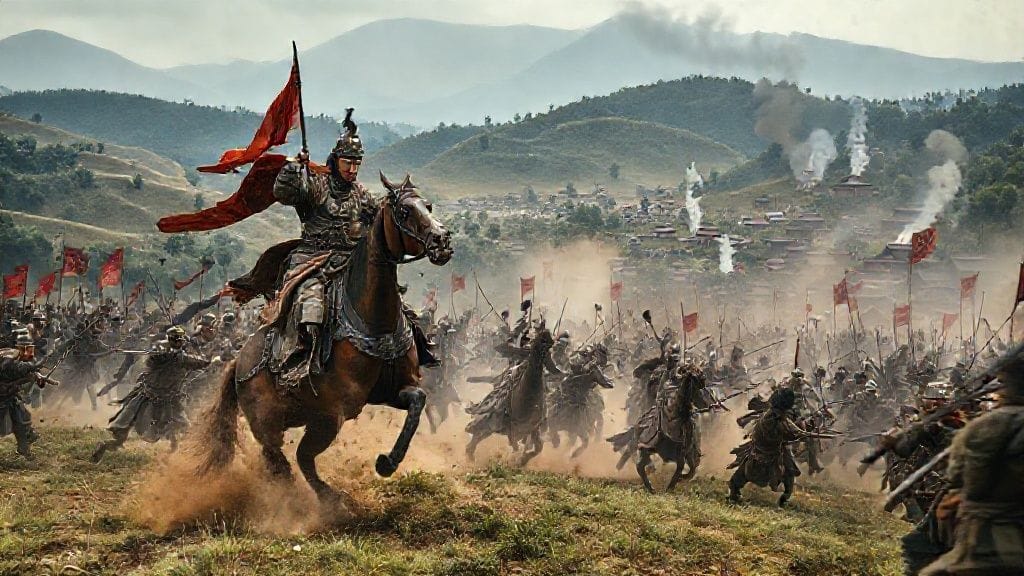
In the final weeks of 279, banners bearing the Jin emblem fluttered in camps from the middle Yangtze valley to the Huai River basin. Trumpets sounded at dawn as soldiers assembled in ranks, receiving their final orders. As the jin invasion of eastern wu shifted from plan to reality, villages along the roads watched long columns of infantry and cavalry march past, their armor catching the pale winter sun. Oxen groaned under the weight of grain carts; teams of conscripted laborers dragged siege equipment, while craftsmen and scribes moved along with the columns, part of the mobile apparatus that empire required.
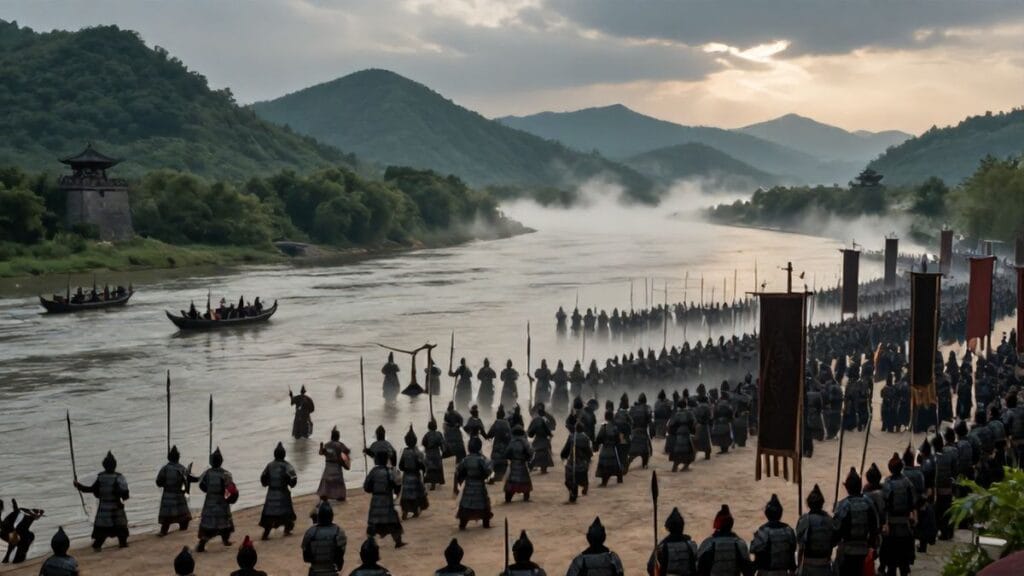
On the riverbanks, the scene was even more dramatic. Shipyards and makeshift docks jammed the shoreline as carpenters hammered together the last warships. Soldiers and sailors worked side by side, loading weapons, coiling ropes, checking rigging. Patrol boats fanned out, scouting for enemy movement and testing currents. The Jin commanders intended to overwhelm Wu’s river defenses not just with superior force, but with better coordination. Signals were agreed upon—flags by day, lanterns and fires by night. Messenger boats were assigned to maintain communication between separate flotillas and shore-based forces.
As the invasion began, multiple Jin armies moved in concert toward the Yangtze. One force advanced toward strategic crossing points opposite key Wu cities, while others targeted upriver positions that, once taken, would allow Jin control of tributaries and interior routes. Still others pushed through surrounding territories to seize high ground from which they could threaten downstream positions. The Jin generals understood that even if some attacks stalled, the cumulative pressure would strain Wu’s capacity to respond effectively everywhere at once.
In Eastern Wu, the first reports arrived with chilling clarity. Frontier outposts sent word of Jin movements, but their dispatches encountered a sluggish and uncertain response at the capital. Some Wu commanders proposed immediate counterattacks against the advancing forces, while others recommended pulling back to more defensible positions near the river. Sun Hao’s court, riddled with mistrust and intrigue, hesitated. Accusations of defeatism were leveled; honest assessment of Jin’s strength was often interpreted as disloyalty. Precious days were lost.
Meanwhile, on a stretch of the Yangtze opposite one of Wu’s fortified positions, Jin scouts signaled that the moment had come. Under cover of darkness and winter mist, rafts, ferries, and full-fledged warships pushed off from the northern bank. Oil-smeared shields lined their decks; archers waited with bows strung and arrows nocked. Oars dipped in unison, the faint creak of wood and the splash of water swallowed by the wide, breathless night. Some men silently mouthed prayers; others stared at the far shore as if willing it to be closer. The jin invasion of eastern wu had crossed from policy to lived experience.
Steel on the Yangtze: Naval Clashes, Broken Booms, and Shattered Defenses
The Yangtze River had long been considered Eastern Wu’s living wall. Its surface was crisscrossed with chains, wooden booms, and fortified islands. River forts perched on bluffs like eagles on cliffs, their watchtowers scanning for the first glint of an enemy sail. Wu’s warships, with their seasoned crews, had earned a reputation for maneuvering skill and swift strikes. Yet as the jin invasion of eastern wu unfolded, Jin commanders demonstrated that they had studied this watery fortification with care—and learned how to unmake it.
One of the iconic scenes preserved in later chronicles describes how a Jin fleet approached a heavily defended Wu river barrier at night. The Wu defenders had chained large wooden rafts and beams across a narrow stretch of the river, forming a floating wall studded with spikes. For years, such barriers had turned back or delayed smaller enemy flotillas. This time, however, Jin engineers had prepared special assault craft reinforced at the bow, backed by rafts loaded with sandbags to absorb impact. Under a hail of arrows from the Wu side, these craft rammed the barrier repeatedly while sappers in smaller boats leapt onto the timbers to hack at chains and ropes.
Torches hissed as they were flung into the cold river; burning arrows traced brief arcs of light before being swallowed by the dark water. The air filled with the smell of smoke, river mud, and fear. A Wu officer shouted orders to concentrate fire on the leading Jin ships, but the sheer number of attackers and the confusion of the moment made control almost impossible. At last, with a sound like a great tree snapping in a storm, a section of the boom gave way. Jin warships surged through the breach, their oars churning white froth, while Wu vessels scrambled to re-form a line.
Elsewhere along the river, Jin forces employed a different tactic: exploiting Wu’s overconfidence and uneven preparedness. At certain crossings, Wu commanders had grown lax, convinced no large enemy force could assemble and cross in winter. Guard rotations shrank; patrol routes were shortened. When Jin flotillas appeared, moving swiftly and in unexpected numbers, local Wu units were thrown into disarray. Some fought bravely, others fled, and some simply surrendered when they saw how heavily they were outnumbered.
One contemporary account, later quoted by historians, claimed that “the sound of drums and horns rose on both banks, and the river seemed to carry the cries of men to Heaven itself.” Whether literally true or embellished, that image captures the sensory overload of those days—the clash of wood and iron, the shouts of officers, the desperate cries of the wounded falling overboard or clinging to shattered hulls. For soldiers on both sides, the Yangtze was no longer a symbol of safety or division; it had become a killing ground.
Step by step, wave by wave, the river defenses of Eastern Wu buckled. Some positions held out fiercely, inflicting real losses on Jin attackers, but the overall momentum had shifted. Once Jin established multiple bridgeheads on the southern bank, the strategic calculus changed dramatically. Wu could no longer trust the river to block the northern armies; now they had to fight them on their own soil.
The Fall of the Borderlands: Commanderies That Chose Silence or Surrender
As Jin forces poured across the river and pushed inland, the fate of Eastern Wu began to hinge not only on battles but on choices made in dusty provincial offices and modest county seats. The jin invasion of eastern wu reached more than just fortresses; it reached into the hearts of local magistrates, garrison commanders, and landholding families who suddenly had to decide what future they believed in—or which one they simply feared less.
Many Wu commanderies along the frontier faced overwhelming Jin pressure. Their garrisons were small, often underpaid and poorly supplied. Some had not seen serious combat in decades. When Jin envoys arrived, holding out imperial edicts promising amnesty for those who yielded peacefully, the dilemma sharpened. Resist and perhaps die for a court in Jianye that had rarely listened to their needs—or open the gates and hope that Jin rule would be more predictable, if not more just?
Records from the period mention several localities where resistance collapsed almost without bloodshed. In one case, a Wu prefect reportedly convened his senior officers and leading local families. After long debate, they agreed to surrender the city on the condition that Jin forces refrain from looting and protect the fields and granaries. When the Jin army entered, banners high but weapons sheathed, the people lined the streets in tense silence. It was not a welcome so much as a collective holding of breath, waiting to see whether promises would be kept.
In other regions, however, Wu officials chose to stand and fight, often with small forces and little hope of relief. They were bound by personal loyalty, a sense of honor, or fear of Sun Hao’s wrath should they yield. Some of these defenders became local legends. A small fortress overlooking a river bend might hold out for weeks, its commander rallying his troops with stories of past Wu victories and warnings that surrender would bring humiliation. In a few such places, Jin suffered real setbacks and casualties, their initial assaults repelled by determined defenders who knew every ditch, wall, and alley.
Yet there was no escaping the larger strategic imbalance. As Jin armies coordinated their advances, Eastern Wu could not mount effective counteroffensives on multiple fronts. Commanderies that resisted stubbornly could find themselves isolated, their supply lines cut, their allies already subdued. Without a coherent, centralized response from Jianye, local courage, however admirable, could not alter the war’s overall trajectory. The borderlands of Wu became a mosaic of reactions—some cities flying Jin banners overnight, others burning those banners on their walls, all overshadowed by the steady advance of Jin’s main forces.
Crisis in Jianye: Court Intrigue, Hesitation, and the Last Councils of Eastern Wu
While battles raged along rivers and in the countryside, the capital of Eastern Wu, Jianye, was a cauldron of fear and confusion. Sun Hao’s court had long been characterized by suspicion and factionalism. The jin invasion of eastern wu magnified these tensions a hundredfold. Messengers arrived breathless at the palace gates, their reports of lost cities, breached river defenses, and wavering generals painting an increasingly grim picture.
Sun Hao’s reaction, as recorded by later chroniclers, was erratic. At times, he raged against commanders who failed to hold their positions, denouncing them as cowards or traitors. At other moments, he seemed paralyzed, unable to decide whether to dispatch reserves, negotiate, or retreat inland with a core of loyal forces. Some advisors urged him to fortify the region around Jianye and turn it into a final bastion. Others quietly whispered that perhaps terms could be reached with Jin—preserving some status for the ruling house, or at least their lives.
Court debates grew more heated as the news worsened. Officials who spoke frankly about Jin’s strength risked being accused of defeatism. Those who promised that Wu could still repel the invasion were rewarded with imperial favor, even if their optimism had no basis in reality. Reliable intelligence from the front was scarce; censorship and self-censorship distorted reports long before they reached the throne. It is astonishing, isn’t it, how often regimes collapse not only from external pressure but from their own inability to hear unwelcome truths?
Outside the palace, the mood in Jianye was anxious and restless. Merchants debated whether to move their goods, families considered sending members to safer rural areas, and rumors spread that Jin armies were already at the city gates, even when they were still days away. The sight of hurried fortification work—increased patrols, stockpiling of grain, conscription of local men—made clear that the war was no longer a distant conflict. It had come to the heart of Eastern Wu.
In one poignant anecdote recorded in later literature, a mid-ranking official reportedly returned home after a tense court session, where he had watched ministers argue over whether to fight on or seek surrender. He found his elderly mother waiting, knitting by the light of an oil lamp. When he told her that the kingdom might fall, she is said to have replied, “Dynasties rise and fall like the tides of this river. Be sure, at least, that you are not swept away by cowardice or cruelty.” Whether the story is literally true or a crafted moral tale, it captures the personal anguish behind grand political decisions.
By early 280, as Jin forces drew closer, Sun Hao’s room for maneuver narrowed. Offers of negotiation now would be seen by Jin less as diplomacy and more as a plea for mercy. Some Wu officials, recognizing the inevitable, sought private channels to Jin commanders, hoping to secure lenient treatment for their families or regions. The moral economy of loyalty, already strained by years of misrule, finally began to crack.
Heroes, Deserters, and the Forgotten: Human Stories from the Invasion Front
War is often described in terms of campaigns and dynasties, but the jin invasion of eastern wu was also etched into the memories of farmers, boatmen, women tending household shrines, and children watching columns of soldiers vanish into the distance. Their stories rarely appear in official chronicles, yet traces of them survive in localized histories, family genealogies, and later oral traditions.
Consider the experience of a Wu infantryman stationed at a riverside outpost. He had likely been conscripted from a nearby village, given minimal training, and told that the river would protect him as it had his father’s generation. When Jin ships appeared with organized ranks of archers and heavy infantry, his world tilted. The shouting of commanders, the hiss of incoming arrows, the thunder of drums—these sounds broke through whatever illusions he had held. Some fought with desperate courage, others froze or fled. In the chaos of retreat or capture, notions of patriotism, loyalty, and self-preservation collided in ways no political slogan could tidy up.
On the other side of the river, a Jin soldier from a northern farming family marched south in hopes of pay, land, or simple adventure. To him, Eastern Wu was almost a legend—a land of warm winters, rich fields, and elegant cities. As he crossed the Yangtze under fire, he might have envied the Wu sailors’ skill even as he tried to kill them. When his unit finally took a small town, the exhilaration of victory could quickly give way to the uncomfortable reality of occupying streets where frightened civilians barred their doors and mothers clutched children away from his gaze.
Women’s experiences during the invasion were especially fraught. In some towns, as Jin troops approached, families hid their daughters and young wives, fearing the age-old scourge of armies on the move. Yet there were also acts of compassion and discipline. Certain Jin commanders, mindful of Emperor Wu’s desire to present the conquest as just and orderly, issued strict orders against looting and assault. Punishments for violations were sometimes swift and public. The gap between policy and behavior varied from unit to unit, but these measures mattered. In areas where Jin troops behaved with relative restraint, local acceptance of the new regime came more quickly.
Among the literati, the invasion left a mixed legacy of shame, grief, and adaptation. Some scholars loyal to Wu committed suicide rather than serve the new dynasty. Others burned their official caps and retreated into rural seclusion, refusing appointments from Jin. Yet many accepted positions under the new regime, rationalizing that their duty was to the people, not to a fallen house. A few even wrote poems that quietly lamented the passing of Wu while acknowledging the inevitability of unification. One such poet, according to a later collection, wrote, “The banners change, but the river flows the same; I bow to a new court, yet my heart drifts to the old.”
These human experiences remind us that the jin invasion of eastern wu was not a simple story of good versus evil, or of inevitable progress. It was a time when ordinary people were forced to make extraordinary choices: fight or flee, resist or adapt, mourn or move on.
The Last Days of Sun Hao: Capitulation, Captivity, and the End of a Dynasty
As Jin armies closed around Jianye, Sun Hao’s options dwindled to bitter fragments. The capital, though still defended, had lost the protective buffer of outlying territories. Reports of Jin victories—and of cities surrendering without orders from the court—undermined any remaining confidence in a successful last stand. Even those who had once urged defiance now had to reckon with the possibility of annihilation.
The final decision to surrender, when it came, has been depicted with varying shades of drama in different sources. The official Jin histories—naturally inclined to justify their own emperor’s actions—portray it as an almost inevitable conclusion: a cruel and misguided ruler finally bending before the righteous might of a unifying dynasty. Other accounts hint at a more complex emotional landscape. Sun Hao, whatever his flaws, had inherited a legacy stretching back to the founding days of Eastern Wu. To lay down that legacy without a final, glorious battle must have been a torment.
Nevertheless, he chose capitulation. Envoys were sent to the Jin camp, bearing symbols of submission. In 280, Sun Hao formally surrendered to the Jin general—traditionally identified as Wang Jun or others depending on the specific theater—ending the existence of Eastern Wu as an independent state. The banners of Wu were lowered over Jianye; Jin standards rose in their place. Citizens of the capital, who had spent weeks fearing siege and slaughter, watched in stunned silence as the transfer of power unfolded with less bloodshed than many had anticipated.
Sun Hao himself was taken into custody and transported north to Luoyang. Here, the contrast was stark. Once a sovereign lord, he now appeared as a captured ruler before Emperor Wu of Jin. The court spectators must have sensed the weight of the moment: with this surrender, the Three Kingdoms era—so full of legendary battles and storied heroes—was definitively over. One anecdote, cited in the Zizhi Tongjian centuries later, recalls that Emperor Wu spared Sun Hao’s life and even granted him a noble title, a gesture meant to demonstrate magnanimity in victory. Whether motivated by genuine clemency or calculated politics, the act reinforced Jin’s image as a restoring, not merely conquering, power.
For many in the former territories of Wu, news of Sun Hao’s surrender came as a distant proclamation, carried on official edicts and the movement of new administrators. Some wept; others shrugged; a few even welcomed the end of what they saw as a dark chapter under his rule. Whatever their reaction, the fact remained: a dynasty that had once stood proudly at the forefront of resistance to northern hegemony had fallen without the climactic, capital-destroying siege some had long anticipated. Instead, its end felt more like a curtain quietly drawing on a stage now claimed by new actors.
Life Beneath Changing Banners: Civilians, Refugees, and Local Elites
After the formal surrender of Eastern Wu, the challenges of unification shifted from armies to administrators. The jin invasion of eastern wu had been planned with an eye not only to victory but to governing what came after. Jin officials now had to integrate millions of new subjects—farmers, artisans, merchants, scholars—into an empire whose institutions and expectations had been shaped in the northern and western heartlands.
For ordinary civilians, the first question was often brutally simple: Would they survive the transition? In many regions, Jin authorities issued proclamations forbidding indiscriminate looting and violence. Soldiers who violated these orders risked punishment. Although abuses certainly occurred, especially in the chaotic early days of occupation, the overall pattern in much of former Wu was one of gradual normalization. Markets reopened; taxes were recalculated; local granaries were inventoried. The replacement of Wu banners with Jin ones above offices and forts may have felt symbolic, but it also marked concrete changes in law and policy.
Local elites—landowners, scholars, and merchants—played a key mediating role. Many had longstanding ties to the Han tradition of imperial bureaucracy and were willing to serve any regime that offered stability and respect for their status. Jin’s prestige as the de facto successor to Han rule gave it a powerful claim on their loyalty. In the months after the conquest, Jin officials actively recruited these elites, offering positions in local administration or recommending them for posts in the wider empire. This co-optation helped smooth the consolidation of power.
Still, not everyone adapted easily. Former Wu officers who laid down arms found themselves in a precarious position. Some were assigned to new posts far from their home districts, a deliberate policy to prevent local power bases from re-forming. Others were pensioned off or monitored quietly. The fear of purges or postwar reprisals hung over them, and in some cases, justified. A few who had resisted Jin most fiercely or committed atrocities during the fighting faced execution. The line between justice and vengeance was thin and often contested.
Refugees formed another important, if less visible, thread of this story. During the invasion, some communities fled ahead of advancing armies, taking to boats along the river or seeking shelter in remote hills and forests. After the war, many of these people trickled back home, only to find their fields damaged, homes looted, or property boundaries in dispute. Jin authorities had to adjudicate these conflicts while also establishing their own systems of land registration and taxation. In some regions, disputes simmered for years, shaping local memories of the conquest.
Yet for all the disruption, there was also continuity. Children still learned to recite classical texts, now under Jin rather than Wu auspices. Priests and monks continued to perform rituals at temples and shrines. The rhythms of planting and harvest resumed along the broad plains and riverbanks. Life under changing banners was complex: for some, a heavy blow to identity; for others, simply another chapter in a long struggle to survive in a world where rulers seemed to change more often than the seasons.
Unifying the Empire: How Jin Explained Victory to Itself and to History
Victory is never just a fact; it is a story told and retold until it becomes part of a civilization’s memory. In the aftermath of the jin invasion of eastern wu, the Jin court moved quickly to shape that story. Official proclamations framed the conquest as the fulfillment of Heaven’s will, the restoration of order after the fragmentation that had followed Han’s fall. The rhetoric emphasized compassion as much as power: Jin was said to be lifting the people of Wu out of the misery caused by misgovernment and tyranny.
In Luoyang, ceremonies celebrated the unification of “All Under Heaven” under Jin rule. Envoys from the newly subdued southern territories appeared at court, bearing tribute and pledges of loyalty. The spectacle of a map of China with no rival polities must have had a powerful emotional resonance for those who remembered the chaos of earlier decades. Emperor Wu’s supporters lauded him as the ruler who had achieved what Cao Cao, Liu Bei, and Sun Quan had all sought but never realized: a single, undisputed realm.
History writing became an essential tool in cementing this legacy. Court-sponsored historians compiled accounts of the Three Kingdoms period and the rise of Jin that naturally favored their patrons’ perspective. Wu’s decline was attributed largely to the personal failings of its last ruler, Sun Hao, and the moral decay of its elites. In contrast, Jin was portrayed as virtuous, disciplined, and guided by wise leadership. Works such as Chen Shou’s Records of the Three Kingdoms (Sanguozhi)—later annotated by Pei Songzhi—provided a foundational narrative that would inform Chinese understanding of the era for centuries. Though Chen Shou had once served in Shu, his text ultimately circulated under Jin auspices and reflected the new unified order.
Of course, historians were not mere mouthpieces. Some subtly critiqued the excesses of all three kingdoms, including Jin’s own early machinations. Yet the broad arc was clear: the fragmentation of the realm was a tragedy; unification under Jin was a restoration. This framing would prove enduring. Later dynasties, looking back at the Three Kingdoms and the conquest of Wu, generally accepted the idea that unity—however achieved—was preferable to division.
It is through such lenses that later generations encountered the jin invasion of eastern wu, often stripped of its local complexities and human ambiguities. But even within these polished narratives, hints remain: stories of hesitant Wu officials, merciful Jin generals, suffering civilians, and the lingering sadness of those who watched their old world disappear beneath new banners.
From Triumph to Trouble: The Hidden Costs of Conquest for the Jin Dynasty
On the surface, the conquest of Eastern Wu marked the high point of Jin power. For the first time in nearly a century, the Chinese heartland and its major river systems were under a single imperial authority. Yet beneath this triumphant veneer lay fractures that would soon widen. The jin invasion of eastern wu had been expensive in both material and political capital. Maintaining the newly unified empire proved even more challenging than conquering it.
One immediate consequence was the redistribution of land and offices to reward the generals and aristocrats who had supported the campaign. Powerful families from the north and west received estates and posts in newly conquered southern territories. This policy helped secure loyalty in the short term but deepened regional and clan-based rivalries within the Jin elite. The empire became a patchwork of semi-autonomous power blocs, each with its own military followers and economic base.
The financial burden of the invasion also left its mark. While Jin’s northern agricultural core was relatively strong, the costs of mobilizing, transporting, and supplying large armies strained the treasury. Rebuilding damaged infrastructure in former Wu territories and integrating their tax systems added further pressure. When harvests faltered or local unrest flared, the state’s capacity to respond was not always equal to the task.
Politically, the very success of the unification created new problems. With no external rival of similar scale left to fight, ambitious generals and royal princes turned their attention inward. The question was no longer how to conquer additional lands but who would control the heart of the Jin state. Within a generation, these tensions erupted into the devastating “War of the Eight Princes,” a series of internecine conflicts among members of the imperial clan. The empire, united at such cost, began to tear itself apart from within.
Even the social integration of former Wu territories presented difficulties. While many southern elites accepted Jin rule, regional identities and loyalties did not vanish overnight. Some southerners resented northern domination or felt marginalized in the new imperial order. Over time, these sentiments contributed to a cultural and political distinction between north and south that would shape later Chinese history, especially when northern China fell to non-Han states in the fourth and fifth centuries and many elites fled south.
Thus, the conquest of Wu, while a spectacular achievement, contained within it the seeds of future instability. Unity, as the Jin rulers discovered, was not a static prize but an ongoing, fragile process.
Memory of a Vanished Kingdom: Eastern Wu in Chronicles, Novels, and Folklore
If official Jin histories framed Eastern Wu primarily as a failed and decadent regime, popular memory was kinder and far more romantic. Over the centuries, the story of Wu—and by extension, the jin invasion of eastern wu—was retold, embroidered, and transformed in works of literature and folk tradition. What had been a political and military event became, in the cultural imagination, a saga of heroes, tragic loyalties, and the inexorable turning of fate.
The most famous of these retellings is the Ming dynasty novel Romance of the Three Kingdoms (Sanguo Yanyi), which, while written more than a thousand years after the events, did much to shape how Chinese readers—and, through translation, readers worldwide—understood the era. The novel lavishes attention on figures from all three states, especially Shu and Wei, but it also grants Eastern Wu a central role. Sun Quan, Zhou Yu, Lu Xun, and others appear as complex characters, sometimes noble, sometimes flawed, but always vivid.
Interestingly, the novel ends not with the jin invasion of eastern wu itself but with the earlier stages of Jin’s rise and the downfall of Shu, leaving Wu’s final defeat more as an implied inevitability than a narrated climax. This artistic choice underscores an important cultural point: by later centuries, the emotional energy of the Three Kingdoms legend often centered on the struggles of Shu and its virtuous, if doomed, heroes like Liu Bei and Zhuge Liang. Wu, despite its rich history, occupied a more ambivalent place in popular sympathy—neither outright villain nor unambiguous victim.
Yet in local folklore across the lower Yangtze region, stories of Wu’s glory days persisted. Temples were dedicated to Wu generals, local festivals commemorated battles, and families traced lineages back to Wu officials with pride. In such tales, the invasion by Jin might be remembered as an unjust downfall orchestrated by an ungrateful Heaven, or as the tragic but honorable end of a brave maritime kingdom. The nuances of Sun Hao’s failings or Jin’s administrative virtues mattered less than the emotional resonance of loss and nostalgia.
Later scholars, particularly in the Song and Ming dynasties, revisited the history of the Three Kingdoms with fresh eyes. Some re-evaluated Wu’s achievements in commerce, naval technology, and regional governance, pushing back against earlier Jin-centered narratives. Others used the story of Wu’s fall as a moral lesson about the consequences of internal corruption and missed opportunities for reform. In this way, the memory of Eastern Wu served as both a mirror and a warning for subsequent polities facing their own crises.
River, Empire, and Aftermath: Long-Term Consequences of the Jin–Wu Conflict
Looking back from the vantage point of centuries, the jin invasion of eastern wu in 279–280 appears as both an endpoint and a beginning. It closed the era of the Three Kingdoms, reuniting the Chinese heartland under a single dynastic banner for the first time since the late Han. But it also set in motion patterns of regional interaction, political fragmentation, and cultural memory that would shape Chinese history long after Jin itself had fallen.
Geographically, the conquest underscored the strategic centrality of the Yangtze River. Control of this vast waterway and its tributaries became a cornerstone of later regimes’ power calculations. The methods Jin used to overcome Wu’s river defenses—combined arms approaches, coordinated naval and land operations, attention to logistics—provided a template that later dynasties would study. The notion that the Yangtze alone could guarantee security was decisively shattered, replaced by a more sober understanding that geography must be matched by institutional strength and flexible strategy.
Politically, the brief unity under Western Jin was followed by division and upheaval. Within a few decades of the conquest of Wu, internal conflict and invasions by non-Han steppe groups plunged northern China into the era of the Sixteen Kingdoms. Many members of the northern elite, along with farmers and artisans, fled south across the same Yangtze that Jin armies had once crossed in triumph. They found refuge in the former territories of Wu, whose cities and farmlands now became the cradle of the Eastern Jin and later Southern dynasties. Ironically, the region once conquered by the north became a stronghold of Chinese culture when the north itself fell into turmoil.
Culturally, the integration of Wu territories into the Jin world accelerated the blending of northern and southern traditions. Literary styles, religious practices, and local customs intermingled. Southern landscapes and sensibilities—lush river scenes, misty hills, waterside pavilions—began to appear more frequently in poetry and painting. Over time, the lower Yangtze region emerged as a distinct cultural heartland, its identity shaped by both its independent history and its role within larger imperial frameworks.
In the realm of historical consciousness, the jin invasion of eastern wu became a touchstone for debates about unity and division, strength and decadence, geography and governance. Later scholars and statesmen would ask: Why did Wu fall? Could reform have saved it? Was unification under Jin an unalloyed good, or did it simply pave the way for new conflicts on a larger scale? The answers varied, but the questions kept alive a critical awareness that political success is fragile, contingent, and deeply tied to the quality of leadership and institutions.
Today, when we read about armored ships on the Yangtze and anxious councils in Jianye, we are not just revisiting an old war. We are looking at a moment when a river ceased to be a boundary and became a conduit; when a dynasty realized its greatest dream and, in doing so, exposed itself to new vulnerabilities; when millions of ordinary people learned, once again, how to live beneath changing banners.
Conclusion
The jin invasion of eastern wu in 279–280 was more than the final military campaign of the Three Kingdoms age; it was a seismic transition that redefined what unity, power, and security meant in early medieval China. On one level, the story seems straightforward: a rising, well-organized northern dynasty exploited the decay and mismanagement of a southern kingdom, crossed a legendary river barrier, and achieved unification. But as we trace the campaign from Luoyang’s planning rooms to the river battles, from provincial surrenders to the turmoil in Jianye, a more intricate picture emerges.
Eastern Wu did not fall because the Yangtze ceased to be wide or its sailors forgot how to steer. It fell because institutional rot, political suspicion, and overconfidence hollowed out the state’s capacity to respond to a determined, coordinated foe. Jin triumphed not only through military might but through careful logistics, intelligence gathering, and an ability to turn local discontent in Wu’s borderlands to its advantage. At the same time, Jin’s victory carried hidden costs: the concentration of rewards in a few elite hands, the strains on the treasury, and the surfacing of internal rivalries once external enemies were gone.
For the people who lived through it, the invasion was not a grand turning point labeled “end of an era” but a blur of fear, choices, and adjustments. Some fought, some fled, some adapted. The banners above their heads changed colors, but the river still rose and fell with the seasons, crops still needed planting, and children still learned to read under the watchful eyes of elders. Over centuries, historians and storytellers turned their experiences into chronicles, moral lessons, and romantic legends, ensuring that the fall of Wu and the rise of Jin would never vanish from the cultural landscape.
In reflecting on this campaign, we see enduring themes: the danger of resting on geographic advantage, the importance of responsive governance, the ambivalent legacy of unification, and the resilience of local societies beneath imperial ambitions. The jin invasion of eastern wu stands as a vivid reminder that the fate of states is shaped as much by choices made in quiet council chambers and village courtyards as by clashes on famous rivers. Empires come and go; the stories they leave behind remain, inviting each new generation to consider how power is gained, how it is used, and how it slips away.
FAQs
- What was the jin invasion of eastern wu?
The jin invasion of eastern wu was a large-scale military campaign launched in 279 by the Jin dynasty, based in northern China, to conquer the Eastern Wu kingdom in the southeast. It involved coordinated land and naval operations across the Yangtze River and resulted in the fall of Eastern Wu in 280, ending the Three Kingdoms period and briefly reunifying China under Jin rule. - Why did Jin decide to invade Eastern Wu?
Jin rulers, especially Emperor Wu (Sima Yan), sought to complete the unification of China after already conquering Shu-Han in 263. Eastern Wu was the last remaining independent kingdom. Jin leaders believed that Wu was weakened by internal misrule and overreliance on the Yangtze as a defensive barrier, making it a timely target for a decisive campaign that would legitimize Jin as the sole imperial dynasty. - What were the main reasons for Eastern Wu’s defeat?
Eastern Wu’s defeat stemmed from a combination of factors: political corruption and instability under its last ruler Sun Hao, an overconfident reliance on the Yangtze River for defense, uneven military readiness, and erosion of local loyalty due to heavy taxes and court excesses. Jin exploited these weaknesses with well-planned, multi-front offensives, superior logistics, and efforts to persuade frontier commanders and local elites to surrender or remain neutral. - How important were naval battles in the invasion?
Naval operations were crucial. Jin forces had to cross the Yangtze and break through Eastern Wu’s river defenses, which included fortified booms, chains, and strong fleets. The campaign featured coordinated attacks by warships and transports, night assaults on river barriers, and battles for control of strategic crossings. Once Jin established stable bridgeheads on the southern bank, Wu’s naval advantage rapidly diminished. - What happened to Sun Hao after the fall of Eastern Wu?
After Jin forces surrounded Jianye and Eastern Wu’s position became hopeless, Sun Hao chose to surrender rather than fight to the last man. He was taken to Luoyang, the Jin capital, where Emperor Wu spared his life and gave him a noble title. This act was presented by Jin sources as an example of imperial magnanimity toward a defeated ruler, reinforcing their claim to moral as well as military superiority. - How did the conquest affect ordinary people in former Wu territories?
For commoners, the transition brought both disruption and continuity. Some regions experienced fighting, displacement, and short-term hardship. However, Jin authorities generally tried to stabilize local conditions quickly, restore agricultural production, and integrate former Wu elites into the imperial administration. Over time, many civilians adapted to the new regime, though memories of the war and the lost kingdom lingered in local traditions. - Did the unification under Jin last?
The unification achieved by Jin after conquering Eastern Wu was relatively short-lived. Internal power struggles, especially among princes of the imperial Sima clan, and external pressures from northern steppe and frontier groups soon destabilized the dynasty. Within decades, northern China fell into fragmentation and invasion, leading to the era known as the Sixteen Kingdoms, while a branch of the Jin house continued to rule in the south as the Eastern Jin. - How is the jin invasion of eastern wu remembered in later Chinese culture?
The invasion is remembered as the final act of the Three Kingdoms saga. Official histories treat it as a necessary step toward restoring unity, emphasizing Jin’s legitimacy and Eastern Wu’s internal decay. In popular culture and literature, especially works like Romance of the Three Kingdoms, the focus is more on the personalities and earlier battles, but the fall of Wu remains an emotionally charged symbol of the end of an age and the inevitability of change.
External Resource
Internal Link
Other Resources
- Encyclopaedia Britannica – general search for the exact subject
- Google Scholar – academic search for the exact subject
- Internet Archive – digital library search for the exact subject