Table of Contents
- A Winter Sky over the Danube Frontier
- An Empire on the Edge: Rome before Diocletian
- Who Were the Carpi? Voices from Beyond the Danube
- Diocletian Rises: From Soldier to Architect of Empire
- Forging the Tetrarchy and the New Roman War Machine
- Storm Warning on the Danube: Raids, Ruins, and Refugees
- Mobilizing for the Northern Campaign
- Across the River: When Diocletian Defeats Carpi
- The Aftermath of Victory: Carpi on the Move
- Resettling the Carpi in Pannonia: A Calculated Gamble
- Life in a New Land: Carpi Families under Roman Rule
- Frontier Politics: Allies, Hostages, and Human Pawns
- Propaganda and Power: How Rome Told the Story
- Economic and Social Consequences across the Danube World
- Faith, Fear, and the Gods of War
- Echoes through the Fourth Century: From Diocletian to Constantine
- Archaeology, Inscriptions, and the Traces of a Vanished People
- Memory, Erasure, and the Fate of the Carpi
- Conclusion
- FAQs
- External Resource
- Internal Link
Article Summary: In the closing years of the third century, the Roman Empire turned a corner from chaos to control under the stern guidance of Diocletian, and one of the most telling episodes of this transition was the moment when diocletian defeats carpi and resettles them in Pannonia around the year 295. This article traces the story from an empire ravaged by civil war and invasion to a carefully managed frontier where even defeated enemies became instruments of Roman policy. It explores who the Carpi were, why they so troubled Rome’s Danubian frontier, and how Diocletian rebuilt military, political, and economic systems to make such a victory possible. We follow the campaign itself—its marches, battles, and negotiations—and the quieter drama of entire families uprooted and replanted on Roman soil. Along the way, we see how imperial propaganda transformed military success into a story of divine favor and restored order, even as the human cost was written on the lives of soldiers and captives alike. The long-term outcomes are traced forward into the age of Constantine and beyond, where the memory that diocletian defeats carpi on the Danube became part of a broader narrative of Roman resurgence. Archaeological remains, inscriptions, and later chronicles help us reconstruct this turning point between Rome and the peoples beyond the frontier. In the end, the article shows how the resettlement of the Carpi in Pannonia illuminates the mixture of ruthlessness and pragmatism that defined Diocletian’s rule, and why this episode still matters for understanding imperial power and migration in late antiquity.
A Winter Sky over the Danube Frontier
The air over the Danube was razor-cold, the kind of cold that burned the lungs and turned armor into ice. Along the riverbank, the Roman watchtowers rose like dark teeth against a washed-out sky, their signal fires sending faint plumes upward into the stillness. On the far shore, in the low forests and frozen marshes of what Rome simply called “the barbaricum,” tents and wooden shelters hid another world—Carpi warriors, their families, their herds, their fears. For decades they had harried the empire’s frontier, raiding towns, overwhelming garrisons, and sometimes trading peace for gold. But this winter felt different. Rumors had crept along the Roman camps and across the river: Diocletian himself was coming.
This is the moment when diocletian defeats carpi begins to take shape, not merely as a clash of arms but as a collision between two systems of life. Rome, weary from a half-century of civil wars, usurpers, and foreign invasions, had found in Diocletian a leader determined to turn chaos into order at any cost. The Danube was not just a river; it was a test of his entire program. Could the empire still project power, impose its will, and bend restless peoples to its grand design?
On a distant hilltop, a Roman officer, perhaps born in some sun-drenched village of Africa or among the mists of Gaul, squinted into the gray light and tried to read the horizon. The Carpi, he had heard, were fierce fighters, used to the forests and the sudden ambush. But behind him, miles of supply wagons, surveyors, clerks, and engineers testified to something the Carpi could never match: the machinery of empire slowly grinding into motion. When Diocletian defeated enemies, he did not merely win battles; he rewrote landscapes.
By the time snowmelt swelled the Danube, the stage would be set. Armies maneuvered, envoys rode between camps, and scouts slipped silently through the underbrush. In this freeze and thaw, in these half-seen movements and whispered calculations, an episode unfolded that would result in thousands of Carpi being torn from their ancestral lands and resettled in Pannonia, deep within Roman territory. This was not just a military victory. It was a quiet revolution in how Rome imagined its borders, its enemies, and its own survival.
An Empire on the Edge: Rome before Diocletian
To understand why the moment when diocletian defeats carpi mattered so much, we must step back into the Roman world of the mid-third century—a time when it was not at all clear that there would be a Roman Empire left to defend the Danube at all. Historians call it the “Crisis of the Third Century,” but the word “crisis” sounds almost too calm for an era in which emperors rose and fell with terrifying speed and foreign armies stamped across imperial soil with impunity.
Between 235 and 284, the empire saw more than two dozen emperors, many of them short-lived soldier-rulers elevated by the army and then cut down by rivals. Borders crumbled under the pressure of Sarmatians, Goths, Persians, and countless lesser-known peoples testing the limits of Roman strength. Plague, famines, and economic dislocation compounded the chaos. Coins were debased; farmers abandoned their fields; cities fortified their walls and prayed that the storm would pass them by.
The Danube frontier was one of the worst-struck regions. Here, the Roman provinces of Dacia, Moesia, and Pannonia faced a mosaic of tribes and confederations whose names flicker through the sources like sparks: Goths, Sarmatians, Vandals, and among them, the Carpi. The Carpi, based primarily east of the Carpathian mountains in the territory of modern Romania and Moldova, had been known to Rome for generations. They were sometimes enemies, sometimes uneasy allies, but always a factor in Danubian security.
Emperors like Decius and Aurelian led campaigns along this frontier, with mixed results. Decius died in battle against the Goths; Aurelian eventually decided that Dacia, north of the Danube, was untenable and pulled Roman forces back across the river, abandoning the province founded by Trajan. That retreat, probably completed in the 270s, was a searing admission of Roman limits. It also shifted the strategic map. The Carpi and other peoples, once buffered by Roman Dacia, now found themselves directly confronting the imperial boundary.
By the time Diocletian was proclaimed emperor in 284, Rome had been shaken to its core. Its prestige had dimmed; its frontiers were riddled with weakness. Yet the empire was not finished. Its armies remained formidable; its tax base, though strained, was still vast; its traditions of administration and law were deeply rooted. What it needed was a leader willing to remake the system from the ground up. Diocletian, a man of obscure origins from the province of Dalmatia, stepped into this void with an ambition that matched the scale of Rome’s troubles.
Who Were the Carpi? Voices from Beyond the Danube
The Carpi are among those peoples whose names echo in Roman texts but whose own voices have been nearly lost. They first appear in literary sources in the second century, associated with the lands around the eastern Carpathians. Greek and Latin authors place them alongside the Dacians and Sarmatians, and sometimes their identity blurs in the eyes of Roman writers who cared more about threats than about ethnography.
Yet we can sketch them in faint outline. The Carpi were not a single, tightly organized “nation” in the modern sense but a confederation of tribes, likely sharing related languages and customs. They lived in fortified settlements and villages, farming the rich soils of the river plains, herding, and hunting in the forests. Archaeology reveals pottery styles, burial practices, and weaponry that mark them as inheritors of the Dacian world demolished by Trajan, but transformed by new contacts with steppe nomads and the Roman frontier economy.
Roman authors usually mention the Carpi in the context of war. The historian Zosimus, writing in the sixth century, looks back on them as a recurring menace along the Danube, describing emperors who “fought the Carpi and confined them beyond the river.” Other sources briefly note their incursions into Moesia and Pannonia, their participation in larger coalitions with Goths or Sarmatians, and occasionally their treaties with Rome. They seem to have been mobile enough to send warbands deep into Roman territory, yet rooted enough to have homelands worth defending.
What did they want from Rome? At one level, the answer is straightforward: plunder. Roman frontiers were fringed with prosperous towns, villas, and military depots. Raids could bring back precious metals, livestock, slaves, and prestige. But the relationship went deeper. As the empire oscillated between strength and weakness, it sometimes used subsidies, titles, and trade concessions to manage the Carpi and other groups. This created a dangerous dependency: tribes that once plundered might prefer stable Roman payments, yet if those payments faltered, raids could resume with new fury.
For Carpi leaders, alliance with or opposition to Rome was also a tool for internal politics. A chieftain who secured Roman arms or gifts gained leverage at home; one who led a successful raid gained honor and followers. The Danube became not only a boundary between worlds but a stage on which ambitious men, Roman and Carpi alike, gambled their futures.
By the late third century, however, the Carpi confronted a Rome that was no longer lurching from crisis to crisis, but systematically rebuilding under Diocletian. They had already tested the frontiers several times; they had learned both Roman weakness and Roman resilience. The coming clash was thus not a casual skirmish. It was the culmination of decades of tension, misunderstanding, and mutual calculation.
Diocletian Rises: From Soldier to Architect of Empire
Diocletian’s own story begins far from the lands of the Carpi, in the rocky landscapes of Dalmatia along the Adriatic. Born to humble parents—some sources suggest he was the child of a freedman—he entered the army and climbed the ranks through ability, discipline, and political instinct. By the time he was proclaimed emperor by his troops in 284, following the death of Numerian, he had spent a lifetime in the hard school of frontier warfare and imperial intrigue.
Diocletian understood that the empire’s problems were systemic. No single victory, no one charismatic ruler, could fix an overstretched, internally divided, economically shaky superpower. What he envisioned instead was a restructuring so profound that future chroniclers would see his reign as the dividing line between “classical” Rome and the late antique empire that would eventually transform into Byzantium.
His first great innovation was the Tetrarchy—the “rule of four.” Realizing that one man could not be everywhere at once, he appointed a co-emperor, Maximian, and later two junior emperors, Galerius and Constantius. Together, these four rulers could respond to crises on multiple frontiers simultaneously. They were bound by oaths, dynastic marriage, and a carefully crafted ideology that portrayed them as a harmonious college of divinely favored leaders.
This political experiment had direct consequences for events along the Danube. With Galerius focused on the eastern Balkans and the Persian frontier, and Diocletian himself taking a deep interest in the Danubian provinces, the Carpi now faced a Rome that could concentrate force in ways that had not been possible during the chaotic mid-century. Reforms in recruitment, logistics, and taxation fed this war machine. New legions were raised; roads were repaired; granaries were stocked; and fortifications sprouted along frontier lines.
Diocletian also reshaped the mental map of empire. He promoted an image of the emperor not as a first among equals, but as a distant, sacral figure whose authority flowed from the gods. Ceremonies became more elaborate; access to the imperial person was tightly controlled. When diocletian defeats carpi in the early 290s, the victory would not be celebrated as the success of a mere general, but as the triumph of a semi-divine ruler restoring cosmic order against the forces of chaos beyond the river.
Forging the Tetrarchy and the New Roman War Machine
The reformed empire that confronted the Carpi in the 290s was not just politically different; it fought and thought about war differently. Under Diocletian, the Roman military became more flexible, more forward-deployed, and more integrated into a broader system of frontier management.
First, there was the matter of manpower. The crises of the third century had drained the empire’s human resources. Diocletian responded by tightening conscription, binding certain classes of landholders more directly to the provision of recruits, and making military service a hereditary obligation in many cases. It was a harsh system, but it allowed the emperors to raise and sustain larger standing forces.
Second, the distribution of troops changed. Instead of relying solely on legions based in older, interior provinces, the Tetrarchic regime increased the presence of permanent garrisons along vulnerable frontiers. Watchtowers, forts, and fortified towns knitted together key stretches of territory, especially along the Rhine and Danube. The frontier was no longer just a line; it was a zone of military and administrative density designed to spot and respond to threats quickly.
Third, logistics became a science. Supply routes from inland provinces to frontier regions were mapped, secured, and improved. Grain from North Africa and Egypt, livestock and timber from the Balkans, metals from the mines of Noricum and Illyricum—all were marshaled to support campaigns. The empire’s mighty road network, a legacy of earlier centuries, now worked in tandem with river transport along the Danube, allowing armies to move with a speed that “barbarian” coalitions, dependent on wagons and herds, struggled to match.
Finally, the Tetrarchy sharpened its intelligence networks. Spies, scouts, and allied chieftains fed information to provincial governors and military commanders. The Carpi’s raids, migrations, and political disputes did not go unnoticed. Diocletian and his colleagues learned not only where to strike, but when, and against whom.
All of this meant that by the time diocletian defeats carpi, the outcome was not merely the result of personal bravery or luck on the battlefield. It was the visible tip of an immense, meticulously constructed apparatus of power. The Tetrarchy gave Rome the ability to wage sustained campaigns beyond its frontiers, to break up confederations of tribes into more manageable fragments, and then to reshape those fragments through resettlement and client relationships. The Carpi were about to experience this strategy firsthand.
Storm Warning on the Danube: Raids, Ruins, and Refugees
The years leading up to the 295 campaign were marked by tension and intermittent violence along the middle and lower Danube. Our sources are fragmentary, but they reveal a pattern: Carpi raids probing into Moesia and Pannonia, Roman counter-raids across the river, hastily negotiated treaties, and then renewed fighting when conditions changed.
One can imagine the impact on local communities. In a small Roman town along the Danube’s southern bank, the first sign of trouble might be smoke on the horizon or panicked refugees pouring through the gates—farmers whose fields lay on the vulnerable edges of Roman control, merchants whose caravans had been ambushed in the borderlands. The stories they brought would be hard to verify but impossible to ignore: Carpi warbands moving swiftly through the woods, burning villas, seizing prisoners, vanishing before the legions could respond.
These raids were not mere banditry. They tested the strength and readiness of Roman defenses. They unsettled provincial economies, forcing landowners to fortify their estates or even abandon them. They strained the loyalty of local elites, who might begin to doubt the empire’s ability to protect them. And they contributed to a pervasive sense of instability that Diocletian was determined to erase.
Politically, too, the Carpi’s activities reverberated in imperial councils. Each incursion, each breakdown of a frontier agreement, threatened to draw resources away from other priorities: the Persian frontier, internal revolts, or the monumental administrative reforms Diocletian was pushing through. The Danube could not be left to simmer indefinitely; it had to be pacified decisively.
Complicating matters was the shifting mosaic of alliances beyond the river. The Carpi did not act in isolation. They had dealings with Goths and Sarmatians, sometimes cooperating in raids, other times clashing violently among themselves. For Diocletian, this presented both a danger and an opportunity. If he moved quickly and forcefully, he might not only punish the Carpi but also demonstrate to their neighbors that Rome, newly reformed, was again the master of the frontier.
Mobilizing for the Northern Campaign
Somewhere around 293–295, Diocletian made a decision. Enough. The Danubian frontier would no longer be a zone of tolerated instability. The Carpi, persistent thorns in Rome’s side, would be brought to heel once and for all. The preparation for this campaign reveals the scale of his ambition.
Orders would have gone out from imperial headquarters, perhaps from Nicomedia or Sirmium, to governors and military commanders throughout the Balkan and Danubian provinces. Units were to be concentrated; supplies stockpiled; roads cleared of bandits; bridges and river fleets readied. The campaign was not a quick punitive raid, but a concerted effort to break the Carpi’s capacity to threaten the empire.
Veterans from earlier wars, younger recruits from Illyricum and Thrace, and specialized units—cavalry from the steppe-influenced regions, archers from the east—were mustered. Behind them, the imperial bureaucracy whirred into action: tax assessments adjusted to provide extra resources, contracts let for grain and fodder, local elites co-opted into providing guides and support. Even the church, still officially tolerated in this pre-persecution phase of Diocletian’s reign, may have offered prayers for victory and stability in local communities.
For Diocletian, the campaign carried symbolic weight as well. An emperor who could cross the Danube and impose his will beyond it would send a message not just to barbarians, but to Romans. His authority, his reforms, his vision for a disciplined empire would be vindicated in steel and blood. The moment when diocletian defeats carpi would thus be staged not only on muddy fields and forest paths, but in triumphal inscriptions, coin issues, and public ceremonies yet to come.
We can imagine the emperor himself, wrapped in a heavy cloak against the chill, conferring with senior officers, examining maps drawn from surveyors’ reports and intelligence briefings. The Danube’s twists and tributaries, the known Carpi strongholds, the likely ambush points—all were weighed and incorporated into a plan meant not just to win battles, but to corner an entire people.
Across the River: When Diocletian Defeats Carpi
The crossing of the Danube, that ancient fluid boundary, marked the transition from defense to conquest. Roman engineers, whose talents had once built aqueducts and amphitheaters, now focused on a more martial task: assembling pontoon bridges, reinforcing rivercraft, calculating currents and depths. Under watchful sentries, cohorts slipped over the water, their oars dipping in unison, their shields stacked by their sides. On the far bank, scouts fanned out, feeling their way into hostile terrain.
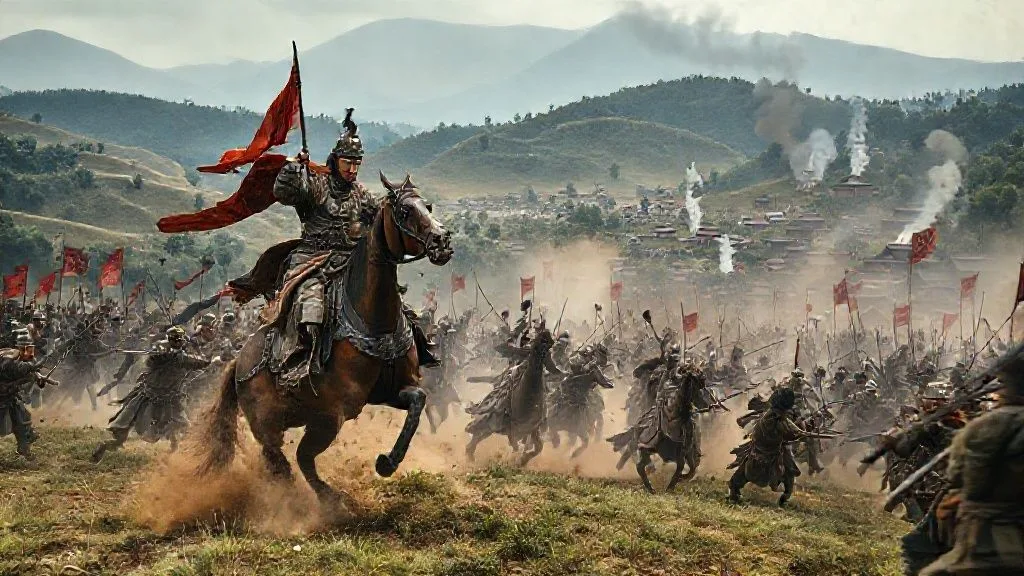
Our surviving texts do not give us a blow-by-blow account of the campaign, but they convey its essence. Diocletian and his generals launched a series of coordinated operations into Carpi territory, aiming to catch warbands before they could disperse, to seize fortified hilltops and river crossings, to break the confidence of leaders who had long relied on the advantages of home ground. It was a grueling kind of war: marches through dense forests, sudden clashes at river fords, night attacks on palisaded camps.
In one engagement, we might imagine a Carpi force massed on a low ridge, their shields—leather and wood, some rimmed with iron—locked against the Roman advance. War cries in a language few legionaries understood rose into the air, answered by the deep, disciplined roar of Roman units advancing under their standards. Behind the Roman front line, horn blasts signaled tactical shifts; cavalry probed for weak points; archers sought to disrupt the Carpi formation. Victory, when it came, would be achieved in meters gained at horrible cost.
Yet Rome had learned from earlier disasters. Diocletian’s commanders avoided being drawn too far into unfavorable terrain without support. They leveraged superior logistics, making sure their troops did not starve or freeze while the Carpi’s supply lines were harried. They targeted not only warriors but infrastructure—storehouses, corrals, strategic villages—slowly strangling the Carpi’s ability to sustain resistance.
Ancient panegyrics, though rhetorical and exaggerated, give us a flavor of how Roman elites remembered this phase. One such oration, praising the Tetrarchs, speaks of emperors who “tamed the savage nations and led them in chains, restoring peace to the provinces” (Panegyrici Latini). It is in this spirit that later chroniclers summarize the events: diocletian defeats carpi, and their people, cowed but still valuable, are taken into the empire as resettled communities.
The campaign likely ended not with the annihilation of the Carpi, but with negotiations forced by overwhelming pressure. Facing repeated defeats, encirclement, and the threat of famine, Carpi leaders may have sought terms: safety for their families and elders in exchange for surrender, hostages, and relocation. For Diocletian, this was precisely the outcome he desired. Dead enemies made for good stories; living captives could be woven into the fabric of Roman strategy.
The Aftermath of Victory: Carpi on the Move
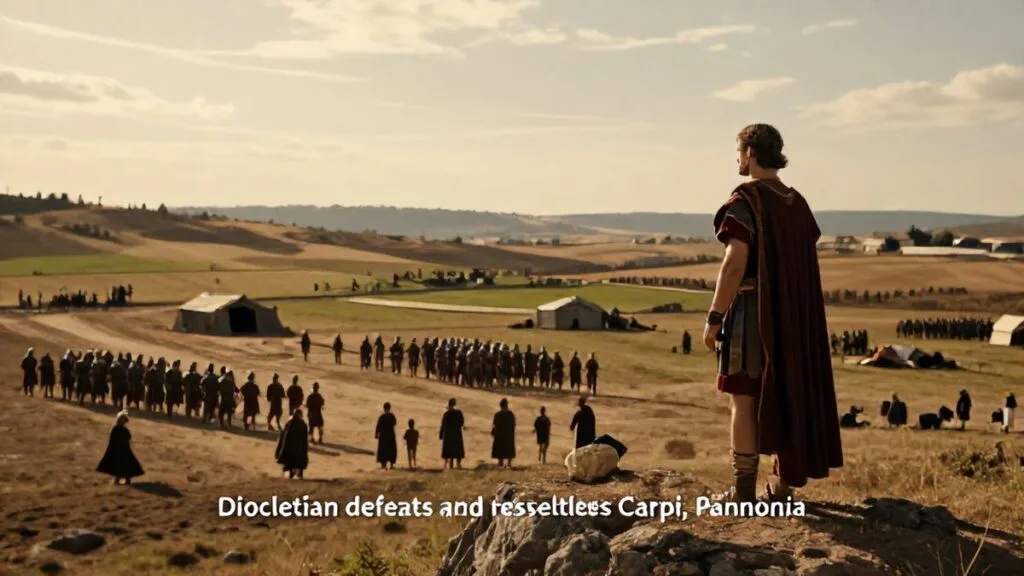
When the fighting stopped, another kind of movement began. The Carpi, or at least a substantial portion of them, were no longer to remain a semi-independent presence beyond the Danube. They were to be uprooted. The episode that Roman sources sometimes celebrate in a single proud phrase—diocletian defeats carpi—was followed by months, perhaps years, of forced migration.
Picture the long columns winding toward the river: warriors stripped of their weapons, women carrying infants or leading children by the hand, elderly men leaning on staffs, oxen dragging carts loaded with what little could be saved. Soldiers marched alongside, a mixture of vigilance and boredom etched on their faces. Along the route, deals were struck, bribes offered, small acts of brutal cruelty committed when no officer was watching. For every grand strategy, there are a thousand petty human dramas.
The crossing back into Roman territory was a grim mirror of the legions’ earlier advance. This time, however, the pontoons and boats bore not armored infantry but captives—“new Romans” in a sense, though few of them would have seen it that way. The empire had long practiced the resettlement of conquered peoples, but under Diocletian this policy took on a fresh intensity. The Carpi were to become colonists, laborers, and perhaps auxiliary soldiers in regions chosen by imperial planners.
One of those regions was Pannonia, a vast province stretching along the middle Danube, encompassing parts of modern Hungary, Croatia, Austria, and neighboring lands. Pannonia had been a militarized frontier since the days of Augustus. It boasted legionary bases, fortified towns, and a mixed population of Roman citizens, local provincials, and earlier generations of resettled “barbarians.” Into this already complex mosaic, the Carpi were now to be inserted.
The Roman government had multiple motives for this move. Strategically, relocating the Carpi inland reduced the chance that they could easily reconnect with allied tribes beyond the frontier. Economically, Pannonia had land that could be cultivated more intensively, especially if worked by new communities bound by obligations to the state. Demographically, the empire needed fresh bodies to till its fields, pay its taxes, and, in time, fill its ranks.
In official records and later propaganda, diocletian defeats carpi would be portrayed as a clean, decisive stroke. On the ground, it was a messy, uncertain process in which a people’s entire way of life was dismantled and reassembled to serve the needs of an empire.
Resettling the Carpi in Pannonia: A Calculated Gamble
The choice of Pannonia for Carpi resettlement was not a random one. This province, long a bulwark of the Danube frontier, had seen its share of crises during the third century. Towns had been sacked, rural estates abandoned, and entire districts depopulated by war, plague, and migration. For Diocletian’s planners, the Carpi presented both a problem and an opportunity: how to transform a recently hostile people into productive contributors to the imperial system.
Roman law and practice provided a framework. Resettled groups were often assigned specific territories as coloni—tenant farmers bound to the land and obligated to pay rents and taxes to state or private landlords. In some cases, they were settled as semi-autonomous communities, under their own leaders, but within a matrix of Roman oversight. Military service could be part of the deal: young Carpi men might be drafted into auxiliary units, their loyalty monitored by mixing them with other recruits and stationing them far from their homelands.
In Pannonia, this translated into the reassignment of lands that had fallen into neglect. Large estates owned by senatorial or equestrian families, sometimes absentee landlords living in distant cities, welcomed new hands to work their fields—if “welcome” is the right word for relationships forged under such unequal conditions. Imperial estates, too, absorbed Carpi families, adding their labor to state-managed production of grain, livestock, and other goods crucial to frontier supply.
The gamble lay in the balance between control and integration. If treated too harshly, the Carpi could revolt, joining other discontented groups in a new cycle of unrest. If left too much autonomy, they might become a fifth column, maintaining ties with tribes beyond the Danube and undermining frontier security from within. Diocletian’s solution was a careful layering of obligations, surveillance, and incentives. Local governors, military commanders, and tax officials all had a stake in ensuring that these former enemies became stable, if second-class, residents of the empire.
Some evidence for this policy survives in inscriptions and later legal texts that speak of “Carpi settled within the empire” and “Carpi granted lands in Pannonia.” Though the details are sparse, they confirm that diocletian defeats carpi was not merely a boast; it set in motion a population transfer that left traces in administrative documents long after the emperor himself retired to his palace at Split.
Life in a New Land: Carpi Families under Roman Rule
What did life look like for a Carpi household newly planted in Pannonia around 295? Imagine a small cluster of houses on the edge of a Roman estate, built partly in the old style—wood, wattle, and daub, steep thatched roofs—but increasingly influenced by local architectural norms. Nearby, a Roman-style villa rises over the fields, with tiled roofs, painted walls, and a courtyard where the estate manager oversees daily operations.
At dawn, Carpi men and women join other workers in the fields. Their tasks vary with the season: plowing, sowing, harvesting, tending livestock. The tools they use increasingly resemble those of their Romanized neighbors. The language shouted across the furrows might be a jumble: native tongues for intimate exchanges, but Latin for commands, contracts, and any dealings with officials. Children grow up bilingual, learning to navigate both worlds with a fluency their grandparents could never have imagined.
Religion, too, adapts. The Carpi bring their own gods—spirits of forest and river, ancestral deities tied to specific landscapes. But those landscapes are now far away. In their new environment, Roman temples, roadside shrines, and household altars offer alternative channels of the sacred. Some Carpi may begin to dedicate offerings to Jupiter or Mithras, seeing in them powerful protectors in a dangerous world. Others cling fiercely to old rites practiced quietly at the margins of the estate.
The presence of the Roman army is constant. Veterans settle nearby; patrols pass through; recruitment officers appear from time to time, eyeing strong youths with interest. For some Carpi young men, enlistment offers a chance to escape the constraints of corvée labor and low status; for others, it feels like another form of captivity. Either way, over the years, Carpi names begin to appear in military diplomas and commemorative inscriptions, slowly merging into the broader tapestry of the frontier army.
Socially, Carpi communities occupy an ambiguous position. They are not slaves—they have homes, families, some property rights—but neither are they full Roman citizens. They are marked as outsiders, yet relied upon. Their daughters might marry local provincials or even poorer Roman citizens; their sons might one day earn citizenship through long military service. Over generations, the boundary between “Carpi” and “Roman” blurs, but in 295, the memories of defeat, migration, and resettlement are still raw.
Frontier Politics: Allies, Hostages, and Human Pawns
The resettlement of the Carpi was only one piece of a larger puzzle along the Danube. Diocletian’s frontier policy combined military strength with intricate diplomacy. Peoples like the Carpi were alternately enemies, allies, clients, and hostages in a constantly shifting game of influence and control.
By moving a large portion of the Carpi into Pannonia, Diocletian achieved several political aims. First, he weakened the power base of Carpi leaders remaining beyond the Danube, depriving them of manpower and undermining their prestige. Second, he created a population whose welfare now depended on Roman stability. Third, he gained potential leverage against neighboring tribes; the presence of resettled Carpi, watched and organized by Roman authorities, made it harder for allied coalitions to form on the far side of the river.
Hostages—taken from among the Carpi elite—played a crucial role. Young sons of chieftains might be brought to Roman garrisons or even to major cities, ostensibly to be educated, more realistically to ensure their fathers’ compliance. In these settings, they absorbed aspects of Roman culture while remaining conscious of their precarious position. Some later rose to important roles as intermediaries between Rome and their home communities.
The Carpi case was far from unique. Emperors throughout the later empire would adopt similar strategies with Goths, Franks, Alamanni, and others. Yet the episode under Diocletian has a particular clarity: it demonstrates the logic of a regime convinced that long-term stability required not only defeating threats but reshaping the human geography of its borderlands.
Of course, this policy carried risks. If conditions in Pannonia deteriorated—if taxes became too heavy, if harvests failed, if Roman internal wars flared again—resettled communities might rebel. Their knowledge of Roman customs and vulnerabilities could then become a weapon against the empire. The balance was delicate, and Diocletian could only hope that his broader reforms would hold it steady long enough for the new order to take root.
Propaganda and Power: How Rome Told the Story
From the moment the last Carpi warband laid down its arms, the story of the campaign entered another battlefield: that of memory and representation. Diocletian and his circle understood the power of narrative. Victories had to be framed, inscribed, and celebrated to reinforce the legitimacy of the regime.
Coins minted in the years after the campaign carried legends invoking the emperor’s virtus (manly courage) and victoria (victory). Some depicted bound captives, heads bowed, under the feet or gaze of a triumphant ruler. Though not always labeled with specific tribal names, these images formed a visual shorthand: diocletian defeats carpi, and by extension, all barbarian threats along the frontiers.
Inscriptions in frontier towns and legionary camps contributed to this narrative. A dedicatory stone might proclaim that “Our Lords Diocletian and Maximian, unconquered Augusti, subdued the Carpi and restored peace to the provinces.” Such texts, as modern scholars like Timothy Barnes have noted, are often formulaic, but they still tell us what emperors wanted their subjects to remember.
Panegyrists—speechwriters commissioned to praise the Tetrarchs—went further. In elaborate Latin, they wove tales of emperors who braved winter’s hardships, crossed raging rivers, and broke savage nations like reeds. One panegyric from 297, praising Constantius Chlorus, indirectly evokes the broader success of the Tetrarchic military campaigns, including those along the Danube, as proof that the gods favored this new collegiate rule (Panegyrici Latini VIII).
Yet behind the celebrations lay anxieties. If Diocletian felt entirely secure, he would not have needed to change the way emperors presented themselves so dramatically. The very insistence that the Tetrarchs were the restorers of order suggested how fragile that order still was. The image of bound barbarians on coins was supposed to reassure Romans that the world beyond their frontiers had been tamed. But the emperors knew better. New threats would always arise; the memory that diocletian defeats carpi had to serve as both warning and precedent for future confrontations.
Economic and Social Consequences across the Danube World
The outcomes of the Carpi campaign extended far beyond the immediate military and political sphere. They touched the economies and social structures of both Roman and non-Roman communities for decades afterward.
In Pannonia, the influx of Carpi laborers contributed to a modest revival in agriculture. Fields once left fallow due to lack of manpower were brought back under cultivation. Increased grain production helped feed garrisons and urban populations, while surplus could be shipped downriver to other provinces. Landowners, always eager to maximize rents and profits, incorporated Carpi households into their estate plans, sometimes granting them modest plots in exchange for fixed obligations.
This process, however, also accelerated a trend toward a more rigid rural society. As resettled groups were bound to the land, the foundations were laid for the late Roman system in which peasants found it increasingly difficult to leave their plots or change their legal status. The Carpi, in this sense, became early participants in a transformation that would affect millions across the empire.
Beyond the Danube, the removal of many Carpi had ripple effects. Neighboring tribes saw a shift in the balance of power. Territories once contested or shared with the Carpi now became open to new claimants; alliances had to be renegotiated. Some groups may have welcomed the weakening of a rival; others worried that they now stood closer to the full weight of Roman attention.
Trade patterns adjusted as well. Carpi communities had been both raiders and trading partners, exchanging furs, slaves, and raw materials for Roman goods. Their semi-removal disrupted these networks, at least temporarily. New intermediaries emerged, including Roman frontier merchants who now dealt directly with different tribes, and Carpi settlers who maintained distant kinship ties across the river.
Socially, the story was one of painful adaptation. Carpi elders grappled with the erosion of their authority as traditional structures of leadership were undermined by resettlement and the demands of Roman administration. Younger generations, growing up in Pannonia, navigated a world of intersecting identities: Carpi by ancestry, Pannonian by residence, Roman by law or aspiration. Over time, these hybrid identities contributed to the increasingly complex, multicultural character of the late Roman frontier.
Faith, Fear, and the Gods of War
Wars and forced migrations are not merely political events; they are spiritual crises. For both Romans and Carpi, the campaigns of the 290s raised urgent questions about divine favor, fate, and the meaning of suffering.
On the Roman side, the Tetrarchs leaned heavily on traditional cults. Diocletian associated himself particularly with Jupiter, the king of the gods, while his co-emperor Maximian invoked Hercules. Their official titles and ceremonies emphasized that they ruled by divine mandate. When diocletian defeats carpi, it could thus be presented as Jupiter’s victory over chaos, enacted through his imperial representative. Sacrifices offered in frontier temples after the campaign thanked the gods for peace restored and enemies subdued.
Among the Carpi, religious practices were localized and varied. Sacred groves, springs, and hilltops dotted their homeland; shamans or priests mediated between human and spirit worlds. The experience of defeat and resettlement must have sparked intense communal reflection. Had their gods abandoned them? Were the Romans’ gods stronger? Or was this suffering a test, a prelude to some future restoration? We can only guess, but comparative studies of other ancient peoples suggest such questions would have been inescapable.
The presence of Christianity, still a minority faith but growing rapidly, added another layer. In Pannonia, small Christian communities already existed by the late third century. For some Carpi individuals, encounters with Christian preaching—offering a narrative of exile, endurance, and eventual salvation—may have resonated powerfully. The idea of a God who himself was a stranger and sufferer in the world spoke to those who had seen their own worlds overturned.
Diocletian, ironically, would later become the architect of the empire’s last and greatest persecution of Christians. But around 295, that storm was still gathering. For the moment, varying faiths coexisted uneasily along the frontier, each offering its own explanation for why the world stood as it did, why some conquered and others were conquered.
Echoes through the Fourth Century: From Diocletian to Constantine
The story did not end when the last Carpi colony was assigned its plots in Pannonia or when the final celebratory inscription was carved. The consequences of Diocletian’s actions reverberated through the fourth century, intersecting with the rise of Constantine, the Christianization of the empire, and new waves of migration and conflict.
For one thing, the Tetrarchic system itself eventually unraveled. After Diocletian’s voluntary abdication in 305—an almost unprecedented act in Roman history—the carefully balanced college of emperors degenerated into rivalry and civil war. Constantine emerged as the ultimate victor, refounding the empire’s center of gravity in Constantinople and promoting Christianity as a favored religion. Yet even as imperial politics shifted, the structures Diocletian built—administrative divisions, tax systems, frontier deployments—remained largely in place. The Carpi in Pannonia lived under new emperors, but within a system Diocletian had designed.
On the Danube frontier, new threats arose. Goths, Huns, and other groups tested Roman resolve. The memory that diocletian defeats carpi was cited, implicitly or explicitly, whenever later rulers sought to emulate his firmness. Some fourth-century authors, like Aurelius Victor, looked back on the Tetrarchic age as a time when emperors had decisively broken barbarian power, contrasting it with the more troubled decades they themselves inhabited.
Meanwhile, the Carpi as a distinct people begin to fade from the record. A few later references hint at groups bearing the name Carpi—or “Carpodaci”—in various contexts, but clearly their identity was changing. In Pannonia and other provinces, they melted into the broader provincial population, their descendants Romanized in language, law, and culture. Beyond the Danube, remnants of Carpi communities were absorbed into larger confederations, their name overshadowed by that of the Goths or others.
Yet the underlying patterns persisted: Rome continued to manage its frontiers not only through war, but through relocation, settlement, and the slow, uneven work of cultural integration. When we later read of Gothic federates being settled inside the empire, or of entire tribes being granted lands in exchange for military service, we are seeing variations on a theme Diocletian had deployed against the Carpi.
Archaeology, Inscriptions, and the Traces of a Vanished People
Today, much of what we know about the Carpi and their fate comes not from grand histories but from small, stubborn objects pulled from the earth. Archaeologists working in Romania, Moldova, Hungary, and neighboring regions have uncovered settlements, graves, and artifacts that scholars link to Carpi communities before and after their resettlement.
In their original homelands east of the Carpathians, traces of fortified hilltop sites and rural villages suggest a society adapted to a contested landscape—capable of defense, but also engaged in agriculture and trade. Pottery styles, metalwork, and burial assemblages show a mix of local traditions and imported Roman goods, evidence of both raiding and commerce across the Danube.
In Pannonia, the picture is more diffuse. There are no great “Carpi towns” clearly labeled as such, but clusters of material culture—particular brooch types, house forms, and burial customs—hint at the presence of resettled groups. Inscriptions, though relatively rare, occasionally mention individuals identified as “Carpi” by origin, especially in military contexts. Each such find is a tiny window into the lived reality behind the terse claim that diocletian defeats carpi and resettles them.
Modern historians debate the extent and nature of this migration. Some argue that ancient sources exaggerate, that only a portion of the Carpi were moved, and that many remained beyond the frontier. Others see in the combined literary and archaeological record strong evidence for a significant population transfer. The truth likely lies between: enough Carpi were resettled to matter for Roman policy and local demographics, but not so many that their original homelands were emptied entirely.
What is striking is how fragile the memory of such events can be. For the people who trudged across the Danube under guard, this was the defining trauma of their lives. For Rome, it was one campaign among many. For us, centuries later, it survives in a handful of inscriptions, a few sentences in later chronicles, and patterns in the soil that only become legible after painstaking excavation and comparison.
Memory, Erasure, and the Fate of the Carpi
The Carpi, once a name that provoked fear along the Danube, slipped gradually into obscurity. This erasure tells its own story. Rome excelled not only at conquering but at absorbing, digesting, and forgetting. Peoples who once stood outside its borders as distinct entities were, if they survived defeat, drawn into its orbit until their separate identities blurred.
In the case of the Carpi, the process was accelerated by their resettlement. Unlike some larger confederations that retained political cohesion inside the empire, the Carpi seem to have been broken into smaller segments, distributed among various estates and communities. Their leadership structures were weakened; their traditional meeting places and sacred sites were left behind. Over a few generations, intermarriage, shared labor, and the pressures of Roman governance encouraged them to think of themselves less as Carpi and more as inhabitants of this or that district of Pannonia.
Yet traces of memory likely persisted in families and local traditions long after official records ceased to mark them as distinct. A grandfather might tell a child about the forests beyond the great river, about a time before Roman overlords assigned their work and took their taxes. Folktales could encode memories of heroic resistance or bitter betrayal. Names—of people, of places—might carry faint echoes of Carpi heritage, even as those who bore them now prayed in Latin to Christian saints.
From a broader perspective, the story of how diocletian defeats carpi and then largely erases them as a visible group foreshadows patterns that would repeat through late antiquity and the early Middle Ages. Gallia, Hispania, Pannonia, and other regions would see new peoples arrive, fight, settle, and gradually disappear into the evolving social fabric. The neat ethnic labels favored by ancient authors mask a far more complex reality of mixing, adaptation, and forgetting.
For historians, recovering the Carpi is an act of quiet resistance to this erasure. By piecing together texts, artifacts, and landscapes, we can restore a measure of visibility to those who were once so consequential that emperors reorganized entire provinces in response to them. In doing so, we recognize that the grand narratives of imperial victory are always underpinned by innumerable personal stories left untold.
Conclusion
In the end, the episode we summarize in the terse phrase “Diocletian defeats and resettles Carpi, Pannonia | 295” unfolds as a rich and troubling tapestry. It is a story of an empire clawing its way back from crisis by hardening its frontiers, reorganizing its institutions, and projecting power across the Danube. It is also a story of a people whose name survives in a few scattered lines of Latin and Greek, but whose lives were reshaped, and in many cases shattered, by that imperial revival.
When diocletian defeats carpi, he does more than win a campaign. He demonstrates the new logic of Roman rule in late antiquity: security secured through a combination of overwhelming force, bureaucratic planning, and demographic engineering. The crossing of the Danube, the battles in forest and field, the forced marches into Pannonia, and the gradual integration of Carpi families into the fabric of provincial life all reveal an empire that understood people as both threats and resources, to be managed as carefully as grain supplies or tax registers.
The consequences of this moment ripple outward. The strengthened Danube frontier undergirds the relative stability of the early fourth century, giving space for the transformations associated with Constantine and the Christianization of the empire. The Carpi, partly absorbed and partly dispersed, illustrate how Rome could both destroy and preserve, erasing the political independence of a tribe while ensuring that its descendants lived on under new names and allegiances.
It’s astonishing, isn’t it, how much can hinge on decisions taken in the chill of a frontier winter: the choice to mount a decisive campaign, to turn victory into resettlement rather than extermination, to move thousands of people across a river and into a new social order. By tracing this story carefully, we see not only the might of Rome but also its anxieties, its calculated brutality, and its remarkable capacity for adaptation. And we are reminded that behind every formulaic inscription celebrating victory lies a landscape of human lives, forever altered when an emperor decided where his empire’s future should be drawn.
FAQs
- Who were the Carpi in relation to the Roman Empire?
The Carpi were a confederation of tribes living primarily east of the Carpathian Mountains, in what is now Romania and Moldova. Known to the Romans from at least the second century, they alternated between being trading partners, foederates (allies), and raiders along the Danube frontier. Their frequent incursions into Roman provinces like Moesia and Pannonia made them a significant concern for emperors of the third century. - Why did Diocletian decide to campaign against the Carpi around 295?
Diocletian saw the persistent raids of the Carpi as both a military threat and a symbol of the empire’s earlier weakness. After decades of crisis, he aimed to reassert firm control over the Danubian frontier. The campaign against the Carpi around 295 was part of a broader strategy to enforce stability, demonstrate the strength of the newly formed Tetrarchy, and reshape frontier demographics through controlled resettlement. - What does the phrase “diocletian defeats carpi” actually refer to?
“diocletian defeats carpi” is a shorthand used by modern historians, based on ancient references, to describe a series of campaigns in the early 290s in which Diocletian’s forces decisively broke Carpi resistance along the Danube. The phrase encompasses not only battlefield victories but also the subsequent negotiations and forced relocation of a large portion of the Carpi into Roman provinces such as Pannonia. - How did the resettlement of the Carpi in Pannonia work in practice?
After their defeat, many Carpi were moved under Roman supervision into Pannonia, a key frontier province. There they were settled as tenant farmers or semi-autonomous communities on lands that needed labor, often on imperial or large private estates. They were bound to provide agricultural output, taxes, and sometimes military service. Over time, they and their descendants integrated into the provincial population, slowly adopting Roman language, law, and customs. - What impact did this episode have on the Roman frontier system?
The defeat and resettlement of the Carpi reinforced a pattern of frontier management that became characteristic of the late empire: combining military campaigns with strategic population transfers. By moving potentially hostile groups inside the empire under controlled conditions, Rome aimed to weaken external threats, repopulate underworked lands, and generate new sources of recruits and taxpayers. This approach influenced later dealings with Goths, Franks, and other peoples. - Did any Carpi remain outside the empire after 295?
Most scholars believe that not all Carpi were resettled. While substantial numbers were moved into provinces like Pannonia, others likely remained in or near their ancestral homelands east of the Carpathians. These remaining groups were gradually absorbed into larger tribal confederations, such as the Goths, and their distinct identity faded from the historical record over the fourth century. - How do historians know about the Carpi and their resettlement?
Information comes from a combination of late Roman historians, panegyrics, inscriptions, coin legends, and archaeological evidence. Texts by authors such as Zosimus and entries in collections like the Panegyrici Latini mention campaigns against the Carpi and their subjugation. Archaeological finds in Romania and Hungary provide material traces of Carpi culture before and after resettlement, while inscriptions occasionally refer to individuals of Carpi origin serving in the Roman army. - What was Diocletian’s broader goal with such population movements?
Diocletian sought a more stable, controllable empire. By relocating defeated groups into the imperial interior under supervised conditions, he aimed to reduce the number of independent powers beyond the frontier, strengthen provincial economies, and secure a steady flow of soldiers and taxpayers. Population movements like that of the Carpi were thus integral to his wider project of imperial reorganization and frontier stabilization. - How did this episode influence later Roman dealings with “barbarian” peoples?
The Carpi resettlement provided a model for later emperors facing similar challenges. Throughout the fourth and fifth centuries, Rome repeatedly settled conquered or allied groups inside its borders as federates or tenant communities. While circumstances varied, the underlying logic—turning former enemies into controlled resources—owed much to precedents established under Diocletian and the Tetrarchy. - What eventually happened to the Carpi as a distinct people?
Over the course of the fourth century, the Carpi disappeared as a clearly identifiable ethnic group in the sources. Those settled in Roman provinces were absorbed into the provincial and military populations, while those who remained beyond the frontier were likely integrated into larger tribal unions. Their name survives in scattered references and in scholarly reconstructions, but their separate political identity did not endure.
External Resource
Internal Link
Other Resources
- Encyclopaedia Britannica – general search for the exact subject
- Google Scholar – academic search for the exact subject
- Internet Archive – digital library search for the exact subject