Table of Contents
- An Imperial Wedding in a Fractured World
- Two Empires, One Dynasty: The Late Roman Stage
- From Child Emperor to Bridegroom: Valentinian III’s Precarious Youth
- Licinia Eudoxia: Princess of Constantinople and Heiress of Two Lines
- The Road to 437: Negotiations, Strategy, and Family Ambitions
- Constantinople Prepares: The City as a Theater of Power
- The Day Valentinian III Marries Licinia Eudoxia
- Rituals, Relics, and Religion: A Christian Imperial Marriage
- Political Calculations Behind the Vows
- A Marriage Across the Sea: Ravenna, Rome, and Constantinople
- Life Behind Palace Walls: The Human Story of Valentinian and Eudoxia
- Crisis and Catastrophe: Vandals, War, and the Fall of Carthage
- The Murder of Aetius and the End of an Illusion
- Assassination, Widowhood, and the Price of the Purple
- The Sack of Rome in 455 and the Fate of Licinia Eudoxia
- Dynastic Echoes: Daughters, Successors, and a Shattered West
- How Historians Remember the Marriage of 437
- Legacy of a Wedding at the Edge of Empire
- Conclusion
- FAQs
- External Resource
- Internal Link
Article Summary: In 437, as the Roman Empire strained under invasions and internal rivalries, the marriage of the Western emperor to an Eastern princess was meant to stitch a crumbling world back together. This article explores how valentinian iii marries licinia eudoxia in Constantinople not merely as a personal union, but as a calculated act of high politics and fragile hope. Moving from the childhood of Valentinian III and the pedigree of Licinia Eudoxia to the streets of Constantinople, it reconstructs the mood, ceremony, and symbolism surrounding the wedding. Yet behind the gold and silk lay anxious emperors, powerful generals, and bishops battling over doctrine and authority. The narrative follows the couple’s later years: the loss of Africa to the Vandals, the murder of Aetius, and Valentinian’s own assassination. It then traces Licinia Eudoxia’s ordeal through the sack of Rome in 455 and her abduction to Carthage. Across these intertwined lives, the article shows how one carefully staged dynastic marriage failed to halt the West’s disintegration. Ultimately, it argues that the day valentinian iii marries licinia eudoxia stands as both a summit of imperial ceremony and a poignant prelude to collapse.
An Imperial Wedding in a Fractured World
When valentinian iii marries licinia eudoxia in the year 437, Constantinople shines like a polished jewel set in a cracked and trembling crown. The Roman Empire still calls itself one, still invokes a single universal dominion under Christ and Caesar, yet everyone living under its banners knows how fragile that claim has become. In the West, provinces slip away to barbarian kings; in the East, court factions sharpen their intrigues like knives. And in the midst of this tense quiet, an imperial wedding promises a moment of unity.
The ceremony that brings Valentinian III, the young emperor of the West, together with Licinia Eudoxia, the daughter of the Eastern emperor Theodosius II, is not a private affair. It is a performance for the world, carefully choreographed. Courtiers feel it in the rehearsed processions; bishops feel it in the homilies they prepare, weaving Scripture with flattery; soldiers feel it in the temporary truce on the streets, where banners flutter instead of blades. When valentinian iii marries licinia eudoxia, the empire is trying to convince itself that bloodlines and bridal veils can heal geopolitical wounds.
Yet behind the celebrations, there are whispers. Some ask whether this union will truly bridge the growing gulf between Eastern and Western courts, or whether it will only bind the weaker half more tightly to the stronger. Others wonder about the young couple themselves: Valentinian, thrust into imperial purple as a child; Eudoxia, raised in the rarified atmosphere of Constantinople’s great palace, surrounded by theologians, scribes, and eunuchs. Their marriage is not their own choice, but it will shape both their destinies, and perhaps the fate of Rome itself.
It’s astonishing, isn’t it? For a brief time, all the forces that are tearing the Roman world apart—barbarian migrations, theological disputes, economic strain, private ambitions—seem to pause, as if holding their breath. The Bosporus glitters beneath autumn light, the domes of churches echo with chants, and the world watches as valentinian iii marries licinia eudoxia, believing—hoping—that the union of these two young lives can keep catastrophe at bay.
Two Empires, One Dynasty: The Late Roman Stage
To understand the meaning of this marriage, one must first understand the stage upon which it unfolds: a Roman Empire divided in administration but united by dynastic memory. Since the death of Theodosius I in 395, the empire had been split between his two sons, Honorius in the West and Arcadius in the East. This division, one historian later wrote, “was less a fracture than a line of stress running through the same body” (as later summarized in the work of modern scholars like J. B. Bury). The two halves cooperated, argued, and occasionally betrayed one another, but they never ceased to claim a shared Roman identity.
By 437, both halves are formally ruled by members of the same Theodosian dynasty. In the East, Theodosius II has ruled for decades, cautious, devout, and heavily influenced by court ministers and his sister Pulcheria. In the West, Valentinian III has been emperor since childhood, nominally sovereign but overshadowed by powerful adults—his mother Galla Placidia and the magister militum Flavius Aetius. The idea that these two branches should intermarry is not new; it is almost inevitable. What is new is the desperation underlying it.
The West is terrifyingly fragile. Visigoths rule in south-west Gaul; Vandals and Alans roam North Africa; Britain has long been abandoned. Ravenna, the Western capital, crouches amid marshes, safer than Rome but symbolically diminished. The treasury strains to pay federate troops and buy peace. The East, for all its own problems, appears richer, more stable, and better defended. Constantinople’s walls are formidable, its gold supply comparatively secure, its court rituals polished to brilliance. When valentinian iii marries licinia eudoxia, the West is not only gaining a bride; it is seeking legitimacy and support from an elder sibling who has fared better in the storm.
At the same time, religious politics weigh heavily on the era. The empire is officially Christian, but not united in belief. The Christological debates that will soon erupt into the Council of Chalcedon are already simmering. Bishops and monks argue fiercely about the nature of Christ, about orthodoxy and heresy, about how closely emperors should intervene in doctrine. Theodosius II’s court is steeped in theological intrigue; Valentinian’s Rome and Ravenna are no less church-ridden, though their concerns often revolve more around papal authority and relations with the bishop of Rome.
In this context, a dynastic marriage acquires spiritual meaning as well. It is read as a sign of God’s favor, a possible instrument of providence, a symbol of unity between not only two courts but also two spheres of Christian authority. When all is said and done, however, it is also a transactional arrangement. Gold, titles, and precedence are negotiated like the terms of a treaty. That tension between sacred symbolism and political utility will run through the entire story of valentinian iii marries licinia eudoxia.
From Child Emperor to Bridegroom: Valentinian III’s Precarious Youth
Valentinian III did not begin life destined for greatness. Born in 419, he was the son of Galla Placidia, daughter of Theodosius I, and Constantius III, a powerful general who briefly held the title of co-emperor in the West. Constantius died soon after, leaving Galla Placidia a widow in a court thick with rivals. For years, mother and son drifted in and out of favor, exiled at one point to Constantinople, recalled at another. Valentian’s early years were marked not by stately continuity but by oscillations of fortune.
In 423, the death of the Western emperor Honorius plunged the West into chaos. A usurper, Joannes, seized power, forcing Galla Placidia and the young Valentinian to flee once more to Constantinople. There, under the protection of Theodosius II, Valentinian’s future was painfully negotiated. The East could choose to recognize Joannes or to back the boy of Theodosian blood. It chose the latter—on its own terms. Theodosius II declared Valentinian Caesar of the West and sent an army to depose Joannes.
Even this resounding act of support was double-edged. Valentinian owed his throne to Constantinople’s armies and to his uncle’s recognition. When he was finally installed as Augustus in 425, he was not an independent sovereign but a child Emperor whose authority was buttressed—and constrained—by the influence of his mother and the Eastern court. Thus, long before valentinian iii marries licinia eudoxia, his life had already been bound to the decisions and ambitions of Constantinople.
Growing up, Valentinian lived in a world of immense splendor and constant fear. He learned letters, theology, the lore of the emperors; he also learned to recognize which generals could make or unmake him. Aetius, the man who would become the “last of the Romans” in the eyes of some chroniclers, hovered over his reign like a stern tutor and possible executioner. Every gesture of deference Valentinian offered this general was a reminder of his own dependence. As he approached marriageable age, he must have known that whom he married would not be decided by affection, but by a calculus of power that had always determined his survival.
By 437, he was in his late teens: not quite a man of independent will, yet old enough to be cast as bridegroom, soldier, and hope of the West. The marriage to Licinia Eudoxia would be his first major public act that looked like a choice, even though it, too, had been mapped out by others long before he could consent.
Licinia Eudoxia: Princess of Constantinople and Heiress of Two Lines
Licinia Eudoxia was born not in the embattled West but in the structured, ritualized world of Constantinople’s Great Palace. Daughter of Emperor Theodosius II and Empress Eudocia, she grew up surrounded by libraries, chapels, and the hum of bureaucratic precision. From infancy she was not only a child but a symbol: of continuity, of piety, of the house of Theodosius.
Her name itself was a statement. “Licinia” recalled an older senatorial line, while “Eudoxia” echoed that of her grandmother Aelia Eudoxia, wife of Arcadius. The blending of these strands underlined her dual role as scion of imperial and aristocratic traditions. Educated in Greek and likely in Latin, instructed in Christian doctrine, she would have had access to the finest tutors. The court of Theodosius II was known for its literary bent; the emperor sponsored the compilation of the Theodosian Code, and his sister Pulcheria cultivated a reputation for austere learning and devotions.
But princesses, like emperors, do not belong to themselves. From an early age, Eudoxia’s body and future were the subject of whispered calculations. Should she be married into a prestigious Eastern family to secure loyalty at home, or reserved for a grander design—unifying the two imperial courts? The second option eventually prevailed. To send her westward was to send a living pledge that the East would not cast off its Theodosian cousins, no matter how tempting it might be to let the troubled West fend for itself.
There is something deeply human, and tragic, in that choice. Licinia Eudoxia, as a child, would have played in sunlit courtyards, learned prayers under the eye of stern deaconesses, listened to political gossip without fully understanding it. At some point she would have realized that her life’s path had a single clear direction: she was to be the wife of Valentinian, the distant relative she had never really known, the boy whose fate so intertwined with hers. The day valentinian iii marries licinia eudoxia is the culmination of a script written over her head, in languages of law, faith, and dynastic necessity.
The Road to 437: Negotiations, Strategy, and Family Ambitions
The idea of marrying Valentinian III to Licinia Eudoxia predates 437 by many years. It was part of a larger bargain forged when Theodosius II backed Valentinian’s claim against the usurper Joannes in 425. Support came with strings attached: the West would be restored to a Theodosian prince, but that prince would be bound by marriage to the Eastern line. The promise of union lingered initially as a betrothal, a diplomatic note of intent in a world where alliances were too easily broken.
Throughout the 430s, the West and East corresponded on matters of war and governance while the marriage question hovered in the background. The Vandals under Geiseric ravaged Hispania and then invaded Africa; Aetius maneuvered against rivals like Boniface; Galla Placidia struggled to maintain her son’s authority amid the shifting loyalties of generals and barbarian federates. Theodosius II, for his part, juggled his own frontier threats, internal religious conflicts, and the complex personalities of Pulcheria, Empress Eudocia, and the palace eunuchs who wielded immense power.
Sealing the marriage would transform a tentative understanding into a concrete bond. For Theodosius, sending his daughter to the West meant risking her future amid instability, but it also meant claiming permanent influence there. For Galla Placidia, the match offered renewed prestige: her son’s bride would be an emperor’s daughter, cementing his legitimacy in the eyes of skeptical elites. The West might be poor, but the purple still mattered. The vision was clear: when valentinian iii marries licinia eudoxia, two diagonal branches of the Theodosian family tree would knot together, forming a thicker, more resilient trunk.
Letters traveled by ship and courier between Ravenna and Constantinople. Envoys discussed dowries, ceremonial precedence, the titles Eudoxia would bear, the timing and location of the nuptials. That the marriage would take place in Constantinople, not in the Western capital, was itself significant. It placed the West in the position of coming to the East, of receiving recognition in the Eastern city that prided itself on being the New Rome. Yet Valentinian’s journey there, and his coronation as consularis for the year 437, would also allow the West a dramatic stage on which to affirm its continuing imperial status.
Constantinople Prepares: The City as a Theater of Power
As the date approached, Constantinople transformed itself into a vast ceremonial machine. The city of Constantine had, by then, perfected a language of spectacle: processions along the Mese, lavish displays in the Hippodrome, carefully orchestrated appearances of the emperor and his family from the balconies of the Great Palace. The arrival of Valentinian III and the imminent union with Licinia Eudoxia offered a perfect occasion to deploy these resources.
Artisans were commissioned to repair and gild statuary, to stitch new hangings for audience halls, to fashion jewelry and insignia worthy of two imperial courts present in one place. Bishops and clergy rehearsed liturgies emphasizing concord and divine favor. The streets leading from the sea walls to the palace were swept, arcades festooned with laurel and purple cloth. For ordinary citizens, the days leading up to the wedding meant not just pageantry but also distributions of food and money—a tangible sign of imperial generosity.
On the waters of the Bosporus and the Golden Horn, ships of the imperial fleet stood ready, adorned for display. Foreign envoys took their places in the city, some residing in permanent embassies, others lodging in hastily prepared quarters. They knew that what they witnessed—and what they reported home—would shape the perception of Roman strength. If the empire seemed united, radiant, and confident, their masters might think twice before testing its defenses.
Yet beneath this glitter lay enormous tension. Many in the East feared that the West might drag them into new conflicts. Some in the West resented the implicit hierarchy suggested by holding the ceremony in Constantinople. Factions at court wondered whether the presence of a Western emperor might embolden their rivals. Even the clergy were divided, debating which bishops would be most prominently visible, whose theology would frame the occasion. The city hummed with anticipation, but also with unease. When valentinian iii marries licinia eudoxia, the streets will roar with joy; in the quiet corners of the palace, daggers of resentment will remain sheathed—but not forgotten.
The Day Valentinian III Marries Licinia Eudoxia
Imagine the morning itself: a crisp, bright day over Constantinople, the sea an expanse of polished silver under a pale sun. Trumpets sound from the palace precincts. The city’s great bronze gates open to processions that bind the whole urban body into a single organism, pulsing in the rhythm of ceremony. Priests swing thuribles heavy with incense; their smoke curls upwards, a fragrant veil over the political theater unfolding below.
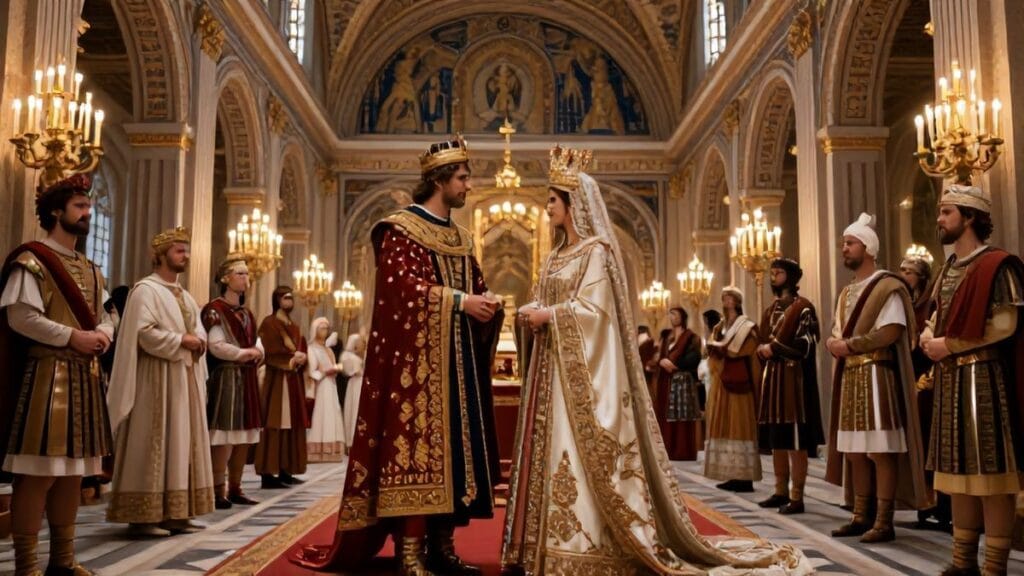
Valentinian III appears in garments that announce his status with every thread. Purple, reserved for the imperial family, glows against gold-embroidered borders. His boots, the calcei of an emperor, shine as he moves. He is still young, and perhaps his eyes betray a hint of nervousness beneath the mask of solemnity he is expected to wear. Beside or behind him, Eastern courtiers and Western followers—those who have accompanied him from Ravenna—form a living tapestry of two courts rubbed up against one another.
Licinia Eudoxia emerges from the women’s quarters of the palace, attended by noble ladies and eunuchs, her attire a careful synthesis of imperial elegance and Christian modesty. Jewels frame her face, a diadem catching the light as she walks. To the crowd, she is an icon of dynastic hope. To herself, perhaps, she is a young woman about to step into a life that will never again be entirely hers.
The ceremony, though imperial, is also Christian. In or near one of the city’s great churches—likely within the sacred spaces at the heart of the palace—clerics preside over prayers for the couple’s fertility, unity, and wisdom. Scriptural readings speak of service, of the bond between Christ and the Church mirrored in that between husband and wife. Yet behind the pious words, everyone knows that this is also about cementing two administrations. When valentinian iii marries licinia eudoxia before the eyes of Theodosius II and the assembled dignitaries, the entire Roman system is, in a sense, renewing its vows to itself.
Outside, the people of Constantinople shout acclamations. “Many years to the Augusti! Many years to the Augusta! Many years to the new couple!” Coins may be thrown, games proclaimed. Chroniclers such as the later chronicler Marcellinus or the compilers of the Chronica Gallica will compress it all into a single line: in the year 437, Valentinian III, emperor of the West, took to wife Licinia Eudoxia, daughter of Theodosius II. But in the moment, it must have felt immense, almost overwhelming.
It is here, in these hours of celebration, that the phrase valentinian iii marries licinia eudoxia is no mere keyword for historians or modern readers. It is a living reality: a union sanctified by altar and law, emblazoned in the memory of thousands of witnesses, set against the horizon of an empire striving not to collapse.
Rituals, Relics, and Religion: A Christian Imperial Marriage
The union of Valentinian and Licinia Eudoxia stands at the crossroads between older Roman marriage customs and the newer Christian sacramental understanding of matrimony. By 437, Christianity has not only taken root but has reshaped imperial ideology. Laws in the Theodosian Code regulate Christian practice and suppress pagan cults; emperors see themselves as guardians of orthodoxy. It is natural, then, that this wedding is infused with religious symbolism at every turn.
In the years leading up to the event, emperors and bishops had collaborated and clashed over doctrine. The cult of saints and relics had blossomed. Churches in Constantinople held fragments of the True Cross, bones of martyrs, objects linked to apostles. It is entirely plausible that, on the day valentinian iii marries licinia eudoxia, such relics were displayed or invoked—brought near the couple as benediction, or at least positioned prominently within the worship space. These material anchors of faith reminded everyone present that the empire’s unity depended not only on blood but on belief.
Bishops delivered homilies tying the marriage to biblical precedents: the wise king Solomon, the holy union of Tobias and Sarah, or the unbreakable bond between Christ and the Church as described in Paul’s letters. They urged the couple to rule justly, to be attentive to the poor, to suppress heresy. One can imagine phrases about the “two lights of the world” joining together, the East and West as the “two eyes of the body of Christendom.” Even if the exact wording is lost, the structure of such orations is well documented in other imperial ceremonies.
At the same time, older Roman ideas about concordia—the harmony of the imperial household, reflected in the health of the state—lingered beneath Christian language. Statues and coins might later depict the couple together, personifying unity, their joined hands encircled by legends praising concord. Religion and politics were not two separate spheres but facets of the same ideology: God favored the Roman Empire, and the marriage of its rulers was part of the story of salvation history.
Yet religion also divided. Disputes over Christology were not far below the surface. Some bishops present at the wedding might have belonged to factions that would soon find themselves at odds during the Council of Ephesus (431) and later at Chalcedon (451). In that sense, the serene surface of the wedding liturgy floated above theological fault lines that would crack open within the couple’s own lifetime.
Political Calculations Behind the Vows
Every gesture at the wedding, every title proclaimed, every seat assigned at banquet and in church carried political weight. When valentinian iii marries licinia eudoxia, the message sent to provincial governors, to barbarian kings, and to court factions is unambiguous: the Theodosian house stands united, and the Western emperor is fully legitimate in the eyes of Constantinople.
For Theodosius II, the marriage was a delicate balancing act. He needed to affirm Valentinian’s status without surrendering any sense of Eastern preeminence. Thus, while the West gained an imperial bride, the East retained its command of the setting and the script. Theodosius could present himself as a benevolent elder, bestowing his daughter and, by implication, his blessing, upon the Western throne. His advisors understood that symbolic hierarchy mattered almost as much as armies.
In the West, Galla Placidia and Aetius hoped the union would stabilize their own positions. Aetius, in particular, needed the prestige of a strong imperial household behind him as he dealt with Huns, Goths, and internal rivals. A married emperor, especially one bound to the Eastern line, might appear less vulnerable to usurpation. The prospect of legitimate heirs was also crucial; children born of this union would carry an impeccable pedigree, discouraging ambitious generals from imagining themselves as future emperors.
There were also external audiences to consider. Barbarian leaders like Geiseric of the Vandals, Theoderic I of the Visigoths, and other federate chiefs watched for signs of Roman cohesion. The more united the two imperial courts appeared, the more cautious such kings might be. Conversely, any hint of discord between East and West would be exploited. The marriage, therefore, was a calculated attempt to signal strength, even if the substance of that strength was already eroding.
And yet, such calculations could cut both ways. An overconfident display of unity might encourage complacency: Western officials might assume help from the East would always be forthcoming; Eastern officials might feel morally obligated, but strategically reluctant, to intervene in Western crises. The day valentinian iii marries licinia eudoxia is a triumph of imagery. Whether it was also a sound strategy would only become clear in the disasters that followed.
A Marriage Across the Sea: Ravenna, Rome, and Constantinople
In the months after the wedding, Valentinian III and Licinia Eudoxia faced the practical challenge of bridging the geographical and cultural gap between their worlds. Constantinople was not only a city but a model of how an imperial court should function. Ravenna, the Western capital, was a different creature: a coastal fortress ringed by marshes, safer from sudden attack but lacking Constantinople’s metropolitan grandeur and long administrative memory.
When the newly married couple traveled west—whether together immediately or after some delay—they crossed the same seas that had carried envoys and armies before them. Yet their journey symbolized something different: the physical transplantation of an Eastern princess into the unstable, fractious environment of the Western court. Licinia Eudoxia brought with her not only personal attendants but also habits, expectations, and perhaps even an air of Eastern superiority that some in Ravenna might have resented and others admired.
Rome itself, though no longer the political capital, remained the symbolic heart of the empire. The marriage strengthened the connection between the old city and the new rulers. Festivals, senatorial ceremonies, and papal audiences would all have been colored by the fact that the empress consort was an Eastern-born Theodosian. For the Roman senate, this might have been reassuring—a reminder that their old city still mattered. For the bishop of Rome, it opened new avenues of negotiation and influence.
Yet the distance between Ravenna and Constantinople, both physical and cultural, never fully closed. Letters continued to cross the Adriatic and the Aegean; envoys carried news of births, deaths, wars. The memory of the great day in 437 remained a shared reference point, a moment both courts could cite when they wished to emphasize their mutual obligations. When later crises arose, the fact that valentinian iii marries licinia eudoxia in Constantinople was often invoked as proof that the East could not simply wash its hands of the West.
Life Behind Palace Walls: The Human Story of Valentinian and Eudoxia
It is easy to let these figures dissolve into symbols, but they were also two young people forced to grow up in an atmosphere of relentless pressure. Behind the gilded doors of palace halls, away from public ceremonies, Valentinian and Eudoxia had to learn how to live together, how to share space and perhaps confidences in a world that watched their every move.
Accounts of Valentinian III’s character from later sources are not flattering. Some portray him as indolent, more interested in pleasures than in governance, too ready to yield to favorites and to sudden fits of jealousy. Licinia Eudoxia, by contrast, appears in the record as pious and dignified, especially in the years after his death. These portraits are colored by hindsight and political bias, but they hint at tensions that must have existed from the start.
We can imagine evenings in Ravenna or Rome when the formal veil dropped slightly. The couple dining in a smaller hall, musicians playing softly, servants keeping discreet distance. News arrives: trouble with the Vandals in Africa, a dispute with the bishop of Rome, a request from Theodosius II, a report of troop movements on the Rhine. Valentinian vents irritation at Aetius, the general who seems to overshadow him; Eudoxia urges caution, drawing perhaps on advice still relayed from Constantinople. They are emperor and empress, but also husband and wife, negotiating power as well as affection.
The birth of their daughters, Eudocia and Placidia, added new layers of meaning to their union. These girls were precious assets as much as beloved children, potential brides for future diplomatic arrangements. Yet in private, one can imagine the tenderness with which Eudoxia held them, the way Valentinian might have bounced them on his knee, proud of the continuation of his line. For a moment, the public weight of valentinian iii marries licinia eudoxia receded into the simple domestic reality of a young family.
But this was only the beginning of their story, and the world outside their chamber doors was not kind.
Crisis and Catastrophe: Vandals, War, and the Fall of Carthage
The stability that the marriage was meant to project quickly fell under the shadow of events beyond the imperial couple’s control. Chief among these was the rise of the Vandals under Geiseric. Initially allies and federates, the Vandals had crossed into North Africa in the 430s, exploiting internal Roman conflicts. The province of Africa, with its fertile lands and rich cities like Carthage and Hippo Regius, was the financial backbone of the Western Empire, supplying grain and tax revenue. To lose it would be to lose the empire’s lifeblood.
Negotiations and conflicts with Geiseric stretched over years. Treaties were struck, only to crumble under renewed violence. In 439, the worst happened: Carthage fell to the Vandals in a stunning blow. The loss was not just strategic but psychological. The West’s façade of strength, polished at ceremonies like that of 437, now cracked visibly. In Ravenna and Rome, the question was no longer if the empire was declining, but how fast.
Valentinian III, for all the majesty implied by his title, was often a spectator to these larger forces. Real military decisions lay in the hands of Aetius and other generals; financial fixes depended on desperate compromises with aristocrats and the Church. Licinia Eudoxia, meanwhile, watched as the realm into which she had married shrank. She had been the imperial bride from a wealthier, more secure East. Now she was the empress of a West visibly failing to defend its territories.
The East, though disturbed by the news from Africa, did not intervene decisively. Constantinople had its own priorities and dangers to manage. The union created when valentinian iii marries licinia eudoxia was not enough to compel a costly Eastern crusade against the Vandals. Instead, the Roman world witnessed what later historians, from Procopius to Edward Gibbon, would describe as the piecemeal dissolution of the Western imperial system, a “gradual and constant progress of decay.”
The Murder of Aetius and the End of an Illusion
If Geiseric and the Vandals exposed the empire’s external weakness, the murder of Flavius Aetius in 454 revealed its internal disintegration. Aetius had long been the de facto master of the Western military. He had fought Attila the Hun, balanced barbarian allies, and, whatever his faults, kept the Western Empire from collapsing outright. His relationship with Valentinian III was fraught—part reliance, part resentment. An emperor was not meant to live under the shadow of a general more famous than he.
According to later sources, including the sixth-century historian Jordanes, Valentinian was persuaded that Aetius plotted to overthrow him or to promote his own son as successor. Whether or not such a plot truly existed, the emperor’s fear was real. In a dramatic scene at court, Valentinian, aided by allies, attacked Aetius during an audience and killed him with his own hand. The act shocked contemporaries. One court official reportedly told Valentinian, “You have cut off your right hand with your left.”
For Licinia Eudoxia, this was a terrifying moment. Her husband, once the youth who had walked nervously beside her in Constantinople, had become a ruler capable of murdering his chief general in the palace itself. The assassination did not bring security; it removed the one man most capable of defending the West. The empire did not rebound; it staggered.
In the months that followed, intrigues multiplied. The Western court became more isolated, more vulnerable. The memory of the bright day when valentinian iii marries licinia eudoxia in ceremonial splendor must have seemed distant and almost unreal. Whatever unity the wedding had symbolized was now mere decoration over a crumbling edifice.
Assassination, Widowhood, and the Price of the Purple
The cycle of violence completed itself on March 16, 455. Valentinian III, while inspecting troops or watching exercises in the Campus Martius in Rome, was attacked by conspirators and killed. Ancient accounts, such as that of the chronicler Hydatius, suggest that some of these conspirators had ties to the family of Aetius, seeking vengeance for their patron’s death. The emperor who had once wielded the dagger now fell to it.
Licinia Eudoxia suddenly found herself a widow, her daughters fatherless, her position perilous. The Western throne did not pass smoothly to a Theodosian heir. Instead, Petronius Maximus, a powerful senator, seized power, married Eudoxia—according to some sources against her will—and tried to shore up his own legitimacy by connecting himself to the Theodosian line. With brutal clarity, the price of the purple revealed itself: women and children became pieces in the desperate chess game of succession.
Eudoxia’s own actions in this tumultuous period are hard to reconstruct with certainty. Some later accounts, possibly colored by rumor and political agendas, claim that she appealed to Geiseric, king of the Vandals, to come to Rome and remove Petronius Maximus. Whether she truly made such a call or not, the result was catastrophic. Geiseric prepared a fleet. The empire that had once celebrated the union of East and West with such fervor now faced the arrival of Vandal ships at the mouth of the Tiber.
In the span between valentian iii marries licinia eudoxia and his assassination, the dream of Theodosian continuity had shattered. The Western Empire no longer possessed the internal coherence to manage succession with dignity. Eudoxia’s personal suffering mirrored that of the empire: widowhood, coercive remarriage, imminent invasion. The wedding crown she had worn in Constantinople was long gone; what remained was the bare weight of survival.
The Sack of Rome in 455 and the Fate of Licinia Eudoxia
In June 455, Geiseric’s Vandals entered Rome. Unlike the brutal sack of 410 by Alaric’s Goths, the Vandal occupation is, in some sources, described as less violent in terms of slaughter, but devastating in terms of plunder. Churches and palaces were stripped of their treasures. The spoils of centuries of Roman conquest, including objects once taken from the Temple in Jerusalem and brought to Rome by Titus, were carried to Vandal ships.
Amid this organized looting, Licinia Eudoxia and her daughters became spoils of a different kind. Geiseric took them captive and transported them to Carthage. The empress who had sailed west as a royal bride now sailed further west as a prisoner of a barbarian king. It is a journey heavy with symbolism: the imperial line, captured and borne away by those once considered peripheral barbarians.
In Carthage, Eudoxia and her daughters lived under guard but in conditions befitting their rank. Geiseric understood the value of his human trophies. He would use them in future negotiations with Constantinople. Eudoxia’s daughter Eudocia was later married to Geiseric’s son Huneric, further entangling the Theodosian bloodline with that of the Vandal royal house. Thus the union that began when valentinian iii marries licinia eudoxia—meant to fortify Rome’s dynastic purity—ended by diffusing that lineage into the very kingdoms that had torn the empire apart.
Eventually, through diplomacy, Licinia Eudoxia and at least one of her daughters were returned to the East. She spent her final years in Constantinople, where her life had begun. One can only imagine her thoughts as she walked again the colonnades where, as a young girl, she had prepared for her journey to the West. The city was familiar, but the world had changed. The Western Empire was tottering toward its final collapse; the Vandals ruled in Carthage; her husband was dead, her youth irretrievably bound to memories of a broken promise of unity.
Dynastic Echoes: Daughters, Successors, and a Shattered West
Though Valentinian III and Licinia Eudoxia never produced a male heir to inherit the Western throne, their daughters played vital roles in the afterlife of the Theodosian dynasty. Eudocia’s marriage to Huneric, as mentioned, blended Roman and Vandal bloodlines. Placidia, the younger daughter, was involved in subsequent imperial politics in ways that still echo in the sources, her presence a reminder that even as the Western Empire crumbled, Theodosian connections carried weight.
After Valentinian’s death, a succession of short-lived emperors—Petronius Maximus, Avitus, Majorian, Libius Severus, Anthemius, Olybrius, Glycerius, Julius Nepos, and finally Romulus Augustulus—held the Western title. None possessed the combination of legitimacy, military backing, and geopolitical luck to reverse the tide. Some of them, like Anthemius and Olybrius, were themselves tied to the Theodosian line, a sign that Constantinople still tried to use dynastic solutions to control the West. But the magic that had been hoped for in 437—when valentinian iii marries licinia eudoxia under the watching eyes of Theodosius II—could not be replicated.
The East, by contrast, endured. Emperors came and went, but the machinery of the Eastern Roman, or Byzantine, state persisted. Theodosius II was succeeded by Marcian; later, Leo I, Zeno, Anastasius, and Justinian would each in their own ways claim to inherit the Roman legacy. Licinia Eudoxia’s presence in Constantinople during her later years served as a living reminder of the West’s tragic decline, a human link to a sister empire now beyond rescue.
The dynastic echoes did not prevent the eventual deposition of Romulus Augustulus in 476, usually taken as the formal end of the Western Roman Empire. Yet even after that date, people continued to think in Theodosian terms, to measure rulers against the standards set by emperors like Theodosius I and to interpret events through the lens of that lost age. The marriage of 437 lingered in memory as one of the last grand gestures of a truly “Roman” West.
How Historians Remember the Marriage of 437
The phrase valentinian iii marries licinia eudoxia appears in chronicles as a simple notation, a line in a list of consular years and notable events. For contemporary chroniclers, it was one more entry in the annals of a restless world. But for later historians, the event took on richer meaning. Edward Gibbon, in his monumental “The History of the Decline and Fall of the Roman Empire,” treats the Theodosian family as both a stabilizing force and a symbol of degeneration, their piety unable to save their state. Modern scholars, such as Peter Brown and Averil Cameron, read the wedding as part of a wider tapestry of late antique transformation, where Roman political forms and Christian spirituality fused in complex ways.
Some have emphasized the strategic miscalculations inherent in the marriage: that the East overestimated what dynastic ties could achieve; that the West placed too much hope in legitimacy and too little in reform; that sentiment and spectacle clouded clear-eyed assessment of military and financial realities. Others argue that no marriage, however well planned, could have reversed the immense structural pressures bearing down on the empire: demographic shifts, economic strain, the rise of new powers like the Huns and Vandals, and the chronic overextension of Roman frontiers.
What most agree on, however, is that the wedding of 437 encapsulates the contradictions of late Roman history. It displays at once extraordinary sophistication and profound naivety: the ability to organize a multi-layered, ideologically rich ceremony, and the inability to control the consequences of broader historical forces. It is a moment of high drama set against a slow-motion collapse.
In recent decades, the study of Licinia Eudoxia herself has gained new attention. Historians interested in women’s roles in late antiquity see in her life a case study of how elite women navigated power through marriage, patronage, and piety. The arc from princess to empress, captive to returned exile, illustrates both the vulnerability and the influence of imperial women in a world dominated by male military elites.
Legacy of a Wedding at the Edge of Empire
So what, in the end, is the legacy of that day in 437 when valentinian iii marries licinia eudoxia under the domes and mosaics of Constantinople? It did not save the Western Roman Empire, nor did it establish a lasting harmony between East and West. Within two decades, the Vandals ruled Africa, Aetius and Valentinian were both dead, and Rome had been sacked again. The bright hopes of the marriage seemed, in retrospect, painfully naïve.
Yet to reduce it to failure is to miss its deeper resonance. The wedding crystallized the late empire’s belief that order could still be restored through continuity: of family, of faith, of ritual. It showed an elite struggling to adapt to a new world with old tools, convinced that if they could only tie the right knots—dynastic, theological, ceremonial—the fraying fabric of their realm would hold together. Theirs was a fundamentally human reaction to crisis: to look backward for models, to place faith in familiar symbols.
For Licinia Eudoxia and Valentinian III as individuals, the marriage defined them. His reign is often summarized in terms of this union, the loss of Africa, and his violent end. Her story circles around the same pivot: as the bride sent from Constantinople, the wife and then widow of a failing emperor, the captive in Carthage, the exile who died back in the city of her birth. Their personal tragedies are inseparable from the larger tragedy of the Western empire.
Today, when we read that valentinian iii marries licinia eudoxia in 437, we are not just noting an event; we are peering into one of the last moments when the Roman world still believed in its own permanence. The ceremony glowed with confidence, with the light of candles and the shimmer of silk and gold. Around it, unseen but unstoppable, the currents of history were already shifting, carrying away provinces, armies, and eventually thrones.
In that sense, the wedding’s legacy is profoundly bittersweet. It is both a testament to the enduring human desire for unity and an emblem of the limits of power. Empires can command processions, write laws, and stage magnificent weddings. They cannot, in the end, command the tide.
Conclusion
The union of Valentinian III and Licinia Eudoxia in Constantinople in 437 was conceived as a grand solution: a dynastic knot meant to bind together an empire fraying at its edges. Surrounded by ritual, sanctioned by bishops, cheered by crowds, it sought to translate the abstract ideals of unity and legitimacy into the tangible reality of two young people standing side by side before an altar. The phrase valentinian iii marries licinia eudoxia thus marks not merely a private moment, but an entire political theology of late Rome, in which family, faith, and power were fused.
Yet as the subsequent decades showed, even the most carefully staged ceremonies could not halt the structural decline of the Western Empire. The loss of Africa, the burgeoning strength of barbarian kingdoms, and the lethal rivalries within the Western court steadily eroded what the marriage had sought to preserve. Valentinian’s own act of violence against Aetius, and his subsequent assassination, symbolized the implosion of imperial authority. Licinia Eudoxia’s capture during the Vandal sack of Rome turned the imperial bride into a captive, her trajectory mirroring the fall from dominance to vulnerability experienced by the empire itself.
Still, the wedding’s legacy endures as a lens through which we can view the late Roman world in all its complexity: ceremonially brilliant yet politically brittle, devout yet divided, innovative yet trapped in old patterns of thought. It reminds us that great historical events are not only about outcomes but also about intentions—the hopes people invested in them, the alternatives they failed to see. The day valentinian iii marries licinia eudoxia stands at the threshold between Rome’s imperial past and a Mediterranean future of divided kingdoms and enduring Byzantine rule.
In the end, the marriage of 437 is both an ending and a beginning: the last confident flourish of a dynasty that would soon be scattered, and a quiet prelude to the new, fragmented world that would rise from Rome’s long twilight. Its story, told and retold by chroniclers and historians, continues to speak to anyone who has ever believed that a single decision, a single alliance, might change the course of history—only to discover how stubbornly the broader tides resist.
FAQs
- Who were Valentinian III and Licinia Eudoxia?
Valentinian III was Western Roman emperor from 425 to 455, a member of the Theodosian dynasty who came to the throne as a child and ruled through a period of severe military and political crisis. Licinia Eudoxia was the daughter of the Eastern emperor Theodosius II and Empress Eudocia, raised in Constantinople and married to Valentinian in 437 to cement ties between the Eastern and Western courts. - Why was the marriage in 437 so important?
The marriage was a carefully planned dynastic alliance designed to reinforce the legitimacy of the Western emperor and signal unity between the two halves of the Roman Empire. By joining the Western ruler to an Eastern princess of impeccable Theodosian lineage, both courts hoped to project stability and continuity at a time when the West, in particular, was under severe pressure from barbarian invasions and internal conflicts. - Did the marriage succeed in stabilizing the Western Roman Empire?
No. Although the wedding had great symbolic and ceremonial significance, it could not reverse the deep structural problems facing the West, such as military shortages, financial strain, and the loss of key provinces like Africa to the Vandals. Within two decades of the marriage, Carthage had fallen, internal rivalries culminated in the murder of Aetius and Valentinian himself, and Rome was sacked again in 455. - What happened to Licinia Eudoxia after Valentinian III’s death?
After Valentinian III was assassinated in 455, the senator Petronius Maximus seized power and, according to several sources, forced Licinia Eudoxia to marry him. Shortly afterward, the Vandal king Geiseric invaded Italy and sacked Rome. Eudoxia and her daughters were taken captive to Carthage, where they lived under Vandal control until diplomacy secured their release and return to Constantinople, where Eudoxia spent her final years. - How did the marriage affect relations between the Eastern and Western Empires?
The marriage strengthened formal ties and underscored the shared Theodosian heritage of both courts, reinforcing the idea of a single Roman Empire under two administrations. However, it did not create a lasting political unity. When major crises struck the West—such as the Vandal seizure of Africa—the East often declined to commit the massive resources that would have been needed for a full-scale rescue, revealing the limits of dynastic bonds in the face of strategic realities. - Are there primary sources that mention the marriage?
Yes. The marriage is noted in several late Roman chronicles and is placed in the context of consular years and major events. It also appears indirectly in legal and administrative documents compiled in collections like the Theodosian Code and later described in narrative histories. Modern historians synthesize these fragmentary references to reconstruct the political and ceremonial context of the wedding. - What does this marriage tell us about women’s roles in late antiquity?
Licinia Eudoxia’s life illustrates how imperial women could be powerful symbols and active participants in political strategy, yet also extremely vulnerable to the decisions of male relatives and rivals. As a princess, empress, widow, captive, and exile, she moved through almost every possible status available to an elite woman in late antiquity, using piety, patronage, and her dynastic status to navigate a dangerous political landscape.
External Resource
Internal Link
Other Resources
- Encyclopaedia Britannica – general search for the exact subject
- Google Scholar – academic search for the exact subject
- Internet Archive – digital library search for the exact subject