Table of Contents
- Storm over the Váh: Setting the Stage for Laugaricio in 179
- Rome under Siege from Within and Without
- Frontier Fires: The Rise of the Marcomanni and Quadi Threat
- A Philosopher on Campaign: Marcus Aurelius Takes the Field
- Toward Laugaricio: Marching into the Northern Wilderness
- The Roman War Machine on the Edge of the World
- The Marcomannic War Strategy: Traps, Rivers, and Negotiations
- Eve of Battle: Night before the Clash at Laugaricio
- The Battle of Laugaricio Unfolds: Dawn over Trenčín
- Turning the Tide: Tactics, Terrain, and Roman Discipline
- Blood on the Snow: Human Stories from the Battlefield
- Aftermath in the North: Forts, Treaties, and Smoldering Resentments
- Empire on the Brink: Political Reverberations in Rome
- From Provincial Memory to Stone: The Trenčín Inscription
- Archaeology and Debate: Reconstructing Laugaricio
- Legacy of a Forgotten Victory: From Roman Frontier to Slovak Heritage
- If Laugaricio Had Been Lost: A Glimpse into an Alternate Empire
- Echoes of Laugaricio in Modern Culture and Scholarship
- Conclusion
- FAQs
- External Resource
- Internal Link
Article Summary: In the closing decades of the second century, the Roman Empire staggered under crisis as northern tribes pressed against the Danube, culminating in the hard‑fought battle of laugharicio near modern Trenčín in 179. This article reconstructs the world in which that clash took place, weaving together Roman politics, frontier life, and the ambitions of the Marcomanni and Quadi. It follows Marcus Aurelius, the philosopher‑emperor, as he leads his legions into the forests and frozen rivers of Central Europe, where the fate of the frontier hung in the balance. Through narrative scenes and historical analysis, we explore how the battle of laugharicio became a crucial—if often overlooked—pivot in the Marcomannic Wars. We examine the tactics on both sides, the human cost of victory, and the long shadow the fighting cast over provincial societies north of the Danube. The article also follows the story of the famous rock inscription at Trenčín, the key piece of evidence that anchors this battle in time and place. By the end, the reader will see how the battle of laugharicio influenced imperial policy, border defenses, and the very imagination of Rome’s limits. Yet behind the chronicles of emperors and generals, we return to the simple fact that this remote victory in 179 was bought with the blood and fear of thousands who stood in the winter air and watched history turn against them.
Storm over the Váh: Setting the Stage for Laugaricio in 179
The winter air over the upper Váh River was thin and bitter in the year 179. On the rocky heights above what is now the Slovak town of Trenčín, the horizon seemed to shiver with the outlines of forests and low hills, a world that to Roman eyes looked both menacing and strangely empty. Yet this land was anything but empty. It was the contested fringe of an empire that had been stopped, for the moment, not by the limits of ambition, but by the brutal arithmetic of war and disease.
Far from the marble forums of Rome, the frontier near Laugaricio—an outpost whose Latin name would echo faintly down the centuries—was a meeting point of worlds. To the south lay the Danube, that restless blue boundary which Romans had turned into a line of forts, watchtowers, and trading posts. Beyond it, stretching northward into dense woodlands and rolling plains, lived the tribes the Romans labeled “barbarians”: Marcomanni, Quadi, and others, whose loyalties shifted with the season and whose warriors had repeatedly demonstrated that Rome’s famed legions were not invincible.
By the time the Roman army approached this outcrop in 179, the empire had already endured more than a decade of trauma. The so‑called Marcomannic Wars had shaken confidence in the security of the northern limes. Raiding parties had crossed the Danube and, in previous years, even penetrated as far as Italy itself. For the first time since Hannibal, enemy warriors had stalked the plains north of Rome. Rural villas burned, trading networks faltered, and whispers grew in taverns and marketplaces: Was the empire beginning to crumble at its edges?
At the center of this tempest stood Marcus Aurelius, the philosopher‑emperor, whose “Meditations” would later be read as the reflections of a serene thinker but were in fact written in the mud and cold of the frontier. To understand why he trudged into the northern wild in 179, and why the battle of Laugaricio would matter to him and to the empire, we must first rewind to the breaking point—when the rivers froze, the plagues spread, and Rome discovered how fragile its triumphs could be.
Rome under Siege from Within and Without
When Marcus Aurelius came to power in 161, he inherited an empire outwardly at its zenith, stretching from the misty shores of Britannia to the deserts of Syria, from the Atlantic coasts of Hispania to the bustling ports of Egypt. But the gilding was thin. The first blow came swiftly: a war with Parthia in the East, dragging legions away from the Danube and Rhine to fight in Armenia and Mesopotamia. Victory was costly. Soldiers returning brought with them not only captured standards but also a silent, invisible enemy—the Antonine Plague.
This epidemic, now often identified with smallpox or a related viral disease, cut through the empire’s population with devastating speed. Contemporary observers spoke of towns emptied, harvests left in the fields, and funeral pyres burning day and night. Some modern estimates suggest that between a tenth and perhaps even a quarter of the population in certain regions perished over several grim years. Recruitment became difficult, tax revenues fell, and the very logistics that supported Rome’s huge army began to fray.
“We are but a little flesh and breath,” Marcus would later write, “and the ruling part.” It is astonishing, isn’t it, to imagine these words being formed in his mind as reports piled in from the northern frontier: forts undermanned, raids increasing, tribal envoys making bolder demands. The empire’s ruler watched as both plague and external pressure converged.
It was at this moment of weakness that the Marcomanni and Quadi, long familiar to Rome from trade, diplomacy, and prior skirmishes, saw their chance. They were not a single, monolithic “barbarian horde,” as later imagination might paint them. Rather, they were confederations of Germanic groups, with chiefs who balanced internal rivalries, opportunities for plunder, and the pressure of other migrating peoples pushing from beyond the Elbe.
The flood came in stages. Around 166–167, as the plague ravaged the heartlands, reports reached Rome that the Danube limes had been breached. Roman sources speak of entire communities pushed southward, seeking new lands and wealth. In 170, shockingly, a large coalition crossed into Italy itself, besieging the city of Aquileia and terrorizing the countryside. Panic took hold. The Senate hastily raised emergency levies. Rural Italians, who for generations had known only the distant thunder of imperial campaigns, now saw war in their own fields.
Marcus Aurelius understood that if the frontier in the north collapsed, the empire would face an unending tide of incursions, perhaps even permanent settlements of hostile groups inside its borders. The crisis was not merely military; it was existential. And so he did what none of his “good emperor” predecessors had needed to do on such a scale: he prepared for a long, grueling war on the Danube.
Frontier Fires: The Rise of the Marcomanni and Quadi Threat
The lands north of the Danube were a patchwork of power. Between the river and the Carpathian arc, assemblies of warriors, tribal councils, charismatic warleaders, and sacred groves formed a world that puzzled and fascinated Roman observers. The Marcomanni, whose very name is often translated as “border men,” had a history of movement and confrontation with Rome. Under their king Maroboduus in the early first century, they had carved out a kind of proto‑kingdom in Bohemia, and only careful Roman maneuvering had prevented a major escalation.
By the second century, the Marcomanni and their neighbors, the Quadi, were both shaped and constrained by Roman power. Trade across the frontier brought metal goods, wine, glass, and coins into their settlements; Roman diplomatic gifts, including weapons and luxury items, bolstered certain chiefs over others. Yet this engagement also bred dependence and resentment. When the empire weakened, many saw an opening not only for plunder but for renegotiating the entire relationship.
Pressure from further north—perhaps from other Germanic or Sarmatian groups—added urgency. Archaeological finds of weapon deposits and fortified hilltops hint at a region increasingly on edge. It is likely that climatic and economic shifts also played a role: poor harvests, competition for pasture, and population movement turned the Danubian frontier into a pressure cooker.
In Roman literature, the Marcomanni and Quadi often appear as caricatures: fierce, restless, barbaric. But look closer at the material remains—finely crafted fibulae, imported pottery, ornaments of silver and bronze—and another picture emerges. These communities were integrated into wide trade networks and were acutely aware of Rome’s wealth and vulnerabilities. When their warbands looked south across the Danube, they saw not just soldiers in armor but an entire system of roads, farms, and towns that might, under the right conditions, be pried open.
Those conditions arrived with the Antonine Plague and the eastern wars. So began the Marcomannic Wars, a series of campaigns, raids, counter‑raids, and negotiated settlements that would span nearly two decades. The battle of Laugaricio was not the first clash, nor the last, but it would become one of the most symbolically charged victories in a struggle that threatened to rewrite the map of the empire’s northern border.
A Philosopher on Campaign: Marcus Aurelius Takes the Field
Marcus Aurelius was not born to be a warlord. His surviving writings reveal a man who would rather have been a student of philosophy than a commander of armies. Educated in the Stoic tradition, he prized self‑discipline, rationality, and the acceptance of fate. Yet destiny tugged him toward the frontier. After the death of his adoptive brother and co‑emperor Lucius Verus in 169, Marcus ruled alone, and the burden of the Marcomannic conflict fell entirely on his shoulders.
He left Rome in 170 and would spend much of the next decade on campaign. In the winter camps along the Danube, he wrote the meditative notes to himself that later generations would compile as the “Meditations.” There, among the tents and timber palisades, he reminded himself that everything was transient: power, pain, joy, and even Rome itself. “Alexander and his stable‑boy,” he mused, “died and the same thing happened to both.” Yet such cool philosophical detachment coexisted with a fierce sense of duty. If the empire demanded that he live among soldiers, then he would do so fully.
The early years of the conflict were brutal. Marcus organized new legions, drew recruits from far‑flung provinces, and even enrolled gladiators and slaves when necessary. He sold imperial treasures to fund the war, an extraordinary gesture that shocked Rome’s elites but underscored the depth of the crisis. The campaigns slowly pushed the Marcomanni and their allies back across the Danube. In 172, at the famous battle often associated with the “Miracle of the Rain,” a Roman army, parched and surrounded, was reportedly saved by a sudden storm that drenched the legionaries while lightning scattered their enemies. Later Christian writers would claim this as proof of divine intervention; pagan authors offered other explanations. The truth, as always, probably lay somewhere between meteorology and morale.
Yet behind the celebrations of such victories, hard realities remained. The tribes were not utterly crushed. They retreated, regrouped, and struck again. The war became a grinding contest of attrition in forests and river valleys unfamiliar to many Roman officers. By the mid‑170s, Marcus began to consider a more radical strategy: pushing the frontier permanently northward, annexing the territories of the Marcomanni and Quadi as new provinces—Marcomannia and Sarmatia—and thus turning the middle Danube from a boundary into a belt of Roman‑controlled lands.
To realize that vision, he needed not only tactical successes but also a decisive demonstration of dominance deep inside enemy territory. That necessity would draw the legions ever further north, toward the hills and river crossings around Laugaricio.
Toward Laugaricio: Marching into the Northern Wilderness
By 178, the empire’s gaze was fixed once more on the Danube. After a brief and uneasy peace, renewed unrest had erupted among the Quadi and their neighbors. Negotiated hostages had slipped away, agreed deliveries of grain and cattle had faltered, and rumors swirled that some chiefs were seeking allies further north. Marcus Aurelius, despite failing health and the continued scourge of plague, chose not to leave the matter to legates alone. He returned to the frontier.
The decision to push beyond the Danube was both bold and risky. Each mile the army advanced into what is now Slovakia and neighboring regions lengthened its supply lines and tested its ability to coordinate between scattered forts and marching columns. Yet it also carried psychological weight. To the tribes, Roman legionaries appearing beyond the river, building fortified camps on hills and at key crossings, were a stark message: This land is no longer beyond Rome’s reach.
Into this landscape came the legion that would later carve its presence into stone at Trenčín: Legio II Adiutrix, the “Second Legion, the Helper.” Raised originally by Emperor Vespasian, it had a reputation for toughness, having fought in civil wars, along the Rhine, and in the East. Now, many of its men—recruited from Pannonia, Italy, the Balkans, and beyond—found themselves trudging up glacial valleys, fording icy streams, and erecting timber palisades in places where Latin had rarely been spoken.
We can picture their progress northward as a chain of rough camps. Each day, surveying officers would identify a defensible rise or river bend; soldiers would dig ditches, raise ramparts, and arrange tents in neat rows. Smoke would rise from cookfires as the sun slid behind the hills, leaving the forests black and depthless. The sounds of the camp—the clink of tools, the murmured Latin, Greek, and provincial dialects, the neighing of tethered horses—would often be answered by a more distant silence. Somewhere out there, Quadi scouts watched and waited.
The Roman column did not move alone. Auxiliaries from allied tribes, cavalry units, engineers, and supply trains formed a sprawling, creaking organism stretching for kilometers. Local guides, sometimes coerced, sometimes bribed, led them to fords and passes. At night, interpreters tried to draw information from captured raiders or nervous villagers: Where were the main Quadi settlements? Which chiefs were prepared to negotiate? Which were sharpening their spears instead?
Gradually, the legions converged on a strategic point near the upper Váh, a place where a rocky outcrop dominated the valley below—a natural fortress and an anchor for military operations. The Romans would call it Laugaricio. Here, in 179, they expected a confrontation that might, at last, break the cycle of raids and reprisals.
The Roman War Machine on the Edge of the World
By the late second century, the Roman army was a honed instrument of power, but on the northern frontier it had to adapt. The battle of Laugaricio was fought not on the sweeping plains of the East or the open fields of Italy, but in a region of rivers, forests, and broken hills. Roman generals knew that their classic tactics—heavy infantry in deep formations, supported by cavalry on the wings—had to be woven into a more flexible approach.
Legionaries of Legio II Adiutrix and their sister units were professional soldiers. Many had served a decade or more by 179. Each man carried some 30–40 kilograms of equipment: mail or scale armor, helmet, shield, javelins, sword, rations, and tools. Their discipline rested on routines drilled endlessly in peacetime: marching formations, rapid camp construction, weapon practice. Against them, Quadi and allied warriors often fought with lighter equipment—shields, spears, swords, perhaps a smattering of archers and horsemen—but within terrain they knew intimately.
Intelligence gathering was crucial. Roman commanders dispatched exploratores, scouts drawn from cavalry and auxiliaries, to probe ahead. They studied the currents of the Váh and its tributaries; they noted where the banks rose steeply or flattened into floodplains. A river that seemed a barrier could become, under winter conditions, a treacherous crossing or, when frozen, a highway for sudden attacks.
Rome also wielded a subtler weapon: diplomacy backed by threat. Envoys rode to tribal leaders with messages that mixed promises of subsidies and trading privileges with stark warnings. Some chiefs took the offers, bringing their warbands under Roman command in return for gifts and status. Others played a double game, sending hostages while quietly aiding resistance. The web of alliances around Laugaricio in 179 was fluid, and any Roman miscalculation could leave a legion isolated.
In this environment, the army’s engineers played a decisive role. Bridging parties with axes, ropes, and timbers built temporary crossings over swollen streams. Surveyors laid out lines of entrenchments and watchtowers to secure areas the legions had “pacified.” When the army settled near Laugaricio, it did not simply camp; it reshaped the landscape—ditches, ramparts, signal fires on high ground linking the hilltop to other posts along the valley.
To the local inhabitants—farmers, herders, and small communities whose loyalty was often to kin rather than to any tribal king—the arrival of this war machine must have been terrifying. Yet it also offered opportunities. Some supplied grain and hay to Roman quartermasters, trading food for coin or protection. Others melted into the woods, fearing retribution for earlier cooperation with raiders. The stage for the battle of Laugaricio was not a simple frontier line, but a living, shifting contact zone between empire and periphery.
The Marcomannic War Strategy: Traps, Rivers, and Negotiations
While Roman sources naturally emphasize imperial perspectives, the tribes of the region had strategies of their own. For the Quadi and their allies, an open set‑piece battle against a full Roman army was a desperate gamble. Their best advantages lay in mobility, knowledge of the land, and the ability to harass supply lines. Before Laugaricio, the conflict in the region had been marked by ambushes in narrow valleys, surprise night raids on smaller Roman detachments, and hit‑and‑run attacks on foraging parties.
According to later reconstructions by historians, the Quadi may have hoped to stretch the Romans into overextending themselves—or to entice them into crossing frozen rivers and marshlands that could become deadly traps when conditions changed. The Danube and its northern tributaries, including the Váh, could turn from allies into enemies with alarming speed. Spring thaws might cut off routes of retreat; sudden floods could strand heavy baggage and siege equipment.
Yet numbers mattered. As Marcus Aurelius pressed more legions into the northern theater, tribal leaders faced a dilemma. Continued small‑scale harassment could inflict casualties but might be insufficient to halt Roman encroachment. On the other hand, gathering a large coalition for a major confrontation risked precisely the kind of defeat that would shatter their capacity to resist further. Somewhere in this calculus, around 179, plans converged around Laugaricio.
Negotiations did not cease even as war bands assembled. Envoys rode between camps. Roman officers offered terms that combined threats with clear conditions: surrender of hostages, return of Roman prisoners, relocation of certain groups further from the frontier, and permission for Roman forts north of the Danube. Some Quadi chiefs might have accepted such terms to preserve their communities; others, bound by honor, rivalry, or sheer anger at Roman intrusion, would have none of it.
In the end, whether by failed talks, a deliberate choice, or a miscalculated raid, both sides found themselves gravitating toward a decisive clash near Laugaricio. The Romans meant to secure their grip on the northern approaches; the Quadi and their allies hoped to break that grip with one sharp blow. And so men on both sides began their final preparations, sharpening blades, mending armor, and whispering prayers to gods whose names have largely been forgotten.
Eve of Battle: Night before the Clash at Laugaricio
Imagine a winter evening in 179 on the rocky prominence that would later bear the inscription of Legio II Adiutrix. The sun sinks early, washing the sky in cold violet. In the Roman camp, torches and braziers flicker, throwing moving shadows on the timber palisades. Within the ordered grid of tents, the routines of the pre‑battle night unfold with a strange mix of normalcy and dread.
At one end of the camp, officers gather around a rough map scratched on wax tablets or laid out with pebbles and sticks. They review the lie of the land: the bend of the river below, the tree lines, the known paths through the hills. Messengers come and go, reporting the latest information from scouts. Somewhere to the north or east, Quadi warriors are also preparing, perhaps around their own fires on the far bank or in a nearby forest clearing.
Among the rank and file, food is distributed—bread, porridge, perhaps a strip of salted meat. Soldiers speak in low tones, some boasting, others quiet. Veterans adjust straps and check the edges of their swords, the gladius that has served Rome for generations. Newer recruits, faces still too smooth, might hide trembling hands. In the dim light, a centurion pauses at each tent, offering a brief word, a shared joke, or a stern warning: “Keep your formation. Watch my signal. Stay alive.”
Religious rites mark the hours as well. Sacrifices may be offered at a makeshift altar—wine poured out, incense burned, a prayer to Jupiter, Mars, or the local deities of the river and hills. Omens are watched carefully: the direction of a bird’s flight, the behavior of the sacrificial animal, the flickering of flame. Marcus Aurelius, if present nearby, would have consulted his priests and augurs, yet his Stoic convictions might have led him to see such rituals as supports for morale rather than messages from the divine.
Across the invisible line between armies, on the Quadi side, the mood is different but the fears are similar. War songs may rise, drums beating in the dark, as warriors dance around fires, working themselves into a frenzy. Elders and priests invoke tribal gods, promising honor in this life and the next for those who fall bravely. But behind the loudest voices, there are also tired mothers, anxious wives, and children huddled in temporary shelters further from the expected battlefield, wondering if their men will return.
And then, late into the night, a stillness settles. The fires burn lower. Guards pace the ramparts; scouts slip into the dark to give final reports. Somewhere, an owl calls. The icy wind moves through the bare branches with a sound like distant whispers. The men who will fight at the battle of Laugaricio lie awake, listening to their own breathing, counting the slow moments until dawn.
The Battle of Laugaricio Unfolds: Dawn over Trenčín
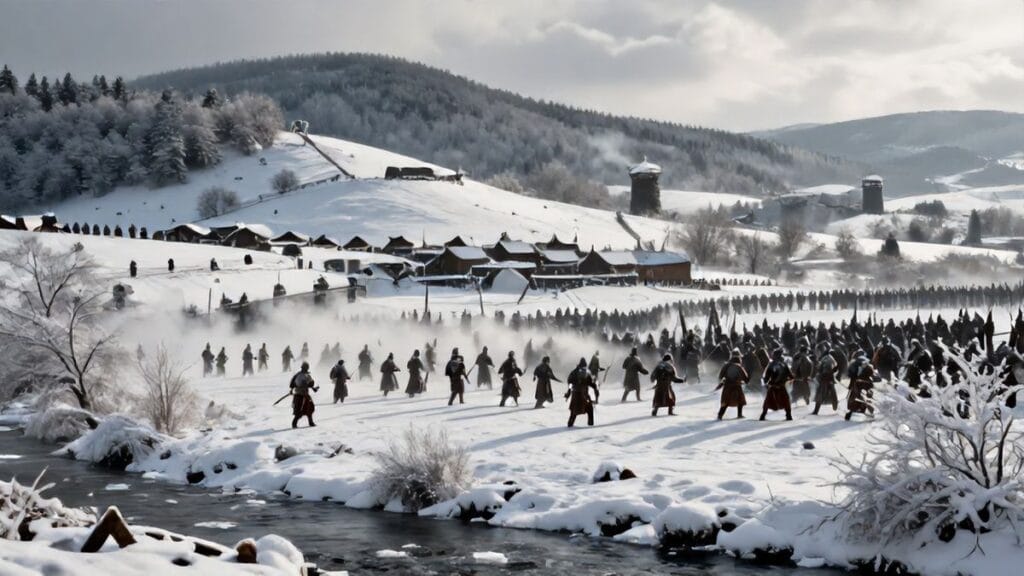
At first light, the world around Laugaricio emerges from shadow in shades of gray and white. Frost clings to the ground; the river below steams faintly in the cold air. Trumpets blare within the Roman camp, cutting through the half‑sleep of the legionaries. Orders are barked. Lines of men form up, shields clattering, breath hanging in the air.
The exact details of the battle of Laugaricio are not recorded in a single, vivid narrative like some earlier Roman victories. Instead, we reconstruct the action from the terse clues of a commemorative inscription and the wider pattern of the Marcomannic campaigns. Yet the logic of Roman warfare and the terrain near Trenčín allow us to trace a likely sequence of events.
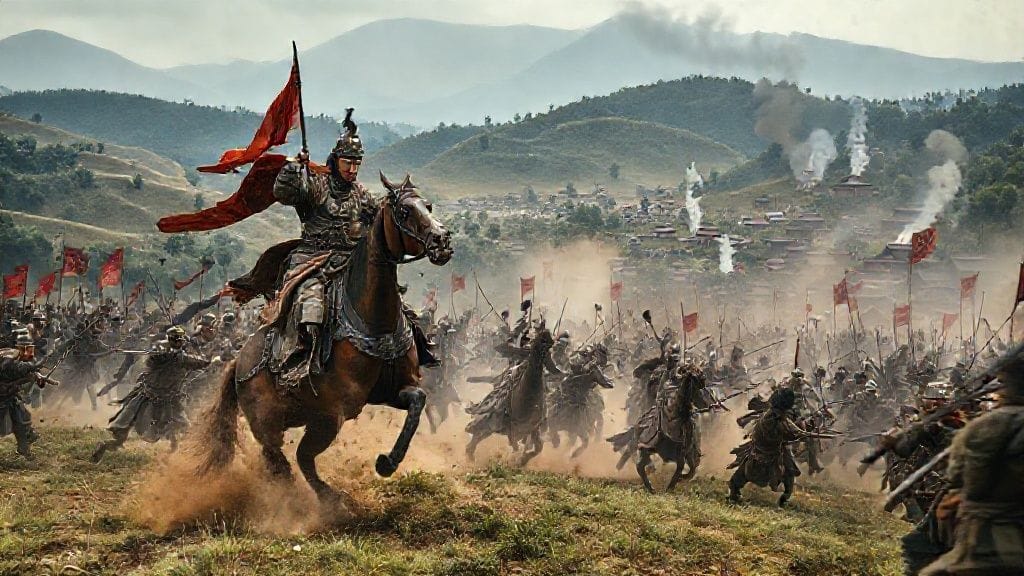
Roman commanders, aware that the Quadi would try to exploit the river and hills, likely sought to anchor one flank on the rocky outcrop while extending their line along the gentler slopes toward the valley. Lights signals or scouts must have confirmed the direction from which the enemy approached. The legions would have deployed in several ranks, heavy infantry at the center, with auxiliaries and cavalry on the wings. Standards—eagles of the legions, banners of the cohorts—rose above the formations, both symbols of honor and practical markers amid the confusion.
Opposite them, Quadi warriors and allied bands formed in looser arrays. Their aim was to disrupt, to break the Roman line at weak points, and to press their advantage in close, chaotic fighting. War cries rose as they advanced, a thunder of feet on frozen ground. Perhaps they hoped the Romans, far from their traditional bases, would falter or panic.
But this was not a green, untested army. At the critical moment, the legionaries would have stepped forward in disciplined fashion, shields locking, javelins ready. At the command, volleys of pila arced out, heavy iron‑shanked spears crashing into the advancing ranks, splintering shields, wounding men, stopping momentum. The impact of these first exchanges often decided whether a barbarian charge carried through with force or began to waver.
Then came the clash: shield against shield, sword against spear. Roman tactics favored staying tight, using the short gladius to thrust into exposed sides, thighs, and abdomens. Quadi warriors, taller on average and often fighting with longer weapons, would have tried to use reach and individual prowess to break the formations. The ground near the river might have become muddy or slick with ice, adding another treacherous element.
Reports preserved later suggest that the Romans, under the command of the legate Marcus Valerius Maximianus, succeeded not only in holding their line but in pushing the enemy back into and across the river zones. If so, some of the Quadi forces may have found themselves trapped between the organized advancement of the legions and the hazardous banks behind them. Once a barbarian force began to turn in retreat, the Roman cavalry could strike, riding down isolated groups, turning a hard‑fought engagement into a rout.
By midday, the tumult would have begun to ebb. Cries of the wounded competed with the shouts of Roman officers rallying their men, calling them back into cohesion instead of allowing an uncontrolled pursuit. The battlefield near Laugaricio, once a quiet valley, now lay strewn with bodies, broken weapons, and abandoned shields. The river carried away fragments of armor, splinters of wood, and perhaps the last bubbles of breath from those who had stumbled into its cold depths.
Against this stark backdrop, the Romans recognized that they had achieved something vital. The enemy here had been shattered, at least for the moment. The northern offensive that had threatened to unravel months of hard campaigning was checked. And so the memory of this day, brutal as it was, would be carved not only into the minds of survivors but into the very stone of the hilltop that looked down on the carnage.
Turning the Tide: Tactics, Terrain, and Roman Discipline
The victory at Laugaricio was not a miracle; it was the product of tactical calculation and the relentless training that defined the Roman legions. Several key factors likely tipped the balance in Rome’s favor and made the battle of Laugaricio a turning point in the Marcomannic Wars.
First, terrain. By anchoring their position on the rocky promontory that would later host the famous inscription, Roman commanders reduced the risk of being outflanked. The heights provided a vantage point for observing enemy movements and coordinating responses. Control of nearby fords or crossings on the Váh meant that Quadi attempts to maneuver around the Roman line could be anticipated and countered.
Second, logistics. Though far from their main bases, the Romans had taken care to secure supply lines in the lead‑up to the battle. Guards along roads and river routes, fortified posts at key intervals, and intelligence on local resources all lessened the risk of sudden starvation or lack of equipment. In contrast, Quadi and allied warriors, assembled in significant numbers away from their villages, depended on rapid action; a drawn‑out campaign favored Rome.
Third, discipline under pressure. Accounts of Roman warfare consistently emphasize the ability of legionaries to maintain formation even when threatened with encirclement or overwhelmed by noise and violence. At Laugaricio, in the biting winter air, this discipline may have been tested to its limits. Yet as long as officers and centurions remained alive and visible, barking orders over the clash of metal, the line could flex without breaking. Once the Quadi realized that their charges were not shattering Roman cohesion, the psychological edge began to shift.
Finally, leadership. Marcus Aurelius, though perhaps not physically present at every front‑line confrontation, set the tone. Under him, capable legates like Marcus Valerius Maximianus coordinated operations. A later inscription from the site—our most important material witness—records that 855 soldiers of Legio II Adiutrix were stationed there under Maximianus. This specific figure, chiselled in stone, offers a tantalizing glimpse into the scale and organization of the force that secured Laugaricio and its surroundings.
In a broader sense, the battle demonstrated that Rome still had the will and the means to project power beyond the Danube. It sent a clear message to other tribal leaders watching events closely: the empire was wounded, but not mortally; its legions, battered by war and plague, could still adapt and prevail in hostile terrain. For a moment, at least, the tide along the northern frontier had turned.
Blood on the Snow: Human Stories from the Battlefield
It is tempting to let the battle of Laugaricio dissolve into abstractions—“forces,” “legions,” “tribes”—but beneath those labels were individual lives, each carrying fears, hopes, and small personal histories that ended or were irrevocably changed on that cold ground.
Consider, for a moment, a hypothetical legionary of Legio II Adiutrix—let us call him Gaius. Perhaps he was born on the banks of the Tiber, or in a small town in Pannonia, or in some Gallic city where Latin mingled with local tongues. Drafted or enlisted in his late teens, he would have trained under the lash of the centurion’s voice, learning to march, to dig, to fight in close formation. By 179, he might have already survived a skirmish or two along the Danube. The battle near Laugaricio was another test, but also another chance at the donatives and promotions that could one day secure him a patch of land and the dignity of a veteran.
On the other side, imagine a Quadi warrior, perhaps named something that has never been written down and so has vanished from history entirely. He might have grown up listening to stories of Roman traders at the river, of exotic goods and greedy tax collectors, of past battles won and lost. For him, the Romans were not an abstract empire but flesh‑and‑blood intruders—sometimes allies, sometimes predators. When the chiefs called for warriors to gather against the advancing legions, he would have taken his spear and shield with a mixture of fear and grim excitement.
On the day of battle, these two men might have faced each other briefly across a shrinking space, shouting words neither understood. Perhaps Gaius’s pilum struck the Quadi’s shield, binding wood and metal in the classic Roman design that made such javelins difficult to discard. Perhaps, in the press of bodies, the Quadi’s spearhead grazed Gaius’s thigh, leaving a wound that would throb in the cold nights to come. Or perhaps one fell quickly, the other never knowing the face of the man whose life he had taken or spared.
Beyond the combatants, think also of those who tended to the aftermath. Roman medici—army medics—worked among the wounded, binding cuts, setting broken bones, cauterizing deep gashes with hot irons. Quadi women and elders searched the fields after the Romans withdrew, seeking sons and husbands, preparing hurried burials or pyres where possible. The river carried away some bodies, denying families even the bitter comfort of a grave.
In one of his “Meditations,” Marcus Aurelius reminded himself that “soon you will have forgotten all things, and soon all things will have forgotten you.” That is the natural fate of most who fought at Laugaricio. And yet, in the faint traces they left—a scar on a bone found by archaeologists, a dented helmet dredged from a riverbank, a worn Latin inscription high on a rock—they insist that we remember, however imperfectly, the human cost of Rome’s northern wars.
Aftermath in the North: Forts, Treaties, and Smoldering Resentments
Once the clash at Laugaricio subsided and the immediate pursuit ended, the Romans faced a familiar set of questions: How far to push the advantage? How to turn a battlefield victory into lasting security? And how to manage the defeated without sowing the seeds of the next uprising?
In the short term, the area around Laugaricio became a forward outpost of Roman power. The presence of the 855 men of Legio II Adiutrix, recorded in the famous inscription, suggests that the army established a semi‑permanent station here, controlling river traffic and monitoring tribal movements. Fortifications of timber and earth likely dotted the nearby heights and river crossings. Patrols fanned out, both to assert dominance and to reassure any local communities who had thrown their lot in with Rome.
Diplomatically, the Romans were now in a stronger position to dictate terms. Surviving Quadi leaders, bruised by defeat, would have been more willing—or more compelled—to negotiate. Hostages were demanded, not just as symbols but as practical leverage: sons and relatives of chiefs sent to live under Roman supervision in Pannonian or Norican towns, their lives a guarantee of future compliance. Agreements on the movement of people and the supply of auxiliary troops followed. Some Quadi youths, in time, might even have donned Roman armor as foederati, fighting alongside the legions in later campaigns.
Yet beneath formal treaties, resentments smoldered. For the tribes, Rome’s victory at Laugaricio could easily be seen as an occupation of ancestral lands by foreign soldiers who built strange stone and timber structures and demanded labor and tribute. For Roman soldiers, stationed in this cold, distant outpost, the surrounding countryside was filled with ambiguous faces—potential allies, informants, or enemies in waiting.
Over the next months and years, skirmishes almost certainly continued. No single battle, however decisive, could erase the structural tensions along the Danubian border. Still, the outcome at Laugaricio bought the empire something priceless: time. Time to regroup, to reassert control over vulnerable stretches of the frontier, and to reconsider the grand plan of pushing the border northward into what Marcus Aurelius had envisioned as new provinces.
That plan, however, would soon collide with a far more implacable enemy than any Quadi warlord—the mortality of an emperor.
Empire on the Brink: Political Reverberations in Rome
News of the victory at Laugaricio, carried by riders and riverboats, must have reached Rome with a palpable sense of relief. Senators and officials, long accustomed to hearing grim reports from the Danube, could point to this triumph as evidence that the Marcomannic crisis was finally under control. Public sacrifices would be offered; the emperor’s titles might be expanded to reflect his success against the northern tribes.
Yet even as the empire celebrated, the foundations of that triumph were already beginning to crack. Marcus Aurelius, worn down by years of campaigning and the ever‑present shadow of the plague, fell ill in 180 in the frontier town of Vindobona (modern Vienna) or perhaps Sirmium, according to differing traditions. Surrounded by military and civilian advisors, he died far from the city that had nurtured him, leaving the throne to his son Commodus.
The shift from Marcus to Commodus was more than a simple dynastic succession. Marcus had been shaped by Stoic philosophy and a sense of duty that made him endure the discomforts of frontier life for much of his reign. Commodus, by contrast, displayed little enthusiasm for the cold camps of the Danube. Almost immediately upon taking power, he negotiated a peace with the northern tribes—one that, while not entirely dishonorable, fell short of his father’s ambitions for annexation and permanent transformation of the frontier.
Thus, the strategic fruits of victories like the battle of Laugaricio were never fully harvested. The envisioned provinces of Marcomannia and Sarmatia remained paper projects, not real territories. Roman troops withdrew from some advanced positions, including, it seems, the more tenuous outposts north of the Danube. The inscription at Laugaricio became a lingering reminder of a moment when Rome stood poised to redraw the map—only to step back.
In Rome itself, Commodus’s tastes ran more to gladiatorial display than to grim frontier campaigns. His erratic rule, punctuated by conspiracies, purges, and bizarre self‑aggrandizing gestures, eroded the stable image of imperial authority that had been carefully cultivated over the previous century. The Senate’s murmured misgivings grew louder. In 192, Commodus was assassinated, plunging the empire into the short but brutal “Year of the Five Emperors.”
From this perspective, Laugaricio shines as a bright but fleeting point of order in a gathering storm. A frontier secured by hard fighting in 179 would, within a few decades, give way to new waves of instability. Yet in those critical years, the fact that Rome could still win such battles mattered. It postponed the disintegration of the northern limes, giving the empire a precious, if temporary, reprieve.
From Provincial Memory to Stone: The Trenčín Inscription
The single most tangible link between modern Trenčín and the battle of Laugaricio is a block of Latin text cut into bare rock. High on a cliff above the town—today partly sheltered beneath the walls of a later castle—the inscription stands as a weathered, stubborn voice from 179, speaking across nearly two millennia.
Discovered and recognized in the 19th century, the Trenčín inscription reads, in its reconstructed form, something like this:
“To the victory of the emperor, under the legate of the Second Legion Adiutrix, 855 soldiers of the same legion, having camped at Laugaricio, caused this to be engraved.”
Those few lines carry an astonishing density of information. They confirm the Latin form of the place name, Laugaricio, anchoring Roman presence firmly in what is now Slovakia. They attest to the presence of Legio II Adiutrix and to the leadership of its legate, Marcus Valerius Maximianus. Most strikingly, they record the exact number of soldiers—855—stationed there, offering a rare glimpse into the garrison size of a forward operating post.
Why carve such a text into the living rock? For the Romans, inscriptions were more than mere labels; they were assertions of authority and memory. To write on stone was to claim permanence. In a landscape of shifting tribal allegiances and transient camps, the cliff at Trenčín became a kind of Roman proclamation: We were here. We prevailed. We inscribed our presence into the bones of the earth itself.
Over centuries, the inscription became partly obscured, buffeted by weather, overbuilt by later fortifications. Medieval inhabitants of the region likely saw the strange letters but could no longer read them. Only with the rise of antiquarian interest and systematic historical study in the modern era did the meaning of the text begin to emerge. Scholars argued over readings, dates, and interpretations, but gradually a consensus formed linking the inscription to the campaigns of Marcus Aurelius during the Marcomannic Wars.
For historians today, that inscription at Trenčín is a linchpin. While literary sources mention Marcus’s wars against northern tribes, they rarely specify precise locations in the valleys beyond the Danube. The rock text anchors the otherwise elusive battle of Laugaricio in space and time. It allows archaeologists to correlate nearby finds—bits of Roman pottery, military equipment, and settlement remains—with a concrete historical moment. As one modern historian put it, “Without this stone, the story of Rome in present‑day Slovakia would be a ghost without a skeleton.”
Archaeology and Debate: Reconstructing Laugaricio
Despite the solidity of the Trenčín inscription, much about the battle of Laugaricio remains open to interpretation. Archaeologists and historians, working with fragmentary evidence, have put forward differing reconstructions of the scale, exact location, and broader context of the fighting in 179.
Excavations in and around Trenčín have unearthed traces of Roman material: pottery shards, fragments of military equipment, and indications of temporary camps. Some features suggest the presence of a marching camp or a smaller fortification on the heights. Yet the ravages of time, later building, and erosion make it difficult to draw a complete plan. Unlike the well‑preserved legionary fortresses along the Rhine or in Britain, Laugaricio was likely a relatively small installation, its timbers long since rotted away.
Scholars also debate the precise nature of the “855 soldiers” mentioned in the inscription. Were they the entire contingent stationed there at one time? A detachment of a larger force operating in the region? A commemorated group from a specific cohort or vexillation? Different answers imply different scales for the operations around Laugaricio. Most agree, however, that this was not an isolated skirmish but part of a larger campaign pushing into Quadi territory.
Questions remain too about the enemy’s composition. While the Quadi are the primary tribal group associated with the area, it is possible that allied warriors from neighboring peoples participated. Some researchers have pointed to similarities between finds in the region and artifacts further north, suggesting a complex web of migrations and alliances.
Modern methods—radiocarbon dating, metallurgical analysis, landscape archaeology—have added new layers of detail. Satellite imagery and LiDAR scans have hinted at ancient trackways and possible fort lines now hidden under forests and fields. Each discovery helps flesh out the context of the battle of Laugaricio, even if it does not provide a detailed, cinematic sequence of the fighting itself.
At times, the scarcity of evidence has prompted bold hypotheses, some more plausible than others. But responsible historians emphasize the limits of our knowledge as much as its riches. As one recent scholarly article cautioned, “Laugaricio stands at the intersection of epigraphy, archaeology, and imagination; we must take care that the latter does not march too far ahead of the former.” Yet without some imaginative reconstruction, the stones and potsherds remain mute. The challenge is to balance rigor with narrative—to let the past speak without putting words too freely into its mouth.
Legacy of a Forgotten Victory: From Roman Frontier to Slovak Heritage
For centuries after the legions withdrew, the memory of Rome’s presence in the region around Trenčín faded. Forts decayed; Latin names were replaced by Slavic and later medieval designations. The battle of Laugaricio, so vivid to those who fought it, vanished from local oral tradition, if it had ever truly taken root there at all. Yet the physical traces remained, waiting for new eyes and new questions.
In the modern era, as national identities in Central Europe crystallized, the Roman past acquired new significance. For Slovak scholars and cultural figures, the Trenčín inscription became a powerful symbol: evidence that this land, now part of their nation, had once been a point of contact—and conflict—with one of history’s greatest empires. The battle of laugaricio, once a line in a legionary report, could be reimagined as an early chapter in the long story of the region’s integration into broader European currents.
Museums in Slovakia now display artifacts linked to the Roman presence in the region: coins, pottery, military fittings. School textbooks mention Laugaricio as a key site, helping students situate their homeland on the mental map of ancient history. Tourist brochures for Trenčín Castle highlight the inscription as a unique attraction, drawing visitors eager to touch, quite literally, a piece of the second century.
This local reappropriation runs parallel to a wider European interest in frontiers and borderlands. The Danube limes, once a military line, is now also a cultural route, part of cross‑border heritage initiatives. Laugaricio sits within this network as a northern outpost, a reminder that Rome’s influence extended further than many might assume. It complicates older narratives that painted Central Europe as a timeless “barbarian” zone untouched by classical civilization.
At the same time, modern commemorations can risk simplifying the past. It is tempting to cast the Romans as bringers of order and progress and the Quadi as faceless antagonists, or, conversely, to romanticize the tribes as noble resisters of imperial oppression. The real history, as the traces from 179 suggest, was messier: alliances of convenience, trade and plunder intertwined, individuals shifting identities in a world where survival often trumped ideology.
Still, the very fact that Laugaricio has reentered public consciousness is significant. A battle once remembered only by a few lines of Latin now resonates in exhibitions, academic conferences, and local festivals. The echo of swords on shields has been replaced by schoolchildren’s voices and tour guides’ explanations, but the site’s role as a meeting point between different worlds endures.
If Laugaricio Had Been Lost: A Glimpse into an Alternate Empire
Counterfactual history is always speculative, yet it can illuminate the stakes of real events. What if, on that winter day in 179, the battle of Laugaricio had gone the other way? What if the Quadi and their allies had broken the Roman line, killing or scattering the 855 men of Legio II Adiutrix and perhaps more beyond?
A single defeat, even a major one, would not have instantly toppled the Roman Empire. The Danubian frontier was long and complex, supported by multiple legions and fortified centers further south. But a serious reverse deep in hostile territory could have triggered cascading consequences. Remaining Roman forces might have been forced into a hasty retreat across the Danube, abandoning advanced positions and leaving local allies to fend for themselves—or to switch sides under duress.
Emboldened by success, tribal leaders might have drawn in additional support from more distant groups, presenting a renewed and larger coalition. With Marcus Aurelius’s health already failing, the imperial command structure would have struggled to respond quickly. Pressure from the north could have coincided with unrest in other regions, overtaxing the empire’s limited reserves of manpower and money in the plague’s aftermath.
Politically, a major defeat at Laugaricio could have weakened Marcus’s ability to dictate terms in Rome. Factions in the Senate, already wary of the immense expenditures on the Marcomannic Wars, might have pushed for a less ambitious, more defensive policy. The dream of annexing new provinces north of the Danube would likely have evaporated even before the emperor’s death. Commodus, inheriting a more precarious situation, might have faced stronger pressure to appease northern tribes with generous subsidies and concessions, exacerbating long‑term dependency and instability.
On a broader historical canvas, a more porous or destabilized Danubian frontier in the early third century could have accelerated the patterns that, a century later, contributed to the so‑called “barbarian invasions.” We might have seen earlier mass migrations into imperial territory, earlier experiments with large tribal federations operating semi‑autonomously within the empire’s borders, and perhaps an earlier erosion of central authority.
Of course, history rarely follows straight lines. Other factors—the rise of strong or weak emperors, economic shifts, climatic events—would still have played decisive roles. Yet it remains clear that the real victory at Laugaricio helped, in however modest a way, to hold back such developments. The frozen valley near Trenčín became, for a moment, one of the hinges on which Rome’s future turned.
Echoes of Laugaricio in Modern Culture and Scholarship
In recent decades, the battle of Laugaricio has moved from the margins of specialized scholarship toward a more visible place in public history and academic debate. Part of this shift stems from the growing interest in “small” or local histories as essential threads in the broader tapestry of the Roman world. No longer is ancient history told only through the lens of Rome, Athens, and Alexandria; borderlands like the upper Váh now claim their share of attention.
Historians and archaeologists from Slovakia, the Czech Republic, Austria, Hungary, Germany, and beyond collaborate to reconstruct the Marcomannic period. Conferences bring together experts in Latin epigraphy, battlefield archaeology, environmental history, and even paleopathology, seeking to understand not only how battles like Laugaricio were fought, but how climate, disease, and landscape shaped them. One scholar recently noted that “to grasp the Marcomannic Wars is to grapple with a prelude to the Late Antique world,” underlining Laugaricio’s place in a longer story of transformation.
In literature and popular culture, Laugaricio also makes occasional appearances. Historical novels set in the age of Marcus Aurelius sometimes feature scenes along the Danube, with fictional characters marching toward a climactic confrontation near a rocky hill later named in Latin. Documentaries on the “decline of Rome” increasingly include segments filmed at Trenčín, with sweeping drone shots over the castle and close‑ups of the inscription, while narrators speak of the “forgotten frontier battle” that secured Rome’s northern border.
Local initiatives further embed the site into contemporary life. Reenactment groups don Roman armor and tribal garb in seasonal festivals, staging mock drills and combats to evoke—however theatrically—the realities of second‑century warfare. School programs bring children to see the inscription, encouraging them to imagine the multilingual shouts and clatter of the camp below all those centuries ago.
Meanwhile, debates within scholarship continue. Some argue that Laugaricio has been somewhat overstated in popular accounts, that it was an important but not singularly decisive engagement in a long series of frontier struggles. Others counter that its symbolic power, especially when read alongside the emperor’s broader strategy, justifies its prominence. As with so many episodes in ancient history, the truth likely lies somewhere between dramatic simplification and dismissive minimalism.
What is certain is that the battle of laugharicio, once an obscure note in the annals of a distant war, has become a focal point for conversations about identity, continuity, and memory. In the interplay between rock, river, and narrative, the hills above Trenčín continue to echo with questions that stretch far beyond 179.
Conclusion
On a cold day in 179, along a river whose name the Romans barely knew, soldiers of Legio II Adiutrix stood shoulder to shoulder and fought for an empire that was already beginning to change. The battle of Laugaricio did not decide the ultimate fate of Rome, nor did it usher in a new era of unbroken peace. But it mattered—deeply, immediately—for the men in the line, for the frontier communities who lived in the shadow of the legions, and for an emperor who had staked his final years on holding the northern border.
Through the lens of Laugaricio, we see the Roman Empire not as a static monolith, but as a fragile system constantly negotiating its limits. We glimpse Marcus Aurelius, the philosopher in armor, wrestling with fate in muddy camps; Quadi leaders weighing survival against honor; local families caught between opposing armies. We watch as a single victory is carved into stone, only to be half‑forgotten and later rediscovered, its meaning reshaped by new generations.
Today, the rock inscription at Trenčín stands above a modern town threaded with cars, trains, and digital signals. The river flows past apartment blocks and shops instead of marching camps and tribal encampments. Yet the questions raised in 179 persist: where do empires end and others’ homelands begin? How do societies balance security and expansion, diplomacy and force? And how should we remember the countless unnamed who paid the price for decisions made far away?
By tracing the story of the battle of laugharicio—from its deep causes to its long afterlife—we reconnect a seemingly remote clash with the wider human drama of power, fear, resilience, and memory. The frozen breath of legionaries and Quadi warriors may long since have vanished into the air, but in the stone above Trenčín, and in the stories we continue to tell, their struggle still leaves a faint, indelible mark.
FAQs
- Where was the Battle of Laugaricio fought?
The Battle of Laugaricio was fought near modern‑day Trenčín in western Slovakia, in the upper valley of the Váh River. The key Roman site was a rocky outcrop overlooking the valley, later marked by a Latin inscription that names the place “Laugaricio” and records the presence of a detachment of Legio II Adiutrix. - Who were the main opponents in the Battle of Laugaricio?
The battle pitted Roman forces—principally elements of Legio II Adiutrix under the legate Marcus Valerius Maximianus—against the Quadi and possibly allied tribal groups. The Quadi were a Germanic people living north of the Danube, in what is now parts of Slovakia and surrounding regions. - Why was the Battle of Laugaricio significant?
The battle was part of the Marcomannic Wars and represented a major Roman success deep inside Quadi territory. It helped secure the northern frontier at a time when the empire was weakened by plague and prolonged conflict. Although it did not lead to the full annexation of the region, it demonstrated that Rome could still project power beyond the Danube and temporarily stabilized a volatile frontier. - How do we know about the Battle of Laugaricio?
Our primary evidence comes from the rock inscription at Trenčín, which mentions Laugaricio, the Second Legion Adiutrix, and the number of soldiers stationed there in 179. Literary sources describe the broader Marcomannic campaigns under Marcus Aurelius, and archaeological finds around Trenčín support the presence of Roman military activity in the area. - Was Marcus Aurelius personally present at Laugaricio?
There is no direct evidence that Marcus Aurelius stood on the battlefield during the clash at Laugaricio itself, though he was campaigning along the Danube during this period. Command on the spot was likely exercised by his legate, Marcus Valerius Maximianus, while the emperor oversaw the larger strategic direction of the war. - What happened to the Quadi after the battle?
After their defeat near Laugaricio, the Quadi entered into negotiated settlements with Rome, providing hostages and accepting certain restrictions. While they remained an important tribal group north of the Danube, their capacity to threaten the frontier was reduced for a time. However, tensions and intermittent conflicts continued in the following decades. - Can visitors see remains of the Roman presence at Trenčín today?
Yes. The most visible Roman remain is the inscription carved into the rock below Trenčín Castle, which is accessible to visitors and often highlighted on guided tours. Archaeological finds from the region, including Roman artifacts linked to the Marcomannic period, can be seen in local and national museums in Slovakia. - How does the Battle of Laugaricio relate to the decline of the Roman Empire?
The battle took place during a period of mounting pressures—plague, frontier wars, and political strain—that some historians view as an early phase in the long transformation of the Roman world. While Laugaricio itself was a Roman victory that delayed frontier collapse, the wider context of the Marcomannic Wars exposed vulnerabilities that would become more pronounced in the third and fourth centuries.
External Resource
Internal Link
Other Resources
- Encyclopaedia Britannica – general search for the exact subject
- Google Scholar – academic search for the exact subject
- Internet Archive – digital library search for the exact subject