Table of Contents
- A Desert Kingdom at the Crossroads of Empires
- From Nomadic Caravans to a Desert Powerhouse
- Petra, Rock of Wonders and Nerve Center of a Kingdom
- Kings, Coins, and Diplomacy: The Political Craft of the Nabataeans
- Between Eagle and Crescent: Nabataea in the Age of Roman Expansion
- The Reign and Enigma of Rabbel II, Last King of Nabataea
- Year 106: When the Desert Fell Silent
- Creating Arabia Petraea: Rome Draws New Lines on Ancient Sands
- Legions, Roads, and Forts: The Militarization of the Nabataean Realm
- Merchants, Artisans, and Farmers: Daily Life After Annexation
- Temples, Gods, and Scripts: Cultural Fusion Under Roman Rule
- Wadi Rum to Bostra: Landscapes Rewritten by Empire
- Echoes in Stone: Archaeological Traces of a Lost Sovereignty
- Historians, Debates, and the Question of Consent
- From Desert Province to Holy Land: Arabia Petraea in Late Antiquity
- Remembering Nabataea: Afterlives in Memory and Imagination
- Conclusion
- FAQs
- External Resource
- Internal Link
Article Summary: This article traces how the thriving Nabataean Kingdom, master of incense routes and builder of Petra, stood at the crossroads of ancient trade and imperial ambition before being transformed into the Roman province of Arabia Petraea in 106 CE. It begins in the age of nomads and caravans and follows the kingdom’s rise into a wealthy, cosmopolitan power whose fate was sealed when the Nabataean kingdom annexed by Rome reshaped the political map of the Near East. Through cinematic narrative and close historical analysis, it explores the annexation’s motives, from strategic concerns and economic calculation to dynastic fragility after the death of the last king, Rabbel II. The article then journeys through the social and cultural consequences for merchants, farmers, priests, and soldiers who suddenly found themselves subjects of a distant emperor. It investigates how cities, temples, and scripts changed under Roman influence, yet how Nabataean identity persisted in subtle ways carved in stone and memory. By following archaeological evidence and ancient sources, it shows how the moment when the Nabataean kingdom annexed by Rome became Arabia Petraea was not just a technical administrative event but a profound human turning point. Finally, it situates this annexation within the broader transformation of the region into a late antique frontier and reflects on why the story of a desert kingdom’s loss of sovereignty still fascinates us today.
A Desert Kingdom at the Crossroads of Empires
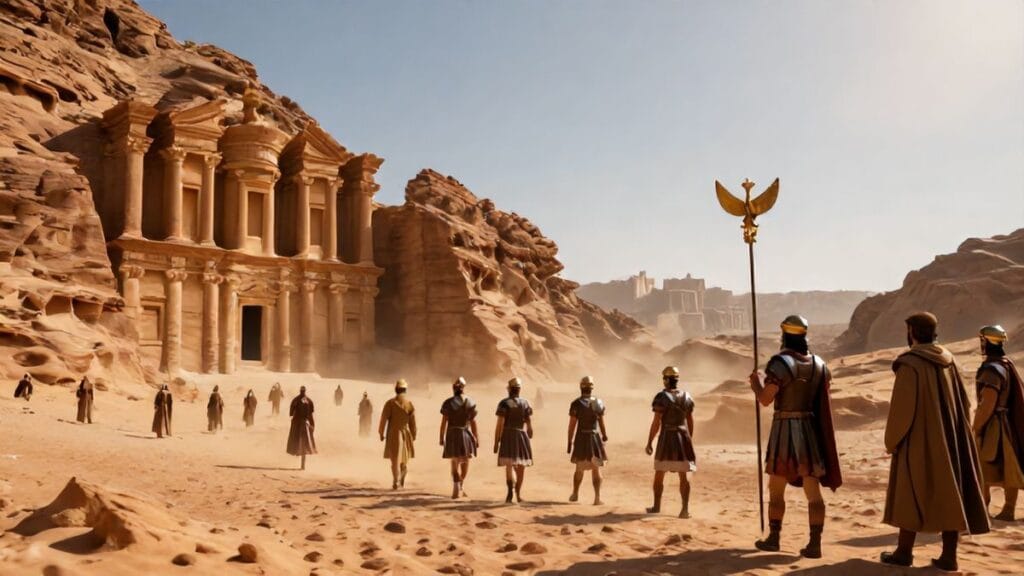
The year is 106 CE. In the high, rose-red canyons of Petra, the wind threads its way between facades carved into sheer rock, whispering across columns and pediments that resemble Greek temples yet feel utterly foreign. Traders who once swaggered through these narrow defiles with laden camels now pause, uneasy, as unfamiliar standards—golden eagles atop poles of bronze—appear on the horizon. The Nabataean kingdom annexed by Rome is not a phrase anyone in Petra would have uttered that spring, but the transformation is already underway. Legions move in quiet, calculated marches from the north and south. A change of banners, coinage, and law is about to descend on a kingdom that for centuries mastered the harsh desert and the rich aroma of incense.
To understand the weight of that moment, one must first understand what it meant to be Nabataean. Long before the Latin term “Arabia Petraea” appeared on official documents and maps of the Roman Empire, this land was home to semi-nomadic Arabs who learned to read the desert like a scroll. Where others saw only emptiness, they saw corridors—of trade, of diplomacy, of power. From the basalt plains near the Hauran in the north to the copper mines of the Arabah and the Red Sea ports in the south, they stitched together a kingdom not on rivers, like Egypt and Mesopotamia, but on routes. By the time the Nabataean kingdom annexed by Rome, their political sovereignty was swept away, yet the routes, and the human stories that traveled with them, remained.
The annexation did not come in a blaze of epic battles immortalized in marble reliefs; it came quietly, almost bureaucratically. Emperor Trajan, meticulously strengthening Rome’s eastern frontier, seized a strategic opportunity. The last Nabataean king had died, the dynasty seemed exhausted, and the empire needed secure passageways and revenue. A new province—Arabia Petraea—was declared, its name tying the Roman world to the rock-hewn capital that had dazzled merchants from Alexandria to Damascus. But this was only the beginning of the story, not its end. Behind that administrative act unfolded an intricate web of adjustments, losses, and surprising continuities that would shape the sands of Arabia for centuries.
From Nomadic Caravans to a Desert Powerhouse
Long before Rome contemplated expansion into the region, the ancestors of the Nabataeans were wanderers. They moved with their herds across the arid steppes, chasing seasonal pastures and waterholes, guided by stars and tribal memory. Historians still debate the exact origins of the Nabataeans: many consider them an Arab people emerging out of the Arabian Peninsula, settling gradually into the fringes of what we now call Jordan, northwest Saudi Arabia, and southern Syria. The first firm shadows of them fall across history in the 4th and 3rd centuries BCE, when they appear in Greek accounts as elusive desert-dwellers who defied Hellenistic kings.
In 312 BCE, the general Antigonus, one of Alexander the Great’s successors, launched an expedition to raid the Nabataeans, hoping to seize their wealth. That wealth lay not in cities of marble but in caravans heavy with frankincense, myrrh, aromatics, and spices crawling north from South Arabia. According to the historian Diodorus Siculus, the attack initially succeeded, but the Nabataeans struck back with shocking swiftness, annihilating the raiding force. It is an early glimpse of what would become a Nabataean trait: the ability to combine mobility, intimate knowledge of difficult terrain, and fierce cohesion under pressure.
From here, the pattern of their ascent becomes clearer. Over the next two centuries, the once mostly nomadic tribes learned to capture and direct the flow of goods moving between South Arabia, the Red Sea, Egypt, Syria, and Mesopotamia. Rather than conquering vast agricultural plains, they specialized in “conquering” routes and oases. They developed an uncanny skill in managing water—through cisterns, channels, and hidden reservoirs—allowing them to maintain outposts deep in the desert. Where others failed, they endured. By taxing caravans, offering security, and gradually planting urban centers along these arteries, they transformed their way of life. What began as a federation of desert clans matured into a kingdom that demanded recognition from its great neighbors.
We can almost imagine an early Nabataean caravan master standing atop a ridge near the Gulf of Aqaba, scanning a line of camels stretching across the dawn. Every bale of incense represented not just profit but influence. Every agreement with a tribe or city-state added a stitch to an invisible net of obligations and dependencies. Over time, the Nabataeans evolved a political system that matched this economic strategy: pragmatic, flexible, and oriented toward balance rather than dominance for its own sake. The rise from nomadic traders to a desert powerhouse laid the foundation for the bitter irony that centuries later the Nabataean kingdom annexed by Rome would be prized precisely because of the networks these early generations had so diligently built.
Petra, Rock of Wonders and Nerve Center of a Kingdom
At the heart of the kingdom stood Petra, almost invisible until one steps into it. Approached through the Siq, a natural chasm slicing through the sandstone cliffs, the city seems to emerge as if the rock itself had decided to imitate architecture. Facades rise on either side—tombs masquerading as palaces, temples playing at being mountains. The most iconic, the so-called Treasury (al-Khazneh), with its delicate Corinthian columns and ornate pediments, greets the traveler at the end of the gorge like an apparition. To contemporary visitors, Petra is romantic ruin; to the ancient world, it was a statement in stone.
Petra was not built overnight. In the early centuries of Nabataean history, it probably began as a loosely organized center of seasonal gathering, a place where tribes met, traded, and celebrated. Over time, as control over the incense routes solidified, as the Nabataean elite grew richer, those who had once pitched tents began to carve their permanence into the cliffs. By the 1st century BCE and 1st century CE, Petra had become a booming urban center, filled with temples, markets, theaters, and lavish tomb complexes. Here, the desert power translated its invisible economic might into visible, monumental form.
The city’s very layout spoke to the kingdom’s genius. The Nabataeans constructed an intricate water management system—channels cut along the rock, covered pipes, vast cisterns carved under the earth—to harness rare rainfall and springs. In a place where water meant life or death, they created surplus. That surplus fueled agriculture on terraced hillsides around the city, supporting not only locals but caravans that flocked there from the Red Sea and beyond. Petra thus became both a caravanserai on a colossal scale and a sacred city dotted with sanctuaries to deities such as Dushara and al-‘Uzza.
The visual style of Petra reveals how open the kingdom was to foreign influences even before the annexation. Hellenistic columns, Egyptian motifs, local Arabian symbols, and Roman architectural idioms all dance together on its rock faces. It is astonishing, isn’t it? Even before the Nabataean kingdom annexed by Rome, an aesthetic of empire had seeped into its stones. Yet this was not simple imitation; it was translation. The Nabataeans borrowed, adapted, and hybridized, expressing in art and architecture the same fluidity that characterized their navigation of trade and diplomacy. When Roman officials later walked these streets as administrators of Arabia Petraea, they would have recognized much that felt familiar, even as local rituals and languages continued pulsing beneath the imperial surface.
Kings, Coins, and Diplomacy: The Political Craft of the Nabataeans
The Nabataean kings, while never as famous as Caesar or Cleopatra, steered their kingdom through a minefield of regional rivalries. Their earliest rulers remain shadowy, but from around the 2nd century BCE we begin to see names—Aretas, Obodas, Malichus—emerging from inscriptions and coin legends. Aretas III, ruling in the mid-1st century BCE, is one of the first to clearly assert Nabataean royal authority beyond Petra, extending influence towards Damascus and Palmyra. His coins, minted with a distinctive Aramaic script and royal portrait, were more than currency: they were declarations of sovereignty, challenging older Hellenistic powers and rising Roman interests.
The Nabataean kings engaged in the subtle art of survival between larger empires. They fought on occasion—against the Seleucids, against rival Arab tribes, even against the Hasmonean rulers of Judea—but they also knew when to compromise. During the Roman civil wars and the rise of Augustus, Nabataea often played the part of a “friendly” client state, formally independent yet deeply enmeshed in Roman economic and strategic networks. Their diplomats traversed the Mediterranean world, their envoys and merchants learning the languages and customs of distant courts, from Alexandria to Rome itself.
One of the clearest symbols of this balancing act appears in their coinage in the 1st century CE. Nabataean coins start to reflect more Roman-style iconography and sometimes bear bilingual legends. Marriages, too, served as diplomatic tools: alliances woven through royal unions could soften rivalries or secure borders. Yet even as they accommodated Rome, the kings defended key prerogatives: control over internal taxation, over trade, and above all over succession. As long as the dynasty produced heirs capable of negotiating with Rome, the kingdom’s independence, though increasingly fragile, could be preserved.
It is here that the seeds of the later crisis are sown. Client kingdoms were a familiar feature of the Roman imperial order—convenient buffers that shouldered local administration and costs. But such arrangements were inherently precarious. When dynasties faltered, when succession became unclear or loyalty suspected, emperors from Augustus to Trajan often preferred to cut the knot. Independent crowns were transformed into provincial governorships. The Nabataean kings knew this pattern well; they had seen it play out in other corners of the Near East. Even so, few could have predicted the quiet finality with which the Nabataean kingdom annexed by Rome would be written into the imperial record in 106.
Between Eagle and Crescent: Nabataea in the Age of Roman Expansion
By the 1st century CE, the horizon surrounding Nabataea was ringed with Roman eagles. Syria to the north, Judea and then Judaea-Palestina to the west, and Egypt to the southwest were all already under Roman control. To the east, the Parthian Empire loomed—a rival power Rome alternately fought and courted. Nabataea lay in between, its deserts, mountains, and caravan-studded tracks forming both shield and artery in the contest between these titans.
Rome’s interest in the region was not purely territorial. Control over trade meant control over revenue, and Nabataea had long profited from its intermediate position between South Arabia and the Mediterranean. For Rome, this represented both an opportunity and a problem. On the one hand, Nabataean merchants connected the empire to luxuries—incense, spices, gems—that delighted its elites and fed its religious practices. On the other hand, the tolls levied by Nabataeans diverted wealth that might otherwise flow directly into Roman coffers. Strategists in Rome and provincial capitals quietly asked themselves: why tolerate this middleman when imperial annexation could, at least in theory, secure and rationalize the routes?
The geopolitical climate tightened further in the reign of Emperor Trajan (98–117 CE), a soldier-emperor with a keen eye for frontiers and logistics. Trajan was planning major campaigns against Parthia, and the security of his eastern communications became a paramount concern. A friendly but independent Nabataean kingdom, perched on critical junctions, represented a strategic vulnerability. What if a hostile power wooed the Nabataean court? What if internal instability in Petra spilled into rebellion or disrupted the movement of troops and supplies?
Diplomatic exchanges undoubtedly took place, even if the details are lost. We know from later Roman writers that pretexts were often found—or manufactured—to justify annexations. When Armenia, Thrace, or Mauretania were absorbed into the empire, it was usually couched in language of “order,” “protection,” or “the will of the people.” The case of Arabia would be similar. To Roman eyes, the transformation of Nabataea into a province would appear as a logical, almost necessary step in completing the imperial ring around the eastern Mediterranean. Yet behind the administrative rhetoric lay a harsher reality: an independent Arab monarchy, with its distinctive culture and traditions, was about to disappear as a sovereign actor from the historical stage.
The Reign and Enigma of Rabbel II, Last King of Nabataea
At the center of the final act stands Rabbel II, the last known king of Nabataea. His reign, beginning around 70 CE and lasting until his death in 106, spanned decades of intense regional change: the First Jewish Revolt, the destruction of the Jerusalem Temple, the tightening Roman grip on the Levant. Yet Rabbel’s own life remains frustratingly veiled. We know him best through inscriptions, coins, and the shifting traces of policy that can be inferred from archaeology.
Rabbel II relocated aspects of royal focus from Petra to Bosra (Bostra) in the north, signaling a strategic pivot toward the fertile Hauran region and closer alignment with Syrian trade networks. Some scholars see in this move a response to changing economic patterns: maritime routes through the Red Sea were increasingly favored, and the overland incense caravans that had once made Nabataea rich may have been declining. By emphasizing agriculture and northern commerce, Rabbel II was perhaps attempting to reinvent his kingdom’s economic base. It was a bold, adaptive strategy—but time was not on his side.
Nabataean coins from his reign show continuity in royal imagery but also hints of convergence with Roman styles. The king navigated the tension between asserting his own authority and signaling loyalty to the emperor. Whether he did so from a position of strength or under growing pressure remains debated. Some modern historians argue that Rabbel’s Nabataea was still prosperous and relatively stable; others detect signs of strain, of a dynasty stretched thin, of succession anxieties lingering in the background.
What we know with more certainty is that Rabbel II died around 106 CE, and no clear, uncontested heir emerged to take his place. Client kingdoms depended heavily on unbroken dynasties. The death of a monarch was always a moment of risk. In this case, the risk proved fatal to Nabataean sovereignty. When the Nabataean kingdom annexed by Rome, Rabbel II’s death would later be presented—implicitly if not explicitly—as the hinge, the “natural” end of a line that justified imperial intervention. But to the people who had known only Nabataean kings for generations, the absence of a coronation, the quiet drift toward Roman administration, must have felt like the air being slowly pulled from their world.
Year 106: When the Desert Fell Silent
There is no single famous battle to mark the moment when the Nabataean kingdom annexed by Rome. No equivalent to the storming of Jerusalem or the crushing of a rebel army emblazoned on triumphal arches. Instead, the annexation unfolded like a script previously rehearsed, quietly executed by legions and officials who understood their roles perfectly. The Roman historian Cassius Dio, writing in the 3rd century, later summarized the event almost offhandedly, noting that “Trajan took over the Nabataean nation, which is situated above Judaea, and made a province of it, calling it Arabia.” In that dry line resounds the echo of a lost independence.
Archaeological evidence suggests a coordinated two-pronged move. Roman forces advanced from the north, likely through Damascus and Bosra, while others may have pushed up from the south, possibly from Egypt or the Red Sea region. The absence of widespread destruction layers in Petra and other major sites points not to a brutal conquest but to a largely bloodless takeover. Whether local elites negotiated terms, whether some resisted and were swiftly overwhelmed, we can only guess. The silence of our sources is itself telling: for Rome, this was routine business, not a heroic saga.
In Petra, the transition would have been both sudden and eerily mundane. One week, officials minting coins with Rabbel’s image; the next, imperial administrators weighing bronze and silver stamped with Trajan’s profile. Marketplaces continued to buzz, ovens to bake bread, camels to bray in courtyards. But above the chatter, new decrees were read out. Taxes were now to be paid in the emperor’s name. Disputes could be appealed to Roman courts. Garrison troops began to occupy strategic points, their Latin commands cutting through the familiar swirl of Aramaic and Arabic dialects.
Imagine a Nabataean elder, perhaps a merchant long accustomed to dealing with Roman traders, listening as the announcement was made: their kingdom was now a province, Arabia Petraea. The words might sound harmless, even promising—Rome brought roads, security, grand opportunities. Yet behind the celebrations staged by some local collaborators lay a gut-deep sense of loss. A line stretching back through kings and caravan leaders, through stories told by firelight of early victories against Macedonian raiders, had been quietly severed. No enemy armies burned Petra; instead, the empire smothered it in an embrace.
Creating Arabia Petraea: Rome Draws New Lines on Ancient Sands
With the annexation complete, the Roman bureaucratic machine began its work. The new province needed boundaries, a capital, an administrative hierarchy. Trajan’s officials, guided by both geography and existing patterns of settlement, carved the province they called Arabia Petraea out of former Nabataean territory and adjacent regions. The choice of name—“Arabia of Petra”—was significant: it stamped the fame of the Nabataean capital onto Roman maps while at the same time implying that Petra, once the proud seat of kings, now lent its glory to an imperial creation.
Bosra (Bostra) in the Hauran was designated as the provincial capital, not Petra. This decision encapsulated the new order. Bosra, already a significant urban center in the fertile north, lay closer to Roman Syria, easier to integrate into existing lines of communication. From Bosra, the governor of Arabia—initially of equestrian rank, later sometimes senatorial—could supervise both the agricultural heartlands and the desert fringes. Petra remained important, but its political centrality had been reassigned. What had once been a royal capital became a distinguished yet subordinate city within a broader provincial network.
The Romans overlaid their administrative grid onto local realities. Cities and settlements were catalogued, their legal status clarified: some were granted municipal rights, others remained dependent communities. Taxation structures were reoriented to align with imperial systems. Where Nabataean authorities had once levied tolls on caravans, these now flowed toward Roman treasuries. In some places, Latin legal inscriptions appeared, carving into stone new norms of property, inheritance, and civic responsibility.
Yet even in this moment of transformation, continuities persisted. Many local elites who had served under the Nabataean kings likely found roles within the Roman framework, their knowledge of land and people invaluable to new rulers. Some Nabataean institutions were modified rather than abolished; the Romans were pragmatic empire-builders, not zealous destroyers of all that preceded them. Still, the fundamental axis of loyalty had shifted. The Nabataean kingdom annexed by Rome was more than a phrase: it was a lived experience in which former subjects of a near, accessible monarchy now belonged—legally, fiscally, militarily—to a vast empire whose center lay thousands of kilometers away.
Legions, Roads, and Forts: The Militarization of the Nabataean Realm
Rome did not simply draw lines on parchment; it anchored them in stone, brick, and marching feet. One of the most enduring legacies of the annexation was the construction of a new infrastructure of control across the former Nabataean lands. Foremost among these was the Via Nova Traiana, a major road stretching from Bostra in the north down toward the Red Sea. Laid out, at least in part, over older caravan tracks, this road transformed the rhythms of movement in the region.
The Via Nova Traiana was more than a military highway. It facilitated trade, postal communication, and the movement of administrators. Inns, way stations, and small roadside settlements sprouted along its course. Milestones inscribed with Trajan’s name—some of which archaeologists have recovered—testify to imperial pride in this achievement. Alongside the road, in key passes and near oases, a chain of forts and watchtowers rose. Units of the Roman army, including auxiliary cohorts recruited from various parts of the empire, were stationed here, their presence a daily reminder of the new order.
The Nabataean kingdom annexed by Rome thereby became part of a defensive belt that shielded the empire’s eastern flank. While the desert beyond still teemed with nomadic groups and semi-independent tribes, the core routes and oases were now guarded by disciplined garrisons. Patrols scanned the horizon for raiders or would-be invaders; taxes could be collected more “efficiently,” which often meant more relentlessly. For local villagers and townspeople, the sight of legionaries in segmented armor, their shields stacked in barracks yards, must have become quickly familiar.
Yet the relationship between army and locals was not purely one of domination. Soldiers spent money in markets, married local women—formally or informally—and sometimes settled in the region after discharge. Latin words filtered into everyday speech; Roman military cults, like the worship of Mithras, began to appear in the archaeological record. The creation of Arabia Petraea thus entwined Nabataean lands with imperial military culture. The same road that allowed columns to march also allowed ideas, fashions, and religions to travel. The annexation militarized the landscape, but it also wove the desert kingdom into the fabric of a far-reaching frontier society.
Merchants, Artisans, and Farmers: Daily Life After Annexation
The great decisions of emperors and kings ripple out most poignantly in the lives of ordinary people. When the Nabataean kingdom annexed by Rome, what did it mean for the merchant in Petra’s market, for the potter in a village near the Hauran, for the farmer coaxing barley from a terraced hillside? The answers are as varied as they are partial, yet archaeology and comparative history allow us to imagine some likely scenarios.
For merchants, the annexation was a mixed blessing. On the one hand, Roman rule promised increased security along routes, backed by the empire’s formidable enforcement capacity. The Via Nova Traiana and improved ports, such as those on the Red Sea, could open new opportunities. On the other hand, imperial taxation might be heavier, more systematic than the more negotiable tolls imposed by Nabataean authorities. Those who had thrived under the previous system’s flexibility may have found the new regime constraining. Some adapted by becoming intermediaries within the Roman economic system; others likely watched their margins shrink as distant officials recalculated what “fair dues” meant.
Artisans—stonecutters, metalworkers, weavers—experienced the annexation in subtler ways. Demand for certain goods shifted. Roman garrisons required equipment, clothing, and construction; local workshops might find steady work supplying these needs. At the same time, imported goods from other regions of the empire began to flow in greater quantity, introducing new competition but also new inspirations. Pottery styles began to blend Nabataean traditions with Roman forms. Lamps, glassware, and small domestic items started to bear the imprint of an interconnected Mediterranean market.
For farmers, especially in the more fertile northern areas and in carefully irrigated pockets around Petra, the essential rhythms of sowing and harvest remained the same. Yet land tenure arrangements might change as Roman legal concepts took root. Inscriptions from other provinces reveal how imperial land surveys and tax registers could redefine ownership, sometimes dispossessing long-established families if their claims were not properly recognized. While detailed documentation from Arabia Petraea is sparse, it is reasonable to suspect that similar processes unfolded here. Some peasants might have gained from clearer recognition of rights; others would have felt the hard edge of bureaucracy in a way their ancestors had not.
Above all, life after annexation was characterized by adjustment rather than abrupt catastrophe. Children born a decade later would grow up knowing only the emperor’s name, not that of Rabbel II. They would learn to navigate a world where Latin and Greek inscriptions punctuated their towns, where Roman coinage rang in their hands, where local gods shared space with imperial cults. The memory of the old kingdom—of the time before the Nabataean kingdom annexed by Rome—would survive, but increasingly as story, not as lived political reality.
Temples, Gods, and Scripts: Cultural Fusion Under Roman Rule
If politics changed the structures of power, culture revealed how deeply or lightly those changes penetrated the soul of a people. One of the most intriguing aspects of Arabia Petraea after 106 is the complex dance between continuity and transformation in religion, language, and artistic expression. In Petra and other Nabataean sites, temples dedicated to deities like Dushara and al-‘Uzza continued to function well into the Roman period. Pilgrims still climbed to high places of sacrifice, incense still burned in sanctuaries, processions likely still wound through streets on feast days.
At the same time, new cults arrived or expanded their reach. The imperial cult—worship of the emperor and Rome’s genius—was introduced through altars, statues, and ceremonial spaces. Participation in such devotion was often more political than spiritual, a way of demonstrating loyalty. Other Roman and Greco-Syrian deities, such as Zeus, Athena, or local forms of Jupiter and Fortuna, appeared in inscriptions and dedications. Rather than a simple replacement of gods, there was a layering, a blending. In some cases, Nabataean deities were equated with Roman ones: Dushara could be associated with Zeus or Dionysus, creating hybrid identities that eased cultural transition.
Writing offers another window into this fusion. The Nabataeans used a script derived from Aramaic, which, over time, evolved forms that many scholars see as precursors to the Arabic script. In the Roman period, this script continued to appear on tombs and monuments, even as Greek and Latin inscriptions multiplied. Bilingual texts—combining Nabataean and Greek, for example—reveal a world where multilingualism was common, where elites at least could shift between tongues depending on context. Over generations, as imperial integration deepened, Greek in particular became a language of administration and prestige, parallel to the persistence of local speech in homes and marketplaces.
Art and architecture likewise show an intensified dialogue. Roman building techniques—use of concrete, standardized column orders, formalized urban layouts—shaped new constructions in Bosra, Petra, and smaller towns. Yet the love of rock carving, inherited from the Nabataean centuries, did not vanish. In some areas, tombs continued to be hewn into cliffs, their facades gradually absorbing more “Roman” elements while retaining older symbolic motifs. According to one modern archaeological synthesis, “the Romanization of Arabia was a negotiation, not a decree,” a comment that captures how culture rarely obeys political boundaries with precision.
Thus, when we speak of the Nabataean kingdom annexed by Rome, we must remember that annexation was not annihilation. Roman Arabia was not a blank slate but a palimpsest. Under the Latin names and Greek inscriptions, under the arches and baths of Roman style, Nabataean sensibilities persisted—sometimes hidden, sometimes proudly integrated, always adapting. The process was neither purely oppressive nor purely liberating; it was a messy, human, and creative entanglement.
Wadi Rum to Bostra: Landscapes Rewritten by Empire
The physical landscapes of former Nabataean territory—its deserts, mountains, wadis, and cultivated plains—also bore the imprint of annexation. Take Wadi Rum, the vast valley of sandstone and granite in today’s southern Jordan. Even before 106, it had been a corridor for tribes and caravans, a place of rock art and scattered shrines. Under Roman rule, the valley and its environs gained new significance as part of the logistical and defensive web linking the Red Sea with inland centers. Small forts and watch posts appeared, clustering near water sources and passageways through the towering cliffs.
Farther north, the Hauran plateau around Bosra, with its volcanic soils, underwent intensified development. Roman policies often encouraged urbanization in such fertile regions, granting civic privileges to towns and investing in public buildings—forums, theaters, baths—that symbolized participation in the imperial order. Bosra blossomed with colonnaded streets and monumental structures, gradually overshadowing Petra as an administrative nucleus. For local peasants, these changes altered where they paid their taxes, where they sought justice, where they bought and sold their goods.
The annexation also influenced how frontiers were conceived. The Roman concept of a limes—a frontier zone defined by a line of forts, roads, and legal distinctions—began to take shape along the empire’s eastern edges, including segments in Arabia Petraea. The desert, once simply open space punctuated by tribal territories and protected routes, now became a frontier in the Roman sense: a place to be monitored, defended, and subtly demarcated from the even more fluid lands beyond.
Travelers in the decades after 106 would have noticed the difference. A caravan journey from the Red Sea to Damascus might now pass under the shadow of stone towers flying the Roman eagle. Where once toll collectors bearing Nabataean insignia demanded payment, imperial agents and auxiliary troops now stood. The echoes of hooves and wheels on the stones of the Via Nova Traiana testified to a new order shaping the land. Yet sunsets over Wadi Rum looked much as they always had, the stars wheeled overhead as they had for millennia, and in the quiet between checkpoints, the desert’s older, freer rhythms persisted in the steps of nomads and smugglers who paid little heed to imperial designs.
Echoes in Stone: Archaeological Traces of a Lost Sovereignty
Centuries later, as the Roman Empire itself crumbled and new powers rose in the Near East, the memory of the independent Nabataean kingdom faded from written records. Petra was gradually abandoned, sand and silt creeping into its streets, its sculptures weathered by wind and rain. Bosra continued as a significant city under Byzantine and early Islamic rule, but its identity as the capital of Arabia Petraea blurred into the broader history of Syria. It would fall to modern archaeologists, epigraphers, and travelers to excavate the echoes of the time when the Nabataean kingdom annexed by Rome vanished into a provincial label.
The rediscovery of Petra by Western travelers in the early 19th century—most famously by the Swiss explorer Johann Ludwig Burckhardt in 1812—reignited interest in this lost desert kingdom. Burckhardt, disguised as an Arab and fluent in local dialects, convinced Bedouin guides to lead him through the Siq. When he emerged before the Treasury, its columns and figures half-buried in rubble, he recognized at once that he was standing in the remains of a great ancient city. His accounts, later published in Europe, cast Petra as a romantic ruin, a city “half as old as time,” in the words of a later poet.
Systematic excavations in the 20th and 21st centuries, led by Jordanian, European, and American teams, have filled in many details that ancient authors left sparse. In Petra, stratigraphic layers reveal the continuity of habitation through the Nabataean period into the Roman and Byzantine eras. Architectural modifications demonstrate how temples were repurposed, streets re-paved, and public spaces Romanized without obliterating their earlier character. Inscriptions, often small and easily overlooked, provide precious chronological anchors: a dedication by a Roman centurion here, a Nabataean tomb inscription there, each anchoring the larger narrative of transition.
Beyond Petra, sites such as Hegra (Madā’in Ṣāliḥ) in modern Saudi Arabia preserve hundreds of rock-cut Nabataean tombs, many still bearing inscriptions in the Nabataean script. These tombs mostly predate the annexation, but their continued use and occasional modifications in the Roman period speak to the persistence of Nabataean elite families even under new rulers. Forts and way stations along the Via Nova Traiana yield coins, pottery, and military equipment that attest to the province’s integration into imperial systems.
Archaeology has also challenged simplistic notions of cultural “Romanization.” Evidence suggests that local building traditions and religious practices remained robust, even as Roman elements were selectively adopted. As one modern scholar observed in a detailed study of Petra’s urban evolution (see, for instance, Glenn Markoe’s analysis in The Nabataeans: A Brief History), the Roman occupation was a chapter in the city’s life, not its abrupt end. The stones, more patient than texts, quietly preserve the layered story of sovereignty lost and identities reshaped.
Historians, Debates, and the Question of Consent
Modern historians, confronted with terse ancient references and fragmentary evidence, continue to debate the nature of Nabataea’s annexation. Was it a hostile takeover enforced by military threat? A largely peaceful incorporation welcomed—or at least accepted—by local elites? Or something in between, involving both pressure and negotiation? The answer matters, because it colors how we perceive the end of this desert kingdom and the broader phenomenon of Roman imperialism.
Cassius Dio’s brief account emphasizes Trajan’s agency, portraying the annexation as a straightforward act of imperial will. Some scholars have inferred from this and from the deployment of Roman forces that Nabataea offered no significant resistance, perhaps because its political structure had already weakened, especially after Rabbel II’s death. Others caution against assuming passivity. They note that the lack of recorded battles does not necessarily mean they did not occur; Rome might have been reluctant to memorialize a conflict that smacked of opportunism against a smaller ally.
Another line of argument emphasizes the possible role of local elites. Urban notables in Bosra or other northern towns, oriented more toward Syria than Petra, might have seen advantages in direct Roman rule: access to broader markets, greater prestige, protection from rival tribes. For them, the Nabataean kingdom annexed by Rome may have appeared less as a tragedy and more as an opening. In contrast, elites in Petra or more traditionally Nabataean areas might have felt dispossessed, their royal patrons gone, their influence diluted in a larger provincial framework.
This tension reminds us that there was no single “Nabataean” perspective. Class, region, and personal connections would have shaped individual responses. Some merchants likely toasted the arrival of Roman order in newly-minted wine cups, while others muttered curses over dwindling margins. Some priests may have adapted their rituals to accommodate imperial cults; others clung fiercely to ancestral forms. When modern historians reconstruct these dynamics, they do so not only from texts but from patterns in material culture, demographic shifts, and comparative analogies with other annexed kingdoms.
One particularly insightful modern study—Fergus Millar’s work on the Roman Near East, for example—frames the annexation of Nabataea within a broader context of eastern provincial evolution, suggesting that Rome’s rule was often characterized as much by negotiation and local agency as by top-down coercion. From this angle, the story of Arabia Petraea becomes less a grim tale of conquest and more a complex, sometimes ambivalent process of integration, in which power was exercised, resisted, and reimagined at multiple levels.
From Desert Province to Holy Land: Arabia Petraea in Late Antiquity
The annexation of 106 was not the end of history for this region but a pivot into new roles as centuries unfolded. Under the High Empire, Arabia Petraea served as a relatively stable frontier province, its cities thriving on trade and agriculture, its garrisons maintaining vigilance against incursions. But from the 3rd century onward, broader currents of crisis and change coursed through the Roman world—political instability, economic strain, external pressures—that altered the province’s trajectory.
Diocletian’s reforms in the late 3rd and early 4th centuries reorganized provincial boundaries and military structures, strengthening frontier defenses and sometimes redrawing lines set in Trajan’s time. Christianity began to spread, first among urban populations, then gradually into rural communities. Cities such as Petra and Bosra saw the construction of churches, the appearance of Christian inscriptions, and the rise of bishops as new prominent figures in local society. The desert that had once echoed with caravans of incense now saw hermits and monastic communities seeking solitude with God, particularly in rugged areas like Wadi Rum and the Sinai fringe.
As the Byzantine Empire succeeded Rome in the East, Arabia Petraea’s territories increasingly intersected with what later generations would call the “Holy Land.” Pilgrims traveled from Mediterranean ports through the province en route to Jerusalem, Mount Nebo, or other sacred sites. The roads Trajan had built for legions now bore processions of the devout. Forts and towns took on new roles as staging points for spiritual journeys, even as they continued to serve military purposes in the face of Persian attacks and Arab raids.
The Arab tribes beyond the frontier, long in contact with the province, gradually assumed greater significance. Federate Arab groups, such as the Ghassanids, were granted lands and responsibilities by Byzantine authorities, blurring the old provincial lines around former Nabataean territories. When, in the 7th century, the early Islamic conquests swept through the region, many of the cities, routes, and social patterns established under Roman and Byzantine rule were repurposed yet again under a new religious and political order.
By then, the memory of the time when the Nabataean kingdom annexed by Rome had become a province called Arabia Petraea was buried under layers of subsequent history. Yet traces persisted in place names, in the outlines of ancient roads, in the carved facades that continued to gaze out from cliffs long after rituals ceased to be performed before them. The desert had absorbed empires as it always does—patiently, without hurry, keeping what it chose and erasing the rest.
Remembering Nabataea: Afterlives in Memory and Imagination
Today, millions of people know the Nabataeans not from dry entries in Roman administrative lists but from the living spectacle of Petra and its cinematic afterlives. Tourists walking through the Siq, emerging before al-Khazneh with cameras raised, participate in a modern ritual of rediscovery. Films and novels have transformed Petra into a symbol of mystery and adventure, sometimes carelessly blending fiction and history. Yet behind the layers of romance lies the very real story of a people whose kingdom rose, flourished, and finally lost its political independence when the Nabataean kingdom annexed by Rome in 106.
Scholars continue to piece together this story from every available thread. New epigraphic discoveries in Jordan and Saudi Arabia, advanced surveys in deserts once considered empty, and fresh analyses of pottery and architecture have all contributed to a richer, more nuanced portrait of Nabataean society. We now appreciate not only the grandeur of Petra’s facades but the skill of its hydraulic engineers, the sophistication of its merchants, the creativity of its artisans blending local and foreign motifs.
In a way, the annexation by Rome has itself become a lens through which we reconsider questions of empire, identity, and resilience. How do small states navigate the ambitions of larger powers? What is lost—and what unexpectedly survives—when sovereignty is stripped away? The Nabataean experience offers a case study that resonates far beyond its time and place. Their story reminds us that political endings are rarely total. Even as the Nabataean kingdom annexed by Rome ceased to exist on official maps, its people, culture, and innovations continued, sometimes transformed beyond recognition, sometimes remarkably intact.
Standing in front of a weathered Nabataean tomb in Petra, its inscription barely legible, one can sense this layered continuity. The words carved in ancient script speak of a family, of pride, of hopes for remembrance. The Roman and Byzantine centuries that followed added their own symbols, as did the early Islamic period. Modern graffiti and guidebook notes, in their own way, continue the tradition. History, in such places, is not a sequence of isolated events but an unbroken dialogue between past and present, between stone and story.
Conclusion
The annexation of Nabataea in 106 CE, the moment when the Nabataean kingdom annexed by Rome and reborn administratively as Arabia Petraea, was both an ending and a beginning. It marked the quiet demise of an independent desert monarchy that had, for centuries, turned the harshness of its environment into an advantage, mastering trade routes and forging a unique cultural synthesis. At the same time, it inaugurated a new era in which those same landscapes, cities, and communities were woven into the vast tapestry of the Roman and later Byzantine worlds.
Seen from Rome, the annexation was a rational act of statecraft: a tightening of frontiers, a capture of revenue, a prelude to further eastern campaigns. Seen from Petra, Bosra, or the villages of the Hauran, it was a more ambiguous transition—part loss, part adaptation, part opportunity. Merchants recalibrated their networks, artisans adjusted their styles, priests and worshippers navigated between old gods and new cults. The desert itself, indifferent to imperial decrees, continued to host caravans, nomads, and, later, pilgrims and conquerors of other ages.
The story of Nabataea’s annexation reminds us that history’s great turning points often lack the dramatic battles and fiery speeches that dominate popular imagination. They can arrive quietly, through changes in coinage, shifts in titles, the appearance of new roads and garrisons. Yet their impact on human lives is no less profound. In the case of Nabataea, the imperial embrace erased a kingdom from political shorthand but could not erase its people’s ingenuity, nor the enduring allure of the city they carved from rock.
Today, as we trace the outlines of ancient roads, decipher fading inscriptions, and gaze up at Petra’s facades glowing red in the setting sun, we participate in a long act of remembrance. We recognize that behind the label “Arabia Petraea” lies the older, more fragile story of a kingdom that once stood on its own between empires, only to be drawn into one of them. In that recognition, perhaps, there is a quiet tribute to all the small states and desert monarchies whose histories, though overshadowed, continue to shape the world beneath our feet.
FAQs
- What was the Nabataean Kingdom?
The Nabataean Kingdom was an Arab state that emerged between the 4th and 2nd centuries BCE in the deserts of what is now Jordan, northwest Saudi Arabia, and southern Syria. It controlled key trade routes linking South Arabia, the Red Sea, and the Mediterranean, with its capital at Petra. The kingdom became wealthy through taxing caravans and developing sophisticated water management and urban centers. - When and how was the Nabataean kingdom annexed by Rome?
The Nabataean kingdom annexed by Rome in 106 CE during the reign of Emperor Trajan. After the death of the last Nabataean king, Rabbel II, and possibly amid dynastic uncertainty, Roman forces moved into the region, facing little recorded resistance. Rome then reorganized the territory as the province of Arabia Petraea, with Bosra as its capital. - What was Arabia Petraea?
Arabia Petraea was the Roman province created from the former Nabataean Kingdom and surrounding regions. Named after Petra, the famous rock-cut city, the province formed part of Rome’s eastern frontier. It included key cities such as Petra and Bosra and was integrated into imperial military, administrative, and economic networks, notably through the Via Nova Traiana road. - Did the annexation destroy Petra and Nabataean culture?
No, the annexation did not destroy Petra or erase Nabataean culture. Petra continued to flourish under Roman and later Byzantine rule, with new buildings, streets, and churches added to its urban landscape. Nabataean religious practices, scripts, and artistic traditions persisted and interacted with Roman and Greek influences, creating a hybrid cultural milieu rather than a simple replacement. - Why was Nabataea important to Rome?
Nabataea was strategically and economically important because it controlled caravan routes that carried incense, spices, and other luxury goods from South Arabia and the Red Sea to the Mediterranean and Near Eastern markets. For Rome, annexing Nabataea secured these routes for military logistics and tax revenue, and helped consolidate the eastern frontier in preparation for campaigns against Parthia. - Who was Rabbel II and why is he significant?
Rabbel II was the last king of the Nabataean Kingdom, ruling roughly from 70 to 106 CE. His reign saw the continued prosperity of the kingdom and a shift of royal focus toward Bosra in the fertile Hauran region. His death without a clearly established successor provided Rome with a pretext—or at least an opportunity—to annex the kingdom and convert it into the province of Arabia Petraea. - What evidence do we have for the annexation and Roman rule?
Evidence comes from ancient literary sources such as Cassius Dio, from inscriptions in Latin, Greek, and Nabataean, and from archaeological remains including roads, forts, public buildings, and coin hoards. The Via Nova Traiana, milestones inscribed with Trajan’s name, and changes in urban planning at Petra and Bosra all testify to the establishment of Roman authority in former Nabataean lands. - How did daily life change for ordinary people after 106 CE?
Daily life changed more through gradual adjustments than sudden upheaval. People now paid taxes to Roman officials, encountered imperial troops along roads, and used Roman coinage. Trade patterns shifted, with increased emphasis on imperial routes and markets. Over time, new religions, languages, and cultural practices filtered into everyday life, but many local customs and economic activities persisted under the new framework.
External Resource
Internal Link
Other Resources
- Encyclopaedia Britannica – general search for the exact subject
- Google Scholar – academic search for the exact subject
- Internet Archive – digital library search for the exact subject