Table of Contents
- A City on the Edge: Rome in the Year 241
- The Boy Emperor and the Empire He Inherited
- From Equestrian Official to Power Broker: The Rise of Timesitheus
- The Road to Power: How Timesitheus Entered Gordian III’s Inner Circle
- The Day of Decision: Timesitheus Praetorian Prefect Appointment in Rome
- Guardians of the Purple: The Praetorian Prefecture in Crisis Times
- Balancing the Court: Politics, Factions, and the Shadow of the Senate
- Family Ties and Imperial Marriage: Timesitheus as Father-in-Law to Gordian III
- The Eastern Storm: Persia, Shapur I, and the March to War
- Logistics, Letters, and Legions: How Timesitheus Rebuilt Roman Power
- Voices from the Sources: Piecing Together a Fragmented Life
- On Campaign with the Emperor: Leadership Tested in the Field
- Whispers of Jealousy: Enemies, Rivals, and the Risks of Greatness
- Illness, Death, and Suspicion: The Sudden End of Timesitheus
- Aftermath of a Lost Advisor: The Descent toward Disaster
- Rome’s Long Crisis and the Place of 241 in the Third-Century Storm
- Memory, Marble, and Silence: How Timesitheus Was Remembered
- Why This Appointment Still Matters: Power, Competence, and Fragility
- Conclusion
- FAQs
- External Resource
- Internal Link
Article Summary: In the spring of 241, amid the tensions of a threatened empire and a fragile child-emperor, Rome witnessed a quiet but momentous political shift: the timesitheus praetorian prefect appointment under Gordian III. This article traces the world in which that promotion took place—the battered, anxious Roman Empire of the third century—and follows Timesitheus from his humble equestrian origins to the pinnacle of power beside the imperial throne. It reconstructs the likely atmosphere in Rome, the debates among senators and soldiers, and the way a seasoned administrator became the de facto guardian of a teenage emperor. As the narrative unfolds, we see how the timesitheus praetorian prefect appointment reoriented policy, stabilized the capital, and prepared Rome for a high-stakes war against the Persian king Shapur I. The story then follows the eastern campaign, the reforms, and the logistical brilliance that made Timesitheus indispensable, before exploring his mysterious death and the devastating consequences that followed. Throughout, the article returns to the central question of why this appointment—one man to one office—could change the fate of an empire. By moving between intimate human drama and broad geopolitical analysis, it shows how the timesitheus praetorian prefect appointment illuminates the fragility of imperial power, the importance of competence, and the tragic volatility of the Roman Crisis of the Third Century.
A City on the Edge: Rome in the Year 241
In the year 241, Rome no longer felt like the unshakable center of the world it once had been. The marble temples, baths, and forums still gleamed; the crowds still surged through the streets; senators still draped their togas just so before stepping into the Curia. Yet beneath the rituals and the polished surfaces, the city carried the nervous hum of an empire in trouble. The coins in people’s hands were lighter, less silver, less certainty. Soldiers grumbled more readily. Rumors of usurpers and invasions drifted across the Mediterranean like smoke.
This was the age historians would later call the Crisis of the Third Century: a time of short-lived emperors, border wars, economic strain, and repeated civil conflict. In the space of a few decades, Rome would see dozens of claimants to the purple, some reigning for years, some for mere months. Assassinations, mutinies, and desperate bargains with the army had turned the imperial office into a dangerous prize. Even in 241, when the youthful Gordian III occupied the throne, nobody in Rome could be certain how long the peace would last—or whether the boy emperor would still be alive in five years’ time.
In that tense atmosphere, political decisions that might once have passed unnoticed became loaded with meaning. A new governor in Syria; a change in the imperial household; the rise of a new general—all could tip the balance between stability and chaos. It is within this charged environment that we must place the timesitheus praetorian prefect appointment. On paper, it was an internal administrative choice: the elevation of a seasoned equestrian officer to command the Praetorian Guard, the emperor’s elite bodyguard and one of the highest offices available to a non-senator. In reality, it was a reconfiguration of power at the very heart of the Roman state.
Rome itself was changing physically. The Severan dynasty had added new monuments, such as the arch of Septimius Severus and the massive Baths of Caracalla, but the costs of such grand projects—combined with near-constant military spending—had eaten away at the empire’s financial health. Inflation had begun to erode savings and salaries. Grain shipments from Africa and Egypt, still the lifeblood of the Roman plebs, sometimes arrived late or in reduced quantities, sparking murmurs in the markets along the Tiber. When the common people thought of the emperor, they thought of bread, games, and stability. When they thought of his guard, the Praetorians, they thought of the armored men who could ensure—or shatter—that stability in an afternoon.
Imagine the sounds of that city in 241: the clatter of carts over ancient stones, the shouts of traders in the Forum Boarium, the chants of Christian groups gathering quietly in private houses, the debates of philosophers under colonnades, and, always, the rhythmic tramp of soldiers’ boots near the Castra Praetoria, the fortified camp of the Guard on the outskirts of the city. Everyone in Rome knew that the loyalties of those soldiers mattered. They had made and unmade emperors before. They could do so again.
Within the Palatine palace, where Gordian III resided amid mosaics and marble, the air was no less tense. Court officials weighed every word; letters from the provinces arrived daily, each carrying news that might shift the political balance. Threats pressed in on all sides. To the east, the Sasanian Persian Empire, energized under its king Shapur I, was probing Roman defenses and boasting of victories. To the north, Germanic tribes tested the Rhine and Danube frontiers. Inside the empire, ambitious governors and generals watched for any sign of weakness in the capital.
In such a context, the choice of who would oversee the emperor’s guard, advise on military affairs, and manage delicate communications between emperor, Senate, and provinces was not mere housekeeping. It was existential. And so when the name Gaius Furius Sabinius Aquila Timesitheus emerged as the man to be raised to this critical role, the decision reverberated through the corridors of power—even if, for most ordinary Romans, it was just another rumor folded into the city’s endless gossip.
Yet this was only the beginning. To understand why the timesitheus praetorian prefect appointment mattered so profoundly, we must first look at the boy who wore the imperial diadem and the empire he had been handed too soon.
The Boy Emperor and the Empire He Inherited
Gordian III was barely a teenager when he became emperor. Born in 225, he was about thirteen when the tumult of 238—known to later historians as the “Year of the Six Emperors”—catapulted him to supreme power. In that bloody year, imperial claimants rose and fell with dizzying speed: Gordian I and II in Africa, the joint emperors Pupienus and Balbinus in Rome, and finally young Gordian III, elevated first as Caesar and then as sole Augustus after the assassinations of his co-rulers. It is astonishing, isn’t it, that a boy scarcely out of childhood became the most powerful figure in the Mediterranean world? But in reality, Gordian was as much a symbol as a ruler: a reassuring name from a respected family that various factions in Rome could rally around.
His very youth made him malleable. He needed guardians—political tutors as much as personal protectors. Initially, that role fell to influential members of the Senate and particularly to the aristocracy that had supported the Gordian family during the earlier African revolt. The Senate, bruised by decades of humiliation under domineering emperors, saw in the child a chance to restore some of its old influence. But there were others at court: ambitious equestrian officials, army officers hungry for promotion, and the all-important Praetorian Guard, whose support had helped bring Gordian to power. These groups did not necessarily share the Senate’s ideals.
The empire Gordian III inherited was still vast, stretching from Britain to Egypt, from the Atlantic to the Euphrates. Yet its unity had never felt more fragile. Since the end of the second century, the Roman state had been under nearly constant military and political strain. The Severan emperors had increased soldiers’ pay and privileges, tying imperial survival even more tightly to the loyalty of the army. To secure that loyalty, emperors often relied on the Praetorian Prefects, the commanders of the guard, as their closest aides and enforcers.
By 241, Gordian III had already outlived more than one political handler. Factions at court jockeyed to shape his reign. Some favored conciliation with the Senate; others emphasized the primacy of the army. Still others, more pragmatic, sought to balance these forces while addressing external threats—especially in the east, where the Sasanian Persians had replaced the older Parthian kingdom and were proving far more aggressive neighbors. In the words of the later historian Herodian, writing of this general period, “the barbarians attacked on all sides, presuming upon the inexperience of the ruler and the divisions among the Romans.” Though Herodian’s account is not specific to 241, it captures the atmosphere of danger that hung over Gordian’s early reign.
The boy emperor himself is elusive in the sources. Portraits show a smooth-faced youth with large, serious eyes, his hair arranged in careful Severan-style curls. Inscriptions praise his piety, his virtue, his devotion to the gods of Rome. But behind this public imagery, what did he feel? Imagine the weight on his shoulders: the knowledge—drummed into him by tutors and relatives—that Augustus, Trajan, and Marcus Aurelius had sat where he now sat; that the legions swore oaths in his name; that friends could become enemies overnight. Anxious officials might have whispered to him that an able Praetorian Prefect would be his shield and sword, his filter and his voice.
In such a world, the appointment of a man like Timesitheus was not just another step in the imperial career ladder. It was a choice about what kind of guidance Gordian would receive, what kind of empire he would try to govern, and who would stand between him and the restless, dangerous forces that swirled beyond the palace walls. The timesitheus praetorian prefect appointment would come to define the most stable and hopeful phase of his otherwise brief reign.
From Equestrian Official to Power Broker: The Rise of Timesitheus
Gaius Furius Sabinius Aquila Timesitheus did not begin life destined for the purple or for the kind of intimate proximity to it that the Praetorian Prefecture afforded. He was a member of the equestrian order, Rome’s “second rank” after the senatorial elite, composed of wealthy, often provincial families whose fortunes rested on commerce, administration, and military service more than on ancient aristocratic pedigree. The equites were, in modern terms, the empire’s managerial class—men who made the Roman world run.
Timesitheus, likely born at the end of the second century, built a career that exemplified the versatility and upward mobility of this order. He may have come from the eastern provinces, perhaps from Syria or Asia Minor, although the evidence is thin and scholars debate his origins. What we do know, from inscriptions and fragmentary records, is that he held a remarkable series of administrative posts in the imperial service. He served as procurator, a financial administrator, in several key provinces. He oversaw tax collection, supply chains, and the management of imperial estates. These were not glamorous jobs, but they were crucial—and they demanded a rare combination of integrity, intelligence, and endurance.
In one inscription from Philippopolis in Thrace, Timesitheus is praised for his fair dealing and diligence, suggesting that his reputation among local elites was unusually positive for a Roman official. Coins and bricks bearing stamps from provinces in which he served hint at the breadth of his reach. Step by step, he moved through the hierarchy of equestrian posts known collectively as the cursus honorum equester, gaining experience in both civil and military matters. He learned how to negotiate with local city councils, how to interpret imperial directives, how to quell minor disputes before they became crises.
By the time he entered the orbit of the central court, Timesitheus had seen enough of the empire’s machinery to understand where it was creaking. He had watched governors struggle to pay their garrisons, city councils plead for tax relief, and traders complain about banditry and corrupt officials. He had seen the results of bad leadership in garrison towns and on provincial frontiers. All this would shape his later decisions as Praetorian Prefect, when he would have to prepare the empire for a grueling eastern war with limited resources and fraying institutions.
Crucially, Timesitheus also developed a reputation at the imperial center as a man who could be trusted with difficult tasks. The emperors of the early third century, facing frequent military emergencies, needed reliable administrators as much as they needed battlefield commanders. Timesitheus’s record suggested he could be both a careful steward and a decisive actor. That dual capacity made him stand out in a time when many officials leaned too far toward either ruthlessness or timidity.
Historians such as Fergus Millar and David S. Potter, interpreting the scattered evidence, have argued that Timesitheus exemplifies the growing importance of equestrian professionals in the later Roman Empire. As crises mounted, emperors increasingly relied on men whose loyalty came not from old noble titles but from long service and proven competence. The timesitheus praetorian prefect appointment, when it came, would be the culmination of this broader trend—an acknowledgment that, in a world on fire, Rome needed not just noble birth but expert hands.
Yet before he could be elevated to this apex, Timesitheus had to do something even more delicate: weave himself into the emperor’s household, not just as an official, but as family.
The Road to Power: How Timesitheus Entered Gordian III’s Inner Circle
Proximity to the emperor was the true currency of power in the Roman world. Titles mattered, but being physically and emotionally close to the person of the ruler mattered more. Timesitheus, the seasoned equestrian administrator, seems to have understood this with remarkable clarity. His path to the praetorian prefecture ran not only through his previous offices, but also through carefully managed personal alliances at court.
By the late 230s, Timesitheus was already serving in high-level capacities close to the imperial center. Some scholars suggest he may have held the office of ab epistulis, the official in charge of the emperor’s correspondence in Greek, or another comparable position in the imperial secretariat. Whether or not this specific title is accurate, there is broad agreement that Timesitheus handled matters that required regular access to the emperor—or, in the case of Gordian III, to those guiding him.
His most important bridge to the heart of power, however, came through marriage politics. Timesitheus had a daughter, Furia Sabinia Tranquillina, born into an already well-connected equestrian family. In an age when dynastic links could cement political alliances, an accomplished and respectable daughter was a formidable asset. Sometime around 241, perhaps just before or just after the timesitheus praetorian prefect appointment, Tranquillina married Gordian III. The exact sequence is debated, but the combination of imperial son-in-law and praetorian prefect transformed Timesitheus almost overnight from trusted official into the emperor’s closest kin and guardian.
Imagine the private discussions that must have preceded this arrangement. Senators would have weighed in, perhaps expressing discomfort that an equestrian, however accomplished, should bind himself so tightly to the ruling family. Military leaders might have seen advantage in having a seasoned administrator linked to the emperor, someone who could negotiate honestly between army and court. For Gordian himself, the marriage to Tranquillina offered an image of maturity and continuity: an emperor with a wife from a loyal Roman family, promising heirs and stability.
Behind the celebrations, though, lay a more sober calculation. By making Timesitheus his father-in-law, Gordian bound himself to a man who could serve as a surrogate father in political terms. The emperor’s natural relatives from the Gordian line were gone or politically marginal. Timesitheus, in contrast, was very much alive, very much present, and deeply invested in the success of the new imperial household. The trust between them—inasmuch as we can infer it—seems to have been genuine. Later sources, including the notoriously unreliable Historia Augusta, portray Timesitheus as a moderating, stabilizing influence over the young ruler, one of the few honest men in a corrupt environment. Even if we strip away the exaggeration, the outline is plausible.
Once the marriage was agreed, the path to the praetorian prefecture opened wide. The timesitheus praetorian prefect appointment was, in a sense, the institutional confirmation of an already existing reality: that Timesitheus had become the indispensable axis around which Gordian’s regime would revolve. The emperor needed him not only as a trusted adviser but as the man who could command the Guard, coordinate with provincial armies, and reshape the empire’s strategic posture.
In Rome, such a consolidation of roles could not happen without resistance. There were surely men who had hoped for the prefecture themselves—ambitious generals, long-serving officers of the Guard, senators who still remembered the days when the prefect had been their peer rather than their superior. Yet Timesitheus’s combination of skill, loyalty, and new familial bond with Gordian overrode these objections. When the appointment was finally announced, it was not simply administrative news. It was the climax of a carefully woven web of relationships, a moment that signaled who truly held power in the palace.
The Day of Decision: Timesitheus Praetorian Prefect Appointment in Rome
There is no surviving text that describes, minute by minute, the day on which Timesitheus was formally invested as Praetorian Prefect. No chronicler left us a detailed schedule of ceremonies. Yet by drawing on what we know of Roman protocol and the political climate of 241, we can reconstruct the likely shape of that moment—and its symbolic resonance in the capital.
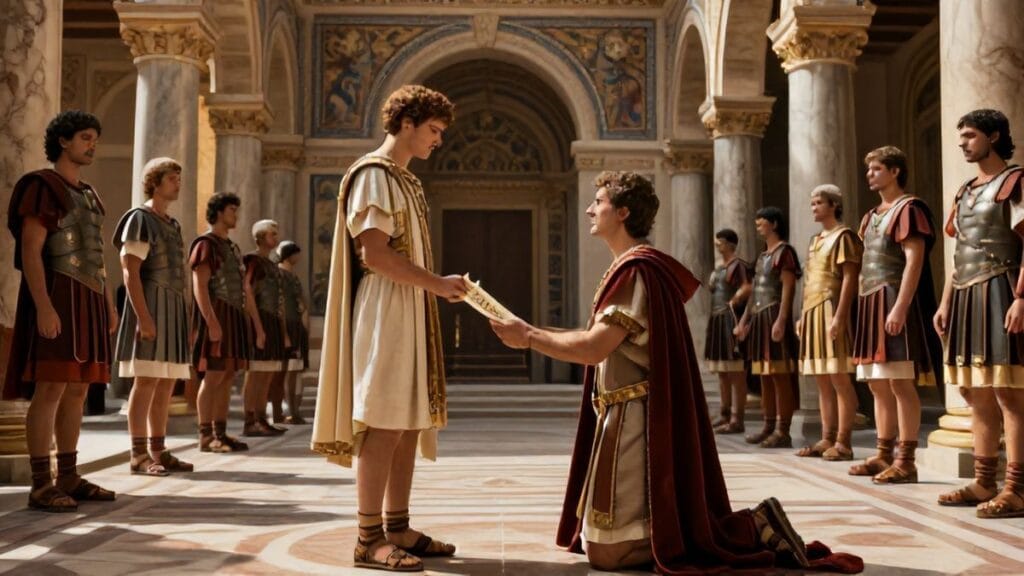
The timesitheus praetorian prefect appointment probably unfolded through a combination of private deliberation and public proclamation. In the private phase, Gordian III—or, more accurately, the circle of advisors shaping his decisions—would have issued the necessary imperial rescript naming Timesitheus as praefectus praetorio. This document, written on papyrus or parchment and sealed with the imperial signet, would confirm his legal authority over the Guard and his expanded role in directing imperial policy.
From the palace on the Palatine, messengers would carry copies of the letter to the Castra Praetoria and perhaps to the Senate House. At the Praetorian camp, the guard officers would assemble, their armor catching the sun, to hear the reading of the rescript. The name of Timesitheus would be pronounced officially as their new commander. For some, already familiar with him from his service at court, the news might bring relief. An experienced administrator, closely tied to the emperor, promised predictability after years of turmoil. For others, especially those whose ambitions had been thwarted, the appointment may have been greeted with clenched jaws and cold politeness.
In the Senate, the reaction was likely complicated. The Praetorian Prefect had long been both a partner and a rival to senatorial power. Under emperors like Septimius Severus, the prefecture had grown in authority, sometimes overshadowing the traditional magistracies that senators cherished. Now, by elevating Timesitheus—an equestrian whose daughter had become empress—Gordian’s government signaled that real power would be shared, if at all, on new terms. Some senators, mindful of the dangers that lay beyond Rome, might have welcomed the stability that a capable prefect could bring. Others would have seen one more step in the erosion of their class’s old supremacy.
Publicly, the appointment would have been woven into the city’s ritual life. Statues of Gordian III and Tranquillina might receive new dedicatory inscriptions praising the emperor’s choice of guardian. In official bulletins and on inscriptions, Timesitheus’s growing list of titles would appear: son-in-law of the emperor, Praetorian Prefect, and, perhaps soon, princeps iuventutis or other honorary distinctions for his family. The timesitheus praetorian prefect appointment was thus both a legal act and a performance—a carefully staged demonstration that the boy emperor was not alone, that he had at his side a man of experience and proven loyalty.
Behind closed doors, the dynamics of the palace shifted almost immediately. Access to Gordian now filtered through Timesitheus. Petitions from provincial governors, financial reports, military requests—all passed under his watchful eye. Foreign envoys, especially from the increasingly aggressive Persian court, found that their words were weighed not only by a teenage emperor but by a seasoned administrator who understood the empire’s limits and needs.
This was the moment when the political landscape of 241 crystallized. The timesitheus praetorian prefect appointment turned a dangerous vacuum—an inexperienced emperor in a time of external threat—into a structured partnership. But it also concentrated power in a single pair of hands, with all the risks that entailed. Rome had seen powerful prefects before, men like Plautianus under Septimius Severus or Sejanus under Tiberius, whose rise had provoked fear and eventual bloody backlash. Would Timesitheus follow their path, or would he chart a different course?
To answer that, we must look more closely at the office he now held and the historical weight it carried.
Guardians of the Purple: The Praetorian Prefecture in Crisis Times
By the third century, the Praetorian Prefect was more than a commander of bodyguards. The office, shaped over generations, had evolved into one of the central pillars of imperial governance. The men who held it straddled the worlds of the battlefield, the courtroom, and the council chamber. They commanded the emperor’s nearest troops, oversaw parts of the judicial system, and frequently took the lead in strategic planning across the empire.
Historically, the Praetorians had been established by Augustus as a personal guard, but their power grew as subsequent emperors leaned on them for support. By the time of Gordian III, this power had become both indispensable and terrifying. The Guard had killed emperors—Caligula, Vitellius, Pertinax—and auctioned the throne to the highest bidder, as in the infamous sale of the empire to Didius Julianus in 193 CE. Their commanders, the prefects, had sometimes acted as kingmakers, or even as would-be emperors in all but name.
In times of crisis, though, emperors had little choice but to entrust weighty responsibilities to their prefects. With the Senate diminished as a military force and the vast distances of the empire demanding quick, centralized decisions, the Praetorian Prefect became, in effect, the empire’s chief operating officer. Under Gordian III, the need was especially acute. A boy emperor could not personally command armies in complex campaigns, negotiate supply contracts, draft legislation, and manage the delicate balance of power in Rome. Someone had to do it for him—and that someone was now Timesitheus.
The timesitheus praetorian prefect appointment thus meant that an equestrian administrator with deep provincial experience now occupied an office that combined military command, legal authority, and intimate access to the emperor’s person. In practice, he would shape imperial foreign policy, particularly toward the Persians; direct the movements of legions; coordinate with frontier commanders; and supervise crucial financial decisions. He would also, perhaps less visibly, serve as the empire’s firewall against internal coups, monitoring the mood of the Guard and the ambitions of generals.
The risks were glaring. A prefect who turned against the emperor could, in theory, topple him with chilling efficiency. A prefect who proved incompetent could mismanage a campaign, squander resources, or provoke rebellion. But the rewards of choosing the right man were just as profound. When a prefect combined loyalty with competence, the emperor’s reign could suddenly stabilize, even under severe external pressure. This is what makes the timesitheus praetorian prefect appointment one of the fulcrums of Gordian III’s rule. For a short but crucial period, Rome had exactly the man it needed in exactly the place that mattered most.
Contemporary and later observers seem to have recognized this. One later source, though colored by centuries of hindsight, describes Timesitheus as “the best of the prefects” who “ruled the empire as if it were his own household, with economy and order.” While we must handle such praise with caution, the pattern of events during his tenure supports the view that his influence was both stabilizing and effective. Under his guidance, Gordian’s government prepared for a major eastern campaign with a coherence and seriousness that had recently been lacking.
But offices, however powerful, exist within networks. To understand how Timesitheus wielded his authority, we have to examine the political ecosystem around him: the Senate, the army, and the emerging factions at court.
Balancing the Court: Politics, Factions, and the Shadow of the Senate
The Roman court in 241 was a dense forest of interests. Senators, equestrians, freedmen, and military officers all sought influence over the emperor’s mind and the machinery of government. The timesitheus praetorian prefect appointment did not wipe this complexity away; instead, it rearranged the balance. Suddenly, one figure stood at the intersection of multiple power streams—military, administrative, and familial—forcing others to adapt to a new reality.
For the Senate, Timesitheus was both a threat and an opportunity. On the one hand, his equestrian status and the vast authority of his office underscored the continuing marginalization of senatorial power in hard times. Consuls, proconsuls, and other traditional magistracies still carried prestige, but the practical decisions that shaped life and death at the frontiers increasingly bypassed them. On the other hand, Timesitheus’s relatively traditional, conservative approach to governance may have reassured many senators. He did not seem interested in humiliating them or stripping away their remaining prerogatives. Instead, he worked with the Senate to secure legitimacy for imperial actions, particularly the forthcoming war against Persia.
In the army, reactions were equally mixed. Legionary commanders on the Rhine and Danube might have preferred a Praetorian Prefect with a stronger background as a field general. Timesitheus’s strengths lay more in strategy and logistics than in personally leading charges. Yet his attention to pay, supply, and the timely rotation of troops could win respect where battlefield bravado alone could not. For frontier officers accustomed to being neglected in favor of Rome’s political games, a prefect who paid attention to their reports and needs represented a welcome change.
Within the imperial household, other ambitious courtiers found themselves eclipsed. Freedmen who had once whispered in the emperor’s ear discovered that their access now ran through Timesitheus. High-level secretaries and financial officials had to coordinate their plans with his office. It would be surprising if envy and frustration did not begin quietly to accumulate. Power rarely centralizes without generating resistance.
Yet, at least in the early phase, Timesitheus seems to have managed this balancing act with skill. He did not move to purge his rivals wholesale—no sweeping bloodbaths or proscriptions are recorded in connection with his rise. Instead, he appears to have relied on competence and necessity: as the empire braced for confrontation with Persia, those who could not contribute meaningfully to the war effort were naturally sidelined. Those who could work within his framework found room to operate.
In this sense, the timesitheus praetorian prefect appointment functioned as both a personal elevation and a reorganization of the Roman state in miniature. It clarified lines of authority and concentrated responsibility. If victory came, Timesitheus would share in the glory. If disaster struck, blame would find him quickly. Either way, he now stood in a place where every decision cast a long shadow.
By tying himself so closely to Gordian III—through office, through daily counsel, and through the marriage of their families—Timesitheus also anchored his fate to that of the young emperor. Their fortunes would rise or fall together. The next great test of their partnership would come not in the marble halls of Rome, but on the dusty roads leading eastward, toward the Tigris and the armies of Shapur I.
Family Ties and Imperial Marriage: Timesitheus as Father-in-Law to Gordian III
In the Roman imagination, the household was a microcosm of the state. The paterfamilias ruled his family as the emperor ruled the empire. Laws, rituals, and social expectations intertwined domestic and political life. When Gordian III married Furia Sabinia Tranquillina, daughter of Timesitheus, he was not simply taking a wife. He was reshaping the symbolic architecture of his reign—and placing his trust in her father in the most intimate way possible.
The marriage likely took place in 241, around the same period as the timesitheus praetorian prefect appointment, and may have been part of a coordinated political design. Tranquillina, already of suitable age and breeding, became Augusta, empress, by virtue of the match. Her portraits on coins show a composed young woman with her hair carefully dressed in the fashion of the time, her image circulating across the empire as the new face of Roman continuity and domestic virtue.
For Gordian, the union signaled his passage from child to adult ruler. An emperor with a wife, and potentially with heirs to come, projected stability. It suggested that the turbulent succession crises of recent years might, at last, settle into a more predictable line. For Timesitheus, the marriage bound his fortunes to the house of Gordian in a way no mere office could do. He became not just the emperor’s prefect, but his father-in-law, linked by the same bonds of kinship and obligation that structured every Roman aristocratic family.
This new relationship likely altered the daily rhythms of the court. Timesitheus would now be present not only in councils of war and administration but also in family gatherings, religious ceremonies, and private celebrations. He had a stake not only in the empire’s survival but in his grandchildren’s potential inheritance of the purple. Gordian, for his part, gained in Timesitheus something closer to a paternal figure than he had known since childhood: an older man, steeped in experience, whose daughter shared his bed and his table.
Sources from later centuries, however biased, consistently emphasize the harmony of this arrangement—at least at first. The Historia Augusta, for all its fabrications, reflects a tradition that saw Timesitheus as a positive, even loving influence on the young emperor. If there had been open conflict between them, or scandals involving Tranquillina, we might expect later writers to preserve juicy details. Their absence suggests that the family alliance functioned relatively smoothly, at least until external events intervened.
Of course, not everyone at court would have celebrated this consolidation of family and office. Other families with senatorial pedigrees may have felt pushed aside. Some might have whispered that an equestrian upstart had ensnared the emperor through his daughter. Yet such grumbling could do little against the combined weight of Gordian’s affection, Timesitheus’s competence, and Tranquillina’s new status as Augusta. For a fleeting moment, the imperial household looked like a coherent, well-ordered Roman family—exactly the image the government wanted to project as it prepared for war.
And that war was coming, faster than many in Rome perhaps understood. Even as marriage feasts were held and new coins minted with Tranquillina’s image, dispatches from the east were bringing grim news. Shapur I, the ambitious king of the Sasanian Persians, was testing Rome’s resolve along the Euphrates. If the emperor and his father-in-law were to prove their worth, they would have to do it on campaign.
The Eastern Storm: Persia, Shapur I, and the March to War
To the Romans of 241, the east was both a land of ancient wealth and an ever-present source of anxiety. Along the Euphrates and Tigris rivers, old cultural centers like Antioch and Ctesiphon framed a border that had long been contested between Rome and Iran-based powers. Under the Parthians, Rome had fought intermittent wars but often found a workable balance. The rise of the Sasanian dynasty in the early third century changed that equilibrium decisively.
Ardashir I, founder of the Sasanian line, had overthrown the Parthians and proclaimed a new, more centralized and ideologically driven Iranian empire. His successor, Shapur I, inherited not only a stronger state but an ambition to reclaim all lands that had once belonged to the ancient Achaemenid kings—including, in theory, much of Roman Asia. In inscriptions at Naqsh-e Rustam, Shapur would later boast of victories over Roman emperors, describing how he defeated, captured, or killed rulers who underestimated his military might.
By 241, Persian forces were pressing against Rome’s eastern frontier. Cities that had enjoyed relative peace now faced raids, sieges, and the frightening spectacle of organized, well-equipped Sasanian armies. The Roman army in the region, weakened by previous conflicts and internal disorder, struggled to hold the line. Governors sent increasingly urgent requests for reinforcements and clear guidance.
At Rome, the response to this eastern storm would define Gordian III’s reign. The timesitheus praetorian prefect appointment placed a man with broad strategic vision in the perfect position to shape that response. Timesitheus appears to have recognized that the empire could no longer drift from crisis to crisis. It needed a concerted, well-planned campaign to push back the Persians, reassure Rome’s eastern subjects, and reassert imperial prestige.
Under his guidance, the imperial court began to prepare for a great eastern expedition. This was not a simple matter of marching legions eastward. It required a painstaking reconfiguration of resources across the empire: shifting troops without compromising other frontiers; ensuring grain and fodder supplies; arranging river and road transport; stockpiling arms; and coordinating with local allies such as Arab client kings and Armenian princes. In this, Timesitheus’s long experience as a provincial administrator proved invaluable.
The decision that the emperor himself would accompany the campaign raised the stakes even higher. A Roman emperor on campaign could inspire troops and allies; he also risked his life and the stability of the regime. But Gordian III, still young and eager to prove his worth, seems to have embraced the role, likely at Timesitheus’s urging. Together, they would present a united front: the youthful Caesar and his wise father-in-law and prefect, marching east to defend Rome’s honor.
In the late months of 241 and into 242, preparations accelerated. The city of Rome buzzed with rumors of upcoming departures. Workshops hammered out armor and weapons; scribes worked late into the night drafting orders; the Senate decreed prayers and sacrifices for the success of the endeavor. The timesitheus praetorian prefect appointment now showed its full significance: without Timesitheus at the center, it is difficult to imagine how such a massive undertaking could have been organized with any coherence.
When the imperial party finally left Rome, likely passing through the city’s eastern gates amid ceremonial farewells, they carried with them the hopes of an empire tired of fear. The march to war had begun.
Logistics, Letters, and Legions: How Timesitheus Rebuilt Roman Power
War is decided not only in battles but in supply depots, wagon trains, and counting houses. Timesitheus understood this profoundly. As Praetorian Prefect and de facto chief of staff for the campaign against Persia, he turned his administrative genius toward the immense logistical problem of moving an imperial army from the heart of Italy to the distant frontiers of Mesopotamia.
The route likely took Gordian III and Timesitheus through the Balkans and Asia Minor, gathering troops and resources as they went. Along the great Roman roads—the Via Egnatia, the arteries of Asia Minor, the routes converging at Antioch—depots had to be prepared, bridges checked or rebuilt, and local magistrates pressed into service to provide carts, animals, and guides. Letters from Timesitheus’s office would have flown ahead, instructing governors exactly how many men and how much grain to have ready at each staging point.
Here, Timesitheus’s prior experience as a provincial procurator and financial administrator proved crucial. He knew how easily corruption, delay, and local resistance could derail such efforts. His reputation likely helped cut through some of this inertia. When a letter arrived in the name of the Praetorian Prefect and the emperor’s father-in-law, it carried a weight few dared ignore.
Our sources for these movements are fragmentary, but they hint at a carefully managed escalation of Roman presence in the east. One later chronicler notes that Gordian assembled a formidable force, drawing on legions from across the empire. Archaeological evidence of coin hoards in the regions through which the army passed suggests a sudden influx of imperial payments, likely tied to the movement of troops and the need to secure local loyalties. Timesitheus’s hands are invisible in these remains, but his influence is everywhere implied.
Politically, the campaign also required delicate handling. Eastern cities that had suffered under previous Roman exactions might have greeted new levies with suspicion. Allies like the kings of Osroene or Armenia needed reassurance that Rome would not abandon them mid-conflict, as had sometimes happened before. Here again, Timesitheus’s skill at correspondence and negotiation—honed in quieter administrative roles—came to the fore.
Letters from this period do not survive in full, but later writers mention treaties and understandings reached with local rulers. Timesitheus would have crafted these carefully, promising protection, outlining mutual obligations, and framing the war against Persia as a joint defense of civilization against barbarian aggression—a familiar Roman trope, but one that had to be adapted to Persian, Arab, and Armenian sensibilities.
As the imperial army advanced toward the Euphrates, morale appears to have been high. Contemporary numismatic evidence—coins issued during the campaign—depicts Gordian in martial scenes, often accompanied by the legends celebrating victories over “the Persians.” Modern historians caution that such coins are propaganda, sometimes minted before real victories were achieved. Even so, the swift initial successes of the campaign suggest that the preparations led by Timesitheus were effective. Roman forces recaptured key cities and pushed the Persians back, regaining territory lost in earlier years.
Everything about this phase of the war points to a well-functioning partnership at the top. The timesitheus praetorian prefect appointment had given the empire a central coordinator, someone who could translate imperial intent into coherent orders and ensure that strategy matched resources. For a brief, luminous moment, the Roman machine, so often faltering in the third century, worked almost as smoothly as it had under the best of the earlier emperors.
But war is never predictable, and success breeds its own dangers. As the imperial army pushed deeper into contested lands, the burdens of command grew heavier. The pressure on Timesitheus must have been immense. Somewhere on those dusty eastern roads, his remarkable career would reach its darkest and final turning point.
Voices from the Sources: Piecing Together a Fragmented Life
One of the challenges in telling the story of Timesitheus is the nature of our evidence. The third century is, in many respects, a dark age for Roman historians. Many contemporary works are lost; others survive only in later summaries or in hostile, biased accounts. To reconstruct the timesitheus praetorian prefect appointment and its consequences, scholars must weave together inscriptions, coins, later narratives, and scattered references in legal and administrative texts.
Two main narrative sources, the Historia Augusta and the later chroniclers like Zosimus, mention Timesitheus, but cautiously. The Historia Augusta, a late fourth-century collection of imperial biographies riddled with inventions, praises him as a model official—honest, moderate, and devoted to the state. It claims, perhaps with some exaggeration, that under Timesitheus’s guidance “the Roman world breathed again, as if released from a long disease.” Modern historians treat such statements skeptically, but they see in them a kernel of remembered truth: that contemporaries had once viewed this prefect as a rare bright spot in a troubled age.
Zosimus, writing in the early sixth century, preserves a more terse tradition. He mentions the Persian campaign of Gordian III and acknowledges the role of advisors, but by his time, the details of Timesitheus’s life were already fading from memory. Inscriptions, particularly those honoring Tranquillina and imperial officials in the east, fill some gaps. They confirm Timesitheus’s titles, his marriage link to the emperor, and his role in the campaign.
One inscription, set up in honor of Tranquillina in the city of Aphrodisias, describes her as “Augusta, wife of the most noble emperor Gordian and daughter of the most distinguished man, Gaius Furius Sabinius Aquila Timesitheus.” Such formulaic words seem dry, but behind them lies a living network of relationships, aspirations, and local memories. The city that carved this tribute into stone did so in a world shaped by the timesitheus praetorian prefect appointment, by the sense that this man’s rise mattered to their own fate.
Modern historians, from the eighteenth century onward, have tried to read between these lines. Edward Gibbon, in his monumental “The History of the Decline and Fall of the Roman Empire,” briefly notes the competence of Gordian’s ministers and the promise of his Persian campaign before turning to the catastrophe that followed. More recent scholars, like Andreas Alföldi and Michael Peachin, have emphasized the broader context: the evolution of the Praetorian Prefecture, the mounting eastern pressures, and the transformative impact of equestrian administrators like Timesitheus.
One citation often discussed in modern scholarship comes from the Byzantine chronographer John Malalas, who hints that Gordian’s early reign was guided by “good counselors” before being ruined by lesser men. Though Malalas does not name Timesitheus explicitly in the surviving excerpts, many interpret this as a veiled acknowledgment of his role. Such indirect echoes remind us how much has been lost—and how carefully we must handle what remains.
In piecing together Timesitheus’s life, historians walk a narrow path between romantic reconstruction and arid skepticism. The temptation to make him a flawless hero, tragically cut down by fate, is strong, especially given the subsequent disasters that followed his death. Yet we must remember that he was a Roman official, operating within a harsh and often ruthless system. He benefited from the same mechanisms of imperial power that oppressed millions. His brilliance in administration and war planning does not erase the coercive nature of the world he helped govern.
Still, the fragmented nature of our evidence makes the contours of his story all the more compelling. The timesitheus praetorian prefect appointment, glimpsed through a handful of inscriptions, a few lines of late histories, and the dim light of coin portraits, becomes a kind of historical puzzle. Each new discovery—a fragment of a dedicatory text, a reinterpreted passage in a chronicle—can shift our understanding of what that appointment meant in 241 and how it played out in the years that followed.
On Campaign with the Emperor: Leadership Tested in the Field
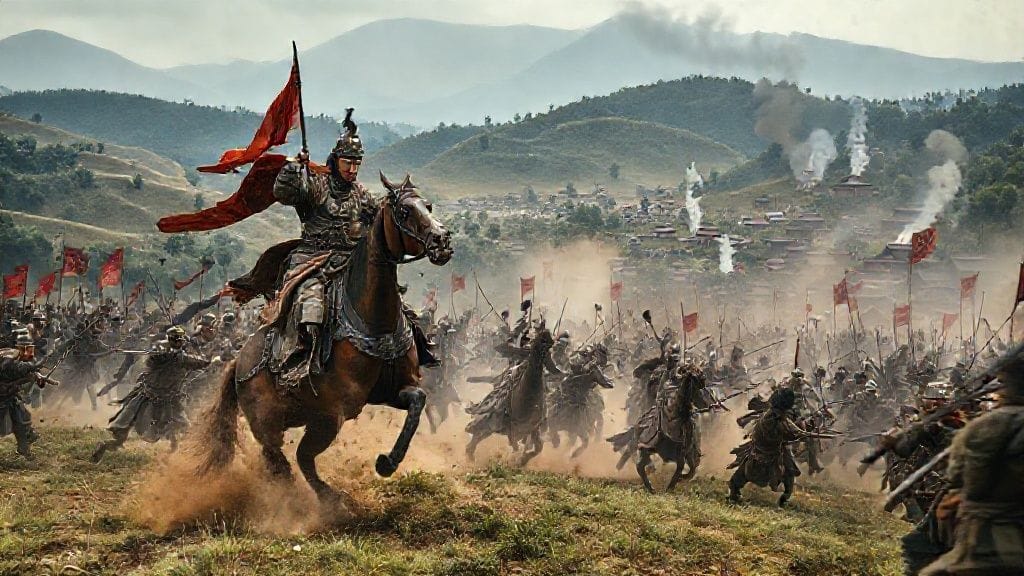
By 243, the imperial army under Gordian III and Timesitheus had crossed into Mesopotamian territory and was engaging Persian forces in earnest. Here, far from Rome’s marble colonnades, amid the heat, dust, and sudden violence of battle, the character of both emperor and prefect was tested.
Accounts of the campaign are fragmentary, but they agree on one crucial point: the early stages favored Rome. Near the city of Resaena, Roman forces gained a significant victory over the Persians, pushing them back and recovering key positions. Some historians attribute the success to Timesitheus’s careful planning—ensuring adequate supplies, choosing favorable ground, and coordinating the movements of legions and auxiliary troops.
Imagine the scene on the eve of such a battle. Gordian, young and resplendent in imperial armor, would address his troops, promising rewards and glory. At his side, Timesitheus would stand not only as Praetorian Prefect but as the real strategist, having spent days poring over maps, consulting scouts, and weighing the strengths and weaknesses of both sides. The soldiers, aware of his reputation, might take comfort in knowing that their leaders were not improvising blindly.
On the field itself, Timesitheus may have directed parts of the action personally, though as an equestrian official his role would probably have focused on coordination rather than leading individual charges. He would watch for signs of Persian cavalry maneuvers, order reserves forward at critical moments, and ensure that supply lines remained open even as the front shifted. His lifelong familiarity with the hard practicalities of moving men and material made him uniquely suited to this task.
Victories like Resaena lifted morale dramatically. The emperor’s image as a young conqueror gained substance. Inscriptions and coins celebrated the “Persian triumphs” of Gordian, presenting him as the restorer of Rome’s eastern glory. Timesitheus, though less visible in public propaganda, would have felt a deep personal satisfaction. The timesitheus praetorian prefect appointment, made in the anxious corridors of Rome, was now vindicated on the battlefield.
Yet behind the confidence of those early successes lay growing strain. The deeper the army pushed into contested territory, the more difficult logistics became. Supply bases were farther away; local populations were less reliable; the risk of desertion, disease, and surprise counterattacks increased. Timesitheus had to stretch his administrative talents to the limit, juggling front-line demands with the need to maintain a reserve, protect flanks, and keep lines of communication open back to Antioch and beyond.
At the same time, the political pressures did not disappear. Within the traveling court, rivalries simmered. Officers jealous of Timesitheus’s prominence watched for any misstep. Letters from Rome brought news of shifting alliances, financial worries, and the ever-present fear that an emperor away from the capital might be vulnerable to plots. Timesitheus’s role thus remained double: he was the empire’s field manager in the east and its chief guardian against internal instability.
For a while, he seemed equal to the task. But human bodies are frail, and the strains of campaign life would soon prove fatal to the man on whom so much depended.
Whispers of Jealousy: Enemies, Rivals, and the Risks of Greatness
Power in the Roman Empire was always precarious. Those who rose too high, too fast, attracted not only admiration but deadly envy. Timesitheus, as Praetorian Prefect, imperial father-in-law, and architect of a successful campaign, embodied precisely the sort of figure others might fear and resent. The timesitheus praetorian prefect appointment had elevated him to a position some emperors might find intolerable in anyone but the most trusted ally. Even Gordian’s genuine affection could not eliminate the underlying tensions.
Though the sources are unspecific about named rivals, we can infer their presence. High-ranking officers commanding legions in the east, perhaps of senatorial background, might have bristled at taking strategic orders from an equestrian administrator, however gifted. Court officials who had once monopolized the emperor’s ear now found themselves reduced to secondary roles. In Rome, senators wary of the long-term implications of equestrian dominance over the army and imperial policy may have cultivated alternative power centers, hoping for a future in which Timesitheus’s star would fade.
In such an environment, rumors become weapons. A minor logistical delay could be whispered about as evidence of incompetence. A necessary but harsh decision—such as compelling a city to provide supplies at short notice—could be portrayed as cruelty. And if Timesitheus’s health faltered, as seems likely in his final months, those whispers might quickly turn into open speculation that the emperor’s most important adviser was no longer fit to serve.
Some later traditions hint that after Timesitheus’s death, his successor, Marcus Julius Philippus—known to history as Philip the Arab—benefited from the vacuum left by his passing. This has led some modern historians to wonder whether Philip, or others around him, had an interest in undermining Timesitheus even before his final illness. There is, however, no direct ancient statement that he was poisoned or deliberately removed. The third century’s frequent resort to conspiratorial explanations for sudden deaths must be handled with caution.
Still, the pattern is suggestive. As long as Timesitheus remained healthy and in favor, his combination of offices made him nearly unassailable. The only forces that could topple him were those that toppled all Romans, regardless of rank: disease, age, or the emperor’s shifting mood. In the harsh conditions of an eastern campaign—heat, bad water, infectious illnesses—such vulnerabilities were magnified.
Gordian himself, despite his youth, must have sensed the risks. He had tied his reign to Timesitheus not only politically but emotionally. Losing him would mean not only the loss of a chief minister but the unraveling of the fragile sense of security he had built since 241. In that sense, the timesitheus praetorian prefect appointment was a double-edged sword: it had given Gordian his best chance of success, but it also made him deeply dependent on one irreplaceable man.
As the army moved deeper into hostile territory and the campaign’s demands intensified, the prefect’s health began to fail. Whether from overwork, infection, or some underlying condition, Timesitheus succumbed, leaving behind a vacuum no amount of political calculation could easily fill.
Illness, Death, and Suspicion: The Sudden End of Timesitheus
The death of Timesitheus, sometime in 243, was a turning point not only in the Persian campaign but in the entire trajectory of Gordian III’s reign. Sadly, the sources provide only the faintest outline of this profound event. They agree that Timesitheus died of illness while on campaign, but the nature of that illness, and the circumstances surrounding it, remain shrouded in uncertainty.
Imagine the imperial encampment somewhere in Mesopotamia or along its approaches: rows of tents, supply wagons drawn up in lines, campfires flickering in the evening heat, soldiers muttering about the next day’s orders. In one of those tents, perhaps slightly larger and more richly furnished than the rest, the Praetorian Prefect lay on a field bed, attended by physicians and worried servants. Outside, messengers continued to arrive with reports from the front; aides waited for instructions that might now be delayed or never given.
Disease on campaign was common. Contaminated water, unfamiliar climates, and close quarters turned armies into breeding grounds for fevers, dysentery, and other maladies. A man of Timesitheus’s age—likely in his forties or fifties—would have been particularly vulnerable under such strain. The official story, that he died of natural causes, therefore fits the epidemiological realities of the time.
Yet suspicion inevitably clung to such a politically consequential death. Some later writers, influenced by the pattern of Roman court intrigues, suggested—or at least entertained the possibility—that he had been poisoned by rivals, perhaps even by Philip the Arab. No surviving source offers concrete proof, and modern historians generally treat these theories as speculative. The truth may simply be that in a world without antibiotics or clean medical practice, even the most powerful men could be brought down by an unseen microbe.
For Gordian III, the shock must have been overwhelming. His father-in-law, chief minister, and the architect of his military successes was suddenly gone. The timesitheus praetorian prefect appointment, which had once promised stability and guidance, now appeared in hindsight as a fragile arrangement contingent on one human life. Without Timesitheus, the emperor was thrust into a far more perilous situation, both militarily and politically.
The immediate practical question was who would replace him. The army could not function without a Praetorian Prefect. Into this vacuum stepped Marcus Julius Philippus, a capable but far more enigmatic figure whose rise would soon alter the course of Roman history. But before considering Philip’s role, we must dwell for a moment on the human dimension of Timesitheus’s death.
Tranquillina, the empress, lost her father somewhere on that eastern front. No source records her reaction, but we can imagine the grief of a daughter who had seen her husband and father work so closely together. For the soldiers, the loss of the man who had organized their supplies and pathways to victory may have sown new anxieties. For the officers who had respected his competence, it meant facing the enemy with a leadership structure suddenly and dramatically altered.
The longer-term political consequences would prove dire. But in that first moment, before rumors and restructuring took hold, Timesitheus’s death was simply a rupture—a break in the fragile thread of continuity that had, for two brief years, held the empire’s hopes together.
Aftermath of a Lost Advisor: The Descent toward Disaster
In the months following Timesitheus’s death, the Roman campaign in the east veered from cautious optimism toward catastrophe. Sources diverge on the exact sequence of events, but they concur on the outcome: Gordian III’s regime collapsed; the emperor himself died—either in battle or as the victim of a mutiny—and Philip the Arab emerged as the new ruler.
The absence of Timesitheus was felt immediately in the coordination of the army. With Philip now rising to prominence as Praetorian Prefect, the leadership style and priorities at the top changed quickly. Philip, though capable, had not built the campaign’s logistical framework and had not forged the same bonds with Gordian or the troops. His incentives were different: as a newcomer to supreme power, he may have calculated that prolonging a risky war under a vulnerable boy emperor was less attractive than cutting his losses and shaping his own path to the throne.
Shapur I, sensing Roman disarray, pressed his advantage. Later Persian inscriptions at Naqsh-e Rustam boast that the Persians defeated a Roman emperor named Gordian and that peace was concluded with Philip, who allegedly paid a large indemnity. The exact details of the battle or battles in which Gordian was involved are murky. Some accounts claim he died in combat near Misiche; others suggest he was killed by his own soldiers in the confusion following setbacks.
What is clear is that without Timesitheus’s steady hand, the precarious scaffolding that had held Gordian’s war effort together began to crumble. The timesitheus praetorian prefect appointment had concentrated strategic and administrative intelligence in a single figure. Once he was gone, no one of equal stature or trustworthiness stood ready to fill his role. The imperial edifice, deprived of its keystone, sagged and then collapsed.
Philip, now emperor, returned to Rome and sought to present himself as the restorer of peace and order. In his narrative, the campaign under Gordian had overreached; his own decision to settle with Shapur and refocus on internal stability was prudent statesmanship. Yet critics, both ancient and modern, have wondered whether the empire might have fared better had Timesitheus lived. Could continued pressure under his guidance have secured more favorable terms? Might Gordian have grown into a more assertive ruler, guided by his father-in-law’s example?
We cannot know for certain. History offers no controlled experiments, only contingent outcomes. What we can say is that the collapse of Gordian’s regime and the ascent of Philip marked a new phase in the third-century crisis, one in which emperors rose and fell with increasing speed and frontiers continued to be tested. The two years of comparative stability and hope under the partnership of Gordian and Timesitheus now appeared, in retrospect, as a brief interlude of competence and promise in a longer story of fragmentation.
In Rome, memories of the timesitheus praetorian prefect appointment and its consequences would linger among those who had witnessed them. For later generations, however, the details would blur, and only the broad strokes—young emperor, eastern war, sudden death—would remain. The man who had once held the reins so firmly receded into the shadows of history, his significance preserved only in fragments.
Rome’s Long Crisis and the Place of 241 in the Third-Century Storm
To grasp the full historical weight of Timesitheus’s rise and fall, we must place the year 241 within the broader arc of the third-century crisis. This was not a single, linear collapse, but a prolonged period of oscillation between precarious stability and near-dissolution. Emperors like Decius, Valerian, Gallienus, Claudius Gothicus, and Aurelian would each, in different ways, confront the same underlying challenges: external invasions, internal rebellions, economic strain, and a fraying sense of shared imperial identity.
Within this context, the timesitheus praetorian prefect appointment stands out as one of the rare moments when Rome seemed to find a functional formula for governance amid chaos. A young emperor symbolized renewal; an experienced equestrian administrator provided competence; the partnership between Senate, army, and court—though fragile—briefly worked well enough to launch a serious, well-planned campaign against a formidable eastern foe.
In that sense, 241 can be seen as a hinge year. Before it, the memory of the “Year of the Six Emperors” and continuing instability made many Romans doubt that any lasting order could be rebuilt. After it, the swift unraveling of the Timesitheus-Gordian project underlined how dependent stability had become on individual talent and fragile personal bonds. The structures of the Roman state—once robust enough to absorb decades of mediocre leadership—now required extraordinary individuals simply to hold together.
Later emperors, especially those who managed to last more than a few years, would implicitly recognize this reality. Aurelian, for instance, would centralize power ruthlessly, relying on a tightly controlled military structure and a more rigid imperial cult to shore up authority. Diocletian, at the end of the century, would go further, creating the Tetrarchy and overhauling the empire’s administrative map. Both men, in different ways, addressed problems that were already plainly visible in Timesitheus’s time: the overconcentration of responsibility in a few offices, the vulnerability of emperors to military coups, and the need for more systematic, less personalized governance.
Seen from this vantage point, Timesitheus appears as a transitional figure. He embodied the strengths of the old system—personal competence, flexible equestrian careers, and close advisory relationships with the emperor—while also exposing its weaknesses. The system worked well enough as long as someone like him was available. Once he was gone, its limits became painfully obvious.
Historians sometimes ask whether the Roman Empire’s long-term survival might have looked different if more leaders like Timesitheus had emerged earlier. It is an unanswerable question, but a telling one. The very fact that we pin hopes on such individuals underscores the uniqueness of their role. The timesitheus praetorian prefect appointment was not just about one man’s career. It was a test of how far personalized solutions could go in an age that increasingly demanded structural change.
Memory, Marble, and Silence: How Timesitheus Was Remembered
After his death and the collapse of Gordian III’s regime, Timesitheus’s memory entered a strange half-light. Unlike some figures of the period, he did not become a vilified traitor in later narratives, nor was he celebrated as a saintly martyr of the old order. Instead, he was remembered as a competent, even exemplary official whose potential was cut short by fate—and then gradually forgotten by all but specialists.
In the immediate aftermath, monuments and inscriptions honoring the imperial family sometimes still mentioned his name, especially in connection with Tranquillina. Local elites in cities that had benefited from his governance or from the imperial marriage might have preserved stories about his fairness or his role in the Persian campaign. But as new emperors rose—Philip, Decius, and others—the official propaganda turned toward justifying their own reigns, not celebrating the merits of a dead prefect linked to a previous, failed regime.
The physical traces that remain—inscriptions, building dedications, coin legends—testify to a man once very much at the center of things. Yet the silence that followed speaks just as loudly. No grand funerary monument in Rome records his deeds; no panegyrics survive in his honor. When later Christians and Byzantine authors told moralizing tales about the decline of pagan Rome, Timesitheus rarely featured. He was too competent, too gray, too unscandalous for stories that preferred clear villains and heroes.
Modern scholarship has slowly pulled him back into view. As epigraphers cataloged inscriptions in Asia Minor, Thrace, and the Near East, and as historians revisited the third century with fresh questions about administrative evolution and imperial resilience, Timesitheus emerged as a key node in the network. His career illustrated the rise of the equestrian order; his appointment as Praetorian Prefect illustrated the increasing reliance on these men; his death, and its aftermath, highlighted the fragility of solutions based on individuals rather than institutions.
Yet even today, he remains a relatively obscure figure outside academic circles. Popular histories of Rome often rush past the third century, lingering instead on the more familiar eras of the late Republic or the early empire. When Gordian III is mentioned, it is usually as a footnote to Philip the Arab or Shapur I, not as the center of a compelling story in which the timesitheus praetorian prefect appointment plays a starring role.
This obscurity invites reflection. Which figures do we choose to remember, and why? Grand conquerors, colorful tyrants, and dramatic martyrs tend to dominate historical memory. Competent administrators who hold things together for a few years before dying of illness have a harder time staking a claim in the collective imagination. And yet, as the story of 241 shows, it is often such men—and women—who determine whether states muddle through or fall apart.
In recovering Timesitheus from the margins of history, we do more than tell the story of one official. We acknowledge the invisible labor of governance, the unglamorous work of logistics and negotiation, and the ways in which those who master such arts can, for a time, slow or redirect the currents of decline.
Why This Appointment Still Matters: Power, Competence, and Fragility
Looking back across nearly eighteen centuries, the timesitheus praetorian prefect appointment in 241 might, at first glance, seem a minor episode in the vast saga of Rome. No new dynasty was founded that day; no city was sacked; no law code promulgated. Yet on closer inspection, this appointment illuminates enduring themes about power, competence, and the fragility of political systems under stress.
First, it shows how much can depend on the right person in the right office at the right time. Gordian III’s youth and the empire’s mounting eastern crisis created a situation in which an exceptional Praetorian Prefect could make the difference between temporary recovery and immediate collapse. Timesitheus, with his blend of administrative experience, strategic vision, and personal loyalty, fulfilled that role more effectively than many emperors of his age.
Second, it highlights the dangers of over-personalized governance. The very qualities that made Timesitheus indispensable also made the system vulnerable to his loss. When he died, there was no institutional mechanism to ensure continuity of strategy or to maintain the delicate balance he had achieved among the Senate, army, and imperial household. Philip the Arab, whatever his abilities, stepped into a situation he had not designed and had no particular reason to sustain. The shift in priorities that followed was as much a structural failure as a personal choice.
Third, the appointment and its aftermath underscore the importance—and limitations—of reform from within. Timesitheus did not overthrow the existing order or attempt to radically reshape the Roman state. He worked through the offices and traditions he had inherited, trying to make them function more rationally. For a while, this was enough. But the underlying issues of the third-century crisis—overstretched frontiers, an army with outsized political power, economic instability, and a fragmented elite—remained unresolved. When the stabilizing figure was removed, those pressures reasserted themselves with brutal speed.
In this respect, the story resonates beyond ancient Rome. Many states, ancient and modern, have relied on talented individuals to navigate periods of crisis without undertaking deeper structural changes. As long as the “Timesitheuses” of their age are on the job, things manage. Once they are gone, the cracks widen. The lesson is not that individual leaders do not matter—they clearly do—but that systems that depend too heavily on them without building resilient institutions are always living on borrowed time.
Finally, the timesitheus praetorian prefect appointment reveals something about how we narrate history. By foregrounding this moment, we shift attention away from the usual focus on emperors and battles toward the connective tissue of empire: administration, logistics, personal trust, and institutional evolution. We see Rome not as a monolithic entity marching inevitably toward decline, but as a complex, adaptive system that sometimes, briefly, found the right people to delay or divert that decline.
Timesitheus’s life, as far as we can reconstruct it, invites neither simplistic hero worship nor cynical dismissal. He was a Roman official who played his part, brilliantly for a time, within a flawed but still formidable imperial machine. His appointment as Praetorian Prefect, in the charged atmosphere of 241, offers a window into the possibilities and limits of governance in an age of crisis—a window through which, if we look carefully, we can also glimpse reflections of our own political vulnerabilities.
Conclusion
The story that began in Rome in 241, with the elevation of a seasoned equestrian administrator to the highest military and advisory office, is at once intimate and imperial. It follows Gaius Furius Sabinius Aquila Timesitheus from the quiet labors of provincial finance and logistics to the heart of power beside a boy emperor, from the marble halls of the Palatine to the dust-choked camps of an eastern war. Along the way, it reveals how the timesitheus praetorian prefect appointment functioned not as a mere bureaucratic shuffle, but as a critical attempt to stabilize a faltering empire through the appointment of a single, extraordinarily capable man.
Under Timesitheus’s guidance, Gordian III’s regime mounted a serious, initially successful campaign against the rising power of the Sasanian Persians. The marriage to Tranquillina, the careful balancing of Senate and army, the meticulous reorganization of supplies and strategy—all these flowed from the trust invested in the prefect. For a brief period, Rome seemed again to find its footing, proof that even in an age of crisis, competence and loyalty could still make a difference.
Yet Timesitheus’s sudden death on campaign exposed the inherent fragility of this arrangement. Without him, the structures he had held together came apart; the emperor he had guided was soon dead; a new ruler with different priorities took charge. The promise of 241—of a partnership between youthful legitimacy and seasoned expertise—gave way to another chapter in the third century’s long saga of instability.
In tracing this arc, we are reminded that history often turns not only on grand ideological shifts or mass movements, but on the contingent fates of individuals whose talents and choices interact with broader structural forces. Timesitheus was not a savior, nor was he the cause of Rome’s crisis; he was a remarkable actor within it, whose brief success and abrupt disappearance illuminate both the possibilities and the limits of leadership in troubled times.
Today, his name may be known mainly to specialists, his life pieced together from inscriptions and late, uneven texts. But the questions his story raises—about how empires manage decline, how much depends on individuals, and how fragile political stability can be—are anything but antiquarian. In remembering the timesitheus praetorian prefect appointment, we remember that even the greatest states rest, in the end, on human shoulders.
FAQs
- Who was Timesitheus?
Timesitheus, fully named Gaius Furius Sabinius Aquila Timesitheus, was a Roman equestrian official of the third century who rose through a series of financial and administrative posts to become Praetorian Prefect under Emperor Gordian III. He was renowned for his competence in logistics and governance, and he became the emperor’s father-in-law through the marriage of his daughter, Tranquillina, to Gordian. - What was significant about the timesitheus praetorian prefect appointment in 241?
The appointment placed an exceptionally capable administrator at the center of imperial power during a critical moment in the Crisis of the Third Century. As Praetorian Prefect, Timesitheus coordinated military strategy, logistics, and court politics, enabling Gordian III’s regime to mount a serious and initially successful campaign against the Sasanian Persians. - How did Timesitheus influence Gordian III’s Persian campaign?
Timesitheus planned and organized the campaign’s logistics, ensuring supplies, troop movements, and alliances were coordinated across vast distances. Under his guidance, the Roman army achieved early victories, such as the battle near Resaena, and pushed Persian forces back, temporarily restoring confidence in Rome’s eastern defenses. - Was Timesitheus related to Gordian III?
Yes. Timesitheus became Gordian III’s father-in-law when his daughter, Furia Sabinia Tranquillina, married the young emperor. This marriage, likely arranged around the time of his appointment as Praetorian Prefect, cemented his political influence and personal connection to the imperial family. - How did Timesitheus die?
Ancient sources state that Timesitheus died of illness while on campaign against the Persians in 243. Some later traditions speculate about possible foul play, but there is no firm evidence to support these claims. Given the harsh conditions of campaign life, most historians accept a natural cause, such as infection or disease. - What happened after Timesitheus’s death?
After his death, Marcus Julius Philippus (Philip the Arab) rose to become Praetorian Prefect and soon after emperor. The Roman campaign lost coherence; Gordian III died under unclear circumstances—either in battle or in a mutiny—and Philip made peace with Shapur I, reportedly paying an indemnity and ending the offensive. - How reliable are our sources on Timesitheus and his appointment?
The sources are fragmentary and must be used carefully. The Historia Augusta is late and often unreliable, while other accounts, like those of Zosimus and later chroniclers, provide only brief mentions. Inscriptions, coins, and modern epigraphic and prosopographical studies supply crucial corroboration, but many details remain uncertain. - What does Timesitheus’s career tell us about the Roman equestrian order?
His rise illustrates the growing importance of equestrian officials in the third century, as emperors relied increasingly on skilled administrators and generals outside the senatorial elite. Equestrians like Timesitheus could accumulate wide-ranging experience and, in times of crisis, become central to imperial governance. - Did Timesitheus leave any writings or laws?
No writings by Timesitheus himself have survived, and no specific laws can be definitively attributed to his authorship. His influence is instead inferred from the policies and campaigns carried out during his tenure, particularly the organization of the eastern war under Gordian III. - Why is Timesitheus less known than other Roman leaders?
He reigned neither as emperor nor as a notorious villain, and his career, though impressive, was cut short by illness. Later narratives focused more on emperors, dramatic defeats, and religious transformations, leaving competent but less colorful figures like Timesitheus in the background. Only modern scholarship’s interest in administration and institutional history has begun to restore his prominence.
External Resource
Internal Link
Other Resources
- Encyclopaedia Britannica – general search for the exact subject
- Google Scholar – academic search for the exact subject
- Internet Archive – digital library search for the exact subject