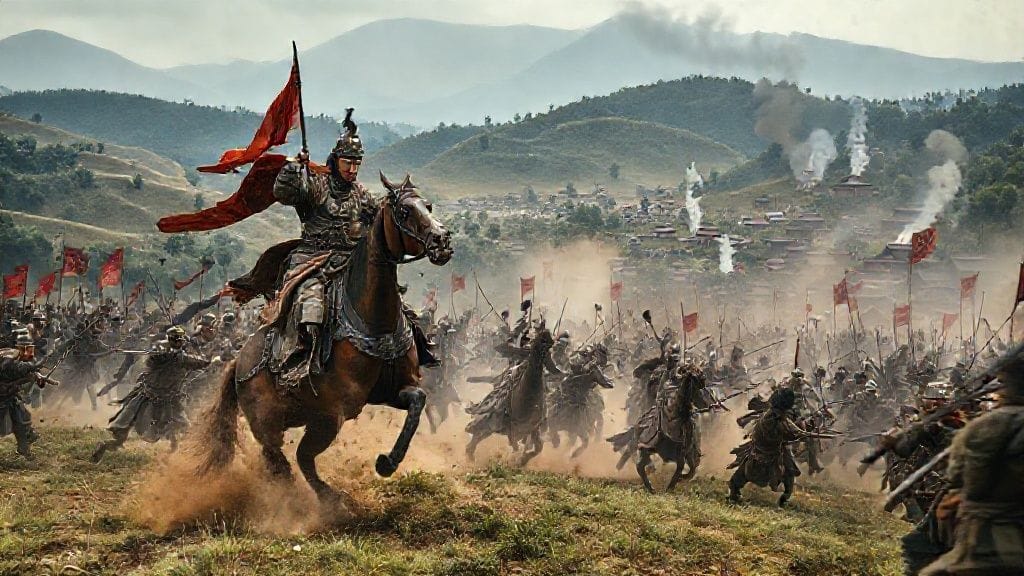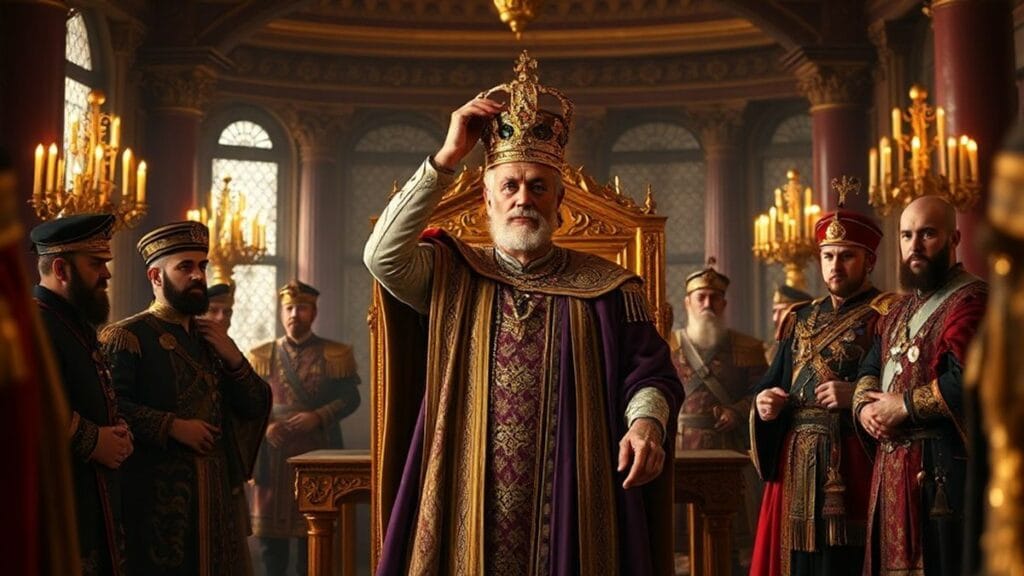
Table of Contents
- A Winter Morning in Constantinople: The Day an Emperor Was Chosen
- An Empire After Theodosius: Fractured Thrones and Fading Certainties
- The Shadow of Aspar: A Germanic General Makes a Roman Emperor
- The Acclamation of 7 February 457: How Leo I Becomes Emperor
- From Thracian Soldier to Purple Robes: The Early Life of Leo
- The Christian Empire and the Patriarch’s Hand: Crowning a New Augustus
- Divided but Not Broken: East and West at the Moment Leo Rises
- Aspar’s Invisible Chains: The New Emperor Under Supervision
- Inside the City of Constantine: Life in the Capital When Leo I Becomes Emperor
- Barbarians at the Frontiers: Leo, the Huns, the Vandals, and the Threatened World
- Faith, Controversy, and the Council’s Legacy: Religion in Leo’s Reign
- The Long Game: How Leo Slowly Escaped Aspar’s Grip
- War for the West: The Grand Expedition Against the Vandals
- Murder in the Palace: The Fall of Aspar and the Making of an Autocrat
- The Human Cost of Empire: Taxation, Army, and the Common People
- A New Dynasty in the East: Leo’s Family, Zeno, and the Isaurian Connection
- Legacy Before Death: How Leo I Became “the Great”
- Echoes Through the Centuries: Why the Coronation of 457 Still Matters
- Conclusion
- FAQs
- External Resource
- Internal Link
Article Summary: On a cold February day in 457, in the heart of Constantinople, leo i becomes emperor of the Eastern Roman Empire, reshaping the fate of a world on the brink. His rise, orchestrated in part by the powerful Germanic general Aspar, seemed at first like just another compromise by an embattled court. Yet behind the formalities of acclamation and the shimmering gold of imperial garments lay fear, ambition, and deep uncertainty. This article follows Leo from his obscure Balkan origins to the moment he stood in the Hippodrome, hailed as Augustus by army and people alike. It traces the fragile balance of power between Roman elites and “barbarian” generals, exploring how leo i becomes emperor as both puppet and rival to those who made him. We will walk through the streets of Constantinople, feel the tension of religious controversy, and watch the desperate attempts to salvage the crumbling Western Empire. Ultimately, when leo i becomes emperor, he inaugurates a new chapter in which the Eastern court begins to break free from military strongmen and lay the groundwork for a distinct Byzantine identity. His story is one of calculated patience, sudden violence, and a constant struggle to hold an empire together as the old Roman world died around him.
A Winter Morning in Constantinople: The Day an Emperor Was Chosen
The dawn that broke over Constantinople on 7 February 457 was not just another winter morning in the imperial capital. The sea winds pushing across the Bosporus cut through woolen cloaks and rough tunics alike, but people still gathered in the streets, clustering near the Great Palace and the Hippodrome. Rumors had been swirling for days: Marcian, the emperor who had steered the Eastern Roman Empire through turbulent years, was dead. No successor had been clearly named. The purple was empty, and in a world accustomed to emperors as the living symbol of cosmic order, this absence felt like a wound.
Every alley seemed to carry whispered names. Could the throne pass to a member of the Theodosian family? Would a powerful general seize it by force? At the center of these mutterings was one name few outside the army had taken seriously before: Leo, a mid-ranking officer of Thracian origin, competent but unremarkable, serving under the magister militum Aspar. Yet this was the day leo i becomes emperor, a day that would echo far beyond the walls of Constantinople.
The city’s crowds, drawn into the Hippodrome, did not see the backstage negotiations, the closed-door arguments among senior functionaries, church leaders, and military commanders. They saw only the narrow, elongated space of the great stadium, once devoted to chariot races and popular spectacles, now transformed into the stage upon which imperial legitimacy would be performed. Banners fluttered, prayers were chanted, and the heavy presence of armed soldiers lining the arena reminded everyone that the empire’s future depended as much on steel as on ceremony.
As the sun climbed higher and the winter light turned bright and hard, a small figure in a richly decorated cloak emerged. The murmurs spread through the crowd; the name Leo moved from lip to lip. Few yet understood what it would mean that leo i becomes emperor on this day—how this seemingly modest man would outlive his patrons, confront “barbarian” kings, and leave behind an Eastern Empire ready to survive the collapse of Rome in the West. But in that moment, what mattered was that the throne would not remain empty, and the slow, dangerous machinery of imperial transition finally groaned into motion.
An Empire After Theodosius: Fractured Thrones and Fading Certainties
To understand why this particular acclamation mattered, one must step back to the death of Theodosius II in 450 and the tangled web of succession that followed. For decades, the Theodosian dynasty had bound East and West together in name, if not always in harmony. The empire had grown accustomed to seeing emperors emerge from a single family line. But with each death, each sudden illness or accident, the chain of legitimacy frayed a little more.
Theodosius II left no son. His sister Pulcheria, a powerful and deeply religious woman, maneuvered to retain influence by marrying Marcian, a seasoned soldier who was elevated to the purple more by her design than by noble birth. Marcian’s reign brought a measure of stability, but it also highlighted how precarious the imperial system had become: emperors were now made through alliances, compromise, and opportunity, not just dynastic inheritance. When Marcian died in January 457, leaving no male heir, the empire again stood at a crossroads.
In the West, the situation was even more alarming. There, emperors had become ephemeral figures, raised and discarded by generals like Aetius and Ricimer. In 455, Rome itself had been sacked by the Vandals under Gaiseric, its treasures stripped and its aura of invincibility shattered. The Western court stumbled from one fragile ruler to the next. The Eastern court watched uneasily, knowing that chaos in the West could easily spill eastward.
In this context of dynastic exhaustion and territorial fragmentation, the question was no longer just who wore the purple cloak, but what it meant to be emperor at all. The old certainties—the unbroken majesty of Rome, the universal dominion of a single Augustus—had dissolved into bitter rivalries and regional power struggles. The death of Marcian, coming just years after the Council of Chalcedon and amid ongoing religious controversies, pushed the Eastern elites into a tight corner. They needed a ruler who could command the army, manage finance, and maintain religious cohesion, yet remain acceptable to the city’s volatile populace and to the powerful generals who actually controlled the troops.
In that vacuum, the figure of Leo emerged not as an obvious heir, but as a compromise candidate. He was not a Theodosian, not the son of a great senator, but he was Roman enough in culture, loyal enough to his superiors, and obscure enough not to frighten the entrenched interests at court—particularly the interests of a man named Aspar.
The Shadow of Aspar: A Germanic General Makes a Roman Emperor
Behind the scenes of every imperial appointment in the fifth century stood the army. More specifically, it stood behind the generals who commanded that army, men who were often of “barbarian” origin but deeply enmeshed in Roman structures of power. In the Eastern Empire of 457, the towering figure in this category was Flavius Ardabur Aspar. Born into an Alanic-Gothic family, Aspar had risen through the ranks to become magister militum, the master of soldiers, and a kingmaker whose influence could not be ignored.
Aspar’s situation was paradoxical. He commanded the loyalty of troops and carried enormous prestige, yet his Germanic heritage and adherence to Arian Christianity barred him from the purple. The Roman populace and the Orthodox clergy would not tolerate an openly Arian “barbarian” emperor in Constantinople. As a result, Aspar’s ambition had to find another outlet: if he could not rule directly, he would rule through a pliable, orthodox, Roman emperor of his choosing.
This is the world in which leo i becomes emperor. Aspar surveyed the landscape of potential candidates. A scion of the Theodosian line would be dangerous, too independent and too easily rallying rival factions. A senior member of the civil bureaucracy might lack support from the troops. Instead, Aspar’s gaze fell on Leo, a middle-ranking officer of Thracian origin stationed in the imperial guard units. Leo was married, solidly Christian, and, most importantly, politically insignificant. To Aspar, he must have seemed the perfect instrument.
Contemporary chroniclers hint at the intensity of Aspar’s influence in these days. One late source reports that it was Aspar who physically presented Leo to the assembled soldiers, urging his acclamation. Another emphasizes that without the backing of the magister militum, no candidate could have hoped to grasp the Eastern throne in 457. Modern historians generally agree: when leo i becomes emperor, he does so in the long shadow of Aspar, who expects to wield real power from behind the throne.
But this was only the beginning. As often in Roman history, the patron underestimated the will of the client. The alliance forged on that February morning in Constantinople would not endure unchanged. In choosing Leo, Aspar had made a bet that imperial dignity would submit to military might. In time, Leo would prove how dangerous that assumption could be.
The Acclamation of 7 February 457: How Leo I Becomes Emperor
The ceremony itself was as crucial as the decision. Imperial power in late antiquity depended on ritual as much as on law or force. The people had to see and hear that leo i becomes emperor; the army needed to shout its approval; the church had to sanctify the act. All of this converged in a carefully scripted spectacle on 7 February 457.
In the Hippodrome, the nexus of entertainment, politics, and mass opinion, the factions that usually cheered charioteers now played a part in the elevation of a new Augustus. Delegations from the Senate, generals in glittering armor, and bishops in richly embroidered vestments all took their places. The air was filled with incense and the half-heard murmur of prayers as the city waited for a sign that the imperial void would be filled.
Leo, still more soldier than emperor, stood before them. Above him, perhaps, hung the great imperial standards, the labarum bearing the Christian chi-rho, visual testimony that this empire claimed Christ as its true protector. As the formal proclamation was read—naming Leo as Augustus, defender of the faith, and guardian of the Roman people—the troops raised their shields and shouted acclamations, the ancient language of loyalty echoing in the stone corridors. Coins had not yet been struck with his image, laws not yet issued in his name, but symbolically, the transformation had occurred: leo i becomes emperor in that instant when the army’s shout met the city’s expectation.
One notable innovation of this coronation was the emphasis on Christian, rather than purely military, legitimation. Sources suggest that Leo may have received a form of coronation blessing from the Patriarch of Constantinople, Anatolius. If so, this marked a subtle but important shift: imperial power was not only conferred by soldiers and senators, but also mediated through the church. As an ecclesiastical writer of the time might have put it, the emperor became the anointed ruler of God’s earthly realm—a notion that would grow ever stronger in the centuries to come.
Yet behind the celebrations, everyone present knew what could not be spoken aloud: this coronation had been engineered. Aspar, standing just behind the scenes, had orchestrated much of it. He had convinced the army, soothed the Senate, placated the great households of Constantinople. The man now hailed as emperor was, to many eyes, Aspar’s creation. For the moment, that seemed to reassure those who feared an uncertain succession. Only later would they realize how difficult it is to contain the authority embodied in the purple robe.
From Thracian Soldier to Purple Robes: The Early Life of Leo
Who was this man suddenly thrust into the center of imperial history? The sources are frustratingly terse, but they allow us to sketch the rough outlines of Leo’s early life. Born around 401 in the region of Thrace, in the Balkan hinterlands of the Eastern Empire, Leo came from a milieu far removed from the refined palace culture of Constantinople. His family was likely of modest landowning or military stock—Roman subjects, probably speaking both Greek and Latin, living in a frontier zone where imperial roads met the threat of raiders and migrating peoples.
In such a world, the army was a path of advancement, perhaps the only realistic one. Leo entered military service, working his way through the ranks over years of uneventful yet disciplined career. He was not a heroic general whose exploits were sung by bards. There are no tales of spectacular victories at his command, no celebrated campaigns that carved his name into panegyrics. Instead, Leo seems to have built a reputation as a loyal, steady officer—reliable, orthodox in his religious views, and unencumbered by large familial networks that might complicate his loyalties.
This combination of qualities made him attractive to men like Aspar and to a court wary of ambitious warlords. Leo’s Thracian background gave him a certain proximity to the empire’s rugged frontiers, yet he was fully integrated into Roman structures. He served in the central army units, the comitatenses, placing him near the capital and under the eye of those who would later promote him. In time he attained the rank of comes, a count, placing him firmly among the imperial officers who guarded the emperor’s person and palace.
It’s astonishing, isn’t it, how such a life—anonymous in its first decades—suddenly bends toward the unimaginable? There is no sign in the surviving record that even Leo himself anticipated the path that would open before him in 457. No prophecies, no omens, no proud lineage pointing unerringly toward the throne. Just a soldier, doing his duty, in an empire that needed someone, anyone, to wear the purple when Marcian died. Yet history does not always choose the most luminous figures. Sometimes, history selects the patient ones.
The Christian Empire and the Patriarch’s Hand: Crowning a New Augustus
By the mid-fifth century, to say leo i becomes emperor was to say more than that he ruled soldiers and collected taxes. The Roman emperor was also the foremost lay figure of the Christian world, a defender of orthodoxy, a patron of bishops, and a central actor in the never-ending drama of theological conflict. Leo stepped into a religious landscape still vibrating with the upheavals of the Council of Chalcedon (451), which had tried—without complete success—to define Christ as one person in two natures, divine and human, “without confusion, change, division, or separation.”
Marcian had supported Chalcedon, as had the Patriarch of Constantinople. But in Egypt, Syria, and other regions, resistance to the council’s decrees was strong. Monophysite believers rejected the Chalcedonian formula, insisting on a more unified understanding of Christ’s nature. Riots, church disputes, and political intrigues followed. Into this storm stepped Leo, now vested with imperial authority and with a new kind of religious aura as well.
Some late accounts emphasize that Leo’s coronation involved a blessing from the patriarch, intertwining imperial and ecclesiastical authority in a way that prefigures medieval coronation rituals. While details are debated by modern scholars, the symbolism remains powerful. Leo was not just acclaimed by soldiers—he was also, in effect, confirmed by the church. The empire thus presented itself as a Christian polity, its imperial office embedded within a sacred story of providence and salvation.
This Christian dimension of his authority influenced the way Leonine rule was portrayed. One chronicler, the later John Malalas, described Leo as “pious” and “orthodox,” stressing his commitment to defending the decrees of Chalcedon. Another, Theophanes the Confessor, writing centuries later but drawing on earlier sources, underlined the emperor’s religious policies as a key element of his reign. These voices, though distant, remind us that for the people of the time, leo i becomes emperor not merely as a politician, but as a guardian of right belief.
Yet behind the shimmering rhetoric of orthodoxy lay hard political realities. The same bishops who blessed Leo were power brokers in their own right, commanding networks of monasteries, charities, and local elites. Religious unity was never simply about doctrine; it was also about power, resources, and identity. Leo would learn that quickly, as he tried to hold together a religiously fracturing empire without alienating the distant provinces upon which its wealth depended.
Divided but Not Broken: East and West at the Moment Leo Rises
When leo i becomes emperor in Constantinople, Rome in the West is already a wounded city. Just two years earlier, the Vandals had sailed up the Tiber and plundered the ancient capital for two full weeks. The imperial court had long since withdrawn to Ravenna, but the symbolic blow reverberated throughout the Mediterranean. Western emperors came and went in rapid succession, dependent on Germanic generals like Ricimer and caught between Gothic, Vandal, and Suevic kingdoms blossoming within what had once been the unchallenged Roman heartland.
The gap between East and West widened daily. Economically, the East was stronger: its cities—Alexandria, Antioch, Constantinople—remained vibrant centers of trade and craftsmanship. Its tax base, especially in the wealthy provinces of Egypt and Asia Minor, allowed it to maintain larger armies and more sophisticated bureaucratic structures. The West, by contrast, suffered from depopulation, loss of territory, and dwindling revenue.
Yet the fiction of a united empire persisted. Leo, upon his elevation, promptly acknowledged the Western emperor Majorian as his counterpart, and in turn sought Western recognition of his own legitimacy. This exchange of courtesies mattered. It reinforced the idea that, in principle, there was still one Roman Empire with two emperors, not two separate states. And it subtly bolstered Leo’s claim: if Rome itself, or what remained of its imperial apparatus in the West, treated him as a peer, then his rule could not easily be challenged as a mere product of Aspar’s ambitions.
Still, the East could not ignore the West’s decay. Germanic kingdoms were carving their own identities from the imperial carcass: Visigoths in Gaul and Spain, Vandals in North Africa, Burgundians along the Rhône. These kingdoms nominally acknowledged the overlordship of the Roman emperors, but in reality, they pursued their own agendas. Leo inherited a diplomatic and military dilemma: how to assert Roman authority without depleting the East’s resources, and how to prevent the West’s collapse from dragging down the entire imperial structure.
For now, in 457, those questions remained in the background. The more urgent concern was internal: to stabilize his own court, secure the loyalty of the army, and prove that his elevation was not a temporary arrangement. Only later, once he had strengthened his position, would Leo dare to reach across the Mediterranean and stake everything on a desperate bid to save Rome’s African provinces.
Aspar’s Invisible Chains: The New Emperor Under Supervision
Being emperor did not mean being free. In the early years of Leo’s reign, the invisible chains of Aspar’s patronage weighed heavily. The magister militum controlled key army commands and had cultivated loyalties among both Germanic and Roman officers. The imperial palace, with its gilded halls and ceremonial guards, might have seemed like the apex of power, but Leo knew that one misstep—one failed campaign, one unpopular edict—could give his “protector” an excuse to replace him.
The relationship between Leo and Aspar was a dance of deference and quiet resistance. On the surface, Leo honored the general who had made him emperor, granting him and his family high titles, offices, and influence over appointments. Aspar, in turn, portrayed himself as the faithful servant of the emperor, dutifully leading armies and managing the defense of the frontiers. Yet beneath these formal gestures, both men were calculating.
Leo recognized that as long as Aspar remained dominant in the military, his own sovereignty would be conditional. He might issue laws, preside over ceremonies, and appear in imperial regalia, but the real test of imperial independence was control over armed force. Aspar, for his part, had to maintain the delicate illusion that the emperor ruled while ensuring that no decisions threatened his position or the interests of his Germanic allies. Each watched the other, measuring small shifts in fortune and support.
Contemporary observers were not blind to this arrangement. One can imagine senators and bishops speaking in low voices in porticoes and dining halls, wondering who truly governed the empire. Was it the emperor, raised from obscurity yet now adorned with the symbols of Roman eternity? Or was it the barbarian-born general, Arian in faith yet indispensable to imperial defense? The question itself reveals how dramatically Roman politics had changed since the more straightforward days of Diocletian and Constantine.
This tension defined the first phase of Leo’s reign. The drama of that February day, when leo i becomes emperor before the eyes of Constantinople, gave way to a subtler, longer conflict—a cold war of palace influence and military patronage. The end of that conflict would not be written in decrees, but in blood.
Inside the City of Constantine: Life in the Capital When Leo I Becomes Emperor
To the people in Constantinople, the day leo i becomes emperor was both a spectacle and a promise. The city itself, more than a million inhabitants by some estimates, was a universe crowded onto a narrow peninsula: grand squares lined with colonnades, packed markets where Greek, Latin, Syriac, and Coptic mingled in the air, cramped wooden houses clustered in the poorer districts, and towering churches that bridged heaven and earth.
The coronation reverberated through every layer of this urban world. For the senatorial elite, gathered in their marble villas overlooking the Bosporus, a new emperor meant fresh opportunities for titles, appointments, and proximity to power. They weighed Leo’s Thracian origins against the apparent backing of Aspar and the church, calculating what alliances would best protect their fortunes. In the law courts and administrative offices, scribes prepared to date new documents by the regnal years of Leo instead of Marcian, a small but tangible sign that time itself now revolved around a different sovereign.
For artisans and merchants in the bustling Mese, the city’s main thoroughfare, politics mattered in more immediate ways. A stable emperor might mean steady coinage, reliable grain shipments, and fewer disruptions to trade. An unstable one could foresee food shortages, riots, and siege. News of Leo’s elevation brought cautious relief. Meanwhile, in the Hippodrome’s taverns and under the arches near the forums, the city’s factions—the Blues and the Greens, nominally chariot-racing supporters but often thinly veiled political blocs—argued about what his rule would bring.
The poor, stacked in insulae or crowded into makeshift dwellings along the city walls, experienced imperial change less as ceremony and more as rumor and hope. Would the new emperor continue the grain dole? Would tax collectors become harsher to fund new campaigns? Would the endlessly rising price of bread finally stabilize? These concerns were immediate, existential. The grandeur of the palace, glittering above the harbors, was an abstraction compared to the daily struggle for food and warmth in the bitter winter of 457.
Yet even here, the aura of the emperor held meaning. Pilgrims and beggars might never touch the purple robe, but they lived under its shadow. The empire’s ideology told them that the emperor, whoever he might be, was God’s chosen guardian of earthly order. When leo i becomes emperor, the message carried into the city’s churches and rescue houses: a new protector now stood between them and chaos. Whether he deserved that faith would only be revealed in the hard years ahead.
Barbarians at the Frontiers: Leo, the Huns, the Vandals, and the Threatened World
The Eastern Roman Empire Leo inherited was encircled by restless powers. The Huns, who had terrified Europe under Attila, were fractured but not wholly defeated. In the Balkans and along the Danube, bands of Huns, Goths, and other groups alternately raided imperial territory and served as mercenaries in its armies. In the east, the Sasanian Persian Empire remained a formidable rival, watching Roman politics with keen interest and ready to exploit any weakness.
Most alarming of all were the Vandals in North Africa. Under their king, Gaiseric, they controlled Carthage and the rich grain-producing regions that once fed Rome. Their fleets, swift and predatory, roamed the Mediterranean, raiding coastal towns and threatening vital sea routes. Their sack of Rome in 455 had shocked the Roman world, signaling that even the ancient capital was no longer sacrosanct. For Leo, their presence was both an insult and a strategic catastrophe: as long as the Vandals held Africa, the dream of a restored unified empire remained elusive.
In confronting these threats, Leo walked a narrow path. On one side lay the need to show strength, to launch campaigns and display Roman arms in defense of frontiers and inheritances. On the other lay the harsh reality of limited resources. Wars were expensive; troops had to be paid, ships built, fortifications maintained. Each military decision could either strengthen his authority or expose its fragility.
Leo initially relied heavily on Aspar and his Germanic clients for military leadership. But he also began to cultivate alternative power bases, promoting officers from regions like Isauria in the Anatolian interior, rough highlanders whose loyalty could be bound more directly to the emperor. Meanwhile, diplomatic efforts sought to play one “barbarian” king against another, as Roman envoys and gold passed through foreign courts in a constant game of deception and alliance.
Underneath these maneuvers lay a broader realization: the world in which Rome had once been the undisputed hegemon was gone. The empire was now just one great power among several, its legitimacy no longer unquestioned. When leo i becomes emperor in 457, he does so at the threshold of a new era, one in which the old imperial framework of subjugated provinces and obedient client kings gives way to a mosaic of successor states. Leo’s response to this changing world—especially his fateful gamble against the Vandals—would define his legacy.
Faith, Controversy, and the Council’s Legacy: Religion in Leo’s Reign
Religion was not a peaceful refuge in Leo’s empire; it was a battleground. The Council of Chalcedon, called by Marcian just a few years before leo i becomes emperor, had tried to heal doctrinal disputes, but instead planted seeds of further division. The council’s defenders insisted that it had preserved the mystery of Christ’s person against both Nestorian division and Eutychian confusion. Its opponents, particularly in Egypt and parts of Syria, viewed it as a betrayal of true faith, imposed by imperial fiat and dominated by Greek-speaking bishops.
Leo inherited this fractured religious landscape. Officially, he remained loyal to Chalcedon, supporting the patriarchs of Constantinople who upheld its decrees. But he could not ignore the political cost of alienating powerful anti-Chalcedonian communities. In Alexandria, tensions ran so high that riots and mutual excommunications were common. Bishops loyal to Chalcedon were sometimes driven from their sees; monasteries became hotbeds of resistance. To rule such an empire required not only soldiers and administrators, but also a fine-tuned sensitivity to ecclesiastical politics.
Leo’s policies tried to thread this needle. He avoided calling a new council, which could have reopened old wounds, and instead worked through local synods and imperial letters—novellae—to enforce what he saw as orthodoxy while minimizing confrontation. In some cases, he supported moderate bishops who sought compromise formulas, hoping to keep dissent within manageable bounds. Yet he never repudiated Chalcedon, even when pressure mounted from anti-Chalcedonian lobbies in the provinces.
A later ecclesiastical historian, Evagrius Scholasticus, would note that emperors like Leo “strove to defend the right confession while preserving the unity of the church,” a nearly impossible balancing act. The comment, though written long after Leo’s death, captures the essence of his predicament. Each move in religious policy risked uproar: too harsh an approach might provoke rebellion in Egypt; too lenient, and Constantinople’s bishops would accuse him of betrayal.
This ongoing turmoil shows how, in Leo’s age, theology and politics were inseparable. Doctrinal statements had direct implications for local power structures, monastic patronage, and ethnic identities. The story of leo i becomes emperor cannot be told apart from this religious context, because the very notion of imperial authority was increasingly bound up with the idea of defending “true belief” against heresy. In embracing that role, Leo stepped into a line of emperors who saw themselves as custodians of both civic order and faith, for better or worse.
The Long Game: How Leo Slowly Escaped Aspar’s Grip
If Aspar thought that elevating a modest Thracian officer would guarantee lifelong control over the imperial office, he misjudged Leo’s capacity for strategic patience. Over the years following 457, Leo played a long game, slowly building alternative networks of loyalty and eroding Aspar’s dominance without provoking open confrontation—at least not at first.
One of Leo’s most important moves was his promotion of Isaurian leaders. The Isaurians, a fiercely independent people from the rugged mountains of southern Anatolia, had long been both a nuisance and a resource for the empire. They could raid lowland provinces but also supply hardy soldiers for imperial service. Leo recognized their potential as a counterweight to Germanic influence in the army. By granting commands and titles to Isaurian chiefs, he created a new bloc within the military establishment, one personally indebted to him rather than to Aspar.
He also cultivated alliances within the civil administration and the church. High-ranking officials in the palace bureaucracy, who feared being overshadowed by barbarian generals, found in Leo a useful ally. Bishops, too, often preferred an emperor who appeared genuinely committed to orthodoxy over a powerful Arian general operating behind the scenes. By gradually aligning these constituencies, Leo made it increasingly costly for Aspar to challenge him directly.
Throughout these maneuvers, Leo maintained an outward posture of respect toward his benefactor. He continued to grant posts to Aspar’s family members, including his son Patricius, who was briefly betrothed to Leo’s daughter. At one point, there was even talk of making Patricius Caesar, a junior emperor—a proposal that provoked uproar in Constantinople due to Patricius’s Arian faith. Leo allowed such plans to circulate just long enough to reveal how deeply unpopular they were, thereby weakening Aspar’s leverage without ever openly defying him.
In this way, year by year, Leo chipped away at the foundations of Aspar’s power. What had begun with Aspar presenting Leo to the army as a safe, controllable candidate slowly inverted: now the emperor had built a coalition strong enough to question whether he needed his former patron at all. The moment was approaching when the long game would end, and decisive action would take its place.
War for the West: The Grand Expedition Against the Vandals
The most dramatic and costly episode of Leo’s reign began with a bold idea: to strike at the Vandals in North Africa and restore to imperial control the provinces that once served as a cornerstone of Roman power. For Leo, this was more than a strategic calculation. It was also a symbolic statement that the empire would not accept the permanent loss of such crucial territories—nor the idea that “barbarian” kings could raid imperial lands with impunity.
The plan, conceived in the early 460s, called for a massive joint operation by the Eastern and Western empires. Leo would provide the bulk of the naval forces and funding; the West, under the emperor Anthemius (himself originally an Eastern general and Leo’s candidate), would contribute ground troops and logistical support. Together, they would land a vast army near Carthage, defeat Gaiseric’s Vandals, and reclaim Africa for Rome.
The scale of the effort was immense. Contemporary sources suggest that Leo poured enormous sums into shipbuilding, armaments, and recruitment. One estimate, preserved by later chroniclers, claims that the expedition cost 130,000 pounds of gold—a staggering figure that, if even roughly accurate, represents one of the most expensive military ventures of late antiquity. Leo entrusted the command of this armada to Basiliscus, his brother-in-law, hoping that family ties would ensure loyalty and coordination.
In 468, the great fleet set sail, a forest of masts gliding across the Mediterranean. On board were tens of thousands of soldiers—Romans, Isaurians, and federate contingents—along with siege equipment and supplies. The goal was simple and breathtaking: to roll back decades of imperial retreat in a single decisive blow. In cities across the empire, hope flared. If the Vandals were crushed, if Africa returned to imperial hands, perhaps the long spiral of decline could be halted.
But reality was harsher. Off the coast of North Africa, near Cape Bon, Gaiseric managed to delay the Romans under the pretense of negotiations, using the time to prepare a counterstrike. When the winds turned in his favor, the Vandals launched fire ships—vessels loaded with flammable materials—into the densely packed Roman fleet. Chaos ensued. Flames leapt from ship to ship; panicked sailors cut anchor lines and collided with one another. The carefully assembled armada disintegrated in a storm of fire and fear.
The defeat was catastrophic. Thousands of soldiers perished or were captured; countless ships burned or sank. The empire lost not only men and materiel, but also prestige. Leo’s grand gamble had failed. The Vandals remained in Africa, perhaps stronger than before, and the treasury was dangerously depleted. In the West, Anthemius’s position weakened. In the East, critics whispered that the emperor had squandered resources and listened to poor counsel.
This failure scarred Leo’s reign. Yet it also prompted a hardening of his resolve. If external glory could not be achieved, then internal stability had to be secured. The time had come to settle accounts with those who threatened his authority at home—above all, Aspar.
Murder in the Palace: The Fall of Aspar and the Making of an Autocrat
The final break between Leo and Aspar came in 471, in an episode that even by the brutal standards of late Roman politics shocked contemporaries. The long tension between emperor and general, simmering since the day leo i becomes emperor under Aspar’s sponsorship, finally erupted into violence within the walls of the Great Palace itself.
The immediate triggers are debated by historians. Some point to the continued unpopularity of Aspar’s Arian faith and his attempts to promote his son Patricius. Others emphasize rivalries between Aspar’s Germanic clientele and the rising Isaurian faction cultivated by Leo. What is clear is that by 471, Leo had concluded that coexistence with Aspar was no longer possible. As long as the general lived, the emperor’s authority would remain compromised, his decisions second-guessed, his plans obstructed.
Leo orchestrated a deadly solution. With the support of his Isaurian allies, especially the powerful general Zeno, he arranged for Aspar and his son Ardabur to be summoned to the palace under pretense of discussion or honor. Once inside, they were attacked by armed men loyal to Leo. Aspar was killed, his blood spilled on the marble floors that had once echoed with ceremonial processions. Ardabur met the same fate. Another son managed to escape, but Aspar’s power network was broken in an instant.
News of the assassination rippled through Constantinople. For some, it was a relief: the empire was finally free from the grip of an overmighty “barbarian” general. For others, it was a terrifying reminder that the palace, the supposed heart of Roman order, could be the scene of sudden, ruthless murder. Fear gripped those whose fortunes had depended on Aspar; they now scrambled to offer loyalty to Leo or to flee before the next wave of purges.
In the aftermath, Leo moved quickly to consolidate his position. He promoted loyal officers, rewarded the Isaurians, and took care to present the killings as a necessary act of self-defense and imperial self-preservation. Official narratives emphasized Aspar’s alleged plots and disloyalty. One court writer, cited later by chroniclers, portrayed the emperor as “liberating the Roman state from barbarian domination.”
From this moment, Leo’s authority within the Eastern Empire was no longer overshadowed by a military strongman. He had crossed a line: he was now an emperor who had killed his maker. The same man who, years earlier, had seemed a mere pawn when leo i becomes emperor had proved capable of lethal autonomy. In doing so, Leo helped establish a crucial precedent: that in the Eastern Empire, unlike increasingly in the West, the emperor could and would assert dominance over his generals, not the other way around.
The Human Cost of Empire: Taxation, Army, and the Common People
Behind the palatial dramas and Mediterranean campaigns lay millions of ordinary people whose lives were shaped by decisions they never witnessed. Leo’s policies, especially the costly Vandal expedition and the restructuring that followed Aspar’s fall, had tangible effects on the empire’s inhabitants. To fund the war and maintain the enlarged military apparatus, taxes had to be raised and collected with relentless efficiency.
The great landowners of Asia Minor and the eastern provinces grumbled but paid. Their estates, worked by coloni bound to the soil, produced grain, wine, and oil that filled state granaries and paid troops’ salaries. In cities, merchants faced levies on trade, customs duties at harbors, and requisitions of goods for military use. Monetary taxation increasingly replaced older systems of in-kind delivery, tightening the integration of the imperial economy but also exposing it to crises when currency supplies faltered.
For smallholders and artisans, the burden could be crushing. A bad harvest, a local raid, or an illness might tip a family from precarious stability into debt and loss of land. Imperial laws from Leo’s reign, preserved in later legal collections, hint at these tensions. Some decrees sought to restrain abuses by tax collectors; others reaffirmed obligations with stern penalties. Each line of legislation, dry on the page, reflects a world of fear, negotiation, and plea.
Military recruitment also bore a human price. The expansion of the Isaurian and other federate contingents meant that more young men from the empire’s peripheries were drawn into long-term service, often far from their homes. Some returned with pay and prestige; others never came back, their names lost in unmarked graves along distant frontiers or the sea floor off Cape Bon. Their families, in turn, might gain exemptions from certain taxes or privileges, but also suffered years of absence and uncertainty.
Yet the empire offered benefits as well as burdens. Imperial institutions maintained roads, aqueducts, and grain distributions in major cities. The church, increasingly supported by the state, ran hospitals, xenodochia (houses for strangers and the poor), and charitable foundations. In Constantinople, the spectacle of power—games in the Hippodrome, public ceremonies, imperial largesse—provided not only distraction but also a sense, however fragile, that a greater order governed their world.
When leo i becomes emperor, he steps into a centuries-old system that both protected and exploited its subjects. His reign did not fundamentally change that structure, but it tested its limits. The costly failures and violent purges of his years on the throne revealed how thin the line could be between stability and breakdown, between order sustained and order lost.
A New Dynasty in the East: Leo’s Family, Zeno, and the Isaurian Connection
Emperors died; dynasties, if carefully crafted, could endure. As Leo aged, he turned his attention increasingly to the question of succession. Having no son of his own who survived to adulthood, he looked to his daughters and their marriages as instruments of dynastic planning. Here, his earlier cultivation of the Isaurian connection proved decisive.
Leo arranged for his daughter Ariadne to marry Tarasicodissa, an Isaurian chieftain who had risen through the ranks to become one of the empire’s most important generals. Upon entering the world of the court, Tarasicodissa adopted the more Hellenized name Zeno. This marriage bound the imperial family to the Isaurian military faction, cementing an alliance that would shape Eastern politics for decades. In effect, Leo was creating a new composite elite, blending old Roman aristocracy with frontier strongmen whose fortunes were now inextricably linked to the survival of the imperial house.
Through careful elevation of titles, Leo gradually positioned Zeno as his heir apparent. He was not the only candidate, and factional intrigues swirled around the question of succession. Germanic groups that had once relied on Aspar sought to regain influence; senatorial households promoted their own protégés. But Leo’s will, supported by the Isaurian military establishment and key figures in the palace, prevailed.
In 473, as Leo’s health declined, he took the unusual step of crowning his young grandson, Leo II—Ariadne and Zeno’s child—as co-emperor. This gesture was both a dynastic guarantee and a political hedge. Leo II, as the biological descendant of the reigning emperor, provided continuity, while Zeno, as his father and the most powerful general, would effectively govern. The arrangement reflected Leo’s understanding that in his world, legitimacy required both blood and sword.
By the time Leo died in 474, aged in his seventies, he had succeeded in creating a new imperial family whose roots were not in the old Theodosian lineage, but in the hybrid world of the fifth-century East: part Roman, part Isaurian, welded together by marriage and necessity. The empire he left behind was not secure—few empires ever are—but it possessed something that the West had increasingly lost: a plausible line of succession, anchored in the capital and supported by a coherent military bloc.
Thus the day leo i becomes emperor in 457 led, seventeen years later, to the birth of a new dynasty that would weather crises and coups, shaping the future “Byzantine” state. Leo’s personal story was nearing its end, but his family’s influence was only beginning.
Legacy Before Death: How Leo I Became “the Great”
Leo died on 18 January 474, after a reign of seventeen turbulent years. By then, the man once seen as Aspar’s puppet had long since outgrown that role. In later tradition, he would acquire the epithet “the Great”—a title given sparingly, usually to rulers perceived as having marked turning points in imperial history. Why did Leo earn it?
Part of the answer lies in his assertion of imperial authority over the army. By eliminating Aspar and restructuring the military leadership, Leo established a model in which the emperor, not a warlord, controlled the ultimate levers of power in the East. This did not end military revolts or palace coups, but it did prevent the Eastern Empire from falling permanently under the domination of Germanic generals in the way the West had.
Another element was institutional continuity. Despite the costly failure in Africa and the ongoing religious disputes, the Eastern Roman state under Leo remained remarkably resilient. Its tax system, bureaucracy, and legal framework functioned with enough consistency to finance large-scale projects, maintain urban life, and keep frontiers defensible. Historians such as A. H. M. Jones have emphasized this continuity as a key reason why the East survived the fifth century while the West did not.
Moreover, Leo’s religious policies, though not resolving all controversies, entrenched the role of the emperor as defender of Chalcedonian orthodoxy in the capital. This set the stage for later emperors who would wrestle with the same doctrinal conflicts, but from a position that assumed imperial involvement was both legitimate and necessary. The intertwining of church and state in Constantinople, visible when leo i becomes emperor with the patriarch’s blessing, crystallized into a defining feature of Byzantine governance.
Finally, there is the matter of memory. Later chroniclers, writing under emperors who traced their legitimacy back through Leo’s line, had every reason to portray him favorably. Yet even allowing for exaggeration, their testimonies suggest a ruler who combined caution with audacity, piety with ruthlessness. He was not a romantic hero; he was a survivor and a builder in an age of collapse.
Standing at the end of his life, one might imagine Leo reflecting on the winter day when he first donned the purple, knowing little of the storms to come. Between that moment and his death stretched a story of miscalculations and recoveries, of near-disaster and calculated violence, of failures at sea and successes in the palace. In sum, he had done enough to deserve, in the eyes of many, the title “Great.”
Echoes Through the Centuries: Why the Coronation of 457 Still Matters
Looking back across fifteen centuries, the day leo i becomes emperor may seem like a minor episode compared to the great narratives of Rome’s fall or Constantinople’s later glories. Yet his coronation in 457 marks a crucial hinge in the story of the Eastern Roman Empire, the polity that modern historians call Byzantine.
In Leo’s rise, we see the crystallization of patterns that would define the empire for centuries: the deep entanglement of military and civil authority, the indispensable role of churchmen in legitimating rule, and the capacity of the Eastern court to absorb and repurpose “barbarian” elements without losing its core identity. Leo’s handling of Aspar prefigures later struggles between emperors and overmighty generals, from the Isaurian wars to the Komnenian era.
His failed African expedition, disastrous though it was, underscores the limits of imperial power in a multipolar world. Rome could no longer project force at will across the Mediterranean; success required fragile coalitions and precise execution. The Vandals’ survival in North Africa after 468 etched a line between the worlds of late Roman and early medieval politics—a line across which the Eastern Empire would seldom leap again with such ambition.
Most importantly, Leo’s reign contributed to the survival of an Eastern Roman state that would endure another thousand years. When the Western Empire collapsed in 476, with the deposition of Romulus Augustulus by Odoacer, the East did not follow suit. It persisted, transformed, at times diminished, but never extinguished. The institutions Leo strengthened, the dynastic links he forged, and the precedent he set for imperial control over the military all played their part in that survival.
In a sense, the story that begins when leo i becomes emperor in a cold Hippodrome in 457 is the story of how “Rome” ceased to be a city or even a geographic empire and became instead an enduring idea, embodied above all in Constantinople. That idea—of a Christian empire ruled by a sacral monarch, heir to Augustus yet shaped by bishops and barbarians alike—would fascinate, inspire, and perplex observers from Charlemagne to the Ottoman sultans.
Standing amid the ruins of the ancient world, Leo did not see the future we can now trace. He saw immediate threats, fragile alliances, and the weight of a purple robe that sometimes must have felt like armor, sometimes like chains. Yet his choices, born of that constrained perspective, helped redirect the mighty river of Roman history into the narrower but enduring channel of Byzantium.
Conclusion
On 7 February 457, in the Hippodrome of Constantinople, a relatively obscure Thracian officer was lifted above his peers and hailed as Augustus. That moment—when leo i becomes emperor before the eyes of soldiers, senators, clergy, and commoners—captured in miniature the tensions and transformations of a world in transition. The Roman Empire was no longer the unchallenged master of the Mediterranean; it was a beleaguered superpower sharing the stage with Germanic kings and Persian shahs, dependent on the loyalty of “barbarian” generals and the fragile consensus of competing religious factions.
Leo’s reign unfolded as a long negotiation with these realities. He rose under the patronage of Aspar, then broke that patronage in a burst of palace violence. He sought to reclaim North Africa and failed at horrific cost. He navigated the bewildering landscape of post-Chalcedonian Christianity, affirming orthodoxy while trying, with mixed success, to avoid tearing the empire’s social fabric. Through it all, he reshaped the Eastern Roman state, tightening imperial control over the army and founding a new dynasty that would link the throne to frontier warriors from Isauria.
His story is not one of unbroken triumph, but of hard-won survival. And survival, in the fifth century, was no small achievement. By the time of his death in 474, the Western Empire was on the brink of extinction, but the East stood firm enough to weather the shock of 476 and carry the Roman legacy centuries into the future. Leo’s decisions—good, bad, and tragic—formed part of the scaffolding that kept that legacy from collapsing.
When we follow the thread from that winter morning in 457 through the tragedies, calculations, and innovations of his reign, we see more than the biography of a single man. We see the birth of the Byzantine world: an empire of ceremonies and scribes, of bishops and generals, of Greek and Latin, of ancient forms filled with new content. In that sense, the day leo i becomes emperor is not just a footnote in Roman history. It is one of the quiet turning points by which the ancient world gave way to the medieval, one winter morning and one unexpected emperor at a time.
FAQs
- Who was Leo I before he became emperor?
Leo I was a Thracian-born officer in the Eastern Roman army, likely from a modest provincial background. He rose through the ranks to become a comes (count) in the imperial guard, known more for his reliability and orthodoxy than for spectacular military exploits. His relative obscurity and lack of powerful family ties made him an ideal candidate for elevation by the influential general Aspar, who believed Leo would be a compliant ruler. - How exactly did Leo I become emperor in 457?
Leo was chosen after the death of Emperor Marcian, during a period of dynastic uncertainty. The magister militum Aspar put Leo forward as a compromise candidate acceptable to the army, the Senate, and the church. On 7 February 457, in the Hippodrome of Constantinople, he was formally acclaimed by the troops and populace, likely received a blessing from the Patriarch, and was proclaimed Augustus, marking the moment when leo i becomes emperor of the Eastern Roman Empire. - What role did Aspar play in Leo I’s reign?
Aspar, a powerful Germanic general and Arian Christian, was the kingmaker behind Leo’s elevation. In the early years of the reign, he exerted enormous influence over military appointments and policy, effectively limiting Leo’s independence. Over time, however, Leo cultivated alternative power bases—particularly among the Isaurians—and eventually had Aspar and his son Ardabur assassinated in 471, freeing the throne from their control. - Why did Leo I launch the massive expedition against the Vandals, and why did it fail?
Leo sought to reconquer North Africa, which the Vandals had seized, both to restore a key economic region and to uphold Rome’s prestige. In cooperation with the Western emperor Anthemius, he organized a huge naval expedition commanded by Basiliscus. In 468, the Roman fleet reached the African coast but was destroyed when the Vandals, under King Gaiseric, used fire ships to ignite the densely packed Roman vessels. Poor coordination, delayed decisions, and tactical missteps turned the campaign into a catastrophic and ruinously expensive failure. - How did Leo I influence the relationship between the emperor and the church?
Leo ruled in the aftermath of the Council of Chalcedon and firmly supported its doctrinal decisions, aligning closely with the patriarchs of Constantinople. His coronation, likely involving a patriarchal blessing, strengthened the model of the emperor as a Christian ruler whose legitimacy was partly religious. While he did not resolve the deep divisions over Chalcedon, his policies entrenched the idea that emperors should defend orthodoxy and work through ecclesiastical structures, a pattern that would persist throughout Byzantine history. - What was Leo I’s contribution to the survival of the Eastern Roman Empire?
Leo’s most important contribution was institutional rather than territorial. By breaking the power of Aspar, promoting loyal military factions such as the Isaurians, and carefully managing succession through his daughter Ariadne and son-in-law Zeno, he ensured that the Eastern Empire retained a functioning central authority. His reign reinforced the primacy of the emperor over generals in the East, helping create a political framework robust enough to withstand the collapse of the Western Empire in 476. - Why is Leo I sometimes called “the Great”?
The epithet “the Great” reflects later assessments of Leo as a pivotal figure in consolidating the Eastern Roman state. Despite major setbacks, such as the failed Vandal expedition, he is credited with freeing the throne from the domination of an overmighty general, aligning imperial power more closely with the Orthodox church, and founding a new dynasty that bridged Roman and frontier elites. These achievements appeared, to later chroniclers, to justify placing him alongside a small group of emperors who significantly shaped the empire’s trajectory. - What happened to the Western Roman Empire during and after Leo I’s reign?
During Leo’s reign, the Western Empire continued its downward spiral, plagued by weak emperors, powerful Germanic generals, and territorial losses. Leo attempted to shore up the West by supporting Anthemius and the African campaign, but these efforts ultimately failed. Two years after Leo’s death, in 476, the Western emperor Romulus Augustulus was deposed by Odoacer, marking the conventional end of the Western Roman Empire. The Eastern Empire, restructured in part under Leo, endured and claimed to be the sole Roman Empire thereafter. - How did Leo I’s family shape later Byzantine history?
Leo’s daughter Ariadne married the Isaurian general Zeno, and their son Leo II briefly became emperor. Though Leo II died young, Zeno went on to rule in his own right, facing rebellions and external threats but maintaining continuity with Leo I’s policies. Through this marriage alliance, Leo created a dynastic line that linked the imperial throne to Isaurian military power, influencing Eastern politics well into the later fifth century and providing a template for future emperors who would similarly blend old Roman and frontier elites.
External Resource
Internal Link
Other Resources
- Encyclopaedia Britannica – general search for the exact subject
- Google Scholar – academic search for the exact subject
- Internet Archive – digital library search for the exact subject