Table of Contents
- A Winter Sky over Nicaea: Setting the Stage for a New Emperor
- The Fractured Empire Valentinian Inherited
- From Frontier Soldier to Imperial Contender
- The Sudden Death of Jovian and the Vacuum of Power
- The Journey to Nicaea: Generals, Officials, and Uncertainty
- 25 February 364: Valentinian I Proclaimed Roman Emperor
- Suspicion, Oaths, and the Demand for a Co‑Emperor
- Choosing Gratian’s Uncle: The Rise of Valens and a Divided Rule
- Imperial Ideology Reforged: Law, Religion, and Power
- The Western Frontiers: War, Walls, and the Danube
- Life under Valentinian: Subjects, Soldiers, and Tax Collectors
- Faith and Fury: Valentinian and the Christian Debates
- Court Intrigues, Family Ties, and Imperial Succession
- Crises on the Rhine and the Making of an “Iron Emperor”
- Death in a Wooden Fort: The Final Rage of Valentinian
- After Nicaea: Valentinian’s Legacy in an Age of Upheaval
- From Nicaea to the Fall of the West: Long Shadows of 364
- Memory, Sources, and the Making of an Imperial Reputation
- Conclusion
- FAQs
- External Resource
- Internal Link
Article Summary: On a cold February day in 364, in the city of Nicaea in Bithynia, the Roman army and court gathered in tense expectation as valentinian i proclaimed roman emperor, reshaping the trajectory of a fragile empire. This article traces the world he stepped into: a realm reeling from civil war, religious conflict, and relentless pressure along its long frontiers. Through a cinematic narrative, it follows Valentinian from his modest Pannonian origins, through the uncertainties that followed Emperor Jovian’s death, to the charged assembly where generals and officers forced decisions that would divide the empire between West and East. It explores the political structures he reforged, the campaigns he led on the Rhine and Danube, and the heavy tax burdens and military laws that defined daily life for his subjects. It shows how the moment when valentinian i proclaimed roman emperor was entangled with the rise of his brother Valens, the sharpening conflict between rival Christian factions, and a growing reliance on barbarian allies. Finally, it reflects on the irony that a ruler so obsessed with borders could not save the Western Empire from its later collapse, even as his policies shaped it for decades. From Nicaea’s council hall to the frontier forts where he died in a fit of fury, the story unfolds as a study in power, fear, ambition, and the unpredictable legacy of one winter proclamation.
A Winter Sky over Nicaea: Setting the Stage for a New Emperor
The winter of 364 laid a cold, gray shroud over Nicaea. The great lake beside the city steamed faintly in the morning chill, and the walls—thick, scarred, and uneven from centuries of siege and repair—stood like an old soldier refusing to bow. Inside those walls, rumors moved faster than the chill wind. The army had no emperor. The empire, at least for a moment, had no master.
Nicaea, in the province of Bithynia, had seen councils and clashes before. Half a century earlier, bishops had come here to argue over the nature of Christ at the Council of Nicaea; now, it was officers and courtiers who gathered, arguing over the very nature of power. In a sense, both councils were about the same thing: authority, unity, and the meaning of obedience in a divided world.
On the streets, booted feet struck the frost-hardened dirt. Supply mules, their breath steaming, shuffled into courtyards where clerks scribbled inventories on wax tablets. Standard‑bearers inspected their precious banners, eagles and labara that had seen the deserts of Persia and the forests of the Rhine. In the barracks, soldiers whispered: Who would rule now? Whose name would priests intone, whose image would appear on the next pay issue of gold solidi?
Amid that low thunder of uncertainty, one name drifted through the ranks more than others: Valentinian. He was not yet a legend, not yet the harsh and formidable Augustus of later memory. He was a veteran, a Pannonian, a man whose life had been spent more among frontier posts and muddy fortresses than in the polished marble halls of Constantinople. But in that moment, as officials and generals converged on Nicaea, his fate—and the fate of the empire—was poised on a knife’s edge.
The day when valentinian i proclaimed roman emperor would begin like any other winter day in Bithynia, with a gray sky and a clatter of arms. Yet the outcome of that day would define imperial politics for a generation, redraw the map of authority between East and West, and set in motion patterns of rule, war, and religious policy that echoed into the twilight of Roman power in the West. But this was only the beginning…
The Fractured Empire Valentinian Inherited
To understand the drama unfolding in Nicaea, one must look beyond its walls, to the vast and troubled body of the empire itself. The Roman Empire in 364 was enormous in theory and fragile in practice. From Britain’s cold frontiers to the deserts of Egypt, from the Atlantic coast to the Euphrates, it was held together by an intricate mesh of roads, garrisons, tax routes, and loyalties that had been strained nearly to breaking.
The preceding decades had been a carousel of emperors and civil wars. Diocletian’s experiment with the Tetrarchy—four emperors ruling together—had aimed to provide stability, but it also normalized division. Constantine the Great had re‑unified the empire, yet his sons split it again after his death. Usurpers rose in the West; rival claimants fought in the East. The monarchy was theoretically indivisible, yet in reality it was often carved up among brothers and colleagues, each ruling part of a greater whole.
By the time Jovian briefly wore the purple, the empire had just endured a catastrophe in Persia. The disastrous campaign and death of Julian “the Apostate” left the army stranded deep behind enemy lines. Jovian, chosen by desperate officers, bargained away Roman fortresses and prestige in a humiliating treaty with Shapur II of Persia simply to get the men home alive. When he turned westward, barely breathing room existed for further mistakes. The empire’s treasury was strained, the frontiers restless, the Christian church bitterly divided between Nicenes and Arians, and the memory of Julian’s attempt to restore paganism still fresh.
And then Jovian died, suddenly, after barely eight months as emperor. Officially, it was an accident—suffocation from coal fumes in a poorly ventilated room while on the march. Unofficially, it was yet another reminder that emperors were mortal, vulnerable, and perched above a sea of plots. The empire he left behind was exhausted, but still immense in possibilities, a colossus staggering yet unfallen.
It is astonishing, isn’t it, that a system so large could hinge on the heartbeat of a single man? Yet this was the Roman reality. Provincial farmers in Gaul, desert traders in Syria, fishermen along the Nile—they might never see the emperor, but their taxes, their sons conscripted to the army, their legal disputes, all depended on a functioning imperial center. With the throne vacant again, doubts spread like a stain. Who would guard the frontiers? Who would ensure the grain fleets sailed? Who would decide, in doctrinal disputes, which bishops were heretics and which champions of orthodoxy?
In that vast, uneasy empire, when valentinian i proclaimed roman emperor at Nicaea, he stepped into a world craving firmness but weary of cruelty, longing for unity but accustomed to division, devoutly Christian but theologically torn. It was a world ready to follow a strong hand—if that hand could first survive the embrace of its own army and court.
From Frontier Soldier to Imperial Contender
Before he wore the purple, Valentinian wore armor. Born in the rough frontier province of Pannonia, likely around 321, he was the son of Gratian the Elder, a respected commander. Pannonia was not Rome or Constantinople; it was a land of fortresses and marching camps, where the empire’s heartbeat was measured in the tramp of legions and the clink of spearheads, not in senatorial debates.
From early on, Valentinian’s world was one of hard labor and harder discipline. He grew up among soldiers more than scholars, hearing stories of Gothic raids and Sarmatian charges rather than of philosophers and poets. The Danube frontier was his first classroom. Cold, wet, and exposed, it taught him that imperial law meant little unless you had the men and the will to enforce it.
His military career advanced under Constantius II and then under the usurper Magnentius, though the details are blurred by time. What emerges clearly from the sources is a picture of a capable, tough, and sometimes inflexible officer. Ammianus Marcellinus, the closest thing we have to a contemporary war correspondent, paints Valentinian as brave and skilled but also volatile, a man who could be both generous and terrifyingly wrathful.
In one oft‑told anecdote, Valentinian—then still a subordinate commander—was dismissed from service temporarily during Constantius II’s reign, apparently over a religious dispute. He was a Christian, likely of Nicene leanings, and refused to participate in a ritual the emperor’s circle demanded. Later recalled to duty, he carried with him a memory: imperial favor could be taken away in a moment, and religious pressure could reach even seasoned officers. To a mind already inclined to severity, such experiences etched deep grooves.
When he served under Julian in the Persian campaign, he saw firsthand what happened when an emperor gambled everything on a bold offensive. Julian’s death in 363, and the army’s desperate election of Jovian, would have left an impression: emperors could rise from the camp itself, elevated by their fellow soldiers in crisis. The army, not the Senate, not the bishops, was the ultimate maker of emperors.
By the time Jovian died on his westward journey, Valentinian was among the senior officers whose names circulated in low conversations in the tents. He was not the only candidate, but he had several advantages: a respectable lineage, long military service, and no obvious record of treason. He was already hardened by frontiers and ingrained with the reflex that order must be imposed if it is to survive. When the moment came, he would be someone the army could follow—and fear.
The Sudden Death of Jovian and the Vacuum of Power
Jovian’s death in early 364 threw everything into confusion. The army was still on the move, the court in transit, the imperial apparatus a caravan rather than a settled government. Somewhere in the stretch between Ancyra and Nicaea, the emperor breathed his last, reportedly suffocated in his sleep by poisonous fumes from a charcoal brazier. The image is almost too symbolic: an emperor who tried to warm a cold, exhausted empire, choked by the very fire he needed.
When the news spread through the marching columns, disbelief gave way to fear. A dead emperor with no adult heir meant a dangerous vacuum. Rival generals might seize the moment, each reaching for the purple. Provincial commanders, hearing rumors days or weeks later, might be tempted to proclaim their own emperors. The Persians could test the fragile peace; the Goths could watch for an opening along the Danube. A leaderless Rome was an invitation.
Amid this, the high officials—military and civil—fell back on a familiar script. They would gather in a city of some standing, a place with sufficient infrastructure to house and feed them, and elect a new emperor in council. Nicaea, with its spacious halls and strategic position in northwestern Asia Minor, offered such a stage. There, decisions of faith had once been hammered out; now decisions of power would be.
The journey to Nicaea, then, was also a journey into uncertainty. Officers rode with their own small retinues, trying to read the intentions of their peers. Bureaucrats clutched dispatch cases heavy with documents, wondering whose name they would soon inscribe at the top of imperial edicts. Secretaries murmured and listened, turning gossip into intelligence.
And in that caravan of anxiety moved Valentinian, watched by eyes that weighed his every word. He had not yet decided his own destiny, nor could he be sure others would allow him to choose it. But he knew something all of them understood: once the army settled in Nicaea and deliberations began, time would move quickly, and hesitation could be fatal.
The Journey to Nicaea: Generals, Officials, and Uncertainty
Nicaea’s earth roads churned into mud as the army’s advance detachments arrived. Quartermasters hurried to allocate barracks, private houses, even barns and workshops as temporary quarters. The civilian population of Nicaea had seen imperial movements before, but the atmosphere this time was different: an emperor had not arrived; an emperor was to be made.
In the evenings, lamplight flickered behind shuttered windows where the empire’s fate was quietly debated. Was another philosopher‑emperor like Julian desirable, or had his Persian gamble cured them of such aspirations? Would a devoutly Christian emperor like Jovian be enough, or did they need someone with more steel in his backbone? Names rose and fell in those conversations, but again and again, the figure of Valentinian reappeared—as a compromise between talent and acceptability.
He was not universally loved. Some feared his temper, others his lack of high cultural polish. But among the soldiers, his reputation for courage and discipline carried weight. He had shared their hardships, marched their marches. If power in the late empire was an alliance between court and army, then he was one of the few who could plausibly unite both—at least for a time.
As dusk settled on the city, trumpets sounded from the camps. Officers were summoned to formal gatherings where senior generals laid out the necessity of swift decision. Rome could not afford another long interregnum. Provinces needed reassurances; enemies needed warnings. The longer the empire waited, the more brittle its authority became, like an old shield left too long in the rain.
In this charged atmosphere, the question was not whether an emperor would be chosen, but who—and under what conditions. The stage was almost set for that February day when the assembly would meet, and valentinian i proclaimed roman emperor in a ceremony as uncertain as it was decisive.
25 February 364: Valentinian I Proclaimed Roman Emperor
The hall in Nicaea where the officers and dignitaries gathered was not originally built for this. It had seen provincial councils, legal hearings, perhaps even banquets in more tranquil years. On 25 February 364, however, it became the crucible of imperial power. Outside, banners snapped in the wind. Inside, the air was thick with the blend of cold breath, oil lamps, and tightly bundled nerves.
We have no stenographic record of what was said that day. But from later accounts, especially Ammianus Marcellinus, we can assemble a vivid impression. The senior commanders, the comites and magistri, along with high civil officials, assembled in their best uniforms, their jeweled belts and gold‑inlaid scabbards gleaming. At the front stood the imperial throne, still technically vacant, bathed in light from high windows.
Names were proposed, debated, perhaps even shouted. Voices would have risen as different factions argued the merits and dangers of each candidate. Some officers wanted a strong soldier‑emperor who would not shrink from harsh measures; others feared another autocrat whose suspicion might lead to purges. The dilemma of empire was on full display: the man best suited to protect them might also be the one most likely to destroy them.
At last, as consensus coalesced, the name of Valentinian prevailed. He was summoned forward. One can imagine the room quieting, the scrape of sandals on stone, as he walked toward the raised platform. When he turned to face the assembly, he saw in their faces his first subjects—and his most dangerous critics.
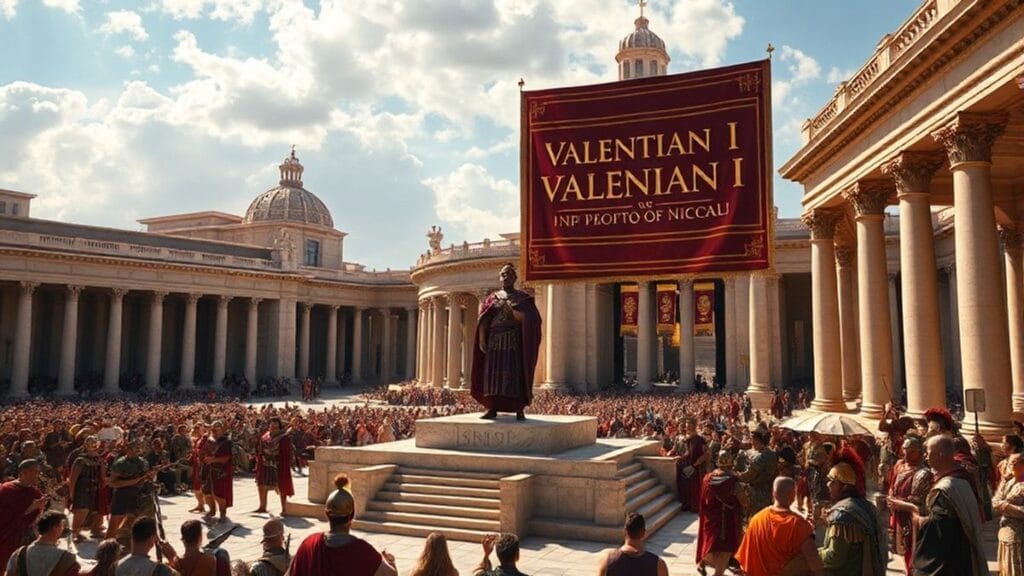
Then came the crucial moment: valentinian i proclaimed roman emperor. The exact formula of words is lost, but the act itself followed the established ritual. He was hailed as Augustus, robed in the purple garments of his new rank, and perhaps lifted on a shield by soldiers in an echo of older military acclamations. The shouts of “Augustus!” and “Vivat!” filled the hall, rolling like thunder against the stone walls.
Outside, the news spread quickly through the encamped army. Trumpets blared; orders went out to distribute donatives—the traditional imperial gifts of money to the troops. Fires were lit; toasts were made in rough tents and cramped barracks. In that moment, the empire had, once again, a master. The ceremony in Nicaea had transformed a frontier commander into the man upon whom millions’ lives would depend.
Yet behind the celebrations, unease remained. Many in the hall that day were already thinking ahead to the next problem: how to prevent rivalry, rebellion, or division now that a single man held such immense power. Even as valentinian i proclaimed roman emperor, the seeds were being sown for the next great compromise—one that would permanently shape the map of the empire.
Suspicion, Oaths, and the Demand for a Co‑Emperor
The jubilation in Nicaea did not last long before tensions surfaced. An emperor newly acclaimed was also an emperor newly feared. Senior officers, especially those commanding powerful field armies, had reasons to distrust any man who now possessed the legal right to execute them on suspicion alone. The late empire’s history was littered with fallen commanders, accused of treachery when they had grown too popular or too successful.
Almost immediately after valentinian i proclaimed roman emperor, negotiating lines began to form—not over who would rule, but over how he would rule. According to Ammianus, the troops and key officers insisted that Valentinian should not govern alone. They demanded a partner, a co‑Augustus, someone to share the burdens of military command and, more importantly, to act as a counterweight should the new emperor’s temper turn murderous.
For Valentinian, this demand cut to the core of imperial identity. Roman tradition celebrated the idea of one supreme ruler, even if reality had often deviated. To be asked, at the very moment of his elevation, to dilute his authority was both a political slight and a warning. If he refused, the fragile loyalty of the army might crumble. If he accepted, he would share his hard‑won throne.
It is said that the scene grew almost chaotic. The soldiers’ clamor echoed through the hall and outside into the streets. The officers pressed their demands. Valentinian tried to speak, but his words were swallowed at first by the noise. At last, perhaps with a gesture of the hand or a raised voice, he imposed silence long enough to reply: he would agree to choose a colleague, but on his terms, and in his own time.
This concession was crucial. It showed that the ceremony where valentinian i proclaimed roman emperor did not create an absolute monarch unbound by pressures. He was still, in many ways, the prisoner of his own power base—forced to deemphasize autocracy in order to secure obedience. The army that raised him could, in theory, unmake him, and everyone present understood it.
So oaths were sworn. The officers pledged their loyalty to Valentinian, and he, in turn, assumed a burden greater than personal ambition. He had to manage not only the frontiers and the court, but also the expectations of a military elite that had grown used to king‑making and king‑breaking. The next act of this drama would unfold not in Nicaea, but farther west, when he finally made the choice that would divide the empire between him and his brother.
Choosing Gratian’s Uncle: The Rise of Valens and a Divided Rule
Leaving Nicaea, Valentinian began the journey that would lead him deeper into his own destiny. He moved westward, aware that every mile brought him closer to the political heartlands of the empire—and closer to the question he had left carefully unresolved: who would be his co‑emperor?
In the weeks that followed, he weighed candidates. He could pick a powerful general, winning gratitude from the army but sowing the seeds of rivalry. He could appoint a high civil official, placating the bureaucracy yet alienating the soldiers. Or he could turn to family, creating a partnership rooted in blood, if not always in harmony.
He chose the last option. In March 364, at Constantinople, Valentinian elevated his younger brother Valens to the rank of Augustus. The scene must have echoed, in diminished form, the earlier moment when valentinian i proclaimed roman emperor at Nicaea: a hall, a throne, robes of purple, acclamations. But this time, the act did more than crown a man; it cleaved the empire in two spheres of responsibility.
The brothers agreed—or were advised—to divide their tasks geographically. Valentinian would rule the West: Italy, Gaul, Spain, Britain, and the turbulent Rhine and Danube frontiers. Valens would rule the East: the wealthy provinces of Asia Minor, Syria, Egypt, and the volatile borderlands facing Persia. Officially, the empire remained one, its laws and citizenship undivided. But in practice, there were now two imperial courts, two centers of gravity, two distinct political universes.
This division was not without precedent. Diocletian and Constantine had done something similar. Yet each such partition left a scar in the body politic, a sense that unity was a ritual more than a reality. Over time, West and East would develop different priorities, different enemies, even different religious dynamics. The decision Valentinian made in raising Valens ensured that a tension line ran through imperial governance—one that would both relieve strain and create new risks.
Valens, less seasoned and more politically vulnerable, would struggle in ways his brother did not. His later catastrophic defeat at Adrianople in 378 would become a turning point in Roman history. But in 364, none of this was yet visible. What people saw, as two emperors took their seats in different capitals, was a fragile solution for an overstretched realm: shared rule, divided labor, and a hope that brotherly cooperation would outlast the storms ahead.
Imperial Ideology Reforged: Law, Religion, and Power
With the double monarchy in place, Valentinian turned to the work of ruling. It was not enough that valentinian i proclaimed roman emperor and then shared the purple with his brother; he had to define what kind of emperor he would be. In late Roman politics, that meant wielding three main instruments: law, religion, and military authority.
In law, Valentinian proved energetic. He issued a cascade of edicts on taxation, provincial administration, and the conduct of officials. Corruption—especially by governors and tax collectors—was a constant concern. Edicts punished those who oppressed provincials or embezzled funds, yet the very need to keep repeating such laws showed how hard it was to tame abuses. The emperor’s justice, though severe, often struggled to penetrate the tangled local networks of patronage and bribery.
Religiously, Valentinian walked a careful line. He was personally a Christian, likely favoring the Nicene creed, but he did not imitate the aggressive religious policies of some predecessors. Unlike his brother Valens, who became a champion of Arian Christianity, Valentinian tended to allow a degree of pluralism. Pagans, though increasingly marginalized, were not persecuted with the full weight of law during his reign. Some temples were still open; some traditional rituals lingered.
This did not mean he was indifferent. Bishops petitioned him; councils appealed to him. He granted privileges to Christian clergy—such as exemptions from certain civic duties—and recognized the growing authority of church leaders, especially in the West. In the words of one later historian, “the Church grew in the shadow of the palace.” The alliance between bishop and emperor deepened, even as theological disputes simmered beneath the surface.
Power, in Valentinian’s arrangement, looked both backward and forward. Backward, to a memory of the principate where emperors were protectors of law and order. Forward, to a world in which Christian bishops and monastic leaders would increasingly claim moral authority over emperors themselves. In that intermediate space, Valentinian tried to carve out a role as the stern guardian of Rome’s frontiers and institutions, a man who wielded the sword while cautiously respecting the cross.
The Western Frontiers: War, Walls, and the Danube
If there was one arena where Valentinian felt entirely at home, it was the frontier. Once valentinian i proclaimed roman emperor, he soon made it clear that he would not rule from a distance. Unlike emperors who spent most of their reign in the palace, he traveled extensively in the West, inspecting fortifications, negotiating with tribal leaders, and at times personally leading campaigns.
The Rhine frontier, in particular, demanded attention. Various Germanic groups—Alamanni, Franks, Burgundians—tested the Roman defenses, probing for weaknesses. Valentinian responded with a mix of force and fortification. He strengthened old forts, built new ones, and repaired roads to ensure swift troop movements. He created and reinforced defensive lines that historians would later call the “Valentinianic frontiers.”
On the Danube, the story was similar. Gothic groups to the north watched Rome warily and opportunistically. Valentinian preferred to keep them divided, using diplomacy, subsidies, and, when necessary, punitive expeditions to prevent any single coalition from dominating. Yet every success was provisional. Next year’s harvest failure, next leader’s death, could set the borderlands aflame again.
In these grim landscapes of palisades and watchtowers, Valentinian came into his element. Ammianus, an eyewitness to some campaigns, praised his energy and vigilance. The emperor inspected arms, drilled troops, and punished lax commanders. He built bridges across rivers, seeded frontier zones with new garrisons, and sometimes settled allied barbarians as buffer communities under Roman authority.
Everywhere, the message was the same: the man who had risen from Pannonian barracks had not forgotten the lessons of exposed frontiers. The ceremony when valentinian i proclaimed roman emperor in Nicaea had been a moment of pageantry; these muddy ramparts and wind‑swept bastions were its daily consequence. To be emperor was to live with the constant pressure of impending raids, knowing that a single failed campaign could unravel years of patient fortification.
Life under Valentinian: Subjects, Soldiers, and Tax Collectors
For the millions of ordinary people living under Valentinian’s rule, imperial politics were both distant and inescapable. They might never see him, but they saw his laws in the actions of tax collectors, military recruiters, and judges.
Taxation under Valentinian remained heavy. The empire’s armies required food, pay, equipment, and infrastructure. Roads had to be maintained, forts repaired, imperial officials funded. Landowners, especially in the West, groaned under the burden of land taxes and special levies. Some tried to evade by abandoning their lands, slipping into cities, or attaching themselves to powerful patrons who could shield them. In response, laws attempted to bind peasants to their plots and curiales (city councilors) to their civic duties, foreshadowing the social immobilities of the medieval world.
Soldiers experienced both the benefits and the rigors of Valentinian’s rule. Pay remained relatively stable, and donatives accompanied major events: an accession, a victory, the elevation of heirs. But discipline was strict. Desertion, theft, and cowardice could be punished harshly. The emperor expected his legions to mirror his own severity—alert on the walls, unyielding in battle, obedient in camp.
Cities, meanwhile, displayed a blend of continuity and change. Public games still took place; baths and theaters still drew crowds. Pagan processions dwindled but did not disappear overnight. Men in togas still argued cases before magistrates; women still managed households that might range from cramped apartments to sprawling villas. Yet Christianity’s presence thickened. Church processions, basilicas, and episcopal courts offered alternatives to older civic rhythms.
For an artisan in Trier, a trader in Milan, or a vintner in Aquitaine, the name “Valentinian” meant an emperor who demanded much and gave little in visible return. Yet his relative stability compared to some predecessors also mattered. Harvests could be sold, ships could sail rivers and seas, contracts could be enforced—so long as no major usurper or barbarian invasion shattered the fragile peace. Under the stern gaze of this Balkan soldier turned Augustus, life went on, hard but possible.
Faith and Fury: Valentinian and the Christian Debates
Religion in the mid‑fourth century was not a matter of private conscience alone; it was public, political, and often explosive. When valentinian i proclaimed roman emperor, he inherited a Christian empire that could not agree on what “Christian” precisely meant. The Nikean Creed had powerful supporters, but so did various forms of Arianism, which questioned the full divinity of the Son.
In contrast to his brother Valens in the East, who zealously backed Arian bishops and persecuted Nicenes, Valentinian in the West adopted a more restrained approach. He allowed Western bishops, many of them Nicene, to manage their own disputes with relatively little direct intervention. Synods convened; letters flew between sees; theological arguments about substance and person, unity and trinity, occupied minds that once might have debated only philosophy or law.
This did not mean Valentinian was indifferent. He granted legal recognition and privileges to the church, enabling bishops to gain increasing control over charitable distributions, urban patronage, and even certain judicial functions. In cases of serious moral outrage, bishops sometimes appealed directly to him, demanding justice for their flocks. The balance between imperial and ecclesiastical power was being renegotiated, move by hesitant move.
At times, however, his celebrated fury intersected with religious questions. Some officials who abused church property or harassed clergy felt the sting of imperial wrath, not out of piety alone, but as part of his broader determination to maintain order. Churches were becoming powerful institutions; to alienate them recklessly was politically unwise.
It is telling that, in the West, the story of Valentinian’s reign did not leave behind tales of mass persecutions or religious terror. His legacy in matters of faith was more about structure than spectacle—about how the emperor’s laws, patronage, and toleration helped solidify Christianity’s social foundations, even as theological storms raged more violently in the East under Valens.
Court Intrigues, Family Ties, and Imperial Succession
Behind the disciplined façade of Valentinian’s reign lay a court full of ambitions, rivalries, and carefully staged alliances. The emperor’s household included not only advisors and generals, but also family members whose fortunes would shape the future of the dynasty.
Valentinian’s marriage to Justina, and his earlier marriage to Marina Severa, produced heirs who would become central in later decades: Gratian, his elder son; Valentinian II, born after his death but educated in his shadow; and daughters who forged dynastic ties with other noble houses. In a world where the army could still choose emperors, bloodlines were nonetheless precious assets. Sons were paraded before troops; their images minted on coins; their names inserted carefully into official oaths.
Court intrigues swirled around access to the emperor. Eunuchs, chamberlains, and high civil officers all sought influence, sometimes turning into factions. Letters of recommendation, denunciations, and flattery competed for Valentinian’s attention. Those who could frame their requests as matters of security or justice found the most receptive ear. Those who appeared to undermine discipline risked his rage.
One enduring question haunted the palace: succession. No emperor could ignore it. The ceremony when valentinian i proclaimed roman emperor at Nicaea had been a reminder of how fragile the process could be when left to chance. Valentinian moved deliberately to secure his line. Gratian was elevated to the rank of Augustus in 367, a gesture designed to make clear that the West now had a junior emperor in waiting. Soldiers were required to swear loyalty not only to Valentinian but also to his son.
This multi‑layered imperial college—Valentinian in the West, Valens in the East, and Gratian in training—was both a hedge and a risk. It promised continuity but also created new potential for conflict should relations sour. Yet for the moment, it seemed prudent. An empire too vast for one man might be safe in the hands of three, bound by blood and shared necessity. Or so many hoped.
Crises on the Rhine and the Making of an “Iron Emperor”
Valentinian’s reputation as an “iron emperor” was forged not in peaceful councils but in crisis. On the Rhine frontier, a series of incursions by the Alamanni and other groups tested Roman resolve. At times, whole communities crossed the river, pressing into Roman territory with wagons, families, and herds, blurring the line between raid and migration.
In 368–374, multiple campaigns unfolded across Gaul and along the Rhine. Valentinian often positioned himself close to the action, directing operations from fortified centers like Trier. He delegated to capable generals—such as Jovinus and Severus—but never relinquished ultimate control. Victory, when it came, was trumpeted in panegyrics, inscriptions, and coins depicting the emperor treading down barbarian captives.
Yet the reality was more complex than triumphal images suggested. Rome could defeat, punish, and occasionally annihilate hostile groups. But the endless stretch of river, forest, and plain could never be perfectly sealed. Every short‑term success required ongoing garrisoning, negotiations, bribes, resettlement policies. The empire’s resources—especially manpower—were finite. Valentinian’s harsh enforcement of recruitment and taxation reflected his awareness of these limits.
One infamous episode in his reign, the revolt of the African procurator Firmus in the province of Mauretania, showed that threats could erupt far from the Rhine as well. Though ultimately suppressed, the revolt revealed how quickly provincial grievances could escalate into full‑blown rebellion when imperial attention was strained by frontier emergencies.
Through it all, Valentinian’s image hardened. He was not a charismatic visionary like Constantine nor a philosophical ruler like Marcus Aurelius. He was the soldier‑emperor as drill master: stern, sometimes cruel, but determined that the machine of empire should keep working. When panegyrists praised him, they highlighted his vigilance, his severity, and his relentless defense of the borders. These were, in that era, the virtues that many believed might yet save Rome from a world that seemed to be closing in.
Death in a Wooden Fort: The Final Rage of Valentinian
The end came far from Nicaea, in a remote wooden fort on the Danube frontier. In November 375, Valentinian was in the province of Pannonia, meeting with envoys from the Quadi, a Germanic group whose incursions and grievances had roiled the region. The setting was stark: timber walls, a drafty hall, warriors and officers crammed into a space meant for brief conferences, not for history.
The negotiations did not go well. The Quadi envoys complained bitterly about Roman building projects beyond the river and the heavy‑handed tactics of certain commanders. Valentinian, already prone to fits of rage, responded with escalating fury. According to Ammianus Marcellinus, who provides a vivid if perhaps dramatized account, the emperor’s anger boiled over. He shouted, gestured violently, and drove his body to such a pitch of strain that he suffered a fatal stroke or heart attack.
There is something tragically fitting in this end. The man who had spent his reign enforcing discipline, guarding borders, and squeezing resources from an already strained society died not on a battlefield, but in a heated argument in a frontier fort. The enemies before him were not storming his walls; they were engaged in diplomacy. Yet his own body rebelled against his relentless temperament.
When the emperor collapsed, panic rippled through the hall and beyond. Officers rushed to his side; envoys stared in stunned silence. Within hours, perhaps, Valentinian was dead. The news traveled quickly to the nearest garrisons, then to Trier, Milan, and beyond. Once again, the West had lost its master. Once again, questions of succession loomed.
Gratian, already Augustus, would now bear the weight of rule in the West, alongside his younger half‑brother Valentinian II, elevated by court officials in a hurried attempt to secure dynastic continuity. But the unifying, if fearsome, presence of their father was gone. The man who, years earlier, had stood in Nicaea as valentinian i proclaimed roman emperor was now a silent memory, leaving behind not only heirs and armies, but also an empire still beset by the same structural strains he had tried so fiercely to control.
After Nicaea: Valentinian’s Legacy in an Age of Upheaval
Assessing Valentinian’s legacy means returning to that winter day in Nicaea and asking what really changed when he stepped into the purple. In the short term, his reign brought a measure of stability to the West. He held the Rhine and Danube line, repelled or contained major threats, and kept internal revolts from tearing the provinces apart. For an empire used to sudden usurpers and humiliating defeats, this was no small feat.
His administrative and legal measures, though harsh, helped keep the machinery of taxation and recruitment functioning. That they had to be harsh at all is a reminder of how frayed the system had become. Wealthy landowners increasingly treated imperial demands as negotiable; local elites looked more to their own survival than to distant emperors. Valentinian pushed back with laws, inspections, and punitive measures, trying to extract from a weary society what was needed to hold the frontier.
Religiously, his restrained approach in the West inadvertently created a space where Nicene orthodoxy could consolidate without the kind of heavy‑handed imperial interference that stoked resentments in the East under Valens. Bishops like Ambrose of Milan would later operate with confidence that emperors needed the church almost as much as the church needed imperial favor—an idea unthinkable a century before.
And yet, for all his energy, Valentinian could not fundamentally reverse the deeper trends pulling at the empire’s fabric. The growing reliance on barbarian federates, the demographic and economic shifts that weakened some regions, the slow erosion of older civic institutions—these forces continued. His fortresses might stand for decades, his legal codes might be cited by successors, but the structural fragilities remained.
Still, historians like Peter Heather and others have acknowledged that without emperors of Valentinian’s type—hard, pragmatic, un‑romantic—the Western Empire might have fragmented even earlier. His reign was a holding action, costly but effective in buying time. Time for what, though? For the rise of Theodosius, for the disaster at Adrianople, for the eventual sack of Rome in 410. The respite he created was not used to reinvent the system; it was used to delay the inevitable reckoning.
From Nicaea to the Fall of the West: Long Shadows of 364
The echoes of that day when valentinian i proclaimed roman emperor in Nicaea can be heard in events that unfolded long after his death. The division of authority between West and East, formalized with the elevation of Valens, anticipated the more permanent administrative split that would, over time, harden into separate imperial identities.
In the East, Valens’ disastrous encounter with the Goths at Adrianople in 378 shattered the aura of Roman invincibility in open battle. The Eastern Empire, under Theodosius I and his successors, recovered and eventually adapted, but the psychological blow was lasting. In the West, Gratian and then Theodosius’ son Honorius inherited an apparatus increasingly struggling to cope with rapid movements of peoples, internal revolts, and court intrigues.
The model of frontier defense that Valentinian reinforced—walls, watchtowers, mobile field armies, federate allies—became the inherited toolkit of later emperors. Its partial successes and frequent failures shaped the late Roman experience. When Alaric and his Goths approached Italy in the early fifth century, or when Vandals crossed into North Africa, they encountered an imperial system whose responses were molded, in part, by the assumptions and structures of Valentinian’s day.
There is also a more subtle continuity. The idea that emperors needed to be both fearsome to their enemies and just to their subjects, both Christian patrons and military commanders, was embodied in Valentinian’s self‑presentation. Later Western rulers—whether Roman, Ostrogothic, Frankish, or otherwise—would grapple with similar tensions. The Carolingian notion of a Christian warrior‑king owes something to the image, however distant, of emperors like him.
When the Western Empire finally disintegrated in the late fifth century, with Romulus Augustulus deposed in 476, the memory of strong soldier‑emperors lingered as a contrast to the weak, palace‑bound figures of the final decades. In that memory, the winter of 364, when Valentinian was lifted to the purple amid the cold stones of Nicaea, marked not only a turning point but also the last confident stride of a certain kind of Roman power.
Memory, Sources, and the Making of an Imperial Reputation
Our image of Valentinian is filtered through lacunose sources and agenda‑laden chroniclers. Chief among them is Ammianus Marcellinus, a former officer whose Res Gestae stands as a rare, detailed eyewitness account of the mid‑fourth century. Ammianus respected Valentinian’s energy and military competence but did not spare him from criticism, especially for his fits of anger and the cruelty of some punishments.
Later ecclesiastical historians, writing in a world increasingly dominated by church concerns, evaluated Valentinian primarily through the lens of religious policy. To Nicene authors, his tolerance in the West compared favorably with the Arian bias of Valens. To others, his failure to take a stronger, uniform stance on doctrine appeared as a missed opportunity. The emperor’s zeal for military matters made him, in their eyes, more a defender of physical borders than of metaphysical truths.
Modern historians, working with fragmentary legal codes, scattered inscriptions, and archaeological evidence of fortifications, have tried to reconstruct a balanced portrait. They see an emperor deeply shaped by his frontier upbringing, operating in a world of limited options. His severity, while often brutal, can be read as the response of a man who believed that only iron measures could keep an overstretched empire from splintering. His achievements—stabilizing frontiers, maintaining fiscal flow, managing succession—are often judged solid, if unspectacular.
Yet biography can only go so far. The ceremony in Nicaea where valentinian i proclaimed roman emperor is both a personal milestone and a symbol of systemic realities. It shows an army compelled to choose a leader, a court forced to negotiate constraints even amid exaltation, a city that had once decided matters of creed now becoming a stage for power. In that sense, Valentinian’s story is not only about one man but about the late Roman Empire itself, caught between grandeur and fragility, unity and fracture, faith and fear.
Conclusion
On that February day in 364, when valentinian i proclaimed roman emperor at Nicaea, a weary empire placed its hopes in the calloused hands of a frontier soldier. The ceremony did not magically heal Rome’s wounds or erase its anxieties, but it set in motion a reign that would, for more than a decade, hold the Western world together under an unflinching, often fearsome gaze.
Valentinian’s story runs like a steel wire through the tangled fabric of late Roman history: from the smoky barracks of Pannonia to the echoing hall of Nicaea, from the storm‑swept Rhine forts to the cramped wooden stronghold where his fury consumed him. He was no philosopher‑king, no visionary reformer; he was a guardian, standing before the gates of a world that he sensed was slipping away. His laws, fortresses, and dynastic arrangements did not arrest the empire’s long decline, but they bought time, offered breathing space, and left legacies—legal, military, and religious—that shaped the centuries to come.
Looking back, it is tempting to weigh him against impossible standards: why did he not save the West, why did he not reinvent the imperial system, why did he not foresee Adrianople or the Vandals in Africa? But such questions misunderstand his world. Valentinian ruled in crisis mode, always on the edge, always reacting to threats that seemed endless. His greatness, such as it was, lay in his refusal to collapse, his insistence that the walls be repaired, the troops paid, the law enforced, even when despair would have been understandable.
The winter light over Nicaea has long since faded, its walls weathered, its council hall repurposed or lost. Yet in that city, on that day, the empire chose a path—a hard, martial, and unsentimental path—that helped define the final century of Roman rule in the West. To follow Valentinian’s journey is to stand at the intersection of personal character and historical necessity, and to feel, across sixteen centuries, the weight of a purple cloak settling on a soldier’s shoulders as an empire holds its breath.
FAQs
- Who was Valentinian I before he became emperor?
Valentinian I was a Pannonian‑born officer and the son of Gratian the Elder, a respected military commander. He spent most of his early life and career on the frontiers, particularly along the Danube, gaining a reputation as a capable, disciplined, and sometimes hot‑tempered soldier. His long service under emperors such as Constantius II and Julian prepared him for high command and made him an acceptable candidate when the army needed a new emperor in 364. - Why was Valentinian I proclaimed Roman emperor at Nicaea specifically?
Nicaea, located in Bithynia, was a strategically placed and well‑provisioned city suitable for assembling the court and senior officers after the sudden death of Emperor Jovian. It had large halls for councils and was close to the army’s route of march, making it a practical choice for holding the emergency meeting at which valentinian i proclaimed roman emperor and was formally acclaimed by the military and civil elites. - How did Valentinian’s reign impact the division between East and West?
Shortly after his own elevation, Valentinian appointed his brother Valens as co‑emperor, effectively dividing administrative responsibility between West and East. Valentinian ruled the Western provinces, while Valens governed the East. Although the empire remained legally united, this arrangement entrenched the practice of separate courts and regional priorities, foreshadowing the more permanent East‑West split of later centuries. - Was Valentinian I tolerant of religious differences?
In the West, Valentinian adopted a relatively moderate religious policy. He supported Christianity and granted privileges to the church but generally refrained from the kind of aggressive intervention in doctrinal disputes seen under some other emperors. He allowed a degree of coexistence with remaining pagan practices and did not persecute Nicene bishops in the way his brother Valens did in the East, helping the Western church consolidate its position with less direct imperial pressure. - What were Valentinian I’s main military achievements?
Valentinian strengthened the Rhine and Danube frontiers, rebuilding and expanding fortifications and launching campaigns to push back hostile groups like the Alamanni. He reinforced the Western defensive system with new forts, bridges, and garrisons, and maintained overall control of the frontier despite repeated incursions. His efforts did not end all threats, but they delayed serious territorial losses in the West during his lifetime. - How did Valentinian I die?
Valentinian I died in November 375 at a frontier fort in Pannonia during heated negotiations with envoys of the Quadi. According to Ammianus Marcellinus, his violent outburst of anger during the meeting led to a fatal stroke or heart attack. He collapsed and died shortly afterward, leaving the Western Empire to his son Gratian and the young Valentinian II. - What was daily life like for ordinary people under Valentinian I?
For most subjects, life under Valentinian meant heavy taxation to support the army, stringent recruitment policies, and strict enforcement of laws. Farmers and landowners bore significant fiscal burdens, while urban life continued with markets, baths, and occasional games. The growing power of the church offered new channels of charity and dispute resolution, but the overarching impression for many was of a government that demanded much in the name of security. - How do historians view Valentinian I today?
Modern historians tend to see Valentinian I as a capable, if harsh, ruler who stabilized the Western Empire during a difficult period. He is praised for his military vigilance and administrative energy but criticized for his cruelty and explosive temper. Rather than a transformative reformer, he is often interpreted as a determined caretaker who held the line for a generation against forces he could not ultimately control.
External Resource
Internal Link
Other Resources
- Encyclopaedia Britannica – general search for the exact subject
- Google Scholar – academic search for the exact subject
- Internet Archive – digital library search for the exact subject