Table of Contents
- Night Before the Coronation: Drums Beyond the Walls of Ye
- The Broken Spine of Northern Wei and the Birth of Contenders
- Gao Huan’s Long Campaign: Forging a House in Fire
- Two Heirs, One Ambition: From Gao Cheng to Gao Yang
- In the Halls of Ye: Ministers, Scribes, and Secret Vows
- Overthrowing the Pretense: Ending Eastern Wei’s Facade
- October 23, 550: The Ceremony of a New Sun
- Seals, Rituals, and Edicts: Crafting Legitimacy
- Fields, Ledgers, and Ranks: The State Takes Shape
- Rivers and Frontiers: Diplomacy and War on All Sides
- Iron Riders of the North: Campaigns and Counter-Campaigns
- Temples and Stupas: Belief as Governance
- Behind the Screen: Empresses, Mothers, and the Inner Court
- Ye’s Markets at Noon: Artisans, Merchants, and Migrants
- Songs from the Fields: The People Under New Banners
- The Sovereign’s Shadow: Excess, Cruelty, and Reform
- Writing the Age: Chroniclers, Memory, and Blame
- Aftershocks and Legacies: What Northern Qi Left Behind
- Conclusion
- FAQs
- External Resource
- Internal Link
Article Summary: On October 23, 550, Gao Yang ascended in Ye and turned a precarious military regime into the Northern Qi, a state born from broken empires and contested memories. This article traces the northern qi dynasty founding as a drama illuminated by torches, sharpened by laws, and sealed with ritual, then looks out across the corridors of Ye to the anxious provinces, the restless cavalry, and the watchful neighbors. We follow the lineage from Gao Huan through Gao Cheng to Gao Yang, unpack the politics of enthronement, and examine the performances of legitimacy in ceremonies, seals, and decrees that made a kingdom feel inevitable. We move through the tax rolls, garrisons, monastic spheres, and women’s quarters to understand the social order crisscrossing the empire’s new name. Yet behind the triumph, the northern qi dynasty founding also contained seeds of excess and terror—a sovereign powerful enough to reform yet vulnerable to appetite and suspicion. The diplomatic threads wound toward Western Wei and Liang, and out to the steppe khaganates, where each skirmish could redraw the border overnight. Above all, this narrative argues that the northern qi dynasty founding was not a single moment but a moving frontier of meaning, where soldiers’ bread, court smiles, and the scratch of a scribe’s brush created a sovereign reality. And in the end, we measure the echo: what remained after the drums faded and the dust of Ye settled.
Night Before the Coronation: Drums Beyond the Walls of Ye
The night air over Ye was taut as a bowstring. Torches flickered along the ramparts, their flames snapping in the wind that came whistling from the plain. Messengers traced the streets in swift arcs, a last flurry of errands that stitched the capital together. Somewhere in the darkness, the future emperor paced a courtyard bare of ornaments—only a lamp, a stool, a low table with an ivory brush-rest and a shallow dish of ink. The city’s heart was Ye, but its arteries stretched through a war-torn north where the empire of Northern Wei had shattered like a clay statue struck by a hammer. In that silence before dawn, Gao Yang’s breath measured the distance between a general’s authority and a sovereign’s mandate. The torches said there would be a sunrise. The drums muttered: not if the horsemen in the wrong camp chose to move.
It is astonishing, isn’t it, how a dynasty is a pair of hands at the tipping point between hope and hazard? This was true of the northern qi dynasty founding, and everyone in Ye felt it. The moment is often told as a climax—a neat line marking the end of Eastern Wei and the beginning of something bright and terrible—but throughout the alleys and courtyards that night, nobody saw a line. They saw a weave: whispers crossing steel and silk, feigned smiles crossing oaths, lamps crossing the ink-black probabilities of a continent at war with itself. The soldiers ate their final ration of the day: millet, a slice of salted meat, and a gulp of wine to dull the edge of waiting. Their officers talked quietly, remembering Gao Huan, the late patriarch whose campaigns had carved out a canvas for his sons. “This is the hour,” someone said, and someone else replied, “But this was only the beginning…” The northern qi dynasty founding lived first as a feeling—thunder forming in the body of a man who would be emperor and in the collective pulse of a beleaguered people.
The Broken Spine of Northern Wei and the Birth of Contenders
To grasp the voltage of that dawn, we must return to the wreckage that gave it power. Northern Wei, a dynasty of remarkable endurance and adaptation, had overextended itself. Reforms had re-routed land and labor; the equal-field system tried to knit a mosaic of households into a predictable quilt of taxes and service. But great houses competed, court factions gnawed, and the realm split in two: Western Wei in the river-washed highlands and Eastern Wei in the flatlands centered on Ye. These were the halves of an empire that no longer recognized its own reflection. The split produced rival cultures of rule: in the west, Yuwen Tai’s disciplined engine; in the east, a delicate marionette theater where generals tugged the strings behind the curtain of a nominal emperor. This was the stage on which the northern qi dynasty founding later unfolded—not a garden, but a field still sizzling after a lightning strike.
Eastern Wei survived on the momentum of Gao Huan’s armies. It was a dynasty in name and a general’s war camp in spirit. Its emperor had a throne, yes, but his throne sat upon the back of a horse. The image is not a metaphor but a diagnosis. From the fringes came Rouran and other steppe powers, smelling weakness and opportunity. From the south, the Liang dynasty waited, sensing that the north’s civil wars would open diplomatic corridors and frontier raids alike. In this chessboard of glass, every piece was a shard. The northern qi dynasty founding would not be the polite handover of a courtly seal: it would be a tightening spiral of necessity, where promises written at swordpoint turned into laws spoken in the voice of a sovereign.
Gao Huan’s Long Campaign: Forging a House in Fire
Gao Huan’s story is the gravitational well into which so many destinies fell. He was not of the old aristocratic lines that had lorded over the north for centuries; he was the man who made his own line. Across the 530s and early 540s, he ground through campaigns whose maps now resemble records of the weather—fronts advancing, storms colliding, pressure systems of loyalties tightening or breaking apart. He built Ye as a military capital, a city that wore armor beneath its robes. From the steppe he recruited horsemen whose saddles creaked with the history of the plain; from the farmlands he pulled soldier-laborers whose hands could hold plow and spear with equal stubbornness. Gao Huan believed in order, in method, in the rhythm that kept an army alive. The northern qi dynasty founding would be his offspring’s bold thesis, but the data—the roads, the depots, the command structures—were his.
No army is only steel; it is a daily economy. Gao Huan kept the rations steady and the pay regular. He kept the temples close, too, and the monks said blessings over banners on the mornings of battle. His partner Lou Zhaojun, a woman whose insight became family doctrine, saw something in their sons that was flintier than court politeness. The legacy was double-edged: discipline, yes, but also a will sharpened enough to cut the hand that held it. Gao Huan’s eldest, Gao Cheng, was the obvious heir, the regent behind the screen in Eastern Wei. Gao Yang was next in the line, sometimes in shadow, sometimes stepping into light. When Gao Huan died in 547, he left behind not just troops and treasuries—but a problem: whether to sustain the theater of Eastern Wei or to take the stage in his own name. The northern qi dynasty founding was that decision carried to its conclusion.
Two Heirs, One Ambition: From Gao Cheng to Gao Yang
Gao Cheng’s hand on the reins of Eastern Wei was firm. He managed the puppet emperor with a mixture of condescension and courtesy that kept dignities intact and power where it belonged. But cruelty loves habit, and Gao Cheng had a taste for dominance that slid too easily into humiliation. In 549, he was killed in a revolt that began, as many do, not with ideology but with the sharp provocation of pride. The shock rippled through Ye. Gao Yang, the younger brother, stepped forward, and the shock turned into a kind of harsh clarity. The government did not break—it pivoted. Men accustomed to obedience changed the name of the addressee on their memorials; messengers who had carried orders from one brother now carried them from the other.
Yet behind the efficiency, there was grief and calculation. Gao Yang studied his brother’s example as one studies a cliff from the ledge: what shape of wind had cut this stone, and how would he avoid the same drop? He moved quickly to secure the camps and the city, to remind the aristocracy that their fortunes were braided with his. And there was the whisper that mounted in the months that followed: why maintain pretenses when the sword is in your own hand? The northern qi dynasty founding, once a future nobody dared speak aloud, became a thought with an anatomy—sinew, bone, chance, and law. In those months after Gao Cheng’s death, the younger brother became a sovereign in everything but name. Within a year, even the name would yield.
In the Halls of Ye: Ministers, Scribes, and Secret Vows
Every dynasty is born in writing as much as in war. The halls of Ye on the eve of the enthronement smelled of ink, lacquer, and the faint musk of cold metal. Ministers debated the wording of edicts that would close the book on Eastern Wei and open the book of Northern Qi. The scribes’ bamboo brushes whispered across silk: formulas of reverence for Heaven, arguments about the Mandate, language that curved like a scythe through the bramble of recent history. Where do you place the blame on a fallen regime when you have ridden it like a stallion? The answer, it turned out, required careful grammar. The northern qi dynasty founding must portray itself as rectification, not ambition; the past as unfortunate necessity; the future as restoration of proper order.
There were dinners that were not dinners, where wine was served but swallowed like medicine, and laughter was a form of test. Those who laughed at the wrong joke found their estates surveyed with new interest by men with sharp chisels for seals. And in a smaller chamber, old oaths were burned in a brazier while new ones were recited with a dryness in the throat. “If the Mandate does not move to the house of Gao,” one minister murmured, “the north will splinter.” Another, better at silence, stared at the scroll on the wall and thought instead of his sons. This was politics as weather: everybody trying to smell the rain. The northern qi dynasty founding is sometimes described as swift, but speed is a masquerade for readiness. Ye was ready, and the paper was almost dry.
Overthrowing the Pretense: Ending Eastern Wei’s Facade
Eastern Wei had become a mask. The mask was carved beautifully—let it not be said that the artisans of statecraft were unskilled—but it pinched the face of the man behind it. Gao Yang’s decision was no new dream but an old inevitability. If a general has the treasury, the throne is a matter of paper, not principle. And yet principle mattered. The city had to see not power grabbing power, but justice unseating a degeneracy. The abolition of Eastern Wei would be framed as the excision of a tumor. Letters went out to governors and garrison commanders, to abbots and clan heads, making the case: what we do now is to save what was precious then. The northern qi dynasty founding thus made a paradox public—revolution as restoration.
Behind closed doors, the deposed emperor’s fate was measured like a dose. Too harsh, and the realm would taste poison; too kind, and the risk of rallying points would rise. Gao Yang chose containment and dignity, at least at first glance: a quiet removal, a promise of safe keeping. In the long run, kings orbit risks until they collide. In the short run, the ceremony had to look spotless. The stage was built. The drums were drawn. The mask of Eastern Wei set aside. And in its place, a new face—not painted, but living, urgent, unafraid—stepped into view. This was the moment when the northern qi dynasty founding ceased to be a rehearsal and finally became the play.
October 23, 550: The Ceremony of a New Sun
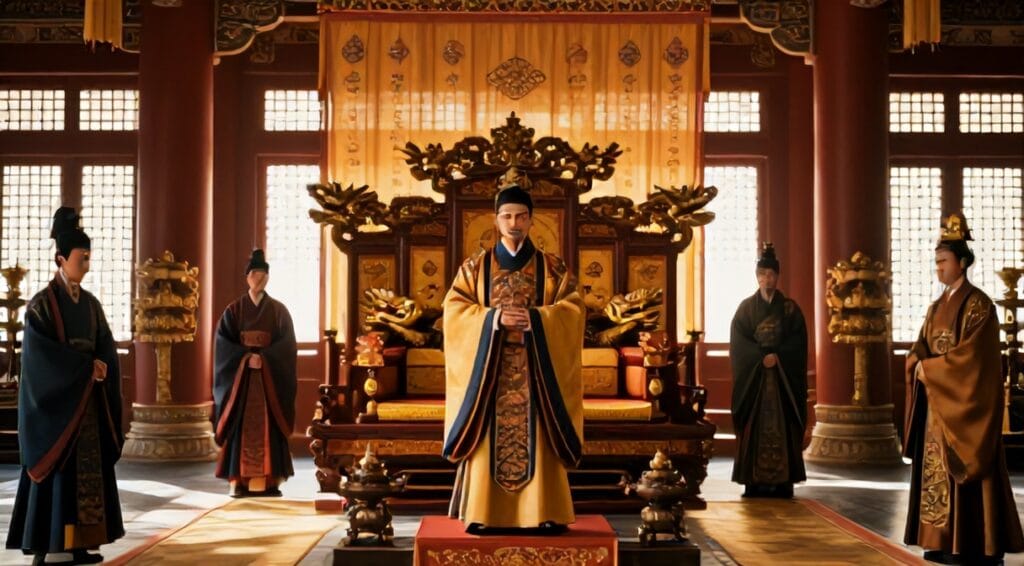
The morning broke clean as splashed water. On October 23, 550, Gao Yang entered the hall in robes whose colors seemed less dyed than distilled from fire. The assembly fell into its choreography: bows like waves rolling to shore, the sound of sleeves like a soft thunder. A jade seal—how many hands had pushed and pulled over its power?—rested on a cushion red as dusk. The court historian bent over his tablet, preparing the sentence that would survive them all. When Gao Yang spoke, it was not as a general addressing troops, but as a sovereign naming the world. “Under Heaven’s will,” he declared, “we constrain disorder and nurture the people.” The northern qi dynasty founding became a sentence on a specific day in a specific place, and we can almost hear the scratch of the pen fixing it there.
Outside, the city streets filled with movement. Butchers sold extra meat; brewers uncorked jars saved for grander times. Children were lifted onto shoulders to see the procession of standards. Within the palace, the rites unfolded with strict attention. Offerings to Heaven, sacrifices in the ancestral temple, annals marked and sealed. The Mandate is a concept, but its rituals are a machine, and that machine was well tended. “He took the jade seal and proclaimed, ‘Under Heaven’s Mandate, I perform the great sacrifice,’” records one chronicle (Zizhi Tongjian, vol. 163). The declaration echoed through the ranks of officials like the repeated beat of a drum. And in that resonance, the northern qi dynasty founding drew power from expectation itself. People had waited for this; the wait itself became proof that it should be so.
Seals, Rituals, and Edicts: Crafting Legitimacy
A dynasty must convince and compel. The first edicts under the new name of Northern Qi performed both—tonally rich, legally crisp. Amnesty for some, promotion for the loyal, censure for the obstinate. Land grants redistributed not only wealth but narratives: the scroll that gave you acres also told you what kind of story you now lived in. New reign titles rolled from tongues not yet used to them; the calendar itself bowed to the new grammar of time. The northern qi dynasty founding pressed its seal on the clock as much as on the law. In one stroke, the year became a reference to the emperor’s own breath counted across seasons.
Legitimacy has to be seen, then told back to the people. Processions wound through the capital. Steles were raised with chisels that sang as iron kissed stone. Priests of local cults and abbots of Buddhist monasteries received donations, and in return they chanted blessings, which is another kind of coin. Foreign envoys were courted with splendid entertainments—enough silk to blind the eye to recent chaos. But the hand behind the glove was not indulgent. Gao Yang ordered reviews of tax records, inventories of arms, audits of provincial warehouses. He made the northern qi dynasty founding a project that began in ceremony but settled into the practical hunger of governance: count, measure, demand, distribute. In that exactness lay a promise: not just a new name, but a functioning order.
Fields, Ledgers, and Ranks: The State Takes Shape
What does a dynasty look like when the standards are furled and the drums are stored? It looks like a grain measure and a ledger, a rank badge sewn on the breast of a commander, a docket carried by a clerk in winter’s rain. The equal-field system, so often declared, had to be enforced in muddy courtyards where surveyors argued with widows and cousins. The corvée labor rosters had to be written with a human hand, then checked by another. Northern Qi’s bureaucracy retained and refined what Eastern Wei had run on a war footing. Promotions were, in theory, by merit—though merit has a way of wearing a familiar face. The northern qi dynasty founding therefore unfolded not only in palaces but in village granaries and district offices where the empire’s pulse could be felt if you pressed your ear to the wooden door.
Gao Yang balanced salaries and stipends with the menace of accountability. Embezzlement was punished with theatrical severity; honest service was decorated to send the right signal down the line. Census counts were taken, and disputes over irrigation brought to court where a judge, with a fatigue born of hundreds of such cases, would pour tea and listen to allocations of blame. These were the sinews of a state that wanted to feel permanent in the hands of the governed. If the people could predict the demands of the capital, they might forgive them. If they could not, they would remember new banners as merely different colors of the same wind. The northern qi dynasty founding therefore had to be legible to the peasant and the officer alike: here is how to live, here is how to serve, here is how to be punished if you do not.
Rivers and Frontiers: Diplomacy and War on All Sides
Founding is a gunshot; neighbors listen. To the west, Western Wei watched with a strategist’s composure. Yuwen Tai, that stern architect of soldiers and systems, had built an order that was allergic to sentiment. He saw in Northern Qi a rival sharpened by fervor yet vulnerable to the intoxication of triumph. To the south, Liang stretched across the Yangzi’s gloss, riddled by its own troubles but still too rich to be ignored. Along the northern horizon, the Rouran Khaganate and other steppe confederacies tested border garrisons with raids that were both war and diplomacy—the language of the saddle and the bow.
Envoys from Ye traveled with well-staged confidence. They carried gifts, and behind the gifts, threats wrapped in courtesy. Alliances were sought, not to fix the map but to make its edges wobble on someone else’s terms. The northern qi dynasty founding sent ripples through this basin of rivals: here, a prefecture switched sides; there, a hostage prince’s fate was improved or darkened. The rivers themselves—Yellow, Wei, and their filigree of tributaries—became pathways and problem sets. Gates along mountain passes were reinforced; watchtowers burned brighter at night. This state was a dancer in mail; every step had to be measured, every spin announced, every bow drawn and then allowed to sleep. For Gao Yang, the first years were a proving ground where every successful parley or punitive raid taught the region that the new name had teeth.
Iron Riders of the North: Campaigns and Counter-Campaigns
Northern Qi’s reputation rode on the backs of horses. Hebei’s plains bred cavalry like the sea breeds waves. The elite formations wowed onlookers with precision charges that could unmake a line or unnerve a city. Even in celebration, rehearsals had a war’s intensity. The emperor reviewed the ranks, and the ranks—well-fed for the occasion—showed him a mirror of order: lances as straight as summer rain, banners drilled to snap in unison. These were not just soldiers but actors in the ongoing spectacle of security.
Skirmishes flared. In some borderland ravine, a general named Duan or Murong carved victory from a night march and a feint, while a courier galloped with the news to Ye, his horse lathered, a chunk missing from one ear where a spear had flown too close. It is in these parables of steel that the northern qi dynasty founding wrote second and third lines beneath its bold first. “The people of Ye feared his temper but admired his vigor,” one account notes of Gao Yang after his review of the troops (Bei Qi Shu, juan 3). Victories bought time, and time bought legitimacy. Yet every success risked courting disaster’s twin: complacency. The best generals told darker jokes than the courtiers did. They could smell winter in the summer grass.
Temples and Stupas: Belief as Governance
Empires rule not only bodies but minds, and belief is the bridge between the two. Northern Qi courted Buddhist institutions as stabilizers of social order and validators of the new name. Patronage flowed to prominent monasteries; in exchange, scriptures were copied with dedications to the dynasty’s peace. Stupas rose, casting long shadows at noon; within their shade, commoners and officials knelt alike. Meanwhile, the cults of local gods were not neglected. Officials arrived with silk and incense to celebrate the river deity whose moods could drown a harvest; they praised the mountain spirit who watched the passes. By honoring the old, the new hoped to feel less abrupt.
At court, debates over doctrine were not purely spiritual. They were budgetary and strategic, too. A monastery’s tax exemption was a policy decision with fiscal effects; an abbot’s influence could turn the morale of a county. The northern qi dynasty founding thus included a liturgical dimension: festivals tied to the new reign era, prayer lists that named the emperor’s titles with increasing subtlety. Confucian rituals in the ancestral temple made the state seem inevitable; Buddhist rites in the open ground made it feel merciful. Where there was resistance or rumor, bell towers rang louder. People are built to attend to bells; the state rang them with a precise sense of timing.
Behind the Screen: Empresses, Mothers, and the Inner Court
Power is not only public. Behind the screens hung with embroidered cranes, conversations shifted the future. Lou Zhaojun, mother to the emperor, was a force of counsel and caution. She knew the temperature of her son’s blood and the turbulence of victors who forget the edge of failure. Empresses and consorts occupied spaces both delicate and decisive. A word in the evening could ripple through the bureaucracy by morning. Marriage alliances reminded the old families that the new regime needed their grain and their gravitas. Concubines from clans with soldiers in their ancestry made the palace itself a garrison of loyalties.
But there were quicksands. The inner court thrives on intimacy’s power, and intimacy feeds jealousy as easily as trust. Servants became informants; eunuchs kept ledgers of favor invisible to any auditor. The northern qi dynasty founding therefore had to manage not only ministries but moods. A scowl after a banquet might mean a province lost if the wrong man felt slighted. The emperor’s laughter—when it glittered dangerously—could chill a council more effectively than a hundred laws. Within these chambers, the empire was not an abstraction but a domestic puzzle: how to hold a house together when every key fits multiple doors.
Ye’s Markets at Noon: Artisans, Merchants, and Migrants
Walk to the market at noon and you will see the dynasty in its truest form: the arithmetic of appetite. Ye’s stalls overflowed with millet, dried fish from rivers cajoled into obedience by engineers, iron tools forged in the sweat of men who might carry swords tomorrow. Silk merchants from the south named their prices with a dancer’s elegance. Traders from the steppe laughed at the damp air but loved the profits. In a corner, a scribe sold letters to those who could pay—love notes in careful hand for a soldier far away, petitions phrased just right to reach a magistrate’s ear. The northern qi dynasty founding might have been decided in palaces, but it lived here, in copper coins slapped on counters and the smell of soy, wine, and horses.
Migrants arrived, some from lands battered by the storms of Western Wei, others displaced by local feuds. They brought skills and invented new ones. Artisans carved stories on bone and wood that hinted at old myths wearing new costumes. Taxes skimmed their vigor, but the law in Ye—when it worked—protected a man’s right to sell what his hands could make. The city’s humor brightened as often as it complained. Yes, the levies bite; yes, the soldiers swagger; yes, the scribes are slow with their seals. And yet: the streets feel safer, the granaries fuller, the harvest fair scheduled with a calendar that seems less arbitrary than last year’s. The northern qi dynasty founding, as a fact in the market, was the reduction of fear to a manageable size.
Songs from the Fields: The People Under New Banners
Beyond Ye, in the quilt of villages that fed the capital, life changed at the speed of plowing. The same fields, the same seasons, the same arguments between neighbors about the edge of a ditch. But there were differences you could count. An inspector with better boots and clearer instructions. A temple festival that now included a prayer for the emperor by a new title. The burden of corvée days recalculated—sometimes lighter where a petition had found its mark, sometimes heavier where a local headman’s cousin had angered the wrong man. The northern qi dynasty founding in the countryside was a set of recalibrations: not an earthquake, but a shifting of furniture that you noticed when you stubbed a toe in the dark.
Songs carried the news. In half-worked rhymes, the people measured their governors. “Harvest holds if levies fold,” someone sang, and the line traveled further than any decree. Rumors, too: that the emperor walked among commoners in disguise; that he drank too much; that he punished thieves with harsh spectacle; that he rewarded bravery even if it came from a poor house. Some of it true, some of it theater carried by the wind. The important thing was that the emperor had become a character in village stories. The northern qi dynasty founding meant a shift in the cast of that ongoing play, with the hope—always the hope—that the end would be gentler than the last act.
The Sovereign’s Shadow: Excess, Cruelty, and Reform
Power is a draught that burns the throat. Gao Yang, who took the temple name Wenxuan, began as a reformer whose energy crackled through the apparatus of state. He could, when he wished, be just. He could also be terrible. Accounts speak of rages that were not merely storms but climates, of punishments designed to educate by terror. Wine flowed; nights lengthened. The balance between vigilance and indulgence tipped and righted itself, tipped again. “The people of Ye feared his temper but admired his vigor,” the chronicler had said, and this remained true even as the admiration began to acquire an aftertaste of dread.
Yet reforms continued. Military administration tightened; tax evasion was hunted like a fever. Some noble houses saw their estates clipped to size. Others fattened under imperial favor, which is just another kind of audacity. The northern qi dynasty founding contained within its early years a pattern of acceleration and skid. Those who served closely learned to read the emperor’s face as one reads a sky before a storm: a quiver at the corner of a mouth meant stall the petition; a certain brightness in the eyes meant raise the matter now, strike while the iron is calm. But this was only the beginning of the difficulties. For a dynasty to endure, the founding energy must be tamed into custom. Wenxuan’s shadow made that taming harder than it needed to be.
Writing the Age: Chroniclers, Memory, and Blame
Every state is a text, every founding a genre. Court historians and later compilers—the Bei Qi Shu, the Book of Zhou, the Zizhi Tongjian—would grapple with Northern Qi’s story, slicing it into moral lessons as butchers slice meat. Their task was to name causes and apportion blame, to link the loosened belt at a feast with a border failure months later, to draw a line between a prince’s pettiness and a peasant’s misery. In their hands, the northern qi dynasty founding became a case study for what happens when vigor courts excess, when a rightful claim meets an unforgiving temperament. They preserved edicts, sketched processions, listed titles with a zeal that makes the eyes glaze, then suddenly—like a bell rung in a quiet room—dropped an anecdote: a joke told by a general, a monk’s prophecy, a widow’s plea in court that turned a magistrate’s heart.
As readers centuries later, we must give them grace and also skepticism. Historians of rival dynasties had their own mandates to justify; religious writers had their own miracles to prove. Still, across the noise there is a harmony: the sense that something urgent happened in Ye in 550, something both inevitable and chosen. The northern qi dynasty founding, seen through their pages, stands as a pivot in a century that otherwise heaves with repetition. War and harvest, tax and revolt, dynasty upon dynasty—Northern Qi’s birth is a spark thrown across that grindstone. We can almost see the light, even now.
Aftershocks and Legacies: What Northern Qi Left Behind
Legacies are instruments played by those who come later. Northern Qi would face tests and successors who learned both what to emulate and what to avoid. Its military style—the swift strike, the cavalry’s pride—echoed in campaigns long after its banners were folded. Its administrative capacities—particularly in the volatile corridor of the central plains—proved that a state of recent mint could stabilize a region that had forgotten the sound of its own heart. Its patronage of Buddhism seeded monasteries whose halls outlasted palaces. And its capital, Ye, remained a hive: the geometry of its streets and the memory of its governance shaped how later rulers imagined control.
There were darker bequests. The temper of its founding sovereign taught courtiers and generals to serve with a tremor in the hand. Internal factionalism, always embryonic in military regimes, found footholds in a court that could not always discipline itself. Enemies watched and learned, probing where the armor did not meet the leather. In time, Northern Zhou would rise hard from the west, and Sui after them, knitting together with unfamiliar rigor what had been unraveling for generations. And yet—if one listens carefully—there is a through-line from that October day: the conviction that the Mandate is not a fossil but a flame, that a state can be remade by force of will and ceremony. This conviction animated the northern qi dynasty founding and echoes in every subsequent attempt at reconciliation between chaos and order in North China.
Conclusion
In Ye on October 23, 550, Gao Yang stepped from the anteroom of possibility into the audience chamber of history. With rites that looked ancient and decisions that felt almost modern in their pragmatism, he rebranded power and in doing so wrote a new chapter of the age. The northern qi dynasty founding was ceremony and sword, tax roll and love song, an argument addressed to Heaven and a bargain struck with the earth. Its first triumphs were stabilizations; its first dangers were temptations. But even as the sovereign’s shadow lengthened with episodes of cruelty and excess, the institutions he energized continued to hum: armies drilled, granaries filled, monks chanted, scribes copied the names that would outlast them all. The story is not tidy. It is exactly as complex as human beings and the empires they compel into existence. If we follow the torchlight through Ye’s halls, we see fear, calculation, hope—and the stubborn belief that a banner raised anew can summon a different future. That belief, dangerous and necessary, is why the founding matters, and why its drums still thrum under the historian’s page.
FAQs
- What exactly happened on October 23, 550?
Gao Yang formally ended Eastern Wei’s pretense of sovereignty and proclaimed a new regime at Ye, taking the throne as the founding emperor of Northern Qi. The enthronement involved ritual sacrifices, the assumption of seals, the proclamation of amnesties and appointments, and the public performance of legitimacy. This day marks the northern qi dynasty founding in the most ceremonial and legal sense. - Why did Gao Yang establish a new dynasty instead of continuing Eastern Wei?
Eastern Wei functioned as a façade for the power of the Gao family. With Gao Huan deceased and Gao Cheng assassinated, Gao Yang consolidated control and judged that open sovereignty would provide clearer legality, stronger internal discipline, and more persuasive diplomacy. In short, the northern qi dynasty founding replaced ambiguity with authority. - How did Northern Qi justify its legitimacy?
Through a combination of Confucian rites, Buddhist patronage, carefully worded edicts, calendar changes, and public ceremonies that framed the transition as rectification rather than usurpation. The narrative emphasized restoring order, protecting the people, and aligning with Heaven’s Mandate—a core theme repeated throughout the northern qi dynasty founding. - What role did military power play in the founding?
A decisive one. The cavalry-centered armies built by Gao Huan and maintained by his sons secured Ye, discouraged domestic dissent, and signaled strength to Western Wei, Liang, and the steppe powers. Military credibility underwrote every ritual of the northern qi dynasty founding. - How did ordinary people experience the change?
Mostly through adjustments in taxes, corvée labor, local administration, and the calendar. Market life in Ye and the surrounding countryside reflected new patterns of stability. For villagers, the northern qi dynasty founding meant a different set of officials, festivals with new titles, and hopes that the burdens might grow more predictable. - What were the main external challenges after the founding?
Western Wei to the west, the Liang dynasty to the south, and the Rouran and other steppe confederacies to the north. Diplomacy, raids, and counter-raids tested Northern Qi’s readiness and shaped the geopolitical climate that followed the northern qi dynasty founding. - Was religion important in consolidating the new regime?
Yes. Patronage of Buddhist monasteries and recognition of local cults helped stabilize society and provide moral legitimacy. Ritual performance—both Confucian and Buddhist—was integral to the narrative of the northern qi dynasty founding. - How do historians assess Emperor Wenxuan (Gao Yang)?
As a complex figure: energetic, decisive, and institutionally effective, yet also prone to violent excess and intoxication. Sources such as the Bei Qi Shu and the Zizhi Tongjian praise his vigor while condemning his cruelties, a dual judgment that colors modern views of the northern qi dynasty founding. - What administrative systems did Northern Qi rely on?
Continuations and refinements of northern dynastic institutions: equal-field land distribution, corvée labor, military household administration, and a layered bureaucracy that sought accountability through audits and inspections. These structures gave the northern qi dynasty founding endurance beyond the initial ceremonies. - What is Northern Qi’s legacy?
Its military style, administrative capabilities, and patronage of Buddhist institutions influenced subsequent regimes, even as later states learned from its internal fractures. The memory of the northern qi dynasty founding persists as a case study in turning de facto control into de jure sovereignty amid civil war.
External Resource
Internal Link
Other Resources
- Encyclopaedia Britannica – general search for the exact subject
- Google Scholar – academic search for the exact subject
- Internet Archive – digital library search for the exact subject

