Table of Contents
- A City Holds Its Breath: Paris Before the Coronation
- From Child-King to Claimant: The Road After the Treaty of Troyes
- Regents and Rivalries: Bedford, Gloucester, and the French Crown
- The Palais and the Procession: Staging Power in December 1431
- The Boy and the Mitre: Inside Notre-Dame on Coronation Day
- Crowns, Oaths, and Oil: Rituals Reimagined in Wartime
- Trumpets in a Divided City: Parisians React to the Spectacle
- The English Machine: Garrisons, Bureaucrats, and the Minting of Authority
- Burgundian Calculus: Allies with Reservations
- The Shadow of Jeanne: Memory of Joan of Arc in Paris
- Words That Fought: Propaganda, Sermons, and Songs
- Money, Bread, and Blood: The Social Cost of Empire
- The Loire That Would Not Yield: Charles VII’s Slow Ascent
- After the Anointing: The Journey Home and Waning Fortune
- The Child Who Became a Symbol: Piety, Passivity, and Policy
- Echoes in Marble and Parchment: Chroniclers and Witnesses
- A Coronation Without a Kingdom: The Paradox of 1431
- Long Reverberations: From Treaty to Tudor Memory
- Conclusion
- FAQs
- External Resource
- Internal Link
Article Summary: In December 1431, amid the gray mists and bitter winds of a war-torn capital, the English regency staged an audacious spectacle: the anointing of a nine-year-old as France’s king in Notre-Dame. This article follows the city’s breathless vigil before the ceremony, the child’s gentle steps along the nave, and the careful orchestration by Henry Beaufort and John, Duke of Bedford. It situates the moment within the Treaty of Troyes, the Anglo-Burgundian alliance, and the fierce counter-claims of Charles VII. We trace how henry vi crowned king of france became more than an act of liturgy; it was a political gambit, a propaganda campaign, and an emotional upheaval for Paris. We explore the ritual improvisations imposed by war, the memory of Joan of Arc’s martyrdom earlier that year, and the city’s divided heartbeat. As the English machine churned—minting coins, staffing offices, guarding gates—allegiance proved brittle. In the end, the phrase henry vi crowned king of france would echo as paradox and omen, a crown that gleamed under vaulted stone but dimmed in the fields beyond the Seine.
A City Holds Its Breath: Paris Before the Coronation
By mid-December 1431, frost glazed the stones of the Île de la Cité, and dusk fell early upon the bridges of Paris. Lanterns swung in the wind like small stars, and the sound of carts echoed against shuttered shops. It was not the winter alone that pressed upon the city. Rumor had been doing its rounds for weeks: henry vi crowned king of france, they said—here, not in Reims. The phrase crossed markets and taverns with the same nervous tremble as the draught that slipped through door cracks. Workmen hammered scaffoldings by Notre-Dame; tapestries were shaken free of dust in the houses of magistrates; and a watchful current ran through the streets, as if the city’s wide gray river had stepped ashore to test the cobblestones with invisible feet.
By then, Paris was a city of contradictions—a capital under English administration, yet profoundly French in its pride and memory. English soldiers rubbed shoulders with scholars of the university; merchants counted profits in both crowns and livres; and the bells that tolled for prayer also tolled for curfew. The news that a child would be arrayed as king of France—henry vi crowned king of france—was at once a spectacle and a provocation. Some swore an oath of readiness to cheer; others prepared to remain indoors with shutters closed. The dukes and churchmen insisted it would be a moment of renewal. And still, as dawn after dawn bled into gray, the question pulsed beneath the city’s breath: could a ceremony lift the weight of war, or would gold thread and incense only perfume an unhealed wound?
From Child-King to Claimant: The Road After the Treaty of Troyes
The road to that winter ceremony began a decade earlier with the Treaty of Troyes in 1420, when the conquering Henry V bound the ailing Charles VI to a bargain that made the English king heir to the French throne. The treaty disinherited the Dauphin, the future Charles VII, and married Henry V to Catherine of Valois in a union of flags and fates. When Henry V died in 1422—still young, still incandescent with victories—and Charles VI followed him to the grave within months, a question rushed in to fill the vacuum. A baby, Henry VI, inherited the English crown; by the terms of Troyes, he was also meant to inherit France. The promise was bold, even logical on parchment. But parchment can be brittle where swords are sharp.
Thus began the slow enthronement of an idea: henry vi crowned king of france. The regents who governed in the boy’s name—John, Duke of Bedford in France, and Humphrey, Duke of Gloucester in England—girded their letters with seals and their hopes with garrisons. On the other side of the Loire, the Dauphin Charles—soon to be Charles VII—refused to vanish from history’s line. If the treaty was one text, the Loire valley wrote another in skirmishes, loyalties, and the quiet bravery of villages. The English crown needed a Parisian coronation to fix the treaty’s promise in the mind of Europe. Reims was in enemy hands; necessity would be the mother of ceremony. In this hard calculus, the infant king on whom so many banners depended would become a sign, a solemn child lifted upon the shoulders of empire.
Regents and Rivalries: Bedford, Gloucester, and the French Crown
Between parchment and processional, there were men with tempers and ambitions. Bedford, sober and strategic, understood that symbols were as crucial as siege guns. Gloucester, restless and proud, quarreled often with his brother’s careful policies. Their rivalry threaded through council meetings like an undercurrent, tugging at decisions about revenues, troops, and the boy’s itinerary. Over them both towered the memory of Henry V, who seemed to stride down every corridor, a ghostly judge of high standards.
To bring the dream of henry vi crowned king of france into stone and sound, Bedford needed allies—Burgundy above all. The alliance, sealed after the shock of Duke John the Fearless’s murder on the bridge at Montereau in 1419, was kept alive partly by mutual interest and partly by mistrust of the Valois claimant across the Loire. Bedford also needed the Church’s sanction, and there the powerful Cardinal Henry Beaufort, Bishop of Winchester, became indispensable. Beaufort combined ritual authority with the instincts of a statesman; in his hands, liturgy would become policy. It is often said that in times of crisis, nations cling to their elders. In 1431, England clung to its dukes and cardinals for direction, and to a child for hope.
The Palais and the Procession: Staging Power in December 1431
On the morning chosen for the ceremony, a pale sun struggled over the rooftops, turning frost to a brief glitter on the cathedral’s buttresses. The route from the royal lodgings to Notre-Dame was mapped with meticulous care. Town officials in fur-lined robes rehearsed their bows; guilds prepared banners to hang from galleries; and musicians waited with cold fingers for their cue. The processional was to give flesh to a phrase that had hovered in councils and treaties: henry vi crowned king of france. But how does one make an argument walk on two small feet? With pageantry, with trumpets, with the city itself pressed into service.
Witnesses describe the boy in garments rich with goldwork, his slight form dwarfed by robes heavy as a king’s responsibilities. Around him moved a choreographed world: Bedford steady as an oak; Beaufort grave with purpose; English captains polished to ceremonial brilliance; Burgundian envoys careful and calculating. The Palais de la Cité, that stone heart of governance, yielded him to the nave’s vast space; the crowd, thinned by winter, thickened at word of movement; and the river, mute and immense, flowed past the island as if indifferent to crowns. For an hour or more, Paris opened its eyes very wide and watched.
The Boy and the Mitre: Inside Notre-Dame on Coronation Day
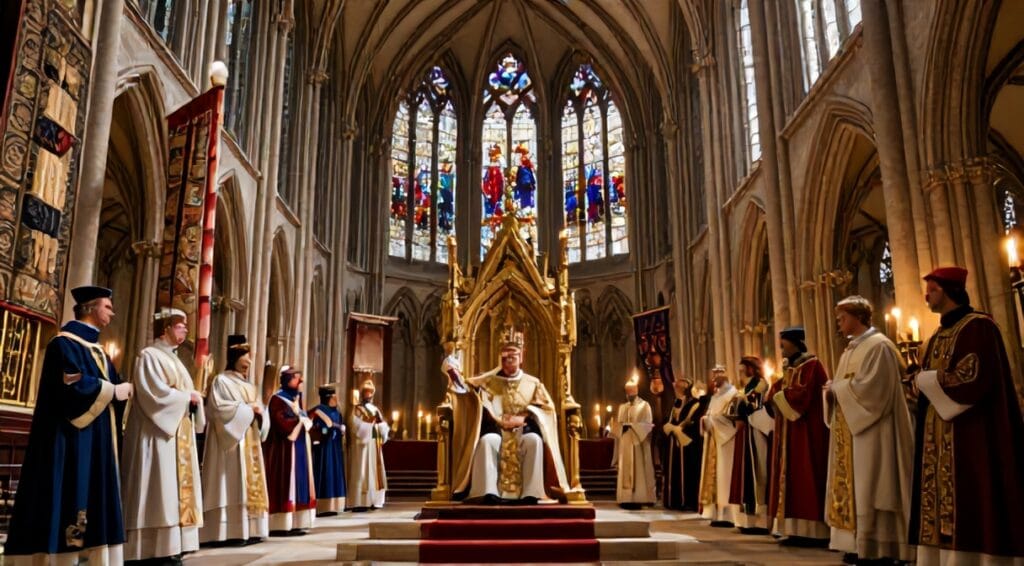
Within Notre-Dame, candles flamed against the cold, and incense wound upward as if the air itself were a rope to heaven. The great doors admitted the procession with a hush that turned, slowly, into the murmur of many breaths. A choir rose like morning, and the disciplined hands of acolytes passed vessels and books in a dance of solemn utility. At the center of it all stood the boy for whom the pageant had assembled—soft-faced, pale from winter travel, and immensely alone inside the ceremonial garments that proclaimed a destiny older than his years. It was said that he listened intensely, as if sound could give him courage, or as if the cathedral’s stones were whispering an older history that he might borrow for the day.
Cardinal Henry Beaufort presided, his red hat a point of gravity amid gold and white. In his Latin, in the gestures of blessing and anointing, the Church conferred not only sanctity but also the credibility without which even the richest robes are mere costumes. The refrain circling through every glance and whispered commentary—henry vi crowned king of france—took on the texture of incense, something breathed as much as heard. Yet behind the splendor, one could sense the tremor: the anointing happened here, not at Reims; the Sainte Ampoule’s legendary oil was absent; the cathedral was Parisian, not the traditional cradle of French kingship. Could a child’s stillness sustain the weight of such omissions? For those devoutly loyal to the English cause, it seemed enough; for others, the rites glowed yet did not quite warm the heart.
Crowns, Oaths, and Oil: Rituals Reimagined in Wartime
Ritual thrives on repetition. Coronations, like harvests, gained their power from the expectation that they would be done as they had always been done. But 1431 was a year of accommodations. Reims was out of reach, and so Paris became the theater—Notre-Dame the stage upon which tradition was carefully, even lovingly, adjusted. The absence of the Sainte Ampoule’s sacred oil, believed since Clovis to descend from heaven itself, was a wound that could not be entirely healed with substitutions. Still, bishops anointed Henry with consecrated oils; prayers were spoken; a crown was lowered; and the oaths unfurled like silk scrolls, binding boy and kingdom in words ancient and always new.
“All ceremonies were accomplished in great propriety,” one later chronicler remarked, “but the kingdom itself remained divided.” Such a line—attributed in spirit to the observations of Enguerrand de Monstrelet—captures the essential paradox. The phrase henry vi crowned king of france entered the ritual vocabulary of the day, marching through litanies and acclamations. Yet behind the celebrations, the counter-text persisted: Charles VII’s adherents dismissed the Parisian anointing as an act of theater. It is astonishing, isn’t it, how rites can both clarify and obscure, making victory gleam even as the map tells another story.
Trumpets in a Divided City: Parisians React to the Spectacle
Parisian reactions were as layered as the city’s rooftops. Some saw honor in the great ceremony: shops hung greenery; windows filled with faces; and when the trumpets cried out, the sound skated along the Seine as if celebrating a festival of light in the bruised heart of winter. Yet many who watched did so warily, hands still from work, lips tight. A chronicler known as the Bourgeois of Paris later wrote of “a great show and great unease,” describing a day “when our city seemed to clap with one hand while the other clutched its cloak.” The English administration would have preferred a single roar of approval. What it heard was applause punctuated by silence.
Several Parisians liked the pageantry precisely because it momentarily suspended the grind of war. Children spotted the little king with wide eyes; mothers blessed him as if he were a saint in a procession. But when the trumpets fell quiet, price lists and rationing returned to the foreground. In warm kitchens and on cold street corners, the phrase henry vi crowned king of france was weighed in the same mental scales as bread, rent, and rumors from the roads to the south. One man at a tavern near the Rue de la Parcheminerie murmured that kingship was fine if it brought peace; another muttered that kings, at that hour, were like falling snow—lovely to watch, but melting as soon as they touched the ground.
The English Machine: Garrisons, Bureaucrats, and the Minting of Authority
Power in a foreign capital has several faces. There is the smile of the royal council, the mailed fist at the city gate, the quiet arithmetic of clerks, and the ringing authority of the mint. After the great day in Notre-Dame, the English administration doubled down on the grind of governance. Coinage bore the boy’s titles; writs invoked his dual rule; public proclamations stitched the coronation’s grandeur into the fabric of the city’s rules. The phrase henry vi crowned king of france was inscribed into seals and letters, so that readers of charters would hear the words even in their minds’ silence.
Garrisons maintained a careful vigilance at the walls; patrols counted shadows as diligently as they counted men; spies and informants swayed between loyalties like reeds in winter wind. The courts worked, the university debated, and merchants bargained—in French, in English, in the language of necessities. Yet there was a cost to this level of scrutiny. The city felt watched. A single festival day had tried to braid trust between ruler and ruled, but trust cannot be summoned by trumpets alone. It needs time, bread, and the absence of shouting. In the weeks after the coronation, Paris had little of those, and so the machine—efficient, persistent—hummed without finding a deep well of love.
Burgundian Calculus: Allies with Reservations
The Anglo-Burgundian alliance made possible much of what unfolded in Paris. Philip the Good, Duke of Burgundy, measured gain against risk with a jeweler’s eye. He had reasons to favor the English: mutual retribution for Montereau; profitable access to trade; the balance of power against a Valois court he did not trust. Still, Burgundy was no vassal. Its own glory was always the first priority, and its loyalty to the English crown was built of ledger lines as well as blood ties. In the choir of Notre-Dame, Burgundian diplomats sang their part in the chorus. Yet even as they smiled, they counted.
Here, the phrase henry vi crowned king of france carried Burgundian arithmetic upon its syllables. If the ceremony consolidated English power, good; if it overreached and provoked general resistance, less good. When things went well—when councils were orderly and markets calm—Burgundy appeared a solid friend. But above all the dukes of Burgundy preferred options: treaties within treaties, understandings behind understandings. It is therefore not surprising that four years later, at Arras, Burgundy would realign with Charles VII. The coronation in 1431 did not change the fact that for Burgundy, the highest allegiance was to Burgundian advantage.
The Shadow of Jeanne: Memory of Joan of Arc in Paris
How could Paris not think of Joan that winter? Only months earlier, in May 1431, Joan of Arc had burned at Rouen. To some in Paris, she had been a witch, a dangerous spark scattering armed boys like dry leaves. To many others—quietly if not boldly—she had been a sign that God might still throw His weight upon the scales for France. Her voice was, by then, ash and smoke. But memory disregards fire; it travels unharmed through the narrowest cracks of repression. In corners and kitchens, people whispered of her courage and wept.
The phrase henry vi crowned king of france, intoned with solemnity under great vaults of stone, met another phrase whispered in the markets: the Maid’s name. Even in Paris, where English arms held power, there were those who remembered how she had lifted the siege of Orléans, how her presence steadied wavering men, how she had guided Charles VII to Reims and made of him not merely a claimant but a crowned king. The English ceremony at Notre-Dame felt, in that light, like an answer—late, grand, and defensive. “A coronation is a sword without an edge if the people do not believe,” one observer muttered, mimicking the style of sermon. For every candle in the cathedral, there was a memory burning elsewhere in the city.
Words That Fought: Propaganda, Sermons, and Songs
Wars are archives of proclamations. The Anglo-Burgundian authorities understood very well that a coronation breathes longest in the lungs of those who sing it. Broadsheets, sermons, and orations spun out in the wake of the ceremony, bearing the message that God’s will had conferred the lily crown upon an English child. Cardinal Beaufort’s words were copied and carried; the Parisian university’s debates were carefully shepherded so that orthodoxy would seem to speak from doctrine rather than dictate. “Behold the anointed of the Lord,” one sermon urged, “whom Heaven has placed among us for the correction of war and the return of peace.”
Yet propaganda is a duet, not a solo. From the south and from the quiet middle places came rival songs: ballads praising Charles VII, muttered jokes about foreign kings, prayers that did not speak the little king’s name. In those skirmishes of sound, henry vi crowned king of france did its best work not as a phrase of conquest but as a phrase of reassurance to uncertain friends. Each repetition sought to tame doubt’s unruly horses. Words galloped across paper and pulpit, but at the gates and along the roads—as soldiers tramped, as wagons rolled—the hoof-beats of reality kept a different time.
Money, Bread, and Blood: The Social Cost of Empire
Whatever anthem the chancery sang, the baker and the ferryman counted differently. Bread was dear. Wood for fires cost more than many dared to spend. Farmers near the city timed their deliveries with fear of seizure or tolls; families sent children to stand in line before dawn for flour. Into these daily reckonings went new levies, requisitions, and the incidental violences that march beneath every banner. The winter after the coronation pressed hard against the belly as well as the soul.
Still, the day of anointing mattered even here. “If he is king, perhaps the tolls will soften,” said a cobbler. “If the anointing is true, perhaps God will send calm,” murmured a widow lighting her single candle. Such hopes were not naïve; they were the arithmetic of survival. And yet, as weeks unspooled, it became clear that the phrase henry vi crowned king of france did not lighten carts or cheapen bread by itself. The English machine worked, yes; it kept the streets from tumbling into banditry. But it also extracted its price in coin and confidence. Social peace, like political peace, demanded more than a golden crown held briefly over a child’s head.
The Loire That Would Not Yield: Charles VII’s Slow Ascent
South of Paris, a different winter lay over the Loire valleys, where Charles VII, once the disinherited Dauphin, gathered strength the way a field gathers green under snow—quietly, steadily. His court at Bourges, then at Poitiers and Tours, fostered not only councils of war but also an atmosphere of cultural resilience that would, in time, blossom into the French recovery. The pragmatism of Constable Arthur de Richemont, the administrative brilliance of Jacques Cœur later in the century, and the slow knitting together of feudal loyalties prepared a counter-season to English ambition.
Against this landscape, the Parisian anointing seemed less a king-making victory than a determined response to a rival who would not dissolve. If Joan’s voice had been silenced in Rouen’s market square, the echo of her deeds still rode the rivers. The phrase henry vi crowned king of france could be heard north of the Loire as a claim; south of it, it sounded like a challenge answered by spring campaigns. In these years, the French monarchy—the one centered on Charles VII—grew roots while the English coronation in Paris, stunning as a firework, brightened briefly and then had to endure the long dark that follows display.
But this was only the beginning of that endurance. Between 1431 and 1435, the political geography shifted again and again, and no candle lit in Notre-Dame could hold back the movable night that stalked territory and alliances.
After the Anointing: The Journey Home and Waning Fortune
When the winter roads thawed and councilors agreed that the ceremony’s work had been done, the royal party prepared to depart. The little king, who had been so carefully placed before Paris’s eyes, would soon be placed once more before London’s, for a homecoming crafted as a response to the French spectacle. He left a city littered with memory: petals ground into the flagstones, candle wax hardened in the cracks, proclamations nailed to doors and flapping in wind. In spring 1432, Henry VI returned to England. Behind him, Bedford remained to hold the line—and to explain, persuade, and, when necessary, to threaten.
But the tide was uneasy. Over the next years, French fortunes sharpened; the English found themselves stretched, and the inevitable frictions of a regency revealed their costs. To the memory of henry vi crowned king of france were added newer memories—defeats taken hard, garrisons thinned, taxes asked and resented. Bedford’s death in 1435 and the Treaty of Arras the same year—by which Burgundy reconciled with Charles VII—marked a turning of the heavens. The angel desired by the English did not descend. What had been staged in winter as permanence began to look more like a photograph in a locket: beautiful, guarded, and increasingly from another time.
The Child Who Became a Symbol: Piety, Passivity, and Policy
In London as in Paris, those who met Henry VI noted a softness of temperament—piety that was genuine, gentleness that was not feigned. In an age that rewarded hard hands and hard eyes, he seemed better made for prayer than for policy. Later reign troubles would magnify those traits into political liabilities, but already, in 1431, they shaped the ceremony. The boy did not thunder with charisma; he gathered sympathy. In the nave of Notre-Dame, his quiet presence drew a hush not of awe but of protectiveness. Advisors could make of this a virtue—casting him as a child of Providence, a balm after the iron age of his father. But wars prefer iron.
When the phrase henry vi crowned king of france was repeated at court, it did double duty: it endorsed the treaty’s logic and it shielded a tender nature behind strong words. It is not that Henry lacked courage. It is that he lacked the appetite for domination that often makes a king in the eyes of others. Policy, under such a monarch, becomes the work of surrounding men. And surrounding men have their own hungers. Thus the crown glittered while power flowed through competing nets, making of the boy a totem even as the kingdom’s fissures widened beneath his soft shoes.
Echoes in Marble and Parchment: Chroniclers and Witnesses
The record of that day survives in voices filtered by time. The Bourgeois of Paris left sketches of moods, the edges of which still cut. English letters from Bedford and Beaufort crafted their own mirror, polished to show order and grace. The chronicler Monstrelet—patient, often plain—helped shuttle the news along to later readers hungry for anchors in a turbulent sea. In the University’s minutes we glimpse the scaffolding of consent; in guild accounts we find the costs of banners and candles, as tangible as splinters.
One Parisian account remembered “the child-king who seemed frail as a winter branch,” a phrase that feels both tender and ruthless. Another claimed that “we rejoiced because we were told to rejoice,” a line that carries the ring of the Bourgeois of Paris’s sardonic tone. Citations like these remind us that history is a choir, not a solo. The phrase henry vi crowned king of france recurs in these sources with a strange doubleness—at once assertion and lament, record and plea. Even marble remembers: the cathedral’s stones, blackened by later centuries of smoke, once reflected candlelight thrown from a crown carried in small hands. Those hands aged. The stones endured.
A Coronation Without a Kingdom: The Paradox of 1431
Strip away the brocade and the cold incense, and one is left with a paradox as plain as oak: a child was crowned King of France in Paris at a moment when much of France would not have him. The ceremony was at once an apex and a defense, the peak of English confidence in the claim and a bulwark against the attrition already at work in the provinces. That is why the phrase henry vi crowned king of france feels like a chord played in a minor key—grand, resonant, but tinged with melancholy even in triumph.
It is tempting to argue that the coronation failed because it did not occur at Reims. But failure, if that is the word, rose from the soil of larger forces: the resilience of regional loyalties, the tenacity of French administration under Charles VII’s partisans, the swing of a great ally back to the native crown, and the quiet arithmetic of ordinary people who tolerate foreign rule only so long as it feeds rather than empties their tables. The English did not lose Paris that day; they only failed to secure it forever. A ceremony can anoint; it cannot annex the heartlands that beat beyond sanctuary walls.
Long Reverberations: From Treaty to Tudor Memory
Time does not forget pageantry; it recasts it. In Tudor England, where the story of Lancastrian and Yorkist fortunes was retold with caution and art, the image of Henry VI shaded into that of a saintly sufferer. Even before his later canonization cults took hold, stories framed him as meek and godly, ill-matched to storms. The memory of the Paris coronation lived on as proof that his title to France had been properly sealed. “He had it by treaty and by rite,” some would later say, referencing both the Treaty of Troyes and the day in Notre-Dame. But in France, where Charles VII’s heirs knit the kingdom back together and launched the long arc toward Renaissance power, the 1431 ceremony read as an episode—a brave, strange day when the city hosted a foreign crown that could not fix itself to the land.
This is why the phrase henry vi crowned king of france has endured so stubbornly in the books. It contains a contradiction that historians love and citizens understand: that legitimacy is not a single act but a long conversation between rulers and ruled, between parchment and plow, between church nave and muddy road. The coronation’s resonance ran forward into diplomacy, backward into scripture, sideways into song. It also ran, stubbornly, into the ledgers of butchers and the sighs of mothers. If we still pause over that December day, it is because we recognize in it the perennial gamble of politics: to make a moment carry more than it can bear, and to hope that time will supply the rest.
Conclusion
On December 16, 1431, Paris became a theater of audacity. A small boy, solemn beyond his years, stood beneath vaulted stone while church and state wove him into a title with threads of incense and oil. The world’s ear caught the phrase henry vi crowned king of france and held it as both marvel and question. A fine ceremony it was; the sort that quivers the heart for an afternoon and seeks to steady it for a generation. Yet even as the trumpets faded, the city’s reality reclaimed its streets: rationed heat, watchful soldiers, the old river turning in winter light. What followed—the slow strengthening of Charles VII, the drift of Burgundy, the long English struggle to keep what had been so brilliantly claimed—revealed the distance between an anointing and a nation.
There is a tenderness in recalling the child at the center of so much design. He did not write the treaty that bore him to Notre-Dame. He did not choose the dukes who arranged his steps. History used him as children are too often used: as symbols to soothe anxieties that only adult courage and careful policy can cure. And yet the day was not empty theater. It was a true attempt to speak to heaven and to the people the language of kingship, to weld divine favor to civic consent. It failed only in the way such attempts often fail—by mistaking a single, shining act for a guarantee. The stones of Paris remember warmth that winter, and the city’s story holds the glow and the chill together. That is how history lodges in us: with trumpets, and with silence.
FAQs
- Why was Henry VI crowned in Paris rather than at Reims?
Reims, the traditional site of French coronations due to the Sainte Ampoule’s sacred oil, was controlled by supporters of Charles VII in 1431. The English regency could not safely reach it, so they chose Notre-Dame in Paris to assert the claim nonetheless. - Who presided over the ceremony?
Cardinal Henry Beaufort, Bishop of Winchester, played a leading role, lending ecclesiastical authority that the regency hoped would substitute for the lost symbolism of Reims. - How old was Henry VI at the time?
He was nine years old, a child-king carefully managed by his regents, notably John, Duke of Bedford. - Did the coronation secure English control of France?
No. While it provided a powerful image and legalistic reinforcement, it could not overcome shifting alliances and the steady resurgence of Charles VII’s rule, especially after the Treaty of Arras in 1435. - What role did Burgundy play?
Burgundy’s support was crucial in enabling English power in Paris, but it remained calculated and ultimately temporary, culminating in reconciliation with Charles VII in 1435. - How did Joan of Arc’s death affect the event’s meaning?
Her execution earlier in 1431 cast a long shadow. For many, her memory questioned the moral and spiritual legitimacy of the English claim, even as the coronation tried to proclaim divine favor. - Was sacred oil from the Sainte Ampoule used?
No. The Sainte Ampoule was at Reims. Substitute consecrated oils were used, which some contemporaries viewed as a significant deviation from tradition. - What immediate changes did Parisians experience after the coronation?
Administrative continuity and surveillance remained; proclamations reaffirmed authority, coinage echoed the title, and garrisons watched the gates. Ordinary life—prices, supplies, tolls—still framed people’s judgments more than ceremony did. - When did Henry VI return to England?
He departed France in early 1432 after the Paris coronation, with his regents continuing to administer the territories on his behalf. - How is the coronation remembered today?
As a brilliant but ultimately fragile assertion of legitimacy during the Hundred Years’ War—moving, meticulously staged, and revealing of the limits of ceremony in the face of political and social reality.
External Resource
Internal Link
Other Resources
- Encyclopaedia Britannica – general search for the exact subject
- Google Scholar – academic search for the exact subject
- Internet Archive – digital library search for the exact subject